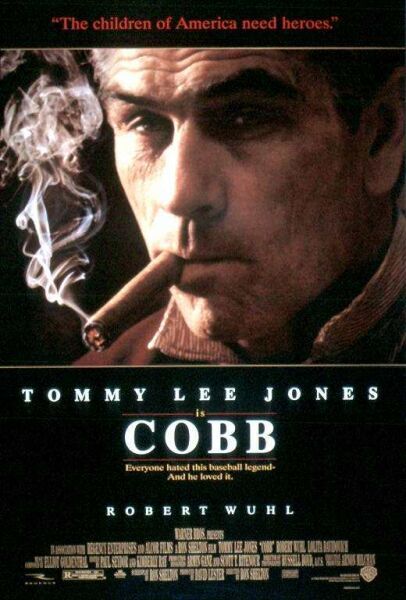
Except for a handful of people, everyone hated Cobb when it was released in 1994. It got savaged by almost every critic and it died a very quick death at the box office, grossing less than $2 million domestic. My dad took me to see it when it played at a local college campus theater during its second run (Trinity College in Hartford, which is still equipped with 70mm projection), and I’ve long been fascinated by its dark edges, its morally compromised center, and its stubborn refusal to play it safe for the biopic genre. Some filmmakers might have tried to soften Ty Cobb’s life story for the sake of potential audience sympathy and empathy, but not writer/director Ron Shelton — he’s too smart for those type of cheap tricks. By almost all accounts, Cobb was a racist, a drunkard, a drug addict, a wife beater, a general all-around asshole who also happened to be one of the greatest baseball players ever to pick up a glove and bat, a man with a ferocious desire to win at all costs, with a dangerous sense of reserve and purpose that outright scared other human beings. Shelton’s rather brilliant creative decision to totally limit the baseball action (you quickly glimpse Cobb on field in a few flashbacks and highlight footage) allowed for a more introspective narrative, thus taking the game out of the man, but never the sense of sport or competition.
Robert Wuhl, as Cobb’s autobiographer Al Stump, and Lolita Davidovich were both excellent in vivid supporting turns, while the production benefited enormously from Russell Boyd’s burnished and elegant lensing and the lived-in production design by Amin Ganz and Scott Ritenour. And then there’s Jones as Cobb, giving one of his greatest performances, unafraid to be unrepentantly nasty, and going for the emotional jugular in almost every single sequence. His fiery back and forth with Wuhl remains volatile all throughout the angry screenplay, providing a unique sense of awkward camaraderie and legendary reverence between subject and author.
Shelton had an absolutely tremendous run of sports films in the 80’s and 90’s, with the classic baseball comedy Bull Durham, the crowd-pleasing yet still subversive blockbuster White Men Can’t Jump, the challenging and unforgiving Cobb, the utterly lovely Tin Cup, and the underrated Play it to the Bone (which would make for a great double feature with Michael Ritchie’s unfairly neglected Diggstown), before moving into the cop genre in the 90’s and 2000’s with the superb Dark Blue, the humorous Hollywood Homicide, and scripting duties on Michael Bay’s at times hallucinatory Bad Boys 2. The Paul Newman political comedy Blaze is a fun and curious offering that found release in 1989. Roger Ebert’s personally conflicted review of Cobb is one of the most interesting pieces that he ever wrote, and is worth checking out.
 Podcasting Them Softly