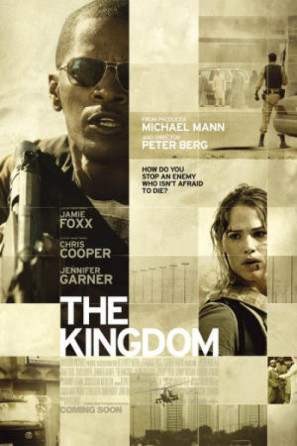
Peter Berg’s thrilling action picture The Kingdom is a ballsy, big-budget production that brings a surprising level of smarts to its relatively predictable and straight forward story. It’s a bummer that this movie didn’t find the theatrical audience it deserved. It’s a tightly focused procedural with solid acting, credible plotting, and shot with an amazingly immediate, semi-chaotic but still coherent visual style that puts you in the middle of the action at all times. The opening credits sequence is a total wowser, dispensing with a ton of information and political backstory during the first five minutes, while the audience is presented with an arresting animated timeline detailing the Unites States’ relationship with the insanely corrupt nation of Saudi Arabia, all stemming from the importance of oil. We’re then plunged right into the middle of a multi-stage terrorist attack on an American housing complex in Saudi Arabia which leaves 100 people dead, many of whom are women and children. Berg didn’t shy away from graphic violence in The Kingdom; rarely do you see a big-budget Hollywood action film that will actually show you on-screen deaths of women and children and innocent bystanders like THE KINGDOM does. Those moments, while shocking, are important. Without them, the filmmakers would be diluting the situation of its impact and realism. Innocent people die when terrorists strike, yet for the most part, Hollywood enjoys its killings bloodless and faceless. Not here. Multiple strikes are coordinated against U.S. interests, the stakes are raised, and it’s time for a response.
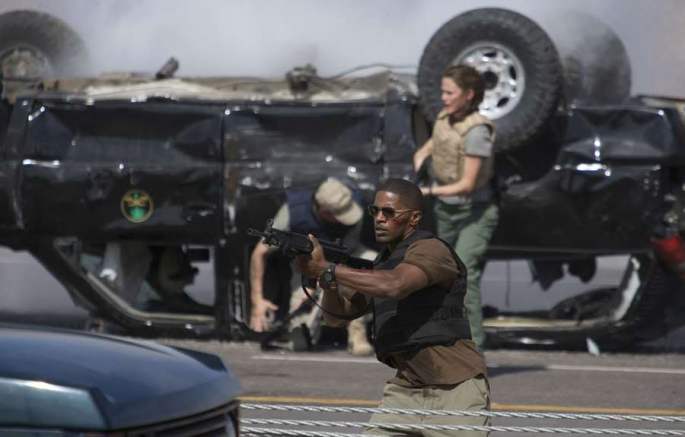
The FBI learns that a few agents were also killed in the attacks so they send Jamie Foxx, playing senior agent Ronald Fleury, and his team to try and apprehend the killers. Chris Cooper, Jennifer Garner, and Jason Bateman make up his squad and each are give more than a few moments to shine. They rendezvous with a sympathetic Saudi policeman named Faris, played by the excellent Ashraf Barhom, who was also fantastic in the supreme (and controversial) political drama Paradise Now, in an effort to gain solid footing. The middle section of the movie resembles a television procedural, but it becomes deeper than that. The relationship that develops between Fleury and Faris is serious and complex, never feeling phony or contrived. These two men are fighting the same fight, and while their backgrounds are different, they are able to agree on what is right and what is wrong. The character shadings that Faris has are important and distinct, and this is where The Kingdom elevates itself over most other action films in the genre. As much as it’s concerned with blowing stuff up real good (and that it does), Berg, and screenwriter Matthew Michael Carnahan, no doubt guided by producer Michael Mann, showcase the frustrations that would accompany an investigation like this. The filmmakers keep the storytelling efficient and coherent, with Foxx in fine form as the commanding officer in charge, and Cooper, as always, giving a sturdy supporting performance as a take no nonsense soldier ready to throw down at a moment’s notice. Garner is also excellent, channeling her role from Alias in some extremely physical fight sequences, and lending the movie a tender heart in a few sequences. And Bateman does his usual self-effacing routine but this time with a machine-gun; he gets all the script’s wisecracks and delivers them in an unforced manner while also getting a chance to flex his action muscles.
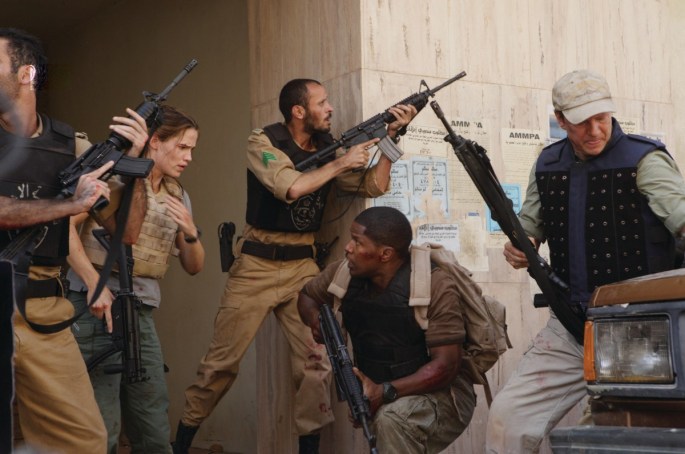
The Kingdom served as Berg’s coming out as a big-time director of action (he’d later go on to direct Hancock, Battleship, and most impressively, Lone Survivor). The last third of The Kingdom, which basically boils down to 30 minute long extended action sequence, is a tour de force of staging, logistics, and pyrotechnics. Beginning with a high speed car chase and highway ambush that evolves into a Black Hawk Down-style urban-combat sequence, Berg never lets the viewer out of his grasp. RPG’s fly all over the place while automatic gun-fire explodes from every direction. Cinematographer Mauro Fiore, who has worked for action vets like Michael Bay on The Island, Jim Cameron on Avatar, and Antoine Fuqua on Training Day and The Equalizer, covers the action at the ground level, heightening every visceral moment for maximum impact. Employing a similar shooting and editing style to that of what Paul Greengrass cultivated with his work on the Bourne franchise and United 93, the restless camera never stops moving and searching, which amps up every sequence. You haven’t seen an SUV flip over like the way you do here. The highly bloody and intimate machine gun violence, reminiscent of the close-quarter shoot-outs in Munich, are pulse-pounding and flinch-inducing. And one sequence, with Garner engaged in hand-to-hand combat with a baddie, is unrelenting in its primal impact. Berg has a feeling for authenticity that’s reminiscent of the works of Mann, and the here-and-now quality of the locations and sets are incredible. But the real coup of the movie are its final moments. The Kingdom ends on a note of surprising darkness and honest reflection; without spoiling anything, you’re reminded that the cycle of violence in our current climate is something that will never end and can’t be easily fixed. It’s a small moment but it adds weight to everything that has come before it.
 Podcasting Them Softly