Night of the Slasher – A Review by Kyle Jonathan

Night of the Slasher

2016.  Directed by Shant Hamassian.
nots2

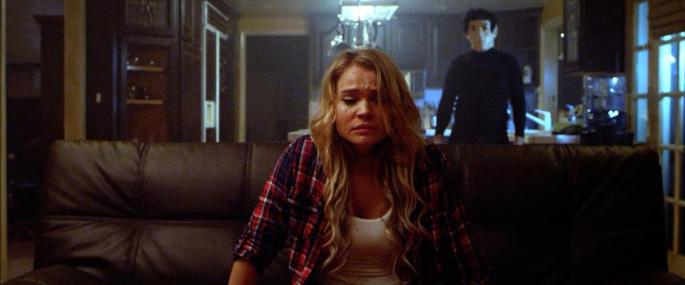
Night of the Slasher is a wickedly sharp homage to the unstoppable killer genre that dominated 80’s American Cinema.  Using a one shot approach and ten minutes and change, Night of the Slasher manages to outshine other masked killer clones with excellent craftsmanship, a surprisingly emotional lead performance, and a script that not only hones in on the essence of stalker horror, but is also a brilliant revision of the Final Girl concept.

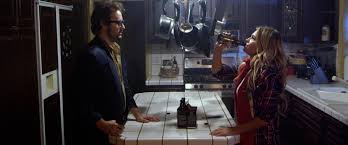
Teenager Jenelle begins her night by dancing, half naked and alone in her house.  She then embarks on a metaphysical checklist, engaging in various risque activities, each of which is an ingredient used to summon a relentless manifestation of slasher flick villainy.  Using her suicidal bravado and quick thinking, Jenelle confronts her tormentor in a desperate showdown, hoping to break free from a prison of cliches.
download

Eli Tahan’s jittery cinematography captures the entire film with the appearance of one continuous take, abandoning traditionally slow transitions by rapidly moving the camera between different vantage points, deftly following Jenelle’s panic stricken point of view while perfectly harmonizing with Simon Michel’s synth infused score.  Using what is absent from the viewer’s perspective, Hamassian’s editing gives the killer an ethereal quality as he seems to vanish into thin air and then reappears just as suddenly, charmingly emulating the quasi-mystical attributes of prolific 80’s boogeymen.  Hamassian’s script has virtually no dialogue, relying on the outstanding body work of Lily Berlina as Jenelle and Adam Lesar as The Killer.

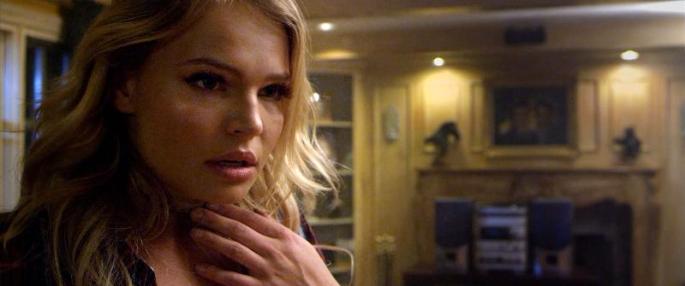
While Berlina’s physical work is outstanding, her approach to the subject matter is remarkably original.  Her Jenelle has been brutally victimized, but she has no interest in being a victim.  She is adroitly aware of her predicament, and rather than surrender to hopeless platitudes or sexual exploitation, she grabs the horror conventions by the throat and viciously fights back, furiously taking control of a destiny that has classically been a foregone conclusion.
nots_lily_berlina_still

The entirety of Night of the Slasher could play as the intro to a longer film, except Hamassian has a more devious goal, completely obliterating tradition and giving the viewer just enough to whet their appetite.  The conclusion comes abruptly, and there’s a telling look by one of the characters that is shockingly resonant, a perfect summation for an ultimate love letter to the genre, featuring an outstanding choice for The Killer’s mask that will have Carpenter fans cheering in their seats.

Available now on Vimeo, Night of the Slasher is now eligible for an Academy Award nomination for Best Short Film.  By Using every possible second to maintain a tense atmosphere, portraying its female protagonist as aggressively competent, and through the use of a wonderfully original approach, Night of the Slasher is essential viewing for horror fans.  Even if horror is not your preferred genre, fans of creative approaches to tired subject matter will find something to marvel at in this bravely self aware renegade.

Highly Recommend.
night-of-the-slasher-banner

Suture – A Review by Kyle Jonathan

Suture

1993.  Directed by Scott McGehee & David Siegel.

MBDSUTU EC006

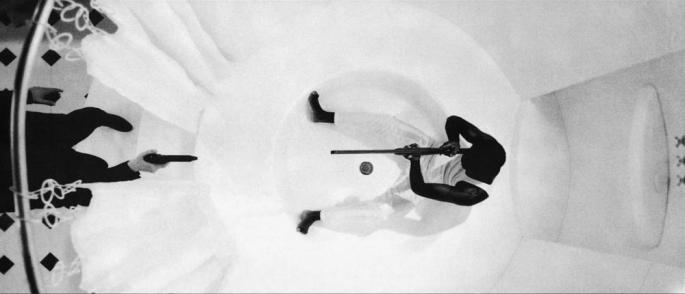
A minimalist neo noir that flirts with the morality of memory, Suture is a black and white psychological thriller that separates the classical archetypes of good and evil through the use of color.  From afar, Suture plays like an art house piece on identity and racial consciousness, however, its spartan atmosphere uses the representations of colors to subvert these concepts, delivering a cyclical story on the nature of consciousness.

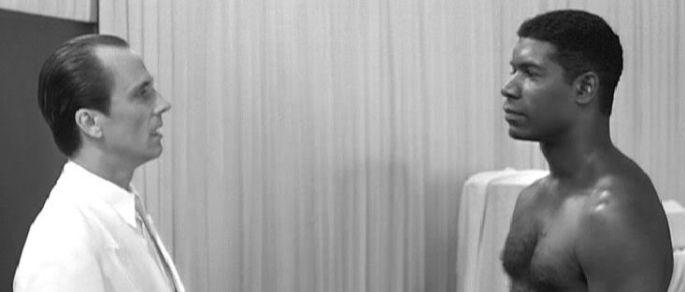
Clay is a blue collar worker who is invited to visit with his half brother, Vincent, after the murder of their father.  The two brothers are nearly identical, and Vincent uses this to his advantage, faking his own death by blowing up his car while Clay is driving and ensuring that Clay is identified as him.  Clay miraculously survives the explosion, but with amnesia.  He begins to undergo rigorous psychological treatment while the police clamor for explanations into the father’s death.  As Clay slowly begins to understand his predicament, he falls in love with one of his therapists and Terence returns to the family’s palatial estate, looking to silence Clay once and for all.

suture-haysbert

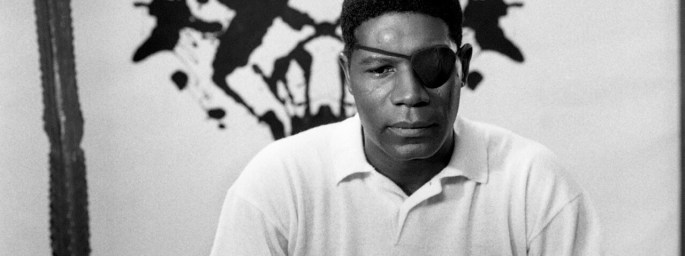
Dennis Haysbert stars as Clay, while Michael Harris portrays Terence.  The directors chose to use a black actor for Clay and a white actor for Terence, making the entire narrative design appear to be a statement on race, but as the story unfolds, it becomes clear that this was done to set the two characters completely apart.  Aside from the last few lines, most of the story remains grounded in Clay’s ordeal with him instantly accepting his new persona while slowly beginning to realize that something is wrong.  This is a slick film that takes great pains with stylistic choices, valuing cool aesthetics in place of depth.  There are several uncomfortably hilarious scenes, with Clay being the only black man in a lineup taking the crown.  Suture knows exactly what it is doing, and its constant decision to stay focused on the mystery rather than the social implications is what makes it work.

Mette Hansen’s costume design is pivotal.  Clay, begins in a flannel and denim, but as he accepts his role as Terence, he switches to crisp white suits, fully symbolizing his true nature.  Terence abandons the white garb in the final sequence, opting for coal black attire that mimics his heart.  The attention to detail shines in virtually every scene, with Greg Gardiner’s blissful cinematography winning top honors at Sundance, capturing the action with Hitchockian emulation.  There are gorgeous wide shots of mysterious Arizona buildings, one of which is an abandoned bank, brilliantly decorated by Nancy Wenz to appear as a lonely stronghold of decadence.

suture1

Steven Soderbergh viewed an early cut and came on board as an executive producer.  McGehee and Siegel’s outstanding script pilfers from Frakenheimer and Teshigahara casually evoking deeper concepts but never fully committing.  This is a noir film, through and through, and it’s this conceit that is perhaps the film’s greatest weakness.  The racially motivated casting is purely to create division between “hero” and villain.

Available now on an outstanding blu ray transfer from Arrow Video, Suture is a unique independent thriller.  Taking an overdone premise and using color to visually remodel the Cain and Abel parable into a slick neo noir that brims with attitude.  If you’re looking for something unique that doesn’t overshadow it’s story with deafening symbolism, Suture is an excellent choice.

Recommend.

images

Taxi Driver – A Review by Kyle Jonathan

Taxi Driver

1976.  Directed by Martin Scorsese.

taxi-driver-1976-film-rcm762x429u

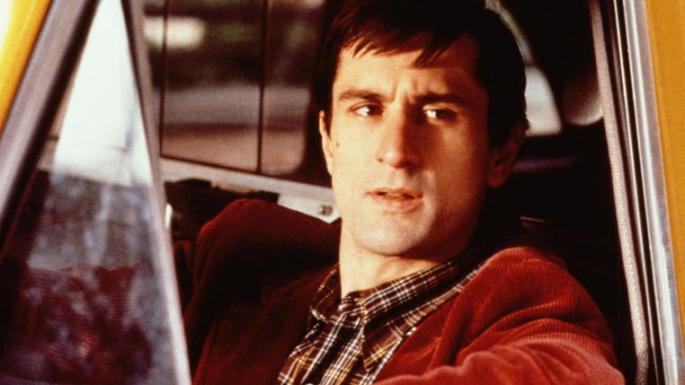
A cinematic journey into an urban purgatory, Scorsese’s masterpiece Taxi Driver is not only one of the most influential American films in history, but also continues to be one of the most artistically important movies ever created.   Using the concepts of mental illness and post Vietnam paranoia, Taxi Driver unequivocally presents a salient exploration of the lone gunmen mythology that continues to remain disturbingly relevant 40 years later.

Travis Bickle is a veteran who suffers from depression and insomnia.  He takes a job as a cab driver, working endless night shifts on the haunted streets of New York, traversing even the most dangerous neighborhoods.  Travis becomes enamored with a political operative working on a presidential campaign, however the relationship rapidly erodes due to Travis’s odd predilections.  In the wake of his emotional distress, Travis begins to plot the assassination of the presidential hopeful, while simultaneously trying to liberate a child prostitute from the clutches of the street, hurtling him towards one of the most brutally iconic climaxes in history.

images

Winning the coveted Palm d’Or at Cannes, the film’s brooding script was penned by the legendary Paul Schrader.  Using Travis’s disjointed voice overs to narrate his descent into madness, Taxi Driver has a devilish quality, ruthlessly critiquing societal mores with a blistering cacophony of senseless monologues, whose uncomfortable notions slowly evolve, matching Travis’s mental undoing with verbal harmony.  All of the characters that exist in Travis’s orbit are shadows, petty dispensers of street curb wisdom, tainted Madonnas, and suits full of empty promises.  Each interaction, including an unforgettable cameo by Scorsese himself, is a dangerous escalation, slowly moving Travis closer to his murderous finality.

Michael Chapman’s cinematography captures the cigarette stained locales of a fallen New York with diabolic neon reds and lonely blues and greens.  This is a film that wears the heart’s blood of the Big Apple on it’s soiled Army jacket sleeve, eloquently capturing the symbiosis of a festering inner city with the privileged echelons that trample upon it.  The bulk of the shots are from the interior of the taxi, mimicking Travis’s longing to be part of a world he holds in contempt because he doesn’t understand it.  The infamous tracking shot (which took several months to complete) uses an overhead point of view to present the aftermath of the finale as an out of body experience, further enhancing the often debated conclusion.

hero_eb20040101reviews08401010364ar

Using a vicious conflagration of primal instinct and last ditch endearment, De Niro creates a living urban legend in the performance of a lifetime as Travis.  Within minutes, you know how the story will most likely end, but De Niro’s formidable incarnation of the troubled outsider garners a tenuous empathetic relationship with the viewer.  You care, but are always questioning why and this the definition of acting.  The famous “You talkin’ to me?” line is so powerful because of the way De Niro wields it, challenging the viewer to accept Travis’s deadly plea for attention, a flawless interpretation of the character’s wounded soul.  Jodie Foster’s virginal Iris is a poisoned breath of fresh air, portraying an all too real child casualty of the unforgiving metropolis.  Her role was so controversial that she was required to undergo a psychological evaluation prior to accepting the part to ensure she was mentally capable.  Both De Niro and Foster would go on to be nominated for Academy Awards.

Peter Boyle gives a broken fortune cookie turn as Wizard, the cabbie veteran whose counsel for Travis is ill advised and perfectly simulates the false concern of bandwagon camaraderie.  Harvey Keitel spent time with an actual pimp in preparation for his portrayal of Matthew, and his handful of scenes are masterfully woven into the story to ironically give Travis’s ire a legitimate target.  Bernard Herrmann’s saxophone laced score is the fallen Angel on Travis’s shoulder, taking what would conventionally be a jazz infused New York love note and subverting it to display a false grandeur, fully encompassing Scorsese’s vision of a tarnished and counterfeit American dream.  Herrmann’s work was also nominated for an Oscar.

10244015_ori

Scorcese’s direction is the epitome of control.  The entirety of Taxi Driver could easily be construed as a fever dream, but even the most expansive parts of Travis’s litany of hate remain grounded in the nocturnal underbelly of New York, with each street representing an infected vein feeding into a rotting heart.  Scorsese’s ability to take a deceptively simple premise and produce an atmospheric chamber piece in which the prison is a city without limits is a one of kind experience.  There have been many films about vengeful outcasts, but none have managed to capture the unrelenting darkness of the mind quite like Taxi Driver, a feat made possible by Scorsese’s mastery of the malign.

Available now for digital rental, Taxi Driver is an essential American film that uses the mental disarray of a lone wolf as an expose’ on a fractured, post war America.  From the way veteran’s were casually discarded to the political distrust that gripped the nation, Taxi Driver depicts a plausible Hell on Earth in which the devil is not only very real, but nihilistic and motivated, a concept that continues to remain frighteningly realistic to this day.

Highly.  Highly. Recommend.

taxi-driver-movie-screencaps-com-17

Speed Racer – A Review by Kyle Jonathan


sracer_trailer4

Speed Racer

2008.  Directed by Lilly & Lana Wachowski.

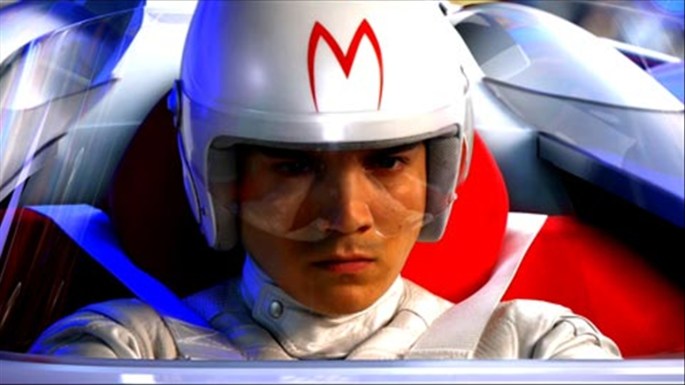
A bacchanal of cheesy excess, the Wachowski’s Speed Racer is a unique incarnation of the family film, bringing the eponymous anime serial to life.  Featuring the directors’s patented theme of artistic rebellion against authoritative control, Speed Racer also delivers a blitzkrieg of CGI visuals and a heartwarming story about familial love conquering all.

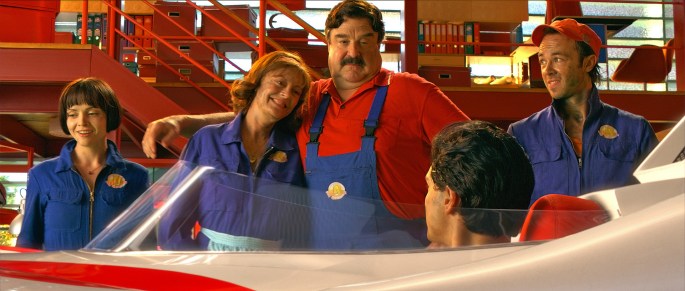
Speed is an 18 year old racing prodigy, living in the shadow of his brother Rex who died on the track.  He races for his family’s independently owned company, valuing his personal tribe and the art of racing over fortune and fame.  Speed is approached by Royalton, CEO of a mega corporation, and offered the contract of a lifetime.  After he rejects the offer, Royalton retaliates by placing a bounty on Speed’s head, one that other drivers are eager to collect.  Speed finds an ally in another independent racing company who asks him for help in The Crucible, the circuit’s most notorious race, in order to ensure that their company will not be consumed by Royalton’s empire.  Things become further complicated when Speed is joined by Inspector Detector and the mysterious Racer X, a crime fighting duo who are desperate to put an end to Royalton’s schemes once and for all.

speed_racer__span

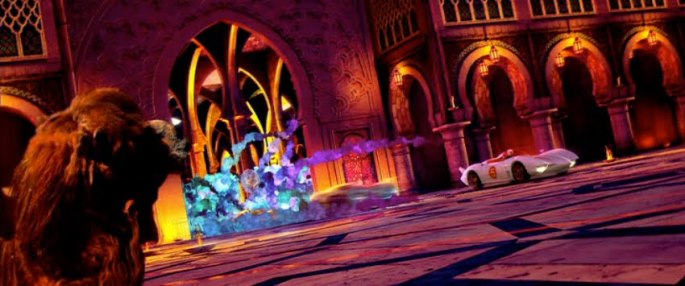
The film took 60 days to shoot entirely on green screen.  David Tattersall’s trippy cinematography captures the the cartoonish action in an explosion of neon.  The framing is all over the place, with the backgrounds melding with the characters to optically dazzle and confuse whenever the cars are engaged in vehicular combat. Kym Barrett’s costume designs are flawless reproductions from the show, while Hugh Bateup’s art direction recreates not only iconic scenes, but double’s down on the outright insanity of the visual acrobatics.  Stephanie Fowler’s makeup has a synthetic quality, allowing each character to mimic their animated counterparts with frightening accuracy, a quality that takes some time getting used to.

The turbulent editing during the race scenes captures the CGI mayhem with a lightning cadence, doubling down on Speed Racer’s relentless visual assault.  The action is mostly harmless, with peril never being a factor, but that is part of the charm.  The technical gadgetry of the race cars has a neo steampunk feel that is one of the many intriguing aspects of the world Speed Racer creates.  Despite the epic run time, many details of the actual universe in which the saga takes place are sadly never explored, using the bulk of the narrative to focus on the contests and the internal struggles of Speed’s family.

Speed Racer

The Wachowski’s script has a infectious B movie vibe that replaces traditional acting with ludicrous pantomiming.  Every cast member is playing a preconceived role with virtually no freedom to explore the depths of their characters. However, this is not so much a weakness as it is a testament to the directorial vision.  The idea was to make a living cartoon and the result is exactly that, complete with the logical flaws that accompany an animated universe.  Roger Allam as Royalton chews up the excessive scenery by portraying his character as a walking symbol of corporate greed.  Matthew Fox gives a surprisingly good performance as the tough guy Racer X and it’s his story line that elevates the entire affair above the endless clones of family films.  Speed Racer has a lot to say when it gives the time to think on its themes of family and artistic freedom, but these moments are few and far between.

Ultimately, this an overlong confusing mess of a film that is a perfect representation of the Wachowski’s volume of work.  They consistently pick interesting concepts that, if accomplished, would completely change the game with respect to the medium.  Like Cloud Atlas, this is one of the most unique cinematic experiences out there, offering of the first attempts at creating a live action film that is a complete copy of its predecessor.   Sometimes, too much, is too much, and the film suffers as a result, collapsing in the final leg of it’s bloated story line.  Despite these concessions, witnessing this film for the first time is truly an unforgettable experience.

speed-racer-4
Available now for digital rental, Speed Racer uses a painfully loyal adaptation as a means to once again allow the Wachowski’s to saber rattle against authority, while also presenting a touching story about the sacrifices we all make for our families.  A one of kind visual delight, Speed Racer is a flawed, but poignantly resplendent experiment that succeeds far more than it fails.

Recommend.

speedracerlogo