OCEAN’S ELEVEN – A REVIEW BY J.D. LAFRANCE

o11DVD33

“Ocean’s Eleven was my opportunity to make a movie that has no desire except to give you pleasure, where you surrender without embarrassment or regret.” – Steven Soderbergh

Fresh from the one-two success of Erin Brockovich (2000) and Traffic (2000), Steven Soderbergh made a conscious decision to shift gears and make a purely entertaining film for a major studio. He managed to convince movie stars George Clooney (whom he had already worked with on Out of Sight) and Brad Pitt to take major cuts in their multi-million dollar salaries and headline a remake of the Rat Pack heist film Ocean’s Eleven (1960). With Clooney and Pitt on board, Soderbergh was then able to get an impressive cast including the likes of Matt Damon and Julia Roberts (both of whom also agreed to take pay cuts) and avoid having his film come across as nothing more than a vanity project for a bunch of smug movie stars. On the contrary, Ocean’s Eleven (2001) is a slick heist film in the tradition of The Sting (1973) in the sense that you know the outcome (the good guys win) but the fun is in how they get there as Soderbergh utilizes every stylish technique that he has available at his disposal.

Daniel Ocean (Clooney) has just been released from prison and is eager to return to his high-end criminal enterprises. He sets his sights on Las Vegas with plans to rob three prestigious casinos: the MGM Grand, the Mirage, and the Bellagio, all of which keep their considerable sums of money in an ultra-secure hi-tech vault controlled by Terry Benedict (Andy Garcia) who, incidentally, is currently dating Danny’s ex-wife Tess (Roberts). It’s not going to be easy and so, with the help of his good friend and ace fixer Rusty Ryan (Pitt), they recruit nine experts to help them pull off a near-impossible heist. In addition to the heist, which serves as the main plot, Ted Griffin’s screenplay expertly weaves in a subplot involving Danny attempt to reconnect with Tess.

This film oozes cool right from the opening credits that play over a fantastic shot of the Atlantic City skyline at night accompanied by funky trip-hop type music by Northern Irish disc jockey David Holmes. We meet Rusty wasting his time teaching young movie stars (Holly Marie Combs and Topher Grace among others making fun of themselves) to play cards. We meet him in Hollywood with a cool groove playing over his establishing shot. This sequence is a bit of meta fun as we see Pitt, one of the biggest movie stars on the planet, teaching other movie stars playing a parody of themselves being totally clueless at playing poker only to eventually be hustled by a bemused Danny. Soderbergh even slides in a few sly inside jokes, like Danny asking Topher Grace if it’s hard to make the transition from television to film, which, of course, is exactly what Clooney did. Or, how Grace gets mobbed by autograph hounds while Clooney and Pitt are completely ignored.

One of the best sequences in the film is when Danny and Rusty recruit their crew. The scene where they convince Reuben Tishkoff (Elliott Gould) to bankroll their operation is a wonderful example of how expositional dialogue being delivered in the right way by the right actor can be entertaining and informative as Elliott Gould does a fantastic job of warning Danny and Rusty of just how dangerous Benedict is. From there, each character that Danny and Rusty approach is given their own introduction that briefly and succinctly highlights their unique skill and distinctive personality traits. Linus Caldwell (Damon) is an up-and-coming pickpocket with uncanny dexterity. There’s the Malloy brothers, Virgil (Casey Affleck) and Turk (Scott Caan), two drivers by trade with one of them having an affinity for remote controlled devices and a perchance for bickering and irritating each other, which provides a good source of humor. Livingston Dell (Eddie Jemison) is an electronics expert in the area of surveillance. Basher Tarr (Don Cheadle) is a demolitions expert with Don Cheadle sporting an obviously exaggerated Cockney accent. Yen (Shaobo Qin) is a diminutive top-of-the-line acrobat that can get in and out of any tight space. Finally, there is Saul Bloom (Carl Reiner), a retired flimflam man coaxed back into action by Rusty. Each actor is given at least one scene, often more, to come front and center and do their thing and this is done in a way that doesn’t distract you from the story at hand, which is quite an accomplishment with such a large cast.

David Holmes expertly mixes jazz, funk, soul and hip hop in a way that evokes groovy trip hop or acid jazz but in a retro way that evokes Quincy Jones circa the 1970s. The often-fat bass lines give certain musical cues a confident swagger. There is also plenty of Hammond organ and vibraphone looped to give a lounge-y kind of vibe at times. Later on in the film, Holmes brings in strings and brass to accentuate the romantic subplot between Danny and Tess. Holmes also incorporates songs, like Elvis Presley’s “A Little Less Conversation” to fantastic effect. This came out of watching the original Ocean’s Eleven as Holmes explained in an interview, “Then I tried to think of ways to identify with what was going on – with it being a contemporary film, how to be original, but set within the heart of Las Vegas. Which is where the Elvis song ‘A Little Less Conversation’ came about, because obviously Elvis had a really strong affiliation with Las Vegas, and that track has a very contemporary feel.”

Steven Soderbergh read Ted Griffin’s screenplay in an afternoon in January 2000. The next day he called producer Jerry Weintraub and told him he wanted to direct the film. What he liked about the script was that it didn’t evoke the original 1960 version but “had this one foot back in the heyday of the studio star-driven movie, like Howard Hawks or George Cukor.” Soderbergh had always been drawn to heist films because, “the conflicts are so clear and dramatic. This seemed to be everything that you want a big Hollywood film to be, on the script level.” He had just made two dramas – Erin Brockovich and Traffic – and wanted to make a fun movie. To prepare for shooting Ocean’s Eleven, he watched Ghostbusters (1984) because he was impressed at “that sort of physical scale [that] feels so tossed-off, with such understated performances and obvious generosity among all the performers.” He also studied films by David Fincher, Steven Spielberg and John McTiernan because they knew how to “orchestrate physical action the way I like to see it.” He looked at how these filmmakers used lens length and height, camera movement and editing, as well as, “how they used their extras, how they structured movements within shots that carried you to the next movement and the next.”

Soderbergh got George Clooney involved and half-jokingly told him, “let’s make it an Irwin Allen movie, where they used to have 10 stars.” Originally, the director considered casting Luke and Owen Wilson, Bruce Willis, and Ralph Fiennes as the villain. Once Clooney was on board, they got the rest of the cast to commit at radically reduced rates, starting with Brad Pitt. However, during filming, the cast stayed in their own 7,000-square-foot villas at the Bellagio. Before shooting, Soderbergh told his cast, “Show up ready to work. If you think you’re just going to walk through this, you’re mistaken. If anybody gets smug, we’re dead.” Soderbergh wanted to shoot in the Bellagio, the MGM Grand and the Mirage – an impossible feat for more mere mortals; however, Weintraub had the connections and the clout to make it happen. The production was allowed to shoot on the floor of the casinos during the day, which nobody is given access to and the casino bosses even shut down entire pits for Soderbergh to shoot in. This allowed the director to design shots that were complicated and large in scale.

Soderbergh wanted the lighting for Ocean’s Eleven to be based in reality and to look like it wasn’t lit at all – not a problem in Las Vegas, a place overloaded with every kind of light imaginable. At times, Soderbergh would add some color to enhance the mood for dramatic purposes in order to put the audience inside the world of the film. He also realized that the locations played a large part in the plot and was interested in showing as much of the environment as possible. One challenge Soderbergh faced was the logistics of filming big dialogue scenes with Danny and his crew in a visually interested way. He had a lot of people in confined spaces and didn’t want these scenes to be boring. So, he attempted to frame shots that clearly established where everyone was while also giving them enough depth and geometry to make the characters interesting to look at.

In a nice touch, Ocean’s Eleven never waxes nostalgic about the original film but instead is wistful about Las Vegas as it was in the 1960s when the casinos were still run by the Mob and had yet to be corporatized and Disney-fied. This is reinforced in one of the motivations Danny has of robbing Benedict. It’s not just that he’s dating his ex-wife but Benedict also recently demolished one of the last old school casinos left in Vegas. Unlike Benedict, Danny respects the past and recruits Reuben and Saul, veteran con artists whose heyday was the ‘60s. It’s great to see Soderbergh giving actors like Gould and Reiner screen-time in a major studio film. These guys don’t work nearly enough and their performances in Ocean’s Eleven are a potent reminder of how good they can be if given the right material and the opportunity. Entrusted with only his second major studio film with an A-list budget, Soderbergh effortlessly orchestrates a fun, engaging popcorn movie like an old pro that has been doing this for their entire career.
TRAINSPOTTING – A REVIEW BY J.D. LAFRANCE

00-32-14

Trainspotting flew out of the gates in 1996 and took the world by storm, first causing a sensation in the United Kingdom, and then moving on to the United States bolstered by a soundtrack that mixed classic rockers (Lou Reed, Iggy Pop) with contemporary ones (Blur, Primal Scream). Audiences couldn’t get enough of this gritty, often funny, sometimes harrowing tale of Scottish heroin addicts. Based on Irvine Welsh’s edgy cult novel of the same name, Trainspotting was adapted by a trio of filmmakers – director Danny Boyle, screenwriter John Hodge and producer Andrew Macdonald – who had previously collaborated on the nasty suspense thriller Shallow Grave (1994).

They chose just the right passages from the novel and proceeded to capture the spirit of what Welsh was trying to say without judging the characters. This resulted in the film getting into trouble as some critics felt it glorified drug addiction. The film takes an unflinching look at the lives of a group of drug addicts and shows why they do drugs — the highs are so unbelievably amazing. However, Trainspotting also shows the flip side: death, poverty and desperation, which lead to stealing, lying and cheating just to get more drugs. Regardless, the film was a commercial and critical success, spawning all sorts of imitators and influencing countless other U.K. filmmakers to go through the door that it kicked open.

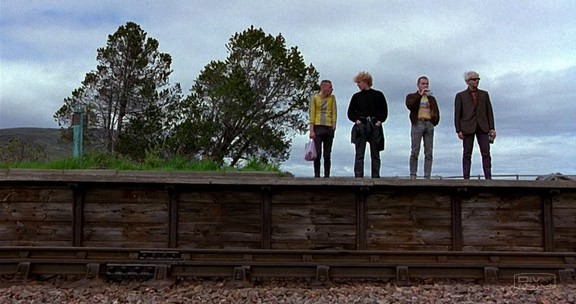
The six-minute prologue does a brilliant job of introducing a group of Scottish drug addicts as seen through the eyes of one of them — Mark “Rent Boy” Renton (Ewan McGregor). His friends include a speed freak motormouth named Daniel “Spud” Murphy (Ewen Bremner), a suave ladies’ man, Simon “Sick Boy” Williamson (Jonny Lee Miller), straight-edged Tommy MacKenzie (Kevin McKidd) and sociopath Francis “Franco” Begbie (Robert Carlyle). Each one of them has their own distinct personality that each actor vividly brings to life. This prologue also sets the tone for the rest of the film as it starts literally on the run with Renton and Spud being chased by the cops to the pounding strains of “Lust for Life” by Iggy Pop (before it became overused thanks to countless commercials using it bizarrely out of context) as Renton’s voiceover narration talks about his “sincere and truthful junk habit.”

The energetic camerawork — fasting moving tracking shots (that recall Mean Streets) as Spud and Renton run from the police and the freeze frames (reminiscent of GoodFellas) with title cards identifying each character is an obvious stylistic homage to Martin Scorsese. Like many of his films, Trainspotting is bursting at the seams with energy and vitality that is very engaging. The prologue does its job by immediately grabbing our attention and drawing us into this world populated by colorful characters. After 30 minutes of showing the incredible highs of shooting heroin where we’re caught up in the euphoria of it with Renton and his friends, director Danny Boyle starts to show the ugly side, starting with the death of fellow junkie Allison’s baby due to neglect.

From there, Renton and Spud get arrested for stealing with the former going into a rehab program while the latter goes to jail but not before Renton takes one more hit and promptly overdoses in a surreal bit where he sinks into the floor and is taken to the hospital by taxi seen mostly from his zonked out point-of-view to the strains of “Perfect Day” by Lou Reed. However, Trainspotting’s heart of darkness is the sequence where Renton goes through the horrors of withdrawal and his reality becomes warped by hallucinations of Allison’s dead baby and his friends. Ewan McGregor really does a fantastic job of conveying Renton in the depths of a painful and terrifying withdrawal.

John Hodge’s screenplay masterfully distills Welsh’s novel to its essence and includes some of its most memorable dialogue. From Renton’s famous “Choose life” monologue (“Choose life … But why would I want to do a thing like that? I chose not to choose life: I chose something else. And the reasons? There are no reasons. Who needs reasons when you’ve got heroin?”) to Sick Boy’s “Unifying Theory of Life” speech (“Well, at one time, you’ve got it, and then you lose it, and it’s gone forever.”), Trainspotting has insanely quotable lines. This helped it develop a loyal cult following over the years that continues to champion the film even to this day. And yet what resonates most is its honesty. The film doesn’t sugarcoat its message and it isn’t preachy about it either. There is an ironic detachment that transforms it into a playful black comedy mixed with gritty drama and surreal sequences.

It doesn’t hurt that this excellent material is brought to life by a fantastic cast of then relative unknowns (especially to North American audiences). Ewan McGregor has the toughest role in the film playing an unrepentant junkie while also acting as the anchor that the audience identifies with and the character that the rest of the cast revolves around. It is a tricky balancing act because Renton does things that make him unlikable and yet we still root for him because of McGregor’s charisma. Fresh from his role as an American computer user in Hackers (1995), Jonny Lee Miller plays Sick Boy, Renton’s best mate but someone who lacks “moral fiber” despite his vast knowledge of Sean Connery. He ends up taking advantage of his friend in a dodgy scheme and Miller does a nice of showing how Sick Boy went from best mate to scheming con man.

Robert Carlyle is also great as the completely unhinged Begbie. The scene where he recounts a colorful story about playing pool (“I’m playing like Paul-Fuckin’-Newman by the way.”) and dealing with his cocky opponent (“You ken me, I’m not the type of cunt that goes looking for fuckin’ bother, like, but at the end of the day I’m the cunt with a pool cue and he can get the fat end in his puss any time he fucking wanted like.”) perfectly captures the essence of his character. Begbie gets his kicks from starting up trouble. As Renton puts it, “Begbie didn’t do drugs either. He just did people. That’s what he got off on; his own sensory addiction.” Carlyle has a frightening intensity and an unpredictability that is unsettling and exciting to watch. Ewen Bremner completes the core group of characters as the not-too bright Spud. He has a good scene early on when, hopped up on speed, he goes to a job interview with the notion of sabotaging it without appearing to. It’s a tricky tightrope that Bremner handles expertly.

Trainspotting also features one of the best contemporary soundtracks with an eclectic mix of British music from the likes of Primal Scream, New Order, Blur and Underworld, and from America, Iggy Pop and Lou Reed. The music veers back and forth from the adrenaline-rush of Iggy Pop’s “Lust for Life” to the faux spy music by Primal Scream to the drugged-out mellow mood music of “Perfect Day” by Lou Reed. Taking a page out of Scorsese’s book, the filmmakers use the music as signposts by conveying the transition of guitar-driven rock in the 1980s to the acid house music scene in the 1990s.

Producer Andrew Macdonald first read Irvine Welsh’s novel Trainspotting on a plane in December 1993 and felt that it could be made into a film. He turned it on to his filmmaking partners, director Danny Boyle and screenwriter John Hodge in February 1994. Boyle was excited by its potential to be the “most energetic film you’ve ever seen – about something that ultimately ends up in purgatory or worse.” He convinced Welsh to let them option the rights to his book by writing a letter stating that Hodge and Macdonald were “the two most important Scotsmen since Kenny Dalglish and Alex Ferguson.” (legendary European football player and manager, respectively, from Scotland) Welsh remembered that most people interested in optioning his book, “wanted to make a po-faced piece of social realism like Christiane F or The Basketball Diaries.” He was impressed that Boyle and his partners wanted everyone to see the film and “not just the arthouse audience.” Welsh agreed to sell the rights to them.

In October 1994, Boyle, Hodge and Macdonald spent a lot of time discussing which chapters of the book would and would not translate onto film. Hodge adapted the novel, finishing a first draft by December, while Macdonald secured financing from Channel 4, a British television station known for funding independent films. According to the screenwriter, his goal was to “produce a screenplay which would seem to have a beginning, a middle and an end, would last 90 minutes and would convey at least some of the spirit and the content of the book.”

Pre-production on Trainspotting began in April 1995. When it came to casting the pivotal role of Mark Renton, Boyle wanted somebody who had the quality “Michael Caine’s got in Alfie and Malcolm McDowell’s got in A Clockwork Orange”: a repulsive character with charm “that makes you feel deeply ambiguous about what he’s doing.” Boyle and Macdonald were impressed with the performance Ewan McGregor had given in their previous film, Shallow Grave, and cast him in advance. Ewen Bremner had actually played Renton in the stage adaptation but agreed to play the role of Spud because he felt “that these characters were part of my heritage.” Boyle had heard about Jonny Lee Miller playing an American in Hackers and was impressed with him when he auditioned by doing a Sean Connery accent. For the role of Begbie, Boyle thought about casting Christopher Eccleston who had been in Shallow Grave but asked Robert Carlyle instead. The actor said, “I’ve met loads of Begbies in my time. Wander round Glasgow on Saturday night and you’ve a good chance of running into Begbie.”

Once cast, Ewan McGregor shaved his head and lost 26 pounds. To research the role, the actor actually considered taking heroin but the more he read and learned about it, the less he wanted to do it. Then, he went to Glasgow and met people from the Carlton Athletic Recovery Group, an organization of recovering heroin addicts. He (and several other cast members) took classes on how to cook up a shot of drugs using glucose powder.

With a budget of $2.5 million, Trainspotting was shot during the summer of 1995 over seven weeks. The cast and crew moved into an abandoned cigarette factory in Glasgow. Due to the rather small budget and limited shooting schedule, most scenes were shot in one take with the effects done practically. For example, when Renton sank into the floor after overdosing on heroin, the crew built a platform above a trap door and lowered actor McGregor down.

When Trainspotting was shown out-of-competition at the 1996 Cannes Film Festival, it received a standing ovation. Once Miramax Films picked it up for North America, Macdonald worked with them to sell the film as a British answer to Pulp Fiction (1994), flooding the market with postcards, posters, books, soundtrack albums, and a revamped music video for Iggy Pop’s’ “Lust for Life” directed by Boyle.

Trainspotting has aged surprisingly well considering it was one of those zeitgeist-defining movies of the ‘90s. It also set the tone and style of later British exports, opening the floodgates for films like the nasty crime drama Twin Town (1997), the hyperactive rave culture comedy Human Traffic (1999) and the films of Guy Ritchie. In an interview for The Guardian, Boyle said, “Has it dated? I can’t tell you that. I am alarmed sometimes by how young the people are who say they’ve seen and loved Trainspotting, so it might have lost an edge it once had. Shallow Grave looks dated, fashion-wise, but Trainspotting has an abiding style.”

THE ABYSS – A REVIEW BY J.D. LAFRANCE

abyss07

The more times I see The Abyss (1989), the more I am convinced that it is James Cameron’s best film to date. Wedged between megahits, Aliens (1988), and Terminator 2: Judgment Day (1991), The Abyss was unfortunately lost in the shuffle. This may also have been due to the flood of leaky underwater films like Leviathan (1989) and Deep Star Six (1989) that were released around the same time. Even though The Abyss came out after these financial and critical failures, it was dismissed by most critics as yet another underwater disaster. Most reviewers were clearly tired of this string of underwater themed films and assumed that Cameron’s motion picture was no better than the rest. However, this is simply not the case with The Abyss, which, like many of Cameron’s films, is filled with stunning visuals, a strong ensemble cast, and a solid story that is never sacrificed at the expense of the movie’s special effects.

As the film opens, a United States nuclear submarine is accidentally sunk by a mysterious, unidentified source under 2,000 feet of water off the coast of Cuba. Nearby, a corporate owned underwater oil-drilling rig commandeered by Virgil “Bud” Brigman (Ed Harris) is subsequently ordered to aid a group of Navy SEALs, led by the no-nonsense Lt. Coffey (Michael Biehn), to salvage the downed sub and search for survivors, if any. To make the situation even more interesting is the surprise arrival of Bud’s soon-to-be ex-wife, Liz (Mary Elizabeth Mastrantonio), who designed the rig and rejoins the crew to ensure that everything goes smoothly. As the mission progresses, a storm rages topside causing many problems for the rig and its crew. Add to this the growing tensions of nearby U.S. and Russian naval fleets and you have a potentially volatile situation. But this is only the beginning of a string of dilemmas that beset Bud and his cohorts who gradually realize that there is something else down there with them, and it may not be human.

The Abyss
was a project that James Cameron had dreamed of making ever since he was 17 years old. He wrote a “very, very crude and simple story dealing with the idea of being in the very deep ocean and doing fluid breathing and making a descent to the bottom from a staging submersible laboratory that was on the edge.” His original short story concerned the adventures of a group of scientists in a laboratory at the bottom of the ocean, “which is the sort of sci-fi idea that appeals to all kids, I suppose,” he said. Over the years, Cameron became involved in numerous other projects but he never forgot about this underwater adventure and wrote several drafts that changed radically over time but the original idea that started it all remained intact. When Terminator (1984) and Aliens became bonafide box office hits, Cameron was in a position to make his dream project a reality. He had no idea the problems that he would face trying to realize this dream.

The bulk of The Abyss was shot in and around Gaffney, South Carolina. At first, this seems like a rather unlikely place to shoot an underwater epic, but it turned out to be the best place after their decision to shoot on-location became unrealistic. Cameron had originally planned to try filming in the Bahamas where the story is set, but soon realized that he had to have a totally controlled environment because of the stunts and special FX involved. To this end, Cameron found the Cherokee Nuclear Power Station, an abandoned site that proved to be ideal for what they needed. The film crew ended up shooting all of the underwater sequences (this comprised 40% of all live action principal photography) in two specially constructed concrete containment tanks: one holding 7.5 million gallons of water, and the other holding 2.5 million gallons.

As if this wasn’t enough of a challenge, the actual shoot consisted of a grueling six month, six-day, 70-hour a week schedule that took its toll on cast and crew alike. “I knew this was going to be a hard shoot, but even I had no idea just how hard. I don’t ever want to go through this again,” Cameron remarked at the time. And yet, the sense that what they were making was groundbreaking and worth doing was the glue that kept everything together. The film’s producer, Gale Anne Hurd clearly viewed The Abyss in this fashion. “No one has attempted this before, and we had to solve everything from how to keep the water clear enough to shoot, to how to keep it dark enough to look realistic at 2,000 feet where it’s pitch black.” By all accounts, the cast and crew thrived on this challenge, and as the final results demonstrate, succeeded in producing a truly stunning work.

Cameron’s production company had to design and build experimental equipment and develop a state-of-the-art communications system that allowed the director to talk underwater to the actors and dialogue to be recorded directly onto tape for the first time. For all of the underwater scenes they used three cameras in watertight housings specially designed by underwater cinematographer expert Al Giddings, known for his incredible work on The Deep (1977). Another special housing was designed for scenes that went from above-water dialogue to below-water dialogue. Underwater visibility was a major concern for Cameron as he wanted to see the actors’ faces and hear their dialogue. Western Space and Marine built ten experimental diving units for the film. They engineered helmets which would remain optically clear underwater and installed innovative aircraft quality microphones in each helmet.

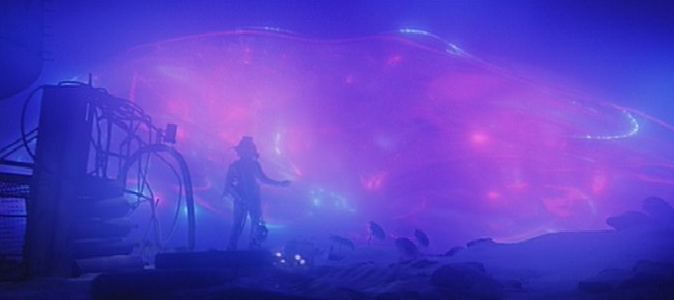
In addition, Cameron was also breaking new ground in the area of special visual effects, which were divided up among seven FX divisions with motion control work by Dream Quest Images and computer graphics and opticals by Industrial Light & Magic. ILM was brought on board to create the amazing water pseudopod and spent six months to create 75 seconds of computer graphics needed for the creature. However, this work caused the film’s release to be delayed from July 4, 1989 to August of the same year.

The production difficulties that plagued The Abyss have become the stuff of Hollywood legend. There were reports from South Carolina that Ed Harris was so upset by the physical demands of the film and Cameron’s dictatorial style that he said he would refuse to help promote the picture. The actor later denied it and did press for the film. He did admit that the daily mental and physical strain was very intense. He recalled, “One day we were all in our dressing rooms and people began throwing couches out the windows and smashing the walls. We just had to get our frustrations out.” The actors were not happy about the slow pace of filming. Mary Elizabeth Mastrantonio remembered, “We never started and finished any one scene in any one day.” Michael Biehn was frustrated by the waiting. He claims that he was in South Carolina for five months and only acted for the three to four weeks. Cameron responded to these complaints by saying, “For every hour they spent trying to figure out what magazine to read, we spent an hour at the bottom of the tank breathing compressed air.”

Like all of Cameron’s other films the action plays a secondary role to the central love story — whether it was between Kyle Reese and Sarah Connor in Terminator or Ripley and Newt in Aliens. In The Abyss we are presented with a disintegrating relationship between Bud and Liz. And yet, as the film progresses and we spend more time with these two people, we begin to realize that they still love each other and that this is what adds a real element of humanity to the special effects-laden film. But The Abyss is much more than that. It mixes elements of an exciting thriller, action film, and science fiction story together in one great package. The way the film is structured, we are presented with several small movies that, when linked together, comprise a larger whole. It is this wonderful structure that makes one realize that there is more going on than a search for a missing submarine.

As Cameron demonstrated with Terminator, he has a real eye for action sequences and The Abyss is no different. One scene, in particular, demonstrates Cameron’s ability to create moments of white knuckle intensity. Several compartments of the underwater rig begin flooding, while crew members try frantically to escape to a safer area. Cameron’s hand-held camera follows these men through the claustrophobic hold at such a breakneck pace, via a compelling first person point-of-view angle, that one can’t help but get caught up in the feeling of urgency brought on by this dangerous situation. At times, it feels like you are actually bouncing through the tight corridors of the rig alongside the characters and this enhances the thrill and excitement of such adrenaline-fueled sequences.

The Abyss
is also similar to Cameron’s previous film, Aliens in the sense that both have a top rate ensemble cast. The crew of the rig all have their own distinctive personalities, which are each given their own moment to shine and never detract from the larger story. The interaction between these people has a ring of honesty and authenticity, which suggests that every character is important and crucial to the film’s outcome. But these colorful characters never obscure the three main principles that are also fully-fleshed characters each with his or her own agenda. Ed Harris portrays Bud as a man dedicated to his rig and his people, but he cannot balance his work life with his personal life. Mary Elizabeth Mastrantonio’s Liz is, as she later admits, “a cast-iron bitch,” but underneath the hard, tough exterior there are occasional glimpses of a sensitive dreamer fighting to get out. Cameron regular, Michael Biehn (an underused actor also seen in Terminator and Aliens, respectively) personifies intensity as the leader of the Navy SEALs who slowly loses his grip on reality and his priorities, posing a threat to the safety of everyone on the rig. Each of these characters has their own inner conflicts as well as the larger conflict that threatens everyone. One of the pleasures of watching The Abyss is seeing how these personal conflicts play out and resolve themselves by the end of the film.

The Abyss
deviates from Cameron’s other features in the sense that it stresses the idea of settling disputes through non-violent means. Violence in the film is not the solution to the problem, but the source. This idea is illustrated through Lt. Coffey, the main instigator of violence in the film. His violent acts create the many problems that the protagonists face and this ultimately results in his demise. On the other hand, Liz personifies the peaceful alternative. Where the selfish Coffey sees anger and hatred, Liz is willing to sacrifice herself for others. She is the calming effect on everyone and her presence on the rig is pivotal in resolving many of the story’s conflicts. It’s a refreshing view that you don’t often see in films nowadays where everything is solved at the end of a gun. Unfortunately, this viewpoint seemed to have disappeared from Cameron’s subsequent work, which regressed to the usual violent antics. Whether it was because of the film’s failure to connect and succeed on a mass level or the departure of long time partner, Gale Anne Hurd, is unknown, but with a film like True Lies (1994), Cameron abandoned a strong, independently minded female character for one that is objectified by the camera and on the receiving end of a lot of misogynistic behavior. It’s too bad because The Abyss contains none of this and instead points the way for a new kind of action-oriented film that stresses problem solving over violence, while still providing the requisite amount of thrills. This is a much-needed antidote to the mindless violence and anger that is problematic in so many films today.

The Abyss
is a truly special film that never lags in pace or interest thanks to the many stunning visuals courtesy of breathtaking computer animation from Industrial Lights and Magic (effects that were the precursor to ones used in Terminator 2). There are also fascinating characters and exciting, often intense situations that keeps the viewer involved in the story. The Abyss is one of those rare films that you wish wouldn’t end because the world and the characters that inhabit it are so compelling and exciting. This film demonstrates, yet again, that James Cameron is one the few directors who can make good science fiction films, with a strong story, a solid cast, and exceptional images that help elevate it above the usual Hollywood dreck and straight-to-video sci-fi clunkers. And that is truly something special at a time of militaristic, flag-waving propaganda like Independence Day (1996), which purports to be entertainment, but is just another mindless special effects workout.

THE UNTOUCHABLES – A REVIEW BY J.D. LAFRANCE

UntouchablesConnery

Brian De Palma’s The Untouchables (1987) is a film that asks the burning question: is police brutality ever justified? It is when you’re dealing with the likes of Al Capone and Frank Nitti – gangsters that had no problem blowing up children and killing nebbish accountants to get what they wanted. The film doesn’t exactly adhere to historical fact opting instead to go with John Ford’s famous credo of printing the legend and in doing so raising the characters and their exploits to mythic status. De Palma’s adaptation of Eliot Ness’ 1957 memoir of the same name had all the makings of a powerhouse production destined for greatness. It featured a screenplay written by legendary playwright David Mamet (Glengarry Glen Ross), expert cinematographer Stephen H. Burum (Rumble Fish) was behind the camera, master composer Ennio Morricone (The Good, the Bad & the Ugly) was scoring the film, and Robert De Niro and Sean Connery were signed on to play larger-than-life characters. The result was an exciting, action-packed epic that helped revitalize De Palma’s struggling career (after the critical and commercial failure of Wise Guys) and earned Connery his first Academy Award.

It is 1930 and gangster Al Capone (Robert De Niro) controls most of the illegal business in Chicago with a ruthless, iron fist. After a ten-year old girl is killed in a gang-related incident, Federal Treasury Agent Eliot Ness (Kevin Costner) is brought in to clean up the city. His first attempt is an embarrassing failure so he tries a different approach. He decides to form his own task force of three men to help him take down Capone and his empire. He picks a veteran beat cop named Malone (Sean Connery), who knows the city and becomes Ness’ mentor. He also selects Stone (Andy Garcia), a cop fresh out of the academy and ace shot with a pistol. Rounding out the group is Wallace (Charles Martin Smith), a bookish FBI accountant who figures out a way to nail Capone. Together, they form an incorruptible group determined to bring Capone to justice.

De Palma and Mamet make it clear right from the get-go that The Untouchables isn’t going to be some half-assed, sanitized gangster film as they proceed to have Frank Nitti (Billy Drago) blow up a bar with a little girl in it. This shocking sequence, juxtaposed with Capone lying about not using violence to enforce his will, sets an all-bets-are-off tone as we get an idea of just how brutal life is in Chicago and how far Capone is willing to go to make a point. This is then contrasted with Eliot Ness’ blandy-McPlainWrap home life with a loving and dutiful wife (Patricia Clarkson) and cute-as-a-button child. We see just how far removed from Chicago Ness’ home life is and what a rude wake-up call he will get when he starts working in the city.

Kevin Costner is wisely cast as the stiff, idealistic Ness. He’s the least interesting character and plays the role straight, trying not to go the obvious heroic route. His all-American looks and Gary Cooper-esque style are ideally suited for the role of the last honest man in the corrupt town (which Oliver Stone would also utilize in JFK). His Ness is as straight an arrow as they come, which makes the character’s arc over the course of the film an interesting one. He goes from staunch upholder of the law to someone who has adopted Malone’s by-any-means-necessary philosophy.

This allows Connery to rightfully shine as the aging cop torn between riding out his remaining time and retire alive or making a difference with Ness and his crew. Unlike Ness, Malone has grown up on and worked the mean streets of Chicago. He understands that they are at war with Capone and must do whatever it takes to bust him and break up his empire because he will be just as ruthless. Upon the first meeting, Malone imparts a valuable lesson to Ness: “Make sure when you shift is over you go home alive.” It seems obvious but is an important one to know. It is also the reason why Malone initially turns down Ness’ offer to form the Untouchables. Connery shows what a once great actor can do with the right material and this results in a truly inspired performance — arguably the veteran actor’s last great one.

Rounding out his trilogy of memorable cameos in the 1980s (including Brazil and Angel Heart), Robert De Niro put on the pounds again (which he first and most famously did for Raging Bull) and transformed himself into Al Capone. Like Tony Montana in De Palma’s Scarface (1983), Capone is surrounded by luxury and opulence but is still just a cruel thug at heart. In the few scenes that he has, De Niro makes them count and it is a thrill to hear a great actor say Mamet’s tough-guy dialogue (listen to how he says the word, “enthusiasms,” in a scene). The actor clearly relishes the role and treats the dialogue like he’s enjoying a rich meal and each word is a juicy morsel that he savors.

The supporting roles feature some fantastic actors, chief among them Billy Drago who exudes just the right amount of oily menace as Nitti. For example, there is a scene where he cordially threatens Ness and his family. On the surface there is the appearance of civility but we know what his true intentions are and it doesn’t take Ness much time to figure it out but by then Nitti is speeding off in his car. He’s made his point. Drago doesn’t get many lines or a lot of screen time but makes the most of what he’s given, making a fine addition to De Palma’s roster of cinematic sociopaths.

Speaking of Mamet’s dialogue, it crackles and pops with intensity and provides many of the film’s classic scenes, perhaps none more memorable than Malone’s famous speech to Ness where he tells him how to get Capone. “He pulls a knife, you pull a gun. He sends one of yours to the hospital, you send one of his to the morgue. That’s the Chicago way.” Sean Connery delivers this speech with the passion and conviction that rightfully earned him an Oscar. The other scene of classic Mamet dialogue is Capone’s infamous dinner table monologue where he talks about teamwork before braining a hapless flunky with a baseball bat for not being a part of the “team.”

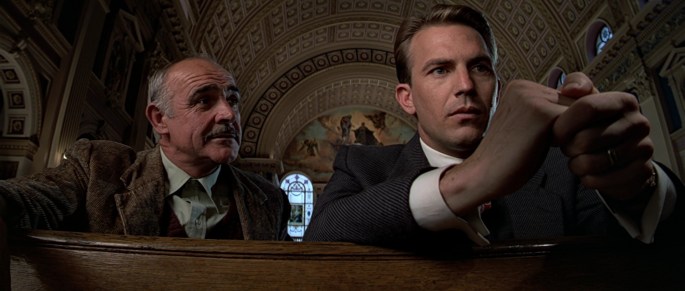
Brian De Palma’s stylish direction is perfect for this epic story: long, uninterrupted takes, slow motion and excellent compositions within the widescreen format. He may well be one of the greatest practioners of this aspect ratio. Just look at a simple set-up in the scene where Malone takes Ness to a church and lays it all out for how they’re going to get Capone. Both men take up most of the foreground occupying either side of the screen. The camera is low looking up at them so that we also see part of the beautifully ornate church ceiling. It is this kind of shot that would be totally destroyed when shown pan and scanned on television. Then there is the much-celebrated train station shoot-out, which was a shameless homage to a famous sequence in the legendary film, Battleship Potemkin (1925). It’s a bravura sequence that is beautifully orchestrated by De Palma as he builds the tension leading up to the shoot-up for what seems like an unbearable eternity. The entire sequence is a brilliant lesson in editing and camerawork.

Although, De Palma does go a little over-the-top (even for him) with the Ness-Nitti show down at the end, which features the director’s obligatory homage to Alfred Hitchcock. There is also a silly bit of business where we see two old cops duking it in a rainy alleyway as Connery and veteran character actor Richard Bradford laughably beat each other up in a scene that I could’ve done without. Also, Malone’s prolonged death scene drags on for what feels like an eternity but these are really minor flaws in an otherwise unimpeachable stone cold classic as De Palma does his best to distract us from these histrionics with giallo lighting in the Connery fight scene and suspenseful point-of-view steadicam work in the death scene.

In 1984, producer Art Linson met with Paramount Studio’s president Ned Tanen about adapting The Untouchables television series into a film. Tanen liked the idea but Linson did not want to do a sequel, a remake or a parody. He wanted “to create a big-scale movie about mythical American heroes.” Linson needed a screenwriter and thought of David Mamet, fresh from just having won a Pulitzer Prize for his Broadway play Glengarry Glen Ross. He met with Mamet and the writer agreed to do the film. The screenwriter was a native of Chicago and something of a gangster history buff. He envisioned a story about “the old gunfighter and the young gunfighter … It occurred to me, what happens if this young innocent, who’s charged with defending the law but only understands that in an abstract way, meets an old disenchanted veteran, the caretaker of the law, soured at the end of his career because of the corruption in the city?”

Mamet asked Paramount to show him two episodes of the original series and he liked them but felt that “there was nothing I could use in the movie.” Mamet wrote an original story after realizing that the real events – Capone being caught for tax evasion – were not that dramatic. Mamet created the character of Malone and gave Ness a family (he did not have one in real life). After eight months, Brian De Palma was approached to direct by Linson after Mamet wrote the third draft of the script. The director liked that the script was more about the characters and did not see it as a gangster film but more like The Magnificent Seven (1960). He felt that the project was “different from anything I’ve done in the past, because it’s a traditional Americana picture, like a John Ford picture.” He, Linson and Mamet worked together on it with De Palma emphasizing the Capone character more. According to De Palma, the film “reflects upon the incredible pressure we place on our police by not equipping them to adequately fight criminals. Why are we surprised that some of them go overboard?”

For the role of Eliot Ness, Linson and De Palma initially considered William Hurt and Harrison Ford, but, according to Linson, they wanted “someone with the right combination of naiveté, earnestness and strength.” They ended up casting Kevin Costner who wanted to do the film because it was so different from the television series and Ness “has to ask for help. It’s the more modern notion that a smart man takes a step back sometimes – that to be a hero you don’t have to be Rambo.” For Jimmy Malone, the filmmakers wanted Sean Connery but assumed that he would not want to play a supporting role and take a pay cut. However, Connery was drawn to the project because of Mamet’s script and the chance to work with Robert De Niro. He ended up signing on for a percentage of the profits. For the role of Al Capone, De Palma wanted De Niro. Paramount initially balked at the actor’s asking price of $1.5 million but relented.

The principal actors rehearsed together for a full week and Connery tried to remain in character even when the cast was relaxing. By the time principal photography began, whole scenes had been blocked and unworkable ideas rejected. A rapport between the actors playing the Untouchables had also been established, which definitely shows in the film. In preparation for the film, De Niro put on 30 pounds between the end of his Broadway run in Cuba and His Teddy Bear and his days of filming scheduled at the end of the 70-day production schedule. He analyzed old Movietone newsreels in order to get Capone’s voice, movements and mannerisms. On an interesting note, the famous scene in the church between Ness and Malone as originally written, took place on a street, but Connery suggested it take place in a church – the only place left in the city where they could speak freely.

Principal photography started in mid-August 1986 and utilized over 25 separate locations in Chicago with the border raid sequence shot on the Old Hardy Bridge spanning the Missouri River because of its period look. The train station shoot-out cost $200,000 to light because extra light was needed to shoot the sequence in slow motion. It took six days to shoot the scene, which cost an additional $100,000. Not surprisingly, staging this sequence like the one in Battleship Potemkin was De Palma’s idea. The budget escalated from $17 million to $24 million thanks to the cost of production designer Patrizia von Brandenstein transforming an entire block of LaSalle Street in Chicago into the 1930s complete with 125 costumed extras and 60 period cars.

The production design for The Untouchables is fantastic, especially the opulence of Capone’s headquarters, with Morricone’s score resembling a 1930s riff on the music from De Palma’s Scarface. This film is one of those rare big-budget, star-studded blockbusters that actually works. All of the right elements came together at just the right time and place and resulted in an incredibly entertaining motion picture. The Untouchables shows what a master filmmaker like De Palma can do with a director-for-hire paycheck movie. He may not be making a personal statement with this film but he still gives it his all in terms of style and virtuoso camerawork. This film certainly set a high standard for period gangster films, casting a long shadow over future endeavors like Michael Mann’s Public Enemies (2009) and the HBO T.V. series Boardwalk Empire.

LEGEND – A REVIEW BY J.D. LAFRANCE

legend_8_tim-curry_darkness3

“The time is ripe for a John Ford of science fiction films to emerge. And I’m determined to be that director.” Ridley Scott told this to author Harlan Ellison when he asked him to write the screenplay for Dune (1984). Although, Scott’s version never happened, for years it looked like he was going to fulfill that bold statement with the incredible one-two punch of Alien (1979) and Blade Runner (1982). The 1980s was a fertile period for fantasy films with the likes of memorable efforts such as Dragonslayer (1981), Conan the Barbarian (1982), and Ladyhawke (1985) and not so memorable ones likes The Beastmaster (1982) and Krull (1983). The best of the bunch was Ridley Scott’s Legend (1985). With this film, he wanted to do for the fantasy genre what he did for science fiction with Blade Runner – create a visually stunning film rich in detail. He cast two young, and up-and-coming stars, Tom Cruise and Mia Sara, recruited acclaimed author William Hjortsberg to write the screenplay, have make-up genius Rob Bottin bring the various fantastical creatures to life, and get legendary composer Jerry Goldsmith to compose the score.

Sounds like the ingredients for a masterpiece, right? Partway through principal photography, the elaborate forest set created on a soundstage burned down. The studio, eager to appeal to Cruise’s youthful fanbase, replaced Goldsmith’s score with one by Tangerine Dream because they had scored Risky Business (1983), the breakout film for the young actor. To add insult to injury, the studio and Scott cut over 20 minutes of footage for North American audiences. After all the dust had settled, Legend was a commercial and critical failure, relegated to cult film obscurity. It’s too bad because even the mangled U.S. version has a lot going for it, namely Bottin’s groundbreaking prosthetic make-up and Tim Curry’s mesmerizing performance as the Lord of Darkness. In 2002, Ridley Scott revisited Legend for a souped-up Ultimate Edition DVD that allowed the director to assemble a version of the film approximating his original intentions.

The opening credits play over shots of a dense forest at night. In typical Scott fashion, we are fully immersed in the sights and sounds of this place. We see a goblin by the name of Blix (Alice Playten) walking through the forest until he comes across a foreboding marsh dominated by an imposing structure that resembles a massive tree. It is known as the Great Tree – “when evil anarchy ruled the land, the wicked came here to sacrifice,” a character says at one point.

The first words that are spoken in the film are, “I am the Lord of Darkness. I require the solace of the shadows and the dark of the night,” They come out of Tim Curry’s booming, theatrical voice, one that is absolutely dripping with menace. Not surprisingly, his enemy is the light of day, but he seeks to find a way to make it night forever. Since he is confined to the shadows, Darkness (Tim Curry) entrusts his “most loathsome of goblins,” Blix, whose heart is “black as midnight, black as pitch, blacker than the foulest witch,” to find and kill the two remaining unicorns – the most pure symbols of goodness and light. Darkness instructs Blix to bring him their horns – the source of their power.

Reclusive creatures, the unicorns can only be lured out into the open by innocence. Cut to Princess Lili (Mia Sara), a beautiful young woman traveling carefree through tall grass, singing happily to herself. Mia Sara, with her expressive big eyes and fresh-faced look (this was her feature film debut), certainly epitomizes the essence of innocence. When she’s not slumming with the common folk, Lili flirts with Jack O’ the Green (Tom Cruise), a young man who lives in the forest among the animals. While the film’s stylized dialogue doesn’t always sound convincing coming out of Tom Cruise’s mouth, he makes up for it with a very physical performance, moving gracefully at times like a classically trained dancer.

Jack shows Lili the wonders of the forest, including the rare unicorns. Their first appearance, captured in slow motion and soft focus, is a sight to behold. Unfortunately, Blix and two other goblins have been following Lili. When she dares to break the unwritten rule of the forest and actually touch one of the unicorns, the goblins strike, taking down one of the magical animals and removing its horn. Lili’s single act of selfishness plunges the world into darkness, blanketing the once lush forest in snow and transforming a nearby pond into ice. I wonder if Peter Jackson is a fan of Legend as the scene where Jack dives into a pond to retrieve Lili’s ring, with its use of a distorted lens, eerily anticipates a similar shot early on in The Fellowship of the Ring (2001) when the Ring’s backstory is recounted.

Lili runs off in shame and guilt, leading the goblins to the second unicorn that they capture. She finds her way to the Great Tree and is courted by Darkness, only to be bewitched and transformed into his dark bride. Crestfallen over Lili’s betrayal, Jack takes refuge in the forest and is discovered by Gump (David Bennett) the elf and two dwarves, Screwball (Billy Barty) and Brown Tom (Cork Hubbert) – providing much of the film’s comic relief. They are in turn helped out by a fairy named Oona (Annabelle Lanyon) who is smitten with Jack. Together, they go to the Great Tree to retrieve the unicorn’s horn and free its mate.

The corruption of Lili sequence is arguably the highlight of Legend as it takes on a captivating, dream-like atmosphere. Dazzled by sparkling trinkets and jewelry, she spots a figure dancing in swirling black garments. Lili is compelled to dance with this mysterious, featureless figure and pretty soon they merge into one and she adopts a stunning Gothic look, complete with black lipstick to contrast her pale alabaster skin. Lili has been bewitched by a powerful spell and it is at this point that Darkness chooses to reveal himself, emerging from a mirror.

Scott prolonged the reveal of Darkness’ entire appearance for as long as possible. All we get early on is a tantalizing glimpse of a hand or an arm. But here is the money shot and what an impressive creature he is: massive with two large horns and cloven feet. He is Rob Bottin’s crowning achievement, a creation so stunningly fully-realized that it still surpasses anything done in subsequent fantasy films, The Lord of the Rings trilogy included. Of course, it doesn’t hurt that Tim Curry’s personality is still able to permeate the tons of prosthetic makeup that he’s buried under. With that great voice and the deliberate cadence he adopts, Curry gives his dialogue an almost Shakespearean flair with the lyrical quality in which he speaks.

When filming The Duellists (1977) in France, director Ridley Scott came up with the idea for Legend after another planned project, Tristan and Isolde, fell through. He thought of a story about a young hermit that is transformed into a hero when he battles the Lord of Darkness in order to rescue a beautiful princess and release the world from a wintery curse. However, Scott felt that it was going to be an art film with limited mainstream appeal and went on to do Alien and then extensive pre-production work on a version of Dune that never happened. Frustrated, Scott came back to the idea of filming a fairy tale or mythological story. For inspiration, he read all the classic fairy tales, including ones by the Brothers Grimm. However, he wanted Legend to have an original screenplay because he felt that “it was far easier to design a story to fit the medium of cinema than bend the medium for an established story.”

By chance, Scott discovered books written by American author William Hjortsberg and found that he had already written several scripts for some unmade lower-budgeted films. Scott asked Hjortsberg if he was interested in writing a fairy tale. As luck would have it, he was already writing some and agreed. The two men ended up bonding over Jean Cocteau’s Beauty and the Beast (1946). In January 1981, just before Scott was to begin principal photography on Blade Runner, he and Hjortsberg spent five weeks working out a rough storyline for what was then called Legend of Darkness. Originally, Scott “only had the vague notion of something in pursuit of the swiftest steed alive which, of course, was the unicorn.” He wanted unicorns as well as magic armor and a sword. Hjortsberg suggested plunging the world into wintery darkness. Scott also wanted to show the outside world as little as possible and they settled on the clockmaker’s cottage. The quest was longer and eventually substantially reduced. Scott wanted to avoid too many subplots that departed from the main story and went for a “more contemporary movement, rather than get bogged down in too classical a format.”

The look Scott envisioned for Legend was influenced by the style of classic Disney animation which, incidentally, was the studio Scott originally offered the project to but they were intimidated by the film’s dark tone despite his reassurances that he would not go too far in that direction. Regardless, the director visually referenced Disney films like Snow White and the Seven Dwarfs (1937), Fantasia (1940) and Pinocchio (1940). Early on, Scott worked with Arthur Lea as a visual consultant, drawing some characters and sketching environments. However, Scott replaced Lea with Assheton Gorton, a production designer the director had wanted to work with on both Alien and Blade Runner. Scott hired Gorton because he knew “all the pitfalls of shooting exteriors on a soundstage. We both knew that whatever we did would never look absolutely real, but would very quickly gain its own reality and dispense with any feeling of theatricality.”

As with all of Scott’s films, Legend is a marvel of production design as evident from the interior of the Great Tree. For example, there’s the hellish kitchen where Jack and his companions find themselves imprisoned only to watch helpless as some other poor creature is tortured among infernal fires. There are the intricate carvings and finely crafted sculptures located in Darkness’ throne room, or the immense columns that lie just outside of this room and Scott gives you an idea of their scale as they dwarf Lili when she runs among them. You could pause the film at almost any moment and marvel at the detail contained in a single frame.

And yet for all of its visual grandeur, the film feels surprisingly intimate. It certainly is not set on the scale of say The Lord of the Rings and this actually works in its favor. Legend has a very specific focus with one overriding quest for our heroes to accomplish. There is a textured, hand-made quality to Scott’s film that seems to be missing from most post-Lord of the Rings films (with the possible exception of The Brothers Grimm as director Terry Gilliam was also working with a modest budget).

Scott also consulted with effects expert Richard Edlund because the director did not want to limit major character roles to the number of smaller people that could act. At one point, Scott considered Mickey Rooney to play one of the major characters but he didn’t look small enough next to Tom Cruise. Another idea they considered was to use forced perspective and cheating eye-lines (later used on in The Lord of the Rings films). Edlund came up with the idea of shooting on 70 mm film stock, taking the negative and reducing the actors to any size they wanted but this was deemed too expensive. Producer Arnon Milchan was worried that the budget for Legend would escalate like it did on Blade Runner and would be an expensive box office failure also. Scott had to find an ensemble of small actors.

After completing The Howling (1981), Scott contacted Rob Bottin about working on Blade Runner but he was already committed to doing John Carpenter’s The Thing (1982). Scott told Bottin about Legend and towards the end of his work on The Thing, the makeup wizard received a script for it. He saw this as an excellent opportunity to create characters in starring roles. After finishing The Thing, Bottin sat down with Scott and they reduced the amount of creatures to a workable number (the script suggested thousands). It would be a daunting task involving complicated prosthetic makeup that would be worn for up to 60 days with some full body prosthetics as well. According to Bottin at the time, Legend had the largest makeup crew ever dedicated to one project. He divided his facility into different shops in order to cover the immense workload. As actors were cast, Bottin and his crew began making life casts and designing characters on drafting paper laid over sketches of the actors’ faces.

The creature makeup in Legend features Rob Bottin at the height of his powers. Consider Meg Mucklebones (Robert Picardo), a nasty-looking witch with green skin, large ears and a crooked nose – exaggerated ugliness at its most inventive. In the film, she has long, spindly arms that end at curved fingernails. The amount of detail just in her face alone is incredible. With the exception of Cruise and Mia Sara, all the principal actors spent an average of three-and-a-half hours (with Tim Curry taking five-and-a-half hours) every morning having extensive makeup applied. Each person needed three makeup artists working on them.

Curry took considerably longer because his entire body was encased in makeup. At the end of the day he had to spend an hour in a bath in order to liquefy the soluble spirit gum keeping it on him. At one point, Curry got too impatient and claustrophobic and pulled it off too quickly, tearing off his own skin in the process. Scott had to shoot around him for a week. From that point on, he had to have an oxygen tank because the makeup was so claustrophobic. Out of all the characters the most challenging one in terms of makeup was Darkness. Bottin and Scott had agreed on a Satanic look for the character. Curry had to wear a large, bull-like structure atop his head with three-foot fiberglass horns supported by a harness underneath the makeup. The horns placed a strain on the back of the actor’s neck because they extended forward and not straight up. Fortunately, Bottin and his crew came up with horns that were lightweight enough to reduce the strain.

Set at a budget of $24.5 million (that by many reports escalated to $30 million), the film’s sets were constructed on six huge soundstages at Pinewood Studios in England, including the world’s largest film stage where a vast forest resided. It took 50 men 14 weeks to build. Principal photography on Legend began on March 26, 1984. The larger the production became, the less money Scott had to work with. Then, 16 weeks into production, and with 10 days left on the large soundstage at Pinewood, the entire set burned down during a lunch break. Flames from the fire leapt more than 100 feet into the air and clouds of smoke could be seen for five miles away. Scott quickly made changes to the schedule and only lost three days as the crew continued to film on another set on a different stage. Meanwhile, the art department rebuilt the section of forest set that was needed to complete filming.

Scott’s first cut of Legend ran 125 minutes long. He felt that there were minor plot points that could be trimmed and cut the film down to 113 minutes, testing this version for an audience in Orange County. However, it was felt by studio executives that the audience had to work too much to be entertained and another 20 minutes was cut. The 95-minute version of Legend premiered in France in September 1985 and the United Kingdom in December through its world distributor 20th Century Fox. Universal Pictures originally planned to release the film in North America on November 6, 1985 but pushed back the date after audience previews did not go well. They re-cut it and replaced Jerry Goldsmith’s score with one by Tangerine Dream. Goldsmith said, “That this dreamy, bucolic setting is suddenly to be scored by a techno-pop group seems sort of strange to me.” It must’ve been a bitter pill for the veteran composer to swallow. Normally, he would spend 6-10 weeks on a film score but for Legend he spent six months writing songs and dance sequences ahead of time “so they could shoot them. Of course all that is out now.” At the time, Scott said, “European audiences are more sophisticated. They accept preambles and subtleties whereas the U.S. goes for a much broader stroke.” As a result, he made the film simpler.

With Legend, you can see Ridley Scott aiming for the prestige and grandeur that Peter Jackson achieved with his The Lord of the Rings films. Scott’s film had the ambition and the sterling production values but failed to capture the popular imagination because of the lack of faith and belief that the studio had in it. Did Scott not do his homework and remember how Universal screwed over David Lynch on Dune (1984) and Terry Gilliam on Brazil (1985)? This was not a studio friendly towards fantasy and science fiction films. One wonders how Legend would have done back in the day (or now for that matter) if this director’s cut had been available and the studio put everything they had behind it like New Line Cinema did with The Lord of the Rings films. We’ll never know and as it stands, Legend is a fascinating cinematic what-could-have-been and a cautionary tale of an ambitious filmmaker succumbing to a myriad of problems and pressures that marred his original vision. Alas, Scott never did realize his dream of becoming the John Ford of science fiction and fantasy films. The commercial and critical failure of Legend, coupled with its production and post-production problems, scared him off from revisiting these genres until recently with Prometheus (2012).

Q & A – A REVIEW BY J.D. LAFRANCE

MSDQANA EC007
Q & A, Nick Nolte (front, left), Timothy Hutton (front right), 1990. ©TriStar Pictures

Among the many genres prolific filmmaker Sidney Lumet has dabbled in, the one in which he excels and demonstrates the most affinity for is the crime thriller. In particular, he is fascinated with police corruption and how the law and order system works (or, in some cases, doesn’t work) in New York City. In the 1970s, he told the story of an undercover cop who deals with corruption among his fellow officers with Serpico (1973). In the 1980s, he depicted the plight of a police detective that informs on his cohorts after being busted himself in the magnum opus Prince of the City (1981). In the 1990s, Lumet tackled police corruption yet again but this time via the angle of racism with Q & A (1990). Based on the novel of the same name by New York judge Edwin Torres, Lumet’s adaptation received mixed reviews from critics and was largely ignored by audiences of the day. It has become something of a forgotten, underappreciated film in Lumet’s filmography and one that deserves to be rediscovered.

During the opening credits we see the rain-slicked streets of New York City through the back seat of a cop car. This sequence sets a nice, gritty tone and takes us on a mini-tour of the city where most of the film’s action takes place. However, Ruben Blades’ jarring song that plays on the soundtrack almost ruins it. I’m not quite sure what Lumet was thinking but it simply does not work here.

Lieutenant Mike Brennan (Nick Nolte) is a dirty cop as evident from his introduction where he ambushes an unarmed Latino drug dealer, blows the guy’s brains out and then bullies two nearby witnesses into saying that the man had a gun in his hand. Assistant District Attorney Al Reilly (Timothy Hutton) is assigned to the case. His boss tells him that the incident is a cut and dry one. He is told that Brennan is a good cop – a little rough in his methods but all of his cases have been tried successfully with no appeals. Reilly is instructed to collect the facts with the help of a stenographer and present them to a grand jury. His boss instructs him that “the Q & A defines what really happened. If it’s not the Q & A, it didn’t happen.”

Reilly is eager to please and is impressed with Brennan’s imposing presence and reputation. The young A.D.A. questions Roberto “Bobby Tex” Texador (Armand Assante), a drug dealer and racketeer, who, along with his wife Nancy (Jenny Lumet), witnessed the aftermath of the murder. He refutes the theory that the gun was found on the murder victim. Reilly begins to suspect that something might not be right with the case. He is also faced with a personal conflict as he used to be involved with Nancy and still has feelings for her. Reilly soon realizes that’s he’s taken on more than he can possibly handle. Sidney Lumet pits Brennan, Bobby Tex and Reilly against one another, each with their own agenda and the film gradually heads towards an inevitable confrontation between the three men.

Nick Nolte is a lot of fun to watch as a larger than life cop. He sports slicked back hair and a thick mustache that threatens to overtake his mouth. There’s a memorable scene early on where his character recounts a story to some other cops about how a mobster gave him a hard time when he tried to fingerprint him that is hilarious and disgusting. The scene has an authenticity of a veteran that delights in telling old war stories to inflate his own ego. Nolte’s Brennan is a chatty guy that loves to tell stories of past glories as he tries to buddy-up with Reilly until the A.D.A. lets him know that he’ll go after the veteran cop if he finds out he’s dirty. Nolte’s whole demeanor changes in a heartbeat and it is quite exciting to see him go from jovial to threatening in the span of a few seconds. Brennan is as corrupt as they get and enjoys the influence he exerts and the power he wields. He uses fear and intimidation to get what he wants. Nolte put on 40 pounds for the role because he felt that the character required it: “just the sheer mass of brutality. I felt that would be the right kind of thing. He had to be on the edge of his own dissipation.”

Armand Assante is a force of nature as Bobby Tex, portraying the crook with an aggressive swagger and an intensity that is impressively conveyed in his eyes. During Reilly’s initial questioning, Bobby oozes casual confidence and Assante does a great job of conveying it. He also imparts a keen intelligence. Bobby isn’t just some two-bit street punk. He doesn’t even blow his cool when Luis Guzman’s cop gets all in his face. Bobby matches his intensity and it is great to see two skilled character actors go at it. Assante ups his intensity when he warns Reilly to stay away from his wife. He gives the A.D.A. a seriously threatening look that would have most people shaking in their shoes. It’s Bobby’s first appearance in the film and Assante makes quite an impression.

Up against two lead actors playing colorful characters, Timothy Hutton wisely underplays Al Reilly. His character may be young and new to the job but he knows the law as demonstrated when questioning a mobster by the name of Pesch (Dominic Chianese) and his lawyer (Fyvush Finkel) in rather confident fashion. At first, it appears that the slick mob lawyer is going intimidate Reilly but the young man expertly turns the tables with his intelligence. Hutton is good as the straight arrow A.D.A. that decides to take on a highly respected cop and in the process uncovers an intricate web of corruption. The actor avoids stereotyping by showing layers to his character through the revelation of his feelings for Nancy which affects his approach to the case. Reilly starts off as an idealistic person but over the course of the film, as he’s exposed to corruption, he gains experience and becomes savvier when it comes to how things work. Early on in Q & A, there is a revealing conversation he has with Leo Bloomenfeld (Lee Richardson), a veteran attorney that has clearly been working in the system for far too many years. He’s jaded and tells the eager Reilly how things really are, giving him a taste of the corruption he will witness first hand later on. To prepare for the role, Hutton went on squad-car runs with police officers in Manhattan in order to get an idea of the challenges they face on the streets. He said of the experience, “in many cases the hands of the officer on the street are tied.”

Lumet shows how close these cops are by the short-hand between them and the familiarity they have with each other. In the scene where Reilly questions Brennan about the homicide in a room full of cops, the director really captures the camaraderie among these men. The dialogue sounds authentic and is delivered by the actors in a way that is so natural you believe that they are these characters. Consummate character actor Luis Guzman has a memorable role as a homicide detective that first suspects the Brennan case is rotten. He has a memorable moment where he jokingly defends Brennan’s casual racism: “He ain’t no racist. He hates everybody. He’s an equal opportunity hater.” Even though this is said in jest, in actuality it’s not far off the mark.

However, in his review for The New York Times, Vincent Canby wrote, “great little scenes overshadow bigger, more important ones. Characters come and go at speed. Watching the movie is an entertaining ride, but when it’s over it’s difficult to remember where, exactly, one has been.” USA Today gave the film two-and-a-half stars out of four and wrote, “Overkill ultimately wears Q & A down, despite two bravura performances and some Hutton understatement that’s adequate to the task. So, too, does unrelenting sordidness, a deadly love angle and a score (Ruben Blades) almost as awful as Cy Coleman’s sabotage of Lumet’s Family Business.”

One of the major themes Q & A wrestles with is racism. There is the casual kind between black, white and Latino cops and there’s the more damaging kind that resulted in the end of Reilly and Nancy’s relationship years ago. Racism informs a lot of the characters’ decisions and often motivates their actions. The film addresses racism in an honest way that you rarely see outside of a Spike Lee film. As he did with Prince of the City and later with Night Falls on Manhattan (1997), Lumet sheds light on how cops and crooks can be intricately linked and just how deep corruption runs in a sprawling metropolis like New York City. These films show how law and order works in fascinating detail and that feels authentic, much like the television show Law & Order does year in and year out.

WATCHMEN – A REVIEW BY J.D. LAFRANCE

Watchmen-watchmen-13107406-1920-1080

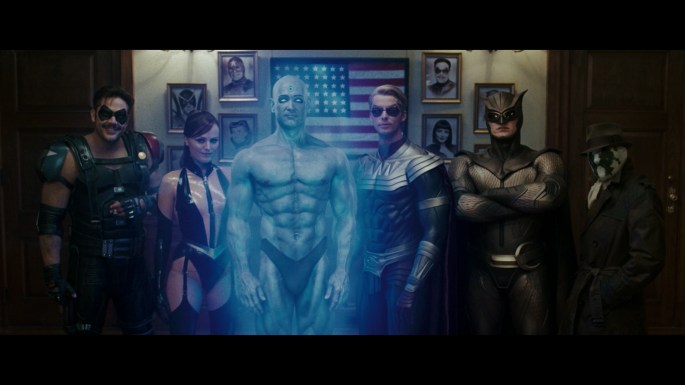
To say the Watchmen film (2009) had a long and checkered production history is a massive understatement. Originally a 12-issue mini-series written by Alan Moore and drawn by Dave Gibbons that was released in 1986, it was a revisionist superhero story about a mysterious assassin killing off costumed superheroes but this is merely a springboard for a brilliant dissection of the genre and comics in general by manipulating symbols and icons. It also addressed the fear of nuclear annihilation that was so prevalent in the 1980’s. The series was a critical and commercial success despite Moore and Gibbons’ intentions for it to act as an epitaph to the superhero genre and ended up revitalizing superhero comics and spawned numerous rip-offs. It wouldn’t take long for Hollywood to come calling.

In 1989, just after he finished making The Adventures of Baron Munchausen, Terry Gilliam was approached to direct a film version of Watchmen by producer Joel Silver. Sam Hamm (Batman) wrote the screenplay, which by all accounts was awful. So, Gilliam discarded this draft and wrote his own with Charles McKeown (his screenwriting partner on Munchausen). Gilliam felt that the mini-series was unfilmable as a traditional two-hour film. The biggest problem lay in the financing. According to Gilliam, Silver said that he had secured a $40 million budget but in actuality he only had about $24-25 million. In 1996, after the success of 12 Monkeys, Gilliam was asked again and turned it down.

Nothing happened with the project for many years until it was announced that screenwriter David Hayter (X-Men) had signed a seven figure deal to adapt Watchmen for the big screen and possibly even direct it for Universal. Larry Gordon, who had long held the rights to Watchmen was going to produce the film. Originally, Hayter pitched Watchmen as a mini-series for HBO but the cost would have been an estimated $100 million. His way to condense the mini-series into a two-hour film was to break down the story points into their main components.

Filming was to being in Prague sometime in 2004; however, the option was picked up in April 2004 with Darren Aronofsky (Black Swan) being named as the director for Revolution Studios. By July, the project had moved over to Paramount when the deal fell through with Revolution. However, by early November 2004, Aronofsky was off the project due to scheduling conflicts with pre-production on The Fountain (2006). Paramount’s insistence on getting Watchmen out in theaters by summer of 2006 forced them to find another director fast. In late November of 2004, they picked Paul Greengrass (The Bourne Supremacy) to direct using Hayter’s script. It did not take long for problems to arise when in April 2005 Paramount was looking to cut the film’s budget by 20% while Greengrass was immersed in pre-production at Pinewood Studios in London, England. One of the reasons cited was the exchange rate of the U.S. dollar to the British pound. However, the studio put the project in the dreaded turnaround (i.e. development hell) in June of the same year because of change of studio heads and the new one felt that the budget for such a risky project was too high.

Finally, in 2005, the film’s producers took the project to Warner Bros. and approached Zack Snyder to direct as they were impressed with his work on 300 (2007), a stylish adaptation of Frank Miller’s graphic novel of the same name. Screenwriter Alex Tse was hired and he took elements from Hayter’s drafts while maintaining the Cold War setting of the comic book. The resulting film polarized critics and was a modest commercial success. Taking his cue from Robert Rodriguez’s adaptation of Sin City (2005), Snyder set out to make a visually faithful adaptation, often recreating certain panels exactly as they were presented in the comic book but ran into trouble when he deviated with his own preoccupations and stylistic flourishes. The end result is a film that is at times brilliantly faithful and also deeply flawed – a mixed bag but also an admirable attempt at an impossible task. The Ultimate Edition version, which fused the director’s cut with the animated short film, Tales of the Black Freighter (a comic book that runs throughout Watchmen, often commenting on the action), is the most complete version of Snyder’s take on the material.

Set during the mid-‘80s amid the nuclear arms race between Russia and the United States, Watchmen begins with two police detectives investigating the mysterious murder of Edward Blake (Jeffrey Dean Morgan) whose alter ego is the costumed superhero known as the Comedian, an amoral mixture of Nick Fury and G. Gordon Liddy. Another costumed vigilante by the name of Rorschach (Jackie Earle Haley) – imagine Travis Bickle mixed with Sam Spade – decides to conduct his own investigation and realizes that the Comedian’s death is only a small fragment of a much larger puzzle. He proceeds to notify the surviving members of the superhero team he belonged to: Dan Dreiberg (Patrick Wlison) a.k.a. Nite Owl, a Batman-esque crusader now retired; Laurie Jupiter (Malin Akerman) a.k.a. Silk Spectre, a beautiful woman pushed into the business by her famous mother, Sally (Carla Gugino), the original Silk Spectre; Adrian Veidt (Matthew Goode) a.k.a. Ozymandias, a billionaire businessman and considered by many to be the smartest man on the planet; and Dr. Manhattan (Billy Crudup), an omnipotent being capable of manipulating matter on a cellular level. As Rorschach’s investigation progresses it appears that someone is trying to eliminate all of his former team members but to what end?

The first indication that director Zach Snyder imposes his trademark style occurs in the prologue when the Comedian is killed by a mysterious assailant. Not only does he drag out the fight, but he also unnecessarily employs his slow motion/speed up technique. However, Snyder makes up for it with a superbly executed opening credits sequence that introduces this world and its alternate history timeline (i.e. the Comedian assassinates President Kennedy on the grassy knoll) while also including all kinds of visual Easter eggs for fans of the comic book (like showing how minor character Dollar Bill died). As a result, there is something for newbies and fans alike.

For everything Snyder gets right – the look and feel of the film, which features some truly astounding production design that completely immerses you in this world – he maddeningly gets other things wrong when he adds bits to scenes that have no purpose except to add a little more action for our ADD culture, like in the scene where Rorschach is discovered by two police officers as he’s searching the Comedian’s apartment. The masked vigilante subdues one of them and disappears before the other can collar him. Why? To show what a badass he is? This is unnecessary as actor Jackie Earle Haley’s excellent performance does that for him.

Another nice addition is the integration of an animated rendition of The Tales of the Black Freighter, a comic book within the graphic novel about the sole survivor (voiced by Gerard Butler) of a shipwreck who desperately tries to make it back home to his family before the pirate ship of book’s title does. Snyder nails the nightmarish Tales from the Crypt vibe of the comic while also restoring the newsstand scenes between the vendor and the kid reading the book, which fleshes out this alternate world.

Snyder makes some blunders with a few of the musical cues, like using “Ride of the Valkyries” in the sequence where Dr. Manhattan slaughters Viet Cong soldiers during the Vietnam War. The director is obviously paying homage to the famous use of the song in Apocalypse Now (1979) but it is unnecessary and too on the nose. However, the most glaring miscue is using “Hallelujah” by Leonard Cohen instead of “You’re My Thrill” as it was in the graphic novel. Do we really need this song played yet again in a film? This song and all versions of it need to be retired from cinema indefinitely.

For the most part the casting is spot on. Patrick Wilson put on weight to portray the slightly out of shape Dan Dreiberg and with his retro haircut and defeated posture certainly looks the part. Wilson gives Dreiberg a slightly sad, pathetic vibe, which suits the character. Billy Crudup nails the eerie detachment of Dr. Manhattan, a god-like being bored with humanity. The actor adopts a neutral tone akin to that of HAL 9000 in 2001: A Space Odyssey (1968). Perhaps the best realized and most faithfully recreated portion of the graphic novel is Dr. Manhattan’s tragic backstory, which also attempts to present his worldview: he perceives the past, present and future simultaneously. Crudup does a nice job of showing the transition of Manhattan from a mild-mannered scientist to omnipotent super being with some eerily uncanny recreations of panels from the graphic novel. We see how Manhattan’s ability to manipulate matter on a cellular level radically changes the course of world history (for example, the U.S. wins the Vietnam War with his help). According to Moore, his aim with Manhattan was to show that he “does not perceive time the same way we do. We have a character who’s post-Einsteinian, who seems to accept that all time is happening at once. Past, present and future. And to him, the past is still there, and the future is there, right now.”

Thankfully, the flashbacks depicting the Comedian’s backstory don’t shy away from his amoral behavior: trying to rape the original Silk Spectre and killing a Vietnamese woman pregnant with his child. Jeffrey Dean Morgan does a fantastic job conveying his character’s skewed worldview: how everything is part of a big, dark joke that only the Comedian gets. In his own way, he realizes that what costumed superheroes do – fighting crime – is ultimately meaningless in the face of nuclear annihilation. The darker and more chaotic things get the more he likes it. Morgan is also able to dig deeper during his tearful late night visitation with an old foe, giving us tantalizing hints at a much, darker and larger scheme at work – the knowledge of which got him killed in the first place.

Easily the strongest performance comes courtesy of Jackie Earle Haley as the sociopathic Rorschach. The most important thing he does is get the voice right. Everyone has their own idea of what he should sound like and Haley got it. Not only does he look great in the costume but also out of it during the portion of the film where he’s unmasked and in prison. The actor is even more chilling as he recounts to a psychiatrist how he became Rorschach and the incident that transformed him permanently into his costumed alter ego. This section of Watchmen offers a glimpse into his disturbing worldview in what is easily the darkest, most bleak part of the film, much like the graphic novel. But again, Snyder imposes his style unnecessarily, adding his own gory flourishes to Rorschach’s showdown with a kidnapper. It is excessive and clumsily executed like something out of a cheap B-horror film whereas the graphic novel was much more horrifying because it left the criminal’s fate to your imagination. Snyder is too busy making Rorschach look cool and failing to realize that in the graphic novel Moore and Gibbons were deconstructing the romantic costumed superhero myth and exploring what motivates someone to dress up and fight crime and how this might warp them. Rorschach wasn’t meant to be a cool character but a depressing, frightening one. His backstory was where, according to Moore, “we actually go for the heart of darkness, we go to the very center of this black, depressing sort of pre-nuclear worldview.”

The most significant miscasting of the film is actress Malin Akerman as Laurie Jupiter. While the attractive actress looks the part, she lacks the acting chops required for the role. Known mostly for romantic comedies, Akerman looks lost in the role, which is unfortunate as it’s the most pivotal part and arguably the most complicated character in the book. Laurie’s relationship with Dan is the emotional center of the story and this is diluted in the film by the casting of Akerman. Carla Gugino, who ironically plays her mother in the film, would’ve actually been better in the role – or, maybe Jennifer Garner who demonstrated a capacity for action and drama in the J.J. Abrams television show Alias.

Another glaring miscast role is that of Matthew Goode as Adrian Veidt. The actor doesn’t look like the character or really act like him either. He’s a little too smug and too over-confident in his portrayal whereas in the graphic novel Veidt was subtly condescending to those around him, coming across as almost distracted, the reasons for which become apparent later on. Snyder has said that he didn’t want to cast recognizable movie stars in the major roles but for Veidt, a celebrity in his own right and by his own making, this would’ve been a wise move. I always thought that Jude Law would’ve been a good choice as he looks the part and showed the capacity to play unlikable characters in films like The Talented Mr. Ripley (1999). Plus, while doing press for Sky Captain and the World of Tomorrow (2004), Law admitted to being a huge fan of the graphic novel and probably would’ve been willing to take a pay cut.

Watchmen perfectly summarizes Snyder’s limitations as a filmmaker. He slavishly recreates panels and sequences from the graphic novel without demonstrating any understanding of what they mean. For example, the climactic scene where Laurie convinces Dr. Manhattan to come back to Earth, that there is more to the universe than random molecules colliding with one another is handled all wrong. In the graphic novel, we find out that Sally loved the Comedian, even after he tried to rape her. The fact that she could feel for a person who committed such a horrible act goes against all logic and that Laurie was the product of their act of love is what convinces the Manhattan to renew his interest in humanity. The film waters this down completely and Sally says that she made a mistake being with the Comedian that one time but that she loves Laurie anyway. Whereas, the graphic novel is a thought-provoking look at human nature and our fascination with costumed superheroes, the film dilutes and tries to make it palatable for a mainstream audience while still trying to appeal to fans of the source material. This schizophrenic attitude is arguably one of the biggest flaws of the film.

Watchmen is a flawed mess of a film – one that gets many things right but also gets a lot of things wrong – but a fascinating one nonetheless. If I’m being overly critical on Snyder it’s only because I love the source material so much that seeing it brought to life in a film was at once exhilarating and depressing. One has to give Snyder credit for making it at all, for using his clout to make sure it was R rated and keeping it set during the ‘80s – two things he went to the mat for with the studio. He made the best possible film one could with the limitations of a feature film format. Ideally, the graphic novel could only truly be done justice in a mini-series format aired on a cable channel like HBO, which would free the filmmakers of the constraints of network television. Watchmen asks many questions but perhaps as Dave Gibbons points out, it really asks the big question: “Who makes the world? Who is responsible for the way the world is? And a lot of it is planned, but a lot of it is just sheer chance. There are patterns, the pattern that we perceive, but there are patterns going on underneath it. And that’s what we tried to show. With these sub, almost subliminal patterns that go through things, echoes, repeating shapes, motifs turning up in unexpected places.” Is the world made of patterns or is it sheer coincidence? The graphic novel expertly examines these questions and offers an entertaining story as well. The film? Not so much.

WALL STREET – A REVIEW BY J.D. LAFRANCE

00ef81a325de4cc6a07dcab0cbd38c42

When Oliver Stone made Wall Street (1987), he was riding high from the commercial and critical success of Platoon (1986). His father, Lou Stone, had been a stockbroker on Wall Street in New York City and this film was a son’s way of paying tribute to his father. Almost twenty years later, it has become one of the quintessential snapshots of the financial scene in the United States and epitomizes the essence of capitalism, greed, and materialism that was so prevalent in the 1980s.

Right from the opening frame, Stone establishes the dominant presence of greed and money by using a gold filter over shots of the New York City skyline with Frank Sinatra (known by his cronies as Chairman of the Board, no less) singing “Fly Me to the Moon,” foreshadowing the dizzying heights that the film’s protagonist, Bud Fox (Charlie Sheen), will briefly ascend. He is an up-and-coming stockbroker in the cutthroat financial world. He is hungry and willing to do anything to get rich. He idolizes Gordon Gekko (Michael Douglas), one of the most ruthless Wall Street tycoons who buys and then takes apart companies for profit. Bud aggressively pursues Gekko in the hopes that he can work for the businessman and follow in his footsteps. Bud soon finds himself in a moral dilemma: does he sell his soul for the gold key to Gekko’s world, or remain true to the blue collar roots of his labor union father (Martin Sheen)?

After the success of Platoon, Stone started researching a film about quiz show scandals in the 1950s. However, at lunch with a film school friend and Los Angeles screenwriter Stanley Weiser, Stone heard an idea for a film that could be “Crime and Punishment on Wall Street. Two guys abusing each other on Wall Street,” as he remarked in an interview. The director had been thinking about this kind of a film as early as 1981. He knew a New York businessman who was making millions and working long days, putting together deals all over the world. This man started making mistakes that cost him everything. Stone remembers that the “story frames what happens in my movie, which is basically a Pilgrim’s Progress of a boy who is seduced and corrupted by the allure of easy money. And in the third act, he sets out to redeem himself.” Stone and Weiser began researching the world of stock trading, junk bonds and corporate takeovers. They met a lot of powerful Wall Street movers and shakers. Reportedly, Bud Fox is said to be a composite of Owen Morrisey, who was involved in a $20 million insider trading scandal in 1985, Dennis Levine, Ivan Boesky, and others.

Stone met with Tom Cruise, who expressed an interest in playing Bud Fox, but the director had already committed to Charlie Sheen for the role. To research his role, the actor spent two days talking with David Brown, a Goldman Sachs trader who pleaded guilty to insider trading charges in 1986. Stone and Weiser began researching the world of stock trading, junk bonds, and corporate takeovers. They met a lot of powerful Wall Street movers and shakers. Weiser wrote the first draft, initially called Greed, with Stone writing another draft. Originally, the lead character was a young Jewish broker named Freddie Goldsmith, but Stone changed it to Bud Fox to avoid the misconception that Wall Street was controlled by Jews. According to Weiser, Gekko’s style of speaking was inspired by Stone. “When I was writing some of the dialogue I would listen to Oliver on the phone and sometimes he talks very rapid-fire, the way Gordon Gekko does.”

Stone wanted to shoot the film in New York City and that required a budget of at least $15 million. The studio that backed Platoon felt that it was too risky a project to bankroll and passed. Stone and producer Edward Pressman took it to 20th Century Fox, who loved it, and filming began in May 1987. Stone switched from 12 to 14-hour days in the last few weeks of principal photography before an impending directors’ strike and finished five days ahead of schedule.

Stone brilliantly sets everything up in the opening minutes of the film. Bud is first shown as an insignificant cog in the city. He’s mixed in with all the other 9-to-5ers — packed in a subway and then in the elevator up to the company where he works. Bud looks uncomfortable and unhappy. He does not want to be in there with all of these other people. He wants to be on the other side with all the money and with Gekko, who rides alone in his spacious limousine. As soon as Bud gets into work, Stone shows a montage of a typical business day — the hectic, rapid-fire pace as people buy, sell, and trade shares.

Taking his cue from another Faustian New York City tale, Sweet Smell of Success (1957), Stone prolongs the first appearance of the film’s most charismatic character. When Bud goes to visit Gekko, we do not see him; we only hear his voice from within his office. It is an enticing teaser that makes Bud and the audience curious to see this man that everyone regards with such awe and reverence. When we finally do meet Gekko, it is a whirlwind first appearance. The camera roves around him aggressively as he never stops talking, making deals, and truly embodying the phrase, “time is money.” According to Stone, he was “making a movie about sharks, about feeding frenzies. Bob [director of photography Robert Richardson] and I wanted the camera to become a predator. There is no letup until you get to the fixed world of Charlie’s father, where the stationary camera gives you a sense of immutable values.” This is such a fantastic way to introduce Gekko as it perfectly conveys what makes him so alluring to someone like Bud: he is always in control, he is smart, and he knows exactly how to get what he wants.

Michael Douglas owns the role of Gekko, and by extension, dominates the film with his larger than life character. He gets most of the film’s best dialogue and delivers it with such conviction. Douglas remembers when he first read the screenplay. “I thought it was a great part. It was a long script, and there were some incredibly long and intense monologues to open with. I’d never seen a screenplay where there were two or three pages of single-spaced type for a monologue. I thought, whoa! I mean, it was unbelievable.” There is a scene between Bud and Gekko in a limousine where he tells the younger man how the financial world works, how it operates and lays it all out, pushing Bud hard to go into business with him. It is one of the strongest scenes in the film because you really believe what Gekko is saying and how Bud could be seduced by his words.

Douglas had just come off heroic roles, like the one in Romancing the Stone (1984), and was looking for something darker and edgier. The studio wanted Warren Beatty to play Gekko, but he was not interested. Stone initially wanted Richard Gere, but the actor passed and the director went with Douglas despite having been advised by others in Hollywood not to cast him. Stone remembers, “I was warned by everyone in Hollywood that Michael couldn’t act, that he was a producer more than an actor and would spend all his time in his trailer on the phone.” But the director found out that “when he’s acting he gives it his all.” The culmination of Douglas’ performance is his much lauded, often quoted, “Greed is good” speech that his character gives to a shareholders’ meeting of Teldar Paper, a company he is planning to take over. He concludes by saying, “Greed is right; greed works. Greed clarifies, cuts through, and captures the essence of the evolutionary spirit. Greed, in all of its forms, greed for life, for money, for love, knowledge, has marked the upward surge of mankind, and greed – you mark my words – will save not only Teldar Paper, but that other malfunctioning corporation called the U.S.A.” This is one of the best delivered monologues ever put to film, as Douglas goes from charming to downright threatening and back again, succinctly summing up the essence of ’80s capitalism and greed.

Stone was smart to cast Martin Sheen as Bud’s dad. He gets a lot of mileage out of the real father-son relationship between them. It makes their chemistry that much more genuine. It also lends itself to their heated conversations — especially the one in an elevator where Bud accuses his father of being jealous and ashamed that his son is more prosperous and successful. The shocked, wounded expression on the elder Sheen’s face says it all, and makes this scene that much more painful to watch. This scene also makes their tearful reconciliation at the hospital after the father suffers a heart attack all the more poignant. It is an intense, emotional moment as the tears start flowing and Bud begins along the gradual road to redemption.

However, Stone made the mistake of casting Daryl Hannah as Bud Fox’s materialistic girlfriend. She was having problems relating to her character and struggled with the role and personal problems. The director was aware early on that she was not right for the role, but arrogantly refused to admit the mistake. He remarked, “Daryl Hannah was not happy doing the role and I should have let her go. All my crew wanted to get rid of her after one day of shooting. My pride was such that I kept saying I was going to make it work.” Stone also had difficulties with Sean Young, who made her opinions known that Hannah should be fired and she should play her role instead. Young would show up to the set late and unprepared. She also did not get along with Charlie Sheen, which caused unnecessary friction on the set. In retrospect, Stone felt that Young was right and he should have swapped roles between her and Hannah.

Visually, Stone ends the film much as he began it, with Bud reduced to an insignificant cog in the city yet again, his future uncertain. Wall Street is a morality play about the seductive nature of greed, examining how far someone is willing to go and what they are prepared to do to become rich. The irony is that many people admired Gekko, and Stone has said on the supplementary material to the film’s DVD that people have approached him saying that they were inspired to get into the financial world because of this character. The 2000 film Boiler Room even features a group of young stockbrokers watching Wall Street on video and quoting along to some of Gekko’s more memorable dialogue. People who admire Douglas’ character don’t seem to realize that Stone is not idealizing him, but merely showing the seductive lure of someone like Gekko. He is not someone to admire, and the film leaves his fate somewhat ambiguous, while it is Bud who goes to jail. It is this stinging indictment that lingers long after the credits end — that rich, powerful men like Gekko never seem to get punished for their transgressions, while the common man, like Bud, suffer instead.

THE MEAN SEASON – A REVIEW BY J.D. LAFRANCE

MSDMESE EC004
THE MEAN SEASON, Kurt Russell, 1985. ©Orion Pictures Corporation

The 1980s was quite a prolific decade for actor Kurt Russell. Sprinkled between the genre classics he made with director John Carpenter, the actor tried his hand at a wide variety of roles, from shifty used car salesman in the comedy Used Cars (1980) to a nuclear power plant worker in the docudrama Silkwood (1983) to a police detective in the neo-noir Tequila Sunrise (1988). Often forgotten during this busy decade is a nifty little thriller called The Mean Season (1985). Based on the bestselling 1982 novel In the Heat of the Summer by John Katzenbach, this well-executed film acts as the cinematic equivalent of an engrossing page turner.

Set in Miami during the hot, late summer months, the film opens with an urgent brassy score by the great Lalo Schifrin that plays over shots of stormy skies juxtaposed with the busy printing presses of the Miami Journal, foreshadowing how both will play a prominent role later on. Malcolm Anderson (Kurt Russell) is a veteran crime reporter that has just come back from hiatus/job hunting in Colorado. He’s burnt out, lacking both ambition and drive. He wants a change of pace and threatens to quite… again. But before he can bring it up, Bill Nolan (Richard Masur), his editor, assigns him to cover the murder of a young woman that has been shot in the head.

The crime scene sequence speaks volumes about Malcolm’s character. He’s covered the beat long enough to be on friendly terms with homicide detective Ray Martinez (Andy Garcia) but not his partner Phil Wilson (Richard Bradford). He also knows how to get the guy who found the body to open up and talk then has the decency not to use the man’s name in the article. Malcolm is also tactful and understanding with the mother of the murder victim, listening to the woman’s reminisces about her child while still getting what he needs for the article. This is in contrast to Andy Porter (Joe Pantoliano), the crime photographer who shadows Malcolm on his assignments and has no problem taking a picture of the grieving parent during a particularly vulnerable moment. This scene is important because it establishes that Malcolm is good at what he does and he is a decent person so we like and identify with him.

Malcolm finally confronts Bill about his desire to quit in a scene between veteran character actor Richard Masur and Russell. Bill tells Malcolm, “You haven’t been at this long enough to be as burned out as you like to think you are.” Malcolm feels like he’s seen and done it all but still hasn’t found his Watergate yet – the dream of all ambitious investigative reporters. Malcolm sums it up best when he tells Bill, “I don’t want to see my name in the paper next to pictures of dead bodies anymore.” The editor counters, “Now we’re not the manufacturer, we retail. News gets made somewhere else, we just sell it.” It’s a nice scene that is well-played by both actors as their characters touch on the nature of ethics in reporting the news. How far are they willing to go to get a story that makes their career? Malcolm is about to find out as he gets a phone call from the man (Richard Jordan) that killed the teenage girl. He admires Malcolm’s writing and wants the reporter to be his mouthpiece as he plans to kill again.

Bill is practically salivating at the possibilities while Malcolm’s ambition kicks in as he realizes that he’s found his Watergate. However, as the murders continue, Malcolm finds himself getting more involved in the story until he’s as much a part of it as the killer, which puts his life and that of his girlfriend (Mariel Hemingway) in danger.

While the set-up and plot of The Mean Season are nothing special – the reporter who gets in way over his head – both are executed well enough that you don’t mind and this is due in large part to the engaging performances of the talented cast that do their best to sell the material. Kurt Russell certainly comes across as a believable newsman. He’s got the lingo down and seems to know his way around the newsroom and the beat that Malcolm covers. The actor does a nice job of conveying his character’s transition from someone reporting on the news to the one making it. He also manages to get a chance to show off some of his action chops in an exciting bit where Malcolm races across town to find his girlfriend before the killer does. His frantic, desperate race is intense because the actor knows how to sell it, running full tilt over several blocks like a man possessed, and because we know more than he does. We know just how much danger his girlfriend is in.

Mariel Hemingway is good in the thankless girlfriend role. She and Russell have good chemistry together. They make a nice couple together and her character ends up acting as the voice of reason when Malcolm gets too involved. Hemingway does her best to avoid the damsel in distress stereotype but it is pretty easy to figure out how it’s all going to go down. She is part of a solid supporting cast that includes Andy Garcia as the dedicated cop that cares and Richard Bradford (The Untouchables) as his older, more experienced partner who thinks that Malcolm is a parasite. The aforementioned Richard Masur (The Thing) is also memorable as the opportunistic editor who just cares about selling papers. The great William Smith (Darker than Amber) has a memorable bit part as a pivotal witness that helps Malcolm and the cops track down the killer. He has only one scene with a decent amount of expositional dialogue to convey but he nails it.

Director Phillip Borsos (The Grey Fox) also does a nice job orchestrating the cat and mouse game between Malcolm and the killer thanks to the smartly written screenplay by Leon Piedmont. They manage to hit all the right notes and fulfill all the right conventions of the thriller genre – the grudgingly helpful cops, the ambitious reporter, the sociopathic killer, and so on – and stir it all up. Borsos employs no-nonsense direction like a seasoned studio pro, which lets the actors do their thing. I also like how he conveys a sense of place with the sweaty, summer weather, coupled with the impending hurricane that is almost tangible. It all comes to a head at the exciting and atmospheric climax when Malcolm confronts the killer in the Everglades.

John Katzenbach was a veteran crime reporter who based his debut novel In the Heat of the Summer on years of experiences and that of his colleagues. Producer David Foster, a journalism graduate, had been looking for a good screenplay about reporters for years. He came across the manuscript for Katzenbach’s novel and was impressed by it. He met with the author and they talked about how to accurately convey the life of a newspaper reporter on film.

In April 1984, Borsos and his crew arrived at the Miami Herald offices to study a typical day in the newsroom and on that day Christopher Bernard Wilder, suspected of kidnapping and murdering several young women, shot himself as the police closed in. The resulting flurry of activity at the Herald helped Borsos create a realistic newsroom atmosphere in his film. Katzenbach urged Kurt Russell to hang out with his fellow reporters in preparation for the film. To that end, Russell and Joe Pantoliano accompanied a reporter and a photographer from the newspaper to the scene of a grisly double murder in North Miami. Much like in the film, the actor found cameras were trained on him and later saw footage of himself on the evening news. In addition, Richard Masur spent days and nights on the Herald’s city desk.

Borsos’ previous film The Grey Fox (1982) did not make a profit and so to pay off his debts he agreed to direct The Mean Season. Unfortunately, he had creative differences with Foster over the tone of the film. According to Borsos, he wanted the film to look “somewhat stylized and slightly unreal, more what you would call a 1950’s film-noir type of picture.” In contrast, Foster wanted a more realistic-looking film as Borsos said, “Mr. Foster’s vision was more of action-packed thriller instead of a character-thriller.” It also didn’t help that the director resented the producer’s constant presence on the set. The newsroom scenes were actually shot at the Miami Herald late at night with several staff members used as consultants and extras. Russell and two fellow actors used three real newsroom desks that were outfitted with authentic-looking notepads, books, dictionaries and computer printouts. In addition, Katzenbach was frequently present during filming and acted as a consultant.

The Mean Season
is an entertaining film that falters a little bit at the end with a clichéd “twist” that sees Malcolm suddenly transform into an action hero but Russell does his best to make it work. At times, it feels like there are two kinds of films competing – the character-driven thriller that Borsos wanted to make and the action-packed thrill machine that Foster envisioned. The result is a sometimes uneven effort. Not every film has to try and reinvent the wheel by offering some novel take on the genre. There’s something to be said for a thriller that has nothing more on its mind then to entertain and tell a good story and that’s something The Mean Season delivers on both counts.

THE GOOD, THE BAD & THE UGLY – A REVIEW BY J.D. LAFRANCE

1aab7290a0f04dc1b8cef150794d358c

I’m not a huge fan of westerns. I could count my favorites on one hand but at the top of the list is Sergio Leone’s The Good, The Bad and The Ugly (1966), an epic story about three men’s pursuit of a chest of gold during the American Civil War. In fact, this film is one of my favorites of all-time. Instead of doing my usual in-depth examination of the film’s production, which has been covered in definitive detail in Christopher Frayling’s excellent Leone biography Something to Do with Death, I’ve decided to take a look at some of my favorite scenes.

The way Sergio Leone introduces the film’s three main characters says so much about them. Tuco a.k.a. The Ugly (Eli Wallach) is the film’s wild, uncontrollable id and the humanistic character of the three in the sense that he has all of the foibles and weaknesses that we all do. He is one of the most lethal, yet ungraceful characters in the western genre. His introduction sets up what a formidable opponent he is as he quickly dispatches three men come to kill him. Tuco crashes through a storefront window with a gun in one hand and a huge chunk of meat and bottle of wine clenched in the other, which perfectly captures the wild, untamable essence of his character. Not even a freeze frame that Leone employs at one point during this sequence slows Tuco down. He is a character of extremes.

Angel Eyes a.k.a. The Bad (Lee Van Cleef) is a cold-blooded killer and Leone captures the menace in the man’s eyes in his first close-up. With this shot Leone establishes that Angel Eyes is pure evil. He visits a man that knows the identity of someone who helped steal a box of gold. He spends a few minutes staring the poor man down, never taking his eyes off him, even while eating, which has to be pretty damn unnerving. The film’s first bit of dialogue is finally spoken in this scene, ten-and-a-half minutes in (including opening credits), which demonstrates Leone’s mastery of visual storytelling. For me, the key bit of dialogue in this scene is when Angel Eyes tells the man, “But when I’m paid, I always see the job through.” He then proceeds to kill the man and his youngest son without hesitation. If that wasn’t bad enough, Angel Eyes goes back to the man who hired him and kills him too because the other man paid him to and, of course, he always sees the job through. There’s a fantastic last shot of Angel Eyes blowing out the room’s lamp and in doing so, disappears into the darkness with a bit of ominous scoring by Ennio Morricone.

Blondie a.k.a. The Good’s (Clint Eastwood) introduction has to be one of the coolest in cinematic history. Three men capture Tuco, who is a wanted fugitive, and one of them says, “You know you got a face beautiful enough to be worth $2,000?” And then a voice off-camera says, “Yeah. But you don’t look like the one who’ll collect it.” Blondie then steps in view, coolly lights a cigar and guns down the men with brutal efficiency. Leone prolongs a shot of Blondie’s face as long as possible until we find out that he and Tuco have a deal. Blondie captures Tuco and brings him in for the reward money. He then rescues Tuco before he’s hanged to death and they repeat the process as the reward money increases. When Blondie brings Tuco in to the authorities, the fugitive lets loose a hilarious string of insults and curses directed at his captors. No one can quite say the word, “bastard” with the same kind of passion and venom as Eli Wallach does in this scene.

Later, as Blondie and Tuco split up the reward, the two men talk about the risks each takes in their endeavors. Tuco gives Blondie a warning that says a lot about his character: “Whoever double-crosses me and leaves me alive, he understands nothing about Tuco.” He laughs and in a nice bit, chews on one of Blondie’s cigar. I always wondered if that last bit was improvised by Wallach as it has a spontaneous feel to it. However, when Blondie decides to end his partnership with Tuco, he foolishly does not heed the outlaw’s warning and leaves him alive, even if it is the middle of nowhere. Blondie is a fool if he thinks that will kill Tuco, or maybe he just doesn’t care and figures that they will never meet again.

Angel Eyes witnesses Blondie and Tuco’s routine and responds to a woman who expresses relief that Tuco is being hanged by telling her, “People with ropes around their necks don’t always hang.” She asks him to explain and he replies, “Even a filthy beggar like that has got a protective angel.” Blondie is only heroic in an ironic sense. Leone underlines this notion at one point when he uses a faux angelical musical cue by Morricone to play over a shot of Blondie about to “rescue” Tuco from a hangman’s noose. Angel Eyes tells the woman, “A golden-haired angel watches over him.” Blondie is a mercenary but he does have his moments of compassion. He may be an efficient killer but unlike Angel Eyes he only kills when it is absolutely necessary or for profit.

Leone plays with our notions of good and evil with these three characters. Blondie isn’t truly good in the traditional sense but he is within the context of The Good, The Bad and The Ugly. Angel Eyes is truly bad, a pure killing machine in it only for the gold and not above repeatedly and viciously slapping a woman around in order to get information out of her. There is a glint in Van Cleef’s eye that suggests Angel Eyes enjoys making others afraid through physical intimidation. He is also very cunning and smart. He knows it would be pointless to torture Blondie when he is held captive at the Union Army Prisoner of War camp because he would never talk, as opposed to Tuco who will do or say anything to save his own skin.

Tuco is actually the film’s only sympathetic character. Sure, he is a liar and he’s crude but he also straddles the line between good and evil — at times he is one or the other — much like most people in real life. He is also quite smart as evident in the scene where he expertly assembles his own custom revolver. The others underestimate him and think that he’s stupid, but he’s quite cunning. If anything, he’s a survivor that repeatedly escapes death during the course of the film. While Angel Eyes is pure evil, Tuco is just out for himself and therein lies the crucial difference between the two characters.
tuco1
The Good, The Bad and The Ugly
is a marvel of editing. For example, the scene where Tuco and his three henchmen ambush Blondie is edited in such a way that there is an incredible amount of tension created from cutting back and forth from Blondie cleaning his gun, Tuco’s men quietly approaching his room, and the army marching outside. We are left wondering if the sounds of the army will make it impossible for Blondie to hear the approaching ambush in time and if he will be able to re-assemble his gun in time. Almost no music is used during this scene, just ambient sounds and this helps ratchet up the tension even more.

A lot of people forget that The Good, The Bad and The Ugly is also a devastating critique of the American Civil War. For example, there’s a scene where Angel Eyes walks through bombed out ruins and finds all kinds of wounded Confederate soldiers. He talks to their Commanding Officer who accepts a bottle of alcohol in exchange for information. We see this again when Tuco takes Blondie to a mission to nurse him back to health after nearly killing him in the desert. They go through a room full of wounded Confederate soldiers – more casualties of this costly war. There’s also Blondie and Tuco’s time spent at a Union Army P.O.W. camp where Angel Eyes poses as an officer who tortures prisoners for information. Finally, the harshest commentary on the Civil War comes when Blondie and Tuco are captured by the Union Army and meet the Captain who is a jaded drunk. He tells them about the “stupid, useless bridge” that his men fight over with the Confederate Army two times a day because it is a strategic spot, but he dreams of seeing it destroyed. And that’s just what Blondie and Tuco do in a brilliantly choreographed sequence. At this point, the Captain has been mortally wounded but before he dies, he hears the bridge detonating and gives a smile before dying. It was Blondie’s idea to blow up the bridge for the Captain and this act is not only a nice thing to do for the man but also allows him and Tuco to cross the river as the two armies leave, no longer having anything to fight over.

Even though The Good, The Bad and The Ugly is operatic on an epic scale it is the relationships between the three main characters that makes the film so good. In particular, the relationship between Tuco and Blondie is one of the film’s strengths. They often double cross each other and have a real love-hate relationship but at the film’s end, Blondie shows mercy for Tuco’s fate. It goes without saying that it is the talent of the three lead actors that makes these characters so interesting to watch. Clint Eastwood comes from the less is more school of acting and suggests a lot from doing or saying very little. In sharp contrast is Eli Wallach’s flamboyant, over-the-top performance as Tuco. If Eastwood is all about minimalism, then Wallach lets it all hang out. Finally, Lee Van Cleef is a confident, malevolent force of nature — the pure essence of evil.

One of Eli Wallach’s finest moments in the film is when he tries to get Eastwood’s character, who is near-death, to tell him the name on the grave that contains the chest of gold. Wallach goes through a whole range of emotions as Tuco tries every trick that he knows to get the name (including using a friendly approach, begging and even crying) but no dice. It’s a wonderful scene and one that shows Wallach’s range and skill as an actor. Even more revealing is the next scene between Tuco and his brother, which provides all kinds of insight into his character. Tuco’s brother condemns his sibling’s wicked ways and past, but Tuco replies passionately, “Where we came from, if one did not want to die of poverty, one became a priest or a bandit. You chose your way, I chose mine. Mine was harder!” For all of his bravado, this is a moment where Tuco shows a vulnerable side and it adds another layer to this fascinating character.

What I’ve always found interesting is that we never find out if Tuco could beat Blondie in a gunfight. At the film’s climactic showdown, Blondie beats Angel Eyes but he tricks Tuco by not having any bullets in the outlaw’s gun. Is it because he knows that Tuco is faster on the draw? Or is he simply hedging his bets knowing that he could outdraw Angel Eyes but that would leave him little time to shoot Tuco before he shoots him. Alas, we will never know. Living up to his moniker, Blondie doesn’t kill him even though he could. He messes with him a little bit by putting him in a hangman’s noose just like Tuco did to him earlier in the film. However, he gives Tuco enough slack so that he doesn’t die and leaves him some of the gold. Blondie can’t kill Tuco because, despite everything he does in the film, he is easy to like. Again, Blondie only kills when necessary. Of course this doesn’t stop Tuco from shouting out one more curse as a parting shot and a great way to end the film.

The three men system that Leone applies to The Good, The Bad and The Ugly is one of the best plot devices ever. While it’s true that Blondie is no saint he is as close to the traditional definition of “good” as you’re going to get out of a bounty hunter. Angel Eyes is pure evil and Tuco has worked with both of them so what does that make him aside from the “ugly” moniker? He has aspects of both Angel Eyes and Blondie. It’s true that Tuco robs a store for his gun but it is done from a perspective that makes is somewhat sympathetic. Tuco is like most of us, forever unable to decide if he’s all good or all evil. He allies himself to both so that he can call on either depending on the situation. Hence, his shifting alliances with Blondie and Angel Eyes. He knows that Blondie and Angel Eyes will never become a team because Angel Eyes is only using Blondie for the name on the tombstone and Blondie is just looking for a way out.
TGTBATU 04
I think that one of the things I love most about this film is how Leone takes his time and lets scenes play out, using editing only when necessary, when it fits the tone and mood of a given scene, like the aforementioned climactic duel where we get all of these insane close-ups of each man’s hands, eyes, guns and so on. The tension builds and builds for what seems like forever until you’re ready to go insane and yell at the screen, “shoot already!” And then, of course, it all plays out in a few seconds. How brilliant is that? The Good, The Bad and The Ugly is one of those rare films that works on several levels, some that only reveal themselves upon subsequent viewings. While many champion Once Upon a Time in the West (1968) as Leone’s greatest achievement, I have always felt that The Good, The Bad and The Ugly was the best thing he ever made – a perfect marriage of epic scale and an intimate, character-driven story.