SKY CAPTAIN AND THE WORLD OF TOMORROW – A REVIEW BY J.D. LAFRANCE

Sky Captain and the World of Tomorrow empire state building

Sky Captain and the World of Tomorrow (2004) was a film bound to polarize audiences and critics alike. Loving homage or blatant rip-off? It really depends on whether you love or hate this movie. Personally, I was transported away to this cinematic dreamland for the entire running time. Kerry Conran’s labor of love is an unabashed tribute to the old pulp serials of the 1920s and 1930s (Doc Savage, Flash Gordon, etc.). It succeeds where previous pulp serial homages of the 1990s failed (The Shadow, The Phantom, Dick Tracy). Like those films, Sky Captain successfully captures the look and feel of these vintage serials but, most importantly, it also stays true to their spirit — something that these other films failed to do (The Rocketeer as the lone exception). The road to its creation is a fascinating one, from a black and white independent film to big budget movie released by a major studio.

A striking image opens the film: a gigantic zeppelin docks with the Empire State Building while the night sky is filled with lightly falling snow. The world’s top scientists have gone missing and ambitious newspaper reporter Polly Perkins (Gwyneth Paltrow in Lois Lane mode) is covering the story for The Chronicle. She meets secretly with the last scientist who hints at a top-secret project. She soon has an idea of just how important this project is as huge, flying robots swarm over the city’s skies. They begin attacking the city, turning cars over like tinker toys.

Before you can activate your Commander Cody decoder ring, Joe “Sky Captain” Sullivan (Jude Law) and his squad of fighter planes arrive to save the day. It becomes obvious that Joe and Polly have a history together. There is a sexual tension between them as they form an uneasy alliance: she shares information with him in exchange for an exclusive scoop on the source of the robots and the mysterious Dr. Totenkopf (Laurence Olivier). They are aided in their adventure by Joe’s trusty sidekick, Dex (Giovanni Ribisi), a whiz technician capable of inventing a deadly ray gun, and Captain Franky Cook (Angelina Jolie), Joe’s ex-girlfriend and commander of a squadron of flying fortresses.

Kerry Conran grew up on films and comic books of the ‘30s and 1940s and commented in an interview, “The stuff that was most visually striking were the covers of the ‘30s and ‘40s. The graphic images just in the covers, I thought, told stories on such a grand scale…The artwork of that era, they just dreamed up things on that level.” He and his brother, Kevin, were encouraged by their parents to develop their creative side at a young age. According to Kevin, their mom “didn’t buy us coloring books and have us color them in, she’d bring us blank pads of paper with pencils and you’d make your own picture and color it in, that sort of stuff, which didn’t seem like a big deal, but it sort of is. We always had a lot of support in that respect.” The Conran brothers were also influenced by the designs of Norman Bel Geddes who did work for the 1933 Chicago World’s Fair and designed exhibits for the 1939 New York World’s Fair. Geddes also designed an Air Ship that was to fly from Chicago to London. Another key influence was Hugh Ferriss, one of the designers for the 1939 World’s Fair and who designed bridges and huge housing complexes.

Conran went to CalArts, a feeder program for Disney animators and became interested in 2-D computer animation. While there, he realized that it was possible to apply some of the techniques associated with animation to live-action. He remembers trying to “use the computer that was just emerging as a technology that was viable for filmmaking, and use a technique that was used traditionally forever – you know, the blue screen – but taken to a real extreme conclusion.” Conran had been out of film school for two years and was trying to figure out how to make a film. He figured that Hollywood would never take a chance on him — an inexperienced, first-time filmmaker. So, he decided to go the independent route and make the movie himself.

In 1994, Conran set up a blue screen in his living room and began assembling the tools he would need to create his movie. He was not interested in working his way through the system and instead wanted to follow the route of independent filmmakers like Steven Soderbergh. Initially, the Conrans had nothing more than “just a vague idea of this guy who flew a plane. We would talk about all the obvious things like Indiana Jones and all the stuff we liked.” Conran spent four years making a black and white teaser trailer in the style of an old-fashion newsreel on his Macintosh personal computer. Once he was finished, Conran showed it to producer Marsha Oglesby, who was a friend of his brother’s wife and she recommended that he let producer Jon Avnet see it. Conran met Avnet and showed him the trailer. Conran told him that he wanted to make it into a film. They spent two or three days just talking about the tone of the film because, according to Avnet, he wanted to “make sure we were on the same page, because he was going to write it. It wasn’t written at that point.”

Avnet and Conran spent two years working on the screenplay and developing a working relationship. Then, the producer took the script and the trailer and began approaching actors. In order to protect Conran’s vision, Avnet decided to shoot the movie independently with a lot of his own money. “I couldn’t protect him from the studios. I prayed we could shoot the movie and then show it to the studios. And we’re lucky, they all wanted it.” The producer realized that “the very thing that made this film potentially so exciting for me, and I think for an audience, which was the personal nature of it and the singularity of the vision, would never succeed and never survive the development process within a studio.”

When it came to casting actors in the movie, Avnet used his connections and reputation and started “looking for people who fit the look, looking for people who had the right theatrical pedigree, if possible, looking for people who weren’t over-exposed.” In 2002, he showed Jude Law the teaser trailer and the actor was very impressed by what he saw. He remembers, “All I got at that early stage was that he’d used pretty advanced and unused technology to create a very retrospective look.” Avnet gave him the script to read and some preliminary artwork to look at. Law: “What was clear was also that at the center was a really great cinematic relationship, which you could put into any genre and it would work. You know, the kind of bickering [relationship]. I always like to call it African Queen (1951) meets Buck Rogers.”

Avnet wanted to work with Law because he knew that the actor had “worked both period, who worked both having theatrical experience, who worked on blue screen, who hadn’t hit yet as a major action star.” The actor had just come off doing Cold Mountain (2003) and was intrigued at going from filming on real locations to working on a movie done completely on a soundstage. Law recalls, “At the time, there was no money attached, and he [Conran] was a first time director. It took us a year and a half to put it together and even then, we didn’t have a studio deal.” The actor believed so much in Conran’s movie that he also became one of the producers and used his clout to get Gwyneth Paltrow involved. Once her name came up, Law did not remember “any other name coming up. It just seems that she was perfect. She was as enthusiastic about the script and about the visual references that were sort of put to her, and jumped on board.” Paltrow said in an interview, “I thought that this is the time to do a movie like this where it’s kind of breaking into new territory and it’s not your basic formulaic action-adventure movie.”

Giovanni Ribisi met with Avnet and, initially, was not sure that he wanted to do the movie but after seeing the teaser trailer, he signed on without hesitation. Angelina Jolie had literally come from the set of Tomb Raider: The Cradle of Life (2003) and agreed to work on the movie for three days. Despite her small role, she had conducted hours of interviews with fighter pilots in order to absorb their jargon and get a feel for the role.

Avnet went to Aurelio De Laurentiis and convinced her to finance the film without a distribution deal. Nine months before filming, Avnet had Conran meet the actors and begin rehearsals in an attempt to get the shy filmmaker out of his shell. Avnet recalls, “By the end of three days of rehearsals, I remember where he said something, describing the ice cave where the dynamite is, and I could see the actors looking really, really intently on him. I realized that he got them.”

Ten months before Conran made the movie with his actors, he shot it entirely with stand-ins and then created the whole movie in animatics so that the actors had an idea of what the film would look like and where to move on the soundstage. To prepare for the movie, Conran had his cast watch old movies, like To Have and Have Not (1944) with Lauren Bacall for Paltrow’s performance and The Thin Man (1934) for the relationship between Nick and Nora that was to be echoed in the one between Joe and Polly.

Working on a soundstage surrounded entirely by blue screens required a new way of looking at the acting process. Ribisi remembers, “The analogy that you say to yourself is it’s like doing theater or avant-garde theater. There’s just a stage and the actors and all of that. But no, it is different, and it’s something that actors are going to have to be getting used to and [they need to] develop some degree of technique for that.” Law echoed these sentiments: “It almost felt like make-believe playing, rather than limiting because I couldn’t see something specific.” Avnet constantly pushed for room in this meticulously designed movie for the kind of freedom the actors needed, like being able to move around on the soundstage.

Conran and Avnet were able to cut costs considerably by shooting the entire film in 26 days (not the usual three to four months that this kind of film normally takes) and working entirely on blue screen soundstages. After filming ended, they put together a 24-minute presentation and took it to every studio in June of 2002. There was a lot of interest and Avnet went with the studio that gave Conran the most creative control. They needed studio backing to finish the film’s ambitious visuals. At one point, the producer remembers that Conran was “working 18 to 20 hours a day for a long period of time. It’s 2,000 some odd CGI shots done in one year, and we literally had to write code to figure out how to do this stuff!”

Sky Captain
is an absolutely gorgeous looking movie filled with eye-popping visuals and drenched in atmosphere. Everything is bathed in a warm sepia filter and captured in a soft focus lens clearly meant to evoke the glamour of classic Hollywood cinema. Sky Captain is a marvel of set design and visual effects. The movie’s elaborate backgrounds were created through a series of photographic plates and 3D animation. By creating an entire world through CGI, Conran raised the bar on these kinds of films. Now, filmmakers are only limited by their imagination… and their budgets.

The problem with most films of these kinds is that the actors are often overwhelmed by the striking visuals. Fortunately, Conran has assembled a strong cast. Jude Law does an excellent job as the wisecracking, square-jawed matinée hero while Gwyneth Paltrow is his ideal foil, criticizing him at every opportunity but you know that it is done out of love. Law remembers that he “tried doing it like an American using 1930’s speak, but it felt like we were sending it up and what we wanted to do was to play it for real, so people didn’t think that we were making a modern version of a 1930’s movie.” Everyone is clearly enjoying breathing life into these archetypal characters. High caliber actors like Law, Paltrow and Angelina Jolie take these intentionally cliché characters and make them interesting to watch.

Sky Captain
has all the markings of a debut by a first-time filmmaker. There is a go-for-broke, let’s-cram-everything-in-this-one attitude that a first-timer has a tendency to adopt because they do not know if there are going to get another chance. Conran has said that his intention was to create something “almost innocent and fun, the things that inspired me in wanting to make movies, the qualities of why I wanted to go to the movies. You lose yourself and escape into a world that didn’t exist anywhere else but in the movies.” Sadly, Sky Captain failed at the box office thus insuring the unlikely prospects of a sequel. It is too bad because the movie presents a richly textured and detailed world with fun and exciting characters.

VANISHING POINT – A REVIEW BY J.D. LAFRANCE

i002067

Vanishing Point (1971) is one of the great existential counter-culture films of the 1970s. Like the similar-minded films, most notably, Easy Rider (1969) and Two-Lane Blacktop (1971), this car chase movie features an anti-hero protagonist who equates the open road with freedom and staying in one place for too long with death. For years, it has quietly amassed a devoted cult following and several high profile admirers, chief among them filmmaker Quentin Tarantino and musicians like Primal Scream and Audioslave.

Kowalski (Barry Newman) is a hot shot driver burning the candle at both ends. He’s a thrill-seeking junky fueled by amphetamines and driving fast. His latest assignment is driving a white 1970 Dodge Challenger from Denver to San Francisco in fifteen hours. His fast driving soon catches the attention of the police which forces him to use his vast arsenal of driving techniques to evade them. Super Soul (Cleavon Little) is a blind African-American disc jockey who listens in on the pursuit of Kowalski and mythologizes the man while also warning him of trouble further down the road on his radio show.

The opening scene of the film features a collection of shots of old men in a small, seemingly deserted town out in the middle of nowhere. They all have grizzled looks of people who have lived hard lives with faces full of character. Gradually, we see more activity in the town as bulldozers rumble along, setting up for the confrontation with Kowalski. A CBS news truck shows up and then a highway patrol helicopter before Kowalski himself is revealed, chased by three patrol cars. This is the present and the rest of the film shows how he got to this point.

At first glance, the premise of Vanishing Point seems pretty slim. Admittedly, it is total B-movie material, however, Guillermo Cain’s (pseudonym for avant-garde Cuban novelist G. Cabrera Infante) screenplay sneaks in a subversive political subtext. Through a series of flashbacks it is revealed that Kowalski is a Vietnam War veteran who has had trouble adjusting to normal life back home. He’s seen police corruption first hand and mistrusts any kind of authority. Cain uses Super Soul as the mouthpiece for the film’s political stance. He cheers Kowalski on with an inspired rap: “The vicious traffic squad cars are after our lone driver. The last American hero. The demigod. The super driver of the golden west. Two nasty Nazi cars are close behind the beautiful lone rider. The police numbers are getting’ closer! Closer to our soul hero in his soulmobile!”

Barry Newman is Kowalski. Not much is revealed about his character except that his whole existence seems to revolve around driving cars from one destination to another. He portrays the man as a burn-out who’s been through a series of dangerous, risky jobs that fuel his need for speed. Through a series of flashbacks we find out he used to race dirt bikes and stock cars. He was also a cop who rescued a young girl from being raped by his partner. Newman has tired, seen-it-all-before eyes that say more than any words could. Kowalski is more than just a burn out; he is also a folk hero of sorts who is helped by the everyday people he meets along the way. There is something sympathetic about Newman’s performance; there is still a glimmer of humanity that years of disappointment have failed to eradicate. This is reinforced by a flashback where we see that Kowalski was in love once and even led a happy life but his girlfriend drowns in a surfing accident. This illustrates why he is so jaded and helps explain his reckless attitude.

Cleavon Little is good as Super Soul. It was his feature film debut and he makes the most of his screen time with an inspired performance. He delivers his dialogue in a way that feels like it was entirely improvised. He transforms Super Soul into some kind of hep, jive talking preacher of the counter-culture who rocks the microphone with his inspired raps. He acts as a Greek chorus of sorts, encouraging Kowalski and warning him of traps that the law has set up for him. The first appearance of his character says so much of social climate of the times. As he walks his seeing eye dog across town its denizens clearly look upon him with the same kind of disdain as in the scene in Easy Rider where Billy, George and Wyatt enter a diner and are scrutinized by the prejudiced townsfolk. However, Super Soul also pays for helping out Kowalski as a group white rednecks trash his radio station and beat him up. This racially motivated attack is bloody and brief and speaks volumes about race relations at the time.

Director Richard C. Sarafian and cinematographer John A. Alonzo create a film of pure, visual storytelling. The first ten minutes alone feature almost no dialogue. They know that the car is the real star of Vanishing Point and showcase it in dynamically shot sequences that perfectly convey speed and motion through driver point-of-view shots and kinetic edits. For example, one scene starts with a close-up of Kowalski’s license plate and then the camera pulls back suddenly to reveal his car speeding along the road. To convey the appearance of speed, the filmmakers undercranked the cameras. For example, in the scenes with the Challenger and the Jaguar, the camera was cranked at half speed. The cars were traveling at approximately 50 miles per hour but at regular camera speed they appeared to be much faster. There are liberal uses of zoom shots and the camera is often close to Kowalski’s car as if it is us who are chasing him. There are also fantastic long shots of the car speeding across the land that let us appreciate the vast, open spaces of Nevada, Colorado and California.

Stunt coordinator Carey Loftin performed many of the film’s breaktaking driving. He got his start in the business as a stunt double in the 1940s and 1950s, working on many B movies. He graduated to stunt driver on films like The Young Lions and Thunder Road (both in 1958). Just prior to Vanishing Point, he choreographed the legendary car chase in Bullitt (1968) and would go on to orchestrate equally famous vehicular mayhem in The French Connection (1971) and The Getaway (1972) before winning an Academy Award for his work on Against All Odds (1984). Barry Newman did a few of the minor stunts while Loftin set-up and performed the major ones in Vanishing Point. The actor learned from Loftin and was encouraged by the stunt coordinator to do some of his own stunts. For example, in the scene before the crash at the end of the film, Newman drove, performed a 180 degree turn on the road and went back, himself without Sarafian’s knowledge.

Loftin requested the use of the 1970 Dodge Challenge because of the “quality of the torsion bar suspension and for its horsepower” and felt that it was “a real sturdy, good running car.” Five alpine white Challengers were loaned to the production by Chrysler for promotional consideration and were returned upon completion of filming. No special equipment was added or modifications made to the cars except for heavier-duty shocks for the car that jumped over No Name Creek. Loftin remembers that parts were taken out of one car to make another because they “really ruined a couple of those cars, what with jumping ramps from highway to highway and over creeks.” Newman remembers that they 440 engines in the cars were so powerful that “it was almost as if there was too much power for the body. You’d put it in first and it would almost rear back!” For the climactic crash at the end of the film, Loftin used a derelict 1967 Camero stripped of its engine and transmission. A tow-rig set-up was used with a quarter mile of cable and with the motor and transmission out. Loftin expected the car to go end over end but instead it stuck into the bulldozers, which looks better.

After filming, Vanishing Point was cut from 107 to 99 minutes, completely removing a scene where Kowalski picks up a hitchhiker played by Charlotte Rampling that Newman felt gave the film “an allegorical lift.” It was cut because the studio was afraid that the audience wouldn’t understand. Newman recalls that the studio had no faith in the film and released it in neighborhood theaters as a multiple release only for it to disappear in less than two weeks. However, the film was a critical and commercial success in England and Europe, which prompted it to be re-released in the United States on a double bill with The French Connection.

A cult following began to develop thanks to a broadcast on network television in 1976. Vanishing Point has endured over the years. British rock band Primal Scream named their 1997 album after the movie and even recorded a song entitled “Kowalski” that features samples from Super Soul’s raps. Audioslave took their love of the film even further and brilliantly recreated and condensed the movie into a music video for their song, “Show Me How to Live.” The video incorporates actual footage from the movie and replaces Kowalski with the band. Vanishing Point would also go on to inspire other films and filmmakers. The two persistent highway patrolmen who pursue Kowalski only to crash their vehicle in the process anticipate two similar lawmen in the opening chase sequence of Mad Max (1980). Recently, Quentin Tarantino’s ode to grindhouse films, Death Proof (2007), features a chase involving Dodge Challenger that resembles the one in Vanishing Point with the three main protagonists referencing it by name several times. The film was even remade for Fox television in 1997 with Viggo Mortensen as Kowalski and Jason Priestly as Super Soul (?!). The characters were contemporized but the performances and, more importantly, the driving sequences and vastly inferior to the original.

MEAN STREETS – A REVIEW BY J.D. LAFRANCE

Mean Streetts 4

Martin Scorsese’s truly great films have all had a personal touch to them. One only has to look at films like Mean Streets (1973), Taxi Driver (1976) and Raging Bull (1980) to see a real vitality and energy to the action on-screen. It is these early films that convey a real sense of someone intensely in love with film — which may be due in part to the fact that Scorsese and his cast and crew were just starting out. Mean Streets, in particular, is a visceral, intimate experience that is just potent today as it was when it first came out.

Mean Streets
takes the notion of the American success story and reduces it to almost nothing. The characters that inhabit this film are small-time hustlers and punks with no real direction in life and no future. Set in the “Little Italy” neighborhood of New York City, we are introduced to most of the main characters in the opening moments of the film. Each one is given his own little scene in order to showcase his distinct character-defining obsession. We first meet Tony (David Proval), the order-obsessed owner of a local bar, as he throws out a junkie and then chastises his bouncer for his lack of initiative. Next, is Michael (Richard Romanus), a serious looking loan shark who ineptly tries to sell a man a shipment of German lenses only to be told by the customer that they are actually Japanese adapters. This is followed by the explosive Johnny Boy (Robert De Niro), a happy-go-lucky punk who gleefully blows up a mailbox and then runs off. Finally, we meet the film’s protagonist, Charlie (Harvey Keitel), an ambitious young man who is embroiled in conflict — both personal and external.

Charlie is torn between two worlds: the static isolation of his uncle’s environment and the constricting chaos of Johnny Boy’s lifestyle. He must make a choice between the two, while trying to exist in both. Conflict occurs when these two worlds inevitably collide and Charlie is left to pick up the pieces. This revisionist approach is in stark contrast to the traditional gangster film which almost always follows a curve that traces the criminal’s rise and eventual fall. However, Scorsese disrupts this notion by having no rise and leaving the fall unresolved. The only thing that is truly alive and vital in the film is Scorsese’s camera which dollies and tracks all over the place with incredible energy and enthusiasm which is truly infectious.

The source of this intensity stems from Scorsese’s personal identification with the material. At the time, the young filmmaker was writing the screenplay for Mean Streets (then known as Season of the Witch) and he had just finished wrapping up Boxcar Bertha (1972) for B-Movie guru, Roger Corman. Scorsese showed the rough cut of the latter to famous actor/director John Cassavetes who told him, “you just spent a year of your life making a piece of shit. You’re better than that stuff, you don’t do that again.” Cassavetes asked Scorsese if he was working on something that he really wanted to do. He showed him the Season of the Witch script and Cassavetes urged Scorsese to work on his own material and not on others.

So, the aspiring auteur began to seek financial backing for his script which initially began as a continuation of the characters in his first film, Who’s That Knocking At My Door? (1968). Scorsese changed the title to Mean Streets, a reference to famous pulp writer Raymond Chandler, and sent the script to Corman who agreed to back the film if all the characters were black. Scorsese was so anxious to make the film that he actually considered this option, but fortunately actress Verna Bloom arranged a meeting with potential financial backer, Jonathan Taplin, who was the road manager for the musical group, The Band. Taplin liked the script and was willing to raise the $300,000 budget that Scorsese wanted if Corman promised, in writing, to distribute the film.

According to Scorsese, the first draft of Mean Streets focused on the religious conflict within Charlie and how it affected his worldview. “See, the whole idea was to make a story of a modern saint, a saint in his own society, but his society happens to be gangsters.” Along with fellow writer Mardik Martin, Scorsese wrote the whole script while driving around “Little Italy” in Martin’s car. They would find a spot in the neighborhood to park and begin writing, all the while immersed in the sights, sounds, and smells of what would eventually appear on-screen. Mean Streets, for them, was a response to the epic grandeur of The Godfather novel. “To us, it was bullshit,” Martin remembers, “It didn’t seem to be about the gangsters we knew, the petty ones you see around. We wanted to tell the story about real gangsters.” It is this rejection of the often pretentious and operatic approach of The Godfather films that really makes Mean Streets distinctive. It was one of the few gangster films, at the time, to use a personal, almost home-movie view of its subjects. The settings and situations are so intimate and personal that you almost feel embarrassed, as if you are intruding on someone’s actual life.

Once the financing was in place, Scorsese began to recruit his cast. Robert De Niro had met the director in 1972 and liked what he had seen in Who’s That Knocking. De Niro was impressed with how the film had so accurately captured life in “Little Italy” where he had also grown up. Scorsese offered the actor four different roles, but he could not decide which one he wanted to portray — they all had interesting aspects to them. After another actor dropped out of the project, Scorsese cast Harvey Keitel in the pivotal role of Charlie. Keitel’s first film was also Scorsese’s debut with Who’s That Knocking and as a result, the two already had a rapport. This may explain why the director ignored the fact that the actor had little experience, and instead opted for a certain amount of rawness and a familiarity with the subject matter that Keitel possessed. Scorsese’s gamble paid off and Keitel’s strong performance is one of the many highlights of Mean Streets. He manages to convey the inner turmoil that threatens to consume Charlie’s character as he struggles to save everyone around him and ends up saving no one.

Keitel was also responsible for convincing De Niro to play Johnny Boy. “I didn’t see myself as Johnny Boy as written, but we improvised in rehearsal and the part evolved.” This improvisation also resulted in some of the most memorable scenes in the film, including the back room conversation between their two characters where Johnny Boy explains to Charlie, in a rather humorous fashion, why he has no money to pay off his debt to Michael. It is also incredible to see how much energy De Niro instills in Johnny Boy — the embodiment of the film’s frenetic force. He is the unpredictable element in Charlie’s otherwise, structured world. Whenever Johnny Boy is on-screen the camera mimics his furious pace that absolutely bristles with intensity. Scorsese reinforces this energy in an early scene where Johnny Boy enters Tony’s bar to the strains of “Jumpin’ Jack Flash” by the Rolling Stones. Even though the entrance is captured in a slow motion tracking shot, De Niro’s character is so energetic that not even this technique can slow him down.

The whole cast was prone to improvising dialogue and Scorsese only encouraged them more by creating a very collaborative atmosphere to the whole shoot. This provided actors like Keitel room to grow and learn their craft. “Mine was a gut, root, raw experience of trying to express myself, and express the character of Charlie in Mean Streets, and trying to discover what it meant to express yourself in a character. I was learning my technique, learning how to apply it. Marty and I always discussed a scene, and usually he trusted me to do what I had in my mind to do.” This trust resulted in a great performance from not only Keitel but the whole cast who transformed into their characters effortlessly.

Keitel was not the only actor who felt like he could make his character his own, the whole cast was encouraged to personalize their roles. Richard Romanus, who played Michael in the film, remembers that Scorsese “allowed you to flesh out the character. Even if you were in the middle of a scene and something came up that was organic, he wouldn’t dismiss it. He would respond to it, and he would probably include it. To me, that is his great gift. He’s an actor’s director.” This approach created a fun environment for the cast and crew to work in and allowed them more opportunity to be creative. As a result, Scorsese, as he put it, “kept pushing the limits of the budget and drove everybody crazy. But that was the only thing we could do because the more we got down there, the more fun we had and the more we realized the atmosphere we wanted to get.” To his credit, Scorsese and his crew achieve this effect with smoky, dimly-lit bars for his characters to inhabit and an amazing classic rock soundtrack to compliment the proceedings. There are several moments in the film where the actors are laughing at something and it seems like they are genuinely enjoying the moment and the experience of making this film which only enhances the enjoyment of watching it.

One of the real joys of Mean Streets is the way Scorsese’s camera captures the action. The camera is restless and frantic as it moves in tight, narrow spaces that lead to dead ends. This is done to convey the destiny of the characters. They are full of energy, but are going nowhere in life. In Mean Streets, Scorsese also used a hand-held camera to create a jerky, off-balance effect that conveys the sensation of disorientation. There is no center of power. No other scene demonstrates this effect more than the famous pool hall brawl where Johnny Boy, Charlie, and Tony go to collect some money from the owner. A fight breaks out when Johnny Boy’s bravado insults the owner. Scorsese uses a hand-held camera to convey the constant confusion of the fight. The camera darts and weaves all over the place, following one fight for a while before shifting to another brawl in an indiscriminate fashion. This effect raises the fight to a frightening level as the audience is drawn right into the middle of the pool hall melee.

We are in as much danger as the characters and this adds an element of realism not seen in traditional gangster films. The combatants in Mean Streets are not easily identified and separated, but instead everything is mixed up and obscured to duplicate the spontaneity of the ensuing chaos that constitutes a real brawl. The violence has no meaning or nobility and no one becomes a hero or succeeds as a result of using excessive force. After the pool hall fight is broken up, the conversation continues as if it never happened. The fight served no purpose and achieved no real end, except to enliven the characters’ mundane existence for a few minutes. Mean Streets excels in its realistic portrayal of violence that goes so far as to implicate the viewer in the spectacle, as the pool hall fight scene illustrates. The camera, and by extension, the viewer enters the fracas, which creates a sense of danger not only for the characters but for the audience as well.

Mean Streets
opened at the New York Film Festival to good reviews and good business. It did so well that Scorsese wanted to show it in Los Angeles where, despite favorable reviews, it promptly flopped. However, it began to gradually find an audience and has since become an influential and much imitated film amongst up-and-coming independent filmmakers who identify with the low-budget exuberance of Scorsese’s film. Even Scorsese himself returned to the same neighborhood, only with greater command of his craft and on a bigger scale with Goodfellas (1990). One only has to look at indie films like Laws of Gravity (1992), A Bronx Tale (1993), and Federal Hill (1995) to see that Mean Streets still continues to inspire filmmakers more than twenty years after its release.

THE HUNT FOR RED OCTOBER – A REVIEW BY J.D. LAFRANCE

maxresdefault

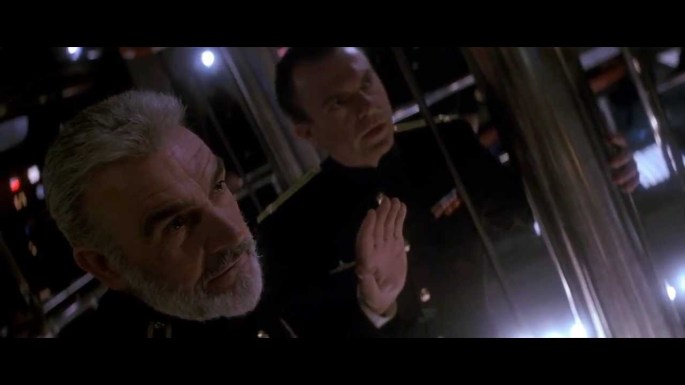
Has it really been over 20 years since The Hunt For Red October (1990) was released in theaters? It has aged surprisingly well. Fresh off back-to-back successes of Predator (1987) and Die Hard (1988), director John McTiernan was at the top of his game. He had become the go-to guy for big budget, blockbuster action films. So, it made sense that he would be entrusted with kickstarting a potential franchise with Red October, an adaptation of Tom Clancy’s best-selling novel of the same name, in the hopes of launching a series of films featuring recurring Clancy protagonist Jack Ryan. Paramount Pictures wasn’t taking any chances, casting screen legend Sean Connery and pairing him up with up-and-coming movie star Alec Baldwin. The result, not surprisingly, was box office gold and arguably the strongest entry in the Jack Ryan franchise.

It’s the mid-1980s and the Cold War is at its peak. American Naval Intelligence discovers that the Russians have created the perfect nuclear submarine — one that can run completely silent. CIA analyst Jack Ryan (Baldwin) is called in to confirm that this is true, but at the meeting with the Joint Chiefs of Staff, he puts forth a radical theory: the sub-commander of this new submarine, Captain Marko Ramius (Connery), may actually be trying to defect and not trying to start World War III as they all fear. This is further complicated when the Russians report that they’ve lost all contact with Ramius. The powers that be send Ryan into the field in the hopes that he can contact the Russian sub-commander before his countrymen blow him out of the water. The film becomes a race against time as Ryan boards the USS Dallas, the American sub closest to the Red October, and convinces its commander (Scott Glenn) that Ramius plans to defect.

McTiernan does a nice job of showing the camaraderie aboard the USS Dallas in a brief scene where the captain of the sub tells a story about how fellow crew member Seaman Jones (Courtney B. Vance) had Pavarotti blasting over the sound system during an exercise with other subs in their fleet. It’s a nice moment of levity amidst this generally serious film. McTiernan also doesn’t bog the film down with an overabundance of technical jargon. And what techno-speak there is in the film is spoken expertly by the cast in a way that is understandable. You may not understand it but you know what they mean.

Along with Das Boot (1981), Red October remains one of the few decent submarine films. And this is because McTiernan builds the tension with the right amount of white-knuckled intensity. The film attempts to maintain the suspense of whether Ramius has gone rogue or is defecting for as long as it can but since Sean Connery is playing the character this removes all doubt as to his true intentions. Connery playing a villain at this stage in his career? Ridiculous! The first hour of Red October is all set-up as the film establishes the major players and their intentions. Then, it shifts into an elaborate game of cat and mouse as both the Russians and the Americans pursue Ramius. If that wasn’t enough, McTiernan ratchets up the tension with the discovery of a saboteur aboard the Red October.

After reading the galley proofs of Tom Clancy’s novel The Hunt for Red October in February 1985, producer Mace Neufeld optioned it. The book went on to become a best-seller and still no Hollywood studio was interested because of its complicated technical jargon. Neufeld said, “I read some of the reports from the other studios, and the story was too complicated to understand.” After 18 months, he finally got a high-level executive at Paramount Pictures to read Clancy’s novel and agree to develop it into a film.

Screenwriters Larry Ferguson and Donald Stewart worked on the screenplay while Neufeld approached the United States Navy in order to get their approval. Initially, they were uncertain because of the fear that top secret information or technology might be exposed. Fortunately, several admirals were fans of Clancy’s book and argued that the film could do for submariners what Top Gun (1986) did for the Navy’s jet fighter pilots. To that end, the director of the Navy’s western regional information office in Los Angeles offered possible changes to the script that would make the Navy look good.

Alec Baldwin was approached to appear in the Red October in December 1988 but was not told for what role. Austrian actor Klaus Maria Brandauer was cast as Marko Ramius but unfortunately two weeks into film he had to quit due to a prior commitment. The producers quickly faxed a copy of the script to Sean Connery. Initially, he declined the offer because the script didn’t make any sense. It turned out that he was missing the first page which stated that the film was set in the past during the Cold War. He agreed to do it and arrived in Los Angeles on a Friday and was supposed to start filming on Monday but he asked for a day to rehearse in order to get into the role.

The Navy gave the production unparalleled access to their submarines, allowing them to take pictures of unclassified sections of the USS Chicago and USS Portsmouth for set and prop design. Key cast and crew members took rides in subs including Alec Baldwin and Scott Glenn, both of whom took an overnight trip on the USS Salt Lake City. To research for his role, Glenn temporarily assumed the identity of a submarine captain on board the USS Houston. The crew took “orders” from Glenn, who was being prompted by the sub’s commanding officer.

Shooting in actual submarines was deemed impractical and in their place five soundstages on the Paramount backlot were used with two 50-foot square platforms housing mock-ups of the Red October and the USS Dallas were built. They stood on top of hydraulic gimbals that simulated the sub’s movements. Connery remembered, “It was very claustrophobic. There were 62 people in a very confined space, 45 feet above the stage floor. It got very hot on the sets, and I’m also prone to sea sickness. The set would tilt to 45 degrees. Very disturbing.”

With The Hunt for Red October, Alec Baldwin was being groomed for A-list leading man status. Prior to this film he had appeared in an impressively diverse collection of films, playing a bland, dead Yuppie in Beetlejuice (1988), an unfaithful greaseball boyfriend in Working Girl (1988), and an unscrupulous radio station manager in Talk Radio (1988). Throughout Red October, Ryan is constantly proving his credentials to veteran military officers that he encounters, including a memorable briefing with a group of generals where he puts one of them in their place after the man condescendingly scoffs at his theory about Ramius.

After all this time has passed and two other actors have assayed the role, Alec Baldwin is still the best Jack Ryan for my money. He brings a solid mix of serious action hero with a whimsical sense of humor to his version of Ryan that is sorely missing from the stuffy, no-nonsense approach of Harrison Ford and the wooden acting of Ben Affleck. Baldwin instills a certain warmth and humanity in Ryan that is a refreshing contrast to the technology that dominates the film. Baldwin does a good job of conveying Ryan’s intelligence – after all, he’s a thinking man’s action hero – but he has his doubts and this humanizes the character.

With his baggage of iconic movie roles, Sean Connery is well-cast as the confident Ramius. There is a scene where he tells his inner circle of defectors his true intentions. Calmly eating his dinner, Ramius tells them, “Anatoli, you’re afraid of our fleet, hmm? Well, you should be. Personally, I give us one chance in three.” Connery says this in casual fashion as only he can. I suppose I believe him as a Russian sub commander as much as I believe him as an Irish cop in The Untouchables (1987). Which is to say not so much but it’s Sean freakin’ Connery, dammit! He’s the most virile Scottish actor alive today. He was James Bond and Indiana Jones’ father fer chrissakes! He pulls off the role through sheer charisma. Who else could play the enigmatic veteran commander of the entire Russian Navy? Connery has the gravitas and the iconic cinematic presence to make him seem like the ideal choice to play Ramius.

The Hunt for Red October
features a stellar cast of fantastic character actors supporting Connery and Baldwin. Two of Ramius’ senior crew members are played by Sam Neill and Tim Curry. Neill is excellent as Connery’s no-nonsense second-in-command who defends him against the other defectors who doubt Ramius’ motivations but in private voices his own concerns. You’ve got Scott Glenn as the commander of the USS Dallas, James Earl Jones as Ryan’s superior and friend, and Stellan Skarsgard as the Russian sub commander hunting down Ramius. Richard Jordan even pops up in a small but memorable part as the President’s National Security Adviser and talks like how I imagine most politicians do when they are among their own. At one point, he tells Ryan, “Listen, I’m a politician, which means I’m a cheat and a liar, and when I’m not kissing babies, I’m stealing their lollipops, but it also means that I keep my options open.” It takes a special kind of actor to come in and knock it out of the park with very little screen time but Jordan does it so well and makes it look easy.

Techno-thrillers don’t get any better than this film — you’ve got Baldwin as the reluctant hero who steps up when he has to, casting Connery with his iconic presence as the enigmatic Ramius, and a top notch supporting cast of character actors. Add to this, expert direction from McTiernan and you’ve got the best Jack Ryan film to date. Sadly, this would be his last really good film. With the exception of The Thomas Crown Affair (1999), he has struggled with the tiresome Medicine Man (1992), signed on for the redundant Die Hard with a Vengeance (1995) and finally taken up residence in Hacksville with the brainless Rollerball remake (2002). Watching The Hunt for Red October again is a sobering reminder of what a good director he used to be.

WILD AT HEART – A REVIEW BY J.D. LAFRANCE

12f6e7965cb2fbac31c874eb42335413By 1990, David Lynch was at the peak of his popularity and enjoying the most productive period of his career. His television show Twin Peaks had captivated American audiences and he was directing a number of commercials and performance art pieces (Industrial Symphony No. 1). This all culminated with Wild at Heart (1990), an adaptation of Barry Gifford’s novel, which went on to win the coveted Palme d’Or at that year’s Cannes Film Festival. It also helped establish Lynch as America’s premier cinematic surrealist. At its core, the film is a touching love story between two people whose love for each other remains constant despite all of the obstacles that life throws at them, including an overly-protective mother, a dentally-challenged psychopath, and a grizzled rocket scientist. This film is, oddly enough, Lynch at his most romantic, a rock ‘n’ roll opera with vibrant, fiery imagery.

Sailor Ripley (Nicolas Cage) and Lula Pace Fortune (Laura Dern) are young lovers on the run from her crazed and over-protective mother, Marietta (Diane Ladd). Sailor has jumped parole after serving time for manslaughter and takes off with Lula for sunny California. This doesn’t sit too well with Lula’s mom who sends her boyfriend and private investigator Johnny Farragut (Harry Dean Stanton), and, unbeknownst to him, her lover and ruthless gangster Marcellos Santos (J.E. Freeman) on the trail of the young lovers.

As he would do with the opening scene in Twin Peaks: Fire Walk With Me (1992), Lynch kicks things off with a shockingly brutal act of violence that establishes a confrontational tone – this is a violent world where Sailor is prepared to kill a man with his bare hands in order to protect the woman he loves. The first image is the striking of a match followed by images of flames announcing the color scheme that would be prevalent throughout the film. This is continued in the love scenes between Sailor and Lula that are bathed in red, yellow and orange – all representing their burning love for each other. During the course of the film there are countless shots of cigarettes being lit, matches being struck, an exploding car, and a house on fire. This film is vibrantly alive and energized more than anything Lynch had done before or has done since.

In the summer of 1989, Lynch had finished up the pilot for Twin Peaks and tried to rescue two of his projects – Ronnie Rocket and One Saliva Bubble – that were owned by Dino de Laurentiis when his company went bankrupt. Independent production company Propaganda Films commissioned Lynch to develop an updated noir screenplay based on a 1940s crime novel while a filmmaking friend of his by the name of Monty Montgomery optioned Barry Gifford’s book, Wild at Heart: The Story of Sailor and Lula in pre-published galley form. Montgomery gave him Gifford’s book and asked Lynch if he would executive produce a film adaptation that he would direct. Lynch remembers telling him, “That’s great Monty, but what if I read it and fall in love with it and want to do it myself?” And this is exactly what happened as Lynch recalls, “It was just exactly the right thing at the right time. The book and the violence in America merged in my mind and many different things happened.” Lynch was drawn to what he saw as “a really modern romance in a violent world – a picture about finding love in hell.” He was also attracted to “a certain amount of fear in the picture, as well as things to dream about. So it seems truthful in some way.”

Once Lynch got the okay from Propaganda to switch projects, he wrote a draft in a week. Within four months, he began filming with a budget of $10 million. Lynch did not like the ending in Gifford’s book where Sailor and Lula split up for good. For Lynch, “it honestly didn’t seem real, considering the way they felt about each other. It didn’t seem one bit real! It had a certain coolness, but I couldn’t see it.” Samuel Goldwyn, who ended up distributing the film, read an early draft of the screenplay and didn’t like Gifford’s ending either so Lynch changed it. However, the director was worried that this change made the film too commercial, “much more commercial to make a happy ending yet, if I had not changed it, so that people wouldn’t say I was trying to be commercial, I would have been untrue to what the material was saying.”

When Lynch read Gifford’s novel, he immediately wanted Nicolas Cage to play Sailor and Laura Dern to play Lula. The actor said that he was “always attracted to those passionate, almost unbridled romantic characters, and Sailor had that more than any other role I’d played.” In Dern’s case, this was the first opportunity she had “to play not only a very sexual person, but also someone who also was, in her own way, incredibly comfortable with herself.” During rehearsals, Lynch talked about Elvis Presley and Marilyn Monroe with Cage and Dern. Around this time, Lynch bought a copy of Elvis’ Golden Hits and, after listening to it, called Cage and told him that he had to sing two songs, “Love Me” and “Love Me Tender.” The actor, a big Elvis fan, agreed and recorded each song so that he could lip-sync to them on the set.

Before filming started, Lynch suggested that Dern and Cage go on a weekend road trip to Las Vegas in order to bond. Dern remembers, “We agreed that Sailor and Lula needed to be one person, one character, and we would each share it. I got the sexual, wild, Marilyn, gum-chewing fantasy, female side; Nick’s got the snakeskin, Elvis, raw, combustible, masculine side.”

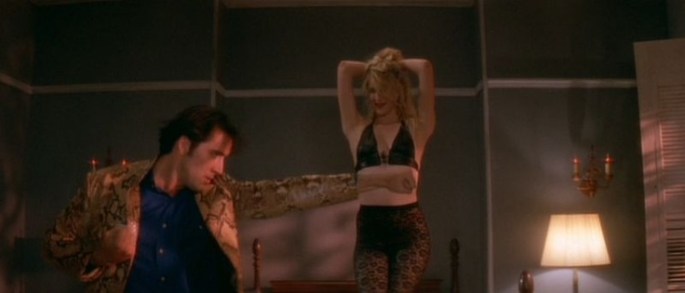
Lynch’s two leads are also on the same page in this respect, especially Cage who affects an Elvis Presley-like drawl and sings two songs made famous by the King. Sailor, like many of the characters in this film, is larger than life with his snakeskin jacket credo, his unorthodox style of dancing (involving martial arts kicks and punches) and his habit of singing Elvis songs to Lula in public. There is a show-stopping moment where he instructs Powermad, a speed metal band, to back him on a note perfect rendition of “Love Me” while the women in the audience scream in adoration in surreal slow motion like something out of a dream. Cage plays Sailor as an instantly iconic figure, where pointing an accusing finger at Marietta is akin to a declaration of war.

Dern plays Lula to gum-chewing perfection, delivering a completely uninhibited performance as Lula. She exudes a captivating sensuality in the way she carries herself and makes a line like, “You got me hotter’n Georgia asphalt,” sound like an enticing come-on. Lula is a young woman full of energy and vitality as is evident in the scene where she and Sailor dance to the music of Powermad. There is genuine chemistry and heat between her and Cage — rather appropriate for a film dominated by images of fire. However, as the film progresses and the tone becomes darker, Lula’s optimism is chipped away and this culminates in a terrifying scene where Bobby Peru (Willem Dafoe) verbally rapes her in a way that echoes a similar scene in Blue Velvet (1986).

Amidst all of this madness and brutality is a touching tenderness between Sailor and Lula, like the way he softly kisses her after a passionate bout of sex, or a moment where he places her hand over his heart without a word. Nothing needs to be said between them because they understand each other intimately. As she tells him at one point, “You mark me the deepest.” And Lynch takes the time to show a series of conversations between Sailor and Lula where they talk about their respective childhoods (“I didn’t have much parental guidance.” Sailor tells her, not surprisingly.), their dreams, random thoughts, and past relationships. This allows us to get to know and care about them while also taking the occasional breather from all of the weirdness that Lynch throws our way.

Diane Ladd is fantastic as the wicked witch cum mother-from-hell, gleefully chewing up the scenery as evident even in the way she vigorously drinks from her martini glass and the way she delivers threats to Sailor with venomous gusto. Also prevalent is Lynch’s trademark fascination with the dark underbelly of America as personified by the character of Bobby Peru, one of Lynch’s most disturbing psychopaths (right behind Blue Velvet’s Frank Booth). With his horrible teeth and all-black attire (to match his pitch black heart), Peru sets his sights on Sailor and Lula with the intention of killing the former and seducing the latter.

Lynch juxtaposes this darkness with his trademark absurdist humor in the guise of the various oddballs Sailor and Lula meet along the way, like the man at a bar (Freddie Jones) who talks about “pigeon-spread diseases” in a goofy, high-pitched, sped-up voice. Or, Lula’s wildly eccentric cousin, Jingle Dell (Crispin Glover in a memorably bizarre cameo), who believes aliens are after him, enjoys placing cockroaches in his underwear and exhibits odd, nocturnal behavior (“I’m making my lunch!”). There is also a memorable scene that introduces Bobby Peru and his friends, including Lynch regular, Jack Nance in a scene-stealing role as Boozy Spool, a dazed and confused rocket scientist who may have been sampling his own rocket fuel. He delivers a brilliantly surreal monologue that is amongst some of the best moments in any Lynch film and reminiscent of the joyride interlude at Ben’s in Blue Velvet.

Wild at Heart
also features stunning cinematography by Frederick Elmes (who also worked with Lynch on Eraserhead and Blue Velvet). In particular, there is a scene where Lula and Sailor pull over to the side of the road as she is upset and disgusted with all of the terrible news that she’s heard on the radio. He finds Powermad on a station and they get out of the car and dance before embracing passionately. Lynch cuts to a long shot and pans away to a gorgeous shot of a sunset that captures the poetic beauty of this moment perfectly.

Wild at Heart
is a film rich in emotion and feeling as everything is heightened to an operatic level. Surreal is an adjective always used to describe Lynch but he is also a very romantic filmmaker. There is the Douglas Sirkian melodrama of Blue Velvet, the emotional journey Alvin Straight takes in order to reconnect with his brother in The Straight Story (1999), and the town of Twin Peaks dealing with the grief over the death of Laura Palmer. Perhaps the most emotional scene in Wild at Heart is when Sailor and Lula drive along a deserted stretch of highway late and night and while an instrumental version of “Wicked Game” by Chris Isaak plays on the soundtrack, he tells her about how he knew her dead father. The reaction she gives is so heartbreaking, like a daughter who realizes that her father isn’t perfect.

Sailor, in some ways, is a father figure to her. He makes her feel protected and she even comments on how some of his physical features resemble her dad’s. This scene represents the first seed of doubt in their relationship. It is the first step off the yellow brick road and this is reinforced by Lula’s nightmarish vision of her mother as the Wicked Witch. And then they come across a horrible car accident and find one person still alive – a woman (Sherilyn Fenn) walking around in shock from a head wound. She eventually dies in Sailor and Lula’s arms. It is a tragic moment accentuated beautifully by Angelo Badalamenti’s moving score. This scene is a crucial turning point in the film as it descends into much darker territory as Sailor and Lula make a series of bad decisions, most notably getting involved with Bobby Peru.

Lynch loved The Wizard of Oz and put a lot of references to it in his own film. Boozy Spool talks about his dog, comparing it to Dorothy’s pooch Toto; Marietta’s picture disappears at the end of the film just like the Wicked Witch; there’s Lula’s vision of her mother as the Wicked Witch of the East; Sailor has a vision of the Good Witch (Sheryl Lee) at the end of the film, who convinces him not give up on love; and Lula clicking the heels of her shoes together after the terrifying encounter with Bobby Peru.

Early test screenings for the film did not go well with the intense violence in some scenes being too much. Lynch estimated that between 100-120 people walked out. The scene in question was the torture and killing of Johnny Farragut. “I didn’t think I’d pushed it to the point where people would turn on the picture. But, looking back, I think it was pretty close. But that was part of what Wild at Heart was about: really insane and sick and twisted stuff going on.” Lynch decided not to edit anything from the film and at the second screening another one hundred people walked out during the same scene. Lynch remembers, “By then, I knew the scene was killing the film. So I cut it to the degree that it was powerful but didn´t send people running from the theatre.”

The film was completed one day before its premiere at the 1990 Cannes Film Festival. Its first screening was in the 2,400-seat Grand Auditorium and afterwards it received “wild cheering” from the audience. Barry Gifford remembers that there was a prevailing mood among the media that hoped Lynch would fail. “All kinds of journalists were trying to cause controversy and have me say something like ‘This is nothing like the book’ or ‘He ruined my book.’ I think everybody from Time magazine to What’s On In London was disappointed when I said ‘This is fantastic. This is wonderful. It’s like a big, dark, musical comedy.’” When Jury President Bernardo Bertolucci announced Wild at Heart as the Palme d’Or winner at the awards ceremony, the boos almost drowned out the cheers with film critic Roger Ebert leading the vocal detractors.

Wild at Heart
perfectly illustrates Lynch’s love-hate relationship with America. The film is filled with beautifully shot iconography of Americana, like big convertible automobiles from the ‘50s and rock ‘n’ roll music from the period. Sailor and Lula are loving (albeit tweaked) homages to Elvis Presley and Marilyn Monroe. It is also something of an underrated film that is often ignored in favor of Lynch’s more well-known work, like Blue Velvet or Mulholland Drive (2001). One can see the film’s influence in a film like True Romance (1993), with its Elvis-obsessed protagonist and his gum-chewing white trash girlfriend as they are pursued by psychotic gangsters, or Natural Born Killers (1994) with its white trash lovers on the run, or even U-Turn (1997) with its town full of eccentric weirdoes. But no one can pull this stuff off quite like Lynch and his film is a true original that deserves to be re-discovered and re-evaluated.

STRIPES – A REVIEW BY J.D. LAFRANCE

stripesWatching Stripes (1981) again after all these years makes me nostalgic for the early comedies of the first generation of Saturday Night Live cast members: Animal House (1978), Caddyshack (1980), Fletch (1984), and so on. They were goofy and silly but they also had an engaging, anarchistic attitude that is so much fun to watch. This is definitely the case with Stripes, a film that pits a “lost and restless generation,” as the film’s main protagonist puts it at one point, against rigid authority that is only interested in producing, lean, mean, killing machines, to paraphrase another character. Much of the film’s humor comes from the clash of these two ideologies.

After losing his job, his girlfriend, and his apartment all in one morning (“You still have your health,” deadpans his best friend), John Winger (Bill Murray) decides to enlist in the Army and straighten out his life. He convinces his best friend Russell Zisky (Harold Ramis) to enlist as well (“If I get killed, my blood is on your hands,” he says, to which John replies, “Just don’t get it on my shoes.”). Once they arrive at the base and meet their no-nonsense drill instructor, Sergeant Hulka (the perfectly cast Warren Oates), John and Russell realize that it’s not going to be as easy as they imagined.

Stripes settles into a classic fish-out-of-water formula as John and his misfit platoon (with the likes of John Candy and Judge Reinhold) gradually become efficient soldiers despite their complete ineptitude and perchance for breaking all the rules. The gang of misfits fulfills all the requisite stereotypes: “Cruiser” (John Diehl) is the dumb guy, “Ox” (John Candy) is the lovable oversized oaf, “Psycho” (Conrad Dunn) is the crazy guy, and, of course, John is the group joker and self-proclaimed leader. Other conventions include casual nudity (Ox wrestles three strippers in a mud wrestling contest) and the obligatory love interests as John and Russell get involved with two cute, female MPs (P.J. Soles and Sean Young). This template would prove to be so successful that it was exploited in films like Police Academy (1984), PCU (1994) and countless others.

On his way to the premiere of Meatballs (1979), director Ivan Reitman thought up the idea for a film: “Cheech and Chong join the Army.” At the premiere, he pitched it to Paramount Pictures and, incredibly, they greenlit the project that day. Len Blum and Dan Goldberg wrote the screenplay in Toronto and would read it to Reitman (who was in Los Angeles) over the phone. He would, in turn, give them notes. Reitman gave the script to Cheech and Chong’s manager and he read it and thought it was very funny. He gave it to the comedians but they wanted complete control. Reitman then suggested to Goldberg that they change the two main characters to ones suited for Bill Murray and Harold Ramis, figuring that if they could get Ramis interested in it and let him tailor the script for the two of them that Murray would be interested in doing the film. It worked and Murray signed on to do the film.

Ramis had already co-written Animal House and Meatballs but was unknown as an actor. He screen-tested for Columbia Pictures, who hated his audition but Reitman told the studio that he was hiring him anyway. Judge Reinhold’s character, Elmo, ended up with a collection of all the best jokes from the Cheech and Chong version of the film. Before filming he thought that he had a handle on his character but once filming started, he was “petrified” because this was his first big studio film. The casting agent picked Sean Young based on how she looked and P.J. Soles tested with Ramis and they got along very well together. John Diehl had never auditioned before and this was his first paying acting job. Goldberg knew John Candy from Toronto and told Reitman that he should be in the film. He didn’t even have to audition.

One of the reasons why Stripes is my favorite Bill Murray comedy are the little touches that he adds to a scene that makes it that much funnier. For example, in the first scene where John goes to pay a guy after getting a shoe shine, Murray turns his back to the man so that he won’t see how much of a tip he’s going to give him. It’s an odd, idiosyncratic choice that no one else would’ve thought to make but it enriches the scene ever so slightly. The next scene demonstrates Murray’s gift for physical comedy when he loads a snotty rich lady’s luggage into the trunk of his cab and accidentally bags himself. It’s an obvious gag to be sure but Murray still makes it funny.

John continues to antagonize the lady (Fran Ryan) during the ride to the airport but in a deadpan, sardonic way. At one point she says, “I’ve never gone this way before,” to which he replies, “I’m sure there’s a lot of ways that I’ve gone that you haven’t.,” implying that she’s square and conservative while he’s hip and liberated, thereby establishing a clear generational gap. The rich lady insults John and so instead of getting angry at her he decides to mess with her, including one memorable bit where he starts driving fast. Suddenly alarmed, she says, “Aren’t you going too fast?” He replies, intentionally slurring his words, “Oh, it’s not the speed, really so much, I just wish I hadn’t drunk all that cough syrup.” John proceeds to give the lady a little scare but when she calls him a bum, he’s had enough and quits right in the middle of a bridge, throwing his car keys in a river and leaving her stranded.

It’s not until almost eight minutes into the film that Elmer Bernstein’s first musical cue appears and it is a slightly sad, whimsical tune. The scene where John’s girlfriend Anita (Roberta Leighton) leaves him is interesting because it straddles the line between comedy and drama. She is clearly unhappy with their relationship and he tries to deflect her complaints with humor before half-heartedly saying, “I’m part of a lost and restless generation,” and follows this up asking her a rhetorical question, “What do you want me to do, run for the Senate?” This scene underlines John’s dilemma – he lacks direction and any kind of motivation. Interestingly, no music plays during this scene so that the gravitas of it, if you will, is not undermined by manipulative music. Bernstein’s whimsical score only returns when Russell arrives and the two banter back and forth about John’s sorry state of affairs.

The chemistry between Bill Murray and Harold Ramis is excellent. Ramis is the perfect straight man to Murray’s smart-ass slacker. They had been friends and worked together for some years and play well off each other as evident in the scene where Russell bets John that he can’t do five push-ups. It is in this scene that John realizes that he’s in crap physical shape and that the army is his only hope in turning his life around. Every scene had some element of improvisation and this was due in large part to Murray and Ramis who suggested things for him to say and this spread to the other cast members. Stripes is quite possibly Murray’s best comedy. He was on his way to becoming a big movie star (he had already conquered T.V. with SNL and a scene-stealing turn in Caddyshack) and applied the comedic chops he honed on T.V. to this role. Murray has a way of delivering dialogue and being able to give certain lines a sarcastic delivery or add a look or a facial expression that makes what he says so funny.

Reitman was a fan of westerns that Warren Oates had been in and wanted someone who was strong and that everyone respected to control the misfit platoon. Reinhold said that during filming, Oates would tell everyone stories about working on films like The Wild Bunch (1969) and they would be enthralled. The casting of Oates, the veteran of many Sam Peckinpah films, gives Stripes a dose of gravitas and provides a certain amount of tension in some of the scenes he has with Murray. Sgt. Hulka is the ideal antagonist for the anti-authoritative John and their scene together in the barracks’ washroom, where Hulka finally asserts his authority, is filled with a palpable tension — unusual for a comedy but it works. Reitman wanted “a little bit of weight in the center,” and have a real argument between Hulka and Winger. It wasn’t played for laughs and allowed Murray to do something he hadn’t done before.

However, the improvisational nature of Reitman and some of the cast did not impress an old school actor like Oates. During one of the days of filming the obstacle course scenes, Reitman told the actors to grab Oates and drag him into the mud without telling the veteran actor about it in order to see what would happen in the hopes of getting a genuine reaction. Oates’ chipped his front tooth and was understandably pissed at Reitman, yelling at the director for what he did.

The film’s not-so secret weapon and scene stealer is John Candy as the lovable Ox. For example, the scene where he introduces himself to the rest of the platoon is quite funny. Candy portrays Ox as an earnest guy who wants to lose weight while Russell, in the background, reacts hilariously to what he’s saying. Candy also excelled at physical comedy as evident in the scene where Ox mud wrestles several scantily-clad women. At first, they get the upper hand on him and he’s afraid to hurt them, but after a pep talk from Winger and invoking the spirit of Curly from the Three Stooges, Ox bests six women at once! Initially, Candy wasn’t sure he wanted to do the film. “The original character didn’t look like much but Ivan said we could change it and I could do some writing. Everything fell together and we realized it could be a lot of fun.”

If Stripes has any weaknesses it is in the last third of the film where the platoon, fresh from a successful graduation parade, is trapped in an Eastern Bloc country (remember, the Cold War was still in full swing at this point) looking for John and Russell after they took off with the army’s top secret armored recreational vehicle (the uber Winnebago). This part of the movie feels forced and tacked on. It just isn’t as strong or as funny as everything that came before it. However, the first two thirds of the film are so good that not even this hurts the picture all that much.

Only during a time when the United States wasn’t at war with anyone (unless you count the Cold War), does joining the army to improve your life seem like an option if you’re reasonably educated as John and Russell are in Stripes. One gets the feeling that they could have easily had a productive life in almost any walk of life if they only applied themselves. Joining the army on a whim doesn’t seem that funny in our current climate which does date the film somewhat. Regardless, the script is filled with tons of witty dialogue and funny gags, the cast is uniformly excellent, and Murray and Ramis have never been better. At the risk of falling back on an old cliché, they just don’t make comedies like this anymore.

BEFORE SUNRISE – A REVIEW BY J.D. LAFRANCE

tumblr_mf50m3U5GF1s0xicxo1_1280Few people saw Before Sunrise when it was released in 1995 but those who did really loved it. In its own subtle and unassuming way, Richard Linklater’s film flew in the face of most romantic films at the time. It refused to be dated by obvious, trendy popular culture references and music. It featured an honest dialogue between two twentysomethings who meet by chance on a train and decide to get off together in Vienna. Before Sunrise would also mark an interesting change of pace for Linklater. With Slacker (1990) and Dazed and Confused (1993), he had worked with rather sizable ensemble casts, but with this film it was essentially two characters and the occasional people they encounter.

Before Sunrise
opens with Jesse (Ethan Hawke), an American taking a train to Vienna where he plans to fly back home after a disastrous summer trip around Europe. On-board he meets Celine (Julie Delpy), a French student headed for Paris to resume classes at the Sorbonne, thanks to a loudly bickering German couple that causes her to move and sit across from him. In a sly, self-referential nod to the format of Linklater’s to Slacker and Dazed and Confused, which adhered to a 24-hour time frame, Jesse tells Celine about a reality show he would like to see that would consist of 24-hour-long episodes documenting a day in the life of an average person. It sounds like something one of the characters in Slacker would pitch.

Jesse and Celine get to talking in the dinner car and enjoy the experience so much that they agree to get off the train together in Vienna and spend the night walking around the city getting to know each other, taking in the sights. They also encounter several intriguing people along the way, like the two guys who invite them to their play Bring Me the Horns of Wilmington’s Cow, which is an amusing reference to Sam Peckinpah’s Bring Me the Head of Alfredo Garcia (1974). The description of their play sounds quite interesting and every time I watch the film I kind of wished that Jesse and Celine had checked it out. It’s a funny, throwaway scene that appears early on and adheres to the amiable, structure established in Slacker of protagonists going from encounter to the next with no real rhyme or reason.

There’s a great moment early on when Jesse and Celine are in a record store listening booth listening to “Come Here” by Kath Bloom. It’s obviously a romantic song and you can see Jesse thinking about making some kind of romantic gesture but stopping himself because it would be way too corny. As Linklater has pointed out in an interview, there is a wonderful awkwardness about this moment that is true to life and something you don’t see much in romantic films.

Celine seems to be obsessed somewhat with death. She takes Jesse to a graveyard populated by unknown people who washed up on the banks of the Danube River. She points out one grave of a 13-year-old girl, the same age when she first saw it. Celine speaks about how much it impacted her at the time and how it still resonates with her. It’s a nice, poignant moment that reveals a lot about her character. A few minutes later, we learn how Jesse is much more jaded about love and life in general – perhaps as the result of coming from divorced parents and recently being dumped by his girlfriend. At one point, he tells Celine that he views life like “I was crashing a big party.”

Jesse and Celine kiss on the same Ferris wheel made famous in The Third Man (1949) when Orson Welles delivers a famous monologue. It is Before Sunrise’s only obvious, touristy moment. There are so many wonderful little interludes in this film, like when Jesse and Celine are sitting at an outdoor cafe and she gets her palm read by an old gypsy lady who tells them that they are stardust. It’s a funny moment but when the lady first takes a look at Celine’s hand she tells her that Celine has to resign herself to the “awkwardness of life.” It’s the one decent observation among the cliché observations that she tells Celine. After the palm reader leaves they laugh about it but the scene underlines the romantic nature of Celine and the cynical worldview of Jesse.

Celine speaks fondly of her grandmother and how she sometimes feels like an old woman and Jesse replies that he sometimes feels like a 13-year-old boy stuck in a dress rehearsal, taking notes for when he has to become an adult. I remember feeling like that in my twenties; in that transitory state between college and joining the workforce. You don’t quite feel like you belong anywhere and Linklater nails it with this exchange between Jesse and Celine.

One my favorite scenes in the film is when Jesse and Celine happen upon a street poet. Instead of just asking them for money he asks them for a word. He composes a poem for them with the word inserted somewhere. If they like it they can give him some money. He recites a wonderful little poem that is romantic and filled with evocative imagery. Again, this scene reinforces Jesse and Celine’s different views of love. She finds the poem romantic and spontaneous while he says that the street poet probably just inserted the word into a pre-existing poem that he had already written.

By today’s standards, with the proliferation of technology like cell phones and virtual meeting places like MySpace and Facebook, the way Jesse and Celine interact in Before Sunrise is positively old school and dates the film in a good way. For example, in one scene Jesse and Celine talk about past relationships over a game of pinball in a nightclub. Pinball machines are rarely made anymore and not as common as they used to be a couple of decades ago. Linklater grew up in the 1970s when pinball was all the rage and as someone who has fond memories of them, I love how they are used as a piece of business for Jesse and Celine to do while they talk about their ex’s.

What makes Before Sunrise such a great film is that it avoids the sappy clichés that are so rampant in most romantic films. Despite the Generation-X marketing of the film, complete with a Lemonheads song in the trailer, Before Sunrise also avoids that pitfall by not using any contemporary “alternative” music or excessive usage of pop culture references that have mired and dated lesser films. This was a conscious concern for the cast as Delpy said in an interview, “We wanted to avoid any pop culture references and just show individuals attempting to communicate and care for someone else.”

The seeds for the film had been planted long ago. According to Linklater, he had been thinking about Before Sunrise for five years. It would be a film about two people, because, at the time, he had never really dealt with male-female issues or romance. The film was based on an encounter Linklater had in 1989. He met a woman in a toy store in Philadelphia and they spent the night walking around the city together, conversing deep into the night. Originally in the screenplay, who the two characters were and the city they spend time in was vague. He realized that because the film was so much a dialogue between a man and a woman he knew that it was important to have a strong woman co-writer – Kim Krizan who had small roles in Slacker and Dazed and Confused. He wanted to write a script with her because he “loved the way her mind worked – a constant stream of confident and intelligent ideas.”

Linklater wanted to explore the “relationship side of life and discover two people who had complete anonymity and try to find out who they really were.” He put Jesse and Celine together in foreign country because “when you’re traveling, you’re much more open to experiences outside your usual realm.” He and Krizan talked about the concept of the film and the characters for a long time. Then, they worked on an outline followed by the actual script which was written in 11 days.

Before Sunrise
is filled with great conversations about sex, relationships, dreams, death, religion, and life in general. Imagine My Dinner with Andre (1981) if the two characters from that film had actually left the restaurant. There are conversations in Before Sunrise that you swear you’ve had before — they are that good. It doesn’t hurt that the film contains only two protagonists and this enables Linklater to take the time and explore their personalities. “In both Slacker and Dazed and Confused, the audience was literally plopped down amongst the characters and you never really got to know them that well apart from their momentary interactions and behavior with each other. So I wanted to make a movie about a unique relationship while still conforming to a character-driven narrative where their personal thoughts are continually verbalized.” The structure of Before Sunrise lies in the characters themselves. The narrative is propelled by their decisions and their actions. Linklater was careful in who he chose for the two main roles which went to Ethan Hawke and Julie Delpy. The director didn’t care what they had done before, but instead based his choice on his impressions based upon meeting the two actors.

When Linklater first considered casting Hawke he thought the actor was too young. Linklater saw him at a play in New York City and reconsidered after talking to him. To his credit, Hawke amends for his self-conscious hipster from Reality Bites (1994) – something I can’t fault him for entirely as I’m sure he played the character as it was written. With Jesse, Hawke plays a much more developed, three-dimensional character that he obviously had input on how he was going to portray him. Hawke’s character actually suggests some depth and personality than merely turning into a philosophizing, ‘70s sitcom quoting machine like in Reality Bites. Initially, Jesse comes across as Linklater’s philosopher character at the beginning of Slacker with his crazy idea for a reality show, but over the course of the film he falls under Celine’s spell. She manages to get past his cynical exterior with her earnest romanticism. Hawke does a nice job of hinting at the romantic that lurks beneath his facade only to emerge in the subsequent sequel Before Sunset (2004).

Linklater met Julie Delpy and liked her personality. She is simply wonderful in her portrayal of Celine. Before Sunrise is, without a doubt, my favorite performance of hers. She plays Celine as a smart, funny independent woman but with insecurities and self doubts that only make her even more endearing. It doesn’t hurt that she’s beautiful, truly the Botticelli angel that Jesse describes her as being. As she remembers, “Although my character was very much my romantic side, I also had to be strong while dealing with this American man.” Delpy was concerned that her character would be reduced to some “cliché-ridden feminine mass,” but Linklater never lets this happen. This is due in large part to the fact that he wrote the screenplay with Kim Krizan to give the film more balance. “I certainly thought that since the film is so much a dialogue between a man and a woman,” Linklater explains, “it was important to have a strong woman co-writer and a strong woman in the production.” Delpy has incredible chemistry with Hawke and it feels genuine. The way they look at each other, especially when the other one is talking, you can see, over the course of the film that their characters are falling in love.

At one point Jesse tells Celine, “I feel like this is some dream world we’re in,” to which she replies, “It must be like I’m in your dream and you’re in mine.” This is what Before Sunrise is – a cinematic dream world that we can lose ourselves in every time we watch it. Linklater captures a specific moment in time for these two characters – one magical night where they make a true connection that they will never forget. Interestingly, Before Sunrise ends like Dazed and Confused, in the early morning with Jesse and Celine rejoining the real world after spending all night together. Near the end of the film there is a montage of places that they shared together – it’s a visual summary of the film and also a sad reminder of places that they will never be again. Before Sunrise ends on a melancholic note with feelings of longing for what could have been. It’s a very unusual way to end a romantic film but it is keeping perfectly in tone with the rest of the film.

A PERFECT WORLD – A FILM REVIEW BY J.D. LAFRANCE

apw059In 1993, Clint Eastwood was enjoying a resurgence in popularity. His revisionist western Unforgiven (1992) won three Academy Awards and he received critical and commercial acclaim for his performance in the action-thriller, In the Line of Fire (1993). When he was approached with the screenplay for A Perfect World (1993), he was still making Line of Fire and doing promotion for the Academy Award nominations for Unforgiven. As a result, Eastwood anticipated only directing A Perfect World. However, when Kevin Costner came on board, he felt that Eastwood would be perfect for a smaller role in the film. Eastwood agreed because it wouldn’t require him to spend a lot of time in front of the camera.
A Perfect World is essentially a road movie set in Texas, 1963, three weeks before the John F. Kennedy assassination (an event that subtly hangs over the film with ominous foreshadowing) that recalls a simpler, even more innocent time. Thematically there is much more going on as the film wrestles with father/son relationships, child abuse and religion. The film begins with two convicts making a daring escape from prison only to take refuge in the neighboring suburbs. Terry Pugh (Keith Szarabajka) is the more amoral one as he wants to kill the driver of the vehicle they commandeer to leave the prison. He then later tries to rape a woman whose house he breaks into. The other convict, Butch Hayes (Kevin Costner), steps in before things go too far with Pugh and the woman. Butch even convinces her little boy, Phillip (T.J. Lowther), to give him the handgun that was dropped during the ensuing scuffle.

This is a crucial moment because it establishes early on the instant bond between Butch and Phillip. Despite the circumstances, there is something about Butch that Phillip intrinsically trusts. What this is will become more apparent later on in the film. When a neighbor intervenes unexpectedly, Butch and Pugh kidnap Phillip and take off in a stolen car. Texas Ranger Red Garnett (Clint Eastwood) is called in to track down and bring in the fugitives. However, the Governor (Dennis Letts) assigns him a criminologist by the name of Sally Gerber (Laura Dern). He immediately resents her intellectual approach to the situation as opposed to her being a woman, which would have been the norm at the time. He tells her, “This is not a penal escape situation, this happens to be a manhunt. And no talking around in circles is gonna fix all that.” Eastwood immediately establishes an antagonistic relationship between Red and Sally, which parallels the antagonistic relationship between Butch and Pugh. In no time at all, both conflicts will be resolved – one amicably, the other violently.

Like many of Eastwood’s characters, Red works on instinct and common sense. He resents authority figures and bureaucracy. He likes to be left alone and do things his own way. He sees Sally as an annoyance and a possible obstacle in his path. However, she clears the air pretty quickly, letting him know that she’s no pushover when she tells him, “But the one thing I won’t do is be your straight man so you can play hero to a bunch of morons who think you’re some kind of hillbilly Sherlock Holmes.” These lines deflate Eastwood’s traditional stoic lawman façade and Red even offers a compromise of sorts. He encourages Sally to speak up and even though he might not agree with her theories, he’s willing to listen. A Perfect World proceeds to cut back and forth between Butch and Phillip’s developing friendship and the partnership between Red and Sally with the two storylines dovetailing finally at the film’s conclusion.

One of the hallmarks of Eastwood’s directorial efforts is an emphasis on character and the relationships that are created between them. This film is no different with John Lee Hancock’s superbly written screenplay. He would go on to adapt Midnight in the Garden of Good and Evil for the film of the same name that Eastwood also directed in 1997. Sadly, they haven’t teamed up since but these two efforts are proof that they were a good match for each other. Hancock’s screenplay is filled with clever dialogue, like when Butch tells Phillip his theory about how a car is a time machine. Everything behind them is the past, everything in front is the future and inside the car is the present. “We’re time traveling through Texas,” Butch proudly proclaims. And in a way that’s what the film is doing – taking us back to a time that doesn’t exist anymore, to a time before President Kennedy was killed and when people were more hopeful and optimistic. His assassination (and that of other key figures of the 1960s) changed all that and we watch these events transpiring with the knowledge of how radically history will change in a few short months.

Hancock’s screenplay should also be noted for how well it develops the relationship between Butch and Phillip. Early on, Butch puts his trust in the boy by leaving him and Pugh in the car with the gun while he goes into a store for supplies. Pugh is able to get the drop on Phillip and take the gun away from him only to find out that there are no bullets in it. Butch assumed that this would happen and did not want to see Phillip get hurt. He may be a convict but he is not as heartless as Pugh. In turn, Phillip trusts Butch and stays with him even when he has the option, on a couple of occasions, to escape. Butch makes Phillip feel important and needed. Once they are on the road, having ditched Pugh, Butch refers to the boy as the navigator of the car. Later on, he asks Phillip to scout a car that he is interested in stealing. Butch doesn’t make Phillip feel like a passive observer but encourages him to become involved in their adventures.

Another significant factor in their friendship is Phillip’s lack of a father figure – something that Butch can also relate to and this provides common ground between them. Butch also speaks honestly to the boy. In one scene, when Phillip says that his mother told him his father would return, Butch replies that she lied and that he is never coming back. He doesn’t come out and say it but we sense that Butch knows this from his own personal experience. He also broadens the boy’s horizons by allowing him to experience things that his Jehovah’s Witness practicing mother would never condone, like drinking soda or wearing a Halloween costume and going trick or treating.

The relationship between these two characters works so well not just because of the excellent script but also because of the strong performances from Costner and T.J. Lowther. On the surface, Butch seems like one of Costner’s cocky, cool characters that he is often known for (i.e. Fandango, Silverado or Bull Durham), yet underneath lurks a dark, dangerous streak that surfaces when he sees a child being abused (the sure sign that Butch was probably abused when he was a child as well). Eastwood never lets us forget that Butch is a criminal. Costner is able to balance this element of danger with his trademark charm, like when he helps Pugh differentiate between a fact and a threat in a scene that is slightly threatening because violence is involved but is also funny as well because of the absurd tone. If Costner had any doubts about his character going into this film, Eastwood assured him that movie stars like Humphrey Bogart and James Cagney weren’t afraid to play convicts and “have a bad side,” the director said, “and I had Kevin play a much harder edge than he has played.”

Lowther matches Costner’s performance with his superb take on a shy, young boy who develops a strong bond with his captor. He has such an expressive face, which he uses to great effect during emotional scenes, like the internal conflict that becomes apparent when Phillip is given the chance to escape or stay with Butch. He has been cut off from everything and everyone he knows. He has little choice but to stay with the convict. Lowther doesn’t have too much dialogue but he is able to convey so much with a look and with his expressive eyes. He is more than capable of holding his own with Costner and their scenes together are well-played as we see their friendship develop over time. Eastwood was never interested in playing the sympathy angle with this friendship. He said, “You can’t have him treat the kid as if he’s paternal. I didn’t want it to come off like he’s cuddling the kid.” Above all, the director did not want the boy to “become precious. I wanted an un-Disneyesque kid.”

The script also provides motivation for Red’s personal interest in this case. We learn that the lawman put Butch in juvenile hall when he was young in an attempt to save him from his abusive father but it turned him into a career criminal. Red even paid off a judge so that Butch would stay in longer and so he feels guilty and responsible for what happened to him. Even though he never comes out and says it, one feels that Red wants to be the person to find Butch and try set things right. This backstory also explains the convict’s hatred for any kind of child abuse (Pugh hitting Phillip or a mother physically scolding her two children) and this manifests itself in a particularly strong way towards the end of the film when he and Phillip take refuge in a poor family’s house in what is surely the darkest scene in the film. After witnessing the father repeatedly abusing his little boy, Butch hits and threatens the father, his own rage threatening to boil over. A scene that started off warm and inviting turns into one that is uncomfortable and filled with tension as Phillip sees just how dangerous Butch can be. He ties up the entire family and we see how this affects Phillip as he observes the fear in the eyes of the mother and her child as Butch threatens the father repeatedly.

Phillip stops Butch before anything fatal happens to the family but the question lingers, was he going to kill them or just tie them up so that they couldn’t get away? Regardless, Phillip shoots Butch and runs away, setting the stage for the film’s climactic showdown between Red and Butch. Even here, Eastwood defies our expectations by drawing out the stand-off. The relationship between Butch and the boy continue to play out as he apologizes for shooting him. They have one last emotional conversation and because we have gotten to know these characters, we care about what happens to them. Their final moments are very touching, even moving. Costner and Eastwood finally have a scene together and this is what we’ve been waiting for the entire film. Not much is said between them and this is because we already know their motivations, Eastwood has been building to this moment. Visually, A Perfect World begins and ends the same with a slow motion shot of Butch lying in a field with money floating around him in the wind but by the film’s conclusion we know how and why he got there.

These sequences feel like something out of a dream and coupled with the leisurely pace probably didn’t endear it to mainstream audiences who were expecting another crowd-pleasing popcorn movie like In the Line of Fire. A Perfect World is closer to Unforgiven thematically as both films explore how the sins of the past affect the present with Eastwood playing tortured characters that try to fix old mistakes that had life-altering consequences but end up resolving things violently. In the case of Unforgiven, Eastwood’s character takes an active part in this resolution but with A Perfect World events spiral out of his control. This film is one of his most underrated efforts to date with its almost lyrical approach making it ripe for rediscovery by another generation of filmgoers receptive to an Eastwood film with complex relationships and a tragic conclusion reminiscent of more recent efforts like Mystic River (2003) and Million Dollar Baby (2004).

BIG TROUBLE IN LITTLE CHINA – A REVIEW BY J.D. LAFRANCE

big trubs born ready

“What I’d like to do today is get your version of what happened,” says a mild-mannered, middle-aged attorney. “Oh? You mean the truth,” replies a rather small, aging Chinese man who identifies himself as bus driver, Egg Shen (Victor Wong). The attorney remains skeptical as his potential client calmly describes his belief in Chinese black magic, and other supernatural phenomenon. As if to prove his point, the man holds up his hands so that they are parallel to one another. Suddenly, small bolts of blue electricity begin to flow from each palm, much to the attorney’s amazement and Shen’s bemusement. “That was nothing,” Shen states. “But that’s how it always begins. Very small.” And with this intriguing, tell-me-a-scary-story teaser, John Carpenter’s film, Big Trouble in Little China (1986), takes us on a ride into the heart of ancient Chinese lore and mythology.

Carpenter, always the maverick director with a knack for exploring offbeat subject matter (see They Live and In the Mouth of Madness), created a film that simultaneously parodies and pays homage to the kung-fu film. This often-maligned genre is given a new level of respectability that is rarely seen in Hollywood. Gone are the ethnic slurs, the insulting stereotypes and that annoying quasi-Chinese music that always seems to accompany representations of Asians in past mainstream features. Big Trouble takes great care in presenting funny and intelligent characters without caring whether they are Chinese or not. What is of paramount importance to Carpenter is telling a good story. He has created an entertaining piece of fantasy that manipulates the conventions of the action film with often-comical results.

From the engaging prologue, Big Trouble takes us back to the beginning of our story with the first appearance of truck driver Jack Burton (Kurt Russell), a good-natured, fast-talking legend in his own mind. When he and his buddy, Wang Chi (Dennis Dun), go to the airport to pick up the latter’s future bride arriving from China, a mix-up occurs. Wang’s bride-to-be is kidnapped by The Lords of Death, a local gang of Chinese punks, and the duo quickly find themselves immersed in the middle of an ancient battle of good vs. evil with immortality hanging in the balance. This struggle takes place deep in the heart of the Little China neighborhood of San Francisco with Burton and Wang Chi taking on David Lo Pan (James Hong), “The Godfather of Little China.” Even Egg Shen appears to help our heroes and provide them with the means to stop the evil that threatens not only Little China, but of course, the whole world.

Big Trouble in Little China was originally written as a period Western set in the 1880s with Jack Burton as a cowboy who rides into town. Producer Paul Monash bought Gary Goldman and David Weinstein’s screenplay but after a reading he found that it was virtually unfilmable due to the bizarre mix of Chinese mythology and the Wild West setting. He had the two first-time screenwriters do a rewrite, but Monash still didn’t like it. “The problems came largely from the fact it was set in turn-of-the-century San Francisco, which affected everything — style, dialogue, action.” The producer decided against having Goldman and Weinstein do additional rewrites because they didn’t want to upgrade the story to a contemporary setting and felt that they had done their best.

Keith Barish and Monash brought in W.D. Richter, a veteran script doctor (and director of cult film, The Adventures of Buckaroo Banzai) to extensively rewrite the script. Almost everything in the original screenplay was discarded except for Lo Pan’s story. “I realized what it needed wasn’t a rewrite but a complete overhaul. It was a dreadful screenplay. This happens often when scripts are bought and there’s no intention that the original writers will stay on.” Richter’s template for his draft was Rosemary’s Baby (1968). “I believed if, like in Rosemary’s Baby, you presented the foreground story in a familiar context — rather than San Francisco at the turn-of-the-century, which distances the audience immediately — and just have one simple remove, the world underground, you have a much better chance of making direct contact with the audience.” Richter was having a hard time getting his own scripts made into movies so he tried sneaking in his own eccentric ideas into other people’s projects. “It’s often easier to take an idea that they bring to you and try to pass it through your sensibility. If you’re honest up front, you get license to work with material you wouldn’t get them to look at if it was your own story.”

John Carpenter had wanted to do a film like Big Trouble in Little China for some time. Even though it contains elements of an action / adventure / comedy / mystery / ghost story / monster movie, it is, in the filmmaker’s eyes, a kung-fu film. “I have dug the genre ever since I first saw Five Fingers of Death in 1973. I always wanted to make my own kung-fu film, and Big Trouble finally gave me the excuse to do just that.” Barish and Monash offered Carpenter the movie in July of 1985. He had read the Goldman/Weinstein script and deemed it “outrageously unreadable though it had many interesting elements.” After reading Richter’s script he decided to direct. Carpenter loved the off-the-wall style of Richter’s writing and coupled with his love of kung-fu films, it is easy to see why he jumped at the opportunity to make Big Trouble.

The two filmmakers had crossed paths before when Carpenter rewrote Richter’s screenplay, The Ninja, a big-budget martial arts epic, for 20th Century Fox. In fact, Richter and Carpenter had both attended University of Southern California Film School from 1968 to 1971. “Rick and I went through all three production classes together. We each had our own crews, so we never actually collaborated on a film.” Carpenter made his own additions to Richter’s screenplay, which included strengthening Gracie Law’s role and linking her to Chinatown, removing a few action sequences (due to budgetary restrictions), and eliminating material deemed offensive to Chinese Americans. Carpenter was disappointed that Richter didn’t receive a proper screenwriting credit on the movie for all of his hard work. A ruling by the Writer’s Guild of America gave Goldman and Weinstein sole credit.

Problems began to arise when Carpenter learned that the next Eddie Murphy vehicle, The Golden Child (1986), featured a similar theme and was going to be released near the same time as Big Trouble. Ironically, Carpenter was asked by Paramount to direct The Golden Child. “They aren’t really similar. Originally, Golden Child was a serious Chinese, mystical, very sweet, very nice film. But now they don’t know whether to make it funny or serious.” However, as both films went into production, Carpenter’s views of the rival production became increasingly bitter. “Golden Child is basically the same movie as Big Trouble. How many adventure pictures dealing with Chinese mysticism have been released by the major studios in the past 20 years? For two of them to come along at the exact same time is more than mere coincidence.” To avoid being wiped out by the bigger star’s film, Carpenter began shooting Big Trouble in October 1985 so that 20th Century Fox could open the film in July 1986 — a full five months before Golden Child’s release. This forced the filmmaker to shoot the film in 15 weeks with a $25 million budget.

To achieve the efficiency that he would need for such a shoot, Carpenter surrounded himself with a seasoned crew from his previous films. He reunited with three long-time collaborators, line producer Larry J. Franco (Starman), production designer John Lloyd (The Thing), and cinematographer Dean Cundey. The cameraman had worked with Carpenter on his most memorable features: Halloween (1978), Escape from New York (1981), and The Thing (1982). The director wanted as many familiar faces on board because “the size and complexity are so vast, that without it being in dependable, professional hands, it could have gone crazy…So I went back to the guys who had been with me in the trenches before on difficult projects.”

Carpenter and Cundey had parted company before Starman due to “attitude problems.” Cundey says it was due to scheduling conflicts, but Carpenter has said that they had problems while working on The Thing. However, when Big Trouble came along, Carpenter met Cundey in Santa Barbara one weekend. “His attitude about survival in the [movie] business coincided with my own. We had a really good time, so we decided to work together again.”

Big Trouble also saw Carpenter re-team with his old friend, actor Kurt Russell who has appeared in several of the director’s films, most notably Escape From New York and The Thing. At first, Carpenter didn’t see Russell as Jack Burton. He wanted to cast a big star like Clint Eastwood or Jack Nicholson to compete with Golden Child‘s casting of Eddie Murphy. However, both Eastwood and Nicholson were busy and Fox suggested Russell because they felt that he was an up-and-coming star. The actor remembered reading the script and thinking that it “was fun, but I was soft on the character. I wasn’t clear how to play it. There were a number of different ways to approach Jack, but I didn’t know if there was a way that would be interesting enough for this movie.” After Carpenter and Russell began to go over the script, the character started to take shape. The role was a nice change for Russell as Carpenter remembers, “Kurt was enthusiastic about doing an action part again, after playing so many roles opposite ladies recently. So off we went.”

After watching Big Trouble it’s impossible to see anybody else as Jack Burton. Russell perfectly nails the macho swagger of his character: he’s a blowhard who’s all talk, totally inept when it comes to any kind of action and yet is still a likable guy. It is the right mix of bravado and buffoonery, a parody of the John Wayne action hero much in the same way Russell made Escape From New York’s Snake Plissken a twisted homage to Clint Eastwood. Russell said, at the time, that he “never played a hero who has so many faults. Jack is and isn’t the hero. He falls on his ass as much as he comes through. This guy is a real blowhard. He’s a lot of hot air, very self-assured, a screw-up. He thinks he knows how to handle situations and then gets into situations he can’t handle but some how blunders his way through anyhow.” Russell showcases untapped comedic potential that ranges from physical pratfalls to excellent comic timing in the delivery of his dialogue. One only has to look at his scene with Wang and the elderly Lo Pan to see Russell’s wonderful comic timing. No one before or since Big Trouble has been able to tap into Russell’s comedic potential as well as Carpenter does in this movie.

By many of the actors’ accounts, Carpenter is a director open to suggestions and input from everyone involved. Dennis Dun’s character starts off as the sidekick of Big Trouble and ends up accomplishing most of the film’s heroic tasks while the initial hero, Jack Burton, becomes the comic relief. Prior to Big Trouble, Dun’s only other film role was a small part in Michael Cimino’s Year of the Dragon (1985) but he was a veteran of more than twenty plays. Carpenter liked the actor in Cimino’s film and met with him twice before casting him in Big Trouble. Even though shooting began only a few days after Dun was cast, the action sequences weren’t hard for the actor who had “dabbled” in martial arts training as a kid and done Chinese opera as an adult.

Dun enjoyed the freedom he had on the set. “John gave me a great deal of leeway to develop my character and pretty much let me do what I wanted. He just encouraged me to be as strong as I could. He gave me a lot of freedom.” This freedom results in a very strong performance from Dun who holds his own against a veteran actor like Russell. Dun remembers that he and Russell shared the same approach to acting. “We never really talked about the scenes. We would come in that day to shoot a scene, and we would just do it. A large part of it was working off each other, just looking in each other’s eyes and taking each other’s energy and running with it.” The chemistry between the two characters is one of the many endearing qualities of Big Trouble as evident from numerous scenes, most notably the one where Wang Chi bets Jack that he can split a beer bottle in half and the scene where the two men attempt to break into Lo Pan’s building to rescue Wang’s fiancée.

The studio pressured Carpenter to cast a rock star in the role of Gracie Law, Jack Burton’s love interest and constant source of aggravation. For Carpenter there was no question, he wanted Kim Cattrall. The studio wasn’t crazy about the idea because at the time Cattrall was primarily known for raunchy comedies like Porky’s (1981) and Police Academy (1984). “I told them we needed an actress, and I enjoyed the way Kim wanted to play the character. She blended in well with the film’s style.” Cattrall plays Gracie as a pushy, talkative lawyer who acts as the perfect foil for deflating Burton’s macho ego at every opportunity.

Big Trouble’s script cleverly avoids the trap of reducing her role to a screaming prop by having Gracie take an aggressive part in the action. “Actually,” Cattrall said in an interview, “I’m a very serious character in this movie. I’m not screaming for help the whole time. I think humor comes out of the situations and my relationship with Jack Burton. I’m the brains and he’s the brawn.” There’s a great give and take between her and Russell. Their characters make for an entertaining screwball comedy couple: he’s always on the make while she constantly fends off his obvious advances. This was Carpenter’s intention. He saw the characters in Big Trouble like the ones “in Bringing Up Baby or His Girl Friday. These are very 1930s, Howard Hawks people.” Listen to how Jack and Gracie talk to each other — it’s a very rapid-fire delivery of dialogue that is reminiscent of Hawks’ comedies.

Production designer John Lloyd designed the elaborate underground sets and re-created Chinatown with three-story buildings, roads, streetlights, sewers and so on. This was necessary for the staging of complicated special effects and kung-fu fight sequences that would have been very hard to do on location. For the film’s many fight scenes Carpenter “worked with my martial arts choreographer, James Lew, who literally planned out every move in advance. I used every cheap gag – trampolines, wires, reverse movements and upside down sets. It was much like photographing a dance.”

Another refreshing aspect of Big Trouble is the way it is immersed in authentic Chinese myths and legends. Carpenter explains: “for example, our major villain, Lo Pan, is a famous legend in Chinese history. He was a ‘shadow emperor,’ appointed by the first sovereign emperor, Chan Che Wong. Lo Pan was put on the throne as an impersonator, because Chan Che Wong was frightened of being assassinated. Then, Lo Pan tried to usurp the throne, and Chan Che Wong cursed him to exist without flesh for 2,000 years, until he can marry a green-eyed girl.” Big Trouble could have easily made light of Chinese culture, but instead mixes respect with a good dose of fun.

Big Trouble also places Asian actors in several prominent roles, including Victor Wong and Dennis Dun who is the real hero of the story, as opposed to Kurt Russell’s character who is a constant source of comedy. “I’ve never seen this type of role for an Asian in an American film,” Dun commented in an interview, “I’m Chinese in the movie, but the way it’s written, I could be anybody.” Big Trouble crushes the rather derogatory Charlie Chan stereotype by presenting interesting characters that just happen to be Chinese. Carpenter also wanted to avoid the usual cliché soundtrack. “The other scores for American movies about Chinese characters are basically rinky tink, chop suey music. I didn’t want that for Big Trouble. I wanted a synthesizer score with some rock ‘n’ roll.”

As if sensing the rough commercial road that the film would face, Russell felt that it would be a hard one to market. “This is a difficult picture to sell because it’s hard to explain. It’s a mixture of the real history of Chinatown in San Francisco blended with Chinese legend and lore. It’s bizarre stuff. There are only a handful of non-Asian actors in the cast.” Unfortunately, mainstream critics and audiences did not care about this radical reworking of the kung-fu film. Opening in 1,053 theaters on July 4, 1986, Big Trouble in Little China grossed $2.7 million in its opening weekend and went on to gross $11.1 million in North America, well below its estimated budget of $25 million.

Big Trouble came out before the rise in popularity of Hong Kong action stars like Jackie Chan, Jet Li and Chow Yun-Fat, and filmmakers like John Woo and Wong Kar-Wai. Mainstream audiences weren’t ready for this kind of movie. Despite being promoted rather heavily by 20th Century Fox, Big Trouble disappeared quickly from theaters. Bitter from having yet another movie of his snubbed by critics and ignored by audiences, Carpenter swore off the big studios. He learned the hard way that working with them meant compromising his art in order to advance his career. Carpenter laid it all out in an interview a year later: “everybody in the business faces one truth all the time — if your movie doesn’t perform immediately, the exhibitors want to get rid of it. The exhibitors only want product in their theaters which makes money. Quality has nothing to do with it.” Years later, he said, “The experience [of Big Trouble] was the reason I stopped making movies for the Hollywood studios. I won’t work for them again. I think Big Trouble is a wonderful film, and I’m very proud of it. But the reception it received, and the reasons for that reception, were too much for me to deal with. I’m too old for that sort of bullshit.”

Big Trouble in Little China has stood the test of time. It was rediscovered on home video where it has become a celebrated cult film with a dedicated audience. It has since become one of the most beloved films in John Carpenter’s career and with good reason. It is a fun, clever movie that still holds up today and remains one of the finest examples of cinema as pure entertainment.

THE LAST BOY SCOUT – A REVIEW BY J.D. LAFRANCE

3BRLjwxF2rmVFedrQkjNdPcd8UwShane Black’s career has had a fascinating, meteoric rise and fall (and rise again). The screenwriter hit the big time when his breakthrough screenplay for Lethal Weapon (1987) sold for $250,000. This kick-started a wildly popular action film franchise. He soon hit rock bottom with the heavily re-written (by others) modest hit, The Long Kiss Goodnight (1996), the script of his that sold for a staggering $4 million. And yet, even his weaker efforts still contain decent action sequences and playful banter between characters. What seemed to be missing in Black’s later films was depth and characterization – elements that made his screenplays distinctive. Perhaps this was as a result of meddling and script revisions at the hands of others. For Black, screenwriting came easy: “The fact that there were so few rules associated with it, so few actual structural maxims … you can just do what you want. So I played around and it was fun. I would just type to keep myself entertained. It turned out people liked that. They felt it represented an interesting way to go, but for me it was truly just typing to keep myself entertained.”

Studio executives were only interested in using Black to write formulaic drivel. Determined to make it, he wrote Lethal Weapon. The script was a blast of fresh air and ended up being made into a big budget action film starring Mel Gibson and Danny Glover. This kind of thing almost never happens in Hollywood and it’s a testimony to Black’s skill as a screenwriter that he achieved this kind of success so early on in his career. Lethal Weapon grossed over a $100 million. In the best tradition of Hollywood, money talks and so in 1990, Black was paid $1.75 million (an unheard of amount at the time) for The Last Boy Scout script. The next year it was made into a 1991 action movie starring Bruce Willis and Damon Wayans and directed by the late Tony Scott.

The film starts off literally with a bang as a pro-football player (a pre-infomerical Billy Blanks) pulls out a handgun right in the middle of a play and shoots three opposing players in his way to getting a touchdown before killing himself. Joe Hallenbeck (Bruce Willis) is a private detective hired by his best friend (Bruce McGill) to protect a stripper named Cory (Halle Berry in an early role). The best friend is subsequently blown up in a car and the stripper gunned down by thugs. Her washed-up, football-playing boyfriend Jimmy (Damon Wayans) hooks up with Joe to get some answers and some much needed payback.

“I had this period where I didn’t think I was any good at anything and fought desperately to stay afloat,” Black said in an interview with Creative Screenwriting magazine. And with that feeling in mind, Black wrote a movie that pushes the world-weary detective stereotype to then new, surreal levels. Willis’ performance and Black’s screenplay combine to produce a portrait of a guy who is so down and out that our first glimpse is a shot of him passed out in his own car while being harassed by snotty neighborhood kids with a dead squirrel. When we meet Joe he has a pretty simple outlook on life – a mantra, if you will, to start each day: “Nobody likes you. Everybody hates you. You’re gonna lose. Smile you fuck.” Willis, who has made a career out of playing world-weary tough guys, nails the defeated vibe that sticks to Joe like stink on dog poop. Joe’s actually a very disillusioned good guy, an ex-Secret Service agent who saved the President’s life once but got fired after he punched out a senator (Chelcie Ross) with a kinky streak. Throughout the movie, Willis delivers deadpanned one-liners while constantly getting the crap kicked out him. As a result, you can’t help but root for him as he and Wayans send the baddies to their well-deserved violent deaths.

Willis plays a classic burn-out, sporting the traditional slovenly appearance of a down-on-his-luck P.I. complete with unshaven look and rumpled clothes that he slept in. And that’s the best he looks, from that point on it’s all downhill as his face takes on cuts and lacerations accrued from fighting numerous bad guys. Joe actually uses his disheveled appearance to his advantage, like when a random baddie takes him into an alleyway to kill him. Joe buys time by cracking jokes about the flunkie’s wife and then, when the guy lets his guard down, stabs him in the throat with a broken bottle. The guy gurgles, “You bastard,” to which Joe curtly replies, “And then some.” Willis was born to spout Black’s dialogue. He’s the master of sarcastic comebacks and gets some real doozies in The Last Boy Scout. At one point, Jimmy chides him, “You read much?” Joe replies, “My subscription to Juggs magazine just ran out.”

Jimmy is also at an emotional cul-de-sac of sorts – popping pills to stave off chronic pain from football injuries he picked up as a player. Like Joe, he’s been disgraced from his former profession, kicked out of the league for gambling. He now spends time feeling sorry for himself by cultivating a drinking problem and nailing anything in a skirt despite having a super-hot stripper girlfriend played by Halle Berry (only in the movies!). Like Martin Riggs in Lethal Weapon, Jimmy lost his family to tragedy and it taints his entire worldview. Life means nothing and solving his girlfriend’s murder is the only thing he has left. Wayans shows that he’s more than just a goofy funnyman in a scene where he tells Joe how he got kicked out of football. It is an angry tirade tinged with hurt and bitter resentment as he was basically chewed up and spit out by an uncaring organization. His speech touches upon the harsh realities of professional sports.

Scott populates his movie with a fine collection of character actors, chief among them Noble Willingham as uber rich football team owner Sheldon Marcone and stand-up comedian Taylor Negron cast wonderfully against type as one of Black’s trademark polite, well-spoken sociopaths (see also Lethal Weapon’s Mr. Joshua and The Long Kiss Goodnight’s Timothy). Marcone is also a repeating motif in Black’s scripts. He’s an old, privileged white man who is greedy and corrupt. Think of the money-laundering retired general in Lethal Weapon and the war-mongering CIA boss in The Long Kiss Goodnight. Black clearly sees these men as the source of real evil in the world, pulling the strings that will result in death and destruction in the name of money. In all three films, the protagonists face insurmountable odds to do what is right regardless of the danger or risk to their own well-being.

Like most buddy action movies, the relationship between Joe and Jimmy starts off with plenty of friction as the quarterback resents the private investigator watching over his girlfriend because that’s his job. They trade a few insults and then decide to team up when she’s killed. Black has fun playing around with the dynamic between two guys who basically hate each other but are thrown together due to extraordinary circumstances. At one point, Jimmy cracks a joke to lighten the mood between them only to be rebuffed by Joe. Jimmy tells him, “I’m just trying to break the ice,” to which Joe replies, “I like ice. Leave it the fuck alone.” There are all kinds of snappy banter between them as Wayans tones down his trademark goofy shtick and more or less plays straight man to Willis’ deadpan humor.

Unlike a lot of buddy action movies, Black allows for the occasional lull, like the moment where Jimmy looks at a photograph of him and Cory and you can see on his face how upset he is by her death now that he has a moment to reflect on it. No words are said, Wayans’ face says it all. Joe and Jimmy represent the last bastion of decency in a world that is corrupt and morally bankrupt, where best friends double cross each other, wealthy businessmen are blackmailed, and wives cheat on their husbands. The deeper our two heroes go into investigating Cory’s murder the more corruption they uncover.

The aforementioned alleyway sequence and Cory’s death are vintage Tony Scott moments with his trademark look: smoke, neon and rainy streets at night. Think of it as the director’s version of a neo-noir. He is equally adept at action sequences as he is with showdown set pieces, like the scene where a henchman repeatedly offers Joe a cigarette only to punch it out of his mouth. Joe has been captured and is unarmed and outnumbered but he still has the balls to threaten to kill the guy if he hits him one more time. There is palpable tension as we wait for Joe to follow through on his threat (or be killed), which he does with brutal swiftness. It is reminiscent of the famous showdown between Christopher Walken and Dennis Hopper in True Romance (1993) where a tense scene could erupt in violence at any moment.

Successful screenwriter Shane Black made headlines in 1989 when he sold his spec screenplay (written without a contract from a studio or a producer) for The Last Boy Scout to the David Geffen Co. for an unprecedented $1.75 million. He had wisely taken advantage of the boom of independent production companies that sprouted up in the late 1980s looking for big budget action scripts. It must’ve come as validation of his abilities after what he had been through.

After his meteoric rise with the success of the script he had written for Lethal Weapon, a sequel was inevitable. The studio gave Black first crack at it. Something had happened to the writer after enjoying a taste of notoriety and his first draft was even darker than what he had written for the first movie. For starters, he proceeded to kill off Mel Gibson’s character. Not surprisingly, the studio didn’t want to go that route and Black quit the project. Then, he lost the desire to write. A family illness coupled with the break-up of a long-term relationship rocked his already shaky confidence. For the next two years he did no writing and instead lived in fear of the next project and failing. Out of this dark period in his life came the script for The Last Boy Scout, which he wrote in five months.

For the script, Black drew on such influences as hard-boiled crime fiction by the likes of Raymond Chandler and Ross McDonald because they wrote about “personal integrity, morality, conflict, dealing with insanity, dealing with pain and death.” He wanted to write a modern private investigator story set in Los Angeles. He decided to set his story with the sleazy side of professional football as the backdrop because it matched up well with his take on a Chandleresque private investigator story. For Black, football “combines the spirit of the American hero with the spirit of American greed.” After finishing the script, he didn’t think it would sell because “it was weird” and “too rough for most people. It’s not a commercial formula; it’s a very raunchy, down and dirty detective film.”

Originally, director Tony Scott had a war movie taking place in Afghanistan set up as his follow-up to the Tom Cruise racing car movie Days of Thunder (1990). However, the script didn’t come together and he was given The Last Boy Scout. He liked it so much that he agreed to do it. Not much has come out of what went down during filming but what little has suggests a contentious shoot. With titanic egos like producer Joel Silver, movie star Bruce Willis and Tony Scott, they were bound to clash and they did as Scott later admitted, “I got caught a little bit between Bruce and Joel Silver … I was pushed in terms of the cast and in terms of how I was shooting it.” He also felt that Black’s script “was better than the final movie.” Of the experience, all Silver would say was that it was “one of the three worst experiences in my life.”

The Last Boy Scout performed fairly well at the box office and has since enjoyed a second life on video and television (thank you, TBS). Black went on to get paid more than $1 million for his rewrites on The Last Action Hero (1993), a criminally underrated romp that is the granddaddy of self-reflexive action movies. This movie was crucified by critics and did not perform as well at the box office as expected but this did not tarnish Black’s reputation either. However, he disappeared from movies for a few years before coming back with a vengeance with the quirky private detective movie Kiss Kiss Bang Bang (2005) and Iron Man 3 (2013). The Last Boy Scout is a lean, mean guilty pleasure with a misanthropic streak that is uncompromisingly un-PC in attitude. This is further reinforced by its rather poor view of women. They are either liars and cheats (Joe’s wife), whores (Cory), or foul-mouthed brats (Joe’s daughter). Joe takes it all grimly in stride because hey, he’s already hit rock bottom. He doesn’t care about anyone or anything, including himself. Action films don’t get any nastier than this one.