ADVENTURELAND – A REVIEW BY J.D. LAFRANCE

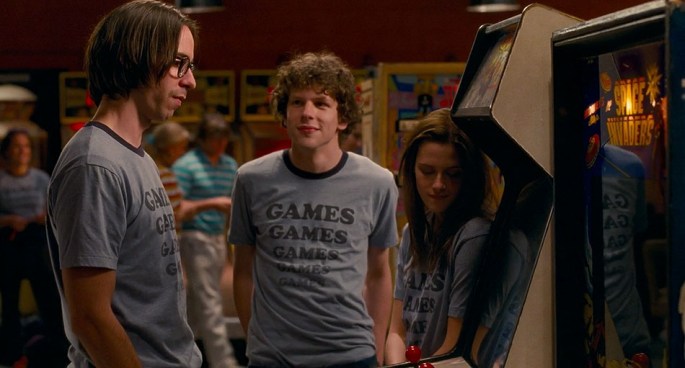
Tepg.se screenshot
Summer jobs are usually the bane of a young person’s existence. They are what you slog through so that you can afford to go to school. They are the drudgery you endure while daydreaming of going to the beach, hanging out with your friends or going to see your favorite band – in other words, pretty much anything else but work. Summer jobs are a necessary evil and no one understands that better than filmmaker Greg Mottola who has masterfully encapsulated these feelings in Adventureland (2009), his follow-up to the popular hit Superbad (2007).

The film opens to the strains of “Bastards of Young” by The Replacements and right away you know you’re in good hands. The year is 1987 and James Brennan (Jesse Eisenberg) has just graduated from college. He is planning to go to Europe for the summer with his buddies; however, his folks can no longer afford to help him pay for it or for grad school at Columbia University in the fall where he hopes to study journalism. James makes some calls, does some legwork and realizes that, with his academic background and a resume with a severe lack of work experience, he’s not qualified for manual labor.

Faced with no other options, James decides to apply at Adventureland, a local amusement park. Much to his surprise, he’s hired right on the spot and put in charge of various games booths. He’s shown how everything works by Joel (Martin Starr), a terminally bored co-worker who’s clearly done this song and dance routine way too many times, telling James at one point, “So, your life must be utter shit or you wouldn’t be here.” While working at the theme park James meets Em (Kristen Stewart), an attractive co-worker with excellent taste in music, and whom he develops a crush on. He also befriends Connell (Ryan Reynolds), the park’s maintenance man, and who is in a local band in his spare time, claiming to have once jammed with Lou Reed. James spends the summer hanging out with Em and his fellow co-workers and learns that if he wants to be a good writer he needs to have some life experiences under his belt.

Adventureland accurately portrays the thankless slog of a minimum wage job (“We are doing the work of pathetic lazy morons,” Joel deadpans) with repetitive tasks, annoying customers, and crap pay. The only thing that makes it remotely bearable is the people James works with – after all, misery loves company. Mottola includes all sorts of nice touches, like the cheesy Foreigner cover band that plays at the local bar, or the mixed tape of music that James makes for Em, which gives the film a more personal feel. This is helped considerably by a great soundtrack that features the likes of Big Star, Crowded House, Husker Du, and The Jesus and Mary Chain – bands responsible for some of the best alternative music of the 1980s. Like the way music was used in Richard Linklater’s Dazed and Confused (1993), the music in Adventureland transports you back to another time and immerses you in it.

Jesse Eisenberg and Kristen Stewart have excellent chemistry together and do a good job of playing two young people that want different things out of a relationship. She has her own issues and they keep James always slightly at arm’s length. One hopes that despite the success of the Twilight films, Stewart will continue to make small, more personal films like Adventureland. Eisenberg nails the awkwardness of someone who’s had very few life experiences, especially in the romance and relationship department.

Mottola does a good job of portraying the brief flings that happen over the course of a summer. They are intense while they last even though they rarely do. He also accurately depicts how messy they can be, especially when you’re at that awkward age – your twenties – and are still trying to figure things out. Adventureland has an authenticity in how it feels to be in your twenties and to fall in love for the first time, stumbling through things, learning as you go. Whereas Mottola was basically a hired gun on Superbad, Adventureland comes from a very personal place and has much more heart while still being very funny and entertaining.

DRIVE ANGRY – A REVIEW BY J.D. LAFRANCE

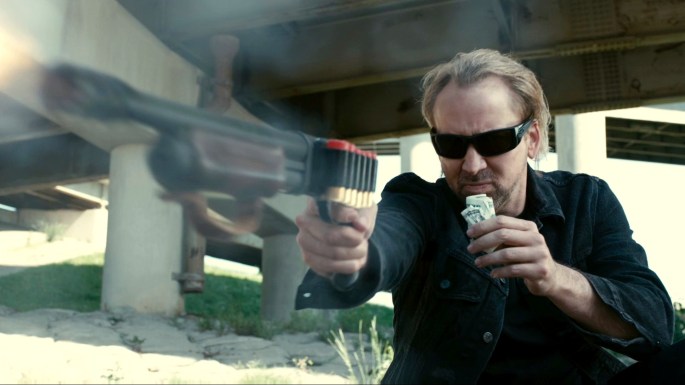
fhd011DRA_Nicolas_Cage_003

Continuing his string of paycheck movies, Drive Angry (2011) is actually closer to the gonzo Nicolas Cage of old than the diluted actor we’ve come to expect in films like Next (2007) and Knowing (2009). With Drive Angry, he’s made a full-on, balls-out cult film that flopped spectacularly at the box office and was trashed by the critics. It has all the necessary ingredients of cult status: loads of ultraviolence, nudity, lots of cussing, and all kinds of character actors chewing up the scenery. The film is the brainchild of Patrick Lussier and Todd Farmer, the former, a B-horror director responsible for efforts like Dracula III: Legacy (2005) and My Bloody Valentine 3D (2009). While the latter film was an unnecessary remake of the 1980’s Canadian slasher film of the same name, it did hint at the garish excesses Lussier was capable of and has finally delivered with Drive Angry.

The film begins with John Milton (Nicolas Cage) literally escaping from hell in a badass muscle car. He is trying to avenge his daughter’s murder and rescue her kidnapped baby from Jonah King (Billy Burke), the sadistic leader of a satanic cult. In the first five minutes, Milton totals a pick-up truck with three flunkies in a way that is so gloriously and stylishly over-the-top that it would make Robert Rodriguez green with envy. While his film Machete (2010) paid homage to exploitation films, Drive Angry is one, only with A-list talent. Milton crosses paths with Piper (Amber Heard), a tough ex-waitress who has recently broken up with her deadbeat boyfriend (Todd Farmer in a cameo). Hot on their trail is a man known only as the Accountant (William Fichtner), a dapper minion from Hell come to bring Milton back.

Inspired by another cartoonish action film, Shoot ‘Em Up (2007), Drive Angry also features a gun battle while the protagonist is having sex only captured in slow motion and cheekily scored to “You Want the Candy” by the Raveonettes. While excessively violent and gory, the action sequences are all so overtly stylish that they can’t be taken too seriously. This film is akin to a blood-drenched, R-rated cartoon. The violence isn’t cruel and mean-spirited like in a torture porn horror film, but rather gleefully petulant like the guys who orchestrated all of this mayhem grew up reading Fangoria in the ‘80s.

Surrounded by all of this garish style and crazed violence, Nicolas Cage wisely underplays his role, going for the calm, collected man of action. He’s matched up perfectly with the always watchable William Fichtner who seems to be channeling Christopher Walken with his wonderfully eccentric performance. He looks to be having an absolute blast with this role and steals every scene he’s in with his unfailingly polite yet very lethal character. Billy Burke is suitably sinister as a religious fanatic and the beautiful Amber Heard holds her own as a two-fisted, curse-like-a-sailor sidekick to Cage’s undead avenger. David Morse even shows up using his considerable skill as an actor to make a chunk of exposition dialogue palatable.

Drive Angry has everything you could want from a trashy action film: cool muscle cars, over-the-top shoot-outs, larger than life baddies, and a cool good guy with a mission. All of this is handled ably by Lussier in what is easily his most accomplished film to date. He gleefully sticks a middle finger in the face of political correctness with a film that is more entertaining than it had any right to be. Cage needs to do more films like this and Bad Lieutenant: Port of Call New Orleans (2009), which harken back to the eccentric characters he played early on in his career.

FANDANGO – A REVIEW BY J.D. LAFRANCE

fandango1

Fandango (1985) is a celebration of being young. It’s a coming-of-age film that takes place during that nebulous time between graduating from college and when you are about enter the workforce and finally became an adult, supposedly leaving childish things behind. The film is much more than freewheeling road movie; it is also has its poignant moments as various characters face an uncertain future. Fandango marked the directorial debut of Texas filmmaker Kevin Reynolds and was also the first time he collaborated with actor Kevin Costner, a relationship that would continue over the years on other projects.

We meet the main characters, known collectively as the Groovers, in an Animal House-ish fraternity house in Austin, Texas, 1971. Gardner Barnes (Kevin Costner) and his buddies are graduating. One of their own, Kenneth Waggener (Sam Robards) is supposed to get married but he just found out that he’s been drafted into the army and will eventually be sent to Vietnam. In an attempt to prolong the inevitable, Gardner decides that the Groovers are going to go on one last road trip. Along for the ride is Phil Hicks (Judd Nelson), a square, perpetual stick-in-the-mud whose car they use, Dorman (Chuck Bush), large fellow who studied to become a minister, Lester Griffin (Brian Cesak), who ends up sleeping through the entire journey, and, of course, Waggener.

The opening title card for Fandango defines the film’s title, one of which describes it as “a foolish act” – an apt description for most of the first half of the film. Reynolds captures the Groovers’ ecstatic, joyous journey in a montage of the guys drinking, laughing, driving fast along the highway, and generally goofing off – all to the strains of “Saturday Night’s Alright for Fighting” by Elton John blasting away on the soundtrack. This eventually gives way to the sobering reality of Phil throwing up on the side of the road and an overheated Waggener dunking his head in a cooler of water. Phil is the group’s nagging moral conscience and reminds them that they have to report to boot camp in a few days. Gardner convinces him to extend their road trip a little longer so that they can go dig up Dom, a vintage bottle of champagne that they buried on the border of Texas and Mexico.

Fandango contains plenty of “foolish acts,” like when the boys are out of gas and they tie fence post cable to the bumper of the car. Then, Dorman lassos a passing train to hitch a ride. It doesn’t work, of course, and the front part of the car gets ripped off. This is only the first of several bits of damage that is inflicted on Phil’s car, much to his chagrin. They push the car to a gas station (the attendant is played by none other than Pepe Serna of Scarface and The Adventures of Buckaroo Banzai fame) and find themselves in the town where Giant (1956) was shot. Later that night, they actually camp out at the site where the famous house from the film stood but all that remains is a pathetic, skeletal frame.

While they wait for the car to get fixed, the Groovers hang out at a Sonic drive-in diner, mooching food off of unsuspecting people. This gets them noticed by two teenage girls (one of whom is played by Elizabeth Daily from Valley Girl and Pee-Wee’s Big Adventure fame) whom they charm for some food and a good time, all to the strains of “Spooky” by The Classics IV, which evokes those fun Saturday nights where all you do is goof off with your friends. The girls invite the guys to shoot off fireworks in a graveyard and everyone has loads of fun aiming them at each other. But this harmless lark gives way to a sobering dose of reality as Gardner and Waggener stumble across the grave of a young man who died over in Vietnam. They look back at the fireworks-induced chaos and it now looks a lot like a warzone, a smoky landscape complete with the image of a mini-mushroom cloud. Is this to be an ominous foreshadowing of what these guys are in for if report to boot camp and are sent to Vietnam?

Not surprisingly, Kevin Costner plays Gardner as a cocky ladies man. As he tells Waggener at one point, “I’ve never been serious about a woman in my life,” but through several flashbacks we know this not to be true. One of them reveals Gardner frolicking with an ex-girlfriend (Suzy Amis) to the strains of that wonderful Carole King song, “It’s Too Late.” I can take or leave Costner as an actor (although, I thought he was great in Bull Durham and A Perfect World) but he’s really good in Fandango. He plays Gardner with a mischievous glint in his eye and has the natural charisma to be the leader of the Groovers. His character isn’t just about having fun as he occasionally flashes back to the girl he once loved but that he let get away, as a dream sequence literally visualizes. Among the group, Gardner has the strongest sense of tradition. He is the driving force behind their quest to dig up Dom. He’s a restless spirit and has a hunger for the open road a la Jack Kerouac. Costner nails this free-spirited vibe so well.

Phil is a complainer and a constant wet blanket who is missing the point of the trip. As Gardner says at one point, “There’s nothing wrong with going nowhere. It’s a right of youth.” Phil just hurls insults at Gardner until Waggener has finally had enough and explodes, telling Phil exactly what he thinks of him. I’ve never been a huge Judd Nelson fan but he is excellent as an initially unlikable character, a “weenie” as Gardner calls him. Partway through the film, Gardner proposes that Phil take a sky diving lesson in order to prove that he’s not a weenie. This sequence was the short film that was the basis for Fandango. After Phil survives his lesson he is much more tolerable and loosens up considerably. Sam Robards is also quite good as Waggener and he, Nelson and Costner would all go on to bigger things, having worked steadily ever since this film.

The camaraderie among the Groovers is believable and fun to watch, especially the scene where they gleefully mess with Phil as he learns the basics of skydiving from Truman Sparks (Marvin J. McIntyre), a burn-out instructor-cum-hippie who looks like he’s done a little too much acid in the 1960s and never really recovered. The skydiving sequence in Fandango is shot-for-shot taken from Reynold’s University of Southern California thesis film “Proof” from 1980. He originally did a stint at Baylor Law School but was unhappy with the prospect of becoming a lawyer and wanted to go back to film school. He practiced law in the daytime and went to film school at night. After a year of doing this he realized that he had to make a choice.

Reynolds applied to USC film school, got accepted and quit his job. His goal was to have a screenplay that he could sell and a film he could show. He ended up selling his first script and got an agent because of it. He finished “Proof” and shortly afterward, Steven Spielberg’s people contacted him. He met with the famous filmmaker who liked “Proof” and two days later got a call from his assistant. Reynolds was told that Spielberg was making arrangements for him to do a feature film version of “Proof.” Once Reynolds got the OK he had to write a script around the action sequence in his short film. Costner had originally auditioned for “Proof” but didn’t get the part. He came back when Reynolds was casting for Fandango and within the first lines during the reading; he knew that Costner “was the guy.”

Fandango culminates with a wedding in a small, sleepy border town which sees Gardner and Phil perpetuating a pretty clever scam by managing to enlist the entire town to help out for free. This leads into the ceremony itself which reveals who Waggener’s bride-to-be is – the girl that Gardner has been thinking about it in the film’s flashbacks. The wedding ceremony is scored to Pat Methany and Lyle Mays’ “It’s For You,” creating a wistful mood that has a slight bittersweet tinge to it because of Gardner’s relationship to the bride. Then, the soundtrack swells with emotion when she and Costner dance the fandango, which takes us back to one of the definitions at the film’s opening title card. And who would’ve thought Costner could dance but he cuts an impressive rug that is shot in such a way that you know it’s really him doing it. This entire sequence is beautifully lit with strings of lights decorating the gazebo where Waggener and his bride are married. The final farewell of the Groovers is a melancholic one as Gardner takes off and Phil is left alone with Dorman telling him to “have a nice life.” The final shot is of Gardner watching from the outskirts of town as the lights go out and he raises a bottle for one last toast.

fandango2Reynolds is a native Texan and Fandango is a love letter, of sorts, to the state. At one point, Phil criticizes Texas and Gardner replies almost reverentially, “It’s wild, Philip. Always has been. Always will be.” As if to reinforce this point, Waggener laments calling off his wedding after coming across a plaque recognizing the McLean Massacre, a place where two Indian fighters were ambushed and killed in 1837. The film has all the energy and vitality of a first-time director who’s willing to go for it and has a burning desire to tell a story. However, the film’s joyful celebration of youth is tempered by a melancholic tone that surfaces periodically as the Groovers realize that their carefree college days are over and the sobering reality of army boot camp and Vietnam hangs over their heads like a dark storm cloud. As Reynolds said in a recent interview, Fandango is “the end of era for these four, and some realized it more than others.” He would graduate to bigger, more ambitious studio films like Robin Hood: Prince of Thieves (1991) and Waterworld (1995), but none of his subsequent work has had the personal touch of Fandango. It’s as if Reynolds lost track of where he came from and had his personality, which is apparent in every frame of his debut feature, removed by the impersonal machinations of Hollywood.

THE DEVIL’S REJECTS – A REVIEW BY J.D. LAFRANCE

12_devils_rejects_blu-ray

In an effort to appeal to the largest audience possible, Hollywood studios have neutered so many horror films into PG-13 movies that they lack any edge or ability to scare beyond the usual fright tactics. They then release the slightly more explicit R-rated or unrated versions on DVD to exploit devotees who don’t want the sanitized theatrical version. Lions Gate, a small, independent studio, flies in the face of this trend by distributing R-rated independent and international horror movies like High Tension (2003) and Saw (2004) that push the boundaries of on-screen violence. Hard rocker turned filmmaker Rob Zombie has taken advantage of this by making and releasing his first two films through Lion’s Gate. The second of those was The Devil’s Rejects (2005), a gritty, balls-to-the-wall horror movie cum road picture – imagine The Hills Have Eyes (1977) directed by Sam Peckinpah.

Not quite a sequel to Zombie’s first movie, House of a 1000 Corpses (2003), but rather the further adventures of a few of its characters – the notorious Firefly family. Early one morning, the police raid their farm. In the ensuing chaos, Otis (Bill Moseley) and his sister Baby (Sheri Moon Zombie) manage to escape with Sheriff Wydell (William Forsythe) in hot pursuit and bent on revenge because they killed his brother (see House of 1000 Corpses). Otis and Baby take a country and western band by the name of Banjo & Sullivan hostage in a motel room. They eventually hook up with their partner Captain Spaudling (Sid Haig) and take refuge at a whorehouse owned by Spaudling’s brother, Charlie Altamont (Ken Foree) where they get ready for the inevitable confrontation with Wydell.

When Zombie wrote House of 1000 Corpses, he had a “vague idea” for a story about the brother of the sheriff that the Firefly clan killed coming back for revenge. He did this just in case the film did well enough at the box office and created interest in another film. After Lions Gate made back all of their money on the first day of Corpses theatrical release, the studio wanted Zombie to make another film and he started to seriously think about a new story. With Rejects, he wanted to make it more horrific and the characters less cartoonish than in Corpses. He was interested in making “something that was almost like a violent western” and has cited films like The Wild Bunch (1969), Bonnie and Clyde (1967), and Badlands (1973) as influences.

Zombie hired Phil Parmet, who had shot the legendary documentary Harlan County USA (1976) because he wanted to adopt a hand-held camera/documentary look. To prepare for the film, Parmet watched many horror films but when he and Zombie started talking about the approach they wanted to take on Rejects, they actually connected on revisionist westerns like Hang ‘Em High (1968), Monte Walsh (1970), and El Topo (1970). They also looked to films like The French Connection (1971), In Cold Blood (1967), and Fat City (1972) for inspiration. During pre-production, they decided to shoot the film on 16mm and Zombie cited films like Amores Perros (2000) and 21 Grams (2003) as jumping off points for how he wanted to shoot his own film. Zombie told Parmet that he wanted to use two cameras at all time and for certain scenes, like the chaotic gunfight at the Firefly house at the beginning of the film, to have as many as six cameras running simultaneously.

Zombie populated his cast with an impressive collection of B-horror character actors: Sid Haig (Spider Baby), Ken Foree (Dawn of the Dead), P.J. Soles (Halloween), and Michael Berryman (The Hills Have Eyes). They are not cast for kitsch or novelty value but because they have the acting chops to pull off these meaty roles. Zombie cast actors with interesting faces that have character. Every line or glint in their eyes says so much and he captures them in close-ups a la Sergio Leone. And no one personifies a fascinating face more than Sid Haig who plays Captain Spaulding as the scariest clown with evil make-up that includes black lips and horrible yellow teeth augmenting his already grizzled looks.

After starring in numerous forgettable direct-to-video efforts, William Forsythe finally gets a substantial role. Every once in a while, he pops up in a mainstream film, like Things To Do In Denver When You’re Dead (1995) and The Rock (1996), usually playing some generic bad guy role. He harkens back to a bygone era of tough guys, like Lee Marvin or Robert Shaw, who naturally exuded a ferocious intensity that is exciting to watch. With his deep, gravelly voice Forsythe plays an unstoppable force of nature that is just as ruthless in his methods as the Firefly clan.

The dialogue crackles and pops with its own profane rhythm. The tough guy-speak works because it is believable and the actors deliver it with conviction. Zombie breaks it up with some very funny bits and truly laugh-out-loud moments of black humor. For example, the Firefly clan uses aliases of names of Groucho Marx characters. To crack this code, Wydell brings in movie critic Marty Walker (Robert Trebor) and they end up getting into an argument about the merits of Elvis Presley movies that is hilarious and helps relieve some of the unrelenting tension that this film generates.

The Devil’s Rejects is a good looking movie that features a lush glow of reds, greens and blues during the night scenes and then Zombie cuts to one with a minimalist single light source with nothing in the background so that we focus on the two actors in the scene and what they are saying. In contrast, the day scenes have a warm, saturated sun-burnt look. The darkest scene in the movie in terms of tonality actually takes place at high noon and this makes it even more sinister because there is nowhere to hide.

Zombie references all kinds of movies and not just the usual horror movies that other filmmakers quote. When he does refer to other films he does so in a subtle way and not in a look-how-clever-I-am way that Quentin Tarantino does. Tarantino is a cinematic show-off content to sample his favorite scenes from other movies without showing any kind of understanding about how they work. The Devil’s Rejects is a down ‘n’ dirty celebration of outlaw 1970s cinema complete with a fantastic score of southern rock classics from the likes of the Allman Brothers Band, Joe Walsh and Lynyrd Skynyrd. In case of the last band, the way their anthem “Free Bird” is used in this movie is incredible. What could have been so clichéd comes across as a poignant and iconic scene in the film, befitting the song itself.

devilsrejects2This film does not quite look like it was shot in the ‘70s but made by someone who grew up in that decade. Rejects was made by a horror film fan for horror film fans. Zombie has created a truly disturbing horror movie with no real redeemable characters, that is refreshingly unpredictable and this is what makes it so scary, like the original The Texas Chain Saw Massacre (1974). Both movies are feverish nightmares except that in Massacre you felt sympathy for the female protagonist. The Devil’s Rejects does not even have that. You may find yourself rooting for the Firefly family early on but Zombie quickly rejects this notion by portraying them as truly irredeemable people. There is no sappy love story or cop-out ending and this remains true to many of the nihilistic movies of the ‘70s. Horror film obsessives always brace themselves for the wimp out ending — it is the downfall of so many horror films — Rejects does not make this mistake. Zombie has shown a real growth as a filmmaker, creating I daresay a modern horror masterpiece.

TOKYO DRIFTER – A REVIEW BY J.D. LAFRANCE

641022096879472221-tokyo-drifter-neon-banner.full

Seijun Suzuki made his name in Japan with hard-boiled B-crime films during the 1950s. By the 1960s, he took traditional Yakuza stories and juxtaposed them with an extreme Andy Warhol-esque pop art look that gleefully pushed genre conventions. He started to break away from convention with Youth of the Beast (1963) and then fused the sensibilities of Samuel Fuller with the aesthetics of Douglas Sirk with Story of a Prostitute (1965). Tokyo Drifter (1966) is a film that eschews narrative logic for playful abstraction and the results are quite unlike anything at the time or since.

Tetsuya Hondo (Tetsuya Watari) is a Japanese gangster trying to lead an honest life as the syndicate he belonged to dissolved itself and went legit. The only problem is that they borrowed money from their rival – Yoshii – and now they’ve come to collect. In the film’s striking washed out black and white prologue, Tetsu is beaten up by the Yoshii syndicate when he refuses to work for them, which, as it turns out, is a test to see if he’s actually gone legit. Out of loyalty to his former bosses, Tetsu decides to help him pay off the debt that is owed. However, complications arise when yet another rival syndicate kills Yoshii and takes over collecting the debt.

Tokyo Drifter has a striking ‘60s pop art look with a nightclub’s walls saturated in purple; a scene with a singer accompanied by a piano in a yellow room and is visited by a man in a red suit, while phones in various rooms in various places are primary colors. These vivid contrasts in color, coupled with the hep jazz soundtrack, make for a very unusual gangster film. Suzuki uses color and composition of the widescreen frame masterfully, like how he places his actors in a given frame.

Tetsuya Watari’s Tetsu is the epitome of ‘60s mod culture cool with his stylish suits, good looks and fashionable existential angst. It also doesn’t hurt that he’s pretty good with a gun. The pop art style that influenced Tokyo Drifter can also be seen in films like Modesty Blaise (1966) and In Like Flint (1967) but Suzuki’s film fearlessly pushes genre conventions further than either of these examples as he experimented with color and composition to a fascinating degree.

A MIGHTY HEART – A REVIEW BY J.D. LAFRANCE

hero_EB20070621REVIEWS70621002AR

Ever since Angelina Jolie won an Academy Award for her memorable role in Girl, Interrupted (1999), she has gradually gotten further and further away from the kinds of roles that won her that coveted accolade in the first place. And so it was with some anticipation that she would be returning to more challenging, interesting work with A Might Heart (2007), an adaptation of the memoir by Mariane Pearl about the kidnapping and death of her husband, journalist Daniel Pearl. Of course, there were the usual fears that this would merely be a vanity project for Jolie – a desperate attempt to reclaim Oscar glory yet again. However, the wild card thrown into the mix was the presence of British filmmaker Michael Winterbottom. He has the reputation of being something of a maverick, adept at all kinds of genres, be they literary adaptations (The Claim), period pieces (Tristram Shandy: A Cock and Bull Story), biopics (24 Hour Party People) or politically-charged docu-dramas (The Road to Guantanamo). However, he also has the habit of turning them on their head in a way that polarizes critics and audiences. If anyone could get Jolie to shed her movie star persona it would be him.

The film is set in Pakistan as Daniel (Dan Futterman) is doing a story on the Taliban for the Wall Street Journal. One day, he goes off to interview a religious leader and never comes back. When he doesn’t return later that night, Mariane (Angelina Jolie) checks his email and tries to track down his contacts but with no success. The next day he is still missing and she starts calling anybody she can think of, eventually bringing in the local police. The film becomes an intense, Michael Mann-esque police procedural as local law enforcement, led by Captain (Irrfan Khan), turn the city upside down questioning anyone connected with Daniel or who helped set up the interview he was going to.

The Department of Justice and Diplomatic Security Service special agents are called in and a representative by the name of Randall Bennett (Will Patton) meets with Mariane in order to get her side of the story. She is also a journalist and does her own digging into the case. In a few days, she receives an email from the kidnappers who claim that Daniel is a CIA agent posing as a journalist while the local newspapers claim that he’s a Mossad agent just because he also happens to be Jewish. Mariane finds herself drowning in the political quagmire that is Pakistan as the authorities question Daniel’s methods and motivations.

Angelina Jolie does an excellent job as a woman barely keeping it together in the face of such uncertainty, not knowing if she will ever get to see her husband alive again while also dealing with being pregnant on top of everything else. She wisely underplays the role, resisting the urge to come on too strong by being showy and instead immersing herself in the part. Winterbottom helps her out, like in one scene where Mariane allows herself a moment to let it all out and break down. He refuses to go for the easy money shot close-up of Jolie’s teary, anguished face and instead opts for a long shot, letting her body language speak volumes about how she’s feeling.

Winterbottom’s hand-held camera careens through the crowded, claustrophobic streets of Karachi much like in the opening scenes of The Insider (1999) when Al Pacino’s character meets with the leader of the Hezbollah. Winterbottom creates an immediate, immersive experience as the sights and sounds of the city are everywhere. He also keeps everything grounded in reality with minimal use of music because of its ability to easily manipulate our emotions. A Mighty Heart feels like a personal project for Jolie but never seems like a vanity project because one never feels like she is grandstanding but rather is passionate about the subject matter and doing justice to it.

THE ROCKETEER – A REVIEW BY J.D. LAFRANCE

rocketeer1

With the massive commercial success of Tim Burton’s Batman (1989), other Hollywood studios scrambled to find their own comic book franchise in the hopes of replicating the boffo box office of the Caped Crusader. With the notable exception of Dick Tracy (1990), most of these films failed to appeal to a mainstream audience. These included pulp serial heroes The Shadow (1994) and The Phantom (1996), and the independent comic book The Rocketeer. Originally created by the late Dave Stevens, it paid homage to the classic pulp serials of the 1930s. For some reason, Disney decided that it would be their tent-pole summer blockbuster for 1991, cast two unproven leads – Billy Campbell and Jennifer Connelly – and hired Steven Spielberg protégé, Joe Johnston to direct. Despite promoting the hell out of it and spending a ton of money on merchandising, The Rocketeer (1991) underperformed at the box office.

It’s a shame because out of the lot of retro comic book films done in the 1990s, The Rocketeer was the best one and the most faithful to its source material. While both The Shadow and The Phantom looked great, they were flawed either in casting or with their screenplays while Dick Tracy was top-heavy with villains and director (and star) Warren Beatty’s ego, but The Rocketeer had the advantage of its creator actually being involved in bringing his vision to the big screen. The end result was a fun, engaging B-movie straight out Classic Hollywood Cinema albeit with A-list production values. The film has quietly cultivated a cult following and deserves to be rediscovered.

Cliff Secord (Billy Campbell) is a young, hotshot pilot who races planes for a living with the help of his trusted mechanic and good friend Peevy (Alan Arkin). One day, while out testing his new plane, Cliff stumbles across an experimental jetpack stolen from Howard Hughes (Terry O’Quinn). Soon, he finds himself mixed up with the FBI, who want to recover it, and unscrupulous gangsters who stole it in the first place. Also thrown into the mix is Neville Sinclair (Timothy Dalton), an Errol Flynn-type matinee idol who wants the jetpack for his own nefarious agenda. Cliff’s beautiful girlfriend Jenny Blake (Jennifer Connelly) is an aspiring actress who catches Sinclair’s eye, which further complicates Cliff’s life. With Peevy’s help, Cliff figures out how to use the jetpack and fashions himself an alter ego by the name of the Rocketeer.

Billy Campbell does a fine job as the scrappy Cliff Secord. He certainly looks the part and has great chemistry with co-star Jennifer Connelly (they fell in love while making the film). Connelly plays Jenny as the gorgeous girl-next-door and looks like she stepped out of a 1930s film. Jenny loves Cliff but dreams of being a movie star, not hanging around the airfield. Connelly, with her curvy figure, shows off her outfits well and does the best with what is ostensibly a damsel in distress role.

Timothy Dalton has a lot of fun playing the dashing cad as evident in the scene where he “accidentally” wounds a fellow actor during filming for stealing a scene from him. Sinclair is a vain movie star with big plans and there’s a glimmer in Dalton’s eye as he relishes playing the dastardly baddie. Alan Arkin is also good in the role of Peevy – part absent-minded professor-type and part father figure to Cliff.

The Rocketeer features a solid supporting cast with the likes of Ed Lauter playing a no-nonsense FBI agent, Terry O’Quinn as the brilliant Howard Hughes, Jon Polito as the money-grubbing airfield owner, and Paul Sorvino as a blustery gangster begrudgingly in league with Sinclair. His casting is a nice nod to the patriarchal mobster he played in GoodFellas (1990) only a lot less menacing (this is Disney after all). The always entertaining O’Quinn is particularly fun to watch as a dashing Hughes that could have easily stepped out of Francis Ford Coppola’s love letter to American ingenuity, Tucker: The Man and His Dream (1988).

The attention to period detail, in particular the vintage planes, is one The Rocketeer’s strengths. The film gets it right with the clothes that people wear and how they speak so that you feel transported back to this era. The recreation of old school opulence is fantastic as evident in the South Seas nightclub sequence where Sinclair works his charms on Jenny. Even Joe Johnston’s direction feels like a throwback to classic Hollywood filmmaking as he gives the flying sequences the proper visual flair that they deserve. He wisely keeps things simple, never trying to get too fancy or show-offy as he takes a page out of his mentor, Steven Spielberg’s book. There’s never any confusion as to what is happening or where everyone is – something that seems to be missing from a lot of action films thanks to the popularity of the Bourne films. Johnston is an interesting journeyman director whose best work is old school action/adventure films, like Hidalgo (2004), or slice-of-life Americana, like October Sky (1999), which is why he was the wrong choice to helm the ill-fated reboot of The Wolfman (2010) and the right director for Captain America: The First Avenger (2011).

rocketeer2Filmmaker Steve Miner (Friday the 13th, Parts II and III) was the first person to option the film rights to Dave Stevens’ independent comic book The Rocketeer but he ended up straying too far from the original concept and his version died an early death. Screenwriters Danny Bilson and Paul DeMeo (Trancers and Zone Troopers) were given the option in 1985. Stevens liked them because “their ideas for The Rocketeer were heartfelt and affectionate tributes to the 1930’s with all the right dialogue and atmosphere. Most people would approach my characters contemporarily, but Danny and Paul saw them as pre-war mugs.” Their subsequent screenplay kept the comic book’s basic plot intact but fleshed it out to include the Hollywood setting and the climactic battle against a Nazi zeppelin. They also tweaked Cliff’s girlfriend to avoid comparisons (and legal hassles) to Bettie Page (Stevens’ original inspiration), changing her from a nude pin-up model to a Hollywood extra while also changing her name from Betty to Jenny.

Bilson and DeMeo submitted their seven-page outline to Disney in 1986. They studio put the script through an endless series of revisions and, at one point, frustrated by the seemingly endless process, the two screenwriters talked to Stevens about doing The Rocketeer as a smaller film shot in black and white. The involvement of Disney put the project on a much bigger level as the writers remembered, “you can imagine the commitment Disney was making to develop a series of movies around a character. They even called it their Raiders of the Lost Ark.” With Stevens’ input, Bilson and DeMeo developed their script with director William Dear (Harry and the Hendersons) who changed the zeppelin at the film’s climax to a submarine. Over five years, the mercurial studio fired and rehired Bilson and DeMeo three times. DeMeo said, “Disney felt that they needed a different approach to the script, which meant bringing in someone else. But those scripts were thrown out, and we were always brought back on.”

They found this way of working very frustrating as the studio would like “excised dialogue three months later. Scenes that had been thrown out two years ago were put back in. what was the point?” Disney’s biggest problem with the script was all of the period slang peppered throughout. Executives were worried that audiences wouldn’t understand what the characters were saying. One of their more significant revisions over this time period was to make Cliff and Jenny’s “attraction more believable … how do we bring Jenny into the story and revolve it around her, and not just create someone who’s kidnapped and has to be saved?” DeMeo said. In 1990, their third major rewrite finally got the greenlight from Disney. However, when the studio acquired the rights to the Dick Tracy film from Universal Studios, DeMeo was worried that executives would dump The Rocketeer in favor of the much more high-profile project. However, when Dick Tracy failed to perform as well at the box office as Disney had hoped, DeMeo’s fears subsided.

All kinds of actors were considered for the role of Cliff Secord, including Bill Paxton, who almost got it, and Vincent D’Onofrio, who was offered the role but turned it down. Finally, Billy Campbell was cast as Cliff. Prior to this film, his biggest role to date was regular on the Michael Mann-produced television show, Crime Story. For the role of Jenny, Sherilyn Fenn, Kelly Preston, Diane Lane, and Elizabeth McGovern were all considered but lost out to Jennifer Connelly, fresh from making the comedy, Career Opportunities (1991). Dave Stevens wanted Lloyd Bridges to play Peevy but he turned the film down and Alan Arkin was cast instead. The Neville Sinclair role was offered to Jeremy Irons and Charles Dance before Timothy Dalton accepted the role.

Campbell wasn’t familiar with Stevens’ comic book when he got the part but quickly read it and books on aviation while also listening to period music. The actor also had a fear of flying but overcame it with the help of the film’s aerial coordinator Craig Hosking. To ensure Campbell’s safety, he was doubled for almost all of the Rocketeer’s flying sequences. Hosking said, “What makes The Rocketeer so unique was having several one-of-a-kind planes that hadn’t flown in years,” and this included a 1916 standard bi-wing, round-nosed, small-winged Gee Bee plane.

The numerous delays forced William Dear to leave the production and director Joe Johnston signed on to direct. He was a fan of the comic book and when he inquired about its film rights was told that Disney already had it in development. He approached the studio and was quickly hired to take over when Dear departed. Johnston said, “One of the great appeals of Stevens’ work was his attention to detail, which really placed the reader in the period. I’ve tried to do the same thing cinematically.” Pre-production on the film started in early 1990 with producer Larry Franco in charge of securing locations for the film. He found an abandoned World War II landing strip in Santa Maria, which the filmmakers used to build the mythical Chaplin Air Field. The Rocketeer’s attack on the Nazi zeppelin was filmed near the Magic Mountain amusement park in Indian Dunes. The film was shot over 96 days and ended up going over schedule due to weather and mechanical problems.

rocketeer3Like The Right Stuff (1983) before it, The Rocketeer is a love letter to the wonders of aviation and the brave souls that risked their lives pushing the envelope. In a nice touch, Cliff even chews Beeman’s gum, the same kind that Chuck Yeager uses in The Right Stuff. The comic book is masterfully translated to the big screen, right down to recreating the iconic Bull Dog Diner. The filmmakers also got all the details of Cliff and his alter ego right, including the casting of Billy Campbell. The same goes for Jenny, although, because Disney backed the film, they downplayed the blatant homage her character was to famous pin-up model Bettie Page. With Dave Stevens untimely passing in 2008, watching this film is now a bittersweet experience but there is some comfort in that at least he got to see his prized creation brought vividly to life even if failed to catch on with the mainstream movie-going public. The Rocketeer is flat-out wholesome fun with nothing more on its mind than to tell an entertaining story and take us on an exciting adventure.
CHE – A REVIEW BY J.D. LAFRANCE

hero_EB20090114REVIEWS901149990AR

Che (2008) began as a personal project for actor Benicio del Toro around the time he was making Traffic (2000) with Steven Soderbergh. Originally, he planned on making the film about iconic revolutionary Ernesto “Che” Guevara with Terrence Malick and its focus was to be on the disastrous Bolivian campaign in 1967. Malick eventually dropped out to go off and make The New World (2005). Soderbergh helped out Del Toro by agreeing to direct and in the process expanded the film’s scope by depicting Che’s role in the Cuban Revolution as a way of explaining his motivations for going to Bolivia.

Amazingly, Soderbergh raised the $58 million budget entirely outside of North America, which allowed him much more creative freedom. The result was a four-and-half-hour epic that refused to champion or demonize Che and instead opted to objectively depict his rise in Cuba and his fall in Bolivia. This approach ultimately doomed Che’s chances in North America where, despite breaking the film up into two, more digestible parts, it received limited distribution. Predictably, it divided critics and was criminally ignored by all of the major award ceremonies – rather fitting for a film about someone who refused to rest on his laurels, always hungry to get back to the jungle and get back to work.

I think that the key to understanding Del Toro and Soderbergh’s take on Che comes from an interview with director where he said, “Clearly this is a guy whose priority is going into the jungle and starting a revolution. That is the most important thing in his life … If you take away all the words and just look at what he did, the guy kept going back into the jungle.” Del Toro and Soderbergh were faced with the daunting task of making a film about an iconic historic figure, someone whose image has graced countless t-shirts and posters. Che is an extremely polarizing figure and so it makes sense that they would step back and take a more objective look at the man. Then, it would be up to the audience to decide how they felt about him.

Those looking for a crowd-pleasing underdog story a la Erin Brockovich (2000) will be disappointed by Che. The famous Argentinean is not as easy to like as the scrappy Brockovich. As depicted in Che, he’s a much more complex individual. He cares about the cause and those that fight with him but does not feel the need to show a lot of emotion. When he’s in the jungle it is all about the task at hand and living in the moment. Che never loses sight of what his objective is and his conviction never wavers, not even in the face of death. He’s like a Method actor that stays in character on and off-camera during a shoot.

Part One juxtaposes Che’s efforts to remove Batista from power in Cuba in 1958 with him addressing the United Nations in 1964 and in doing so we see Che in his element, putting into practice guerrilla warfare tactics, and we see Che the superstar espousing his beliefs to the media in New York City and the international community at large. At first, the Bolivia campaign as depicted in Part Two starts off well enough with Che sneaking into the country and meeting with his fellow revolutionaries. We see them get supplies and train in preparation for the task at hand. However, the country’s Communist party refuses to support an armed struggle, especially one led by a foreigner. The support of the peasants, so crucial in Cuba, is lacking in Bolivia, making food hard to come by. A feeling of dread creeps in as government troops gradually close in on Che, cutting off any avenue of escape.

Soderbergh maintains an objective stance by refusing to show any close-ups of Che. We always see him from a certain distance and often grouped with others. During the battle at El Uvero on May 28, 1957, Soderbergh conveys the noisy, chaotic nature of combat as men are seemingly wounded at random but there is never any confusion visually about what is going on. Twice during the battle, he takes us out of it by having a voiceover by Che where he espouses his philosophy of guerrilla warfare. With a widescreen aspect ratio, Soderbergh opens things up in Part One and this is particularly evident during the battle scenes. In Part Two, this all changes, as the smooth camerawork is replaced with hand-held cameras and a more standard aspect ratio which creates a claustrophobic feel and look. The long takes and deliberately slow pace may frustrate some expecting a more traditional biopic but I found it a welcome change from the cookie cutter mentality of most Hollywood depictions of history.

During the Cuban campaign it is evident that Che is very much a man of the people, whether it is making contact with and befriending peasants that he comes across in the jungle or treating a wounded comrade. However, Che eschews character development in favor of showing the nuts and bolts of a revolution. As Che says at one point, “A real revolutionary goes where he’s needed. It may not be directly in combat. Sometimes it’s about doing other tasks … finding food, dressing wounds, carrying comrades for miles … and then, taking care of them until they can take care of themselves.” The film takes this philosophy to heart by showing the day-to-day activities of Che and his fellow revolutionaries. We see him dressing wounds, the wounded being carried through the jungle and strategizing with his men and Fidel Castro (Demian Bichir).

Benicio del Toro effortlessly becomes Che and tones down his tendency to sometimes resort to Brando-esque acting tics (see The Way of the Gun) and plays the iconic revolutionary as a man confident of his own convictions. He conveys Che’s sharp intellect with his eyes and also does an excellent job with the physical aspects like his recurring asthma that constantly plagued him. Del Toro provides us insight into the man’s character through attitude, behavior and the way he acts towards others.

24a125_34547ac222f04702b5e68cb83dd8629cChe is ultimately a study in contrasts. What worked in Cuba did not work in Bolivia. Soderbergh’s film illustrates the differences. In Cuba, the revolutionaries were able to get the trust and support of the peasants while in Bolivia they feared the rebels. It must also be said that Castro played a key role in the success of the Cuban revolution and his absence in Bolivia, the galvanizing effect he had, is sorely missed. With Che, Soderbergh has created an unusual biopic that does its best to not try and manipulate you into feeling one way or another about the revolutionary. Instead, it shows two very different examples of the man’s philosophies put into practice and how they played out – one a success and the other a failure. Che was a polarizing historical figure long before this film came along and will continue to be long afterwards.
THE LIFE AQUATIC WITH STEVE ZISSOU – A REVIEW BY J.D. LAFRANCE

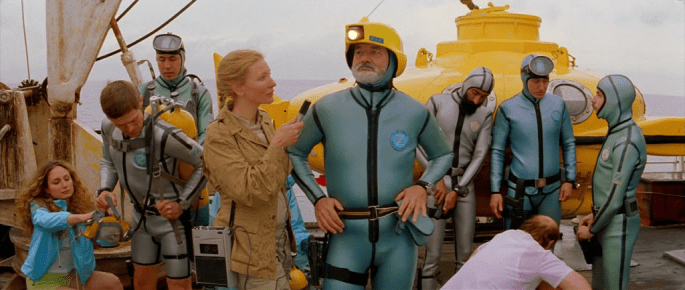
the-life-aquatic-with-steve-zissou-1024x435

There’s always a certain amount of trepidation when a filmmaker like Wes Anderson, known for making intimate and personal films, starts making movies on a more ambitious scale – bigger budgets and movie stars in an attempt to appeal to a larger audience – that he will lose all of the qualities that made his movies so interesting in the first place. Easily his most accomplished film, The Life Aquatic with Steve Zissou (2004) merged his stylized dialogue and quirky characters with elaborate sets and action set pieces in an exotic locale.

After his best friend is eaten by a Jaguar shark, famed oceanographer Steve Zissou (Bill Murray) vows revenge. The problem is that the fish is endangered and he’s having trouble raising money for the expedition. He also meets Ned Plimpton (Owen Wilson) who may be his son by a woman he met 30 years ago. So, he convinces the young man to join his expedition in an attempt to make up for three decades of neglect.

Ever since Bottle Rocket (1996), Anderson’s movies feature a water motif in some form or another, whether it is Anthony and Inez’s first kiss in a swimming pool in Bottle Rocket or Max Fischer’s desire to build an aquarium in Rushmore (1998). With Life Aquatic, Anderson finally realizes his fascination with water head on by crafting an homage to Jacques Cousteau.

Life Aquatic also continues Anderson’s thematic pre-occupation with flawed father figures and their sons. There is the burnt out Mr. Blume and Max in Rushmore and Royal and his children in The Royal Tenenbaums (2001). In Life Aquatic, Steve tries to reconnect with Ned in the hopes that they will bond while hunting for the Jaguar shark. Like Blume and Royal, the world seems to have forgotten about Steve. He’s washed up and hit rock bottom now that his best friend has been killed.

The film also continues Anderson’s structuring of his movies into segments. In Rushmore, the story was broken down into months serving as acts in a play, with Tenenbaums, it was chapters as in a book and now with Life Aquatic it is days as Steve’s mission is being filmed for a new documentary. This structure reinforces the magical, almost-fairy tale feeling that Anderson creates in every one of his films by drawing attention to itself as a fanciful tale.

Bill Murray turns in another excellent, low-key performance as the melancholy Zissou. With his beard and gruff, macho attitude, Steve comes across as a Hemingway-esque figure with a dash of Cousteau. And yet, no matter how extravagant things get, Murray always keeps things grounded with his sparse performance. Over the course of his career, the comedian has been gradually refining his style of acting. He gained fame in broad comedies like Stripes (1981) and Ghostbusters (1984) but has fine-tuned his style to a less-is-more approach with movies like Rushmore and Lost in Translation (2003). His turn in Life Aquatic is just the right blend of comedy and pathos.

Most films don’t warrant much thought or discussion, but Anderson gets more and more interesting with each new effort. They are filled with so many fascinating little details crammed in each and every frame, repeated thematic motifs and minor characters who often wander in and out of the background of scenes. His movies are magical, existing in their own unique worlds and bursting with ideas that are almost too much to absorb in one sitting. As was the allure of David Lynch’s short-lived T.V. show, Twin Peaks, one of the appeals of Anderson’s films is that we want to be in these quirky worlds he creates and we want to know his characters. We want to lose ourselves in his universe and the beauty of DVD is that they allow us to revisit the worlds of his movies any time we want.

Anderson is not only more ambitious in terms of structure and scale but also with the visuals of Life Aquatic. Shot in Italy, he utilizes the striking landscape of the country for a sun-kissed warm color scheme of yellows and browns. There are also the striking images that linger long after the film ends: the glowing jellyfish on a beach at night and the stop-motion animated fish (by Nightmare Before Christmas’ Henry Selick) and portrays them so vividly and in an exciting way.

Anderson’s career had been building up to this film. With The Royal Tenenbaums, he was able to juggle a large cast of name stars while still maintaining his artistic integrity. With Life Aquatic, he continued to use stars but upped the ante in production values and scope. However, he did not lose the intimate feeling that all of his movies possess. No matter how ambitious or big the scale, his films have hand-crafted feel to them. One gets the feeling that Anderson cares about every detail and every aspect and it is this personal touch that makes his movies so unique.

EASY RIDER – A REVIEW BY J.D. LAFRANCE

easyrider1

The critical and commercial success of Easy Rider (1969) scared the hell out of the Hollywood studios at the time of its release. Executives thought that they knew what the public wanted to see: safe comedies like Pillow Talk (1959) or the Frankie and Annette beach party movies. Along came this counter-culture movie that featured contemporary rock ‘n’ roll music, two hippie protagonists and a nihilistic ending. And audiences loved it. All bets were off on what audiences wanted to see and so the studios began hiring young producers and directors who in turn cast their friends and contemporaries in their films. As a result, Easy Rider ushered in the last great decade of American movies in the 1970s.

After selling their stash of cocaine, Billy (Dennis Hopper) and Wyatt (Peter Fonda) decide to ride their motorcycles from California to Florida (by way of the South) where they plan to live off the money. They travel the back roads of America and encounter all sorts of people: suspicious small-townsfolk, an oppressive sheriff and a rancher and his large family who invite them to a meal. The deeper they go into the South, the more resistance they meet because of how they look.

Easy Rider is a fantastic snapshot of the times. It signaled the end of the not-so idyllic 1960s, where having long hair could deny you a room in a motel because the manager didn’t like the way you looked. The hippie commune that Billy and Wyatt briefly stop at is not all peace and love. Some of them are suspicious of the duo. There is conflict among the members and it becomes obvious that they suffer from many of the same problems that plague the outside world.

Time running out is a constant theme throughout Easy Rider. When Billy and Wyatt start their journey, Wyatt throws away his watch. Later on, he finds a discarded pocket watch just before they leave the commune. Also, as they are leaving, the hitchhiker they pick up warns Wyatt that time is running out. It eerily foreshadows the film’s disturbing finale and gives a feeling of impending doom that hangs over the entire film.

Peter Fonda plays Wyatt as the quiet, more introspective character, while Dennis Hooper’s Billy is a talkative, let-it-all-hang-out type. Wyatt is more trusting of people and Billy is more paranoid and guarded — he is constantly thinking of the money they have stashed in their bikes and is very protective of it. They make a good team with their strengths and weaknesses complimenting each other. However, their dynamic is given a jolt once Jack Nicholson appears as George Hanson, an ACLU lawyer who gets Billy and Wyatt out of jail. Nicholson showcases his trademark easy-going charm in all of the scenes he’s in. His stoned rap (during one of the camp fire scenes) about UFOs and “the Venusians” is funny and oddly poignant. Later on, he talks about how the country has been divided and says, “It’s real hard to be free when you’re bought and sold in the marketplace.” His speech anticipates the greed-obsessed ‘80s. People forget that Easy Rider really put Nicholson on the map and led to an impressive string of film roles in the ‘70s.

Laszlo Kovacs’ beautiful cinematography really does a stunning job of showcasing the expansive landscape of the U.S.: the imposing mountains in California, the vast canyons of Arizona at sunset with pink and red hues in the sky and the deep green foliage as Billy and Wyatt get closer to New Orleans. Kovacs would go on to shoot such great films as Five Easy Pieces (1970), Shampoo (1975) and Ghostbusters (1984).

easyrider2Easy Rider’s nihilistic ending would go on to inspire similar-minded road movies in the ‘70s, like Monte Hellman’s Two-Lane Blacktop (1971), Vanishing Point (1971), and Terrence Malick’s Badlands (1973). Easy Rider’s legacy is impressive. It paved the way for the Movie Brats (Coppola, Lucas, Scorsese, et al) in the ‘70s, which was the golden age of American filmmaking where the director was king.