CLOSE ENCOUNTERS OF THE THIRD KIND – A REVIEW BY J.D. LAFRANCE

closeencounters1

I have been fascinated by UFOs and the notion of life on other planets ever since I was a kid and saw Steven Spielberg’s film Close Encounters of the Third Kind (1977). At the time, it made a huge impression on me as it did with many of my generation. Nowadays, most people dismiss stories about UFOs or alien abductions as tabloid fare. They laugh at the stories of people being snatched by “little green men,” but over the years there have been some really interesting cases that have come to light.

In the past 40 years, the idea of UFOs and alien sightings has been investigated by numerous psychologists and psychiatrists like Carl Jung. Some of the first recorded sightings can be traced back to the late 1940s and during the 1950s when the UFO craze really took off. After this initial phenomenon died down, reports began to drop off as more and more people scoffed at the idea that people may have been abducted. They say that there’s no physical evidence that UFOs exist, but perhaps there is no publicly acknowledged physical evidence that UFOs exist. Spielberg’s film takes this idea and runs with it in an entertaining and engaging way that continues to fascinate me after all these years.

Close Encounters of the Third Kind begins in the Sonora Desert, Mexico during a blinding sandstorm. A group of scientists drive up in two vehicles. They are there because of a squadron of American World War II era fighter planes that have mysteriously resurfaced minus their pilots after disappearing during a training run in 1945. The scientist, led by a Frenchman named Lacombe (Francois Truffaut) question an old man who was there when the planes appeared and he claims that the sun came out at night and sang to him. I love the opening image of headlights just barely piercing the intense storm. Spielberg establishes a fantastic air of mystery during this sequence, which leads us right into the next scene.

At an air traffic control center in Indianapolis, a controller is in communication with pilots in two different planes that experience a brief run-in with a UFO. Nobody can explain it, but the pilots don’t want to report it as such. What I like about this sequence is that we get a few more teasing details about the alien craft from the pilots, but we don’t actually see anything, which only adds to the intrigue.

In Muncie, Indiana, a little boy named Barry (Cary Guffey) is awoken in the middle of the night by his toys suddenly activating. He’s not scared, but excited as if he’s met some new playmates. The sounds of crickets and the play of shadows across Barry’s room reminds me of summer nights as a child and really draws me in to this scene. The use of light inside and outside the house (including a brief glimpse at an incredible starry sky) is tremendous.

These three atmospheric teasers are all part of the same mystery – that whatever made the planes reappear almost caused two commercial airliners to crash into each other and also activated all of a little boy’s toys. Vilmos Zsigmond’s cinematography really shines in these early scenes, from the sandstorm in Mexico to the rural Muncie home to the beautiful night sky full of stars as electrical lineman Roy Neary (Richard Dreyfuss) goes on a call. Spielberg creates a tangible sense of place that immediately draws you into the film.

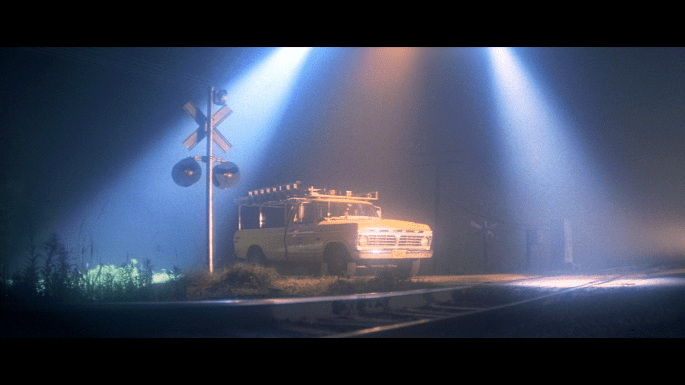
Roy is the film’s protagonist and I like how Spielberg expertly sets up the family dynamic of the Neary’s, like how Roy chastises his kids for having zero interest in going to a screening of Walt Disney’s animated classic Pinocchio (1940). He lives in a noisy, chaotic household and kind of acts like a kid himself. Roy soon has his own close encounter that changes his life forever. While he’s out on a call, late one night, a UFO hovers over his vehicle and bathes him in a blinding light. On his C.B. radio, Roy hears of others seeing what he saw and heads off in pursuit. Spielberg continues to tease us as a large shadow flies ominously over the stretch of road that Roy is driving along. He literally crosses paths with Barry and his mother Jillian (Melinda Dillon), narrowly avoiding running over the little boy with his truck. They witness several UFOs flying by in graceful formation at an incredible speed.

After his experience, Roy becomes obsessed with what he saw much to the chagrin of his family who don’t understand what he’s going through. Richard Dreyfuss does a fantastic job at conveying his character’s newfound mania. Roy is practically euphoric, but there is also a sense of child-like wonder and we are meant to share these sentiments. Spielberg takes us back and forth between the global and the personal, with Lacombe and his assistant Laughlin (Bob Balaban) going all over the world gathering evidence, and Roy’s own journey as he tries to make sense of an image of a large mountain in his head, which turns out to be Devils Tower in Wyoming.

Roy and Jillian’s journey to Devils Tower is an exciting adventure as they cover a lot of terrain, first by car and then by foot, facing constant opposition by the military. Throughout, Spielberg creates all kinds of tension as the two run across ominous signs that something isn’t right, like the livestock that lie dead by the side of the road. They risk getting caught several times and when they are captured, even manage to subsequently escape. This sequence also shows the United States’ government’s response to all of this activity. They create a fake threat to get people who live near Devils Tower to evacuate because Lacombe and his team believe that is where the aliens will establish contact. With the scandal of Watergate still fresh in people’s minds at the time, this elaborate ruse must’ve rung true with audiences who had a healthy distrust of their government. Spielberg really uses the environment around Devils Tower to great effect. You get a real sense of place and how imposing a structure it is for Roy and Jillian to traverse.

Fresh from his excellent supporting role in Jaws (1975), Richard Dreyfuss delivers a wonderfully layered performance as a man who doesn’t understand what’s happening to him. He knows what he saw and experienced, but is unable to get anyone to believe him, not even his family. Roy also has visions of a place he feels compelled to go to, but can’t articulate beyond constructing mountain-like images out of his mashed potatoes or mounds of dirt. It drives him and his family a little crazy and there’s a moving scene where Roy breaks down in front of his family during dinner that really makes you empathize with the poor guy. Eventually, his obsession is too much for his wife (Teri Garr) and kids and they leave him, afraid that his madness will consume them as well. It’s really quite incredible how much Roy alienates his family – something that, sadly, Spielberg has said he would never do now that he has a family of his own. It is heartbreaking to see how Roy’s mania affects his kids, causing them to act out, but Roy can’t help himself. Dreyfuss is so good at conveying this compulsion, this drive to make sense of what Roy experienced. Spielberg is unafraid to show the extremes of Roy’s behavior and how it affects his family.

Close Encounters’ impressive practical visual effects still hold up, like the animated cloud formation that occurs when the aliens appear and take Barry away or the colorful quartet of UFOs that Roy chases in his truck. These effects, in particular the show-stopping finale, are still awe-inspiring and have a tangible quality that has not dated at all. With the Barry abduction sequence, Spielberg demonstrates how you can convey so much by doing very little. With the use of lighting effects and some practical tricks, he creates an intense, nerve-wracking scene as the little boy is taken from his mother right from their house. We never actually see the aliens or the craft. This is all left up to our imagination. For most of the film we are only given glimpses of the UFOs as Spielberg gradually builds to the exciting climax where contact is achieved.

Close Encounters of the Third Kind’s influence can be seen either stylistically or thematically in other like-minded film such as The Abyss (1988), Contact (1997), Signs (2002), and, the most obvious homage, Super 8 (2011). For the ending of his film, Spielberg took a page out of Stanley Kubrick’s 2001: A Space Odyssey (1968) by making the aliens benign and enigmatic. Instead of falling back on the tried and true clichés of alien invasion movies from the 1950s, Spielberg presents aliens that only wish to communicate with us. He created a film full of wonder and hope, culminating in the transcendent climax where we make contact with the aliens. It is an incredible display of good ol’ fashion practical effects that is truly something to behold.

closeencounters2Close Encounters of the Third Kind was made by someone who sincerely believed that there was intelligent alien life on other planets and that if it did exist would not want to wipe us out. This yearning for answers, for wanting to believe is embodied perfectly in Spielberg surrogate Roy Neary. Whether or not you believe in life on other planets, this film still tells an entertaining and engaging story – a global-spanning epic that still feels personal and intimate. This was the first film Spielberg had made that he felt truly passionate about it and this is evident in every frame, brimming with sincerity and idealism that flew in the face of a lot cynicism of the 1970s. As a result, Close Encounters was a touchstone film for me. Seeing it a young age affected me profoundly and still does to a certain degree. It also spoke to a young, impressionable generation, instilling in them a fascination and wonder for the possibilities of intelligent life on other planets.

IN THE MOOD FOR LOVE – A REVIEW BY J.D. LAFRANCE

maxresdefault

Hong Kong filmmaker Wong Kar-Wai may be the master of unrequited love. Think of the cop with a crush on a femme fatale in Chungking Express (1994) or the hitman whose handler admires him from afar in Fallen Angels (1995). However, In the Mood for Love (2000) is his masterpiece – a rich, atmospheric ode to romantic longing and yearning. Inspired by the short story “Intersection” by celebrated Chinese writer Liu Yi-chang and Wong’s own memories of growing up in the 1960s, his film depicts the friendship that develops between two lonely people in Hong Kong, 1962.

Chow Mo-wan (Tony Leung) is a newspaperman who has just moved into an apartment with his wife. Next door, Si Li-zhen (Maggie Cheung), an executive secretary, has also moved into a place with her husband. It just so happens that their respective spouses are constantly out of town at the same time and are having an affair. Initially, Chow and Su are unaware of their spouses cheating ways and contact with each other is brief and fleeting, kind and courteous. Chow and Su being to flirt with having one of their own. Interestingly, we never get a good look at the faces of the cheating spouses and they get very little screen-time with the focus on Chow and Su.

Tony Leung and Maggie Cheung make for a fascinating almost-couple and over the course of the film we want so badly for them to give in to their feelings for each other, but, of course, common sense and the cultural decorum of the day prevents them from acting on their impulses. It is what their characters don’t say to each other, but is conveyed through longing glances, that says so much. Speaking of which, there are incredible moments of longing, like the sequence where Chow and Su, caught out in the rain at night, take refuge at different spots on the street. Their respective body language conveys their loneliness, while how they are framed in a shot relates to their isolation.

Wong has a fantastic eye for detail, not just the period clothes and furniture (which are incredible), but also in showing the everyday minutia of Chow and Su’s lives, like showing them at work. It is these bits of business that inform us about their characters. What they do and say tells us a lot about them. So does what they wear, from Su’s stunning, form-fitting floral print dresses to Chow’s impeccably-tailored business suits.

There are beautiful, almost hypnotic slow motion shots of Chow and Su going to and from work through dimly-lit streets at night or up and down the stairs of their building to the repeated strains of a waltz. Thanks to Christopher Doyle and Mark Lee Ping-bin’s breathtaking atmospheric cinematography, Wong immerses us in this cinematic world he has created. It’s a place where people dine on green jadeite plates while Nat King Cole plays in the background of a restaurant.

In the Mood for Love has become Wong’s most acclaimed film, just edging out his popular breakthrough, Chungking Express. He has yet to surpass this film, coming close with the admirable effort 2046 (2004), a sequel or sorts to In the Mood, which also features world class cinematography but it is too abstract narratively. It lacks the former film’s passion and soul.

LAND OF THE DEAD – A REVIEW BY J.D. LAFRANCE

land of the dead blu-ray7

The 2000s saw a resurgence in the zombie film with the good (28 Days Later), the bad (Resident Evil) and the funny (Shaun of the Dead), but all of them pale in comparison to George A. Romero’s trilogy of zombie films. The first two have been remade already, most significantly with Dawn of the Dead (2004), and both failed to build on or even recapture what made Romero’s films so great in the first place. They seem to only be in love with the gore and miss (or just didn’t understand) the socio-political message of them. Romero returned with a zombie movie that was years in the making and was well worth the wait.

As with his other zombie films, Land of the Dead (2005) is a stand-alone story but looks like it could exist in the same universe as the others. The zombies have completely taken over and the dwindling human population tries desperately to hold onto what little land they have left. A small, heavily armed group venture regularly into zombie territory to scavenge whatever supplies they can find and then return to an island complex known as Fiddler’s Green. The island has been heavily fortified by the military who rule with complete control with rich businessman Kaufman (Dennis Hopper) as their leader.

Society has degraded even further since Day of the Dead (1985). The wide gulf between the rich and the poor is even more pronounced. In the slums of the city people can get their pictures taken with captive zombies or shoot them with paintball guns. At one point, they even throw a woman (Asia Argento) into a steel cage with two zombies for sport. The rich people aren’t much better as represented by Kaufman who is corrupt and amoral enough to make money off of and sacrifice his own people. It’s as if Romero’s saying that it wouldn’t be so bad if the zombies wiped us out. Look at what we’ve become.

The glimmer of hope is represented by Riley (Simon Baker), the leader of the scavengers and his sidekick and ace sharpshooter Charlie (Robert Joy). Like the protagonists in Romero’s Dead trilogy and Knightriders (1981), Riley is a reluctant leader who is tired of this corrupt world and is quietly planning an escape route to a more natural way of life. However, this is disrupted by another member of his group, Cholo (John Leguizamo), who represents the dissenting voice. He’s only in it for the money and has a secret pact going with Kaufman. However, when Kaufman rips off Cholo, the mercenary goes rogue and takes off with Dead Reckoning, the island’s heavily armored vehicle. So, Kaufman cuts a deal with Riley to find Cholo, kill him and bring back the vehicle.

To make matters worse, the zombies are getting smarter as exemplified by Big Daddy (Eugene Clark) who not only learns how to use a gun but is also able to organize legions of the undead. It’s nice to see a return to the slow moving zombies that we all know and love, but with a definite upgrade in the intelligence department while the humans continue to regress, embroiled in more bickering and in-fighting. After all, the zombies are the ultimate have-nots in this world. They are clearly tired of being shot at and exploited by the living. It’s almost as if Big Daddy is some kind of zombie Che Guevara leading an undead revolution that wants to take down corrupt, rich capitalists. In fact, Land of the Dead can be read as Romero’s critique of the George Bush administration with Kaufman as a Donald Rumsfeld stand-in.

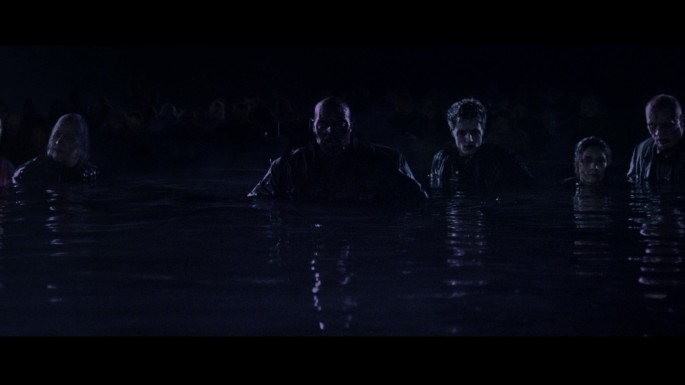
Romero has crafted a very smart horror film, which is something of a rarity these days what with all of these lames remakes littering the landscape. Land of the Dead has all of the requisite gore (and the unrated version has even more) while actually trying to say something. There are plenty of powerful images, like the undead rising out of the water at night (a nice nod to Carnival of Souls, one of the films that inspired Night of the Living Dead) or zombies crashing through the posh apartment complex and feasting on the wealthy. Like with his other zombie films, Land of the Dead is a commentary on the times in which it was made. And for that alone, his movie is a refreshing breath of fresh air.

GLENGARRY GLEN ROSS – A REVIEW BY J.D. LAFRANCE

glengarry1

One of the dangers in adapting a stage play into a film is that you won’t be able to break out of the theatricality inherent with so many plays. Fortunately, film director James Foley seemed to be acutely aware of this when he decided to take on Glengarry Glen Ross (1992), an adaptation of David Mamet’s Pulitzer Prize-winning play of the same name with the screenplay written by the man himself.

Right from the start, Foley keeps things visually interesting by bathing the film in Giallo-esque lighting that would make Dario Argento proud. Cinematographer Juan Ruiz Anchia photographs two salesmen talking in adjoining telephone booths, bathing them in white and blue light respectively with contrasting red in the background. Not only are these colors of the American flag and thereby making a subtle allusion to the notion that this story is a damning indictment of Capitalism, one of the principles that made the United States what it is today. The two men bitch and gripe to each other about the potential clients they have to cold call and then turn on the charm once they get them on the phone. Welcome to Mamet’s cutthroat world of real estate sales populated by desperate, often cruel men that are driven to make as much money as they can, consequences be damned.

One night, an office of down-on-their-luck salesmen are given the pep talk from hell by a ruthless man named Blake (Alec Baldwin), an executive sent by their bosses Mitch and Murray, on a “mission of mercy” as he sarcastically puts it. He starts off by telling them that they’re all fired. They have a week to get their jobs back by selling as much property as they can. He gives them an additional incentive: first prize is a new Cadillac El Dorado, second prize is a set of steak knives and third prize is, as he puts it, “you’re fired.” If the salesmen do well they will get the new Glengarry leads and the promise of better clients and good money.

Blake delivers an absolutely punishing speech as he belittles them (“You call yourself a salesman, you son of a bitch?”), is downright insulting (“You can’t close shit, you are shit! Hit the bricks, pal and beat it because you are going out!”), and demoralizing by even questioning their manhood. He throws in all sorts of “encouraging” words, like “Get them to sign on the line which is dotted,” and “Always be closing.” Alec Baldwin delivers a blistering performance as Blake. His character was not in the original stage play, Mamet wrote him specifically for the film. In his brief amount of screen time, Baldwin dominates the screen against the likes of Ed Harris and Jack Lemmon as he delivers a devastating monologue with ferocious intensity. At one point, Dave Moss (Ed Harris) asks him, “What’s your name?” to which Blake replies, “Fuck you! That’s my name. You know why, mister? ‘Cause you drove a Hyundai to get here tonight. I drove an $80,000 BMW. That’s my name.” Blake is an icy motivational speaker that only motivates the salesmen out of fear of being unemployed, making this scene eerily relevant to our times as that is also the prime motivator for most people trying to hold down a job in our current economic climate.

If there was ever a film that deserved an Academy Award for best ensemble cast then this is it. Glengarry Glen Ross features a dream collection of acting heavyweights: Jack Lemmon, Al Pacino, Kevin Spacey, Ed Harris, and Alan Arkin. Pacino plays the slickest salesman of the bunch – Ricky Roma, a smooth-talking, well-dressed bullshit artist of the highest order. This is evident in the scenes where Roma spins an incredibly long and convoluted story, seducing a mild-mannered middle-aged man named James Lingk (Jonathan Pryce). It’s a marvel of acting as we watch Pacino do a spectacular verbal tap dance around the actual pitch until the last possible moment when he’s got the guy’s complete and utter confidence – even then he presents the land he’s pushing as an opportunity as opposed to a purchase, preying on Lingk’s insecurity. It’s a brilliant bit of acting as Pacino commands the scene with his mesmerizing presence. Jonathan Pryce is also excellent as he portrays a weak-willed man susceptible to Roma’s polished charms.

Harris plays Moss as an angry man pissed off at the lousy leads (i.e. clients) and is plotting to defect to a rival, Jerry Graff. George Aaronow (Alan Arkin) is a nervous guy unable to close a sit (pitching a client in person) and seems keen on Moss’ plan to steal the new Glengarry leads and sell them to the competition. John Williamson (Kevin Spacey) is the office manager, a pencil pusher that shows little remorse in what happens to his staff. He’s a smug son-of-a-bitch who takes a particular interest in Shelley “The Machine” Levene’s (Jack Lemmon) plight. Levene is an older salesman trying to make enough money to pay off mounting medical bills for his sick daughter, which colors everything he does.

glengarry3Levene is a pathetic character desperate to keep his job and still capable of a slick sales pitch (in a nice touch, he often refers to an imaginary secretary named Grace while calling a potential client on the phone), it’s just his judgment that’s off as he finds out with devastating consequences later on in the film. Jack Lemmon somehow manages to make him sympathetic. We see both sides of Levene in a scene where he tries to sell property to a man (Bruce Altman) in his home. The man is not interested and despite Levene’s desperate attempts, asks him to leave. It is an increasingly uncomfortable scene that is hard to watch as the man finally and firmly rebuffs Levene. Your heart really goes out to Lemmon’s character as he dejectedly walks back out into the pouring rain, looking very much like a drowned rat. It is to Lemmon’s incredible skill as an actor that he makes you care about such a pitiful man.
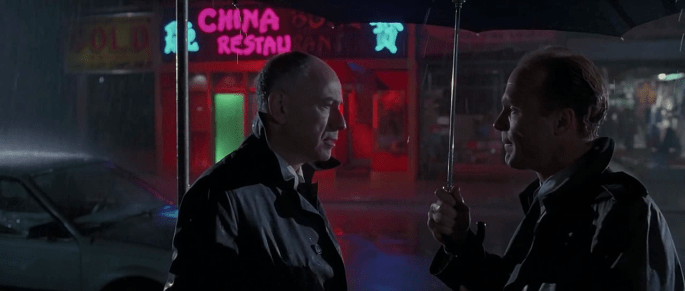
Director Foley successfully transfers Mamet’s play to the big screen by creating atmospheric visuals. There is a somber mood that permeates almost every scene. The first half of the film takes place at night during an oppressive rainstorm. Anchia’s rich, textured cinematography is the key ingredient in giving Mamet’s play a cinematic look. He relied on low lighting and shadows with blues, greens and reds for the first part of the film. The second part adhered to a monochromatic blue-grey color scheme. All the locations are given their own distinctive color scheme, in particular, the hellish red/navy blue of the Chinese restaurant that the salesmen frequent. The overall atmosphere is dark, like that of a film noir.

And then there is Mamet’s trademark hard-boiled dialogue or “Mamet speak” as it is known. It has a sharp, staccato quality to it that cuts right to the point with characters often interrupting each other or their dialogue overlapping as evident in the scene where Moss tells Aaronow of his plans to rob their office. One thing that is evident in Glengarry Glen Ross is just how good Mamet is at writing amusing dialogue. For example, at one point, Williamson asks where Roma is to which Moss replies, “Well, I’m not a leash so I don’t know, do I?” Mamet’s characters talk like they are thinking about what they are going to say next as they are saying it — much like in real life.

David Mamet’s play was first performed in 1983 at the National Theater of London and won the Pulitzer Prize in 1984. That same year it made its United States debut in the playwright’s hometown of Chicago before moving to Broadway. Shortly thereafter, producer Jerry Tokofsky (Dreamscape) read the play on a trip to New York City in 1985 at the suggestion of director Irvin Kershner who wanted to make it into a film. Tokofsky then saw it on Broadway and contacted Mamet. The playwright wanted $500,000 for the film rights and another $500,000 to write the screenplay to which the producer agreed. Washington, D.C.-based B-movie producer Stanley R. Zupnik was looking for A-list material and co-produced two previous Tokofsky films. Zupnik had seen Glengarry Glen Ross on Broadway and found the plot confusing. He also knew of its reputation in Hollywood as being a commercially difficult project but figured that he and Tokofsky could cut a deal with a cable company.

During this time, Al Pacino and Alec Baldwin became interested in Glengarry Glen Ross but without any concrete financing both Kershner and the actors dropped out for various reasons. Pacino had originally wanted to do the play on Broadway but was doing another Mamet production, American Buffalo, in London at the time. Director James Foley read the script in early 1991 and was hired to direct only to leave the project soon afterwards. By March 1991, Tokofsky contacted Baldwin and practically begged him to reconsider doing the film. The producer remembers, “Alec said: ‘I’ve read 25 scripts and nothing is as good as this. O.K. If you make it, I’ll do it.’” This prompted Foley and Pacino to get back on board with Jack Lemmon agreeing to do it as well. Foley and Pacino arranged an informal reading with Lemmon in Los Angeles.

From this point, Foley and Pacino had subsequent readings with several other actors. Lemmon remembers, “Some of the best damn actors you’re ever going to see came in and read and I’m talking about names.” Alan Arkin originally wasn’t interested in doing the film because he didn’t like the character he was asked to portray but fortunately his wife, manager and agent pushed him to do it. Tokofsky’s lawyer called a meeting at the Creative Artists’ Agency, who represented many of the actors involved, and asked for their help. CAA showed little interest but two of their clients – Ed Harris and Kevin Spacey – soon joined the cast.

Due to the uncompromising subject matter and abrasive language, no major studio wanted to finance Glengarry Glen Ross even with actors like Pacino and Lemmon attached. Financing ended up coming from cable and video companies, a German television station, an Australian movie theater chain, several banks, and, finally, New Line Cinema over the course of four years. Because of the film’s modest budget of $12.5 million, many of the actors took significant pay cuts do it. For example, Pacino cut his per-movie price from $6 million to $1.5 million. This didn’t stop other actors, like Robert De Niro, Bruce Willis, Joe Mantegna, and Richard Gere from expressing an interest in the film.

Once the cast was assembled, they spent three weeks in rehearsals. The budget was set at $12.5 million with filming beginning in August 1991 at the Kaufman Astoria soundstage in Queens, New York and on location in Sheepshead Bay, Brooklyn over 39 days. Ed Harris remembers, “There were five and six-page scenes we would shoot all at once. It was more like doing a play at times [when] you’d get the continuity going.” Arkin said of the script, “What made it [challenging] was the language and the rhythms, which are enormously difficult to absorb.” During principal photography, Tokofsky and his producing partner Zupnik had a falling out over credit for the film. Upon the film’s release, Tokofsky sued to strip Zupnik of his producer’s credit and share of the producer’s fee. Zupnik claimed that he personally put up $2 million of the film’s budget and countersued, claiming that Tokofsky was fired for embezzlement, which seems rather ironic considering the subject matter of the film. To date neither one of them has gone on to produce another film with the lone exception of The Grass Harp in 1995 by Tokofsky.

glengarry2It takes a certain kind of personality to sell something that people don’t need but convincing them that they do. There is a whiff of pathetic desperation to Mamet’s salesmen. It seems like their best days are behind them. It’s a vicious circle of sorts – they can’t get access to new, potentially good clients unless they close some of their old ones and they are all deadbeats. These salesmen will say and do anything to keep their job, which begs the question: is that what it takes to be a good salesperson? Ed Harris believes that the film is “about the evils of the free enterprise system. You’ve got these guys selling bogus real estate and they’re upset because they can’t sell it.” The film is a rather timely one as it addresses tough economic times, something that we are experiencing now. One of the reasons Mamet’s characters have such a hard time selling these properties is because nobody has any money and what they do have they’re holding onto it. First performed on stage in the “Greed is good” 1980s, Glengarry Glen Ross was a scathing indictment of the free enterprise system. The film was made in the early 1990s when the economy was doing well and now it has become relevant once again in the lean and mean post-9/11 New Millennium.
STAR TREK II: THE WRATH OF KHAN – A REVIEW BY J.D. LAFRANCE

startrek3

People tend to forget how much was riding on Star Trek II: The Wrath of Khan when it was released in 1982. Star Trek: The Motion Picture (1979) was considered to be a big bore and not really indicative of the television series. The powers that be wanted to make sure that the next film would not repeat the previous one’s mistakes. So, they removed series creator Gene Roddenberry and replaced him with veteran T.V. producer Harve Bennett. He proceeded to watch the entire run of the original series and decided to dust off a classic villain and give Admiral James T. Kirk (William Shatner) a decidedly personal stake in this new mission.

Early on in the film there are two crucial exchanges between Kirk and his two closest friends. In observance of his birthday, Captain Spock (Leonard Nimoy) gives Kirk a copy of Charles Dickens’ novel A Tale of Two Cities (Spock refers to Kirk’s fondness for collecting antiques) and the latter quotes the famous opening passage, “It was the best of times, it was the worst of times,” to which Spock replies, in reference to this day, “Surely the best of times?” This bit beautifully encapsulates the film as a whole, featuring the crew of the Enterprise at their best and at their lowest. Wrath of Khan is often regarded as the strongest film of the franchise – “Surely the best of times,” indeed.

The second important exchange happens between Kirk and Dr. McCoy (DeForest Kelley). The latter gives the former 400-year-old reading glasses and we get a glimpse at his living quarters – full of the antiques Spock alluded to in the previous scene. Kirk is surrounded by reminders of the past and is staring down yet another birthday. “It’s about you flying a goddamn computer console when you want to be out there hopping galaxies,” McCoy tells him. He encourages Kirk to take command of a starship again before he gets too old.

I love these early scenes because they not only allow us to get reacquainted with Kirk and co., featuring quiet, human moments that give us insight into Kirk and his friendships with Spock and McCoy, but they also establish the themes of friendship and mortality that will feature prominently later on. The opening scenes with Kirk confiding in Spock and McCoy are like revisiting old friends you haven’t seen in a while and there is something enjoyable and reassuring about seeing these veteran actors dusting off and slipping so easily back into their iconic characters. There is a shorthand and a familiarity between these characters because the actors have so much experience playing them.

Most contemporary films would do away with scenes like this, viewing them as extraneous and unnecessary, but on the contrary they are vital to getting us invested in Kirk’s dilemma of getting old and becoming obsolete vs. going back out there and mixing it up in outer space once again. “Galloping around the cosmos is a game for the young,” Kirk says early on and it is the film’s central theme as it pits two aging enemies against each other. The film openly acknowledges the age of the cast, in particular Kirk, who comes face to face with his own mortality. The film even starts off on a playfully cheeky note as the entire Enterprise bridge crew are killed off in a battle simulation.

Before Kirk makes a decision, fate intervenes and forces his hand. Khan Noonien Singh (Ricardo Montalban) and his crew manage to escape the desolate planet prison that Kirk banished him to many years ago and decide to exact revenge on his most hated enemy. He kidnaps two key crew-members from the U.S.S. Reliant (while also marooning its crew and commandeering the ship) and steals Project Genesis, a device that will take a lifeless planet and bring it violently back to life. Carol Marcus (Bibi Besch), an old ex-flame, and her son David (Merritt Butrick) – that resulted from their brief union – are the primary architects of Project Genesis. They send out a distress call, which Kirk and the crew of largely inexperienced cadets on the Enterprise intercepts, unaware that Khan has set a trap for them.

startrek2I also like how this film is steeped in classic literature, from John Milton’s Paradise Lost to Herman Melville’s Moby Dick. Spock gives Kirk a copy of A Tale of Two Cities by Charles Dickens. The book’s famous opening lines, “It was the best of times, it was the worst of times,” is cited and its hero dies to save his friend, sly foreshadowing to the end of Wrath of Khan. On two occasions, Khan paraphrases Ahab in Moby Dick, most memorably in that classic scene where he conveys his passion for wreaking vengeance on Kirk: “I’ll chase him round the moons of Nibia and round the Antares maelstrom and round perdition’s flames before I give him up.” I appreciate a science fiction film that isn’t content to merely throw around technical jargon, but also allude to classic literature, both thematically and quoted by its characters. It makes sense because characters like Kirk and Khan are mythological in nature themselves.

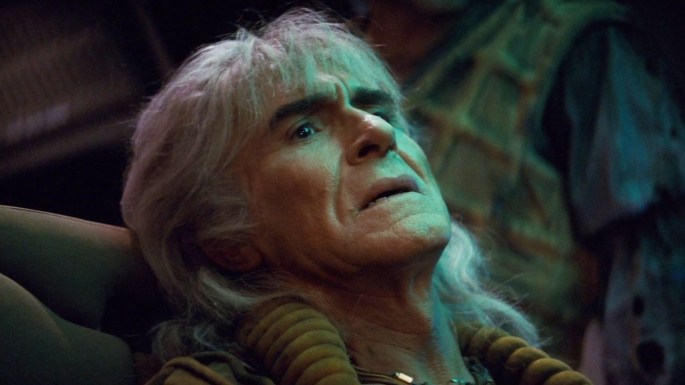
The scene where we first meet Khan gives Ricardo Montalban a chance to savor the moment as he relishes every word like a fine meal, giving the dialogue a unique spin as only he can. Khan is an aggrieved villain with an axe to grind – years of hatred for Kirk. He has the cunning intelligence to devise a trap in which to ensnare his old foe. Montalban’s take on Khan is a deliciously evil one and there is no doubt that he is more than a formidable match for Shatner’s Kirk. Khan isn’t out to rule the galaxy. No, this is a personal vendetta against Kirk and he’ll stop at nothing to get his revenge. Khan is on a mission of vengeance, plain and simple, and after hearing him recount the hardships he and his people endured it is hard not to – I wouldn’t say sympathize, but understand what motivates him. He’s seen his wife and 19 of his people die. He’s had years to brood over what happened and what he’d do to Kirk if given the chance. Once he gets control of the Reliant, Khan strikes back, hurting the Enterprise crew in a way so that Kirk gets a taste of what he’s been through and this makes their battle a very personal one with a lot at stake for both men.

The Wrath of Khan may be William Shatner’s finest moment in the Star Trek franchise as Kirk wrestles with his own mortality and must confront and conquer his self-doubts. He also must deal with an old nemesis, which makes the battle personal for him as well. Shatner does a nice job conveying these initial doubts about getting back into the Captain’s chair, then his joy at being back in a mission, then anger as he is tricked by Khan, and finally grief of the toll the battle takes on him and his friends. The veteran actor has to convey a wide-range of emotions and does so with his usual dramatic flair. Even better, we get to see who can overact more, Shatner or Montalban, as they take turns chewing up the scenery with melodramatic gusto complete with some great, spirited exchanges and some insanely quotable dialogue. It’s not just what is said but how it’s said that makes it so memorable. They are both acting hams, fond of … dramatic … pauses and sudden outbursts of emotion, but both clearly bring the best out of each other. Part of the enjoyment that comes from this film is watching these two go at it, holding nothing back, just like their characters.

The veteran cast from the show inhabits their roles with the ease and confidence that comes from years of practice. It helps that the main cast portray characters with detailed backstories thanks to the T.V. series and so there is all of that baggage for them to draw on, not to mention their complete familiarity with their respective roles. All Kirk and McCoy have to do is exchange a knowing look between each other to suggest more than any dialogue could. The screenplay draws on the Enterprise crew’s long-time camaraderie by raising the emotional stakes, making this mission a very personal one for Kirk and whose outcome will not only impact him, but also his mates. The nature of friendship is explored in Kirk’s yin to Spock’s yang. They complement each other because together they provide the right mix of instinct and logic. This balance is in flux in The Wrath of Khan when Spock reminds Kirk that “the needs of the many outweigh the needs of the few,” to which Kirk adds, “or the one.” These are words that will gain importance at the film’s climax as they come back to haunt the characters.

startrek1In The Wrath of Khan, Kirk is forced to face two people from his past – one hostile and one he used to be romantically involved with – both of whom will dramatically change his life in unexpected ways. Only by defeating Khan can Kirk overcome the doubts that plagued him at the beginning of the film. Kirk is a man of action who relies heavily on his instincts. Engaging a like-minded adversary like Khan reawakens these tendencies where they had been inactive after the events of Star Trek: The Motion Picture. Director Nicholas Meyer keeps the film moving at a decent pace, but knows when to let things breath for nice, character-driven moments that provide important motivations for future actions later on in the film. There’s a reason why The Wrath of Khan is considered the best film with the most compelling story in the series: it pits the Enterprise crew against a truly formidable opponent, features thrilling spacecraft battles, and has an incredibly moving finale. Surely the best of times.

DRUGSTORE COWBOY – A REVIEW BY J.D. LAFRANCE

tumblr_njtzsqon201tus777o3_1280

Filmed in “beautiful” Portland, Oregon, Drugstore Cowboy (1989) is an unapologetic look at the life of a junkie during the early 1970s. As the film opens we see the protagonist, Bob (Matt Dillon), flat out on a stretcher in a speeding ambulance. He stares at the camera and his voice narrates, “I was once a shameless full-time dope fiend.” It is this confessional voice that sets the tone for the rest of the film as Bob takes us back in time to show how he reached his current state. He was the leader of a gang of drug users who robbed drugstores to maintain a constant high.

The gang follows a family mentality with Bob acting as the street smart “father,” and Diane (Kelly Lynch) as the “mother” who keeps everyone else in line. “I loved her, and man, she loved dope,” Bob remembers. Rick (James Le Gros) is the “son,” a quiet guy who clearly views Bob as a father figure. Nadine (Heather Graham) is Rick’s wife, the “daughter” figure, and a recent addition who is forever trying to prove her worth to the others. Director Gus Van Sant introduces this “family” in a great opening scene where they work together to rob a drugstore in broad daylight. Each one enters the store, apparently by themselves, each casing the place, waiting until Nadine provides the signal – a faked epileptic fit that draws everyone’s attention, leaving Bob free to sneak behind the counter and take the drugs. The plan is flawlessly executed with Diane even having the time to steal a paperback novel from a rack.

As the group flees the scene in a getaway car, Bob shoots up in the back seat and Van Sant uses this action to enter Bob’s head and show us the worldview of a junkie. As the drug takes hold Van Sant has the real world fade into the background and a dreamy, surreal world filled with floating syringes, spoons and houses complete with a hypnotic, monotone rap of a stoned Bob narrating the action: “Upon entering the vein, the drug would start a warm edge that would surge along until the brain consumed it in a gentle explosion that began at the back of the neck and rose rapidly until I felt such pleasure that the whole world sympathized and took on a soft, lofty appeal.” It’s a dreamy logic that seems to suit Bob’s own little world perfectly. In fact, much of the film is seen from Bob’s viewpoint. Van Sant takes the basic ritual of shooting up and focuses in on the primary components: extreme close-ups of the pills, a lit match, and a syringe sucking up the drugs off a spoon. It is almost like we are preparing for a fix right along with Bob.

And yet for such an accurate portrayal of the highs of drug use, oddly enough Van Sant does not show Bob or any of his crew in the throes of withdrawal, especially when, later on, he decides to go straight. While some of the negative aspects of this kind of life are shown, like people dying, the film refuses to show what happens when one tries to stop using drugs, unlike, say Trainspotting (1996), which does it so well and with such frightening intensity. What sets Drugstore Cowboy apart from other films about drug users are nice little touches like Bob’s superstitions: dogs, hats on beds and, strangely enough, looking at the back of mirrors. It is the hats, however, that is the most important hex and one that comes back to haunt him later in the film.

Matt Dillon does an excellent job of portraying someone high on drugs, in particular, the scene where Bob has taken speed. The actor nails all of the fidgety mannerisms, like clenching his job repeatedly. In Dillon’s long, illustrious career, this performance is his most relaxed and naturalistic. He gives Bob a cool, confident swagger that seems so right for the character. Dillon presents Bob as a smart person, always thinking ahead, always one step ahead of the law. He’s smart because as he says, “I just know, from years of experience, the things to look for, the signs…All you gotta do is look for the signs.” It is this ability that keeps him on top of his game. Dillon’s voiceovers are particularly effective in filling in the gaps and giving little tidbits of junkie culture. There is no wall between him and the camera and there are no artificial mannerisms in his performance.

The rest of the “family” is also excellent, in particular Kelly Lynch who is the perfect foil for Dillon. Diane’s role in the crew is evident in the way she deals with the other members. For example, when she steps in and breaks up a heated argument between local speed-freak David (Max Perlich) and Bob, it is like a mother breaking up a fight between two little boys fighting over a toy. James Le Gros is a greatly underappreciated character actor who dabbles in mainstream films like Point Break (1991) and Zodiac (2007), usually in small roles, and meatier parts in independent films like Living in Oblivion (1995) and Scotland, PA (2001). In Drugstore Cowboy, he plays Bob’s inexperienced right-hand man and protégé. At first, Rick seems a little on the dumb side as he speaks simply but there’s more to him. Le Gros spends a lot of time watching Bob and learning as becomes evident later on. Rounding out the crew is Heather Graham as Nadine. Before her performance as Rollergirl in Boogie Nights (1997) launched her career on a mainstream level, she had a memorable turn as Agent Cooper’s doomed love interest in Twin Peaks. She’s good as the hopelessly naive and inept member of the crew and her sole purpose is to be a pain in Bob’s ass but you kind of feel sorry for her at times.

James Remar brings a real sense of humanity to what could have been a stock cop role. He usually plays bad guys (48 Hrs.) or disreputable types (The Warriors) and gets to show off his range with Gentry in Drugstore Cowboy, playing a cop trying to bust Bob and his crew. At first, he comes across as a typical antagonist, always giving Bob a hard time but something happens over the course of the film. As Bob attempts to kick his drug habit, Gentry becomes a more sympathetic figure. He recognizes that Bob is trying to make an honest go of things and supports him in his own way.

What would a film about junkies be without a cameo by the king of them all, William S. Burroughs who plays a defrocked priest. Van Sant uses Burroughs as a sort of prophetic figure who delivers a sage monologue on the future of drugs: “Narcotics have been systematically scapegoated and demonized. The idea that anyone can use drugs and escape a horrible fate is anathema to these idiots. I predict, in the near future, right wingers will use drug hysteria as a pretext to set up an international police apparatus.” The legendary writer apparently wrote all of his own lines and it shows, as these words seem like vintage Burroughs, coming right off the pages of Naked Lunch. His presence also helps give the film an authenticity.

Drugstore Cowboy 1Drugstore Cowboy
is a film filled with strong performances, and stunning cinematography as Van Sant mixes Super 8mm with 35mm, using time lapse photography with elements of surrealism to create a world as seen through the eyes of a junkie. Van Sant does not judge his characters, he merely presents them as they are and leaves it up to the audience to make their own minds. Even though the film deals with depressing subject matter it never dips down the murky level of a film like Sid and Nancy (1986), but rather offers a ray of hope at the end as Bob tries to come clean and kick his habit. It won’t be easy for him, but at least he has a chance to give it a shot.
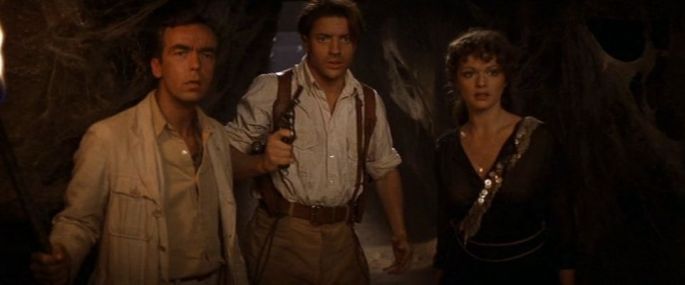
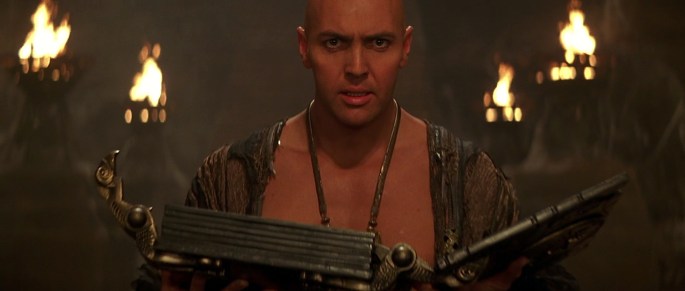
THE MUMMY – A REVIEW BY J.D. LAFRANCE

mummy1

Many cinephiles view director Stephen Sommers as the cinematic equivalent of Satan, and with everything that has gone horribly wrong with Hollywood blockbuster films. And, to be fair, with films like Van Helsing (2004) and G.I. Joe: The Rise of Cobra (2009) on a not-too impressive resume (in fact, looking over his filmography, there’s only one film of his I like), he’s hardly a filmmaker one equates with quality, but I will admit to being quite fond of The Mummy (1999). As far as Indiana Jones rip-offs go, it is pretty good. If that sounds like faint praise, I don’t mean it to be as Sommers’ film is actually a lot of fun and entertaining as hell.

The movie is the very popular re-imagining of the old Boris Karloff classic and would go on to spawn two inferior sequels and transform Brendan Fraser into a bonafide leading man. Up to that point he had a reputation for starring in forgettable comedies like Encino Man (1992), The Scout (1994), and Airheads (1994). With The Mummy, he demonstrated some serious action film chops with a hint of romantic leading man qualities that were complimented by his knack for comedy, thankfully doled out in relative moderation this time. The end result is a satisfying popcorn movie with no other agenda than to entertain.

It’s 1923 and the French Foreign Legion engage the Medjai, descendents of Pharaoh Seti I, in battle at the legendary Hamunaptra, the City of the Dead. When his superior officer deserts, Rick O’Connell (Fraser) finds himself in charge, much to his chagrin. It certainly is an exciting way to introduce our leading man as he and his fellow soldiers attempt to stand their ground on the city walls as the Medjai attack in wave after wave. Brendan Fraser shows some decent action movie skills as his character valiantly tries to stay alive despite being overwhelmed by superior numbers and abandoned by his cowardly sidekick (and comic relief) Beni (Kevin J. O’Connor). Rick narrowly escapes and runs off into the desert where the Medjai leave him to die.

Three years later in Cairo, we meet bookish librarian Evelyn Carnahan (Rachel Weisz) at the Museum of Antiquities as she single-handedly manages to topple over a room full of towering bookcases like dominoes when she attempts to shelve a book. It’s a cute bit of slapstick that establishes Evelyn as one of the most not-so graceful people on the planet. With her hair tied up and sporting a thick-rimmed pair of glasses, the movie’s greatest special effect may be trying to convince us that the gorgeous Rachel Weisz is a socially awkward bookworm (yeah, right). Evelyn’s application to bigger and better things has been rejected yet again because she doesn’t have enough field experience. Along comes her older ne’er-do-well brother Jonathan (John Hannah) who has discovered a trinket at an archaeological dig in Thebes. Inside it contains a map to the mythic Hamunaptra, the place where the earliest Pharaohs are said to have hidden the wealth of Egypt. No one has ever found it and naturally Evelyn’s boss scoffs at the notion of its very existence.

It turns out that Jonathan actually stole the map from Rick who is rotting away in prison. Jonathan and Evelyn pay him a visit and he agrees to tell them where the City of the Dead is located but only if they free him. They do (and just in the nick of time) and set out for the site with a rival expedition of American fortune hunters also looking for it. As luck would have it, they are led by Beni, setting up a personal rivalry between him and Rick. Both groups arrive at the City of the Dead and split up, each looking for treasure. However, the American fortune seekers uncover a curse that condemns their party to death.

Meanwhile, Rick and Evelyn uncover the coffin of Imhotep (Arnold Vosloo), the ruler of Hamunaptra and who carried on a forbidden affair with Seti I’s wife Princess Anck-su-namun (Patricia Velasquez). He was buried alive for his indiscretions while she killed herself. Evelyn unlocks the legendary Book of the Dead and reads from it, unwittingly resurrecting Imhotep who proceeds to kidnap Evelyn with the intention of sacrificing her so that his lover will also come back to life. It’s up to Rick, Jonathan and Ardeth Bey (Oded Fehr), the enigmatic leader of the Medjai, to stop Imhotep.

One of the things that makes The Mummy work is the chemistry between Brendan Fraser and Rachel Weisz. At first, Evelyn sees Rick as an uncouth mercenary and he sees her as a naive stuffed shirt. But the more time they spend together, especially in death-defying situations, the more they grow to admire and respect one another. The two actors handle this development quite well and certainly make for an attractive couple with Fraser’s matinee idol good looks and Weisz’s beautiful appearance – a little something for everyone. They manage to transcend the predictable screenplay and often clichéd dialogue through the sheer force of their natural charisma. This is readily apparent in the campfire scene where one-night Rick teaches Evelyn a bit about hand-to-hand combat even though she’s had a little too much to drink. She ends up passing out just before they kiss, much to his bemusement. There’s a bit of an old school Hollywood vibe to this scene and to how these actors approach their respective roles that works.

mummy2.jpgAs far as Indiana Jones clones go, Rick doesn’t quite bring the slight air of danger that Harrison Ford brought to Raiders of the Lost Ark (1981), the most obvious influence on The Mummy. Not to mention, Fraser has more hulking boyish good looks as opposed to Ford’s roguish charm. Also, Fraser relies more on comedy than Ford but as far as action-oriented treasure hunters go, you could do worse than Rick O’Connell. Fraser hasn’t really been able to capitalize on the success of this film, appearing in several generic children’s adventure films – although, he showed some promise co-starring with Michael Caine in an adaptation of The Quiet American (2002).
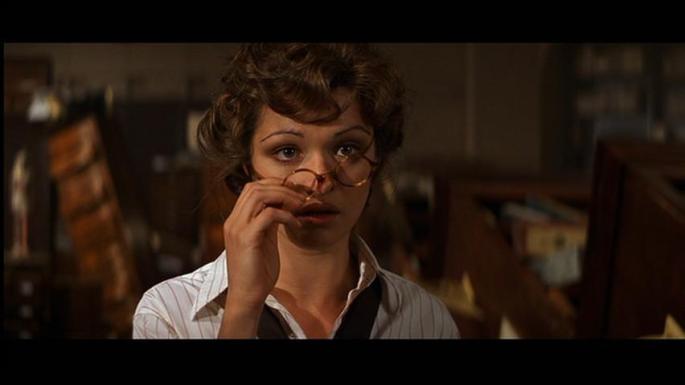
While Evelyn is certainly not as feisty and as capable as Marion in Raiders, she has more of an arc as she goes from sheltered academic to damsel in distress to experienced adventurer. At the time, Weisz was known for appearing in small, independent films and the success of The Mummy would launch her into the A-list stratosphere. She has fared the best of the cast, appearing in delightful romantic comedies like About a Boy (2002) and Definitely, Maybe (2008), and winning an Academy Award for her excellent work in The Constant Gardener (2005).

Sommers handles the action sequences with refreshing simplicity (something that would be absent from his subsequent films). We always know what’s going on and where everyone is. He clearly took notes while watching Raiders and manages to capture its flair for 1930 cliffhanger serials. The Medjai siege on the boat to Hamunaptra early on in the movie is particularly exciting and well-staged, evoking a real Indy Jones vibe.

As with so many big budget tent-pole movies for Hollywood studios, The Mummy was a project that gestated for years and went through many hands before it wound up with Sommers. This new version’s origins lie with producer James Jacks who decided in 1992 to update the original film for the 1990s. He struck a deal with Universal Pictures who agreed to back it but only on a budget around $10 million. Jacks remembered that the studio “essentially wanted a low-budget horror franchise.” To this end, he hired filmmaker/writer Clive Barker whose version was about the head of a contemporary art museum built like a pyramid. The man was actually a cultist trying to reanimate mummies. Jacks described it as “dark, sexual and filled mysticism.” Sadly, after several meetings, Barker and Universal lost interest in the project and parted ways.

Once Barker was off the project, George Romero was brought in and he wanted to make a zombie-style horror film along the lines of his legendary feature film debut, Night of the Living Dead (1968). However, Jacks and the studio wanted to make a mainstream film and felt that Romero’s vision was too scary. Next up was Joe Dante with a contemporary reincarnation tale with elements of a love story starring Daniel-Day Lewis as a brooding Mummy. John Sayles even co-wrote the script but Universal was only willing to spend $15 million on his vision. Jacks then offered the project to Mick Garris and also Wes Craven, both of whom passed.

In 1997, Stephen Sommers contacted Jacks with his take on The Mummy “as a kind of Indiana Jones or Jason and the Argonauts with the mummy as the creature giving the hero a hard time.” He saw the original film when he was only 8-years-old and with his version wanted to recreate the things he liked about it only on a bigger scale. He had wanted in on the project since 1993 but other writers or directors were always involved. Seizing a window of opportunity, he prepared an 18-page pitch to Universal. As luck would have it (for Sommers, that is), the studio had taken a bath on Babe: Pig in the City (1998) and in response, decided to revisit its successful franchises from the 1930s. Executives were so thrilled with Sommers’ concept for The Mummy that they increased the budget from $15 million to a staggering $80 million. Once he got the gig, he spent six months researching the film and then eight weeks writing the screenplay.

When it came time to cast Rick O’Connell, Jacks offered the role to Tom Cruise, Brad Pitt, Matt Damon, and Ben Affleck but they were either not interested or too busy. Jacks and Sommers were impressed with the box office receipts from George of the Jungle (1997) and cast Brendan Fraser as a result. The actor was drawn to the project because he was looking for an action film and liked the idea that Universal was reinventing one of its properties from the 1930s. For the character, he drew inspiration from the likes of Robin Hood, Buck Rogers and Sinbad. Most importantly, he understood that Rick was the kind of character who didn’t “take himself too seriously, otherwise the audience can’t go on that journey with him.”

The Mummy
was shot over three months in Morocco and not in Egypt because of the unstable political conditions there. They also had the official support of the Moroccan army. In a reassuring touch, the cast had kidnapping insurance taken out on them. In addition, the cast and crew had to deal with blinding sandstorms and bad-tempered camels. The production had wranglers on set to catch snakes, scorpions and spiders at the end of every shooting day. This still didn’t prevent many crew members from being airlifted out after being bitten. Everyone also had to worry about dehydration when filming moved to the Sahara Desert. The production’s medical team ended up creating a beverage that the cast and crew had to drink every two hours.

mummy3Looking back, whatever good will Sommers garnered with The Mummy, he has subsequently pissed it all away with The Mummy Returns (2001), which reduced the number of quiet moments that developed the characters and told the story in the first movie in favor of wall-to-wall frenetic action and the addition of a bratty child (Rick and Evelyn’s offspring, natch) into the mix. Sommers didn’t return for the third and most disappointing installment (neither did Weisz) which is just as well. The damage had already been done with The Mummy Returns but the first movie is still a rousing, entertaining ride.
THE NINTH GATE – A REVIEW BY J.D. LAFRANCE

The-9th-Gate-the-ninth-gate-16058196-960-414

Critical and commercial reaction to Roman Polanski’s films has always been mixed at best. To say that they are an acquired taste is an understatement. The Ninth Gate (1999) is no exception. Despite what the film’s misleading trailer promoted at the time of its initial release, it is not a straight-forward supernatural thriller but rather showcases the auteur in a darkly humorous mood as he plays around with the conventions of the genre.

Dean Corso (Johnny Depp) is an unscrupulous book dealer whose motivation is purely for financial gain. He swindles a naïve couple from a set of rare and priceless books in an amusing scene that sets up his character beautifully. A very rich book collector by the name of Boris Balkan (Frank Langella) hires Corso to validate his recently purchased copy of The Nine Gates of the Kingdom of Shadows, one of only three copies that exist in the world. The book contains nine engravings which, when correctly deciphered and the interpretations properly spoken, are supposed to conjure the Devil. Balkan believes that only one book is authentic so he hires Corso to track down each copy and verify their authenticity. It seems like a simple enough task but as Corso soon finds out, someone does not want him to complete the job. He crosses paths with an odd assortment of characters, from a mysterious woman (Emmanuelle Seigner) who seems to help him in his quest, to another, more obviously evil woman, Laina Telfer (Lena Olin) intent on impeding his progress and quite possibly trying to kill him.

Polanski received the screenplay by Enrique Urbizu and was so taken by it that he read the book it was based on, El Club Dumas by Arturo Perez-Reverte. He liked the novel because, “I saw so many elements that seemed good for a movie. It was suspenseful, funny, and there were a great number of secondary characters that are tremendously cinematic.” The novel featured several intertwined plots and so Polanski decided to write his own draft with long-time screenwriting partner, John Brownjohn (they had collaborated previously on Tess, Pirates and Bitter Moon). Perez-Reverte’s book contains numerous literary references and a subplot concerning Corso’s investigation into an unpublished chapter of The Three Musketeers. Polanski and Brownjohn jettisoned these elements and focused on one particular plot line: Corso’s pursuit of the authentic copy of The Nine Gates. For Polanski, the story had “all the ingredients that I like. It’s a great dose of a certain kind of irony and humor, and a bit of the supernatural or metaphysical or whatever you call it. Suspense and a central character, which I found very appealing.”

Johnny Depp became attached to the project as early as 1997 when he met Polanski at the Cannes Film Festival promoting his directorial debut The Brave (1997) that was in competition. Initially, the veteran filmmaker did not think that Depp was right for the role of Corso because the character was 40-years-old. Polanski was thinking of casting an older actor but Depp was persistent and wanted to work with him. According to the director, Corso’s disheveled look was modeled after Raymond Chandler’s famous sleuth, Philip Marlowe and there is a hint of that rumpled cynical vibe that is the trademark of that character. Hints of friction between Depp and Polanski while working on the film surfaced in the press around the time of its North American release. The actor said, “It’s the director’s job to push, to provoke things out of an actor.” Polanski told one interviewer, “He [Depp] decided to play it rather flat which wasn’t how I envisioned it. And I didn’t tell him it wasn’t how I saw it.”

Polanski cast Frank Langella as Balkan after seeing him in Adrian Lyne’s version of Lolita (1997). The director liked how the actor could be “charming and disturbing at the same time.” Polanski cast Lena Olin as Liana Telfer because he needed “an actress who could give the impression that she’s an intellectual and, at the same time, a very sensuous woman capable of great bursts of violence.” Barbara Jefford was a last minute casting decision because the German actress originally chosen was struck with pneumonia and another actress could not learn the lines. Jefford came in with only a few days notice, learned her lines, and affected a German accent. Casting Jefford was a nice nod to her role in the Hammer Horror film, Lust for a Vampire (1971), where she played a countess who conducts a satanic ceremony to resurrect the body of her daughter.

Polanski admired the work of director of cinematography, Darius Khondji. “I love his lighting, because he knows how to make it both sophisticated and realistic. It keeps you on the fringe of fantasy so when you tip over into the supernatural, it doesn’t feel artificial at all,” he remarked in an interview. Khondji was also keen to work with the director. “I’ve always wanted to make a movie with a witchcraft or supernatural subtext – I love those kinds of stories. Roman is obviously one of the best directors in the world to work with in that genre.” Filming took place in France, Portugal and Spain during the summer of 1998.

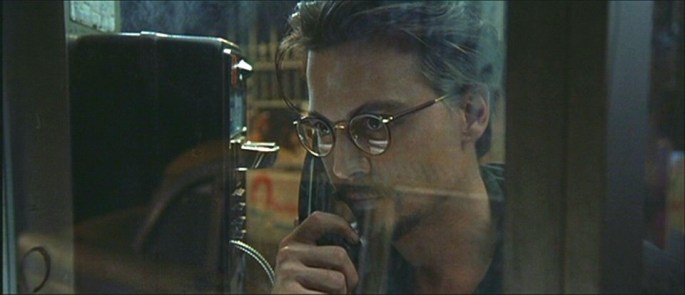
While the film’s slow, deliberate pacing turned off many, there is a method to Polanski’s madness. The gradual pacing draws one into this engaging world. Perhaps it is the European setting but The Ninth Gate has an otherworldly atmosphere that is well done. The attention to detail and Khondji’s richly textured cinematography is exquisite and contributes to the overall mood of this vivid world. For example, the New York City scenes have a very 1940s vibe to them, utilizing brown and blacks with a warm gold glow from the street lamps. This is, in turn, contrasted with the green and red in the phone booth when Corso is trying to contact Balkan.

hQFD1However, The Ninth Gate does not just have atmosphere going for it. Johnny Depp adds yet another intriguing character to his roster of unconventional roles. Corso is an unethical cheat who would do anything to make a buck. A rival describes him as a “vulture” and “unscrupulous” to which he freely admits to as he swindles four volumes of a rare edition of Don Quixote. He really does not care about others and yet, despite all of his reprehensible qualities, Depp’s natural charisma and charm make him kind of an endearing character that you care more about as he delves deeper into dangerous waters.
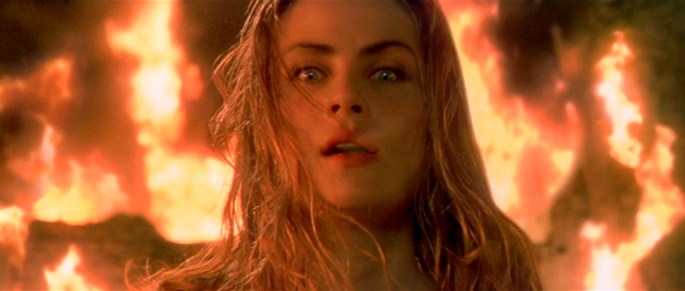
Balkan is a pompous windbag filled with self-importance but Frank Langella stops just short of being a cliched, moustache-twirling villain. He’s melodramatic and his presence is a nod to horror fans who recall his most famous role in Dracula (1979). Lena Olin’s dangerous Telfer widow evokes her femme fatale character from Romeo is Bleeding (1993). She smokes and even flashes a suggestive shot of her black garter-clad thighs in an attempt to seduce Corso and draw him into her web. She uses sex to get what she wants and when that fails she resorts to violence, attacking him in an animalistic frenzy.

Emmanuelle Seigner plays a mysterious woman who constantly shadows Corso and sometimes helps him out when gets in dangerous situations. Her motives do not become fully apparent until the end and even then it is open to interpretation. She helps him get inside the Fargas house and flies with him to France. Who or what is she? At one point, she literally glides down a flight of stairs and saves Corso from getting a beating at the hands of Telfer’s henchman.

This movie is ample with clues, a puzzle waiting to be solved. For example, in Balkan’s lecture at the beginning of the movie, he suggests that all witches are evil and in league with Satan. The irony is that Corso sleeps through this important clue to Balkan’s real intentions. There is also the odd, disregard for The Book of Shadows, a book worth an estimated $1 million. It is placed in constant peril and is even flicked with ash when the Ceniza brothers analyze it.

As for the cliché aspects of the film, one should be less concerned at anticipating plot twists and predictable elements in favor of simply enjoying the ride. Polanski probably was aware of this and decided to have fun with them. There is Balkan’s “666” password, Corso’s perchance for getting the crap kicked out of him, and the one-armed woman book dealer that all contribute to a playful mood that punctuates the film whenever it runs dangerously close to being too pretentious or self-important.

Polanski approached the subject matter with a certain amount of skepticism as he said in an interview, “I don’t believe in the occult. I don’t believe. Period.” He wanted to have fun with the genre. “There is a great number of clichés of this type in The Ninth Gate which I tried to turn around a bit. You can make them appear serious on the surface, but you cannot help but laugh at them.” For Polanski, the appeal of the film was that it featured “a mystery in which a book is the leading character” and its illustrations “are also essential clues.” The film has a playful tone but Polanski knows when to reign things in. As the horror is heightened so is the film’s dark comedy during the climactic moments. The screenplay is in perfect synchronicity with the direction.

For a film supposedly steeped in literature, the text, and by that I mean the story, is irrelevant. There are many clues scattered throughout the film that suggest this to be the case. One has to understand that among the characters there is a hierarchy. At the bottom level is the Frenchman that Corso meets early on. He owns one of The Nine Gates but is not all that interested in it except for the craftsmanship of its binding. Then, there is the Baroness who has spent her life writing about The Devil but never considered the meaning behind the images in her copy of The Nine Gates. And, if you take her word, she had the best clue because she claimed to see the Devil when she was a child. At the next level is Laina who is aware that the book has some power but is still focused on the words and not the images. Above her is Balkan who knows that the text is irrelevant and that the pictures are crucial but incorrectly thinks that the key to summoning the Devil lies in them.

The Ceniza brothers have the ability to tinker with the power of the pictures. They are allusive figures that seem whimsical when Corso first meets them and then are gone when he visits their now defunct store at the film’s end but thanks to the movers who are disassembling the store he gets the final piece of the puzzle. Corso starts off at the bottom because the value of books are neither in the text nor in the pictures but in their binding and availability. By the film’s end he realizes that the power is not in the pictures but the quest itself. There is the mysterious woman who resembles one of the figures in the engravings and actually provides the final clue for Corso to reach the end of the quest. The final layer is the viewer. That makes nine players and eight levels of consciousness created by Polanski.

fhd999TNG_Emmanuelle_Seigner_037The Ninth Gate
was a refreshing change from the trend of mundane Hollywood supernatural schlock at the time (i.e. The Bone Collector, Stigmata, End of Days, et al.) that took itself way too seriously and tried too hard. Unlike those films, The Ninth Gate never falls into that trap. It contains some truly vintage Polanski black humor that, alas, North American audiences and critics alike did not appreciate. They wanted meat and potatoes filmmaking that he has always resisted in favor of subversive thrills and following his own muse come hell or high water.
TROPIC THUNDER – A REVIEW BY J.D. LAFRANCE

large20tropic20thunder20blu-ray6

For the years leading up to Tropic Thunder (2008), Ben Stiller had been coasting on his patented, one-note neurotic doormat shtick in films like Night at the Museum (2006), The Heartbreak Kid (2007), and others. What happened to the guy who could play a self-destructive junkie screenwriter in Permanent Midnight (1998) and a dorky romantic in There’s Something About Mary (1998)? Stiller, at times, is more interesting behind the camera as director of the Generation X comedy Reality Bites (1994), the black comedy about stalking and television, The Cable Guy (1996), and the hilarious fashion world satire Zoolander (2001).

With Tropic Thunder, Stiller returned to being behind the camera (and also in front of it) and decided to take on the Vietnam War sub-genre. In an odd way, we have Oliver Stone to thank for this film. Not just because he made Platoon (1986), which really popularized the sub-genre, but he also rejected Stiller when he auditioned for a role in the film. Stiller never forgot it and now he’s parlayed those feelings of rejection into a film that not only lampoons war films but Hollywood in general.

Tugg Speedman (Stiller) is an action film star on the decline, still flogging his Scorcher franchise – films that resemble a cross between something Tom Cruise might do and Roland Emmerich’s brain-dead special effects epics. Jeff Portnoy (Jack Black) stars in low-brow comedies filled with fart jokes that allow him to play multiple characters a la Eddie Murphy (Norbit, anyone?). Australian actor Kirk Lazarus (Robert Downey Jr.) is a five-time Academy Award winner who appears in “serious” films that win all of the important awards just like Russell Crowe.

They are all starring in a Vietnam War movie called Tropic Thunder that is currently being made on location in South Vietnam. The production is on the verge of being in the kind of trouble that almost consumed Apocalypse Now (1979) as Lazarus is upstaging Speedman. First-time director Damien Cockburn (Steve Coogan) can’t control his actors, which is causing the movie to go behind schedule, much to the chagrin of Les Grossman (Tom Cruise), the blustery, Harvey Weinstein-esque head of the studio.

In an effort to save the movie, Cockburn takes the five main actors to a remote jungle area to shoot a bunch of scenes guerrilla-style only to stumble across a rag-tag group of Vietnamese drug runners who assume that the clueless movie stars are actually DEA agents. At first, Speedman and his co-stars think that this is all part of the production but they (except for Speedman) quickly realize that this is for real.

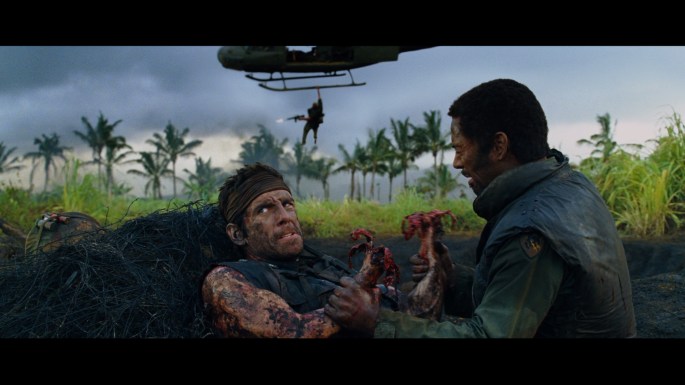
Robert Downey Jr. was rightly praised for his hilarious performance as an actor who goes so deep into character that he undergoes “pigmentation alteration” surgery to darken his skin in order play an African American soldier. Downey’s commitment to the role is almost as dedicated as Lazarus’ and he gets some of the film’s best lines, including such gems as “Man, I don’t drop character ’till I done the DVD commentary,” and “I know who I am. I’m the dude playin’ the dude, disguised as another dude!”

It’s not too hard to figure out the real-life Hollywood power players that Stiller’s film satirizes with Cruise’s Grossman channeling the abusive reputation of the aforementioned Weinstein and Downey poking fun at the way-too serious on-and-off-screen antics of Crowe. Unlike all of those Scary Movie spoofs, Stiller understands that a good satire plays it straight on the surface. Admittedly, he’s got a much bigger budget to play with ($100 million+) than any two of those dime-a-dozen spoof movies so he’s able to hire the likes of A-list cinematographer John (The Thin Red Line) Toll and cast marquee name actors like Robert Downey Jr. and Jack Black instead of C-listers like Carmen Electra to make Tropic Thunder look like the slick war films he is sending up. Of course, the danger in doing this is to become the very thing you’re trying to parody, but fortunately Stiller doesn’t fall into this trap.

Every generation needs a Mel Brooks and Stiller takes up where the legendary comedian left off – before he became irrelevant and painfully unfunny. Stiller goes after the usual suspects of the genre: Platoon, Apocalypse Now, The Deer Hunter (1978), and even a sly reference to a scene from Predator (1987), but Tropic Thunder is more than a game of spot-the-reference that spoof movies tend to devolve into. It actually has something to say other than Hollywood is excessive. This is one of Stiller’s most ambitious film to date and demonstrated that he can play in the same big leagues that fellow comedian-turned-filmmaker Jon Favreau has also graduated to with Iron Man (2008). They both started off with very modest films and have shown a very definite learning curve with each subsequent film they’ve helmed. Tropic Thunder has everything you’d want from a big budget, R-rated comedy.

COWBOYS AND ALIENS – A REVIEW BY J.D. LAFRANCE

Cowboys and Aliens-15

Jon Favreau has certainly come a long way since his independent film roots with Swingers (1996), the film he wrote and starred in. Over the years, he’s increasing spent more time behind the camera than in front, directing Made in 2001. The modest success of that film saw him transition to studio films with larger budgets like Elf (2003) and Zathura (2005). Then came Iron Man (2008), his most ambitious effort up to that point, and he rolled the dice with the casting of Robert Downey Jr. as his leading man. The gamble paid off and the film was a massive success, paving the way for the inevitable sequel. Rushed into production, the end result was a commercial triumph but a critical failure, which upped the stakes for his next film, Cowboys & Aliens (2011), an adaptation of the graphic novel of the same name by Scott Mitchell Rosenberg.

The premise is an intriguing hybrid of the science fiction and western genres with an alien invasion set in 1873 New Mexico. To hedge his bets, Favreau corralled Daniel Craig and Harrison Ford to headline his film, which caused epic seismic ripples through the fanboy community at the prospects of seeing the actors who played James Bond and Indiana Jones in the same film together. As a result, expectations were understandably high. Could Favreau and company deliver the goods or would this be another Wild Wild West (1999)?

A man wakes up in the middle of nowhere wounded and with a strange, futuristic device strapped to his wrist. He has no idea who he is or how he got there. Three men on horseback show up assuming he’s an escape convict and try to take him in. He quickly and brutally dispatches them, taking their gear and heading towards the nearest town – the former mining colony of Absolution. He eventually learns that his name is Jake Lonergan (Craig), a notorious outlaw wanted by the law for a variety of offences. One of which was robbing local cattle baron Colonel Woodrow Dolarhyde (Ford) of his gold. When he learns that Lonergan is in Absolution, Dolarhyde and him men intend to lynch the outlaw in retribution.

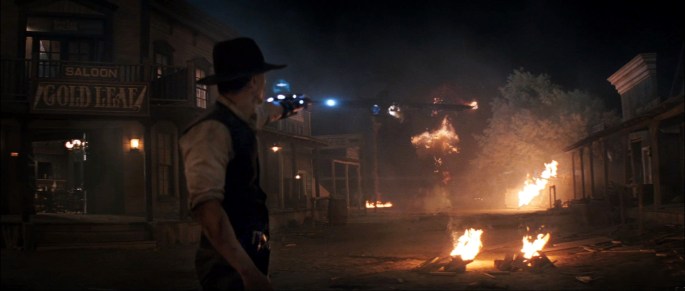
However, a strange light appears in the sky just as Dolarhyde arrives into town. The device on Lonergan’s wrist activates and the light turns out to be several alien spacecraft that proceed to blast the town to smithereens and kidnap several of its townsfolk. Lonergan discovers that his wrist device is a weapon, which he uses to take down one of the alien craft. The film sets up Dolarhyde as a mean son of a bitch while Lonergan is a no-nonsense criminal. They represent two unstoppable forces of nature and one of the pleasures of this film is when they have to put aside their differences, repel the alien invaders and rescue the kidnapped townsfolk.

For years, Harrison Ford has made bad choices in the films he’s decided to be in and phoned in one-note performances, playing the same gruff character, but with Cowboys & Aliens acting against someone like Daniel Craig has inspired him to bring his A-game this time around. Ford actually looks interested and engaged in the material and the role. It’s great to see him go up against Craig and their scenes together crackle with intensity and tension. Best of all, Ford has two scenes that expose his character’s gruff exterior and reveal a more vulnerable side. They are poignant and heartfelt because we’ve become invested in these characters by this point. This is the best Ford has been in years and reminds one of when he used to play characters we cared about.

Craig adds another man of action to his roster. He excels at playing edgy tough guys and is well cast as the enigmatic outlaw. The only drawback is that Lonergan is underwritten and there isn’t much for Craig to work with except for some standard motivation for his character revenging a lost one. As a result, the character comes across as a one-note Man with No Name, at times.

Favreau does a good job of surrounding Craig and Ford with a solid ensemble cast of character actors. You’ve got Clancy Brown as the upstanding town preacher Meachum, Sam Rockwell as Doc, the mild-mannered saloon owner, Keith Carradine as Sheriff John Taggart, the always watchable Adam Beach as Nat Colorado, Dolarhyde’s right-hand man, and Olivia Wilde as a mysterious woman named Ella whose exotic beauty gives her an almost otherworldly aura. Hell, Favreau even throws Walt Goggins in for good measure as a member of Lonergan’s gang.

Favreau has all the traditional western iconography down cold and the fun of Cowboys & Aliens is seeing these motifs clash with the science fiction elements. So, we see cowboys on horseback being chased by fast-moving alien spacecraft. This film doesn’t stray from the conventions of either genre or try to reinvent them but instead merges and fulfills them in a crowd-pleasing way. Cowboys & Aliens has impressive special effects, nasty-looking aliens, several exciting action sequences, and two cool heroes to root for. This may not be the classic that people were hoping for but it is a very entertaining film in its own right and sometimes that’s enough.