GRIDLOCK’D – A REVIEW BY J.D. LAFRANCE

coolmoviecaps-gridlockd-143048

“This is gonna be a fucking nightmare day, I can just feel it.” These rather prophetic words are spoken by Stretch (Tim Roth) as he and his best friend, Spoon (Tupac Shakur) start the day trying to kick their drug habit in the film, Gridlock’d (1997). But it’s not going to be that easy as the duo run into bureaucratic red tape at every turn.

The film begins on New Year’s Eve as Spoon’s girlfriend, Cookie (Thandie Newton) overdoses on heroin. This intimate brush with death forces Spoon to face his own mortality. “Do you ever feel like your luck’s run out, man? Lately, I’ve been feeling like my luck’s been running out.” These lines take on a rather eerie significance when you realize that Shakur was killed shortly after this film finished shooting.

And so, the two struggling musicians make a New Year’s resolution: to go into rehab and get off drugs for good. The only problem is that not only are they constantly given the runaround, hassled, and turned away by government workers, but an evil and very persistent drug dealer (Vondie Curtis-Hall) and his henchman (Tom Towles) are also pursuing them.

Now, this may sound like the makings of a moralistic film but Gridlock’d refuses to fall into this trap. Instead, it comes across as a very stylish social satire — a strong indictment against the United States health care system and their welfare programs. The ultimate irony is that Stretch and Spoon want to do the right thing but their attempts are constantly thwarted at every turn by overburdened social workers that are too burnt out to care.

Gridlock’d
marked the directorial debut of Vondie Curtis-Hall, an actor by trade who has appeared in such films as Die Hard 2 (1990), Broken Arrow (1996), and a regular spot on television’s Chicago Hope. Hall wrote the screenplay for Gridlock’d in 1993 and it was originally conceived of as his final film school project, based on his actual experiences with drug addiction in the 1970s in Detroit. “Heroin is the drug of the ’90s. But it was also the drug of the ’70s, when I was doing it,” he said in an interview. Much like the two main characters in his film, Hall and a friend sought treatment for their addiction only to be told that it would take weeks for them to get admitted into a program.

But Hall kicked the habit, paid his dues an actor, and cashed in some favors to get this personal project off the ground. Polygram agreed to finance the film with a modest $5 million budget. Hall sent the script for Gridlock’d to actor Tim Roth while he was working on Rob Roy (1995). Initially, Roth wasn’t interested in doing the film but Hall met and convinced him to do it. For Roth, it was the script that attracted him to the film. “Normally you’d work through a screenplay and say, ‘We’ll have to change that and that and somehow try to make it work’, but here the dialogue was always dead-on.”

Hall wrote the character of Spoon with Laurence Fishburne in mind but couldn’t afford the veteran actor. He had considered Tupac Shakur for the role but thought that the rapper was too young and was also just out of jail. However, someone gave Shakur the script and Hall ended up auditioning the rapper who really wanted to do the film. Shakur made the cut and Hall said that with this film, the rapper “wanted to prove that he was a good actor,” and felt that he was “actually a lot like I was at the time the film was set. He wanted to sort himself out and was looking for some help.”

Gridlock’d
’s strength lies in its two leads. The interaction between Roth and Shakur is excellent. For example, there is a scene where the two men sit at the bedside of their unconscious friend and Shakur delivers a heartfelt speech where he decides to stop doing drugs. It is an emotional moment as Shakur looks over at Roth who says nothing — he gives Shakur a little smile. It is an action that says a lot more about their friendship than any words could. They also display crackerjack comic timing with Roth’s Stretch a manic goofball to the laidback cool of Shakur’s Spoon. They play well off each other which is crucial in a buddy film like this one.

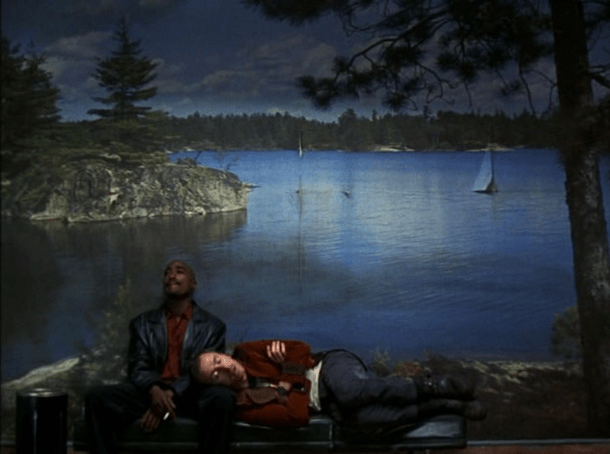
The visuals in Gridlock’d are also worth mentioning. The film’s camerawork is very stylish but never overwhelms or obscures the story or its characters. Instead, the film’s imagery only enhances the mood of any given scene. There is a great shot early in on the film when Spoon and Stretch wait in the hospital to hear any word on Cookie’s condition. The two men are sitting on a bench with a huge mural of an idyllic setting: a peaceful cottage scene complete with lake and a sailboat. It is an ironic image when you consider where they are, what has happened, and how they feel. And yet, coupled with very soulful music on the soundtrack, it is an oddly peaceful image juxtaposed in a fast-paced film.

Gridlock’d
is filled with many clever moments that elevate it above the usual drug movie. Without resorting to preachy sermons, it does an outstanding job of showing how bad the drug problem is the United States and how badly equipped they are in dealing with it. Gridlock’d is a smart film with plenty of humor and action to alleviate the rather serious subject matter. Best of all, it refuses to sentimentalize or romanticize its characters. And in an age of political correctness, this is a refreshing concept.

REAL GENIUS – A REVIEW BY J.D. LAFRANCE

Real Genius 1

In the 1980s, Martha Coolidge’s films were a welcome antidote to the dominance of John Hughes’ output. On the surface, her films appear to be quite similar, but whereas Hughes’ films ultimately play it safe and are conservative in nature (i.e. the status quo is preserved), Coolidge’s films champion the outsider in society – for example, Nicolas Cage’s punk rocker hooks up with Deborah Foreman’s Valley girl despite societal pressure in Valley Girl (1983). Real Genius (1985) appears to be just another mindless college comedy like Revenge of the Nerds (1984), but whereas that film had its outsiders ultimately become part of accepted mainstream society, the nerds in Real Genius rebel against it and are proud to be different.

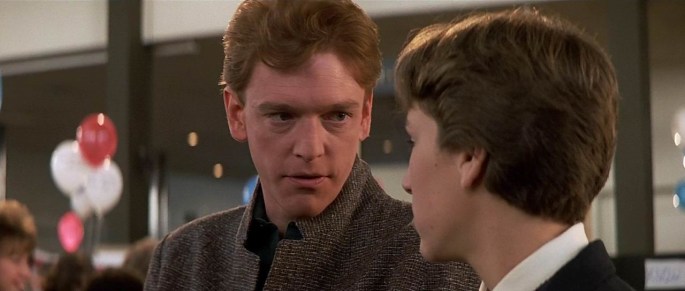
Mitch Taylor (Gabe Jarret) is a brilliant high school student recruited by Professor Jerry Hathaway (William Atherton) to become a student at Pacific Tech and join a special team working on an experimental laser. Hathaway tells Mitch and his parents in person at a science fair. The exchange between them is priceless. His parents obviously have no idea just how smart their son is and only want him to get the best education. At one point, Mitch’s mother asks Hathaway, “I saw your show the other night on radioactive isotopes and I’ve got a question for you. Is that your real hair?” He cheerfully replies, “Is Mitch by any chance adopted?” They are oblivious to the implied insult and Hathaway pulls Mitch aside and tells him, “We’re different than most people. Better.” Hathaway’s elitist attitude is established early on, setting him up as an arrogant snob that must be taught a lesson in humility by our heroes.

Hathaway rooms Mitch with Chris Knight (Val Kilmer), the top brain on campus – at least he used to be until Mitch showed up. We first meet Chris as he’s being taken on a guided tour of a top science laboratory. He has a t-shirt on that reads, “I love toxic waste,” and a set of alien antennae on his head that demonstrate he is the antithesis of Hathaway. He may be super smart but he’s not a stuffed shirt. At one point, his tour guide asks him, “You’re Chris Knight, aren’t you?” Without missing a beat, he replies, “I hope so, I’m wearing his underwear.” Val Kilmer’s deadpan delivery is right on the money and he demonstrates an uncanny knack for comic timing. The film could have so easily set up a rivalry between Chris and Mitch but instead they become friends and team up against a common foe: Kent (Robert Prescott), an arrogant senior student who is also working on the laser.

Chris is super smart, but something of a loose cannon, always cracking jokes and never taking anything too seriously, much to Mitch’s consternation because he doesn’t know how to loosen up and have fun. Mitch also has trouble adjusting to campus life and this isn’t helped by Kent who enjoys tormenting Mitch when the senior student isn’t busy sucking up to Hathaway. Coolidge replaces the class warfare in Valley Girl with in-fighting amongst academics in Real Genius. The setting may be different, but the tactics are no less mean-spirited as Kent delights in publicly humiliating Mitch. Meanwhile, Hathaway puts pressure on Chris to produce a working laser before the school year ends. Failure to do so will result in Hathaway making sure that Chris doesn’t graduate or work in his field of expertise. Unbeknownst to the ace student, his professor is getting pressured by a flunky and his superior from the CIA who want to use the laser for their own covert actions (assassinations from outer space?).

Every so often, Mitch catches a glimpse of a mysterious long-haired man who goes into his closet at random times during the day. His name is Lazlo (Jon Gries) and he lives deep in the bowels of the school. He used to be the smartest student on campus back in the 1970s but cracked under the pressure and now spends all of his time generating entries for the Frito Lay sweepstakes (enter as often as you like) so as to get as many of the prizes as possible. Jon Gries plays Lazlo as a shy genius, smarter than Chris and Mitch combined. He’s a gentle soul and a far cry from the arrogant blowhard he would go on to play in Napoleon Dynamite (2004).

Over the course of the film, Mitch finds himself attracted to Jordan (Michelle Meyrink), a hyperactive student who never seems to sleep. She sports an adorable Louise Brooks-style bob haircut and a nervous energy that is oddly attractive. I had a huge crush on her when I first saw this film back in the day, quite possibly one of my earliest cinematic crushes. She was the ultimate nerd sex symbol in the ‘80s with her undeniable beauty and brains. Sadly, after a few films she grew disenchanted with the movie making business and retired to Canada to become a Zen Buddhist.

Remember when Val Kilmer was funny? Between this film and Top Secret! (1984), he displayed some impressive comedic chops. Kilmer excels at delivering smartass quips and jokes but is also capable of delivering an inspirational speech that convinces Mitch to stick it out at school and get revenge on Kent. There are two scenes where he dispenses with the jokes and has a relatively serious conversation with Mitch about life. They are refreshingly heartfelt and elevate Real Genius above the usual ‘80s teen comedy.

Gabe Jarret is perfectly cast as the helplessly square Mitch with his dorky haircut and his J.C. Penney’s wardrobe. We aren’t meant to laugh at him and Coolidge shows that he’s a good kid thrust into a new and strange environment. He’s smart, but lacks the emotional maturity, which he will acquire over the course of the film. Jarret does a nice job of conveying his character’s arc. He doesn’t totally transform into Chris but instead absorbs some of his traits while remaining true to himself.

Real Genius 2In the ‘80s, William Atherton seemed to be the go-to guy for playing douchebag authority figures, with memorable turns as the unscrupulous journalist in Die Hard (1988), the “dickless” EPA guy in Ghostbusters (1984), and, of course, his turn in Real Genius. Atherton’s job, and man, does he do it oh so well, is to provide a source of conflict for our protagonists. He portrays Hathaway as the ultimate arrogant prick and we can’t wait to see him get his well-deserved comeuppance at the hands of Chris and Mitch.

Real Genius
does plug in the usual tropes of ‘80s teen comedies with the now dated soundtrack of New Wave songs, most of them forgotten except for “Everybody Wants to the Rule the World” by Tears for Fears, which plays over the blissfully carefree ending of the film. There are the wacky comedic set pieces involving pranks. There’s also the T&A factor when Chris takes Mitch to an indoor pool party populated by sexy beauticians. Not to mention, the dorm that Chris and his classmates live in which vaguely resembles the chaotic frat house in Animal House (1978), only inhabited by really smart people.

However, it is how the film presents these generic elements that sets it apart from the typical ‘80s teen comedy. For example, the pranks are quite inventive, like when Chris and Mitch manage to place Kent’s car in his dorm room. There are several and they all lead up to the mack daddy of them all, which occurs at the climax of the film. While there is the requisite T&A factor in Real Genius, the PG rating assures that we don’t see much, just some girls in bikinis. Instead, we get the understated romance that develops between Mitch and Jordan, which is rather sweet in its own unassuming way. The dorm is certainly not the debauched chaos of Delta House, but it clearly is a place of fun, led by Chris and his various antics.

Producer Brian Grazer loved the humor and the sensibility that Martha Coolidge brought to Valley Girl and asked her to direct Real Genius. She thought that the screenplay was funny, but it had “a lot of penis and scatological jokes” that reminded her of other teen comedies she had turned down in the past. However, Grazer brought in Lowell Ganz and Babaloo Mandel to give the script a polish and had Coolidge re-read it. She liked it and Grazer’s boundless enthusiasm convinced her to commit to the project. Still not completely satisfied with the script, Grazer brought in comedy writer P.J. Torokvei to help Coolidge create the story, come up with the ending and fully develop the characters. For example, it was Torokvei who came up with the character of Jordan and was responsible for many of Chris Knight’s memorably smartass remarks.

Coolidge insisted on researching laser technology and policies of the CIA. The producers even brought in top-level consultants from the military and weapons development experts. To make Real Genius distinctive from other teen science fiction films at the time, the director went to great lengths to make sure the science was authentic and the science fiction aspect was plausible. At the time, scientists were actually working on the powerful laser Chris and his fellow students were developing for Hathaway, but the filmmakers could only work with a smaller wattage for reasons of safety and cost. The production used real lasers with very little visual effects enhancement, of which was used only sparingly at the film’s climax.

In addition, she interviewed dozens of Cal Tech students and based most of the stories in the film and the visual depiction of their school on Cal Tech, in particular Dabney Hall. Coolidge also met with all kinds of scientists and students, including the legendary Cal Tech mathematician grad that was rumored to have lived in the steam tunnels. To say that the director was a stickler for authenticity was an understatement. The graffiti in the dorm was copied from the actual dorm graffiti by scenic painters and then embellished further by Cal Tech students brought in by the production.

Not surprisingly, Coolidge and producers saw many young actors for the role of Chris Knight. It became obvious that Val Kilmer was the best actor to embody the role, but John Cusack was also considered at one point. However, once principal photography began, Coolidge found Kilmer not so easy to work with because he was “intellectually challenging and erratic.” He avoided working by asking a lot of questions and was sometimes late to the set and acted moody. That being said, over the 75-day shoot, they gained a lot of trust and worked well together.

The filmmakers also spent a lot of time trying to cast an actor for the role of Mitch Taylor. At one point, they seriously considered hiring a true young genius that had graduated college in his early teens. They discovered Gabe Jarret late in pre-production and he had the “right combination of seriousness, gawkiness, intelligence and emotion that we needed,” Coolidge remembers.

For the house that explodes with popcorn at the film’s exciting climax, the special F/X people designed all kinds of hydraulic systems to move the popcorn. The next challenge was generating all the stuff. They couldn’t buy all the popcorn needed for the scene in the short amount of time they had so the film crew popped 40 tons themselves on the lot over six weeks. All the popcorn was stored in 38 40-foot tractor-trailer trucks.

Real Genius 3Real Genius
argues that nerds can have fun too, but there needs to be a balance. You can love solving problems but it can’t be all science and no philosophy as Chris tells Mitch. People like Kent and Hathaway have no sense of humor and are self-obsessed egotists. They are ambitious to a fault, not caring who they step on the way, while Chris and Mitch are aware of the consequences of their actions. There is sweetness to this film that is endearing and rather strange considering that Neal Israel and Pat Proft wrote the screenplay (authors of such paeans to sweetness, like Police Academy and Bachelor Party), but Coolidge is firmly in charge and wisely doesn’t let Real Genius get too sappy. She also doesn’t let the funny stuff devolve into mindless frat humor, instead maintaining a proper mix that doesn’t insult our intelligence. The end result is a film that the characters in the film might enjoy, if they weren’t already in it. Achieving just the right alchemy may explain why the film continues to enjoy a modest cult following and is one of the few teen comedies from the ‘80s that stands the test of time.

TRON – A REVIEW BY J.D. LAFRANCE

tron1

When Tron came out in 1982, it was intended to be a visually stunning parable against the abuse of powers by computers and technology. More than thirty years later, the film plays more like a nostalgic ode to the early 1980s than a simple good vs. evil morality tale. Tron evokes the heady days when video games like Pac-Man, Defender and Centipede ruled the arcades and when it seemed like everyone owned a Commodore 64 or an Atari 2600 – the eight track of personal computing. It also anticipated the proliferation of CGI special effects and was not a big hit back in the day but its influence is widespread – it enjoys a loyal cult following today.

Kevin Flynn (Jeff Bridges) is a hot shot computer programmer turned computer hacker after being fired three years ago by ENCOM corporate big wig, Ed Dillinger (David Warner). To add insult to injury, the executive stole a series of video games that Flynn created and transformed them into wildly popular and profitable products, chief among them Space Paranoids – much to the young programmer’s chagrin. Flynn can prove true authorship of the games but only if he can gain direct access to ENCOM’s mainframe. Enter ex-girlfriend Laura (Cindy Morgan) and her current beau, Alan (Bruce Boxleitner) – both disgruntled employees at ENCOM – who give Flynn the access he needs to find out the truth. However, the corporation’s artificial intelligence, the tyrannical Master Control Program, discovers what Flynn is doing and uses a high tech laser to digitize the troublesome hacker and transport him inside the computer world.

This is where Tron really begins to get interesting as writer/director Steven Lisberger creates a flashy, neon-drenched world, a cybernetic version of Social Darwinism where lowly computer programs must participate in gladiatorial battles against the Master Control’s ruthless minions. These involve games where opponents throw glowing discs at each other or, in another game, hurl a ball of energy at one another. If either one of these things hits someone, they are killed or de-rezzed – slang for deresolution. Even though the computer effects are primitive by today’s standards, back then they were considered ahead of their time. There is a certain clunky charm to the effects that makes Tron all that more endearing to its fans. The look of the computer world is all blacks and dark blues, which is in nice contrast to the vivid neon red and blue of some of the characters and vehicles that inhabit it.

Undeniably, the coolest sequence in the film is the light cycle race where Flynn, Ram (Dan Shor) and Tron take on three of the MCP goons. It involves futuristic vehicles made out of energy and that leave behind a solid trail that one uses to block in their opponent and destroy them. The action is fast-paced and exciting to watch with dynamic visuals. The computer world is beautifully realized in vivid detail that immerses one fully and is obviously a large part of the film’s appeal. Lisberger adopts a pretty simple color scheme of predominantly primary colors. Tron is one of those rare examples where style over substance works. The computer world that Lisberger and his team worked so hard to create is rich in detail. It also plays on our romantic notions of what really goes on inside our computers – not a collection of microchips and circuit boards but a vast world where programs fight each other for survival. It’s no wonder that visionary science fiction writer, William Gibson once commented in an interview that the cyberworld in Tron is how he envisioned the cyberspace in his own novels.

The film’s genesis began in 1976 when Lisberger, then an animator of drawings with his own studio, looked at a sample reel from a computer firm called MAGI (Mathematical Applications Group, Inc.). At the time, he was researching technology in the late 1970s. Shortly afterwards, Atari came out with Pong and he was immediately fascinated by them. He wanted to do a film that would incorporate these electronic games. According to Lisberger, “I realized that there were these techniques that would be very suitable for bringing video games and computer visuals to the screen. And that was the moment that the whole concept flashed across my mind.” He was frustrated by the clique-ish nature of computers and video games and wanted to create a film that would open this world up to everyone.

tron2

Lisberger and his co-producer Donald Kushner borrowed against the anticipated profits of their 90-minute animated television special, Animalypmics to develop storyboards for Tron. They moved to the west coast in 1977 and set up an animation studio to develop Tron. Originally, the film was conceived to be predominantly an animated film with live-action sequences acting as book ends. The rest would involve a combination of computer generated visuals and back-lit animation. Lisberger planned to finance the movie independently by approaching several computer companies but had little success. One company, Information International, Inc., was receptive. He met with Richard Taylor, a representative, and they began talking about using live-action photography with back-lit animation in such a way that it could be integrated with computer graphics.

Lisberger and Kushner took their storyboards and samples of computer-generated films to Warner Bros., MGM and Columbia – all of whom turned them down. Lisberger spent two years writing the screenplay and spent $300,000 of his own money marketing the idea for Tron and had also secured $4-5 million in private backing before reaching a standstill. In 1980, Lisberger and Kushner decided to take the idea to Disney, which was interested in producing more daring productions at the time. However, Disney executives were uncertain about giving $10-12 million to a first-time producer and director using techniques that, in most cases, had never been attempted.

The studio agreed to finance a test reel which involved a flying disc champion throwing a rough prototype of the discs used in the film. It was a chance to mix live-action footage with back-lit animation and computer generated visuals. It impressed the executives at Disney and they agreed to back the film. The script was subsequently re-written and re-storyboarded with the studio’s input. At the time, Disney rarely hired outsiders to make films for them and Kushner found that he and his group were given a less than warm welcome because “we tackled the nerve center – the animation department. They saw us as the germ from outside. We tried to enlist several Disney animators but none came. Disney is a closed group.”

One the reasons why the cyberspace in Tron is so striking is because of the creative brain trust assembled to help realize it. Futuristic industrial designer Syd Mead, legendary French comic book artist Jean “Moebius” Giraud, and high-tech commercial artist Peter Lloyd served as special visual consultants. Mead designed most of the vehicle designs (including Sark’s aircraft carrier, the light cycles, the tank and the solar sailer). Moebius was the main set and costume designer for the film. Lloyd designed the environments. However, these jobs often overlapped with Moebius working on the solar sailer and Mead designing terrain, sets and the film’s logo. The original Program character design was inspired by the main Lisberger Studios logo, a glowing body builder hurling two discs. CGI had been used in films before, most notably in Westworld (1973) and Star Trek: The Motion Picture (1979), but it was used much more extensively in Tron. In order to pull it off, four of the United States’ foremost computer graphics houses produced the computer imagery for the film. They invented the computer techniques and created the visual effects in approximately seven months. More than 500 people were involved in the post-production work, including 200 inker and hand-painters in Taiwan.

Jeff Bridges brings a playful energy to the film both in the real world – like when he breaks into ENCOM – and in the computer world, like when he gets acclimatized to his new surroundings. Tron is the no-nonsense hero while Flynn provides comic relief. We are introduced to Flynn in his environment – the video arcade that he owns, beating the world record score for Space Paranoids, one that he invented but was stolen from him. Now, he plays the game and the only profits he sees from it are the quarters that kids put in it. Bridges brings an engaging, boyish charm to the role as is evident in the way he gleefully circumvents ENCOM security and then proceeds to sneak in so that he can find and use an unattended computer terminal. There are the little touches, like when Flynn sneaks on ahead and hides from Laura, that keep the mood light and fun, just before our hero is zapped into the computer world.

In the real world, Tron’s alter ego, Alan is a bespectacled, slightly bookish programmer who is frustrated by the lack of access he has to his company’s computer system. Bruce Boxleitner plays these two contrasting roles quite well. He knows he’s the straight man to Bridges’ charismatic goofball Flynn. We meet his character as he tries to access a high level of security so that he can run his Tron program, an independent security program that would act as a watchdog to the company’s MCP computer. There is a cut to a long shot and we see that Alan’s cubicle is one of hundreds – impersonal and he is treated as an insignificant cog in a massive corporation. Interestingly, the corporation’s name is ENCOM, which eerily foreshadows another evil empire, but in the real world – ENRON.

tron3Amazingly, Tron wasn’t even nominated for a special effects Academy Award because “the Academy thought we cheated by using computers,” Lisberger remembers. However, his film and the world he and his team created captivated a small group of moviegoers. A loyal cult following developed around Tron over the years. The film may have not captured the public consciousness when it first came out but it has since developed a loyal following that loves it dearly. In many respects, Tron is a snapshot of the early ’80s when video games were just starting to take off, but it also was a harbinger of things to come. It paved the way for the elaborate computer graphics we see in movies like The Matrix (1999) and the new Star Wars movies. However, Tron warns that we cannot rely totally on computers to do everything because in doing so we run the risk of losing our humanity. I always imagine Flynn going on to become Bill Gates or maybe Steve Jobs.

BEAUTIFUL GIRLS – A REVIEW BY J.D. LAFRANCE

b1

There is something about turning 30 that makes one re-evaluate their life. It is that time when you are forced to grow up, find direction, settle down, and become an adult. Beautiful Girls (1996) concerns a group of men faced with this dilemma. They have been living in the past and recent events have forced them to confront it head on. This is also the late director, Ted Demme’s best film in an all-too brief career. As he said in an interview at the time of the film’s release, “I don’t think there are too many movies about turning 30, or just about to turn 30. Those issues are whether to get married or not, whether to have kids or not, am I happy in my job, do I need to find another job, am I unsettled with myself. You’re not a teen anymore, and you don’t want to admit you’re an adult either.”

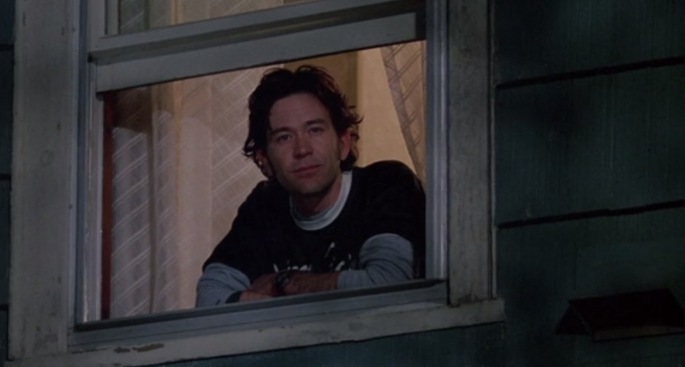
Willie (Timothy Hutton) returns to his small, Northeastern hometown for his ten-year high school reunion, hook up with buddies, and get his life in order. His mom has recently died (leaving his younger brother and father in a deep funk) and all of his friends are having relationship problems. Willie strikes up a friendship with a young girl named Marty (Natalie Portman) who has moved in next door. She is a character out of J.D. Salinger short story – wise beyond her years. Marty sets the tone for the rest of the women in the story. They are all intelligent and end up suffering with men who don’t appreciate what they have right in front of them.

Screenwriter Scott Rosenberg was living in Boston, waiting to see if Disney would use his script for Con Air (1997). “It was the worst winter ever in this small hometown. Snow plows were coming by, and I was just tired of writing these movies with people getting shot and killed. So I said, ‘There is more action going on in my hometown with my friends dealing with the fact that they can’t deal with turning 30 or with commitment’ – all that became Beautiful Girls.” The resulting screenplay turned out to be quite autobiographical, with Willie being Rosenberg’s surrogate.

The friendship between Willie and Marty pushes the boundaries of what is comfortable in a comfort movie but it never goes beyond it. Rosenberg’s screenplay is smart enough to be self-aware of this and even addresses it in a scene between Willie and his friend Mo (Noah Emmerich). Fortunately, the film narrowly avoids letting things get too uncomfortable and therefore taking us out of the captivating spell established by the movie. It also avoids clichés like the beautiful Andrea (Uma Thurman) having sex with one of the guys. Instead, she rebuffs them all because she is loyal to her boyfriend who, makes her martinis listens to Van Morrison and reads the newspaper with her on Sunday mornings – simple pleasures. She is not a perfect ideal, just on another level than these guys.

Rosenberg’s script is also able to juggle the various subplots without resorting to cliché resolutions. Tommy (Matt Dillon) is cheating on his girlfriend Sharon (Mira Sorvino) with his high school sweetheart (Lauren Holly). When he gets beat up by her husband (Sam Robards) and his buddies you anticipate Willie, Paul (Michael Rapaport) and Mo to mobilize and kick some ass but at the last second they stop because the man’s child will see her father get beaten up. This stops Mo who also has kids.

In addition to the clever plotting, Rosenberg’s script also features a lot of funny, memorable dialogue. Tommy chastises Paul for getting his on again-off again girlfriend, Jan (Martha Plimpton) a brown-colored diamond when he tells him, “Buddy, you been eating retard sandwiches.” There is also great throwaway dialogue like Stinky (Pruitt Taylor Vince) with his proprietor lingo, “We got apps!” or the often-used word “crease” to convey frustration at something, like when Tommy asks, “What’s got him creased?”

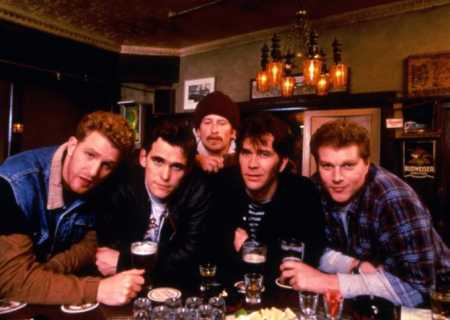
b2All of the guys in Beautiful Girls are essentially the same person. Willie is just finding his luck, Paul just lost his luck as the film begins, Tommy loses it over the course of the movie, and Mo has already found and achieved it with his family. Demme does not waste an opportunity to subtly illustrate his point. In one scene, he frames all three guys together: Paul (lost luck) is driving with Willie (finding luck) and Mo (achieved luck) along for the ride. The women counterpoint their men in this cycle: Tracy (Annabeth Gish) for Willie, Jan for Paul, Sharon for Tommy, and Sarah (Anne Bobby) for Mo.

The women in the film are smarter than the guys and make them (and us) feel like they are lucky that their behavior is even tolerated much less loved despite all of their failings. This is epitomized in Gina (Rosie O’Donnell)’s famous monologue where she chastises Tommy and Willie for obsessing over the women in Penthouse magazine. She tells them, “If you had an ounce of self-esteem, of self-worth, of self-confidence, you would realize that as trite as it may sound, beauty is truly skin-deep.” Gina speaks for the women in the film when she reminds the men to forget the airbrushed ideal of women that we see in magazines and movies. They do not exist or are unattainable to any normal guy.

To counter her argument, later on in the movie, Paul delivers a monologue defending men’s idealization for the impossibly perfect image of women. “She can make you feel high full of the single greatest commodity known to man – promise. Promise of a better day. Promise of a greater hope. Promise of a new tomorrow.” It is a rare, articulate moment for Paul, suggesting that he may be more than some lunkhead who drives a snowplow. He may actually be a romantic. It is nice to see a film that is obviously told from a man’s point of view trying to show both sides of the argument.

The women in the film are not treated like excess baggage. They all have a soul and a brain which is rare for a film written and directed by men. There is a tendency to make them perfect or marginalized with their problems defining them. This is not the case with Beautiful Girls. This is reversed and it is the problems that define the men.

Ted Demme assembled a fantastic cast of independent character actors for his movie: Michael Rapaport, Max Perlich, Pruitt Taylor Vince and Mira Sorvino to name only a few. They all work so well together and their friendships are believable because of the preparation the director made them do. He had the entire cast come to Minneapolis and live together for two to three weeks so that they could bond. One only has to watch a scene like Andrea’s first appearance in Stinky’s bar as Willie and his friends try desperately to impress her that the two week bonding session paid off. There is an ease and casual nature between everyone that is authentic.

The setting is a character unto itself. Demme has set his film in a charming east coast hamlet that is filled with little diners and bars that look so inviting that you want to go there, you want to be there. It all looks so comforting, so inviting and this is so hard to achieve properly in any film. He commented in an interview that he “wanted to make it look like it’s Anytown USA, primarily East Coast. And I also wanted it to feel like a real working class town.” To this end, Demme drew inspiration from Michael Cimino’s The Deer Hunter (1978). “The first third of the film is really an amazing buddy movie with those five actors. You could tell they were best friends, but they all had stuff amongst them that was personal to each one of them.” Demme wanted to make Beautiful Girls more than just a buddy movie. When he read Rosenberg’s screenplay he told him, “‘You know, we really need to take this to another level.’ If I was ever going to make a buddy movie, which I never thought I would, I wanted to make sure it had some real depth to it.”

b3The film does not wrap everything up nice and neatly. Paul and Jan’s subplot is not resolved in the sense that we don’t know if they settle their differences and get back together. Tommy and Sharon will probably get back together but it is not spelled out. Instead, as the closing credits appear we are left to imagine what happens to the characters. It is Paul’s parting comments to Willie as he is about to go back to New York City, “Come and see us any time, Will. We’ll be right here where you left us. Nothing changes in the Ridge but the seasons.” This is also a message to the viewer as well. Come back and see Beautiful Girls again. The film’s world and its characters are comforting and making you want to revisit them again and again.

ALI – A REVIEW BY J.D. LAFRANCE

Ali-Michael-Mann

Ever since Ali was released in 2001, I have felt that it has been one of Michael Mann’s most under-appreciated films. It received decidedly mixed reviews and underperformed at the box office. While Will Smith was praised for his impressive physical transformation into legendary boxer Muhammed Ali, the film itself was criticized for revealing nothing new about the man. Herein lies the problem that Mann faced: how do you shed new light on one of the most documented historical figures of the 20th century? His angle on the material was to look inwards.

Proposals for an Ali biopic had been around since the early 1990s when producer and one-time business partner of the boxer, Paul Ardaji, pitched the idea to the man on his 50th birthday. Ali gave the project his blessing and financing quickly fell into place. A number of scripts were written by the likes of Gregory Allen Howard (Remember the Titans) and Stephen J. Rivele and Christopher Wilkinson (Nixon), but they all failed to please the powers that be. The project bounced around various studios for years as executives tried to decide who should make it, who should star in it, and would it even make a profit? In 1991, Oliver Stone met with Ali about making a film about his life but the collaboration ended when the director refused to share creative control. In 1992, Ali’s best friend and personal photographer Howard Bingham and Ali’s wife Lonnie got together with Ardaji. Gregory Allen Howard’s take on Ali was delivered in 1996. His angle was that the key to the boxer’s life was his relationship with his father, who ignored him.

When Will Smith met Ali in 1997, the boxer asked the actor to play him in the film. Smith was flattered but said no. He was not ready and too intimidated for such a demanding role. The actor almost did it when Barry Sonnenfeld agreed to direct. Both men had worked together on the Men in Black movies and Wild Wild West (1999). Thankfully, their version never saw the light of day. After he turned 30, Smith realized that he had to make the decision about playing Ali. However, when no one could settle on a script, Sonnenfeld dropped out. There were several more rewrites and directors, including Curtis Hanson who expressed interest. Smith was ready to give up on the project.

It then came down to Spike Lee or Michael Mann to fill the director’s chair left empty by Sonnenfeld. Sony Pictures, the studio bankrolling the film, was faced with a $100+ million budget and went with Mann who had just received several Academy Award nominations and all kinds of critical praise for The Insider (1999). Upset, Lee voiced his anger through a friend in The New York Post: “Only a black man could do justice to the Cassius Clay story,” he was reported as saying. Mann responded that he “wanted the film to come from the point of view of the main character, Muhammed Ali. I’m not interested in showing a white man’s idea of how someone suffered racism. The perspective of the film has to be African-American.” When asked why he did not pick a black director Ali said that he wanted the best qualified person regardless of color, and his wife said, “Muhammad didn’t want it to be a movie just for black audiences. He wanted it to be a movie for all cultures and all people.”

When Mann was approached to direct he wasn’t even sure if he wanted to tackle such challenging subject matter but was sure of one thing; he did not want to make a docudrama or idealize Ali’s life. After meeting with Ali and his wife, they told him that they did not want “a teary Hallmark-greeting version of Muhammad Ali … What they didn’t want I didn’t want,” Mann remembers. The director liked Rivele and Wilkinson’s screenplay but rejected their flashback structure and their use of Ali’s 1978 fight, the “Thrilla in Manila,” as the present frame of the story. Mann felt that Ali’s 1974 fight in Zaire was more significant. He was also not interested in spelling things out for the audience: “I wanted to insert you into the stream of this man’s life, orient you without doing it in a blatant way with exposition.” Ironically, this is what would scare off a lot of people.

Smith’s agent arranged a meeting with Mann that changed his attitude towards the film. According to the actor, it was “the clear picture he had of the road from Will Smith to Muhammed Ali. He explained it in a way that made it seem, in my mind at least, not so utterly impossible, just marginally improbable.” Smith and Mann agreed that the film’s focus should be on ten turbulent years of Ali’s life, from 1964 to 1974. The director set the film during these years because “that formation of everything by ’74 is the beginning of what is now culturally in the United States.” Mann identified Ali with the spirit of change that occurred in the 1960s. “He consistently defied the establishment and its conventions, and we loved him for it.” Ali led such a colorful, eventful life that a focused story was crucial to the film. Mann said in an interview, “It would be catastrophic to divert into every interesting story. Everything this guy does is fascinating. I could have made an entire movie about Ali’s relation to women. Music, Cadillac convertibles and women. It would have been great.”

By February 23, 2000, Mann signed on to the film and went to work transforming Will Smith into Ali. Smith remembers that Mann created the “Muhammad Ali Course Syllabus” that began with a study of the boxer’s physical attributes: “learning to run how he ran, to eat the food he ate, spar the way he sparred. Essentially creating the physical life and physical appearance of Muhammad Ali.” From there, Smith moved on to the mental and emotional aspects and finally the man’s spirituality. Boxer trainer-choreographer Darrell Foster spent a year training Smith. Foster was Sugar Ray Leonard’s conditioning coach when the boxer turned pro. According to Foster, the key to becoming Ali was “looking for specific movements. Hand speed, ring generalship, how he made guys miss. Will had to become Ali, because you can’t demonstrate those moves through choreography.” Foster created a high-carb, high-protein diet for Smith and had him run in combat boots through snow in the thin air of Aspen, Colorado for ten months before the start of filming. His training schedule consisted of five miles of roadwork starting at 5:30 am, in the gym at 11:30 am, six days a week for three hours of ring work and weight training, watching fight films at 3 pm, and weight training in the evening. Smith put on 35 pounds of pure muscle in four months and went from bench-pressing 175 pounds to being able to press a very impressive 365 pounds. The finishing touch was being fitted with a hairpiece and a prosthetic nose.

For the fights, Foster started Smith on the basics: balance, footwork and defense. Then, he worked with the actor on the offensive aspects: a mix of overhand rights, hooks and upper cuts. Foster remembers that Smith “thought he knew how to fight because he had some street fights. But really, he couldn’t fight at all.” Smith worked on his hand and eye reflexes in order to perform eleven of Ali’s signature moves. Smith spent days studying film of Ali, including early footage shot when he was an Olympic boxing champion to interviews with Howard Cosell. Much of the material, unseen for years, was supplied by Leon Gast, a documentary filmmaker who made When We Were Kings (1996), a celebrated and acclaimed documentary about Ali’s championship bout with George Foreman. Smith also took classes in Islamic studies at the University of California.
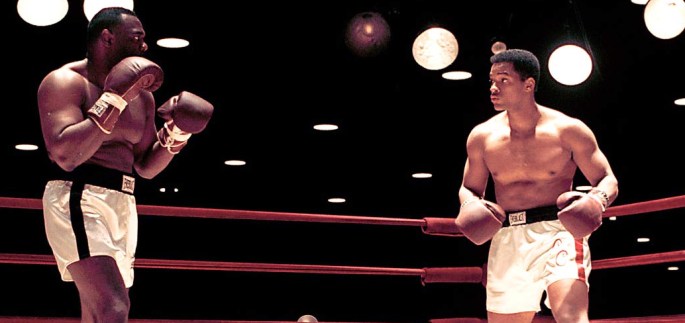
aliThe focus on the years 1964 to 1974 are arguably the most fascinating ones of Ali’s life because they are so rife with dramatic possibilities. It was during this period that Ali became the World Boxing Champion after beating Sonny Liston, then lost it when he refused to serve as a foot soldier in the Vietnam War, and finally reclaimed the Championship Title after beating the odds-on favorite, George Foreman in Zaire. It was also a time of great social and political upheaval in the United States with the assassinations of Malcolm X and Martin Luther King, Jr. Finally, Ali also shows the man’s private side: his numerous wives and failed marriages, and his friendships with Malcolm X and Howard Cosell.

Mann immediately immerses the audience in the time period with a montage of footage that features Sam Cooke performing in front of a live audience juxtaposed with Ali jogging alone at night and being harassed briefly by the police. Mann then goes into a montage of Ali training and two boxers fighting with Ali watching. Mann fractures time by also intercutting footage of Ali as a child witnessing the brutality of racism and its effects as he sees a newspaper article about the vicious beating of Emmet Till. The film then cuts back to a mature Ali sitting in on a lecture by Malcolm X. The entire montage is masterfully edited to the beats of a medley of Sam Cooke songs. This opening sequence establishes the Impressionistic take that Mann is to going to have on Ali’s life. It is also one of his most complex, layered opening credits sequence because he shifts time frames and presents us with all of these apparently unconnected images without explaining them. This is done on purpose in order to establish a mood, give an impression of the look and feel of the film and to set up that we are seeing the world through Ali’s eyes.

The fight scenes are covered from every conceivable angle as Mann cuts back and forth from shots outside and inside the ring. The first shot we get of the ring is a close-up of the red ropes and in Mann’s films this color signifies danger. There is the potential for Ali to not just lose the fight but possibly his life. This is a risk every time a boxer steps into the ring. In the Liston fight, Mann alternates between camerawork inside the ring, with tight and close point-of-view angles so that we are right in the ring with the boxers, and shots just outside of the ring but still close to the fighters. This gives the fight scenes a real visceral impact and immediacy that has not been seen since Martin Scorsese’s Raging Bull (1980). The Liston fight also shows how Ali could work a crowd of boxing fans just as well and in just the same way as the crowd of journalists before the fight.

Unlike most boxing films, Mann wanted to get inside the ring in order “to bring you inside the strategy and tactics, to bring you into the round as far as I could.” To this end, Mann would often be in the ring with the fighters with a very small digital camera. To achieve the most realistic fight scenes possible, Mann really had Smith and the other boxers hit each other. The director recalled one such incident: “When James Toney as Joe Frazier knocks Will down, we did three takes of that — every single one of those left hooks he connected. When Will stands up on the one that’s in the film, that wobble is not acting — you can tell how shaky he is.”

Mann also uses a cool, blue color to suggest intimacy and does so in the scene where Ali and Sonji (Jada Pinkett Smith), who would become his first wife, dance in a nightclub. They are close together, flirting with each other as Mann drenches the scene in blue much like he did with Neil McCauley entering his house in Heat (1995) and Will and Molly making love in Manhunter (1986). Ali is temporarily in an area of safety and love but this will change very soon.

After an interview with legendary broadcaster Howard Cosell (Jon Voight), Ali’s life takes a turn for the worse as he refuses to be inducted in the Army and is arrested. He then denounces the war in an interview and is subsequently labeled as being unpatriotic. He is stripped of his boxing title as Heavyweight Champion of the World, his boxing license and his passport. Like Jeffrey Wigand in The Insider, Ali is threatened by the powers that be for telling the truth and being his own man. It becomes obvious that this is a war of attrition in an effort to bleed Ali dry financially and threaten him with five years in jail. Then, as if to add insult to injury, the Temple of Islam suspends him just like they did to Malcolm X.

Cosell and Ali meet up and the veteran broadcaster, conscious of how bad off his friend is but not acknowledging it publicly, puts him on television despite network pressure. Cosell allows Ali to speak his piece about his ban and dazzles everyone again with his showmanship. It really is a testimony to Cosell that he did this. When everyone else had abandoned Ali, the T.V. personality stuck by him and used his considerable clout to put him back in the public eye. This interview is the turning point for Ali who wins a fight. Only then does Herbert and the Temple of Islam come back to him but Ali makes it clear that they do not own him. His eyes have been opened and he now knows just how much he can trust them.

Ali culminates with the legendary Rumble in the Jungle where Ali fought George Foreman in Zaire. Ali was not the favorite going in as Foreman was younger, stronger and the Champ. Mann, again, hints at the potential danger of this opponent when we see Foreman training, pounding a punching bag with powerful hits all with a greenish filter, a sign of peril in a Mann film. Sure enough, during this period Ali drives away his second wife (Nona Gaye) who does not like his relationship with the Temple of Islam because she feels that they are exploiting him. While still married to her, Ali becomes interested in a female journalist (Michael Michele) from Los Angeles who is in Zaire doing a profile on the boxer. This relationship effectively ruins his second marriage and Mann does not gloss over this showing that Ali was clearly in the wrong.

This portion of the film was shot in Johannesburg, South Africa and from there, an hour journey to Maputo, Mozambique because Mann liked the architecture in Maputo. In 1974, the legendary “Rumble in the Jungle” bout between Ali and George Foreman took place in Kinshasa, Zaire which had since become the Democratic Republic of Congo, but there was too much political unrest for Mann to shoot there in 2000. Associate producer Gusmano Gesaretti remembers that Mann fell in love with the architecture in Maputo. It was predominantly built by the Portuguese during the middle to later part of the century with buildings done in Art Deco-style curves and arches alongside others with straight lines in the block style of the 1960s. All were very aged and weather-beaten and looked very much the way Kinshasa was in the 1970s.

The “Rumble in the Jungle” was filmed over five weeks in Machava Stadium, five kilometers northwest of Maputo. The stadium was used to host large international soccer tournaments but had fallen into disrepair — there wasn’t even any electricity. The production spent $100,000 repairing and upgrading the 64,000-seat capacity stadium. They structurally engineered and replicated a ring and canopy that was 40 feet high, 82 feet wide and weighed over 40 tons. Over 10,000 extras were needed for the scene where Ali makes his entrance into the stadium. Fliers were distributed in Maputo inviting people to watch the filming. The production also cast 2,000 extras that would be costumed and fill seats on the floor around the ring. On the night of the scene, over 30,000 people showed up.

Known mostly for mindless, yet entertaining action films like Bad Boys (1995) and Independence Day (1996), Will Smith was not exactly most people’s first choice to play Muhammad Ali. However, Smith shows that he has the capacity for more substantial work with Six Degrees of Separation (1993) but he had never attempted anything as challenging as this project. Smith captures Ali’s distinctive speech patterns, especially his flamboyant, larger-than-life public persona. Like Anthony Hopkins before him in Nixon (1995), Smith does not look exactly like the actual person he is playing. Instead, he manages to capture the essence and the spirit of the man. He also does a good job of conveying Ali’s conflict between his loyalty to Islam and to his family and friends. Smith peels back the layers to show that there was so much more than Ali’s flashy public side. For example, most people only saw Ali and Cosell as antagonists, but this was only for show. In fact, they were good friends and the sportscaster was willing to help him out in any way possible.
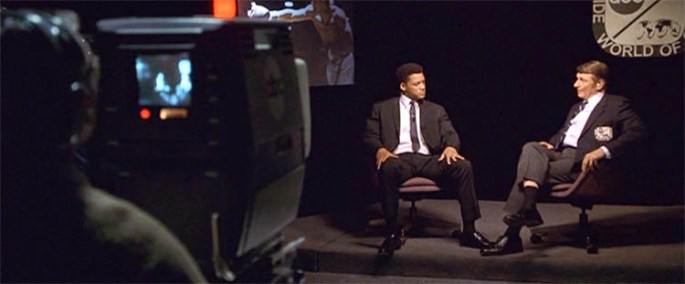
Ali-Howard-CosellWhile Smith was praised for his impressive physical transformation into legendary boxer Muhammed Ali, the film itself was criticized for revealing nothing new about the man. Herein lies the problem that Mann and company faced: how do you shed new light on one of the most documented historical figures of the 20th Century? Ali eschews the traditional docudrama for a more impressionistic take on the man and life. Mann’s film may not say anything new about the famous boxer, but it does depict an exciting ten years of his life in a masterful and richly evocative fashion. It’s a surprisingly soulful take on Ali and an excellent addition to Mann’s impressive body of work.
MEGAFORCE – A REVIEW BY J.D. LAFRANCE

megaforce

Megaforce (1982) is one of the most nakedly jingoistic might-means-right movies to come out of the Ronald Reagan era. Directed by legendary stuntman Hal Needham (Smokey and the Bandit), it is an astonishingly so-bad-it’s-good action movie that brilliantly epitomizes the kind of excess that was synonymous with the 1980s. The poster’s tagline says it all in a nutshell – “Deeds not words.” Hell, yeah! In some respects, Megaforce was a response to many of the gritty, downbeat genre films of the 1970s. It also signaled a new decade where America proudly flexed its military muscle all over the world. It is also a laughably bad movie but entertainingly so.

The opening voiceover narration sets things up for us. Megaforce is in fact, “a phantom army of super elite fighting men,” and whose mission it is “ to preserve freedom and justice battling the forces of tyranny and evil in every corner of the globe.” The opening credits play over triumphant synthesizer music courtesy of Jerrold Immel (Knots Landing) that sets the cheesy tone right from the get-go and also wonderfully, and instantly, dates the film.

We meet the bad guys – a paramilitary army from Gamibia with one of them anal retentively reciting his country’s manifesto while their leader Gurerra (Henry Silva) looks on in boredom. He just wants to blow shit up, which his army of tanks does – attacking a power station in the peaceful Republic of Sardun. Hopelessly outgunned and outmaneuvered by the Gamibia army, Sardun, not wanting to risk an international incident send Major Zara (Persis Khambatta) and General Byrne-White (Edward Mulhare) to find and enlist the help of Megaforce

They meet their contact out in the middle of nowhere. He introduces himself as Dallas (Michael Beck), a good ol’ cowboy type who takes them to his hidden base in a beat-up Ford Bronco. Three armored motorcycles that show off their prowess by popping wheelies and shooting balloons out of the sky eventually greet them. Director Hal Needham captures this all in loving close-ups and slow motion shots that comes across as porn for military vehicle enthusiasts.

Zara and Byrne-White meet Commander Ace Hunter (Barry Bostwick) in all of his spandex jump-suited glory. He’s the leader of Megaforce and not above hitting on Zara who, naturally, takes an instant dislike to him because, y’know, he’s a loose cannon. Barry Bostwick, the terminally square Brad in The Rocky Horror Picture Show (1975), is the last person I’d expect to play an action hero but there he is with fantastically blond blow-dried helmet hair as if channeling Barry Gibb. To his credit, he realizes that this is all silly nonsense (I mean, how could you not?) and has fun with the role.

Megaforce resides in a massive underground complex full of experimental vehicles and gear stolen from other countries. This army of mercenaries is made up of experts from all over the world. Ace and Zara continue to flirt like crazy, admiring each other’s chests and comparing their combat experience and even sharing an intimate moment skydiving, all to jarring romantic music right out of an elevator. I know I always like to treat a lady to a death-defying jump out of an airplane as a form of seduction. That Ace is one smooth operator. He and Zara’s “romance” is laughable at best, with their meet-cute dialogue, clumsily written by the writing team of James Whittaker, Albert S. Ruddy, Needham, and Andre Morgan, and their bizarre goodbye gesture that consists of kissing the thumb and then giving the thumbs up sign to each other. Of course, it doesn’t help that Bostwick and Persis Khambatta have zero chemistry together.

Edward Mulhare, known mainly for his role in the popular television show Knight Rider, plays the stereotypical fussy Brit with a posh accent and haughty attitude until Ace impresses him with knowledge of military tactics. After the career high of The Warriors (1979), it was all downhill from there for Michael Beck who went on to appear in the Olivia Newtown-John opus, Xandau (1980) and Megaforce before settling into a career of roles mostly on T.V. He seems to be having fun in this film and I wonder if he envisioned playing Dallas in a series of sequels that sadly for him never happened. Persis Khambatta, who had been touted as the next big thing prior to appearing in Star Trek: The Motion Picture (1979), further damaged her career in this film by playing eye candy. At first, Zara appears to be a feisty feminist but after a bit of verbal sparring with Ace she is more than happy to sit on the sidelines while the boys go off and play army with their expensive toys.

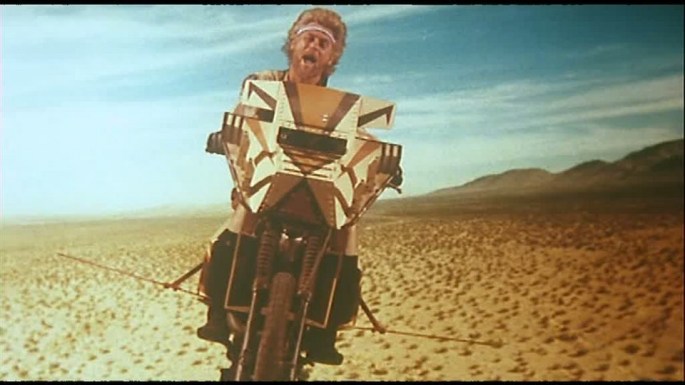
The movie’s grand finale has to be seen to be believed as Ace and his team punch a hole through Gurerra’s tank army in an orgy of explosions and lingering close-ups of guns firing and missiles launching. If that wasn’t enough, Ace escapes Gurerra’s army in a motorcycle that flies! While this sounds great and was the coolest thing when I was nine-years-old, it looks pretty ridiculous now. And just before Ace does this, he delivers the movie’s classic and most memorable line: “The good guys always win – even in the ‘80s.” If that doesn’t sum up most action films in this decade then I don’t know what does.

Director Hal Needham got the idea for Megaforce from Bob Kachler, the man who got him sponsors for his racing cars. He suggested it could be a television series, but Needham said, “It’ll never make a series, but it’ll make a helluva feature.” Needham and producer Albert S. Ruddy hired a writer to produce a screenplay and afterwards felt that it had some good ideas, but they ended up completely rewriting it in order to make the film funnier and have more action. Needham saw it as “kind of a version of James Bond done with a helluva lot less budget and no Roger Moore, but it was a high tech, good ‘right wing’ film and I thought it was kinda interesting.” They were able to procure funding from Hong Kong film production company Golden Harvest.

Needham and Ruddy approached Mattel Toys and worked with them in designing the look of the vehicles in the film. William Frederick took the designs and engineered the actual vehicles used in Megaforce, which were dune buggies and motorcycles rigged up with weapons and armor. It took him 9-10 months to build 30 them. According to Frederick, Mattel designed the exteriors and made them look “racy” while he designed the interiors to make sure they worked. When Needham asked if they were functional, Frederick fired a missile off of one of them and it blew a hole through the outside wall of the studio! So much smoke was generated from the explosion that the fire department came. During filming, the United States military sent out people to observe Frederick’s vehicles in action for a week out in the dry lakebeds in Nevada. Needham said, “And, if you go back and take a look at Desert Storm, there’s a pretty good resemblance to my vehicles.”

To do all of the riding scenes required in the film, Needham hired approximately 50 drivers for three months. According to those who worked on the production, he used real M48 tanks and armored personnel carriers. One driver said, “I’ve worked on a lot of war movies. Megaforce was as much like going to war as I can remember.” An interview with one of the stunt drivers gives an indication of Needham’s directorial style. During filming, when he wasn’t getting what he wanted, Needham would jump on or in a vehicle and show a stunt driver what to do. “Hal jumped on one of the bikes and went flying down the road who knows how fast and clipped one of these things [two-foot-deep furrows left by the tanks] and got off so hard that it took the production assistant an hour and a half to find his Rolex watch.” This incident delayed filming for approximately a week while Needham recuperated. It was a harbinger of things to come as several drivers were injured over the three-month shoot. Special effects expert Cliff Wenger Sr., who provided the film with its numerous explosions, remembers Needham coming up to him with an idea for a new ending: “They rewrote the script all the way through. I mean, what we shot and what the original script is, there is no comparison whatsoever.” Needham described to him what would eventually be in the final cut and asked Wenger if he could do it in three days.

Megaforce’s ending cries out for a sequel – however, it only grossed $5.6 million at the box office, not even recouping its then-pricey $20 million budget. Needham must’ve taken its failure hard as he barely mentions the movie in his recent autobiography. Years passed and the movie slowly acquired a modest cult following, which included a pair of famous fans – South Park creators Trey Parker and Matt Stone who have not only name-checked it in an audio commentary for one of the episodes of their show, but also mentioned it in passing in an interview they did with the alternative music band Ween. However, they paid the ultimate homage to Megaforce with their own film, Team America: World Police (2004), an action film parody using marionettes and which owed a lot to Needham’s movie, right down to the flying motorcycle.

d8cde3efda1bfc0352491fb8db9f274dMegaforce is the best movie in the world… when you’re a nine-year-old kid with no critical faculties and just want to see stuff blow up, like I did back in 1982. As a kid I loved this movie for the simple reason that it was a live-action version of the T.V. cartoon/toy I was obsessed with at the time – G.I. JOE: A Real American Hero. Both feature a secretive army populated by specialists armed with hi-tech gear, fighting evil all over the world. They eventually made a live-action G.I. JOE movie in 2009 (with a sequel on the way) but, for me, it pales in comparison to Megaforce, which for all of its inherent cheesiness feels like it was the product of a deluded madman – Needham – and not a badly made by committee, CGI-heavy advertisement for toys.
RAIDERS OF THE LOST ARK – A REVIEW BY J.D. LAFRANCE

raiders

There’s no disputing that Raiders of the Lost Ark (1981) is one of the greatest action/adventure films ever made, featuring some of the most memorable action sequences ever put on celluloid. Who can forget part-time archaeologist, part-time adventurer Indiana Jones (Harrison Ford) outrunning a giant boulder at the beginning of the film? Or the exciting gun battle in a Nepalese bar? Or Indy being dragged behind a truck full of Nazis? However, the older I get the more I appreciate the quieter moments in Raiders – the downtime between action set pieces. These scenes convey exposition and develop the characters. The credit for them working so well should be given to the film’s screenwriter Lawrence Kasdan, who also wrote the screenplays for such noteworthy films as The Empire Strikes Back (1980), Body Heat (1981), The Big Chill (1983), and many others. He’s written some of the best scripts ever committed to film and knows how to write witty dialogue and create engaging characters.

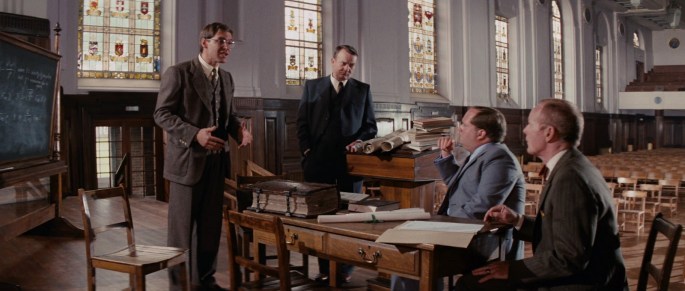
raiders1Kasdan’s ability to engage us in the obligatory exposition scene is evident early when Indy and his friend and colleague Marcus Brody (Denholm Elliott) meet with two military intelligence officers about the location of an old colleague of Indy’s – Abner Ravenwood – who might have an artifact – the headpiece of the Staff of Ra – that will reveal the location of the Ark of the Covenant, which the Nazis are eager to get their hands on. Indy and Marcus give the two men a quick history lesson on the Ark and its power. Marcus concludes with the ominous line about how the city of Tanis, that reportedly housed the Ark, “was consumed by the desert in a sandstorm which lasted a whole year. Wiped clean by the wrath of God.” The way Denholm Elliott delivers this last bit is a tad spooky and is important because it lets us know of the Ark’s power, his reverence for it, and why the Nazis are so interested in it. This dialogue also gives us an indication of the kind of danger that Indy is up against.
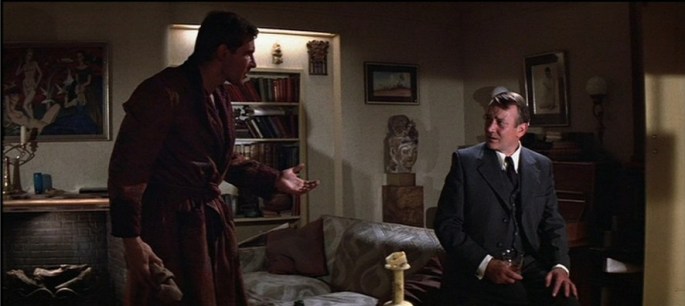
raiders2This segues to a nice little scene right afterwards at Indy’s home between the archaeologist and Marcus. He tells Indy that the United States government wants him to find the headpiece and get the Ark. As Indy gets ready they talk about the Ark. The camera pans away from Indy packing to a worried Marcus sitting on a sofa and he reveals his apprehension about what his friend is going after: “For nearly 3,000 years man has been searching for the lost Ark. It’s not something to be taken lightly. No one knows its secrets. It’s like nothing you’ve ever gone after before.” Indy shrugs off Marcus’ warning but his words, accompanied by John Williams’ quietly unsettling score, suggest the potential danger Indy faces messing with forces greater and older than himself.
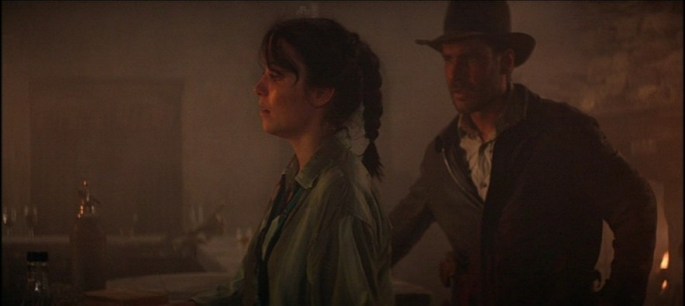
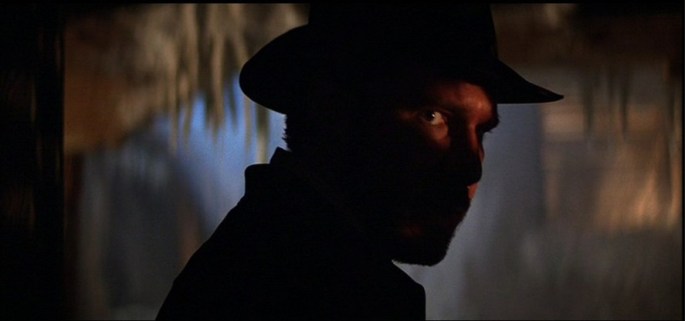
raiders3Kasdan also does a great job hinting at a rich backstory between Indy and his ex-love interest, Marion Ravenwood (Karen Allen). When they are reunited at a bar she runs in Nepal, she is clearly not too thrilled to see him, giving Indy a good crack on the jaw. Marion alludes to a relationship between them that went bad. She was young and in love with him and he broke her heart. To add insult to injury, her father is dead. All Indy can do is apologize as he says, “I can only say sorry so many times,” and she has that wonderful retort, “Well say it again anyway.” Harrison Ford and Karen Allen do a great job with this dialogue, suggesting a troubled past between them. In a nice touch, Spielberg ends the scene with Indy walking out the door. He takes one last look back and his face is mostly obscured in shadow in a rather ominous way as he clearly looks uncomfortable having had to dredge up a painful part of his past.
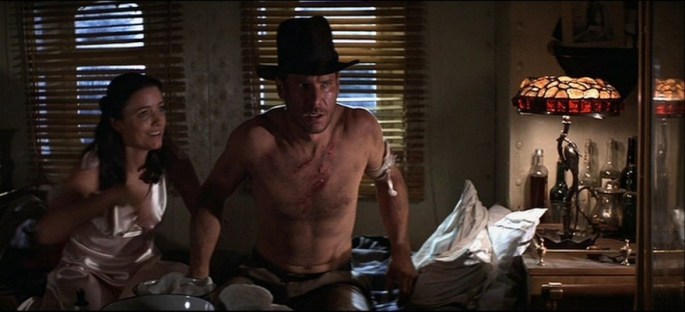
raiders4Indy and Marion have another nice scene together after they’ve retrieved the Ark from the Nazis and are aboard the Bantu Wind, a tramp steamer that will take them to safety. Marion tends to Indy’s numerous wounds and says, “You’re not the man I knew ten years ago,” and he replies with that classic line, “It’s not the years, honey, it’s the mileage.” It starts out as a playful scene as everything Marion does to help hurts Indy’s world-weary body. In frustration she asks him to show her where it doesn’t hurt and he points to various parts of his body and in a few seconds the scene goes from playful in tone to romantic as they end up kissing. Of course, Indy falls asleep – much to Marion’s chagrin. Kasdan’s dialogue gives Spielberg’s chaste, boyhood fantasy serial adventure a slight air of sophistication in this scene as two people with a checkered past finally reconnect emotionally.
raiders5.jpgFor me, Raiders is still the best film in the series. The pacing is fast but not as frenetic as today’s films. There are lulls where the audience can catch its breath and exposition is conveyed. In many respects, it is one of the best homages to the pulpy serials of the 1930s and a classic example of when all the right elements came together at just the right time. This film has aged considerably well over time and each time I see it, I still get that nostalgic twinge and still get sucked in to Indy’s adventures looking for the lost Ark.
THEY LIVE – A REVIEW BY J.D. LAFRANCE

“I’m disgusted by what we’ve become in America. I truly believe there is brain death in this country.” — John Carpenter

they_live_23

Filmmaker John Carpenter has always considered himself as an outsider in Hollywood. Like Sam Fuller before him, Carpenter makes genre films that are usually regarded by critics as simple thrill rides. However, underneath the surface lurks a strong, often savage social commentary on what Carpenter believes to be the problems that plague the United States. This approach is readily apparent in They Live (1988), an angry film born out of his disgust with the greed and materialism of the Ronald Regan era during the 1980s. What’s interesting is how its scathing critique of homelessness, rampant unemployment and corporate greed has become relevant yet again. Sadly, these problems never really went away, they’ve just become more prevalent because of the current global economic reality.

Nada (Roddy Piper) is a drifter, an amiable blue collar guy looking for steady work in Los Angeles. He arrives in town like the lone gunman in a western, completely with an accompanying soundtrack that even features a lonely harmonica like something out of an Ennio Morricone spaghetti western score (perhaps a nod to Once Upon a Time in the West). Carpenter shows all kinds of homeless people populating the city. Nada is told that there are simply no jobs available by a clearly indifferent government social worker. He wanders by a blind African American preacher (Raymond St. Jacques) who rants about being oppressed, the corruption of the American spirit and tells everyone that it’s time to wake up just before two police officers arrive to deal with him. Nada passes by a store with televisions in the window that present all sorts of cliché images of Americana: Mount Rushmore, the bald eagle, an American Indian dancing, a cowboy riding a wild horse, and a group of guys playing sports together. These are images of propaganda designed to keep us sedated and complacent.

Nada eventually finds a job and befriends a fellow worker named Frank (Keith David), a man who is clearly tired of Capitalism as he says bitterly tells him, “The golden rule: he who has the gold, makes the rules. They close one more factory we should take a sledgehammer to one of their fuckin’ fancy foreign cars.” Nada tells him to be patient but Frank has clearly run out of that particular commodity. He proceeds to lay it all out in a nicely written speech that sums up the American dream in a nutshell: “The whole deal is like some kind of crazy game. They put you at the starting line and the name of the game is ‘make it through life.’ Only everyone’s out for themselves and lookin’ to do you in at the same time. Okay, man, here we are. Now you do what you can, but remember, I’m gonna do my best to blow your ass away.” These sentiments eerily anticipate the anti-materialistic message of Fight Club (1999) by several years. Nada is more optimistic. He believes in playing by the rules as he tells Frank, “I deliver a hard day’s work for my money, I just want the chance. It’ll come. I believe in America. I follow the rules.” But this faith in the system begins to change when the squatter’s camp the men are staying at is suddenly bulldozed by the police one night. At first, there seems to be no reason for this unprovoked attack but over the course of the film Carpenter does an excellent job of gradually revealing what is really going on.

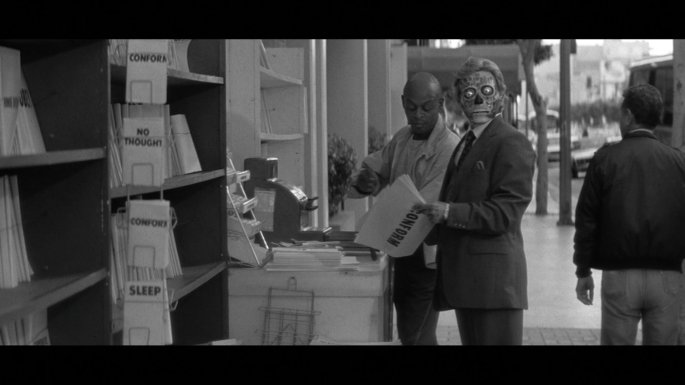
One day, while rummaging through some garbage, Nada comes across a pair of sunglasses that allow him to see things as they really are: the world is seen in black and white. The color facade disappears and billboards reveal their true messages: “OBEY,” “MARRY AND REPRODUCE,” and “SLEEP,” money is merely pieces of paper with the words, “THIS IS YOUR GOD,” written on them. Most shockingly is that with the glasses on, certain people turn out to be aliens in disguise. The glasses are a clever play on the notion of subliminal advertising and capitalism as the root of all evil. Once Nada wakes up, Carpenter has fun with the character, like when he enters a bank armed to the teeth, spots some aliens and says the memorable line, “I have come here to chew bubblegum and kick some ass. And I’m all out of bubblegum.” Or, when Nada confirms the truth of the alien’s existence to Frank when he tells him simply, “Life’s a bitch and she’s back in heat.” From this point, They Live’s pace rarely slackens as Nada and Frank form an uneasy alliance in an attempt to stop this secret alien invasion as if Marshall McLuhan suddenly took over scriptwriting duties and decided to rewrite Invasion of the Body Snatchers (1956) with a dash of Noam Chomsky for good measure.

The idea for They Live came from two sources: a futuristic story, involving an alien invasion, called “Nada” from a comic entitled Alien Encounters. This story was actually inspired from a short story called “Eight O’Clock in the Morning” by Ray Nelson that was originally published in The Magazine of Fantasy and Science Fiction in the 1960s. Carpenter describes it as “a D.O.A. type of story. A fellow is put in a trance by a stage hypnotist. When he awakens, he realizes that the entire human race has been hypnotized. Amongst us are alien creatures that are controlling our lives. He has only until eight o’clock in the morning to solve the problem.” Carpenter acquired the film rights to both the comic book and the short story and wrote the screenplay using Nelson’s story as a basis for the film’s structure.

The more political elements came from Carpenter’s growing distaste with the ever-increasing commercialization of popular culture and politics at the time. As he once remarked in an interview, “I began watching T.V. again. I quickly realized that everything we see is designed to sell us something…It’s all about wanting us to buy something. The only thing they want to do is take our money.” To this end, Carpenter thought of sunglasses as being the tool to seeing the truth, which “is seen in black and white. It’s as if the aliens have colorized us. That means, of course, that Ted Turner is really a monster from outer space.” In regards to the alien threat depicted in the film, the director said, “They want to own all our businesses. A Universal executive asked me, ‘Where’s the threat in that? We all sell out every day.’ I ended up using that line in the film.”

Since the screenplay was the product of so many sources: a short story, a comic book, and input from cast and crew, Carpenter decided to use the pseudonym, “Frank Armitage,” which was a subtle allusion to one of the filmmaker’s favorite writers, H.P. Lovecraft. Frank Armitage is in fact a character in Lovecraft’s “The Dunwich Horror.” Carpenter has always felt a close kinship with Lovecraft’s worldview and his influence can be felt in other films — most notably, The Thing (1982) and In The Mouth of Madness (1995). According to Carpenter, “Lovecraft wrote about the hidden world, the world underneath. His stories were about gods who are repressed, who were once on Earth and are now coming back. The world underneath has a great deal to do with They Live.”

After a budget of around three million dollars was established, Carpenter began casting his film. For the crucial role of Nada, the filmmaker surprisingly cast wrestler “Rowdy” Roddy Piper whom he had met at Wrestlemania III. For Carpenter it was an easy choice: “Unlike most Hollywood actors, Roddy has life written all over him.” Carpenter’s gamble pays off as Piper does a fine job playing an everyman-type hero who, at first plays by the rules, but once he realizes that it’s all a sham, decides to fight back. Piper’s performance is not going to win any acting awards but he does a solid job and brings the physical presence necessary for the role while also conveying a blue collar vibe.

Carpenter was impressed with Keith David’s performance in The Thing and needed someone “who wouldn’t be a traditional sidekick, but could hold his own.” To this end, Carpenter wrote the role of Frank specifically for the underrated actor. David does a great job as the perfect foil for Piper. The two men have this intense relationship that oscillates between outright distrust and grudging respect. This rather volatile alliance reaches critical mass in a wild, fist fight between the two men over a pair of the special sunglasses that lasts for several minutes. The brawl starts off seriously but eventually transforms into an absurd free-for-all. Carpenter remembers that the fight took three weeks to rehearse. “It was an incredibly brutal and funny fight, along the lines of the slugfest between John Wayne and Victor McLaglen in The Quiet Man.”

One of the reasons why They Live works so well is the film’s pacing. It starts off like the original Invasion of the Body Snatchers with the threat of alien invasion being implicit at first. Everything seems normal enough but after a half hour into the film, the threat suddenly becomes shockingly explicit when Nada puts on the sunglasses. From there, the film’s pacing speeds up and They Live begins to incorporate action film sequences into its science fiction premise. And yet, throughout the film, there is always thought-provoking commentary. This is represented by the pirate television broadcasts which, initially, seem like some lone conspiracy nut but eventually his ravings are revealed to be right on the money. His presence is the first sign that something is amiss. The television is presented as an electronic sedative in They Live. It’s a drug to the masses. When the T.V. pirate appears, the mind-numbing routine is broken and people get headaches as a result.

large_they_live_blu-ray_8Carpenter sees the commercial failure of his film as a result of “people who go to the movies in vast numbers these days [who] don’t want to be enlightened.” It’s a shame because They Live is far from being an overtly preachy film. On the contrary, it is always exciting and entertaining first, and a scathingly social satire second. However, the director sees the real tragedy to be the lack of humanity in society. “The real threat is that we lose our humanity. We don’t care anymore about the homeless. We don’t care about anything, as long as we make money.” If They Live is about anything, it’s a strong indictment against the capitalist greed that was so fashionable in the 1980s. It’s sentiment that still exists. This makes Carpenter’s film just as relevant today as it was back in 1988.

THE TRANSFORMERS: THE MOVIE – A REVIEW BY J.D. LAFRANCE

Tftm1986e

Before Michael Bay decided to piss all over our nostalgic memories of The Transformers cartoon with his live-action monstrosities, there was a feature-length animated film that for all of its clunky animation and cheesy, dated soundtrack is better than the entirety of Bay’s series of movies. For those of us who grew up watching the cartoon every day after school in the early 1980s, the movie came as quite a shock. Most of us, at that early, impressionable age, were unprepared for the much darker tone and the increased level of violence, including some of the show’s most popular and beloved characters getting quickly killed off in the first few opening scenes. The Transformers: The Movie (1986) was a commercial and critical failure but went on to develop a strong cult following among fans.

It is 20 years into the future (making it, at the time, 2005!) and the war between the Autobots (a race of good transformable robots) and the Decepticons (their evil counterparts) continues to rage. The Decepticons have taken control of the transformers’ home world of Cybertron. The Autobots are planning to retake the planet but need to get more energy from Earth in order to do so. Unfortunately, the Decepticons learn of these plans and their leader Megatron (voiced by Frank Welker) intercepts the ship headed for Earth with the intention of launching a sneak attack on the Autobot’s base. Unbeknownst to the Autobots and the Decepticons, a planet-sized transformer named Unicron (Orson Welles) is devouring entire planets to feed its insatiable desire for energy. Only the Matrix of Leadership, housed in Optimus Prime (Peter Cullen), leader of the Autobots, can stop him.

The dark tone of the movie is set right from the prologue, which features Unicron mercilessly destroying an entire planet of transformers. No one is spared. We even see one escape pod almost make it before getting sucked into Unicron’s massive, gaping maw. For kids used to the relatively tame television series this sequence came as quite a surprise. This was nothing compared to what came next as soon afterwards the Decepticons ambush a ship carrying several Autobots that are quickly and casually killed off! It was one thing to see anonymous characters with nothing invested in them be destroyed but it was something else entirely to see characters we had grown to like on the series dispatched so suddenly and coldly. These deaths do raise the stakes considerably as if the filmmakers were making a statement that all bets are off with this movie – any character, no matter how beloved, is fair game.

Clearly the powers that be (i.e. the toy company) meant to clear the decks for a new generation a.k.a. a new line of toys for kids to buy but I think they underestimated just how profound an effect all these deaths would have on their audience. This culminated with the death of Optimus Prime – the most popular transformer. Not since Darth Vader cut down Obi-Wan Kenobi in Star Wars (1977) had the death of a heroic character been so traumatic for its fanbase. At least Prime got to go out in style with an epic one-on-one slugfest with his nemesis Megatron. For kids at the time, it was an emotional moment because we cared about Prime. His death scene, in particular, had gravitas and meant something to the fans of the show. This is something that the Bay movies never were able to replicate with their multi-million dollar budgets.

Another memorable aspect of the movie is the scope and scale. Where the T.V. show’s action was largely confined to Earth, the movie opens things up by introducing other worlds and races (even if they are all transformers). And so we are presented with the Planet of Junk, one of the more fascinating additions to The Transformers universe. It is inhabited by the Junkions and their leader Wreck-Gar who speaks in T.V. clichés mainly derived from advertisements. In an inspired bit of casting, he is voiced by Monty Python alumni Eric Idle. Their world is a metallic compost heap masquerading as a planet and rather fittingly their theme song is performed by none other than Weird Al Yankovic. This race of robots provides a much-needed moment of levity in what up to that point had been a very dark film.

The battles are also bigger and more intense as Unicron transforms into an enormous robot that attacks Cybertron but this almost pales in comparison to the intensity of the epic battle between Optimus Prime and Megatron that left many fans shocked by its outcome. No one was prepared for what went down and the film never quite recovers from this moment. Speaking of gravitas, who better to play a transformer the size of a planet than Orson Welles, the brilliant filmmaker who made Citizen Kane (1941)? His digitally augmented voice has the dramatic weight befitting the scale and power of Unicron. The filmmakers needed a formidable actor to play a formidable character and they found their ideal candidate in Welles. This gig would be his last and he died five days after completing his work from a heart attack.

One of the things that dates The Transformers movie the most is its soundtrack of awesomely bad generic ‘80s hair metal, complete with the show’s cool theme song redone by Lion. Most memorably is Stan Bush’s “The Touch,” which went on to be hilariously immortalized in Paul Thomas Anderson’s Boogie Nights (1997). The one song that acts as a crazy counterpoint to this bloated arena rock is Weird Al Yankovic’s theme for the Junkions, “Dare to Be Stupid.” His goofy, non-sensical lyrics (anticipating Beck by a few years and actually goofing on Devo) are perfect for this absurdist, almost Dada-esque race of transformers.

After the first two seasons of the television show, toy company Hasbro wanted to eliminate many of the characters and introduce a new line. Season three would feature several new characters and the feature film would make that transition. Toy lines are discontinued for new ones and so the dilemma facing the screenwriters of the movie was how to make this transition seamlessly. According to story consultant Flint Dille, “So, we had this one scene where the Autobots basically had to run through a gauntlet of Decepticons. Which basically wiped out the entire ’84 product line in one massive charge of the light brigade. So whoever wasn’t discontinued, stumbled to the end.” The scene didn’t quite play out that way but over the first third of the film, several of seasons one and two characters were killed off. Not surprisingly, it was Hasbro that dictated the story of the film, “using characters that could best be merchandised for the movie. Only with that consideration could I have the freedom to change the storyline,” said director Nelson Shin in an interview.

The Transformers: The Movie
’s pacing is fast and furious with never a dull moment – perfect for kids with short attention spans and actually works in its favor as any narrative fat is trimmed, packing a lot of action into its running time (again something the live-action films failed to realize with their bloated lengths). While I don’t know if the movie exactly lives up to its poster’s tag line, “Beyond good. Beyond evil. Beyond your wildest imagination.” It was a pretty mind-blowing experience for this impressionable youth back in the day. So, I come at this movie now with nostalgic baggage in tow, unable to really look at it objectively. I can only imagine what kids of today think of it now. Sadly, they probably don’t even know/care of its existence having been bombarded by the Michael Bay movies, which is too bad because they lack the imagination, the ambition (which are largely earthbound while the animated film takes place mostly in outer space) and the substance that makes The Transformers: The Movie by far superior. Plus, I’d take the likes of Stan Bush and Lion over the bland nu metal stylings of Linkin Park any day.

INVASION OF THE BODY SNATCHERS (1956) – A REVIEW BY J.D. LAFRANCE

eTxgy8eROB5Ly7ZXKLukQoF6tKl

There have been three remakes of the classic 1956 film, Invasion of the Body Snatchers — 1979, 1994, and 2007 respectively. This does not include the countless rip-offs and homages that have been made since the original graced the screen: some good (They Live), some bad (The Astronaut’s Wife) and some just plain ugly (Body Snatchers). By far the superior film in every way is the 1956 version directed by Don Siegel, which continues to thrill and entertain while hopeless rehashes like Abel Ferrara’s film try in vain to recapture the power and the impact of its predecessor. What Ferrara and other imitators don’t understand is that extravagant special effects and elaborate chases do not compensate for a non-existent story and weak characters — something that Siegel understood implicitly and wisely avoided in his film.

Adapted from Jack Finney’s excellent novel The Body Snatchers (1954), Siegel’s film is the best of all the versions made because it is the most faithful to the novel. The film begins with suspenseful music while the credits are shown over a sky filled with rushing clouds. After the credits end we meet a frantic Dr. Miles Bennell (Kevin McCarthy) who is being questioned by the police. When a psychiatrist arrives Miles goes wild, until reassured that his story will be heard. What follows is a flashback account of how Dr. Bennell, with the help of an old girlfriend, Becky Driscoll (Dana Wynter) uncover a secret plot by aliens from outer space to take over the inhabitants of the small town of Santa Mira. It is a subtle invasion that at first glance does not appear to be that much of a threat, but as Miles and Becky soon discover, its implications reach far and wide, threatening not only close friends like Jack and “Teddy” Belicec (King Donovan and Carolyn Jones), but all of humanity.

Like the novel, Invasion of the Body Snatchers is a real marvel of pacing — achieved by gradually building the suspense, until the tension is too much. When Miles begins to tell his story, he starts by saying, “At first glance everything looked the same. It wasn’t. Something evil had taken possession of the town.” While these words are spoken, Siegel presents an ordinary looking small town. Miles’ words are a teaser that makes us curious. We want to know what this evil force is, how it has taken the town captive, and why it seems so normal. It is this curiosity that draws us into the story. At first everything seems normal, but little details appear that suggest otherwise. Maybe it is the scared child running out in front of Miles’ car, the same boy who later claims that his mother is not his mother, crying, “Don’t let her get me!” These events are all warning signs that point to a larger, impending danger that threatens the small town.

The film’s inception lies in the hands of producer Walter Wanger who had read Finney’s story in its original serial form in Collier’s magazine. He felt that it would make a good low-budget film for Allied Artists and asked Don Siegel to direct. After convincing screenwriter Daniel Mainwaring to join the production, the film began to take shape. From the start, the three men shared the same approach to the material. Their intention was to have the film act as a metaphor for the way “the majority of people in the world unfortunately are pods, existing without any intellectual aspirations and incapable of love,” remembers Siegel.

Originally, producer Walter Wanger and director Don Siegel wanted to shoot Invasion of the Body Snatchers on location in Jack Finney’s model for Santa Mira, Mill Valley, just north of San Francisco. In the first week of January 1955, Siegel, Wagner, and screenwriter Daniel Mainwaring visited Finney to talk about the film version and to take a look at Mill Valley. The location proved to be too expensive and Siegel and some Allied Artists executives found locations resembling Mill Valley in nearby Sierra Madre, Chatsworth, Glendale, the Los Feliz neighborhood, and in Bronson and Beachwood Canyons. However, much of the film was shot in the Allied Artists studio on the east side of Hollywood. Invasion of the Body Snatchers was originally budgeted for a 24-day schedule at $454,864 and the studio asked Wanger to cut the budget significantly. The producer proposed a shooting schedule of 20 days and a budget of $350,000.

Initially, Wanger considered Gig Young, Dick Powell, Joseph Cotton, and several others for the role of Miles. For Becky, he thought of casting Anne Bancroft, Donna Reed, Kim Hunter, Vera Miles, and others. With the lower budget, Wanger had to abandon these choices and cast Richard Kiley who had just starred in Phoenix City Story for Allied Artists. Kiley turned the role down and Wanger cast two relative newcomers in the lead roles: Kevin McCarthy, who had just starred in Siegel’s Annapolis Story (1955), and Dana Wynter, who had done several major dramatic roles on television but had not done a film.

The film was shot in 23 days between March 23, 1955 and April 18. The cast and crew worked a six-day week with only Sundays off. The production went over schedule by three days because of night-for-night shooting that Siegel wanted. The final budget was $382,190. Siegel used his lack of budget and unknown actors to create an authentic, natural feeling of normalcy to the proceedings. This became one of the strengths of the film. We so easily believe that this is Smalltown, U.S.A. that when the horror of what is really happening becomes apparent the shock is that much more significant. Siegel, a former special effects expert, knew full well the pitfalls of relying too much on effects and not on the plot. “Instead of doing what so many science fiction and horror films do — spend all their money on special effects and put poor actors on the screen — we concentrated on the performers. The main thing about the picture, however, was that it was about something and that’s rare.” And so Siegel actually used the handicap of a small budget to his advantage by downplaying the special effects in favor of creating strong, three-dimensional characters and telling a suspenseful, often scary story.

The project was originally called, The Body Snatchers after the Finney serial. However, Wanger wanted to avoid confusion with the Val Lewton 1945 horror film with a very similar title. The producer was unable to come up with a title and accepted the studio’s choice, They Come from Another World that was assigned in summer 1955. Siegel protested this title and suggest two alternatives: Better Off Dead and Sleep No More, while Wanger offered Evil in the Night and World in Danger. None of these were chosen as the studio finally settled on Invasion of the Body Snatchers in late 1955. Wanger saw the final cut in December 1955 and protested the use of the Superscope format. Its use had been a part of the early plans for the film but the first print was not made until December. Wanger felt that the film lost sharpness and detail. Siegel had originally shot Invasion of the Body Snatchers in the 1.85:1 aspect ratio. The Superscope look was a post-production lab process designed to make the film resemble the popular Cinemascope format.

The studio scheduled three previews for the film on the last days of June and the first day of July 1955. According to Wanger’s memos at the time, the previews were successful. However, later reports by Mainwaring and Siegel contradict this, claiming that audiences could not follow the film and laughed in the wrong places. In response, the studio removed much of the film’s humor, “humanity”, and “quality”, according to Wanger. He scheduled another preview in mid-August that did not go well. The studio decided to change the film’s title to a more conventional science fiction one. In later interviews, Siegel pointed out that it was studio policy not to mix humor with horror. Both Siegel and Mainwaring were satisfied with the film as shot. It was originally intended to end with Miles screaming hysterically as truckloads of pods pass him by. The studio, wary of such a pessimistic conclusion, insisted on adding a prologue and epilogue to the movie that suggested a more optimistic outcome to the story which is thus told mainly in flashback. Siegel decided to shoot these scenes because he knew the studio would put them in regardless and if he filmed them then perhaps he could do a little damage control. Mainwaring scripted this framing story and Siegel shot it on September 16, 1955 at Allied Artists.

Siegel had problems with these sequences because as he saw it, they let “you know right away that something unusual is going on. If you start, as I wanted to, with McCarthy arriving in the town of Santa Mira, it reveals it slowly, we understand why McCarthy can’t readily accept the terrible thing that appears to be happening. And the dramatic impact of the ending is reduced with the epilogue.” Allied Artist also made Siegel cut out a lot of the humor in the film, but enough survived for the director’s intended effect. “I felt the idea of pods growing into a likeness of a person would strike the characters as preposterous. I wanted to play it that way,” Siegel remembers, “with the characters not taking the threat seriously. For example, if you told me now that there was a pod in my likeness in the other room, I would joke about it. However, when I opened the door and saw the pod, the full shock and horror would hit me and the fun would be gone. I wanted the people in the film to behave like normal people.” Despite the studio’s constant meddling, Siegel managed to create an impressive film whose impact has not diminished over the years.

In addition to these bookends, Wanger wanted to add a variety of speeches and prefaces. He suggested a voice-over introduction for Miles. While the film was being shot, Wanger tried to get permission in England to use a Winston Churchill quotation as a preface to the film. The producer also tried to get Orson Welles to voice the preface and a trailer for the film. He wrote speeches for Welles’ opening on June 15, 1955 and spent considerable time trying to convince Welles to do it but was unsuccessful and considered science fiction author Ray Bradbury instead but this also did not happen. Mainwaring eventually wrote the voice-over narration himself. The shorter version of the film was often rerun late at night on T.V. stations and one PBS showing in 1988. The full theatrical version was not widely released until 1978 when a remake was produced starring Donald Sutherland.

By giving us only bits and pieces at a time, Siegel slowly begins to reveal the threat of alien invasion. People act normal enough, but something is slightly askew. People seem to have emotions, but as one character observes, “There is just the pretense of it.” Body Snatchers feeds on our fear of dehumanization and conformity — not only of ourselves, but our family and friends. A lot of the suspense in the film is derived from the fact that the characters must stay awake to remain human; to sleep means becoming a pod. Sleep is an important motif of the film, to the point where Siegel originally wanted it to be called Sleep No More, a reference to Shakespeare’s play, Macbeth. For Siegel, sleep is a metaphor for conformity or the stifling of any intellectual curiosity. People often sleepwalk through their whole lives — never truly alive. And like Miles in the film, we are surrounded daily by these intellectual sleepers, being subtly invaded by their ever-growing numbers. Again, the studio stepped in and imposed a more science fiction/horror-like title which the filmmaker had no choice but to accept.

Despite the compromises Siegel was forced to make, his original intentions were not diminished. Through subtle references and imagery, he managed to convey his fears of conformity and present the solution to this problem in the form of its hero: Miles Bennell who embodies individuality and humanity — something that the pods (read modern industrial society) try to destroy. Unfortunately, Invasion of the Body Snatchers was not blessed with a big budget or big name stars and as a result critics and box office success ignored it upon initial release. Over the years, film buffs and student groups began to take interest in the film and an ever-growing cult following developed leading to its rediscovery in the 1960s by French New Wave critics who declared it to be one of the best and most influential science fiction films of the 1950s, alongside such classics as The Thing (1951), The Day the Earth Stood Still (1951), and Them! (1954).

bodysnatchers_1American critics underestimated the widespread influence it has had since its initial release. A much imitated (see The Hidden amongst many others) film, it still manages to captivate and delight people today. The film has been read on many different levels, most often as a subtext for protesting Senator Joseph McCarthy and his Red Scare mentality or as an anti-Communist allegory. First and foremost it is an entertaining film that blends a science fiction premise with film noir and horror elements (in particular, its use of unusual camera angles, close-ups, sharp editing, music, and lighting). Despite three remakes, the original film is the superior version because its director, Don Siegel understood Finney’s novel and was able to translate its intent successfully to the screen without relying on flashy special effects and trickery like so many contemporary science fiction films.