A BETTER TOMORROW II – A REVIEW BY J.D. LAFRANCE

abettertomorrowii02

After the smash box office success of A Better Tomorrow (1986) in its native country of Hong Kong and other Asian territories, the film’s producer Tsui Hark convinced its director John Woo to quickly crank out a sequel imaginatively titled A Better Tomorrow II (1987). The two men had a contentious relationship during production and this spilled over during the editing phase where they argued over the length of the film. It got so bad that a mediator had to step in, allowing Hark and Woo to each edit a half of the film. The end result is a flawed yet fascinating mess of a film that divided Woo fans but helped popularize what became known as the Heroic bloodshed movie, a genre of Hong Kong cinema distinctive for its overtly stylized action sequences often involving excessive gunplay and melodramatic themes consisting of brotherhood, honor, duty, and ultimately redemption.

A few years have passed since the events depicted in A Better Tomorrow. Sung Tse Ho (Ti Lung) is recruited from prison to infiltrate and bust an international counterfeiting operation in Hong Kong. His target is Lung Si (Dean Shek), his former mentor. He’s asked to go undercover and investigate Lung but Ho refuses out of loyalty and the belief that his friend has retired from the business. So, his younger brother Sung Tse Kit (Leslie Cheung), now a police lieutenant, takes the job instead. He manages to impress Lung by helping his daughter in a dance contest.

When Kit’s wife Jackie (Emily Chu) visits Ho in prison upset and worried about her husband’s “secret mission,” he reconsiders the deal offered him. Ho is quickly reunited with Lung and finds out his mentor really has gone straight despite crippling debts and pressure from rival mob boss Mr. Wong (Ng Man-tat) to buy Lung’s shipyard. However, at a meeting with Mr. Wong, Lung is framed for the crime boss’ murder and so Ho puts his mentor on a boat to New York City. However, Lung’s beautiful young daughter is killed on orders from crime boss Ko Ying Pui (Shan Kwan), which, coupled with seeing the kindly priest that took him in and a little girl get killed by assassins, drives him off the deep end. Just how much more trauma can this guy take?

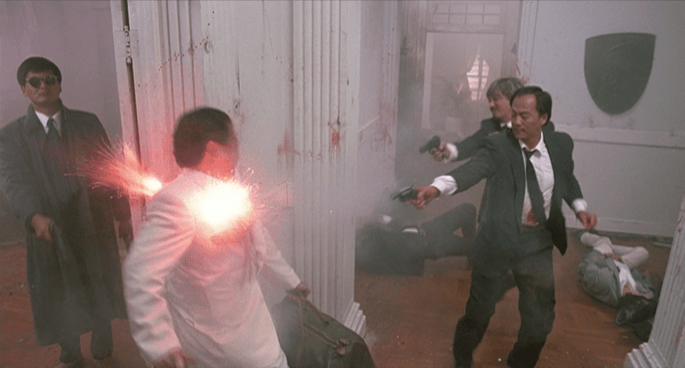
Before he’s about to be given electroshock therapy at a mental institution, Lung is sprung by Ken “Gor” Lee (Chow Yun-fat), the twin brother of Mark who was killed in A Better Tomorrow. It takes approximately 20 minutes before we’re introduced to Ken in a ridiculously drawn out scene where he rants about a plate of rice that a customer doesn’t like. It is a shameless bit of overacting even by Hong Kong cinema standards and I suppose is intended to show that Ken is just as wild and unpredictable as his brother. However, the scene goes on and on into self-parody and one has to give Chow Yun-fat credit for fully committing – or something like that. The overacting continues as Ken tries to get Lung out of his catatonic state. Of course, just as Ken makes a breakthrough they are attacked by assassins. Only in a Woo film would a bloody shoot-out snap a character out of his catatonia. Having survived yet another attack, Ken and Lung go back home to Hong Kong, team up with Ho and Kit and exact unholy vengeance on Ko and his army of crooks in what proves to be one incredible action set piece after another.

In keeping with the tradition of Heroic bloodshed movies, A Better Tomorrow II is essentially a soap opera for guys, albeit a bullet-ridden one. It features incredibly heightened emotions (see the rice scene) as the main characters constantly make life or death decisions. Their lives are continually in danger, which creates an intense bond – the hallmark of many Woo films, especially his Hong Kong ones. Around the one-hour mark the slow motion mayhem really kicks into gear as the Chow Yun-fat action hero we all know and love manifests itself when a gang of bad guys tries to kill Ken and Lung at a flophouse they’re hiding out in. Among the beautifully orchestrated carnage we get a breathtaking shot of Ken sliding down a flight of stairs while dispatching an anonymous baddie with two guns – an iconic image that perhaps best encapsulates what the Heroic bloodshed genre is all about. This stunt was also a warm-up for a similar one that would be pulled off in Hard Boiled (1992), Woo’s Hong Kong swan song.

The rice rant aside, Chow Yun-fat demonstrates why he was such a super star in Hong Kong. He gives off an air of effortless cool as the unstoppable action hero and Woo’s cinematic alter ego. He has loads of charisma and the camera really picks up on it in a big way. Ti Lung is also quite good as the conflicted ex-con that risks his life by going undercover to protect his brother. Leslie Cheung plays the tragic cop with everything to lose. His character has a pregnant wife yet constantly risks his life in order to take down Ko. Finally, Dean Shek is excellent as the father figure of the group and shows considerable chops as Lung goes from honest businessman to catatonic victim to ruthless avenger.

After the financial success of A Better Tomorrow, the film’s producer Tsui Hark wanted to capitalize on it by quickly making a sequel. Originally, the film’s director John Woo agreed but only if it was a prequel set in Vietnam. To him, it didn’t make sense to make a sequel because Mark, A Better Tomorrow’s most popular character, was dead. Woo came up with a story that depicted how the main characters in the first film became friends and got to where they were in life. This was ultimately rejected and he later used it in one of his most personal films Bullet in the Head (1990).

One of Woo’s good friends, actor Dean Shek was going through a rough patch in his career. He was no long popular with audiences and had gone to the United States with the intention of retiring. So, Hark and Woo met with Shek in America and convinced him to come back and make another film with them. This inspired Hark to come up with an idea for a sequel with Shek’s character Lung being coaxed back into action by his friends. Hark also came up with the idea of Mark’s twin brother Ken living in New York City. Woo wasn’t thrilled with these ideas because it ended any notion of his prequel idea but he wanted to help out Shek.

Problems arose during production when Woo came up with the idea of shifting the focus of the film to the two younger brothers – Ken and Kit – because he felt that they had a lot in common. The director shot several scenes with them working and talking together. However, when the film’s original cut ran almost three hours, Hark felt that the film was too long and that the focus should be on Lung. He wanted all of these additional scenes removed. Woo refused to make these cuts and so Hark secretly made edits only for Woo to then put the footage back in afterwards. A mediator stepped in and gave Hark and Woo one week to each edit a half of the film. The end result is a version of the film that neither men were happy with, especially Woo who considers it his least favorite of anything he’s done (Really? Has he seen Paycheck?).

Like many Woo films, A Better Tomorrow II examines themes of honor and loyalty. Ho goes to great extremes in protecting his mentor and his brother Kit as well. These guys are willing to face insurmountable odds and die for each other all in the name of friendship. But it is more than just friendship. When you’ve come so close to death as these guys have there is an unbreakable bond that connects them in a way that clearly fascinates Woo as he has explored it so many times in his films.

Sure, he lays the angst and melodrama on thick but in doing so raises the stakes in the action sequences. This was a pretty novel notion at the time. It makes the climactic showdown – where Ken, Lung and Ho are decked out in black suits (anticipating Reservoir Dogs by a few years) – that much more memorable because these guys have sacrificed so much that they’re due for some well-deserved payback and man, do they ever dish it out by staging a full-on assault on Ko’s compound with automatic weapons, grenades and, in one memorable bit, a samurai sword. But it is Woo’s trademark dual handgun action that is used the most and to greatest effect. A Better Tomorrow II takes the first film and ups the ante with more bloodshed and more melodrama for an installment that some prefer over the original. For a film that had such a troubled production, it is surprisingly coherent and in terms of its action sequences a classic of the genre. Woo would improve greatly on this template with The Killer (1989) and the aforementioned Hard Boiled before trying his luck in Hollywood with mixed results.

THE LAST DETAIL – A REVIEW BY J.D. LAFRANCE

ld-one

Hal Ashby directed some of the best films to come out of the 1970s, exploding out of the gates with four motion pictures over five years. They were all quirky comedy-drama hybrids that, in terms of subject matter, couldn’t be more different and yet are united in the sense that they all feature offbeat protagonists. They focus on outsiders that exist on the margins of mainstream society, like the death-obsessed young man who falls in love an unflappable, optimistic septuagenarian in Harold and Maude (1971). In its own way, The Last Detail (1973) is a comedy tinged with drama and one that features marginalized protagonists in the form of two veteran United States Navy petty officers that have to transport a young sailor from Virginia to New Hampshire and end up learning something about themselves and each other along the way.

At the time, Ashby was coming off the commercial and critical failure of Harold and Maude when Jack Nicholson told him about The Last Detail. Then up-and-coming screenwriter Robert Towne had adapted Darryl Ponicsan’s novel of the same name with the actor (they were close friends) in mind. Nicholson was on an incredible run of classic film roles that started with Easy Rider (1969) and continued with two Bob Rafelson films – Five Easy Pieces (1970) and The King of Marvin Gardens (1972). His role in The Last Detail would yet again demonstrate his power and versatility as an actor, resulting in him being crowned Best Actor at the 1974 Cannes Film Festival.

Billy “Badass” Buddusky (Nicholson) and Richard “Mule” Mulhall (Otis Young) are assigned “chasers” duty, which involves taking a young sailor by the name of Larry Meadows (Randy Quaid) to Portsmouth Naval Prison. He’s been sentenced to eight years for trying to steal $40 from the Commanding Officer’s wife’s pet charity project. They have a week to do it, but Buddusky proposes that they can pocket more of the per diem and spend it on the way home if they get Meadows there as fast as possible. I like how the film settles into a character-driven groove with a series of colorful encounters that provide insight into these guys after efficiently setting up the premise.

Meadows is just a scared kid that did something stupid and pissed off the wrong person as a result. Meadows has hardly had any life experiences and will be denied the possibility of them for eight long years unless Buddusky and Mulhall do something about it. Not surprisingly, Buddusky’s original plan goes out the window as he and Mulhall bond with Meadows by getting him drunk, stoned and laid in one last hurrah before eight years of imprisonment.

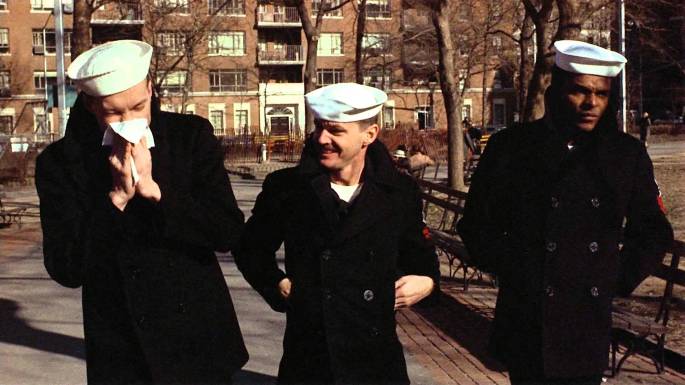
The Last Detail continued Jack Nicholson’s fascination with angry outsiders that live on the margins. It was the start of a great run of like-minded characters, beginning with Easy Rider. It is interesting to watch the choices he makes as an actor in this role, from the way Buddusky seems to sarcastically chew his gum to the way he wears his sailor’s cap. Nicholson is equally adept at showing the anger that simmers under his character’s façade and the explosion of rage that occurs when provoked, like the famous scene where a bartender refuses to serve the three sailors, which is reminiscent of the even more well-known diner scene in Five Easy Pieces. Later on, there’s a nice moment where Buddusky explains why he gets so angry and how liberating he finds it to wail on someone that ticks him off. He even tries to pick a fight with Meadows. It gives us some valuable insight into Buddusky’s volatile nature. Nicholson also shows us moments where his character is a consummate bullshit artist, like when he, Mulhall and Meadows get invited to a party in New York City and he tries to impress a young woman (Nancy Allen) by romanticizing life in the Navy. He’s stoned and getting nowhere with this girl who looks like she’d rather be anywhere else. Nicholson effortlessly inhabits the role in a way that seemed to disappear through the late 1980s and beyond when he relied more and more on his movie star persona.

Fresh-faced Randy Quaid does a nice job of conveying his character’s clueless naiveté. He plays Meadows as a pathetic mess of a human being. With his young, soft face, the actor projects a kind of innocence, but his actions sometimes say otherwise. For example, on the train he tries to make a break for it and when caught breaks down crying. Quaid achieves just the right mix of awkwardness and an occasional sympathetic side to keep us interested in this bundle of contractions all the while holding his own against a flashy actor like Nicholson. Quaid exhibits character behavior that is intriguing to watch – so much so that we want to know more about Meadows. Why did he try to steal the money? Over the course of the film, Buddusky and Mulhall try to find out what motivates this kid. As they get closer to prison, Quaid shows how the inevitable weighs more and more on Meadows’ mind by facial expressions, which oscillate between contemplative and anxious.

Otis Young has the least flashiest role, but it is a crucial one as he provides the stable, calming voice of reason, trying to keep everyone on track. When Buddusky comes up with some wild idea or wants to diverge from their mission, Mulhall is the sober realist and this sometimes causes friction between him and Buddusky, but when they are presented with an outside threat they quickly close ranks.

Robert Towne’s script hits us up with salty language right from the get-go, but it never feels false or forced because it rolls off the tongue so easily off someone like Nicholson who curses as naturally as breathing. I also like how the film is set during the winter months and you can tell that they actually shot it during that time by how you can see the actors’ breath in outdoor scenes. It looks so cold that it is almost tangible, most notably in a scene towards the end when the three sailors decide to have a makeshift picnic out in a snowbound park. They stand around freezing their asses off while trying to start a fire to cook hotdogs.

Producer Gerry Ayres had bought the rights to Darryl Ponicsan’s novel The Last Detail in 1969, but had difficulty getting it made because the studio was concerned about all of the bad language in Robert Towne’s screenplay, asking him to reduce the number of curse words. Towne told them, “This is the way people talk when they’re powerless to act; they bitch.” The screenwriter had refused to tone down the language and the project remained in limbo until Jack Nicholson, who was by then a bankable movie star, got involved. Towne, who was good friends with Nicholson, had written the role of Buddusky with the actor in mind.

Director Hal Ashby was in pre-production on Three Cornered Circle at MGM when Nicholson told him about The Last Detail, his upcoming project at Columbia Pictures. Ashby had actually been sent the script in the fall of 1971, but the reader’s report called it, “lengthy and unimaginative.” After looking at it again, he had warmed up to it. Ashby wanted to do it, but the project conflicted with his schedule for Three Cornered Circle. However, he pulled out of his deal, impressed by Nicholson’s loyalty, with MGM and took Nicholson’s suggestion that they work together on The Last Detail.

Ashby and Ayres read Navy publications and interviewed current and ex-servicemen who helped them correct minor errors in the script. During pre-production, Ashby worked with Towne on polishing the script and with Nicholson on his character. Ashby wanted to shoot on location at the naval base in Norfolk, Virginia and the brig at Portsmouth, New Hampshire, but was unable to get permission from the U.S. Navy. However, the Canadian Navy was willing to cooperate and in mid-August 1972, Ashby and his casting director, Lynn Stalmaster, traveled to Toronto to look at a naval base and meet with actors. The base suited their needs and Ashby met actress Carol Kane whom he would cast in a small, but significant role.

Nicholson was set to play Buddusky and so the casting of The Last Detail focused mainly on the roles of Mulhall and Meadows. Nicholson and Towne were friends with Rupert Crosse and felt that he would be perfect as Mulhall. Bud Cort, who had worked with Ashby on Harold and Maude, begged the director to play Meadows, but he felt that the actor was not right for the role. Stalmaster gave Ashby a final selection of actors and the two that stood out were Randy Quaid and John Travolta. Quaid had the offbeat and vulnerable qualities that Ashby wanted.

Shortly before principal photography was to begin, Crosse discovered that he had terminal cancer and Ashby delayed production a week so that Crosse could come to terms with the news and decide if he still wanted to do the film. However, a day before filming was to begin, Crosse had to pull out and Ashby and Stalmaster scrambled to find a replacement, quickly casting Otis Young as Mulhall. Ashby had tried to get Haskell Wexler, Nester Almendros and Gordon Willis as the film’s director of photography, but when none of them were available, he promoted Michael Chapman, his camera operator on The Landlord (1970). Ashby and Chapman worked together to create a specific look for the film that involved using natural lighting to create a realistic, documentary style.

Ashby decided to shoot The Last Detail chronologically in order to help the inexperienced Quaid and the recently cast Young ease into their characters. Quaid was indeed very nervous and wanted to make a good impression. Ashby kept a close eye on the actor, but allowed him to grow into the role. With the exception of Toronto doubling as Norfolk, the production shot on location, making the same journey as the three main characters.

The day after principal photography was completed; Ashby had his editor send what he had cut together up to that point. The director was shocked at the results and fired the editor. The director was afraid that he’d have to edit the film himself. Ayres recommended brining in Robert C. Jones, one of the fastest editors in the business and who had been nominated for an Academy Award for Guess Who’s Coming to Dinner (1967). Jones put the film back into rushes and six weeks later had a first cut ready that ran four hours. Ashby was very impressed with Jones’ abilities and trusted him completely.

However, the studio was not happy with the length of time it was taking to edit The Last Detail as well as the amount of bad language in it. Columbia was in major financial trouble and needed a commercial hit. Jones called Ashby while he was in London meeting with Peter Sellers about doing Being There (1979), telling him that Columbia was fed up. The head of the editing department called to tell Ashby that a studio representative was coming to take the film away. However, Jones refused to give up the film and Ashby called the studio and managed to smooth things over with them.

By August 1973, the final cut of The Last Detail was completed and submitted to the MPAA, which gave it an R rating. Columbia was still not happy with the film and asked for 26 lines with the word “fuck” in them to be cut. Ashby convinced the studio to let him preview the film as it was to see how the public would react. The film was shown in San Francisco and the screening was a success. Columbia decided to give the film a limited release to qualify for Oscar consideration with a wide release in the spring of 1974. Both Nicholson and Quaid were nominated for Academy Awards for Best Actor and Best Supporting Actor respectively.

For all of their fun and wild times – including picking a fight with some army soldiers in a train station washroom – Meadows’ fate hangs over them like an ominous storm cloud that occasionally makes itself known. While Mulhall wants to take Meadows straight to prison, Buddusky wants to show the kid a good time because it will be the last one he’ll have for eight years. Even though, by the end of The Last Detail, Buddusky and Mulhall do their job, you can tell that Meadows got to them, past their hardened Navy lifer exteriors. For them, Meadows represents how fucked up the system is – that someone could get punished so severely for such a minor crime. It’s not right, but there is nothing they can do about it, which ends things on a rather melancholic note of resignation that is refreshing for a film that started off as a comedy.

The Last Detail performed well at the box office and it has gone to become an influential film, representing one of Nicholson’s finest performances of the ‘70s. It was an excellent early role for Quaid and was also part of a fine run of films during this decade for the character actor. And finally, for Ashby it marked another great effort in a decade chock full of classics as he would go on to make, including Shampoo (1975), Coming Home (1978), and Being There.

SIN CITY: A DAME TO KILL FOR – A REVIEW BY J.D. LAFRANCE

sin-city2

In 2005, Robert Rodriguez adapted the comic book Sin City into a film with help from its creator Frank Miller who co-directed it. Convincing the veteran comic book writer/artist to come on board was a smart move on the filmmaker’s part as it assured that Miller’s luridly violent noir tales would be faithfully translated. This was achieved through a then-groundbreaking green screen environment that allowed Rodriguez to place his actors in Miller’s stylish world with a striking look comprised of black and white with strategic splashes of color. This innovative approach attracted a star-studded cast that included Bruce Willis, Mickey Rourke, Clive Owen and Benicio Del Toro among others. The final result dazzled audiences and was a commercial success.

A sequel seemed inevitable, but instead Rodriguez went on to team up with Quentin Tarantino on the box office misfire that was the Grindhouse double bill (2007) while Miller applied the Sin City aesthetic to a disastrous adaptation of Will Eisner’s comic book The Spirit (2008). Over the years, talk of a sequel surfaced occasionally with the likes of Johnny Depp and Angelina Jolie being mentioned in potential leading roles. Nine long years later and the stars (and money) aligned for Rodriguez and Miller to reunite with Sin City: A Dame to Kill For (2014). The film promptly tanked at the box office and received mixed to negative reviews. What happened? Did Miller and Rodriguez wait too long? A green screen-heavy film is no longer a novelty. Two cast members with characters in the film had passed away and some roles have been recast. The general consensus seems to be that they waited too long to make a sequel and interest in the film had waned.

Some might complain that A Dame to Kill For is just more of the same. As a big fan of the first film this is not necessarily a bad thing. After seeing Sin City, I wanted to see more of Miller’s stories brought to life. In addition to adapting A Dame to Kill For and the short story “Just Another Saturday Night” from the Booze, Broads, & Bullets collection, Miller created two new stories specifically for the film – “The Long Bad Night” and “Nancy’s Last Dance.” By doing this, he has given the fans a real treat by offering two stories where the outcome is not known and introducing new characters into this universe.

In “Just Another Saturday Night,” Marv (Rourke) wakes up amidst a car accident unable to remember how he got there. He proceeds to recall what happened via flashback on a snowy Saturday night. This segment is a nice way to reacquaint us to the brutal yet darkly humorous world of Sin City. “The Long Bad Night” introduces us to Johnny (Joseph Gordon-Levitt), a confident gambler who decides to take on Senator Roark (Powers Boothe), the most powerful man in the city, in a high-stakes poker game and gets more than he bargained for. It’s a lot of fun to see Joseph Gordon-Levitt square off against Powers Boothe, the former playing a young upstart and the latter an evil, influential man.

The centerpiece of the film is “A Dame to Kill For,” which features Dwight McCarthy (Josh Brolin) as a private investigator taking photographs of a businessman (Ray Liotta) cheating on his wife with a hooker (Juno Temple). When the man tries to kill her, Dwight intervenes. He has a tortured past, which involves keeping his homicidal impulses in check. Afterwards, Dwight gets a call from an ex-lover by the name of Ava Lord (Eva Green), a beautiful woman married to a very rich man. She’s in some kind of trouble and he finds himself drawn into her tangled web yet again. He soon runs afoul of her imposing bodyguard Manute (Dennis Haysbert) who proceeds to work him over. Realizing that he’s out of his depth and bent on rescuing Ava, Dwight enlists Marv’s help, which only complicates things in typical noir fashion.

In “Nancy’s Last Dance,” Nancy Callahan (Jessica Alba) is an exotic dancer still haunted by the death of her lover John Hartigan (Bruce Willis) and is obsessed with avenging his death by killing Roark, the man responsible for it. Over time, she’s counseled/haunted by Hartigan’s ghost, which drives her increasingly crazy.

Actors Josh Brolin, Joseph Gordon-Levitt and Eva Green slip seamlessly into the Sin City world. It helps that they have that old school noir look, especially Brolin with his chiseled tough guy features and gravelly voice – perfect for his character’s voiceover narration. In no time, the actor makes you forget that he plays a character once portrayed by Clive Owen. Gordon-Levitt is excellent as the young newcomer with a secret and manages to elicit sympathy for his ultimately doomed character. Green plays Sin City’s reigning femme fatale. The stunning actress has an alluring, exotic look and can turn a vulnerability on and off at will all the while playing a cold-hearted manipulator of men. Green gives key line deliveries the right venomous spin that makes Ava Lord a fearsome figure in this world.

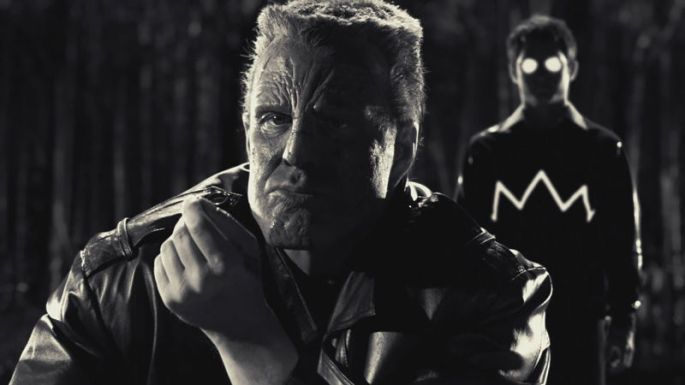
It’s great to see Mickey Rourke return to the role of Marv, a character he inhabits so well. He brings a world-weary charm and a much-needed dose of dark humor to the film. Powers Boothe, who only had a minor role in the first film, gets a much meatier part in A Dame to Kill For and it’s a lot of fun to see him sink his teeth into such a deliciously evil character. Unfortunately, Jessica Alba is once again miscast as Nancy, the stripper with a heart of gold. While she looks the part, the actress doesn’t have the chops to pull off the tricky evolution of character that goes from sweet girl traumatized by the death of loved one to a revenge-obsessed vigilante. Miller’s stylized dialogue needs to be delivered a certain way. Some actors can pull it off and others can’t. Alba falls into the latter category and it becomes painfully obvious in her segment. Even her dancing is unconvincing.

While it no longer has the technological novelty factor as an incentive (shooting it in 3D really didn’t help either), there is certainly no other film out there that looks like Sin City. There have been a few imitators since, most notably The Spirit and Max Payne (2008), but the look of the film is so specific to its universe that few have dared to emulate it. Rodriguez has said that with the first Sin City he held back somewhat stylistically for fear that it would be too much for audiences. Emboldened by its commercial success, he took the look further and made it even more faithful to Miller’s comic book. So, there are things like Ava being rendered in black and white accentuated with red lips and green eyes, and visual flourishes like Marv recounting past exploits while a tiny car chase revolves around him, or the moody storm clouds that hang heavy in the cemetery where Nancy visits Hartigan’s grave. And why not? It’s not like the characters or the world they inhabit are based on any kind of reality. They exist in a hyper-stylized neo-noir universe drenched in atmosphere.

The dialogue in A Dame to Kill For is riddled with clichés and the characters are drawn from archaic stereotypes, but that’s the point. Miller is paying homage to the Mickey Spillane crimes stories he clearly idolizes. The film immerses itself in noir clichés and wears them proudly like a badge of honor, refusing to make any excuses for trading in them. There’s really nothing more to it than that, which may make the film seem instantly forgettable, but Rodriguez’s film never aspires to be art as it is unrepentedly sexual and violent with very few if any redeeming characters. The first Sin City film came out at the right time and tapped into popular culture zeitgeist. A Dame to Kill For is not so lucky, but you have to give Miller and Rodriguez credit for sticking to their guns and delivering another faithful adaptation of the comic book, which may only appeal to fans and probably won’t convert the uninitiated.

SIN CITY – A REVIEW BY J.D. LAFRANCE

sin-city

Until recently, most adaptations of independent comic books were far more successful (and by successful I mean faithful to their source material) than long-running mainstream ones from the two largest comic book companies, Marvel and DC. One only has to look at examples, such as Ghost World (2001), American Splendor (2003) and Hellboy (2004) against the failures of Catwoman (2004), Elektra (2004) and Constantine (2005). So, why are the first three films more satisfying triumphs and the last three empty exercises in style? The answer is simple. In the case of the first three movies, the filmmakers wisely allowed the comic book creators direct involvement in the filmmaking process, whether it was working on the screenplay (as with Ghost World and Hellboy) or actually appearing in the movie (American Splendor).

In the past, the comic book creator was, at best, a peripheral presence in the filmmaking process, or not even included at all. With bigger, longer running series, like Spider-Man or Superman, it is much harder to include the creator because there is not just one but many who have worked on the comic book over the years. Where does the filmmaker even start in these cases? To be fair, with Iron Man (2008) began a great run of adaptations of Marvel Comics being successfully translated to the big screen but before it the examples were few and far between.

It only makes sense that if one is going to adapt a comic book into a film that it be faithful in look and tone to its source material. Otherwise, why adapt it in the first place? Of course, there is always the danger of being too faithful to the look of the comic and not being faithful to its content (characterization, story, dialogue, etc.) like Warren Beatty’s take on Dick Tracy (1990) — all style and no substance. It goes without saying that the next logical step would be to include its creator, if possible, in the process so as to achieve the authenticity and integrity of the source material. Filmmaker Robert Rodriguez took this notion to the next level with Sin City (2005) by having its creator Frank Miller co-direct the movie with him. In fact, Rodriguez is so respectful of Miller’s work that he not only has the artist’s name listed first in the directorial credit but also displays his name prominently above the film’s title.

Sin City
began as a series of graphic novels created by Miller. They are loving homages to the gritty pulp novels Dashiell Hammett, Raymond Chandler and Mickey Spillane and classic film noirs from the 1940s and 1950s. Miller’s world — the dangerous, crime-infested Basin City — is populated by tough, down-on-their-luck losers who risk it all to save impossibly voluptuous women from corrupt cops and venal men in positions of power through extremely violently means in the hopes of ultimately redeeming themselves. The movie ambitiously consists of three Sin City stories: That Yellow Bastard, The Hard Goodbye, and The Big Fat Kill with the short story, “The Customer is Always Right” acting as a prologue.

In the first story, Hartigan (Bruce Willis), a burnt-out cop with a bum-ticker and on the eve of retirement, is betrayed by his partner (Michael Madsen) after maiming a vicious serial killer (Nick Stahl) of young girls who also happens to be the son of the very power Senator Roark (Powers Boothe). The next tale features a monstrous lug named Marv (Mickey Rourke) who wakes up in bed with a dead prostitute named Goldie (Jaime King) and decides to get revenge on those responsible for killing the only thing that mattered in his miserable life. The final segment focuses on Dwight’s (Clive Owen) attempt to keep the peace in Old City when the prostitutes who run the area unknowingly kill a high profile (and also a sleaze bag) cop named Jack Rafferty (Benicio del Toro) and in the process risk destroying the precarious truce between the cops and the hookers that currently exists.

The three main protagonists are all well cast. Bruce Willis is just the right age to play Hartigan. With the age lines and the graying stubble on his face, he looks the part of a grizzled, world-weary cop with nothing left to lose. Willis has played this role often but never to such an extreme as in this film. Quite simply, Mickey Rourke was born to play Marv. With his own now legendary real life troubles and self-destructive behavior well documented, the veteran actor slips effortlessly into his role as the not-too-bright but with a big heart hero. British thespian Clive Owen is a pleasant surprise as Dwight and is more than capable of convincingly delivering the comic’s tough guy dialogue. As he proved with the underrated I’ll Sleep When I’m Dead (2003), Owen is able to project an intense, fearsome presence.

The larger-than-life villains are also perfectly cast. Nick Stahl exudes deranged sleaze as Roark, Jr. and cranks it up an even scarier notch or two once he undergoes his “transformation” as the Yellow Bastard of his story. Perhaps one of the biggest revelations is the casting of Elijah Wood as the mute cannibal Kevin. Nothing he has done previously will prepare you for the absolutely unsettling creepiness of his character. Finally, Benicio del Toro delivers just the right amount reptilian charm as Jackie-Boy. Not even death stops him from tormenting Dwight and it is obvious that Del Toro is having a blast with this grotesque character.

Miller’s pulp-noir dialogue may seem archaic and silly but it is actually simultaneously paying homage and poking fun at the terse, purple prose of classic noirs and crime novels of the ‘40s and ‘50s. Rourke, Willis and Owen fair the best with this stylized dialogue as they manage to sell it with absolute conviction. It helps that both Rourke and Willis have voices perfectly suited for this kind of material: weathered and worn like they have smoked millions of cigarettes and downed gallons of alcohol over the years.

Of the women in the cast, Jessica Alba is the only real miscast actress. Not only does she not look like her character, Nancy Callahan (who was much more curvy, full-bodied and naked most of the time in the comic) but she does not go all the way with the role and her line readings feel forced and unnatural. Fortunately, Rosario Dawson more than makes up for Alba as Gail, an S&M-clad, heavily-armed prostitute who helps Dwight dispose of Rafferty’s body. She looks the part and inhabits her role with the kind of conviction that Alba lacks.

Finally, somebody has realized that the panels of a comic book are perfect storyboards for a movie adaptation. With Miller’s guidance, Robert Rodriguez has uncannily recreated, in some cases, panel-for-panel, Sin City onto film. He has not only preserved the stylized black and white world with the occasional splash of color from Miller’s comic, but also the gritty, dime-novel love stories that beat at its heart. Fans of the comic will be happy to know that virtually all of the film’s dialogue (including the hard-boiled voiceovers) has been lifted verbatim from the stories and the sometimes gruesome ultraviolence has survived the MPAA intact.

If you think about it, Rodriguez’s career has led him up to this point. With the stylized, over-the-top action of Desperado (1995), the pulp-horror pastiche of From Dusk Till Dawn (1996) and the mock-epic Once Upon a Time in Mexico (2003), he has been making comic book-esque movies throughout his career. It was only a matter of time before he adapted an existing one. Cutting his teeth on these action movies has allowed him to perfectly capture the kinetic action of Miller’s comic. Seeing hapless thugs fly through the air at the hands of El Mariachi’s deadly weapons in Desperado foreshadows the cops being propelled through the air when Marv makes his escape in Sin City.

What Sky Captain and the World of Tomorrow (2004) did for the pulp serials of the 1930s and ‘40s, Sin City does for film noir. There is no question that Sin City resides at the opposite end of the spectrum from Sky Captain. While both feature retro-obsessed CGI-generated worlds, the former looks grungy and lived-in and the latter is pristine and perfect-looking. Sin City is absolutely drenched in the genre’s iconography: hired killers, femme fatales that populate dirty, dangerous city streets on rainy nights. It is the pulp-noir offspring of James Ellroy and Sam Fuller with a splash EC Comics gore. Ultimately, Sin City is a silly and cool ride and one has to admire a studio for having the balls to release a major motion picture done predominantly in black and white with the kind of eccentric characters, crazed violence and specifically-stylized world that screams instant-cult film.

MULHOLLAND FALLS – A REVIEW BY J.D. LAFRANCE

600px-Mulfal-ctroop4

They say timing is everything and this certainly applies to the release and reception of movies. Case in point: Mulholland Falls (1996). Released a year before the very similar L.A. Confidential (1997), it was also a retro-neo-noir set in 1950s Los Angeles and featured a murder mystery leading to a vast conspiracy. However, Falls was promptly blasted by the critics and quickly disappeared from theaters while Confidential became the toast of critics and received awards from all over the world. So, what went wrong? Falls featured an impressive cast of solid character actors (it had more name actors than Confidential) and a critically acclaimed director with Once Were Warriors’ Lee Tamahori as opposed to Confidential’s Curtis Hanson who had only done adequate B-movies like The Hand That Rocks the Cradle (1992) and The River Wild (1994). Now that a few years have passed, Mulholland Falls has aged surprisingly well.

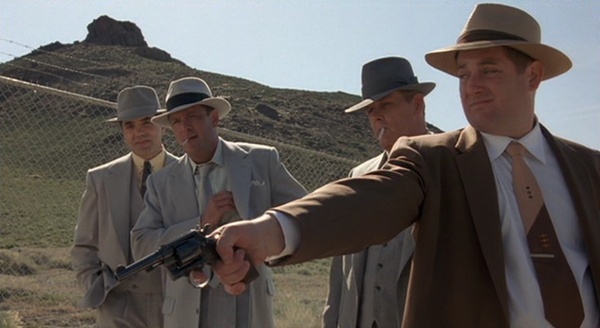
Set in 1953, the first image is one of a mushroom cloud from an atomic bomb explosion. It is one of the enduring images from that era and one that hangs like a shadow over the characters and events in the film. Max Hoover (Nick Nolte) leads a group of four cops known as The Hat Squad who do things their own way, like bullying out-of-town gangsters and dropping them off one of the deserted stretches of Mulholland Drive (aka “Mulholland Falls”) as a deterrent for setting up shop in L.A. One day, Max and his crew – Coolidge (Chazz Palminteri), Eddie (Michael Madsen) and Relyea (Chris Penn) – go out to a construction site to investigate the murder of a beautiful woman (Jennifer Connelly) who has been literally pressed into the ground. There is a shock of recognition on Max’s world-weary face. His connection to the dead girl and his subsequent investigation into her murder leads to a dangerous conspiracy involving the United States government and a mysterious General Timms (John Malkovich), head of the Atomic Energy Commission.

After the success of Once Were Warriors, Tamahori was offered many projects before finally choosing Mulholland Falls. Michael Mann was originally attached to the film but left at some point. One of the first things that is so striking about this film is the gorgeous attention to detail with vintage cars, suits and music from the period. This is enhanced by the gorgeous cinematography of the legendary Haskell Wexler who evokes classic film noir in every frame of Mulholland Falls. Tamahori assembled an impressive crew including the likes of production designer Richard Sylbert, who worked on Chinatown (1974) and The Manchurian Candidate (1962), and Wexler, who won an Academy Award for Who’s Afraid of Virginia Woolf? (1966) and worked One Flew Over the Cuckoo’s Nest (1975) and In the Heat of the Night (1967) amongst others.

Tamahori says that people within the industry were surprised that he hired veterans like Sylbert and Wexler and realized that Hollywood was being run by young executives: “It’s a kind of youth-oriented thing, and—blast, blam, blam, blam, make the action for the under-25-year-old crowd. Do this, do that, you’ve got to be on top, you have to be fast. They see age as being old and boring.” Mulholland Falls consciously eschews this approach for a slower paced, more thoughtful vibe that harkens back to films made before music videos and their kinetic editing changed the way films were made in Hollywood.

With his gravelly voice and weathered good looks, Nick Nolte is well cast as the conflicted tough guy, Max Hoover. If there is one significant problem with the film it is the lack of screen time given to the excellent members his crew. They are given little time to develop their characters with only Chazz Palminteri edging out the others. Palminteri plays Nolte’s best friend and second-in-command. He’s the most sensitive of the bunch (although, that’s not saying much) because he’s seeing a female psychiatrist and this makes him the voice of reason, often curbing Max’s more self-destructive impulses. Tamahori met Burt Reynolds and Tom Arnold for the role of Coolidge but felt that Reynolds was a little old for the role.

Little time is devoted to developing the chemistry between them. The filmmakers should have used The Untouchables (1987) as inspiration – although, the crucial difference is that in Brian De Palma’s film we see how Eliot Ness and his crew come together while in Mulholland Falls, Max and his group have been together for some time. Pete Dexter’s screenplay doesn’t do a good enough job making us believe that they are a tight-knit crew. That being said, the chemistry between Nolte and Palminteri begins to kick in towards the end of the film but it is too little, too late.

The casting of actresses Jennifer Connelly and Melanie Griffith is right on the money as they both have the voluptuous body type common to that era, especially Connelly who has curves in all the right places and that were also used to great effect in The Rocketeer (1991). Sadly, Connelly and Griffith aren’t given too much screen time but this does give Connelly’s character something of an ethereal, mysterious quality that is quite haunting and works well in the film.

John Malkovich essays yet another one of his cultured bad guy roles as General Timms. The first meeting between him and Nolte is good as we watch two different acting styles bounce off each other. Timms tries to dazzle Hoover with philosophical double speak while the cop plays dumb but subtly applies pressure on the scientist. What is so interesting about this scene is what is not being said. Watching this film again, I was struck by the eclectic cast featuring the likes of Treat Williams, Andrew McCarthy, Bruce Dern, Daniel Baldwin, William Petersen, and Rob Lowe.

There is somber tone that hangs over Mulholland Falls and the ending is refreshingly downbeat (unlike the very classic Hollywood ending of L.A. Confidential) evoking Chinatown of which it was most often compared to. Like any good noir protagonist, Max’s shattered life stays shattered. The murder has been solved but at a terrible cost to his own life. While Falls is a flawed film and certainly not as strong as Confidential, it is not an awful effort by any means and actually has a lot of merits. It is definitely worth another look if you haven’t seen it since it debuted or if you’ve never seen it before.

THE KILLERS – A REVIEW BY J.D. LAFRANCE

the-killers-pic-2

“The current cycle of crime films is a vicarious way to participate in the crime wave without committing a crime. That feeling is latent within each of us. Everybody wants to get even with somebody.” – Lee Marvin in a January 1969 interview with Playboy magazine

The first feature-length adaptation of Ernest Hemingway’s short story, “The Killers” was directed by Robert Siodmak in 1946 and featured a young Burt Lancaster and Ava Gardner as the two leads. It was a simple tale of a man who had hit rock bottom so badly that he allowed two hitmen to kill him. The doomed man was the focus of Siodmark’s film while, on the surface, it may seem that Don Siegel’s 1964 film version is all about doomed race car driver Johnny North. After all, he is given the bulk of The Killers’ screen time through flashbacks by the people that knew and loved him. However, Siegel drops in subtle visual clues throughout the film to suggest that the film is actually about the two professional killers with an emphasis on the elder more experienced one, Charlie, played by Lee Marvin. It is interesting to note that the first and last image of the film is of Charlie – the first tip off that this is his story and not North’s.

A great, menacing soundtrack by John Williams plays over the opening credits and immediately establishes the tough tone of Siegel’s film. Charlie and Lee (Clu Gulager) are ultra-cool, well-dressed hitmen that have been hired to kill ex-race car driver Johnny North (John Cassavetes) — now working as a teacher at a school for the blind. Even though he’s warned in advance, North does nothing and just lets the two men kill him. Afterwards, Charlie is bothered by the job. Something just does not feel right. And so, he and Lee decide to track down the people that knew North and find out why their victim didn’t run when he had the chance.

Along with Point Blank (1967), The Killers is one of the finest performances of Marvin’s career. He exudes a calm, malevolent nature through the simplest gesture or look and has a deep, weathered voice that conveys a lifetime of experience. For example, in the opening scene when Charlie and Lee question the receptionist at the school for the blind about North, the younger hitman fidgets with the furniture, taking some flowers out of a vase, sniffing them while pouring the water out onto the desk. The veteran killer concentrates on the frightened woman. Marvin uses that great voice of his to get the information he wants, uttering the immortal line, “I’m sorry lady, we don’t have the time.” This won’t be the last time he says that line. This scene is simultaneously funny and filled with tension in the way that the two men carry themselves. And yet we never lose sight of the fact that Charlie and Lee are there for only one reason: to kill North. Nothing is going to get in their way.

After they kill North, we see a more relaxed, casual side of Charlie. He and Lee are traveling on a train. The younger hitman still has his tie, vest and sunglasses on while the elder killer looks much more relaxed with the top button of his dress shirt undone, his shirt sleeves rolled up and his tie and sunglasses removed. However, something is bothering Charlie. Why didn’t North try to make a run for it? Charlie and Lee got paid a lot of money for a simple hit. They also find out that North was part of a million dollar heist – where’s the money? They don’t know who hired them but Charlie wants to find out. He wants that million dollars as he tells his partner, “But me, I’m getting old. My hair’s turning gray, my feet are sore and I’m tired of running.” It this slight admission that he’s getting older that humanizes Charlie for a brief moment and provides motivation for their quest. Half of a million dollars would certainly allow Charlie to retire in style.

Charlie and Lee decide to track down the other accomplices in the heist. In order to do so, they find North’s mechanic (played with blubbery bluster by Claude Akins). As Charlie puts the pressure on him, he says once again, “We don’t have the time.” There is now a bit of urgency in Charlie’s methods. As he said earlier, he’s tired of running and it is this urgency that motivates him to track down the money.

However, Charlie and Lee hit a dead end with the mechanic and go out for dinner. An interesting thing happens during this scene. At first, a mildly depressed Charlie is unable to eat his “fine steak,” but after he gets an encouraging call and a tip on the whereabouts of another one of North’s accomplices, his mood changes instantly and he happily begins cutting into his food. Charlie has become reinvigorated and tells Lee that it just isn’t the money that he’s after: “But I gotta find out what makes a man decide not to run. Why all of the sudden he’d rather die?” (Incidentally, this question is what also convinced Marvin to do the film) However, it is this curiosity that will ultimately be Charlie’s undoing.

Marvin delivers an economic performance which helps convey the all-business attitude of his character. He belonged to a dying breed of actor that you just don’t see anymore. Most actors today, if they’re lucky, take a whole film to convey the kind of toughness that Marvin has naturally. “Tough guys” of today – Russell Crowe, Jason Statham, Clive Owen, et al – don’t even come close to someone like Marvin. You can just tell from the way he looks and acts that he would kill you if you ever got in his way. And this kind of hard living attitude carried over into the actor’s real life as he alluded to in a 1969 interview with Playboy magazine and in Don Siegel’s memoir, A Siegel Film. The director recalls how Marvin showed up drunk the first two days of principal photography. The actor became such a disruptive influence on the set that Siegel had to intervene. Instead of dressing him down in front of everybody, he talked to Marvin in private. According to Siegel, Marvin never showed up to work drunk again.

When Charlie and Lee finally confront the film’s heavy, Jack Browning, played by Ronald Reagan in an inspired bit of casting. It was the first and only time that he played a bad guy in a movie. Browning would also be his last film role before he went into politics. It’s great to see a casually intense actor like Marvin square off against a limited one like Reagan. Charlie paces back and forth across the room with a gun in his hand while Browning sits there stiff as a board playing dumb while he’s accused of ordering the hit on North. Marvin does an excellent job working the room and questioning Reagan’s character. He clearly owns this scene.

Charlie shows just how brutal he can be when he questioning North’s girlfriend, Sheila (Angie Dickinson), and doesn’t like her answers. So, he and Lee hang her out of a window high above the street, scaring the answers out of her. Sheila pleads for her life at the end of the film putting all of the blame on Jack who says nothing, grimly accepting his fate at the hands of the uncompromising Charlie. Even after Charlie shoots and kills Jack, Sheila continues to pathetically plead for her life and Charlie utters that immortal line, “Lady, I don’t have the time,” before shooting and killing her. He kills her last because it is revenge for North’s death. Through flashbacks we learn that she not only double-crossed the doomed race car driver but she broke his heart too.

However, the damage to Charlie has been done. He has been mortally wounded by a sniper rifle at the hands of Jack earlier on. Charlie staggers out onto the front lawn of Jack’s house just as the police arrive. In a haze, he points his right hand like a gun and collapses dead, the precious money he spent the entire film pursuing fluttering all around him. Siegel then cuts to a long shot of Charlie’s dead body with the money lying in the heart of suburbia with its manicured green lawns and tract houses.

Siegel’s film takes place mostly during the day with a bright color scheme. This is due largely because the picture was originally intended to be a made-for-television movie (the first of its kind) but the harsh depiction of violence was too much for NBC and it was eventually released theatrically. The artificial T.V. look, with its extensive use of rear projection, gives The Killers an almost surreal kind of feel that works surprisingly well. Even though it is bright and colorful, the attitude of the film is pure, gritty film noir. Life is cheap and the film concludes on an uncompromisingly nihilistic note as Siegel ends things with a hell of a final image that underlines the very thing that resulted in everyone’s demise: money.

HIGH FIDELITY – A REVIEW BY J.D. LAFRANCE

highfidelity

Have you ever spent hours organizing your record collection in chronological order and by genre? Have you ever had heated debates with your friends about the merits of a band who lost one of its founding members? Or argued about your top five favorite B-sides? If so, chances are you will love High Fidelity (2000), a film for and about characters obsessed with their favorite bands and music. What Free Enterprise (1999) did for film geeks; High Fidelity does for music geeks. Based on the British novel of the same name by Nick Hornby, it is a film made by and for the kind of people who collect vintage vinyl and read musician and band biographies in their spare time yet is still accessible to people who like smart, witty romantic comedies.

Rob Gordon (John Cusack) is an obsessed music junkie who owns a record store called Championship Vinyl. He has just broken up with Laura (Iben Hjejle), a long-time girlfriend and the latest in a countless string of failed relationships. Rob addresses the audience directly throughout the film (just like Woody Allen did in his 1977 film, Annie Hall) about this latest break-up and how his top five break-ups of all-time inform his most recent one. It’s a great way for Rob to try and come to terms with his shortcomings and the reasons why his past relationships did not work out. He is talking directly to us and in doing so we relate to him and his dilemma a lot easier. And so, he goes on a quest to find out why, as he puts it, “is doomed to be left, doomed to be rejected,” by revisiting his worst break-ups. The purpose of this trip down memory lane is an attempt to understand his most recent falling out with Laura.

Along the way we meet a colorful assortment of characters, from his past girlfriends (that includes the diverse likes of Lili Taylor and Catherine Zeta-Jones) to his co-workers at Championship Vinyl (Jack Black and Todd Louiso). They really flesh out the film to such a degree that I felt like I was seeing aspects of my friends and myself in these characters. Being a self-confessed obsessive type when it comes to film and music, I could easily relate to these people and their problems. And that’s why High Fidelity works so well for me. The extremely funny and wryly observant script by D.V. DeVincentis, Steve Pink, and John Cusack (the same team behind the excellent Grosse Pointe Blank) not only zeroes in on what it is to love something so passionately but why other things (like relationships) often take a backseat as a result. A girlfriend might not always be there for you, but your favorite album or film will. A song will never judge you or walk out on you and there is a kind of comfort in that.

The screenplay also makes some fantastic observations on how men view love and relationships. Throughout the film Cusack’s character delivers several monologues to us about his thoughts on past love affairs, one of my favorite being the top five things he liked about Laura. It’s a touching, hopelessly romantic speech that reminded me a lot of Woody Allen’s list of things to live for in Manhattan (1979). Usually, this technique almost never works (see Kuffs) because it often comes across as being too cute and self-aware for its own good but in High Fidelity it works because Cusack uses it as a kind of confessional as Rob sorts out his feelings for Laura and sorts through past relationships and how they led him to her.

The screenplay works so well because not only is it well written but it is brought to life by a solid ensemble cast. The role of Rob Gordon is clearly tailor-made for John Cusack. Rob contains all the trademarks of the kinds of characters the actor is known for: the cynical, self-deprecating humor, the love of 1980s music, and the inability to commit to the woman of his dreams. Even though High Fidelity is not directed by Cusack, like Grosse Pointe Blank, it is clearly his film, right down to the casting of friends in front of and behind the camera (i.e. actors Tim Robbins, Lili Taylor, his sister Joan, and screenwriters, D.V. DeVincentis and Steve Pink). Along with Say Anything (1989), this is Cusack’s finest performance. I like that he isn’t afraid to play Rob as a hurtful jerk afraid of commitment despite being surrounded by strong women, like his mother who chastises him for breaking up Laura, and his sister Liz (Joan Cusack) who is supportive at first until she finds out why he and Laura really broke up. Rob had an affair with someone else while Laura was pregnant and as a result she got an abortion. This horrible act runs the risk of alienating Rob from the audience but Cusack’s natural charisma keeps us hanging in there to see if Rob can redeem himself.

All of the scenes that take place in the record store are some of the most entertaining and funniest moments in the film, from Rob listing off his top five side one, track ones, to Barry schooling an Echo and the Bunnymen fan on The Jesus and Mary Chain, to Rob fantasizing about beating the shit out of Laura’s new boyfriend Ian (Tim Robbins) when he shows up one day to clear the air. These scenes showcase the excellent comic timing of Cusack and his co-stars, Jack Black and Todd Louiso. The interplay between their characters instantly conveys that they’ve known each other for years by the way they banter and bicker.

Louiso’s Dick is a shy, introverted guy that you can imagine listening to Belle and Sebastian religiously, while Black’s Barry is a rude, annoying blowhard who says everything you wish you could actually say in public. It’s a flashy, scene-stealing role that Black does to perfection, whether it is discussing the merits of Evil Dead II’s soundtrack with Rob or doing a spot-on cover of Marvin Gaye’s “Let’s Get It On” for the launch of Rob’s record label. And yet, Barry isn’t overused and only appears at the right moments and for maximum comic effect. His sparing usage in High Fidelity made me want to see more of him, which is why he works so well. However, Louiso, with his quiet, bashful take on Dick, is the film’s secret weapon. The scene where he tells a customer (Sara Gilbert) about Green Day’s two primary influences which is a nice example of the understatement he brings to the role.

The casting of Danish actress Iben Hjejle is an atypical choice but one that works because she brings an emotional strength and an intelligence to a character that is largely absent from a lot of female romantic leads. She’s not traditionally beautiful, like Catherine Zeta-Jones, who plays one of Rob’s ex-girlfriends, Charlie Nicholson. Sure, Charlie is drop-dead gorgeous but her personality is so off-putting that any kind of deep, meaningful relationship would be impossible. Laura is so much more than that. While Rob refuses to change and to think about the future, Laura is more adaptable, changing jobs to one that she actually enjoys doing even if it means she can’t have her hair dyed some exotic color. Laura is easily Rob’s intellectual equal, if not smarter, and the voice of reason as well as having no problem calling him on his shit.

Nick Hornby’s book was optioned by Disney’s Touchstone division in 1995 where it went into development for the next three years. Disney boss Joe Roth had a conversation with recording executive Kathy Nelson who recommended John Cusack (whom she had worked with on Grosse Pointe Blank) and his screenwriting and producing partners D.V. DeVincentis and Steve Pink adapt the book. They wrote a treatment that was immediately green-lit by Roth. In adapting the book into a screenplay, Cusack found that the greatest challenge was pulling off Rob’s frequent breaking of the fourth wall and talking directly to the audience. They did this to convey Rob’s inner confessional thoughts and were influenced by a similar technique in Alfie (1966). However, Cusack initially rejected this approach because he thought, “there’d just be too much of me.” Once director Stephen Frears came on board, he suggested utilizing this approach and Cusack and his writing partners decided to go for it.

The writers decided to change the book’s setting from London to Chicago because they were more familiar with the city and it also had a “great alternative music scene,” said Pink. Not to mention, both he and Cusack were from the city. I like how they shot so much of the film on location, making the city like another character and even including visual references to local record labels like Touch & Go and Wax Trax! Another challenge they faced was figuring out which songs would go where in High Fidelity because Rob, Dick and Barry “are such musical snobs.” Cusack, DeVincentis and Pink listened to 2,000 songs and picked a staggering 70 cues for the film. DeVincentis was the record-collection obsessive among the writers with 1,000 vinyl records in his collection and thousands of CDs and cassettes. They also thought of the idea to have Rob have a conversation with Bruce Springsteen in his head, never thinking they’d actually get him to be in the film but that putting him in the script would get the studio excited about it. They were inspired by a reference in Hornby’s book where the narrator wishes he could handle his past girlfriends as well as Springsteen does in the song, “Bobby Jean” on Born in the USA. Cusack knew the Boss socially, called the musician and pitched the idea. Springsteen asked for a copy of the script and after reading it, agreed to do the film.

High Fidelity is now a historical document thanks to the rise of iTunes and the subsequent demise of brick and mortar record stores. The film is a tribute to these places where one could spend hours sifting through bins of vinyl records and used CDs, looking for that forgotten gem or a rare deal on something you were looking for. I’m not talking about places like Tower Records or Virgin Megastore but those cool, local stores that catered to obsessive collectors. This film is a love letter and a eulogy to these stores. It’s scary to think that it’s only been more than ten years since High Fidelity came out and indie record stores are almost an extinct breed, except for the ones hanging on in big cities. Even though the world and the characters in High Fidelity are unashamedly of a rarified type: the obsessive music geek or elitist, which some people may have trouble relating to, the film’s conclusion suggests that there is much more to life than one’s all-consuming passion for these things. It also helps to be passionate about someone. And that message is delivered in a refreshingly honest and cliché-free fashion as it provides what is ultimately the humanist core of High Fidelity.

FLETCH – A REVIEW BY J.D. LAFRANCE

chevyfletchlives-xlarge

Has it really been more than 30 years since Fletch (1985) was first released in theaters? For my money, it is still the best film Chevy Chase ever made (with Caddyshack a very close second). I can put the film on at almost any time and still find it just as funny, no matter how many times I have seen it. And yet, it is too often dismissed as just another dated piece of 1980s pop culture. To be sure, the soundtrack is horribly dated (Stephanie Mills’ “Bit by Bit” anyone?) but this part of the film’s charm. It is also often cited as the rare highlight of Chase’s career that subsequently went downhill over the years. But Fletch has endured, thanks in large part to repeated broadcasts on television channels like TBS and rock-steady video rentals (with revenues of $24 million in the United States alone). So why does Fletch continue to inspire such a strong and loyal following after all these years? It is simple: insanely quotable dialogue, a colorful assortment of character actors and, of course, Chase’s inimitable, vintage smart-ass persona.

When he’s not avoiding his ex-wife’s attorney – Arnold T. Pants, Esq. (George Wyner) – Irwin “Fletch” Fletcher (Chase) is an investigative reporter who writes under the anonymous pen name Jane Doe for a Los Angeles newspaper. He is currently looking into the local drug trade on the beach and its links to police corruption when he is approached by Alan Stanwyk (Tim Matheson), a rich businessman who tells him that he is dying from bone cancer. He wants to pay Fletch $50,000 to kill him. After doing some digging, he finds out that Stanwyk is lying and may also have some kind of involvement in the city’s drug trade. His investigation ends up connecting these two seemingly unrelated plots for an exciting finale.

Fletch originated from a novel of the same name by Gregory Mcdonald. According to the author, the idea for the character came from hearing “from other people in the newsroom about other reporters doing these things for stories, and that gave me an idea. He was running around in my head for quite some time before I actually wrote the book.” The novel was very successful and soon Hollywood came calling. His Fletch books were optioned around the mid to late 1970s but the author had the option of approving the actor cast to play Fletch. Mcdonald remembers that “everybody from 12 to 72 in Hollywood wanted to play Fletch. But I kept throwing a monkey wrench into their plans.” He rejected the likes of Burt Reynolds and Mick Jagger when the studio mentioned Chevy Chase as Fletch. Despite never really seeing the comedian in anything, Mcdonald agreed to this choice. Years before, the comedian’s manager had recommended Mcdonald’s books to him but showed no interest in them or playing Fletch. However, when an old friend and producer Alan Greisman and screenwriter Andrew Bergman got involved, Chase agreed to do the film. Mcdonald sent him a telegram saying, “I am delighted to abdicate the role of Fletch to you.”

Chevy Chase started out as a satirical writer for the Smothers Brothers, National Lampoon magazine, and Mad magazine. He started acting in a comedy workshop called Channel One in Greenwich Village in New York City. Chase learned the art of comedy through improvisation during his stint at the workshop. “A laugh is a surprise,” he once said in an interview, “and all humor is physical. I was always athletic, so that came naturally to me.” Chase shows a stellar range of physical comedy in Fletch. His technique ranges from broader displays, such as the dream sequence when he imagines himself as the unusually aggressive L.A. Lakers star power forward (“6’5″, 6’9″ with the Afro”), to more subtle bits such as when he bangs his nose into a door, posing as the accident-prone Mr. Poon.

Andrew Bergman was hired to adapt Mcdonald’s book into screenplay form. He was only 26-years-old when Mel Brooks transformed his first script, “Tex X,” about a black militant cowboy, into Blazing Saddles (1974). The money Bergman made from that script allowed him to stay in New York City where he wrote The In-Laws (1979), a brilliant black comedy starring Alan Arkin and Peter Falk. Bergman went on to write several more screenplays for mediocre films in the ’80s before working on Fletch. Bergman remembers that he wrote the screenplay “very fast – I did the first draft in four weeks …Then there was a certain amount of improv, and something that we used to call dial-a-joke. Michael [Ritchie, the director] found this aircraft hanger, and called me and said we need a scene set in an aircraft hanger. So I wrote it that afternoon.” This, of course, became the scene where Fletch poses as an airplane mechanic by the name of G. Gordon Liddy and famously chastises the real mechanics that confront him about not using ballbearings. “It’s all ballbearings nowadays,” he says with hilarious mock-indignation. However, Mcdonald read the script was upset by how much it differed from his novel. He wrote the studio and listed his numerous issues with the script. Ritchie invited the author to the set of the film and then took him out to dinner where, according to Mcdonald, “Point by point, he showed me where I was wrong. I was beautifully chewed out.”

Director Michael Ritchie had much the same career arc as Bergman. He enjoyed success early on in theater and television, directing episodes of The Man From U.N.C.L.E. and Dr. Kildare in the 1960s, before breaking into feature films with Downhill Racer (1969) and The Candidate (1972) – both starring Robert Redford. After a successful run of films in the 1970s that included The Bad News Bears (1976), Ritchie directed mostly forgettable fare, like The Island (1983), until Fletch came along. According to actor Tim Matheson, Fletch was the first film Chase did after cleaning up a problem he had with drugs. Regardless, the studio hedged their bets and hired Ritchie to keep tabs on Chase. However, during principal photography, the director would do one take that adhered to the script and then another take where Chase was allowed to improvise. The comedian enjoyed the role and working with Ritchie as it allowed him to play a diverse collection of characters. He once said in an interview, “I love props, like wigs and buck-teeth and glasses. At one point I wear an Afro and play basketball with Kareem Abdul-Jabbar. There were some scenes where I didn’t recognize myself.”

Fletch is essentially a vehicle tailor-made for Chase. It plays to the comedian’s strengths; in addition to his affinity for physical comedy, the film is famous for showcasing his trademark deadpan smart-ass delivery of dialogue and his knack for playing a wide variety of characters – abilities he perfected on Saturday Night Live. Chase expertly juggles Fletch’s numerous aliases. From the likes of the absent-minded, Dr. Rosenrosen to Mr. Underhill’s racquet club “friend” John Cocktosten, Chase makes each one distinctive and hilariously memorable.

Fletch spends the film skewering all sorts of authority figures, from wealthy businessman Stanwyk to the scary chief of police Karlin (Joe Don Baker). He always has a snappy comeback for any given situation. For example, there is a scene early on where Fletch has a funny exchange with Frank (Richard Libertini), his long-suffering editor at the newspaper, about the identity of the reporter’s source to the drug trade going on at the beach. Frank asks Fletch for more information to which he replies, “Well, there we’re in kind of a gray area.” Frank asks, “Alright, how gray?” Without missing a beat, Fletch replies, “Charcoal?” Infuriated, Frank’s hand trembles with anger as he holds a pot of coffee to which Fletch responds by holding an empty styrofoam cup and shakes it also. I think that why the film appeals to so many is that in some way we wish that we all could walk through life like Fletch delivering smart-ass one-liners and getting away with everything. Chevy does it in such a casual, nonchalant way that seems so effortless. It was just a perfect marriage of Bergman’s script and Chevy’s knack for improvising and physical comedy.

Capitalizing on the immensely popular action comedy, Beverly Hills Cop (1984), Fletch adheres to the same formula: the maverick protagonist who has a problem with authority, the use of multiple disguises to get in and out of dicey situations for comedic effect, the obligatory car chase, and even the hopelessly dated synth-soundtrack by Harold Faltermeyer who seemed to be everywhere in the ‘80s, scoring major hits like the aforementioned Beverly Hills Cop and Top Gun (1986). His distinctive minimalist synth beats are the glue that holds the collection of forgettable ‘80s songs together. Fletch deviates in one significant aspect: Chase’s character never uses a gun (he also repeatedly gets the crap kicked out of him).

Another aspect of Fletch that makes it so unforgettable is the strong supporting cast. The film features character actors like Joe Don Baker as the slimy Chief of Police Karlin (who brings a wonderfully scary intensity to his role), George Wendt as the amicable drug dealer Fat Sam, Tim Matheson as the double-dealing bigamist Alan Stanwyk, M. Emmet Walsh as the probing Dr. Dolan, and a young, pre-Thelma and Louise (1991) Geena Davis as Larry, Fletch’s ever loyal co-worker. I’ve always harbored a cinematic crush on Dana Wheeler-Nicholson (playing Stanwyk’s wife, Gail) thanks to this film. Her first encounter with Fletch at the racquet club, decked out in a cute, white tennis outfit, is a memorable one. She essentially plays straight man to Chase (who doesn’t in this film?) and they have pretty decent chemistry together. One of the joys of the film is how Chase interacts with all these people and how they react to his flippant, off-handed remarks. Watch him in action in the hospital sequence as he confuses and befuddles the staff in order to get the information he wants (even offhandedly ordering a cup of fat and making a sly reference to Bring Me the Head of Alfredo Garcia) – it is not only what he says to them but, more importantly, how he delivers the dialogue that makes it so funny.

There are the little asides that are a constant source of amusement, like when researching Stanwyk’s past, Fletch comes across information about the man’s parents and their hometown. Chase deadpans, “that’s three names I enjoy. Marvin, Velma and Provo.” There’s also the recurring gag of Fletch running up an expensive tab on the Underhills, an obnoxious member of the racquet club that Gail frequents, and who Fletch overhears berating the waitstaff upon his initial visit. From that point on, whenever he gets a chance, Fletch orders all kinds of exotic foods and drink, sticking it to this arrogant jerk.

Since Fletch, Michael Ritchie continued as a director-for-hire on a number of movies that didn’t make much of an impact, except for Fletch Lives (1989) and the highly enjoyable James Woods con-man comedy, Diggstown (1993). Sadly, Ritchie died on April 16, 2001 from complications of prostate cancer. Andrew Bergman, on the other hand, enjoyed critical and commercial success with The Freshman (1990), which he wrote and directed, and also made two successful, box-office-friendly romantic comedies starring Nicolas Cage – Honeymoon in Vegas (1992) and It Could Happen To You (1994). Sadly, Chase’s post-Fletch career has not been as triumphant. He starred in Fletch Lives, which has its moments but let’s be honest, it is a pale imitation of the original. He has done a series of forgettable family-oriented films (Cops and Robbersons anyone?) that feature Chase on auto-pilot. Even the man himself admits, “I made about 28 movies and I think about five of them were good.”

More so than in any other film, Fletch is classic Chevy Chase. While he is in exceptional form in Caddyshack and National Lampoon’s Vacation, they do not showcase his unique talents as well as in Fletch. In every scene, Chase does a fantastic job carrying the picture with the right mix of comedy and drama. Fletch has aged surprisingly well over the years. The jokes are still funny and many of Chase’s one-liners are insanely quotable. So much so that it has become a cult film. In an interview for the New York Post, Bergman tried to explain its appeal. “It’s so bizarre, but Fletch strikes a chord. There’s a group of movies like that in the ‘80s, like Caddyshack, too, that captured a certain wise-ass thing.” Chase also looks back on the film with fondness. “It was at the height of my career in film, and it was as close to me as a person as any part I’d played.” Perhaps the most meaningful praise comes from Gregory Mcdonald himself: “I watched it recently, and I think Chevy and Michael Ritchie did a good job with it.” As Fletch would put it, “and a damn fine answer if I do say so my damn self.”

STAR WARS: EPISODE IV: A NEW HOPE – A REVIEW BY J.D. LAFRANCE

open-uri20150608-27674-lashgn_719bef9d

For many of my generation, the first Star Wars film (1977) was a defining moment of our childhood and so I always look back at it in a nostalgic way. I had the action figures, the coloring book, the calendar, the t-shirt, and so on – all part of the vast merchandising that helped build the George Lucas empire. But as a kid I wasn’t thinking about that – I loved the film and wanted to have everything associated with it, including the comic books and the novelization. The Star Wars I love is the original incarnation unmolested by Lucas’ awkward revisionist CGI makeover. The Star Wars I know and love has Han Solo (Harrison Ford) firing first. The film has been analyzed and written about extensively so I can only look at it from my perspective and offer various observations that always stick out in my mind whenever I watch it.

One of the reasons Star Wars works so well is because of a solid combination of engaging storytelling and groundbreaking (for its time) special effects. The coming-of-age story is as old as the hills and I’m sure that is part of the film’s appeal – its comforting familiarity. Young Luke Skywalker (Mark Hamill) leaves behind his life on a small, insignificant planet and becomes involved in an intergalactic civil war that involves rescuing a princess from the clutches of an evil empire. In the process, he grows up and becomes a man.

I still get goosebumps when I see that opening text, “A long time ago. In a galaxy far, far away…” And then, John Williams’ rousing score kicks in with a sudden blast from the horn section and we’re on our way. We get that iconic shot of the small Rebel Alliance spacecraft being pursued by an Empire Star Destroyer so massive it takes up at least three-quarters of the screen as it rumbles into view. We soon meet two of the film’s most endearing characters – C-3PO (Anthony Daniels) and R2-D2 (Kenny Baker), droids that have a sometimes slapstick-y love/hate relationship a la Laurel and Hardy. 3PO is the eternal pessimist as evident from his declaration early on, “We’re doomed.” Of course, this is as the Empire prepares to board the Rebel spacecraft. 3PO and R2 play well off each other – the former whines about danger and complains about the conditions of Tatooine (the planet they escape to), while the latter clearly has a purpose, a mission that he must complete with or without his long-time companion. They bicker like an old married couple and even on his own, 3PO still bitches about R2.

Has there ever been a cooler introduction for a villain than the one for Darth Vader (David Prowse)? Having boarded the Rebel ship by force, he emerges from the smoke to survey the damage done. We immediately hear his ominous breathing, that unsettling raspy respirator sound – awesome! We soon hear James Earl Jones’ booming, authoritative voice (later on the voice of CNN no less!) which, coupled with David Prowse’s intimidating physical presence and the brilliantly black armor, creates an instantly memorable bad guy, a real force of evil. Lucas constantly reminds us what a badass Vader is in scenes like the one where he deals with one of his officers who dares to scoff at the power of the Force compared to the power of Empire’s new battle station, The Death Star. Vader warns him, “Don’t be too proud of this technological terror you’ve constructed. The ability to destroy a planet is insignificant next to the power of the Force.”

Unconvinced, the guy foolishly insults Vader’s “sad devotion to that ancient religion,” and, in response, the Dark Lord merely raises a hand and chokes the man from afar. Vader coolly and ominously replies, “I find your lack of faith disturbing.” Now, how badass is that? It takes Peter Cushing’s bureaucrat Grand Moff Tarkin to step in and call Vader off. As evil as Vader is, Tarkin is on a whole other level. He destroys a planet populated by millions of innocent people just to make a point and teach Princess Leia (Carrie Fisher) a lesson. How nasty is that? Vader just chokes a few guys which pales in comparison to what Tarkin does.

I always found it fascinating how the Jawas are basically the used car salesmen of the galaxy and they even try to pawn off a faulty droid to Luke and his Uncle Owen (Phil Brown). Mark Hamill’s take on Luke is right on the money, playing the character as a teenager on the verge of becoming a young man – someone who would rather pick up power converters over at Toschi Station than haggle over the price of droids with Jawas. His uncle sees right through Luke and chastises him, “You can waste time with your friends when your chores are done.” This little moment is one of the reasons why Star Wars appealed to a younger generation – they could relate to Luke’s disinterest in chores and his frustration of being stuck on his uncle’s farm. Who would rather hang out with their friends than get stuck doing boring chores?

This is further reinforced in the scene where Luke talks to Aunt Beru (Shelagh Fraser) and Uncle Owen about transmitting his application to the Academy sooner rather than later but his uncle wants him to stick around for the harvest and another year. After Luke goes off in defeat, his aunt says, “Luke’s just not a farmer, Owen. He has too much of his father in him,” to which Owen replies, “That’s what I’m afraid of.” This conversation cleverly hints at earth-shattering revelations that come in the next film in the series, The Empire Strikes Back (1980). I just want to say how much I love the little moments of domesticity that Lucas shows here with Luke having a meal with his aunt and uncle or another scene where we see Aunt Beru (who I was always struck by what a kind face she has and what a gentle person she appears to be) preparing some sort of meal. It humanizes these people in a short amount of time so that we care about what happens to them later on.

What I also like about the story is that Lucas makes it personal for Luke. His only reason for staying was to help out his aunt and uncle but when they are killed by Imperial Stormtroopers, his life as a farmboy dies that day. He’s got nothing left to lose and his innocence has been taken away from him forever. Lucas makes sure that we understand just how horrible the Empire is with a lingering shot of the aunt and uncle’s still smoking, charred skeletons, which was pretty shocking to me when I first saw the film at a very young, impressionable age. This scene ups the stakes and reinforces just how ruthless the Empire is and how personal it has gotten for Luke.

The casting of Alec Guinness as Jedi master Obi-Wan Kenobi was genius on Lucas’ part. With his classic British accent, he gives his dialogue a classy spin, perfect for the expositional dialogue his character imparts throughout the film. For example, early on he explains the nature of the Force to Luke: “The Force is what gives a Jedi his powers. It’s an energy field created by all living things. It surrounds us, it penetrates us, it binds the galaxy together.” What a great way to describe the Force – it’s succinct and doesn’t give too much away, just enough to let our imagination fill in the rest.

One of the most memorable scenes in Star Wars takes place in the Cantina at Mos Eisley (a place that Obi-Wan warns Luke is a “wretched hive of scum and villainy.”), a bar where all sorts of strange and unusual creatures hang out. Of course, the purpose of this sequence is for Luke and Ben to meet and hire Han Solo and Chewbacca (Peter Mayhew) to rescue Leia, but it is also a fantastic showcase for a memorable collection of exotic-looking alien creatures. There’s one that looks a little like Cousin It from The Addams Family, one that looks like the Wolfman, one that kinda looks like a devil with two horns sprouting out of the top of his head, and so on. The diversity of these creatures is so fascinating that I just like rewatching this sequence to check out all of the various creatures. This sequence has gone on to inspire several other films, including Nightbreed (1990), Serenity (2005), and Hellboy II: The Golden Army (2008). The aliens in Star Wars don’t look cute and cuddly but strange and dangerous. Lucas reinforces this by having Luke bullied by two lowlifes until Obi-Wan steps in with his mad lightsaber skills.

How cool is Han Solo? We meet him haggling with Obi-Wan over the price of taking them to Alderaan and Han tries to impress his prospective clients with the speed and reputation of his spacecraft the Millennium Falcon. However, after their meeting, Han runs into Greedo, a bounty hunter collecting a sizable debt that the smuggler owes notorious gangster Jabba the Hutt. Han acts cool and casual, keeping Greedo talking while he quietly unholsters his gun and blasts the bounty hunter before he can shoot him. How badass is Han? Harrison Ford plays it so well – all cool and accommodating to Greedo so that he has time to get the drop on him. It’s this scene that establishes Ford’s character – is he a bad guy or a good guy? You’re never really sure until the end of the film and this is due in large part to Ford’s performance as a cocky smuggler who only looks out for himself.

I also like Han’s simple philosophy, like when he scoffs at the notion of the Force: “Hokey religions and ancient weapons are no match for a good blaster at your side … I’ve flown from one side of the galaxy to the other. I’ve seen a lot of strange stuff but never seen anything to make me believe there’s one all powerful force controlling everything. There’s no mystical energy field controls my destiny. It’s all a lot of simple tricks and nonsense.” He provides a lot of the film’s moments of humor, like when Luke tries to convince him to rescue Leia by appealing to his greed, or his constant bickering with her. As he tells Luke at one point, “Wonderful girl. Either I’m gonna kill her or I’m beginning to like her.” Han and Leia end up bantering like a couple in a vintage screwball comedy and this is carried over to an even more memorable degree in The Empire Strikes Back.

Another exciting scene is the one where our heroes escape the Death Star while Han and Luke man the Falcon’s laser cannons. Lucas uses editing and Williams’ stirring score to make this scene even more dynamic. It’s a nice warm-up for the climactic sequence where a squadron of Rebel Alliance X-Wing fighters launch an attack on the Death Star. Not only do the Rebels have to worry about the Imperial TIE Fighters, but also the battle station’s laser cannons. Also adding urgency to the assault is the ever-looming threat of the Death Star on the verge of eradicating the Rebel base located on the moon of Yavin. Luke finally gets to show off his piloting skills while many of his comrades are blown up. It doesn’t hurt that he’s aided by Obi-Wan’s disembodied voice and the Force. The use of models in this sequence gives it a more tangible quality, a realness that is missing from most CGI-heavy science fiction films nowadays. This sequence gets even more exciting when Luke and the surviving Rebel X-Wings descend into the trenches of the Death Star to bomb its weak spot. Lucas is able to convey a real sense of speed and urgency that is thrilling, especially when the Millennium Falcon comes from out of nowhere to give Luke the opportunity to destroy the Death Star.

Some feel that Star Wars looks dated and I would agree but for me that is a large part of its appeal, sideburns and all. Watching it instantly takes me back to when I first saw it and the rush of excitement and wonder that I felt as it unspooled before my eyes. It is one of those pivotal moviegoing experiences that I have never forgotten. While I think that The Empire Strikes Back is the better film in terms of story, pacing, characterization, action, etc., Star Wars is the film I enjoy watching the most for all of the reasons stated above. I think that a review in the now-defunct Sci-Universe magazine sums it up best: “even today, would-be sci-fi franchise-builders haven’t learned the lessons about what made Star Wars a cinematic landmark; compelling, but flawed, characters and attention to the smallest pieces of minutiae.”

ALL THE PRESIDENT’S MEN – A REVIEW BY J.D. LAFRANCE

13-todos-los-hombres-del-presidente-33

The 1970s was a fertile time for challenging, politically charged movies. Thanks to Easy Rider (1969) a lot of riskier material was getting made by the major Hollywood studios and, in some cases, they were commenting on the current political climate and being socially conscious. One of the best examples from this decade is All the President’s Men (1976) – the Citizen Kane (1941) of investigative journalism films. It’s the benchmark by which all other films of its genre are compared to, from The China Syndrome (1979) to State of Play (2009). Its influence can be felt in the films of Steven Soderbergh (Traffic) and David Fincher (Zodiac).

All the President’s Men
was immediate and topical, dramatizing Washington Post reporters Carl Bernstein and Bob Woodward’s investigation of the Watergate Hotel burglary and the resulting scandal that would rock the White House and forever taint President Richard Nixon’s tenure there, effectively sending him home packing before his term was up. Alan J. Pakula’s film struck a chord with audiences of the day (and continues to do so) and is credited with inspiring future generations of journalists. Of course, it didn’t hurt that the film starred Dustin Hoffman and Robert Redford, two of the biggest movie stars in Hollywood at that time. Fortunately, they left their egos at the door to deliver thoughtful and intense performances. These are complemented by Pakula’s no frills direction and Gordon Willis’ moody, atmospheric cinematography.

The film begins, rather fittingly, with the actual break-in. We see the burglars at work in the gloom of the hotel, often from a distance which, somehow makes it actually creepier than it should. Pakula juxtaposes this with the next scene, which takes place in the brightly-lit offices of the Washington Post. Bob Woodward (Redford) gets the tip about the burglars and goes to see the charges brought up against them in front of a judge. It is here that he meets the first of many people that will try to stonewall him. Woodward starts talking to a man named Markham (Nicolas Coster) sitting in front of him. He tells Woodward that he’s not there as the attorney of record but reveals who that is and leaves. Woodward follows Markham outside into the hallway and continues to question him. Markham tries to confuse and evade Woodward through dialogue and while not actually saying much of anything he does pique the reporter’s curiosity.

Back at the Washington Post offices, Woodward meets with his editor Harry Rosenfeld (Jack Warden) and fellow reporter Carl Bernstein (Hoffman) who has been calling around getting information of his own. However, neither of them have much and Rosenfeld calls them on it: “I’m not interested in what you think is obvious. I’m interested in what you know.” One of the things that is so great about All the President’s Men is that they show the legwork these guys do in order to get the facts and the details to flesh out their articles. For example, there’s the scene where Woodward calls around trying to find out who Howard Hunt is and his relation to the White House. Pakula has Redford in the foreground but utilizes deep focus photography so that we can make out the hustle and bustle in the middle and background of the scene, which is a nice touch. It makes the scene more than just about dialogue and about what’s being said as Pakula keeps things visually interesting.

The way Woodward and Bernstein team-up is also well done. Woodward hands in a copy of his article to be proofread only for Bernstein to immediately take it and give it a polish. Woodward is upset at Bernstein for doing it without his permission, gives him his notes and says, “If you’re going to hype it, hype it with the facts. I don’t mind what you did. I mind the way you did it.” In an amusing bit, right after he says this, Rosenfeld walks by and tells them that they’re working together on the Watergate story. Early on, Woodward and Bernstein know that they are onto something and the more people evade them or deny any kind of knowledge of what went down at the Watergate, the more they realize that they’re onto something big. I also like that once they team-up, Pakula doesn’t try to make them too buddy-buddy. They work closely together but it is purely professional. They don’t hang out together or go to nightclubs. They are completely consumed by their investigation and getting to the truth.

Woodward and Bernstein show their story to the newspaper’s executive editor Ben Bradlee (Jason Robards) and the way he picks apart their article is devastating, especially if you’ve ever worked at a newspaper or a magazine. But, deep down, they know he’s right – they don’t have the story or the hard facts to back it up. Woodward and Bernstein approach every contact they know that might have even the most remote connection to their investigation. But they are persistent and keep plugging away at the story.

For a film that is ostensibly about two guys talking on the phone and interviewing people, All the President’s Men is always interesting to watch because of Pakula’s no-nonsense direction coupled with Gordon Willis’ textured cinematography. We get one engaging visual after another, like the scene where Woodward and Bernstein pour over index cards at the Library of Congress and the camera starts off with a tight overhead shot of them and then gradually pulls back to reveal the circular design of the building while also showing how insignificant these two men are in comparison to the task they are undertaking. In addition, Woodward’s meetings with his enigmatic informant known only as Deep Throat (Hal Holbrook) in a deserted parking garage at night illustrates why Willis was often referred to as the “Prince of Darkness.” We first see Deep Throat in the distance, enshrouded in darkness. He briefly lights a cigarette that does little to illuminate his identity. Even when shot in close-up, he’s still mostly in shadow except for a very film noirish strip of dim light across his face so that we can at least see his eyes. This emphasizes the ominous nature of this clandestine meeting. Never has a parking garage looked so menacing.

Another visually interesting phone scene has Woodward doing some more legwork at his desk. As he’s talking, off to the left in the background, a group of people are watching something on television. As the scene continues, the camera ever-so gradually moves in on Woodward until a close-up of his face dominates the screen. Pakula flips this in another scene where we get a close-up shot of a T.V. covering Nixon getting voted into the White House for four more years while in the background Woodward works away on the story. The juxtaposition of visuals is particularly striking as the T.V. absolutely dwarfs Woodward symbolizing just how marginalized he is in comparison to Nixon. He has regained the most powerful position in the free world while Woodward is still trying to get some decent facts. Willis’ lighting goes beyond adventurous as he continually pushes the boundaries of available light. For example, there’s a scene where Woodward and Bernstein have a conversation while driving in a car at night and it looks like the scene was done with only naturally available light. There are significant portions of the scene where we can barely or not see Woodward and Bernstein. You would never see that in a mainstream studio film today as it goes against the conventional wisdom of making sure the audience can always see the heroes clearly.

It goes without saying that All the President’s Men features an impressive cast. Redford and Hoffman do a good job showing the incredible pressure that Woodward and Bernstein are under. Not only are they trying to find people to go on the record but are also trying to prove to their editors that they are doing a good job and deserve to be on this story. In addition, they also have to make sure that a rival newspaper like The New York Times doesn’t scoop them first. Redford and Hoffman are not afraid to show the friction that sometimes surfaces between Woodward and Bernstein, especially when they hit dead ends in their investigation. Their frustrations come out as they try to get someone to go on record and give them some crucial information that they can use.

Supporting Dustin Hoffman and Robert Redford are the likes of Jack Warden, Jason Robards, Martin Balsam, and Hal Holbrook who bring their real life counterparts to the big screen in such compelling fashion. Robards brings just the right amount of world-weary gravitas necessary to play someone like Ben Bradlee. He plays the editor as the gruff father-figure that gives Woodward and Bernstein tough love and in doing so pushes them to work harder and dig deeper on the Watergate story. There’s a nice scene where Bradlee sits down with the two reporters and recounts a story about how he covered J. Edgar Hoover being announced as head of the FBI. The story and how Robards tells it humanizes Bradlee and makes him relatable to Woodward and Bernstein.

Hal Holbrook is coolly enigmatic as the shadowy Deep Throat, giving Woodward cryptic clues and vague encouragement. His brief but memorable appearance would go on to inspire like-minded characters in Oliver Stone’s JFK (1991) and the popular T.V. series The X-Files. And, if you look close enough, a young and very good-looking Lindsay Crouse plays a Washington Post office worker that helps out Woodward and Bernstein. Also, look for Stephen Collins, Ned Beatty and Jane Alexander in small but memorable roles.

From the age of 13, Robert Redford disliked Richard Nixon after meeting the man at a tennis tournament when he was only a senator. These feelings persisted when Nixon became vice-president and during his first term as president. While promoting The Candidate in July 1972, Redford became aware of Woodward and Bernstein’s articles in the Washington Post documenting the break-in at the Watergate Hotel. Four Cuban-Americans and CIA employee James McCord broke in and burglarized the Democratic Party’s headquarters. It was later revealed that they were funded by the Republican Party. Redford asked various reporters on his promotional tour why they weren’t covering the Watergate break-in and he was met with cynicism and condescension.

After his promo duties ended, Redford returned home and continued to follow Woodward and Bernstein’s progress in the Washington Post. In October 1972, Redford read a profile about the two reporters and began thinking about making a film about them. His original notion was to make a low-budget, black and white film with two unknown actors and he would produce it. Redford tried to contact Woodward and Bernstein but they did not return his calls. He tried again six weeks later while making The Way We Were (1973) but was rebuffed by them and decided to shelve the project.

In April 1973, a link between the burglars and the Committee to Re-elect the President (CREEP) was uncovered and all of Woodward and Bernstein’s hard work had finally paid off. Redford contacted Woodward again and was able to convince him to meet the next day in Washington, D.C. Redford pitched his idea and passion for the project and Woodward agreed to meet him, along with Bernstein, at the actor’s apartment in New York City. Redford told his friend, and screenwriter William Goldman about the meeting and he asked the actor if he could tag along. Redford agreed and in February 1974, they met with Woodward and Bernstein. They told Redford and Goldman that they were about to expose, and thereby cause the resignations of, chief of staff H.R. Haldeman, assistant for domestic affairs to the president, John Ehrlichman, and Nixon’s lawyer, John Dean.

Redford asked Woodward and Bernstein for the film rights to their investigation of the Watergate Hotel burglary but they were hesitant to do so and told him that they were working on a book. He told them that the film would focus on the early stages of their investigation. He said, “the part I’m interested in is not the aftermath so much as what happened when no one was looking. Because that’s what no one knows about.” Redford also wanted to tell the story from Woodward and Bernstein’s point-of-view. They agreed to give him the film rights but with the stipulation that work on it could not begin until they completed the book in eight or nine month’s time. During this time, Nixon resigned and “an amazing story unfolded while I was waiting to do this movie,” Redford said.

The book’s publisher, Simon & Schuster, demanded $450,000 for the film rights which was a very high price at the time. Redford’s dream of a low-budget film with unknowns was no longer possible and so he had Warner Brothers raise $4 million while his production company, Wildwood Productions, contributed another $4 million. As a result, the studio insisted that All the President’s Men would be a commercial film and that Redford would have to agree to be in it. He still wanted Woodward and Bernstein to be played by unknown actors but the studio refused and the actor would have to play Woodward. So that Bernstein would not be overshadowed as a result, an actor of equal star power would have to be cast opposite Redford and Dustin Hoffman was hired for the role.

William Goldman wrote a draft of the screenplay that Redford was not thrilled about: “Goldman writes for cleverness and was still leaning all over Butch Cassidy and the Sundance Kid. He was borrowing heavily from the charm of that piece and it didn’t work. It was written very quickly, and it went for comedy. It trivialized not only the event but journalism.” The actor wanted Elia Kazan to direct the film but the veteran filmmaker did not like it either and turned down Redford’s offer. Next, he approached William Friedkin because Redford felt that the film needed “a visceral kind of emotional energy, and Friedkin had that.” The director actually liked Goldman’s script but felt that he was the wrong person for the job. Bernstein also joined the ever-increasing list of people who did not like what Goldman had written and with then-girlfriend Nora Ephron, wrote his own draft. Not surprisingly, their version had Bernstein as a dashing, heroic figure while Woodward was a passive follower. Redford was unaware that Bernstein was doing this and when he read their draft he realized that too much emphasis had been placed on Bernstein and rejected it.

Impressed with his work on Klute (1971), Redford asked Alan J. Pakula if he would like to direct All the President’s Men. Initially, the actor was worried that Pakula was too cerebral a filmmaker and lacked the visceral edge that he wanted for the film but when he met with him, Redford “felt so comfortable about our ability to communicate that I just decided to go for it.” Pakula read Goldman’s script and, big surprise, did not like it (these also included executives at the Washington Post). In order to prepare for the film, Pakula spent more than a month hanging out at the Post offices observing the daily routines of the editors and reporters. In addition, he hung out with Bradlee for three days, joining him on phone conversations and news conferences. Afterwards, he insisted that Goldman’s script be rewritten and the lighthearted tone changed. Redford spoke to Goldman and told him that he had to work on the script more and spend time in Washington, D.C. and, in particular, at the Post. However, the actor found out that Goldman was also writing Marathon Man (1976) and realized that the screenwriter would not be devoting the time needed for the All the President’s Men’s script. He confronted Goldman over the issue and the two men had a falling out over the script. In his defense, Goldman claimed that Pakula was “unable to make up his mind” when it came to discussing scenes in the script and as a result he was unable to write productively.

Pakula and Redford checked into the Madison Hotel in D.C. and spent a month rewriting the script themselves. During this process, Woodward and Bernstein turned over all their notes to Redford and Pakula who used them as the basis for their treatment. Redford said, “we were literally able to take these notes and construct a kind of through-line of their investigation.” Ultimately, they used the structure Goldman had created for the script and discarded most of the rest.

Originally, Pakula and Redford had hoped to shoot All the President’s Men in the offices of the Washington Post and use actual employees as characters in the film but the newspaper’s publisher denied them access and was afraid that it would destroy the periodical’s reputation. A replica of the Post’s newsroom was built on two large soundstages at the Warner Bros. lot in Burbank, California at a cost of $450,000. This put a strain on the budget forcing three planned scenes to be cut. However, the Post offices were recreated in the most exact detail. Around 200 desks were ordered from the company that the Post also used. They were then painted in exactly the same color as the real desks. The attention to detail is incredible as the offices of the newspaper look, sound and feel like an authentic newsroom.

Principal photography began on May 12, 1975. Early on, Redford had difficulty portraying Woodward because he found him to be a “boring guy. He’s not the most exciting guy in the world to play, and I can’t get a grip on the guy because he’s so careful and hidden.” Pakula told Redford, “you’ve got to concentrate and you’ve got to think, and the audience has got to be able to see you think and they’ve got to be able to feel your concentration.” The director noticed that for awhile Redford was uncomfortable in the role and was frustrated trying to get a handle on the character. Pakula used this to his advantage early on in filming to convey a more reserved and controlled Woodward. Once Redford got comfortable in the role, Pakula filmed his scenes in the newsroom and saw that the actor’s concentration had improved.

Pakula does the seemingly impossibly by making what is essentially a film about people talking and make it incredibly compelling. This is because of the material and the actors that bring it to life. With the help of Willis’ camerawork, Pakula keeps things visually interesting. This is not an easy thing to pull off and may explain why there aren’t many good journalism films like this one. And that’s because you run the danger of getting bogged down by excessive expositional dialogue that tells us too much instead of showing us. Or, the filmmakers try and spice things up with clichéd genre conventions like a car chase or a shoot-out. Pakula’s film also doesn’t rely on an overtly dramatic score that tells us what to feel. David Shire’s score is refreshingly minimalist and used sparingly by the director. What makes the film work so well is that it shows all the hard, tedious legwork that Woodward and Bernstein had to do in order to break the case: countless phone calls and knocking on doors trying to get anybody remotely linked to the burglary or those arrested to talk. All the President’s Men was a watershed film that would go on to inspire other hard-hitting, investigative journalism movies like The Insider (1999) and Shattered Glass (2003).