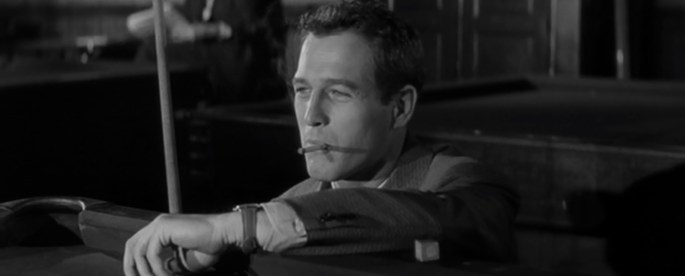
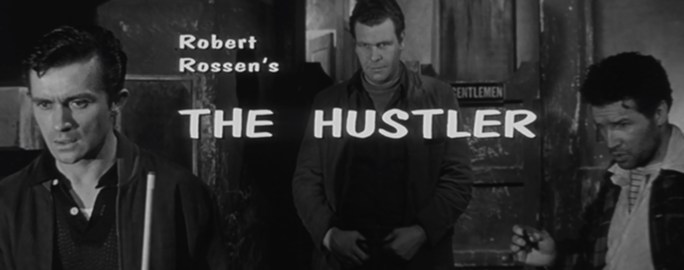
ROBERT ROSSEN’S THE HUSTLER — A REVIEW BY NICK CLEMENT

2

Robert Rossen’s silky-smooth 1961 drama The Hustler contains one of Paul Newman’s finest screen performances, and is easily one of the most subtly complex stories about gamesmanship and the art of winning, losing, and knowing when you’ve met your match. Based on Walter Tevis’ 1959 novel and adapted by Rossen and Sidney Carroll, the pool hustling narrative packs both a visceral and emotional punch, with a sterling supporting cast doing some extra-fine character work, including George C. Scott, Jackie Gleason, Piper Laurie, Michael Constantine, and Murray Hamilton. Eugene Shuftan’s extremely stylish cinematography made excellent use of the monochromatic visual style, with perfectly chosen angles employed during the various pool matches, and knowing exactly when and where to opt for close-ups. The music by Kenyon Hopkins unobtrusively sets a great mood for the picture, matched by legendary editor Dede Allen’s smart and sharp cutting. The fact that Rossen and his collaborators never went over the top with the material, instead staying true to real life, has made this film the classic that it has become. Infamous boxer and nightclub owner Jake LaMotta appears briefly as a bartender. A huge success with critics and audiences, The Hustler would receive nine Oscar nominations (winning two), while Martin Scorsese would later helm the sequel The Color of Money, which brought back Newman as Eddie Felson and paired him with a young hot-shot played by Tom Cruise.

1

WERNER HERZOG’S INTO THE INFERNO — A REVIEW BY NICK CLEMENT

3

Leave it to the ultra-eccentric and always ambitious Werner Herzog to take his audience directly inside of active volcanoes at various points on the globe, as his latest documentary, Into the Inferno (currently streaming on Netflix), peers into the smoky-hot abyss while simultaneously commenting on the world all around us, drawing parallels to exotic jungle tribes and the people of North Korea, all in an effort to show us how corrosive certain aspects of life can be, and how the effects from global change can be felt everywhere. Herzog’s regular (and rather fearless) cinematographer Peter Zeitlinger again demonstrates an unflinching eye behind the camera, showing the audience surreal sights and sounds (the engrossing and at times haunting musical score goes a long way in this film) that echo throughout your consciousness long after watching; Herzog and Zeitlinger have long understood the power of the sustained image, and some of the shots of the erupting magma take on an almost otherworldly effect. Working with volcanologist and co-director Clive Oppenheimer, Herzog and his creative team have yet again provided audiences with a distinctive sociological piece of entertainment that simultaneously appeases our desires to see new things and learn about ideas of humanity that might not be so upfront or obvious.

2

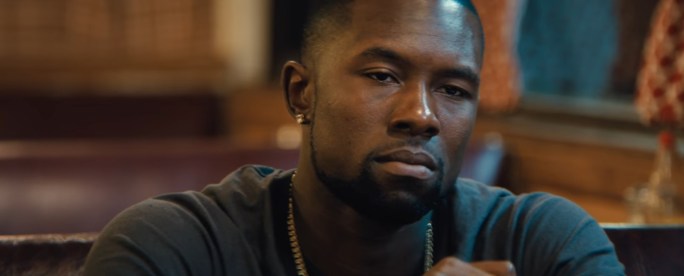
BARRY JENKINS’ MOONLIGHT — A REVIEW BY NICK CLEMENT

3.jpg

Moonlight is bravura filmmaking and storytelling, a thrillingly cinematic exploration of identity, sexuality, and repressed desires. From the startling and engrossing opening Steadicam shot all the way until the absolutely perfect final image, writer/director Barry Jenkins crafts a narrative, from an original story by Tarell Alvin McCraney, which feels personal, honest, tragic, and uniquely uplifting. This film has been rapturously received by critics, and rightfully so, as it’s an important piece of work at a very important time in society, and while focusing on something specific and largely absent from movie screens in wide exposure (the black gay experience), its themes are universal and will hit hard for many people, regardless of race or sexual orientation. Progressive, introspective, and directed with extreme care by Jenkins, Moonlight is the type of film that will be seen as a rallying cry for some, and deserves to find the widest possible audience, as its message is one that feels authentic and enormously human. James Laxton’s bold and beautiful widescreen cinematography absolutely simmers with visual possibilities, with Jenkins totally embracing aesthetic artifice without projecting a self-conscious sense of false importance; the emotional power of the material matches the expressionistic shooting style so as a result, there’s a harmonious quality to the entire piece.

2

The film revolves around a young man named Chiron who has been dealing with an extremely dysfunctional home life (his mom is an addict and dad is absent), living in the rougher parts of Miami and just trying to get through each day. The narrative has been broken into thirds, with each chapter highlighting a particular moment in time (middle-school, teen-years, and manhood), while painting a portrait of a changing world and the various issues that a gay black man would face while living in the ghetto. The cast is sensational from top to bottom, with Trevante Rhodes, André Holland, Janelle Monáe, Ashton Sanders, Alex Hibbert, Jharrel Jerome, Naomie Harris and Mahershala Ali all delivering richly drawn portraits which helps to create an organic flow to the time-jumping story. Rhodes, in particular, is spellbinding in his ability to project bottled up feelings and intense vulnerability, with his buff physique masking his warm and open heat at his center. Holland, so incredible on the Cinemax series The Knick, shows up in the final act and steals all of his scenes with a quiet sense of melancholy and grace. And I love how Jenkins consistently subverted expectations all throughout, starting with the tense opening bit, showing characters to be more than meets the eye on more than one occasion, and allowing the audience to fill in the blanks during some key sexual moments which make them all the more powerful. Leave it to go-to-indie distributor A24 to be the ones to get this earth-shaker out there.

1

ADRIAN LYNE’S NINE 1/2 WEEKS — A REVIEW BY NICK CLEMENT

1

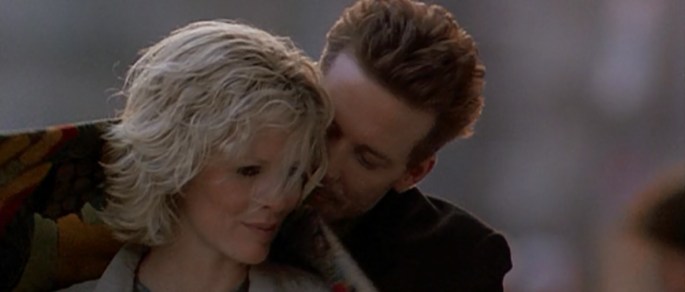
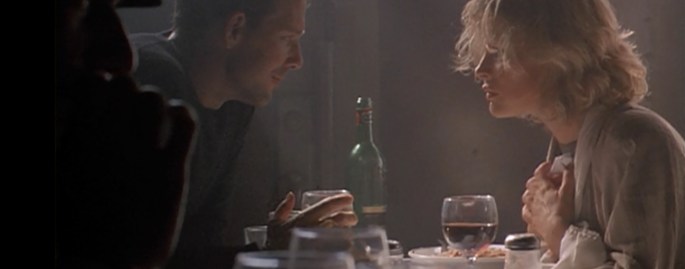
Sleek, slick, and supremely sexy, Adrian Lyne’s unconscionably gorgeous erotic drama Nine ½ Weeks is still one of the better cinematic explorations of pure carnal lust, and upon a recent revisit, I was struck by how genuine and sincere the screenplay felt, while being totally consumed by the performances of Mickey Rourke (rarely more appealing) and Kim Basinger (insanely hot). A notorious film at the time of its release, critics were all over the map in their appraisals of the film, and while audiences in America ignored it on a theatrical level, its international release was a massive success, before becoming one of the biggest VHS items of its time.

4

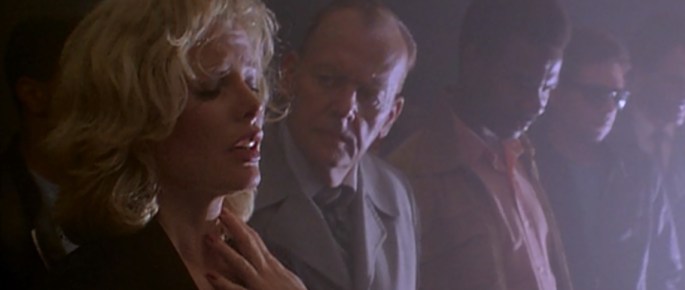
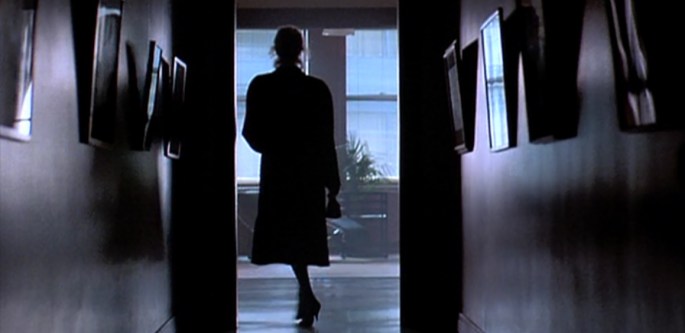
Released in 1986, Lyne’s glossy and sensational drama was based on the 1978 memoir by Ingeborg Day, with the screenplay written by Sarah Kernochan, Zalman King, and Patricia Louisanna Knop. Basinger is Elizabeth McGraw, a somewhat shy art gallery worker living in New York who enters into a short lived but wildly intense affair with a mysterious Wall Street broker named John Gray (Rourke). Margaret Whitton, David Margulies, Karen Young, and Christine Baranski all co-starred, but this was the Rourke and Basinger show all the way. The chemistry between them is absolutely scalding in this film, with each sexual set piece truly steaming up the camera lens; Hollywood stars rarely share this much on-screen heat.

66

The genius cinematographer Peter Biziou (The Truman Show, Pink Floyd: The Wall, Mississippi Burning, Monty Python’s Life of Brian) bathed the film in soft, warm light, giving off that special 80’s visual sheen that Lyne and other filmmakers like Alan Parker and Tony Scott helped to cultivate. There’s a pleasant graininess to the imagery, with jet blacks in the foreground and cool, white light from above in many scenes; every single shot in this film was lusciously composed. Jack Nitzsche’s sleazy, romantic, and at-times bombastic musical score heightened every moment, especially in conjunction with the pop-centric soundtrack. Despite being shot in 1984, the film took two years to complete, with the director famously going to great (and emotionally turbulent) lengths to coax blistering performances from his two white-hot leads.

55

This film is so much better than its reputation, and so much more than an easy target due to its more over-the-top moments. A direct-to-video sequel, Another 9½ Weeks, followed in 1997, while money-hungry producers dished out a direct-to-video prequel in 1998 called The First 9½ Weeks. I haven’t seen either of those titles, so I can’t speak to their merits (or lack thereof), but in terms of hot-blooded cinematic artistry, Lyne always knew how to set pulses racing, exploring provocative themes with a tremendous sense of style. He made so many great films (Fatal Attraction, Jacob’s Ladder, Unfaithful, Lolita) that it’s a shame he wasn’t more prolific.

3

J. LEE THOMPSON’S THE GUNS OF NAVARONE — A REVIEW BY NICK CLEMENT

3

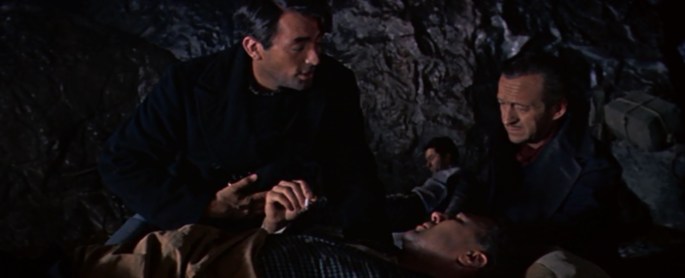
Starring a rugged and masculine cast including Gregory Peck, David Niven, Anthony Quinn, Stanley Baker, and Anthony Quayle, the 1943-set The Guns of Naravore centers on a crack commando unit who are tasked with destroying massive German artillery off of the Greek island of Navarone, all in effort to rescue Allied troops who are trapped behind enemy lines. One of many large-scale studio funded WWII action adventures of the era, future Charles Bronson collaborator J. Lee Thompson directed this square-jawed actioner in 1961, which was adapted by producer Carl Foreman from the original novel by Alistair MacLean. Cinematographer Oswald Morris (Reflections in a Golden Eye, The Hill, The Spy Who Came in From the Cold) made maximum use of the widescreen space, filling the frame with action and detail, while the triumphant musical score by Dimitri Tiomkin (Duel in the Sun, Red River) punctuated nearly every scene.

1

Quinn fell in love with the Greek island of Rhodes during filming, and apparently purchased land there, which is still referred to as Anthony Quinn Bay, while Niven got near-fatally sick after shooting some underwater scenes, requiring hospitalization for a period of weeks before he could rejoin the cast. All of Peck’s German dialogue was dubbed by voice actor Robert Rietty as he wasn’t fluent in the language. Thompson, with directorial credits as diverse as they are inconsistent, was a replacement choice in helmer after Foreman fired original director Alexander Mackendrick. The film was a massive financial success and critical favorite, winning an Oscar for Best Special Effects, while racking up six other nominations. Other notable WWII films from the era also include The Bridge on the River Kwai, The Longest Day, The Dirty Dozen, The Great Escape, and Von Ryan’s Express.

2

ARRIVAL — A REVIEW BY NICK CLEMENT

1

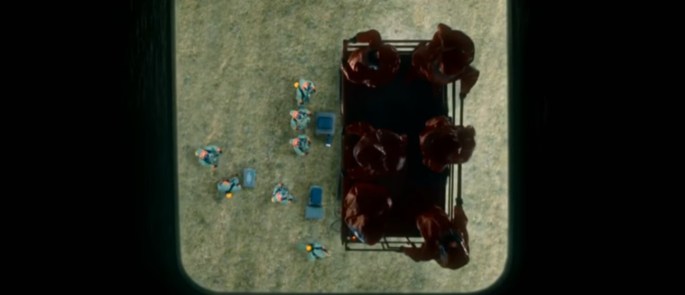
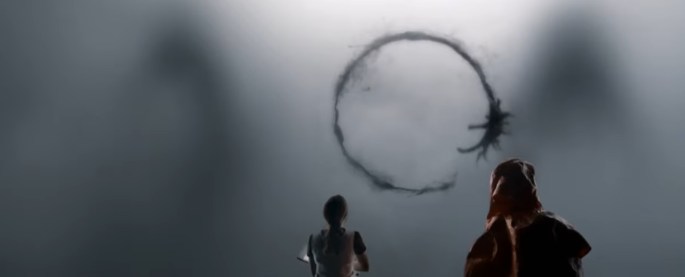
Arrival is cinema I crave – a thought-provoking, somber yet stylish, and thoroughly cerebral piece of storytelling within one of my favorite milieus, and produced independently of the major studios, thus feeling resolutely unconcerned with satisfying endless rounds of notes and enduring creative compromises that could have potentially sabotaged the crux of the piece as well as the emotional wallop it delivers well after the fade to black. Telling a legitimate story about actual people rather than CGI/spandex superheroes, the writing favors pragmatic decision-making and reactions, instead of going for the bombastic or over the top. The filmmakers have concocted a narrative that weaves a scholarly sense of linguistics into its eerie, otherworldly implications, which makes the film stand out even more. Hot-shot director Denis Villeneuve (Incendies, Prisoners, Enemy, Sicario, the upcoming Blade Runner 2049) and genre specialist screenwriter Eric Heisserer (this past summer’s surprise horror hit Lights Out) have retooled the original short story by author Ted Chiang into an intelligent science fiction tale that not only intelligently explores what first contact with an extraterrestrial species would most likely resemble, but also contains a full dose of the mind-bending and unexpected.

4

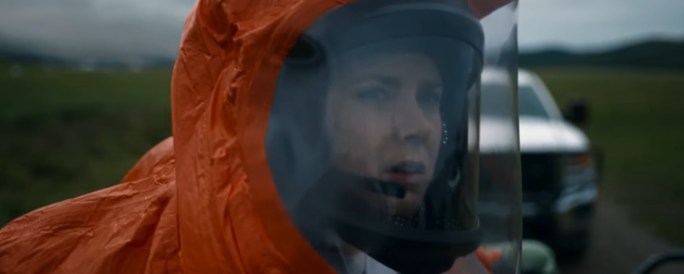
I wouldn’t dream of spoiling anything about this film, as it was my top choice to see for the rest of the year, but I will state that my seriously inflated expectations were easily met if not surpassed. The brilliant Amy Adams (one of my favorite on-screen talents) plays an emotionally guarded college professor reeling from the death of her young child and separation from her husband. She’s a master of various languages, someone who can decipher various dialects at a moment’s notice, so it’s only natural that she gets recruited by the government in an effort to communicate with some recently landed aliens. They’ve arrived in 12 seemingly random spots on Earth, in oval-shaped hovering monoliths that sit just above the ground (or water), with a door opening every 18 hours so that teams of scientists can attempt to speak with the ship’s occupants. Jeremy Renner is sly and compelling as always as Adams’ tack-sharp sidekick, Forest Whitaker turned in reliably strong work as a top military commander, and Michael Stuhlbarg brought just the right amount of realistic hostility that a stressed out CIA agent might be projecting during a once-in-a-lifetime situation such as this.

11

Heisserer’s script perfectly balanced the need for the audience to connect with Adams’ psychologically fraught character as well as our demand for something new and exciting, and because Villeneuve is such a strong image maker with a tremendous feel for mood, texture, and atmosphere, every shot inside the ship is goose-bump inducing and always photo real. The film has been given a smoky and full-bodied visual sheen by rising star cinematographer Bradford Young (A Most Violent Year, Selma, Pawn Sacrifice), who has an absolutely tremendous eye behind the camera. The creepy, almost mournful score by Johann Johannsson feels oh-so-right in every single moment, both big and small, while the final act really sticks the landing, offering up visceral excitement which feeds into the story rather than overtaking it with needless special effects. The cold and mysterious alien ships provide adequate menace and ample intrigue, with some fantastic special effects work employed in a few key sequences; the less you know going in about the specifics the more fun this trip will be.

2.jpg


Villeneuve has been a director-on-fire of late, tackling various genres and injecting all of his work with the same sense of smarts and polish that Christopher Nolan brings to the table; he’s ready to bust out at the seams and I have a feeling that Blade Runner 2049 is going to turn heads. Arrival certainly feels spiritually connected, to some degree, to Nolan’s magnum opus Interstellar. Less overtly showy than Nolan’s exquisite cosmic journey so as a result more subtle and nuanced, Arrival instead has been designed to consistently upend most of your expectations; not only do the final moments send you out of the theater still trying to fully process everything that you’ve just seen, but it’s all been crafted with a sense of quiet elegance, both in Heisserer’s emotionally involving dialogue and Villeneuve’s sublime sense of visual aesthetics. Arrival is the movie I’ve been waiting to see for a long time, a thoughtful meditation on first contact that never forgets the human element at its core, uninterested in blowing stuff up just because it can, as fascinated by the unknown as it is rooted in something universal and important.

3

GEORGE ROY HILL’S BUTCH CASSIDY AND THE SUNDANCE KID — A REVIEW BY NICK CLEMENT

3

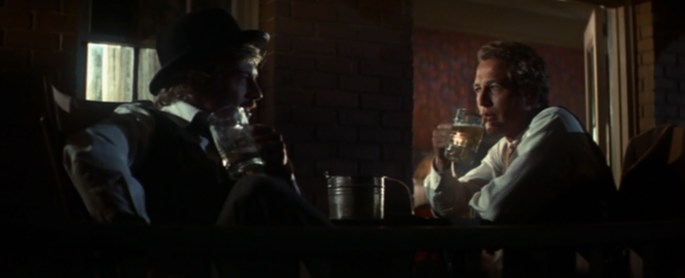
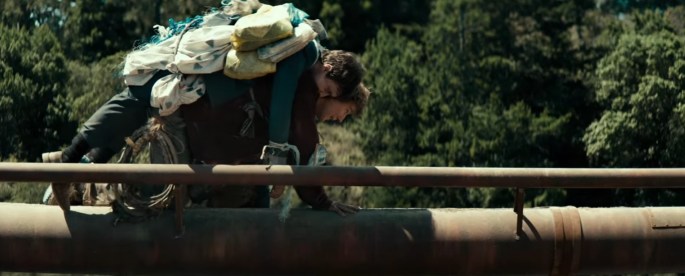
So smooth, so classy, so effortlessly entertaining. Butch Cassidy and the Sundance Kid is a revered film for many reasons, not the least of which, is that it contains two of the most charismatic performances of Paul Newman and Robert Redford’s career, and George Roy Hill’s direction was so crisp and clean that the film hardly has a chance to stop and admire it’s breezy charms and subtly elegant visual sense. William Goldman’s poetic yet salty dialogue rolls off everyone’s tongues with a sense of true joy for the spoken word, Conrad Hall’s majestic widescreen cinematography shows off amazing vistas without sacrificing the visual intimacy we crave because of how much we like the characters, and the action scenes are perfectly integrated into the story, never feeling forced or unnecessary.  All of the elements came together on this film, and in general, Hill’s output was rather sterling and consistent, with Slap Shot and The Sting as other major standouts.

2

It’s also got some of the best stunts and one of the greatest explosions of all time, with those two particular stuntmen really earning their day rate for standing that close to the detonated train doors. Burt Bacharach’s playful and eclectic score set a jaunty tone that also shared the possibility for danger, while co-star Katharine Ross projected smarts, beauty, and grit, matching the two legendary leading men every step of the way. And then there’s the iconic finale, which says so much with so little, instilling a sense of grace to match its inherent sadness. Costing $6 million dollars in 1969, the film would become a smash hit and critical favorite, grossing well over $100 million in theatrical ticket sales and won four Oscars, before becoming one of the most ubiquitous films in the history of cable television. Richard Lester’s vastly underrated sequel, Butch and Sundance: The Early Years, would be released ten years later.

1

DANIELS’ SWISS ARMY MAN — A REVIEW BY NICK CLEMENT

3

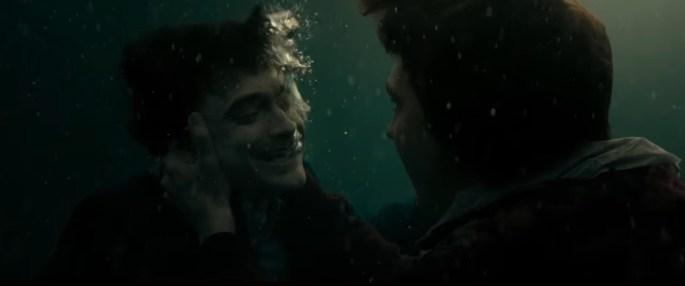
The final line of dialogue in Swiss Army Man sums up the entire viewing experience: “What the fuck?” This is one of the most visually inventive and thematically odd films I’ve seen in years, and despite the concluding 15 minutes not truly working for me, the previous 75 minutes are pure stony bliss. I’ve also never seen a film concentrate as much on farts and farting as this one did. Seriously. Farting, and how people react to their own farts and the farts of others, is a topic that’s explored in great depth during this film. If you’ve seen the trailer, then you know what to expect, as this is one instance where the marketing department didn’t hide what was in store from the viewer. In fact, stop reading this now, go watch the trailer, and you’ll likely know just from those two and a half minutes if this wild and crazy piece of work is going to be up your cinematic alley, or if you’re better off just smelling your own farts for effect instead.

2

I don’t want to discuss too much about what this idiosyncratic film is about, because, I suspect that this film will be about a great many things to everyone who checks it out. All I can say is that Paul Dano and Daniel Radcliffe were both fantastic (especially Radcliffe), the in-camera practical effects defy logic, the cinematography is stunning, and I caught whiffs of Where the Wild Things Are all throughout (Dano is basically an older version of Max from that story). The directors, who go by Daniels (they both share the same first name), seem to be totally insane and happy about it, as this is a flick that PROUDLY marches to the beat of a VERY specialized and specific drum. It’s also got a really catchy theme song. I wish that it had all wrapped up in a different manner, but regardless, this is something I can see myself revisiting more than once. I mean – you get to see a fart-powered human Ski-Doo – how cool is that?!

1

BARRY JENKINS’ MOONLIGHT — A REVIEW BY SPECIAL GUEST CRITIC DOUG COOPER

1

You’ll hear it mentioned as a story within the story – Moonlight is the tale of how black boys turn blue. And you’ll watch it unfold as the film follows its main character, Chiron (pronounced Shy-rone), through three formational periods in his life. Through his childhood, where he goes by the nickname “Little”. Through his teenage years, where he’s attempting to live by his given name, Chiron. And through the beginning of his adult years, where he’s built a persona under the nickname “Black”. The film follows his struggles through these phases and through his own self-discovery – it’s a coming-of-age story built around his desire to love and be loved. And while that may sound familiar, the film is anything but.

Moonlight is a movie that begs to be talked about outside of the traditional movie talking points. We can discuss the performances – all of which are fantastic. Like, how Naomie Harris, as Chiron’s mother, brings dignity and warmth to a role that might’ve felt unforgivable in lesser hands. Or, how Mahershala Ali, as a drug dealer named Juan, is the embodiment of unflappable cool until he wants to devastate you by letting it all come crashing down. Or, how Janelle Monae’s portrayal of Teresa is hilarious and how Andre Holland as Kevin is so effortlessly charming it’s hard to understand why he hasn’t been a movie star for the last 10 years. Or, certainly about Trevante Rhodes, who playing the adult “Black”, might be the most remarkable of all, as he consistently captures a lifetime of confusion and pain in smallest flicker of his eyes. We can talk about the way Barry Jenkins’ kinetic direction and James Laxton’s gorgeous cinematography gaze upon their subjects with such palpable joy and compassion. Or, we can talk about the way Nicholas Britell’s score brings grandeur and universality to the most intimate of stories about this singular human being.

All of these things are more than worth mentioning. And still, what stood out to me was that old, familiar story. One with a conceit I was sure I’d seen a hundred times, and yet, as I was transported into the world of Moonlight, it was clear the film resembled nothing I could find in my own memory. Not only because of the quality of its pieces, but also because it was a story that I had simply never been told – one of a young black man trying to understand and cope with his own homosexuality in the face of a world that didn’t want to allow him to be himself. And one so fully-realized and understood by its makers that by the time you reach its climactic scene inside a tiny diner in Liberty City Miami, and Barbara Lewis coos the chorus to “Hello Stranger”, you might feel like just that – a stranger. I know that for me, I had never been to this place with these people before. But, I also knew that’s what made Moonlight a revelation.

Because, why? Why had it taken me so long to get here? As a lover of movies and someone who watches almost everything, almost every year, why had it taken so long for me to sit alongside these two characters as they enjoyed the “Chef’s Special”, or stand between them as they made eyes from across the room and music poured from the jukebox? As the song would put it, “It seems like a mighty long time.”

Wesley Morris, the Culture Critic for the New York Times – who also happens to be a gay black man, and probably the voice in film best suited to speak on the experience of watching Moonlight – recently wrote about 10,000 words (I’ll be honest, I didn’t count) for New York Magazine on the recent film history of the penis. Specifically how that recent history, reflects a much older history about the fear of black male sexuality – or more specifically – the black penis. And if that sounds like a somewhat daunting and uncomfortable read to some, well, I would guess that’s kind of Mr. Morris’ point. Because, as he intuits, it’s the same sentiment that probably kept a film like Moonlight from being made. The fact that having a conversation about this topic makes a certain sect of the population extremely uncomfortable (i.e. white people, i.e. white men, i.e. me – if I’m being really, REALLY honest with myself) is the very reason we have to discuss it. It’s the very reason we need a movie about it. And it’s what makes his piece the perfect complement to Moonlight and required reading for someone like me to understand the film on a deeper level.
3

Just like a really long article on black male sexuality may get flipped over in the pages of New York Magazine, Moonlight is a film that might be dismissed by some simply because of its subject matter. But, just like the choices made in Jenkins’ storytelling, or the lengthy word count of Morris’ article – it’s also how both are simultaneously working on two levels – telling us that if you don’t want to read this much about the sexuality of black males, or, for that matter, watch a movie that might be about it, then you probably have the most to gain from doing either. Because, if you’re going to Moonlight expecting a film that’s explicitly about black sexuality, you won’t find it – the film is too smart and upends those expectations by making it not really about that at all (and never even showing it on screen). Moonlight, instead, is about how repression can keep us from something we all so desperately need – affection. And by normalizing and humanizing that universal desire through a vaguely semi-biographical personal history, Jenkins seems acutely aware of the meta-story roiling beneath the main story of his film.

It’s a meta-story that I’m sure wasn’t the focus of Jenkins’ efforts – but as various cues unfold through the course of film – it’s one that I have to believe was playing out in the back of his mind.  Because, not unlike the music cues playing in the background of several scenes – from the aforementioned “Hello Stranger”, to starting a movie about a young black man with “Every Nigger is a Star”, to a chopped and screwed version of “Classic Man” that rattles the trunk for a confused “Black” – Jenkins upends too many film tropes and social stereotypes for me to believe he didn’t know exactly what he was doing.

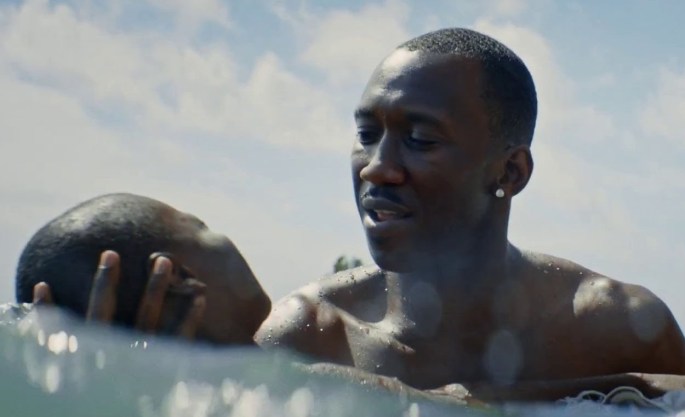
Just take the scene you might see in the trailer for the film, where Mahershala Ali’s Juan teaches a young Chiron how to swim. Juan could have easily been portrayed as the familiar, inner-city, drug dealing archetype. But, archetypes are not life and this is a film about just. So, while Ali lives inside that utterly believable side of his character, there’s also another side of him that’s just as present – the one that recognizes something different inside a young boy and chooses to care for him and defend him just because. When Juan helps “Little” learn how to swim in the Atlantic, it’s a familiar and universal metaphor for life that’s twisted by challenging the societal stereotypes about African-Americans and water, while also being deepened by the humanity and multi-dimensional nature of the characters taking part in it.

It’s this mastery of multi-level storytelling where Moonlight truly excels for me. Because while saying so much, it never feels like a movie that’s trying to make a point – be it political or otherwise – at the expense of its story, its world, or the characters who are living in both. Not once.

On some level, Jenkins is surely aware that the structures that forced him to go outside the Hollywood system to make Moonlight are the same structures that forced the main character of his film to suffer most – structures that turned a kid named “Little” who loved to dance into a lost man named “Black” who felt forced to trap. He knows that his character lives in the same world in which the movie about him was made – a world that tried to keep him from expressing one of the most fundamental aspects of his being.

So, I definitely get that Moonlight isn’t a Marvel movie. Meaning, I’m not going to sit here and act like it has anything approaching that level of commercial appeal. It’s an art house film – plain and simple. But, with per-theater averages that are breaking records, maybe the film industry would be better off pursuing films that were less like the blockbusters that are so consistently plain and simple. In a year so dishearteningly wrought with recycled ideas and overflowing with unwanted sequels, Moonlight seems like a powerful condemnation of mainstream Hollywood’s current mode of operation. Why recycle ideas from the 70’s, 80’s, 90’s, and even the 2000’s, when we’ve learned so much and come so far since then? And why make a sequel to a film that people didn’t care about the first time, when there are stories out there that take us to places in the world that we have never been and could learn to care about so deeply? The film is an unflinching reminder that maybe we’d all be better off if we showed those that are different what Chiron was searching for all along – a little love.

2

WALTER HILL’S SOUTHERN COMFORT — A REVIEW BY NICK CLEMENT

3

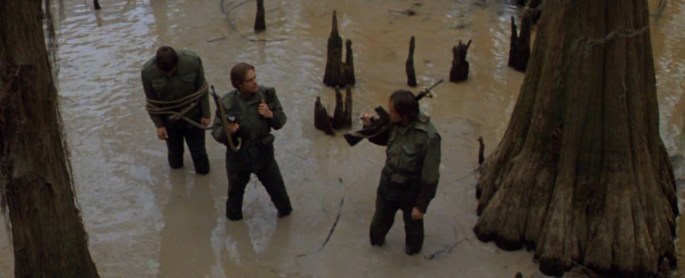
Walter Hill is one of the manliest directors of my lifetime, or any lifetime. He’s made a career out of telling tales of gunslingers, cops, criminals, and loners, and I instinctively respond to his particular brand of tough guy cinema. Southern Comfort is one of my favorite efforts from Hill, a totally nasty and rather disturbing tale of backwoods terror; it would pair extremely well with Deliverance on a double bill. Released in 1981, the film was co-written by Hill, Michael Kane, and David Giler, and features a surly and macho cast consisting of Powers Boothe, Keith Carradine, Fred Ward, Peter Coyote, T.K. Ward, Franklyn Seales, Lewis Smith, Les Lannom, Brion James, and Sonny Landham, and concerns a group of Louisianan Army National Guard members who are doing routine weekend combat drills in the bayou, and who become the prey of a band of local Cajuns who aren’t impressed with fatigue-clad and rifle-toting visitors in their backyard.

2

After a misunderstanding leads to a murder, all hell breaks loose, with the added twist that the good guys are carrying guns loaded only with blanks. This is a rather terrifying actioner, with a final sequence of violent confrontations that definitely get the blood pumping and the pulse racing. Setting the film during the latter portion of the Vietnam War also added a level of subversive topicality to the narrative, while the film has a purposefully grimy visual style courtesy of cinematographer Andrew Laszlo, which stressed the damp and grubby environment. It genuinely hurts when people get shot and stabbed in this movie; not a moment in the fleet running time is wasted. Despite the film not making much money in theaters, it has certainly attained the label of cult classic, and was somewhat recently released on Blu-ray by Shout! Factory. Apparently, the Iranian government heavily edited and altered the film’s narrative for release in that country, turning it into an anti-American military statement.

1