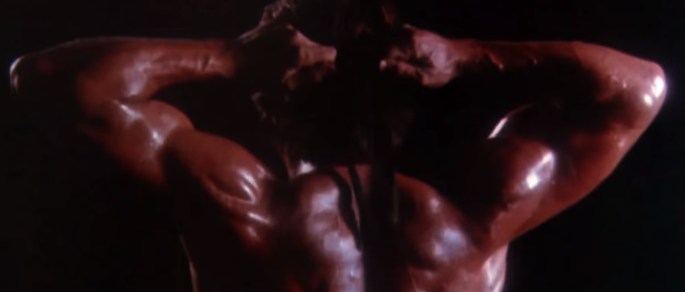
GEORGE P. COSMATOS’ RAMBO: FIRST BLOOD PART II — A REVIEW BY NICK CLEMENT

5

This movie is absurd. Absurdly fucking amazing. EVERYTHING EXPLODES POWER. TESTOSTERONE GALORE POWER. Where the first film in this phenomenal franchise was more of a lean and mean and stripped-down chase movie, this overblown and undeniably thrilling sequel opted for period appropriate bombastic spectacle, with hindsight results that are beyond perplexing and rewarding in equal measure. There’s nothing in this film that isn’t jacked, juiced, and fully loaded, with every single performance teetering on the edge of cartoonish respectability, and yet, it’s so damn sincere you just have to laugh and marvel at all of its blazing idiocy. Released in 1985 and grossing $300 million worldwide and becoming one of the most iconic action films of all time, Rambo: First Blood Part II was directed by George P. Cosmatos in a smack-you-in-the-face fashion, with every single action set-piece destroying the last and laying waste to entire villages, multiple armies, and entire populations. Definitely one of the premium gonzo-action movies of its day, there’s nothing on the Hollywood landscape, for multiple reasons, that remotely comes close to replicating this sort of insane summer fun.

r2

The story cooked up by Stallone, Kevin Jarre, and James Cameron involves Rambo being sent to look for POW’s in Vietnam, only to be double-crossed by his own side, and then delivering repeated smack-downs to every single person he comes into contact with, foreign and domestic. The bold and beautiful anamorphic widescreen cinematography by the historic talent Jack Cardiff showcased every fire ball, every glistening muscle, every single machine gun casing with slick and gritty glee. A chorus of top-flight editors including Larry Bock, Gib Jaffe, Frank E. Jiminez, Mark Helfrich, and Mark Goldblatt, whose legendary credits include Commando, Terminator 2, and Bad Boys 2, made strict and coherent sense of all of the pyrotechnics, throat-slicings, and hand-to-hand combat, whittling everything down into a tight, 96 minute package that wasted not a single moment of screen time. Jerry Goldsmith’s pounding, triumphant score is a lesson in pure cinematic bad-assery. Richard Crenna, Charles Napier, Steven Berkoff, Martin Kove, all provided studies in gruff masculinity, while Sly anchored the entire production with a sense of 100,000 watt movie-star magnetism. This was the first film ever to receive a 2,000 screen release nationwide. A Carolco Pictures production of a TriStar release.

r3

ANDREW HAIGH’S 45 YEARS — A REVIEW BY NICK CLEMENT

1

45 Years loves its silence. This is a patient, slow burn drama about the power that secrets have over a very long marriage. Featuring immaculate performances from Charlotte Rampling and Tom Courtenay, writer/director Andrew Haigh steeps his film in small details, both written and visual, with results that are nothing short of quietly riveting. A true two-hander and really hard to “explain,” this is a film that requires your strict attention, not unlike something like Certified Copy by Abbas Kiarostami, and is less about “big moments” than it is about the cumulative sum of many intimate sequences that highlight all of the many qualities, happy and sad, that form married life. The story centers on a retired couple living in the British countryside, who are blindsided by the news that the husband’s long-ago lover, from before their marriage has died, and has  apparently left the man as her next of kin. Why would she do that? What could the husband not be letting on to his wife after all of these years? What will this life development do to them as they prepare to celebrate 45 years of joyous unity? Haigh prefers low key dramatics as opposed to over the top histrionics, so as a result, everything in this film feels very measured and carefully parsed out; not a word is wasted and not a glance is out of place.

2

45 Years asks hard questions and doesn’t provide easy answers, and because Haigh is too smart to try and wrap up his tender and provocative narrative with a tidy bow, some people might feel cheated by the final scene, despite the fact that Rampling essentially puts on an acting clinic with only using that amazingly expressive face of hers; it’s a moment like the one in Jonathan Glazer’s Birth where you see Nicole Kidman in long shot with a major realization hitting her like a ton of bricks. Rampling, who looks stunning at 70 years of age, crafts a tremendous portrait of a woman slowly realizing that she might not know some of the more important sides to her husband, while Courtenay suggests frailty, both physical and mental, which adds to the sympathy you feel towards him as his character is put through something he could never have anticipated or asked for. The invisible editing by Jonathan Alberts was in perfect synch with the carefully chosen visual presentation favored by the sharp cinematographer Lol Crawley. 45 Years is a very internal piece of storytelling, never telling you once how to feel, and always asking you to engage with it on multiple levels so as to better understand the various thematic complexities on display and up for discussion.  This is a fabulous piece of work for people who want to actively engage with their art.

3

GUILLAUME CANET’S TELL NO ONE — A REVIEW BY NICK CLEMENT

1

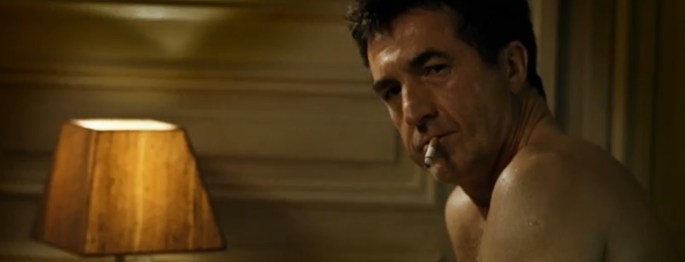
The breathless and extra crafty French thriller Tell No One is a propulsive “wrong-man” chase movie that Hitchcock would have flipped for. And while I would be lying if I said that upon first viewing that I totally followed every single plot development over the two frenetic yet somehow coherent hours that Tell No One occupies, it’s pretty clear that filmmaker Guillaume Canet has directed an awesome mind-bender that takes you on a fantastic ride. This is a complicated narrative that offers multiple twists, turns, and surprises, and the less you know about it going in, the better the viewing experience will become. I will say, at the film’s mid-section, there is a stunning foot and car chase, with one of the most spectacular high-way pile-ups I’ve ever seen. If special effects were used, they were flawless. If not, the multiple stunt drivers involved should be given medals. I’ve never seen a chase quite like it. Tell No One is a vigorously contrived thriller, almost to within an inch of its life, much like David Fincher’s vastly underrated The Game, and other brain-teasers of this sort.

2

But that’s sort of the point – everyone involved knows that the movie they’re in is wildly ludicrous, but it’s the level of skill that everyone brings to the table the makes Tell No One as effective as it is. The rug is continually pulled out from underneath the weary and sympathetic protagonist as well as the audience, who is consistently left at the edge of their seat. Francois Cluzet’s manly, commanding performance is engrossing to watch, and it’s crazy how much he looks like a French Dustin Hoffman. Canet’s stylish, energetic direction hurtles the movie forward at a brisk pace, never allowing you to think too hard about the ridiculous yet highly entertaining scenario that’s unfolding. This is a movie that demands multiple viewings and improves when you view it more than once because it allows you to see just how effectively Canet is able to turn the screws and keep the final truth from coming out. The “missing wife” narrative has been a constant in cinema for years, but the way that everyone takes each aspect of Tell No One up a notch, from the actors to the crew, elevates it to one of the best examples in the genre.

3

OLIVER STONE’S BORN ON THE FOURTH OF JULY — A REVIEW BY NICK CLEMENT

born_on_the_fourth_of_july_xlg

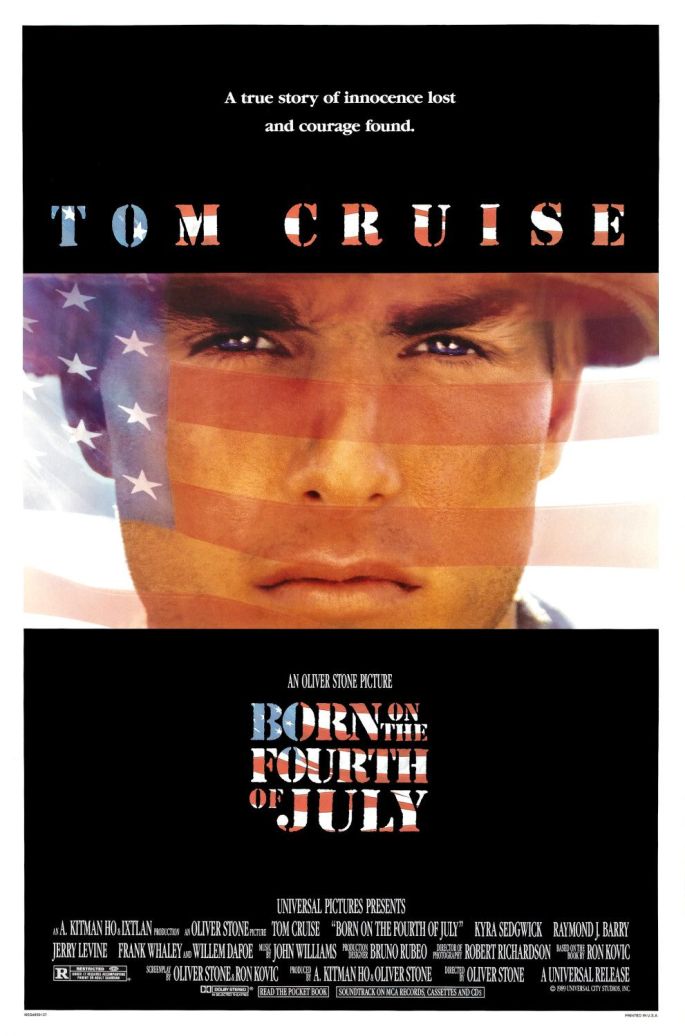
This is an overwhelming cinematic experience, and one of many masterpieces for Oliver Stone. Tom Cruise went long and deep here, easily delivering one of his best and most passionate performances. This entire film singes the senses, with every single craft contributor working at the very top of their class. Robert Richardson’s mesmerizing widescreen cinematography created hellish epic landscapes of war-time fury that’s both nightmarish and slightly surreal, while still nailing the intense intimacy of the domestic sequences. Every performance from the ridiculously stacked supporting cast was dialed-in and extra heartfelt. Stone wanted everyone to FEEL SOMETHING with this one, from his actors to his crew to his audience, and in that sense, this film is similar to Michael Cimino’s The Deer Hunter. And while that film is more than likely a bit more uncompromising, I can’t help but feel that both of these fiery works share many artistic sensibilities. The score by John Williams skillfully added layers of sadness to an already bleak yet oddly triumphant narrative. A reminder of how horrible war is for all participants and a shattering indictment of the way America treated its many Vietnam veterans, Born on the Fourth of July scalds the viewer, on purpose and by design, and in doing so, likely registers as unforgettable cinema for anyone who encounters it.

SIDNEY LUMET’S POWER — A REVIEW BY NICK CLEMENT

8

Sidney Lumet’s totally cracking 1986 political drama Power. I feel like my cinema-viewing life has been leading up to this moment. How had I not seen this terrific movie sooner? I’ll resist my temptation to get super obnoxious with this mini-review, but holy shit this movie rocks it – hard. You’ve got sleazy mustache Dick Gere playing a crafty, cynical, and overworked political consultant/campaign strategist who knows how to handle the media and is working for an Ohio business tycoon with Senate aspirations, Gene Hackman as his old friend and one-time mentor with traditional values who gets back-stabbed, Kate Capshaw doing near-nudity in her role as Gere’s hottie girlfriend, Julie Christie as Gere’s dreamy ex-wife who might be more lethal than him, Denzel Washington in a fiery supporting turn as Gere’s arch rival, JT Walsh in a small but crucial role, Fritz Weaver, E.G. Marshall, and Beatrice Straight. The barbed screenplay by David Himmelstein took aim at the media with tremendous gusto, paving the way for something like the even more hard-nosed Nightcrawler or the similar-feeling but decidedly more playful Our Brand is Crisis.

2

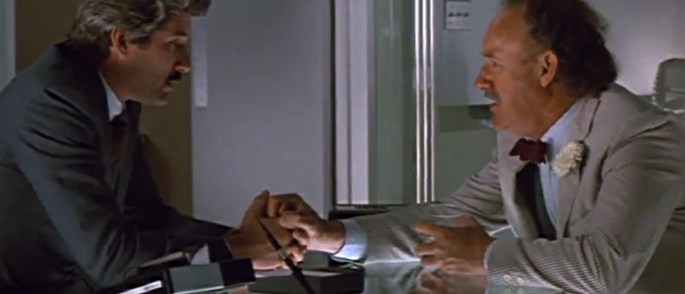
Lumet’s on-point direction was well served by frequent collaborator Andrzej Bartkowiak’s crisp and clean cinematography, while the film is bookended by a pulsating opening credits sequence and a beyond engrossing final montage that puts one final nail in the coffin; Andrew Mondhshein’s tight editing kept the pace fast and energetic. And c’mon, Gere’s character’s name is PETE ST. JOHN, and he’s rocking one of the ULTIMATE nose-ticklers without a shred of irony. There’s one absolutely fantastic scene between Gere and Hackman where the two men discuss their past and their potentially rocky future, some nice interplay between Christie and Gere, and a general sense of knowledge and understanding of the themes and ideas at play. In many respects feeling remarkably prescient 20 years after its original release, where it was met with indifference from both critics and audiences, my guess is that Power is even better now than it was when it first unspooled for disinterested viewers.

5

GINA PRINCE-BYTHEWOOD’S BEYOND THE LIGHTS

1

Honestly – everyone in the Academy should be FLOGGED for not having nominated Gugu Mbatha-Raw for her towering performance in Beyond the Lights a few years ago. Seriously – it’s time to dismantle the Academy. They’ve all had their chance to be relevant and they’ve consistently blown it year after year. Despite some conventional beats and a few predictable moments, I absolutely loved this film overall, I cried nearly half-a-dozen times, and it’s more conclusive proof that Mbatha-Raw is not of this planet – her supernatural beauty combined with pure, raw acting talent is a combination that is impossible to resist. And, just as a bonus, she’s an amazing singer, and she grabs you from the first frames (which is nearly impossible as the film opens with an extra sultry music video that gets the pulse racing) and never lets go, delivering more than one powerful ballad, and then late in the game, with her emotional guard down, does a solo number, sans instruments, in one take(!), that’s positively spellbinding to behold. I’m smitten, I’m anxious to see what she does next, and I’m starting to think that after her stellar work in Belle, and how she changed her look so often in Beyond the Lights, that she might have the same chameleonic quality that some of the best actors and actresses possess, instantly making her a must-follow talent for me as a viewer.

5

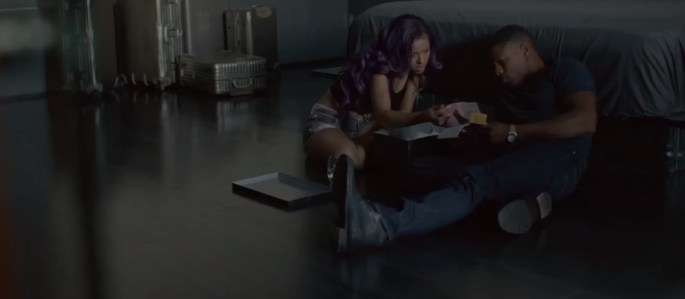
Beyond the Lights was written and directed by Gina Prince-Bythewood (who previously crafted the excellent Love & Basketball), and it tells the story of Noni (Mbatha-Raw), a Rhianna-esque pop star making the transition from back-up star on another artist’s album to a full-fledged music icon, and all of the rocky roads that lead her to stardom. Her domineering mother, Macy (an excellent Minnie Driver who was also robbed of Oscar consideration), wants nothing more than for her daughter to explode on the scene, constantly pushing Noni to the extreme, never truly thinking about the consequences. One night, after the Billboard Music Awards, Noni attempts suicide by jumping out of her hotel room window, but she’s heroically saved by a dashing, idealistic cop named Kaz (the extra-buff and appealing Nate Parker, who memorably co-starred with Richard Gere in Arbitrage) who has political aspirations and a wise father (Danny Glover, slyly cast as a police captain) who is always looking out for his son. Prince-Bythewood sort of structures Beyond the Lights as a new-fangled Notting Hill, in that the film is about a mega-star finding romance with a “regular person,” but she throws twists into the formula to keep things fresh and interesting. And while she dabbles in melodrama maybe a bit too often, there’s a level of sincerity and an emotional openness that I admired about this film; as previously mentioned, my eyes enjoyed tearing up with this one. When a movie works it works and this one does for the full two hour run time. Will Noni and Kaz make it as a couple? Will Noni be able to escape her demons? Will Kaz be able to handle his new found fame as the boyfriend of a popular musician?

3

Beyond the Lights is a sexy movie, with glitzy, mobile, and stylish photography all over the place, as cinematographer Tami Reiker basically made camera-love to Mbatha-Raw and Parker, showcasing his impeccable physique on more than one occasion, and the extra-hot Mbatha-Raw in a variety of scantily clad dresses and outfits that will raise the most jaded of eye-brows (Sandra Hernandez’s costume design is spot-on). You believe that these two gorgeous people could be a couple, and they share an instant, palpable chemistry that’s totally required for the genre. But let’s be honest, capturing the two of them in a constant state of semi undress or rhythmic action goes a long way in keeping the film humming along at a fast pace. And without spoiling it entirely, when their first love scene occurs, the way that Prince-Bythewood integrates it into the story goes a long way in making it one of the best love scenes in recent memory. It’s not about the nudity or the graphic nature, but more about the heart behind the act, and how one character is looking out for the other. And I also really liked how the film tackled the notion that the overly sexualized female is a bad thing for women of all ages, and how Driver’s character never thought twice about exploiting her daughter in an effort to advance her career. It’s a sad fact in that industry and the way Prince-Bythewood blends social commentary with romantic fairy tale is deft and assured. And what’s a music-based movie without catchy songs? On this level the film also succeeds, and I was further blown away to learn that Mbatha-Raw sang on more than one occasion. Beyond the Lights is a massively enjoyable movie and one that holds up on repeated viewings.

2

MARC FORSTER’S STAY — A REVIEW BY NICK CLEMENT

1

Having an impressive visual style as a filmmaker is very important to me as a movie lover. Without it, we’re left with nothing to admire with our eyes, and since film is a visual medium first and foremost, when a script isn’t perfect, the material can be saved when the filmmaker has a distinct vision. Here’s one movie that not enough people are familiar with: Marc Forster’s extra-trippy thriller Stay. I’m not sure if it’s an entirely successful motion picture, but so much of it is so interesting, and it’s a near constant marvel to experience on a conceptual level, with one scene transitioning effortlessly and seamlessly into the next, giving off an extremely heightened, dreamlike quality which results in a movie that feels as if it’s been created in one long vertiginous take, sort of like Birdman on a bad acid trip. Released to extreme critical hostility except for a few passionate supporters, this mind-bender quickly disappeared from the handful of theaters it was dumped in during the fall of 2005, ultimately grossing less than $5 million domestically(!), and that’s a shame, because it’s one of the most stylish films that I can think of, with a whammy of an ending that’s both powerful and unique. Taking influences from Vertigo, The Occurrence at Owl Creek Bridge, and with Forster even going on record at one point in saying that the works of Nicolas Roeg heavily inspired his aesthetic on Stay, this is a film that’s been art directed to within an inch of its life, and vigorously directed with an elaborate and dynamic aesthetic that propels every single shot. This is a work that continues to fascinate me on almost every level, but I can’t stress enough how intoxicating I find this film to be from a visual stand point; it’s a true wowser that’s flown so far under the radar as to almost make me sick.

The film’s brilliant cinematographer Roberto Schaefer, who has shot almost all of Forster’s always eye-catching work, must’ve had intensive meetings with his editor, Matt Cheese, as the filmmaker constructed the film to feel like a fever dream puzzle, with each shot interlocking with the next, using dissolves and morphing techniques to constantly startle the viewer and make them aware of the fact that nothing is as it seems within the tricky narrative. What’s also fantastic about Stay is that the intense visual style is in service of the story being told. Screenwriter David Benioff crafted a narrative that I’m not 100% sure I totally understand, even after multiple viewings, but I’m fine with that, because I enjoy getting the chance to discover new secrets that this film seems to be constantly holding up its sleeve. This is a tough one to explain. Watch the trailer. Or read Roger Ebert’s ***1/2 review; he boils it down better than I could ever attempt. The film stars Ewan McGregor as a paranoid psychiatrist suffering from odd dreams, a baby-faced Ryan Gosling as his suicidal patient, Naomi Watt’s as the doctor’s reluctant girlfriend and ex-patient, and Bob Hoskins, having a ball with a devilish glint in his eyes, as a blind, possibly unstable friend of McGregor’s who indulges the doctor in games of chess. Stay discusses various themes all revolving around life, death, the dream state, true love, and what might happen when we depart this planet. The film has the same weird, eerie quality of Denis Villeneuve’s ultimately superior head-scratcher Enemy, but even when Stay is possibly a bit to convoluted for its own good, there’s no denying that it has been made with supreme technical skill, and that there’s plenty to dissect even if all of the pieces don’t quite add up on first or second or third or fourth or fifth viewing.

3


DANNY BOYLE’S TRANCE — A REVIEW BY NICK CLEMENT

2

This one made a nickel when it was released, my nickel actually, and I’ll never understand why it was left out to dry by the studio. Trance is an intense movie, fever dream-esque in almost all respects, and aggressively stylish from first frame to last. This was a major mind-teaser from exuberant and hyped-up filmmaker Danny Boyle who was in major Nicolas Roeg territory here, spinning a thematically complex and visually audacious tale with the help of screenwriters John Hodge and Joe Ahearne and the extraordinary cinematographer Anthony Dod Mantle. Shot with bold and super-saturated colors and edited with sensational zest by Jon Harris, this is one of those films that is so outlandish, so movie-movie, that you just have to sit back and relax and enjoy the incredibly wild show. When all is said and done, I don’t believe ONE THING about this picture, and yet, I absolutely love it, because it takes me on such a trippy journey that half of the fun is seeing how the filmmakers are constantly messing with my senses. Trance features a trio of engrossing performances from James McAvoy, Vincent Cassell, and Rosario Dawson, all of whom subvert your expectations and take their potentially duplicitious characters into surprising directions. Violent, sexy, and always potentially dangerous, this is a propulsive thriller with a final act that truly makes your head spin. Repeated viewings are a must, for multiple reasons.

1

ROGER MICHELL’S ENDURING LOVE — A REVIEW BY NICK CLEMENT

enduring_love

Despite trading off of some of the more durable genre conventions of the stalker-thriller, eclective and underappreciated filmmaker Roger Michel’s gripping and exquisitely mounted film Enduring Love more than stakes it claim as one of the most provocative and stylish genre entires in recent years. Released in 2004 and starring a pre-007 Daniel Craig as a man who becomes inexorably linked to a mentally fractured and obsessive individual (Rhys Ifans in a chilling, unhinged performance of quiet determination), the nightmarish narrative centers on a tragic hot air balloon accident and the lives of the people who are impacted by the calamitous event. This incredibly scary sequence, as shot by the extremely skilled cinematographer Haris Zambarloukos (Locke, Venus), is thrillingly staged, as the piercing quality of the visuals leaves nothing to the imagination. After the life changing accident, Joe Penhall’s terse screenplay jumps back and forth between studying Craig’s emotionally strained relationship with his girlfriend (the always excellent Samantha Morton) and the sense of uneasiness that begins to grow as he realizes that Ifans is a man on a mission. And because Ifans is so eager to assert himself into Craig’s orbit, the film is able to hone in on the uncomfortable and inevitable fact that nothing good can come out of this perilous situation, as the story builds to an expected moment of shocking violence that doesn’t necessarily play out as fully expected. Adapted from Ian McEwan’s novel, this is one of the more icy and nasty psychological thrillers that I can think of in recent years.

MICHAEL CUESTA’S KILL THE MESSENGER — A REVIEW BY NICK CLEMENT

1

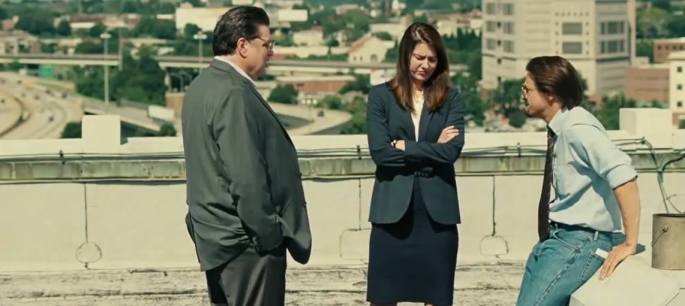
Disturbing, engrossing, and totally underrated, 2014’s political thriller Kill the Messenger should have shocked and appalled all who saw it, but due to a crummy release strategy with zero marketing support offered up by the releasing studio (Focus Features) who seemed disinterested in their own film, this scrappy, true-story journalism thriller got buried at the theaters despite solid critical notices. Jeremy Renner is Gary Webb, a reporter for the San Jose Mercury News, who back in the mid 90’s was responsible for writing a series of controversial articles which implied that the CIA ran a drug smuggling operation to support the Nicaraguan Contra rebel army in an effort to fund their war. The ghettos of America, South Central Los Angeles in particular, became over-run with crack-cocaine, creating havoc and instability and an alarming death rate. CIA officials were tasked with using informants to keep the drug trade going, even going so far as to renting an apartment to store all of the cash that was coming in from the drug sales. Webb begins his quest to uncover the truth after he’s handed some sensitive government-approved information and he’s off and running, heading down to Nicaragua to meet with potential sources, all the while trying, and failing, to secure one legit source from within the CIA to verify what he’s learned. The movie painfully displays how Webb’s family life began to suffer as a result of his dogged determination, and the unwanted advances of nefarious government types who routinely try to keep information suppressed and Webb off track with his story. One of the many unsettling messages that this film repeatedly drives home is that the notion that the CIA will do anything to protect their interests; the way they smeared Webb’s life and career was disgraceful, and it’s no surprise to learn that Webb’s life was effectively ruined as a result of him just doing his job.

2

Efficiently and energetically directed by Homeland’s Michael Cuesta and absorbingly written by Peter Landesman (the writer/director of the equally underappreciated Concussion), the film has a terrific supporting cast including Rosemarie DeWitt, Oliver Platt, Ray Liotta, Andy Garcia, Mary-Elizabeth Winstead, Michael Sheen, Barry Pepper, Tim Blake Nelson, and Michael K. Williams. But this is Renner’s show all the way and he’s absolutely fantastic in the leading role of Webb, displaying an idealistic yet never foolhardy approach to his job, all the while trying to maintain his home life and the demands of his profession. Sympathetic, doggedly determined, and always trying to make the best out of any potentially compromised position he’s in, this is easily one of the best performances Renner has delivered since his breakout turn in The Hurt Locker. It always seems like Renner gives juicy supporting turns but then gets overshadowed by the flashier performances that surround him. But not here. He owned every single frame of this movie. Sean Bobbitt’s ground-level camerawork kept a sense of intimate paranoia while Brian Kates’ fleet editing contributed to the quick but coherent pace by exuding nothing but forward momentum. And it has to be said – people should have been sickened by the revelations of corruption that Webb’s work brought about, and a movie like this one should have acted as a rallying call. Feeling very much like a product of the 70’s in terms of documenting social injustice and something tangible and topical without dipping into excessive melodrama or implausibility, it’s no real surprise that general audiences weren’t interested or shocked by what they saw, if they did see it. It’s a further reminder of how complacent we’ve become on the big issues, old or new, that surround us every day.

3