JAMES MOTTERN’S TRUCKER — A REVIEW BY NICK CLEMENT

1

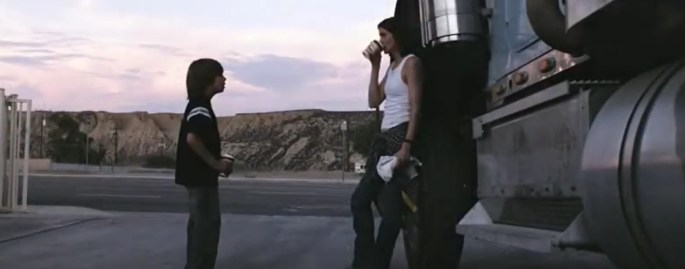
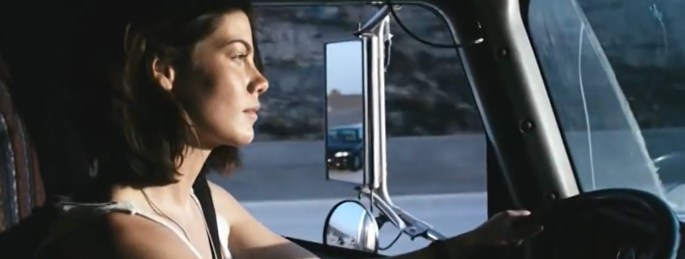
James Mottern’s indie gem Trucker is one of those little movies that’s still waiting to be fully discovered, having only received an extremely limited release back in 2008 after premiering at the Tribeca Film Festival. Despite attracting favorable reviews, most notably a four out of four star rave from the late, great Roger Ebert, who included the film on his list of the 10 Best Independent Films of 2008, this film got sadly lost in the shuffle for many people. Starring Michelle Monaghan in her best performance to date as a long-haul truck driver named Diane, Mottern’s satisfying and unpredictable original screenplay zigs and zags in ways unexpected, grounding the film with a solid emotional hook in the sudden arrival of Diane’s 10 year old son, Peter (the excellent Jimmy Bennett), and pivoting off the big question of whether or not she’s ready to finally be the mother that she never gave herself a chance to be. Diane is a woman very much used to a hardscrabble life on the road, tempted by booze and casual sex, and Monaghan brought just the right touch of salt-of-the-earth toughness that a role like this would require in order to feel believable.

2

Lawrence Sher’s unassuming yet stylish cinematography showcased the open road, along with Diane’s trusted big-rig, with a visual crispness which gave the picture a sharp aesthetic edge, while Monaghan handled most (if not all) of her own driving, which really ups the level of verisimilitude to the entire project despite it being a roughly $1 million production. Refreshingly, there is a noticeable lack of “process driving shots,” which I absolutely detest seeing in any film; all of Trucker feels lived in and authentic. Nathan Fillion shows up as Diane’s married neighbor, with the two of them entangled in a directionless affair, while she juggles the various issues stemming from her ex-husband’s cancer treatment (Benjamin Bratt in a small but effective performance). Mottern smartly uses melodrama to extract painful life lessons while never cheapening his story with anything artificial or unnecessary, as every scene in Trucker feels exactly as it should, with a finish that’s particularly sublime. Mychael Danna’s subtle yet impactful score seals the deal. This is definitely one of those true, under the radar titles that deserves a much higher profile.

3

DAVID CRONENBERG’S EASTERN PROMISES — A REVIEW BY NICK CLEMENT

1

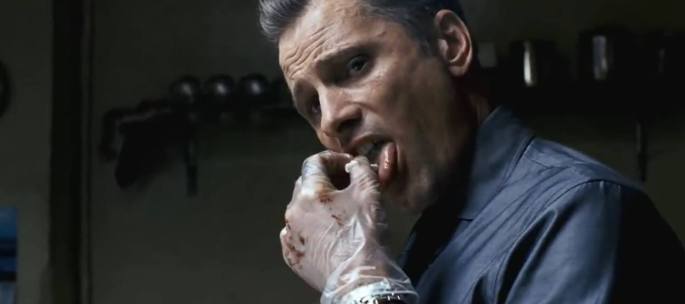
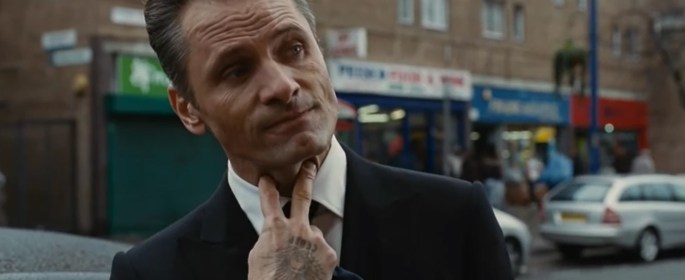
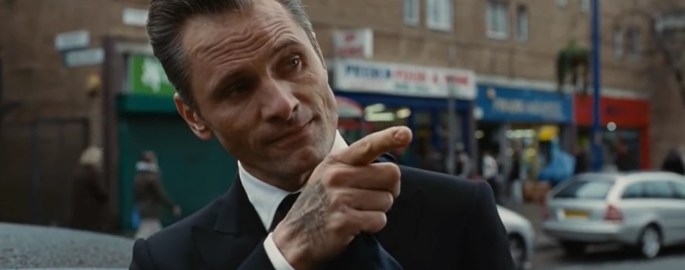
David Cronenberg’s Eastern Promises is as ruthless and nasty of a thriller as you’re likely to find. The director’s uniquely cold, semi-detached style perfectly fit with the pitch-black script from writer Steven Knight, who also penned the underrated thriller Dirty Pretty Things and the confined-to-a-car knock-out Locke. Without giving anything away, Eastern Promises has more than a few extremely smart, completely unpredictable surprises and twists, all of which are casually revealed like it’s no big deal. That’s one of the many sly pleasures that this film affords; Cronenberg and Knight pay their respects to the genre they’re working in, but they do enough to subvert our expectations, which results in a film that has the power to immediately engross the viewer in the dangerous underworld of violent Russian gangsters, but also allowing for thoughtful moments of introspective character development which allows the film to become so much more than a series of violent set-pieces.

5

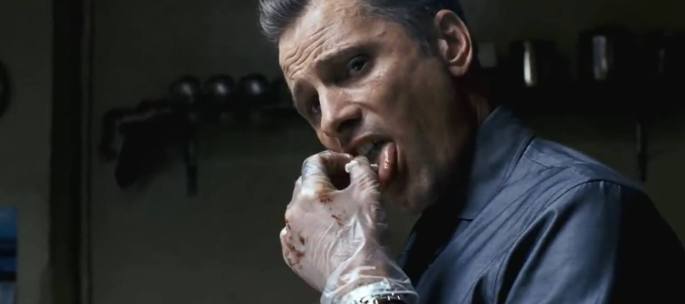
But about those set-pieces, of which there are a few – this movie takes zero prisoners when it comes to the visceral impact of murder, and the film’s ultimate bit of action, a five minute fight-to-the death with Viggo Mortensen taking on two thugs in a steam bath, completely nude, is easily one of the most brutally punishing movie fight I have ever seen. I’ve see a lot of ass-kicking, and the last bout in The Raid 2 certainly went to hell and back, but the choreography in that film turned it into a violent dance, something John Woo would wet himself over. The steam bath fight in Eastern Promises is raw, sloppy, scary, and never slick, which is why I love it so much.

8

We’ve seen countless scenes in movies and television shows were someone pulls off the perfect murder, all tidy, no blood, no loose ends. The steam bath fight is the opposite of that – things don’t go as planned for the various characters, split second decisions are made, and blood gushes like a babbling brook. Eschewing guns in favor of small knives, Cronenberg’s masterful direction is the definition of riveting, and Mortensen, working completely nude throughout the entire fight, delivers a tour de force of physical acting, something you’ll never forget. The brutal yet realistic violence all throughout this film will turn off some, but because each incident so neatly serves the air-tight script, nothing ever feels cheap or exploitive – just the way it would go down if you were a part of an extremely volatile group of murderers and psychopaths.

6

The “Russian-ness” of this film is a character unto itself, with the fantastic production design giving every scene a realistic feel, and the observant cinematography never turning a blind eye. Every once in a while a thriller like this one comes along and reminds you what can be done with familiar material, and while satisfying in the conventional sense, Cronenberg is still able to play with all of his customary themes, with characters who serve more than one purpose on the outside as well as the inside. Vincent Cassell provides juicy, sweaty, paranoid support, and Naomi Watts, as usual, does commanding work, bringing welcome sass and a much needed vulnerability to her small yet important role within the tricky narrative. Eastern Promises and A History of Violence make for a great one-two punch of rarefied crime cinema.

1


HAIL, CAESAR! — A REVIEW BY NICK CLEMENT

2

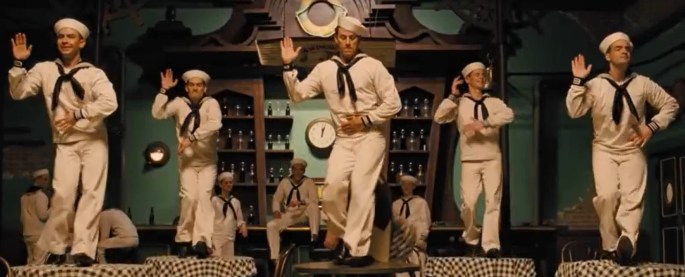
Hail, Caesar! is light fun from the Coen brothers. I can see why it left general audiences cold but I am surprised it only did so-so with critics as this is a full-on film buff movie and love letter to old-school cinema in general. Roger Deakins is essentially God with a Camera – this cannot be argued. Every shot in this film is delicious looking. The big song and dance number fronted by Channing Tatum is absolutely unbelievable in its physical staging and overall choreography. Josh Brolin owns the role of studio fixer Eddie Mannix who has to look into the sudden and alarming disappearance of big-time movie star Baird Whitlock (a droll George Clooney). The central mystery to the narrative is delightfully playful and never at all truly menacing, everyone in the star-studded supporting cast gets their moment to shine (Scarlett Johansson clearly had some major fun), and as usual for the Coens, the entire endeavor feels like something that only they could have pulled off, something that so few filmmakers could ever convince a studio to fund. Oh, and the film is repeatedly stolen by Alden Ehrenreich, who gets the script’s funniest sequence which was highlighted in the trailer, a combat of words with the devilish Ralph Fiennes. This isn’t a game changer like A Serious Man or No Country for Old Men, but rather, an entertaining jaunt that rests near entries like The Hudsucker Proxy and Intolerable Cruelty. Even when the Coens are just riffing, the zest and zeal is still on full display.

3


ALAN PARKER’S SHOOT THE MOON — A REVIEW BY NICK CLEMENT

1

Albert Finney and Diane Keaton delivered powerhouse performances in Alan Parker’s blistering family drama Shoot the Moon. I’ve long been a fan of Parker (Mississippi Burning, The Commitments, Midnight Express, Pink Floyd: The Wall, Evita) and this film is easily one of his best and most underrated, and I wouldn’t be surprised if it has snuck by the radar of many people. Released in February of 1982 and grossing just under $10 million domestically, Finney and Keaton play a married couple with four daughters who are struggling to keep it together; he’s a writer and she runs the house and while they love each other there’s something prohibiting them from truly being happy. That the movie dances around the true reasons for their discord is a testament to the truthfulness of the scenario; sometimes people just can’t make it work, no matter how hard they try. Being that this film was made and released in the early 80’s, I was struck by how mature the handling of the material was, and how real and honest the writing was from scene to scene. Written by Bo Goldman, there’s a fantastic sense of how people really speak in Shoot the Moon, especially the four daughters of Finney and Keaton, with numerous scenes of familial interaction that sting with sad believability.

2

And because Parker was so good at juggling so many elements, the multi-layered strands to the characters are alternately heartbreaking and fascinating, while their spoken dialogue rings true at every single turn. The characters in Shoot the Moon behave like real people, not pieces of a clichéd narrative, and their strengths and flaws are continually displayed so that the viewer can decide what to feel even when we’re not guided in any one specific direction. Life is complex and that’s how Parker and Goldman wanted it to be in Shoot the Moon. Information is doled out carefully and casually, incidents occur off-screen, and relationships between the characters progress and regress in fully realized ways. It’s not a perfect movie (scenes get a bit hysterically pitched from time to time and there’s one massively wrong sequence that doesn’t work from a conceptual point of view) but so much of it is so terrific that it’s easy to look past some of its shortcomings. There’s nothing easy about Shoot the Moon, especially the totally bonkers and uncompromising last five minutes, which sort of have to be seen to be truly believed. The movie ends on a final freeze frame that was probably debated over by critics to no end; bold doesn’t cover it.

3.jpg


ADAM WINGARD’S THE GUEST — A REVIEW BY NICK CLEMENT

1

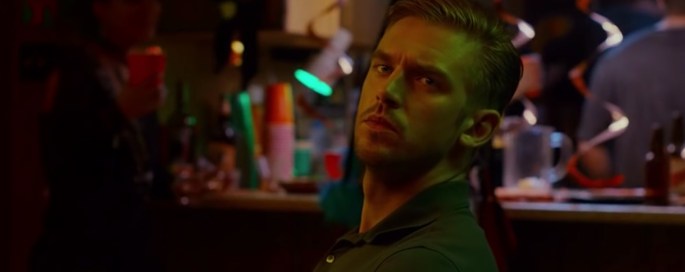
The Guest is some good, bloody, twisty, twisted, B-movie fun, filled with loving homages to a variety of 80’s and 90’s action-thriller staples, and a great, career-changing performance from Dan Stevens (formerly Matthew Crawley on TV’s Downton Abbey) as a soldier returning home from Iraq who, in more ways than one, may or may not be fit for society. He ingratiates himself into the household of one of his dead squad members, telling his parents and sexy sister (Maika Monroe) that he died heroically in battle. But what is the mysterious house guest hiding from the innocent people who have taken him in? This isn’t a serious film about PTSD or anything like that, but rather, the filmmakers have taken something tangible and turned it on its face, crafting a violent, nasty, John Carpenter-esque thriller out of shopworn ingredients. The results are funny, over the top, suspenseful, and extremely action oriented especially in the last act.

2

Director Adam Wingard and screenwriter Simon Barrett clearly love to skewer genre; check out their clever spin on the home-invasion scenario, the wild and absurdly entertaining effort You’re Next. And like that film, with The Guest, they’re up to their usual tricks: The Guest is a ludicrous movie but made with such confidence and a good amount of panache that you can’t help but go along for the ride. The filmmakers clearly have a lot of energy and they love what they’re doing; there’s a palpable sense of joy to much of this movie despite it getting very intense and trigger-happy. There are some vicious fights, some unexpected but refreshing cheesiness, a couple of left-field narrative “huh’s?” that take you by surprise, and a finale consisting of nearly 20 minutes of constant mayhem and bodily injury. Also, if you’re a fan of audio commentaries, the one featuring Wingard & Barrett is absolutely priceless, a film buff’s dream to be honest, as these two dudes are so in LOVE with cinema as a whole that their passion is totally infectious.

3.jpg

JOYCE CHOPRA’S SMOOTH TALK — A REVIEW BY NICK CLEMENT

3

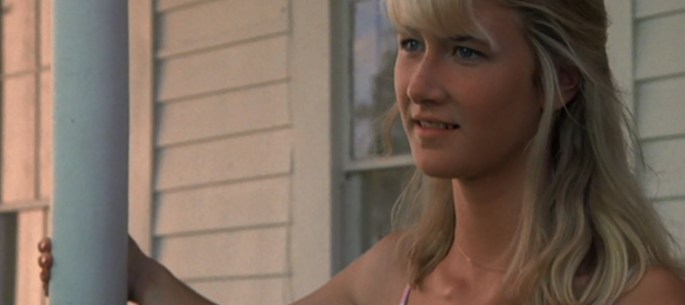
Smooth Talk is one of the greatest adolescent coming of age stories I’ve seen. It’s mystifying how this film doesn’t have a higher profile. Released for one week in theaters in 1985 after winning the Grand Jury Prize at Sundance and loosely based on the short story Where Are You Going, Where Have You Been? by Joyce Carol Oates, the film stars a then-18 year old Laura Dern, playing a 15 year old girl on the forefront of her own blossoming sexuality, unaware of the power that she holds over men, and too naïve to understand the dangerous consequences of her seemingly innocent actions. Dern, one of our greatest actresses for the last 30 years, is marvelous in the film, giving a performance that becomes all the richer when put into her own personal context as a human being. Here, at 18, she was asked to think like a 15 year old, which was only three years separated from her while she was shooting, thus presenting an intimate opportunity to potentially relive aspects of her own youth via cinematic artifice. Tom Cole’s screenplay adaptation skillfully depicts a family unit becoming untethered due to the stresses of growing up, and how shifting attitudes between mother and daughter can create friction and abrasive moments of personal interaction. Never cheap or cloying or overly sentimental, the film looks at its characters with intelligence and confidence, and never settles for the easy way out in any instance.

2

Her mother, played by Mary Kay Place in an extremely heartfelt performance that mixed equal parts exasperation and love, doesn’t know what to do with her daughter, instead focusing more effort on her first born child, while her husband, the casually aloof Levon Helm in a sadly hilarious performance, is so out to lunch as to never potentially understand the mindset of a teenaged girl, let alone his own daughter’s complicated development. Directed with sensitivity and grace by Joyce Chopra, who would go on to helm the epic disaster The Lemon Sisters in 1990, the film’s narrative moves into some seriously disturbing territory during the final act, when extra-sleazy Treat Williams shows up in an astonishing performance of seductive menace, portraying a man at least 10 years older than Dern, and who is looking for nothing remotely good at all. The final moments are devastating in their emotional and psychological implications, and Chopra’s decision to remain visually ambiguous during one key sequence was a bold and brave move, asking the audience to do the heavy lifting rather than being overt or explicit with her storytelling. James Glennon’s lyrical and poetic and summery cinematography perfectly meshed with Dennis Wasco’s evocative production design, while the score by Russ Kunkel and Bill Payne, featuring a few tracks from James Taylor’s including the subtly devious selection of “Handy Man” during a key cathartic moment, present a chilling sonic alternative to the more customary or expected melodic notes you’d expect from this sort of film. Olive Films has released Smooth Talk on Blu-ray, but sadly, there seems to be no special features. Netflix carries the DVD via their disc-at-home service. There’s a DVD also available for purchase at various online retailers. No streaming option on Amazon or Netflix is currently offered.

9


TARSEM’S THE FALL — A REVIEW BY NICK CLEMENT

1

THE FALL is not going to be everyone’s cup of tea. But for me, this is the brew I need. I drank the whole pot and loved every single sip, as this is truly a one of a kind  effort. Directed by Tarsem (THE CELL) from a script he co-wrote with Dan Gilroy (NIGHTCRAWLER) and Nico Soultanakis, THE FALL is one of the most personal and private films that I’ve ever encountered, a constant feast for the eyes, ears, and brain. Terrence Malick and Werner Herzog would blush if they saw it. It’s also an uncompromising, wholly masterful vision that was easily my favorite film in 2008, and over the years, I’ve repeatedly returned to it in an effort to unlock all of its secrets and filmic virtues. There is imagery in THE FALL that I will never forget, and for me, that’s what I look for in movies – a visual style that’s going to take me somewhere new and fantastic in a way that I’ve not experienced. This is a haunting movie, a work that mixes surrealist fantasy with a simple yet dark story, and THE FALL has captivated me in a way that few other releases have over the last decade. From the utterly engrossing opening in luscious, smoky, black and white, all the way to the emotionally draining and satisfying ending, THE FALL sweeps you out of your seat with lush, exotic, and unforgettable visions while spinning a touching yet complicated narrative that adds up to something completely spectacular and original.
3

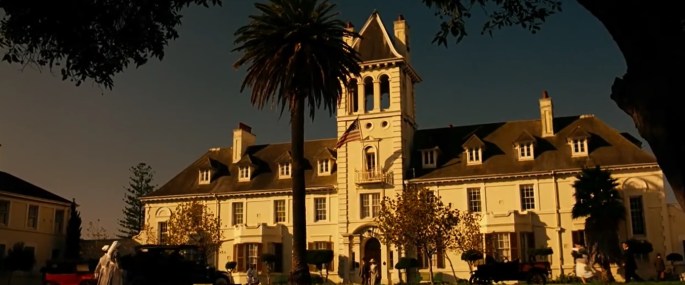
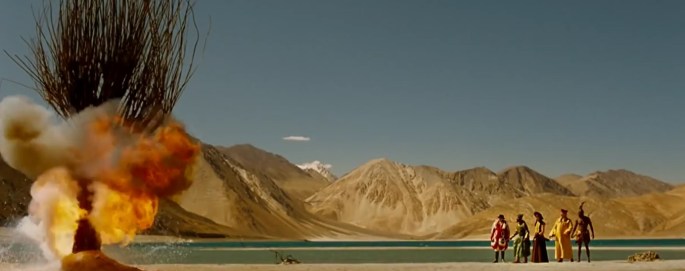
Shot over the course of four years in over 20 countries and fully financed by Tarsem out of his own pocket, THE FALL is the story of two lost souls who connect while convalescing in a Los Angeles hospital, sometime in the early 1920’s. Roy Walker (a tortured and excellent Lee Pace) is a Hollywood stuntman who has become paralyzed from the waist down after falling off his horse during the filming of a Western. Confined to his bed in the hospital, he is a man suffering not only from his terrible injury, but from a broken heart; it seems that his actress-girlfriend has run off with the film’s leading man. Along comes the impossibly precocious Alexandria (Catinca Untaru), a Romanian immigrant no older than 10 years old, who is nursing a broken arm at the hospital. Their paths cross and an instant bond is created. Roy begins to tell Alexandria a fantastical story about five adventurers (an Indian, an Italian explosives expert, a masked bandit, an African slave, and Charles Darwin) who are all caught in a battle with the evil Governor Odious. Alexandria patiently listens to Roy tell his story, and the audience gets to see how she envisions what she’s being told. Because of her wild imagination, the language barrier between her and Roy, and her childlike view of the world, Roy’s story shape-shifts in Alexandria’s head to the point of cerebral exhaustion. In a nod to THE WIZARD OF OZ, Alexandria imagines the five adventurers as versions of the people who surround her in the hospital (a doctor, a nurse, Roy himself, etc.). What she doesn’t realize is that Roy is really conning her; he starts stopping the story at integral moments (much to her cute annoyance) so that she can fetch him morphine pills from the hospital’s dispensary, in an attempt to slowly commit suicide. That’s as much of a plot synopsis that I will offer.
7

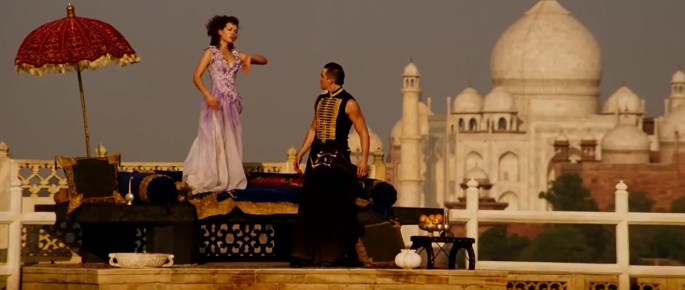
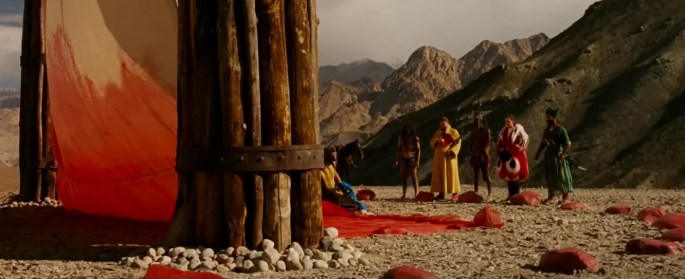
What I will report is that THE FALL is one of the most gorgeously mounted productions I can think of. Tarsem, a world-renowned commercials and music-video director who somehow has yet to truly explode on a massive stage, was operating on another level while making this film, working on an all-together different playing field with this film. His utter dominance of the visual language is so distinct and so intricately detailed that I’ve found it difficult to think of anyone else who comes close to this level of artistry. There are shades of BARAKA and PAN’S LABRYINTH and the aforementioned WIZARD OF OZ that can be felt throughout THE FALL, but in the end, Tarsem has created something completely original. This is a boldly imaginative movie that smartly pays homage to other works that have come before it, and yet sets out to chart its own specific course in the annals of cinematic fantasy. And still, for some reason, with as much talent as Tarsem clearly has, other than THE CELL, which benefitted from a terrific screenplay from Mark Protosevich, he’s yet to fully find his footing as an established filmmaker. Immortals was a great looking CGI/green screen movie that felt like 300’s cousin, and while I haven’t seen Mirror, Mirror, it felt like a decidedly minor effort based on the trailers. Self/Less came and went.

2

And to think, a project such as this one, could have easily been a complete failure. Without a strong story or well developed characters, the film would have become two hours of startlingly beautiful imagery in search of a meaningful narrative or dramatic purpose. The friendship that develops between Roy and Alexandria makes the fantasy sequences all the more involving because the closer they get in spirit, the more intense the fantastical elements become. Pace brings you into Roy’s situation and you feel his pain at times. His performance is always interesting and quite layered once you factor in the various levels that the story is pivoting on. Untaru is a revelation in her big screen debut, and even if she never makes another feature film again (she’s appeared in a few short films), she’ll always have this special piece of filmic history. Her line readings, at times alternating between supremely confident and slightly awkward, produce a nervous quality to the film that melds perfectly with the avant-garde nature of the visual scheme. Alexandria, whether due to her naiveté or youth, doesn’t understand everything that’s going on around her, which allows Tarsem and his writers the freedom to run wild with her interpretation of the story. Certain moments, including a swimming elephant, a chanting and dancing tribe of natives, a city painted in blue, a man resting on a bed of arrows like a bed of nails, and a creature separating itself from a flaming tree, were beyond words in their level of visual sophistication. Working with the brilliant cinematographer Colin Watkinson, THE FALL has one of the most unique and robust visual palettes that I’ve ever come across. The breathtaking opening sequence, showcasing Roy’s tragic accident in creamy black-and-white and super-slow-motion sets the tone right away; THE FALL is akin to a living, breathing painting.
5

THE FALL will be a polarizing film for most audiences, and to be honest, as with any great piece of moving image art, more than one viewing is likely required, because on first exposure, it’s incredibly easy to get lost in the visuals as the film is constantly overwhelming. It’s experimental, it’s artsy, it’s innocently pretentious in a great way, and above all, it’s totally exhilarating. To watch a filmmaker shoot for the moon the way Tarsem did here seems almost lunatic in the level of overall ambition. This is not the sort of film that could ever get made through the traditional studio system and it’s not the sort of film that, sadly, will win over sold-out crowds and every critic who checks it out (it’s a 50/50 split at Rottentomatoes, with some truly moronic comments made by some sneering “critics”). However, I truly feel that this is a work of art, and a beyond personal accomplishment that’s worth seeking out if you care at all about the power of filmmaking and storytelling. It’s a visual tour de force that has few equals and one of the rare instances where a filmmaker literally put their own money where their mouth was, conjuring up results that are nothing short of cinematically intoxicating.
9

MELANIE LAURENT’S BREATHE — A REVIEW BY NICK CLEMENT

3

I don’t want to oversell Melanie Laurent’s brilliant psychological thriller Breathe (Respire). It’s 85 minutes of cinematic perfection. There isn’t one bad scene or false moment. It’s a slow-burn first two acts which give way to some shattering developments by the finale. I wasn’t prepared for this film, how emotionally hard-hitting it would be, or for how stylish on a cinematic level it would get. This is a gorgeous film that was shot with a painter’s eye; cinematographer Arnaud Potier is now firmly on my radar. Released in France in 2014 and based on the novel by Anne-Sophie Brasme, Laurent and Julien Lambroschini handled the scripting adaptation, and while I can’t claim to be familiar with the source material, what they’ve put on screen is piercing, troubling, sexy, and fascinating on numerous levels. Starring Joséphine Japy and Lou de Laâge as two high school seniors who unexpectedly fall into each other’s orbits, the film operates as a smart and savvy mix of Blue is the Warmest Color and Fatal Attraction, and because of how delicate the entire piece is, I’m reluctant to reveal much more about the plot. What I will allow is that Laurent’s film is thematically rich, poking at the social norms and constructs of the modern high school setting, the many layers of friendship, obsession, and emerging sexuality, while toying with preconceived genre expectations in all the best ways. The two lead performances are tremendous, totally different from one another, and dependent on each other’s abilities in ways that two-handers like this really need to pounce on. Supporting performances are all top notch, there’s a Malick-esque vibe to some of Potier’s striking visuals along with some expertly judged stedicam work and slow-motion techniques, and the final scene is one that you’ll never, ever forget. Had I seen this film during the year of its initial release, it probably makes my top 15. Breathe is available as a DVD rental via Netflix and as a streaming option on Amazon.

2

MICHAEL BAY’S 13 HOURS — A REVIEW BY NICK CLEMENT

3

Michael Bay is back. Potentially forever lost to giant toy movies (which certainly have all had their moments of gee-whiz visual insanity), he’s stepped up and made an uncompromising modern combat film with 13 Hours. Smartly avoiding any overt political specifying or sketchy speculation, Chuck Hogan’s battle-ready screenplay, based on Mitchell Zuckoff’s book, is all forward momentum, focusing on the harrowing and desperate efforts of six American private military contractors who leapt into action when a United States diplomatic compound in Benghazi was attacked by terrorist insurgents on September 11, 2012. Captured with Bay’s always spectacular sense of bravado, heroics and adventure, this is a grab you by the throat action picture, violent and sad and upsetting, never diluted by extraneous side plots or unnecessary digressions, all made more robust by the surprisingly thoughtful contextualization of the enemy and the local people of the area. The extra-macho cast includes the movie stealing James Badge Dale who completely dominates with a tough as nails performance, a surprisingly effective John Krasinski, the terrific Pablo Schreiber, Max Martini, Toby Stephens, David Denman, Dominic Fumusa, Freddie Stroma, and Alexia Barlier. The opening act and closing moments might’ve been a bit tighter, and some of the spoken dialogue is a tad corny in spots, but these are very minor quibbles, as this was a movie designed for maximum sensory force and extreme visceral impact, made by a filmmaker who seemed liberated to be working in a more decidedly adult arena.

2

Dion Beebe’s powerhouse cinematography is nearly hallucinatory at times, conjuring up images that are absolutely tremendous, while emphasizing spatial geography in nearly every instance, putting you smack-dab in the middle of one ferocious fire-fight after another with striking clarity. You’ve seen plenty of war films but not one done by Bay in this particular fashion, and it’s clear that he took notes from Black Hawk Down and Lone Survivor and other recent genre entries that have demonstrated a single-minded obsession of detailing bloody, terrifying sequences of wartime violence. The lucid and precise editing by master cutter Pietro Scalia (Black Hawk Down) only further ratcheted up the suspense, dread, and excitement. Lorne Balfe’s on-edge musical score highlights triumph where needed but mostly uses somber, almost mournful ambient sounds to give the film an added sonic pulse. One set-piece in particular, featuring a group of mercenaries taking refuge in a heavily armored Mercedes SUV that comes under fire from every direction, ranks as some of the best on-screen firepower that Bay has ever delivered, to say nothing of the overwhelming final blasts of rooftop fighting, with one particular on-screen injury ranking as one of the gnarliest I’ve seen. And that’s saying something. I’ve always been a fan of Bay’s distinct brand of visual mania, and this is the hardcore action picture I’ve been waiting to see from him for a very, very long time.

6

ULU GROSBARD’S STRAIGHT TIME — A REVIEW BY NICK CLEMENT

2

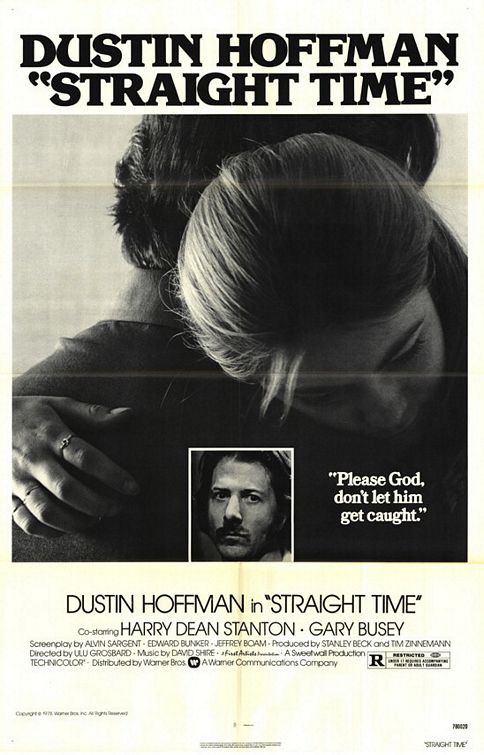
Helmed by stage and screen director Ulu Grosbard and written by screenwriters Alvin Sargent (Ordinary People), Edward Bunker (whose life the film is based on), and Jeffrey Boam (Lethal Weapon 2, Indiana Jones and the Last Crusade, Innerspace), the 1978 film Straight Time feels more like a Michael Mann production than anything else (he was an uncredited writer on the project, along with Slap Shot’s Nancy Dowd), with certain aspects feeling like early warm-ups for the events that would comprise the narratives of Thief and Heat. Starring Dustin Hoffman as a career criminal in what ultimately amounts to more than likely the best performance of his legendary career, this is a film of simple, direct power, never straying over the top, preferring sensible, if sudden and surprising, plot developments that propel the story forward at a brisk pace.

2

The fantastic M. Emmet Walsh co-stars as Hoffman’s overbearing parole officer, a man all too eager to throw Hoffman back into the joint after he’s been released in the first scene after six years in the pen, and there’s one scene between him and Hoffman at the film’s midpoint that’s got to be one of the funniest, most unexpected things I’ve seen in any movie. An innocent looking Theresa Russell, 21 at the time(!), is Hoffman’s love interest, a job-finder working with ex-cons who develops an unlikely crush on Hoffman. She knows he’s bad, just not HOW bad, and her character struck me as an almost exact match to Amy Brenneman’s role in Mann’s Heat. She’s the normally sensible woman who just gravitates towards the wrong man, even if her head is telling her no, because her heart is telling her yes.

1

The Heat-isms don’t stop there either; in one scene, Hoffman gives a moralistic speech that sounds like a junior version of De Niro’s cold-hearted “walk out on ’em in 30 seconds flat if you spot the heat around the corner” spiel that’s now become so popular. Hoffman’s increasingly desperate string of robberies mimics the late in the game plotting of Heat, and one lead character’s decision to kill another character feels incredibly reminiscent of Mann having De Niro take care of business during the final 30 minutes of Heat. Harry Dean Stanton, Gary Busey(!), and an almost unrecognizable Kathy Bates also have memorable bit parts. Hoffman is just electric here, quiet and reserved one moment, then all explosive rage the next, and while it feels a bit movie-movie that a sweet girl like the one Russell portrays would fall for a guy like Hoffman, I went along with it at all times because of the conviction of Grosbard’s unfussy direction, the uniformity of the performances, and the surprising beats that the story took at more than one juncture.

straight_time

Grosbard, a talented storyteller who moved back and forth between movies and theater, never got in the way of his performers or added any unnecessary stylistic flourishes that would have otherwise distracted from his highly disciplined aesthetic. Owen Roizman’s crisp and clean cinematography eschewed any sense of artifice, bringing the same stripped down quality he brought to such seminal 70’s films such as The French Connection, Network, and The Exorcist. Hopefully, Warner Brothers will put out a special edition Blu-ray or license the rights to The Criterion Collection, because this is a film that’s worthy of long-term preservation.

3