DANNY DEVITO’S DEATH TO SMOOCHY — A REVIEW BY NICK CLEMENT

2

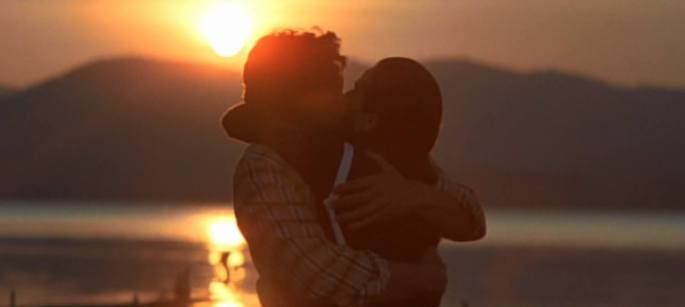
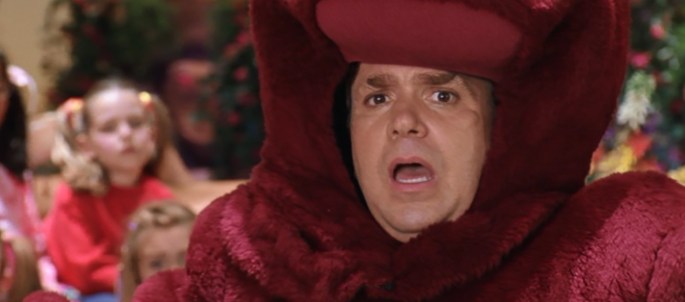
Death to Smoochy has got to be one of the ultimate “love it or hate it” movies. I think it’s absolutely hysterical and one of the funniest, sharpest critiques of pop culture entertainment that’s been put up on the big screen in years. Mercilessly directed by Danny DeVito and written seemingly without limits by Adam Resnick, the film opened to savage reviews and audience indifference back in 2002, but for me, easily ranks as one of the craziest black comedies in recent memory. Starring Robin Williams, in one of his absolute best performances, as a cracked-out and morally bankrupt children’s TV show host named Rainbow Randolph, the story charts his very public firing due to an off-camera bribery scandal, while detailing the rivalry that erupts between him and his replacement, a completely naive and ridiculous Edward Norton, doing unexpectedly great comedic work as a simpleton with his own costumed creation: Smoochy the dinosaur. The supporting cast was superb, with the likes of extra-sardonic Jon Stewart (dig the bowl cut!) and extra-hot Catherine Keener delivering some scaborous jabs towards at the TV industry, both playing jaded and cynical network execs who are mostly only interested in the bottom line. But the film is repeatedly stolen by the great character actor Michael Rispoli, who portrays a punch-drunk and mostly deaf former boxer who takes a shine to Norton and the Smoochy character, and who wants to get in on the fun himself. How his character is integrated into the plot yields some serious laughs. Pam Ferris, Harvey Fierstein and Vincent Schiavelli all landed some great jokes with perfect comic timing.

1

Death to Smoochy is a film that revels in its cruelty, delighting in the pschological terrorization of children, the mental anguish of numerous adult characters, and brazen comic violence that pushes the limits of taste and respectability on more than one occasion. In short, it’s fun for the entire family! It’s no surprise that DeVito ended up on the long running FX comedy series It’s Always Sunny in Philadelphia, as all of Death to Smoochy feels like it was cut from the same exuberantly devilish cloth as that wild and woolly show. The dynamite script leveld insults at everyone, never backing down from any challenge it presented to itself within the narrative, and finding the perfect balance between funny-nasty and outright off-putting. Cinematographer Anastas N. Michos knew exactly how to capture the harsh light of a TV soundstage, giving the picture a sickly visual texture that extends to the grotesque actions of the characters. The purposefully tacky production design was spot on, too. And damn, it really can’t be undersold how sexy Keener was here; she’d do similarly icy-hot work in Being John Malkovich, 8mm, Your Friends and Neighbors, and Full Frontal, before dropping a charming bomb in The 40 Year Old Virgin. This is a ribald, filthy, risk-taking, and completely mean spirited film, crafted with an anarchic spirit all throughout, and a work that deserved to gross a lot more than $9 million at the domestic box-office.
6

STANLEY DONEN’S TWO FOR THE ROAD — A REVIEW BY NICK CLEMENT

2

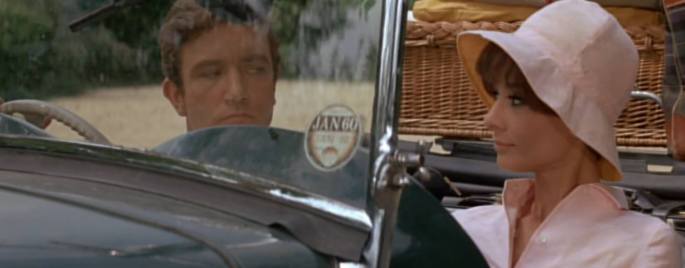
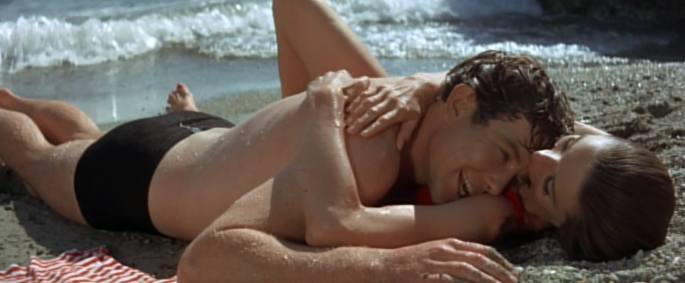
Stanley Donen’s 1967 British marriage dramedy Two for the Road is a film that I feel like a schmuck for not seeing sooner. Written by Frederic Raphael (who would receive an Oscar nomination for his brilliant work and who would later collaborate with Stanley Kubrick on Eyes Wide Shut), the film is a witty, serious, subtle, and totally late ‘60’s style and acting piece with fabulous performances from Albert Finney, Audrey Hepburn, Eleanor Bron, William Daniels, and a child performance of purposefully staggering annoyance by Gabrielle Middleton, who you literally just want to leave on the side of the road. The film centers on a husband and wife (Finney and Hepburn) who begin to examine and reminisce about their 12 year relationship while taking an emotionally taxing trip to Southern France. Various events from their lives are crisscrossed throughout the script, with former lovers making appearances, potential new lovers becoming a possibility, and a constant sense of “anything-might-happen” driving the story. Raphael’s boldly non-linear screenplay makes some modern movies feel downright conventional, and I’d have to assume that back in the day, this narrative style really took people by surprise.

1

The relationship on display is examined from multiple perspectives in multiple time periods, with both Finney and Hepburn running a gamut of emotions while hitting major life milestones, and contending with the birth of their daughter. Finney, in what can sort of be considered a warm up to his blistering work in Alan Parker’s 1982 masterpiece Shoot the Moon, is fantastic as a man caught between his desire to be a loving husband and the man who he believes he is deep down inside, even if that’s not who he is in actuality. Hepburn, stunningly photographed and costumed in every scene, gets lots of laughs and enjoys playful banter with Finney, while also getting a chance to explore her dramatic side, especially during the emotionally volatile last act. I loved how in certain scenes, Donen would edit a bit sooner than normal, thus forcing the viewer to put some of the story pieces together on their own, and while nothing is left up in the air, the way that Raphael devised his tricky but coherent screenplay allows for all sorts of speculation about what’s in store for the various characters by the film’s conclusion. The jaunty and spirited original score by Henry Mancini peppers each scene with distinct personality, and Donen’s New Wave-inspired aesthetic touches keep the film visually interesting and narratively unique. The film is also a feast for the eyes for anyone who considers themselves a vintage car enthusiast.

3

NICOLAS ROEG’S THE WITCHES — A REVIEW BY NICK CLEMENT

witches_xlg

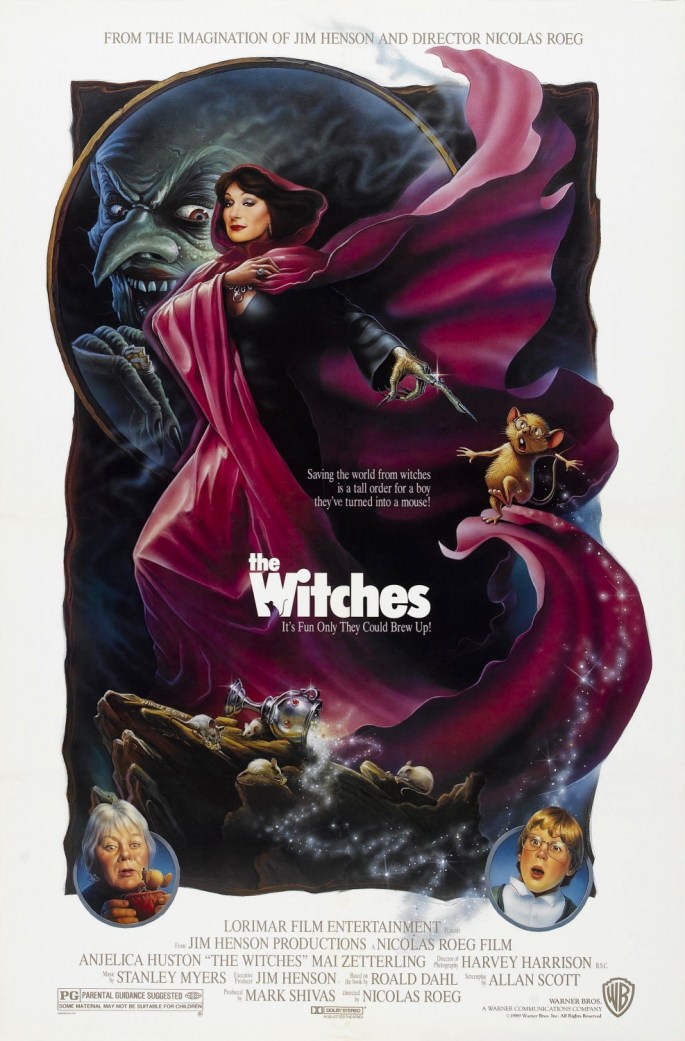
I can remember seeing Nicolas Roeg’s The Witches on opening day with my mother and sister back in late August of 1990 and I think I’m still losing some sleep over it. This is a funky, wild, frightening, and totally delightful family film that kids will be equal parts amazed and horrified by. And for just cause, as the human-to-mice transformation effects in this movie are bewildering and playfully creepy, all done in those glorious pre-CGI days where cinematic artisans and technicians all joined forces to create true movie magic before everyone got extra lazy by relying on computers to create their art. Based on the classic Roald Dahl book and produced by Jim Henson’s production company, this film sadly only grossed $10 million in the United States, as it was probably deemed too “British” or weird for most audiences. However, over the years, I’d like to think that it’s become a cult classic, as it represents the type of PG-rated filmmaking you rarely see these days. Anjelica Huston’s performance as the head witch haunted me for years, well before I knew who she “was” as an actress, while Rowan Atkinson provided all sorts of funny comic relief. But when you really boil it all down, this is a NASTY movie, centering on a witch population who are interested in destroying every child they can possibly find. There’s a sense of menace to much of this movie that always left me on edge but that always made me want to come back for repeat visits. The Witches was the final film that Henson worked on before his untimely death and the final theatrical film from production company Lorimar Productions. Apparently, Dahl wanted Cher for the lead role, but she was busy with other projects. The puppet work is extraordinary.

CLINT EASTWOOD’S SPACE COWBOYS — A REVIEW BY NICK CLEMENT

1

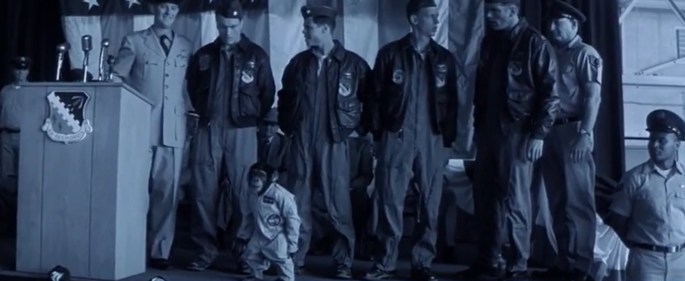
I’ve always been a big fan of Clint Eastwood’s Space Cowboys. Released in August of 2000, the film is a sincere and compelling tale of retired ex-test pilots who take the chance of a lifetime. It appears that an old Soviet satellite is in need of repair, and nobody knows how to handle business better than Eastwood, Donald Sutherland, Tommy Lee Jones, and James Garner. Sort of like Armageddon for the AARP audience, this refreshingly small-scale but still high-stakes scenario got a lot of comic mileage out of the collective ages of the co-stars, but still told a lean and effective story, with Ken Kaufman and Howard Klausner’s peppy screenplay giving each actor their moment to shine, and not wimping out at the finale. In fact, the final shot of this movie has continued to haunt me for the last 16 years; I’ve never forgotten it as it still chills me to the bone whenever I think about it. A great supporting cast including Loren Dean, Marcia Gay Harden, William DeVane, Courtney B. Vance, Rade Šerbedžija, and James Cromwell all did solid character work, while Jack N. Green’s stylishly composed cinematography never called overt attention to itself while still displaying visual gravitas and a smart use of the widescreen frame.

2

This isn’t a game changer, but rather, a comfortably solid film, the sort of late summer programmer that was better than it had any right in being, which is mostly due to Eastwood’s classy sense of direction, and the amusing performances by all of the old-timers. There’s emotional pay-off, terrific action, and a genuine sense that everyone involved was having fun. The opening sequence, set in 1958, is a stunner, showing the test-piloting exploits of the guys when they were young hot shots, with the entire prologue captured in a unique shade of black and white which also gave off a cool blue-grey visual sheen; I always get totally engrossed in this film from its opening moments. Shot for an economical $60 million but never feeling skimpy at any moment, the film became a solid box office hit, taking in $90 million domestically and another $40 million overseas. Nominated for an Oscar for Best Sound Editing and carries a triumphant musical score courtesy of frequent Eastwood collaborator Lennie Niehaus. The film marks the feature film debut of Jon Hamm. Fly Me to the Moon POWER.

3

FRANK OZ’S BOWFINGER — A REVIEW BY NICK CLEMENT

bowfinger

Silly and smart in equal measure, the Frank Oz showbiz comedy Bowfinger hit some really sharp notes of pointed satire, while still displaying a care-free, absurdist sense of its own willfully unbelievable plot. Released in the summer of 1999 and feeling more and more unique as the years have progressed, the film showcased Steve Martin (who also penned the witty screenplay) in pure rapscallion mode, portraying a bottom-barrel Hollywood producer looking to trick the world’s biggest action star, Kitt Ramsey (an absolutely superb Eddie Murphy), into starring in his sci-fi B-movie that he’s been shooting undercover. After the plot gets entangled in various idiocies, Ramsey disappears, which causes Bowfinger to hire a dimwitted lookalike, again played by Murphy, with serious comic hijinks ensuing. The sequence on the freeway is an all-timer; I can’t believe that the studio asked Martin to cut it out of the script as it’s the funniest sequence in the film. And it goes without saying that Murphy hasn’t been this good in years, maybe since Bowfinger, delivering two very different and equally successful comedic performances.

Coming on the heels of the more serious minded The Truman Show and the more audience friendly EDtv, this was the third meta-reality-TV-movie in this late 90’s cycle of prophetic filmmaking, and if Bowfinger didn’t go for the jugular the way Truman did or play it as enjoyably safe as EDtv, Oz and his collaborators were still able to craft their own special little gem, a movie that moves to its own beat and plays by its own rules. Featuring a fantastic supporting cast featuring Heather Graham, Christine Baranski, Terrence Stamp, Robert Downey Jr., Jamie Kennedy, and Adam Alexi-Malle, and including some hilarious jabs at Scientology throughout the playfully mischievous script, Bowfinger feels like very few other studio comedies that I can think of, as it deftly juggled multiple tones in an effort to create something purposefully different. Warmly embraced by critics, the film did $60 million domestic and just about $100 worldwide, which seems about right, as the ingredients were certainly more challenging than most of your typical big budget offerings from roughly 20 years ago. Originally titled Bowfinger’s Big Thing. Chubby Rain POWER.

NASH EDGERTON’S THE SQUARE — A REVIEW BY NICK CLEMENT

1

The 2010 Australian crime film The Square is one of the best thrillers that you’ve never seen. Tautly directed by Nash Edgerton (his brother Joel is one of the main characters and co-wrote the brilliantly layered screenplay), this shady and shifty neo-noir sits atop of the genre pack with titles such as Red Rock West, The Last Seduction, Blood Simple, and Bound – it’s a damn near flawless piece of cinematic screw-tightening and air-tight filmmaking. There is a confidence to this film that’s highly engrossing to observe, as right from the start, you know you’re in the hands of a filmmaker who knew exactly what he wanted. With twists coming left and right and all the way up until the end, The Square requires your attention, for which you’ll be handsomely rewarded. Spoiling any of plot’s surprises would be criminal, but the action centers on an unhappily married guy named Raymond (the gruff David Roberts), who is carrying on an affair with his beautiful young mistress named Carla (Claire van der Boom), who in turn is stealing from her mullet-sporting, low-life boyfriend, Billy (a skeevy and oily Joel Edgerton). When a plan to rob Billy goes haywire and unexpected deaths ensue, all hell breaks loose. Plus, Raymond is dealing with shady contractors at his construction site who may or may not know what Raymond has been up too with Carla.

2

Mysterious notes are sent, people are followed, chased, and killed, and more than one person gets shot. Nobody is safe in The Square. Not even the family pet. All of this is done with expert style and with a minimum of logic lapses and inconsistencies. And across the board, the acting is excellent, with Roberts and Boom registering strongly as two people who never should have met, let alone fallen in love. Mixing a De Palma-esque voyeuristic shooting style (be on the lookout for some amazing stedicam work) with gritty, hand-held realism, Edgerton ramps up the suspense in one scene after another, with maximum results by the conclusion. This is a genuinely unpredictable film that only the smartest genre enthusiasts will be able to guess before the end credits start rolling. Because there is so much going in within the plot during The Square, the film could have easily felt bogged down in exposition or gone off the rails into implausible realms, so it’s a testament to Edgerton’s writing and directing skills that the narrative never grinds to a halt, with the brisk pace complimenting the ruthless action sequences. The Square feels like an early Coen brothers film to me, reminiscent of Blood Simple, a movie totally in command of its story and style, made by people who love the genre they’re working in, and who want to wow people with a good old fashioned crime thriller. Films like this are in short supply.

3


THE RUSSO BROTHERS’ CAPTAIN AMERICA: CIVIL WAR — A REVIEW BY NICK CLEMENT

1

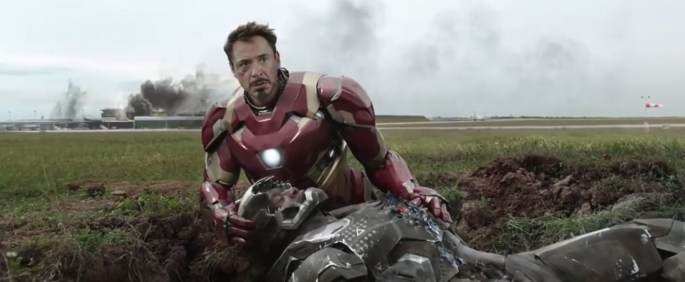
The Russo Brothers know exactly how to blend all of the ingredients within the parameters of a Marvel super-production. Captain America was always my #1 Marvel hero, so it’s no surprise that Joe Johnston’s square-jawed and retro-futurist Captain America: The First Avenger remains my favorite film from within the MCU. The Russo brothers’ follow up, Captain America: The Winter Soldier, was a fabulous integration of current pop blockbuster trends and the vibe of a 70’s paranoid thriller, with the added bonus of leathery Robert Redford as the chief baddie. And now, with Captain America: Civil War, the sibling filmmakers have added an epic scope to their already sharp sense of intelligent storytelling, with a superhero royal rumble for the ages, with all sorts of (mostly) seamless special effects being hurled at the audience with an almost elegant sense of wonder, primarily due to Trent Opaloch’s bold, vibrant, absolutely sensational widescreen cinematography. I wasn’t a big fan of The Avengers: The Age of Ultron, so while this film picks up in the aftermath of the destructive events of that recent effort, Civil War boldly sets forth in a seemingly new direction. And even if all of the main characters are on relative speaking terms by the end of the film, we get a sense that an interesting shift has occurred in the overall group dynamics moving forward with this particular world that’s been built over the last 10 years. I just wish that the creative team had called this The Avengers: Civil War, and had included Thor and the Hulk, as they’re off-screen for no discernible reason. Yes, the friendship between Captain America and his buddy Bucky, aka The Winter Soldier, is explored even further, with a crucial plot twist really sealing the deal in terms of an organic reason for the most exciting and hard-core moments of superhero vs. superhero action. But overall, this is a major team-up flick of the first order.

3.jpg

The film feels like a logical extension of the ever growing universe, with the introduction of a new and brash Spiderman (Tom Holland, excellent and joyful), the mysterious and lethal Black Panther (a fierce Chadwick Boseman), and a focus on the civilian collateral damage that has taken place during the various globe-stretching brawls from all of the previous films. The plot involves the creation of a set of rules that are set to govern superhero involvement all around the world, with the numerous group members all displaying their own responses to the idea of being overseen by a higher power. Much like this year’s earlier superhero blow-out Batman vs. Superman: Dawn of Justice, Civil War feels overstuffed, but yet more focused, and while I preferred Zack Snyder’s film more as a whole, that has a lot to do with nostalgia and an intense love for that filmmaker’s particular visual aesthetic, even if I think he could have dialed back some of the CGI this time around. What I admire about the Russo’s is that they ground their film in as much reality as possible, keeping the themes topical and relevant, with a solid emphasis on character motivation and not as much reliance on quirky humor, though the film certainly has its numerous moments of inspired levity. Chris Evans continues to own the role of Captain America, as he dominates the film whenever he’s on screen, and Robert Downey Jr. will forever have a problem shedding the visage of Tony Stark/Ironman, as he’s way too good as the dual characters. Paul Rudd steals the show every time he appears as Ant-Man, while Elizabeth Olsen gets some cool and very comic-booky moments during the numerous action scenes. Daniel Bruhl’s credible villain keeps the film’s main dramatic conflict intimate rather than world-ending, a refreshing change of pace, and while clocking in at close to two and a half hours, the visuals have a snap and the pacing has a pop so that time goes by rather fast while viewing.

1

SHANE BLACK’S THE NICE GUYS — A REVIEW BY NICK CLEMENT

1

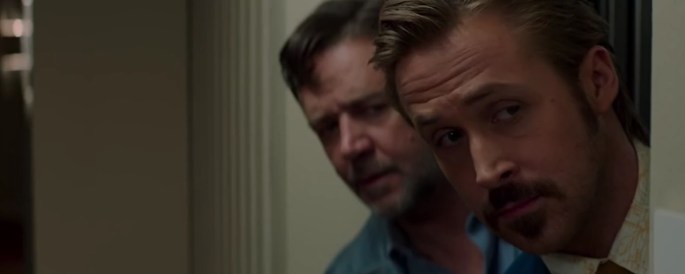
Shane Black’s The Nice Guys is an extremely entertaining throwback to the 80’s buddy-cop film, but switch out cops for bumbling private detectives, and add a dash of 70’s-flavored aroma to the cinematic atmosphere. Starring the improbably perfect pairing of Ryan Gosling and Russell Crowe as mismatched partners who start the film as enemies but learn to love each other by the end, the film has a rough-house vibe with Black’s usual smart-assed sense of humor on full display. Add in a dash of Freebie and the Bean inspired vehicular mayhem (LOVE the opening bit with the car vs. house!), a seedy porno element, copious use of casual vulgarity, a funkadelic soundtrack, some lively and bloody (but never gratuitous) shoot-outs, and a sprinkling of nudity – it’s all so Shane Black and I love it. He’s got a way of adding unique character bits to the smallest of supporting players, and his two big leads get some serious zingers while displaying layered character backgrounds that help to add to the tonal richness of the piece. Gosling in particular seems to be having a ball with the comedic elements, even riffing on classic Abbot and Costello material. I love how the film mixes tones all throughout, and while the stakes are high, you know that it’ll all end comfortably. Crowe looks like he gained 50 pounds of fat and his laconic delivery is well suited to his character’s brutish tendencies. The two actors have genuine chemistry with one another and it’s a pleasure to watch them interact.

2

I am not going to attempt to summarize or potentially spoil the shaggy-dog plot, but it sort of reminded me of elements of The Big Lebowski, where the almost tangential A-story continues to escalate in craziness, while all of these interesting characters walk in and out of the twisting narrative. There’s a careening sense to the physical action which was also really enjoyable, especially during the big, raucous set piece at the film’s mid-section, a debauched porn-party at a glitzy mansion in the hills that turns into a shooting gallery. The film looks fabulous thanks to master cinematographer Philippe Rousselout (Big Fish, The People vs. Larry Flynt) calling the shots behind the camera, and the pace is zippy due to the crisp editing by Joel Negron. The widescreen images have been purposefully altered to suggest the haze and grime of late 70’s Los Angeles, all smoggy and brown and gold and amber. Too many comedies aren’t creatively thought out on a photographic level, and because Black cares about this side of filmmaking, his witty script compliments his great sense as a visual storyteller. A great ensemble cast is along for the ride, including Kim Basinger (still smoking hot), Keith David, Matt Bomer, the alluring Margaret Qualley, and the excellent Angourie Rice as Gosling’s mischievous daughter, which is one of Black’s classic movie staples. My only question: Why didn’t he set this film during the Christmas holiday?

3


BEN STEINBAUER’S WINNEBAGO MAN — A REVIEW BY NICK CLEMENT

1

To say that Jack Rebney is a pissed-off guy would be an understatement. For background, go and YouTube the phrase: The Angriest Man in the World. What you’ll encounter are a slew of viral videos all centering upon Rebney, back in the late 80’s, working as a pitch-man for the Winnebago company. During a particularly arduous, steamy-hot, mid-August shoot, Rebney kept screwing up (and cursing up a fuckin’ storm), and all of the outtakes were edited into a reel by one of the editors working on the shoot. The rest is history. What you get is pure and raw and utterly hysterical; a guy coming undone on camera, flipping out repeatedly on both his crew and himself, and even laughing about some of it. The documentary Winnebago Man is part genuflection, part investigation, and all absolutely fascinating and grin inducing. After becoming fixated on the viral videos, newbie filmmaker Ben Steinbauer boldly tracked down Rebney in northern California, in an effort to get a glimpse into the man’s life and apparent madness, and with the obvious hopes of getting Rebney to talk about the infamous Winnebago shoot.

Winnebago Man is many things at once — funny, dark, sad, eye-opening, and by the end, oddly moving. Rebney, unlike, say, Timothy Treadwell (another eccentric doc subject — see Grizzly Man), doesn’t come across as a total loon, but rather, a man fed up with a country that he feels unfamiliar with. All one has to do is view the completed sales tape that he produced for Winnebago and it’ll become clear that this was a guy who cared about his job and what he was doing. He could never have figured that some cussing and yelling done on a closed set would ever be remembered the way it has been. I won’t spoil any of the priceless surprises and genuine twists that you’ll learn from watching this exceedingly entertaining movie. It’s the kind of doc that a lot of people are going to discover and instantly love.

2

J.C. CHANDOR’S ALL IS LOST — A REVIEW BY NICK CLEMENT

1

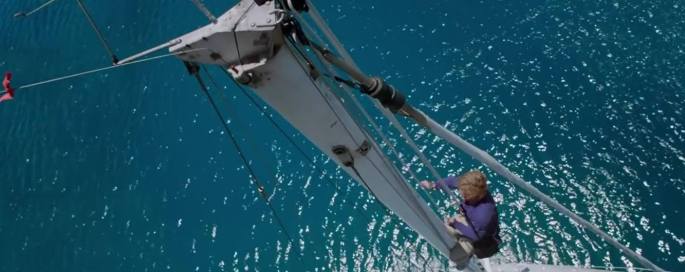
All is Lost is as simple and straightforward as storytelling will likely get, but at the same time, it strenuously avoids or upends cliché at almost every turn and is totally devoid of obvious, for-the-cheap-seats-sentimentality. It’s a nearly wordless motion picture, relying on clear-cut visual storytelling to communicate its ideas and feelings, and I am never less than fully moved to tears by its devastating, thought provoking conclusion. Seriously – I was an emotional, physical, and spiritual DISASTER when the lights came up after my first viewing in the theater, literally bawling like a confused, scared baby. This film AFFECTED me, and after countless viewings, I’m still choked up when that final sequence begins to unfold. Writer/director J.C. Chandor and screen legend Robert Redford, in an utterly historic performance, take the viewer on a harrowing and breathtaking journey with an ending that shakes to the core – this is vital cinema for anyone who considers themselves a fan of the medium. Recalling the sadness and melancholy of Hemingway’s The Old Man and the Sea but also infused with a sense of pride and grace under pressure, All is Lost will likely test the limits of most moviegoers, as it offers little in the way of backstory or easily identifiable character traits, and values patience and quiet like few recent films.

2

The primal muscularity and overwhelming visceral tension that Chandor and cinematographer Frank G. DeMarco achieved harkens back to 80’s-era Friedkin and Mann as well as the works of Philip Kaufman, Joe Carnahan, and Robert Zemeckis, recalling films such as Sorcerer, Thief, The White Dawn, The Grey, and Castaway, while still achieving its own sense of place and importance. Shooting on the open water in full 2.35:1 widescreen, while also utilizing hand-held cameras which were fitted with wide-angle lenses, the filmmakers presented themselves with a huge task, and the film possess a near-constant state of nervousness and visual excitement. Whatever CGI or green screen work that was used was brilliantly integrated and kept to a minimum, which maximizes the overall verisimilitude of the film. Alex Ebert’s moody and inventive score surrounds the film but never overpowers it, allowing Redford’s remarkable face to do the heavy emotional lifting rather than a cloying soundtrack; it’s the smartest use of music in a film that I can remember. All is Lost is a tour de force for all involved, a work that’s interested in pushing boundaries and expectations, and is clearly the closest we will get to pure, existential filmmaking in the current Hollywood landscape. This was my #1 film from 2013, and while that year was tremendous overall, this is the one that I feel truly changed the game (The Counselor is a VERY close #2). Magnificent, minimalist, profound, and ultimately masterful, Chandor has fast become one of the premiere young talents working today.

3