JOHN SAYLES’ LONE STAR — A REVIEW BY NICK CLEMENT

lone_star_ver1_xlg

I can remember my parents taking me to see John Sayles’ Lone Star 20 years ago and how it utterly blew my mind. I was in my cinematically formative years, devouring the works of Scorsese and Mann and Stone and Scott and Tarantino, and then my dad had me see City of Hope, Matewan, and Eight Men Out at home with him on VHS, and in tandem with Lone Star, I became a lifelong fan of Sayles’ uniquely humanistic approach to storytelling. He’s one of the most natural, unhurried, and totally relaxed filmmakers that I can think of, and this 1996 neo-noir crime gem is easily one of the best and most layered works. Set in a small Texas town and featuring a stellar ensemble cast featuring the always amazing Chris Cooper, a note-perfect Kris Kristofferson, the fabulous Elizabeth Pena, and Matthew McConaughey in one of his first big attention-getting roles, the story centers on murder investigation that stretches generations, and as usual for Sayles, themes of racism, class, and family are at the forefront of the narrative. The tone is contemplative and the performances are beautiful and tragic and honest, while as a filmmaker, Sayles was able to capture a very believable sense of place and atmosphere through strong work with the amazing cinematographer Stuart Dryburgh (Blackhat, The Secret Life of Walter Mitty). Leisurely paced with Sayles serving as his own graceful editor, the film is never boring, and at times gets downright sprawling, and it seems a shame that an outfit like The Criterion Collection hasn’t released this as the special edition that it truly deserves.

MICHAEL BAY’S BAD BOYS II — A REVIEW BY NICK CLEMENT

1.jpg

Michael Bay is capable of making great, completely rollicking action films. His particular brand of visual mania has frequently been spectacular, and at times utterly gob-smacking; he’s the king of the money shot, the emperor of the razzle-dazzle trailer. A premiere visual stylist who cut his teeth on snazzy commercials and music videos and clearly influenced by the aesthetics of Tony Scott and John McTiernan (to name just a few), he caught the eye of super producer Jerry Bruckheimer early on, and it’s clear that he’s proud of the loud and massively-scaled summer movies that he unleashes on the multiplexes. Throughout the years he’s been one of the most prolific and successful orchestrators of cinematic chaos that the film world has ever seen. Look no further than The Rock, Bad Boys, The Island, and the first Transformers movie – these are supreme pop-corn entertainments made by a guy who is out to stun his audience with one insanely detailed image after another. Armageddon and Pearl Harbor are both shamelessly entertaining in their earnest cornball hysterics, tapping into an apple-pie sense of Americana that’s hard to resist. I’m also a huge fan of his underrated Pain & Gain, which acts as a treatise on everything that a Bay movie can and should be, but because of the smart screenplay, there’s an element of social satire not seen in any of his other works. And I greatly anticipate his most recent effort, 13 Hours, as it certainly appeared to be his Black Hawk Down; it’s the first Bay film I’ve not seen in theaters and it pisses me off that my streak has been broken.

10

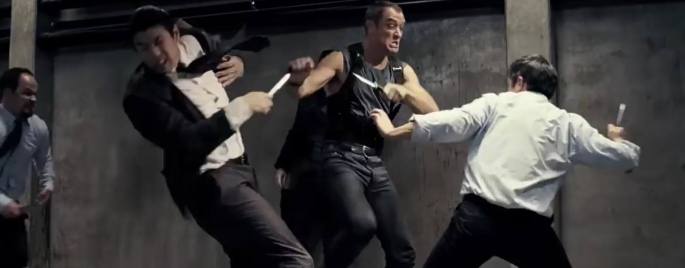
But when I want to re-live some over the top spectacle, I always come back to Bad Boys II, as I consider it to be the apex of Bay’s vulgar, jocular style, and one of the last balls-to-the-wall, R-rated studio action films that has seen a wide release. Explosive, racist, absurd, divorced from reality, and completely bonkers with its various action set pieces, the film, as friend and critic Paul Rowlands from Money Into Light once stated, is “like an un-ironic remake of Richard Rush’s Freebie and the Bean.” This couldn’t be more apt and knowledgeable. Taking the buddy-cop formula and going complete insane with a rather routine story and mostly serviceable dialogue in between some truly excellent zingers, Bay, Bruckheimer, and a zillion screenwriters, both credited and uncredited, dismantled this well-worn formula and went for broke with some massive-stakes action, all done with a minimum of CGI and loving affection for physical pyrotechnics. Every single moment in this film is jacked for extreme visceral impact, with the ultra-stylized and super saturated images scorching the eye-balls, while all of the almost-impossible to believe action was staged with a minimum of computerized artificiality. And as per usual for a Bay movie, whatever CGI was used is always photo-real, so that you’re never taken out of the moment for a split second.

2

Seriously – there have been very few big-budget action films to rival this one over the last 15 years. I am not talking on a story/dialogue level – it’s all perfectly standard, nothing more, nothing less, and it won’t win any unpredictability contests. BUT – the style – the ferocity – Amir Mokri’s aggressively sexy and super-glossy yet somehow still gritty cinematography – the confrontational attitude – the obscene stunts – THAT FUCKING CAR CHASE ON THE MIAMI CAUSEWAY – nobody has topped what Bay and Bruckheimer and all the various daredevils on this dangerous production did in this particular genre. Recent films like Mad Max: Fury Road and The Raid 2 might trump Bad Boys II  – no question. But from the standpoint of huge entities making a glorified 1980’s B-movie with 2000’s $$$, Bad Boys II is a total riot from start to finish. Will Smith and Martin Lawrence have a natural chemistry that is nothing short of special to watch unfold in scene after scene, and as per standard for Bay, his supporting cast deep and strong, with familiar faces and rugged, gruff physiques all on display. Bad Boys II is outlandish, it could care less what you think of it, and it loves itself through and through. Working the front desk at Jerry Bruckheimer Films when this film was in production will forever remain one of the key highlights of my Los Angeles experience.

9


ADRIENNE SHELLY’S WAITRESS — A REVIEW BY NICK CLEMENT

1

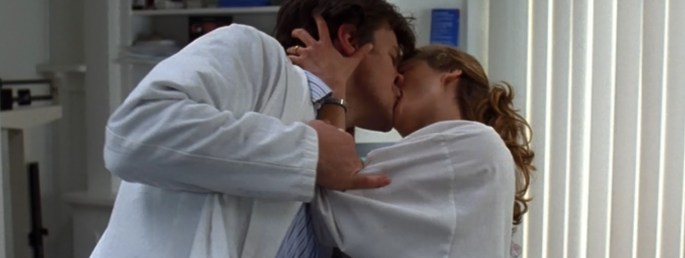
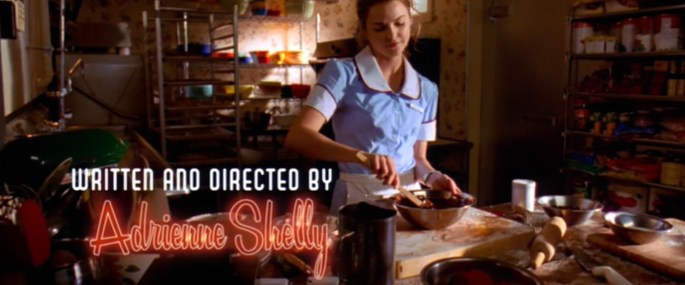
Waitress is a delectable rom-com, one of my favorite modern romantic fantasies from recent years, with a truly effervescent performance from Keri Russell, who, thanks to Adrienne Shelly’s warm and wonderful script, was given a role that didn’t skimp on edge and sass while still remaining 100% sympathetic. Shelly, who also directed with snappy visual pep and a great understanding of pacing, was tragically murdered in her apartment not long after the film was completed in 2006, thus never getting a chance to see the amazing success that her film would become (she also left behind an infant daughter and husband). The story centers on an adorable pie maker (Russell) who is stuck in a dead-end marriage to a total loser (Jeremy Sisto, reprehensibly excellent) and who spends anytime away from her kitchen at a local diner working as a waitress. Cheryl Hines and Shelly played her best friends, both of whom have their own relationship issues, while the likes of Andy Griffith, Lew Temple, Eddie Jemison as popping up in colorful supporting performances.

7

But the crux of the film lies in Russell’s love affair with a married doctor played by a super-charming Nathan Fillion, and how the two lonely souls find a deep connection, that despite being illicit is clearly something born out of true passion and love. At 105 minutes, there’s no fat on this film’s bones, with each scene forwarding the plot and all of the actors in total harmony with the tasty material. And then there’s the cut-ins of Russell making her pies; don’t attempt to watch this film on an empty stomach or with a depleted kitchen because your sweet tooth will be calling out for mercy. After debuting at the 2007 Sundance Film Festival, Fox Searchlight purchased the rights for distribution, and the film became a major summer sleeper success, grossing $22 million in theaters before finding a very long shelf life on cable and physical media. A newly launched Broadway musical based on the film has been greeted with much acclaim. It’s a travesty that Shelly’s life was cut so short. Her story is a further reminder to live life to the fullest.

2

KELLY REICHARDT’S MEEK’S CUTOFF — A REVIEW BY NICK CLEMENT

meeks_cutoff_xlg

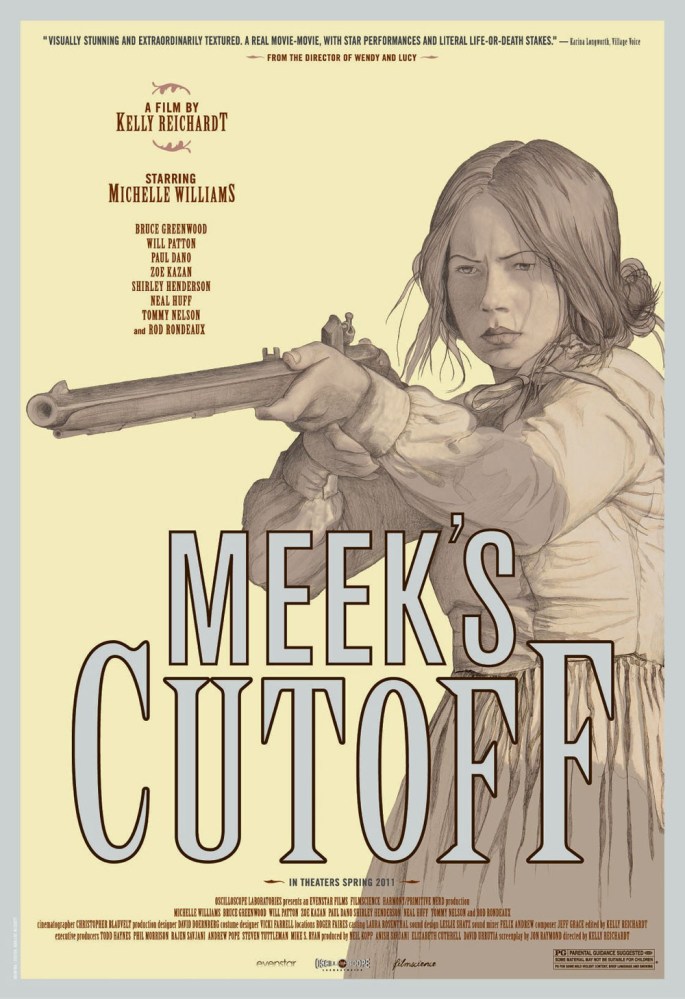
Meek’s Cutoff is a minimalist, austere western that appears to have been an absolute chore for the production team to film. Seriously. There’s absolutely no trace of present day life in this rocky, dusty, slow-burn item from super-smart filmmaker Kelly Reichardt (Old Joy, Wendy and Lucy, Night Moves), which is likely to appeal mainly to those of us who still have something resembling an attention span. Set in the 1840’s and loosely based on real events, the script by Jonathan Raymond concerns six pioneer settlers who end up getting lost with their befuddled guide, and as a result, risk death via starvation and/or dehydration. Sounds like a happy and light little film, yes? This is a harsh, brutal piece of cinema, all of it necessary and desperate and foreboding and ugly-beautiful. The fact that the guide, a perfectly hard-headed Bruce Greenwood, totally out to lunch and without any sense of direction, is as much of a mess as he is, lends the film a strange sense of black comedy. And the way that Reichardt continually reinforces the fact that all of the women in the party are intentionally being kept out of the plans and decision making, only hearing the particulars from a distance and at low audio levels, amps up the stress on the part of the viewer.

Michelle Williams is reliably excellent as the conscience of the film, the only member of the group willing and able to go up against Greenwood when absolutely necessary, and the entire piece has a sly feminist underpinning that separates it from modern entries in this extremely durable genre. There are a few more twists to the story that I won’t spoil, but I’ll add that the supporting cast, including Will Patton, Shirley Henderson, Paul Dano, Zoe Kazan, and Rod Rondeaux is totally ace across the board. Christopher Blauvelt’s smart and compact 1.33:1 cinematography subverts the traditional expectations of this milieu, instead opting for intimate compositions with an almost exclusive use of natural light, while Reichardt served as her own precise and judicious editor. Released in 2010 to great critical acclaim after premiering at the Venice Film Festival, Meek’s Cutoff is a formally challenging movie that proudly announces itself as one of a kind and is yet another unique, under the radar gem worth catching up with.

BEN WHEATLEY’S HIGH-RISE — A REVIEW BY NICK CLEMENT

1

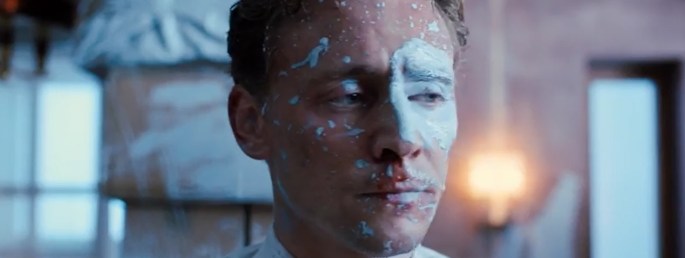
I’ve now come to expect something special from writer/director Ben Wheatley with each new film. In a short period of time, he’s unleashed Down Terrace, Kill List, Sightseers, and A Field In England, all movies that I feel are terrific pieces of cinema, and have totally confirmed him as one of the premiere filmmakers within his age group. His latest, the gloriously surreal and exceedingly stylish futurist satire High-Rise, takes him into Grand Guginol territory with flashes of sexual intrigue while overall presenting a wildly maniacal vibe to the proceedings. Based on J.G. Ballard’s famous and much-loved novel (which I’ve not read), my guess is that this film will be a very, very different viewing experience for those familiar with the source material than from those with no preconceived expectations. Being that I never, ever compare movies to books (one of the single most pointless endeavors that anyone could possibly waste their time with), I can only report about what I’ve seen with my two eyes in terms of the movie. I loved every, single depraved, erotic, disgusting moment of it. This will be a repellent film for some. For others, it’ll be exactly the kind of decadent showmanship that you’re looking for. This is an intense film, in every sense of the phrase, forcing the viewer into a constant stream of excess, never relenting for a moment.

2

Tom Hiddleston finally has a juicy role to call his own, sexy Sienna Miller is back in smoking-hot mode (with some peek-a-boo nudity for extra frustration), and the entire movie has been crafted with a sophisticated visual style that blends ingenious sound work with feverish cinematography by Laurie Rose. Jeremy Irons is the brilliant yet foolhardy architect who has constructed a mega apartment building that in essence works as its own self-contained environment. There’s a gym, a grocery store, a school, restaurants, and all the creature comforts you might expect in high-society living, with each level to the high-rise comprising a different sect of society; the higher up in the high-rise, the more wealthy the inhabitants. All hell breaks loose when a series of power failures hit the complex, resulting in a total breakdown of acceptable behavior. Feeling like a thematic cousin to Snowpiercer, Wheatley stuffs his film with a locked and loaded aesthetic, and as usual, the results are wholly cinematic and form pushing; coming on the heels of the hallucinatory A Field in England, his latest walk on the wild side seems like a logical next step, further cementing Wheatley’s anarchist social worldview. The up-for-anything supporting cast includes Sienna Guillory, Luke Evans, Elizabeth Moss, Keeley Hawes, Augustus Prew, Peter Ferdinando, and a totally debauched James Purefoy. I’ve seen the film twice in three days and I can already tell that this one will be binged – HARD – once it hits Blu-ray.

3


PETER WEIR’S THE TRUMAN SHOW — A REVIEW BY NICK CLEMENT

1

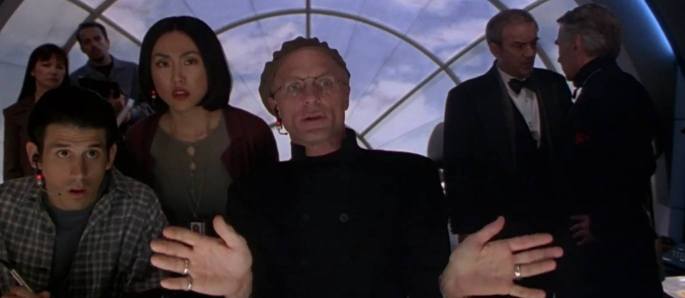
The Truman Show is easily one of the most disturbing and prophetic films of my lifetime. Directed with extreme care by Peter Weir (Witness, Picnic at Hanging Rock) and written by Andrew Niccol (Gattaca, Lord of War, Simone) who always seems one step ahead of everyone else, this is a genuinely sad film about stolen identity, the loss of innocence, the understanding of evil, and how one man decides to finally think and act for himself after years of bowing to the expected norm. Jim Carrey was absolutely brilliant (and probably never better) than he was here, subverting the silly-man image he had cultivated for a few years before dropping this dramatic bombshell during the summer of 1998. The fact that The Truman Show came out in the popcorn movie season, and grossed $130 million domestic after rapturous critical response, is still one of the coolest cinematic notions I can think of. Just think about it for a moment – a movie built on ideas becoming a huge success in the mostly brain dead, CGI summer movie landscape. It seems almost too good to be true. And I’m not so sure that this movie does that sort of business if it gets released this summer, or next summer. Both of the moment and completely ahead of its time, The Truman Show sought to expose the fraudulent nature of reality television in the darkest way possible, while skewering the notion of 15 minutes of fame, and seeking to examine the fallacies of every day life. Ed Harris was hypnotic in an Oscar nominated performance as the magician behind the scenes, calling all the shots in poor Truman’s life, and the way that he truly feels that he’s his father in the final act, and most especially in those heartbreaking and liberating final scenes, still creeps me out to this day.

2

Peter Biziou’s tricky and stylish cinematography took on a uniquely voyeuristic aesthetic, and Weir’s decisions to set the story in a bright and sunny and antiseptic seaside town as opposed to Niccol’s originally scripted rainy and nighttime and noir-ish NYC, was a stroke of visual and thematic genius. Take some of the most frightening emotional material ever conjured up and place it inside this friendly, sterile environment that would seem inviting to anyone. Dennis Gassner’s exquisite and duplicitous production design is worthy of intense study, as it’s always working to suppress the behind-the-scenes shenanigans while giving off a radiant, scarily friendly vibe. The concluding moments of this film with Truman heading up that perfectly surreal set of steps still makes the hairs on the back of my neck stand up, and the decision on the part of the filmmakers to smash cut to black in the exact fashion that they did will always remain one of the best storytelling decisions that I can think of. The absolutely insane supporting cast was an embarrassment of riches, including the stunningly beautiful Natascha McElhone, cocky-funny Paul Giamatti, the brilliant Laura Linney, everyone’s best buddy Noah Emmerich, Harry Shearer, and Philip Baker Hall. The ensemble was in total synch in this film, allowing Carrey and Harris to totally dominate, while still providing the film with warmth and edge where needed. Producer Scott Rudin first approached Brian De Palma (and then many others) to direct before hiring Weir, who has had one of the more bizarre careers I can think of. The absolute final shot of this work of art stings with such ironic humor that it hurts to laugh. This is one of the great existential films of the 1990’s, and a film that has only gained in its masterfulness as the years have progressed.

3

YORGOS LANTHIMOS’ THE LOBSTER — A REVIEW BY NICK CLEMENT

1

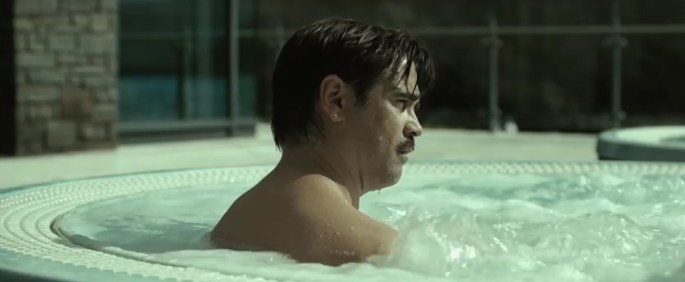
From the startling opening moments and continuing all throughout its entirely beguiling and metaphorical narrative, The Lobster presents us with another bizarre cinematic world from Greek director Yorgos Lanthimos (the Oscar nominated shock-fest Dogtooth and the funereal drama Alps), an emotional sadist who is constantly picking at his filmic subjects like itchy scabs, always trying to expose the raw and volatile relationship between humans and their fragile sensibilities. Co-written by Lanthimos and Efthymis Filippou, this is true, absurdist, pitch-black comedy, with plot threads that will make you feel purposefully uncomfortable, which you then feel bad about laughing over. The only thing I’m not super keen on in Lanthimos’ decidedly bleak yet strangely hopeful worldview is his strange obsession with weird animal violence; not sure where all of that comes from, but it’s a recurring theme for him that’s very noticeable. Colin Farrell isn’t the first actor you think of when dry comedy is the order of the day, but he fits perfectly within this rigidly stylish film that continually subverts its own sense of pictorial precision with a story that’s alternately confounding and exhilarating. Lanthimos is a true original and I can safely say that his films feel like the creations of only himself, so it comes as no surprise that this bizarre film won the Grand Jury prize at the Cannes Film Festival, and that so many big movie stars would jump at the chance to work with this brazen and unpredictable filmmaker.

2

The Lobster supposes a near-future where, by law, people must have a life companion. If you’re single, you’re sent to this ominous and ostentatious hotel that rests near the ocean, and you’re given 45 days to find a mate. And if you’re unsuccessful in your romantic quest, no worries, you’ll be turned into the animal of your choice, and released into the nearby woods, where you can look for love as a different species. If all of this sounds lunatic, well, it is, but it most certainly has a point of view in terms of relationships and societal expectations and honesty within the construct of partnership, and it basically serves as a corrective to the mindless crap that the Hollywood studios churn out on a weekly basis. Lanthimos recruited a starry cast for his first English language movie, including the magnificent Rachel Weisz, a priceless John C. Reilly, the brittle Olivia Colman, the uniquely photogenic Lea Seydoux, and a mysterious Ben Whishaw. Each shot by cinematographer Thimios Bakatakis feels formally perfect and in total synch with the sharp editing by Yorgos Mavropsaridis, the keep-you-on-edge musical jolts add a repeated sense of menace, and the way Lanthimos builds his entire creation to its haunting finale will keep you buzzing after the last frame has been exposed. I’ll certainly need to see this offbeat item again to unlock all of its secrets, but like the best of films, it’s begging me for an immediate revisit.

3


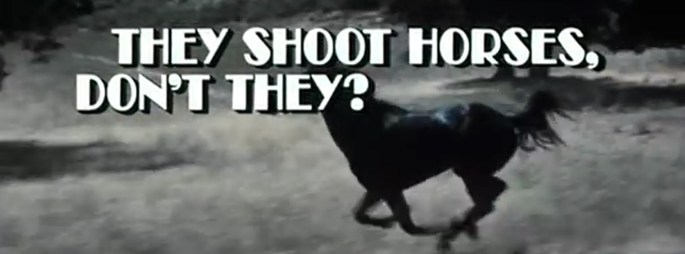
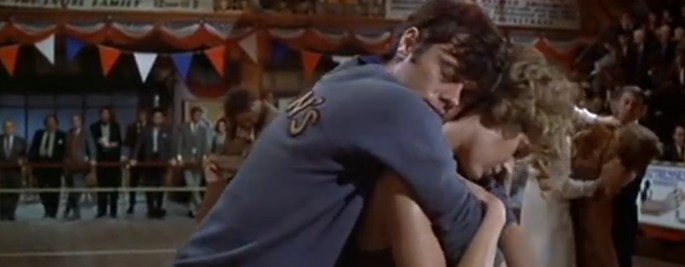
SYDNEY POLLACK’S THEY SHOOT HORSES, DON’T THEY? — A REVIEW BY NICK CLEMENT

1

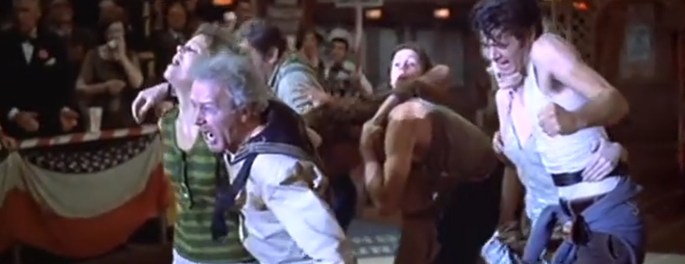
They Shoot Horses, Don’t They? is an absolutely devastating movie. Disturbing to the core, really. It’s deceptive in its sadness, instead taking something as potentially jubilant like a marathon dance contest, and using it as a backdrop for some of the most poignant and cynical comments about the human experience and psyche. While I’ve not seen everything that Sidney Pollack directed, I’m tempted to say that, from what I’ve seen, this is his best, most defining work. How this epic yet intimate film hasn’t been picked up by The Criterion Collection or Twilight Time I’ll never know, as it’s the sort of picture from a lost era of filmmaking, that would never, ever get made today. And while certainly a product of its time, it still tells a thoroughly timeless story that anyone could connect with. Jane Fonda was at her iciest here, and did an extraordinary job of communicating sadness with only her facial expressions.


2

Released in 1969 and based on the Horace McCoy novel from 1935, screenwriters James Poe and Robert E. Thompson crafted a true piece of cinematic Americana, and via Pollack’s steadfast and unwavering direction, the film resonates just as strongly now as it likely did upon first glance. An amazing supporting cast including Michael Sarrazin, Susannah York, Bruce Dern, Bonnie Bedelia, and Gig Young were all on hand, while the dusty images by cinematographer Philip H. Lathrop reinforced the desperate, hardscrabble nature of the disparate group of characters. Johnny Green’s musical score, in tandem with various era-specific classics, ranged from jaunty to severe, lively to melancholy, while the film would become noted for its use of flash-forwards, especially during the extremely grim, final sequences. They Shoot Horses, Don’t They? screened at the Cannes Film Festival, and would prove to be a critical success and box office hit, but really needs to be rescued by a boutique physical media company as it deserves major Special Edition treatment.

3

MIGUEL SAPOCHNIK’S REPO MEN — A REVIEW BY NICK CLEMENT

1

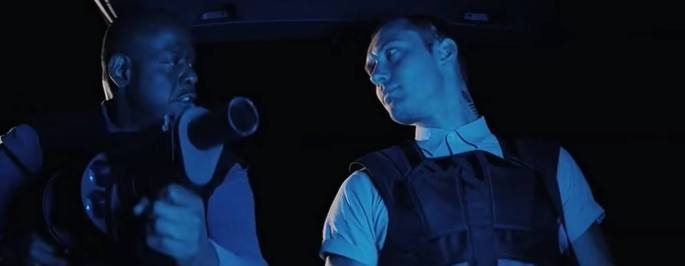
Repo Men is a sneaky, cheerfully violent, and occasionally kinky sci-fi flick that totally bombed in theaters for no good reason other than piss-poor marketing and zero confidence from the distributing studio. Why make movies if you don’t have any faith in the material?! Centering on a future world where artificial limbs and fresh internal organs can be purchased via credit, this is a gory, nasty, extremely funny movie that flirts with disreputability at almost every turn, featuring an anti-hero for a protagonist, and all sorts of colorful baddies lurking around every corner. The kicker of the plot: What if the amoral repo man tasked with taking back, by any means necessary, the body parts his clients can’t pay for, all of a sudden became a victim of his own profession? The third act twist is trippy and unexpected and awesome, Jude Law was superb in a very forceful and physical performance, and overall, the material feels decidedly fresh and unique and creative. I’m a big fan of when a film mixes tones, and this B-movie with A-production values does that often.

2

Original novelist Eric Garcia was given the opportunity to adapt his own work for the screen with co-scripter Garrett Lerner, and while helmer Miguel Sapochnik certainly demonstrated an extremely strong sense of cinematic style, he’s been in feature director’s jail for the last few years, instead turning to high-profile television direction. It’s a shame, because this film has distinct personality and lots of nifty special effects that served the story, rather than dominating it. I have a feeling that Paul Verhoeven would absolutely LOVE this film, as Repo Men carries a casual cruel streak and a layer of social satire that makes the proceedings all the more robust. The solid supporting cast features Forest Whitaker as Law’s totally badass partner in crime, Liev Schreiber at his smarmiest as their morally bankrupt boss, Alice Braga as Law’s love interest, Carice van Houten, John Leguizamo, and RZA. The vibrant yet gritty cinematography by Enrique Chediak is a major highlight, as is the crisp editing by Richard Francis-Bruce. Shot for a reported $32 million, this film looks three times as expensive. The unrated version features even more badassery.

3.jpg

MICHEL GONDRY’S HUMAN NATURE — A REVIEW BY NICK CLEMENT

1
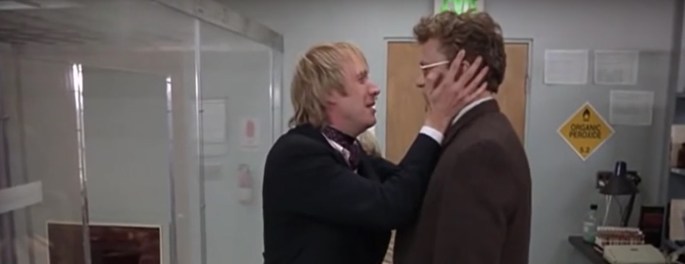
Completely and utterly absurd and often hilarious, Human Nature was the first collaboration between writer Charlie Kaufman (Anomalisa, Being John Malkovich, Synechdoce, NY) and director Michel Gondry (Eternal Sunshine of the Spotless Mind, Mood Indigo, The Science of Sleep). To call this film bizarre or self-conscious would be an understatement; while it’s coherent and certainly adds up by its conclusion, I can think of few other R-rated fantasies like this one. The film is basically a sex-farce about the animalistic urges that we as humans suppress on a daily basis, as well as a pointed observation on the role of outward beauty in society and how people judge others on superficial levels. Almost beyond description, the film juggles three story major story strands which result in an extremely heady brew. Rhys Ifans (so scary in Enduring Love, so funny in Notting Hill) is a feral man, raised as an ape by his father, who has been living as one with nature for almost his entire existence. Patricia Arquette, in a rather fearless and vanity-free performance, is a woman suffering from abnormal hair growth all over her body; she’s never been with a man and has zero self-esteem. Tim Robbins is a virginal, up-tight behavioral scientist who is trying to teach a pair of mice common table manners; eat with a fork, pull out the chair for your friend, etc. He thinks that if he can teach table manners to mice, he’ll be able to teach table manners to humans.
2
In his world, we’ve all become slobs with no idea of proper etiquette. Hysterical flashbacks show how his 50’s era parents drilled order and OCD-styled tendencies into their son. Robbins and Arquette meet through a mutual friend and sparks fly, while Arquette conceals her hairy secret from him. One day while walking in the woods, they come across Ifans, who knocks himself out while trying to run away from them. Robbins, ever the intrepid scientist, sees this as a major opportunity. He takes Ifans back to his laboratory and puts him into a large, glass-walled box. Forget the mice; now he has a human experiment! How a strange love triangle develops between the three characters will be up for you to discover. If all of this sounds mildly mentally insane, well, I’m not surprised. But coming from genuine artists like Gondry and Kaufman, the film is a whimsical endeavor. And while Human Nature will like prove to be challenging film on some levels for many people, it can hardly be denied that it’s stunningly unique, and very smart about humans, and, well, nature. Gondy’s cinematic DIY-aesthetic was in its infancy here, with visual motifs that would become frequently explored in subsequent films. The scenes alone of the mice eating with forks are worth a viewing. And one scene, in which Robbins teaches Ifans how to behave at an opera, is a true pisser. This is a fun, strange film that I promise you won’t forget.
3