FRANCOIS OZON’S SWIMMING POOL — A REVIEW BY NICK CLEMENT

1
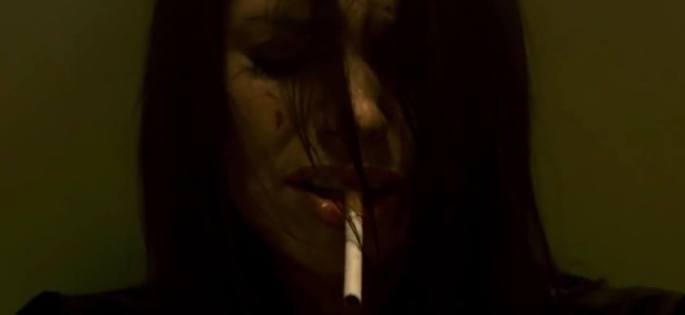
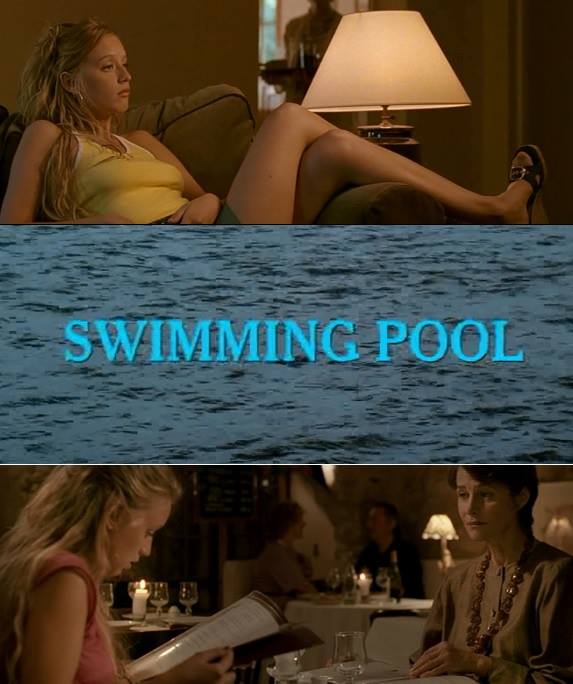
Swimming Pool is one of those erotic dramas that toys with thriller elements without ever really becoming a full blown suspense film, at least not in the traditional sense. Directed with extreme specificity by Francois Ozon, this 2003 British/French mind-teaser features two startling performances, one from lead Charlotte Rampling, and the other from Ludivine Sagnier, who does some of the most effortless on screen nudity that I’ve ever seen in a film. Ozon and co-screenwriter Emmanuèle Bernheim’s narrative is simple on the surface, but beyond tricky in the fine details, and I’d never want to spoil anything, so all that I’ll say is that Rampling plays a successful writer who accepts an invitation from her longtime publisher (Charles Dance, excellent as usual) to spend some time at his gorgeous French country house in an effort to get cracking on her new mystery novel. But before she can get into any sort of creative groove, her publisher’s promiscuous and free spirited daughter shows up, looking to crash at the villa and hang out topless by the pool, while bringing home an interesting selection of men at night to entertain.

This is a very sexy movie, and if you’re looking for a film to get the juices flowing and isn’t afraid to confront hot-blooded sexuality up front and center, this one will certainly do the trick. Sagnier’s glistening body is repeatedly studied by Ozon and cinematographer Yorick Le Saux’s patient camera, and it’s clear that she was an actress very comfortable in her own skin while shooting, because there’s hardly a scene where she’s not unclothed to some degree. Rampling’s internal psyche is explored in interesting ways all throughout the twisty narrative, and while I’m reluctant to describe the plot any further, I’ll allow that the fates of both Rampling and Sagnier become crucially intertwined, with the film coming to a close on an abstruse note of moral questionability and psychological complexity. Philippe Rombi’s playful musical score knew when to twist the screws and when to have some fun. Swimming Pool premiered at the Cannes Film Festival, and Ozon’s unrated director’s cut is available on disc.


JEFF NICHOLS’ MIDNIGHT SPECIAL — A REVIEW BY NICK CLEMENT

midnight

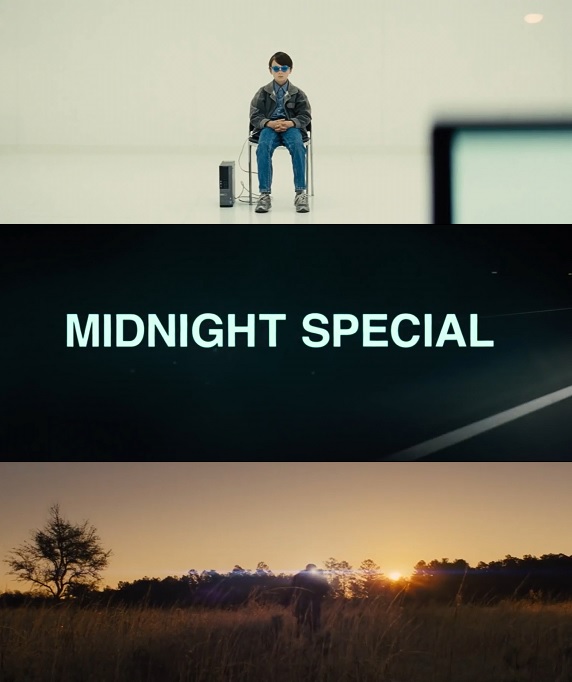
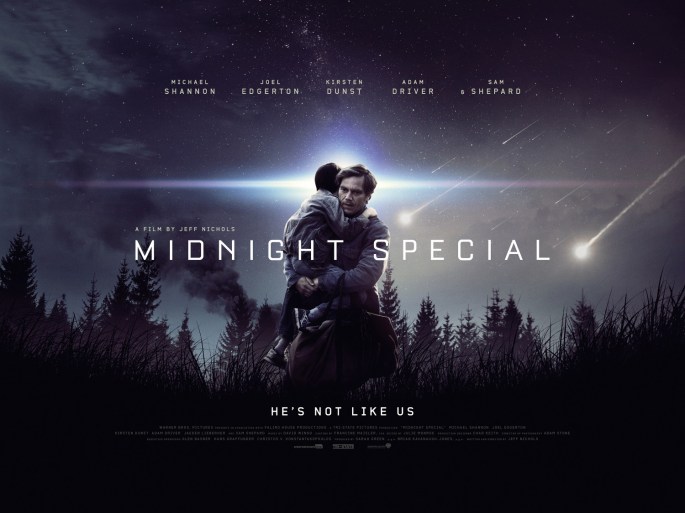
The experience of watching Midnight Special was akin to eating 50 Oreos with a humongous glass of ice cold milk. In short, I loved every single second of this fantastic film, but I’m not too surprised, considering how Jeff Nichols has only made quality films, with his sophomore effort, Take Shelter, registering as a masterpiece of introspective, existential cinema. He’s back in semi-ambiguous mode here after the solid southern drama Mud, and to be honest, I want Nichols to stick to this arena, the thought provoking genre bender that you can’t quite pin down. It’s a miracle that a major studio funded this film – bravo, Warner Brothers. There’s no chance of a sequel or lunchboxes or action figures with this one, and it seems to have been crafted with BRAINS as the motivating factor, not endless action scenes or noisy visual effects. Instead, the audience is treated to tantalizing ideas, smart dialogue and riveting plotting, excellent performances, realistic family dynamics that propel the narrative, and CGI that’s used to enhance the story, and not act as the central focus. I loved the Amblin-ness of Midnight Special, and how it reminded me of John Carpenter’s Star Man and other nostalgic offerings from the 80’s, yet still made with modern panache and overall exquisite style, rarely ever calling overt attention to itself. Adam Stone’s shimmery and bold widescreen cinematography meshed perfectly with Chad Keith’s inspired and subtly stylish production design, which went a long way in evoking these feelings. And the last 20 minutes of the film are spellbinding in their ability to transport you out of the theater and into a movie world where you just have to know what’s going to happen next.
1

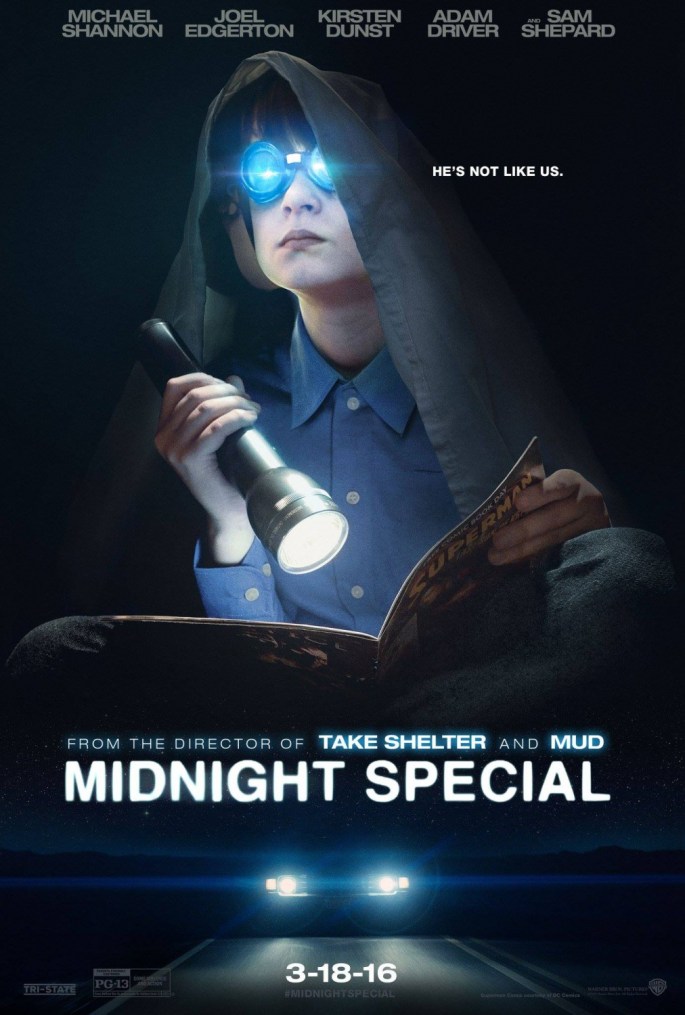
If you’ve see the trailer, that’s all you need to know from a plot stand point. There’s a strange and unique child being moved across state lines by two men with a variety of groups giving chase, and for some reason, the kid is able to emit light rays from his eyes. I’m giving nothing away that’s not shown in the trailer. And I’ll reveal no more. This movie has a ton of heart and honest emotion that worked me over like a baby, and a central performance from Michael Shannon that is compelling and totally consuming to observe. Jaeden Lieberher is equal parts spooky and sympathetic as the potentially dangerous cargo, while Joel Edgerton and Kirsten Dunst are both very effective in supporting roles. Adam Driver nails his scenes as an NSA agent looking into the situation, while Sam Shepard has a cameo as a cult leader who feels that, for some reason, the boy is very special. David Wingo’s music is haunting and pulsating and delivers a serious punch, and again, it must be mentioned that the entire film has been shot with casual elegance by Stone, who clearly was favoring a lot of natural light, and knew exactly where to place the camera in some key situations. But the star of the show is Nichols, and his erudite sense of storytelling, never holding the audience’s hand too firmly, and always allowing for tantalizing bits and pieces from his heady narrative to remain unanswered, so that when you leave the theater, you’ll be thinking about the fine details for hours after the film has finished. I can’t wait to see this film again and again and again and I have no doubt that it will be included in my top 10 favorite films of the year.
midnight_special_ver2_xlg

DAVID O. RUSSELL’S THE FIGHTER — A REVIEW BY NICK CLEMENT

the fighter

The Fighter is an inherently compelling piece of entertainment. Christian Bale, as a crack-addicted boxing coach, stole the entire show, but Mark Wahlberg, starring as real life boxer Micky Ward, was low-key terrific and was somewhat overshadowed by the hype that accompanied Bale’s transformative performance. Wahlberg clearly excels while working with director David O. Russell (they previously teamed on the masterwork Three Kings and the criminally underrated I Heart Huckabees) and it’s clear from frame one that this was Wahlberg’s passion project. It’s probably the least idiosyncratic movie that Russell has ever directed, but switching it up a bit thematically and stylistically was probably a good move for him at the time, as he definitely showed that he’s got solid commercial instincts and that he can stay focused with a concise story. The film also has some huge and unexpected doses of humor (mostly at the expense of the broadly drawn characterizations that comprise Ward’s white-trashy sisters) that really bring the laughs.

You might not like the brutality of boxing, you might not want to have your face rubbed in the low-class Lowell-grit-‘n-slime for two hours, and sure, most of the beats in the script are predictable, but it’s got such a rousing finish and the story is so quintessentially American (who doesn’t love a second, sometimes third chance in life?), that it’s hard not to find the film inspiring to a certain degree. The acting across the board was so strong and enjoyable that in tandem with the sharp and believable dialogue, the obviousness of some of the story recedes into the back of my mind. The Fighter has a somewhat traditional boxing movie narrative, but everything is spiced up by the gritty, lived-in atmosphere and by the rough and tumble dynamics of the Ward family. Amy Adams and Melissa Leo were both terrific, and again, it needs to be said, without Wahlberg’s sensitive and quietly observed performance, the film would be without its steady anchor. It’s his best overall performance since Boogie Nights and it’s something that he should be very proud of.

PETER BERG’S LONE SURVIVOR — A REVIEW BY NICK CLEMENT

lone s

Writer/director Peter Berg pulled out all the stops and went for the emotional and visceral jugular with his ferocious combat film Lone Survivor, a harrowing, gut-wrenching modern war movie that deserves to sit alongside other battle-ready, anti-war classics such as Hamburger Hill, Black Hawk Down and We Were Soldiers, truly throwing the audience into the middle of a nightmarish warzone where anything can happen. Crafted with stunning technical proficiency, Lone Survivor aims to put you in the middle of a bloody, unrelenting gun battle, rarely letting up for a breath of air. And what a battle sequence it is. The fluid yet ragged cinematography from Tobias Schliessler is remarkable to behold and the crispness of the editing by Colby Parker Jr. smartly establishes concise geography and clear spatial coherence during the protracted firefight. Berg was as single-minded and determined in his directorial approach to the story as the soldiers-on-a-mission were in his narrative, centering on their attempt at doing their job and coming out of a terrible situation alive. And it’s because Berg stuck to the nitty gritty, never losing focus or succumbing to cheap politicizing, the film operates in a bluntly forceful fashion, and almost immediately kicks into high gear.

No matter what or how many creative liberties the filmmakers took with the true-story aspects of the incident (a botched mission where four Navy SEALS went up against numerous Taliban soldiers in the unforgiving mountains of Afghanistan after allowing civilians to go free), the emotional core of the film is honest and at times overwhelmingly powerful, just like great cinema should always be. It’s no spoiler to reveal that only one SEAL makes it out of the fight alive, and it’s mind-blowing to think that these guys were able to endure what they probably endured during those hellish hours. Berg smartly opens the film with real-world SEAL training footage, and by watching just two minutes of these clips, it’s easy to see how these men could become total warriors, able to drop their enemies with precise head-shots, never succumbing to fatigue or lack of food, always ready to fight and kill. Berg wisely celebrates the warrior spirit in all of the men, while never glamourizing the horrific toll that war brings to multiple societies. And most importantly, he never turned the film into a cheesy political message or soap-box statement – this is truly “War is Hell Cinema,” with a focus on the blood and guts of the situation. Persuasively acted by the grizzled quartet of Mark Wahlberg, Taylor Kitsch, Ben Foster, and Emile Hirsch, this is an unforgettable reminder of what’s been going on for over a decade during the “War on Terror.”


BOB FOSSE’S LENNY — A REVIEW BY NICK CLEMENT

lenny_xlg

Bob Fosse’s forceful and uniquely constructed biopic Lenny remains as topical and exhilarating today as it likely did upon first release back in 1974. Nominated for six Academy Awards including Best Picture, Best Director, Best Actor, Best Actress, Best Adapted Screenplay and Best Cinematography, the film was a critical and commercial success, even if the potentially distancing aesthetic put off some viewers and film aficionados upon first glance. The film expertly cuts back and forth between key and intimate moments of Bruce’s life, showing him in his full comic glory, but also detailing the darker times, when he was extremely wasted and strung-out. The script also delves into the latter portions of his life where he used his own nightclub as a venting arena for all of his personal problems and hardships, often times reading his arrest reports and court transcripts. Dustin Hoffman was consistently electrifying as Lenny Bruce, burrowing deep into his feverish psyche, always a loose cannon and ready to explode with intelligent vulgarity and a sense of purpose that defined him as a stand-up comic and general rapscallion. It’s a performance of startling conviction, and a further reminder of the live-wire quality that Hoffman exuded in the 70’s.

Similar to the themes in a film like The People vs. Larry Flynt, this is yet another movie to examine the importance of free speech, and to celebrate the idea of the nonconformist. Bruce’s material had a subversive quality that the best types of entertainment can bring out, always questioning himself and those around him, and challenging societal norms and expectations. Valerie Perrine won the award for Best Actress at the 1975 Cannes Film Festival, and it’s easy to see why, as it’s a show-stopping performance of overt sexuality and unquestionable emotional tenderness, and when juxtaposed with Bruce’s hard-charging theatrics, it was easy to see why they were such a great match for each other. The smoky and gorgeous black and white cinematography by Bruce Surtees is a constant treat, and the numerous sequences detailing the various performances and arrests that befell Bruce during his rise to fame are handled with a devil-in-the-eye sense of humor. And of course, this being a tragic story, Fosse doesn’t shy away from the ugly price of fame, showing how Bruce was a true pioneer, and how that fact more than likely cost him his life. Playwright Julian Barry adapted his own work for the screen. Available on Blu-ray via Twilight Time.


BOB RAFELSON’S BLOOD & WINE — A REVIEW BY NICK CLEMENT

2Bob Rafelson’s Blood & Wine is a seriously underrated film. Released 20 years ago, it feels like a downbeat effort that should have been made in 1976, not 1996, and with this cast, it’s hard for me to understand how this film came and went with nary a trace when it was buried with a late February opening. This is a hot blooded neo-noir with ripe dialogue and a starry ensemble, and I just can’t fathom how it only grossed $1.1 million in the theaters. Jack Nicholson was perfectly cast as a desperate wine salesman who concocts a jewelry robbery that then goes way off the mark after the initial job. Stephen Dorff, Michael Caine, Judy Davis, Harold Perrineau, and a very sultry Jennifer Lopez were all terrific in supporting roles, but my guess is that the material was too unlikable to be widely embraced. Critcs were mostly kind but nobody really went crazy for it, which seems a shame, because it’s damn good.

This is a dark movie about flawed people, and while it featured megastar Nicholson in the lead role, he’s nothing like a traditional hero or easy to identify with. There’s a moral ambiguity that strengthens the entire film, with the pungent and twisty script by Alison Cross and Nick Villiers never allowing for easy answers to the complicated situations posed by the increasingly sinister plot. The Florida atmosphere lent an interesting visual texture, with cinematographer Newton Thomas Sigel bathing the film in a gauzy visual sheen that recalled films from two decades previous, while legendary production designer Richard Sylbert made terrific use of the hot and seedy Floridian locations. This was the seventh collaboration between Rafelson and Nicholson, and even if the film is more conventional in its overall schematics than some of their previous team-ups, there’s still a distinct level of old-fashioned confidence in all of the genre tropes that this type of film can exploit. Nicholson has some terrific moments during the big car-crash sequence, and the film ends on a moment of sad realization for all involved.


JULIEN MAURY & ALEXANDRE BUSTILLO’S INSIDE — A REVIEW BY NICK CLEMENT

Insideposter

Inside (À l’intérieur), a stunningly violent French thriller from filmmakers Julien Maury and Alexandre Bustillo, sets the standard (at least from what I’ve scene) for on-screen death and punishment. Listen — I’m no horror junkie — it’s the one genre I’ve seen the least from, but every once in a while I hear about a foreign language effort that supposedly pushes the envelope and Holy Shit does this movie do that. This is a mercifully short (75 minutes) but unrelentingly brutal horror-thriller that utilizes fantastic digital cinematography and brilliant sound effects to create one of the craziest, nastiest, bloodiest cinematic home-invasions ever put on film.

1

The set-up is simple. A pregnant woman named Sarah (Alysson Paradis), who has just recovered from a devastating and life altering car-wreck where you see portions of the accident from the POV of a fetus in the womb, is home alone on Christmas eve on the probable last night of her pregnancy. A strange woman knocks on her door and asks if she can use the phone as she’s been in an accident. The woman, never named in the film but played with icy, intense devotion by Beatrice Dalle in an astonishing performance, seems to know a little about Sarah, and before long, she has broken her way into Sarah’s house. The general air of mystery helps to propel the slim narrative, with twists being doled out in the final moments that cement the generally believable depravity of the film’s strikingly nihilistic scenario.

2

What ensues is a vicious fight to the death between Sarah and the mysterious psychopath, with cops and other innocents making their way into the house at various points in the film, but never making it out. The directorial craft and technique of Maury and Bustillo cannot be ignored; they are phenomenally talented at mounting cinematic dread and maintaining a hugely creepy atmosphere, and their level of stylized filmic sadism is something to behold. IF – and ONLY if — you have a strong stomach for blood and gore. Really strong. There’s no question that this is one of the bloodiest movies I’ve ever seen, and while I normally steer clear of genre fare such as this, I couldn’t resist viewing it a while back as people had told me it would raise the hair along my neck. It did. And then some. The performances from Paradis and Dalle, are, in a word, exhausting, both emotionally and physically. Throwing themselves around the house and with the inherently vulnerable Paradis in emotional turmoil for almost an hour straight, the dedication to their parts deserves commendation.

3

But while the film is technically fantastic and the gore handled in a very up-front and realistic fashion, what purpose does the film serve overall? Many mentions are made throughout the film to the 2007 riots in France, but any ideas of social critique are absent in the story. Instead, what we’re subjected to is a film with brass balls, a movie that punishes its characters and the audience for the sheer thrill of it. And trust me, unless you’re a student of New French Extremity, you’ve probably never seen ANYTHING like this. Most amazing are the subjective “from-the-womb” shots that Maury and Bustillo cut too while the pregnant Sarah fights for her life — terrifying and unforgettable. I doubt I’ll ever watch it again but I’m glad (in some sort of sick and deranged way) I got a chance to see what many people feel is one of the best horror movies in recent years.

Insideposter

CHAD STAHELSKI & DAVID LEITCH’S JOHN WICK — A REVIEW BY NICK CLEMENT

john wick

John Wick is exactly the bullet to the face that the American action picture desperately needed. There’s nothing remotely new to the mostly predictable narrative of this film and that’s totally fine – it’s just lean, mean, and very, very effective. Obviously inspired by the blood ballet that is The Raid and The Raid 2 and John Woo films from the 1990’s, first-time directors (and veteran stunt coordinators) Chad Stahelski and David Leitch shot their impressively staged action scenes with a stylish, confident hand, emphasizing long takes with a static camera, letting the ammo fly all over the room, and ramping up the body count to obscene, old-school-Schwarzenegger levels. I had an absolute blast watching this totally kick-ass action film, and if it loses some overall points in the way of originality, there’s something to be said for a lower-budgeted Hollywood actioner such as this that returns the R-rated action film to some form of glory.

There’s nothing complicated about John Wick, but that’s sort of what I loved about it, as it appeals to your primal levels in an immediate, visceral, and universal way. A stoic assassin (Keanu Reeves, well cast) goes for the straight life after years of loyal and lethal service to his Russian boss because he’s finally found the woman worth retiring for. She then gets cancer, quickly dies, and leaves him a farewell present: A beautiful puppy. After the gangster son of Wick’s ex-employer unwittingly roughs up Wick, steals his treasured car, trashes his house, and kills his dog, what’s an ex-contract killer to do than take out ALL of the trash?

And that he does – people are sliced, diced, shot repeatedly, thrown across the room and over ledges, and used as general battering rams against all sorts of sharp objects. The Gareth Evans effect is in total display here, as Stahelski and Leitch go for broke with their wild yet coherent action scenes, letting the bad guys have it at all times, always trying to up the ante from scene to scene. And honestly – if you’re not down for seeing an animal abusing scum bag and a slew of his henchmen get what they deserve – well, this isn’t the movie for you, and you need to check your priorities. PETA should use this film as their calling card from here on out. I fucking LOVED this piece of simple minded action cinema.


MILOS FORMAN’S THE PEOPLE VS. LARRY FLYNT — A REVIEW BY NICK CLEMENT

people_vs_larry_flynt_ver2_xlg

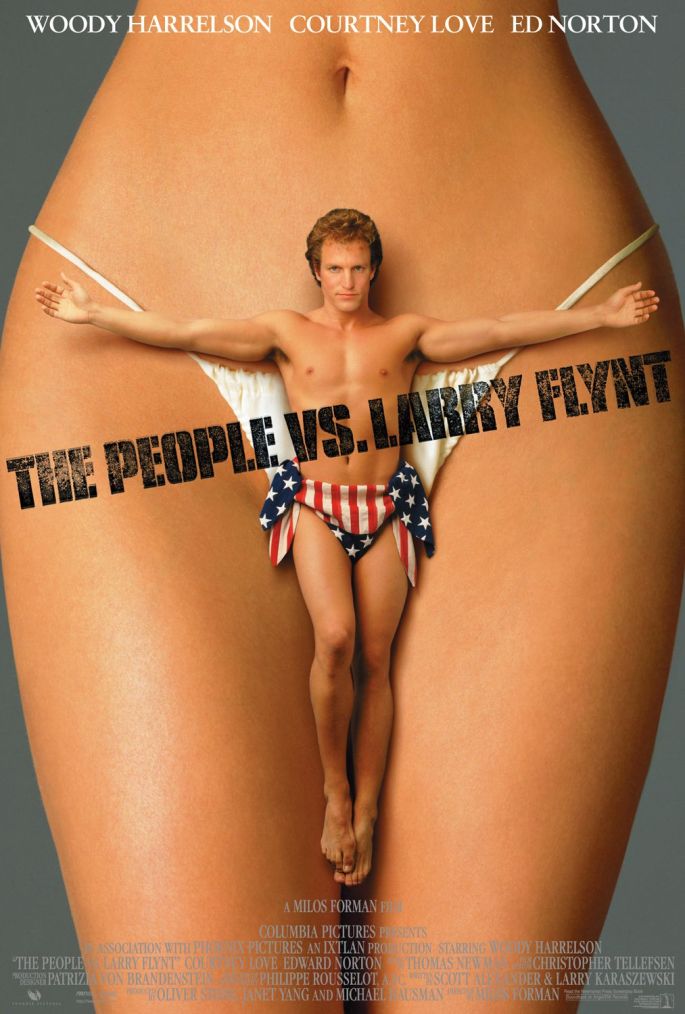
Incendiary. Forceful. Incredible. The People vs. Larry Flynt took on a larger than life subject with gusto and bravado, with director Milos Forman plunging neck-deep into the smut and kinky fun that accompanied the hard-living life of exuberant Hustler Magazine publisher Larry Flynt, brilliantly portrayed by Woody Harrelson in a performance that’s nothing less than a tour de force. This film absolutely ripped my head open at the age of 16 when I viewed it theatrically, and over the years, I’ve remained fascinated by the film, due in no small part to the fabulous, three decade spanning screenplay by masters of the biopic Scott Alexander and Larry Karaszewski. This is a raucous, ribald, and totally righteous film about an outrageously insatiable man, with a personality the size of Texas, and a sex drive to equal it. Co-starring the perfectly cast Courtney Love as Flynt’s long suffering romantic companion Althea, Forman populated the edges of his film with a sterling acting ensemble, including Edward Norton as Flynt’s crusading lawyer, James Cromwell as the venal Charles Keating, Richard Paul in a hilarious performance as scumbag Jerry Falwell, Vincent Schiavelli and Crispin Glover as magazine cohorts, and Donna Hanover in a sickeningly awesome performance as Ruth Carter Stapleton.

Forman’s effortlessly natural storytelling sense was on firm display all throughout, with the tone bouncing back and forth between jovial fun to serious darkness. This film is scene after scene of terrific filmmaking, crafted by an intelligent director who seemingly paid attention to every single element that went into his films. And most importantly, it was a warts and all exploration of a man who lived life according to his own terms, a project fully sanctioned by Flynt, who also made a disturbingly ironic cameo as the judge who sentenced him to prison. The velvety cinematography by Philippe Rousselot was in perfect tandem with Patrizia von Brandenstein’s evocative production design, all pulled together by Thomas Newman’s pensive score and the swift editing of Christopher Tellefsen. The film received excellent reviews but, sort of unsurprisingly, stalled out at the box office, no doubt hampered by the potentially alienating subject matter and the mostly prudish, immature attitudes of mainstream audiences. But it’s a tremendous entertainment, and a film with much to say about free speech and freedom of expression, still feeling relevant and important today just as it did 20 years ago.

ANTON CORBIJN’S A MOST WANTED MAN — A REVIEW BY NICK CLEMENT

a most wanted man

The gifted and cerebral director Anton Corbijn (The American, Control) de-glamourized and upended the conventions of the post 9/11 spy film with A Most Wanted Man, a cold, cynical effort, where, much like in The American, he subverted the audience’s expectations at almost every turn, favoring the plausible over the unbelievable, the rational over the illogical, with results that are highly intelligent and wholly engrossing. Based on the John le Carré novel and shot with muted, un-showy elegance by the great cinematographer Benoit Delhomme, this is a film that lives in the same world as The Constant Gardener and Tinker Tailor Soldier Spy, favoring moral ambiguity and shadowy inner workings over flashy action scenes featuring car chases and shoot-outs. Andrew Bovell’s crisp, talky, and extremely sharp screenplay gave the late, great Philip Seymour Hoffman the chance to slow-burn his way through one of the best performances of his estimable career. Slugging scotch or coffee and sucking down cigarettes in almost every scene, this weathered, broken, beaten-down character was a perfect match for Hoffman’s inherent sad-sack instincts – his final moments on screen blister with intensity. The great supporting cast includes Rachel McAdams, Robin Wright, Willem Dafoe, Daniel Bruhl, Nina Hoss, and Grigoriy Dobrygin. With an ending that truly stings and zero hand holding at any point, this is a film I’ve found myself watching whenever I come across it on the movie channels.