PETER HYAMS’ BUSTING — A REVIEW BY NICK CLEMENT

busting

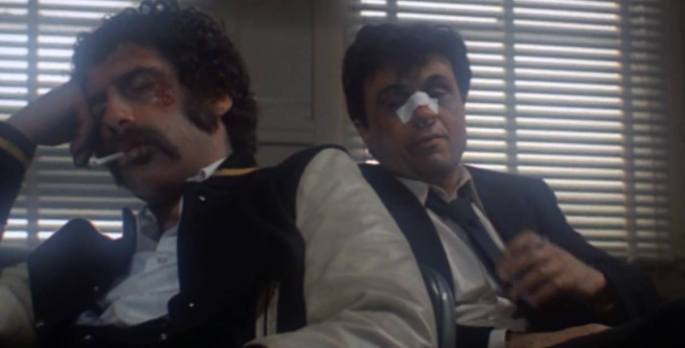
Busting is early buddy movie brilliance from the master of mid-budget studio actioners Peter Hyams (The Relic, 2010, Capricorn One, Timecop, The Star Chamber, End of Days, Sudden Death). This was the filmmaker’s debut feature film after two made-for-TV efforts, and while the project has a low-tech quality all around the edges, it still stands as one of the director’s best films. Starring an amazingly mustached Elliot Gould and future Robert Blake as a pair of pimp-slapping Vice squad detectives, Busting takes on an episodic structure, throwing the viewer into various cases and assignments, all of which lead to an overarching bad guy who is controlling the city’s vast pimping and whoring racket. At 95 minutes, there’s not a wasted scene, and despite the various converging plot lines, everything stays streamlined and easy to follow. I love how the two cop characters are idealistic and interested in cleaning up the streets, but that they slowly realize that their efforts may be all for not. Cynical, formally exciting in surprising ways, casually sexist and homophobic (those were the times!) and totally trading off of ugly, common stereotypes of the era, this was 1974’s “other” precursor to the popular 80’s buddy-cop film, with Freebie and the Bean beating Busting to theaters that year, and earning more box office and respect from critics and audiences. While the two films share some common traits, they are vastly different genre exercises, with Richard Rush’s Freebie placing an emphasis on madcap comedy and hilarious antics, and Busting being the more serious of the two films, mixing violence and sex into a gritty, decidedly more adult package, with Hyams clearly loving the chance to show off a down and dirty visual aesthetic. But there were two BIG things that stood out in Busting for me as a viewer. First — I can’t remember another film that ends on a freeze frame that then goes on to include a flash-forward voiceover narration which wraps up the narrative and the main character’s personal arc. I’d never seen this before, and I totally loved the nerve of it, as it fit perfectly with the film’s hopeless and dark denouement, which could only have been pulled off in a low budget 70’s item such as this one (with a few modern exceptions). The other technical aspect that I was constantly marveling over was the camerawork, and in particular, the numerous tracking shots that appeared to have been accomplished without the use of a dolly, and this being a film that predates the use of the stedicam (no?), I’m left only to guess how these fantastic scenes of action were accomplished. During the film’s various chase scenes and shoot-outs, the action is captured in long, unbroken takes, with actors running straight for the camera and then right past it as it continues to move and turn and swivel, all of which suggests the use of some sort of motion stabilizer device for the camera, as everything is ultra-smooth, especially considering the obvious budget limitations. It’s awesome, energizing stuff. Gould clearly had fun with his role, and the short-statured Blake made for a solid partner when contrasted with Gould’s lankiness. I found very little to quibble over with Busting. This is an example of a filmmaker crafting a tight, entertaining, hard-nosed actioner that now has the benefit of serving as a societal time capsule of a bygone era.
2

SAM RAIMI’S A SIMPLE PLAN — A REVIEW BY NICK CLEMENT

simple_plan.jpg

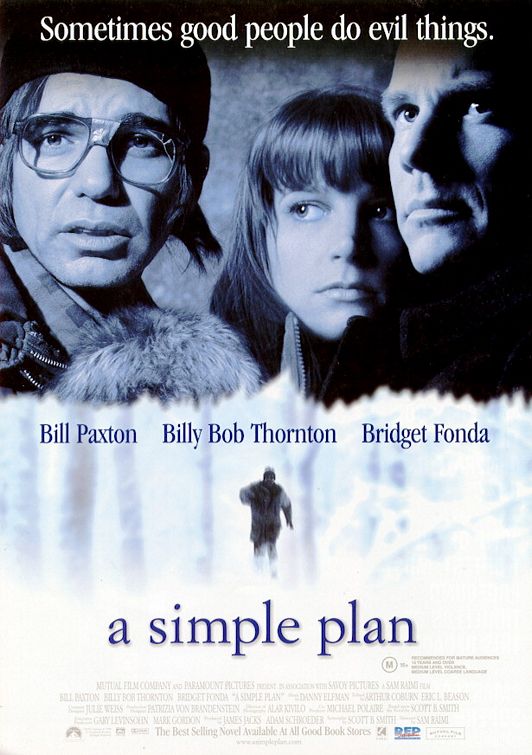
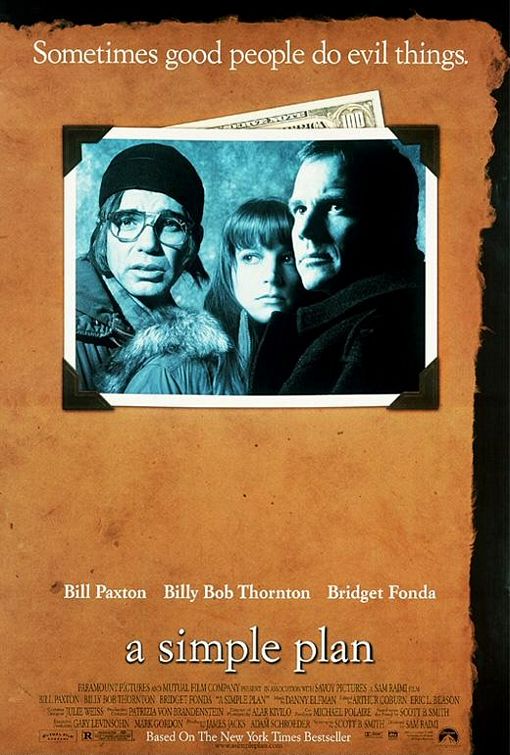
Make no mistake: A Simple Plan is the best film that Sam Raimi has ever made. It’s his most complete, his most human, his most emotionally affecting. This film has ice water running through its veins. I’ve seen it easily 10 times and it never fails to raise the hairs along the back of my neck, and because of how deadly serious the film is, nothing is played for laughs or with a sly smirk. What would you do if you found a ton of money in a crashed airplane in the middle of the snowy woods, with seemingly nobody around to see you make your discovery? That’s the dangerous and potentially lethal scenario posed by Scott B. Smith’s brilliant screenplay (which was based on his novel), which takes on Shakespearean levels of familial tragedy. Bill Paxton and Billy Bob Thornton were perfectly cast as Minnesota brothers, desperate for one big stroke of luck in their otherwise unremarkable lives, and Bridget Fonda was absolutely terrific as Paxton’s too-clever wife who might just be the smartest person in the room. The cinematography sends a chill down your spine, the snow vistas are shot with cutting simplicity, and the lack of nonsense in the final act truly elevates this film from standard genre piece to something more powerful and memorable.
simple_plan_ver4

I’d love to see Raimi return the neo-noir genre, as this film was aced from top to bottom, and displayed a maturity that he would seemingly abandon in future efforts. Danny Elfman’s creepy musical score was unsettling in all the right moments (love the piece of music that plays over the opening credits), and cinematographer Alar Kivilo made the most out the wintry, desolate locations, using bright daylight in a way that you normally don’t see in a thriller, with visual nods to In Cold Blood strewn all throughout. There’s also a ton of snow in this movie, and I love movies that take place in snowy environments. Gary Cole turns up as the villain in an extremely memorable performance. At one point, Mike Nichols was set to direct, before Ben Stiller became interested, which then lead to John Dahl becoming attached with Nicolas Cage in the Paxton role, only to have John Boorman temporarily replace him as a potential director (Boorman would be responsible for casting Paxton and Thornton). Despite grossing only $16 million at the American box office, the film was nominated for two Oscars (Best Supporting Actor, Billy Bob Thornton; Best Adapted Screenplay), and has most certainly taken on cult classic status. A Region A Blu-ray upgrade is long overdue, but for those with Region Free players, there’s a spiffy looking German Blu-ray available to own.

simple_plan_ver3

JOHN WELLS’ BURNT — A REVIEW BY NICK CLEMENT

burnt.jpg

Burnt is enjoyable fluff but should have been meatier, a decent first and second course, but it felt like old Harvey Scissorhands didn’t include the dessert. Now that I’ve got enough bad food puns out of the way, this movie was extremely sharp looking (MONTAGE POWER), Bradley Cooper was very commanding (he plays a terrific jerk, with the various outbursts in the kitchen registering as the film’s strongest scenes), the supporting cast is very deep (Sienna Miller, Daniel Bruhl, Omar Sy, Alicia Vikander, Emma Thompson), and it’s engagingly directed by John Wells. But, it’s the script by Steven Knight (Locke, Dirty Pretty Things) that felt surprisingly undernourished, or, more was shot and for some reason taken out of the final cut. And if that’s the case, I can’t begin to understand why. Not that what we’ve been given is bad; it’s just mostly predictable and it felt too quick and a tad slight. Cooper’s personal reflection/awakening happened awfully fast for someone with so many personal demons, and all of his potentially dangerous side issues got too neatly wrapped up. The real star of Burnt is the food and the high-energy scenes set inside of Cooper’s kitchen, as this is where the film feels truly alive. The filmmakers really nailed the chaos that overtakes a bustling cooking space, and Cooper’s performance was clearly inspired by real-life bad boy chefs who take their work very, very seriously. Interesting to note that Cooper played a sanitized version of this character on the short lived FOX TV series Kitchen Confidential. Also interesting to note, this project bears striking similarities to an unproduced screenplay that made the rounds about a decade ago called Seared, which was written by one-time flavor of the week Jesse Wigutow (who also penned the similarly unproduced yet fantastic Urban Townie), and was primed to be a David Fincher/Brad Pitt package. As is, Burnt is solidly decent, fast moving (a bit too fast), and always a slick visual treat. It’s what I’d like to call a Good Netflix.

burnt

GASPAR NOE’S LOVE — A REVIEW BY NICK CLEMENT

Untitled

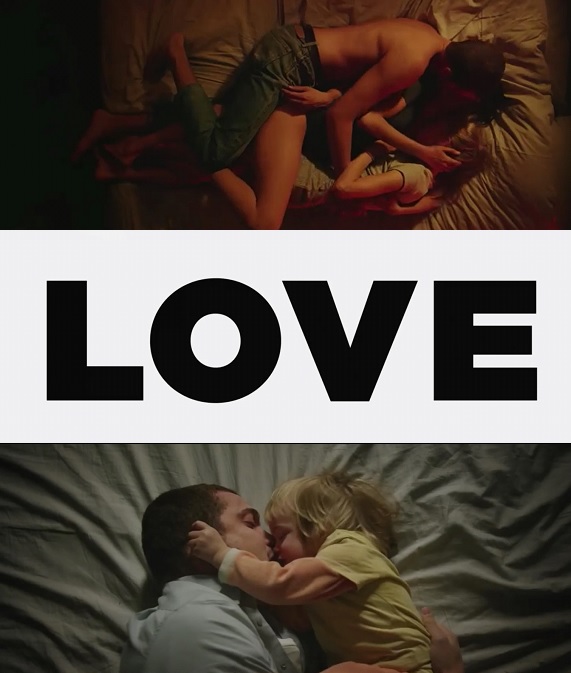
The French cinematic outlaw Gaspar Noe loves to provoke his audience. It seems to be his job. And it’s clear that he’s immensely enjoying himself. Throughout his overwhelmingly intense career as a filmmaker, he’s fashioned a body of work that could best be described as ugly-beautiful; he’s a man who sees genuine wonder and sometimes transcendent beauty in some of the most vile and visceral moments of human behavior. If I Stand Alone and Irreversible were both endurance tests and warm-ups for his magnum opus, Enter the Void, his newest picture, the hardcore sex drama Love, represents a nicer Noe to adventurous cinema lovers. Not that he’s not interested in taking his audience on a sometimes surreal, all the time wild ride through the sexual relationships of a particular trio, because in this film, which was presented in some theaters in 3-D, Noe joins the ranks of other filmmakers (Michael Winterbottom, Catherine Breillait, etc) who show honest sexual behavior as a way of communicating truth and reality to the viewer. Because our society is still so openly Puritanical, especially in America, where nothing is thought of if heads explode on TV but freak-outs occur if nipples are unleashed, this movie will certainly shock those who are unprepared for what Noe has up his sleeve, or I guess, in this instance, down in his pants.

The film’s very first scene, a three minute static shot of a man and a woman mutually pleasuring each other, sets the tone immediately, and it’s because Noe forces you to watch in an unblinking fashion that the action becomes more than just a rush of primal sexual energy, but a glimpse into the private world of two people who seemingly have a lot of affection for each other. The story to Love centers on a guy named Murphy (Karl Glusman), an aspiring American filmmaker living in Europe who enters into a volatile relationship with damaged-goods stunner Electra (Aomi Muyock), a dark haired vixen who runs away with Murphy’s heart and libido. As the two of them have always fantasized about a threesome, they bring a sexy young blonde into the mix named Omi (Klara Kristin), and in the film’s sexual centerpiece, you see the three of them make love for what seems to be an eternity; this sequence is easily one of the most rigorously and sensually realized bits of on-screen sexuality that I’ve ever seen, and it’s sort of insane (and sort of cool) to learn that Noe didn’t necessarily choreograph what went down during this sequence and others during the film.

But things get very complicated when Murphy begins an outright affair with Omi, gets her pregnant, and then Electra snaps, which sends the film down some narrative paths that it’s not necessarily interested in answering, offering more of a mosaic atmosphere and stressing its nonlinear structure as a way of showing the emotional complications that stem from people not being able to accept the past and move on. And like the sexual content of Blue is the Warmest Color, you feel an undeniable passion during each carnal encounter, with the film achieving an incredible sense of primal energy that frequently bubbles to the surface. The rest of the film is your typical Noe shock fest, with trips to neon-lit sex clubs with strobe light effects, discussions of fate, life, death, drugs, movies, and infidelity. I liked the film, but I never fell head over heels for it like I did with Enter the Void, which I consider to be one of the most amazing cinematic experiences that I’ve ever encountered.

The acting in Love is rough around the edges, as it was probably hard to find extremely skilled thespians who would be willing to get as down and dirty as Noe wanted them to get. Glusman, in particular, strains to achieve the emotional heft required to make the audience truly care about his plight, and the fact that he’s not the most likable of characters isn’t helped by the lack of subtlety required to turn his role into something more than two dimensional. And while I liked the content of the voice over that Noe wrote, Glusman’s reading of the lines seemed strangely flat. Nothing particularly enlightening is offered from a narrative POV, and while certainly stylish and glisteningly photogenic (Noe’s regular cinematographer Benoit Debie was behind the sinuous camera yet again), there’s a reserved sense of normalcy in comparison to Noe’s other works. I’m glad I experienced Love, but unlike Enter the Void, I don’t have the immediate desire to revisit, and with Noe, I am always expecting and prepared to have that itch, even if it’s an itch that can never be scratched again (Irreversible is the only film I can’t watch a second time, despite many attempts and an interest in doing so). Love is currently available in its completely uncensored form via Netflix streaming and Amazon streaming, and will hit Blu-ray on March 15.

Untitled


CHARLIE KAUFMAN AND DUKE JOHNSON’S ANOMALISA — A REVIEW BY NICK CLEMENT

anamolisa.jpg

Anomalisa is more miserable brilliance from Charlie Kaufman. He’s got a distinctly pessimistic world view that’s not going to sit well with some people, and his latest effort, which feels birthed from the same source as his previous masterpiece Synecdoche, NY, is just as dryly hilarious and caustically introspective, if even more interested in the crushing banality of life. Co-directed by Kaufman with animation superstar Duke Johnson, all of Anomalisa is designed with stop motion animation, with digital effects used to smooth things over, and the results are positively unique and at times distractingly curious. I spent the first 15 minutes of this film just staring at the construction of the faces and bodies, not to mention becoming sort of obsessed with the cracks in the sides of the heads; there’s a beguiling sense of wonder that comes from watching this strange and unique piece of cinema, and it truly feels like nothing I’ve ever seen before. The story is classic Kaufman stuff: A man is VERY disappointed with his life, and through a series of unfortunate circumstances, has to learn that not much is going to change, and that he’s doomed to repeat his frustrations again and again. David Thewlis voices the lead character, all filled with self-doubt and existential paranoia, and totally unimpressed with the fact that he’s married and has a kid and is still obsessing over an ex-girlfriend. Then, he meets a woman, exquisitely voiced (not to mention sung) by Jennifer Jason Leigh, and he thinks that this is it – he’s found his EXACT match. But, this being a romance from the poisoned soul of Kaufman, I’m not spoiling anything by saying that by the conclusion, happiness will likely still be out of reach for everyone.

It really reminds, in lots of ways, of the Coen brothers film A Serious Man, which I think is one of the top five efforts from those acerbic artists. Like A Serious Man, Anomalisa is about temptation, regret, disappointment, and the general principle that if something bad can happen, it more than likely will, even if there are moments of levity along the way. Lots of people will be immediately turned off by this film, and that’s cool. I get it. Scenes of oral sex comprised by Claymation characters shot in stop motion probably aren’t what everyone has in mind for their Saturday afternoon. But for me, this film was a non-stop (if incredibly dark) visual and verbal treat, a further reminder that there is only ONE Charlie Kaufman, and that his collective work has formed some sort of overall treatise on the human condition. Tom Noonan’s phenomenal voice work went a long way in cementing this film’s confidence, and without spoiling it, the central conceit to the sonic nature of the film was beyond heady. Joe Passarelli’s impossible to fully understand cinematography is worthy of repeated viewings as to dissect all of the subtle and ingenious ways that ideas were visually conveyed to the viewer. To be honest, I never thought this movie was going to open in my area, and including myself and my wife, there were four people in the theater, with the other two individuals displaying ZERO outward response to the film. Very interesting. I consistently wonder if people know about the films they choose to see before buying a ticket. The film was based on a 2005 play that Kaufman wrote for a Carter Burwell produced theater series comprised of “sound plays”, and it’s the first R-rated animated film to be nominated for an Academy Award for Best Animated Feature.

anamolisa


STEVEN SPIELBERG’S MUNICH — A REVIEW BY NICK CLEMENT

Munich

I thought so after the first viewing and 10 years later my feelings are still the same – Munich is a great film, one of Steven Spielberg’s top five movies of all time (Jaws, Close Encounters, Saving Private Ryan, and Schindler’s List would be the other four, with Minority Report nipping at heels), and a reminder that when a filmmaker is passionately involved in the thematic ambition of the story they are telling, the results can be incendiary and all-consuming. The Blu-ray retains the film’s overwhelming visual beauty and sonic glory. This is a raw and angry story about the impact of violence, grief, and revenge, and the way that Spielberg and his writers, Eric Roth and Tony Kushner, explored various themes and topics within the confines of the political thriller, elevate this film from merely a rush of ruthlessly staged and exhilarating action sequences, resulting in a deeply heartfelt study of a country’s need for vengeance and emotional catharsis. Munich covers the massively upsetting and extraordinarily intense story of the various Mossad agents who were dispatched to find and kill the 11 Palestinian terrorists who made up Black September, and who killed 11 Israeli athletes at the 1972 Olympics. This is a profoundly moving film experience, a piece of work that juxtaposes sex and violence in a way that’s rarely glimpsed, and the way that Spielberg designed the film stylistically with his immensely talented cinematographer Janusz Kaminski is a thing of geometric beauty. Using zooms, pans, hand-held camera, and always finding ways to cover the proceedings in a stealthy manner, the film has a rich visual style that’s endlessly engrossing and amazing to study in the fine details. The bombing sequences are handled in an ultra-tense fashion, and the raid in Beirut still stands as one of the most visceral, most unsettling displays of close-quarters AK-47 combat ever put to film. Bullets rip apart flesh in this film, with the unflinching camera never turning a blind eye to the bloody carnage all round it.

This is the harshest film of Spielberg’s career, a movie born out of the ashes of 9/11, one that simmers with burning rage and resentment. I love when Daniel Craig’s character so bluntly states “Don’t fuck with the Jews.” It’s a comment that’s meant to sort of be funny, but it’s also meant to reinforce the notion that when push comes to shove, a body of people can take their collective pain and return it to those who caused it in the first place; the cycle of violence that Munich perpetuates is both honest and frustratingly real. The ensemble is stellar across the board, with a perfectly cast Eric Bana leading the unit as the commanding agent, with terrific support coming from underrated Irish actor Ciarán Hinds as a “cleaner”, a pre-Bond Daniel Craig as the getaway driver, Geoffrey Rush in a slyly humorous performance as the group’s government contact, Mathieu Kassovitz as the group’s apprehensive resident bomb maker, Mathieu Amalric as a shadowy French informant who helps the group with tracking down their targets, and other familiar and not so familiar faces rounding out the edges. There are so many great scenes in this film it’s almost a joke to try and list them all. The film crackles with violent, propulsive energy during the numerous action scenes, there’s a truly wonderful sequence with Bana and his crew arriving in an already occupied safe-house with members of the opposition, and an Amsterdam-set interlude that finds the crew going after a drop-dead gorgeous female assassin who has taken out members of their group. And the final, haunting image of a changing-through-the-years NYC skyline pumps up the film’s ultimate message that things are never going to get any better despite how hard we try to change our societal landscape. It’s a troubling, cynical comment to make at the end of such an emotionally draining film, but just look at how things have progressed since the time of this film’s release, and tell me we’re any further along at correcting the mistakes of the past. If anything, we’re headed down an even more dangerous path.


TERRENCE MALICK’S KNIGHT OF CUPS — A REVIEW BY NICK CLEMENT

1

Terrence Malick, at this point, isn’t going to make any new fans with the distinctly personal direction his work has taken him in over the last five or six years. You’ve either accepted the radical change in his intent as an artist, or you haven’t. I was absolutely soul shaken by The Tree of Life (one of the best movies ever made) and his continued reinvention of the cinematic language continued with the perhaps even more personal To the Wonder. Now, with Knight of Cups, Malick has crafted his most openly sexual film of his career, telling a familiar story of hedonistic Los Angeles excess through a filter of dreamy poetry and the blinding beauty of the incomparable Emmanuel Lubezki’s bewilderingly seductive images. Christian Bale is the Malick stand-in this time around, and he continues where Ben Affleck impressively left off in To the Wonder, acting as a wandering cipher for most of the runtime, yet allowing you, crucially, into his headspace at key moments for maximum emotional impact.


4

Bale plays a screenwriter named Rick, aimlessly living a potentially toxic and empty existence in Los Angeles, and in a Fellini-esque stroke, Malick fills the film with strange and surreal moments that seem designed to test and tempt his flawed hero. Still haunted by the death of one brother and the troubling lifestyle of another, it’s clear that Rick’s chosen brand of self-medication is women and the carnal pleasures they can provide him. He stunts his sadness with a series of romps with a slew of impossibly attractive women, each one more potent than the last, with the voiceover slyly informing us that “sometimes you want raspberry…and then…sometimes…you want strawberry.” But instead of cheaply reducing women to nothing more than fanciful play objects, Malick makes it clear that women hold the key to Rick’s full understanding of his life, and that without the sometimes painful and challenging experiences that he faces, he wouldn’t be the complete man that he has become without these moments of potential discomfort.

2

Knight of Cups feels like Malick’s response to the overwhelming attraction that men can have when seeing a beautiful woman, and I found, at times, that the film seemed terrified by the power of the female form and mindset. Malick, never one to show on-screen sexual behavior or nudity in any sort of graphic fashion, cuts loose in Knight of Cups, filling the screen with one sexy and sensual image after another, all in a quest to capture the female body in ways that you’re not normally used to seeing. Similar to the recent work of Paolo Sorrentino in The Great Beauty and Youth, there is an almost fetishistic love for the female body in Knight of Cups, with the camera lingering on legs, breasts, faces, and derrieres, with Bale encountering one beguiling beauty after another, and the narrative taking on an impressionistic quality; this film is a blur of sound, image, and color, with a fleeting sense of randomness that thematically and aesthetically ties it neatly into Phase 2 Malick.

3

If To the Wonder was born out of The Tree of Life, then Knight of Cups feels like the next logical extension from To the Wonder, with Malick continually pushing the boundaries of non-linear, free-form storytelling. It’s also sort of thrilling to see a totally modern film from Malick, who is prone to period pieces, and to my knowledge, has never shot in the city of Los Angeles before working on Knight of Cups. The city is given the glow of a halo, with a lyrical vibe projected under Malick’s starry-eyed gaze, and it’s rather astonishing that he’s made one of the most recognizable cities look totally different than what you’re used to seeing. There are some nighttime shots of downtown Los Angeles that will produce feelings of apoplexy for Michael Mann when he sees this shimmery piece of work. The overwhelmingly alluring supporting cast of females includes Nathalie Portman, Cate Blanchett, Teresa Palmer, Imogen Poots, Freida Pinto, and Isabel Lucas, while Antonio Banderas, Brian Dennehy, Wes Bentley, and Armin Mueller-Stahl all provide memorable bits and pieces that help to solidify the clearly personal and internalized story. I’m sure I’ll have more to say about this decadent piece of cinema throughout the year as more viewings occur, but for now, I’ll state that I was positively engrossed immediately from the start, and after two screenings, it feels as different and new as one could hope from a filmmaker who never seems content to play it traditional or safe.


PILOT REVIEW: THE PEOPLE VS. OJ SIMPSON — BY NICK CLEMENT

OJ

Believe the hype. The pilot for the new FX series The People vs. OJ Simpson was absolutely terrific, and if the quality level of the first installment is any indication as to where the entire show is headed, then it’s going to become essential TV viewing, because already, the hooks have been set firmly in place. I had a feeling that this was going to be a show of particular merit when I learned that Larry Karaszewski and Scott Alexander were going to be calling the shots as executive producers and writers, if not director(s) — the episode list at Wikipedia only has credits listed thru episode five. Their insanely awesome feature screenwriting credits include Ed Wood, Man on the Moon, The People vs. Larry Flynt, and Big Eyes, to name just four, all fantastic projects in similar and different ways, with their past work promising smart writing, plotting, and character building for this new crime anthology series. Of course, it can only help to have material as juicy and as iconic as the OJ Simpson fiasco/murder trial as your playing field, and during the first hour, Karazeweski and Alexander, along with director and executive producer Ryan Murphy, establish an almost dizzying array of people, places, and events, all of it coherently streamlined and executed with a minimum of stylistic intrusion or unnecessary fuss. There’s an urgency to the storytelling, which nails all of the key moments during those feverish first 24 hours of Nicole Brown Simpson and Ronald Goldman’s murders, and the way that the media circus is portrayed hits all of the perfect satirical marks about how frenzied our celebrity obsessed culture can be, especially during times of crisis. An almost absurdly stacked cast is top lined by sweaty and nervous Cuba Gooding Jr. as The Juice, a brittle and hostile Sarah Paulson as Marcia Clarke, John Travolta doing a lovely lock-jaw impersonation of Robert Shapiro (“I’m on the list” – ugh!), Courtney B. Vance as hot-tempered Johnnie Cochran, Rescue Me’s Steven Pasquale as the racist detective Mark Furhman, with Connie Britton, Jordana Brewster and Selma Blair popping up for a quick scene (more with them to most certainly come…). And yet the entire piece is practically stolen by, of all people, David Schwimmer, playing OJ’s long time friend Robert Kardashian, all sad-sacked and droopy-eyed, trying to discredit all that he’s learning about the increasingly desperate situation, never wanting to believe or accept the fact that his buddy is actually a murderer. Honestly, this is one of the most impressive ensemble casts I’ve ever seen on a TV series, and it’s tremendously clear that every performer brought their A-game to this production. I was 14 years old when I saw that white Bronco charging down the California freeway from my living room in CT, and during those final moments of the pilot when you see Simpson being driven by Al Cowlings (Malcolm Jamal Warner!) in that infamous SUV, you get that creeped-out sensation all over again, with the show serving as a volatile time capsule as well as a riveting drama. I watched this first installment twice, and I am very anxious to see more.

TOM MCCARTHY’S SPOTLIGHT — A REVIEW BY NICK CLEMENT

1

The dangerous and hideous organization otherwise known as the Catholic Church gets the greatest cinematic middle finger ever possible with the gripping journalism procedural Spotlight. Exhaustively researched and written with class and care by director Tom McCarthy and co-scripter Josh Singer, this is a bold and provocative film that dares to speak out against one of the most disgusting and powerful religious groups that gets to carry on with impunity in our increasingly absurd and hypocritical society. My stomach was in twisted knots all throughout this film, as the script details the various sexual abuses that rocked the Boston Archdiocese in the early 2000’s. A sterling ensemble cast comprising of Michael Keaton, Mark Ruffalo (absolutely superb), Rachel McAdams, John Slattery, Liev Schreiber, Brian d’Arcy James, Stanley Tucci, and the amazing voice of Richard Jenkins all do intense and laser focused work. There isn’t one bad performance out of the group, the direction is crisp and efficient, the writing razor sharp, the editing fluid, the cinematography subtle and controlled.

2

I have nothing negative to say about the film or the way it was crafted. Were there other movies from 2015 that I enjoyed watching more? You bet. But not many were this incendiary, this enraging, or this important to our society. How ANYONE could support the Catholic Church is well outside my realm of personal understanding in this day and age. This movie makes it ABUNDANTLY CLEAR that 249 priests molested or raped 1,000 children of various ages, from all over the Boston area, and in many instances, were simply moved by the Church from one city and parish to another, and sometimes listed in official documents as being on “sick leave.” Yeah. Sick leave, all right. The systemic failure of the Catholic Church to take care of an epidemic of this nature is disturbing and embarrassing, and clearly demonstrates the church’s smug and cavalier attitude towards this reprehensible behavior. I wanted to throw my TV out the window when the filmmakers included the text note that Cardinal Bernard Law was reassigned to a senior position of honor in Rome after being removed from his duties in Massachusetts. The text listing of all the states and countries affected by this tragedy is detailed at the finish, and it makes your skin crawl. This is a great movie about something insanely ugly and sad.

3

JAMES KENT’S TESTAMENT OF YOUTH — A REVIEW BY NICK CLEMENT

3

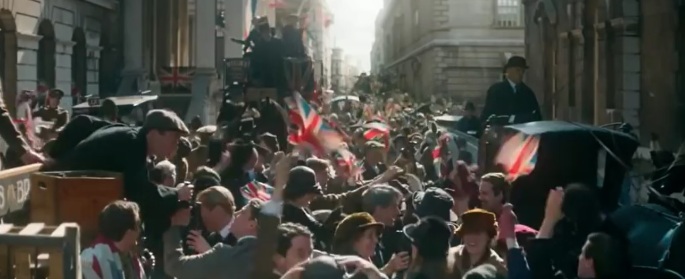
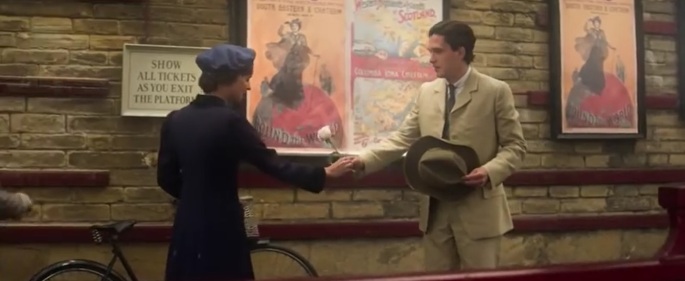
Make no mistake: Alicia Vikander is the real deal and she’s here to stay. 2015 was the year of Vikander POWER, with her brilliant work in Ex-Machina, her much lauded performance in The Danish Girl (which I’ve yet to see), her playfully sexy romp in The Man from U.N.C.L.E., and her quietly forceful turn in the staid and solid British WWI drama Testament of Youth. This is material that’s been done to death, and while there’s nothing revolutionary about the material or approach, there’s a comfortable squareness to the production, all of which is anchored by Vikander’s excellent portrayal of a woman caught at multiple crossroads at various points in her life. Capably directed by James Kent and efficiently written by Juliette Towhidi, the film was based on the memoir by Vera Brittain, and details her struggles both with herself and the social environment that she found herself a part of.

2

A strong willed and fiercely independent woman in the face of almost certain lifelong domestication, she wasn’t interested in getting married and becoming arm candy for a rich suitor; she had her own dreams and aspirations, despite her father’s insistence that she find a suitable husband before anything else. She gets accepted to Somerville College, an offshoot of Oxford, ends up reluctantly falling in love, and then WWI explodes on the scene, changing her life forever, with her joining the Voluntary Aid Detachment as a nurse serving near the front lines of battle, caring for both British and German soldiers wounded in London and France. Again, this material is tried and true, the production goes through the expected paces, and the entire piece finishes on a downbeat note that is appropriately sad and tragic. Taron Egerton (so terrific in last year’s Kingsman), Emily Watson, Haley Atwell, Dominic West, Miranda Richardson, Kit Harrington, and Colin Morgan all provide solid supporting turns. Rob Hardy’s studious and cleanly composed widescreen cinematography is a major highlight, while the musical score from Max Richter hits the expected notes of poignancy. This film never received any sort of wide or even semi-wide theatrical release in the United States. Saoirse Ronan was once attached to Vikander’s role, for which she received a Best Actress nomination from the British Independent Film Awards.

1