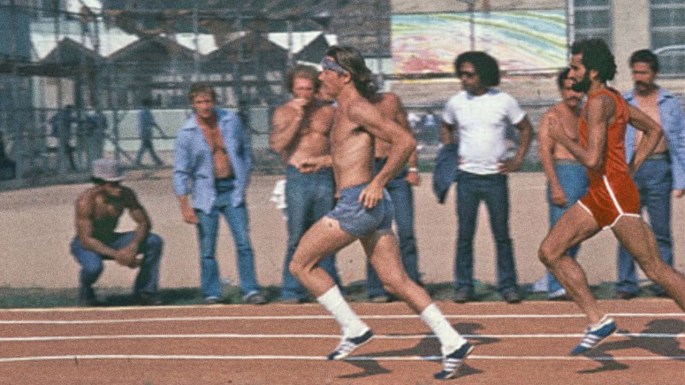
THE MICHAEL MANN FILES: THE JERICHO MILE (1979)

Tracing his incremental steps that ultimately led to theatrical features, it makes sense that Michael Mann would create his first feature film for network television. Coming off two paying gigs that made 1978 a pivotal year for the filmmaker (namely his uncredited work on Ulu Grosbard’s Straight Time and his credited creation of the television series VEGA$ by way of the Mann-scripted pilot), he was a natural fit to write The Jericho Mile, a movie-of-the-week for ABC. Hired directly by actor Peter Strauss, Mann’s script impressed Strauss so much that he convinced the network to allow Mann to direct. After bouncing around Hollywood for a while and writing scripts for television (not to mention having the creation of a whole show on his resume), Mann was definitely due. And Strauss, insanely popular throughout the seventies due to his appearance in Rich Man, Poor Man, had the kind of stroke to make it happen.

The Jericho Mile was prime material for Mann. A healthy blend of the prison film and the sports drama, the film follows lifer inmate Rain Murphy (Strauss) as he uses long distance running as a means of coping with the confines of prison and his inability to steer the direction of his life. As his prison counselor notices the incredible speed in which Murphy can clear a mile, a succession of events occur in which Murphy is given the opportunity to compete for a spot on the Olympic team while he also navigates the tricky and sometimes lethal political structure within the prison.

It is the latter where The Jericho Mile truly excels, at times feeling entirely authentic as the convicts with speaking roles mesh alongside the professional actors. Additionally, a great deal of value is generated by shooting within the walls of California’s Folsom Prison. The metal works, the kitchen, laundry room, the yard, and the squat, desolate cells go a great distance in selling the film’s credibility and reflecting a world that is cramped and oppressive. This last element is also helped immeasurably by its boxy 1.33:1 aspect ratio, standard for television broadcasts of the day, which now makes the film look especially claustrophobic and tight.

The film should also be commended for what it doesn’t do. While it can’t help but traffic in some of the hoariest tropes of the prison film (which may or may not be its fault since there are only a limited number of things that can occur in prison), it doesn’t stoop to underlining the explicit inhumanity that occurs in confinement. Instead of shocking viewers with lurid details (which was actually pretty much par for the course in the day), the film wisely keeps within the boundaries of taste and shows how prisoners are generally in an impossible double-bind with both the state and the prison population, the structure of the latter being as complicated, unfair, and unforgiving as the bureaucratic red tape and regulations that routinely crush the spirits of the incarcerated. Additionally, the film doesn’t introduce a doomed relationship into Murphy’s life and, instead, keeps his one encounter with the opposite gender to be that of a brief glance between himself and an executive assistant at the U.S. Olympic board, reminding him of his status as someone with zero future with her or with anyone else but himself and what’s in his head.

To this end, The Jericho Mile has a wise, knowing angle on the life of the career criminal and prisoner. Whether or not this is due to Mann’s familiarity with the Edward Bunker material that became the screenplay for Straight Time is uncertain, but it’s likely. The transcendent poeticism meshing with the gritty details feels very much like Bunker’s outward expression of the criminal life as a certain kind of art form but the level of stoic control in Murphy’s character is all Mann. Murphy is Max Dembo if Dembo was remanded back to the state pen and took up long distance running, speaking with a clear, direct cadence with very few consonants, most reminiscent of James Caan’s Frank in Thief. This is why The Jericho Mile also stands as an almost reference point for the vast majority of Mann’s other criminal protagonists that would come later. Certainly both Frank and Neil McCauley’s talk about prison and doing time harkens back to the life we see unfold in The Jericho Mile where the only time we leave the prison walls to get a sense of real freedom is when Murphy is allowed to run around the parameter of them while in training. The reasoning behind the reluctance for later Mann characters to want to go back into a hell on earth is made strikingly clear in this film and, once he’s out, Mann rarely ever takes his cameras, or his characters, back in.

Being a television movie, the film sometimes falls into traps that reveals its limited hand. Where it doesn’t feel as sanded down in terms of the language or the prison violence (though it is on both counts), Mann’s preoccupation with lacing his drama with broad, emotion-driven moments is met with the medium’s small scale causing passages that might play a little more successfully on larger-than-life movie theater screens. This is most evident with the hotted-up performance by Brian Dennehy as Dr. D, the leader of the neo-Nazi faction of the prison, and with Richard Lawson’s performance as the doomed inmate, Stiles. For both, the screen size seems an ill fit to their grander, almost stage-bound turns. Mann often lets his actors descend into a sort of archness (specifically Tom Cruise’s Vincent in Collateral and literally everyone in his theatrical adaptation of Miami Vice) where the characters play to both the dunderheads AND the back row, but those performances need to be accompanied by a bigness and a freedom that a made-for-television movie produced in 1979 is just not going to be able to allow.

Also less successful, though not fatally, is the film’s sports angle. Again, there can really be no suspense as to how any of this is going to work out so the actual moments of Murphy running, training, and racing are less interesting than the passages that explore the reasons for his running. Unfortunately, the hook of the film is in its plotted narrative so the main thrust of the movie is, in fact, that of a rote sports film. Mann’s attempt to turn Murphy into a hopeful symbol both by and for the inmates may anticipate his approach to the material he would later take with Ali but here it feels a little undercooked. Despite Strauss’s emotional reaction to it, the moment where the prisoners line up to give him food for his training feels like a lachrymose, reverse-Cool Hand Luke, hitting the chords it wants to but not hitting them like it should.

For the most part, The Jericho Mile is an absolute triumph and, in fact, made a pretty big splash with audiences and critics at the time. Peter Strauss is utterly fantastic and won an Emmy for his role while Mann and co-writer Patrick Nolan picked up Emmys for their script. But most importantly, it gave Michael Mann his first stab at assembling a feature while also allowing him to work in the milieu that would inform his characters and their collective worldview throughout the rest of his career.

(C) Copyright 2021, Patrick Crain

THE P.T. ANDERSON FILES: BOOGIE NIGHTS (1997)

It’s a strange thing to consider but for all of the power that sex wields to start wars, topple the powerful, and put people into financial or personal ruin, the porn industry is small time. That’s not to say that the porn business doesn’t make boatloads of cash. In fact, it’s quite the opposite. I mean, if one really wants to believe that the only things subsidizing the porn industry are the spending habits of amoral perverts, that person may want to try and show their math on that assertion if only to sooner realize that there just aren’t that many degenerates wandering the earth. In other words, a whole lot of people you encounter at work, in the streets, and (gasp) at church have at least dipped a toe or, more likely, engaged in a full baptism into one of the four corners in the pool of the sex industry. But yet, for all of the dough the films generate, there are precious few hardcore actors or directors that have been able to transcend the hermetic shell of the adult film world either in name or deed. For every John Holmes, Ron Jeremy, or Sasha Grey, there are a thousand others whose stopover into the world of porn occurs because it’s a place that, if they can’t build a legacy, they can definitely make a buck.

It is because of this that, despite actually working at a General Cinemas theater at the time, I’m unsure as to what went through the public’s mind when they saw the expertly cut and energetic trailers for Paul Thomas Anderson’s Boogie Nights prior to its release in the summer of 1997. Here was a film that was going to be playing in the multiplexes and malls across America that would, in seemingly frank terms, follow the story of an ersatz John Holmes as he navigated the literal ups and downs in the pornographic film industry in the 1970’s and 80’s. Would America be able to reckon with its very real attachment to pornography to feel comfortable enough to go and see it and give it the respect it deserved or would the film flop given the culture’s mind-bogglingly puritanical attitude towards THIS KIND OF SEX™️? If there is anything to challenge the accepted notion that sex sells, it’s to invite people to sit through two-and-a-half hours of it.

But Boogie Nights was a hit and, surprisingly, a quite sizable one. Anchored in the front by a dynamite and keenly sensitive central performance from a then-risky Mark Wahlberg and, in the back, by a jaw-dropping return to form by Burt Reynolds with incredible, fearless performances by Julianne Moore, Heather Graham, John C. Reilly, Don Cheadle, William H. Macy, and Philip Seymour Hoffman (among others) between them, Boogie Nights was received as a rollicking, exhilarating American epic that was an intoxicating mix of Scorsese-like rhythms and editing being navigated by Demme/Ashby-like heart across an Altman-like canvas; the most joyous piece of pop filmmaking since Quentin Tarantino’s Pulp Fiction three years earlier.

Boogie Nights appeared at just the right time in America to make the splash that it did. The years of peace and economic expansion under the Clinton administration turned the 90’s into a freewheeling party which saw the birth of the internet and, also, a certain lax in our social mores as latchkey kids from the 70’s who grew up sneaking peeks at their parents’ poorly hidden porn stashes rolled into their twenties with a more permissive, NBD attitude towards Boogie Nights’s subject matter. All of the moments within the film that focused on the hilariously crude approach to adult filmmaking (and its spot-on recreations of the final product) were met with the appropriately knowing chuckles of an audience that couldn’t do anything but acknowledge that they understood exactly what they were looking at and, in the words of Elliott Gould in The Long Goodbye, it was (at long last) ok with them. And it was the good fortune of everyone cast in the film that the worm of American culture had somewhat turned as Boogie Nights is a virtual “who’s who” of talent that was just beginning to crest a professional summit out of indie-world and the film’s success would propel almost every single one of them to mainstream fame.

One of the things that has continued to work in Boogie Nights’s favor almost a quarter century later is its anticipation of the succeeding generation’s devotion to 100% acceptance and the encouragement of full positivity among its peers. To this end, Anderson doesn’t excuse his characters’ flaws but is ultimately sympathetic to all of them (save and except Diggler’s mother, Joanna Gleason in a ferociously monstrous performance). The characters are small time but, almost presciently, exist in a world of total support and encouragement; one in which, from the point of view of those on the ground in the actual time and place, seemed like more of a legitimate enterprise than, say, selling blowjobs on Hollywood Boulevard for a hot meal and/or somewhere to sleep. So maybe it’s technically incorrect (and borderline irresponsible) for Julianne Moore’s mother-surrogate, Amber Waves, to fawn over Wahlberg’s decidedly not-very-talented (but massively endowed) Dirk Diggler as “so fucking talented,” but is it really worse than how his actual mother treats him in the neatly trimmed “normal” world of Torrance? Sure, Jessie St. Vincent’s (Melora Walters) paintings are uniquely awful but, really, are they any more subpar than some of the tacky prints that adorned the walls of suburbia at the same time? Are those adult award shows any more moronic and stupidly self-congratulatory than the Oscars? Certainly, the ephemeral static attached to the porn industry doesn’t make it look like the most positive environment to some people who live nine-to-five existences but, as the film makes crystal clear, the need-driven support structure within it is mighty alluring for the socially outcast, the marginalized, and the abused.

And Boogie Nights was never going to be a movie that reveled in its orgiastic pleasures for its own sake. Much like Goodfellas, there is a real “set ‘em up and knock ‘em down” formula to the film’s structure. The film’s first half looks like a total blast of wanton abandon; an effervescent celebration of the largesse of the sexual revolution replete with a pulsating soundtrack and the promise of a perpetual California sunset. As an audience member, you WANT to be there, even if you’re just hanging out in a lounge chair poolside while drinking a margarita while everything else swirls around you. But, sweet Christ, brutal is the comedown that occurs in the second half of the film when the organic pleasures of the 70’s are replaced with the synthetic coke high of the 80’s. A nonstop stack of nightmares including a murder-suicide, crippling addiction, accompanying sexual dysfunction, mounting legal challenges, the cold yet practical move from film to video, and violent moments of terrifying, rock-bottom sobriety show that Boogie Nights is just as eager to argue the downslope as convincingly as it does the ascension, though without any kind of sanctimony in regards to its characters’ plights.

But as much as Robert Altman utilized the titular city to examine America as a whole in 1975’s Nashville, Anderson is using the porn industry in the bracketed time frame to explore the fluid boundaries of family much like he did in Hard Eight the year before and he would in Magnolia two years later. And, to be sure, the world of Boogie Nights remains his best Petri dish in which to study this dynamic as the film’s libertine atmosphere mixes with its members’ outcast and discarded statuses which create disarmingly moving and powerful moments throughout the film, most especially those involving any combination of Wahlberg, Reynolds, and/or Moore.

And so it is that Boogie Nights endures not just because it’s a naughtily hilarious and dramatically satisfying film, well-remembered by Gen-Xers who pine for the sun-kissed days of the mid-90’s. It endures due to the fact that it was written and directed by a guy not yet twenty eight who could resist the easy temptation of sniggering at its subject matter in favor of focusing on the longer view that included poignancy, care, and familial love shared among its characters, ensuring that it would continue to pay dividends to its audience well into the future.

THE ROBERT ALTMAN FILES: NASHVILLE (1975)

The Paramount logo appears in black and white and in a state of mismanaged distress. This is quickly followed by a calm pre-title credit countdown; Three, the studio… two, the producers… one, the director. Then, the blast off occurs with a voice that booms “NOW AFTER YEARS IN THE MAKING…” revealing a commercial for the film’s soundtrack album that will also operate as the film’s opening credit sequence. Welcome to Nashville, Tennessee in 1975, a reflection of an America that could be marketed just like a K-Tel record. Years in the making but here for your enjoyment “in stereophonic sound and without commercial interruption.”

Robert Altman’s Nashville is ground zero for reflecting America’s unhealthy appetite for mixing celebrity and politics and it savagely and meticulously lays bare the ugly mechanisms that fuel both enterprises and also our collective and insatiable obsessions with them. It’s about a post-war, post-Eisenhower America being left behind as a perverted geek show of wrong-headed populism, shameless grifters, and shallow entertainment tightens its grip on a nation that has been so beaten down and disillusioned that a earnest yet moronic song like “200 Years,” an anthem that marvels at America’s ability to withstand trials and tribulations long enough to last two whole centuries, can be mistakenly presented as a chest-bursting piece of patriotism instead of the hilariously stupid self-own that it is.

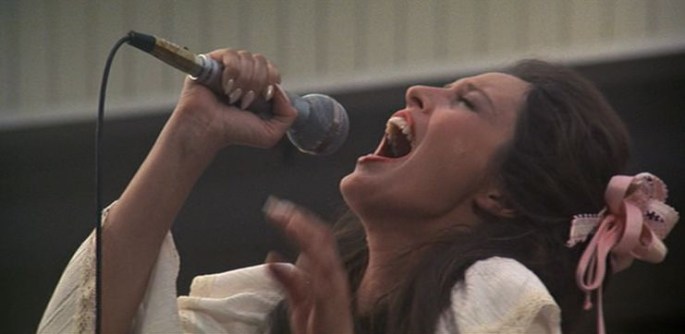
Nashville is the story of a few days in the life of twenty-four people in the titular city in which there are two defining events afoot. One of them is the re-emergence of country artist Barbara Jean (Ronee Blakely), the undisputed but fragile queen of Nashville who’s been convalescing after a recent “flaming baton” incident. The other is the organization of a political rally for Hal Phillip Walker, presidential candidate for the populist, third-party “Replacement Party,” and winner of enough recent primaries to make the political establishment sweat. Through these two events, which will eventually thread together, we follow a whole host of country stars, political advance men, groupies, journalists, bored husbands, their even more bored wives, rock stars, hangers-on, has-beens, never-weres, kooks, and earnest fans. There’s a lot of information that floats at the viewer like an unstoppable current but Altman, with the help of a framework screenplay by Joan Tewkesbury, links all of these characters together with an uncanny skill and a uniquely American eye.

Up until 1975, there had not been a film quite like Nashville. Sure, star-studded films in the vein of Grand Hotel had been produced and were crowd-pleasing successes, but even those felt more like omnibus tales and less like a grand tapestry in which there truly is no lead character. Nashville was the first film to spread its giant cast comfortably across the widescreen canvas while also making them feel as they were part of something that was bubbling with vitality and was recognizably and organically alive. And in fact, Nashville exists in a space where real stars such as Elliott Gould and Julie Christie appear alongside characters portrayed by actors with whom they’ve worked before. Additional life is given to the film in the way it integrates likewise authentic locations like the Grand Old Opry (replete with a real GOO audience) being utilized for the actors to authentically perform songs that they wrote and brought to the project themselves. While the greatest example of this form of Altman commitment likely goes to the mock presidential campaign that crossed paths with very real ones in Altman’s Tanner ‘88 (which, not coincidentally, featured Michael Murphy as the central visible political figure), Nashville was the first to truly make an Altman production the kind of all-in communal effort he’d been tinkering with since McCabe & Mrs. Miller.

In the spirit of how our lives actually unfold, Nashville is a big movie built of little things. Broad gags such as the freeway pileup at the beginning and the climactic ending aren’t subtle nor are they hard to forget but the heart of the film is found in its small, fleeting passages such as the moment where Barbara Jean’s manipulative, boorish husband/manager, Barnett (Allen Garfield) blows her a kiss as she hits an emotionally terse high note while struggling to get through a musical set without a meltdown. It’s a film that recognizes the hurt on Mary’s (Cristina Rains) face when the vacuous Opal From the BBC (Geraldine Chaplin) announces that she, too, has slept with Tom (Keith Carradine), Mary’s musical partner to whom she’s truly in love despite being married to Bill (Allan Nicholls), the third in their musical trio. It’s a film that makes no judgements in understanding the delta between the feelings of frustration felt by Delbert Reece (Ned Beatty) and the joy felt by his wife, Linnea (Lilly Tomlin), while listening to their deaf son’s story about swimming class. It’s a film that picks up on the absolute contempt, punctuated by camera-ready smiles, that floods the face of Connie White (Karen Black) as she waits in the wings at the Grand Old Opry to fill in for Barbara Jean, a woman she positively hates. Finally, it’s a film that documents the sometimes ugly birth of stardom as it allows Barbara Harris’s unlikely and wonderfully ragged Albuquerque, a total hot mess of bleached hair, torn stockings, mismatched outfits, and wild dreams of becoming a “country western singer and or a star,” to triumphantly rise above tragedy, fully embodying American’s broken soul.

Nashville is also very good at both covering all of its bases and existing on a wavelength of recognizable ebbs and flows. It’s not satisfied with Gene Triplett’s (Michael Murphy) smug disdain for the people of Nashville as he tries to schmooze each and every star or half star into the Walker rally; it’s satisfied when it gets to show his utter shamelessness, following him into the hotel room of Tom and Mary where he attempts to rook them into the same show by dismissing the appeal of the country music artists he’s worked to put on the bill as being limited to dumb shitkickers. It’s not satisfied by showing us Barbara Jean virtually being draped in an American flag while performing “One, I Love You”; it’s satisfied when, earlier in the film, the tragically untalented Sueleen Gay (Gwen Welles) gets booed off the stage at a smoker for performing the same song. It’s not satisfied to show self-absorbed Tom treating every single woman that moves through his hotel room like absolute garbage and with reckless abandon; it’s satisfied when Linnea returns the favor by coldly and wordlessly reminding him that she’s past a point in her life where her feelings can be manipulated by a casual fling, even by him.

Nashville was the last time Altman keenly anticipated the culture and, in fact, the film’s ending became a reference point when Mark David Chapman assassinated John Lennon five years after the film’s release. But created in the haze between Richard Nixon’s resignation and the ascension of Jimmy Carter, Altman found the most fertile possible ground for the ascendancy of the campaign of a sleazy idiot like Hal Phillip Walker. For all the ink spilled on the prophetic nature of Sidney Lumet’s brilliant Network, released the following year, the bone-headed populism at the root of Hal Phillip Walker’s campaign has had longer legs with American culture. After all, not by coincidence, Altman would find the depths of the Reagan years to be the perfect time to recast Hal Phillip Walker as a (still unseen by the audience) right-wing television talking head in his unnecessarily maligned O.C. and Stiggs. The chord of Hal Phillip Walker and how it would likely eat America from the inside out was something that must have troubled and disgusted Altman to such a degree that, after Nashville, Altman ceased reporting on the culture and, in a manner of fashion, tried to do more to influence it (to diminishing returns) with specific elements found in A Perfect Couple, Quintet, and HealtH.

Nashville caused quite stir when it was released and it was uniformly detested by the Nashville community. Of course, this should be expected as, outside the coasts, most every place in America which feels like it’s keeping her memory pure has an almost insatiable desire to appear as unblemished as one of Tom Wolfe’s freshly-pressed suits. But what did Nashville reveal that was so objectionable? That, despite their cornpone humility, folks in the south can be just as petty, uninformed, and judgmental as those in New York or Los Angeles? That reductive, simple-minded country weepies like “For the Sake of the Children” could actually be hits? That there exists a ruthless power structure within the bowels of show business, regardless of what region of the country one finds themselves? That black country entertainers like Tommy Brown (Timothy Brown) have to often grit their teeth and accept the transactional relationship they have with their majority-white milieu? That boredom and infidelity occur in spades, even in places where seemingly everyone goes to church on Sunday morning, even if that house of worship is a hospital chapel? If Nashville, the city, was so bent out of shape at the content explored in Nashville, the film, then they simply revealed that the flame put to their hypocrisy was justified. Just as, in an effort to move forward, Shelley Duvall’s Keechie resigned herself to repeating the untruth that the father of her child died of consumption in Thieves Like Us, perhaps Nashville (and America as a whole) keeps its engine humming along on the fuel of an untenable false narrative about itself that is two parts hubris and one part tomfoolery, lacking any ability or desire to take account of itself.

In 2017, I was asked to list my top ten films of all time and I chose Nashville as number two (for the record, Peter Yates’s Breaking Away will never not be number one). At that time, I talked about how the election of Donald Trump evoked the memories of the end of the film and how America was basically conditioned to just sing and move on after catastrophic events without proper acknowledgment or collective reflection. Since that time, we’ve lived through a pandemic in which the former president couldn’t have cared less that half a million Americans died on his watch. We also saw a deadly insurrection in Washington D.C. at the behest of that same president. With the help of performative politicians who traffic in shallow patriotism with low-rent celebrities, the disreputable, right-wing media has created a cultural situation in which logic is untoward and facts are verboten, preparing us for a future that is as terrifying as it is unpredictable. But in our relative, localized comfort, we still continue to do the same thing as Haven Hamilton does at the end of Nashville; bloodied and bruised, we will call everything to order and give the microphone to someone… anyone… who will hopefully distract us from the pain and the damage. Up until now, this formula has always worked though, as sure as I’m sitting here writing this, one day it won’t. But, until that day, “It Don’t Worry Me” won’t be just a song in this film, it’ll stand as our glib, alternative-national anthem.

America the doomed, the damndest thing you ever saw.

THE ROBERT ALTMAN FILES: THIEVES LIKE US (1974)

If Nicholas Ray’s 1948’s masterful film noir They Live By Night was the true cinematic template for the “doomed lovers on the run” subgenre of films that eventually led to Arthur Penn’s revolutionary Bonnie and Clyde in 1967, then Robert Altman’s Thieves Likes Us brings it all back full circle. By adopting the Bonnie and Clyde standard of the time that was the employment of period detail, authentic locations, and, when necessary, graphic violence, Altman’s film utilizes the same 1937 Edward Anderson novel that was the source material for Ray’s film and gives the audience what the Norman Rockwell-inspired, George Gross-rendered one-sheet poster promises. But the film ends on a note of brusque cynicism which slyly deprives the audience of a traditional resolution and, in true Altman fashion, upends the genre’s conventions.

Thieves Like Us, also the title of the Anderson novel, begins much like Ray’s film and, in fact, doesn’t much divert from its plot during its entire running time. After bathing in a beautifully lazy, unbroken shot across a Mississippi work farm, courtesy of French cinematographer, Jean Boffety, we see prisoners Bowie (Keith Carradine) and Chicamaw (John Schuck, delivering his final performance in an Altman film) steal away to an adjacent field to meet T-Dub (a terrific Bert Remsen) who has rooked an unwitting hick taxi driver in aiding in the escape of the two. From there, the trio hides out with alcoholic garage owner, Dee Mobley (Tom Skerritt), and his daughter, Keechie (Shelley Duvall in her first above-the-title role) before moving on the the home of Maddie (Louise Fletcher), the wife of T-Dub’s incarcerated brother. While on the run and convalescing after a car accident turns into a deadly confrontation with police, Bowie falls in love with Keechie and she reciprocates in such a fashion that their union can’t be met with anything but doomed and tragic consequences.

From a ten thousand-foot view, there isn’t anything detectable to distinguish Altman and Ray’s different treatments of the material from each other. Sure, Altman’s film is more committed to the Depression-era period of the novel and neither film keeps Anderson’s nihilistic ending but, on first blush, Thieves Like Us is just a seemingly more relaxed and softer roll through the same territory as They Live By Night. But there comes a time in Altman’s film that the focus on the women characters becomes sharper and causes the film to shift away from a film about boys at play and towards a film about, to paraphrase my wife, how women will do whatever necessary to achieve a sense of normalcy, regardless of what that might look like. First, we see this in Keechie. Bored but resigned to her fate, Bowie gives Keechie someone other than her drunken father to look after and mother. Bowie’s murder rap, as explained by him, doesn’t seem all that just so Keechie goes with him out of a blend of genuine affection, boredom, and hope for a better life than her present one which Altman paints as desperately terminal.

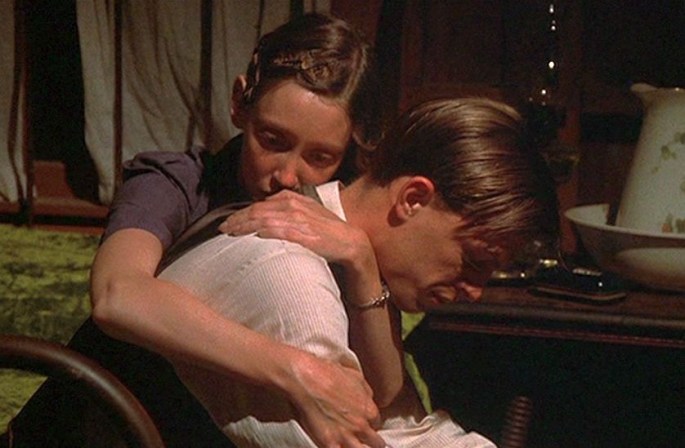
It should be noted that Shelley Duvall is so real and so natural as Keechie that you can feel true romantic tension build between her and Keith Carradine during their silent moments together early in the film. They talk like actual people and respond in kind. When Bowie remarks that she’s cut a great deal of her hair off, she smiles, looks to the ground, and says “I dunno” in a manner that is so genuine and sweet, it recalls deep, buried memories of the awkwardness and shyness of first love. This is in diametric opposition to the way the characters are played by Farley Granger and Cathy O’Donnell in Ray’s film, faultlessly walking a fine line between love-sick, smitten pups and hard-edged, damaged souls. In specific contrast to Granger, Carradine’s Bowie is a sweet-faced greenhorn, only slightly more streetwise than his ill-fated cowboy character in McCabe & Mrs. Miller. Duvall’s Keechie is at once more naive and tougher than O’Donnell and her anguish at the end of the film is told in spades as Altman trains his slow motion camera not on the gory details of the police ambush that kills Bowie, but on her face as she watches it unfold, held back in a quasi-embrace by Maddie, the true driving force of the second half of the film.

In They Live By Night, Maddie’s character (played with gusto by Helen Craig) is spitting fire from the get-go, making her prime turncoat material. But Fletcher’s interpretation of the role is closer in spirit to Julie Christie’s Constance Miller; a woman who can see far more clearly than any of the men around her and will cut her losses as quick as breathing when she must. At no time in the film would any of the men suspect that Maddie would double-cross them for her own gain. And, honestly, neither would the audience. If one were to go into Thieves Like Us completely cold, Fletcher would seem like a harried but big-hearted good sport. She’s far more focused on the details of running a home and distracting her children from the awful details of her houseguests by ensuring her son knows to use his roll as a pusher at dinner time. But with her life in virtual ruin as it contains both a husband in prison and rugrats she can scarcely control, Fletcher exudes the quietest of strengths in a role that is by turns tough, honest, and canny. Slowly emerging in the second third of the film, Fletcher’s presence permeates the final act and, by the time the credits roll, more than a little of her character will have imprinted itself on Duvall’s Keechie’s. Keep a stiff upper lip and believe the stories you have to tell yourself to keep moving forward.

One has to wonder how much of this specific focus came at the hand of Joan Tewkesbury who, along with Altman and Calder Willingham, adapted Anderson’s novel for the screen. Instead of keeping Ray’s ending where Keechie reads the tragic love note that was written by Bowie just before he is killed in an ambush, and likewise jettisoning Anderson’s ending where the both of them are killed in the same event, Thieves Like Us presses a more tragic point about the very human cost and the actual wreckage that occurs to those in the orbit of criminals. It explicitly deals with the unfortunate shame and social baggage that (mostly) women have to tote around with them due to the careless and thoughtless actions of the men in their life. Not coincidentally, this theme would likewise emerge in Nashville, Altman’s next feature which was also penned by Tewkesbury.

Additionally, the connection between Thieves Like Us and Nashville is also clear due to their strong usage of pop iconography and corporate branding across the American landscape. Thieves Like Us shows the radio tying the country together in a way that previous mediums could not and by synching the diagetic music and dialogue from the radio dramas with the action on screen, Altman suggests an emerging correlation between real life and shared entertainment while also displaying a savvy focus on cultural mass marketing that is beginning to take root. Where prison gates are used as literal ad space for Coca-Cola, the almost outsized presence of that product in Thieves Like Us predates the Goo-Goo Clusters that will eventually underwrite the Grand Ole Opry in Nashville where the country crooners on the radio will no longer be selling Rinso Detergent, but Hal Phillip Walker’s goofy, untenable brand of populism.

Thieves Like Us was part of a cycle that came in the wake of Bonnie and Clyde, itself as much a film about the then contemporary change in America as it was a biopic of Depression-era criminals. But where Bonnie and Clyde pops, Thieves Like Us simmers letting the individual ingredients stew and causing the material to cook into something else entirely. It never feels like Altman’s players are wearing stuff from the wardrobe department as is the case in Martin Scorsese’s underrated but undeniably budget-hampered Boxcar Bertha nor are things quite as clean as in the other Corman-produced films cut from the same cloth, such as Bloody Mama and, later, The Lady in Red. By letting us slowly wade into the world of Thieves Like Us, Altman rewards us by reminding us that the quiet details of real-life feel much more piercing than the grand sweep of Hollywood dramaturgy.

Nicholas Ray’s They Live By Night is a true beauty with a well-deserved, unimpeachable reputation as a film that is as hard-edged a piece of business that you can find. It’s a film that talks tough, moves fast, and kisses tragic. Robert Altman’s Thieves Like Us isn’t nearly as well known but it operates in the same, languid style as his adaptation of The Long Goodbye. It’s a film that speaks softly, takes its time, and ultimately reveals itself to be positively ruthless.

ZAPPA (2020) – D. ALEX WINTER

Full disclosure right up front, I’m a Frank Zappa fanatic. While I had four of Zappa’s albums in high school, it wasn’t until around 2003 that, due to a burgeoning interest in the music of Captain Beefheart, I dove into his catalogue in earnest. And, man, did I dive HARD. By hitting every new and used music store within a forty mile radius, I managed to collect every Frank Zappa album that had been released up until that time. And while it is to be expected that a fully smitten person is going to try and digest every single piece of work from an artist with whom they fall in love, the extraordinary thing about Zappa is that, in his lifetime, he released some 62 albums and, as of this writing, another 50-plus have been released by the Zappa Family Trust, the family business now run by his youngest son, Ahmet.

So that’s a lot of music and I own it all. And that’s what Frank Zappa wanted. As Zappa himself states a couple of times in Alex Winter’s long-gestating and beautiful documentary, Zappa, all he was interested in was composing his own music, recording it, and selling it to anyone who shared his passion for listening to it. It’s truly a noble goal, but when you realize that Frank Zappa’s first album came out in 1966 and the last one released during his lifetime arrived in 1993, something in the math doesn’t seem right and one can only conclude that Zappa lived a life completely out of balance. Nobody who is consistently releasing 2.3 albums every year for 27 straight years has anything resembling a normal existence.

It’s probably most surprising that Zappa almost goes out of its way to show how unbalanced Frank’s life was. Forever cutting away to images and footage of Frank hunched over some kind of table as he is painstakingly writing his compositions as if he were a Benedictine monk copying a Bible by hand, the film presents Zappa as a sentient music machine who had little feeling for anything beyond his work and interests. While he certainly loved his family, it almost feels like Zappa’s style of love was unique and could only be expressed in his own way. But there aren’t many people in Zappa’s universe who sat down for interviews that didn’t articulate the same line on Frank: he was just a laser-focused perfectionist to whom it was difficult to feel a kinship.

The film never really goes into what made Frank an emotionally distant person but there are hints sprinkled about here and there. Growing up in a family in which the parents are joyless stiffs (as Zappa’s folks mostly were) can’t help but have an effect on a person and while Zappa’s zany, anti-authoritarian persona was aimed directly at his parents’ generation, he kept his own generation at arm’s length, too. Tall, gangly, hairy, and brooding to the point where he was concocting ways to set fire to Antelope Valley High, save and except fellow rhythm and blues fanatic Don Vliet (who would later take musical form as Captain Beefheart), Zappa probably wasn’t much of a hit with his peers, male or female. Frank Zappa, quite simply, never counted on being loved and never really knew what to do with it when he was which, naturally, leaves one’s wife and children and workmates at something of a disadvantage.

But while it doesn’t shy away from the ugly truths about him, Zappa isn’t on a mission to bury him, either. Frank Zappa lived an incredible life on his terms and Winter wants to tell that story. Here is a uniquely American tale of an iconoclast who went from chronically sick child to self-taught musical genius to outrageous rock artist to Washington D.C. crank to, finally, one of the ultimate symbols of freedom and deified hero to the people of newly liberated countries of the then-crumbling Soviet bloc. That’s a lot to pack into a film meant for general audiences so Winter had the unenviable task of keeping the narrative moving forward without getting distracted on every single detail of Zappa’s career, of which there are a lot.

This approach created some very interesting reactions in me as a viewer versus me as a Zappa super fan. For me, he had no band better than the Roxy/One Size Fits All incarnation of the Mothers of Invention but the film glides over that period in what ends up being a brief moment in a quicksilver collage of his rotating bands from 1973-1979. For Winter, the lion’s share of the time is spent on the original lineup of the Mothers, highlighting as much their bizarre, performance art stage antics as he does their music. Ultimately, regardless of my personal preference of any specific era of Zappa’s impressively varied body of work, the foundation of his career and public persona was created, gestated, and borne out of the 1966-1969 lineup and it’s just as crucial to the beginning of the narrative as much as his triumphant partnership with the Ensemble Modern in the twilight of his life is to the end.

This also spills over into other aspects of the film. Frank Zappa was one of the finest, most mind-bending guitarists in all of rock history but you’d really never know it from the film. Aside from one shot of Zappa absolutely shredding which reveals, in full color, the man’s scorching dexterity on the fretboard, there are no moments of him noodling, soloing, or a montage of stage moments overlaid with audio snatches from any one of the multiple albums he released that are filled with nothing but guitar solos. But, again, this isn’t the story Winter wants to tell and the film is the better for it. As Gail Zappa insists early on in the film “I married a composer.” And regardless of what each individual Zappa fan loves about him, most all of them agree that the term “composer” is the one thing that should be elevated above all else. And this is why Winter makes it to where you’re more likely to see Zappa with a conductor’s baton in his hand than a guitar. Even when Zappa’s “stunt guitarist”, Steve Vai, shows up to talk about Frank, there’s never any real discussion about guitar technique or soloing off of Frank; it’s all about musical complexity and the Herculean effort of manually transcribing “The Black Page”, a beyond-difficult Zappa composition written for drums and percussion.

Much is made, too, of Zappa’s battles with the Parents Music Resource Center (otherwise known as the PMRC), a group of Washington wives who wanted to regulate what they considered “porn rock.” This occupied a great deal of Zappa’s time in the late eighties and helped cement his legacy as a champion for freedom at a time when it was uncertain if our country was ever going to climb out of the hole of the Reagan Era. This chapter also helps lend understanding to the weird international wrinkle that occurred when Zappa was disallowed by Bush 41’s State Department to serve as cultural attaché to the newly liberated Czech Republic (then Czechoslovakia) which had been personally requested by then-President Václav Havel.

The film does do some slight dramatizing and, at times, completely omits somewhat crucial information when it really doesn’t need to. Coming away from the film, you’d have thought Zappa served all six months of the jail sentence he got as a result of that raid on his studio when, in fact, he was only in the clink for ten days. There’s no reason to mislead the viewer by omission when the very real pain and injustice of ten days in jail on a bullshit charge wouldn’t feel minimized if it were followed up with the very real story of how Zappa was held in jail just long enough for his entire life’s work up to that point, including the studio, to be seized by the authorities and sold off. Missing also is the fact that Zappa was living in that studio because he moved in after divorcing his first wife, Kay Sherman, who is never mentioned in the film at all.

But, again, Zappa’s life was so full of left turns, details, and grand adventures with both Gail and his band that you’d need three full length features to tell it all. But Winter has a limited canvas on which to work and delivers the most comprehensive and complete story of an incredibly difficult and complex figure one could possibly hope for. And it’s not a story bereft of heart regardless of Zappa’s tough cynicism. The respect and understanding that is in the clear-voiced appreciation of Zappa though Steve Vai and Alice Cooper (who got his start on Zappa’s imprint label) feels absolutely right but there may not be a more touching figure than that of Ruth Underwood who strikes the right balance between hard-nosed realist and fawning admiration. Detecting (and connecting to) the deep soul of Frank through the complexity and beauty of his music, Underwood supplies the film with two of its most moving passages, one in which, at 74 years-old, she absolutely nails “The Black Page” on a baby grand piano, and second where she (and, curiously, only she) breaks down in tears when discussing the end of Zappa’s life.

When the end does come, the film turns impressionistic and, instead of lining up all of the interviewees to give bittersweet postmortems about Frank and his work and what it meant, Winter relates everything to the work to be done versus the time in which one has to do it. As the clock ticks out, and despite his one last heart-bursting success as an incredibly sick Zappa conducts the Ensemble Modern in a perfect performance of “G-Spot Tornado,” a song so complicated it was composed for the Synclavier, a computerized keyboard sampler with which Zappa utilized in his later years, out of fear humans couldn’t play it, we’re left with ideas of the voluminous projects that remained unfinished.

Like filmmaker Rainer Werner Fassbinder, Frank Zappa was a notoriously prickly and paradoxical figure whose dictatorial approach to his art made him a complicated individual who was destined to work himself into an early grave. For both, their art and their lives generally crossed lines as there was hardly any time and space to separate the two. In the case of Frank Zappa, his oft quoted line from Joe’s Garage “Music is the best,” was probably the simplest thesis of his entire life energy as everything seemed to flow towards it and away from it. And Alex Winter’s Zappa does as good a job as any to make audiences understand that, in the end, maybe it’s something as simple as that that fuels a contradictory, complex artist to endlessly create. And maybe it’s not so easy on everyone in their immediate orbit but we’d be foolish as a society to not celebrate their lives and their work, created just as much for us as for themselves.

THE ROBERT ALTMAN FILES: CALIFORNIA SPLIT (1974)

“You know, I know, rent means dough,

Landlord goin’ kick us in the cold, cold snow.

Rufus Rastus Johnson Brown,

What you goin’ do when the rent comes round?”

-Harry Von Tilden

“Pal… I’m gonna win!!!”

So says George Segal’s Bill Denny as he’s being flattened by the pressures of his overdue gambling debts, his irritated bookie, and being stuck in the unenviable position of having run out of personal items to sell for gambling money. It should also be said that he’s been on one hell of an impressive losing streak over the past couple of weeks. But, still, gripped by the kind of desperation that occurs when there are no options left, he says that he’s going to win a high rolling poker match in Reno as if it’s an absolute certainty. Given his circumstances, what the hell else is he going to say?

Robert Altman’s California Split is a film that understands that specific kind of desperation better than any movie I’ve ever seen. It also has a lot to say about dysfunction, camaraderie, semi-homoerotic male bonding, codependency, ennui, danger, disappointment, and, finally, the empty feeling one has after going jowls-deep into the depths of your own mania. For a small movie about two lost souls who luck out to find each other and enjoy a few eventful weeks together, California Split, one of Altman’s very best efforts, is alive in a way other films can only dream of being.

After randomly being seated at the same table at an L.A. poker club and then escaping the wrath of a fellow player who might as well wear a cape that says “sore loser,” Bill and Charlie Waters (Elliott Gould, never cooler than he is here) connect again in a nearby bar where Charlie’s infectious and quick witted assessments on basketball wagers win Bill over. Soon, they’re drunkenly staring over a graveyard of empty beer glasses and making low-stakes, bullshit bets as to whether or not they can name all seven dwarfs in their present condition. The evening ends with them getting beaten up, robbed of their winnings, arrested, and then, in the hazy, early morning hours, bailed out of jail by Gould’s call girl roommates (Ann Prentiss and Gwen Welles, both unforgettable and fantastic) which then leads to a fruitful, winning partnership.

There are many things going on under the surface but there truly is a sly romantic comedy at the heart of California Split. Sure it’s not very conventional but I’m not sure what other subgenre creates the kind of unfettered joy Bill and Charlie feel when they’re around each other. There are times that George Segal is smiling so widely, you can see all of his back teeth and fear that somehow the top half of his head may become unhooked from his lower jaw. As the movie rolls along, their relationship ebbs and flows as winning and losing streaks exchange hands leading to a temporary separation, a reconciliation, and one last big dance before finally breaking up. The film is set during the Christmas season but it’s not something the audience would notice given Altman’s insistence on keeping the two protagonists cloistered in the details of their own world and blinded by their mutual, raw enthusiasm for action and each other’s company.

The film immediately frames Elliott Gould’s flashy Charlie in stark contrast to George Segal’s more buttoned-down Bill. They come off as two very different guys but, in the granular, they really aren’t all that different. Charlie may seem like the wise guy motormouth who is careening toward disaster but it’s actually Bill who is on the path to rack and ruin. Charlie is just already there; a smooth-talking loser who takes life one day at a time and doesn’t even pretend to give a hang about a day job. He bets like a chaos agent and doesn’t seem to care whether he wins or loses. Bill, on the other hand, still keeps an office in the startup magazine for which he works though it’s not clear if he’s paid for writing, which we never see him do, or avoiding his boss (an impossibly young Jeff Goldblum), at which he’s more adept. And though it’s not explicitly telegraphed, the audience gets the sense that Bill’s failed marriage is probably still within view in the rear view mirror and that a reconciliation wouldn’t necessarily be completely out of the question.

But the screenplay by Joseph Walsh (who turns up as Sparkie, Bill’s bookie whose patience has finally run out) is less interested in the well-worn path of personal redemption when it comes its characters as, a recovering gambling addict himself, Walsh understands that the joys of the compulsive gambler are small, fleeting, and infrequent. After Bill runs a streak that nets $84,000, he goes into a semi-trance and shakily rids every pocket of its gambling chips as if he’s vomiting after a particularly impressive bender. Exhausted, he holds his head in his hands as the life is drained out of him. Even winning is painful and empty. “Don’t mean a fuckin’ thing, does it?” Charlie observes.

While he had churned out a few masterpieces in the previous four years, California Split cemented Robert Altman as one of his generation’s most observational filmmakers. Standing the tallest in a class that included Paul Mazursky, Jonathan Demme, and Hal Ashby, Altman reveled in the details and quirky inhabitants that (still) make America unique and special. Early in the film, the audience is treated to a mini-drama that erupts between a bottomless go-go dancer and her gambling addicted girlfriend which ends with the dancer having to borrow against her earnings just to get the girlfriend out of the bar. It’s a small moment that occurs courtesy of Altman’s penchant for overlapping dialogue and roaming camera but it comes alive and makes three-dimensional people out of who would be nothing more than glorified extras living on the edge of the frame in a lesser filmmaker’s work. Altman argues for an America being a country of Mom and Apple Pie as long as we understand that Mom is a hooker named Barbara who compulsively reads the TV Guide to unwind and Apple Pie is Froot Loops (or Lucky Charms, your choice) and beer. It’s an America of gambling superstitions, all night brothels, and Friday night prize fights. It’s an America choking on a cloud of cigarette smoke in tiny rooms with poor ventilation, watered down drinks at the racetrack, and lonely people perfumed in Shalimar. In short, it’s not Norman Rockwell’s America but, instead, an America that actually exists.

At the end of the film, Bill and Charlie go their separate ways with the former saying “I gotta go home.” But Charlie can see Bill even when Bill refuses to see himself. Charlie knows Bill doesn’t live anywhere outside the action and that he’s only pretending that he does. For there was probably a time in his life that Charlie admitted that he, too, had to go home only to realize that, sadly, he was already home. All of this is unspoken, by the way. It’s just that California Split is that rarity of a movie where the dialogue tells us plenty but the characters’ actions tell us more.

THE MICHAEL MANN FILES: STRAIGHT TIME (D. ULU GROSBARD – 1978)

By Patrick Crain

In the cinematic world of Michael Mann, there are two figures who loom the largest. The first and most obvious one is Jean-Pierre Melville, French auteur whose cool visual style, obsession with the relationships between cops and criminals, and strict attention to detail and precision all informed the majority of Mann’s work. The second giant figure in Mann’s universe is Edward Bunker, master criminal who was also a gifted writer and turned his own real-life exploits into fodder for crime-obsessed filmmakers such as Mann and, later, Quentin Tarantino. While one-time cop Dennis Farinia and one-time thief John Santucci both lent their expertise to Mann’s world and filled it with the kind of details only professionals can articulate, it’s hard to imagine a character more important to our contemporary and cultural understanding of the professional criminal via broad, poetic, and genius stokes than Edward Bunker, both folk hero and ground zero for the Michael Mann archetype. So great was Bunker’s presence in the world of Michael Mann that, in Heat, Jon Voight’s criminal fixer, Nate, was modeled in both look and voice after Bunker.

And so it is that Straight Time, Ulu Grosbard’s film from 1978 based off of Bunker’s semi-autobiographical novel, No Beast So Fierce, is derived from a screenplay by Alvin Sargent, Jeffery Boam, and Bunker, with uncredited passes by the incomparable Nancy Dowd and, in his first feature film gig away from the confines of television, Michael Mann. Starring Dustin Hoffman as Bunker substitute Max Dembo, the film displays in very stark terms the incredibly limited and stifling choices afforded to an ex-con while also revealing, in the case the viewer wasn’t aware before watching it, why recidivism is a thing that occurs with an unfortunate frequency.

Straight Time is mostly what one would consider now a “hangout movie.” Nothing really much happens in terms of plot outside the trajectory of Max’s transformation from ex-con to fugitive with unsparing, heartbreaking detail (and rewarding invested audiences by making them amateur penologists). We meet the ex-cons in Dembo’s universe in their flophouses, modest starter homes, and even their middle-class suburban digs. But punching time-clocks, the routine of raising a family on the straight and narrow, and hosting backyard barbecues hold no life for these people. They are loners at heart and not much different from Pike and his men in Sam Peckinpah’s The Wild Bunch; rudderless souls to whom civilization is just another prison.

Despite it going through a few more cycles before hitting the screen, much of Michael Mann’s work is still imbedded the screenplay. There materializes a familiar, doomed romanticism between Dembo and Jenny (a dazzling Theresa Russell) which will also show up in numerous Mann works. If the restaurant scene between Hoffman and Russell feels familiar, it’s because it’s a dry run for the James Caan/Tuesday Weld diner scene in Thief. Additionally, Max’s usage of “What’s to it?” sounds like he could have been James Caan’s cellmate as it’s a favored piece of phraseology of the latter. The timed bank heist, the criminal detail, and the Los Angeles locations all lend themselves easily to what would later become Mann’s sandbox.

However, this material isn’t uniquely Michael Mann’s and Grosbard does a brilliant job infusing it with his own visual style. Defused night lighting, hot dog stands populated with the flotsam and jetsam of the evening, and the gross interiors of sketchy dive bars slam up against the scenes set in the blazingly bright Los Angeles daytime where Max hustles in his attempt to go legit, which loads Straight Time with a cinematic tension that straddles film noir and slice of life.

Aside from containing Dustin Hoffman’s career-best turn and a (shoulda been) star-making performance from Russell, Straight Time also benefits from a deep bench of supporting players doing some of their best work. M. Emmet Walsh is absolutely repellant as Max’s sleazy parole officer, Gary Busey and Harry Dean Stanton are 100% authentic as ex-cons desperate for some kind of action, and Kathy Bates gives a beautiful, nuanced performance that amounts to about three minutes of screen time but stops the film short to remind the audience of the sad reality that is the life of an ex-con.

While his metier at the time was churning out scripts for television crime shows like Starsky and Hutch and Police Story, tangling with Edward Bunker’s material was likely a watershed moment for Michael Mann as he found a vessel in Bunker’s prose which could keep him invested in the gritty world of crime while keeping the slick, visual ideas he would pioneer completely intact. And, quite fortuitously, it would serve Mann well the following year as his debut television film as a writer and director, The Jericho Mile, was actually shot in Folsom Prison and Peter Strauss’s main character is nothing if not a dress rehearsal for James Caan’s Frank in Thief. It’s a less polished mesh of the poetic and the procedural than what would come later but it would show the true bones of a filmmaker whose exposure to the real deal would create a filmography that would both redefine the crime film and would set the pole position for the visual and editing style that would dominate pop culture in the 1980’s.

THE ROBERT ALTMAN FILES: THE LONG GOODBYE (1973)

Philip Marlowe has been asleep. Whether it’s been a literal and continuous Big Sleep that has lasted since we last saw the man in 1946 is unclear. But there are clues scattered about which suggest that it is. First off, genius screenwriter Leigh Brackett is back with another adaptation of a Raymond Chandler opus just as she was all those years earlier when she was Howard Hawks’s scribbler of choice. But regardless of the initial and obvious familiarity, things are markedly different than the last time we saw Marlowe. For the hope and exuberance of postwar 1946 has given way to the cultural malaise of 1973, a time where the fabric of the country was disintegrating under the twin stresses of Vietnam and Watergate and everything we thought we understood about America was turned upside down and was perpetually under audit.

Robert Altman’s masterful The Long Goodbye was the first in a wave of neo-noir films that flooded the American cinemas in the 1970’s. Along with Roman Polanski’s Chinatown, Arthur Penn’s Night Moves, and Robert Benton’s The Late Show (produced by Altman and both cast and crewed by many of his regulars), these films took the antique formula of the dogged private eye and turned it on its ear by examining the current culture through the newly-minted, cynical lenses of the Boomer Generation or making a contemporary allegory out of an old-fashioned period piece. In all of the cases, there was a strong, moralistic tone regarding right and wrong that would crack as the film unspooled and the hero found that he no longer recognized the world he was in, a theme that cut deeply with the intended audience.

This is strongest and most evident in The Long Goodbye, which, not coincidentally, was the first of the bunch. In it, private eye Philip Marlowe is juxtaposed immediately with a cinematic fantasy. As “Hooray For Hollywood” scratches its way over the soundtrack and we survey the lodgings of one of pop culture’s most indelible and toughest detectives, we immediately sense that something has gone directly to seed. Instead of clean-lined Humphrey Bogart, we get fuzzy, wrinkled, and unshaven Elliott Gould. And instead of having to jump into his car in the middle of the night to solve a hot mystery under the darkness of the Los Angeles night, Marlowe’s cat simply wakes him up because he’s hungry and wants some food.

While the trip to the grocery store for the cat food supplies the film with its most potent allegory about trust, it also serves to crosscut an escape from the Malibu Colony by one Terry Lennox (Jim Bouton), lifelong buddy of Marlowe currently bruised and battle-scarred after a tussle with his wife, Sylvia. As he drives to Marlowe’s pad to request an emergency, middle of the night escort to Tijuana, Terry surveys the physical damage to his person; deep scratch on the face with a swollen and bruised hand. When Sylvia Lennox shows up beaten to death fifteen minutes into the film and Terry confesses to her murder in his own suicide note, Marlowe goes on a personal crusade to clear his friend’s name. In doing so, he mixes with an alcoholic writer (Sterling Hayden), the writer’s icy blonde wife (Nina van Palllandt), an equal opportunity mafioso (Mark Rydell), and a quack doctor (Henry Giibson).

Clad in a cheap black suit that never comes off his corpus and prowling about in his 1948 Lincoln Continental Cabriolet with a bottomless supply of non-filtered Lucky Strikes, Marlowe stumbles through blanched, early 70’s L.A. in a total haze. Still smart enough to sniff out phony amateurs and bumbling hoods, Marlowe never seems to understand the gravity of his current situation or the physical stakes involved. And in direct opposition to Howard Hawks’s The Big Sleep where Philip Marlowe seemed to glide through a studio-built Los Angeles with horny women throwing themselves at him without any effort on the part of Humphrey Bogart, Gould’s Marlowe can’t even negotiate a fruitful conversation with Mrs. Tewksbury, real estate agent to the rich and famous. “It’s ok with me,” a catchphrase he’ll employ throughout the film to signify his acceptance of any given situation without any shred of understanding, seems to fly out of his mouth with more frequency the closer the film gets to its conclusion.

What makes The Long Goodbye unique is that, like the other genre-blasting offerings by Altman, this is a detective film without much of a mystery at its center. Marlowe seems more intent on convincing himself of Lennox’s innocence than he really cares about clearing Lennox’s name and, like so many other Altman heroes, there is more than a touch of self-deception at play with Philip Marlowe. Lost in a landscape where ideals have become malleable, trust is transactional, and macaroni costs more than a quarter, Marlowe desperately builds a case out of the wildest of red herrings so he can continue to float along through life with his core values intact. Jack Nicholson’s J.J. Gittes is gutted by the larger graft that has seared him very personally and Gene Hackman’s Harry Moseby is frustrated at his inability to see three moves ahead of him but Philip Marlowe believes in a kind of idealistic clarity better suited for a time long since vanished, if it even ever really existed at all.

It isn’t until about the the middle of Alan J. Pakula’s Klute, itself ostensibly a whodunit about a call girl killer, that the film’s mystery is lifted and the audience knows the identity of the murderer well before the titular cop figures it out. In The Long Goodbye, the detail of Terry Lennox’s bruised hand being concealed by the driving gloves is something told to the audience but not Marlowe and it is a reveal that occurs before the opening credits end. In essence, Altman wants us to know that Marlowe will spend the rest of the film being played for a sucker and expending a ton of shoe leather just to get his heart broken. In a world that’s gone all wrong, Marlowe is all right. Unfortunately for him, he’s all wrong in a world where, by his own constant admission, it’s all ok with him.

THE ROBERT ALTMAN FILES: IMAGES (1972)

Robert Altman was once quoted as saying that, to him, his entire filmography was one whole movie with each individual film a chapter. If this is true, Images, the lone horror film in his career, is a very pivotal chapter in that string as it reflects backwards on characters already introduced while also projecting forward and allowing the audience to more clearly see how, in Altman’s cinematic world, trace elements of one project can seep into another.

In some ways Images is a re-examination of Frances Austen from That Cold Day in the Park but through the prism of Cathryn, a much more sexual and less socially awkward creature than Frances but one who likewise nurses a mysterious void in her life. In direct opposition to Frances’s hanging out with barely-sentient wax mummies to fill the time, Cathryn spends her days writing children’s novels and waiting around for her boorish jagoff of a husband, Hugh, who has business dinners that last until four in the morning and, like a complete asshole, wears driving gloves as if they’re a perfectly acceptable and fashionable addition to his fall ensemble.

Despite the obvious differences between herself and Frances, Cathryn is similarly and undeniably unwell, which is made quite obvious in the first five minutes of the movie. Mysterious and disturbing phone calls which may or may not be occurring give way to brief, shocking hallucinations which cause Cathryn and Hugh to beat retreat to Green Cove, a semi-isolated, two-story cottage where Cathryn lived with her grandfather during her childhood (shot in picturesque County Wicklow, Ireland). Once there, the hallucinatory nature of the visitations of former lover Rene blend with the shifting, confusing interactions with not only Hugh but also old friend and neighbor, Marcel, and his twelve-year old daughter, Susannah.

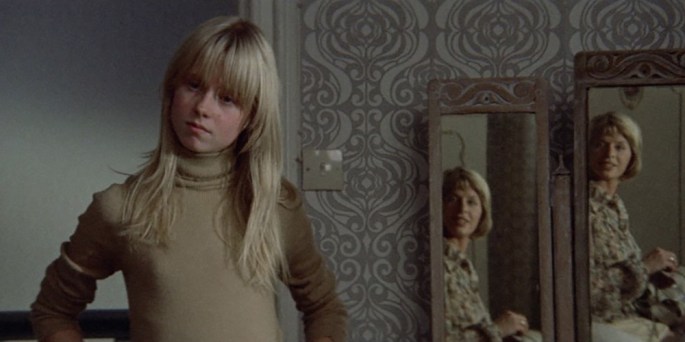
On top of employing a lot of methods of twinning, namely the utilization of mirrors and clever match cuts, Altman plays a deft and creative card by swapping all of the cast and characters’ names. Susannah York plays Cathryn, Cathryn Harrison plays Susannah (who, in a moment of perfect, unnerving realization later in the film, says “I think I’m going to be just like you” to York). In terms of the men in Cathryn’s life, Altman stalwart Rene Auberjonois portrays Hugh, Hugh Millais portrays Marcel, and Marcel Bozzuffi portrays Rene. Identity is all but annihilated which keeps the viewer off-balance and the tension ever-shifting.

Up to this point, Images would be Altman’s most intimate film which has perhaps lent to its relative obstructiveness in Altman’s oeuvre. Coming hot on the heels of the megacast and decidedly anti-authoritarian M*A*S*H and Brewster McCloud but before the giant wave of films that would cement Altman’s style (namely The Long Goodbye and California Split), Images is a curious, lonely beast that, despite Susannah York’s Best Actress win at the Cannes Film Festival that year, is only beginning to gets its due almost fifty years after its release. This just a little more than unfortunate as Images uses the manifestation of madness through architecture and space in such a a way that puts it in the exact same company as Robert Wise’s The Haunting, Roman Polanski’s Repulsion, Stanley Kubrick’s The Shining, and Ari Aster’s Hereditary.

And Images is yet another exhibit in what was becoming Altman’s hobby, namely genre bending. In fact, this may be his very most successful. While every other movie seems to function within its respective genre while also obliterating the conventions, nobody doubts that, say, The Long Goodbye is a mystery or that Thieves Like Us is a crime picture. Yet despite the legitimate chills and shocks that come from Images (and there are plenty), it’s only been since until recently that it’s been accepted as a horror film even though it is almost explicitly so. However, this might also be more due to the arbitrary boundaries put on horror films in general which causes discussions surrounding them to devolve into qualifying nonsense where something gets described as “elevated horror.”

Images is also the first film since The Delinquents in which Altman takes full screenplay credit. That being said, all of Susannah York’s narration is hers as it incorporates In Search of Unicorns, an actual children’s book she authored and released in 1973 (and for which she is given full credit at the end). This detail in which Altman utilizes and injects elements of reality onto his cinematic canvas had already felt during the shooting of McCabe & Mrs. Miller where the cast had to choose and mend their own costumes throughout the entire production. But by incorporating York’s actual book as a double for Cathryn’s, Images takes on a multi-dimensioned life of its own which predated the kind of extraordinary hands-on approach to the country music that would be deployed by his cast in Nashville or the in-the-mix of media and politics that would give life to Tanner ‘88.

On a technical level, Images is a stunner. Masterfully dressed by production designer Leon Ericksen, the film has an almost tactile quality and is enormously clever. From Hugh’s complicated folding glasses to the numerous cameras, lenses, stereopticons, and the ocular designs in her headboard, Cathryn lives a life overloaded with optical tchotchke and bric-a-brac where she always feels seen. The subtle details that seem to appear in both Cathryn and Hugh’s home in town and in Green Cove gives off the impression that the film may not take place anywhere outside of Cathryn’s mind. Every detail seems to have a match and every thread seems to be tied.

Pulling off some fluid camerawork alongside more static moments that reveal exquisite, painterly compositions which come alive with York’s beautifully tempered narration of passages from her book, Vilmos Zsigmond’s cinematography is just achingly gorgeous and it gives Images the sheen of a dark fairy tale set in a haunted, mystical land. John Williams garnered an Oscar nomination for his stately and creepy score which is often and effectively punctuated by sharp and discordant sounds by Japanese composer Stomu Yamashta.

In the beginning of Altman’s next film, The Long Gooodbye, driving gloves are introduced in a key moment, offering a visual clue to the film’s mystery to the audience without also revealing it to Philip Marlowe. Five years later, the shared DNA of Cathryn and Frances would most certainly find its way into Shelley Duvall and Sissy Spacek’s characters in 3 Women. And while these seem like trivial details that might even be described as wild reaches, if we were to take Altman at his word in that all of his movies served as one continuous film, it’s hard to argue that these things that floated downstream and lodged themselves explicitly in Altman’s future projects weren’t the consciously laid soft-tissue connections that joined his entire cinema together like a massive, gorgeous tapestry.

THE ROBERT ALTMAN FILES: MCCABE & MRS. MILLER (1971)

Into the impossibly soggy, Pacific Northwestern frontier “town” of Presbyterian Church rides John McCabe. Call him a “gambler” and he’ll gently correct you (“Businessman… businessman,” he’ll say in an attempt to convince himself more than you). Call him a gunfighter and he’ll avoid the subject altogether but only after you believe he very well could be. Before hitting the heart of the ramshackle huts and rickety structures that seem to be constructed on top of one another in the town, McCabe stops and does a quick wardrobe change while muttering some mostly inaudible, solitary grievances. But once clad in his best gambling duds, John McCabe enters the central meeting point that is Patrick Sheehan’s Restaurant and Boarding House and, within ten minutes of screen time, he will have charmed most everyone in the town and planted his flag with dollar signs in his eyes. For it is here that he will get wealthy by operating a saloon and whorehouse. After all, men like to drink, gamble, and screw so building a grand sporting house would be almost like having a machine that printed money.

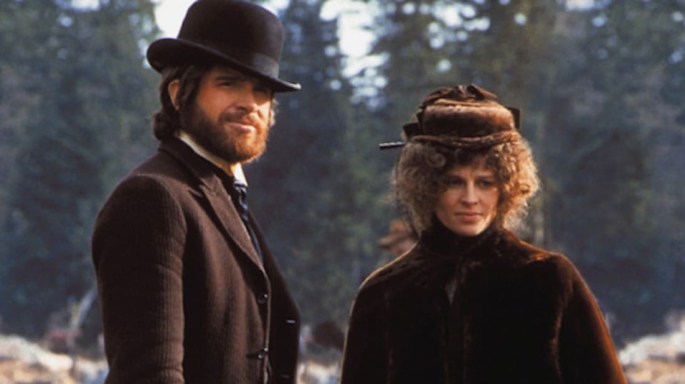
Robert Altman’s McCabe & Mrs. Miller is a poetic ode to the kind of moronic, Friday-rich, American choade whose long vision is stunted and for whom aiming higher always leads to disaster. Warren Beatty’s John McCabe is almost like a distant, frontier relative of George Roundy, the lothario hairdresser character Beatty and screenwriter Robert Towne would create for Hal Ashby’s Shampoo a few years later. Businessmen who seem to understand only their clientele’s most basic of needs without any real plan for personal or professional growth, Roundy and McCabe both manage to make it to the precipice of success before plummeting into the abyss due to their own foolishness. At the end of Shampoo, Roundy stands cliffside in Beverly Hills the morning after Richard Nixon’s inauguration and watches his future roll away in a luxury car into the hazy hills of Southern California. At the end of McCabe & Mrs. Miller, McCabe sits mortally wounded in the snow, caught between death and frozen contemplation. And in both films, Julie Christie has become mournfully fed up with him and what he’ll never be able to give her.

You see, McCabe & Mrs. Miller is a film adapted from the Edmund Naughton novel simply titled McCabe. Altman knew that to understand the tragedy of John McCabe, Mrs. Constance Miller would have to be given an equal importance in the equation. And so Julie Christie’s brusque, whip-smart prostitute-cum-madam enters into the scene early and joins McCabe at the hip, steering his business into more profitable waters merely by paying attention to the cleanliness of the house and catering to its employees’ personal concerns. But with an elevated awareness of her position in a rapidly changing America, Mrs. Miller is also the one in the partnership who is smart enough to understand that there often comes a time to pack it in and cut your losses. And though she’s addicted to opium which helps keeps her emotionally at an arm’s length (McCabe always pays for it), she isn’t hampered with the kind of artificial courage afforded to McCabe via the copious amount of whiskey he ingests while trying to deal with a couple of mining representatives charged with buying his holdings in the town from him.

McCabe & Mrs. Miller is to the western what M*A*S*H was to the war film. And while the films of Sam Peckinpah had already done their best to demystify the west and pretty much put a period on the western itself, Altman couldn’t help but use the most American of the genres to completely drain the accepted iconography and themes and to elevate contemporary meditations on independence, ruthless business practices, the hypocrisy of the church, and the impossible predicament of women in our society. And to the last point, Altman makes amends for any misogyny that might have still been in the air after M*A*S*H by giving the gaggle of prostitutes who swagger into Presbyterian Church something more to work with than garish rouge work and frilly lounging clothes, most recognizable in countless westerns of the time. Here, they have missing teeth, might defend themselves with a knife if the client gets a little out of hand, explicitly need to take bathroom breaks, and otherwise act in a manner needing a more human touch than McCabe. Constance Miller becomes the advocate for the women who quite literally helped settle the west and built the foundation of the society which we take for granted today. In short, if you’re living in an established community, prostitutes helped establish it.

In the traditional western (and even those of Peckinpah), the church is almost the central point of the town and the one place that everyone congregates. But while the town is called Presbyterian Church, the actual Presbyterian church in the town is a slow construction and nobody seems in a big hurry to complete it. We only ever see Reverend Elliott (Corey Fischer) toiling away at it which is juxtaposed with the remainder of the able-bodied men in the town who, like a bunch of monkeys on a jungle gym, clamor all over the frame of what will become John McCabe’s little slice of paradise once its been completed. The only time we ever see anyone engaged in anything remotely non-secular is at the funeral of Bart Coyle which is executed in a perfunctory and rushed manner with Rev. Elliott moving through the eulogy if he were dispassionately reading the ingredients for a stew. So it is the film’s most jaw-dropping moment of irony that, in the film’s finale, the entire town braves a brutal (and 100% authentic) snowstorm to save the burning church about which they’ve previously shown zero interest while John McCabe, the guy who arguably made their life more immediately fulfilling, fights for his life all by his lonesome in the other side of the town. I can think of nothing that is more representative of America’s lopsided lip-service to faith and religion than the film’s final twenty minutes.

It’s a cinch that, along with the following year’s Images, McCabe & Mrs. Miller is one of Altman’s most gorgeous pictures. By indulging in a process called flashing (slightly exposing the negative before actually using it) cinematographer Vilmos Zsigmond gives McCabe & Mrs. Miller a distressed, leathery look in its interiors that looks like vintage photographs come to life. Weaved into the dreamy atmosphere are the indelible original songs by Leonard Cohen which seem to work in tandem to the narrative in such a way to suggest the film is some kind of ballad that exists in the grey matter of the American consciousness.

All of this works to create a film that feels at once nostalgic and also like nothing you’ve ever seen, the cinematic equivalent of what hearing The Band must have been like in 1968. And it also further illustrates what Altman ultimately thought about formulas, situations, and tropes that were routinely the stuff of genre films. Instead of seeing the hard lines in which he was to keep his colors, he saw a whole new opportunity to be endlessly creative that would lead to one of the richest resumes in modern cinematic history.