Hard Eight: A review by Patrick Crain


The screen is black and the opening credits begin. The first thing we hear is a dirge called Clementine’s Loop, composed by Jon Brion. The mood it pitches is stark and foreboding. The audience is immediately keyed in to the notion that the next 102 minutes will probably not be a reflection of the life-affirming highlights of the characters’ lives.

When the image comes up, we’re outside a Denny’s. Well, a reconverted Denny’s. The world of Hard Eight is one of unshakable reputations; it can say Ray’s Cafe on the sign but it’s still a Denny’s that has been broken down, sold off, and is quietly functioning in its new skin. Walking towards this cafe is Sydney, a shadowy, yet direct man who, seemingly at random, offers to buy a poor stranded soul named John a cup of coffee.

It seems appropriate to note that, once upon a time, Peter Yates directed Robert Mitchum in a film called the Friends of Eddie Coyle which was not too dissimilar from Hard Eight. Set in the less-cinematic parts of Boston, that film chronicled the lives of the lowest-level functionaries in the organized crime business; bottom feeders who would feed on each other if need be. And in that film, everyone spoke with a clarity that ensured that whoever was listening understood what was said and what was not being said.

Hard Eight is very much like this world. In the earlier film, Robert Mitchum got to put the fear of God into a hot shot gunrunner by explaining why you never ask a man why he’s in a hurry. In Hard Eight, Sydney helpfully reminds John never to ignore a man’s courtesy. In both scenes, the veteran looks dog-tired and slow but you never once doubt his wisdom and respect the commanding way he delivers it.

In Hard Eight, Sydney is played by Philip Baker Hall and John is played by John C. Reilly. During the course of the opening scene, we will learn just enough about each character to want to tag along with them; Sydney is a well-dressed, professional gambler and John is a sweetly dim loser who only wants to win enough money in Vegas to pay for his mom’s funeral. Fifteen minutes into the film, we’re hanging on Sydney’s every word and John’s receptiveness to them. By the time sad-eyed cocktail waitress-cum-prostitute Clementine (Gwenyth Paltrow) and reptilian casino security manager Jimmy (Samuel L. Jackson) are added to the mix, we slowly begin to see the ingredients of disaster come together and, like John, we look to Sydney for his guidance and trust his every movement. For there’s no doubt he’s seen disaster before.

What’s most astonishing about the debut film of Paul Thomas Anderson is how subdued it is, Made by a young man of 26, Anderson refuses to fall into the trap that 99% of nascent filmmakers do which dictates that one must be as flashy as possible by jamming in as many cinematic references and tricks that they can. In his first time out as a filmmaker, Anderson shows a real maturity in his restraint and his ability to approach material correctly and there is an amazing wisdom in the dialogue.

The film’s setting is interesting, too. Like Robert Altman’s California Split, Hard Eight takes place in the unglamorous world of daytime nightlife. Garish hotel rooms, eerily desolate roads, and the sparse, Wednesday afternoon crowd in dumpy Reno casinos are all writ large on cinematographer Robert Elswit’s wide canvas. And John Brion’s Hammond B3-laced score injects the right amount of lounge-lizard sleaze into the atmosphere. The characters and plot, a potent blend of a Jean Pierre Melville’s Bob Le Flambeur, Louis Malle’s Atlantic City, and an Elmore Leonard novel, mix with its harsh, cinematic world in such a way that you can smell the stale cigarette smoke on every frame of film.

To achieve this, a film has to be extraordinarily observant and meticulous in its details. Take, for instance, a scene in which Clementine, who has to leave town with John in a hurry, gives Sydney instructions for feeding her cats and how to unlock her apartment door with a key ring we never see, but can hear is ridiculously overloaded with keys and trinkets. It’s not played for laughs and it doesn’t even call attention to itself. It’s simply a detail that serves as a reminder that Anderson knows characters like Clementine; someone who sadly, and in the name of basic survival, gives so much of herself away that overloading her keychain with goofy charms and ephemera seems like one of the few remaining frontiers of self-expression and individuality.

As well-realized its world and well-written its dialogue, Hard Eight is, above all, an actor’s film.

Philip Baker Hall, an actor who before Hard Eight was mostly known as Richard Nixon in Robert Altman’s film adaptation of Secret Honor, got one of the biggest gifts from the gods with a role for the ages. Stoic and precise, Hall gets the immense actor’s pleasure of both being able to express himself with his stoney face and the right to spit hot-fire lines of dialogue like “You know the first thing they should have taught you you at hooker school? You get the money up front.” It’s a performance of masterful skill, immense control, and sheer perfection. I’ll fight the man, woman, or child that disagrees.

John C. Reilly can never get enough credit and is one of the finest character actors working today. In Hard Eight, he turns in one of his greatest performances as a truly pitiful lug who needs a hug and an emotional anchor. While Hall is tasked with the heavy lifting during the scenes of severe gravity, Reilly gets a few astonishing moments of emotional counterbalance, most especially during a telephone conversation in a key scene in the film’s third act. Also bringing the lumber is Gwenyth Paltrow who summons up the depressing cheapness that runs through her character while also making her vulnerable and human. It helps that her character is the hooker with a heart of despair and loneliness, not gold and half of the time her smeared lipstick makes her look like a clown that escaped a black velvet painting.

Fourth-billed Samuel L. Jackson brings fire to the film as the charismatic yet crudely loathsome security manager who knows everything that goes on in, and out, of the casino. With his wide grin, his maroon leather jacket, and his driving gloves, Jimmy is a study in someone who wouldn’t know class if he fell into it, yet is supremely lethal and projects a menace that, once he’s introduced, hangs like a pall over every remaining second of the film.

Looking back on how Hard Eight was marketed, it must be said that the trailer for the film is ridiculous. Obviously cut to capitalize on the then-red hot Samuel L. Jackson and Quentin Tarantino vibe, the film was marketed as a explosive fire of witty banter, cool Vegas shenanigans, and gritty gangster action. To give the film more of that post-Rat Pack fetish vibe that washed all over indie cinema in the mid to late 90’s, the trailer assigns face-card titles to the characters (Gwenyth Paltrow is the Queen!). That the film had none of the aforementioned elements probably surprised the few that were able to overcome the distributor’s shameful mismanagement and see it in a theater. For some, the surprise was likely a let down. Regardless of quality, there was an audience that ate up every single post-Pulp Fiction-ish film indiscriminately. This, by the way, is how the noxious Boondock Saints, the Sublime of the Pulp Fiction wannabes, ever became the hot property it did. If a film didn’t have that same pop, slash, and burn, it was chucked as boring. And Hard Eight doesn’t have that pop. Despite the use of a quick pan here or there and one tremendous tracking shot of Sydney moving like a shark across the casino floor, the film’s dynamism comes solely and bravely in its silences and what it doesn’t say. The electricity it emits is a slow burning charge that feels confident.

But, finally, Tarantino fashioned the mood of Pulp Fiction after those deliciously chosen pop tunes, Anderson fashioned Hard Eight after a Tom Waits song; a broken boulevard of heartache and misery where, after an evening of carnage, one can merely adjust their coat sleeve to cover up the bloodstains and move about their day unmolested.

hard-eight-poster

THE FUNHOUSE (1981) – A REVIEW BY PATRICK CRAIN

Poor Tobe Hooper. Unlike other genre contemporaries such as John Carpenter, George Romero, and David Cronenberg, he really didn’t waltz into the 1980’s with unlimited potential and the brightest of futures. Despite helming the Texas Chain Saw Massacre in 1974 and the well-received television adaptation of Stephen King’s Salem’s Lot in 1979, Hooper’s reputation was one of an unreliable commodity; a combative personality who had been a contributing factor to the troubled production of Eaten Alive, Hooper’s third feature, and someone who had been outright fired from the William Devane/Cathy Lee Crosby vehicle, the Dark, in 1979.

But with horror at peak interest in the early 80’s, every studio was looking to get in on the action. And what studio wouldn’t want to splash “From the director of the Texas Chain Saw Massacre” across the front of the poster? Universal Studios certainly did. What emerged from Tobe Hooper’s major studio debut did him little favors in terms of his future (Poltergeist was a life-raft tossed his way by Steven Spielberg). But, in retrospect, the Funhouse is one of Hooper’s strongest films; another addition in a line of narratives about an almost folklorish, ruined America, where families are still separated by class and equally troubled. If the cannibalistic Sawyer family represented the unmanageable pioneer lifestyle amid an industrial society in the first Texas Chain Saw Massacre and a gluttonous shark swimming in Reagan’s pools of unfettered hypercapitalism in the sequel, the Funhouse’s twin families reflect America’s white hot fascination with both nightmarish tragedies that were being peddled by television magazine shows and tabloids and their voyeuristic curiosity for the malformed versus a travelling family populated by society’s outcasts.

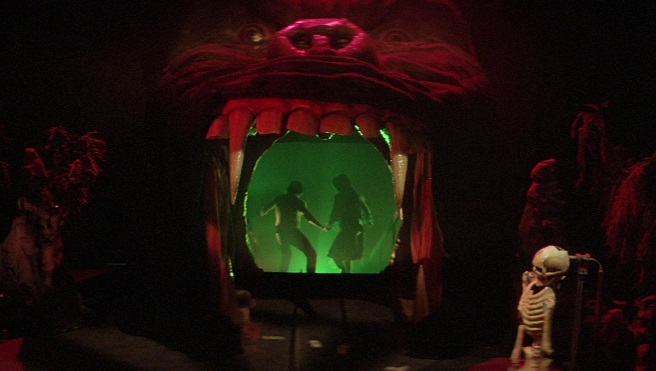
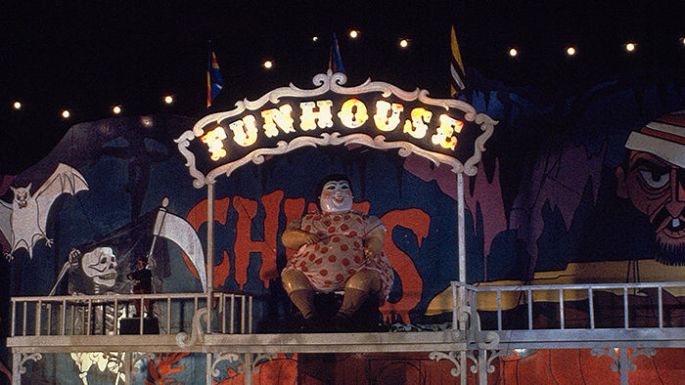
There is a certain urban myth flavor permeating the central idea of the Funhouse. After a night of pot smoking and grab-ass at the local carnival, the wise guy in a group of four kids on a double date proposes they all spend the night in “The Funhouse” (which, as Wikipedia would correctly point out, is actually a dark ride). What lives within the Funhouse is the Barker and his hideously deformed son who helps work the Funhouse with the cloaking aid of a Frankenstein’s Monster mask. Not long after the kids witness the murder of a fortune teller at the hand of the Barker’s son, they are discovered by the Barker and their attempts to exit the Funhouse are thwarted at every turn. Will they survive the night?!?

Funhouse_43

In 1981, the failure of the Funhouse was partly due to Universal’s decision to make the film look more like it was an entry in the slasher genre than what it really was; an homage to the horror film in general with elements of multiple eras represented throughout. While it was certainly made sense from a production standpoint to utilize as much no-charge Universal Monster iconography as possible, it’s hard to discount that the monster in the Funhouse is, like the majority of those early creatures, truly a monster to be pitied and goaded on to aggressiveness by his abusive, alcoholic, and manipulative father. For more modern influences, the opening shot recalls both the shower scene in Psycho and the opening moments of John Carpenter’s Halloween (and even Brian De Palma’s Dressed to Kill, if you’re being generous). The traveling carnival setting has its roots in the oldest of American folktales including those that are represented in our films, such as Tod Browning’s Freaks.

But the Funhouse also hints at a true, simmering horror within in the modern family, and if there’s a nagging issue with the film, it is that its less successful in fleshing this out effectively. The mother for the representative “good” family seems to be a short-tempered alcoholic that instills nothing but fear and dread in her children but we can only guess at this given her scant screen time and the opaque dialogue surrounding her character.

Other than that, the characters and situations do offer up a certain dark streak that runs throughout the film and hints at something deeper. The clean-cut daughter, our identifiable “Final Girl,” isn’t exactly the frigid, do-gooder as in other films from the era. Instead, Elizabeth Berridge’s all-American Amy Harper disobeys her dad, smokes grass, engages in some free-spirited sexual misconduct, and goes along with the crowd without much resistance at all. The ubiquitous younger brother character has a certain perverseness given his prank in the opening moments of the film. I mean, it never occurred to me to, as a goof, take pictures of my older, naked sister in the shower. Additionally, in a nifty plot pivot, the “good kids” find themselves in double-jeopardy after the wise guy pulls a dick move and steals from the Barker and his son. Sure, this is a standard horror device but the motivation suggests a certain deterioration in Hooper’s overall worldview. After all, in both the Texas Chain Saw Massacre and Eaten Alive, the protagonists’ transgressions were no greater than simply stumbling upon the antagonists’ hunting ground.

But from most standpoints, the Funhouse is an impressive film. The cast is uniformly great; Elizabeth Berridge radiates a nervous and apprehensive sweetness, Kevin Conroy is perfectly greasy as the corn liquor-soaked Barker (Conroy actually turns up as three different barkers, hustling for the strip tease, the freak-of-nature tent, and the Funhouse), Cooper Huckabee sports the right amount of Dirk Daring-Do as Barrage’s lunkheaded date with a heart of gold, De Palma regular William Finley turns up as the nip-taking, ghoulish Magician, and the always exciting Sylvia Miles, sporting the hammiest gypsy accent this side of Grayson Hall on Dark Shadows, steals each scene she occupies as the Fortune Teller. The film also sports some really beautiful widescreen camera work (including some fun split-diopter compositions and epic crane shots) courtesy of the great Andrew Laszlo, a master of color and darkness who gave Walter Hill’s the Warriors and Streets of Fire their distinctive comic book look. Here, much like in Hooper’s Eaten Alive, the colors give the film a roadside attraction garishness the look of which is as threaded into the American consciousness as the colors of the flag.

Like anything Tobe Hooper made after 1974, the Funhouse is far from perfect. The ending confrontation feels anticlimactic, uninspired, and deflated and there is a wish that at least some of the backstory that was written into the Dean Koontz’s novelization (initially released under the pseudonym Owen West) could have been incorporated into the domestic moments, if only to flesh out the parental conflicts with the children and restore a much-needed balance of subtext. But, as it stands, the Funhouse remains an overlooked, colorful homage to the institution of American horror, both real and imagined.

0dc7633a56c59a7bf7a2eb423a780e04

HealtH – A Review By Patrick Crain

zoom_1418768851_HealtH@2xWhen you begin to consider the high-level talent that went into the formula that produced Robert Altman’s HealtH, it’s difficult to recall another movie in film history that was, and continues to be, treated as poorly. Coming directly after Altman’s twin failures of 1979, Quintet and a Perfect Couple, its production was relatively quick and on-the-fly; an attempt to get one in the can while things at 20th Century Fox were still being run by Alan Ladd, Jr., a staunch Altman proponent who once gave the maverick filmmaker a million and a half dollars to make 3 Women, a movie that came to Altman in a dream and had no real cohesive story.
Sure enough, things did change and Ladd was ousted. HealtH, which had an initial scheduled release date in late 1979, began to get slowly pushed back on the schedule. Early 1980 came and went and a series of test runs arranged by the new management proved to be less than promising. The master plan of having it released before the 1980 presidential election never materialized. It’s safe to assume that when Altman began shooting the lavishly budgeted, dual-studio event picture Popeye in 1980, he couldn’t dream that he would get it shot, edited, and in theaters before HealtH.

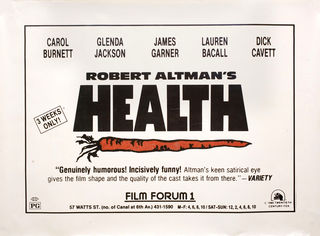
But Popeye was released in time for Christmas in 1980 and HealtH was eventually pushed off of the Fox release schedule entirely. It did manage to play a limited engagement at Film Forum in 1982 but, aside from its occasional, stealthy appearance on various television movie channels, HealtH has never seen a release on home video. It’s a depressing world in which we live that Robert Downey Sr.’s similarly-imprisoned the Gong Show Movie finally gets a Blu ray release and HealtH can’t even be bought on the sad, used VHS market. Every once in a while, a widescreen rip from one of those movie channel broadcasts makes its way onto YouTube, but its difficult to know if it’s been edited for time or whether the somewhat squeezed visual presentation is a representation of the film’s true aspect ratio.

Given its obscurity, the perceived notion is that HealtH must be some kind of otherworldly dog of a film; a real hubristic bonanza crafted amidst a barrage of likeminded projects by Altman. But the truth of the matter is that HealtH is a surprisingly strong look at the ridiculousness of the American political system as filtered through the world of the then-bourgeoning consumer health industry. A fine addition to the busier, wide-canvas ensemble pieces Altman could engineer with remarkable skill and dexterity, HealtH performs double duty as a sly comedy and a prescient warning of the toxic injection of empty personality and media-driven messaging into our electoral process.

In a way, the overtly political overtones of HealtH would go on to serve Altman well when it came time for him to produce his masterpiece of the 80’s, Tanner ’88; one specific element, the jaunty campaign theme “Exercise Your Right to Vote,” is heard in both films.  In its earlier incarnation, it’s delivered by The Steinettes, an a capella outfit who acts as a ridiculous but appropriate greek chorus to HealtH’s very odd portrait of 1979 America.

HealtH is, on the surface, about two days at a health convention in which two candidates are running for the title of “President of HealtH.” Present at this convention are product pitchmen, authors, political functionaries & fixers, glad-handing bureaucrats, dirty tricksters, aides, liaisons, and PR staff all centering around the two presidential hopefuls.

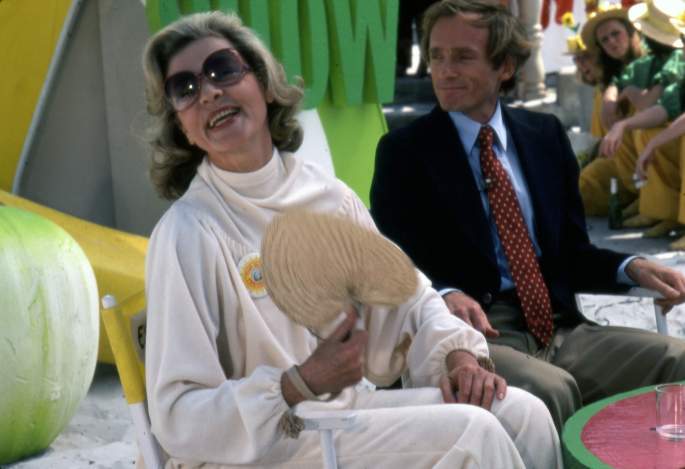
In one corner, Esther Brill (Lauren Bacall), 83 year-old virgin whose ubiquitous campaign slogan “Feel Yourself,” is delivered with an astounding cluelessness as Brill believes that each orgasm shaves 28 days off of your life. Her staff is made up of PR guru Harry Wolff (James Garner), oversexed campaign manager, Dr. Ruth Ann Jackie (Ann Ryerson) Brill’s undersexed personal physician who secretly lusts after Wolff, and a gaggle of nurses who are constantly drinking behind Brill’s back.

In the other corner is Isabella Garnell (Glenda Jackson) a pragmatic-yet-cold idealist whose speeches all seem swiped from Adlai Stevenson. Her entourage consists solely of Willow Wertz (Diane Stilwell), a sweet-natured aide whose ongoing sexual frustration is rooted in her inability to feel anything sexual for anything whatsoever.

Between the two candidates is Gloria Burbank (Carol Burnett), a representative from the White House and Wolff’s ex-wife; Dr. Gil Gainey (Paul Dooley), an independent candidate for president and shill for something called “Vita-Sea;” Colonel Cody (Donald Moffat), a bellowing political string-puller; Bobby Hammer (Henry Gibson), a slimy political operative sent to disrupt the Garnell campaign; Sally Benbow (Alfre Woodard), the convention hotel’s PR director; and, finally, Dick Cavett, as himself, who is there to cover the event for his talk show. Oh, yeah, and the Steinettes. 

In the film, we’re told that HealtH (which stands for “Happiness, Energy and Longevity through Health”) is an organization more than three times the size of the NRA and whose members can be similarly motivated to vote one way or the other. So the film certainly exists in an America that could also produce the cockeyed presidential campaign of Nashville’s Hal Phillip Walker. But Walker didn’t much have a real-life counterpart in 1975. The populist politics of Nashville reflected a hopelessness that washed through the post-Watergate, pre-Carter country like a rotten fever. The politics of HealtH were much more immediate. While sending up the then-current political climate, the film seems to anticipate the cultural shift that occurred in the presidential election in 1980. Even if the other candidates in the film could be composites of many other political figures, Esther Brill is a certain representation of the perceived image of Ronald Reagan, a man who counted on a network of advisors and aides to keep him informed and aware and who was about to enter the presidential race with a boatload of sunny optimism and slogans aplenty.

While HealtH is far from perfect due to its unfocused and rushed production and its occasional tendency to get lost in the weeds of its own mix of satire and reality (you never really feel like you should be investing in it as you really should), there is a great deal to admire. The script, by Altman regular Frank Barhydt, actor Dooley, and Altman does an admirable job keeping the film equally steeped in reality (through the characters of Woodard and Garner), television (Cavett and, eventually, Dinah Shore), and fantasy (basically everything else). The performances, too, are all top-notch. Burnett, Bacall, and Jackson are all terrific but the film is absolutely stolen at every turn by Woodard whose polite facade hilariously begins to give way to disdain as the convention rolls along. Among the men, Garner turns in a reliably easy-going performance, Paul Dooley is as energetic as I’ve ever seen him, and Dick Cavett, remarkably comfortable in a sizable role, has a great deal of fun.

As history marches on, HealtH’s chances of being anything other than a completely forgotten and mostly unseen film become slimmer and slimmer. Altman passed away ten years ago so it’s unlikely that any other event could be the catalyst for its release. Sometimes chuckling and sometimes wincing while watching it in the midst of our own current presidential election that certainly seems like it could play out in an Altman film, it’s a cinch that HealtH could still find an audience today.health-sm-web