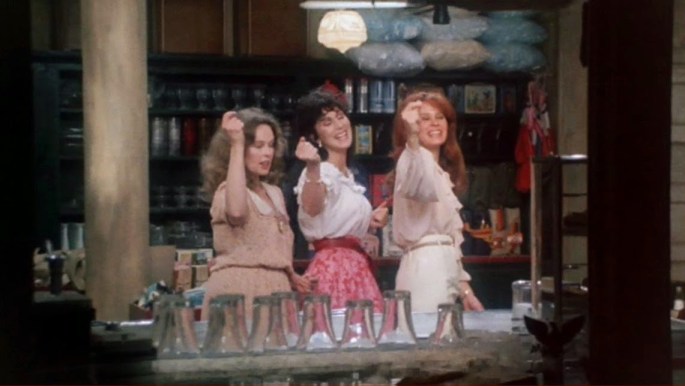
With cinematographer Pierre Mingot’s camera crawling across the dusty and crowded aisles of the shabby Woolworth’s five-and-dime aided by nothing but the sound of the hot Texas wind blowing in the background, the stillness is shocking and the silence is deafening. After the assaultive soundtracks and busy tableaux of Robert Altman’s body of work from 1970 through 1980, this seems downright pastoral; retrograde, in fact. For this quiet solemnity is the brief calm before the kickoff of the 20th anniversary reunion for the Disciples of James Dean, a small gaggle of friends who once wore matching sweaters, dreamed of being in a singing group like the McGuire Sisters, and worshiped at the alter of James Dean while sweating out life in McCarthy, Texas during the early fifties.
Set on September 30th, 1975, the 20th anniversary of the death of James Dean, Come Back to the 5 & Dime Jimmy Dean, Jimmy Dean tracks the sad, lonely, and scarred lives of those for whom the Woolworth was once the nexus of their universe; a place you could get an orange Crush and read Photoplay magazine while waiting for your friends to get off work. And in 1975, time has not been kind to the Woolworth, itself slowly beginning to feel the pressure as regional retailers like TG&Y, Target, and Wal-Mart began to slowly creep across the map all the while watching smaller stores burn out and die as their host towns did the same.
The McCarthy Woolworth is situated not sixty miles from Marfa where, in 1955, director George Stevens and company travelled to film portions of Giant, a film that would prove to be James Dean’s last. This proves to be a crucial point in time in the lives of those at the Woolworth, most especially high-strung Dean fanatic, Mona (Sandy Dennis), and Joe (Mark Patton), her co-worker and friend whose homosexuality is becoming a point of rancorous contention in the conservative town. A day-trip to Marfa in the hopes to be extras in the film leads to a secret that will be revealed twenty years later in the course of the reunion just as everyone else in the store’s purview will see their lives peeled back and exposed.
It’s perhaps no accident that 1982 marked the 25th anniversary of the release of The Delinquents and The James Dean Story, Robert Altman’s first two films that were bathed in the ghost of Dean and his legacy. For 5 & Dime, Altman’s adaptation of Ed Graczyk’s stage play, is a film about, among a lot of things, a gulf of time, starting over, and reassessment; a mirror of disillusionment and reconciling the past with the present. After the death of HealtH and the perceived folly of Popeye, Altman was on the other side of the Hollywood gates, reconfiguring his strategy and finding new energy for the march through the wilderness ahead.
In 5 & Dime, Robert Altman gets to start the 80’s off with a big “fuck you” to the type of salt of the earth community that was so lionized in the ascension of Reagan’s America. Steeped in religious hypocrisy and homophobia, the town of McCarthy deserves to shrivel up and die on the vine. We see that this isn’t a town where the righteous and the upstanding live, but, instead, its a lifeless husk inhabited by the sad denizens of a religious culture that has proved ruinous. We never see anything of McCarthy outside the store but we really don’t need to, mostly because movies like Peter Bogdanovich’s The Last Picture Show exist and it’s a well-traveled landscape. This is a town in which the skating rink closed in 1965. You really only need to understand that.
Populating this world are only those who work at the Woolworth or those from its past. Randy and foul-mouthed Sissy (Cher, extraordinary in her first serious dramatic role) still works the counter twenty-five years later but now is cemented to Lester T, a husband we never see but about whom we will hear plenty. Juanita (a perfect Sudie Bond) runs the place with the same kind of starchy, unforgiving attitude that was its brand when it was being run by her late husband, Sidney, who, like Lester T, is a man we will not see but about whom we will hear plenty. Coming in from out of town are Stella Mae (Kathy Bates, hurling it to the back row), a wealthy but terminally empty woman whose acrid ribbing of the plain but sweet-natured Edna Louise (Marta Heflin) reveals a deep pain of jealous resentment. Mona still lives in town and arrives a little late from a trip to Marfa, carrying another piece of Reata, the false front from Giant built in the middle of that town’s arid wasteland that slowly became dismantled by the natural elements and tourists who wanted a piece of its memory. Finally, the one stranger to the group arrives in the form of Karen Black’s Joanne, a mysterious woman with bold and striking features who drives a fancy yeller Porsche who… somehow… reminds everyone of someone they once knew.
It should go without saying that there is a feeling by some that this film is poorly representative and isn’t without issues. While I certainly understand and to a certain extent agree with some of those concerns, I do think they miss a wider point of just how rare it was in 1982 to see any film that dealt with LGBTQ issues as openly and with any sympathy for those characters who had been traditionally marginalized. But aside from being a very brave, LGBTQ-positive film, 5 & Dime is pointedly reflective for Altman on a personal level. Along with Popeye, here, too, lies a dark self-assessment regarding the regrets of misspent parenthood as it is revealed that Mona’s child, long-heralded in McCarthy as the illegitimate love child of James Dean, has been smothered and emotionally abused by his mother. And it is again Mona who acts as the vessel in which Altman places some of his wistful nostalgia for his salad days. “I should have kept up with all of them,” she says as the transparent scrim in the mirror gives way to a reminiscence that feels like it’s bathed in CinemaScope, revealing a sadness that independent, cinematic productions of one-set plays was the extent of Altman’s professional reach. In Sandy Dennis, Altman had a rare creature who could be as pitiful in her neurosis as she could be tender and hers is the character who slowly fades away over the course of the film, her life no more than an empty shell of lies disguised as memories.
If Hollywood bet Altman would wilt without his widescreen trickery and ephemeral bullshit, they bet wrong. With nothing but one set and a handful of actors, Altman spans twenty years of hurt and pain that feels epic in scope. Not only is it a roaring success, it’s a remarkable piece of filmmaking and one of Altman’s very best pictures. And even if he would eventually pare his mise-en-scene down even further in 1984’s blistering Secret Honor, the amount of production value Altman gets from just the performances and the theatrical utilization of the mirror as a window into the past reflects just how incredibly gifted he was when it came to brass tacks of visual storytelling. 5 & Dime could obviously be done in a master shot but every cut and camera setup seems considered and, unlike other adaptations of stage plays to the big screen, Altman does absolutely nothing to open the piece up to make it more cinematic, correctly gauging that the claustrophobia would make the microscopic examination all the more riveting.
In adapting the play to the screen, Altman is reporting on an America that is breathing its last breath. It’s a place where the plastic pinwheels refuse to move in its atmosphere. There is a stagnancy and a ripening; rain threatens to roll in but always passes by without showing up. Most everyone in the group promises each to reunite again in the year 1995 but there’s little question that it’s a reunion that won’t occur. As the ending credits roll, the audience is reminded that time will eventually wear everything down into a bittersweet, faded memory. From the structure of Reata in which nobody dwelled to entire towns that once bustled with actual life and energy, absolutely nothing is spared in the end.
(C) Copyright 2021, Patrick Crain

 Podcasting Them Softly