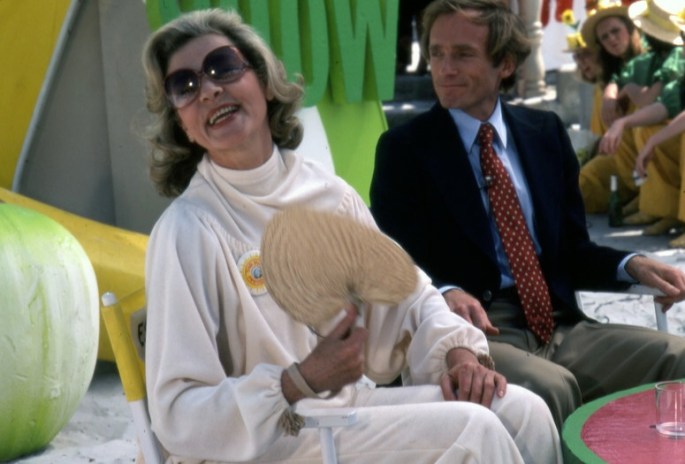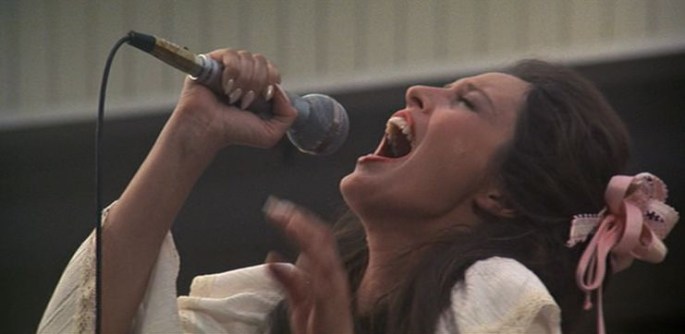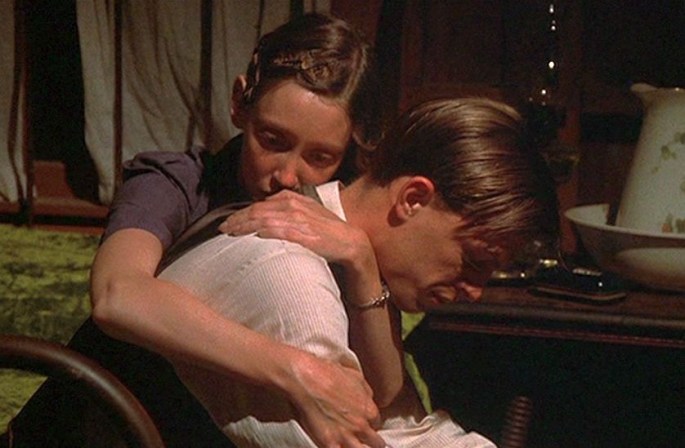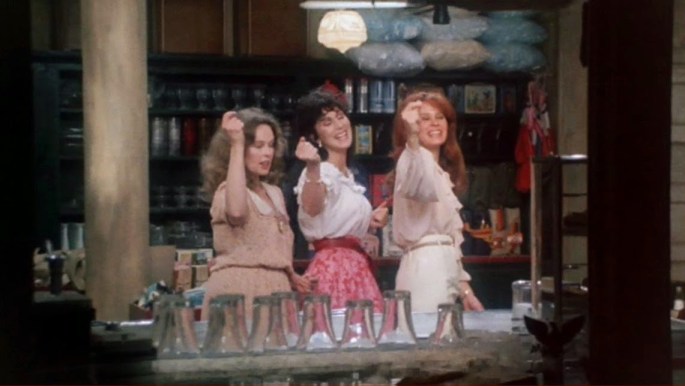
THE ROBERT ALTMAN FILES: COME BACK TO THE 5 & DIME JIMMY DEAN, JIMMY DEAN (1982)

With cinematographer Pierre Mingot’s camera crawling across the dusty and crowded aisles of the shabby Woolworth’s five-and-dime aided by nothing but the sound of the hot Texas wind blowing in the background, the stillness is shocking and the silence is deafening. After the assaultive soundtracks and busy tableaux of Robert Altman’s body of work from 1970 through 1980, this seems downright pastoral; retrograde, in fact. For this quiet solemnity is the brief calm before the kickoff of the 20th anniversary reunion for the Disciples of James Dean, a small gaggle of friends who once wore matching sweaters, dreamed of being in a singing group like the McGuire Sisters, and worshiped at the alter of James Dean while sweating out life in McCarthy, Texas during the early fifties.

Set on September 30th, 1975, the 20th anniversary of the death of James Dean, Come Back to the 5 & Dime Jimmy Dean, Jimmy Dean tracks the sad, lonely, and scarred lives of those for whom the Woolworth was once the nexus of their universe; a place you could get an orange Crush and read Photoplay magazine while waiting for your friends to get off work. And in 1975, time has not been kind to the Woolworth, itself slowly beginning to feel the pressure as regional retailers like TG&Y, Target, and Wal-Mart began to slowly creep across the map all the while watching smaller stores burn out and die as their host towns did the same.

The McCarthy Woolworth is situated not sixty miles from Marfa where, in 1955, director George Stevens and company travelled to film portions of Giant, a film that would prove to be James Dean’s last. This proves to be a crucial point in time in the lives of those at the Woolworth, most especially high-strung Dean fanatic, Mona (Sandy Dennis), and Joe (Mark Patton), her co-worker and friend whose homosexuality is becoming a point of rancorous contention in the conservative town. A day-trip to Marfa in the hopes to be extras in the film leads to a secret that will be revealed twenty years later in the course of the reunion just as everyone else in the store’s purview will see their lives peeled back and exposed.

It’s perhaps no accident that 1982 marked the 25th anniversary of the release of The Delinquents and The James Dean Story, Robert Altman’s first two films that were bathed in the ghost of Dean and his legacy. For 5 & Dime, Altman’s adaptation of Ed Graczyk’s stage play, is a film about, among a lot of things, a gulf of time, starting over, and reassessment; a mirror of disillusionment and reconciling the past with the present. After the death of HealtH and the perceived folly of Popeye, Altman was on the other side of the Hollywood gates, reconfiguring his strategy and finding new energy for the march through the wilderness ahead.

In 5 & Dime, Robert Altman gets to start the 80’s off with a big “fuck you” to the type of salt of the earth community that was so lionized in the ascension of Reagan’s America. Steeped in religious hypocrisy and homophobia, the town of McCarthy deserves to shrivel up and die on the vine. We see that this isn’t a town where the righteous and the upstanding live, but, instead, its a lifeless husk inhabited by the sad denizens of a religious culture that has proved ruinous. We never see anything of McCarthy outside the store but we really don’t need to, mostly because movies like Peter Bogdanovich’s The Last Picture Show exist and it’s a well-traveled landscape. This is a town in which the skating rink closed in 1965. You really only need to understand that.

Populating this world are only those who work at the Woolworth or those from its past. Randy and foul-mouthed Sissy (Cher, extraordinary in her first serious dramatic role) still works the counter twenty-five years later but now is cemented to Lester T, a husband we never see but about whom we will hear plenty. Juanita (a perfect Sudie Bond) runs the place with the same kind of starchy, unforgiving attitude that was its brand when it was being run by her late husband, Sidney, who, like Lester T, is a man we will not see but about whom we will hear plenty. Coming in from out of town are Stella Mae (Kathy Bates, hurling it to the back row), a wealthy but terminally empty woman whose acrid ribbing of the plain but sweet-natured Edna Louise (Marta Heflin) reveals a deep pain of jealous resentment. Mona still lives in town and arrives a little late from a trip to Marfa, carrying another piece of Reata, the false front from Giant built in the middle of that town’s arid wasteland that slowly became dismantled by the natural elements and tourists who wanted a piece of its memory. Finally, the one stranger to the group arrives in the form of Karen Black’s Joanne, a mysterious woman with bold and striking features who drives a fancy yeller Porsche who… somehow… reminds everyone of someone they once knew.

It should go without saying that there is a feeling by some that this film is poorly representative and isn’t without issues. While I certainly understand and to a certain extent agree with some of those concerns, I do think they miss a wider point of just how rare it was in 1982 to see any film that dealt with LGBTQ issues as openly and with any sympathy for those characters who had been traditionally marginalized. But aside from being a very brave, LGBTQ-positive film, 5 & Dime is pointedly reflective for Altman on a personal level. Along with Popeye, here, too, lies a dark self-assessment regarding the regrets of misspent parenthood as it is revealed that Mona’s child, long-heralded in McCarthy as the illegitimate love child of James Dean, has been smothered and emotionally abused by his mother. And it is again Mona who acts as the vessel in which Altman places some of his wistful nostalgia for his salad days. “I should have kept up with all of them,” she says as the transparent scrim in the mirror gives way to a reminiscence that feels like it’s bathed in CinemaScope, revealing a sadness that independent, cinematic productions of one-set plays was the extent of Altman’s professional reach. In Sandy Dennis, Altman had a rare creature who could be as pitiful in her neurosis as she could be tender and hers is the character who slowly fades away over the course of the film, her life no more than an empty shell of lies disguised as memories.

If Hollywood bet Altman would wilt without his widescreen trickery and ephemeral bullshit, they bet wrong. With nothing but one set and a handful of actors, Altman spans twenty years of hurt and pain that feels epic in scope. Not only is it a roaring success, it’s a remarkable piece of filmmaking and one of Altman’s very best pictures. And even if he would eventually pare his mise-en-scene down even further in 1984’s blistering Secret Honor, the amount of production value Altman gets from just the performances and the theatrical utilization of the mirror as a window into the past reflects just how incredibly gifted he was when it came to brass tacks of visual storytelling. 5 & Dime could obviously be done in a master shot but every cut and camera setup seems considered and, unlike other adaptations of stage plays to the big screen, Altman does absolutely nothing to open the piece up to make it more cinematic, correctly gauging that the claustrophobia would make the microscopic examination all the more riveting.

In adapting the play to the screen, Altman is reporting on an America that is breathing its last breath. It’s a place where the plastic pinwheels refuse to move in its atmosphere. There is a stagnancy and a ripening; rain threatens to roll in but always passes by without showing up. Most everyone in the group promises each to reunite again in the year 1995 but there’s little question that it’s a reunion that won’t occur. As the ending credits roll, the audience is reminded that time will eventually wear everything down into a bittersweet, faded memory. From the structure of Reata in which nobody dwelled to entire towns that once bustled with actual life and energy, absolutely nothing is spared in the end.

(C) Copyright 2021, Patrick Crain
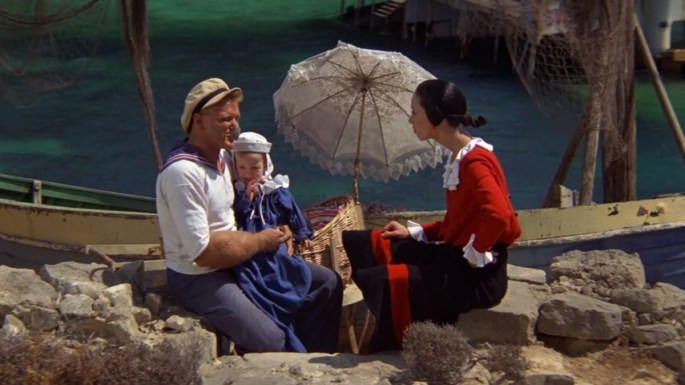
THE ROBERT ALTMAN FILES: POPEYE (1980)

As the seventies came to a close and a new day was dawning on Hollywood, filmmakers and studios began to shift their work and business models to better prepare for the type of film they needed to make. Sure, the point of any movie studio at any time in the history of motion pictures had always been to make a profit. But after watching truckloads of cash show up at their doorstep after the release of films such as Jaws and Star Wars, it was no longer enough to just turn a profit. Movies began to come together in board rooms and designed to be less as entertainment vehicles that would make money and more unstoppable machines that would print money. So this is why it made a certain amount of sense for Paramount Pictures and the Walt Disney Company to join forces for a slate of films that would be geared towards the entire family but would be just a smidge more sophisticated than what could be expected from a live-action “Disney movie” which, by the 1980’s, had a certain kind of downmarket reputation and wasn’t exactly raking in the cash.

This partnership produced exactly two movies, Robert Altman’s Popeye in 1980 and Matthew Robbins’s impressive Dragonslayer, released the following year. That it produced anything is a small miracle as Popeye, first on the slate, was an absolutely cursed production from top to bottom and any sane assessment of the film reveals that fact many times over. From on-set fighting to the cocaine bust of producer Robert Evans, the production of Popeye kind of had it all. It wasn’t quite a Heaven’s Gate but it was definitely the last thing director Robert Altman needed at that point in his career. After owning the first half of the 1970’s, Altman’s work was continually met with diminishing returns which culminated in HealtH, his previously completed picture, getting completely buried and unreleased by 20th Century Fox. He needed a hit in the worst way and Popeye was a tee-up for him.

But the fact of the matter was that there was no real certainty Popeye would be a hit. All that was there was a vague notion that the monster Broadway success of Annie meant that there was sure to be a motion picture adaptation and, therefore, something had to be crafted to catch that similar wave of upscale family fare. Paramount owned King Features and, therefore, the universe of the Popeye comic strip so why not hire Harry Nilsson, the genius but inveterate alcoholic pop star on the downslope, to write the tunes and Robert Altman, an independent, bullheaded filmmaker whose last huge hit had been a whole decade earlier, to direct? I mean, it looked good on paper to somebody and I can’t help but think that somebody was Robert Evans whose career, like Altman’s, was also in jeopardy after a string of poor decisions teetered his reputation for rescuing Paramount Pictures in the late sixties from impatient creditors who were ready to engage the studio in a complete fire sale.

Another thing not considered is that by 1980, there was a giant delta that separated audience’s understandings of the Popeye from his origins in the Thimble Theatre comic strip created by Elzie Crisler Segar in 1919. In that iteration, Popeye (introduced in 1929) was but a supporting player in the larger world of Sweethaven, a cockeyed seaport town crawling with strange, yet lovable denizens. After becoming the star of the strip, Max Fleischer’s studios popularized Popeye and the majority of the Thimble Theatre characters in a series of cartoon shorts which usually put Popeye and company in contemporary and urban settings. By the time Paramount’s Famous Studios began producing the cartoons, Popeye and Olive Oyl were fully suburbanized and Popeye would frequently appear in shorts in which he would be battling his nemesis Bluto over trivial things like front lawn maintenance and seats at a baseball game. When Altman and screenwriter Jules Feiffer took the story back to its roots, it looked a lot like a world unfamiliar to many of the people who had become accustomed to Popeye as the confident, spinach-swilling, language-murdering hero who always had Olive Oyl by his side and Bluto at his feet.

But, oh, Lordy Moses, did people bitch when Popeye hit the theaters. Save the Wolf Kroeger production design and the incredible sets constructed in a Maltese cove (that are still standing and function as a tourist attraction, by the way), there was virtually nothing in the film that didn’t prove distasteful to at least one person in some shape or form. It did decent business but, unfortunately, was made at a time when it wasn’t enough to do good business if the business wasn’t good enough. Because of this attitude, Popeye has since been remembered as a magnificent disaster and a flop of a film, neither of which are remotely true. It’s a wild film in Altman’s canon and looking at it from the highest peak of Mt. Objectivity reveals an absolute mess of a final product but it’s also not out of line to rule Popeye a film where the sum of the parts are definitely better than the whole. As if it were built as if it were a number of cartoon shorts strung into one whole movie, Popeye is a movie without much drive but with a whopping ton of energy which can be joyous and fun but, at 114 minutes, feels like a juggernaut that could even wear down the last, most energetic person on the Studio 54 dance floor.

To the uninitiated, Popeye is about the titular character (Robin Williams in his film debut) arriving in the seaside town of Sweethaven in the search for his father, Poopdeck Pappy (Ray Walston). During his hunt, he becomes entangled with and falls for the dizzy Olive Oyl (Shelley Duvall in her final bow for Altman), takes charge of abandoned infant, Swee’ Pea (Wesley Ivan Hurt, Altman’s impossibly cute ham of a grandson), and runs afoul of Bluto (Paul Smith), the burly and hirsute heavy who begins the film as Olive’s betrothed.

Thematically, this is McCabe & Mrs. Miller territory (replete with a direct blink-and-you’ll-miss-it visual nod in the floating casino sequence as a zonked-out prostitute examines a ceramic pot as she reclines in her bunk); ultimately a story about how an iconoclast can enter a town and rearrange the structure. The problem with Popeye is that the story never allows the viewer to understand how anything in the town works in the first place. Some of it feels like a parody of shallow American nationalism but the town of Sweethaven is such a sketch, the details the audience has a right to know are either not there or buried. Taxes are being constantly collected but for what purpose and they’re routed where, exactly? The town has a Mayor but the Commodore holds more stroke why? The Commodore is a recluse that nobody has seen for what reason? Is this an isolated island burg in a post-Quintet future that’s surrounded by the melted ice and where the people are only just learning how to be a functioning society again? Because they sure act like it.

But, putting narrative and story aside (which we shouldn’t do but will anyway) is there another movie outside of Warren Beatty’s Dick Tracy that looks like it was Silly Putty’d right off a newspaper than Popeye? As a retrospective criticism, the film’s bloated budget would be a legitimate concern if every single dollar wasn’t up on the screen and everything didn’t look absolutely gorgeous. The beautiful widescreen compositions by cinematographer Giuseppe Rotunno capture the sideways-pitched structures against an immensely beautiful green sea where foregrounded primary colors absolutely pop off the screen. The costumes by Scott Bushnell, longtime Altman producer, are magnificently elaborate and detailed and everyone in the cast looks 100% perfect.

Altman’s on-screen choreography with his performers, always a staple in making his movies breathe, might just be at its highest level here as the frame is constantly swishing back and forth, always revealing some new information in the background. In fact, so busy is its canvass that, after forty years of watching the film, I have just recently spotted the caveman that randomly pops up in the far back of the background throughout the movie. Where most Altman films demand a second viewing due to the multi-tracked, overlapping dialogue, Popeye joins ranks with works such as Brewster McCloud and HealtH as needing multiple views due to everything that’s going on everywhere but the center of the screen. Just one instance of this is Robert Fortier’s Bill Barnacle. Sloshing around as the town drunk (ya know, the same character he played in McCabe & Mrs. Miller for those of you keeping score), it’s worth missing everything else that’s happening on the screen each time he appears as his physical performance is likely funnier and more interesting than what’s happening front and center.

And despite his giving up on the project to return to Flash Harry, his penultimate album before his untimely death in 1997, the Harry Nilsson tunes (and their wonderful Van Dyke Parks orchestrations) still soar. “Sweethaven,” “I Yam What I Yam,” “I’m Mean,” “Kids,” and, especially, “He Needs Me” all have a loopy charm and sly humor while “He’s Large,” a song dedicated to Bluto’s… ahem… girth, sung by Shelley Duvall and backed up by the Steinettes, the Greenwich Village doo-wop outfit who served as the Greek chorus in HealtH, is absolutely inappropriate for a family film but, on second thought, perhaps this film deserved such a shot of raunch if to only diffuse the treacle in “Sailin’” and “Swee’ Pea’s Lullabye,” two slabs of straight sentimentality that feel a bit out of place in a bizarre place such as this.

1980 wasn’t terribly kind to Popeye and time has done little to repair its image. Folks that loved it then, love it now. Folks that hated it then are always quick to point out they’ve never revisited it. Contemporary audiences don’t know quite what to make of it. Robert Altman didn’t end up in director’s jail but he would be cast out onto the stormy seas of the 1980’s with almost zero studio support, fully requested by the powers that be that he learn to fend for himself. In the end, Popeye turned out to become a fondly-remembered cocaine film for children and, regardless of the film’s box office returns, we probably needed more of them as the dawn of Reagan loomed large.

(C) Copyright 2021, Patrick Crain

THE ROBERT ALTMAN FILES: HealtH (1980)

When you begin to consider the high-level talent that went into the formula that produced Robert Altman’s HealtH, it’s difficult to recall another movie in film history that was, and continues to be, treated as poorly. Coming directly after Altman’s twin failures of 1979, Quintet and A Perfect Couple, its production was relatively quick and on-the-fly; an attempt to get one in the can while things at 20th Century Fox were still being run by Alan Ladd, Jr., a staunch Altman proponent who once gave the maverick filmmaker a million and a half dollars to make 3 Women, a movie that came to Altman in a dream and had no real cohesive story.

Sure enough, things did change and Ladd left for form the well-intentioned but doomed Ladd Company. HealtH, which had an initial scheduled release date in late 1979, began to get slowly pushed back on the schedule. Early 1980 came and went and a series of test runs arranged by the new management proved to be less than promising. The master plan of having it released before the 1980 presidential election never materialized. It’s safe to assume that when Altman began shooting the lavishly budgeted, dual-studio event picture Popeye in 1980, he couldn’t dream that he would get it shot, edited, and in theaters before HealtH.

But Popeye was released in time for Christmas in 1980 and HealtH was eventually pushed off of the Fox release schedule entirely (its final replacement on the Fox release schedule being Oh, Heavenly Dog!, a movie starring Chevy Chase and Benji). It did manage to play a limited engagement at Film Forum in 1982 but, aside from its occasional, stealthy appearance on various television movie channels, HealtH has never seen a release on home video. Every once in a while, a widescreen rip from one of those movie channel broadcasts makes its way onto YouTube, but it’s difficult to know if it’s been edited for time or whether the somewhat squeezed visual presentation is a representation of the film’s true aspect ratio.

Given its obscurity, the perceived notion is that HealtH must be some kind of otherworldly dog of a film; a real hubristic bonanza crafted amidst a barrage of likeminded projects by Altman. But the truth of the matter is that HealtH is a surprisingly strong and wicked look at the ridiculousness of the American political system as filtered through the world of the then-bourgeoning consumer health industry. A fine addition to the busier, wide-canvas ensemble pieces Altman could engineer with remarkable skill and dexterity, HealtH performs double duty as a sly comedy and a prescient warning of the toxic injection of empty personality and media-driven messaging into our electoral process. And having rewatched it in 2021 to rejigger this piece (originally written in early 2016), HealtH comes off as an even stronger film today given the twisted road down which we’ve travelled as a country.

HealtH is, on the surface, about two days at a health convention in which two candidates are running for the title of “President of HealtH.” Present at this convention are product pitchmen, authors, political functionaries & fixers, glad-handing bureaucrats, dirty tricksters, aides, liaisons, and PR staff all centering around the two presidential hopefuls. In one corner, Esther Brill (Lauren Bacall), 83 year-old virgin whose ubiquitous campaign slogan “Feel Yourself,” is delivered with an astounding cluelessness as Brill believes that each orgasm shaves 28 days off of your life. Her staff is made up of PR guru Harry Wolff (James Garner), oversexed campaign manager, Dr. Ruth Ann Jackie (Ann Ryerson) Brill’s undersexed personal physician who secretly lusts after Wolff, and a gaggle of nurses who are constantly drinking behind Brill’s back. In the other corner is Isabella Garnell (Glenda Jackson) a pragmatic-yet-cold idealist whose speeches all seem swiped from Adlai Stevenson. Her entourage consists solely of Willow Wertz (Diane Stilwell), a sweet-natured aide whose ongoing sexual frustration is rooted in her inability to feel anything sexual for anything whatsoever. And between the two candidates are Gloria Burbank (Carol Burnett), a representative from the White House and Wolff’s ex-wife; Dr. Gil Gainey (Paul Dooley), an independent candidate for president and shill for something called “Vita-Sea;” Colonel Cody (Donald Moffat), a bellowing political string-puller; Bobby Hammer (Henry Gibson), a slimy, Roger Stone-adjacent political operative sent to disrupt the Garnell campaign; Sally Benbow (Alfre Woodard), the convention hotel’s PR director; and, finally, Dick Cavett, as himself, who is there to cover the event for his talk show. Oh, yeah, and the Steinettes, an a capella outfit that acts as a ridiculous (but appropriate) greek chorus to HealtH’s very odd portrait of 1979 America.

In the film, we’re told that HealtH (which stands for “Happiness, Energy and Longevity through Health”) is an organization more than three times the size of the NRA and whose members can be similarly motivated to vote one way or the other. So the film certainly exists in an America that could also produce the cockeyed presidential campaign of Nashville’s Hal Phillip Walker. But Walker didn’t much have a real-life counterpart in 1975. The populist politics of Nashville reflected a hopelessness that washed through the post-Watergate, pre-Carter country like a rotten fever. The politics of HealtH were much more immediate. While sending up the then-current political climate, the film seems to anticipate the cultural shift that occurred in the presidential election in 1980. Even if the other candidates in the film could be composites of many other political figures, Esther Brill is a certain representation of the perceived image of Ronald Reagan, a man who counted on a network of advisors and aides to keep him informed and aware and who was about to enter the presidential race with a boatload of sunny optimism and slogans aplenty.

While HealtH isn’t perfect due to its unfocused and rushed production and its occasional tendency to get lost in the sauce of its own mix of satire and reality (you never really feel like you should be investing in it as you really should), it’s Altman’s strongest film since 3 Women. The script, by Altman regular Frank Barhydt, actor Dooley, and Altman does an amazing job keeping the film equally steeped in reality (through the characters of Woodard and Garner), television (Cavett and, eventually, Dinah Shore), and fantasy (basically everything else). The performances, too, are all top-notch. Burnett, Bacall, and Jackson are all terrific but the film is absolutely stolen at every turn by Woodard whose polite facade hilariously begins to give way to disdain as the convention rolls along. Among the men, Garner turns in a reliably easy-going performance, Paul Dooley is as energetic as I’ve ever seen him, and Dick Cavett, remarkably comfortable in a sizable role, has a great deal of fun.

As history marches on, HealtH’s chances of being anything other than a completely forgotten and mostly unseen film become slimmer and slimmer. Fox’s catalog is now owned by Disney, Altman passed away in 2006, and, aside from his centennial that will occur in 2025, there simply seems to be few occasions that could plausibly act as a catalyst for its release. This is a genuine shame because while sometimes chuckling and sometimes wincing while watching it in the midst of our own current absurd political climate that certainly seems like it could play out in an Altman film, it’s almost guaranteed that HealtH could still find an audience today. Sadly, it will probably never have the chance.

(C) Copyright 2021, Patrick Crain

THE ROBERT ALTMAN FILES: A PERFECT COUPLE (1979)

Coming off the universally reviled and glum Quintet, Robert Altman began to move back toward the warmth of human relationships with A Perfect Couple, a lighthearted romantic-comedy that tracks a mismatched couple through a series of sweet-natured misadventures as they connect, decouple, and reconnect. Put against Paul Newman’s fight for survival in a world not fit to survive, the synopsis of a middle-aged man (Paul Dooley) falling in love with a backup vocalist in a rock band (Marta Heflin) probably seemed much more in tune with what moviegoers in 1979 were wanting. Unfortunately, Altman wasn’t in much of a mood to tackle such a light project and as a result of being weighed down by a number of elements on top of which it can never seem to climb, A Perfect Couple both registers as one of Altman’s weakest efforts and the one that marked the end of his relationship with 20th Century Fox as his fifth picture delivered to them, 1980’s HealtH, would slowly bump its way down their release schedule, eventually dropping off of it completely, never to return.

The movie opens promising enough as Alex Theodopoulis (Dooley) and Shiela Shea (Heflin) enjoy an outdoor performance at the Hollywood Bowl of the LA Philharmonic, for which his sister, Eleouisa (Belita Moreno), is a cellist. As a torrential downpour disperses the crowd and ends the concert, Alex and Sheila escape to cut short what we learn is their first date which has been powered by their participation in a video dating service. During this time we also learn that Sheila lives in a cramped loft among numerous members of Keepin’ ‘Em Off the Streets, a rock outfit she has just recently joined. Alex, on the other hand, is part of a starchy and conservative Greek family where almost nothing is done individually, Friday nights are spent watching their father (Titos Vandis) mock-conduct along to orchestral music, and men who are almost halfway done with their entire existence on this planet still have to ask for permission to go on a date.

All of this is to set up a story of opposites where two sides of a relationship are viewed with elements in both sets of families that mirror each other and, surprisingly, this is where the film really fails. This is a movie that wants to show how clever it is by drawing parallels between the two disparate worlds but, unfortunately, neither world is appealing and Altman further cheats the audience by giving too much of one and not enough of another. One of the biggest examples of this is how Altman treats the gay characters in his film. Always one step ahead of his peers in his treatment of LBGTQ characters on the whole (most notable in the remarkable Come Back to the Five and Dime, Jimmy Dean, Jimmy Dean), Altman wears down a lot of shoe leather discussing the inner workings of the relationships between three gay members of the band (which is commendable) but then gets tight lipped and opaque when dealing with the other side of the coin, namely, Eleouisa and her relationship to band mate Mona (Mona Golabek) which is clearly non-platonic. It’s unclear if Altman keeps it coy to underline Alex’s clueless, almost juvenile and stunted view of sex and relationships or if Altman is making a point in regards to the sad sickness in Alex’s family that causes Eleouisa to code-talk her way around it but, by doing so, he shortchanges the audience by closing off an interesting avenue for dramatic exploration.

In fact, throwing up road blocks to anything interesting is what Altman seems to do well in this movie. Almost every side character that saunters into the frame is preferable to the couple at the center. Whether it’s co-screenwriter Allan Nicholls popping up as well-meaning suitor Dana 115 or Ann Ryerson’s hilarious turn as a randy veterinarian, the urge overwhelms me to cling to their legs and beg them to take me away with them. Likewise, I’m almost certain a better movie could be made out of the exploits of Alex’s bored yet obsequious brother, Costa (Dennis Franz) and/or his creepy, effete brother-in-law, Fred Bott (Henry Gibson, fabulous as ever), both of whom feel like characters who escaped from an episode of the brilliant sitcom Soap. Hell, give me a movie featuring nothing but the exploits of the emergency room doctor, drolly played by frequent Altman collaborator Frank Barhydt and one of the few in the film who seems to understands he’s in a Robert Altman picture.

Throughout the film, Alex is an uppity scold who is continually turned off by things in both Sheila’s world and outside the confines of his own familial sarcophagus. He’s disdainful of the “weirdos” in her world but he also runs like a scared man-child when he realizes that a video date he is with likes a little slap and tickle. He seems to be a man of little intestinal fortitude, reuniting with Sheila after a disastrous video date only to leave again when he realizes that the rigors of the road and the lack of privacy just aren’t for him. His final return to her, almost insultingly, occurs only after he’s banished from his family following a left-turn tragedy that occurs in the third act and, unfortunately, one which the film simply cannot emotionally support, creating a fatal tonal imbalance. I would almost say that Alex is maybe a spiritual cousin to the distaff sexual cripples that populated 3 Women and That Cold Day in the Park excepting we see the patriarchal squeeze that makes Alex into the person he is and we are triply frustrated when he never does anything proactive about it.

Her performance maybe three slight shades of beige, Marta Heflin makes zero impression in this movie. This is a shame because Heflin is a natural and good actor (she’s underused in A Wedding and she’s perfect in Five and Dime). Only ever getting the heart pumping during a scene where she is roundly humiliated by Alex’s ridiculous family, Heflin never seems like she’s fully bought in to the relationship nor does she give off the impression that she wouldn’t be fine without it. After all and in the end, is Alex REALLY worth all the trouble she goes through in the film? But Altman and Nicholls don’t give her character much life and, like the contrast between the gay characters, the comparison between the stern patriarchs of the Theodopoulis clan and Keepin’ ‘Em Off the Streets is a cosmetic afterthought; the kind of thing you’d be able to show an elective film course made up of seventh graders as to teach about thematic balance.

This is a film that doesn’t resolve as much as it ends. It feels like a much longer film was shot but a hacksaw was taken to it and only the items that really interested Altman (namely, the stuff with the band) were left in. But, by keeping one eye on the clock and delivering a crowd pleasing rom-com (which, at just a hair under two hours, is still overlong) the cuts to the film create gaping holes and so many questions remain as the credits roll. Is Sheila now out of the band and replaced by the singer we see for the first time right before the end? How did the band and the LA Philharmonic wind up playing together at the Hollywood Bowl? Is Alex completely done with his family without ever standing up for himself? How in the world did Alex ever have a first wife without ever telling her he really liked her? Does Sheila even have a backstory? Is she so weak that she takes Alex back with no kind of discussion about his shitty attitude and his penchant for leaving her? If Altman thought he could pull a Minnie and Moskowitz and simply get by with a “love conquers all…EVEN TWO WILDLY OPPOSITE PEOPLE” movie, he missed the gritty charm and the attention to character that infused every frame of that film that made it work despite all of its logical holes and corners cut by its writer and director, John Cassavetes.

And let me pause on here to remark on the thing I most dislike about A Perfect Couple, which is the entirety of Keepin’ ‘Em Off the Streets. From their candy-ass stage routine to their insistence on using two apostrophes in their name to the soft rock musical arrangements that are so tethered to 1979 they sound like they were composed while sitting in wicker furniture and recorded under a hanging plant supported by macrame, I hate everything about this band and despise any and all moments spent with the group in rehearsal or in concert. Like a Grateful Dead full of Donna Jean Godchauxes (but only if Donna Jean Godchaux could actually carry a tune outside of the studio), this is a band far too large to be plausibly functional. Ted Neeley has the thankless role of prick band leader, Teddy, but my disdain for his character goes beyond what’s written given his stupid wardrobe and his annoying habit of jamming his hands in his pockets while he’s performing on stage. All of it combines to create a grating, overexposed idea that is not entertaining nor do I buy any of it as something audiences would care to see, regardless of the fact that they were, indeed, a real band who had split before production but reformed specifically for the film. When people tell me that they have the soundtrack to A Perfect Couple, I have to fight back the urge to snakily tell them that I don’t bother them with my personal troubles so I don’t know why they can’t return the favor.

Throughout the film, we witness a silent “perfect couple” (Fred Beir and Jette Seear) as they pop up in various scenes through the story as a visual counterpoint to the messiness that happens around them. Only at the big ending at the Hollywood Bowl do they fall apart as our imperfect couple of Alex and Sheila reunites for the final time. It’s a cute idea, I guess, but stuck in the midst of one of Robert Altman’s worst films, it’s an idea wasted on a film that doesn’t deserve it.

(C) Copyright 2021, Patrick Crain

THE ROBERT ALTMAN FILES: QUINTET (1979)

O.C. and Stiggs aside (and we’ll get to that later), if there is another movie in the canon of Robert Altman that has been as torched and reviled as Quintet, first in a pair of films Altman released in 1979, I know it not. Laughed out of the theaters and dismissed upon its initial release, Quintet now camps comfortably at the precise halfway mark between maligned masterpiece and deserved disaster though, in the end, it will likely never amount to anything other than being a nobly interesting film that pleases exactly nobody.

Stepping about as far away as he could from the crowded canvasses that had served him well throughout the decade, Quintet tells the story of Essex (Paul Newman), a seal hunter living in the final, frozen days of civilization who, with his pregnant traveling companion, Vivia (Brigitte Fossey), returns to his iced-over and ruined city after a decade-long sojourn/hunt in the south. Upon his return, he rejoins his brother, Francha (Thomas Hill), and learns that there is no longer any employment or hope in the civilized world and that people mostly pass the time playing Quintet, a backgammon-like game played on a pentagonal board. When a pipe bomb is slipped through the doorway to Francha’s apartment while Essex is away and kills all of the inhabitants within, Vivia included, Essex becomes embroiled in an enigmatic search to unravel the reason for their murders and the numerous deaths that occur soon afterward.

This summation makes this all sound terribly exciting and, to be sure, there’s probably a better film to be made from the elements that make up Quintet, but, as released, it’s readily apparent that there was just simply nobody around to tell Altman “no.” What began life as a star-studded meditation on the unknown ended up looking more like a yarn someone heard while huddled around a water pipe with some friends in a dorm room. As a contemporary piece of entertainment in 1979, it’s unclear who this movie would be for and its audacity is as equally admirable as it is peculiar. But it also shows just how far away Altman was from the pulse of America he so keenly tracked during the first half of the 70’s as popular entertainment, and Altman himself, had been rocked by bubblegum films such as Superman: The Movie, Star Wars, and Grease.

Quintet is designed to be an intellectual mystery film (though it’s more a whydunit than a whodunit) crossed with some trace elements of science fiction and it succeeds far more in the latter than it does the former. In creating a location as unique as Presbyterian Church in McCabe & Mrs. Miller or Sweethaven in Popeye, the utilization of the derelict portions of Montreal’s Expo 67 was a stroke of genius as both the art direction of Wolf Kroger and production design Leon Ericksen help create a believable, ice-encased metropolis. Likewise, Altman is 100% committed to the frozen world he builds in Quintet which seeps into the smallest parts of the film. Whether it’s your cup of tea or not, there is a mad genius to cinematographer Jean Boffety, returning from Thieves Like Us, smearing Vaseline around the outer edge of his lenses, giving the visuals a patina of translucent frost that contributes to the perpetual and uncomfortably frigid atmosphere that blows off the screen.

Also impressive is the assemblage of Altman’s top tier, globe-spanning cast which also helps sell the illusion that the inhabitable world which remains is a frozen coagulation of run-off from the four corners of the earth. American Paul Newman and Swedish Andersson mingle with Spanish Fernando Rey, French Brigitte Fossey, Danish Nina Von Pallandt, and Italian Vittorio Gassman, the latter two exchanging their marriage license in the previous year’s A Wedding for opposing sides in the deadly tournament of Quintet. All of these performances are very unique and mix in a way that is sometimes tin-eared and jarring but probably comes close to fully realizing a world where language is being boxed up and only the physical actions and gestures in the service of all-encompassing gamesmanship matter.

But allowing Altman to take the audience on a joyride to the edge of extinction couldn’t help but give audiences of the time a case of the grumps. For this is a film Altman wants everyone to Take Very Seriously and, as such, it is completely without joy and utterly faithful to its hopelessness. Staking its claim in this grim territory early by killing off the pregnant Fossey, the film’s one beacon of life, Altman presents a world so bleak that wild dogs are devouring the bodies of the dead within thirty seconds of them hitting the ground; a civilization so dark, the word “friend” has been replaced with “alliance.” Perhaps Altman felt the world was coming to a place that was so pained and depressed that a post-coital embrace would be met with a flood of sadness at the remembrance of what’s been lost. And maybe it was (and is). But to think that anyone in 1979 would pay hard-earned money and burn a Friday or Saturday night to be told these truths was just as mad as the pulpit rankings of Gassman’s St. Christopher, telling his flock of frigid miserables that the unknown blackness that awaits after death is so completely terrifying and all-consuming that they should be happy with the disconsolate lives they lead even as they slowly starve and freeze to death.

As an unearthed relic that is slowly becoming lost to time, Quintet is a kind of fascinating curio. An outlier in his filmography, there still remains through-lines to his work both past and future. The opening mostly resembles California Split as it moves the poker club to the end of the earth, people huddling around frozen gameboards and fighting off boredom instead of feeding their gambling addictions. Likewise, the whole idea of the sixth man, a player position in the game of Quintet that’s festooned with all kinds of allegorical meaning, is something Altman first toyed with in 3 Women, specifically with the character of Willie Hart (Janice Rule). Representing the silent watcher on the margins of the frame, Willie Hart was the unknowable-known; a creature filled with middle-aged emptiness that can only fully understood when it’s too late to change the course of destiny.

In the end, Altman does find a kind of hope as Newman refuses conventional wisdom and marches (for five straight minutes of screen time) into the great white north, following a goose he spied with wonder in the opening minutes of the film. But ending on an opaque note of hopeless bravery just wasn’t what a lot of people who had just watched John Travolta and Olivia Newton-John fly away in a car wanted to put up with. And while a lofty piece of nonsense dialogue such as “You’ll never understand the scheme until you are part of the scheme” seems ponderously risible and ultimately head-scratching when deployed in the film, I can’t help but think it would have been better served as the Orson Welles-voiced tagline to the (non-existent) board game adaptation of Quintet by Parker Brothers.

“One Man Against the World” screamed the tagline on the Quintet one-sheet, plastered under the contemplative mug of Paul Newman and his mid-distance stare. Replace his face with that of Robert Altman and you were probably closer to the truth as the seventies began to sputter to an unfortunate close.

(C) Copyright 2021, Patrick Crain

THE ROBERT ALTMAN FILES: A WEDDING (1978)

Robert Altman understands that weddings are semi-goofy affairs on which, each year, a whole lot of money is dropped on lavish, nerve-wracking, and anxiety-inducing ceremonies and even more unthinkably gaudy receptions, all in the service of unions that have less than a 50% chance of succeeding. He’s also keen on the notion that all weddings are secret disasters waiting to happen as the joining of two families is generally a nightmare recipe. So it’s curious that A Wedding, Altman’s first contemporary and reality-bound work since Nashville, feels like more like a rough idea than it does an actual movie. To be sure, it’s a mostly wonderful and quotable film, but it’s also frustratingly overstuffed, laboriously too busy (even for an Altman joint), and, perhaps most consequentially, permeated with an ugly and rank contempt for almost all of its characters.

A Wedding is the story of the wedding and subsequent daylong reception of Muffin Brenner (Amy Stryker) and Dino Corelli (Desi Arnez, Jr.). Opening as a grand and reverent enterprise, the film slowly peels layer upon layer from almost every character in its purview to the point where, at the end, the entire party on both sides of the aisle has been exposed as unpleasant, sick, and/or corrupted in almost embarrassing measures.

On the groom’s side is an air of a nouveau riche aristocracy and is one that is likewise laced with ennui-induced drug addiction. On the bride’s side, there is more established wealth that masks a lower-class of people where bored complacency leads to wanton hedonism and where familial relations are far too close for comfort. Between them is an assortment of friends, siblings, in-laws, ex-boyfriends, ex-girlfriends, estate staff, and event contractors, all of whom share secrets, desires, loves, laughs, drinks, weed, politics, and indignities throughout the day and into the evening.

I suppose that in his defense, Altman thought it was all ok if he stuck it to everyone on the screen with equal force and measure and therefore couldn’t be branded as an elitist if he did so. But it’s almost as if the cynical summations of America that he presented in both Nashville and Buffalo Bill and the Indians had disgusted Altman to the point where the poison couldn’t help but flow into his creative juices which, sometimes, does minor damage to the film. I mean, it’s one thing to introduce a creepy, almost incestuous relationship between two of the family members in the pursuit of some dark humor but, from a sexual standpoint, the bride’s side of the family is presented as such a gaggle of grossly dysfunctional and regressive hayseeds that the film sometimes veers dangerously close to being mean-spirited. Like the world on display in Buffalo Bill and the Indians, the groom’s side of the family is a closed, perverted environment and one that is so decadently incorrect that “Chairman of the Board” William Williamson (Altman regular Bert Remsen filing his last performance for the director) is the only guest to show amid the “few more than a hundred” regrets.

Sometimes, the need to cover everything crowds out Altman’s better sense and further dulls the piece. While the former supplies at least three of the film’s hilarious moments, both Viveca Lidfords’s Ingrid Hellstrom and Maureen Steidler’s Libby Clinton could have been completely excised from the film without affecting its structure in the least. Likewise, less time could have been spent on extraneous characters and situations such as the sometimes farcical security detail (which includes co-screenwriters Patricia Resnick and John Considine) and the film crew (which includes another co-writer, Allan Nicholls). While well-intentioned, neither of these conceits feel very organic and they likewise suck up a lot of oxygen that could have been of better use by focusing on the specific relationships between the myriad characters or on Geraldine Chaplin’s delightfully uptight wedding planner, smartly utilized as the film’s master of ceremonies/center of the hurricane.

As is to be expected, the entire cast is incredible. While her broadly pitched performance sometimes tilts in the direction of the Eunice character she created for her variety show, Carol Burnett is wonderfully hilarious as Tulip Brenner, mother of the bride. Almost better is Nina Van Pallandt as Regina Corelli, mother of the groom. Nursing a secret yet crippling addiction to heroin, Pallandt is by turns nervous and jittery before her performance relaxes into an enunciation minefield where all of her hard r’s are sanded down and she glides along on a soft, narcotic cloud. Vittorio Gassman, playing beleaguered father of the groom Luigi Corelli, turns in a softly hilarious and ultimately touching performance as he slowly reveals himself to be perhaps the most decent person in the whole bunch. But, if anything, the film’s greatest casting coup was to pair Paul Dooley and Dennis Christopher as father and son. Portraying, respectively, father and brother of the bride, Snooks and Hughie Brenner, both find the exact temperature in every scene they’re in and create a truly believable dynamic which no doubt led Peter Yates to cast them as father and son in the following year’s Breaking Away in which both gave career-best performances.

And on a technical level, A Wedding is a marvel. As much as any multi-tracked ensemble film from Altman, it demands to be seen twice as half of the film’s best jokes are found in the grout and away from the camera, in snippets of random dialogue that rise above the maelstrom of its staggering cast of characters (there are about twice as many people in this than in Nashville). Additionally, most of the scenes contain an energetic and bustling choreography of actors moving in and out of the staid and static frame that sit nicely alongside Altman’s more familiar, “roaming-eye” camera flourishes.

By now, it probably sounds as if A Wedding is something of an unlikeable failure which is most definitely not the case. While it’s far from a masterpiece, it contains a great many worthwhile insights that live underneath its thorny and acrid surface and, despite the film’s tone, the natural beauty of Altman’s style can’t help but elevate the picture to something more than just a moving portrait of unappealing wax dummies. Even though the air is mostly foul, there’s a vivaciousness in this movie and perhaps the point of the film is that it’s as as equally hilarious and nauseating as real life.

In retrospect, though, Altman’s greatest idea involves the death of Nettie Sloan (Lillian Gish). It’s probably no accident that Gish, the doe-eyed “First Lady of American Cinema,” is cast as the matriarch of a family which is helplessly dishonorable. Dying in the film’s early moments (setting up one of the film’s best gags that predates Ted Kotcheff’s Weekend at Bernie’s by a full decade), she seems utterly relieved to no longer have to lord over a family where the relationship between her daughter Clarice (Virginia Vestoff) and Randolph (Cedric Scott), the African-American house butler, is explicitly dictated to remain in the closet (as is the family’s biggest secret which reveals itself in the film’s closing moments). An antiquated sense of race and class dissolving as the natural winds of change blow about her, Altman symbolically uses Gish’s demise to trumpet the new cinema which had, by 1978, choked out the old system.

“When it’s over, it gets real sad,” says Rosie Bean (Lesley Rogers) to Geraldine Chaplin’s Rita Billingsley about the exhausting comedown that occurs after the ceremonial brouhaha surrounding a wedding. On one hand, it’s an indictment of the kind of dichotomy that naturally exists between a wedding and a marriage. On another hand, it’s something of an existential conundrum put to people like Billingsley who make a living feeding the beast and widening that delta. But another possibility is that it could also be Altman speaking to himself; reckoning that his Hollywood stroke had become less and less significant and perhaps feeling his best days were shrinking into the horizon behind him. But like the detestable and doomed Wilson Briggs (Gavan O’Herlihy) and Tracy Farrell (Pam Dawber), the bride and groom’s respective exes who each show up to the wedding reception as bad-faith discomfort agents, Altman was too busy being a condescending wisenheimer to see the jackknifed tanker sitting in the middle of the highway toward which he was barreling at top speed.

(C) Copyright 2021, Patrick Crain

THE ROBERT ALTMAN FILES: 3 WOMEN (1977)

After dicking with the Dino De Laurentiis company one and only time in 1976 with his acidic Buffalo Bill and the Indians, Robert Altman moved into what seemed to be a really nice and comfortable distribution deal with 20th Century Fox, whose film division president was Altman superfan Alan Ladd, Jr. To Ladd, Robert Altman could do no wrong, so whatever Altman wanted to deliver was a-ok with him. This couldn’t have been a more perfect arrangement but it somehow led Altman to write, produce, and direct five movies over the course of the following four years that would greatly assist in his unceremonious ejection from Hollywood and cause him to wander the creative wilderness for every waking second of the 1980’s. This is not a reflection on the quality of the movies Altman delivered to Fox, mind you. This was just how it went down.

3 Women, the first project on Altman’s slate, was likely the one that knocked him most off-course with audiences, causing him to have to thread quite the needle to work his way back into the mainstream. If audiences were only somewhat welcoming to Nashville and Buffalo Bill & the Indians, it’s hard to imagine that anyone thought they were going to cotton to 3 Women, a perplexing and mysterious film quite literally built out of a dream. But ever the maverick, Robert Altman just didn’t care. He had carte blanche with a major studio and he was going to make the movies that he wanted to make and 3 Women was his shot across the bow to illustrate just how serious he was about it. And, in crafting a post-Bergman/pre-Lynch meditation on shifting personalities and twinning identities, Altman produced a true masterpiece with 3 Women and it stands as one of his greatest achievements.

The film begins simply enough. Inelegant and plain Pinky Rose (Sissy Spacek) arrives fresh from Texas to a dusty, desert town in California and goes to work in a health spa that caters to the elderly. There, she meets Millie Lammoreaux (Shelley Duvall), a overly self-confident chatterbox whose lack of an emotional quotient would stun even the least self-aware among us. In need of a roommate after her freewheeling friend, Diedre (Beverly Ross), moves out of her one-bedroom apartment, Millie reluctantly allows Pinky to move in with her. Here, Pinky soaks in Millie’s constant jabbering about her goofy recipes for frozen banana pops and tuna melts and becomes completely enamored with (to Pinky) Millie’s excitingly independent lifestyle which doesn’t really consist of anything outside either being shunned by her neighbors at her apartment complex’s pool or hanging out at a nearby bar and shooting range run by Edgar and Willie Hart (Robert Fortier and Janice Rule). After one of Millie’s McCall’s-inspired dinner party goes awry, the film takes a sharp left turn better left experienced as a first person viewer rather than a third person reader as Altman and company take the audience on one of the most spellbinding and haunting journeys in his filmography.

The third part in a loose trilogy that includes That Cold Day in the Park and Images, 3 Women stays out of the humdrum life of Frances Austin or the unreliable mind of Cathryn and replaces them with a diaphanously hazy dreamscape where only Dennis Christopher’s Coca-Cola delivery boy seems like the only outsider. Traces of the other films occur as the horribly awkward Millie is much more like Frances Austin, her understanding of sex and contraception bordering on the juvenile as she chirps to Pinky that she only takes the pill “when I know I’m going to do something.” But more in line with Images, 3 Women goes into hyperdrive when it’s focusing on the confusion of identity and psychological doubling. Aside from the utilization of identical twin sisters who work alongside Millie and Pinky at the spa, the details that blossom from both Pinky and Millie reveal a wicked symmetry that continues to tangle around the two of them until metaphoric ripples across the surface of a pool triggers a sea change in attitudes and personalities that culminates in a horrific nightmare and an even more terrifying climax, the board and all of its players becoming completely resettled.

3 Women is a curious title for the film as it predominantly about two women. But Janice Rule fills the important role of the silent and intimate yet unknowable presence that fascinates Altman, an idea that he would explore in greater detail two years later in Quintet. Willie isn’t just another woman in this universe with a phonetically similar Christian name to Duvall’s character. She’s the sad end to a tributary Duvall pretends to understand but, in reality, one in which Duvall has no clue. To Millie, Edgar and Willie are just a fun couple who run the watering hole where he cuts up on the shooting range and she solitarily creeps around the rotten and derelict park and emblazons all available white space with sinister, anatomically-defined figures engaged in a terrifying and bitter scrum. To Willie, Millie and Pinky become, at different times, “the other woman” which, frankly, they can only understand from their side. It’s all Scrabble and wines with names like like Lemon Satin and Tickled Pink until you’re the one who is desperately alone, toiling away at the bottom of a dried up pool while on the downslope of middle age where allegory and reality cruelly blend into one.

It’s likely impossible to heap enough praise on Shelley Duvall and Sissy Spacek who give two of their greatest performances in 3 Women. And, truthfully, it was likely the best Duvall ever got, her performance nabbing her a Best Actress award at the Cannes Film Festival that year. As Millie, Duvall projects an almost impossible lack of self-awareness with an attitude both supremely confident and subtly fragile that is by turns both painful and hilarious. And Spacek’s Pinky has to go from homely to hot in both look and attitude and the 180 degree shift in her performance an absolute masterclass from top to tail. The film’s tone never strays from its dreamy origins and everything in the story clicks much like it would if you were half-lucid and looking at life through a gauzy filter. It sometimes feels like it’s a movie taking place about five hundred feet above an Altman film where the overlapping dialogue and off-frame conversations can still be vaguely heard, always keeping one of the film’s feet in a recognizable reality but submitting to almost no rule of traditional Hollywood filmmaking.

Given that this came out in April of 1977 and Star Wars came out a scant five weeks later, it probably comes as no surprise that 3 Women, despite getting some of Altman’s best reviews in years, got its ass kicked all over the box office. Unlike William Friedkin’s Sorcerer, another brilliant film from ‘77 that got itself all kinds of fucked up by Star Wars’s monopoly on America’s imagination, the business 3 Women lost to Star Wars was, truthfully, probably negligible. This film was going to be a tough sell no matter what year in which it came out. But what happened to 3 Women was not just that it simply got murdered in its general release, hardly anyone not named Jerry Harvey remembered it at all and the film languished in obscurity, never seeing a home video release until the Criterion Collection picked it up in 2004.

But to Altman, this was just part of the business and tough sells and easy sells weren’t his problem. He had a pipeline set up and when one project crashed, another one was on the horizon. While doing promotion for 3 Women, Altman made an off-handed remark to a reporter that his next film was going to be “a wedding,” a joke on the then-nascent business of having a legit film crew come and professionally capture your wedding. Well, a joke turned into an idea, an idea into a script, and a script into a film, and by the following year, A Wedding would be unleashed on America.

That’s just the way Altman rolled. Well… for a few more years, at least.

(C) Copyright 2021, Patrick Crain

THE ROBERT ALTMAN FILES: NASHVILLE (1975)

The Paramount logo appears in black and white and in a state of mismanaged distress. This is quickly followed by a calm pre-title credit countdown; Three, the studio… two, the producers… one, the director. Then, the blast off occurs with a voice that booms “NOW AFTER YEARS IN THE MAKING…” revealing a commercial for the film’s soundtrack album that will also operate as the film’s opening credit sequence. Welcome to Nashville, Tennessee in 1975, a reflection of an America that could be marketed just like a K-Tel record. Years in the making but here for your enjoyment “in stereophonic sound and without commercial interruption.”

Robert Altman’s Nashville is ground zero for reflecting America’s unhealthy appetite for mixing celebrity and politics and it savagely and meticulously lays bare the ugly mechanisms that fuel both enterprises and also our collective and insatiable obsessions with them. It’s about a post-war, post-Eisenhower America being left behind as a perverted geek show of wrong-headed populism, shameless grifters, and shallow entertainment tightens its grip on a nation that has been so beaten down and disillusioned that a earnest yet moronic song like “200 Years,” an anthem that marvels at America’s ability to withstand trials and tribulations long enough to last two whole centuries, can be mistakenly presented as a chest-bursting piece of patriotism instead of the hilariously stupid self-own that it is.

Nashville is the story of a few days in the life of twenty-four people in the titular city in which there are two defining events afoot. One of them is the re-emergence of country artist Barbara Jean (Ronee Blakely), the undisputed but fragile queen of Nashville who’s been convalescing after a recent “flaming baton” incident. The other is the organization of a political rally for Hal Phillip Walker, presidential candidate for the populist, third-party “Replacement Party,” and winner of enough recent primaries to make the political establishment sweat. Through these two events, which will eventually thread together, we follow a whole host of country stars, political advance men, groupies, journalists, bored husbands, their even more bored wives, rock stars, hangers-on, has-beens, never-weres, kooks, and earnest fans. There’s a lot of information that floats at the viewer like an unstoppable current but Altman, with the help of a framework screenplay by Joan Tewkesbury, links all of these characters together with an uncanny skill and a uniquely American eye.

Up until 1975, there had not been a film quite like Nashville. Sure, star-studded films in the vein of Grand Hotel had been produced and were crowd-pleasing successes, but even those felt more like omnibus tales and less like a grand tapestry in which there truly is no lead character. Nashville was the first film to spread its giant cast comfortably across the widescreen canvas while also making them feel as they were part of something that was bubbling with vitality and was recognizably and organically alive. And in fact, Nashville exists in a space where real stars such as Elliott Gould and Julie Christie appear alongside characters portrayed by actors with whom they’ve worked before. Additional life is given to the film in the way it integrates likewise authentic locations like the Grand Old Opry (replete with a real GOO audience) being utilized for the actors to authentically perform songs that they wrote and brought to the project themselves. While the greatest example of this form of Altman commitment likely goes to the mock presidential campaign that crossed paths with very real ones in Altman’s Tanner ‘88 (which, not coincidentally, featured Michael Murphy as the central visible political figure), Nashville was the first to truly make an Altman production the kind of all-in communal effort he’d been tinkering with since McCabe & Mrs. Miller.

In the spirit of how our lives actually unfold, Nashville is a big movie built of little things. Broad gags such as the freeway pileup at the beginning and the climactic ending aren’t subtle nor are they hard to forget but the heart of the film is found in its small, fleeting passages such as the moment where Barbara Jean’s manipulative, boorish husband/manager, Barnett (Allen Garfield) blows her a kiss as she hits an emotionally terse high note while struggling to get through a musical set without a meltdown. It’s a film that recognizes the hurt on Mary’s (Cristina Rains) face when the vacuous Opal From the BBC (Geraldine Chaplin) announces that she, too, has slept with Tom (Keith Carradine), Mary’s musical partner to whom she’s truly in love despite being married to Bill (Allan Nicholls), the third in their musical trio. It’s a film that makes no judgements in understanding the delta between the feelings of frustration felt by Delbert Reece (Ned Beatty) and the joy felt by his wife, Linnea (Lilly Tomlin), while listening to their deaf son’s story about swimming class. It’s a film that picks up on the absolute contempt, punctuated by camera-ready smiles, that floods the face of Connie White (Karen Black) as she waits in the wings at the Grand Old Opry to fill in for Barbara Jean, a woman she positively hates. Finally, it’s a film that documents the sometimes ugly birth of stardom as it allows Barbara Harris’s unlikely and wonderfully ragged Albuquerque, a total hot mess of bleached hair, torn stockings, mismatched outfits, and wild dreams of becoming a “country western singer and or a star,” to triumphantly rise above tragedy, fully embodying American’s broken soul.

Nashville is also very good at both covering all of its bases and existing on a wavelength of recognizable ebbs and flows. It’s not satisfied with Gene Triplett’s (Michael Murphy) smug disdain for the people of Nashville as he tries to schmooze each and every star or half star into the Walker rally; it’s satisfied when it gets to show his utter shamelessness, following him into the hotel room of Tom and Mary where he attempts to rook them into the same show by dismissing the appeal of the country music artists he’s worked to put on the bill as being limited to dumb shitkickers. It’s not satisfied by showing us Barbara Jean virtually being draped in an American flag while performing “One, I Love You”; it’s satisfied when, earlier in the film, the tragically untalented Sueleen Gay (Gwen Welles) gets booed off the stage at a smoker for performing the same song. It’s not satisfied to show self-absorbed Tom treating every single woman that moves through his hotel room like absolute garbage and with reckless abandon; it’s satisfied when Linnea returns the favor by coldly and wordlessly reminding him that she’s past a point in her life where her feelings can be manipulated by a casual fling, even by him.

Nashville was the last time Altman keenly anticipated the culture and, in fact, the film’s ending became a reference point when Mark David Chapman assassinated John Lennon five years after the film’s release. But created in the haze between Richard Nixon’s resignation and the ascension of Jimmy Carter, Altman found the most fertile possible ground for the ascendancy of the campaign of a sleazy idiot like Hal Phillip Walker. For all the ink spilled on the prophetic nature of Sidney Lumet’s brilliant Network, released the following year, the bone-headed populism at the root of Hal Phillip Walker’s campaign has had longer legs with American culture. After all, not by coincidence, Altman would find the depths of the Reagan years to be the perfect time to recast Hal Phillip Walker as a (still unseen by the audience) right-wing television talking head in his unnecessarily maligned O.C. and Stiggs. The chord of Hal Phillip Walker and how it would likely eat America from the inside out was something that must have troubled and disgusted Altman to such a degree that, after Nashville, Altman ceased reporting on the culture and, in a manner of fashion, tried to do more to influence it (to diminishing returns) with specific elements found in A Perfect Couple, Quintet, and HealtH.

Nashville caused quite stir when it was released and it was uniformly detested by the Nashville community. Of course, this should be expected as, outside the coasts, most every place in America which feels like it’s keeping her memory pure has an almost insatiable desire to appear as unblemished as one of Tom Wolfe’s freshly-pressed suits. But what did Nashville reveal that was so objectionable? That, despite their cornpone humility, folks in the south can be just as petty, uninformed, and judgmental as those in New York or Los Angeles? That reductive, simple-minded country weepies like “For the Sake of the Children” could actually be hits? That there exists a ruthless power structure within the bowels of show business, regardless of what region of the country one finds themselves? That black country entertainers like Tommy Brown (Timothy Brown) have to often grit their teeth and accept the transactional relationship they have with their majority-white milieu? That boredom and infidelity occur in spades, even in places where seemingly everyone goes to church on Sunday morning, even if that house of worship is a hospital chapel? If Nashville, the city, was so bent out of shape at the content explored in Nashville, the film, then they simply revealed that the flame put to their hypocrisy was justified. Just as, in an effort to move forward, Shelley Duvall’s Keechie resigned herself to repeating the untruth that the father of her child died of consumption in Thieves Like Us, perhaps Nashville (and America as a whole) keeps its engine humming along on the fuel of an untenable false narrative about itself that is two parts hubris and one part tomfoolery, lacking any ability or desire to take account of itself.

In 2017, I was asked to list my top ten films of all time and I chose Nashville as number two (for the record, Peter Yates’s Breaking Away will never not be number one). At that time, I talked about how the election of Donald Trump evoked the memories of the end of the film and how America was basically conditioned to just sing and move on after catastrophic events without proper acknowledgment or collective reflection. Since that time, we’ve lived through a pandemic in which the former president couldn’t have cared less that half a million Americans died on his watch. We also saw a deadly insurrection in Washington D.C. at the behest of that same president. With the help of performative politicians who traffic in shallow patriotism with low-rent celebrities, the disreputable, right-wing media has created a cultural situation in which logic is untoward and facts are verboten, preparing us for a future that is as terrifying as it is unpredictable. But in our relative, localized comfort, we still continue to do the same thing as Haven Hamilton does at the end of Nashville; bloodied and bruised, we will call everything to order and give the microphone to someone… anyone… who will hopefully distract us from the pain and the damage. Up until now, this formula has always worked though, as sure as I’m sitting here writing this, one day it won’t. But, until that day, “It Don’t Worry Me” won’t be just a song in this film, it’ll stand as our glib, alternative-national anthem.

America the doomed, the damndest thing you ever saw.

THE ROBERT ALTMAN FILES: THIEVES LIKE US (1974)

If Nicholas Ray’s 1948’s masterful film noir They Live By Night was the true cinematic template for the “doomed lovers on the run” subgenre of films that eventually led to Arthur Penn’s revolutionary Bonnie and Clyde in 1967, then Robert Altman’s Thieves Likes Us brings it all back full circle. By adopting the Bonnie and Clyde standard of the time that was the employment of period detail, authentic locations, and, when necessary, graphic violence, Altman’s film utilizes the same 1937 Edward Anderson novel that was the source material for Ray’s film and gives the audience what the Norman Rockwell-inspired, George Gross-rendered one-sheet poster promises. But the film ends on a note of brusque cynicism which slyly deprives the audience of a traditional resolution and, in true Altman fashion, upends the genre’s conventions.

Thieves Like Us, also the title of the Anderson novel, begins much like Ray’s film and, in fact, doesn’t much divert from its plot during its entire running time. After bathing in a beautifully lazy, unbroken shot across a Mississippi work farm, courtesy of French cinematographer, Jean Boffety, we see prisoners Bowie (Keith Carradine) and Chicamaw (John Schuck, delivering his final performance in an Altman film) steal away to an adjacent field to meet T-Dub (a terrific Bert Remsen) who has rooked an unwitting hick taxi driver in aiding in the escape of the two. From there, the trio hides out with alcoholic garage owner, Dee Mobley (Tom Skerritt), and his daughter, Keechie (Shelley Duvall in her first above-the-title role) before moving on the the home of Maddie (Louise Fletcher), the wife of T-Dub’s incarcerated brother. While on the run and convalescing after a car accident turns into a deadly confrontation with police, Bowie falls in love with Keechie and she reciprocates in such a fashion that their union can’t be met with anything but doomed and tragic consequences.

From a ten thousand-foot view, there isn’t anything detectable to distinguish Altman and Ray’s different treatments of the material from each other. Sure, Altman’s film is more committed to the Depression-era period of the novel and neither film keeps Anderson’s nihilistic ending but, on first blush, Thieves Like Us is just a seemingly more relaxed and softer roll through the same territory as They Live By Night. But there comes a time in Altman’s film that the focus on the women characters becomes sharper and causes the film to shift away from a film about boys at play and towards a film about, to paraphrase my wife, how women will do whatever necessary to achieve a sense of normalcy, regardless of what that might look like. First, we see this in Keechie. Bored but resigned to her fate, Bowie gives Keechie someone other than her drunken father to look after and mother. Bowie’s murder rap, as explained by him, doesn’t seem all that just so Keechie goes with him out of a blend of genuine affection, boredom, and hope for a better life than her present one which Altman paints as desperately terminal.

It should be noted that Shelley Duvall is so real and so natural as Keechie that you can feel true romantic tension build between her and Keith Carradine during their silent moments together early in the film. They talk like actual people and respond in kind. When Bowie remarks that she’s cut a great deal of her hair off, she smiles, looks to the ground, and says “I dunno” in a manner that is so genuine and sweet, it recalls deep, buried memories of the awkwardness and shyness of first love. This is in diametric opposition to the way the characters are played by Farley Granger and Cathy O’Donnell in Ray’s film, faultlessly walking a fine line between love-sick, smitten pups and hard-edged, damaged souls. In specific contrast to Granger, Carradine’s Bowie is a sweet-faced greenhorn, only slightly more streetwise than his ill-fated cowboy character in McCabe & Mrs. Miller. Duvall’s Keechie is at once more naive and tougher than O’Donnell and her anguish at the end of the film is told in spades as Altman trains his slow motion camera not on the gory details of the police ambush that kills Bowie, but on her face as she watches it unfold, held back in a quasi-embrace by Maddie, the true driving force of the second half of the film.

In They Live By Night, Maddie’s character (played with gusto by Helen Craig) is spitting fire from the get-go, making her prime turncoat material. But Fletcher’s interpretation of the role is closer in spirit to Julie Christie’s Constance Miller; a woman who can see far more clearly than any of the men around her and will cut her losses as quick as breathing when she must. At no time in the film would any of the men suspect that Maddie would double-cross them for her own gain. And, honestly, neither would the audience. If one were to go into Thieves Like Us completely cold, Fletcher would seem like a harried but big-hearted good sport. She’s far more focused on the details of running a home and distracting her children from the awful details of her houseguests by ensuring her son knows to use his roll as a pusher at dinner time. But with her life in virtual ruin as it contains both a husband in prison and rugrats she can scarcely control, Fletcher exudes the quietest of strengths in a role that is by turns tough, honest, and canny. Slowly emerging in the second third of the film, Fletcher’s presence permeates the final act and, by the time the credits roll, more than a little of her character will have imprinted itself on Duvall’s Keechie’s. Keep a stiff upper lip and believe the stories you have to tell yourself to keep moving forward.

One has to wonder how much of this specific focus came at the hand of Joan Tewkesbury who, along with Altman and Calder Willingham, adapted Anderson’s novel for the screen. Instead of keeping Ray’s ending where Keechie reads the tragic love note that was written by Bowie just before he is killed in an ambush, and likewise jettisoning Anderson’s ending where the both of them are killed in the same event, Thieves Like Us presses a more tragic point about the very human cost and the actual wreckage that occurs to those in the orbit of criminals. It explicitly deals with the unfortunate shame and social baggage that (mostly) women have to tote around with them due to the careless and thoughtless actions of the men in their life. Not coincidentally, this theme would likewise emerge in Nashville, Altman’s next feature which was also penned by Tewkesbury.

Additionally, the connection between Thieves Like Us and Nashville is also clear due to their strong usage of pop iconography and corporate branding across the American landscape. Thieves Like Us shows the radio tying the country together in a way that previous mediums could not and by synching the diagetic music and dialogue from the radio dramas with the action on screen, Altman suggests an emerging correlation between real life and shared entertainment while also displaying a savvy focus on cultural mass marketing that is beginning to take root. Where prison gates are used as literal ad space for Coca-Cola, the almost outsized presence of that product in Thieves Like Us predates the Goo-Goo Clusters that will eventually underwrite the Grand Ole Opry in Nashville where the country crooners on the radio will no longer be selling Rinso Detergent, but Hal Phillip Walker’s goofy, untenable brand of populism.

Thieves Like Us was part of a cycle that came in the wake of Bonnie and Clyde, itself as much a film about the then contemporary change in America as it was a biopic of Depression-era criminals. But where Bonnie and Clyde pops, Thieves Like Us simmers letting the individual ingredients stew and causing the material to cook into something else entirely. It never feels like Altman’s players are wearing stuff from the wardrobe department as is the case in Martin Scorsese’s underrated but undeniably budget-hampered Boxcar Bertha nor are things quite as clean as in the other Corman-produced films cut from the same cloth, such as Bloody Mama and, later, The Lady in Red. By letting us slowly wade into the world of Thieves Like Us, Altman rewards us by reminding us that the quiet details of real-life feel much more piercing than the grand sweep of Hollywood dramaturgy.

Nicholas Ray’s They Live By Night is a true beauty with a well-deserved, unimpeachable reputation as a film that is as hard-edged a piece of business that you can find. It’s a film that talks tough, moves fast, and kisses tragic. Robert Altman’s Thieves Like Us isn’t nearly as well known but it operates in the same, languid style as his adaptation of The Long Goodbye. It’s a film that speaks softly, takes its time, and ultimately reveals itself to be positively ruthless.

THE ROBERT ALTMAN FILES: CALIFORNIA SPLIT (1974)

“You know, I know, rent means dough,

Landlord goin’ kick us in the cold, cold snow.

Rufus Rastus Johnson Brown,

What you goin’ do when the rent comes round?”

-Harry Von Tilden

“Pal… I’m gonna win!!!”

So says George Segal’s Bill Denny as he’s being flattened by the pressures of his overdue gambling debts, his irritated bookie, and being stuck in the unenviable position of having run out of personal items to sell for gambling money. It should also be said that he’s been on one hell of an impressive losing streak over the past couple of weeks. But, still, gripped by the kind of desperation that occurs when there are no options left, he says that he’s going to win a high rolling poker match in Reno as if it’s an absolute certainty. Given his circumstances, what the hell else is he going to say?

Robert Altman’s California Split is a film that understands that specific kind of desperation better than any movie I’ve ever seen. It also has a lot to say about dysfunction, camaraderie, semi-homoerotic male bonding, codependency, ennui, danger, disappointment, and, finally, the empty feeling one has after going jowls-deep into the depths of your own mania. For a small movie about two lost souls who luck out to find each other and enjoy a few eventful weeks together, California Split, one of Altman’s very best efforts, is alive in a way other films can only dream of being.

After randomly being seated at the same table at an L.A. poker club and then escaping the wrath of a fellow player who might as well wear a cape that says “sore loser,” Bill and Charlie Waters (Elliott Gould, never cooler than he is here) connect again in a nearby bar where Charlie’s infectious and quick witted assessments on basketball wagers win Bill over. Soon, they’re drunkenly staring over a graveyard of empty beer glasses and making low-stakes, bullshit bets as to whether or not they can name all seven dwarfs in their present condition. The evening ends with them getting beaten up, robbed of their winnings, arrested, and then, in the hazy, early morning hours, bailed out of jail by Gould’s call girl roommates (Ann Prentiss and Gwen Welles, both unforgettable and fantastic) which then leads to a fruitful, winning partnership.

There are many things going on under the surface but there truly is a sly romantic comedy at the heart of California Split. Sure it’s not very conventional but I’m not sure what other subgenre creates the kind of unfettered joy Bill and Charlie feel when they’re around each other. There are times that George Segal is smiling so widely, you can see all of his back teeth and fear that somehow the top half of his head may become unhooked from his lower jaw. As the movie rolls along, their relationship ebbs and flows as winning and losing streaks exchange hands leading to a temporary separation, a reconciliation, and one last big dance before finally breaking up. The film is set during the Christmas season but it’s not something the audience would notice given Altman’s insistence on keeping the two protagonists cloistered in the details of their own world and blinded by their mutual, raw enthusiasm for action and each other’s company.

The film immediately frames Elliott Gould’s flashy Charlie in stark contrast to George Segal’s more buttoned-down Bill. They come off as two very different guys but, in the granular, they really aren’t all that different. Charlie may seem like the wise guy motormouth who is careening toward disaster but it’s actually Bill who is on the path to rack and ruin. Charlie is just already there; a smooth-talking loser who takes life one day at a time and doesn’t even pretend to give a hang about a day job. He bets like a chaos agent and doesn’t seem to care whether he wins or loses. Bill, on the other hand, still keeps an office in the startup magazine for which he works though it’s not clear if he’s paid for writing, which we never see him do, or avoiding his boss (an impossibly young Jeff Goldblum), at which he’s more adept. And though it’s not explicitly telegraphed, the audience gets the sense that Bill’s failed marriage is probably still within view in the rear view mirror and that a reconciliation wouldn’t necessarily be completely out of the question.

But the screenplay by Joseph Walsh (who turns up as Sparkie, Bill’s bookie whose patience has finally run out) is less interested in the well-worn path of personal redemption when it comes its characters as, a recovering gambling addict himself, Walsh understands that the joys of the compulsive gambler are small, fleeting, and infrequent. After Bill runs a streak that nets $84,000, he goes into a semi-trance and shakily rids every pocket of its gambling chips as if he’s vomiting after a particularly impressive bender. Exhausted, he holds his head in his hands as the life is drained out of him. Even winning is painful and empty. “Don’t mean a fuckin’ thing, does it?” Charlie observes.

While he had churned out a few masterpieces in the previous four years, California Split cemented Robert Altman as one of his generation’s most observational filmmakers. Standing the tallest in a class that included Paul Mazursky, Jonathan Demme, and Hal Ashby, Altman reveled in the details and quirky inhabitants that (still) make America unique and special. Early in the film, the audience is treated to a mini-drama that erupts between a bottomless go-go dancer and her gambling addicted girlfriend which ends with the dancer having to borrow against her earnings just to get the girlfriend out of the bar. It’s a small moment that occurs courtesy of Altman’s penchant for overlapping dialogue and roaming camera but it comes alive and makes three-dimensional people out of who would be nothing more than glorified extras living on the edge of the frame in a lesser filmmaker’s work. Altman argues for an America being a country of Mom and Apple Pie as long as we understand that Mom is a hooker named Barbara who compulsively reads the TV Guide to unwind and Apple Pie is Froot Loops (or Lucky Charms, your choice) and beer. It’s an America of gambling superstitions, all night brothels, and Friday night prize fights. It’s an America choking on a cloud of cigarette smoke in tiny rooms with poor ventilation, watered down drinks at the racetrack, and lonely people perfumed in Shalimar. In short, it’s not Norman Rockwell’s America but, instead, an America that actually exists.

At the end of the film, Bill and Charlie go their separate ways with the former saying “I gotta go home.” But Charlie can see Bill even when Bill refuses to see himself. Charlie knows Bill doesn’t live anywhere outside the action and that he’s only pretending that he does. For there was probably a time in his life that Charlie admitted that he, too, had to go home only to realize that, sadly, he was already home. All of this is unspoken, by the way. It’s just that California Split is that rarity of a movie where the dialogue tells us plenty but the characters’ actions tell us more.