
In retrospect, John Woo’s Hard Boiled (1992) can be seen as his audition reel for Hollywood. And what a helluva audition reel it was – a masterfully orchestrated magnum opus of mayhem. After its release, he moved to the United States and started over (directing a Jean Claude-Van Damme film no less – ouch!). Woo’s film took the gangster melodrama, that he started with A Better Tomorrow (1986), to the next level. In doing so, he created what is arguably the greatest action film ever made.
We are introduced to a city mired in crime and corruption – one that is at the mercy of the Triads, gun smuggling gangsters with very little regard for human life as evident from the bloody shoot-out in a teahouse that kicks off the film. We are also introduced to a police officer named Tequila (Chow Yun-Fat), a one-man army with two guns in his hands; able to gun down bad guys while sliding down a banister (which has since become one of the iconic images from the movie). However, when the gangsters kill his partner, Tequila makes it his life’s goal to take them all down, the law be damned. He eventually crosses paths with Tony (Tony Leung), an undercover cop working deep within the Triads as an efficient killer. So deep, in fact, that he’s beginning to lose his original identity. Once Tequila discovers Tony’s true identity, they team-up for a show-stopping finale that can only be described as a bullet-ridden blow-out of epic proportions.
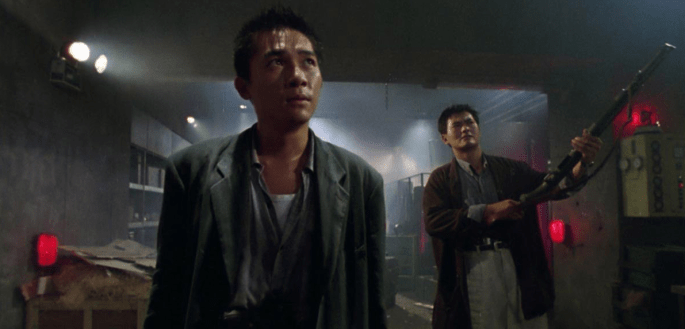
Hard Boiled is structured around three major action set pieces: the teahouse shoot-out that introduces Tequila, a warehouse gun battle where the cop meets his undercover counterpart, and the hospital showdown where the two men team-up to take down the bad guys. Each sequence is more ambitious than the one that came before and this culminates in the hospital battle that includes an impressive three-minute action sequence without any edits – virtually unheard of in an action film, especially one with as much mayhem as this one.
Woo plays with action film conventions by imparting intentionally sappy, sentimental moments like Tequila rescuing a room full of babies from gangsters and then gives it a mischievous twist by having one baby pee on the fire that started on the cop’s leg after he outran an explosion with said child.
While Woo purists cite The Killer (1989) as his finest achievement, Hard Boiled tops it in terms of kinetic action and choreography. While the previous film may deal with weightier themes, the latter film has a stronger foil to interact with Chow Yun-Fat. The chemistry between him and Tony Leung is excellent. Their characters start off as antagonists but over the course of the film they become allies, developing the kind of deep, meaningful bond that a lot of characters in Woo films share with one another. Tequila’s girlfriend (Teresa Mo) almost seems like an afterthought. After all, how can she compete with what Tequila and Tony go through together over the course of the film?
 Hard Boiled was Woo’s last Hong Kong film and this caused some critics to speculate that the film reflected his conflict between staying in a country he loved but that was facing an uncertain future, and leaving it for a prosperous new beginning. This metaphor was said to be expressed symbolically in the besieged hospital at the film’s finale. It represented Woo’s state of mind at the time: does he stay in a place that will potentially kill him, or escape and live but at a cost. The cost was the many restrictions that the Hollywood studios imposed on his first two American films, Hard Target (1993) and Broken Arrow (1996). It wasn’t until Face/Off (1997) that he was able to finally cut loose stylistically but it still felt like highlights from his Hong Kong output. This makes fans nostalgic for his older films and is why Hard Boiled has stood the test of time. It is still superior to any action film that has been made since.

 Podcasting Them Softly