
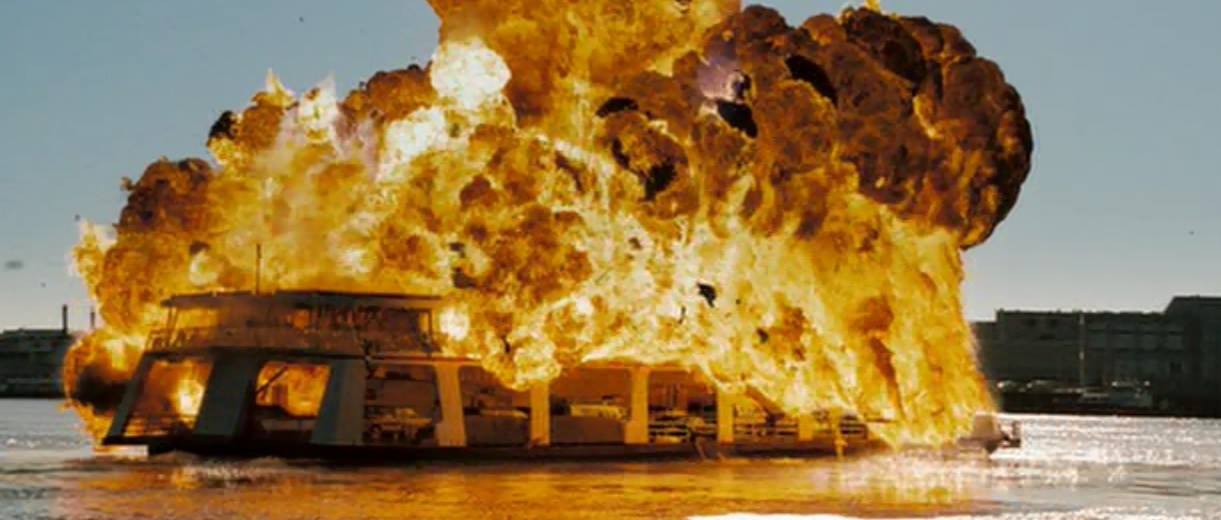
Déjà Vu is a mind-bending thriller with fantastic nods to real-world science fiction, a genre that Tony Scott only had the chance to dip into once. Snazzily photographed by Paul Cameron (Collateral, Man on Fire), Déjà Vu contains some incredibly rendered explosions (the one that opens the film is mind-blowing in its intensity to be perfectly honest), a heady murder/conspiracy plot, and one of the coolest car chases ever devised (it’s certainly one of a kind). When a massive bomb goes off killing hundreds of Navy sailors and their families, ATF agent Doug Carlin (a headstrong Denzel Washington) is called in to investigate. However, he never would suspect that the U.S. government has time-travel technology that might be able to help catch the terrorist (a sleazy Jim Caviezel). The production design in Déjà Vu is extraordinary and one of the film’s best assets; the fast moving computer images and zooming of the time-machine’s controls keep your head buzzing. And then there’s the breathless car chase set on a bridge in which Denzel is in two planes of time at once, trying to track the killer via his whereabouts from four days previous. As his character says mid-chase, “This is trippy!” It’s probably Tony’s most underrated movie, a film that’s smart, exiting, and as usual for the filmmaker, filled with lots of heart. At its core, the film is a romance, about a man falling in love with a dead woman, only this time, he might have the chance to bring her back and have the opportunity for her to reciprocate the feelings. As always with a Tony Scott film, the supporting cast was ace; Val Kilmer, Bruce Greenwood, Adam Goldberg, and the spectacularly gorgeous Paula Patton as Denzel’s love interest round out the proceedings. Coming off the box office failure of Scott’s passion project Domino, this was his way of retreating within the safe confines of a Jerry Bruckheimer production (their sixth and final), but you can still tell from the restless visuals that he still had plenty of style to burn. This is easily one of the artsiest, most gorgeously conceived big-budget movies of all time, with each image retaining a stark visceral quality as well as the occasional descent into expressionistic realms; even when making “one for them,” Tony Scott was never content to play it 100% safe. There’s even an existential bent to the film, which automatically kicks it up a notch; I doubt all involved knew how well this one would ultimately turn out. With a silly 55% Rottentomatoes score and only $180 million in worldwide box office ($65 million in the U.S., where it was overshadowed by Casino Royale during the busy Thanksgiving movie season), it really stands as undervalued and underappreciated.
 Podcasting Them Softly