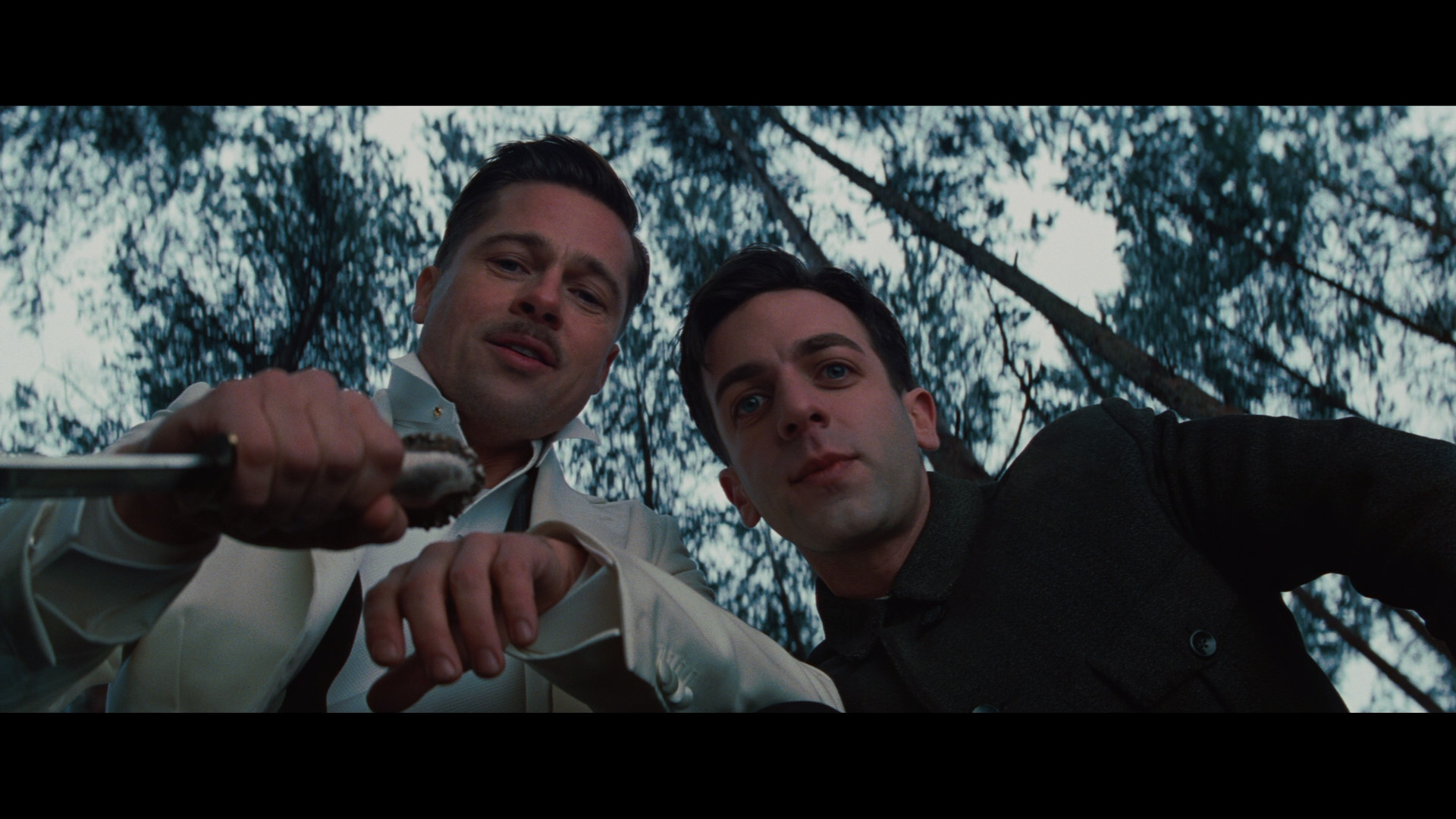
“I think this just might be my masterpiece.” – Lt. Aldo Raine
The quote above that leaps from the mouth of Lieutenant Aldo Raine, and both echoes an earlier scene in Inglourious Basterds, and closes out Quentin Tarantino’s sixth film, is not a gleefully pretentious boast as one could blindly assume, but in my eyes, a coy wink to the audience from a director who seemed to be aware at the time, that he had in fact concocted his masterpiece. To this day, Tarantino holds the film’s notorious opening sequence, where Christoph Waltz’s Nazi Colonel Hans Landa (in an Oscar winning turn) slowly and methodically removes vital information about the whereabouts of a Jewish family from the mouth of farmer Perrier LaPadite, in high regard as the best thing he has ever written. Whether he believes the film in its entirety is a masterpiece or not remains ambiguous to me. Whether you find it to be his masterpiece, or far from it, is another story. What I think of the film is coming right up.
I can recall with reasonable clarity the first time I saw Inglourious Basterds, on DVD in the comfort of my bedroom, and how I found myself both thrilled and bored at the same time. I had heard from friends and even a couple teachers at my high school that I was guaranteed to love Tarantino’s latest feature, and there I was at films end underwhelmed and sorely disappointed. At the time of the film’s release, I was quite the action movie junkie who seemingly lived and breathed violent cinema, and was expecting a simplistic, wickedly graphic WWII action adventure extravaganza, something so relentlessly bloodthirsty and violent it would make Rambo 4 and Shoot ‘Em Up look like Forrest Gump in comparison. What I did not expect, or want, was the deeply resonant, audacious blackly comical war picture I was served on a silver platter. You could say I was rather cinematically ignorant. Roger Ebert had it pegged right on the forehead when he said it would annoy some, and startle others. I was certainly startled by unexpected moments of frightening violence, and as mentioned, I was annoyed that I had not received that ultraviolent action movie I so desperately wanted. But by the same token, I was pleasantly surprised by Inglourious Basterds.
What took me by surprise were two vastly different aspects of the film: the craft, and the impact. Initially, I was taken back by how great the performances were, in particular and quite obviously, Pitt and Waltz’s, and just how much fun and wild and odd, and yet, deeply layered, three dimensional, and even kind of powerful those two performances and plenty of others, to this day still are. I was hypnotized by Tarantino’s musical selection, captivated by his editing and the offbeat and bold manner of storytelling he was shoving down my throat. But what really caught me off guard, was just how damn suspenseful the entire film was. I sat with my eyes glued to the screen while Landa interrogates LaPadite, quite literally chewing on my nails and almost giddy from the overwhelming tension and suspense I felt boiling over within myself. Or in the case of the sequence in the basement bar, where the identities of three Basterds hinge on the validity of one of their accents that sounds a wee bit off to a nosy and understandably suspicious Nazi Major, the threat of impending violence growing at the drop of every letter that falls from their respective tongues…I could have chewed my finger off, I was so consumed by suspense. Or even later in the film, in a moment toward films end to be more specific, when Shosanna is ever so close to watching her unseen reel of film displayed before Hitler himself and an unhealthy number of Nazis, when the ever persistent and fairly annoying Fredrick Zoller comes knocking at the door to the projection room…oh damn. I could have swallowed my arm whole like a shark.
But what has surprised me the most is the second item I mentioned, the impact the film has had on me in the years since my first viewing of it. Over time, and with expected subsequent viewings, I have come to adore it more and more with each individual viewing. Long gone is the lust for a purely cathartic action packed ride, the days of me wishing Tarantino had made the movie I wanted to see, and not the incredible piece of cinema I am praising today. The more I see Inglourious Basterds in all its angry, hilarious, gutsy, and riveting glory, the more I come to appreciate the cinematic gift Tarantino gave those receptive enough to see the film for what it is, and not what it could be.
Which brings me to one final point. On January 2nd, I sat down in a crowded theatre with quite a good seat in the middle if the room, and found myself completely engrossed in Quentin Tarantino’s eighth film, The Hateful Eight, for its entire 168 minute long duration. Yes, this was the widely seen digital theatrical cut. After seeing the film, I informed my friends that I felt it was the high point of Tarantino’s career, his masterpiece plain and simple, and likely my favourite film within his short repertoire. A week later, I find myself stumped. The Hateful Eight is like a well oiled machine with nary a hiccup along the way. It is so finely tuned, so boldly and magnificently performed, so passionately manufactured, and so angrily powerful and intensely resonant, I find myself unable to shake the memory of it from my mind for even a second. I called it his masterpiece after all. But prior to seeing The Hateful Eight, I called Inglourious Basterds his masterpiece. Surely he can have two masterpieces, but one will always stand a little taller than the other, so which one takes the high ground? I judged them by their endings. Now, for those of you who have not had the pleasure, or displeasure (depending on where you stand on the film once you’ve seen it), of seeing The Hateful Eight, you need not worry about spoilers, because I will not provide any.
The Hateful Eight, while complicated in the dialogue that leads to its inevitable conclusion, is to put it bluntly, simple entertainment, and almost could have been quite the superficial film. Much of the meat of the film is not bloody killing or hyper stylized visual gimmickry that seems to be the meat of a couple of his other films (at least three), but the very dialogue that propels the film forward, at least for me, with the velocity of a hot bullet. Additionally, The Hateful Eight is as angry, spiteful, nasty, brutal, profane, and humorous as Inglourious Basterds, and unexpectedly hopeful. It is a blast, a real treat, and a true gem of a film. At films end, I felt so deeply that the film is perfect, and in the way the ending is constructed and performed, I found myself swept up in its sublime power in a way only a small, and I do mean small, handful of films had ever done beforehand. I felt like I could breathe again, as if I had been holding my breath in as I sat in a disquieted and unnerved, suspense ridden state, completely caught up in the twisting and turning of this Western mystery. I felt pure relief, and yet I felt like I was still grappling with the angry, societally relevant morality tale spinning at the centre of the film, a sensation I have yet to shake.
Inglourious Basterds is not simply entertainment for the sake of entertainment or the mastering of craft…not that The Hateful Eight is either. It is an intricate, complicated piece of work. Here is a film that gives Jews hypothetical revenge against Nazism, with richly textured, yet goofy and nearly sadistic characters enacting swift justice with their guns, knives, and a baseball bat, creating chaos within France, and with every bullet riddled scalped Nazi, sending the coldest shivers all the way up the ranks of the Nazi war machine, echoing the horror of Nazi atrocities. In its final moments, one senses an air of achievement in much the same way the surviving characters surely do, having won the war and overcome pure evil, and yet we sit still, frozen, almost shell shocked, utterly disquieted. Because in those final moments, we are still dealing with the ramifications of their actions, cleansed of nothing, and left with a powerful, overwhelming sensation burning in our guts. Even as Aldo revels in his mastery of scarring Nazis with swastikas carved into their foreheads, and Tarantino winks at the audience with that clever last line that rings as truthfully as anything he has ever written, we cannot help but feel unsettled, disturbed, disquieted, shocked. I think we are supposed to.
But none of that answers the question of which film do I hold in higher regard as Tarantino’s clearer masterpiece. And on that note, here is my verdict: Inglorious Basterds is bound for the same iconic glory as Pulp Fiction, and fully deserves every ounce of it, but The Hateful Eight, flawless in its execution and utterly unforgettable in its sublime power, takes the high ground. A dramatic film has not stuck to my mind as hard as The Hateful Eight has in the last three years since I saw Killing Them Softly in its theatrical run. It is just that damn good.
But of course, I have a sneaking suspicion another film will replace The Hateful Eight in my mind as if I never saw it: the Golden Globe winning The Revenant.
We’ll see.
 Podcasting Them Softly