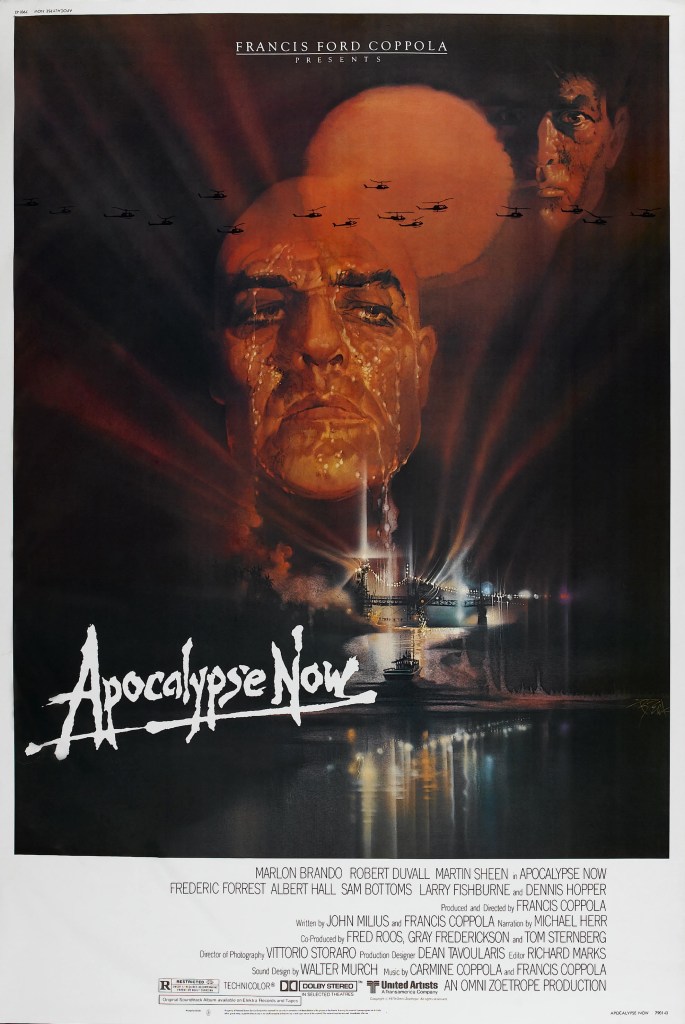
When I think about Apocalypse Now and the countless viewings I’ve undertaken over the years since I first watched it some ten or eleven years ago, two things always spring to the forefront of my mind like a bullet to the head: the horror, and the helicopter ride, and for good reason too.
I think the vision of Vietnam that director Francis Ford Coppola created is the epitome of hell, the stuff nightmares are born from. It’s as cold brutal, and unforgiving as anything I could ever fathom; a long bleak trip down the blackest tunnel into the fiery pits of man-made hell. Between the Doors, Wagner, and a Coppola score pounding against my eardrums like napalm strikes igniting the Vietnamese countryside, and the unforgettable, terrifying onslaught of violent imagery erupting across the screen, my mind often seems to shift into another dimension of itself, into a realm of utter despair and bleakness. The overwhelming power of Apocalypse Now comes from the way in which the film causes that shift in one’s mindset that takes you from a happy place, and throws you face first into the chaos of war. It’s a dehumanizing, soul killing experience, and yet also one of the most deeply fascinating I’ve ever encountered.
The horror I am referring to also encapsulates a disturbing monologue Kurtz gives to Willard late in the film, detailing the dismemberment of polio stricken children by the Viet Cong after Kurtz and his soldiers vaccinated them. “Then I realized they were stronger than we. They have the strength, the strength to do that. If I had 10 divisions of those men, then our troubles here would be over very quickly. You have to have men who are moral and at the same time who are able to utilize their primordial instincts to kill without feeling, without passion, without judgement.” His madness seems to spring from this soul changing event, the discovery that this war cannot be won by those weaker in their hearts than the people they’re trying to overcome. Only hearts of darkness will win Vietnam. 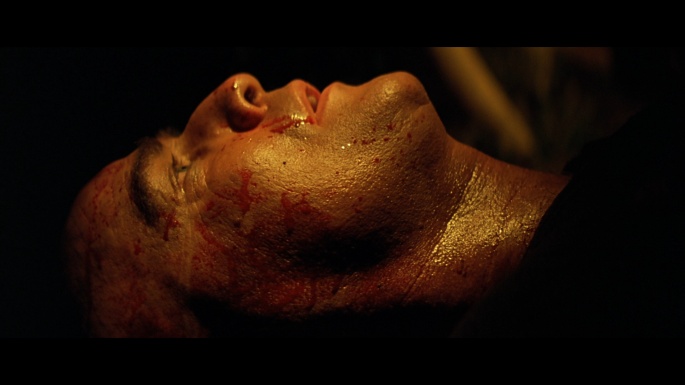
There’s also that line, “The horror. The horror.” It’s spoken with shallow breaths, whispered for only Willard to hear as it floats from the dying mouth of Kurtz and deep into our minds, residing prominently in our memories days after watching the film. It’s the first line I associate the film with every time I think about Apocalypse Now, without failure.
And then there’s the helicopter sequence, where Col. Kilgore’s choppers play Wagner’s Ride Of The Valkyries over the loudspeakers as they dive into enemy territory and wipe out everyone in the area, for the sole purpose of capturing a beach that offers great waves for the surfing enthusiast. I don’t know if such tactics were ever employed or not in Vietnam, and something tells me they likely weren’t, but in this film, in that moment, it’s nothing short of sheer brilliance. In a film that has one great sequence after another for its entirety, a rare feat in a sea of films that struggle for even just one great scene, the Ride Of The Valkyries sequence in its entirety is perhaps the most memorable scene in the entire film. Who could ever forget “I love the smell of napalm in the morning” anyways? 
After a gut wrenching viewing of Apocalypse Now, I can’t help but think about the film, every last grueling second of it. It might be the most dehumanizing, horrific, grotesque, and stressful war film ever concocted to date, but it’s also the most memorable and unforgettable. There are plenty of war films that are nearly as depressive and brutal, more patriotic and perhaps indulgently so, and more triumphant and proud than Apocalypse Now, but flag waving manufactured heroism doesn’t always make a great war film. Apocalypse Now is the great American war film, that coveted “M” word, because we’re talking about it all these years later as enthusiastically as if it came out just yesterday, and that’s no easy feat. Persistence goes a long way.