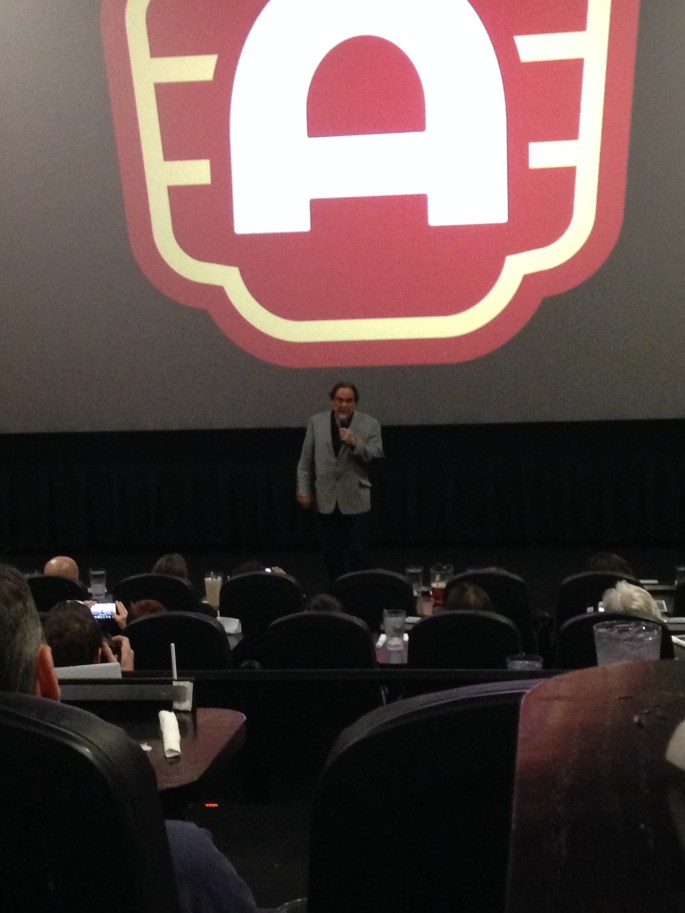
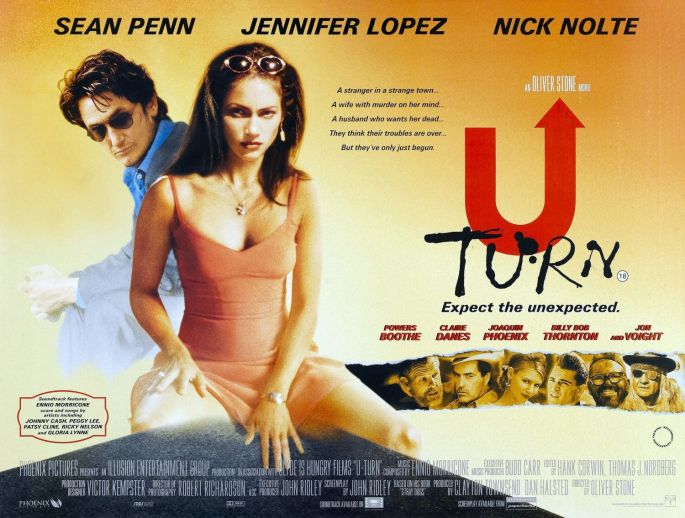
This past Sunday, the sleepy suburb of Littleton Colorado was once again favored by the scheduling magic of the Alamo Drafthouse. Polarizing mad genius Oliver Stone stopped in to present two of his 90s highlights, Natural Born Killers and U-Turn, with film critic and author of the upcoming “The Oliver Stone Experience” Matt Zoller Seitz in tow to run Q&A sessions after each show. I was fortunate enough to attend the U-Turn screening, not only for the chance to gain insight on the work from the filmmaker himself but also for the chance to give the overlooked film a second chance. Its initial run seemed shoehorned into a glut of neo noir exercises that came out prior to the turn of the century, neither registering as the worst nor the best of them, but as Stone himself pointed out, it felt like his core audience simply didn’t appreciate him swimming in the same waters as young upstarts of the day such as Quentin Tarantino and the Coen Brothers. The revisit proved a minor revelation: The story, familiar as it may be to genre fans, is airtight and reverential/referential to the best of the bunch; the cast is top notch and finds many (we’re looking admiringly down our noses at you, Billy Bob Thornton, Nick Nolte, and the pre-phenomenon Jennifer Lopez) turning in some of their nastiest, best work; Stone’s obsessions and talents clearly meld with John Ridley’s source material (you may know the writer’s name from his more recent work, like 12 Years A Slave); Sean Penn’s cocky rube drags the audience along towards the inevitable double and triple crosses, which Stone gleefully paints with a bloody brush across a rocky, desolate canvass. There’s a ton of fun to be had with U-Turn, and even more in hearing Oliver Stone discuss its place in his filmography.
Zoller Seitz quite nicely described Stone as “The Poet of The Id,” but the writer/director didn’t appear to be feeling up to any lofty titles when this project came along. Burned out from creating Natural Born Killers, the mixed reception to Nixon, and extensive revisions put into publishing the novel he started as a 19 year old, A Child’s Night Dream, he told our audience he was simply looking for a fun time and perhaps a decent paycheck off a low budget investment. In typical Stone fashion, even an attempt at relative film production normalcy derailed quickly—Bill Paxton, signed on to star as star-crossed tennis pro Bobby Cooper, dropped out at the last minute, and the entire project almost dove off a cliff (as several protagonists ultimately do in the film itself, referencing the so-called “Arapahoe Leap” suicides of Native Americans in the region as European settlers corrupted the land). Thankfully Sean Penn agreed to take the role, and heartily threw himself into what Stone described as “the sleaziest work he’s ever done.” The actor wore the same single blue shirt throughout the entire 42 day shoot and collected so many cuts and bruises, fictional and otherwise, that the director had an official Wound Continuity Diary for the star to keep track. Through rewrites, Stone slowly but surely evolved the boilerplate noir into an almost Lynchian meditation on small town Americana and its seamy underbelly; he noted that the incestuous relationship at the miserable heart of U-Turn is the type of thing that can live and even thrive in the obscurity of rural areas that coast by on apple pie surface clichés. There’s brain damage from incest, Stone stated, and pointed out that Nolte’s character is a representation of exactly that. This wasn’t in Ridley’s book or screenplay but the filmmaker felt it was not only appropriate to the proceedings, but also brought a slice of Bunuel-style surreality to the film, a shot of seriousness and lunacy in equal measure.
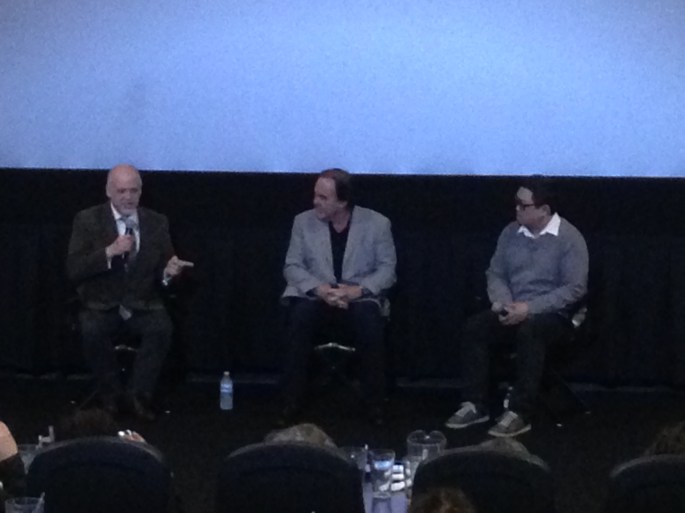
He continued by discussing the inevitability of Bobby’s downward spiral, pointing out that Billy Bob Thornton’s grease-drenched mechanic and Jon Voight’s Tiresias-like blind seer give the young hustler plenty of warnings, but of course they all go unheeded as karma continues to wind up for its third act wallop. The director said he found U-Turn to be a classic American narrative, that of a man coming to a corrupt town and either fighting to make things right or falling to the place’s corrosive effects. Citing Sergio Leone Westerns and Dashiell Hammet’s Red Harvest in making the point, Stone also ultimately feels it’s a Greek Tragedy. Turning to audience questions, he reinforced his headstrong and no-holds-barred reputation when discussing collaborating with Ennio Morricone on the score and Robert Richardson on the cinematography. Calling the former a “prick,” Stone said he was a fan of Morricone’s work on 1900 and appreciated the love theme he crafted for U-Turn, but didn’t find the rest of the score effective and dragged the Italian master back to the U.S. from his European home (a trip the scorer apparently despises) and showed him a Tom and Jerry cartoon to illustrate what the film needed. Suffice to say the two won’t be working together again, and Stone closed that anecdote with this backhanded compliment: “I’m glad he got the Oscar this year, even if it’s for his worst score.” Difficulties with Richardson started before the shoot, as the director told the crowd that the cinematographer didn’t like the dark direction of the story and called it a “disgusting, depressing movie.” Stone’s choice to use reversal stock furthered the stress on their partnership, as they could barely secure insurance for the production based on this decision. While noting the irony of Richardson’s going on to lens plenty of blood for the likes of Scorsese and Tarantino since, he simply summarized that “it was a marriage for 10 years, and then it was over.”
Oliver Stone went on to answer a variety of queries from the crowd about who some of his favorite filmmakers are–Kubrick, Fellini, Godard, Coppola, Friedkin, as well as recent Oscar contenders Innaritu and McKay—and what a few surprising favorite films as of late are, including the likes of Man From U.N.C.L.E., Battleship and Zoolander 2 (“Malick is a fan too!” “Farrell’s never been better as the pure embodiment of evil!”). He discussed working with Edward Snowden on his upcoming biopic of the controversial American, saying that the expat is in very good spirits, working hard on a Constitution For The Internet and giving plenty of input on the screenplay. Snowden’s seen a rough cut of the film and while initially trepidatious about the project he was quite happy with the results so far. For a man who watches few films, Stone feels that Snowden has an excellent sense of storytelling so he was pleased with the feedback. In conclusion, Stone seemed to be answering a plea for advice from a young filmmaker in the theater flippantly—“get a good night’s sleep…eat well…”—but quickly turned serious. “As a director, it’s like you’re running a giant party. It’s exhausting. There will always be impediments to your vision, with some actors taking your direction and others rejecting it…there will be compromises all the time, but you always have one last opportunity to cement your vision, and that’s in the editing room.” With that, the cinematic lion concluded this portion of the program and left a satisfied crowd pondering his comments and enjoying U-Turn in an expansive new light.
 Podcasting Them Softly