Nocturnal Animals – A Review by Kyle Jonathan

Nocturnal Animals

2016.  Directed by Tom Ford.

nocturnaldudes

The end of a relationship is an idea that is often equated with death. It’s a theme that has pervaded the film industry for years, offering a plethora of various interpretations in which the aftermath of amorous annihilation has been deconstructed to the point of excess.  Tom Ford’s second directorial effort, Nocturnal Animals, abandons any sense of convenience and presents the concept as a blistering crime story that doubles as a warning about betrayal, both of the partner and of the self.  Ford’s extremely mature marital fable is an assault by cinema, an unforgettable revenge story in which love doesn’t conquer all, it kills every transgressor with calculated malice.

Beginning with the an unforgettable credits sequence,  the film puts the viewer into a complex stranglehold and never relents.  Seamus McGarvey’s cinematography is the perfect companion to Ford’s unique vision.  Hideous beauty, both in the human subjects and the landscape is always on display, with dark clouds hanging over blood red meridians, harshly removed from the violence that fills the sun baked highways beneath.  The fictional world is offset by sterile art galleries and empty houses, devoid of the extremes within the novel at the center of the narrative.  The thundering catharsis of the crime story is rationed by Mike Austin’s editing, seamlessly transporting the viewer between the forlorn desert of the mind and the coldness of reality.  The story within the story is presented as imagery conjured by Amy Adams’s character’s subconscious and no supposition is needed to explain the physical representations therein.  You know, with almost certainty where things are going and that precognition is a result of the extreme control Ford uses in every aspect of the film to bring everything to a perfectly malign conclusion.

amy-adams-nocturnal-animals-670x280

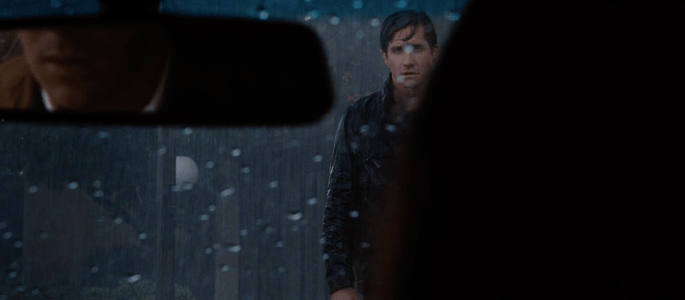
Amy Adams does an adequate job with her character’s vulnerability, but Ford’s script reveals his continuing struggles with female characters.  Her dialogue with Jake Gyllenhaal is stilted, almost pastiche, but the moments between, the physical cues, overcome this.  Michael Shannon supports as the lawman in the crime portion, giving a tragic turn as the devil on your shoulder, representing the rage and despair of the abandoned lover.  Gyllenhaal brings his underrated pathos to bear, but his segment is soft balled into the happenings with intent.  His dual character is both a hopeless romantic and a scorned, but darkly motivated respondent.  All of these remarkable performances are underscored by Aaron Taylor-Johnson’s beautiful monster.  His performance is the definition of excellence in a supporting role, bringing an unhinged sexuality to an easily repugnant role.  He doesn’t chew the scenery, he eviscerates it with stone cold glares and an intoxicating presence that oozes from his sweat soaked killer with ease.

Malanie Romero’s makeup design is flawless, and brilliantly understated.  The characters are presented at different times in their lives and this is accentuated by subtle skin tones and intimidating mascara, bringing the eyes of each emotional combatant to the fore in every altercation.  Donna O’Neal’s costume design encases each character in fabricated armor.  Adams’s art gallerist is adorned in crystalline ensembles, perfectly equating her emotional weakness while the fictional characters are soiled and broken, caked in the dust of their predicaments, dutifully embodying an imagined world of natural recompense.
screen-shot-2016-09-14-at-6-10-27-pm

In theaters now, Nocturnal Animals is one of the best films of 2016.  Ford’s glitzy reality may leave some viewers alienated, but the undeniable maturity of the content is what pushes it to greatness.  An older, wiser, and less accusatory sibling to The Neon Demon, this is a film about the truths of self denial and the ultimate comeuppance for harming the ones we love.  Featuring beautiful, but extremely unsettling imagery, Ford’s renowned compositions, and a one of a kind cast, this is a film that will haunt you long after it fades to black.  If you’re looking for an anti feel good experience, that is devilishly liberating in its exploration of vendetta, Nocturnal Animals is the perfect choice.

Highly Recommend.
nocturnal-animals-amy-adams-poster

The Eyes of My Mother – A Review by Kyle Jonathan

The Eyes of My Mother

2016.  Directed by Nicolas Pesce.

5-1

Nicolas Pesce’s debut feature, The Eyes of My Mother is a reverse horror film that uses a three act format, stark black and white cinematography, and an intriguing central performance to deliver a disturbing and emotionally cold origin story.  Featuring creepy visuals and odd pacing elements, this is a unique genre offering that fails to capitalize on it’s surprisingly humane subject matter, focusing on themes of isolation and the morality of violence as a means to connect.

Zach Kuperstein’s Noir camera work is spellbinding.  Initially, the various static shots immediately conjure a likeness to Night of the Hunter, presenting ominous farmhouses and bewitching forest locales as hidden nightmares, bathed in deep shadows that are intricately manipulated by bold lighting and ingenious blocking compositions.  The camera refuses to move for the majority of the film, only coming to life whenever the main character ventures from her rustic abattoir.  Kuperstein’s decision to not double down on the odd angles of German Expressionism is a bold choice, clearly emulating the classics, but also presenting a fresh imagining of an overdone concept.  There are several long takes, the best of which has the viewer looking through a curtained window into field in which a brutally slow horrific act is occurring.  The body work by the participants and slick editing by Sam Daley uses the absence of violence and barely audible sound effects to terrorize without surrendering to visceral gore that allows the viewer’s mind to do the work.

eyesofmymother6

Kika Magalhaes gives layered performance that entrenches itself in the constant alienation that saturates every part of the narrative.  She is awkwardly sexy, bounding from victim to victim with child like wonder that is astutely juxtaposed from the viciousness.  This is part of the film’s frustrating assembly.  The idea of a coming of age story, in which the morality is murder and not tribulation is a fragile thing.  Pesce’s command of the various elements used to communicate this is excellent for an initial work, but ultimately pushes the isolation theme to a place where the viewer can’t relate.  Killing, sex, blood, and bondage all play a part, while underdeveloped themes of parenthood are forced at every turn, with chains undulating like umbilical cords and male bodies being contorted into a fetal positions.  The ideas are there, but there is very little to support their inclusion, aside from the blatant symbolism.

Available now for digital rental, The Eyes of My Mother is a fantastic debut effort.  Featuring some 2016’s best cinematography, this is a film that will scratch the horror itch, but for anyone less than a horror fanatic, the film’s unfeeling insinuations rebuke as much as the visuals entice.  Despite this glaring flaw, The Eyes of My Mother is worth viewing for the spectacular presentation and delirious lead performance.

Recommend.

hqdefault

Sunset Boulevard – A Review by Kyle Jonathan

Sunset Boulevard

1950.  Directed by Billy Wilder.

hero_eb19990627reviews08906270301ar

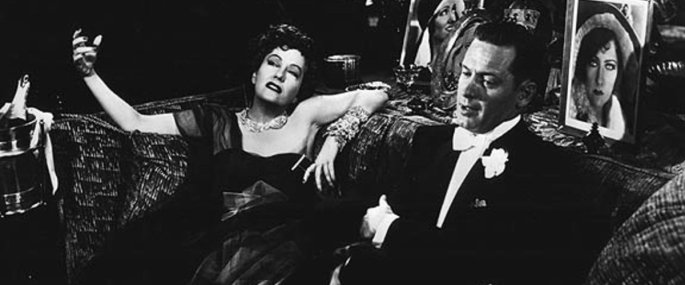
As American cinema plunged into the heart of its noir period, transitioning from the golden era of silent films and historical epics, Billy Wilder’s tragic dissertation on the cost of fame threatened the foundations of the industry and shocked audiences by obliterating the divide between art and reality. Its opening sequence, with the title stenciled on a forgotten gutter, could not be clearer with its intent.  Casually described as a poisoned love letter to Hollywood, Sunset Boulevard is an uncomfortable refutation of the insatiable limelight and a masterfully constructed satire on the craft itself.

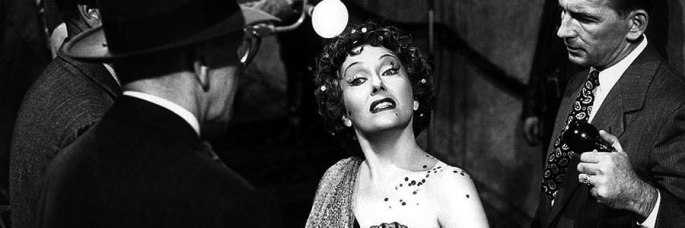
The central theme of the film explores the consumption of idols by the masses, the discarded remnants of youth, sexual fixation, and uncanny melodramatics filling the crumbling manse in which Gloria Swanson’s ghastly starlet holds counterfeit court from a tabloid torpor.  Her Norma Desmond is an animated apparition, moving and communicating as if she were a celluloid wraith given life.  Initially her performance comes across as over the top, but as the film settles into its celebrity quagmire, her actions and delivery reveal themselves as the perfect representations of an appalling culture in which youth is a finite currency.

featured-image-sunset-boulevard-1200x520

Self indulgent illusions are one of the film’s profane tenants.  John Seitz’s abrasive black and white cinematography is both complex and synthetic, using elusive trickery to frame each composition as a series of waterlogged memoirs.  The opening pool sequence was filmed by placing a mirror on the bottom of the pool and shooting the reflection.   Swanson is always enshrouded in a haze of cigarette smoke, twirling her fingers through the vapors, signifying her desperate attempt to hold onto a dream that was never real in the first place.  William Holden’s lascivious screen writer is framed in morose shadows and rigid compositions whenever he is within the mansion, contrasted by bright lights and open air wide shots whenever he sneaks away to a production set.  Holden’s formidable talent is a boon in what is essentially a supporting role to Swanson’s planetary presence.  He presents as the common man, the unseen face that provides the life blood for the silver screen behemoths, disenchanted by the truths of the business.

Wilder used actual directors for many of the roles.  Eric von Stroheim, who plays Norma’s “butler” actually directed Swanson in a silent film.  Cecil B. Demille plays himself and the legendary Buster Keaton makes an appearance as a “waxwork”, the dubious moniker Gillis gives to Norma’s archaic colleagues.  Swanson herself landed the role because she was a silent picture star who never made the transition to talkies, a literal embodiment of Norma’s purgatory. The blending of on and off screen concepts was initially rebuked by Wilder’s fellows, garnering a disdain for the picture upon its debut.  The film would go on to be nominated for eleven academy awards, signaling the industry’s surrender to the film’s accusatory allure.

dvd_sun

The ambiance of the film doubles as throat clutching protest and a tragic love story.  Stroheim’s butler protects Norma’s fragile sanity by penning fan letters and yet constantly appeals to Holden’s Gillis to end the charade.  Gillis begins as a screen writing huckster, all to eager to take advantage of the glitz and then slowly, irrevocably, comes to loathe what he has become.  There are glimmers of hope sprinkled among the shadows, with Gillis finding actual love in a colleague and Norma seizing upon the promise of a return (Never a comeback!) by subjecting herself to a menagerie of cosmetic transfigurations.  The use of a dead man narrator subverts these kernels of respite, constantly reminding the viewer that there is no escape.  The end result is a passionate, but ultimately bitter acceptance of the reality of American cinema.

Available now for digital rental, Sunset Boulevard is an exceptional film, evoking every aspect of an age where films were more than just entertainment.  Featuring a legendary lead performance, vicious dialogue, and unforgettable set designs, this is truly one of the greats.  Words cannot adequately explain this film’s importance or implore you to view.  In the end, be it spandex blockbuster or a last minute Oscar contender, Norma’s ghost is a specter that haunts every theater and every bedroom streaming solution.  Pyrrhically relevant and universally cherished, Sunset Boulevard is a landmark achievement whose corrupted heart quietly beats underneath the box office veneer, warning about dangers who have been ignored in the CGI and social media saturated landscape of modern American entertainment.

Highly.  Highly Recommend.

sunset_blvd_title

Cutthroat Island – A Review by Kyle Jonathan

Cutthroat Island

1995.  Directed by Renny Harlin.

cutthroat-island-1995-stan-shaw-geena-davis-pic-2

Considered to be the biggest box office failure of all time, Renny Harlin’s robust pirate homage was doomed from its origin.  The final movie produced by Carolco Pictures, Cutthroat Island is a remarkably average adventure story encased in staggering practical effects packaging.  Taking a by the numbers approach to the tried and true swashbuckling formula, the film tells the story of a brash female captain and her ragtag crew who are searching for a fabled island that holds immeasurable wealth while being pursued by corrupt politicians and other unsavory nautical nomads.

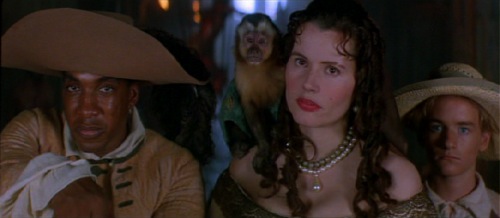
Geena Davis was married to Harlin at the time of her casting, with Harlin intending for the role to springboard Davis into other action films.  Michael Douglas was originally cast as her love interest, however, after countless difficulties, dozens of actors turned the role down and Matthew Modine was cast.  Their chemistry has a flaccid quality that never attempts to break free of the script’s tired retreading of the genre, echoing the mediocre heart at the core of Cutthroat Island’s story.  They’re supported by the wonderful Frank Langella as the villain and Maury Chaykin as a starstruck chronicler of piracy.  Langella’s sweat soaked mad dog is the standout, but even his formidable talents can’t synthesize the idea that anyone had a good time making this film.

cutthroat-island2

Robert King and Marc Norman’s script is presented as an inverted King Lear in an attempt to put a spin on the buried treasure formula, but there is never enough time.  This is a film about action set pieces, and the plot exists only as a vehicle to get you to the next one.  Peter Levy’s baked cinematography is surprisingly fun and loose, offsetting the oddness that taints the film.  Filmed on location in Malta and Thailand for the sea battles, sunlight captures the cannon smoke and gunfire in a hail of fiery oranges and grainy turquoise, Sweeping, all too familiar, camera angles capture the naval carnage aerially until nosediving into perilous close ups of the swordplay.  The explosions are the most impressive part, with one in particular being so devastating that the camera actually reverberates from the impact, taking the viewer directly into harm’s way.

Roger Cain and Keith Pain’s art direction is flawless.  The film employed thousands of extras, hundred of replica weapons, and the ships were built to scale from the ground up.  Maggie Gray’s period perfect set direction and Enrico Sabbatini’s grungy costumes combine with the practical effects to give Cutthroat Island an epic feeling that almost manages to overcome to narrative flaws.

0212

Available now for digital rental, Cutthroat Island is an impressive piece of technical film making.  Every element of the craft looks and feels authentic because they’re real.  The irony is that the human elements, the acting and the plot, feel out of place and counterfeit, overshadowed by artistic obsession and a studio that couldn’t admit it had already died.  Had the film been better marketed, it’s possible that it would have been more of a success, solely for the one of a kind craftsmanship that was involved in its construction.  Come to see things blow up.  Stay to see more things blow up.  If you’re looking for a loyal pirate adventure piece with jaw dropping action, Cutthroat Island doesn’t disappoint.

Recommend.

3917458647_723ca1b7f8

Upstream Color – A Review by Kyle Jonathan

Upstream Color

2013.  Directed by Shane Carruth.

amy-seimetz-stars-as-kris-and-shane-carruth-stars-as-jeff-in-upstream-color-2013-movit-net_

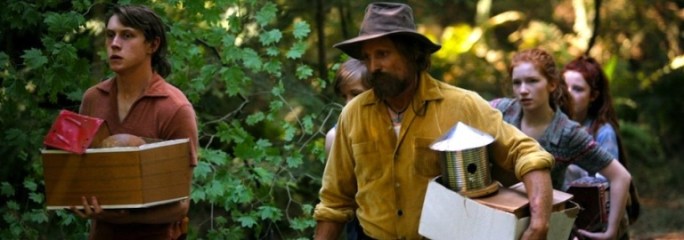
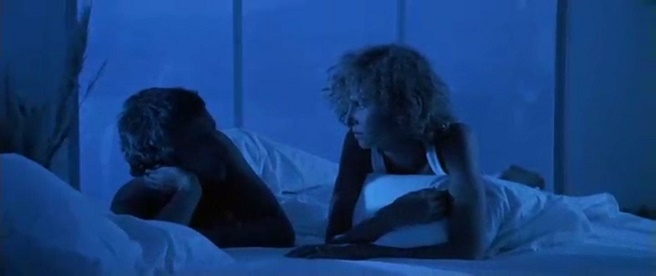
What draws us to one another?  How can you explain the feeling you get when you meet someone for the first time and it’s as if you’ve known each other your entire life?  Shane Carruth’s puzzling masterpiece, Upstream Color, is an artistic triumph, a one of kind exploration of the human condition that is a transcendent science fiction emotional epic.  What begins as a hypnotic violation transforms into a careful examination of desire and intimacy, using philosophical concepts and poetic visuals to impart a story about breaking the chains that confine relationships and embracing the basic connections that define humanity.

Carruth wrote the script, which tells a cyclical love story that is compounded by a profound investigation of partnerships.  Replete with abusive symbolism, indescribable loss, and unimaginable parental terror, this is a truly unique film that deftly evades summation, requiring a surplus of patience and a complete surrender to it’s surreal presentation.  Carruth’s delicate cinematography has a dream like quality whose marriage with the film’s (also created by Carruth) entrancing score creates a world within the screen, slowly pulling the viewer into its gentle warmth with each imaginative sequence.  There is a terse mixture of brilliant colors and muted environments.  Everything brims with life, but as the characters begin to work through their situation, everything is presented as purposefully restrained, slowly, inevitably regaining more and more vibrancy as the narrative coasts towards its hopeful conclusion.

post-primer

Carruth and Amy Semietz are sensational as Jeff and Kris.  The film has a paltry handful of dialogue riveted into specific segments that act as a guide post more than an explanation, keeping the viewing within the story’s confines, but allowing them to float from one idea to another as the images and revelations entwine to form the center of Kris and Jeff’s coupling.  Semietz taps into raw primal energy and leaves everything on the screen.  Heartbreak, attraction, bereavement, revenge, and salvation are all played out with perfect nonverbal communication, whose intensity only magnifies with each viewing.  Victimization is one of the most important parts of the story, but Semietz portrays this as a natural, expected side effect of an intense relationship, rather than a pitiable aftermath.  Hurting the ones we love is a constant theme in cinema, but Carruth subverts this idea by giving the concept a metaphysical representation of a living organism that pervades through Jungian oceans of time.

Available now on Netflix, this is a thoughtful, beautifully constructed argument for the merits of the soul.  Endlessly divisive due to its lack of coherent structure and traditional dialogue, this is a movie that will confuse as much as it endears.  A touching love story with a sci-fi twist whose enigmas glacially unfold throughout its somber resuscitation, Upstream Color is an experience like no other.

Highly.  Highly Recommend.

upstreamcolorstills_0004_screen-shot-2012-12-04-at-3-15-13-pm-png

Captain Fantastic – A Review by Kyle Jonathan

Captain Fantastic

2016.  Directed by Matt Ross.

captain-fantastic-movie-slice-600x200

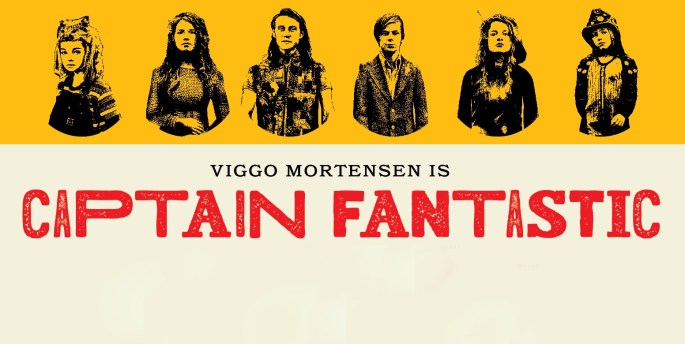
There are countless stories about families who chose to live off the grid, with each version either being a cautionary tale about isolation or a sly commentary on the advantages of living outside the comforts of modern society.  Matt Ross’s exceptional feature film, Captain Fantastic manages to walk the divide between these extremities, delivering a dissenting lead performance, vibrant watercolor visuals, and a touching script that both glorifies personal freedom and stresses the importance of societal connections.

Ben and Leslie are raising their six children in the wilderness of the Pacific Northwest.  Ben is a charismatic intellectual who believes capitalist society is fraudulent and uses philosophy, classical literature, and social discourse as a means to instill his world view in his children.  A tragedy leads to the family returning to the confines of the big city, challenging Ben’s authority as his patchwork clan mingles with accepted civilization, bringing to the surface rebellious intentions, fatherly guilt, and familial discord.  As a result, Ben is forced to confront his perceived nobility and the cost of raising children in his own, elitist vision rather than the flawed, but worthwhile reality in which we’re all a apart of.

captain-fantastic-film-22_article-detail

Viggo Mortensen gives one of the strongest performances of his career as Ben.  Ross’s script is full of memorable and hilarious exchanges, the bulk of which involve Mortensen explaining the workings of the world to his children with an anthropological presentation, devoid of emotion or connection.  Initially, the various rhetoric used by the children to verbally spar with their father is unappealing, appearing to be a counterculture refutation delivered with cult like fervor.  However, as the narrative unfolds, the various philosophical and religious dissertations become symbols of Ben’s sorrowful existence and the educational prison that he has built around his children, in which learned anarchist knowledge is the key to their deliverance.

Stephane Fontain’s cinematography blooms with natural colors, capturing the rugged landscape and Ben’s commune with wide shots that highlight the splendor of the hidden sanctuary.  Courtney Hoffman’s costume design, particularly with the family’s ceremonial attire in the first act has a lived in quality that becomes more and more removed as the the film continues.  The highlight comes in the family’s hippie drenched livery that they don to attend a service that is the centerpiece of the story.  While the costumes have an out of time theme, it’s the idea that this family, for better or worse, is a singular unit that resonates.

1892

Captain Fantastic is a story about familial identity, and while it is somewhat predictable, it’s the journey that matters.  Everything is in transition.  The emerald forests give way to looming towers of concrete while the children begin as supplicants and grow into independent and often comically self aware renegades.  The film’s greatest concession, that every rebellion ends on the home front, doesn’t diminish Ben’s philosophy, but rather welcomes it’s turbulent mantra into the merry go round of parenthood, ending with a tear inducing rendition of an 80’s classic that heals the wounds of regret with compassion and acceptance.

Available now for digital rental, Captain Fantastic is a predictable, but profoundly moving example of picaresque parenthood.  While the viewer only gets a glimpse into the family’s rigid customs and anti-capitalist anthems, these concepts are interchangeable with the various rites and traditions of any family.  Parenting, and the importance of family is what this film is ultimately about.  Featuring an unforgettable performance and a genuinely heartwarming story about the importance of moderation and acceptance of what we cannot change, if you’re looking for an uplifting viewing experience, Captain Fantastic will not disappoint.

Highly recommend.

captain-fantastic-movie-pos

Certain Women – A Review by Kyle Jonathan

Certain Women

2016.  Directed by Kelly Reichardt.

685425p19685ednmain3474certainwomen-lowres-1

Cautious.  Intimate.  Entrancing.

Kelly Reichardt’s loose triptych of Montana women is one of 2016’s most resonant films.   Using three vignettes to distill the American female identity, Certain Women is an immaculately constructed poetic vision.  Featuring lush visual compositions and potently restrained performances, this is an unflinching dissection of everyday life from the feminine perspective.

Laura is an attorney who is in a sexual relationship with a married man.  Her current case involves a disgruntled worker who refuses to heed her advice, and seemingly submits to the same encouragement from a male colleague.  Gina is a married woman who, along with her husband, attempts to purchase a pile of sandstone from an elderly man who pretends that she does not exist.  Jamie is a lonely ranch hand who enrolls in an educational law class.  She befriends Beth, the attorney teaching the class and goes to great lengths to find a connection, despite Beth expressing her disdain for the trip she has to make to teach the class.  All three stories are lightly interwoven to deliver a devastatingly quiet premise on the human condition.

kristeninner

Reichardt adapted her script from stories by Maile Meloy.  The dialogue is simplistic and pointed, but never pretentious.  There is no mystery to unravel or hidden meaning to uncover.  This is life on display, and Reichardt’s steady hand delivers a thoughtful slice of Americana that evokes Ozu’s glacial sentimentality throughout.  Christopher Blauvelt’s rustic cinematography harmonizes perfectly with the  somber atmosphere, capturing the Montana landscapes with a laconic sense of observation.  The world of Certain Women is remarkably beautiful, but also shackled by a sense of longing that is purveyed in virtually every scene.

Lily Gladstone as Jaime is the standout.  Her ability to communicate unrelenting loneliness with virtually no dialogue is a triumph that cannot be overstated.  Her scenes with Kristen Stewart, who does an excellent job with a minimal role, are the heart of the film.  Despite the events being uncertain, Gladstone denies the viewer any chance to pity her character, persevering through heartbreak by mechanically returning to her daily routine, signifying the film’s core inspection of everyday life.  The lack of overt drama may be off putting, even boring to many, but the payoff is in between the exchanges, with needy stares and knowing smiles filling the small universe of these women with an uncommon sense of realism that is too often lacking in the box office experience.

408668

Laura Dern, Jarred Harris, and long time Reichardt collaborator Michelle Williams round out the cast.  Dern and Harris’s chemistry, in what is arguably the film’s greatest exchange, is a masterful display of two lost souls warily treading through an emotional minefield.  The two actors put everything into this scene and despite its ferocity, the fact that it remains in tune with the film’s hushed ambiance is a credit to their talent.  Michelle Williams has the least amount of screen time, but she does wonders with what time she has.  Her portrayal of a married women in a man’s world is thoughtfully accepting, broadcasting an aura of submissive ignorance under which lies a furnace of discontent that will never be ignited, for to do so would undo the social harmony that has become the expectation of a nuclear American family.

In select theaters now, and hopefully coming to digital soon, Certain Women has garnered a plethora of Independent Spirit Award nominations and is slowly emerging as an Oscar hopeful.  Featuring a profound breakout supporting performance, pristine visuals, and an unusually grounded story, this is one of 2016’s must see films.  If an artistic approach to deliberately straightforward material interests you, give this one a chance.

Highly Recommend.
certain-women-poster-1024x538-623x350

Evolution – A Review by Kyle Jonathan

Evolution

2016.  Directed by Lucile Hadzihalilovic.

images-3

Evolution is a cerebral puzzle box.  A slow burn reverse horror film, Lucile Hadzihalilovic’s second feature is the definition of high art.  Told in a deliberate whisper, with some of the most evocative cinematography of the year, this is a movie that poses endless conundrums and offers absolutely no relief.

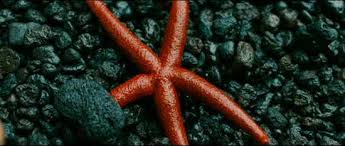
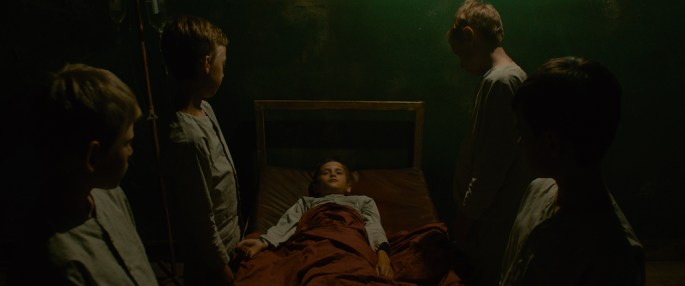
Nicolas is one of many boys who live on a secluded island with an enigmatic group of female nurses..  While swimming in the ocean, Nicolas comes upon a body with a starfish attached to its stomach.   The discovery forces Nicolas to question his reality and begin an exploration of the island’s dark secrets, leading to a terrifying discover in which the definition of humanity will be rewritten into a terrifying commentary of the propagation of a species.

images-2

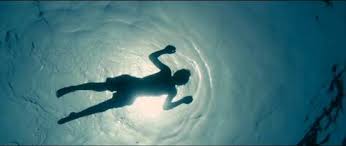
Manuel Decosse’s camera work is a revelation.  Using a combination of sharp colors and blinding light, exotic animals become harbingers of terror, as extreme close ups capture natural undulations in uncomfortable contexts.  The underwater sequences, particularly in the opening, are so clear that they have a porcelain quality, perfectly representing Nicolas’s fragile world view that is precariously close to fracture. Nothing is overt, with even the film’s centerpiece, a shadowy “entanglement” being obscured in deep shadows, with torch light rippling across writhing flesh, but never fully revealing what is transpiring.

Hadzihalilovic and Alante Kavait’s script takes an extremely minimalist approach, using only the most basic of dialogue, allowing the visuals to do the lion’s share.  The ideas of evolution, primal identity, and maturation are all in play, with each forming a pillar beneath the island’s happenings.  Nurses watch surgery videos with a disquieting sense of pragmatism while the boys are subjected to archaic medical cures for a disease Nicolas doesn’t believe any of them have.  The glacial build up never pays off, with the reveal being obvious, but it’s the questions that remain that make Evolution special.

evolution

The makeup and digital effects enhance the mystery, revealing clues as to the women’s origins, infusing a sense of nautical mythology into the film that when considered along with the other evidence construes a shocking plausibility.  The cyclical nature of life and death are constantly at odds, with both Nicolas and a sympathetic nurse grappling with natural changes that neither of them can control, and it is this conflict that injects an unusual sense of hope into the final act. It’s impossible to get specific with a summation, as Evolution demands that the viewer come to their own conclusions, and that is a task that is impossible without spoiling the essence of this story.

Available now for digital rental, Evolution is a movie that is not for everyone.  Another stunning entry into the New French Extremity, proving once again that female directors are in absolute control of the surreal horror scene, Evolution is a one of kind exercise in metaphysical terror.  An anti-body horror genre entry that obliterates convention and carefully examines the very essence of humanity, Evolution is one of the most unique films of the year.

Highly.  Highly Recommend.

evolution-1

Legend – A Review by Kyle Jonathan

Legend

1985.  Directed by Ridley Scott.

vlcsnap-2011-06-03-12h00m14s254

A not so original fairy tale brought to life, Ridley Scott’s Legend is a clinic on makeup design and world building.  Lacking a coherent plot and featuring an interesting mix of absurdity and genuine terror, this is a fantasy epic that encapsulates the 80’s trend of family films with an edge.

Once, Long Ago…

The Lord of Darkness, a demonic potentate, seeks to end daylight forever by slaying the last two unicorns.  He sends a cadre of goblins into an enchanted forest to hunt the beasts, where Princess Lily, a virginal wild heart, is in the midst of being courted by Jack, an orphaned adventurer.  A moment of weakness by Lily allows the goblins to steal one of the unicorns’ magical horns, plunging the world into an eternal winter and banishing Lily to Darkness’s personal lair.  Jack, aided by a ragtag band of fairies and dwarfs sets out on a quest to rescue his true love and stop Darkness once and for all.

image

Scott had the idea for Legend on the back burner for years, and the influence of both Alien and Blade Runner are evident throughout.  Jerry Goldsmith’s score constantly evokes the feeling of discovering dark wonders that is prevalent in Scott’s previous masterworks.  The feeling is extended through entirely hand crafted sets that create a fantastic world,  The forest sequences are glitter choked dreamscapes, captured by Alex Thomson’s entrancing cinematography.  The scenes within Darkness’s castle have a gritty dungeon like quality that fades into the shadows of the villain’s sanctum as the narrative progresses, using deep wide shots to simulate a desolate cavern and slick angular shots to obscure Darkness whenever possible.

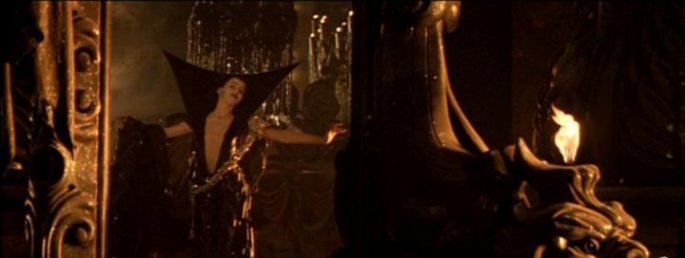
Rob Bottin’s Oscar nominated makeup effects are the centerpiece.  Tim Curry, underwent over 5 hours of makeup every day, with the final product revealing an elegant predator, a twisted demon prince with mammoth black horns and crimson flesh.  Curry’s delicious performance as Darkness is full of subtle derision and over the top grandeur, elevating the lukewarm script to a place of abject horror.  Charles Knode’s costume design, particularly with respect to Mia Sara’s “Dark” Lily is unbelievable.  There are dozens of intricacies to every ensemble, but Sara’s obsidian gown, complete with gaudy whisk collar, blazes across the screen, shimmering in the torchlight to present a damsel in fatale.  While the symbolism is pedestrian, part of Legend’s charm is its simplicity.  The bad guys are bad, the good guys are good and you know how it’s going to play out, but, thanks to the wonderful visuals, the viewer doesn’t have much time to care.

legend-mia

Available now for digital rental, including Scott’s preferred director’s cut, Legend was a critical and commercial disaster on release.  The undeniable flaw is that Legend lacks a heart, never really going anywhere with its basic story.  However, this truth has been forgotten over the years, leading to Legend becoming a cult classic, due to its outstanding makeup effects, Tim Curry’s nightmarish performance, and Scott’s patient control.  While it is easily overshadowed by Scott’s previous, iconic films, Legend remains a bastion of childlike nostalgia, telling the tried and true story of love conquering all.

Recommend.

legendmovie

Manhunter – A Review By Kyle Jonathan

Manhunter

1986.  Directed by Michael Mann.

manhunter

A hyper stylized crime procedural that introduced the world to Hannibal Lecter, Michael Mann’s outstanding mood piece, Manhunter, is one of the more thoughtful entries into the serial killer genre.  Featuring Mann’s trademark visual flamboyance. memorable performances, and a brooding script, this is a film that bleeds cool from its somber opening to it’s unforgettable climax.

Will Graham is an ex FBI profiler who retired after suffering a mental breakdown as a result of apprehending notorious murderer, Hannibal Lecter.  He’s recruited by his former mentor Jack Crawford to assist with a new serial killer, dubbed The Tooth Fairy who is preying on entire families.  The reluctant Graham enlists Lecter’s aid in catching the killer, which initiates a bloody cat and mouse game in which Graham’s family comes into harm’s way, forcing him to confront the psychological horrors of his past, setting up a chilling moonlight showdown in which the line between harrier and quarry are dangerously blurred.

man6

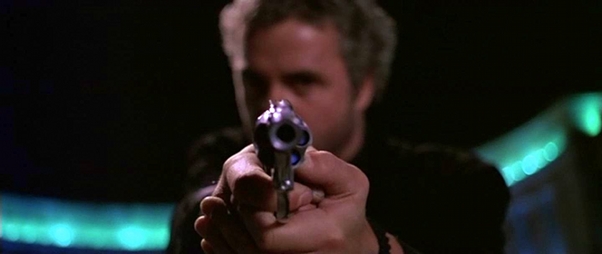
Mann cast William Petersen as Graham after seeing his performance in To Live and Die in L.A.  Petersen’s portrayal has a subtle restraint that is immediately engaging.  He’s human and he’s hurting, victimized by the ghosts of the ones he couldn’t save and the audience pays the price for his emotional torment, following his quietly growing obsession with eagerness.  Mann’s typical central archetype is the brooding outsider, and Petersen takes this rote concept and unleashes a melancholy knight errant, cruising the blue neon highways of the night searching for an evil that he already knows will shred the fibers of his soul, and yet he’s morally unable to stop the pursuit.

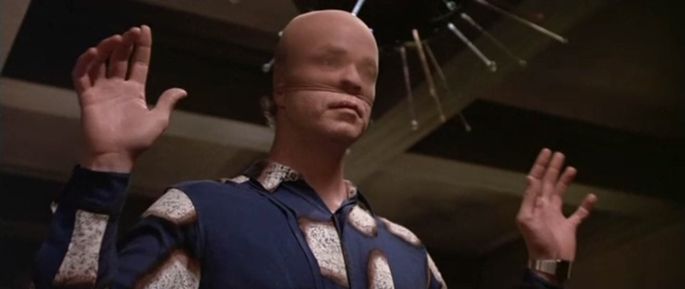
The always formidable Tom Noonan supports as the killer, bringing his well known soft spoken and disturbing persona to bear.  Dennis Farina, Kim Griest, and Joan Allen round out the cast, each of them portraying flesh and blood influences on the two central players.  Underrated legend Brian Cox stars as the first screen incarnation of Hannibal Lecter.  His performance is organic and dangerous, giving Lecter a level of realness that is both unsettling and a perfect representation of the demons that Graham carries in his subconscious.  One the strongest aspects of this film is how understated it is, despite the visuals and the talent.  Cox’s Lecter is obviously a monster, but he subsides with wit and malign rather than the grim etiquette that would later make the role famous.

manhunterblue

Mann spent years writing the script, spending time with law enforcement and corresponding with a convicted serial killer.  Underneath Dante Spinotti’s blue tinged cinematography is a laconic rumination on the price for facing the monsters.  The cop jargon is real, replete with gallows humor and the undeniable compartmentalization of those who wear the badge.  The violence, particularly the aftermath, present in Jack Blackman’s art direction, is so visceral that the viewer can feel the congealed blood on their shoes.  Richard Keefe’s editing frames every scene so that the focus remains on the emotional content, using Spinotti’s jarring angles and off centered close ups to bolster the suspense, creating a delirious prison in which violence is the only escape.

The Reds, Shriekback, and Mark Rubini composed the score, giving Manhunter a dichotomy of synth ballads and pulsing rhythmic tones that awkwardly oppose the intensity, mirroring Mann;s treatment of the material.  The unthinkable violence is approached from a distance, easing the viewer into the madness at the heart of Graham’s world, a place that most civilians wouldn’t dream existed,and yet the viewer is helplessly entranced by the harmonic symmetry in every scene.

man1

Available now for digital rental, on HBOGO, and on a crisp blu ray release by Shout Factory, Manhunter was a critical and commercial misfire upon its debut.  Thankfully, over the thirty years since its release, critics have returned to it and recognized it as one of the most artistic studio pictures of the 80’s.  A heady detective story with more flash than resonance, Manhunter is a one of kind film from one of the best directors working today.  If you’re interesting in seeing an underrated take on one of the most infamous characters in fiction and a truly indulgent crime thriller, Manhunter will not disappoint.

Highly recommend.

manhunter-1986