ON THE ROAD – A REVIEW BY J.D. LAFRANCE

on-the-road-hedlund-riley

For years, Jack Kerouac’s novel On the Road had been considered unfilmable. That hasn’t stopped people from trying ever since it was published in 1957 with Kerouac himself sending a letter to Marlon Brando asking the actor to star opposite him in a film version. It isn’t the style or the structure that makes the novel difficult to adapt but rather its iconic status as one of the signature books of the 1950s. Even more daunting is its status as a book that millions of people grew up reading, like The Catcher in the Rye. As a result, it has become a much beloved and cherished book for generations of readers. Anyone attempting to adapt Kerouac’s novel into a film faces the intimidating task of living up to the impossible expectations of legions of fans, not to mention somehow making people forget the equally iconic people the characters are based on – Kerouac and his famous friends, Neal Cassady, Allen Ginsberg, and William S. Burroughs.

The path to an On the Road film has been littered with failed attempts from the likes of Francis Ford Coppola, Joel Schumacher, Brad Pitt, Billy Crudup, Colin Farrell, and Gus Van Sant, who were all attached at one time or another. Of all the people linked to the project, it was Coppola who has remained a constant over the years. He bought the rights in 1979 and has managed to steer it clear of Hollywood interference, finally picking Walter Salles (The Motorcycle Diaries) to direct. He saw it through a turbulent period where financing fell through and actors dropped out. He finally made and released the final product in 2012 with up-and-coming actors Sam Riley and Garrett Hedlund, and, oh yeah, a young actress you might have heard of – Kristen Stewart. On the Road debuted to a lackluster reception at the Cannes Film Festival prompting Salles to cut 13 minutes from the film in an effort to tighten things up and focus more on the two main characters – Sal Paradise (Riley) and Dean Moriarty (Hedlund).

On the Road
is a fictionalized account of Kerouac’s numerous journeys across the United States between 1947 and 1950 when he met Neal Cassady, who would become the mythical character Dean Moriarty in the book. The film begins, literally, on the road with a shot of Sal Paradise’s feet walking on several different roads both during the day and at night. Rather interestingly, Salles and screenwriter Jose Rivera’s angle with their adaptation is the theme of absent fathers and Sal and Dean’s yearning for theirs. Sal’s father dies before he first meets Dean and Dean’s elusive father is a semi-famous hobo in Denver who abandoned his family when his son was very young. So, the two men bond over a common missing element in their lives. This is established early on with Sal’s opening voiceover narration that quotes Kerouac’s original scroll manuscript before it was edited into the book most of us know and love: “I first met Dean not long after my father died. I had just gotten over a serious illness that I won’t bother to talk about except that it really had something to do with my father’s death, my awful feeling that everything was dead.” By choosing to quote the scroll instead of the novel, Salles and Rivera are letting fans know that they’ve done their homework and understand the source material.

Sal meets Dean and his beautiful young wife Marylou (Stewart) as the dynamic couple land in New York City to meet a mutual friend. Sal is captivated by Dean’s infectious energy and considerable charisma. Garrett Hedlund does a fantastic job of conveying Dean’s insatiable hunger for learning and for experience. He’s willing to try almost anything once if only for the experience. The actor captures the mischievous glint in Dean’s eye. You can see why he is so initially attractive to people with his dynamic and fascinating personality. However, there are hints early on that he may not be all he’s cracked up to be, like how he glosses over breaking up with Marylou, which was so bad that she called the cops on him.

I will admit that when I first heard of Hedlund being cast as Dean I wasn’t sold on the idea, but after seeing him in the wildly uneven Gwyneth Paltrow vehicle Country Strong (2010), I could imagine him in the role. He was by and far the best thing in that film, bringing a natural charisma that made you want to watch him every time he came on screen. He brings that quality to Dean in On the Road.

Once I got past the fact that none of the actors in the film look like their real-life counterparts, I was able to settle in and enjoy the experience. Salles wisely did not try to go for people who resembled Kerouac and his friends (an impossible task) but rather actors that were able to capture the spirit of the characters in the book. Sam Riley, who was so good as Ian Curtis in Control (2007), is fine as Sal but plays him a little too passively than he comes across in the book. This is due in large part to the fact that Riley is often overshadowed by the more dynamic Hedlund.

For those worried about the presence of Twilight’s Kristen Stewart, you have nothing to fear. Given the strong material and an equally strong director guiding her, the actress sheds her trademark acting tics and affectations and disappears into her character. Freed from not having to carry a massive cinematic franchise, Stewart allows herself to have fun with the role. She is cast wonderfully against type as the sexually hungry Marylou. Despite her movie star status, Stewart only has a supporting role but she makes the most of it and one hopes that a part like this is a sign of things to come for the talented young actress.

While the film is mostly about Sal and Dean, a few of the supporting characters get their moments, chief among them is Carlo Marx a.k.a. Allen Ginsberg (Tom Sturridge) and a memorable extended cameo by Old Bull Lee a.k.a. William S. Burroughs (Viggo Mortensen). A perfectly cast Viggo Mortensen eerily channels Burroughs’ distinctive voice including his trademark drawl as he dispenses pearls of paranoid wisdom to Sal and Dean while Amy Adams grunges herself down as Bull Lee’s equally cryptic wife Jane. They play well off each other and leave us wanting to see more of this odd couple.

To say that On the Road plays like a collection of highlights from the book is not a criticism as the source material is episodic in nature. That being said, Salles’ film is made by and for fans of Kerouac’s novel, possibly alienating the uninitiated. For fans of the novel, your enjoyment of the film will probably be based on how many of your favorite passages made it into the final version as the ones that do are translated quite faithfully with significant chunks of Kerouac’s prose spoken verbatim in the frequent voiceover narration.

For me, it was great to see some of my favorite passages from Kerouac’s novel realized in the film, like Sal’s ride to Denver on a flatbed truck with a hobo by the name of Mississippi Gene and a hitchhiker named Montana Slim that is pretty much the way I imagined it, right down to Gene singing that great little blues song with everyone joining in all photographed during dusk by cinematographer Eric Gautier. None of these characters are identified in the film but fans of the book will recognize them immediately. This scene shows the camaraderie among fellow travelers. Another favorite bit is a brief scene that demonstrates Dean’s amazing ability to park cars on a dime while living in New York. Salles also manages to capture the energy and vitality of be-bop jazz in a sequence early on where Sal and Dean go see a jazz saxophone player in action (Terrence Howard) and we see Dean lost in the music, lost in the beat.

Salles’ film accurately depicts the initial rush of excitement that most of the characters experience with Dean and how this eventually gives way to anger and disappointment when he invariably lets them down in some way. For Sal, it’s disillusionment as Dean turns out not to be the mythic Western hero figure he had imagined but an irresponsible man who does what he wants, oblivious of how it might affect those around him and yet he still loves him like a brother because of the intense bond they developed on their adventures crisscrossing the country. Jose Rivera’s screenplay doesn’t shy away from showing Dean’s poor treatment of women, like how he neglects his wife Camille (Kirsten Dunst) and baby for trivial “kicks,” going out to a jazz club with Sal. The film also shows how he repeatedly cheats on her with Marylou and vice versa, eventually abandoning both. On his path for the ultimate thrill, he leaves a path of failed marriages and destroyed friendships. For Dean, nothing must get in the way of his voracious appetite – be it drink, drugs, women or the open road. He is the quintessential free spirit, a restless soul that burns like the roman candles Sal compares him to.

As far as films directly about the Beat Generation go, On the Road is best one to date. That’s not saying much when its competition consists mostly of failed efforts like Heart Beat (1980), The Last Time I Committed Suicide (1997) and Neal Cassady (2008), which were made by people who understood little about the Beats. Sure, there have been the rare exceptions that got it right, like Naked Lunch (1991) and Howl (2010), but I’ve always felt that the two best unofficial Beat Generation films were Robert Rossen’s adaptation of The Hustler (1961) and Gus Van Sant’s My Own Private Idaho (1991). The former managed to capture the run down, “beat” feeling that is often conveyed in Kerouac’s novels, while the latter brilliantly captures the allure of the open road and the search for a missing parental figure, in this case a mother. At that point in their respective careers, Rossen and Van Sant would have been ideal directors to tackle On the Road.

The attention to period detail is fantastic, from recreating 1940s New York City to the famous ’49 Hudson that Sal and Dean drive across the country. Right from the get-go, Salles immerses us in this time period with the help of jazz music from the likes of Slim Gaillard, Dinah Washington, Charlie Parker, and Dizzy Gillespie. The sets, locations, outfits and music all work together to provide us with a glimpse of that time as seen through Kerouac’s eyes. Rather interestingly, Salles and Rivera don’t shy away from the sex in On the Road as we see Dean with a variety of sexual partners over the course of film as does Sal, which includes his brief relationship with Terry, (Alice Braga), a beautiful Mexican woman he meets in California. The Beat writers were very passionate people and this included their sex lives.

The care and detail applied to every scene clearly demonstrates that this was a passion project for everyone involved. On the Road is not some sterile, impersonal studio film, but rather one made by people with a real affinity for the source material. Salles’ film captures the energy and excitement of Kerouac and his friends who shared a passion for literature and jazz. They lived for the moment, giving into their wildest urges as one sometimes does at that young age where you have your whole life in front of you and feel indestructible. They are the “mad ones” as Kerouac calls them in his book. This is certainly not a film for everyone and rightly so. What it does is perfectly capture the essence and spirit of the novel. It does this so faithfully that it may alienate the uninitiated but so be it. At least Salles has the conviction to pick a specific angle and go for it, making definite choices along the way instead of playing it safe.
INHERENT VICE – A REVIEW BY J.D. LAFRANCE

inherentvice1

There are unfilmable novels and then there is Thomas Pynchon, the premiere post-modern novelist responsible for legendary tomes like Gravity’s Rainbow and Mason & Dixon. He is known for producing dense, complex novels that explore themes such as racism, philosophy, science and technology while fusing theological and literary ideas with popular culture references to comic books, films, urban myths and conspiracy theories. Satire and paranoia are common currencies that he uses in his novels. And that’s only scratching the surface.

The 1960s were an important decade for Pynchon. It was at this time that his novels V. and The Crying of Lot 49 were published and the bulk of Gravity’s Rainbow was written. He would revisit the ‘60s again from the perspective of the 1980s with Vineland and, most recently, with Inherent Vice, which was published in 2009. The latter novel has been considered his most accessible work since Lot 49 and has been adapted into a film by Paul Thomas Anderson, the American auteur responsible for such memorable efforts as Boogie Nights (1997), There Will Be Blood (2007) and The Master (2012) among others.

Possibly informed by Pynchon’s stint in Manhattan Beach, California during the mid-‘60s, Inherent Vice is part stoner comedy/mystery and part lament for an era that was all but gone by 1970 when the story takes place. If the ‘60s was about having your head in the clouds then the ‘70s was about having your feet on the ground. Like its source material, the film plays fast and loose with notions of plot and story, riffing on elements of a Raymond Chandler-esque mystery through a counterculture filter.

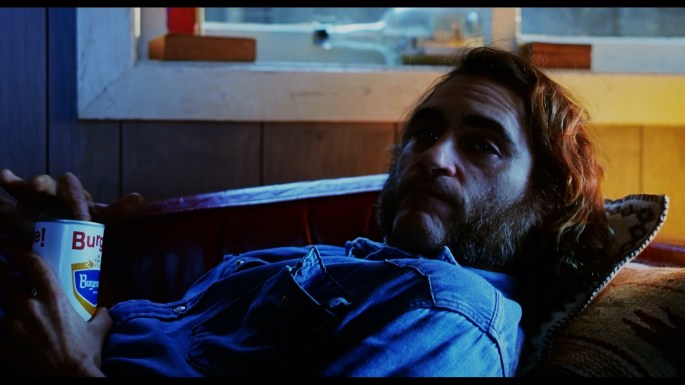
Larry “Doc” Sportello (Joaquin Phoenix) is a private investigator of the rumpled variety. One night, he’s visited by an ex-girlfriend by the name of Shasta Fay Hepworth (Katherine Waterston) whose latest boyfriend, Mickey Wolfmann (Eric Roberts), a big-time real estate developer, and his wife are involved in some kind of shady scheme. Doc soon finds himself framed for murder, Shasta disappears (as does Mickey) and he runs afoul of hardass Los Angeles police detective Christian “Bigfoot” Bjornsen (Josh Brolin). During the course of his investigation, Doc finds himself immersed in the bizarro social strata of California culture, including a drug-addicted surf musician (Owen Wilson), a member of the Black Panthers (Michael K. Williams), a cokehead dentist (Martin Short), and a secret cartel known as the Golden Fang.

Inherent Vice is the second collaboration between Anderson and actor Joaquin Phoenix and the former may have found his cinematic alter ego. Working together brings out the best in both of them with the actor delivering another excellent performance. He portrays Doc as a peaceful hippie P.I. content to coast through life surrounded by a cloud of pot smoke, but is thrust into a strange world when an ex-lover comes back into his life. He acts as our guide on this journey and the key to navigating the sometimes murky narrative waters is to never lose focus of the primary mystery: the disappearance of Shasta. Doc represents the peace-loving idealism of the ‘60s and who is confronted by all kinds of outlandish people that represent the aggressive excessiveness of the ‘70s.

Anderson populates Inherent Vice with a stellar cast of supporting actors that includes Owen Wilson, Reese Witherspoon, Benicio del Toro, and Martin Short, all of whom bring this collection of oddball characters vividly to life. Some may find the cavalcade of recognizable movie stars distracting but, on the contrary, they act as important signposts along the way to help us keep track of the numerous characters Doc encounters during his investigation.

Josh Brolin gets the most screen-time of the supporting cast as Bigfoot Bjornsen, a throwback to cops of the early ‘60s, complete with crew cut and deep loathing of hippies like Doc. Initially, Bigfoot starts off as Doc’s primary nemesis, but over the course of the film he reveals a frustration with his lot in life, displaying a grudging mutual respect. Brolin certainly has the imposing frame to play Bigfoot and wisely plays the role straight, which makes several of his scenes that much funnier because the uptight character is a product of a bygone era that clashes with the more easygoing Doc as much as the excessive culture of the ‘70s.

The trailers for Inherent Vice are misleading in the sense that they sell the film as some kind of madcap comedy and while there are some out-and-out funny scenes, like Martin Short’s cocaine-addicted dentist, there is a melancholic tone that permeates most of the film expanding on “The High Water Mark” speech Raoul Duke gives late in Fear and Loathing in Las Vegas (1998) as he laments the death of ‘60s idealism. Inherent Vice even ends on a surprisingly emotional moment that is quite affecting. Instead of going for quick, comedic beats, Anderson applies the aesthetic he used in There Will Be Blood and The Master by breaking the film down into lengthy, dialogue-heavy scenes between Doc and one of the many people involved either directly or tangentially to Shasta’s disappearance, which may test the patience of some expecting the stylish zaniness of something like Fear and Loathing in Las Vegas. While Terry Gilliam’s film reflected Hunter S. Thompson’s gonzo sensibilities, so too does Inherent Vice reflect Pynchon’s peculiar sensibilities. Like the book, Anderson takes his time and lets you sink into Pynchon’s world, which is certainly not an experience for everyone.

Several reviews have compared Inherent Vice to Robert Altman’s The Long Goodbye (1973) and the Coen brothers’ The Big Lebowski (1998), but they are only similar on a very superficial level. Anderson’s film is its own thing – a shaggy dog journey through a corner of Pynchon’s universe that the filmmaker has brought faithfully and lovingly to life. Much like Walter Salles’ adaptation of Jack Kerouac’s On the Road (2012), Inherent Vice is made by and for fans of Pynchon’s novel, which will leave the uninitiated out in the cold, struggling to follow a film that may seem like an incoherent mess, but is actually quite faithful to its source material with huge chunks of the author’s prose coming out of the characters’ mouths. You shouldn’t have to see a film more than once to “get it,” but there are some that reveal themselves in more detail and whose nuances are appreciated upon repeated viewings. This is such a film. As Pynchon himself once famously said in response to the complexity of his novel V., “Why should things be easy to understand?” The fact that one of Pynchon’s novels has been adapted into a film is quite a significant accomplishment. That it successfully translates his worldview is even more noteworthy.

TWELVE MONKEYS – A REVIEW BY J.D. LAFRANCE

46

“It’s one thing to get lost in your own madness, but to become lost in somebody else’s madness is weirder.” – Terry Gilliam

How do you know when someone is crazy? This is a question that filmmaker Terry Gilliam tries to answer in many of his films, for he is obsessed by the notion of insanity – what makes someone insane and how do others view this person. Is someone really crazy or do they simply have a different view of the world than the rest of society? In the past, Gilliam’s films have presented characters that tend to blur the boundary between sanity and madness, but perhaps his most complex treatment of this subject is Twelve Monkeys (1995). It is with this project that the filmmaker combines his long standing obsession of breathtaking visuals with his knack for working closely with actors. This combination has resulted in more mature films for Gilliam who is normally associated with stylish overkill: films that tend to let the visuals overwhelm the story and characters. And make no mistake, Twelve Monkeys contains some of the most stunning images you are ever going to see but never at the expense of the story or its characters and herein lies one of the reasons why Gilliam remains one of the most interesting people working in film today.

Twelve Monkeys
is a film that constantly plays with, distorts, and more often than not, manipulates time. The film begins in the year 2035. A deadly virus has wiped out almost all of humanity, leaving the survivors to take refuge deep underground. Only the occasional foray up to the surface in protective gear by a select group of “volunteers” offers any clues as to what went wrong. James Cole (Bruce Willis) is one such volunteer who is particularly good at retrieving information. As a result, he soon finds himself being sent back in time to find out how the virus originated and who was responsible. Unfortunately, he goes back too far, arriving in 1990 and is promptly thrown into a rather nightmarish mental hospital in Baltimore where he meets Jeffrey Goines (Brad Pitt), a fellow inmate with a loopy sense of reality that feeds all sorts of paranoid delusions of grandeur. Cole also encounters Kathryn Railly (Madeleine Stowe) a beautiful doctor who feels sympathy for him and his plight.

As Cole travels back and forth in time he begins to realize that one of the most important clues to the source of the deadly virus may lie in the rather enigmatic underground organization known only as The Army of the 12 Monkeys. Soon, Railly and Goines begin to play integral roles in Cole’s search as he consistently crosses paths with them. But is this all taking place in Cole’s mind? Is he really humanity’s only hope at averting a catastrophic disaster or is he just insane? From the first shot to the film’s conclusion we are never quite sure of Cole’s sanity or lack thereof. It is just one of many questions that the audience must think about not only during the film but long after it ends.

The seeds of Twelve Monkeys lie in an obscure French New Wave film called La Jetee (1962) made by Chris Marker. The film was composed entirely of black and white photographs and set in Paris after World War III. It was an apocalyptic vision in reaction to the threat of nuclear annihilation that became prominent in the 1950s and 1960s. Writers David and Janet Peoples were approached by producer Robert Kosberg to do an adaptation of La Jetee. The screenwriting couple wasn’t that keen on the idea, however. “We couldn’t see the point. It’s a masterpiece and we didn’t see that there was anyway to translate that masterpiece,” David remarked in an interview. And he was no slouch to the art of screenwriting, having rewritten the screenplay for Blade Runner (1982) and penned the brilliant Clint Eastwood film, Unforgiven (1992).

Kosberg got the Peoples to watch La Jetee again and the couple began to see possibilities for a different, more detailed take on the material. “How would we react to people who showed up and said ‘Oh I’ve just popped up from the future’ and in turn how would that person deal with our reaction.” With this in mind, David and Janet set out to write a challenging piece of fiction that not only manipulated our conventional views of time but that also dealt with the notion of madness. Janet explained in an interview, “We were very interested in asking questions like ‘Is this man mad? And how about the prophets of the past, were they mad? Were they true prophets? Were they coming from another time? What are all the different possibilities?'” The film’s script argues that certain people who are classified insane by society at large may not really be crazy at all but are in actuality presenting ideas that are way ahead of our time. And perhaps the blame for this misunderstanding should be leveled at the psychiatric profession which, as one character in the film observes, has become the new religion of a society that has deserted traditional faith for modern technology.

After showing the finished screenplay to Marker and getting his blessings, the Peoples were faced with the daunting task of finding someone who would not only click with the material but also have the visual flair that the story needed. The couple figured that the only director to handle such tricky subject matter was somebody like Ridley Scott or Terry Gilliam. The theme of madness that plays such a prominent role in the script fit right in with Gilliam’s preoccupations and so he seemed the natural choice to direct. As luck would have it the filmmaker was between projects and looking for work after several years of seeing potential projects fall through for various reasons.

Gilliam was also eager to take a lot of Hollywood money (a $30 million budget) and create a strange art film that would fly in the face of the traditional mainstream movie. “The idea that someone’s writing a script like this in Hollywood and getting the studio to pay for it was pretty extraordinary. So I thought let’s continue to see how much money we can get the studio to spend.” Gilliam’s battles with Hollywood studios are the stuff of legend – most notably his struggle with Universal over the release of Brazil (1984). They wanted to revoke the director’s final cut privileges to insert a happier ending instead of Gilliam’s decidedly downbeat ending. Gilliam’s vision prevailed in the end, but the ordeal left him understandably wary of further studio involvement. He had reconciled somewhat with Hollywood by making The Fisher King (1991), which turned out to be a surprise commercial and critical success.

Architecture plays an important role in Gilliam’s films and Twelve Monkeys is no different. “I’ve always used architecture as if it was a character.” To this end, he found all sorts of intriguing architecture to populate his film. This included the transformation of an 1820s prison into a 1990s mental hospital where the film’s protagonist, James Cole first meets the Jeffrey Goines. The director found that the structure was designed like a wheel with spokes and hub. And so Gilliam used one section where three spoke-like parts headed off into nowhere. “It seemed to me [that] this trifurcated room was right for multiple personalities.” This feeling of madness is further amplified by the extensive use of skewed, off-kilter camera angles that are often shot at low angles to constantly distort and disorient the scene. “We started doing it and it got more and more fun to see how far we could push it because I wanted to create an atmosphere that you don’t know whether this guy is crazy or whether he actually does come back from the future.” The unusual camera angles not only mimic Cole’s confused state but also reflect Jeffrey’s manic, hyperactive worldview. By presenting the mindsets of these two characters in such a fashion, Gilliam is inviting us to see the world through their eyes and in the process offer a new, unique take on the world that we might not have been aware of before.

Gilliam was not just content to challenge mainstream audiences with unusual visuals and subject matter, but he also wanted to mess with people’s perception of certain movie stars by casting box office names like Brad Pitt and Bruce Willis against type. “One of the reasons [for doing Twelve Monkeys] was taking Bruce and putting him into situations and asking of him things I don’t think he’s ever done before or that people haven’t seen him do … and with Brad Pitt it’s the same thing. Brad is pretty laconic in some ways. Suddenly he’s a blabbermouth, jabbering away at high speed. I love doing that, playing with the public’s perception of that star; otherwise, it wouldn’t be fun.” As a result we get a very different Bruce Willis here than we have come to expect. Gone are the wisecracks and smart-aleck attitude and instead we see Willis impart a real wounded sensibility to the character of James Cole. The reluctant time traveler always seems to be flinching at every little thing, often appearing disoriented or distracted as he struggles to understand what is going on around him. Willis displays great skill in this role – perhaps the best of his career – as he creates a truly tragic figure that may or may not be losing his mind.

Brad Pitt’s character, Jeffrey Goines, resides at the exact opposite end of the spectrum. Where Cole is a sad, brooding figure, Goines is a frenetic psychotic oscillating wildly between paranoid ravings and calm interludes where his madness is kept in check but still resides behind wild eyes. It’s a daring performance for Pitt who lets it all hang out as he gladly chews up the scenery with his loony radical environmentalist cum revolutionary that all but steals every scene he’s in. It’s a performance that Pitt worked long and hard to achieve and it paid off in a Golden Globe Award that year for Best Supporting Actor and an Academy Award nomination in the same category.

It is easy to see what attracted Terry Gilliam to a project like Twelve Monkeys. In keeping with his past films, this one also played “with the same old things – time, reality, madness – so I was intrigued.” Even though it was one of the few projects he did not originate himself, Gilliam quickly made the film his own. In fact, it is Twelve Monkeys‘ unique look that prevents any easy categorization. As Gilliam observed in an interview, “I’m determined to make it indefinable.” It is this avoidance of any clear cut genre that makes the film a riddle waiting to be solved. The film is also structured somewhat like an onion. On the surface, the audience knows very little at the beginning, but gradually as it progresses and the layers are removed, more and more of the mystery is revealed. However, this is not readily apparent after an initial viewing. Only after subsequent screenings does the full impact and brilliance of what Gilliam and his cast and crew have created sink in. It is this great amount of care and detail that has clearly gone into this film that makes Twelve Monkeys worth watching.

THE LONG GOODBYE – A REVIEW BY J.D. LAFRANCE

longgoodbye

“I felt that the film was almost an essay, an education, to the audience, to say, ‘Stop looking at everything exactly the same way.’” – Robert Altman

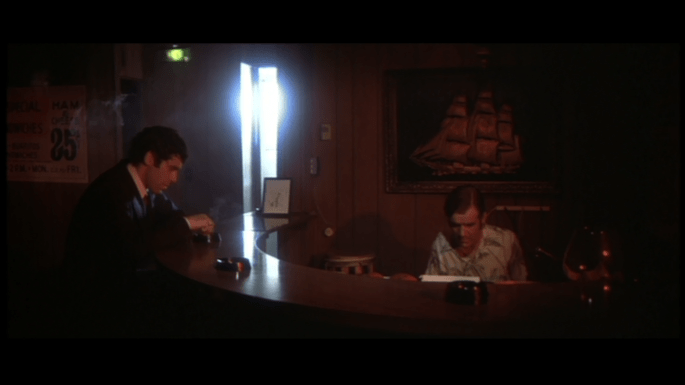
When The Long Goodbye was released in 1973, United Artists promptly bungled its ad campaign. Robert Altman’s film radically reworked Raymond Chandler’s novel of the same name and the studio had no idea how to market the offbeat movie. It polarized critics and promptly disappeared from theaters. People weren’t ready for its offbeat vibe and the way it satirized Los Angeles culture. However, it was Elliott Gould’s unusual take on private investigator Philip Marlowe that drew the lion’s share of people’s criticism. His loose, easy-going style flew in the face of the traditional interpretation made famous by Humphrey Bogart and was tantamount to heresy among cinephiles but in retrospect paved the way for a film like the Coen brothers’ The Big Lebowski (1998), which also confounded the mainstream with its own eccentric take on West Coast culture.

While trying in vain to feed his cat late one night, private investigator Philip Marlowe (Gould) receives a visit from his friend, Terry Lennox (Jim Bouton). Lennox asks Marlowe to drive him to Tijuana, Mexico. When he returns home, the police are waiting for him and claim that Lennox brutally murdered his wife. Marlowe does not believe that his good friend is a murderer and refuses to tell the police anything. After three days in jail, he’s released when the police inform him that Lennox committed suicide in Mexico. It’s an open and shut case but something doesn’t quite sit right with Marlowe. He is subsequently hired by the wealthy Eileen Wade (Nina van Pallandt) to find her alcoholic husband, Roger Wade (Sterling Hayden), a famous author with an Ernest Hemingway complex. Marlowe learns that the Wades knew the Lennoxes and that there is more to Terry’s suicide and his wife’s murder than initially reported.

The Long Goodbye
is bookended by the strains of “Hooray for Hollywood” and the song quickly fades out as if to signal that this film will not be a classic noir take on Chandler. Marlowe wakes up after an undetermined period of time. How long has he been asleep? He mutters to himself while trying to feed his cat, a very fickle pet that will only eat a specific brand of food, and when he tries to fool the feline with another brand hidden in an old can, the cat bolts. So what is the purpose of the first ten minutes of the film dedicated to Marlowe feeding his cat? First off, it establishes that this is going to be a very different take on Chandler’s book and that Marlowe’s friend, Terry Lennox, is as fickle as his cat – he only hangs around Marlowe when he needs him but when he’s no longer of use, he splits. This opening scene came from a story a friend of Altman’s told him about his cat only eating one type of cat food.

The Long Goodbye
is much more than a murder mystery. Taking Chandler’s novel set in the 1940s and updating it to the 1970s, Altman is also interested in satirizing the superficiality of L.A. culture. Marlowe is surrounded by an odd cast of denizens that populate the city: his neighbors are a group of women who spend their time getting high and doing yoga with very little clothes on, the security guard for the Wade’s gated community does impersonations of famous actors like Barbara Stanwyk and Jimmy Stewart, and Marty Augustine (Mark Rydell) is a nasty gangster who is proud of his Jewish heritage. Throughout it all, Marlowe repeats his own personal mantra of sorts, “It’s okay with me,” which personifies his easy-going nature.

The heart of the film is Elliot Gould. His Marlowe is a laid-back guy in a rumpled suit that wanders through the film muttering jokes to himself and chain smoking constantly. Gould’s character is man out of time, a throwback to another era, which provides a sharp contrast to the trendy, health-obsessed ’70s culture that surrounds him. Altman nicknamed Gould’s character Rip Van Marlowe, as if he had been wandering around L.A. in the early ‘70s but “trying to invoke the morals of a previous era.” The actor delivers a wonderful assortment of smart-ass comments to anyone who gives him trouble but also knows when to play it straight during key dramatic moments. He’s also not afraid to improvise in a given scene like when the police interrogate him and he smears the fingerprinting ink under his eyes like a football player and then applies it to the rest of his face a la Al Jolson, riffing off the police officer that is giving him a hard time. Gould delivers a multi-layered performance that ranks right up there with his other classic Altman films, M.A.S.H. (1970) and California Split (1974). There was clearly a creative synergy between the two men that resulted in both of their best work to date.

Producers Jerry Bick and Elliott Kastner commissioned a screenplay from Leigh Brackett, who had written the script for the Humphrey Bogart version of The Big Sleep (1946). The producers offered the script to both Howard Hawks and Peter Bogdanovich. Both directors passed on it but Bogdanovich recommended Altman, whom he admired. Bick and Kastner sent Brackett’s script to Altman while he was shooting Images (1972) in Ireland. Brian Hutton was supposed to direct but was offered another film and Altman took over. Initially, he didn’t want to do it until he was told that Gould would be cast as Marlowe.

In adapting the book, Brackett had problems with its plot which she felt was “riddled with clichés” and was faced with the choice of doing it as a period piece or updating it. Altman and Brackett spent a lot of time talking over the plot. He wanted Marlowe to be a loser. Her first draft was too long and she shortened it but the ending was inconclusive. She had Marlowe shooting Terry Lennox because it was the way Hutton wanted it. Altman liked the ending because it was so out of character for Marlowe. He agreed to direct but only if the ending was not changed.

Altman conceived of the film as a satire and it was his decision to cast Sterling Hayden and Nina Van Pallandt. The director only knew Van Pallandt from The Johnny Carson Show and from the Clifford Irving scandal. He felt that she resembled a character from Chandler’s novel and the studio allowed him to do a screen test. He also made all kinds of changes to the script, like Wade’s suicide and Marty Augustine smashing the Coke bottle into his girlfriend’s face. Altman did not read Chandler’s book and instead gave copies of Raymond Chandler Speaking to the cast and crew and advised them to study the author’s literary essays. Altman originally wanted Dan Blocker for the role of Roger Wade but he died just before shooting began and the director was persuaded to meet with Sterling Hayden.

When Bogdanovich was briefly attached to the project, he wanted Robert Mitchum or Lee Marvin to portray Marlowe. United Artists president David Picker may have picked Gould to play Marlowe as a ploy to get Altman to direct the film. Bogdanovich did not see Gould in the role because he was “too new” and left the project. Brian Hutton also wanted Gould to play the private detective. At the time, the actor was box office poison in Hollywood after his rumored troubles on the set of A Glimpse of Tiger where he argued with co-star Kim Darby, exchanged blows with director Anthony Harvey, and abused drugs as well as being unreliable and absent. Warner Bros. stopped the production early on and Gould claimed that he was blamed for its failure. The studio collected on an insurance policy that attested the actor was crazy. For The Long Goodbye, United Artists gave Gould the requisite physical before approving his contract and demanded a psychological exam to determine that the actor was mentally stable. Gould read the first draft of Brackett’s script described it as a “pastiche” and very convoluted. Altman called Gould to discuss the film and the actor told him that he always wanted to play Marlowe. Altman asked Gould to read the novel as well as Chandler on Chandler. Gould discovered that he was exactly the same age, height, and weight as Marlowe.

When it came to the scenes between Marlowe and Wade, Altman had Gould and Hayden ad-lib most of the dialogue. Hayden, with his long, scraggily beard and scattershot delivery of his dialogue, is great as the eccentric writer who constantly refers to Marlowe as “Marlboro” (“the Duke of Bullshit,” he adds at one point), in reference to his ever-present cigarette hanging from the corner of his mouth. Hayden delivers a wonderfully unpredictable performance full of bluster and eccentric line readings. According to Altman, Hayden improvised a lot of his dialogue and was drunk and stoned on marijuana most of the time. In the scene where Marlowe tries to save Wade from drowning himself in the Pacific Ocean, Gould almost drowned when he went out too far. He was only able to do three takes. The director decided that the camera should never stop moving and put the camera on a dolly. However, the camera movements would counter the actions of the characters so that the audience would feel like a voyeur. To compensate for the harsh light of southern California, Altman gave the film a soft, pastel look reminiscent of old postcards from the 1940s.

Mark Rydell is something else as Marty Augustine. In the first scene we see him in he threatens Marlowe, then talks sweetly to his girlfriend, and then goes back to menacing Marlowe. At times, Augustine is downright charming and then he suddenly and shockingly smashes a Coke bottle across his girlfriend’s face just to make a point. With the shocking violence of this scene, Altman said, “It was supposed to get the attention of the audience and remind them that, in spite of Marlowe, there is a real world out there, and it is a violent world.” Augustine is clearly a psychopath and Rydell nails the character’s shifting moods with unsettling intensity. The Coke bottle scene is like a cold splash of water to the face and it causes not only the audience to sit up and notice but Marlowe as well, who, up to this point, has mostly been in his own little world. Now, Marlowe has a real, vested interest in what happened to his friend Lennox because he owed Augustine a lot of money and is now threatening Marlowe’s life.

The Long Goodbye
was previewed at the Tarrytown Conference Center in New York. The gala was hosted by Judith Crist, then the film critic for New York magazine. Altman flew in for the Q&A session. The film was not well-received by the audience except for Nina Van Pallandt’s performance, which got good notices. The mood at the Q&A was “vaguely hostile” and afterwards Altman was reportedly “depressed.” The Long Goodbye did not fare well in its limited release in Los Angeles, Chicago, Philadelphia, and Miami. As a result, the New York City opening was canceled at the last minute after several advance screenings had already been held for the press. The Long Goodbye received mixed reaction from critics and performed poorly at the box office because of the unconventional story, plot, and character changes from the novel.

The film was abruptly withdrawn from release by United Artists with rumors that it would be re-edited. Altman went to Picker and told him, “No wonder the fucking picture is failing. It’s giving the wrong impression. You make it look like a thriller and it’s not, it’s a satire.” The studio analyzed the reviews for six months and concluded that the advertising campaign was too narrow. They created a new release strategy for The Long Goodbye with a novel ad campaign that featured a poster illustrated by legendary Mad magazine artist Jack Davis. Altman explained that he “had to prepare audiences for a movie that satirizes Hollywood and the entire Chandler genre.” United Artists spent $40,000, and the New York City première was profitably and critically successful. The Long Goodbye ended up on The New York Times’ year-end Ten Best list. Cinematographer Vilmos Zsigmond won the National Society of Film Critics’ award for best cinematography in 1973. Unfortunately, the damage had already been done and the film still failed to perform well elsewhere.

The Long Goodbye
has endured and become one of Altman’s signature films. It also has some famous fans, chief among them the Coen brothers who cite it as their favorite of Altman’s and an influence on The Big Lebowski. Aside from being a cheeky satire on Hollywood almost as much as The Player (1992) was, a later Altman film that brought him back into the mainstream, it is a film about loyalty. By the end of the film, Marlowe has learned a valuable lesson – there are some friends you don’t stick your neck out for. He is loyal to a fault and realizes that Lennox wasn’t the friend that he thought he was. As the Altman quote states at the beginning of this article, Marlowe is forced to stop looking at everything exactly the same way, just as we are, and see his friend for who he truly is.

WONDER BOYS – A REVIEW BY J.D. LAFRANCE

Wonder-Boys-robert-downey-jr-13124127-1280-544

Wonder Boys (2000) is a redemptive tale of a college professor in the midst of a mid-life crisis. It is a film about faded glory and people past their prime. Curtis Hanson’s film is the kind of small, oddball little tale with a decidedly off-kilter, dark sense of humor and a cast of eccentric characters. It was a bit hit with critics but never quite connected with a mainstream audience due in part to a bungled initial promotional campaign that clearly did not know how to convey the quirky tone of the film into an easily digestible soundbite.

Grady Tripp (Michael Douglas) is a burnt out English professor that wrote a much celebrated novel entitled, The Arsonist’s Daughter, but has since been having a hard time with his follow-up. He keeps writing and writing with no end in sight (current page count sits at around 2,100+ pages). His young wife has left him and he’s sleeping with his boss’ wife, Sara Gaskill (Frances McDormand), who is also the Chancellor of the university where he works. His long-suffering editor Terry Crabtree (Robert Downey Jr.) is in town to take a look at the book. He maintains a “what me, worry?” façade but is in danger of losing his job unless he can find a potential best seller and applies subtle but definite pressure on Grady. The professor has also taken under his wing a brilliant but troubled student, James Leer (Tobey Maguire), from his creative writing class. He’s a tortured artist wannabe as evident from his habit of sitting in an empty, dark classroom. He is also ostracized by his classmates who resent his ability to write.

Producer Scott Rudin gave Michael Chabon’s book to screenwriter Steve Kloves. At first, he wasn’t interested – he hadn’t written a word in four years and had never adapted a novel before – but while reading the novel he connected with the material, “and a sort of kinship with Michael Chabon’s tone and the way he looked at his characters, with all their flaws, with a real generous spirit,” he said. Initially, Kloves agreed to adapt the book and talk about directing it but two and half years into working on the screenplay, he decided not to direct. After the success of L.A. Confidential (1997), Hanson was working on a script of his own and reading other scripts with a keen interest for his next film to be a comedy. Actress Elizabeth McGovern once advised him to work with Kloves and was given his screenplay. He was told that Michael Douglas was interested in playing Grady and was impressed by the way in which the characters were presented and “the lack of judgment on their actions and eccentricities.” In addition, Hanson “fell in love with these characters – and they made me laugh.”

Hanson told Rudin, “it’s too bad you can’t have Jean Renoir or Hal Ashby direct this.” Once Hanson was attached to direct, Kloves met with him and was relieved that they were both on the same page in terms of their approach to the material. Chabon encouraged Kloves to make the material his own and this included changing Grady’s Jewish in-laws to gentiles. Additional changes were made once Hanson came on board. For example, he felt that James Leer would be a fan of Douglas Sirk’s films as opposed to Frank Capra as he is in the novel. The studio wasn’t interested in making a quirky, character-driven comedy/drama until Michael Douglas agreed to work well below his usual large fee. One of the challenges for Hanson was to take a plot that he called “meandering and, apparently, sort of aimless,” and a character that “does things that even he doesn’t really know why he’s doing them,” and try to create a “feeling of focus” to keep the audience interested. Another challenge was working on actual locations in very cold weather and constantly changing conditions.

Hanson’s other concern was if Douglas would be willing to take on the role without a hint of vanity but also do it in a truthful way and not in a way that would draw attention to the fact that he was playing an unattractive character. To his credit, the actor disappears completely into this role. He’s not the first person you’d think of to play Grady. When he tries too hard to be funny it can come across as pompous, but he tones it down here and looks completely at ease, comfortable as the frumpy Grady. Douglas hits just the right notes of world-weary cynicism but with a romantic streak buried underneath. For the veteran actor it’s an unglamorous role – he gained 25 pounds for the role, eating pizza, subs and drank a lot of beer. He always looks rumpled, unshaven with unkempt hair and often wearing a ratty old housecoat when he writes. Grady has the capacity to do something about his miserable lot in life and during the course of the film his character undergoes a fascinating arc. In some ways, Grady is a pot-smoking burn-out like the Dude from The Big Lebowski (1998) only with slightly more ambition. He lives outside of normal society in the rarified atmosphere of academia — puttering around, writing his novel and teaching his writing class, but when he crosses paths with James Leer, Grady realizes that he’s got to change.

Wonder Boys
also marked a break-out role for Tobey Maguire. Before he garnered massive mainstream exposure with Spider-Man (2002), he was known mostly for roles in small, independent films. Like everyone else in the cast, he has his memorable moments, like when his character laughs at Q’s (Rip Torn) pretentious speech at Wordfest with a high-pitched giggle that reverberates through the large auditorium. The blissfully stoned expression he gives afterwards is priceless. Everyone in the film keeps harping on what a genius writer Grady is, but it gradually becomes apparent that James is the true genius. He writes pages and pages of beautiful prose in minutes. And like any true talent, it just comes pouring effortlessly out of him. What makes James such a good writer is that his whole life is essentially a lie – he lies about his parents’ past, how they met and where they came from. He even maintains this air of a tortured artist but as we find out that too is a lie. James has it pretty easy, living in a large house in an affluent neighborhood. Good fiction writers have to be masters at making things up.

As always, Robert Downey Jr. knows how to make an entrance, meeting Grady at the airport with a transvestite as his date. The exchange between Terry and Grady quickly establishes their long-time friendship by the familiarity between them. Downey is able to take the most mundane, ordinary line and give it his own unique spin and make it funny or give a look that is memorable. His rapport with Douglas is excellent and they play well off each other as both sides of the comedic equation. Downey was on probation during the winter of 1999 when Hanson considered him for a role in Wonder Boys. The director was cautious because of the actor’s drug history and was concerned because it would be a tough film shot in sequence in Pittsburgh in the winter. Downey flew to Pittsburgh and had a long dinner conversation with Hanson where they addressed his problems. The actor demonstrated a commitment to the film and the director hired him. According to Hanson, Downey acted in a professional manner for the entire four-and-a-half month shoot but after it ended and he returned to Los Angeles, the actor violated his parole.

Frances McDormand knows how to react to those around her, like when she meets Grady, Terry and his date at a party. Watching her react to the charming transvestite is priceless. She and Douglas also have excellent chemistry together as evident in the short hand, the give-and-take between their characters. This is nicely established in their first scene together where Sara tells Grady that she’s pregnant. The music sets a slightly melancholic even whimsical tone as the two characters reveal that they are trapped in relationships that they don’t want to be in. They want to be together but Grady won’t show her how serious he is about them. Ultimately, Grady has to save himself and to in order to do this he must convince Sara that he does love and he want to be with her.

Steve Kloves’ script is a solid piece of writing as he does a great job of adapting Chabon’s book, trimming it of its excess narrative fat (as he also did so well with the Harry Potter books). It has clever, memorable dialogue that speaks volumes about these characters. There is a pleasant mix of off-kilter humor and poignant drama as we are presented with all sorts of colorful characters, like Grady’s bisexual editor and the famous and pompous writer known as Q (played to haughty perfection by Rip Torn) and then have them played by equally eccentric characters actors. The dialogue is humorous and offbeat in one scene, touching and thoughtful in the next. For example, in one scene, James rattles off a list of celebrity suicides in alphabetical order, the dates and how they did it in a mechanical monotone as if he’s reading off a grocery list that adds to humor of the scene because it is such an unusual moment.

Kloves also wisely avoids the usual clichés. like Katie Holmes’ character, the young, nubile co-ed who, in a lesser film would have had a fling with Grady. This would have broken the magical spell that this movie casts and so the filmmakers wisely avoid it. Instead, she helps Grady realize that his book is going nowhere and that he needs to make some choices about it and his life. One of the film’s major themes is about making choices. Grady’s problem is that he is indecisive. He can’t make up his mind about how he feels about Sara and he can’t figure out how to end his wildly out of control novel that is ultimately a metaphor for his life. Grady’s life is in a holding pattern, like his book and both get more complicated as life goes on. As the days go on so does the page count increase on his book. However, the key to his salvation lies in his mission to reach James and nurture his talents. Grady sees some of himself in James – a wonder boy in the making while he is a wonder boy who has lost his way. Terry is the third wonder boy in the film and his luster has been fading over years, unable to find another breakthrough novel like The Arsonist’s Daughter and is generally regarded as a joke at work.

Hanson strips color from the palette, presenting Pittsburgh in blues and grays, a romantic, post-industrial setting that we see through Grady’s car window. It’s subtly presented as Hanson doesn’t hit us over the head with obvious landmarks. He excels at creating just the right mood and atmosphere. For the director, the city mirrors the characters in the film as he commented in an interview, “it’s a city with this glorious past that went into decline…That’s why I wanted to shoot here. I think the city’s so emblematic of the characters’ problems.” The city was experiencing a mild winter during their shoot and they had to use a lot of artificial snow.

The best films are the ones that you lose yourself in completely. There is a scene where Grady sneaks a smoke outside of the Gaskill house at night and a light snow falls. He spies a greenhouse in the distance and it is illuminated in the night looking like “heaven” as James puts it. This is in contrast to the warm, gold interior of the nearby Gaskill house. This is a wonderful little moment frozen in time and the beginning of the friendship between Grady and James.

The attention to detail — a snowy winter in Pittsburgh — is beautifully realized. Hanson does a great job of conveying a sense of place, utilizing locations well. There is the warm, red and gold of a blues bar that Grady meets Terry and James at. It’s a small place packed with people and they sit in a booth that create an intimate feel. There’s a great moment where Grady and Terry spot an odd looking guy across the bar and create an elaborate and colorful backstory for him, including a name – Vernon Hardapple – and who is, among other things, “president of the James Brown Hair Club for Men.” Grady later encounters the man on a couple of very memorable occasions including a funny scene where Grady, Q and Terry try to evade Vernon outside of the bar that ends with the man jumping on the hood of their car with his butt. We see Q and Terry laughing and having fun as Grady tries to escape and in turn it is fun for us to watch.

Hanson had been a fan of Bob Dylan’s music since childhood and a great admirer of his soundtrack for Pat Garrett and Billy the Kid (1973). As it turned out, Dylan was a fan of Hanson’s previous film, L.A. Confidential and after a lot of convincing screened 90 minutes of rough footage from Wonder Boys. Hanson wanted Dylan because “who knows more about being a wonder boy and the trap it can be, about the expectations and the fear of repeating yourself?” In addition to Dylan, Hanson built the score around nine singer-songwriters including Leonard Cohen and Neil Young. The entire soundtrack is integrated into the film and Hanson even played some of the songs for the actors on the Pittsburgh set to convey a scene’s “aural texture,” as the director put it in an interview.

The studio decided to release Wonder Boys in February, notoriously the month where films no one cares about are unceremoniously dumped, and while it connected with critics, flopped at the box office. It came out a week after the Academy Award nominations were announced. The studio spent a lot more money promoting the films of theirs that were nominated and not enough on Wonder Boys. The Wall Street Journal‘s Joe Morgenstern praised Douglas’ work in the movie, but criticized the movie poster, which featured a headshot of Douglas: “a raffishly eccentric role, and he’s never been so appealing. (Don’t be put off by the movie’s cryptic poster, which makes him look like Michael J. Pollard.)” The Los Angeles Times‘ Kenneth Turan also slammed the poster: “The film’s ad poster brings Elmer Fudd to mind.”

Hanson was not happy with how the film was marketed, in particular the poster, which he said in an interview, made Douglas look “like he was trying to be Robin Williams.” Furthermore, he said, “The very things that made Michael and I want to do the movie so badly were the reasons it was so tricky to market. Since films go out on so many screens at once, there’s a need for instant appeal. But Wonder Boys isn’t easily reducible to a single image or a catchy ad line.” The director disagreed with the studio over the film’s original release date and advertising campaign. To make matters worse, the marketing was criticized in the press and in an unprecedented move, the studio canceled the lucrative video contract and pulled the film out of theaters. Hanson and Rudin lobbied to have the film re-released. A new campaign was designed that emphasized the ensemble cast and the film was released in theaters where it promptly flopped at the box office again.

Every scene in Wonder Boys feels warm and inviting and filled with interesting characters that inhabit this world and that allows you to be in it for the duration of the film. By hanging out with James, Grady regains that wonder boy spark while also guiding his young protégé to becoming one himself. What better teacher than someone who was once one? At one point, Grady says that most people don’t think and that books aren’t important anymore. He’s jaded and cynical about the world but over the course of the film James reaches him and changes his outlook on life.

RUMBLE FISH – A REVIEW BY J.D. LAFRANCE

20150410-6

History remembers Francis Ford Coppola’s, Rumble Fish (1983) as a film that was booed by its audience when it debuted at the New York Film Festival and in turn was viciously crucified by North American critics upon general release. It’s too bad because it is such a dreamy, atmospheric film that works on so many levels. It is also Coppola’s most personal and experimental project — on par with the likes of Apocalypse Now (1979). From the epic grandeur of The Godfather films to the excessive Bram Stoker’s Dracula (1992), Coppola has pushed the boundaries, both on-screen and off. He has almost gone insane, contemplated suicide, and faced bankruptcy on numerous occasions, but he always bounces back with another intriguing feature that is visually stunning to watch. And yet, Rumble Fish curiously remains one of Coppola’s often overlooked films. This may be due to the fact that it refuses to conform to mainstream tastes and stubbornly challenges the Hollywood system with its moody black and white cinematography and non-narrative approach.

Right from the first image Rumble Fish is a film that exudes style and ambiance. It opens on a beautiful shot of wispy clouds rushing overhead, captured via time lapse photography to the experimental, percussive soundtrack that envelopes the whole film. This creates the feeling of not only time running out, but also a sense of timelessness. Adapted from an S.E. Hinton novel of the same name, Rumble Fish explores the disintegrating relationship between two brothers, Rusty James (Matt Dillon) and the Motorcycle Boy (Mickey Rourke). The older brother derives his name from his passion: stealing motorcycles for joyrides. The film begins with the Motorcycle Boy absent, perhaps gone for good, while Rusty James tries to live up to his brother’s reputation: to act like him, to look like him, and, ultimately, to be him. Rusty James’ brother is viewed as a legend in the town as he was the first leader of a gang and also responsible for their demise.

Much like Harry Lime in The Third Man (1949), the Motorcycle Boy is initially physically absent, but his presence is felt everywhere — from the shots of graffiti on walls and signs that read, “The Motorcycle Boy Reigns,” to the numerous times he is referred to by characters. This quickly establishes him as a figure of mythic proportions. When the Motorcycle Boy finally does appear — during a fight between Rusty James and local tough, Biff Wilcox (Glenn Withrow) — it is a dramatic entrance on a motorcycle like Marlon Brando in The Wild One (1953). This appearance marks a significant change in the film. We begin to see the world through the eyes of the Motorcycle Boy, almost as if the whole film is taking place in his head.

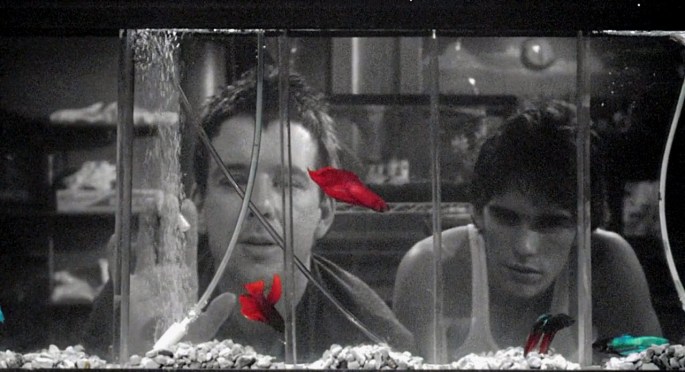
Consequently, Rumble Fish is shot entirely in black and white to simulate his color blindness. We even begin to hear the world like he does: voices sound echoey, disembodied, with his own heartbeat threatening to drown everything else out. It is this existential worldview that makes the Motorcycle Boy a tragic character. The rest of the film explores his attempts to come to grips with this outlook and his relationship with Rusty James, who views him as a hero — a label that the older sibling has never been able to accept.

Coppola wrote the screenplay for Rumble Fish with Hinton on his days off from shooting The Outsiders (1982). As the filmmaker said in an interview, “the idea was [that] The Outsiders would be made very much in the style of that book, which was written by a 16-year old girl, and would be lyrical and poetical, very simple, sort of classic. The other one, however, Rumble Fish, which she wrote years later, was more adult, kind of Camus for teenagers, this existential story.” Coppola even went so far as to make the films back-to-back, retaining much of the same cast and crew. Warner Brothers was not happy with an early cut of The Outsiders and chose not to distribute Rumble Fish. Despite a lack of financing, Coppola completely recorded the film on video during two weeks of rehearsals in a former school gymnasium, encouraging his young cast to improvise.

Actual filming began on July 12, 1982 on many of the same Tulsa, Oklahoma sets used in The Outsiders. The attraction to Rumble Fish, for Coppola, was the “strong personal identification” he had with the subject matter: a young brother hero-worships his older, intellectually superior sibling. Coppola realized that the relationship between Rusty James and the Motorcycle Boy mirrored his own connection to his brother, August. It was an older, more experienced August who introduced Francis to film and literature. Coppola always felt like he was living in the shadow of his brother and saw the film as a “kind of exorcism, or purgation” of this relationship.

As always, Coppola assembled an impressive ensemble cast for his film. From The Outsiders, he kept Matt Dillon, Diane Lane, Glenn Withrow, William Smith, and Tom Waits, while casting actors like Mickey Rourke and Vincent Spano who were overlooked for roles in the film for one reason or another. They fill out their roles admirably, but Mickey Rourke in particular, is mesmerizing as the Motorcycle Boy.

To get Rourke into the mindset of his character, Coppola gave him some books written by Albert Camus and a biography of Napoleon. “There’s a scene in there when I’m walking down the bridge with Matt; and I’d try and stylise my character as if he was Napoleon,” the actor remembers. The Motorcycle Boy’s look was patterned after Camus complete with trademark cigarette dangling out of the corner of his mouth — taken from a photograph of the author that Rourke used as a visual handle. He portrays the character as a calm, low key figure that seems to be constantly distracted as if he is in another world or reality. Rourke “Methodically” conceived the Motorcycle Boy as being “an actor who no longer finds his work interesting.” To this end, he uses subtle, little movements and often cryptic phrases that only he seems to understand.

This feeling is further enforced by the two brothers’ alcoholic father, played brilliantly by Dennis Hopper in a surprisingly low key performance. He describes the Motorcycle Boy perfectly when he says that “he is merely miscast in a play. He was born in the wrong era, on the wrong side of the river. With the ability to be able to do anything that he wants to do and finding nothing that he wants to do.” Rourke’s Motorcycle Boy is almost embarrassed by the myth that surrounds him, that threatens to drown him. He openly rejects it when he says, “I’m tired of all that Robin Hood, Pied Piper bullshit. You know, I’d just as sooner stay a neighborhood novelty if it’s all the same to you… If you’re gonna lead people, you have to have somewhere to go.” It is this reluctance to embrace his legendary reputation that gives the Motorcycle Boy an element of humanity that was not in the novel.

Not only did Coppola assemble a talented cast of actors, but he also gathered an impressive crew to create the images and the proper mood to compliment them. The striking black and white photography of the film’s cinematographer, Stephen Burum, lies in two main sources: the films of Orson Welles and German cinema of the 1920s. Welles’ influence is particularly apparent in one scene where the Motorcycle Boy and Steve bring a wounded Rusty James home. While Steve and Rusty James talk in the background, the Motorcycle Boy looms into a close-up, as if the lens were a mirror in which he was admiring himself. He is clearly a character who suffers from what one critic called, “fatal narcissism,” a trait common in many of Welles’ films. This deep focus shot (a favorite of Welles) shows how far removed the Motorcycle Boy is from his brother and from everyone. He is like a mirror, impenetrable and impossible to read as Steve observes, “I never know what he’s thinking.” This scene harkens back to Welles’ masterpiece, Citizen Kane (1941), which used the deep focus technique to give characters that look of “fatal narcissism,” to live a doomed existence.

Before filming started, Coppola ran regular screenings of old films during the evenings to familiarize the cast and in particular, the crew with his visual concept for Rumble Fish. Most notably, Coppola showed Anatole Litvak’s Decision Before Dawn (1951), the inspiration for the film’s smoky look, and Robert Wiene’s Cabinet of Dr. Caligari (1919) which became Rumble Fish‘s stylistic prototype. Coppola’s extensive use of shadows (some were painted on alley walls for proper effect), oblique angles, exaggerated compositions, and an abundance of smoke and fog are all hallmarks of these German Expressionist films. Godfrey Reggio’s Koyaanisqatsi (1983), shot mainly in time-lapse photography, motivated Coppola to use this technique to animate the sky in his own film. The result is an often surreal world where time seems to follow its own rules.

Coppola envisioned a largely experimental score to compliment his images. He began to devise a mainly percussive soundtrack to symbolize the idea of time running out. As Coppola worked on it, he realized that he needed help from a professional musician. And so he asked Stewart Copeland, drummer of the musical group The Police, to improvise a rhythm track. Coppola soon realized that Copeland was a far superior composer and let him take over. The musician proceeded to record street sounds of Tulsa and mixed them into the soundtrack with the use of a Musync, a new device at the time, that recorded film, frame by frame on videotape with the image on top, the dialogue in the middle, and the musical staves on the bottom so that it matched the images perfectly. One only has to see Copeland’s evocative score matched with the film’s exquisite imagery to realize how well the musician understood Coppola’s intentions.

Rumble Fish is a rare example of a gathering of several talented artists whose collaboration under the guiding vision of a filmmaker results in a unique work of art. Why then, did the film receive such scathing reviews when it was released? The film alienated former head of production for Paramount, Robert Evans, who “remembers being shaken by how far Coppola had strayed from Hollywood. Evans says, ‘I was scared. I couldn’t understand any of it.'” Rumble Fish’s failure may have been due to the climate of American cinema at the time. The film was released in the early 1980s when art films and independent cinema were not as widely celebrated as they are now. Nobody was ready for a stylish black and white film with few big name stars and little sign of mainstream appeal. American critics and studio executives, on the whole, just did not “get it.”

It is a marvel that Rumble Fish was even made at all. Only Francis Ford Coppola’s unwavering determination and his loyal cast and crew could have made such a project possible. He had the clout and the resources to assemble such a collection of talented people to create a challenging film that acts as the cinematic equivalent of the novel by capturing its mood and tone perfectly. Every scene is filled with dreamy imagery that never gets too abstract but, instead, draws the viewer into this strange world. Coppola uses color to emphasize certain images, like the Siamese fighting fish in the pet store — some of the only color in the film — to create additional layers in this complex, detailed world.

With a few odd exceptions, Coppola has been content to merely rest on his laurels and reputation and crank out safe, formulaic films that lack any real substance or passion. Perhaps Coppola is tired from the numerous battles he has had with Hollywood studios over the years and simply does not have the energy to make the daringly ambitious films that he made during the ’70s and early ’80s. It is too bad, because Rumble Fish shows so much promise and creativity. Tossed off as a self-conscious art film, now that some time has passed, I see it as a movie clearly ahead of its time: a stylish masterpiece that is obsessed with the notion of time, loyalty, and family. Perhaps the most distinctive feature of Coppola’s film is that it presents a world that refers to the past, present, and future while remaining timeless in nature.

GUARDIANS OF THE GALAXY – A REVIEW BY J.D. LAFRANCE

Image19Much ado has been made about the huge risk Marvel Studios took adapting Guardians of the Galaxy (2014) for the big screen. Since The Avengers (2012), they’ve been content cranking out sequels to their mega-successful franchises of Iron Man, Thor and Captain America. Guardians would be a real test of the Marvel brand with most industry insiders forecasting a modest success and a few predicting it to be the studio’s first big flop.

Based on a fairly obscure comic book set in a galaxy far, far away featuring the misadventures of a ragtag group of aliens led by a human orphaned from Earth, Guardians of the Galaxy enjoyed a resurgence in 2008 but still lacked the name recognition of the aforementioned superheroes. Furthermore, it was to be co-written and directed by James Gunn, the B-movie maverick responsible for modern cult classics like Slither (2006) and Super (2010), starring up and comers like Chris Pratt, Zoe Saldana and professional wrestler Dave Bautista. The two biggest movie stars – Bradley Cooper and Vin Diesel – would not actually be appearing on-screen, instead providing voices for completely computer generated characters. Marvel’s canny and pervasive marketing blitzkrieg paid off. Guardians smashed opening weekend records for August.

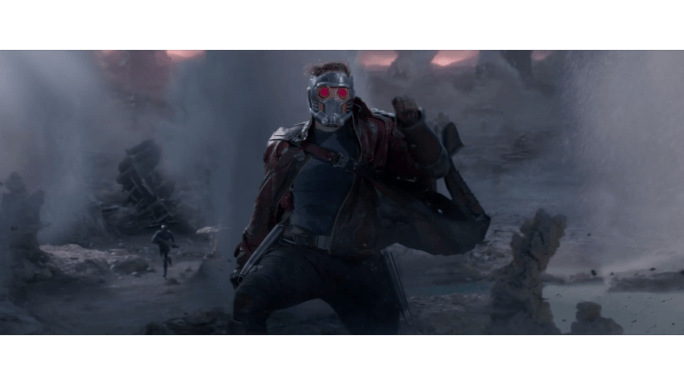
We first meet Peter Quill as an eight-year-old boy losing his mother to cancer only to be subsequently abducted by a group of notorious space pirates led by a blue-skinned bandit known as Yondu Udonta (Michael Rooker). They raise the young boy to be a smuggler and an outlaw a la Han Solo complete with the self-applied moniker Star-Lord (Chris Pratt). He steals a mysterious orb and plans to sell it on the Nova Corps homeworld Xandar, ripping off Yondu in the process, which results in a hefty bounty being placed on his head.

Little does Quill know that this theft has caught the attention of several interested parties: Groot (voiced by Vin Diesel) and Rocket Raccoon (voiced by Bradley Cooper), a mercenary duo, and Ronan the Accuser (Lee Pace), a powerful Kree alien who wants the orb so that it can be handed over to Thanos (Josh Brolin), an even more powerful being last seen at the end credits of The Avengers, in exchange for destroying Xandar, his sworn enemies. To this end, Ronan sends Gamora (Zoe Saldana), a deadly assassin, to retrieve the orb.

However, Quill when crosses paths with Groot, Rocket and Gamora, the resulting chaos has them arrested by the Nova Corps and thrown into an outer space prison known as Kyln. It is here that they meet Drax the Destroyer (Dave Bautista), a warrior with a thirst for revenge on Ronan for killing his family. They form an uneasy alliance and break out of prison to sell the orb with Yondu, the Nova Corps, and Ronan and his trusted lieutenant Nebula (Karen Gillan) in hot pursuit.

With this film, Parks and Recreation’s Chris Pratt becomes a bonafide action star, deftly blending amusing quips with heroic feats. He does a nice job of also portraying Peter Quill as a man haunted by his past, like many of his cohorts. All of the Guardians have lost deeply personal things in their lives and this is what unites them – that, and saving their own lives and, by default, the galaxy. Zoe Saldana gets to portray yet another alien, but instead of being buried under CGI as she was in Avatar (2009), the actress sports a striking green look and a fierce attitude to match. A pleasant surprise comes from the casting of WWE wrestler Dave Bautista who is excellent as Drax, the gruff warrior that tags along with the rest of these ne’er-do-wells. It is a lot of fun to see this athlete bounce off of the other actors and who more than holds his own.

If Quill provides the film its heart, then Rocket provides the bulk of its humor, stealing almost every scene he’s in by not just getting to spout the bulk of the film’s funniest lines, but also the impressive CGI that brings him vividly to life so that he actually emotes convincingly. Special effects technology has finally caught up to Groot and Rocket, creating expressive, fully realized characters. Early on, you stop thinking of them as CGI characters and look at them as part of the team thanks to the voice work of Vin Diesel and Bradley Cooper who give Groot and Rocket distinctive personalities.

The banter between Quill, Rocket, Gamora, Drax, and even Groot is a large part of the film’s charm. Quill is the wisecracking smartass while Gamora is all business, Rocket has anger management issues, Drax doesn’t understand metaphors (making for some pretty funny exchanges between him and Quill), and Groot just says, “I am Groot” at key moments. Credit should go to the witty screenplay by Gunn and Nicole Perlman that plants the seeds of jokes early in the film only for them to successfully pay off later on.

There is a fantastic mix of character moments and visual eye candy in Guardians of the Galaxy as Gunn immerses us in this strange galaxy and the colorful characters that populate it. His production team has crafted a textured, lived-in universe that is rich in detail and drenched in atmosphere. The film’s vibrant color scheme is complimented by a stellar soundtrack featuring songs from the 1970s and 1980s via a mixtape in Quill’s vintage Walkman that also acts a touchstone to his childhood on Earth and memories of his departed mother. As a result, the songs run the gamut from commenting humorously on the action (“Hooked on a Feeling” by Blue Swede) to also adding poignancy to more reflective moments (“I’m Not in Love” by 10cc) as well.

The only problem I have with Guardians of the Galaxy is that its villainous trio isn’t all that interesting. Ronan and Nebula look cool, but the former is yet another power-mad baddie that Marvel likes trotting out in all of its films with only a few notable exceptions, and the latter suffers from Darth Maul syndrome – a character with a badass reputation but with very little actual proof of such. It’s no surprise that Loki and the Winter Soldier are the Marvel Cinematic Universe’s strongest villains – they both have deeply personal and compelling motivations for what they are doing, which is something that is lacking with Ronan. As for Thanos, he only gets a cameo this time out with hints that he might figure more prominently in either Guardians 2 or The Avengers 3, but that’s a long way off. Fortunately, our heroes are so interesting and so much fun to watch that the lack of substantial villains is a minor quibble at best.

Gunn has pulled off a real coup with this film. He maintains a tricky balancing act of creating a gonzo space opera full of weird characters and loaded with a dense plot while somehow making it palatable for mainstream consumption without compromise. After the debacle that was the Star Wars prequels, cinema needed a good space opera to expunge the bad vibes of George Lucas’ movies. Only Joss Whedon’s Serenity (2005) bravely stepped up and showed everyone how do it right, but now Guardians of the Galaxy joins it by providing an alternative for those hungry for an entertaining science fiction film, fulfilling a need that Lucas was unable to with his prequels.

Guardians of the Galaxy is an unabashed science fiction film full of exotic aliens, power-hungry villains, and exciting spaceship battles with the fate of the entire galaxy at stake. It is also a funny film – as close as Marvel has come to making a full-on comedy. Their other films have had humor, but were largely dramatic in nature. Guardians inverts this formula so that it is largely comedic with dramatic moments and the result is another entertaining and engaging film from Marvel who continue their impressive winning streak. More importantly, this film opens up the Marvel Cinematic Universe in a big way by introducing an entire galaxy for its increasing number of characters to inhabit.

UNFAITHFUL – A REVIEW BY J.D. LAFRANCE

unfaithful_15

Sometimes it’s frustrating being a Diane Lane fan. For an actress so talented, she appears in a lot of dreck. For every The Outsiders (1983) or A Walk on the Moon (1999), there are three or four Must Love Dogs (2005) type clunkers. Yet, she gamely plugs along, turning in consistently good performances in even the most routine films (Murder at 1600). With Unfaithful (2002), she finally found material that could challenge her by portraying a fascinatingly flawed character in a provocative film. It was a remake of Claude Chabrol’s 1968 film, La femme infidele and was directed by Adrian Lyne, a filmmaker not afraid to court controversy by bringing a European sensibility to sex and sensuality in films like 9½ Weeks (1986), Indecent Proposal (1993), and Lolita (1997). With Unfaithful, he proposed a simple yet intriguing premise: why would a woman with a successful, loving husband and nice child threaten this security with an illicit affair with another man? While his film ultimately conforms to clichéd thriller conventions, Lane transcends the material with a career-best performance that garnered her all kinds of critical accolades and awards, chief among them an Academy Award nomination.

Constance Sumner (Lane) has it all: Edward (Richard Gere), a handsome husband with a successful business in New York City, and Charlie (Erik Per Sullivan), an adorable son. They live in a beautiful house on a lake outside of the city. Not to mention Connie has a body most women her age would kill for. The worst you could say about Connie and Edward’s marriage is that it’s gotten routine. They obviously still love each other and have that familiar shorthand that couples do after living together for years. For example, one morning she notices that he’s wearing a sweater inside out and lets him know before he goes off to work. We first see her in the midst of domesticity, doing the dishes and getting Charlie ready for school. She’s loving and supportive towards her husband and child.

Diane Lane and Richard Gere play this sequence well and are quite believable as a married couple by the way they interact with each other. Lyne inserts little details to reinforce their comfortable domesticity, like how Connie stops the dog bowl from moving around as their pet hungrily chows down on his food – it’s a move that looks like she’s done many times over the years. It also didn’t hurt that Lane and Gere were paired up previously in Francis Ford Coppola’s The Cotton Club (1984) and while they didn’t have much chemistry together on that film, they at least had something to build on.

One particularly windy, blustery day, Connie goes into the city to run some errands and literally runs into a young man (Olivier Martinez) carrying an armful of books. They both go sprawling and she ends up scraping her knees. He invites her up to his apartment so that she can tend to her wounds and call for a taxi. His offer isn’t difficult for her to accept. He’s gorgeous looking and has a sexy French accent. Paul is a book dealer who just happens to look like fashion model – of course he does or how else are the filmmakers going to explain Diane Lane cheating on someone like Richard Gere? Paul is aloof and accommodating but when Connie goes off to use his telephone, he checks her out. The camera adopts his point-of-view, slowly moving up her long legs to her face. No one can quite make a trenchcoat look sexy like Lane does in this scene.

Paul startles Connie by gently placing an ice pack on her knee and first physical contact is made. The look she gives him, a sly smile, makes you wonder if it is at this moment that she first thinks about having an affair with this man. The extremely windy day that starts off this scene is a harbinger, an ominous warning of how turbulent Connie’s life will become once she accepts this man’s invitation. After this alluring encounter, Connie comes home to reality: toys lying around, the dog roaming around and her son watching television. Later, she and Edward try to make love but are interrupted by Charlie – the ultimate mood killer.

Home alone during the day, she checks out the book Paul gave her and inside is his business card. On an impulsive whim, she takes the train into the city and calls him on a pay phone. Paul invites her over and Connie accepts, turned on by the attention she is getting from this mysterious, attractive young man. Once there, he slyly puts the moves on her, taking off her coat so that his fingers brush up against her neck. Lane is excellent in this scene as she conveys the excitement her character feels being with this man, the apprehension of being unsure of what she’s doing, and the inner turmoil as you can tell that she’s trying to decide whether to leave or stay. Ultimately, Connie leaves and visits her husband at work, giving him a present out of the guilt she feels for seeing Paul.

She visits him again and he excites her in the way he looks and touches her. Paul looks at Connie in a very seductive way that makes her feel wanted and desired – something that she doesn’t feel with Edward. She has a moment of conscience where she tells Paul that what they are doing is a mistake, to which he replies, “There’s no such thing as a mistake. There’s what you do and what you don’t do.” Connie leaves and then comes right back to get her coat. Before she can say anything, Paul embraces here and literally sweeps her off her feet. Lyne does an interesting thing here. Instead of just showing their subsequent love scene, he breaks it up by intercutting Connie’s train ride home, juxtaposing her emotional reaction to what she’s done with the act itself. As he demonstrated with 9½ Weeks, Lyne certainly knows how to capture the erotic intimacy of a sex scene.

Lyne shows Paul gently touching Connie’s body, which is trembling in fear and excitement. The emotional turmoil that plays across Lane’s face is astounding as she displays a vulnerability that is quite raw. This gentle foreplay segues into something more primal as Connie attempts one more time to stop this and Paul tells her to hit him so that her aggressive passion that he knows lurks under her conflicted surface will take away her fear. It does as she pummels him and this gives way to passionate kisses as she hungrily devours him. This is intercut with Connie’s train ride home as she reflects on what she’s done. The range of emotions that play across her face as she replays it over in her mind is incredible to watch. She smiles to herself and her hand absently runs across her chest. Her mood darkens ever so gradually before lightening again as she smiles and then breaks out into a laugh. Finally, her face takes on a slightly sad expression. In only a few moments, she has run a whole gamut of emotions and pulls it off masterfully.

Edward has been married to Connie long enough to sense when something is off with her. Early on, he doesn’t have any definite indicator that something is amiss except for a possible small lie that she told him. But it’s enough for him to ask her one night if she loves him. Richard Gere asks Lane in such a way that your heart goes out to his character. He’s done nothing wrong while she’s off having an affair with another man.

Lyne orchestrates another fascinating montage that juxtaposes Connie spending time with Edward and her son at their home with her spending time with Paul in the city. She has fun with both men but in different ways. With Edward, she feels safe and secure in domesticity, and with Paul, she feels excited and passionate. Ultimately, she is looking for someone who can make her feel both safe and passionate. Connie’s affair emboldens her to take unnecessary risks, like kissing Paul in a public place and, by chance, one of the men (Chad Lowe) that works with her husband sees them.

As he demonstrated in both 9½ Weeks and Indecent Proposal, Lyne really knows how to photograph women and bring out their beauty. Unfaithful is no different as he does an incredible job of conveying Lane’s beauty, both naked (the scene where she takes a bath) and clothed (she can even make wearing a t-shirt and jeans look sexy). It is the way he lights her and the angles he uses that bring out her natural good looks. Lane has never looked or acted so well.

When Edward suspects that Connie isn’t being truthful with him yet again, he checks up on her excuse and finds out that she lied to him. To add further risk, when she’s in the city to meet Paul for another tryst, Connie runs into a friend of hers with a co-worker. Unable to ditch them, they all go out to lunch. Connie calls Paul and tells him what happened and he shows up. On the spur of the moment, they have sex in a bathroom stall. Lyne shows a playful side during this scene as he cuts between Paul and Connie’s brief but passionate bout of sex and Connie’s friend talking to her co-worker about how good Connie looks, which is rather obvious. As Edward’s suspicions grow, he decides to have Connie followed and what he finds out and how he acts on it, changes the entire complexion of the story and the film.

The longer the affair goes on, the more selfish Connie becomes and she loses sight of what’s important to her – Edward and Charlie. She has become addicted to her rendezvous with Paul as he consumes her thoughts to the point where she even gets jealous when she spots him with another woman. Connie becomes more desperate and her behavior more erratic as the affair continues.

Richard Gere has the thankless role of playing the spurned husband and he does a good job of eliciting sympathy early on. Edward may not be has handsome as Paul but, c’mon, it’s Richard Gere! The man has aged incredibly well and looks handsome no matter how many frumpy sweaters Lyne tries to put him in. Gere’s finest moment in Unfaithful is when his character confronts Paul. Edward starts off angry but Gere doesn’t chew up the scenery – it’s a slow burn as Edward questions Paul and then he gradually becomes unglued. Gere has to convey a wide spectrum of emotions in this scene and does so quite expertly. From that scene on, his character undergoes a very profound change and it is interesting to see how Gere plays it out.

After years of playing heroic roles in films like Judge Dredd (1995), Lane began to seek out projects that gave her the chance to play more flawed characters. In many respects, A Walk on the Moon was a warm-up for her role in Unfaithful. In that film, she played a 1960s housewife who gets caught up in the sexual revolution of the era and cheats on her husband with a good-looking traveling clothes salesman. Whereas her character’s motivation was clearer in that one, it is more ambiguous in Unfaithful. In fact, Lyne cast Lane based on her work in A Walk on the Moon in which he found her to be “very sympathetic and vulnerable.”

During the production, Lyne fought with 20th Century Fox over the source of the affair. Executives felt that there needed to be a reason while the director believed that chance played a large role. Early drafts of the screenplay featured the Sumners with a dysfunctional sexual relationship and the studio wanted them to have a bad marriage with no sex so there would be more sympathy for Connie. Lyne and Gere disagreed and the director had the script rewritten so that the Sumners basically had a good marriage. He said, “The whole point of the movie was the arbitrary nature of infidelity, the fact that you could be the happiest person on Earth and meet somebody over there, and suddenly your life’s changed.”

When it came time to assemble the crew for this film, Lyne asked director of photography Peter Biziou, with whom he had made 9½ Weeks, to shoot Unfaithful. After reading the screenplay, Biziou felt that the story lent itself to the classic 1.85:1 aspect ratio because there was often “two characters working together in frame.” During pre-production, Biziou, Lyne and production designer Brian Morris used a collection of still photographs as style references. These included photos from fashion magazines and shots by prominent photographers.

Initially, the story was set against snowy exteriors but this idea was rejected early on and the film was shot from March 22 to June 1, 2001 with Lyne shooting in sequence whenever possible. Much of the film was shot in Greenwich Village and Lyne ended up incorporating the city’s unpredictable weather. During the windstorm sequence where Connie first meets Paul, it rained and Lyne used the overcast weather conditions for the street scenes.

Lyne also preferred shooting in practical interiors on location so that, according to Biziou, the actors “feel an intimate sense of belonging at locations,” and use natural light as much as possible. A full four weeks of the schedule was dedicated to the scenes in Paul’s loft which was located on the third floor of a six-story building. Biziou often used two cameras for the film’s intimate sex scenes so as to spare the actors as little discomfort as possible. For example, Olivier Martinez wasn’t comfortable with doing nudity. So, to get him and Lane in the proper frame of mind for the sex scenes, Lyne showed them clips from Five Easy Pieces (1970), Last Tango in Paris (1972), and Fatal Attraction (1987). The two actors hadn’t met before filming and didn’t get to know each other well during the shoot, a calculated move on Lyne’s part so that their off-camera relationship mirrored the one of their characters.

Lyne tested his cast and crew’s endurance by using smoke in certain scenes to enhance the atmosphere. According to Biziou, “the texture it gives helps differentiate and separate various density levels of darkness farther back in frame.” Lyne used this technique on all of his films; however, on a set where cast and crew were filming 18-20 hour days, it got to be a bit much. Gere remembered, “Our throats were being blown out. We had a special doctor who was there almost all the time who was shooting people up with antibiotics for bronchial infections.” Lane even used an oxygen bottle for doses of fresh air between takes.

The last 25 minutes of Unfaithful slides dangerously into formulaic thriller territory, threatening to derail what had been up to that point an engrossing drama about an illicit affair. Why did Lyne feel the need to go in this direction? Did the studio influence his decision and mandate that he incorporate more commercial elements? Lane and Gere do their best to keep things on track and it’s a credit to their abilities that they keep us interested in what is happening to their characters as they transcend the material. In some respects, Unfaithful is a horror film for married couples or for people in some kind of long-term relationship as it shows the ramifications of cheating on one’s spouse. The tragic thing is that all of this could have been avoided if Connie and Edward just talked to each other openly and honestly about how they felt about things. After all, communication is the key to a successful marriage or any meaningful relationship. As Unfaithful shows, lies only complicate things and drive people apart. It’s a harsh lesson that Connie and Edward learn the hard way.

OCEAN’S THIRTEEN – A REVIEW BY J.D. LAFRANCE

Ocean_s_Thirteen_2007_BRRip2

Despite its impressive box office returns, Ocean’s Twelve (2004) was considered something of a disappointment by its director Steven Soderbergh who felt that the plot was too complicated. While not quite as fun as Ocean’s Eleven (2001), it was a fine film in its own right – one that had a more satisfying emotional pay-off and doesn’t deserve the lousy reputation that it seems to have. Ocean’s Thirteen (2007) was seen as a return to the fun, breezy vibe of the first film by bringing it back to Las Vegas with style. The result was a very satisfying conclusion to the Ocean’s films.

As the revenge picture cliché goes, this time it’s personal. When Reuben Tishkoff (Elliott Gould) is muscled out of a business deal by slick businessman Willy Bank (Al Pacino), resulting in a heart attack, Danny Ocean (George Clooney) and his crew reunite for one last job: to ruin the opening night of Bank’s casino, The Bank, by making sure he loses a huge amount of money, which involves rigging all the games and slot machines. Bank wants the Five Diamond Award – the top accolade for hotels and will do anything to get it. Danny and the boys use this as a way to get at Bank. To this end, they devise an elaborate plan with the help of their arch-nemesis Terry Benedict (Andy Garcia) who bankrolls the operation. They also bring in Roman Nagel (Eddie Izzard) from Ocean’s Twelve to crack a state-of-the-art artificial intelligence security system.

Soderbergh kicks things off rather stylishly as we get a beautiful shot of Rusty Ryan (Brad Pitt) walking across a runaway tarmac to an awaiting plane at dusk with the sky an impossibly deep dark blue that, accompanied by David Holmes’ groovy score, is absolutely breathtaking. Once again, the director shoots the hell out of the film by employing all sorts of zoom ins and outs, pans and split-screens that, along with a saturated color scheme, keeps things visually interesting.

This time out, Matt Damon gets a juicy subplot where he goes undercover as Lenny Pepperidge, the assistant to a Mr. Weng (Shaobo Qin as The Amazing Yen, also undercover), a very high roller, in order to get close to Bank’s lovely assistant, Abigail Sponder (Ellen Barkin). Part of his disguise involves wearing a ridiculous fake long nose – a sly fuck you to Harvey Weinstein who wouldn’t let Damon wear said nose for his character in Terry Gilliam’s The Brother’s Grimm (2005) because he felt it would obscure the actor’s good looks and hurt the film’s box office potential. Well, it didn’t hurt Ocean’s Thirteen box office as the film went on to gross a very respectable $311 million worldwide.

It is also a lot of fun to see Ellen Barkin reunited with her Sea of Love (1989) co-star Al Pacino. She appears to be having a good time playing a confident businesswoman succumbing to Damon’s “seductive” charms. It is also fun to see Pacino go off autopilot for a change and sink his teeth into a juicy bad guy role. Who else could Soderbergh get to pose as a credible threat to the likes of George Clooney and Brad Pitt but someone of the legendary star caliber like Pacino? He plays Bank like the offspring of his take on Ricky Roma from Glengarry Glen Ross (1992) and Gordon Gekko from Wall Street (1987) – a smooth-talking unscrupulous bastard. In another nice bit of casting, the inventor of the artificial intelligence security system is played by none other than Julian Sands, an actor whose big break through came in A Room with A View (1985), but whose career settled into mostly direct-to-home video fare so it was a pleasant surprise to see him appear in a big mainstream film like Ocean’s Thirteen.

Another amusing subplot involves Virgil Malloy (Casey Affleck, sporting a ridiculous-looking mustache) organizing a revolution/strike among the workers at a dice-making factory in Mexico. He goes from complaining about a lack of air conditioning to tossing Molotov cocktails on the strike lines. At one point, he and his fellow co-workers drown their sorrows at a local bar and Virgil asks them, “Have all of you forgotten Zapata?” He goes on to offer inspirational words that fire them up. How this whole subplot plays out is quite funny. In another nice twist, Terry Benedict is helping Danny out albeit with all kinds of conditions. After all, he resents Bank’s lack of taste and the competition he represents. There can only be on top dog in Vegas and Benedict clearly feels that he is the one. Andy Garcia looks like he relished the opportunity to be in on the joke instead of being the target as he was in the last two films.

While working on Ocean’s Twelve, Steven Soderbergh began thinking about Ocean’s Thirteen. He thought about how fun it would be to set it back in Las Vegas. The motivation to make the film was a desire to work with everyone again but all eleven cast members had to want to do it. Producer Jerry Weintraub contacted them 18 months before hand and told them filming would take place during the summer of 2006 and to clear their schedules. He was able to find a way to juggle all these movie stars’ busy lives and add Al Pacino and Ellen Barkin into the mix.

For the film’s story, Soderbergh felt that Danny and his crew weren’t driven entirely by money and that they would reunite for friendship and revenge. The director came up with the notion of Reuben being betrayed and his friends helping him out. Weintraub hired Brian Koppelman and David Levien to write the screenplay. They had written the script for Rounders (1998) and created the gambling television cable show Tilt, and so they were familiar with the world of con men and gamblers. Soderbergh and Weintraub were both big admirers of Rounders and the director met with the screenwriters in New York City over lunch. They talked about great con movies, the nature of heists, and how the characters had evolved since Ocean’s Eleven. Within minutes, Soderbergh knew they were who he wanted to write the script and were working on it within minutes: “There was not a long list of people that we thought could step into this specific universe and pick up the language and the sense of humor.”

Koppelman and Levien had spent years exploring Vegas culture and the gambling lifestyle. They had every book they could find about con artists and thieves. Early on, Soderbergh told them that he wanted the film’s focus to be on the friendship between Danny and his crew. They understood that getting revenge on Willy Bank was what drove the entire story of Ocean’s Thirteen. They also wanted to “’flip’ the casino so that the patrons would win every time, which would spell disaster for Bank.” Soderbergh also told them that the bad guy should be a casino owner and they imagined Al Pacino and wrote Bank with him in mind. George Clooney also offered some ideas, mostly things to do with the revenge scheme that reunited the crew.

Some exterior scenes were shot in Las Vegas, but the casino interiors were mostly shot on one of the largest soundstages on the Warner Bros. lot in Los Angeles because it would have taken too long to film in actual casinos as they had done with Ocean’s Eleven. Soderbergh said, “In order to get the shots that I wanted, I needed to completely control the environment.” He instructed production designer Philip Messina to build a hotel and casino that would reflect Bank and his huge ego. Messina decided to go with a quasi-Asian theme and make it visually overwhelming. He purposely broke the rules in Vegas by designing a multi-level gaming floor because the production didn’t have a lot of horizontal space to work with.

Like Ocean’s Eleven, Ocean’s Thirteen pays tribute to the classic era of Vegas as Danny and co. restore Reuben’s honor. He’s an old school player who still believes in following a code and prides himself in being part of a select group of insiders that got to shake Frank Sinatra’s hand back in the day. Like Benedict, Bank represents the current corporate mentality of making money over the personal touch that the Mob-run casinos used to provide. If the first two films were about Danny and Rusty’s respective relationships with the loves of their lives, then Ocean’s Thirteen is about their friendship with Reuben. He mentored them when they were just starting out and taught them about respecting history as well as those who came before them. Like with the previous films, going after the bad guy is a matter of personal honor and hitting them where it hurts – in Bank’s case it’s his monster ego. Ocean’s Thirteen ends much like Ocean’s Eleven did thus bringing the trilogy full circle and with a truly satisfying conclusion as the bad guy gets what’s coming to him and Reuben’s honor is restored. Likewise, the film did very well at the box office and garnered fairly positive reviews going out on a well-deserved high note. It serves as an example of a star-studded big budget Hollywood film that entertains without insulting your intelligence.

OCEAN’S TWELVE – A REVIEW BY J.D. LAFRANCE

Brad-Pitt-in-Ocean-s-Twelve-brad-pitt-15567639-853-480

After the commercial failures of Full Frontal and Solaris in 2002, there was pressure on Steven Soderbergh when he announced that his next film was to be the sequel to the wildly successful Ocean’s Eleven (2001), to not only come up with a box office hit but to also outperform the previous film. With big budget, star-studded casts like the one in Ocean’s Twelve (2004), there is always the danger of having them look too smug and self-indulgent instead of having fun along with the audience. Ocean’s Eleven managed to straddle this line quite well, resulting in an entertaining popcorn movie. Soderbergh kept his cast in check, never letting them go too far over-the-top and shooting it with a style that was always interesting to watch. The big question for the sequel was if he could pull off the same feat without repeating himself too much. Ocean’s Twelve ended making less than its predecessor (but still a lot of money) and cost more while also dividing critics but in some ways I find it a better film.

Danny Ocean (George Clooney) is supposed to be retired and enjoying domestic bliss with Tess (Julia Roberts). However, old habits die-hard and the lure of pulling heists is always calling. She catches him casing a jewelry story on their anniversary. To make matters worse, Terry Benedict (Andy Garcia) is still hot on their trail, tracking down all of the original eleven and letting them know, in his own casually menacing way, that he wants the $160 million, plus interest, that they stole from him in Ocean’s Eleven, and in two weeks time. The montage of him doing this mirrors the one in the first film where Danny and Rusty recruited their crew. If Benedict was an imposing figure in the first film, Andy Garcia makes him even more of a threatening presence in this montage by doing little except exude menace with his eyes and the all-business tone of his voice.

So, Danny gets everybody back together to figure out what to do. Obviously, they need to pull another job but they are too high profile in the United States, so they go to Europe and cross paths with a truly formidable opponent and rival master thief known as the Night Fox (Vincent Cassel), a bored French playboy. He’s jealous of Danny’s status as the world’s greatest thief and is out to prove that he’s the best by having the both of them go after the same thing: the Faberge Imperial Coronation egg. Vincent Cassel plays the Night Fox as an ultra-confident, cocky man in such a way that you want to see Danny and company knock him down a peg.

Ocean’s Twelve
ups the difficulty level for our heroes even more by having most of the crew neutralized leaving only Basher (Don Cheadle), Linus (Matt Damon) and Virgil (Scott Caan) left to pull off an impossible heist. So, they bring in Tess to pose as, well, Julia Roberts. Unfortunately, another major movie star is staying at the same hotel, which only adds to the meta aspect. Said movie star gamely plays a fictional version of himself. The scene where he meets Tess as Julia Roberts is very amusing as Damon and Roberts act all star-struck in front of him. It is also interesting in that the meta aspect that was present in Ocean’s Eleven is made even more explicit – something that turned off some critics and audiences but I think works extremely well because Soderbergh isn’t having a cutesy cameo of a movie star for the sake of it but actually incorporating them into the plot and making them an integral part of the scam.

If the first film was about Danny’s redemption by reconciling with Tess, then Ocean’s Twelve is about Rusty’s (Brad Pitt) redemption by reconciling with his past love, Isabel Lahiri (Catherine Zeta-Jones), a determined and quite beautiful Interpol agent. Like Danny’s feelings for Tess potentially compromising his involvement in the heist in Ocean’s Eleven, Rusty’s feelings for Isabel leaves him potentially vulnerable in Ocean’s Twelve. To her credit, Catherine Zeta-Jones fits right in with the European vibe, maintaining just the right mix of determination in nailing Danny and his crew and vulnerability when she’s with Rusty. Their relationship elevates the film ever so slightly above the standard heist story and the conclusion of her subplot is surprisingly emotional and poignant – the highpoint of the trilogy and something you don’t expect from a film like Ocean’s Twelve, which is essentially a feature-length lark.

Matt Damon demonstrates excellent comic timing in this film and is the real stand-out of this strong cast. Early on, Linus asks Rusty if he could have more to do this time out and this moment comes across as quite self-reflexive. It’s as if Damon were almost asking if he could have more screen time in the film itself. In some respects, he is the group’s stammering conscience. There is an amusing scene where Linus, Danny and Rusty meet a contact by the name of Matsui (Robbie Coltrane) for a potential job. Danny, Rusty and Matsui all speak cryptically, which leaves poor Linus totally confused. Damon plays the scene so well as he looks desperately to his cohorts for help or some sort of clue as to what he should say. Put on the spot, Linus finally responds by quoting lyrics from “Kashmir” by Led Zeppelin to hilarious effect.

While doing a press conference in Rome during the promotional tour for Ocean’s Eleven, Steven Soderbergh fell in love with the city and over dinner with producer Jerry Weintraub began thinking about the story and structure for a sequel. He got the idea to set it in Europe and was so inspired that he started writing down ideas. After returning to Los Angeles, Weintraub discovered George Nolfi’s screenplay, entitled Honor Among Thieves, about the greatest thief in America going up against his equal in Europe. It was originally developed for John Woo to direct but Weintraub sent the script to George Clooney, Brad Pitt and Soderbergh. The director came up with the basic idea for the film and thought that it “would be more fun if Twelve was the movie in which everything goes wrong from the get-go.” He ended up merging Nolfi’s script with his own ideas. Soderbergh saw this film as more emotional, character-driven and complicated on a narrative level than the first one.

Prior to the start of principal photography, which lasted 77 days, Julia Roberts found out that she was pregnant and Soderbergh incorporated it into the script. He also met with Vincent Cassel at the 2003 Cannes Film Festival and asked the actor if he would be interested in being in Ocean’s Twelve. He agreed without reading the script because he trusted someone with a reputation like Soderbergh’s. Once filming began, the production spent ten weeks globetrotting all over the world with stops in Chicago, Amsterdam, Paris, Monte Carlo, Lake Cuomo, and Rome. Principal photography concluded with four weeks on three Warner Brothers soundstages in L.A.

Once again Soderbergh keeps the pace brisk and breezy, making the two-hour running time fly by. Like its predecessor, Ocean’s Twelve is beautifully shot with atmospheric lighting and saturated color as evident in the bright yellow that permeates Isabel’s Europol lecture or the green lighting that illuminates the underwater sequence during a heist that Danny and his crew pull off, or the red lighting that dominates the nightclub where Rusty and Isabel meet. Most of the film takes place in Europe and Soderbergh adopts the look of a European film from the 1960s, which also applies to the eclectically groovy soundtrack from David Holmes that evokes a ‘60s Euro-lounge vibe. The director even described the film’s aesthetic as “the most expensive episode of a ‘60s television show ever.” He and Holmes agreed that the score would be completely different from Ocean’s Eleven in order to complement the different look and feel.

Soderbergh is an excellent visual storyteller and this is evident in several scenes that he depicts without any dialogue, instead resorting to music married to visuals that conveys exactly what’s going on. He understands the kind of movie he’s making and doesn’t try to be too cute or wink knowingly at the audience, instead focusing at the task at hand: making a confident, entertaining movie. Granted, Ocean’s Twelve is no Traffic (2000), and it’s not meant to be, but you could do a lot worse with two hours of your time.