CALIFORNIA SPLIT – A REVIEW BY J.D. LAFRANCE

californiasplitgould

“I’ve had a couple of good wins, but they don’t compare to the losses. People only remember the wins.” – Robert Altman

In the 1970s, Elliott Gould and Robert Altman were an unbeatable team. They first worked together on M*A*S*H (1970), a savage satire of the military, then again on a radical, contemporary reworking of Raymond Chandler’s novel The Long Goodbye (1973), and finally completed the hat trick with California Split (1974), an ode to obsessive gamblers. For years, this film has been relegated to obscurity, showing up occasionally on television and tied up in legal issues over the music, which delayed its release on DVD.

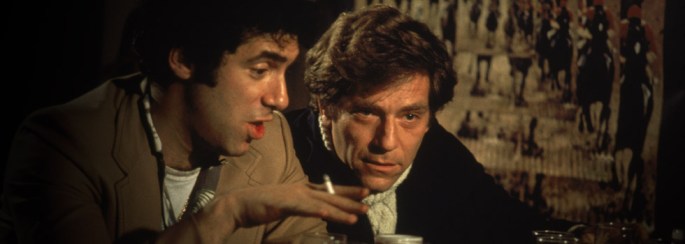
A nice, self-reflexive moment kicks things off: gambler and card shark, Charlie Waters (Elliott Gould) is killing time before a poker match by watching an instructional video on the game. The voiceover narration intones, “It has been said that everyone in America understands poker or wants to. It is one of America’s most popular games and since you’ve shown an obvious interest in coming here we have prepared a short film to teach you the fundamentals.” This voiceover could easily be talking to the audience watching this film as Altman introduces us to this world and the characters that inhabit it.

While this video is playing, Altman’s camera sweeps across the game room, setting the scene and introducing the film’s other main character, Bill Denny (George Segal). The video is also functional, providing a crash course on a couple of actual poker hands and the house rules. The opening poker game does a good job of showing the dynamics of professional poker playing and is also very funny as Charlie fleeces an irate player who then punches Bill, thinking that they are in league with each other. In a nice bit of business, a dazed Bill has enough sense to pick up his poker chips while all hell is breaking loose. For this scene, the poker club was built in a dance hall. Altman set up a few gambling situations and filmed them happening. None of the actual poker players’ dialogue was scripted.

Fed up with the unrealistic dialogue he and other actors were forced to say on a regular basis, struggling actor Joseph Walsh wrote a screenplay about his own gambling addiction in 1971. Steven Spielberg, fresh from directing the made-for-T.V. film Duel (1971), was originally supposed to direct. He and Walsh worked on the script every day for nine months. The director was fascinated by the characters and would react to Walsh’s script, offering suggestions. At the time, the screenplay was called Slide and the two men had a deal to make it at MGM with Walsh as producer and Steve McQueen in the starring role. The whole story was going to be set at Circus Circus in Las Vegas because the studio owned the casino.

A month before filming started, the studio experienced a shake-up at the executive level and with it came a new set of changes. MGM wanted the story to be a Mafia-related “sting” concept with Dean Martin as one of the two main characters. Walsh would no longer be the producer. He and Spielberg left MGM because he realized that they did not understand the point of the film: “I wanted the picture to be almost a celebration of the gambling, the joy of it, going along with it, and then, at the end, you could see where the trap comes in.” Spielberg and Walsh took the script to Universal Pictures where they had an agreement with executives Richard Zanuck and David Brown. However, Spielberg decided to work on another project called Lucky Lady (1975) leaving Walsh and his film stranded.

The writer’s agent, Guy McElwaine, contacted Altman’s agent, George Lito, and the director was given the script, read it and loved it. For years, he had wanted to do a gambling film with “the ambience of gambling, and then point out it had nothing to do with money.” He was drawn to Walsh’s script because he liked to gamble himself, his father was a gambler, and the director knew a lot of gamblers. David Begelman, the new studio chief of Columbia Pictures, was a former agent who knew Altman’s agent and greenlighted the screenplay to be made into a film. Walsh was a novice and unaware of Altman’s reputation for taking liberties with the scripts of for his films. However, Walsh was very protective of his script and argued with Altman numerous times over certain details. The only serious revisions to the script that the director made before filming were to background scenes. The writer had seen other Altman films and wasn’t always satisfied with how these scenes played out. He told the director that they could be changed but that he would rewrite them. Walsh wrote a full script for the background scenes, three to four page scenes for good actors to play.

George Segal was cast early on and Altman mentioned Gould but Walsh, even though he was childhood friends with the actor, held back. Altman and Walsh saw other actors, like Peter Falk and Robert De Niro, but kept coming back to Gould. Finally, the actor called Walsh and convinced him that he was right for the role. According to Walsh, on the set, Gould was full of confidence while Segal was insecure. The writer remembers that on the first day of shooting Gould “was there as that character…After seven days, George Segal came to me and said, ‘This guy’s [Gould] unbelievable. He’s an octopus. He is absolutely strangling me to death. I don’t even know what to do.’” Walsh told Segal that Gould had lived the life of his character and said, “Don’t try to act with him, don’t try to outdeal him…be off-base – just what you’re feeling – and it’s all working.”

Altman employed members of Synanon, the rehab organization of former convicts and addicts, as extras. The organization received a flat sum and delivered as many as needed each day. California Split marked the first time Altman experimented with the use of the eight-track sound system that allowed eight separate audio channels to be recorded and helped develop Altman’s trademark of overlapping dialogue. To this end, he gave the supporting actors and extras significant emphasis on the soundtrack. On the first day of shooting, the effort to keep eight separate channels clean and distinct made everyone very anxious. Haskell Wexler had originally been approached to shoot the film but Altman opted to go with relative newcomer Paul Lohmann who would go on to shoot Nashville (1975) and Buffalo Bill and the Indians (1976).

California Split
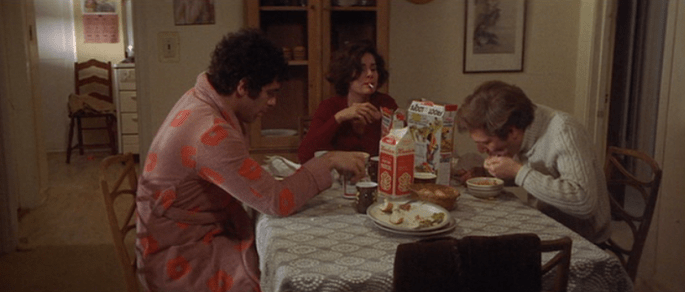
is one of Altman’s trademark character-driven films. It is less concerned with plot than behavior as we watch the friendship between Bill and Charlie develop over a mutual love of gambling. Charlie is a wisecracking joker and experienced gambler constantly looking for the next score. Initially, Bill isn’t as committed a gambler (he works at a magazine during the day) but he’s well on his way and hanging out with Charlie doesn’t help. As the film progresses and the two men hang out more, Bill starts to become more addicted to the gambling lifestyle. He blows off work early to meet Charlie at the track and sells his possessions for money. Bill and Charlie are gambling addicts who ride the high arcs and the low valleys, never passing up a bet. At a boxing match they put money on the outcome of the fight with a fellow spectator.

Those who know Elliott Gould and George Segal only from their contemporary sitcom appearances (Friends and Just Shoot Me, respectively), should see California Split if only to see these guys in their prime and working with a master filmmaker at the top of his game. Gould and Segal have never been better and play well of each other. There is good chemistry between them as Gould plays the more experienced gambler in contrast to Segal’s more naïve one.
justtalkingonthetelephoneCalifornia Split
is not afraid to show the ugly side of gambling. Bill sells his car and his possessions for a big poker game in Reno. Charlie exacts a rough, bloody revenge on the guy who mugged him at the beginning of the film. These are not always likeable guys and to Altman’s credit he doesn’t try to romanticize or judge them, leaving that up to the audience. Altman wanted to convey the empty feeling that winning from gambling gives these guys as he told Film Heritage magazine, “The mistaken feeling that winning…you can’t spend that money; you don’t go out and pay the milk bill with it unless you’re about to go to jail. It just means that you can play that much longer…In other words, it’s passes. It’s more tickets to the amusement park – that’s all it is.” California Split is arguably Altman’s loosest film in terms of plot and one of the richest in terms of character and observing their behavior.
ROCK ‘N’ ROLL HIGH SCHOOL – A REVIEW BY J.D. LAFRANCE

rock-n-roll-high-school_0

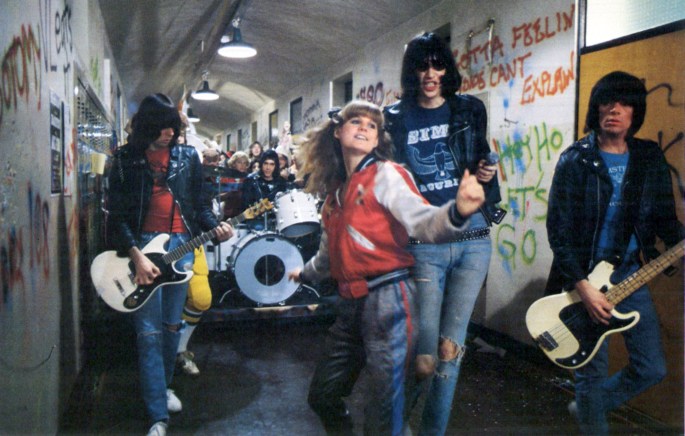
Hey Ho! Let’s Go! Listen up, kids. Rock ‘n’ Roll High School may have been released way back in 1979 but it still kicks the ass of any of those square MTV movies. Forget about Britney Spears and Mandy Moore’s brand of bubblegum pop music and their equally bland movies – they don’t hold a candle to the unbridled power of those punk rockers from New York City… the Ramones! Making a band the central focus of a film is nothing new. The Beatles did it with A Hard Day’s Night (1964) and The Monkees with Head (1968). Hell, the Spice Girls even did it with Spice World (1997). But to do it with an anti-social punk rock band like the Ramones?! And to have it produced by legendary B-movie mogul Roger Corman?! The results: a cult classic in the proud tradition of juvenile delinquent films of the 1950s.

Riff Randell (P.J. Soles) is the ultimate Ramones fan. She’s introduced gleefully bypassing Vince Lombardi High School’s PA system so that she can blast “Sheena is a Punk Rocker” to the entire school population. The energetic song wakes up the students, shatters glass, and shakes tables and pictures right off the wall. The school erupts into complete anarchy as the student body begins to spontaneous dance to the boisterous rock ‘n’ roll music. How kick ass of an opening sequence is that? It also does a great job of conveying the excitement and energy of the Ramones’ music.

Riff dreams of meeting the Ramones and giving them a song she wrote entitled, “Rock ‘n’ Roll High School.” She tries it out on her gym class causing all the girls in their skimpy gym outfits (ah, Corman and his exploitation tendencies) to dance around in what can only be described as the greatest gym class ever.

Riff even camps out for days to get tickets for the Ramones’ upcoming concert while her best friend, Kate Rambeau (Dey Young) covers for her by telling the nasty, shrewish Principal Togar (Mary Woronov) that various members of Riff’s family have died. Not surprisingly, Togar doesn’t fall for it and takes Riff’s ticket away, forcing the two girls to find another way to meet their heroes. Meanwhile, good girl Kate has a major crush on the school’s quarterback, the bland Tom (Vincent Van Patten), but he has his sights on the dynamic Riff.

The film was originally called Girls Gym, then it was changed to Disco High by Corman, who wanted to capitalize on the disco craze, but was (fortunately) persuaded otherwise by director Allan Arkush. Originally, the filmmakers wanted Devo and then Van Halen before approaching the Ramones. They finally settled on Rock ‘n’ Roll High School after Arkush convinced Corman that the Ramones were the perfect band for the film. To their credit, the Ramones knew that it was the right move. Guitarist Johnny Ramone was a huge fan of Corman’s films and when he heard that the producer was behind the film, he agreed to do it. And the rest, as they say, is history.

Rock ‘n’ Roll High School
does a great job of playfully championing the Ramones as rock gods and yet shows them being accessible to their fans as well. The band first appears in a car driving down the street on the way to their venue as they play “I Just Wanna Have Something To Do.” Once outside the club, they get out of the car and interact with the crowd of ticket buyers (who were, incidentally, actual Ramones fans). The editing, coupled with the insanely catchy song, gives the scene an infectious energy that is so much fun to watch. Incidentally, Dean Cundey was the film’s cinematographer and he would go on to shoot some of John Carpenter’s best films, including Halloween (1978) and Escape from New York (1981).

From B-movie veterans like Paul (Eating Raoul) Bartel and Mary (Death Race 2000) Woronov to newcomers (at the time), P.J. (Halloween) Soles and Dey (Strange Invaders) Young, the entire cast has a lot of fun spouting the film’s wonderfully inspired cornball dialogue (“If you don’t like it, you can put it where you the monkey puts the nuts,” Riff says defiantly to Togar at one point) courtesy of National Lampoon magazine writers Richard Whitley and Russ Dvonch. I would be remiss without also mentioning the presence of Corman regular Dick Miller (as a cop) and Clint Howard who plays matchmaker for Tom. The Ramones are good sports and mumble their way through the film and truly come alive during the music sequences like the pros that they are. This film rightfully cements their reputation as legends.

Shot in only 15 days (which, when you think about it, is entirely appropriate for this kind of film), Rock ‘n’ Roll High School embodies the essence of the punk rock music that made the Ramones famous. The film is bursting with youthful energy, a dose of good ol’ fashion anarchy, and is loads of fun to watch. These are also the ingredients that made Rock ‘n’ Roll High School a cult film. Corman cannily marketed it as a Midnight Movie in the hopes that the same people who flocked religiously to The Rocky Horror Picture Show (1975) would come to see the Ramones. It was a modest commercial success upon its initial release and actually garnered critical praise – very unusual for a cult film.

While Rock ‘n’ Roll High School will appeal predominantly to fans of the Ramones (duh!), it is also one of those fun, goofy movies to invite friends over and watch with copious amounts of junk food on hand. This film is all about loving music and a particular band unabashedly. Riff gives herself up to the music and this translates into an enthusiastic celebration of the Ramones and the rowdy, rebellious spirit of rock ‘n’ roll music. Repeated midnight screenings, coupled with steady appearances on T.V., have helped the film endure over the years so that is has become a beloved cult classic.

HELLBOY – A REVIEW BY J.D. LAFRANCE

hellboy-movie-screencaps.com-3473

The success of X-Men (2000) and Spider-Man (2002) opened the door for a new wave of comic book adaptations. In the past, studios have played it safe and only green-lighted adaptations of mainstream comic books with large followings. However, this changed with adaptations of independent fare like Ghost World (2000), American Splendor (2003), and with Hellboy (2004). Based on Mike Mignola’s comic book of the same name, the title has a dedicated cult following at best so it was a pleasant surprise to see a major studio take a big budget gamble with it.

October 1944. The Nazis have begun mixing science with black magic in a desperate attempt to regain the advantage in World War II. The seemingly invincible Russian, Rasputin (Karel Roden) has teamed up with the Germans and plans to open a portal to another dimension and bring about an apocalypse. However, American troops arrive and disrupt the procedure just in time. In the process, something comes through: a red-skinned demon baby that the soldiers adopt and call Hellboy.

With the World War II prologue, director Guillermo del Toro does two important things: he vividly introduces this colorful world and the characters that inhabit it by creating just the right moody atmosphere and with detailed production design and excellent special effects. Secondly, Del Toro establishes the film’s mythology and what exactly is at stake through a clever mix of science fiction and the supernatural. He does this via an exciting action sequence as a young Dr. Broom and U.S. soldiers confront Rasputin and the Nazis.

Present day. Rasputin has been resurrected and continues his plans to summon destructive supernatural forces that will result in the end of the world. Hellboy (Ron Perlman) has matured (sort of) and now works for the Bureau for Paranormal Research and Defense (BPRD) in New Jersey — under the guise of a waste management company (just like Tony Soprano). Along with Abe Sapien (Doug Jones with an uncredited David Hyde Pierce doing the voice), an amphibious humanoid (“the fish guy” as a guard puts it), firestarter Liz Sherman (Selma Blair), and the token “normal guy,” John Myers (Rupert Evans), Hellboy tracks down Rasputin and tries to prevent him from fulfilling his nefarious goals.

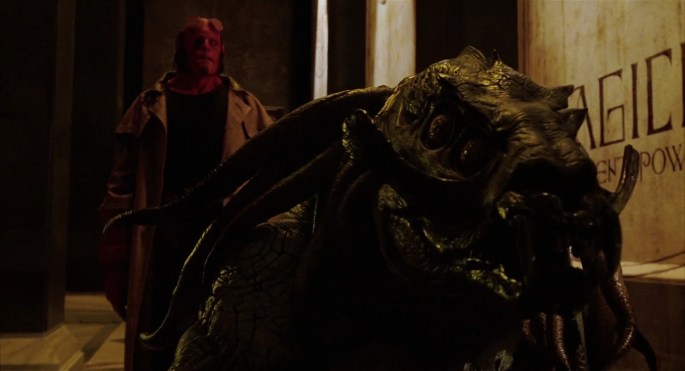
Del Toro, a die-hard comic book fan and self-described film geek, shoots the action sequences much like he did in Blade II (2002), with crazy camera angles and fantastically choreographed fights. Case in point, Hellboy’s extended tussle with Sammael (Brian Steele). It’s like Del Toro took panels right out Mignola’s comic book and made them move but with the same kind of explosive energy that made Jack Kirby’s art so exciting. Del Toro also has incredible production design at his disposal to create a fully realized world rich in detail and drenched in atmosphere. He is heavily influenced by Italian horror films and not only references Mario Bava’s Black Sunday (1960) but also the saturated primary color scheme of Dario Argento’s Suspiria (1977) to name just a couple of examples. This is a great looking film, from the warm colors and ornate architecture of the library where Abe Sapien resides, to the darker, colder colors of Rasputin’s mausoleum in Moscow.

Del Toro was shooting Mimic (1997) and discovered the Hellboy comic book but never thought that it could be made in Hollywood and if it did they would ruin it. He heard that it was going to be adapted into a film at Universal Pictures and started writing a screenplay in 1997. He met Mike Mignola when they worked together on Blade II, which they used as their “rehearsal” for Hellboy. They found out that they read the same comic books and pulp and classic gothic horror novels. With Hellboy, Del Toro wanted to make a self-contained film, “almost a fairy tale, a fable.” His original pitch to executives at Sony-based Revolution Studios was that both The Mask (1994) and Men in Black (1997) were comic books that they were not familiar with and yet went on to become extremely successful films. He told them that the same thing could happen with Hellboy. In April 2002, Del Toro’s film was given the green-light at a budget of $60 million.

Del Toro first saw Ron Perlman in Quest for Fire (1982) and then The Name of the Rose (1986) and was very impressed with his acting, so much so that he ended up casting the actor in his first film Cronos (1994). Del Toro initially wanted him to play Hellboy but Vin Diesel was a rising star at the time and so the director approached him instead for the role. However, with the move from Universal to Revolution, Diesel dropped out of the picture and Perlman was in. Early on, if the actor didn’t work out, Del Toro thought about making Hellboy a mixture of puppet and computer graphics. He talked to James Cameron who warned him that if he went that route he would lose the love story. Del Toro wisely decided to stick with Perlman.

Perlman is perfectly cast as the cigar smoking, two-fisted action hero who eats Baby Ruth candy bars and loves cats. He does a great job of capturing Hellboy’s sarcastic, wise-cracking nature. Perlman gets to utter cool one-liners and looks fantastic in his make-up (thanks to legendary makeup artist Rick Baker). Often, what makes it to the film rarely resembles what was drawn in the comic book. Not the case here — Perlman IS Hellboy. With this role, he firmly established himself as one of the cult film icons of the new millennium (much like Bruce Campbell was in the 1990s). Perlman has got the drop-dead cool action hero shtick down cold. With his hulking, imposing physique, he’s Arnold Schwarzenegger with brains and irony.

Del Toro cast Selma Blair because he always saw a “haunting quality in her eyes and in her look. Sort of a doomed, gothic beauty in her.” He was a fan of The Larry Sanders Show and felt the Jeffrey Tambor had that “smarmy, wannabe bureaucratic presence” that was ideal for Tom Manning. He cast Tambor against type and wanted him to be an “absolute asshole in the beginning, and play it straight.” Del Toro and Mignola created the character of Myers to guide audiences into Hellboy’s world. The director interviewed a lot of young Hollywood actors but many of them were “just too cute and too Calvin Klein beautiful to put in the movie.” He liked Rupert Evans because he had “such an open face, and he had a real innocence about him.” Del Toro saw John Hurt in Love and Death on Long Island (1997) and felt that the actor had “that little air of tragedy about him” that suited Professor Bruttenholm.

hellboy-movie-screencaps.com-5535Hellboy is one of those rare comic book movies with depth. It takes time to develop its characters and the relationships between them. There is the touching father-son relationship between Hellboy and Bruttenholm and the romantic love triangle between Hellboy, Myers and Liz. While the film has the requisite slam-bang action sequences, it is not dominated by them. The film is not driven by them but rather by the characters and the story. And this is because Del Toro has strong source material to draw from: Mignola’s comic book, in particular “Seed of Destruction,” which chronicles Hellboy’s origins. Both Del Toro and Mignola’s works are steeped in the gothic and horror genres, in particular the fiction of H.P. Lovecraft. The author’s influence is all over this movie as Hellboy trades blows with Cthulhu-inspired creatures that would make ol’ Lovecraft proud. While Del Toro’s film didn’t exactly rack up the kind box office numbers the studio was hoping for, it did prove to be quite popular on home video and eventually spawn an even better sequel in 2008.

REALITY BITES – A REVIEW BY J.D. LAFRANCE

tumblr_nafg91N3AK1qdnfkpo1_1280

The early to mid-1990s was a period of time when popular culture was dominated by Generation X, from films like Richard Linklater’s Slacker (1990) to Douglas Copeland’s book, Generation X to the massive popularity of Seattle music spearheaded by Nirvana. During this decade three films were made that provided a fascinating spectrum of how this generation was depicted. On one end, there was Linklater’s low-budget independent film. On the opposite end there was the glossy, studio picture Reality Bites (1993). Somewhere in between was Singles (1992), which shared the big studio backing of Reality Bites but with the authenticity of Slacker.

I can remember when I first saw Reality Bites, I hated it. I had recently seen and was blown away by Slacker, which felt so authentic. In comparison, Reality Bites tried in vain to capture the essence of Gen-X, but came across more like an episode of Friends. Slacker presented everyday settings with realistic, albeit eccentric people, warts and all, while Reality Bites introduced perfect looking people with perfect problems. Now that some time has passed and the whole Gen-X thing has died down, I see Reality Bites in a different light now. When I think of the film, I think of the videos for “Stay” by Lisa Loeb and “Spin the Bottle” by Juliana Hatfield – the two big singles to come off the soundtrack album. Back in the day, it seemed like those two songs were everywhere. The film is still lightweight material but it has a more nostalgic vibe now as a dated piece of mainstream ‘90s culture. It’s a pretty decent snapshot of that time and reminds me a lot of what I liked about the decade.

Reality Bites
also features one of my favorite performances of Winona Ryder’s entire career. She had just come off making several period piece films and was clearly looking to do something contemporary, something that spoke to her generation. She used her star power to pluck an unknown screenwriter out of obscurity and, with the help of Ethan Hawke, got the film made where it would normally have languished in development hell for years. However, Reality Bites was seen as and marketed as a Gen-X film and its supposed target audience wasn’t interested in seeing their lives and interests writ large in a mainstream commercial film. It underperformed at the box office but has since gone on to develop a sizable following. I don’t want to say cult following because it isn’t that kind of film but it does have its fans.

Reality Bites
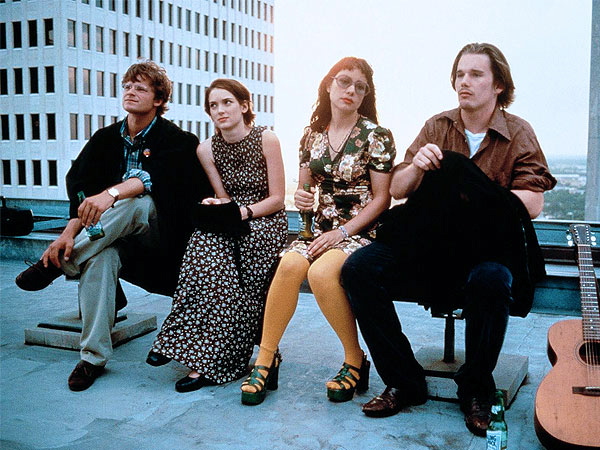
is about four college graduates dealing with life after school as they try to figure out what they want to do with the rest of their lives. Vickie (Janeane Garofalo) works as store manager at a local Gap. Sammy (Steve Zahn) is trying to figure out a way to tell his conservative mother that he’s gay. Troy (Ethan Hawke) is a struggling musician. Lelaina (Ryder) aspires to be a filmmaker and chronicles the ups and downs of her three friends for a documentary about her generation.

Lelaina, like her friends, is a child of divorce and her parents (Swoosie Kurtz and Joe Don Baker) want her to get a regular 9-to-5 job so that she can become a productive member of society. To pay the bills, she works as an assistant/gofer for a morning television talk show called Good Morning Grant! where she caters to the whims of its obnoxious host (played with two-faced gusto by John Mahoney). She’s roommates with Vickie and their friendship is summed up rather nicely in a scene where we see them singing along to Squeeze’s “Tempted” in Lelaina’s car. Who hasn’t done that with their friend(s) at some point in their lives? I don’t mean necessarily to that song but to music in general.

One day, she literally runs into Michael Grates (Ben Stiller), an executive at MTV wannabe, In Your Face TV, when they get into a minor car accident. She finds herself attracted to his inability to articulate a sentence much less a thought and he’s drawn to her nervous, awkward energy. It’s baffling what they see in each other but they’re both young and attractive and start dating. However, when Troy is fired from his day job, Vickie invites him to stay at their place (“Welcome to the maxi-pad.”) until he can find work, much to Lelaina’s chagrin (“That’s the American Dream of the ‘90s. That could take years!”). Me think she doth protest too much (“He will turn this place into a den of slack!”). See, Lelaina has a thing for Troy and he for her but they’re too busy getting on each other’s nerves in a meet-cute kinda way to do anything about it.

Lelaina’s first date with Michael has to be one of the most inarticulate ones ever put on film as they stammer their way through dinner. They each come up with some real gems to woo each other, like he tells her about how Frampton Comes Alive! changed his life while she explains why the Big Gulp is the most profound invention in her lifetime (?!). Maybe these two are really made for each other. As superficial as Lelaina comes across a lot of the time, Winona Ryder, with her adorable presence, keeps me interested and engaged. Away from Michael’s I.Q.-sucking black hole presence, Lelaina seems smarter.

When he’s not spending time pretending he can’t stand Lelaina, Troy writes awful, subpar Beck lyrics and quotes from Cool Hand Luke (1967). While he waits for her to realize that he loves her, he has sex with a succession of not-too bright groupies (one of them is a blink and you’ll miss her, Renee Zwelleger). Vickie also has a revolving door of sexual partners – so much so, that she gets an AIDS test and anxiously awaits the results – her character’s big dilemma that is resolved fairly quickly and a little too neatly.

Ben Stiller, in what was not only his first major acting gig, but also his directorial debut, does a good job of portraying a guy who means well but is so clueless when it comes to things that really matter. He isn’t afraid to come off as an idiot while also hinting that underneath it all Michael does appear to have the best intentions, he just goes about articulating them in all the wrong ways. Troy, on the other hand, is mean-spirited and channels his jealously in vindictive ways, like when he pretends to tell Lelaina that he loves her. The hurt that registers on her face, especially in her eyes, says it all, reminding one of how good a silent actress Ryder could have been if she had acted in another bygone era.

Ryder shows a capacity for comedy in a montage where Lelaina applies for a series of film and T.V.-related jobs featuring brief but amusing cameos by Andy Dick, Keith David, Anne Meara, and David Spade. Watching Ryder try to define irony under pressure always gives me a chuckle as does her interaction with Spade’s condescending burger jockey (“Ms. Pierce, there’s a reason I’ve been here six months.”). She was one of my earliest cinematic crushes and I know I shouldn’t like this film but dammit, she’s in vintage adorable Manic Pixie Dream Girl mode – smart and gorgeous with a vulnerable quality that I find irresistible. Sorry Natalie Portman, Zooey Deschanel and you other Pixie Dream Girls, Ryder is the original – accept no substitutes!

Coming from the world of stand-up comedy, Janeane Garofalo gets some of the film’s funniest lines (“I think I was conceived on an acid trip.”) and delivers them effortlessly like she was born to play Vickie. She also interacts well with Ryder and an even more interesting film would’ve been one where Vickie’s friendship with Lelaina was the focus. Obviously, others thought she had something special and for a brief while, Garofalo flirted with a mainstream film career with The Truth About Cats and Dogs (1996) and The MatchMaker (1997). Out of the four friends the one that suffers most in terms of screen time is Sammy. It often feels like his storyline was reduced so that more time could be devoted to the Michael-Lelaina-Troy love triangle. It’s a shame because Steve Zahn is such a gifted comedic actor with excellent timing and he’s given little to do in Reality Bites.

If I sound a little too harsh on Reality Bites, I don’t mean to be. The film does nail what it’s like to sit around with your friends, get high and comment ironically on old 1970s sitcoms. There is a fun bit where our four friends go out to get junk food and dance spontaneously to “My Sharona” by the Knack. It’s nice to see the normally reserved Ryder cut loose and act goofy. The film’s best scenes are the ones where all four friends are interacting with each other, bantering back and forth in a way that feels authentic and has a relaxed air that only comes from people who have known each other for some time.

In 1991, the producer of The Big Chill (1983), Michael Shamberg wanted to make a like-minded film for people in their twenties. He read Helen Childress’ Blue Bayou, a writing sample from the 23-year-old University of Southern California film school graduate. He liked it and wanted her sample to be the basis for his project. She met with him and told him about her life and friends and their struggle to find work during the recession that had hit the United States at the time. She had used her friends, their personalities and some of their experiences as the basis for her script. Shamberg, along with co-producer Stacy Sher, saw the pilot for The Ben Stiller Show and approached him to direct not act. At the time, Sher and Childress were developing the screenplay and had Lelaina and Troy figured out but couldn’t quite come up a credible character to complete the love triangle.

In February 1992, Shamberg sent Ben Stiller a copy of Childress’ script while he was editing the pilot for a show on Fox. He soon signed on to direct and worked with Childress for nine to ten months, developing her script. He suggested that he could play the third person in the love triangle. Over time, the Michael Grates character changed from a 35-year-old advertising man attempting to market Japanese candy bars in America to a twentysomething executive at a music video T.V. station. Childress and Stiller also changed the structure of the film, with the focus changing to the relationship between Lelaina and Troy while the stories about Vickie and Sammy, which were originally more fleshed out, were scaled back.

Childress and Stiller had a script that could be filmed by December 1992 and began shopping it around to various Hollywood studios all of whom turned it down because it tried to capture the Generation X market much like Singles had attempted to and failed. They finally got TriStar interested and began developing it there. The studio soon put it in turnaround. Childress, Sher and Stiller managed to convince the Film Commission of Texas to fund a location scouting trip to Houston despite no studio backing, no budget and no cast. As they arrived in the city, they got a call and learned that Winona Ryder had read Childress’ script. She wanted to do it and Universal Pictures agreed to finance the film. Coincidentally, Childress had Ryder in mind when she wrote the character of Lelaina.

The previous three films Ryder had made were period pieces and she needed a break. She wanted to do “something about people my age and in my generation growing up in today’s society.” She read Childress’ script while making The House of Spirits (1993) and it made her laugh: “It was very familiar to me – the way they talk, the attitude they have towards each other, the places they go. These were things I could relate to.” It was exactly the change of pace she wanted. At the time, Ethan Hawke’s career was in a rut after the buzz from Dead Poets Society (1989) had subsided. Up to that point, he had been known mostly for playing clean-cut characters and so the role of Troy would be something of a departure for him. Ryder was a fan of Hawke’s work and stipulated in her contract that he would co-star opposite her.

Stiller met Steve Zahn through Hawke as they were doing a play together at the time and was impressed by how funny he was. Zahn borrowed some money from his agent and went to Los Angeles to test for the film. He responded strongly to portraying a gay character coming out of the closet. Janeane Garofalo knew Stiller through their work together on his show and the producers felt that her style of comedy was perfect for the role of Vickie. According Garofalo, it came down to her, Parker Posey, Anne Heche and Gwyneth Paltrow. The studio loved and wanted Paltrow but Ryder liked Garofalo and had developed an instant connection with her.

tumblr_nn20i1aWFx1rkd2bio2_1280Ultimately, Reality Bites plays it too safe and veers dangerously close to being a feature-length sitcom by wrapping things up too conveniently. The characters often come across as superficial which tends to undercut the sincerity of the film’s message. Singles and the hilarious short-lived MTV sitcom, Austin Stories, were much more successful in documenting the trials and tribulations of Gen-X. And yet I’m oddly fascinated with Reality Bites, mostly because of Garofalo and Ryder. They play characters that deserve to be in a better film. I always thought that at the end of the film, Lelaina should’ve dumped both guys and stayed single. I mean, look at her options: Michael is a clueless T.V. executive that listens to generic gangsta rap and Troy is a pretentious wannabe musician that screws around with her emotions. Hell, she should’ve hooked up with Vickie, who is funny in wonderfully sarcastic way and digs ‘70s popular culture in a sincerely ironic way. Despite all of its flaws, I still enjoy watching Reality Bites when I just want to turn off my brain and let a film wash over me – junk food for the mind. Films like that have their place, too.

CRIME STORY – A REVIEW BY J.D. LAFRANCE

z9270693Q,Crime-Story

Fresh from the success of Miami Vice in the mid-1980’s, Michael Mann parlayed his powerful clout within the industry to produce a new television show entitled, Crime Story. It was a pet project that he developed with good friend Chuck Adamson and Gustave Reininger. Like Vice, Crime Story was a cop show but set in the early 1960s and with a grittier, darker edge as opposed to the stylish, brightly-lit pastel look of its predecessor. To this end, Mann not only cast Hollywood outsider Dennis Farina (whose unconventional looks must’ve terrified NBC executives), but had exploitation filmmaker Abel Ferrara direct the pilot episode. The result is a lean, mean drama that features politically incorrect police officers battling it out with nasty criminals.

The pilot episode for Crime Story begins with a daring restaurant robbery gone badly. Del Shannon sings “Runaway” (re-recorded especially for the show) as the hold-up turns into a hostage situation. Three police detectives led by Mike Torello (Farina) race to the scene (blink and you’ll miss a young Michael Rooker as a beat cop). No words are spoken between the men as they calmly check their guns and get ready. As the criminals are about to take off with their hostages, Torello leans in menacingly and says to one goon, “You hurt anybody else, when this is all over I’m gonna find what you love the most and I’m gonna kill it. Your mother, your father, your dog. Don’t matter what it is – it’s dead.” Welcome to the world of Crime Story.

It turns out that the criminals are working for local wise guy Ray Luca (Anthony Denison), a vicious thug with a short fuse and an awesome pompadour that defies gravity. This guy isn’t afraid to smash bottles and furniture over hapless underlings to get his point across. Luca plans to steal some valuable European royalty jewels from the Lakeshore Museum but Torello intends to link the restaurant robbery to the thug and stop the heist from going down.

Mann has said that he was influenced by working on the Police Story T.V. series (1973-1977), which was run by playwright Liam O’Brien and included famous crime writer, Joseph Wambaugh (who wrote The Onion Field) as a contributor. Each episode was based on a real event, working with the policeman whose story it was based on. Mann “learned a lot about writing and about working with real guys.” Crime Story was based on the experiences of Chuck Adamson, a former Chicago police detective of 17 years. He claimed that the stories featured on the show were composites rather than actual events that happened, “but they’ll be accurate.” According to Mann, the genesis of the project was to follow a group of police officers in a major crimes unit in 1963 and how they change over 20 hours of television. He asked Reininger and Adamson to write the series pilot and a “Bible.”

Reininger was a former Wall Street international investment banker who had come to Mann’s attention based on a screenplay he had written about arson investigators, and a French film that he had written and produced. Reininger researched Crime Story by winning the confidence of Detective William Hanhardt who put him in touch with undercover officers in Chicago. They sent him on meetings with organized crime figures. Reininger risked wearing a body microphone and recorder. After visiting the crime scene of a gruesome gangland slaying of bookmaker Al Brown, Reininger backed off his Mob interviews.

Mann said that the first season of the show would go from Chicago in 1963 to Las Vegas in 1980 where the characters would have “very different occupations, in a different city and in a different time.” He said, “It’s a serial in the sense that we have continuing stories, and in that sense the show is one big novel.” Mann and Reininger’s inspiration for the 1963-1980 arc came from their mutual admiration of the epic 15+ hour film, Berlin Alexanderplatz (1980) by German director Rainer Werner Fassbinder. Mann said, “The pace of our story is like the speed of light compared to that, but that’s the idea – if you put it all together at the end you’ve got one hell of a 22-hour movie.”

NBC President Brandon Tartikoff gave an order for a two-hour movie, which had a theatrical release in a handful of U.S. theaters to invited guests only. Tartikoff also ordered 22 episodes which allowed Reininger and Adamson to tell a story with developing character arcs, and continuing stories (instead of episodic, self standing shows). Mann predicted a five-year network run for the show. However, due to budgetary constraints (the need for four sets of vintage cars proved to be too expensive). Tartikoff eventually allowed their series to move to Las Vegas for the last quarter of the 22 episodes. By the second season, an average episode cost between $1.3 and 1.4 million because it was shot on location, set during the 1960s and featured a large cast.

However, they realized that it was too expensive to go through several different period changes in one season. Universal Pictures decided not to make Crime Story because they deemed it too expensive and a small studio called New World Pictures Ltd. stepped up to finance it. It allowed them to work in the big leagues with a major T.V. network like NBC and a chance to sell the show overseas while Universal would retain the domestic syndication rights. The production schedule was a grueling two episodes every three weeks shooting 12 hours a day or more every day of the week.

One of the most distinctive aspects of Crime Story is the look, the attention to period detail. Hilda Stark worked as an art director on the pilot and was asked back by Mann after seven episodes to be the production designer. To achieve the show’s period look, she and her team would go to second-hand and antique stores, run ads in the in newspapers seeking articles from the period, and sometimes build furniture if they could not find it. According to Stark, the overall design or look of the show featured “a lot of exaggerated lines. We go for high style – sleek lines and high style…We go for the exaggerated shapes that recall the era.” Stark and her team also came up with a color scheme for the show that featured “saturated color, and certain combinations – black, fuchsias – reminiscent of the ‘50s.” She finds inspiration from a library of old books and magazines, in particular Life. For the vintage cars in the show, they would buy or rent from private owners.

It’s a testimony to Mann’s reputation at the time that Crime Story was even greenlighted. NBC would have never gone for the casting of Dennis Farina, with his pockmarked face and lack of acting experience, had Mann been a neophyte producer with no proven track record. The choice of cult film director Abel Ferrara must have also freaked out network execs. His previous films included The Driller Killer (1979), where a deranged psycho gruesomely kills people with a power tool, and Ms. 45 (1981), where a rape survivor viciously kills the men who attacked her with a .45 pistol.

And yet, the final product proves that Mann’s instincts were right on the money. Farina delivers the hard-boiled dialogue with the perfect amount of intensity (Torello orders a loose cannon cop, “Why don’t you get unconscious for awhile.”). You can see it in his eyes and the way he barks out orders that this a no-nonsense guy who isn’t going to let anything get in the way of his job. In many respects, he is the prototype for Al Pacino’s equally driven cop in Mann’s Heat (1995). Farina’s Torello is the prototypical Mann protagonist: professional and a perfectionist, all at the expense of everything else.

Ferrara directs with the same proficient skill of crime auteur, Don Siegel. Like Siegel’s two best crime films, Charley Varrick (1973) and The Killers (1964), Crime Story depicts a harsh world where life is cheap and characters will do anything – even if it means bending or breaking the law – to achieve their goals. Crime Story would provide the blueprint for Ferrara’s later forays into urban crime films like The King of New York (1990) and Bad Lieutenant (1992).

tumblr_m5dqibKT7Z1r14f8v

One of the most striking aspects about Crime Story is that it feels like it was ripped right from the pages of a James Ellroy novel. It is even more surprising that this show was done before Ellroy had written his famous L.A. Quartet of books that featured L.A. Confidential, which Crime Story most closely resembles. The author claims that he hadn’t seen the show until after he wrote these novels but he does admit to being a fan since then. In an interview with Paul Duncan, Ellroy said, “I think Dennis Farina as Lieutenant Mike Torello is a force of nature. When the hatred between him and Anthony Denison fuels the plot, it’s great, it’s epic. but after a while it just goes to hell.”

BRIGHT LIGHTS, BIG CITY – A REVIEW BY J.D. LAFRANCE

bright-lights-big-city-1

In the late 1980s, Michael J. Fox attempted to break out of the typecasted roles he found himself stuck in – light, breezy comedies like Teen Wolf (1985) and The Secret of My Success (1987). He also didn’t want to be known just for his role as the ultra-conservative Alex P. Keaton on the hit television sitcom Family Ties. To this end, he tried his hand at three dramatic departures: the gritty, blue collar Paul Schrader film Light of Day (1987), playing a musician in a bar band; a naive American foot soldier faced with a tough moral dilemma in Brian De Palma’s Casualties of War (1989); and a cocaine-addicted fact checker whose life is falling apart in Bright Lights, Big City (1988). You can argue the merits of each film but clearly the mainstream movie-going public was not interested in seeing Fox’s serious side and all three films failed to set the box office on fire. The critics were just as unforgiving and the films received mixed reactions at best, or outright savaging at worst.

Out of these three films, I find Bright Lights, Big City to be the most interesting one, especially in terms of Fox’s acting. The film is an adaptation of Jay McInerney’s best-selling novel of the same name and the production was plagued by all kinds of problems, which makes the fact that the finished product is as coherent as it is that much more impressive. For all of its flaws, the constant is Fox’s excellent performance as a struggling New York writer trying to figure out why his wife Amanda (Phoebe Cates) left him and why his life is a mess.

“You are not the kind of guy who would be at a place like this at this time of the morning, but here you are…”

And with these words both the book and the film begin with Jamie Conway (Fox) drunk and coked to the gills on what he calls “Bolivian Marching Powder.” With McInerney adapting his own book, he is able to preserve its distinctive second person narrative, which only reinforces Jamie’s self-absorbed state of mind. For example, there are several shots of Jamie looking at himself in various mirrors as he recognizes less and less of the person staring back at him. He works as a fact checker for Gotham magazine, a fictionalized version of The New Yorker. What he really wants is to be working in the fiction department. It’s interesting to see all the grunt work Jamie has to do at his job in the days before the proliferation of computers and the omnipresence of the Internet. At home, he works on his novel on a clunky old typewriter. It is these things that date Bright Lights, Big City in a wonderful way, especially for those of us who can remember these things.

The film’s most glaring flaws include an ill-conceived dream sequence involving “the coma baby,” the story of an unborn child trapped in a woman in a coma as documented on a daily basis by The New York Post. In the dream, Jamie sees the baby through the mother’s transparent belly. Not only does the baby look obviously fake, Fox does its voice as well. I guess the selfish child is supposed to be him or something like that. This sequence always takes me out of the film temporarily. Then, there’s the scene where Jamie and his best friend Tad Allagash (Kiefer Sutherland) break into the Gotham offices to plant a live ferret in his ex-boss’ office. Naturally, all hell breaks loose and the film’s tone veers dangerously close to slapstick as the understandably freaked out animal bites Jamie’s hand and almost tears off Allagash’s balls. They are caught in the act by Alex (Jason Robards), the veteran staff member who spends most of his time drunk, rambling on about working with the likes of William Faulkner and Dorothy Parker. Alex is almost taken out by a suit of armor in a kind of goofy moment. This scene isn’t quite as bad as the coma baby dream sequence but both could easily be removed from the film and no one would miss them. Interestingly, both of these scenes are in the novel but some stuff just doesn’t translate as well on the big screen as it does on the page where your imagination can create its own images.

Michael J. Fox does a really good job showing the gradual spiraling of his character, like when Jamie shows up to a fashion show featuring his wife (Phoebe Cates) as one of the runway models. He arrives a sweaty, disheveled mess, bribes the bartender (a then-unknown David Hyde Pierce) to pour him a couple of drinks even though the bar is closed, and then tops it all off by trying to get his wife’s attention by attempting to climb up onto the catwalk only to get ejected for his troubles. During this scene, Fox has a glazed look in his eyes of someone clearly not fully in control of their faculties. If that wasn’t bad enough, when spotted on the street by his brother (Charlie Schlatter), Jamie runs away, sprinting through the streets like a madman until he loses his sibling on the subway. The end of this perfect day comes when Jamie has dinner with a kind, former co-worker (Swoosie Kurtz) and proceeds to get drunk and make a clumsy advance towards her that is intentionally awkward and uncomfortable to watch. What a shock these three sequences must’ve been for fans of Fox’s squeaky clean roles on T.V. and in film.

Fox is excellent playing someone in denial that their life is falling apart. He just keeps piling on more alcohol and drugs in an attempt to deaden the pain or to forget about the reality of his situation. As the film progresses, you keep wondering when is Jamie going to hit rock bottom? It’s hard to say if he ever does but there is a scene late in the film where he finally acknowledges the reality of his situation. Whether he will finally be able to straighten out his life is left rather open-ended but there is a suggestion that he has come out on the other side of a pretty dark place and lived to tell the tale, just like the coma baby.

I’ve always admired Kiefer Sutherland’s courage to play unlikable characters that are interesting to watch. With his leading man good looks it would’ve been so easy for him to play one-dimensional romantic leads or flawless heroes but he has stubbornly refused to do so time and time again. Just think of some of his signature roles. In Stand By Me (1986), he played a vicious bully that terrorizes the film’s three teenage protagonists; in The Lost Boys (1987), he played the leader of a pack of vampires that delight in feeding off the riff raff at a California beach community; and in Flatliners (1990), he played a gloryhound medical student willing to kill and then resuscitate his classmates in order to prove life after death. In two of these three films he plays out and out villains and in the other one he plays a deeply flawed protagonist and yet we kinda like all of these characters because of Sutherland’s natural charisma. As an actor, he’s just so damn interesting to watch.

In Bright Lights, Big City, he plays Fox’s best friend Tad Allagash, the kind of Yuppie slimeball character that James Spader perfected during the ‘80s (I guess he was busy doing another film when this one was cast). On the surface, Allagash seems like a good friend to Jamie. After work, Allagash takes Jamie out clubbing and introduces him to several beautiful women in an attempt to help his friend forget about his disintegrating marriage and thankless day job. However, they really have a toxic relationship. He only pretends to listen to Jamie’s problems and always seems to be hitting him up for drugs. With the exception of a clandestine visit to Jamie’s workplace after hours, Allagash only seems interested in taking Jamie to nightclubs and parties. Sutherland uses his natural charisma to show why someone like Jamie would hang out with a guy like Allagash. He’s the kind of guy that is hard to say no to, especially when he’s offering you drugs, alcohol and women.

In 1984, Jay McInerney’s semi-autobiographical novel Bright Lights, Big City became a hot commodity. Brat packer Emilio Estevez wanted to option it and adapt it into a film. He met with the author who was working on his own screenplay version. However, it was Robert Lawrence, vice president at Columbia Pictures, who ponied up the money for the option and championed the novel despite resistance from older executives who saw it as “subversive and unconventional.” Lawrence saw it as his generation’s The Graduate (1967) with “a little bit of Lost Weekend in there.” Columbia agreed to make it with Jerry Weintraub producing and Joel Schumacher, hot off St. Elmo’s Fire (1985), directing. Soon after McInerney started writing the screenplay, Schumacher started rewriting it. Considered for the role of Allagash were the likes of Judd Nelson, Estevez and Rob Lowe. Tom Cruise was all set to play Jamie Conway and even took a tour of the New York City night life with McInerney and Schumacher.

A year later, when Weintraub became the chief executive at United Artists, he took the project with him. Now Bright Lights, Big City needed a new producer and so Sydney Pollack and his partner Mark Rosenberg agreed to come on board. They hired Julie Hickson to write the script. Schumacher lost interest and Cruise got tired of waiting. They left and Weintraub also exited, leaving the studio. The project was tied up in a complicated settlement until late 1986 when the studio decided to start from scratch with the notion of casting a relative unknown like Charlie Sheen (pre-Platoon) as Jamie. Tom Cole, who adapted a Joyce Carol Oates story into the screenplay for Smooth Talk (1985), was hired to adapt McInerney’s novel. His wife Joyce Chopra had directed that film and her high-powered agent not only got her involved in Bright Lights but also sent the novel to another of his clients, Michael J. Fox.

Initially, Pollack and Rosenberg weren’t too crazy about the idea of Fox starring in Bright Lights but then they got worried that mainstream audiences wouldn’t relate to a selfish Yuppie like Jamie. Pollack reasoned, “There is something in the persona of Michael that makes you care what happens to him, no matter how bad the character is.” However, with the casting of Fox, Bright Lights changed from a modestly budgeted film to a major commercial feature shot on location in New York City with a top box-office movie star. Fox used his clout to request Kiefer Sutherland play the part of Tad Allagash.

The producers surrounded Chopra with a crew that had worked with Pollack and were loyal to him. To make matters even more interesting, she brought James Glennon, her cinematographer on Smooth Talk, on board, thereby drawing sides with her, Glennon and Cole against the rest of the Pollack-loyal crew. To complicate matters, a Directors Guild of America strike was predicted to start early in July 1987 (that ended up never happening). Fox had to resume work in Los Angeles on Family Ties by mid-July giving Chopra ten weeks to finish her film.

Principal photography barely started and already studio executives were not happy with Chopra’s working methods. Some felt that she relied too much on Cole and Glennon and took too much time setting up shots. The director claimed that she “kept insisting that we take time each day to give the actors a chance to find their way,” and worked “collaboratively” with Glennon. Clearly, this slow, methodical approach was not going to work for the time crunch that the production was working under and something had to give. Executives did not like the footage Chopra was getting and a week into principal photography the chairman of United Artists and the president of production flew in from L.A. to New York. They had rushed the film into production without reading Cole’s script which diverged significantly from the novel. McInerney felt that Cole “was writing out all the drugs.” In his defense, Cole claimed that Pollack instructed him to do that because the producer was worried about tarnishing Fox’s squeaky clean public image.

Officially, Chopra was fired over creative differences with the studio. Fox cheekily referred to the month that Chopra was in charge as “a rehearsal period, though it wasn’t meant to be.” On the short list of replacements were Ulu Grosbard, Bruce Beresford and James Bridges. On a Friday, Bridges received a phone call from his agent telling him that Bright Lights, Big City was in trouble. He read the novel that night, flew to New York on Sunday and saw the footage Chopra shot. He agreed to take over only if he could start from scratch. Bridges was known for box office hits like The China Syndrome (1979) and Urban Cowboy (1980) but was coming into Bright Lights with back-to-back flops of Mike’s Murder (1984) and Perfect (1985).

On Monday, Bridges contacted legendary cinematographer Gordon Willis who agreed to sign on to the production. In a week, Bridges wrote a new draft of the script that had Jamie’s mother’s death as the emotional core of the film. He brought McInerney back into the fold and fired six actors, replacing them with Jason Robards, John Houseman, Swoosie Kurtz, Frances Sternhagen, Tracy Pollan, and Charlie Schlatter. They all read the novel because the script wasn’t ready. Bridges wisely kept Kiefer Sutherland and Dianne Wiest as Allagash and Jamie’s mother respectively. Before each day of shooting, Bridges worked on rewrites of his script and on weekends worked on it with McInerney. Bridges brought a much needed stability to the production and the film was shot in six weeks.

vlcsnap-2014-02-08-15h56m40s45Shooting on location in New York City gives Bright Lights, Big City a real authenticity and serves as a snapshot of a city that looks and feels quite different now. In the ‘80s, it was quite a hedonistic time with materialistic Yuppies snorting cocaine in nightclub bathrooms while holding down jobs in the publishing industry or on Wall Street. I always felt that Bright Lights was the east coast answer to Less Than Zero (1987), also a flawed adaptation of a best-selling novel about affluent twentysomethings mired in drug addiction. Bright Lights is more successful because it doesn’t soften the edges of its protagonist as much as in Less Than Zero, which feels more compromised and less faithful to its source material. It’s really a shame that audiences and critics didn’t respond more favorably to Bright Lights. I would’ve liked to have seen Fox take more chances like he did with this film. Instead, he retreated back to safe comedies like Doc Hollywood (1991). It’s a rather unfortunate case of what could have been.

MIDNIGHT RUN – A REVIEW BY J.D. LAFRANCE

midnightrun-3

One of the most popular trends in the 1980s cinema was the buddy-action film. The best ones to come out of this period were 48 HRS. (1982), Beverly Hills Cop (1984), Lethal Weapon (1987), and Midnight Run (1988), which spawned numerous imitators and sequels. Along with Lethal Weapon, Midnight Run is arguably the genre’s last gasp before slipping into formulaic predictability and self-parody (see Rush Hour, Blue Streak, et al). What makes Midnight Run so good, even after all these years, is the unbeatable combination of an excellent cast, a witty script and solid direction.

Jack Walsh (Robert De Niro) is a bounty hunter hired by his bail bondsman Eddie Moscone (Joe Pantoliano) to find and transport to Los Angeles, one Jonathan Mardukas (Charles Grodin) — a.k.a. “The Duke,” an accountant who stole $15 million from Las Vegas gangster Jimmy Serrano (Dennis Farina). What is initially a simple “midnight run” from New York City to Los Angeles, turns into the road trip from hell as Walsh and Mardukas are pursued across the country via plane, train, and automobile by dim-witted gangsters, frustrated FBI agents led by Alonzo Mosely (Yaphet Kotto), and a rival bounty hunter named Marvin Dorfler (John Ashton).

While this film may be a comedy, Brest lets us know right from the get-go that it’s going to have a slightly unpredictable edge to it as Walsh is almost killed by a deadbeat he’s supposed to bring in. If that wasn’t bad enough, his guy is almost snatched away from him by Dorfler. I like that Brest takes the time to show Walsh doing his job and that he’s good at it. The bounty hunter is able to track down and find Mardukas where the Feds and the Mob were unable.

Brest wastes no time introducing the film’s various antagonists starting with Mosely who approaches Walsh on the street. The bounty hunter quickly finds himself surrounded by four FBI agents. Walsh knows what they want and gives them nothing but smartass replies to their questions. Yaphet Kotto doesn’t play Mosely as an inept bumbler but instead brings an impressive intensity to the role that makes his character something of an intimidating figure which, of course, makes his kind of incompetent lackeys that much funnier the more frustrated he gets when they are repeatedly unable to catch Walsh and Markdukas. For example, there’s the withering glare Mosely gives one of his flunkies when he states the painfully obvious – that Walsh has his identification.

Midnight Run
adheres to the basic formula of the buddy-action film with two diametrically opposed characters teaming up to fight the bad guys. Inevitably, humorous situations arise from constant bickering while the duo shoots, punches, and fights their way out of action-packed set pieces. Ultimately, what makes Midnight Run work so well is how it messes around with the formula. Instead of having one funny guy and one straight man, you have two straight men with De Niro and Grodin. And yet it works, due in large part to the skill of the two leads who complement each other perfectly — De Niro plays Walsh as a gruff, foul-mouthed guy constantly annoyed by Grodin’s clean-cut accountant, armed with a seemingly endless supply of personal questions to ask his traveling companion. Their scenes together seem very spontaneous and real as they annoy the hell out of each other.

Fresh from his scene-stealing appearance in The Untouchables (1987), Robert De Niro was eager to try something different. He wanted to do a comedy and to this end, pursued the lead role in Penny Marshall’s film, Big (1988). Marshall was interested but the studio was not and thankfully the role went to Tom Hanks. Martin Brest, who directed Beverly Hills Cop, had found another script by George Gallo in the same vein — one that blended elements of comedy and action. He sent it to De Niro and was very up front with the actor: Midnight Run was a commercial film, not an in-depth character study. Regardless, De Niro researched his role by working with real-life bounty hunters and police officers.

Paramount was originally interested in backing Midnight Run but they wanted a big name star opposite De Niro in order to improve the film’s chances at the box office. Their production executives suggested that the Mardukas character be changed to a woman and wanted Cher for the role in the hopes that she would provide some “sexual overtones.” Brest wisely rejected the idea and so Paramount suggested teaming De Niro up with Robin Williams. Williams was a big star in his own right and eager to get the role. He even offered to do an audition for Brest — a rarity for the comedian whose name alone could green light projects. However, Brest was impressed by Charles Grodin’s audition with De Niro. The director felt that there was a real chemistry between the two actors. As a result, Paramount backed out and the studio’s president Ned Tanen claimed that the budget became too high and decided that “it wasn’t worth it.” Universal Pictures became interested in the project. It is to Brest’s credit that he supported Grodin down the line and refused to change his decision despite studio pressure.

Brest brought Grodin aboard with the understanding that the actor would have the opportunity to improvise. Grodin was very much open to De Niro’s improvisational technique. He remembered that De Niro “was all about ‘work,’ plain and simple, and being with him felt like breathing pure oxygen.” Some of their best scenes feel like the screenplay was just thrown out and that they simply riffed off one another. For example, the night boxcar scene where Walsh and Mardukas bond, after illegally stowing away on a train, was improvised entirely.

Much of Midnight Run’s humor comes from these moments as they constantly antagonize each other. This relationship is believable because the film takes the time to develop it with many scenes where the two men just talk, and this allows us to get to know them. Most buddy films spend only the bare minimum amount of time on character development and instead cram as many action set pieces and explosions in as possible. As a result, we do not become attached to the characters. Midnight Run does not fall into this trap.

For all of its commercial elements, George Gallo’s script has very strong, three-dimensional characters that transcend their stereotypes. It was the script that first drew Grodin to the project. He said in an interview that “the script had dimension beyond what I’m used to seeing. The dimension of character. It looked like a good action-adventure genre picture with strong character evolution.” De Niro, being the consummate actor that he is, still manages to inject little touches and details, like a habit of constantly checking his faulty watch, or the nice bit of comedy when he checks out Mosely’s identification that he pickpocketed during their first meeting. De Niro walks away from the camera only to quickly turn around and flash the stolen ID in an amusing parody of an FBI agent. It is these little bits of business that provide insights into his character. Brest commented in an interview that, “sometimes I’d let the camera run after finishing a scene to see if he did any bits, and invariably he did.”

From the two leads to the rest of the supporting cast, each character is given a moment or two to say or do something that makes them distinctive and funny. For example, there is John Ashton as Dorfler, a rival bounty hunter who falls for the same stupid trick every time. Dorfler is not just some generic bounty hunter. Ashton transforms him into a self-absorbed idiot who is completely oblivious to the big picture. Even though Dorfler is always on the receiving end of many jokes, he gets his chances to prevail. However, you know that, ultimately, he is destined to fail. Dorfler has a distinctive personality instead of being merely a cardboard cutout.

Joe Pantoliano is so good as the increasingly exasperated bail bondsman. His opening exchange with De Niro early on in the film is so well played. In a matter of moments De Niro and Pantoliano suggest a long history between their two characters in the way they act towards each other. Eddie is a consummate bullshit artist but Walsh sees right through that. I like the nice little detail that Brest throws into this scene where Eddie pays Walsh by taking out a wad of cash stashed in his pink and white socks. It is details like this that say so much about a character. Eddie cares only about money and his reputation. These characters could have been presented as clichéd stereotypes but Brest wisely casts veteran character actors like Ashton and Pantoliano in these roles.

Many of the supporting characters appear constantly throughout the film in a series of recurring gags, like Mosely running into people who’ve encountered Walsh posing as him, or Mardukas’ never-ending questions about Walsh’s personal life (“Why were you so unpopular with the Chicago Police Department?”), or Dorfler getting fooled by the same trick time and time again. Then there’s Joey (Robert Miranda) and Tony (Richard Foronjy), two dumb Vegas wiseguys that work for Serrano. Tony’s the slightly smarter one but not by much. The give and take between these two minor characters is really funny and the script gives them a moment of actual competency which makes them more than just one-dimensional thugs. It helps that the two actors playing them do such a good job bringing these characters to life.

Much like Yaphet Kotto does with Agent Mosely, Dennis Farina plays his character as if he were in a drama and not a comedy. Unlike his goofier mobsters in Get Shorty (1995) and Snatch (2000), the actor transforms Jimmy Serrano into an imposing figure best illustrated in the scene where he confronts Mardukas and tells him that he’s going to die. For a brief moment, Midnight Run stops being a comedy and there’s a real sense of danger thanks to Farina’s chilling presence in this scene. He’s also quite funny in the scenes where he threatens his underlings with all sorts over-the-top violent acts if they don’t do his bidding.

Nowadays, it’s hard to remember when De Niro doing a comedy was something of an anomaly. Sure, he had done The King of Comedy (1983) but by and large he was known at the time as a dramatic actor. So, teaming him up with veteran comedic actor Charles Grodin in an action comedy must’ve seemed like a risky prospect to the studio. But this would be tempered with director Brest behind the camera. This was years before Gigli (2003) when he was still enjoying the good will from the smash hit Beverly Hills Cop. If anybody could make De Niro funny while still retaining his trademark intensity, it was Brest.

Now, there is a whole generation of filmgoers that only knows De Niro from comedies like Meet the Parents (2000) and Analyze That (2002). Charles Grodin has, for the most part, shunned the limelight. He had a short-lived talk show but has, unfortunately, not done anything on par with his work in Midnight Run. In fact, he hasn’t acted much since 1994 and said in a recent interview that he has quit acting altogether. By the late 1980s, early 1990s, the buddy-action film had become a tired and hackneyed cliché. Screenwriter Shane Black offered a brief breath of fresh air with Lethal Weapon (1987) and The Last Boy Scout (1991) but generic time-wasters, like De Niro’s own Showtime (2002), Serving Sara (2002), which blatantly rips off Midnight Run, or the more recent The Bounty Hunter (2010), are still cranked out with predictable regularity by the studios. Back in 1988, Brest delivered the goods in a big way, serving up an R-rated film that mixed exciting car chases and shoot-outs with hilarious recurring gags and assortment of colorful characters.

BEST SELLER – A REVIEW BY J.D. LAFRANCE

best_seller_03

Best Seller (1987) is an example of an odd convergence of talent with a screenplay penned by B-movie schlockmeister Larry (It’s Alive) Cohen, directed by journeyman crime film director John (Rolling Thunder) Flynn, and starring A-list talent like James Woods and Brian Dennehy. The key to enjoying this film is if you can swallow Cohen’s pulpy B-movie nonsense: a slick, corporate hitman convinces a hard-boiled police detective, and sometimes author, to write his memoirs. Once you get past this rather odd premise, Best Seller is quite enjoyable to watch, especially the interplay between the two lead actors who do their best to sell the film’s set-up.

Flynn’s no-nonsense, self-assured direction quickly establishes itself in the film’s prologue set in Los Angeles circa 1972 with an ill-fated bank heist. There are some nice touches in this sequence, like the lone bum sleeping on the steps of the building that is about to be robbed, and all of the crooks wearing Richard Nixon masks (anticipating the Ex-Presidents in Point Break). A cop named Dennis Meechum (Brian Dennehy) barely survives the heist (although, a couple of his fellow officers aren’t so lucky) and goes on to write a best-selling book about the incident.

Fifteen years later, Meechum has graduated to undercover work, despite being a high-profile author in his spare time (?!), busting bad guys. During one case he’s almost killed if not for the last minute intervention by an enigmatic stranger. We are given a little insight into this cop. He’s a widower raising a teenage daughter (Allison Balson), facing lots of unpaid bills, and has missed the last four deadlines on his latest book. He’s not quite the burn-out cop that Nick Nolte was known for playing in the 1980s but he’s stuck in a rut.

Meechum finally meets the mystery man known as Cleve (James Woods) who proceeds to pitch an idea for a new book about his life and the dirty work he did for tycoon David Madlock (David Shenar) and his company Kappa International. During one of their meetings, Cleve lays it all out for a skeptical Meechum: “Corporations deal in two things, period: assets and liabilities. I removed the liabilities and I provided some assets.” It turns out that Cleve was in on the bank heist back in ’72 and helped Madlock get his start. However, he’s had a falling out with the businessman and wants to expose his corrupt enterprise with Meechum’s help. And so, Cleve and Meechum form an uneasy partnership that is volatile at best as the hitman attempts to back-up his wild claims to the understandably wary cop.

James Woods had quite a run in the ‘80s with intense performances in films like Salvador (1986), Cop (1987) and True Believer (1989). He’s in fine form here as an ultra-confident killer. His best moments are when he tries to convince Brian Dennehy’s cop of some of the people he murdered for Kappa International. Woods brings his customary intensity to these scenes and a certain reptilian charm as a corporate assassin. Cleve really isn’t a nice guy – in fact’s he’s an arrogant prick – but Woods manages to get us to like him anyways because the actor is so charismatic in his own right.

Woods plays well off of Dennehy’s variation of the cop he portrayed in F/X (1986). He’s not as rumpled and still has his issues but there’s the same sharp intellect. Meechum plans to string Cleve along until he gives him enough evidence to bust him and get some much deserved payback for the ’72 bank job. While Woods is all wiry intensity, Dennehy is a solid, imposing figure with his stocky figure. Most of the film’s best scenes involve watching these two top notch actors bounce off each other.

This is evident in a scene where Cleve tries to pick up a woman at a bar and gets into it with her date only for the guy to be put in his place by Meechum. Just one look by Dennehy makes the man back down. I know I wouldn’t want to mess with someone like Dennehy. Cleve demonstrates his considerable willpower (and threshold for pain) and, in doing so, reveals a part of his past that sets off Meechum. The tension between the two characters in this scene is tangible and ups the ante in their relationship.

Cleve’s crusade against his former corporate handlers is Larry Cohen’s blatant attack on corporate greed so prevalent in the “Greed is good” decade. Cohen wrote the screenplay, reportedly based loosely on Los Angeles cop Joseph Wambaugh, who tried to remain on the police force after several of his novels became best-sellers, in 1981 for Columbia Pictures but it was stuck in development hell due to a change in management. Orion Pictures eventually picked it up. Flynn rewrote Cohen’s script but was unable to get credit because he failed to prove to the Writers Guild of America that he had written 51% of it. The film was originally called Hard Cover but was changed to Best Seller in post-production as the former title didn’t test well with preview audiences. At the time of the film’s release, Cohen said, “I think the idea of being a killer for a major corporation was a little bizarre seven years ago. But time has caught up with the story when we’re reading all these stories about corruption in big business and corruption in Wall Street and the craziness in Washington.” Cleve’s ruthless tactics for Kappa International are meant to show just how far corporations are willing to go to exert their influence and power. It is this commentary that elevates Best Seller above your typical crime thriller – that, and the performances of Woods and Dennehy.

Best Seller
was backed by Orion, an independent studio that pushed through all sorts of fascinating cinematic gems in the ‘80s, from efforts by auteurs like Woody Allen, to genre fare like RoboCop (1987). None of the major studios would’ve touched pulpy material like this and it’s a shame because a film like this has become scarce in the 2000s. The film does a good job delivering the requisite genre conventions under John Flynn’s workman-like direction and the television cop show production values only add to the tawdry B-movie vibe. Best Seller is certainly no masterpiece but it is a solid piece of entertainment and one of those underappreciated gems from the ‘80s waiting to be rediscovered.

CAPTAIN AMERICA: CIVIL WAR – A REVIEW BY J.D. LAFRANCE

la-et-hc-first-captain-america-civil-war-trailer-black-panther-iron-man-20151124

It has been said that 2016 marks the deconstruction phase of the comic book superhero genre what with Deadpool turning it on its ear with a healthy dose of postmodern irreverence. It also saw two movies that addressed the very heroic nature of these larger than life characters, first with Batman v Superman: Dawn of Justice and then Captain America: Civil War. Both movies featured iconic superheroes in conflict with each other while also addressing the effect they have on the world. How does the general populace react to them and, more importantly, how do those in positions of authority react to them? The latter in both movies – not so well. Should superheroes be governed and if so by whom? Should they be held accountable for the massive destruction incurred from their world-saving battles? These two movies address these questions in very different yet intriguing ways.

Civil War
takes the basic story from the 2006-2007 Marvel Comics limited series of the same name, written by Mark Millar and penciled by Steve McNiven, and uses it as a springboard to address narrative threads introduced in Captain America: The Winter Soldier (2014) and Avengers: Age of Ultron (2015). Civil War intertwines two primary storylines: Steve Rogers a.k.a. Captain America (Chris Evans) and Falcon (Anthony Mackie) track down elusive assassin the Winter Soldier (Sebastian Stan), and the continuing animosity between Cap and Tony Stark a.k.a. Iron Man (Robert Downey Jr.), which finally reaches a critical mass when they disagree over the creation of an international governing body to watch over and control the Avengers, splintering the team into two camps – those on Cap’s side and those on Iron Man’s. This culminates in an epic battle between both sides.

Civil War
starts off with a bang as Cap and his new Avengers team comprised of Scarlet Witch (Elizabeth Olsen), Falcon and Black Widow (Scarlett Johansson) as they track down and stop Brock Rumlow (Frank Grillo), the Hydra agent who has now become supervillain Crossbones, from stealing a biological weapon in Lagos. For Rumlow, it’s a personal vendetta as he blames Cap for almost dying in the collapse of the S.H.I.E.L.D. headquarters in The Winter Soldier. This is a recurring theme throughout the movie: deeply personal motivations for why characters do what they do.

Meanwhile, the individual human cost of battles like the one in Sokovia at that climax of Age of Ultron weighs heavily on Tony as do the people that died during the Crossbones mission on Cap. To make matters worse, United States Secretary of State Thaddeus Ross (William Hurt) meets with the Avengers to inform them that the United Nations is preparing legislation that will sanction their future actions. He considers them all dangerous and is concerned that they continue to operate unchecked, showing them a greatest hits montage of carnage that ensued during their battles. He gives them a choice: come on board with this legislation or retire.

Tony feels guilt over the ramifications of his actions – what with helping to create Ultron and all – and that of the Avengers and backs the sanctions along with Vision (Paul Bettany), War Machine (Don Cheadle), and Black Widow. Cap argues that signing this legislation will take away their right to choose. What if the U.N. sends them somewhere they don’t want to go or shouldn’t go? Where does it all end? Things for Cap only get more complicated when the Winter Soldier, who is actually Cap’s childhood friend Bucky now a brainwashed killer, is responsible for the death of T’Challa a.k.a. Black Panther’s (Chadwick Boseman) father. Meanwhile, the mysterious Helmut Zemo (Daniel Bruhl) is quietly plotting something big and it involves the Winter Soldier.

While this movie seems plot-heavy, it moves along briskly, punctuated with kinetic action sequences, like an exciting chase through the streets of Bucharest as Cap tries to capture Bucky alive while preventing Black Panther from killing him. It starts off as a dynamic foot race and then ramps up to vehicles that rivals the chase early on in The Winter Soldier. Much like with that movie, directors Anthony and Joe Russo have a real knack for orchestrating kinetic action sequences that create an almost palpable sense of danger for our heroes because so much is at stake. It doesn’t hurt that they wisely enlisted the help of Chad Stahelski and David Leitch, directors of the dynamic action revenge thriller John Wick (2014), to choreograph some of this mayhem.

This culminates in the epic airport battle teased in all the movie’s trailers and ads. It is everything they promised and more. This is easily the best action sequence in any of the Marvel movies since The Avengers (2012). It’s epic, visceral and loaded with several mini-battles as hero fights hero. We also get to see the new Spider-Man (Tom Holland) and he’s everything you’d want him to be – full of funny quips, nerdy and more than capable of holding his own with the likes of Cap and co. only he lacks the battle-hardened experience. This is easily the best cinematic incarnation of the webslinger since Spider-Man 2 (2004). On Cap’s side, Ant-Man (Paul Rudd) pops up to lending a helping hand and offer a slew of his own funny one-liners and a cool surprise in the heat of the battle.

There are deeply personal stakes for several of the characters in Civil War, from Black Panther’s desire to get revenge for the death of his father, to Tony’s guilt over the death of a young man in Sokovia, to Cap and his friendship with Bucky. All of these things are powerful motivators for what they do in the movie and supersede accords and sanctions. Initially, there was some concern that the inclusion of all these characters would create an overly stuffed movie but on the contrary the Russo brothers found a way organically integrate newcomers like Black Panther and Spider-Man and use their appearances as a springboard for their upcoming standalone movies.

In a nice contrast to past Marvel villains, Zemo is a more cunning, understated menace whose endgame isn’t readily apparent and only reveals itself towards the end at a crucial moment just before the exciting climax where Cap and Tony have it out one last time. The filmmakers mess around with the formula on this one. Whereas Age of Ultron featured yet another super baddie bent on world domination, Civil War features a villain that wants something that isn’t on an epic scale. He wants revenge and has a very definite agenda that only gradually reveals itself over the course of the movie in a wonderfully understated way that makes quite a gut-punching impact when it is finally unveiled to our heroes.

DC – this is how you do a battle with superheroes. Once again, Civil War demonstrates how far behind DC is from Marvel in terms of superhero movies on every level. Unlike Batman v Superman and even their own Age of Ultron, the filmmakers of Civil War do a great job of juggling this large cast of characters, giving everyone their moment to say something cool/funny and do something cool or significant without forgetting that the movie is ultimately about Cap and the arc of his character so that he goes from being a patriot in The First Avenger (2011) to an insurgent in Civil War. It’s his story and it’s a personal one. It is really a marvel of narrative juggling that succeeds where even the overstuffed Age of Ultron came precariously close to collapsing under its own ambitions. It is quite an accomplishment and screenwriters Christopher Markus and Stephen McFeely should be commended on a good job.

So many movie trilogies tend to end a weak third installment that tries to tie up all the loose narrative threads created in the previous incarnations while going bigger in scale while losing sight of what made them so good in the first place (i.e. Return of the Jedi, Spider-Man 3 and The Dark Knight Rises). At the heart of Civil War is Cap’s friendship with Bucky. It’s a thread that has run through all of the Captain America movies, culminating with this one where it is put to the ultimate test. This relationship is also the most satisfying aspect of this excellent movie because it is also the most compelling thing about it. Civil War manages to be simultaneously epic in scale in terms of how what happens affects so many characters and intimate in the sense of Cap’s journey over these movies. The filmmakers never let us forget that at its heart, the movie is about Cap and Bucky’s lifelong friendship. That gives us something to care about amidst all the carnage.

MISSION: IMPOSSIBLE – A REVIEW BY J.D. LAFRANCE

micruise

A lot was riding on Mission: Impossible (1996) for Tom Cruise. Not only was it the first film he produced (in addition to starring), it was also his first attempt to kick start his own film franchise. And what better way to do this than resurrecting a classic television show from the 1960s? Cruise, always the calculated risk taker, wisely surrounded himself with talented people: Robert Towne co-wrote the screenplay, Brian De Palma directing and the likes of Jon Voight, Jean Reno, and Vanessa Redgrave in the cast. At the time, the James Bond franchise was in a transitional period and didn’t produce a new film until the following year. Mission: Impossible was a huge box office success spawning a franchise that continues to produce installments.

Jim Phelps (Voight) leads his group of IMF agents on a mission to intercept Alexander Golitsyn (Marcel Iures), a traitorous attaché, who has stolen a list of the code names for all of the CIA operatives in Europe. He plans to steal the other half of the list with their real names from an embassy in Prague. One by one, members of the team are killed off by mysterious assailants. Only Ethan Hunt (Cruise) survives the bungled mission and rendezvous later with his superior, Kittridge (a wonderfully twitchy Henry Czerny) in a restaurant. Over the course of their conversation, Ethan realizes that he was set-up and that another team was shadowing his own. Kittridge reveals that the embassy debacle was actually an elaborate scheme to expose a traitor within the IMF organization and he believes that it is Ethan and that he also killed his entire team.

De Palma conveys Ethan’s growing sense of paranoia and panic in this scene through increasingly skewed camera angles as the magnitude of what has happened begins to sink in. Henry Czerny plays the scene beautifully as Kittridge talks to Ethan as a parent might scold a child. The conversation between them culminates with a daring escape as Ethan causes a large aquarium to explode, using the ensuing chaos to make his getaway. This scene was Cruise’s idea. There were 16 tons of water in all of the tanks but there was a concern that when they blew, a lot of glass would fly around. De Palma tried the sequence with a stuntman but it did not look convincing and he asked Cruise to do it despite the possibility that the actor could have drowned.

Ethan regroups at a safe house where he meets Claire (Emmanuelle Beart), another surviving member of his team. He must find out who set him up and retrieve the list. To aid him in his endeavor, Ethan enlists the help of Claire and two other disavowed agents (Ving Rhames and Jean Reno). The film really gets going once Cruise hooks up with Reno and Rhames (playing an ace hacker no less) and they decide to break into CIA headquarters for what is Mission: Impossible’s most famous set piece. This impressively staged sequence is cheekily dubbed the “Mount Everest of hacks” by Ethan and is masterfully orchestrated by De Palma. The heart of this sequence is nearly soundless proving that one doesn’t need a ton of explosions and gunfire to have an exciting, tension-filled action sequence (Michael Bay take note).

Paramount Pictures owned the rights to the television series and had tried for years to make a film version but had failed to come up with a viable treatment. Cruise was a fan of the show since he was young and thought that it would be a good idea for a film. The actor chose Mission: Impossible to be the first project of his new production company and convinced Paramount to put up a $70 million budget. Cruise and his producing partner Paula Wagner worked on a story with filmmaker Sydney Pollack for a few months when the actor hired Brian De Palma to direct. They went through two screenplay drafts that no one liked. The screenwriting team of Willard Huyck and Gloria Katz (Indiana Jones and the Temple of Doom) wrote a draft and then David Koepp (The Shadow) was reportedly paid $1 million to rewrite it. According to one project source, there were problems with dialogue and story development. However, the basic plot remained intact. De Palma brought in screenwriter Steve Zaillian (A Civil Action) and finally Robert Towne to work on the script. According to the director, the goal of the script was to “constantly surprise the audience.”

Amazingly, even with all of these talented screenwriters working on it, the film went into pre-production without a script that the filmmakers wanted to use. De Palma designed the action sequences but neither Koepp nor Towne were satisfied with the story that would make these sequences take place. Towne helped organize a beginning, middle and end to hang story details on while De Palma and Koepp worked on the plot. The director convinced Cruise to set the first act of the film in Prague, a city rarely seen in Hollywood films at the time. Reportedly, studio executives wanted to keep the film’s budget in the $40-$50 million range but Cruise wanted a “big, showy action piece” that took the budget up to the $70 million range.

The script that Cruise approved called for a final showdown to take place on top of a moving train. The actor wanted to use the famously fast French train the TGV but rail authorities did not want any part of the stunt performed on their trains. When that was no longer a problem, the track was not available. De Palma visited railroads on two continents trying to get permission. Cruise took the train owners out to dinner and the next day they were allowed to use it. For the actual sequence, the actor wanted wind that was so powerful that it could knock him off the train. Cruise had difficulty finding the right machine that would create the wind velocity that would look visually accurate before remembering a simulator he used while training as a skydiver. The only machine of its kind in Europe was located and acquired. Cruise had it produce winds up to 140 miles per hour so it would distort his face. Most of the sequence, however, was filmed on a stage against a blue screen for later digitizing by the visual effects team at Industrial Light & Magic.

The filmmakers delivered Mission: Impossible on time and under budget with Cruise doing most of his own stunts. Initially, there was a sophisticated opening sequence that introduced a love triangle between Phelps, his wife Claire and Ethan that was removed because it took the test audience “out of the genre,” according to De Palma. There were rumors that Cruise and De Palma did not get along and they were fueled by the director excusing himself at the last moment from scheduled media interviews before the film’s theatrical release.

In some scenes, Cruise has a tendency to over-emote, like when Ethan is reunited with Claire after their entire team has been wiped out. Sleep deprived and paranoid, Ethan yells at Claire, “They’re dead! They’re all dead!” It’s an embarrassing bit of overacting on Cruise’s part but the actor redeems himself somewhat later on in a cheeky bit of acting when he cons Reno over a CD of vital information through a clever display of sleight of hand.

The film’s overriding theme is one of deception, a world where nothing is what it seems. The prologue has a disguised Ethan trick a captive man into giving up a name of a key operative. This is only one of many disguises (created by make-up legend Rob Bottin) he adopts throughout the film in order to obtain information or trick an opponent. The prologue also cleverly serves as a metaphor for filmmaking. The spy trade, like cinema, is all about creating an illusion and pretending to be something that you’re not. In addition, several members of his team are not who they appear to be as well and this keeps the audience guessing as to who is “good” and who is “bad.”

mi_still02The common complaint leveled at Mission: Impossible was that it was hard to follow, fueling speculation that De Palma’s original cut was non-linear in nature and that Cruise re-cut it after disastrous test screenings. Regardless, if one is paying attention to what is happening and what is being said (or not being said, in some cases) it isn’t difficult to navigate the film’s narrative waters. The script is lean and unusually well-written for a big budget action blockbuster, which is quite amazing when you consider how many writers worked on it. Make no mistake about it; this is a paycheck film for De Palma. However, being the consummate professional that he is, the veteran director still delivers an entertaining film with some nice stylistic flourishes. What more could you ask for from this kind of film?