Gore Verbinski’s A Cure For Wellness 


Gore Verbinski’s A Cure For Wellness is a tricky one to pin down or feed readers a review that will point in either direction. Parts of it are sleek, beautiful, scary beyond words and terrifically staged. Others are bombastic, out of left field and completely unwarranted. During the head scratching climax I found myself wondering aloud, ‘how did we get from where the film started off to… *this*??!’. It’s senseless, meandering and probably a bit too long as well, but despite all that, I kind of loved the damn thing, eels and all. When you see the name ‘Gore Verbinski’ as director, you know that the film you’re about to see is going to have a few distinct qualities: lengthy, ambitious, stuffed with ideas both visual and auditory, offbeat and usually in no way similar to the last film he did. He’s the king of variety, I love his work a ton and think he’s one of the most under appreciated directors out there. This is his stab at a grand old horror picture, and while he admittedly doesn’t get everything right, there’s much wonder to behold and keep the viewer mesmerized. I don’t believe I’ve seen a more visually sumptuous horror flick since Guillermo Del Toro’s Crimson Peak. This largely takes place in the Swiss Alps, and shot after shot is just cold beauty and immersive vistas, a beautiful terrain surrounding the facility where a young businessman (Dane DeHaan, who I’ve never really been a fan of, but his weird spindly goblin aura suits the material here) ends up, trying to extricate a senior member of his company back to New York for a life and death merger. Life and death are also key components of this establishment, or more-so the latter, as he will find. The place is an eerily calm self help retreat run by icy, devilishly charming Director Volmer (Jason Isaacs eating up scenery with ferociously measured relish). There’s foul play afoot, which is glaringly obvious from the moment the young man steps through the front door. That’s the thing about this film, or much of it anyways, there’s no surprises or unpredictability to be had. We know the sinister path of these types of shockers quite well, and it all seems so familiar. Then when the third act rolls around, we wish we didn’t hope for something deviating from that path, because the narrative pretty much sets the path on fire, runs off the map into it’s own deranged subplot that will shock, if not awe. The film has some truly icky moments, one involving eels and a dubious looking plastic tube that’s a squirmer for sure, and the sickly atmosphere in the air all about this hellhole in the heavenly mountains. There’s fine acting to be seen, not just from terrific Isaacs but also ethereal looking Mia Goth as a creepy young waif who’s presence the plot hinges on later. The end ramps up for something that ditches the clinical body horror and heads right into old school, Hammer Films style horror a la Frankenstein or something kinkier, and while jarring, I’d be lying if I said I wasn’t entertained or giving it the aghast slow clap of sheepish approval simply because the film had the balls to *go* there, without a care spent on whether we wanted to see such absurdities or not. I admire such brazenness in film. A curiosity of a flick, seemingly cobbled together from ideas that don’t always quite mesh, but are still fun to bear witness to. A mess, but a hot one, and a damn good looking one too, if all over the place. 

-Nate Hill

Breakheart Pass


Breakheart Pass is a wicked tough, badass Charles Bronson action vehicle steeped in the macho charm on the 1970’s, and filled with ever changing photography as a train hurtles across the Nevada and Idaho mountains during a snowy winter. Onboard is John Deakins (Bronson), a dangerous outlaw being transported as prisoner to a remote, well guarded fort somewhere deep in the wilderness. Deakins isn’t who he seems though, and neither is anyone else onboard for that matter. When a murder occurs, he takes it upon himself to wage a bloody crusade on everyone else in order to find the truth about what’s going on, and the truth about their frozen voyage. Bronson is nails tough, doing some deliriously sketchy stunts and engaging in blessedly R rated, pretty intense violence for 70’s standards. The cast is stacked, other passengers include Ed Lauren, David Huddleston, Richard Crenna, Charles Durning and Ben Johnson as the ruthless federal marshal in charge of Deakin’s transport. A rock solid genre picture, thrilling, decked out in western production design and filled with savage, bullet ridden, bone breaking set pieces. 

-Nate Hill

Larry Fessenden’s Wendigo


Larry Fessenden’s Wendigo is a film that has stuck with me since I saw it years ago, a glowing textbook example on how to create chilly, effective and engrossing horror on a minimal budget, to maximum creepy effect. Set in the snowy drifts of Upstate New York in the dead of winter, a stressed out family heads up to a remote cottage for a rest. Following an accident, a dead deer and the subsequent altercations with angry locals, things take a turn for the supernatural as some dark force takes up residence on the cottage grounds, shaking the family to their collective core. There’s an old legend out there about a spirit called Wendigo, a vengeful ghost that latches onto traumatic events, haunting those involved often right to their graves. These poor people awakened it, and it won’t go away. Jake Weber, Patricia Clarkson and Dewey from Malcolm In The Middle are great as these folks, compelling in their sense of confusion and dread. The creature is rarely seen, save for a single stark image that I haven’t forgotten since: after the car accident, the child looks a ways up the road and sees it standing there, a freaky spectre, all shadows, antlers and such. Spooky stuff. 

-Nate Hill

Jaco Van Dormael’s Mr. Nobody 


Ever see a film that you actually can’t really, properly describe to someone? You often hear “it’s hard to describe”, but you know those ones where you really do find yourself short of a five second cocktail party summary, left with nothing to compare it to and no way to impart the contents in quick, succinct jargon? Jaco Van Dormael’s Mr. Nobody is exactly that type of film, an experience so dense, disorienting and thought provoking that one needs at least a few months after the initial viewing alone to ruminate, mull it over and meditate on what was seen before even a word of analysis is offered. On surface level it’s about a man named Nemo Nobody, played by Jared Leto in a jaw dropping, multifaceted encore of a performance. Nemo is over a hundred years old, the last mortal on an earth of now immortal humans, and he recounts his life, or many lives, rather, to a journalist. That’s the diving board that vaults into an intricate narrative full of love, grief, joy, tragedy and the peculiarities of being human. We see Nemo at hundreds of junctures of his life, penultimate crossroads where he could make either choice, but if he makes neither of them, can then see both outcomes, how they carry forward his trajectory into the future towards more crossroads, more lives, more decisions, like the infinitely branching tributaries of an ever flowing river. How would one make a film like this work onscreen, you ask? Well, not easily. The thing runs almost three hours and often gets a little caught up in itself, especially in the midsection, but it’s sheer ambition and uniquely structured storytelling carry it on wings of light, spanning through a hundred years and countless events that Nemo sees passing. He has three loves, or at least three the film focuses on: luminous Ana, played by an excellent Juno Temple and then Diane Kruger as she gets older, mentally unstable Elise (Sarah Polley) and Jean (Linh Dan Pham), all of whom help shape him or have key parts to play along the branches of his tree of life. There’s a lynchpin event from his youth upon which it all hinges though; faced with the decision to move away with his mother (Natasha Little) as her train leaves, or stay behind with his father (Rhys Ifans), the boy begins to run, but also looks back. This nano-moment is the key to eternity here, the introspective Big Bang that gives way to our story. At times the film lags, and the slack could have been pulled tighter during the development of the three relationships, but the first and third acts that bookend the whole thing move along like the forces unseen around us, using cinematic tools to compose a symphony of motion, music, scientific pondering and emotional resonance. No other film is like this one, and my attempts to describe it above still just don’t even scratch the surface of the dreams found within its runtime. There’s only a few other ones out there that have aspirations as cosmic as this one, and most, including this, have made it into my personal canon of favourites. Darren Aronofsky’s The Fountain, The Wachowski’s Cloud Atlas and Terence Malick’s Tree Of Life are such films, and Mr. Nobody now sits at their table. 

-Nate Hill

B Movie Glory: The Surgeon aka Exquisite Tenderness


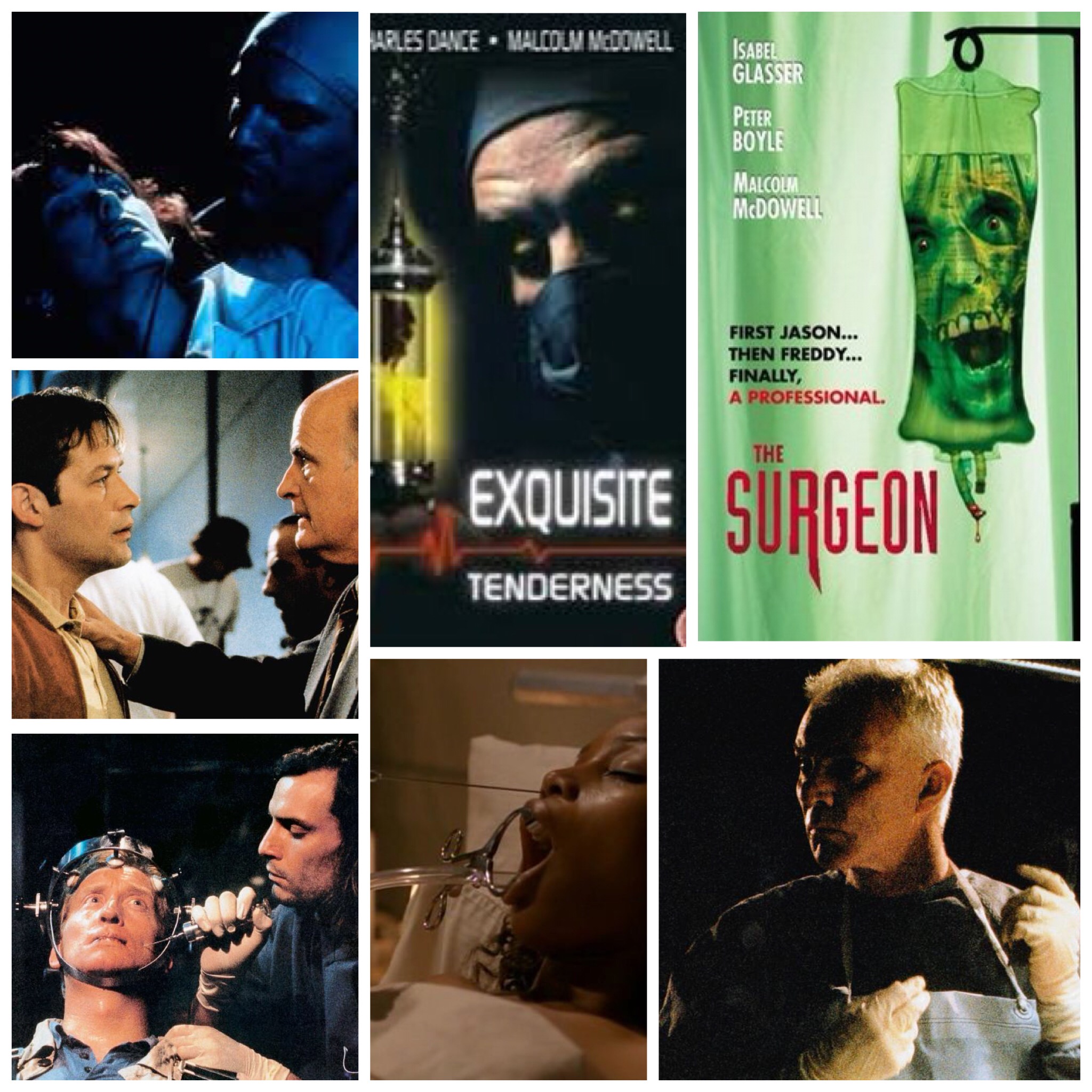
The Surgeon is an overlooked little hospital horror chiller that’s worth the price of admission just for the opening scene alone, a spooky black and white prologue in which a young boy witnesses a surgery gone horribly wrong, all set to that cheery ‘Lollipop Lollipop’ song, quite a memorable way to kick your film off. After that it’s fairly standard, as he grows up to be a scalpel wielding slasher who roams the wards of a huge hospital, killing patients, doctors and undergrads at leisure. Two intrepid doctors in training played by Isabel Glasser and James Remar are onto this beast and gradually begin to realize there’s foul play afoot, and the demented surgeon, played by Sean Haberle, continues his stealthy rampage throughout the halls. Malcolm McDowell is also there for a bit, sorely underused as an arrogant, short lived doctor who likes to trial weird drugs on chimpanzees in the basement. Peter Boyle chews scenery as a bumbling detective, Charles Dance has a fun bit and it all hurtles along like the B movie it is. That opening though, quite a well accented bit with the song, and an eerie setup for the schlock to follow. The film’s actual title on IMDB is Exquisite Tenderness, which was rebranded for DVD release as The Surgeon, which is slightly less.. European of them than the original one, but it does suit the low grade silliness. Decent stuff, for what it is. 

-Nate Hill

Alan Parker’s Angel Heart 


No other film has the seething elemental power of Alan Parker’s Angel Heart, a detective story propelled by a murder mystery, all the while cradled in the sweaty, unnerving blanket of a satanic horror story. Get the extended unrated cut if you can, as it cheerfully amps up both the queasy gore and kinky sex in spades. The time is postwar 1940’s, the setting New York, or at first anyways. Shabby private detective Harry Angel (Mickey Rourke) is hired by sinister clandestine gentleman Louis Cyphre (Robert De Niro) to find a missing lounge crooner named Johnny Favourite, for nasty reasons shrouded in thinly veiled threats. Harry is stalled at every turn, kept just out of the loop on every plot twist and soon seems to be a magnet for violence, troubling hallucinations and all the eerie hallmarks of a case he should have stayed far away from. The grisly clues lead him from Brooklyn to the smoky ghettos of Harlem, then south to voodoo soaked swamps of Louisiana and beyond, chasing illusory information and feeling more like the hunted than the hunter with each step. The film feels at times like a shrinking steel cage of unease and dread, a trap that closes in on both Harry and the viewer until the soul crushing revelations of the final act have been laid bare. This is hands down the best work Rourke has ever done, and it’s priceless listening to him try and to downplay it on the DVD commentary, classic ice cool Mickey. De Niro is the kind of quietly dangerous that leaves a deadly vacuum in the air of each scene, underplaying evil expertly and laying down more mystic mood by simply peeling a boiled egg than most actors could with a twenty page monologue. Ex Cosby Show darling Lisa Bonet sauces up her image here as a Bayou voodoo princess with ties to the mystery, and the steamy, no holds barred sex romp she has with Rourke has since become the stuff of legend, a feverish cascade of blood and other bodily fluid that almost gave the MPAA a coronary. The one area this film excels at most is atmosphere; there’s something intangibly wild about everything we see, hear and feel on Harry’s journey, from the supernatural tinged, noirish hues of Michael Seresin’s cinematography to the haunted, hollow tones of Trevor Jones’s baroque, restless original score, everything contributes to forging a world in which we feel enveloped in and can’t quite shake after, like a bad dream that creeps out into waking life for a while after the night. Angel Heart is a horror classic, a blood red gem amongst genre fare and one in an elite group of films that are pretty much as close to perfect as can be. 

-Nate Hill

Christian Alvert’s Antibodies

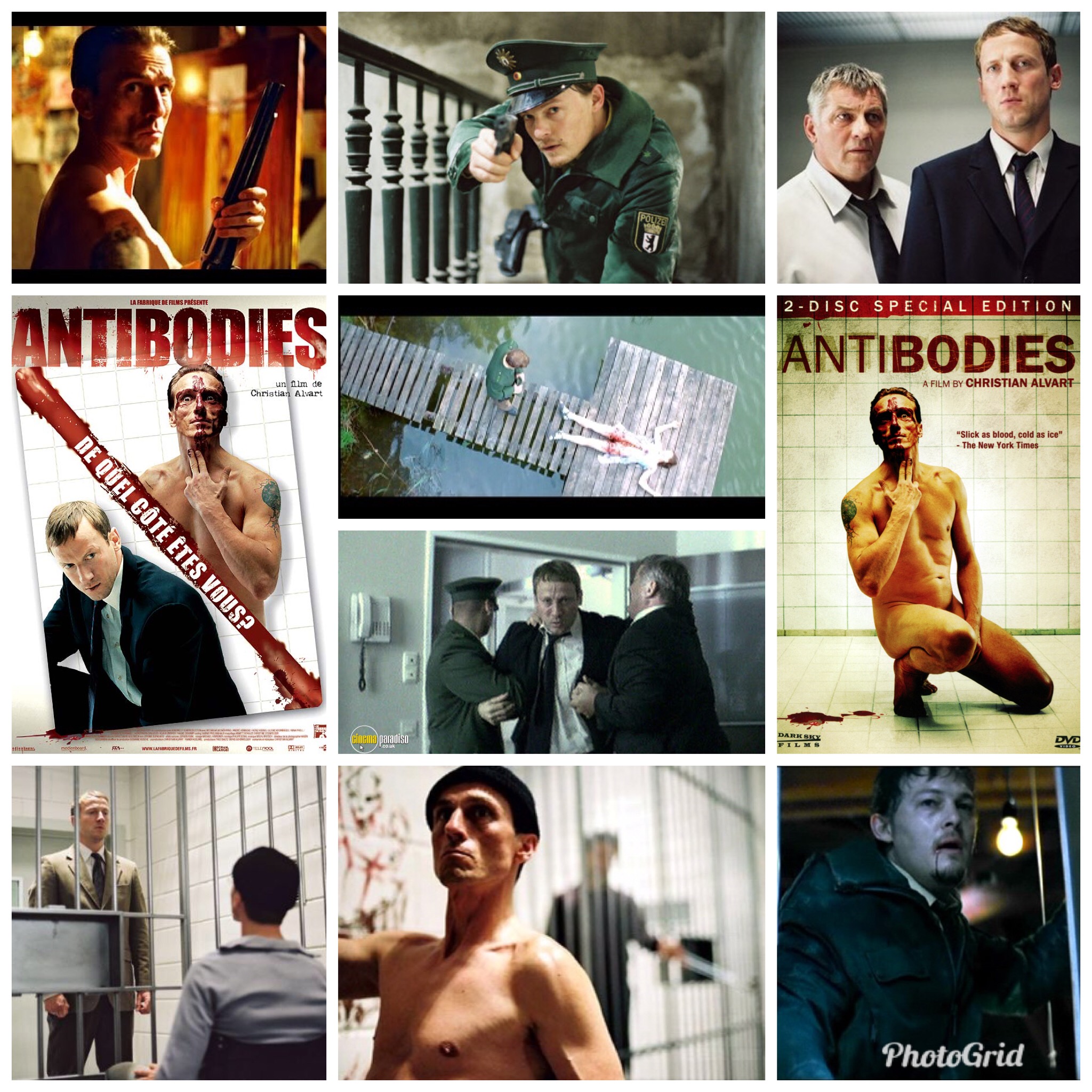
Christian Alvert is a wicked sharp German director who has quietly been making terrific films for years that have somehow slipped past the nets of notoriety (his SciFi horror Pandorum is one of the most underrated films of the decade). If you haven’t seen his highly disturbing, Silence of the Lambs esque psycho shocker Antibodies, you’re in for a treat. Perverted, intelligent, psychological, skin crawlingly freaky, the story unwinds in uncomfortable revelations following a gruesome discovery in an apartment by a Berlin police officer, who curiously enough, is played by a silent Norman Reedus. This turns into a raid in which prolific serial killer Gabriel Engel (a bone chilling portrayal by André Hennicke) is finally captured. After sometime, top cop Michael Martens (Wotan Wilke Möhring) runs into a series of murders that bear similarity to Engel’s Crimes, and brings the killer into the fold in consultation capacity. From there it’s a devilish madhouse of deception, sickening mind games and one cracker of a suspenseful ending. I’ll warn you: this shit ain’t pretty. There’s a lot of seriously dark stuff, thematic matter that blasts through the western taboos we find in films over here, and buckets of clinical, shudder inducing gore. If you enjoy smart horror that piles on thought provoking notions in with the carnage and asks questions along the way, you’ll dig this. 

-Nate Hill

Friday The 13th Part VIII: Jason Takes Manhattan 


Friday The 13th Part VIII: Jason Takes Manhattan is kinda guilty of shitty false advertising, as well as just being an overall laughable effort in the franchise, which by that time had already run thin on new ideas. It was after Jason had run amok in the Camp Crystal Lake Woods, but before he got to go to hell, space or slap fisticuffs with Freddy Krueger, and kind of suffers in limbo at a juncture of the franchise that’s stuck in a quagmire of dumb ideas. Of all the evocative, atmospheric locales they could have switched his bloody tirades to, the big Apple just doesn’t seem like the ticket. That isn’t even the real problem anyways, as a good two and a half thirds of the film isn’t even set in NYC, but rather on a luxury cruise liner out on the coastline straights, bound for Manhattan and stuffed with more idiotic graduating high schoolers than you can shake a machete at. Lazy writing, nonexistent plotting and goofball acting are hallmarks in this terrain, but even more so with this flick, literally every non Jason character just being an insufferable ignoramus. The kills are passable but don’t even come halfway to topping the franchise charts, Kane Hodder shows up for his shift as the big lug in full gear, hockey mask and slimy mongoloid prosthetics included at no extra charge. When the boat does finally land on New York shores, it’s jarring to see Jason waltzing down fifth avenue looking like a homeless nut whose stairs don’t quite reach the attic, machete in hand in broad daylight as he pursues the few remaining partygoers through the crowded streets. Really, guys? Keep the big guy in his shrouded summer camp forests where he’s at home, and the feng-shui of his murders rings true. Or at least let him go to space where there’s still dark hallways and hidden alcoves. Probably the biggest misfire in the series.  

B Movie Glory- Brian Yuzna’s Faust: Love Of The Damned 


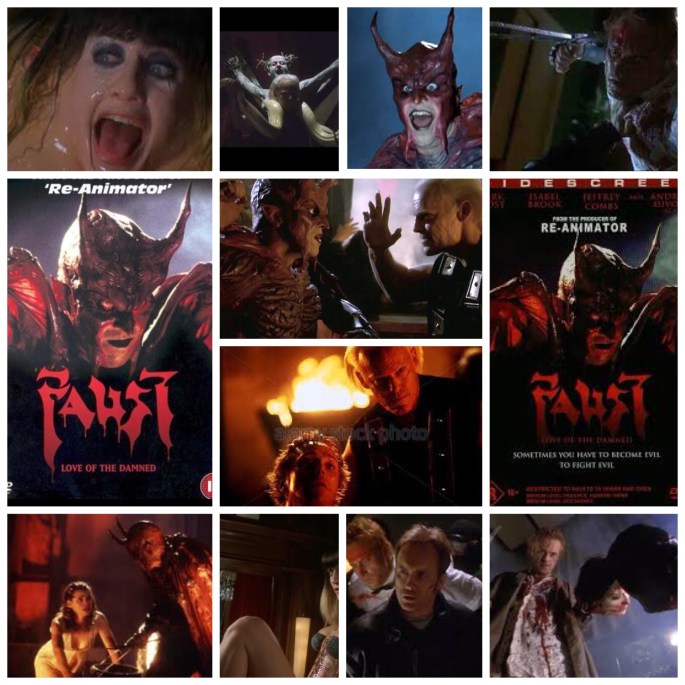
I think Goethe might do a few barrel roles in his grave if he ever saw Brian Yuzna’s Faust: Love Of The Damned, an unhinged, risible and obnoxious rendition of his literary works, filled with Spawn inspired effects, heavy metal music, extreme nudity and a general sense of debauched commotion running through it. When regular guy John Jaspers (Mark Frost) sells his soul to the mysterious M (Andrew Divoff) in order to exact revenge on those who killed his girlfriend, things don’t… quite go as planned. Before he knows it he’s transformed into some ridiculous walking demon vigilante thing, given snazzy superpowers and set loose on the city. M, being the devil, is naturally not a man of his word and is planning some horrific apocalyptic mayhem using Faust’s unwitting help, and it all goes so monumentally haywire it’s hard to tell what is even going on, for fuck’s sake. Much of the film consists of him just running about with blaring music in the background, killing people in over the top, spectacularly gory ways. Story has little place here amongst the ruckus din of VFX and soft core porn sensibilities. Divoff is in Djinn mode as M, sporting a startling blonde dye job and Mayan inspired costume design, and having as much fun as every Hollywood character actor has playing Old Scratch himself. There’s a scene where he reprimands his hot sidekick by causing her to melt into a moaning pile of her own bodily fluids that will have everyone nervously shifting on the couch and wondering just exactly what the fuck they’re watching. The Reanimator himself Jeffrey Combs has an eccentric police detective role that somehow just gets swallowed up by the orgy of visual and auditory assault that the film consists of. Nothing remotely similar to the original tale of Faust, you’ll either get a sick thrill, laugh the whole way through or get up and walk out. I loved it. 

-Nate Hill

Hellraiser: Inferno 


Hellraiser: Inferno marks the first juncture in the franchise where ideas deviated beyond the formula set in place by the first borderline surreal, masochist piece.

Gone is the dreamy, sordid aesthetic used back then, the Cenobites who were front and centre are reduced to limited appearances and the story is less otherworldly and something decidedly more noirish and down to earth. Whether that’s accepted by franchise die-hards and horror hounds alike is subjective, but I didn’t mind it’s slow burn approach or sidewinding tone. Craig Sheffer, the closest thing you’ll get to Josh Brolin without breaking the bank, plays a crooked Detective who finds himself dragged down a rabbit hole of creepy, murderous goings-on when he’s assigned to hunt a serial killer known as ‘The Engineer’. Of course the murders always seem one step ahead of his grasp, and naturally dark secrets from his sketchy past are brought to light as he gradually begins to lose his mind. Doug Bradley does eventually return as the iconic Pinhead, with a few members of the Cenobite posse, but their presence is kept mostly on the back burner for quite a while. Taking antagonist duties for a while instead is Sheffer’s eerie psychiatrist, played with sinister charm and knowing charisma by James Remar, a dubious fellow with a few tricks up his own sleeve. This is the one entry that sticks out from the franchise in it’s diversion from the usual path of distinct, abstract psychosexual horror and mutes the whole icy nightmare down to rebuild a story in it’s own image. You’ll either appreciate the initiative, or you’ll miss the good ol’ freakshow of the original film. Up to you. 

-Nate Hill