BARRY LEVINSON’S WAG THE DOG — A REVIEW BY NICK CLEMENT

3

I can vividly remember the opening night for Wag the Dog. It was back in 1997, I was in high school becoming a budding film lover, and I went with a group of friends to see this bitter black comedy about Hollywood and politics and I can remember being one of the few people in the theater who seemed to love what they were seeing. It was very topical material at the time, and still is today, with razor-sharp satire always at the forefront, and a whiff of pompous, know-it-all-humor that probably alienated many people. Energetically directed by Barry Levinson and craftily adapted by Hilary Henkin and David Mamet from Larry Beinhart’s novel American Hero, Wag the Dog centers on a presidential sex scandal, and the Washington DC-based spin doctor (Robert De Niro, wonderfully affable and light on his feet) who is called in for crisis management by the White House.

wag_the_dog_ver1

His big idea? He’ll start a fake war with Albania and spread various media rumors and lies in an effort to deflect the country’s attention from the real scandal at hand. De Niro enlists the help of an aging, full-of-himself Hollywood mega-producer, perfectly played with smarmy glee by a bronzed and absurdly coifed Dustin Hoffman, who brings along his various production contacts so that he can “produce a war” that nobody will ever realize is fake. And one that he can, rather frustratingly, never tell anyone he had a part in creating. The comic mileage that’s derived from this ironically painful fact for Hoffman is a constant source of hilarity all throughout this happy-to-be-mean little movie. And when you actually pay close to attention to the dialogue, you’ll notice just how tack-sharp the spoken words are, with various individual lines carrying a wicked punch (“No more make-up, she’s just been raped by terrorists!”).

2

An amazing supporting cast rounds out the brittle edges of this scathing media takedown, with Anne Heche, a diseased Woody Harrelson, rapid-fire Dennis Leary, Willie Nelson, Andrea Martin, John Michael Higgins, David Koechner, William H. Macy, and Kirsten Dunst all showing up for memorable cameos and bit performances. But the black heart and acidic soul of this punchy little movie belongs to the amazing team of De Niro and Hoffman, who both seemed to be in love with the idea of occupying the same space as one another, generating tremendous chemistry, and letting the zippy screenplay do most of the heavy lifting. Mamet and Henkin’s script throws out a variety of nastily barbed zingers, and Levinson’s snappy direction is in perfect tandem with Robert Richardson’s agile, hot-white cinematography. Also, the idea that this movie was released exactly one month before the Monica Lewinsky scandal broke is just too wild to contemplate.

1

GARTH DAVIS’ LION — A REVIEW BY NICK CLEMENT

lion_ver10_xlg
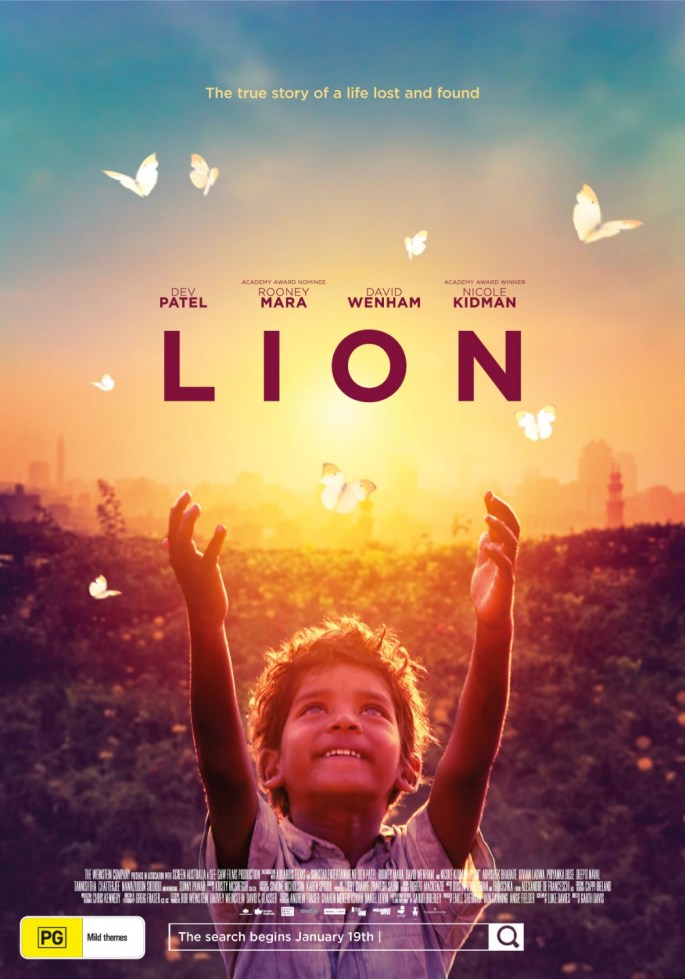
You would have to be mostly dead inside to not have a nearly immediate emotional reaction to Garth Davis’ stunning true life story Lion. I was a personal disaster all throughout this film; it hit me with blunt-force impact and I can’t stop thinking about the film and its message and how life throws insane curve-balls to many, many people. Confidently directed by Garth Davis in his big-screen debut and written with sensitivity and open honesty by Luke Davies, this magnificent piece of work certainly tugs on your heartstrings, but how could it not? The tragic yet uplifting story of Saroo Brierley and how he was separated from his family as a child only to be reunited as a young man, Lion is soul-stirring cinema, and because Davis doesn’t force any one particular aspect too hard, the entire film feels honorably cathartic by the poignant conclusion.
3
 
Greig Fraser’s gorgeous cinematography finds beauty in some truly horrific situations, and the sweeping musical score by Dustin O’Halloran and Hauschka builds and swells yet never overpowers. The central performances by Sunny Pawar and Dev Patel are both superb, especially Pawar, who imbued his character with a plucky sense of resourcefulness and grace under pressure that I found positively astonishing to observe; I can’t imagine most five year-old children acting in the same manner as the real Brierley did, and it was nearly overwhelming to get a condensed glimpse of his 25 year journey. Nicole Kidman was also excellent as the adoptive mother; she even got to rock out with her classic frizzy-red pseudo-afro, while still looking all sorts of porcelain-doll beautiful.
2
 
Lion, intentionally or not, doesn’t paint a particularly inviting portrait of India as a country, and the postscript includes a note that 80,000 children are reported missing every year in the country. Shot on location in India and Australia on a $12 million budget, Lion grossed over $130 million worldwide and got nominated for six Oscars, including Best Picture. This is the type of moving, life-affirming cinema that more people should be checking out as a reminder that existence, for most of us, is a privileged experience. I’m continually drawn to true stories, and narratives that define us as a collective species, as I find that it’s important to be humbled by the plights and sacrifices of others.
1

MEL GIBSON’S HACKSAW RIDGE — A REVIEW BY NICK CLEMENT

1

Mel Gibson’s unsurprisingly savage WWII film Hacksaw Ridge delivers the fiery-action goods. I was definitely impressed by the wild stunt work and some of the individual bits of action, and it’s truly lunatic/nuts of conscientious objector Desmond Doss to have done what he did in real life. The religious angle, thankfully, isn’t hit too hard on the nose, which was a surprise; the trailers were very off-putting in this regard and the movie just presents the facts as the facts – this guy just didn’t feel like killing anyone, but had it in him to save other people’s lives. Good on him. A bit insane to contemplate given the battlefield circumstances, but he’s certainly a “hero” in the squarest sense of the word. The movie is pleasurably old-fashioned and very familiar in the early stretches, some of the dialogue exchanges are corny (perhaps intentionally? it’s even sort of commented on mid-film…), and the scenes at basic training are very “seen it before” but Vince Vaughn clearly had some fun with his salty dialogue. But when the combat footage kicks in, Mad Mel went all out, really showing some savage and grotesque battlefield atrocities with tons of blood and explosions and lost-limbs.

2

Andrew Garfield is a very specific actor and his whiny vocal tone and lanky physical characteristics sometimes make it a challenge to fit with the material, but in Hacksaw Ridge, he showed grit and brawn in a way not previously seen. None of the film ever felt new or groundbreaking, but rather, it’s a solidly told war film that rose above the preachy and mildly embarrassing trailers. Teresa Palmer is also very, very photogenic. But it’s the action and stunt work in this film that I’ll remember the most, with tons of people getting lit on fire and blown backwards from grenades and mortars; I really don’t get how that stuff is done with any sense of true safety as most of the action felt very “done for real.” Also, annoyingly, there are some chintzy moments of odd CGI and process-shots; I hate that crap so thankfully it was kept to a minimum, with on-location shooting and practical effects ruling the day. Overall, the film looks frequently stunning thanks to cinematographer Simon Duggan and will definitely satisfy fans of the war genre. Listen – there’s no doubt that Gibson has some incredibly intense personal demons (as do many of us…) that he’s likely still wrestling with, but as he demonstrates time after time, he’s a helluva filmmaker.

3

LINDA, LINDA, LINDA — A REVIEW BY GUEST CRITIC/FILMMAKER DAMIAN K. LAHEY

LindaLindaLindaPoster

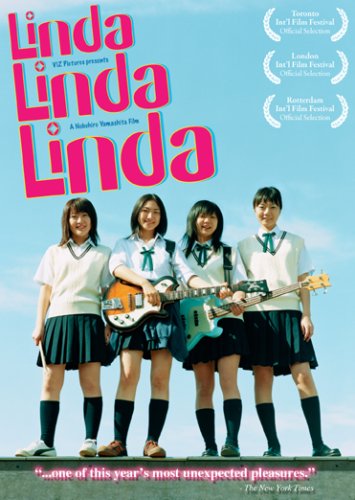
Linda, Linda, Linda (2005) dir. Nobuhiro Yamashita


This film centers around a group of high school girls who have three days to put together a band to perform at their school’s cultural festival after their lead guitarist and singer quit. The spunky narrative hums along vibrantly as the girls struggle to get their band together for the big event. Yamashita does a tremendous job of evoking the raw emotions of the high school experience. And has so much fun with them. The anxiety of love, the anxiety of fitting in, the anxiety of needing to achieve – it’s all there. Being an art school brat, this story resonates with me more than others. The best high school movies, like Kazan’s ‘Splendor In The Grass’ and Lucas’ ‘American Graffiti’ for example, pull off the tricky job of portraying the experience as it happened in the moment and also how it would become once filtered by the passage of time. I believe Yamashita accomplishes this here. This film is also shot and paced in a timeless manner. It’s not loaded down with the gimmicky editing tricks or the over stylized camera moves of its time.


Doona Bae’s breakout performance is one of foppish uncertainty and well timed awkwardness. But she’s a team player. Like the band in the film she knows she’ll only look good if she lets the others shine as well. This is not only one of the best films I have ever seen but also one of the best theatrical experiences I have ever had. I had the honor of having my work screened as part of the Rotterdam International Film Festival in 2005. An unforgettable time. I saw many films and met incredible people from all over the world. But sitting there in the theater with a multi-cultural audience and watching this film was a different kind of magic. This was the first time that I really became aware of how connected the human experience is. I was in the Netherlands watching a Japanese high school pop punk flick with people from Russia, Iraq, France, China…and the themes of the film were universal to everyone sitting in that theater. I became acutely aware of how so many people rob themselves of enriched lives by never watching or reading the works of other cultures and never discovering how really alike we all really are in this world. It is that collective experience that holds us together and ultimately what can save us. But only if we embrace it. When the girls took the stage at the end of the film and tore through the Blue Hearts’ hit single ‘Linda, Linda’, Linda’ like they wrote it themselves the audience cheered and I cried because it was all too much and I’m totally cool with people knowing that.

LindaLindaLinda2


HAROLD RAMIS’ GROUNDHOG DAY — A REVIEW BY NICK CLEMENT

3

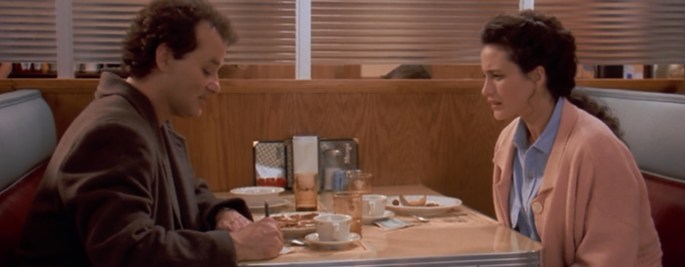
One of my favorite comedies, the immortal Groundhog Day feels like the sort of studio-crafted entertainment that would be hard to replicate these days. Directed by Harold Ramis, who co-wrote with Danny Rubin, this 1993 offering was a big box-office hit and critical favorite, with Bill Murray turning in one his best and most playful performances as an egotistical Pennsylvania weatherman who is cosmically forced to relive the same day, over and over again, in order to be a better person and win over the woman he truly loves. Some might call this movie a high-concept stalker flick, and you wouldn’t be too far off, but because there’s nothing truly menacing on display in this family-friendly item, with Murray’s romantic wooing of Andie MacDowell coming off as sweet rather than salacious. The supporting cast is packed to the gills with character actors and familiar faces, while the dialogue is instantly quotable and often times extremely hilarious (“Don’t drive angry” and “Is it snowing in space?” are two of my favorites). I also think that this is a movie where repeated viewings are required to truly appreciate every single brilliant layer to this thoughtful, introspective, and hugely entertaining piece of work.

1

WOLFGANG PETERSEN’S DAS BOOT — A REVIEW BY NICK CLEMENT

2

In 1997, my father took me to see the full director’s cut of Wolfgang Petersen’s masterpiece Das Boot in 70mm. It was an absolutely unforgettable experience. Released in 1981 and shot for a hard-to-fathom $18.5 million, this exceedingly intense submarine thriller is likely the best film of its type, a relentless cat and mouse pursuit through murky WWII waters, with some of the most claustrophobic cinematography ever captured (the great Jost Vacano was the film’s herculean director of photography). I’ll never forget the final sequence to this film, once the U-boat has made its way back to port, and the Allied forces start dropping their bombs and gunning everyone down. After all that these guys had gone through out in the open water, once home, they encountered a different type of hell. Jürgen Prochnow, Herbert Grönemeyer, Hubertus Bengsch, and Klaus Wennemann anchored the supremely masculine cast of actors, all of whom felt totally authentic in nearly every situation posed by the emotionally draining narrative. The full director’s cut is currently available for purchase on Blu-ray.

1

DON’T TORTURE A DUCKLING — A REVIEW BY GUEST CRITIC/FILMMAKER DAMIAN K. LAHEY

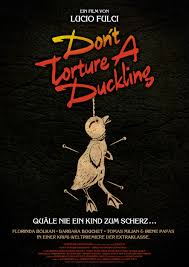
Don’t Torture A Duckling (1972) Dir. Lucio Fulci

DontTortureADucklingPoster

Young boys are being strangled in a small rural village in southern Italy. Historical context. ‘Don’t Torture A Duckling’ is considered a ‘giallo’ (named for the seedy yellow tinged paperbacks they were often inspired by) – a type of European thriller made popular following the international critical and commercial mega success of Dario Argento’s ‘The Bird With The Crystal Plumage’ in 1970. Waves of these giallo thrillers (some with artsy animal titles, some without) crashed upon Europe during this time. The women in these movies are unforgettable. The movies themselves? Kinda forgettable though there are certainly some gems to be found. Fulci, a director for hire at the time, jumped onto the band wagon first with ‘A Lizard In A Woman’s Skin’ which is a decent enough Argento rip-off though ‘Don’t Torture A Duckling’ is a film with its own voice and its own mission statement.

‘Don’t Torture A Duckling’ is a frightening and frustrating work and that’s how it should be. This is the story of the madness that creeps in when people never leave their enclave. People become slaves to the prejudices of their upbringing – holding on to outdated moral codes, superstitions and religious beliefs. They refuse to embrace cultural shifts or those they see as outsiders. And who suffers? The noble and innocent as this film so accurately portrays. Its messaging might be a bit too on the nose for some but this film plays more like a socio-political art house piece than a genre entry though it certainly has enough dollops of unnecessary gore and nudity to satiate the cine-pervs that scrounge around for that kind of stuff. But ultimately this film errs on the side of Bergman and Rossellini and this places it on a higher pedestal than many other works in this sub genre.

I personally believe this to be Fulci’s best and most accessible film. I don’t entirely agree with the revisionist evaluation of Fulci as being a director on par with other genre greats like Romero, Raimi, Carpenter and Argento. Certainly a talented and hard working dude. But did he have the vision or the artistry that the best of Romero, Argento, Carpenter, Cronenberg or Raimi have? I would say not. I think he falls more in the camp of D’Amato, Lenzi and Deodato. Lots of time chasing trends established by others. Not to say these directors don’t have flashes of brilliance or make some fun films. I totally dig their stuff and D’Amato’s ‘Beyond The Darkness’ is one of my favorite horror films. But there’s something missing from their work and Fulci’s. Too often it falls flat and comes off as needlessly crass.

Despite the above paragraph I do own a coffin tin collector’s box set of Fulci’s gore porn shocker ‘The Beyond’ complete with marquee cards and I would like to point out that the audio commentary by stars Catriona MacColl & David Warbeck is one of the best I have ever heard.

DontTortureADuckling


HOUSE OF FOOLS — A REVIEW BY GUEST CRITIC/FILMMAKER DAMIAN K. LAHEY

House Of Fools (2002) dir. Andrey Konchalovskiy


HouseOfFoolsPoster

This film has one of the more unique premises you’re likely to find. During the Chechen war, a mental hospital is abandoned by the doctors – leaving the patients to fend for themselves. ‘House Of Fools’ also does a very solid job of portraying mental illness. What makes mental illness so incredibly terrifying is that those that are inflicted with it do not believe they are. I have seen wonderful people I know succumb to this. People who were once so vibrant and alive. Watching them fall apart in such a humiliating way is a tragic thing. I would give all the money in the world if they could be healthy and happy again. Yuliya Vysotskaya shines as a tortured young woman who believes Bryan Adams is her fiancee and is away on tour. I thought it was really touching of Bryan Adams to make cameo appearances in this film in dream sequences. Not a lot of guys in his position would do that. It says a lot about his character and really added heart to the film. Not the biggest fan of his music, but…

With the arrival of the soldiers this film does not take the dark route that it could have though it is certainly tense and uncomfortable at times. This was a smart move by the director. As he has already established a set up rife with suspense he chooses to go with eccentric humor and sadness over vicious hysteria and exploitative elements which I believe was the right call to make. ‘House Of Fools’ depicts just a fragment of life during war time, reinforcing that it affects every facet of life. Nothing is safe from it. It creeps into everything. One of  my favorite scenes is when soldiers on opposing sides take a break from fighting to sell each other weed. At the end of the day this film is interested in asking the big question: who is crazier? The soldiers or the patients? But that’s too easy. What will stick with you are the sequences of the mental patients left on their own after the doctors have fled and their attempts at continuing with life as usual. It’s endearing and heart breaking.

HouseOfFools

AND THE SHIP SAILS ON — A REVIEW BY GUEST CRITIC/FILMMAKER DAMIAN K. LAHEY

AndTheShipSailsOnPoster

And The Ship Sails On (1983) dir. Federico Fellini

Such a wonderful concept. A cruise ship in 1914 sets sail with a number of eccentric folks to disperse the ashes of a famous opera singer. Fellini creates the ideal scenario for him to indulge himself though he cuts a nice pace here with just the right amount of class and abandonment to make for a remarkable viewing experience. Film uses the narrative device of a ‘reporter’ that speaks directly to the camera, gossiping about characters and making enthusiastic comments about the proceedings. This helps give the film an air of mirth and self deprecation it may not have otherwise had. There are other moments where the film comments on itself – references that draw attention to it being a set and the final shot exposing the camera technicians and the entire crew.

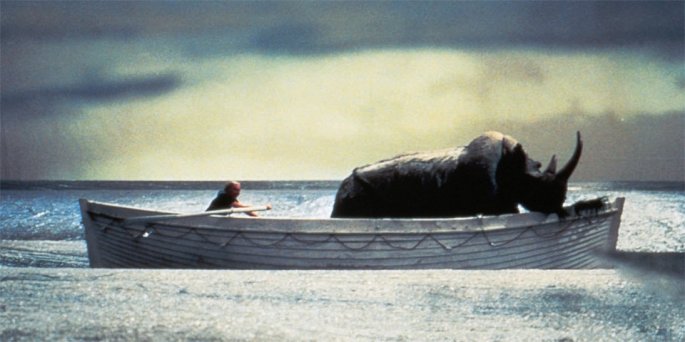
This film also provides a fictional account of the events that may have led to WWI. It paints a not so flattering picture of the European elite prior to the war – taking them to task for their extravagance and self absorption. Fellini makes murky comments about class division and there seems to be a bridge he might be trying to build between the entourage’s behavior towards the crew on the ship and their embracing of the Serbian refugees in the final act but it’s disconnected and not clear. Fellini plays it coy here and I believe he was wise to do so. Life is often a combination of intent, perception and the situational. Our morals and sense of duty can fluctuate from circumstance to circumstance. A scene in which the opera stars sing to the men working down below in the furnace is one of the greatest things I have ever seen in cinema. There is a love sick rhinoceros on board the ship in this film for no reason. I love that. Really. This film is a pure joy and an ode to the creative in every way.

This is one of my favorite films by Federico Fellini. It was financed by a millionaire in the United States who was a huge cinema lover. He lost money on the whole thing but said it was a one of a kind experience that he doesn’t regret. I’m not sure if this is true. Reportedly Fellini ran over budget on this guy and didn’t give a damn about it simply yelling “I must have it!!” over and over when he came up with some new lofty idea. I’m a big Fellini guy but I dig the later period films the best. I know I am in the minority here. ‘Amarcord’, ‘And The Ship Sails On’ and ‘Ginger & Fred’ are my top picks from him. I understand the significance of ‘8 1/2’, ‘La Strada’, ‘La Dolce Vita’, ‘I Vitelloni’ – and they have wonderful elements to them. Watched them all multiple times. Brilliant stuff, no doubt. But I always found them to drag bit. For those interested, ‘I, Fellini’, a collection of interviews with the director by Charlotte Chandler is a great read and provides delightful insight into the maestro’s creative process!

AndTheShipSailsOn

RIAN JOHNSON’S LOOPER — A REVIEW BY NICK CLEMENT

1.jpg

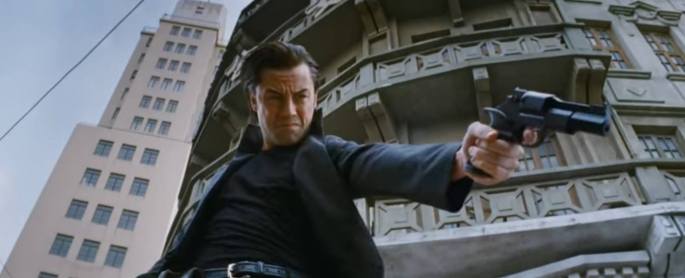
I’m still not 100% positive that I follow Looper and all of its time-travel hoopla and all of the rules the story establishes. But that doesn’t stop me from loving it up and down, and revisiting it whenever it pops up on the movie channels. I was a big fan of writer/director Rian Johnson’s debut film, Brick; his follow up, The Brothers Bloom, was a bit too precious but still demonstrated tons of style and cinematic quirk. But Looper is a heady and stylish mélange of science fiction and noir with some bloody shoot-outs, numerous narrative twists and turns, and really fun performances from an eclectic cast including Joseph Gordon-Levitt, Bruce Willis, Paul Dano, Jeff Daniels, Emily Blunt, Piper Perabo, Pierce Gagnon, Garret Dillahunt (love this guy!), Frank Brennan, and Noah Segan. I am still not entirely sure that Gordon-Levitt looks like Willis, but I can roll with it; when a movie is having this much fun and is consistently smart with its various elements than I can look past some inconsistencies.

2

Another big reason why this movie works as well as it does is that the characters are fully formed and everyone feels multidimensional, which is something that can’t be said for every movie of this ilk. And then when the explosive final act kicks into high-gear, the viewer has become emotionally invested in the story and characters so that by the end, you truly care about the outcome. The slick cinematography by Steve Yedlin features some superb individual shots, with lots of seamlessly integrated visual effects that make the film feel more expensive that it was. Looper was a big hit worldwide, pulling in $175 million, with a budget of roughly $30 million. The Chinese release version included additional scenes set in Shanghai that were removed for the American final cut.

3