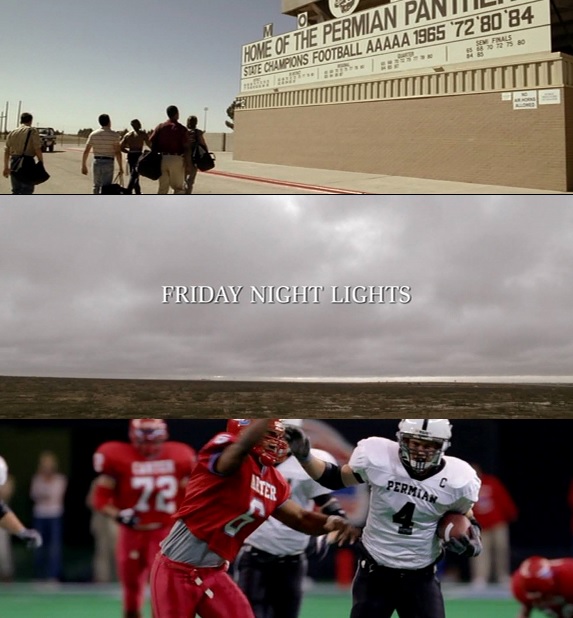
PETER BERG’S FRIDAY NIGHT LIGHTS — A REVIEW BY NICK CLEMENT

Friday Night Lights

Peter Berg’s Friday Night Lights is the football picture as if it were a combat film. These high school gridiron warriors are like battle-ready troops, ready to sacrifice it all in the name of glory. This is one of the best sports movies ever made, totally riveting, just as well done in the small details as it is in the grand scope of the sport and the society that it’s reflecting. Billy Bob Thornton beautifully underplayed the role of Head Coach, letting the colorful characters that make up the Permian Panthers do the heavy lifting in terms of dramatic consequence, though he’s not without his moments of explosive fury or deep introspection. Berg’s semi-regular cinematographer Tobias Schliessler shot the hell out of this movie, opting for a washed out color palette to match his gritty yet slick aesthetic; the film also has some of the best choreographed football action ever put on film. And true to the real-life story that this film covers, in the end, it’s not about winning and losing, but about putting it all out there in everything that you do, and picking up the pieces if it doesn’t land your way, always ready for the next challenge. The musical score by Explosions in the Sky is transcendent, all of the young actors and actresses nail their roles on and off the field, and the dialogue by co-scripters Berg and David Aaron Cohen has a believable quality that rings true at every moment. Fantastic production design and engrossing editing round out the tech package. When it comes to sports films, I hold this one in extra-high regard. Berg’s cousin H.G. Bissinger wrote the best selling book that the film is based on. Friday Night Lights would become a respectable box office grosser, and would be followed by one of the most critically acclaimed and dramatically involving TV shows of all time.


PTS PRESENTS: 10 QUESTIONS WITH FILMMAKER JOHN CARNEY

Carney Banner

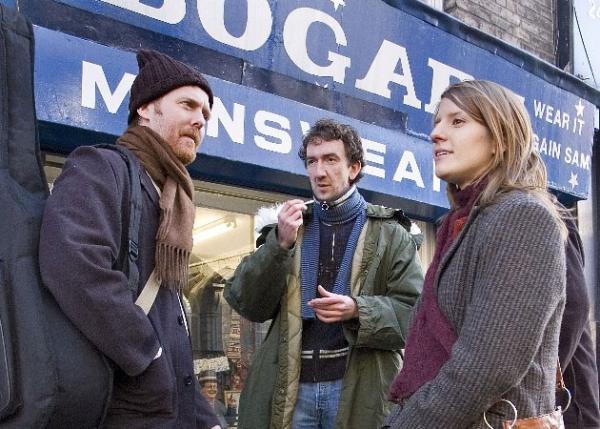
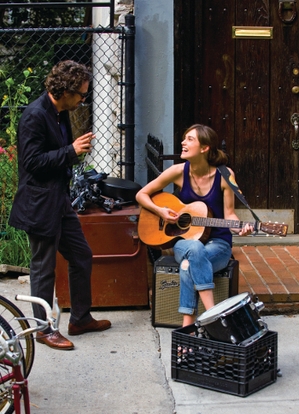
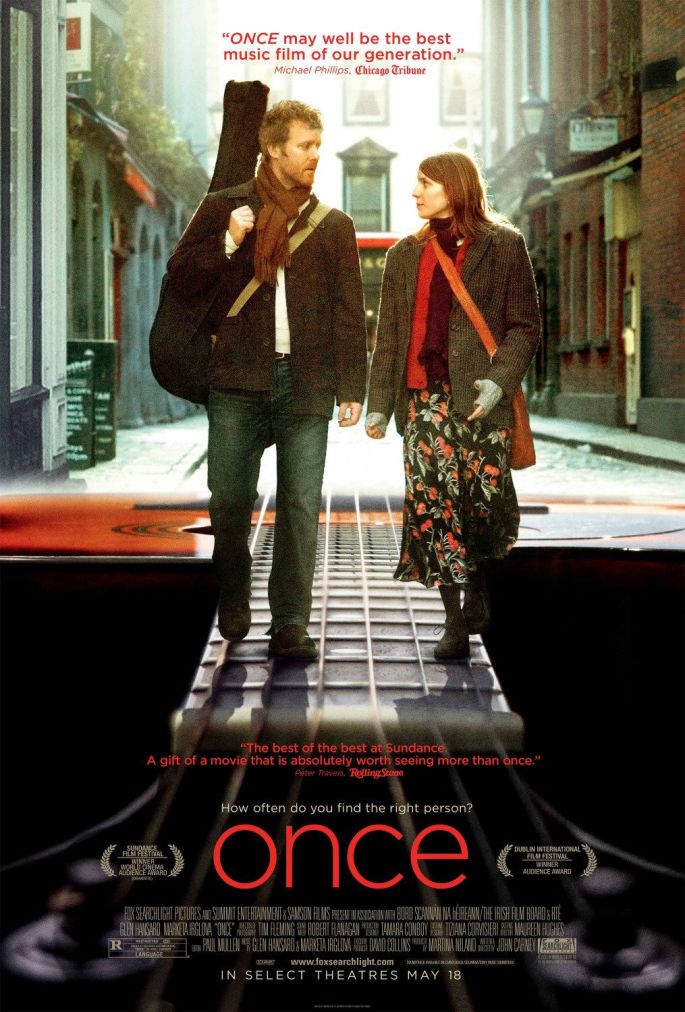
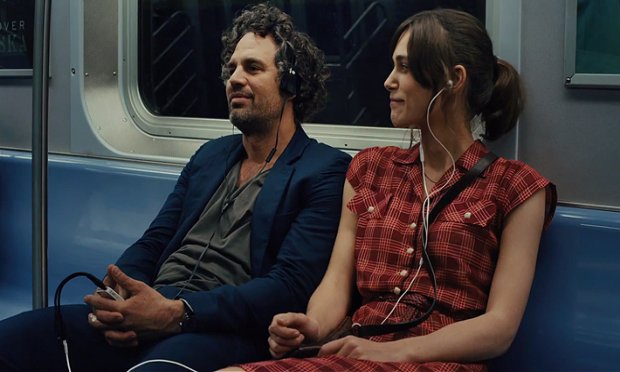
Podcasting Them Softly is excited to present our latest 10 QUESTIONS INTERVIEW with the fantastic filmmaker John Carney (Once, Begin Again, the upcoming Sing Street). He chatted with Nick about the importance of independent cinema, the current state of affairs in Ireland within their blossoming film community, and what inspires his creative process. Look for his new film, Sing Street, in theaters this spring! We hope you enjoy!

once bts

HOW DID THE SUCCESS OF ONCE CHANGE YOUR CAREER?

It had a huge impact. I didn’t have a career before Sundance accepted Once. I had a camcorder, some filmmaking and actor friends, and a hunk of debt! I don’t see how an Irish filmmaker can have a “career” without endorsement from elsewhere, Europe or America.

ruff

HOW DID ONCE PREPARE YOU FOR BEGIN AGAIN?

It didn’t at all! I just made Begin Again with the same attitude as I did Once. I just show up to set as late as I possibly can and hope the day offers up some surprises. This, I think, shocked some American crew members, not to mention some British actresses!

carney in action

CAN YOU DESCRIBE YOUR CREATIVE PROCESS?

I write the scripts and score, and develop the songs in all my films, so the preparation is in that. This happens months, sometimes years before. After that I just show up as late as I can to set and do as little as I can get away with. Preparation is in what you have for dinner the night before shooting, what you read, and what you watch.

zonad

WHAT’S YOUR FAVORITE PART OF PUTTING A FILM TOGETHER?

The laughs you have while casting the actors. Any work comes ages before shooting. Shooting is fun. If it isn’t, I think the audience knows.

sing

HOW DID SING STREET COME ABOUT?

It happened on an underground train in London. I was looking at a schoolboy carrying a guitar and remembering that feeling of breaking out of school and heading to your friend’s house for band practice. The bully is after you, the teacher is on your case, your parents are being assholes, you’ve got no money, no girlfriend, and you’re never more alive. I thought, that would make a nice scene, and took it from there.

begin

WHAT ARE YOUR THOUGHTS ON THE CURRENT IRISH INDEPENDENT CINEMA SCENE?

I’m excited if it gives people jobs. Ireland is really more like a city. It’s tiny. And it’s hard to sustain an industry. Thankfully we have state subsidy, which hopefully this interest in Irish filmmakers will help to sustain. But we need to cast Irish actors! Actors are still really struggling in Ireland.

once-poster

WHICH FILMMAKERS HAVE YOU LOOKED TO FOR INSPIRATION?

John Ford was good.

begin-again-poster01

HOW EXCITED ARE YOU ABOUT ALL OF THE RECENT IRISH TALENT TO FIND TRACTION IN HOLLYWOOD?

I don’t see it any different as before. Some Irish directors are certainly doing very well. But I’m glad I got in there before this new “wave.”

1

WHAT’S THE HARDEST PART OF THE CREATIVE PROCESS

Writing stories is the hardest part about making films. I mean creating new stories. Finding something new to tell, that’s what drives me.

2

CREATIVELY, DO YOU FIND YOURSELF ATTRACTED TO “IRISH STORIES?”

Are there actually any “new” stories? I think bad filmmakers are always looking for new stories. But the fact might be that the world has been spinning for so long that everything has pretty much been written. I mean, how original was Once? Boy meets girl. Ships in the night. The end. The original part was the tone, the songs, the casting. And that can all have an “Irish” feel, but Irish stories? I’m not so sure. Good films, I think, stem from the minutiae of your detailing and the universality of your story.

Carney Banner


JONATHAN DEMME’S RICKI AND THE FLASH — A REVIEW BY NICK CLEMENT

ricki and the flash

There isn’t a role that Meryl Streep can’t absolutely knock out of the park. It’s kind of crazy. She’s just as believable as Margaret Thatcher or Julia Child as she is portraying a fading music star in Jonathan Demme’s charming dramedy Ricki and the Flash. Well observed and written with sass and sensitivity by Diablo Cody, the film is that rare medium budgeted studio picture that’s about family and people and human interaction and words and thoughts and feelings. Kevin Kline is around for some great supporting moments and comical pot smoking, but the entire picture is stolen by Mamie Gummer, playing Streep’s estranged daughter, who is emotionally devastated over the recent collapse of her marriage, and still hurting from years of motherly inactivity. If you want a film about characters and their emotions and how we’re all human beings who are capable of mistakes, this is the film for you; not a CGI image in sight.

The story focuses on the broken nature of families when divorce is involved, and how when one parent, in this case Streep, disappears into their own private world, the effects can be long lasting on their children. Demme is one of the most humanistic of filmmakers I can think of, and as usual, there’s an effortless sense of grace that accompanies every sequence in this intimate film. Music, as always, plays a large part to the narrative and general cinematic atmosphere; in another life, Demme was likely some sort of rock ‘n roll star. And the film confirms, yet again, as if we needed to be reminded, how versatile and engaging Streep is as a performer, taking a potentially totally unsympathetic character and filling the edges with moments of personal reflection that might not have existed on the page. A mild sleeper hit in the theaters, this is the sort of film that will find a long life on cable and on disc. Also – some nice Rick Springfield POWER.

ZACK SNYDER’S BATMAN V. SUPERMAN: DAWN OF JUSTICE — A REVIEW BY NICK CLEMENT

batman v superman

Wow. Rarely have I ever experienced such a divide between my personal thoughts on a film, and seemingly every single paid “critic” who has presumably seen the same film as I. Are people having a laugh? Are they being obtuse for some unknown reason? The last time something happened like this was during the release of Ridley Scott’s diamond-cut masterpiece The Counselor, and before that with Michael Mann’s expressionistic tour de force Miami Vice and Tony Scott’s avant-garde Domino; throw in the last two films from Terrence Malick as well. On repeated occasions, I simply don’t understand what film most people seem to have been watching or say that they’ve seen. Don’t get me started on this asinine argument that Batman V Superman: Dawn of Justice isn’t “fun.” It may not be YOUR idea of fun, but for people who like their superhero stories gritty and dark and thoughtful, this movie is beyond fun. To be perfectly honest, it’s absolutely astonishing on almost every single level, especially given how routine and homogenized most blockbusters have become. You don’t hire filmmaker Zack Snyder to be “safe.”

I’ve said it before and I’ll say it again – he’s a visual genius. He understands the inherent power of the cinematic image and he exploits it for all it’s worth. Film is a visual medium, first and foremost. I understand that it all starts with a script, but films are not books, and for me, the power of the image will always supersede that of the spoken word. And because Snyder’s images are so consistently mind-blowing, people love to forget how he almost always pays attention to story and character and motivation; he’s not uninterested in his screenplays despite what so many love to report. And best of all, and most rare, he challenges his comic book material in ways that you rarely see, especially in Batman V Superman: Dawn of Justice. Though definitely not a direct sequel to his smashing and rousing Man of Steel, this new film picks up in the immediate aftermath of the events of that 2013 blockbuster (and in my favorite sequence of the film during the Battle for Metropolis), and over the course of two and half hours, expands on Snyder’s vision and idea of realism within the scope of the fantastical, continuing down a purposefully humorless path through the revisionist corners of the DC universe.
 

3

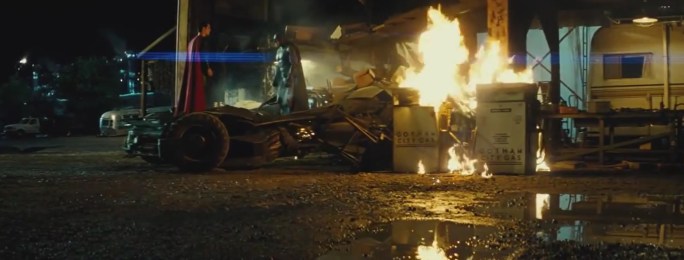
This film is playing by Snyder’s rules, rules that borrow a tad from Frank Miller’s graphic novels and other bits of comic book inspiration, but make no mistake, this is Snyder totally unleashed. So, if you’re not a fan of his overly dynamic visual style, then you aren’t likely to respond well to this heavy and sometimes nightmarish piece of action filmmaking. This is a dark looking film, heavy on nighttime action with rain-soaked skylines and a striking sense of noir running through its very fabric. After the bright daylight action sequences of Man of Steel, Snyder decided to desaturate his images, suggesting a level of death and despair that has hit both Gotham and Metropolis. I’ve been enamored with Snyder’s aesthetic ever since his brilliant reimagining of Dawn of the Dead, which is easily my favorite modern horror film of the last 20 years. 300 was a pop-art explosion that broke new stylistic ground and Watchmen sits at the very top of the pile of films inspired by graphic novels. Sucker Punch is lusciously composed and severely underrated, and I happen to think “that owl movie” is really fun and unlike any other “kid’s movie” out there (visually it’s alive in ways that few films could ever dream of being). But it was Man of Steel that really set my world on fire, and now that he’s been given the keys to the expanded DC universe, I am overwhelmingly excited to see where he takes these various characters and to observe his glorious visual style progress even further. Batman V Superman: Dawn of Justice is as bold of a superhero film that I can think of, a movie that takes chances with its material, and succeeds greatly as a result.

2

I am not going to spoil the plot. There’s a lot to dissect, the focus is split evenly between Batman and Superman, and there are some really well integrated teasers and Easter eggs that will inform future movies in this particular universe. From the trailers, it’s been made clear what you should generally expect, but because this film is super dense (being confused by many as “overstuffed”) and packed with characters and incidents and numerous plot strands, I’d rather people just experience it. Your preconceived notions of these characters and their origins and histories will be tested all throughout this film, and I seriously applaud the entire creative team for boldly taking risks with iconic characters and imagery and making it their own thing. I will say that I do wish the film had simply been called Dawn of Justice, as it’s both more concise and slick, and it better represents the overall scope to the proceedings. The titular smack down, while no doubt viscerally and visually impressive and narratively clever, comprises maybe 10 minutes of screen time, with so much more of greater importance occurring during the film. It’s not a throwaway, this bout of the titans, but rather, feels more like a series of intense disagreements rather than genuine fear or hatred of each other. I thought I maybe knew the driving force that would pit Batman and Superman against each other, so it was a pleasant surprise to see my expectations upended. It’s also abundantly clear that Snyder wanted a longer film, as the pacing does feel strange in a start-stop manner in spots, and I noticed in a few instances where it was obvious that some connective tissue had been removed. There’s a 30 minute longer director’s cut coming out on Blu-ray, so it’ll be interesting to see what the suits at WB felt needed to be trimmed. It just strikes me as odd that Snyder would have conceived of a close to three hour cut without knowing for sure if WB would allow him to release his vision as is; didn’t the suits, at the script and development level, realize how long and how packed of a film they were getting involved with?
1

And when it comes to the action, Snyder doesn’t disappoint. There’s a sense of weight to the big fight between Batman and Superman, and there’s one beat of action at the mid-way point which felt positively surreal, something that I truly didn’t expect. And that opening sequence is a true wowser, showing Bruce Wayne racing through the exploding streets of Metropolis, with Superman and Zod ripping stuff apart; it’s a bird’s eye view of total destruction and it’s scary and thrilling in equal measure. Snyder, as always, has a field day with slow motion techniques, but in general, keeps his camera calm and steady, allowing for some seriously awesome widescreen compositions that blast the eyeballs on multiple occasions. While I am not particularly fond of lead characters doing battle with all CGI monstrosities (there was a certain level of disinterest during the climactic battle with Doomsday), I was pulled back into the film by the emotional content, which hits some rather shocking notes towards the last act.

Snyder and screenwriters David Goyer and Chris Terrio were definitely interested in mixing up the formula, throwing a lot of stuff against the wall with almost all of it sticking, and allowing for multiple viewings to truly unlock all of this film’s many secrets. The thunderous and at times operatic musical score from Hans Zimmer and Junkie XL takes cues from Man of Steel and becomes something larger and at times even more epic, with a triumphant musical cue waiting for Wonder Woman during her battle entrance. Thematically, it’s a rich film, with both superheroes getting a chance to battle their inner demons all throughout, with the surprising maternal connection to the both of them being explored in a unique fashion; call it a “Tale of Two Martha’s.” Batman V. Superman: Dawn of Justice is a beast of a movie, and nothing like The Dark Knight trilogy from Christopher Nolan, with Snyder going out of his way to separate his version of Batman from Nolan’s, as he was wise to do. And the film also feels like a big departure from Man of Steel in many respects, much darker and more forbidding.

2

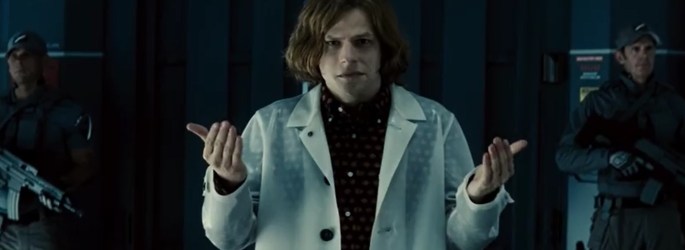
The performances are all uniformly excellent, with Ben Affleck cutting a hardened pose, both emotionally and physically, as Batman/Bruce Wayne. This is a very different Batman, more heavily armored and ready for battle than ever before, with a distinct lack of caring for the overall outcome of his adversaries. Snyder likes his superheroes to kill their bad guys, not hurt them with force. Henry Cavill embodies exactly what a modern Superman should be, bringing both nobility and an incredible sense of stoicism to the role; hopefully we’ll see a bit more of Clark Kent in upcoming films. Gal Gadot is sexy and heroic in equal measure as Wonder Woman, and I can’t wait to see her in action during her standalone film. She seemed EXCITED to be getting in on the big-battle action in the final act which was very cool to see. Jessie Eisenberg plays this new-fangled Lex Luthor with the proper amount of absurd glee that’s needed for this type of role, going appropriately over the top but never losing grasp of his character’s edgy megalomania. Jeremy Irons is all class as a more weathered version of Alfred, and he gets the film’s best lines of dialogue. Amy Adams brings that signature pep back to the role of Lois Lane, and while she’s not neglected, I hope there’s another standalone Superman film to focus more on her relationship with Clark and Superman. And Holly Hunter and Laurence Fishburne both get some really good moments; same goes for the terrific Scoot McNairy.

But the star of the show here is Snyder and his absurdly talented cinematographer Larry Fong, who literally peels your head wide open and blasts the screen with one insanely composed image after another. I grew up in a DC Comics household. Superman, Batman, Wonder Woman – these were my favorite characters, the ones I became obsessed with as a tyke. So, to see the DC Universe explode in such a fabulous way on screen, I feel tremendously lucky to have films like Nolan’s The Dark Knight Trilogy and Snyder’s mesmerizing Man of Steel ready in my Blu-ray arsenal. And with Batman V. Superman: Dawn of Justice, the flood gates have been smashed wide open for more adventures with these decidedly darker superheroes.

3


DOUGLAS TRUMBULL’S SILENT RUNNING — A REVIEW BY NICK CLEMENT

silent running

A triumph of imagination more than overall execution though certainly not without more than one sequence of bravura filmmaking, Douglas Trumbull’s ultra-ambitious sci-fi oddity Silent Running is a relic of 70’s cinema, made clean again by the advances of modern day Blu-ray technology. Back in the day, I would passively watch this movie on cable with extra-wide-eyes as a youngster, but seeing it now, I’ve realized how ahead of its time the central message was, and how interested it was in character and personality rather than needless action or explosions. Trumbull, the special effects guru who assisted Stanley Kubrick on 2001: A Space Odyssey, Terrence Malick on The Tree of Life, Steven Spielberg on Close Encounters of the Third Kind, Ridley Scott on Blade Runner, and Robert Wise’s Star Trek: The Motion Picture and The Andromeda Strain, was and still is a pioneer in the art modern special effects and in-camera photographic techniques, and he was given the chance by Universal pictures to create something entirely his own (albeit on a ridiculously low budget of $1 million dollars!). You can tell that he’s not the world’s greatest director, and while Bruce Dern’s performance is certainly passionate and committed, I don’t think it’s a stretch to say that Trumbull wasn’t an “actor’s director.” But what Trumbull may have lacked in experience he made up for in the creativity and style department.

After drafting a treatment for Silent Running, screenwriters Mike Cimino(!), Steven Bochco(!), and Deric Washburn(!) fleshed out the screenplay, which centers on the idea that sometime in the future, all the world’s plant life has become extinct, with the last remnants preserved and sent out into the solar system inside massive geodesic bio-domes, complete with animal life and fresh water, in the hope that one day they can be returned to Earth and life can again become sustainable. The film takes an anti-corporate slant when Dern, the ship’s constantly sweating botanist/scientist/astronaut, defies the orders of his greedy superiors who want the environmental experiment terminated in favor of sending the massive ships back into money-making routines. Dern commandeers his ship, fights it out with the other scientists, and blasts off for the rings of Saturn, all with the help of three robots who appear to be prototypes of TARS and CASE from Christopher Nolan’s Interstellar.

After evading the enemy, Dern keeps the ship out of contact, hence the title Silent Running, and tries to keep the forest life in the bio-dome up to speed with the robots acting as his helpers. The film then turns into something more quiet and introspective than I ever remembered, with Dern making a perilous journey through Saturn’s rings (shades of 2001 here galore), and then learning that his reforestation idea may not be attainable because of limited resources aboard his ship. He also develops an interesting relationship with his robot buddies. The limited budget shows in many areas, but when the ideas are this interesting and at times profound, I can excuse the lack of slickness in some of the technical departments. And considering the age that this film was crafted during, and with such a small budget, the film is something of a miracle. Nolan CLEARLY must love Silent Running, because he totally cribbed from this film (and from The Right Stuff) while making his magisterial science-fiction epic Interstellar, and it’s awesome to see that Trumbull’s work has continued to inspire a wide variety of current filmmakers.

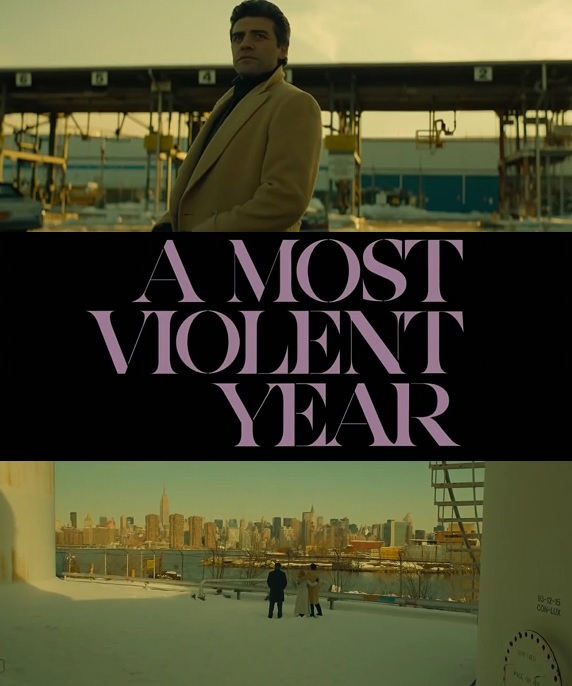
J.C. CHANDOR’S A MOST VIOLENT YEAR — A REVIEW BY NICK CLEMENT

a most violent year


How does a (mostly) honest man working in a thoroughly corrupt industry stay on the right side of the tracks? What’s wrong with cutting corners and being shady if all of your competitors are taking extra, morally questionable steps to ensure their success? What drives people to do the things they do? These are only some of the questions that the thematically rich film A Most Violent Year covers in an intimate, very 70’s way. Writer/director J.C. Chandor (Margin Call, All is Lost) summons the ghost of Sidney Lumet with this down and dirty, early 80’s NYC fable consisting of businessmen, politicians, cops, wives, children, and the constantly shifting dynamics between men of power and those who are needed to allow that power to continue and thrive.

Every character in this slow-burn drama (with a tad of melodrama thrown in at the end) is out to get their own; everyone has an agenda and enormous reasons for wanting the things they want. When one character asks another in this beautifully written story about ethics and morals: “Why do you want this?” the question takes on multiple meanings. And when the character answers with simply: “I don’t understand your question” you know that this is a film that isn’t interested in black and white notions of good and bad, but rather, the gray areas that separate us from doing right and wrong.

A Most Violent Year carries a metaphorical title that extends more to the atmosphere of NYC in the early 80’s then it does to constant violent action, which is something that this talky, low-key, and wonderfully observed movie is most definitely not interested in. Yes, you get some fantastic foot chases and one sensational, hair-raising car chase that echoes the POV hell-ride in James Gray’s The Yards (another Lumet homage), but A Most Violent Year is all about the distinct performances and the pungent writing and the burnished, dark, early morning and late night cinematography from shooter-of-the-moment Bradford Young. His work here is elegant and smoky, all browns and blacks and golds with splashes of orange and red for accent. I loved looking at every image in this movie.

Oscar Isaac was sensational as Abel Morales, a man trying to run a home heating-oil company with his wife Anna (a juicy, sexy Jessica Chastain, playing the ultimate snake-in-the-grass), and always attempting to run an honest business without cutting too many corners. Interesting in that he’s always being “mostly good,” Abel knows he could call his wife’s gangster father for support in any number of ways (someone is jacking his oil tankers and beating up his salesmen and drivers; people are waiting for him outside his new mansion in the late hours of the night with pistols, etc.) but he doesn’t want to do that. And despite probably knowing that his wife is more than meets the eye in any number of respects, he keeps his head up, doesn’t ask too many questions, and lets the assorted pieces to his complicated business puzzle take shape. By the end of this tense and gripping drama, if you loved it as much as I did, you’ll want to know more about what happens to the various characters as the screen fades to black – I know I did.

KEVIN REYNOLDS’ THE COUNT OF MONTE CRISTO — A REVIEW BY NICK CLEMENT

count_of_monte_cristo

Truly exciting modern swashbucklers are hard to come by. The first Antonio Banderas Zorro was great fun, and I’m a big, big fan of the Gore Verbinski Pirates of the Caribbean movies, as he’s a premiere visual talent who makes some of the most unorthodox and unique blockbusters. But one film that snuck in under the radar was 2002’s The Count of Monte Cristo, from Waterworld and Robin Hood: Prince of Thieves helmer Kevin Reynolds. Featuring two rock-solid performances from then up-and-coming stars Jim Caviezel and Guy Pearce, the film was bolstered considerably by fabulous production values; Andrew Dunn’s exceptional cinematography and the sumptuous set decoration and overall design by Mark Geraghty really evoked time and place with a great sense of style that was never over the top. Crisply adapted from the classic Alexandre Dumas novel by Jay Wolpert, who also worked on the first Pirates film, the plot was streamlined with the action elements beefed up, but the film never felt cheapened or dumbed-down for contemporary audiences, with both Caviezel and Pearce offering up impassioned performances that fit their respective molds just right. On a $25 million budget, the film became a theatrical success with a box office gross of $75 million worldwide, but this is certainly one of those films that has had a long shelf life on cable and disc. You can’t go wrong with a supporting cast that includes Richard Harris, Luis Guzman, Michael Wincott, James Frain, and Henry Cavill, and the sweeping musical score from Edward Shearmur immediately set an appropriately high-stakes tone with rousing emotional beats. This film didn’t try and pretend to be anything other than what it was — a spirited romp through classic material told with directorial panache and an unpretentious sense of classical Hollywood hat-tipping.

BRIAN HELGELAND’S LEGEND — A REVIEW BY NICK CLEMENT

Legend mixer

Legend is robust, underappreciated genre entertainment, boasting two explosive performances from Tom Hardy as the infamous Kray brothers, twin gangsters who ran the show in swinging-60’s East London. Hardy is simply an actor on fire, repeatedly making it clear in film after film that he is an absolute force to be reckoned with. Written with sass and directed with punchy style by Brian Helgeland, the film was all but buried by Universal in the United States. The studio must’ve realized at the last minute that, sadly, Hardy’s name means nothing above the title on a poster or in trailers as regular Joe moviegoers haven’t a clue as to who he is. The decidedly British tone and setting might have represented a further challenge to audiences looking for a more formal gangster film. But my question will always be, in the case of this film and many others – why BOTHER making the film in the first place if you have no intention of properly releasing it? Studio execs presumably read the script and approved the casting decisions, so why is it some sort of big shocker that the end results are exactly what should have been expected?

The film doesn’t break any new ground for the milieu, but at the same time, it’s mighty entertaining at almost every turn, with the dual performances from Hardy as Ronnie and Reggie Kray absolutely blazing up the screen with full-force intensity. Tapping into his innermost Bronson at times and letting it rip with extreme visceral force, he was able to convey two very different characters, sometimes within the same scene thanks to seamless visual effects work, while showcasing an overall level of cinematic ferocity that is getting increasingly harder for any other actor to match. Emily Browning is sexy as hell as the object of desire, looking smashing in glitzy period-authentic clothing, with some of the best make-up work I’ve seen in recent films.

The film is vulgar, violent, and cheerfully bloody, with all sorts of stabbings and throat-slicing and shootings to satiate the gore hounds, with Helgeland comfortably playing in the tough-guy cinematic arena that clearly comes natural to him (other potent screenplay credits include Mystic River, LA Confidential, and Man on Fire, while he’s probably best known for directing the neo-noir Payback with Mel Gibson). A snappy soundtrack and vibrant cinematography by Dick Pope also spruce up the proceedings, while familiar faces such as Chazz Palminteri, Paul Bettany, Sam Spruell, David Thewlis, Taron Egerton, and Christopher Eccleston provide solid supporting turns. The film grossed $42 million worldwide, with just $2 million of that total coming from U.S. box office receipts. Insane to ponder.

PETER LANDESMAN’S CONCUSSION — A REVIEW BY NICK CLEMENT

concussion mixer

Wow. I am shocked and confused by how little respect was paid to Peter Landesman’s confident, important, and all together sad true life story Concussion, which documents the mostly futile attempts by the brilliant Dr. Bennet Omalu to wake the NFL up to a massive health issue, played in a nearly career topping performance by Will Smith (nice to have you back!), replete with flawless accent, who was completely and utterly robbed of an Oscar nomination last year. But, this movie was always, unfortunately, going to face an uphill battle with audiences; like Michael Mann’s The Insider, people don’t want to hear that one of their favorite things in life is a potential killer. But the facts cannot be disputed. If you play professional football, you have a 28% chance of coming down with the disease Chronic Traumatic Encephalopathy (CTE). This is not a figure made up out of thin air – this is a figure backed up by real life incidents and statistics and deaths that might otherwise have been prevented had the reasons behind them not been swept under the rug. William Goldenberg’s fluid editing keeps the film very focused for a tight two hours, with Smith displaying huge amounts of sympathy and courage, in what has to be one of his most compelling screen performances.

Shot with silky smooth elegance by the continually underrated and extremely versatile cinematographer Salvatore Totino (Any Given Sunday, Everest, Changing Lanes), who captured the rusty Pittsburgh locales with gritty realism, Concussion remains engrossing from the very first shot to the depressing-truth closing image. Like last year’s Spotlight, this is a movie that sticks with the facts, and because of that, contains a sense of virtue and relevance that’s lacking in most studio productions. The NFL was wise to be nervous about this film. But at the end of the day, as Landesman’s well-observed screenplay points out, the NFL, like many massive corporations, doesn’t care about anything else other than making money, even at the expense of people’s health and quality of life. They hired the same group of lawyers who represented “The Big Seven” tobacco companies back when their destructive product was put under the legal microscope. David Morse is exceptional (when’s he not?) in a small but crucial supporting performance, and the stunner Gugu Mbatha-Raw is de-glammed after her striking and poignant turn in the exceedingly undervalued Beyond the Lights, providing a sensitive portrayal of a woman drawn to the magnetism of Omalu, even when knowing he was facing an uphill battle. Albert Brooks and Alec Baldwin are both terrific in sharply-etched supporting roles. James Newton Howard’s score is potentially too insistent upon itself, but is nonetheless powerfully composed. Produced by Ridley Scott.


JOHN WOO’S FACE/OFF — A REVIEW BY NICK CLEMENT

face off mixer

Face/Off unquestionably represents the one time that Hollywood really got out of the way of action maestro John Woo and allowed him to go for broke with a big-budget and play on an R-rated playground of his patented poetic ultra-violence. I saw this film twice during opening weekend back in the summer of 1997 (19 years ago!), and over the years, I’ve watched it so often that most of it has been committed to memory. The film contains two of the juiciest movie-star performances of all time between John Travolta and Nicolas Cage, both hamming it up exceedingly well, delivering sympathetic and villainous turns, sometimes in the same scene, while getting a chance to flex their action star muscles, which had been respectively set in motion with 1995’s Broken Arrow (also directed by Woo) and 1996’s The Rock, from then-rising star and future genre overlord Michael Bay. The exceedingly high-concept story from Mike Werb and Michael Colleary must’ve resulted in a big script sale, as this was the sort of non-franchise action movie that used to get made before everything started to take on a homogenized, PG-13 flavor. Travolta is Sean Archer, an FBI Agent hell-bent on capturing or killing the terrorist Castor Troy (Cage, who was given one of the best movie character names I can think of), who inadvertently killed his son.

The film’s gorgeous and dreamlike opening sequence, all crafted without one line of dialogue, perfectly sets up the story, which breathlessly leads into the film’s first action set-piece, and then from there, the movie is like a rip-cord of over the top ideas and sequences, all done with zero CGI, featuring larger than life stunt men and women who were doing things that could have easily gotten them killed, all for our general amusement. A great supporting cast was on hand, with Joan Allen, Gina Gershon, Nick Cassavetes, Alessandro Nivola, Colm Feore, Harve Presnell (this guy’s post-Fargo credits are sort of obscene), John Carroll Lynch, C.C.H. Pounder, and a then-teenaged Dominique Swain all delivering solid work that tied the two, mega-wattage star turns from Cage and Travolta together. Woo went wild with his trademark double-fisted shoot-outs and bloody, operatic fight sequences studded with classical music, fluttering pigeons, and overall eclectic soundtrack choices (“Somewhere Over the Rainbow” gets a very subversive workout), with results that often times resemble an elaborate dance. John Powell and Hans Zimmer teamed up for the pulse pounding musical score, while ace cinematographer Oliver Wood pulled out all the stops behind the camera, resulting in one of the best looking action movies ever crafted. I was totally obsessed with this movie back in the day, and upon revisiting, it’s not hard to see why. It’s absolutely awesome.