JOE DANTE’S INNERSPACE — A REVIEW BY NICK CLEMENT

innerspace

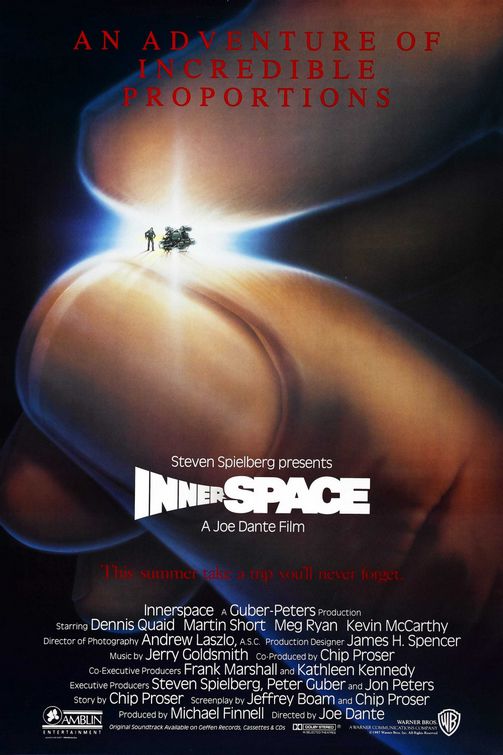
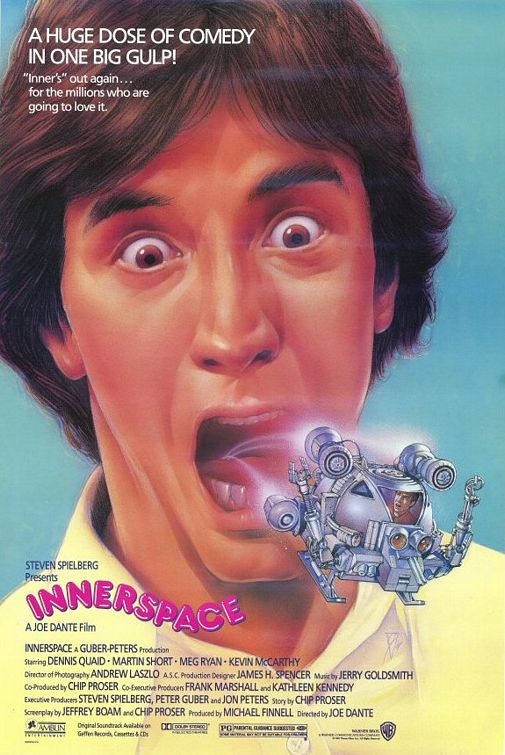
Innerspace is a film I watched repeatedly as a kid, and there’s just so much gee-whiz charm about this film that I can’t stop grinning while watching it to this day. Joe Dante has always been a favorite filmmaker of mine, someone with that Spielberg touch for tone and spirit, as so many of his efforts have left me enchanted that I’ll never forget the importance he’s had on my cinematic upbringing. Explorers, Gremlins, Gremlins 2, Small Soldiers, The Howling, The ‘Burbs, and Matinee (damn I love Matinee!) – it’s just an insane list of genre-defying entertainment, with Innerspace ranking near the very top of his output. Starring Dennis Quaid with that mile-wide smile and Meg Ryan in the prime of her filmic cuteness, this sci-fi-romance-comedy centers on Quaid’s Marine who is miniaturized in a government experiment and is then accidentally injected into Martin Short, playing a massive hypochondriac who feels that he’s become possessed. Short is an utter pisser in this film, and the way he bounced off of Quaid was absolutely perfect, offering up any number of hilarious moments of character interplay. Ryan is Quaid’s love interest, and the chemistry they shared together is bonkers to witness. This film is one laugh after another, one scene of inventive plotting after another, with some truly wonderful (and practical) special effects that never feel dated in a now modern context. Jerry Goldsmith’s score is sprightly and catchy, and one must never underestimate the talents of cinematographer Andrew Laszlo, who also shot First Blood, Streets of Fire, The Warriors, and Southern Comfort. The freshly released Blu-ray has a commentary track with Dante and key craft contributors – can’t wait to give that a listen! Also, it goes without saying, MASSIVE Robert Picardo POWER.
innerspace_ver5

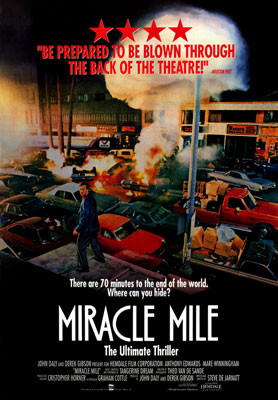
STEVE DE JARNATT’S MIRACLE MILE — A REVIEW BY NICK CLEMENT

miracle_mile

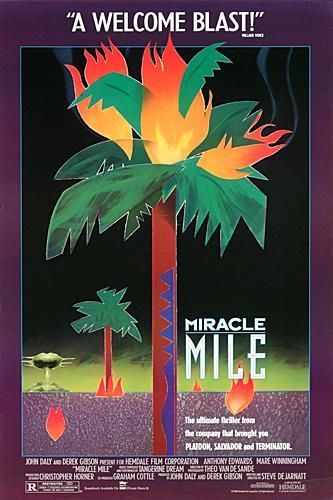
Steve De Jarnatt’s cult classic Miracle Mile has just hit Blu-ray thanks to the lovely people over at Kino, and it’s about damn time this terrific little gem had its high-definition day of reckoning. Starring Anthony Edwards and Mare Winningham as two potential love birds whose romantic date-night is cut short thanks to the alarming notification of the end of the world (nukes have been launched…!), De Jarnatt’s exciting, heartfelt, and totally unique tale of desperate romance hits all the right notes of 80’s tonal shifts and scrappy whimsy. Edwards is great in the rare lead role as drifting musician Harry Washello, who immediately becomes smitten by a waitress name Julie (Winningham), who he meets at a downtown LA diner in the Miracle Mile district. They make plans for a date, but things get complicated when Harry runs late, and then answers a ringing pay phone where he hears on the other line the wild rantings of a supposed government worker exclaiming that the end of the world is near. The rest of the film unfolds more or less in real time, as Harry attempts to traverse the rapidly crumbling city in an effort to find Julie and spend the last remaining moments of life together and happy. That is…of course…if the caller on the other end of that pay-phone was telling the truth. Without spoiling the film for anyone who hasn’t see it, there’s a conviction to the storytelling, especially in the final act, that feels alive and bracing, and the film serves as a unique precursor to stuff like Seeking a Friend for the End of the World (very underrated) and any number of end-of-times thrillers that have been released over the years since Miracle Mile’s low-profile theatrical release. The film has become a massive favorite with at home viewers throughout the years, and it’s easy to see why: there’s not much else quite like it and few films dare to pack as much in as this one does into its slim but engrossing 90 minute runtime. De Jarnatt created a lively cross-section of distinct characters who all feel oh-so-Los Angeles, and I loved how the film’s narrative swerved back and forth between comedy, romance, surprisingly dark and violent action, and pointed social commentary which still feels relevant to this day. Clearly shot on a low budget, the film feels much bigger, with slick and stedicam-dominated cinematography from Theo van de Sande, who was making his English language debut as a cameraman. There are some brilliant long takes that boggle the mind and I loved how De Jarnatt and de Sande captured the restless spirit of both Harry and Julie’s characters. This is a movie that meant one thing to me as a teen while watching it and a totally different thing when recently revisiting it. This is a goodie that too many people may be unfamiliar with.

Miracletheatrical

RON HOWARD’S THE MISSING — A REVIEW BY NICK CLEMENT

2

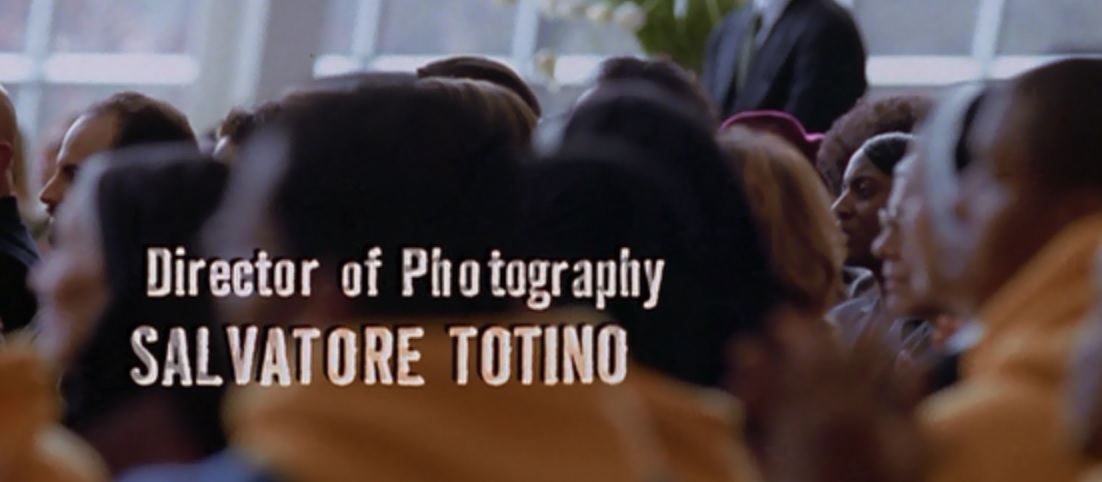
The Missing is one of Ron Howard’s best, most underrated efforts. I typically love his films when he goes with R-rated material, and this one has edge, intelligence, fantastic performances from Tommy Lee Jones, Cate Blanchett, and a roll-call of terrific character actors, and an extremely impressive visual atmosphere courtesy of cinematographer Salvatore Totino, a dynamic cameraman who I’ve been impressed with for years. This is a unique, revisionist Western that plays on old-school genre touchstones within the classical narrative while also allowing for a modern sensibility to creep through, in terms of the attitudes and aesthetic. There’s a directness that I admired about this film, with Howard steering clear of overt and sappy sentimentality, and allowing for the desperate, rugged qualities of life in the old West to shine through. Blanchett cut a convincing portrait of a woman pushed to her mental and physical edge, with the production going to great lengths to show how hard life would have been during that time period. Jones is fantastic as her spiritual and literal guide to revenge and redemption, and it’s yet another performance where he’s able to do so much with that weathered face and amazing voice beyond the dialogue that he was given. Howard and Totino opted for a washed out, de-saturated color palette; we might be in John Ford territory but this doesn’t look and feel like your grandfather’s Western. The Missing feels cold and forbidding and dangerous and lawless, all attributes of that life and time, but what’s so special about this film is that it never feels softened at any point. This 2003 release flew under the radar with critics and audiences and deserves a higher profile, and it more than qualifies as overdue for a Blu-ray release, especially considering how well appointed the production was on a visual scale. And as usual, James Horner’s score popped in all the right ways, adding heft and dimension to the action on screen. A terrific roll-call of supporting actors are on display, including Clint Howard, Evan Rachel Wood, Aaron Eckhart, Val Kilmer, Eric Schweig, Ray McKinnon POWER, Jenna Boyd, and Max Perlich, who is always terrific.

3

ROGER MICHELL’S CHANGING LANES — A REVIEW BY NICK CLEMENT

2

All director Roger Michell has done throughout his career is make one terrific, underrated film after another, and one of his absolute best is Changing Lanes. Feeling like a movie from the 70’s in many respects, this is a thoughtful drama about personal morals and business ethics, and while it was well-received by critics (Ebert notably flipped out) and did solid box-office (close to $70 million domestic), I feel that this one qualifies as terribly under the radar, deserving of far more praise and reassessment. Starring the surprisingly combustible duo of Samuel L. Jackson and Ben Affleck as two men pushed and stretched to their respective breaking points by one another’s selfish, potentially dangerous behavior, Changing Lanes is ALL about character, motivation, decisions, and a constant sense of inner turmoil for everyone involved in the narrative. Jackson and Affleck both deliver excellent performances, with Jackson getting the chance to play sensitive which is a rarity, and Affleck doing some of his most effective dramatic acting as a young man who seemingly has it all figured out, but quickly realizes he’s swimming in a sea of vipers. The screenplay by Chap Taylor (an ex-assistant to Woody Allen) and Michael Tolkin never goes over the top even though at times you feel it might; everything stays believable within reason and I loved how there was never the thought to inject a phony action scene or shoot-out or something conventional into an otherwise unconventional (in many respects) piece of studio filmmaking. The film truly feels like a complicated exploration of the human condition, a lost relic from a different era.

1

The action centers on two men having a bad morning, which gets even worse when they’re involved in an traffic accident on the highway outside of NYC. They’re both late for court (Affleck is a lawyer; Jackson is going through child custody hearings) and Affleck flippantly dismisses the accident and throws a blank check at a dismayed Jackson, who wants to do things by the book. What Affleck doesn’t realize is that he’s dropped sensitive and super-important documents in the street, which Jackson snags after Affleck drives away. From there, the film becomes a desperate story about Affleck needing to retrieve the documents, and going to psychological war with Jackson, who is dealing with his new-found sobriety (William Hurt turns up for a great cameo as his AA sponsor) and the deep love for his children. Affleck is also forced to contend with his conniving father-in-law and boss (the perfectly smarmy and vicious Sydney Pollack) and his ice-cold wife (Amanda Peet, nailing her one big seen with pointed line delivery and casual, deceptive sexiness). And then there’s the subtly stylish cinematography from Salvatore Totino Asc Aic, which goes a long way in shaping the emotional textures to the characters and the story. It’s constantly raining in Changing Lanes – both outside and inside, literally and metaphorically – and the way Totino’s slippery camera moves captured water and its reflective quality brought an introspective level to the visuals that amps up the psychological and dramatic tension all throughout the film. I also loved the close-up on the back of Affleck’s head towards the film’s denouement; you feel like you’re travelling directly into his thoughts as his makes up his mind on how to handle the situation he’s found himself in. David Arnold’s moody and ambient score is also first-rate.

THE WORK OF SALVATORE TOTINO — BY NICK CLEMENT

4

Ever since I was 19 years old I knew Salvatore Totino Asc Aic “had it.” That’s because I saw Any Given Sunday, and holy WOW, that film is a cinematographer’s dream come true. Of course, working with Oliver Stone would likely challenge any budding cameraman, and I can’t help but feel that a film as aggressive as Any Given Sunday would probably have been one of the craziest ways to make your big-screen debut as a full-fledged cinematographer. He arrived from a background in music videos, working with all of the greats (REM, Radiohead, U2, Bruce Springsteen), so feature films were the next logical fit. And over the years, Totino has brought a deceptively stylish and obscenely photogenic eye to every project that he’s worked on. He’s shot sports films, historical dramas, light comedy, intense action, and character-based dramatic thrillers, and no matter the genre, he always embodies his films with rich texture, motivation for his choices, and unique angles in which to cover all of the action and conversations. His name is one that I look for on posters and in the credits as a sign of quality, and I can’t wait to see his upcoming efforts Everest, a mountain climbing adventure with a massive cast, and his return to the football field with the NFL brain-trauma expose Concussion.

4

Watching Any Given Sunday can sometimes make the viewer feel dazed or drunk – there’s so much visual information being hurled at the viewer that it can be a challenge to keep up. But that’s exactly the point – Totino and Stone wanted you to feel the rush of the on-field action in a way you never had before; watching a football game feels boring in comparison to what they did with their film. Each image as a level of dynamism that feels hard-edged and forceful, with the camera wildly swerving from one side of the frame to the other, without ever losing clarity or spatial reasoning. This same sort of attention to geography would be demonstrated during the boxing scenes in Cinderella Man, a deeply burnished, sepia-toned period piece that feels lived-in and incredibly authentic. The ringside sequences sting with bloody realism, and while never going full-on heightened in the same fashion as Raging Bull, there’s an intensely stylish yet still honest aesthetic that comes into play during the many brutal bouts and emotionally draining family and home-life sequences. And then in something modern and contemporary like Changing Lanes, Totino was able to bring out character and emotion in a very grounded, cut-from-the-70’s manner which emphasized clean camera moves and a subtle sense of high-style. And while never calling attention to itself, Changing Lanes still stands out as distinctive, moody, and edgy, with an introspective quality to the images which helps to ratchet up the tension. No matter the film or style or the director that he’s working with, Totino has repeatedly proven to be one of the most versatile and dependable big-studio cinematographers for over the last 15 years.

Kornél Mundruczó’s WHITE GOD — A Review by Nick Clement

1

A few nights ago, I viewed the Hungarian film White God. It affected me so much and on such a personal level that I’ve not been able to accurately summarize my thoughts and feelings concerning all that it covers as a piece of art. What I can say is this: No film this year has gotten to me on an emotional level like the way this one did, and while it’s not going to be a movie for everyone, I urge as many people as possible to seek out this important, brilliant piece of work. Simply put, it’s an uncompromising masterpiece, a film that feels like some sort of miracle, and one that holds an overwhelming sense of power and grandeur by its conclusion, while never forgetting to explore all of the intimate details that make this film truly special. I’ve never seen anything remotely like it, and on a technical level, I can’t even begin to understand how it was achieved. The level of patience involved is staggering to ponder. White God depicts some VERY graphic animal abuse, and if you know me in any-way-shape-or-form from my interactions on the Facebook, you know where I stand on animal abuse and how I feel animal abusers should be dealt with – they should be killed.

2

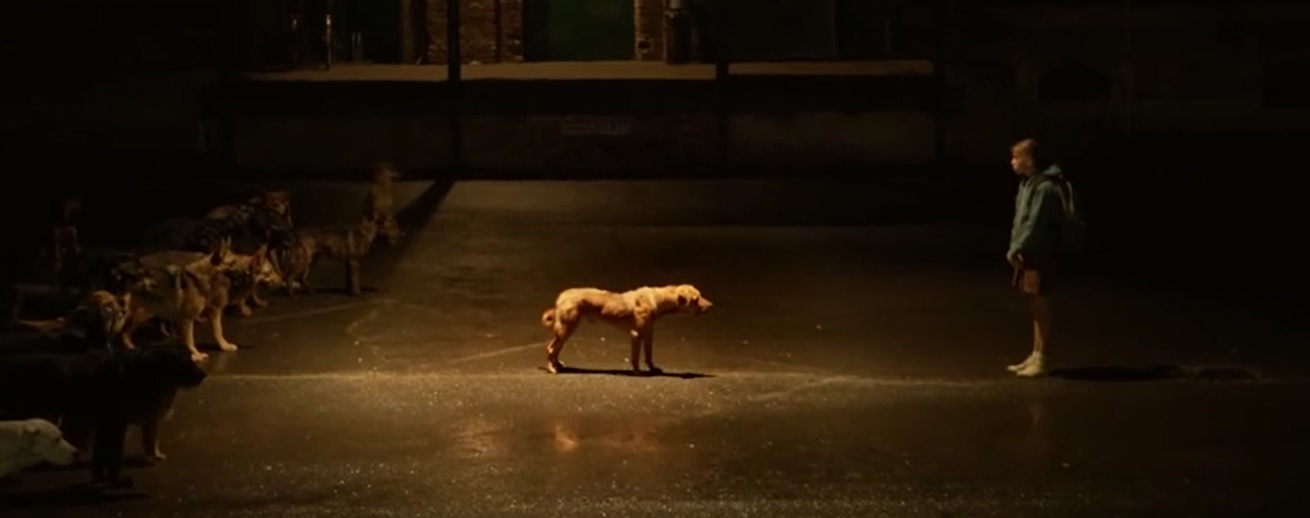
For those who are unfamiliar with this blistering motion picture, the devastating narrative follows two separate story-lines, one tracking a mixed-breed dog named Hagen, and the other involving his master, a young girl named Lili. When Lili moves into the apartment of her estranged father, bringing along Hagen, tensions begin to mount, and in a moment of heartless behavior, Lili’s father abandons Hagen after city officials demand that a tax be paid because the dog isn’t a pure-bred. Alone, scared, and confused, Hagen wants nothing more than to be reunited with Lili, and he sets off across the city in an attempt to be reunited. Along the way he’ll be captured by members of an illegal dog fighting organization who abuse and train him to kill, all before escaping, only to be rounded up by the soulless city workers who are more interested in euthanizing rather than helping. And then – enough is enough – Hagen busts loose, rips some people a new one, and attracts a pack of 250 other half-breed canines that start an uprising against anyone who stands in their way. The final moments of White God must be seen to be believed, as the last act of this riveting film is more than outstanding and cathartic.

3

There are some very, very tough scenes of animal cruelty in this film, all simulated of course, but what occurs in the final third makes the most harrowing of moments worth the punishment. Written and directed with visual elegance, a sense of provocation and extreme visceral intensity by Kornél Mundruczó, White God will be nearly impossible to shake off once you’ve seen it. What’s most sad about this film is that you know this sort of thoughtless behavior is being thrust upon animals that aren’t able to adequately defend themselves, and while the film should probably be treated more as allegory than anything else, it’s a further reminder that how one treats an animal says much about their inner qualities as a person. Marcell Rév’s landmark cinematography is nothing short of awe inspiring; how any number of shots in this film got accomplished I’ll never understand. There’s a primal clarity to the images, and while Rév’s camera never exploits the sad carnage around the edges of the story, he’s not afraid to get up close and personal to a certain type of ugliness that is all too real. This is a film that’s going to be very, very hard for me to stop analyzing and pondering.

OLIVER STONE’S ANY GIVEN SUNDAY — A REVIEW BY NICK CLEMENT

4

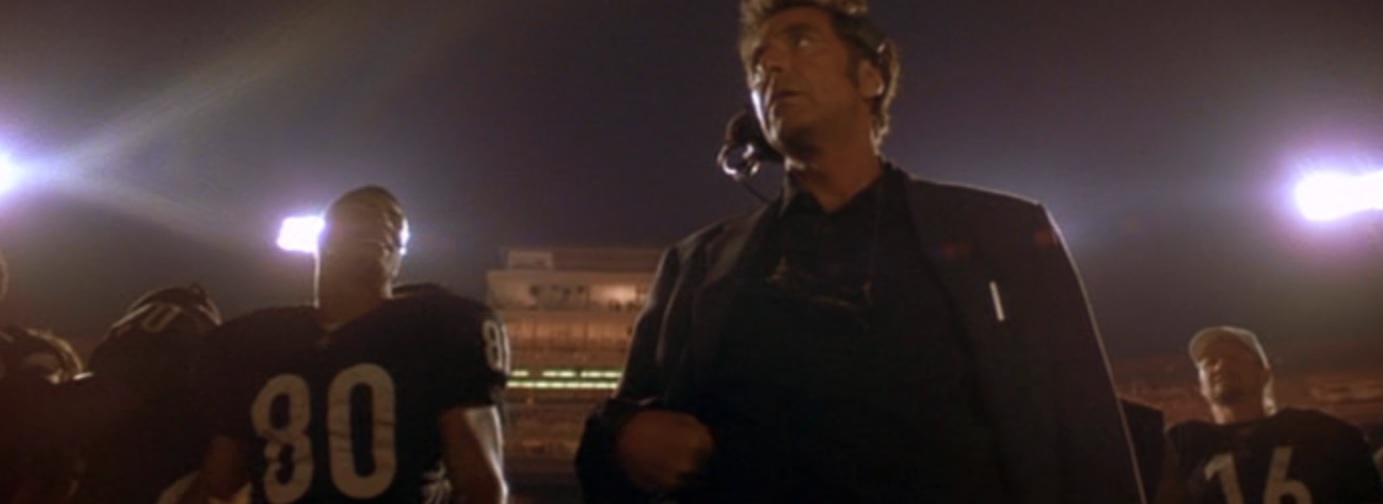
Oliver Stone’s Any Given Sunday is now over 15 years old and thanks to the Blu-ray format, this visually expressive blitzkrieg-of-a-sports-film just bleeds off the screen. Featuring a supremely aggressive audio/visual package, this is totally-in-your-face filmmaking at all times, featuring hurtling, stylized, frenzied cinematography from master cinematographer Salvatore Totino that shakes the senses; it boggles the mind to think that this was his first big studio feature as a director of photography. The amount of coverage, the insanity of the camera placement, the constant ramping of film speed and visual distortions and augmentations are staggering to witness, and if you’re a cinematography junkie like me, this film is a constant source of maxed-out pleasure. The hyperactive yet still lucid editing is in perfect tandem with the over the top subject material and everything is played at just the right tone and pitch. The eclectic musical score compliments every wild and crazy scene, mixing rap, metal, and classical songs with the techno stylings of Moby in more than one instance. Al Pacino is at his Shouting-Mad best here, and he gets some seriously good dialogue from John Logan and Stone; his “inches” locker room speech is one for the ages, ridiculously quotable, epitomizing the idea of coaching ferocity. Stone brought major directorial intensity to each and every scene in this scathing indictment of professional football; in retrospect this film feels very ahead of its time, with a cold and cynical message purveyed at all times, feeling more relevant now than it did upon first release. The absurdly deep cast all deliver deeply committed performances; standouts are an icy Cameron Diaz, a perfectly weathered Dennis Quaid, sleazy James Woods pushing pain killers on the players, and of course, the flashy and confident work of then-acting-newcomer Jamie Foxx, who held his own with all of the veteran actors, knowing when to ease up and allow others to have their space, while still getting a chance to cut loose with his arrogant, show-boating character. The sequence where he has dinner with Pacino and the chariot race from Ben-Hur is playing in the background is still one of my favorite scenes in any film. And let’s not forget about the in-credits stinger during the final credit roll – so nasty! Great football action, sharp satire, fantastic visuals, and dynamite sound design help make this one of the best sports movies of all time.

1

BILL CONDON’S MR. HOLMES — A REVIEW BY NICK CLEMENT

2

Mr. Holmes is a superbly acted and lushly appointed British period piece that tells a clever story involving a retired Sherlock Holmes played by the reliably fantastic Ian McKellen. Gracefully directed by Bill Condon and based on the 2005 novel A Slight Trick of the Mind, which was written by Mitch Cullin, the film co-stars Laura Linney as Holmes’ housekeeper Mrs. Munro, with the wonderful young actor Milo Parker as her son Roger. The story takes place primarily during Holmes’ retirement, with flashbacks peppering the narrative featuring a younger Holmes and his investigations, and pivots on the notion that Holmes’s mind has begun its deterioration, as he struggles to recall all of the details to his final case, something that’s haunted him for years. There are more than a few nice surprises in the story, Tobias Schliessler’s unfussy but stylish cinematography keeps things visually interesting at all times, and McKellen was afforded the chance, due to the crafty screenplay, to create a full bodied portrait of one of literatures greatest figures, and it’s clear from frame one that he was delighted to have been given this chance. Carter Burwell’s score immediately sets the mood, and the production design and costumes were top-notch and on par with what you’d expect for this sort of period fare. Condon has proven to be a filmmaker who is hard to pin down; I certainly appreciate the eclecticism of his filmography, which includes Candyman: Farewell to the Flesh (genuinely scary), Gods and Monsters (also starring McKellen), Kinsey (my personal favorite), Dreamgirls (still need to see in its entirety), the underrated and energetically entertaining topical thriller The Fifth Estate, and he’s now hard at work on a big-budget, live-action retelling of Beauty and the Beast. And while I’m not a Twilight person, I applaud Condon’s ability to play in the blockbuster arena and then move back to smaller, more personal pieces. Mr. Holmes is a pleasant movie, the sort of film that will appeal mainly to an older, more adult crowd, and it feels like smart counterprogramming in the sea of summer blockbusters.

3

MARTIN SCORSESE’S THE KING OF COMEDY — A REVIEW BY NICK CLEMENT

2

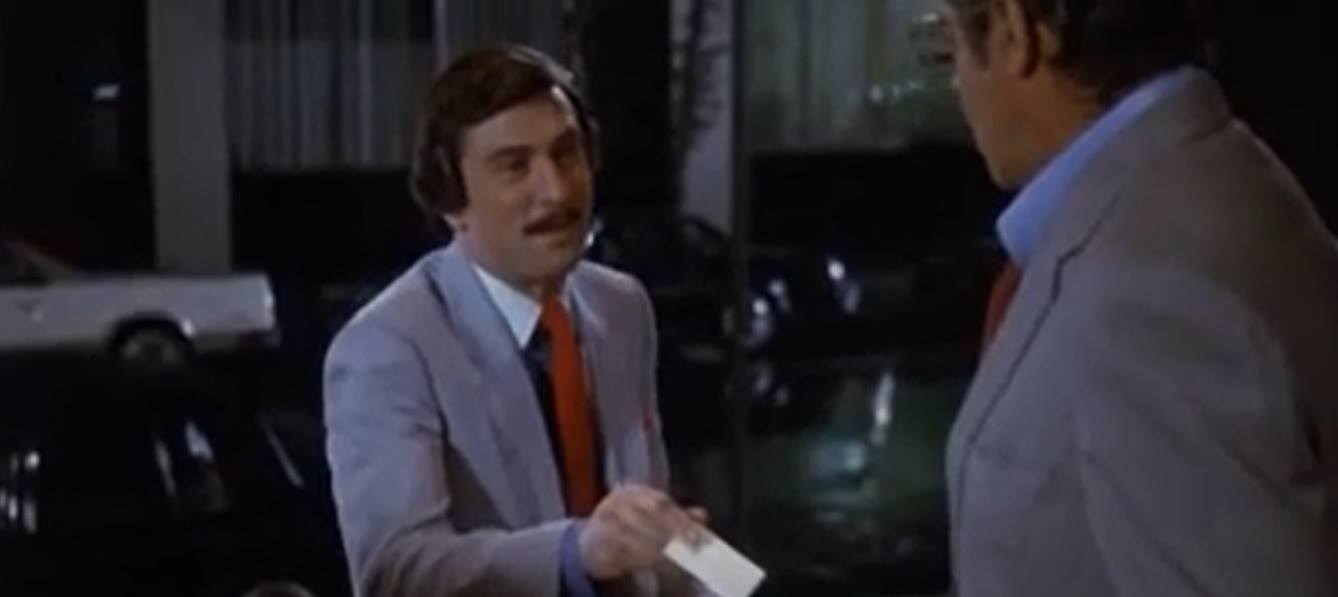
My #3 Scorsese picture behind Goodfellas and Raging Bull. This is a brilliant black comedy, with an aggressively funny performance from Robert De Niro. Jerry Lewis is utterly amazing here, all dead pan and stern seriousness, completely unimpressed with De Niro’s idiotic pestering and absurd shenanigans. Merely thinking about this film makes me burst out laughing. The bit with Sandra Bernhard clearing the table with Lewis tied up in tape – screamingly funny. De Niro doing his asinine routine in the basement of his mother’s house with his mother yelling at him to be quiet – it’s the stuff of instant comic legend. It’s appalling and sad that nobody gave a squat about this film upon its initial release aside from a likely handful of astute critics and viewers. There’s something positively diseased about The King of Comedy, and the way the Scorsese seems to be relishing in the madness makes the film all the more bracing and effortlessly watchable. Scorsese and screenwriter Paul D. Zimmerman painfully examine hero and celebrity worship, the false sense of importance that some people feel in their lives, and the overriding obsession with becoming famous that sits inside so many individuals. The King of Comedy, in a weirdly prescient manner, acted as a precursor to some forms of reality TV, blurring the lines between true stardom and mere infamy, further perpetuating Andy Warhol’s prophetic notion of everyone’s ability to have “15 minutes of fame.” De Niro and Bernhard are looney tunes in this film, but the scariest, worst type of looney tunes imaginable — the sort of people who don’t realize that they’re sociopaths, even after they’ve committed their acts of transgressive lunacy. Audiences and critics weren’t expecting this sort of caustic, dry humor from Scorsese in 1982, especially coming directly after Raging Bull, and the film died a quick death at the box office and wasn’t as critically respected as it should have been. Thankfully, over the years, the film has taken on cult classic status, and easily stands as one of Scorsese’s best and most underappreciated efforts (I also feel that Kundun is woefully unsung, and The Age of Innocence warrants reconsideration, hopefully by The Criterion Collection). I can’t help but bust a gut every time I see this unhinged masterwork of intensely disturbing hilarity.

1

GEORGE P. COSMATOS’ LEVIATHAN — A REVIEW BY NICK CLEMENT

1

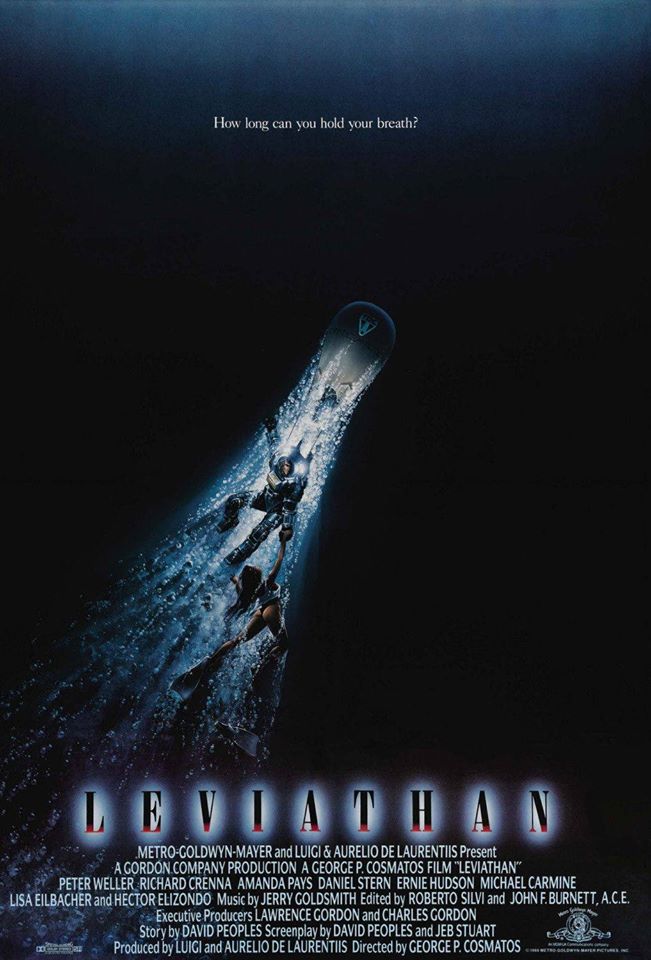
I’ve always really enjoyed Leviathan. This is another exceedingly entertaining, late 80’s genre hybrid (a bit of sci-fi, a bit of horror, a bit of action, tons of drama) from my childhood that holds up remarkably well considering how things have progressed in the visual effects department in later years. But part of the now-novelty of seeing films like this is that they feel awesomely quaint by modern standards, and for me, there’s a true sense of old-school movie-magic that guides these sort of creature features. The cast is oh-so-1989-perfect: Peter Weller, Richard Crenna, Ernie Hudson, Lisa Eilbacher, Daniel Stern, Hector Elizondo, and Meg Foster are all on display giving solid, no-nonsense performances. Co-written by the estimable pair of David Peoples (Blade Runner, Unforgiven, 12 Monkeys) and Jeb Stuart (Die Hard, The Fugitive) and directed with gritty integrity by George P. Cosmatos (Cobra, Tombstone, Rambo: First Blood Part II), Leviathan is an underwater actioner in the same vein as Alien and The Thing — a group of scientists and adventurers are confined to a single location and terrorized by a creature that they never see coming. Stan Winston did the sensational and refreshingly practical special effects, Jerry Goldsmith’s score is appropriately pulse-pounding, and Alex Thomson’s moody and atmospheric lensing bolstered every single scene. The March release date beat The Abyss by 5 months, but the film would still end up being a mild box office performer, which would eventually lead to cult status in later years. What’s the last monster at sea movie? Deep Rising? We need a good return to form for this sort of movie!