“I’m not saying the universe is evil but it sure has a nasty sense of humour.” – A review of Passengers by Josh Hains

The following review contains mild spoilers that will describe events that occur during the first 25-30 minutes of the movie (the first act). If you do not wish to read what could be considered spoilers to some individuals, you can skip the fourth paragraph.

Science fiction, as a genre within the medium of film, has always been built on ideas, either that reflect societal issues or political stances, or that ask audiences thought provoking questions about Life, time, space, and our own morality codes. Since Gravity was released in 2013, I have asked myself what I consider to be a rather important question with each new science fiction epic related in the years since: does this story break new ground, does it try something different, or have I seen it all before? In the case of Gravity, I came to the conclusion that the story didn’t break new ground at all, though apparently there were possibly some ground-breaking methods behind the construction of the movie. Interstellar broke new ground, presenting us with the theoretical concept of astronauts travelling through a black hole in search of a new planet to colonize after mankind’s way of life ceases to be a sustainable enterprise. The Martian asked what would happen if a man was stuck on Mars for 4 years, how would he survive, and how would we get him back to Earth, and showed us with a great deal of scientific accuracy, how this might occur.

Passengers asks us some pretty deep and dark questions, such as what would you do if on a 120 year voyage to a new sustainable planet, you awoke from hyper-sleep 90 years early? How would you deal with the situation at hand and the idea that you’ll die before the voyage is over? How would you entertain yourself? Why were woken so early? Is this how your life ends?

The marketing team behind Passengers seems to have struggled immensely with concocting an effective way to advertise the movie to the two audiences who would undoubtedly want to invest in this movie: the science fiction lovers, and the romance-comedy-drama lovers. It’s as if half of the advertising was attempting to appeal explicitly to men with images of thrilling adventure and mind bending physics, while the other half of the marketing was aiming for a female demographic by hyping up the romantic elements and using odd pop-rock music. You can’t sell a sci-fi epic simply off the star power of your two leads, so a delicate balancing act showcasing the thrill and romance dramatics was needed, but sadly never achieved by a lazy marketing team. Thankfully, the movie itself is actually perfectly fine.

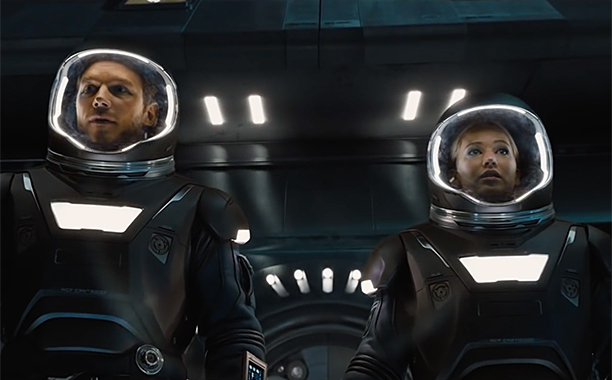
Jim Preston is awoken in his hibernation pod on the starship The Avalon, which is transporting 5000 colonists who have volunteered to travel in hyper-sleep for 120 years to Homestead II, a neighbouring planet to our Earth capable of sustaining human life. To his shock, Jim realizes he’s the only person currently awake on the ship because something in the ship malfunctioned and woke him 90 years early. Jim spends the next year of his life becoming acquainted with android bartender Arthur, trying to fix the pod and even send a desperate distress message that won’t reach Earth for 50 years, enjoying some of the luxuries of the ship, and becoming increasingly lonely, bored, unhappy, and suicidal. During a drunken venture through the ship, Jim sees an attractive young woman in a pod named Aurora Lane, and begins going through some of her person a effects, learning she’s a writer and other intimate details. He becomes obsessed with her, and after a bout of indecision, makes the choice to tamper with her pod and awaken her in the hopes of finally having a human companion and possibly finding some semblance of happiness with this seemingly perfect woman.

The dilemma the movie presents, being awoken 90 years early on a 120 year voyage through space, is a unique and thoughtful concept, and it’s interesting to see how our two leads, Jim Preston (Chris Pratt) and Aurora Lane (Jennifer Lawrence) grapple with this concept, and the knowledge that they will die before the voyage comes to a close unless they can somehow figure out how and why they were awoken so early. The actors do a great job of capturing the varying emotions and mental states their respective characters experience during the course of the movie, with Pratt working his trademark charm and sly humour, and even digging deep into some strong emotional work, giving us a performance that might actually be surprisingly stronger than his turn as Star-Lord in Guardians Of The Galaxy. Lawrence is every bit as charming and witty as Pratt, and even doing a splendid job with the more emotional scenes of the movie. This is probably Lawrence’s best work since her Oscar winning turn in Silver Linings Playbook.

Passengers doesn’t have plot twists that pull the rug out from underneath you, and even the real cause of the ship’s continuous malfunctions isn’t even that convincing an idea, or perhaps it’s just a lazy idea altogether, but that doesn’t make this a bad movie. The risks this movie takes don’t come in the form of jaw dropping spectacle or mind bending twists, but rather in the way the movie initially connects two characters in a less than desirable fashion. That this movie had the guts to bring the characters together in such a dark way and sustains that connection for as long as it does, and convincingly so, is worth praise aplenty. It’s really not the bad movie the Rotten Tomatoes collective are making it out to be, and while it’s not shocking or necessarily all that visually impressive compared against Interstellar for example, it is a perfectly fine movie. An unpretentious, enjoyable, entertaining, heartfelt, and thought provoking sci-fi drama, a voyage I won’t mind investing in again when the time is just right.


“Half of America just lost their Facebook.” – A Gravity review by Josh Hains

I love Gravity. Love, love, love it. L-O-V-E IT!

I mean, the unseen force that keeps us pinned to the ground so we don’t tumble about and float away into the depths of space. That Gravity. So thankful for it. As for the film, I love it too. You don’t even know.

Now let’s be perfectly honest with ourselves and admit, Gravity is kind of a difficult film to write a review about because there isn’t much of a story or plot for me to pick apart meticulously.

Russians blow up one of their own satellites and the fallout causes debris to collide with the several other satellites including American ones, as well as the Explorer space shuttle and its crew who are working on the Hubble Space Telescope. Two crew members, biomedical engineer Dr. Ryan Stone (Sandra Bullock), a newbie to space, and veteran astronaut Lt. Matt Kowalski (George Clooney), are the only survivors, and must make their way back to Earth without the assistance of Mission Control in Houston, who has gone offline thanks to those satellites getting trashed. That’s it. I’m not kidding, that’s all there really is to it. That’s so simple a caveman could write a review about it. No offence to cavemen.

I’m actually pretty glad there’s not much plot to the film. There was a time when a lack of plot could get a film places, when people didn’t care if a film had the most intricately layered plot, as long as it entertained the hell out of them, and they’d put it upon a pedestal high above other films, giving it some kind of a legendary status in cinema history. Like Blade Runner. Today, a film without much plot often gets ripped to shreds by critics before the audience has even seen the film, automatically creating a negative aura that engulfs the flick and rapidly builds an unwarranted bias and stigma toward the film. Just look what’s happened to Disney’s Tomorrowland. Original ideas aren’t enough for some people, blah, blah, blah, the film looks amazing if you ask me.

Wait…Gravity was one of the best reviewed films of the 2013 season? And it won Best Director, Best Cinematography, Best Film Editing, Best Original Score, Best Sound Editing, Best Sound Mixing, and Best Visual Effects at the 86th Annual Academy Awards? Oops. Guess I’m late to the party.

Gravity might not have much plot, but that isn’t even the slightest of a hinderance for this full throttle space thriller. In fact, the lack of plot actually works in its favour, allowing ourselves the opportunity to take in all the wondrous sights and sounds, rather than shovelling mountains of unnecessary exposition and plot-stuffings down our throats. Right from the first frames of the film, it’s evident moviegoers are in for a visual treat, thanks in large part to Emmanuel Lubezki’s uber-detailed cinematography, and the all-to-real CGI effects that make up I’d say about 98% of the film’s visual content – only the actors and their suits are real, to my knowledge. Again, this isn’t at all a hinderance, although at varying moments through the course of the film the two leads had a CGI sheen to them. I can only assume this was entirely intentional, given that this obscure look found its way into the final cut. The film is rich with detail, from the finest stubble on Kowalski’s chin that can be made out perfectly despite the camera being several feet away from the character, to the awe inspiring other-wordly view of our home planet; the detail is pronounced, immaculate, and gorgeous. Seriously, Gravity couldn’t look anymore beautiful than it already does. Can you believe me that their visors are CGI? Neither could I, they look so damn real.

In space, no one can hear you scream. In Gravity, sound is everything. From the thunderous score enhancing the urgency of the thrill-a-minute perilous sequences, to the subtleties of the character’s breathing as their oxygen levels dip. Between the stunning cinematography melded with the extremely lifelike visuals effects wizardry, and the moody music and pitch-perfect sounds effects, Gravity becomes an elevated immersive cinematic experience you have to see to believe. Simply hearing about the film or watching it’s then-popular trailer is not enough, you genuinely have to sit back and allow the ride to envelop you completely. If you’re into that sorta thing.

In terms of acting, in several elongated sequences strung throughout the film, we don’t get to see the actors faces as much as we get to hear them. Bullock’s Stone leans toward the panic-stricken side of things, being that she’s a space newbie and all, and she’s distressed enough from early in the film until the final frames to have next to no oxygen for an albeit short duration of the film, which is a bad thing in case you were wondering. Anytime something goes wrong, and believe me, the shit hits the fan (Murphy’s Law is in full, vibrant effect here), she goes into panic mode and can’t seem to keep her cool or maintain some semblance of self control, which again, is expected because she’s a…newb!On the other hand, Clooney’s Kowalski is the calm, cool professional. He maintains as much control as is feasible within the confines of their situation, but never overreacts or panics. He’s always cool, calm, collected, and does his absolute best to assist Stone and help calm her down at various points so she doesn’t use up all her oxygen. I couldn’t help but notice at a later point in the film, when Kowalski gives a motivational push to Stone, that George Clooney has possibly the most soothing male voice I’ve ever heard from a mainstream Hollywood actor. After the rigorous endurance test that is the early portion of Gravity, he actually calmed me down with his inspirational words of wisdom, I shit you not. In three noteworthy moments I don’t want to spoil for anyone who might not have sen Gravity, both actors, with little dialogue and very little of their faces available for our viewing pleasure, convey melancholic aspects of themselves without diving headfirst into sentimentality. These moments feel genuine and organically constructed, never once ringing falsely, and thus constructing raw moments of compassion we feel for their respective characters.

A hot topic surrounding the film has been the scientific accuracy of the picture, with everything from zero gravity to deceleration being scrutinized by the general public (why are people who know nothing about space given the time of day?), along with astronauts and Astrophysicist Neil DeGrasse Tyson. Tyson, after his viewing of the film, took to twitter to debunk some of the film’s key aspects, some of which were scientifically accurate, and some of which were simply movie mumbo-jumbo. The film’s director, Alfonso Cuarón, as stated that he is aware the film is not always scientifically accurate, but that these inaccuracies were necessary for the sake of the story. That’s something I can abide by.

As a whole, sure, Gravity has zip for a story. Nada, nothing, right?. But sometimes, watching a film isn’t about whether you’re sucked in by the story or not, but how the film affects you on a visceral, deeply psychological and emotional level. Sometimes, the best films don’t require the brains to navigate through overlong dialogues and meticulously crafted story lines, but rather, the sight to bear witness to the greatness being displayed before your very eyes. But a great film can’t be measured by such things, even though I’ve taken the time to acknowledge them. That’s what I love about cinema, it’s not about how great the story was, or how terrifically riveting the performances were, or how the special effects looked or the way the music rings through your ears. No, a great film is measured by how it makes you feel deep down in those places you don’t talk about at parties. A great film is measured by how deep it reaches you. How deeply it hits you square in the gut like a shotgun blast at point blank range, or how it sinks into the furthest recesses of your heart and makes you long for its company. Or how intimately it affects your mind, and resurrects your love for fine filmmaking. A great film can push the world and all its complications to the side, put you at ease, and take the time to entertain the living shit out of you, if only for a short time.

In Gravity’s case, it took just one incredible moment in a tremendous motion picture to make my jaw hit the floor with its beautifully rendered view of the Earth and the astronauts working near it.

And I’ve gotta admit one thing: can’t beat the view.

A Suicide Squad review by Josh Hains

Don’t worry, the following review is a spoiler free zone.

Appalling. Bad. Very, very bad. Trash. Garbage. Stupid. Incoherent. Incomprehensible. Dumb. Boring. Awful. Mediocre. Disaster. Rotten. I don’t agree with words such as these being used in reviews for Suicide Squad to describe the movie as whole. I’m not being blindly dismissive like some social media users out there who are mad that this highly anticipated movie isn’t getting a great critical reception. I just don’t agree, I had a different experience, and this review will reflect that experience.

Suicide Squad has a pretty straightforward plot: government spook Amanda Waller (Viola Davis) assembles Task Force X, a motley crue of super-villains plucked from prison, and let loose in a city under attack by a malevolent meta-human. Kill the bad guy, save the city, and get some time off your prison sentences, that’s honestly as deep as it goes. But that’s not a detrimental aspect of the movie. In many comic book movies, the plot takes a back-seat to the action, humour, and character development, and Suicide Squad embraces that trope with wide open arms. With these team oriented comic book movies, it’s kind of expected that the story takes a back-seat to the character interactions and action, and if you need proof of that look no further than The Avengers movies. You don’t need an over complicated plot with far too many sub-plots for this kind of movie (I’m looking at you Batman V Superman). Simplicity is key, so by the time the plot gets thrown out of the window late in the second act you really won’t mind because director David Ayer makes up for it with great character moments, irreverent Deadpool style humour, and a wallop of fun action. Think of this movie as the DC equivalent of The Expendables, with way more humour but no gore, and you’ll be fine.

Speaking of character moments, many of the best belong to Deadshot (Will Smith), Harley Quinn (Margot Robbie), Rick Flag (Joel Kinnaman), and El Diablo (Jay Hernandez), all of whom are given just enough screen time (or more than enough) to make us care about the characters as they contend with their dire mission. I was initially worrisome about the casting of Smith as Deadshot, I thought he might end up becoming overbearing and even over the top, but he proved me wrong with a subtle and believable performance, his best since the Pursuit Of Happyness. Joel Kinnaman matches Smith’s performance, bringing a naturalistic touch to what could have been a stereotypical stubborn leader role. Margot Robbie’s Harley Quinn is exactly like the Harley I grew up watching in the animated series that her creator Paul Dini wrote (minus the jester costume), and a total scene stealer. More on her later. El Diablo, the “fire guy” as Captain Boomerang (Jai Courtney) tauntingly dubs him, has the biggest emotional journey of any of the Squad members, though not as much screen time as the trio of aforementioned characters.

Captain Boomerang gets a solid amount of time to do his thing, which is make plenty of jokes and jabs, and kick a few asses along the way, but he isn’t given quite enough to do, which is a shame because he’s quite a lot of fun. Adewale Akinnuoye-Agbaje as Killer Croc, Karen Fukuhara as Katana, Cara Delevigne as June Moon & Enchantress, and Viola Davis as Amanda Waller, don’t get much to do, and neither does the sacrificial lamb Slipknot (Adam Beach), who follows in the footsteps of other villains in Suicide Squad comic and cartoons whose sole purpose is to prove that the bad guys aren’t playing around. Davis, a blank slate lacking charisma and passion behind her delivery of lines, doesn’t do much more than manipulate a few minds and give orders, and Delevigne’s characters aren’t fleshed out enough for us to care all that much about her. Killer Croc and Katana have minor moments of asskicking, and Croc gets a couple of funny lines, but neither of them are all that relevant to the plot, and easily could have been removed from the movie altogether without hurting the final product. However brief they may be, the two much hyped cameos, which includes Batman himself (Ben Affleck), fit naturally into the movie, and lack the feeling of being shoehorned into the movie for the sake of having them there.

Now back to Harley. Margot Robbie, equipped with a believable Bronx accent, and a fresh take on the New 52 Suicide Squad comic iteration of Harley, brings life and a lot of love for the character to a performance many were worried would fall flat. She looks, sounds, and behaves exactly like the Harley Quinn fans know and fondly love, and it’s a joy to see her steal scene after scene. She’s also fortunate enough to have some of the funniest lines in the movie, which Robbie delivers with a glint of pure enjoyment in her eyes.

In my eyes, the performance I was most drawn to belongs to Jared Leto as the Clown Prince of Crime himself, The Joker. Seemingly drawing from previous Jokers such as Caesar Romero, Jack Nicholson, and Heath Ledger, as well as the vast number of animated incarnations, Leto gives us a fresh take on the iconic villain that doesn’t feel like any Joker that came before it. I’d equate the performance to that of taking all the best elements of the aforementioned Jokers, and building from the ground up a composite of what that may look like. He’s not better, or worse than Heath Ledger’s Oscar winning turn as The Joker, he’s just different in his own unique fashion. I do think he’s better than the Jokers pre-Ledger though. Leto is gleefully over the top, cackling and growling like a tiger waiting to tear the face off his next unsuspecting victim, but not too over the top. This Joker’s as unpredictable, crafty, and brutal as ever before, but not overbearingly so. Sadly, Joker’s vastly underused, with much of his screen time left on the cutting room floor. I’d love to see more of this new Joker. The relationship between he and Harley, while volatile and unhealthy, is perfectly reflective of the one seen in the pages and frames of various DC comics and cartoons, and seeing it come to life was also a rather joyous experience.

Throughout the second and third acts of the movie, the editing seems to be a bit on the choppy side, more predominantly in the third act than the second act by a mile. It became pretty clear to me that the push for a two hour crowd pleasing comic book movie got in the way of giving the sidelined characters more depth and more impactful screen presences. Somehow, despite the clunky nature of the editing (which isn’t very distracting, thankfully), these scenes that are affected by it still work fairly well until the editing seems to get back on track and working just fine.

Beyond the quibbles I have with the editing, the story, the character development, and the casting of Amanda Waller, I still enjoyed this movie a lot, in some ways more than I thought I would, and in a couple of ways, less. I do not feel that this is a bad movie by any means, I think it’s actually damn good, but it’s not quite as great as it could have been, though I wasn’t always wanting or expecting it to be great anyways. If anything, all I ever wanted was yet another fun comic book movie I could lose myself in while watching these badass villains kick all kinds of ass six ways to Sunday. David Ayer gave me that in spades.

Now where’s the sequel?


A Batman V Superman review by Josh Hains

I haven’t received a single payment from Disney for my criticisms of Batman V Superman over the last four months. Cough up a buck already Disney, I’m waiting! But wait a minute, Warner Bros hasn’t paid me for my criticisms of Avengers: Age Of Ultron either! Where’s my damn money? I’m mad as hell, and I’m not going to take this anymore!

Before I go any further, I am a HUGE lifelong fan of comic books, both DC and Marvel alike, and I don’t prefer one over the other. Marvel has more movies, comics, and characters in their respective universes, so I’ve been exposed to more of their content and therefore have a tendency to lean toward Marvel. That being said, Batman and Superman are my first two favourite comic book characters in a top ten roster, and the first comic book I ever read was Batman (I still have the comic), so it’s not like Marvel completely dominates my love for comics, even if my favourite comic book movie is Guardians Of The Galaxy. No preferential treatment here, and besides, I like this movie.

Somewhere in my mind is a long, long review of this movie that eclipses four or even five thousand words and feels as long as the Director’s Cut of BVS (for my own sake I’ll refer to it as BVS from this point forward). I could go on for far too long about all the various plot issues I have found in this movie, but I don’t want to do that. That would bore me writing it as much as it would bore you reading it. Over the last few months, I’ve been able to watch and read all kinds of arguments for and against this movie, and had plenty of conversations myself with like minded individuals who share similar and opposing opinions. The more I watch, read, or talk BVS, the more flaws come to light, most of which are script level. This Director’s Cut seemed to rectify a lot of editing issues, so I won’t traverse that territory. I do however want to want paint a clear picture of my two main issues with the movie.

Nothing that has been said in the last four months can sway me to believe that Jesse Eisenberg was the right choice for Lex Luthor, and I do mean nothing. When you take into consideration that Bryan Cranston wanted to play Luthor, and even BVS’s director Zack Snyder admits that Cranston would have been an awesome choice, it’s nearly impossible to not watch this movie and picture the better actor delivering those lines. The Lex Luthor I grew up with in the pages of my Superman comics collection, or in cartoons or the classic Superman movie, was always a formidable opponent for Superman. He was built like Superman or Bruce Wayne, and had that entrepreneurial sensibility and the luxuries of a billionaire. He was what one could imagine an evil Bruce Wayne to be. That is not the Lex Luthor we see in BVS. The Lex Luthor in BVS lacks the immediate intimidating presence of the Luthor I grew up with. Instead we’re treated to a a socially neutered, twitchy geek who likes stuffing Jolly Ranchers into the mouths of government officials. Weird. Not once did I ever think he could fight Superman, or that he could outwit or outsmart Bruce Wayne. Not once did I find his behaviour unpredictable and ferocious, intimidating, powerful, and fearsome. He was just a whiny, thinly constructed way to bring the real heavy, Doomsday, to life. Yes, he does look like a steroid enhanced troll from Lord Of The Rings, but that dude was more than a match for three heroes. This Luthor never could be.

My other major critique is that the movie as a whole is bloated, and unnecessarily long in order to intentionally overstuff the narrative of the movie to allow for various subplots, most of which are also unnecessary. In the theatrical cut of the movie, many plot threads were left hanging because of continuous smash cuts that abruptly ended, and some footage that actually enhances the movie was brought back in for this Director’s Cut.

The new footage surrounding Bruce Wayne/Batman, actually contributes to the emotional impact of his storyline, as well as enhances the action sequences. The warehouse fight is even more brutal and cool to watch than ever before. Actually, nearly everything that has Batman or Bruce Wayne in this movie is pretty awesome stuff. I know some people were turned off by his murderous side, but clearly they’ve never read The Dark Knight Returns from which entire scenes were lifted and implanted into this movie. This is unmistakably the best live action representation of Bruce Wayne and Batman to date.

That being said, while the new footage ties up some of the loose ends, it not only leaves plenty left, but also creates more at the same time, and all of it is still incredibly unnecessary, and actually does very little to propel the story forward. You can argue against that and tell me I’m wrong all you like, but let me provide a strong example of what I’m alluding to first. Diana Prince casually pops up a few times over the course of two and half hours or longer, shoved in the background because Warner Bros needed to shoehorn this character into this movie to set-up Justice League. However, the extended game of cat and mouse she and Bruce play does absolutely nothing to propel the story of this movie forward. Their interactions easily could have been removed in favour of something that would actually contribute to the movie, like five extra minutes of the titular fight, rather than serving the Warner Bros agenda of Justice League setup. You can keep the actual Wonder Woman fight scene footage which was pretty badass stuff. Given that Warner Bros is setting up Justice League in this movie, it makes sense that they work in reference to other metahumans who we all know will later become League members. The addition of a scene where Bruce sends vital information showing off captured footage of these metahumans to Diana via email is embarrassingly stupid. I still can’t believe someone was paid millions to write that, but for a better writer it’s easily fixable.

Don’t even get me started on the Martha connection.

Aside from these issues that I can’t overlook, I still love this movie. It looks and sounds amazing, the cast is all fantastic with the exception of Eisenberg, the action is as slick and involving as ever, especially in 3D, and we’ve been given the best film Batman and Bruce Wayne to date,  which is something to be proud of.

Somewhere in this bloated runtime and narrative indulgence is a two hour long movie that contains all of the incredible Bruce Wayne/Batman footage we saw in BVS, and smarter, refined, and involving material featuring Superman. A movie that has the same thought provoking idealism of controlling the uncontrollable as in Captain America Civil War, because the fear and worry of the destructive power of Superman keeps men like Bruce Wayne awake at night. A movie that chooses to build on the relationship between Superman and the public, and Clark and Lois. A movie that doesn’t need Lex Luthor’s boring evil plan to pit our heroes against each other. A movie that makes us believe that Batman and Superman are at odds, that bring them together for reasons that feel authentic to their dislike for each other. A movie with a titanic fight scene between Batman and Superman that lasts longer than eight minutes, that isn’t apocalypse porn and all CGI, and is so cool, so stylish, so powerful and resonant, it would make the battle that ends The Avengers weak in the knees. A movie that is about the triumph of good over evil, of light over darkness. The movie we all paid for and still haven’t gotten. It’s no masterpiece what we were given, but it’s not granny’s peach tea either.

It’ll do until Justice League gets here, and hopefully exceeds expectations.


To boldly go where no man has gone before – A Star Trek Beyond review by Josh Hains

Always imitated but never duplicated, Star Trek has stood the test of time for 50 years, and has influenced not just the vast majority of science fiction generated in the decades after its fruition (film, television, comics, and books alike), but also pop culture itself. The fingerprints of Star Trek are everywhere, similar to Star Wars (original trilogy) for example, and it seems that hardly any sci-fi movies, specifically space operas like Guardians Of The Galaxy (drop the Marvel logo and the Thanos and Howard The Duck cameos and you have a pure space opera) go by without taking influence of some magnitude from these iconic franchises, whether purposefully in homage, or unintentionally. Because of the heavy influence of these two titanic properties (especially Star Trek), familiarity between properties has become an ever increasing issue in the science fiction community. What was groundbreaking then is cliche and familiar today, so Paramount Pictures has wisely chosen to embed fresh takes on old stories in their latest cinematic franchise rather than conjuring up completely new stories that might stray too far from source material for Trekkies. To the untrained eye of some of today’s more picky audiences, the familiarity of the stories is a let-down and hindrance to their movie going experiences, yet precisely what others want out of the ongoing series (a fourth installment is on the way).

Beyond opens with Captain Kirk via Captain’s log, explaining how the crew of the Enterprise has been handling the third year of their five year voyage mentioned in the last installment. Kirk, now a year older than his father George, was when he died heroically in the riveting opening sequence of Star Trek, is contemplating his position as Captain, and his place in an unlimited universe. Spock too, is grappling with his place in the universe after *possible spoiler alert* he learns that Spock Prime has passed away (a respectful way to tie up that recurring subplot). During the Enterprise crew’s all too brief shore leave at the Yorktown Starbase, they’re called into action to rescue a ship stranded on a planet in the nebula. The Enterprise comes under attack by the brutal Krall and his formidable army, leaving crew members scattered on the planet, with some taken captive by Krall. You can probably guess what happens next.

For some (and quite absurdly) the familiarity and predictability lodged within the plot of Star Trek Beyond, is a detriment to the movie. For this life long Trekkie (and Star Wars lover), to quote Bones McCoy in Beyond, “That’s just typical.” Familiarity isn’t a bad thing in the slightest in Beyond, because rather than feeling like a clone of something it’s striving to be (Into Darkness aiming for Wrath Of Khan status), Beyond feels more akin to the 2009 Star Trek reboot. Refreshing, ridiculously fun and enjoyable, yet touching and deeply heartfelt. It feels like a return to what made the original series great, performing a delicate balancing act between humour, drama, and spectacular action set pieces, none of which take a back seat in Beyond. The cerebral nature of the series, a thinking person’s movie or show with a finely tuned focus on dialogue and relationships rather than spectacle and action, has slightly diminished with the recent movie series in favour of lens flares and big explosive blockbuster action sequences, but still remains present and potent as ever. Take note of a scene late in the movie involving a picture. I won’t say anymore, you’ll know the scene when you see it, but it works because we too have been there, we can understand the emotions of the character, and our hearts bleed for them.

Star Trek has always worked best when the characters, the relationships between them, and the fun bantering, are at the forefront. They don’t talk too much in Beyond, I saw that complaint and it makes me laugh even as I type this. I’ve seen a Star Trek episodes with too much talking, and Beyond is far from those. A random and awkward complaint that the characters dictate their feelings to the audience, is just asinine by all accounts. Communication in Star Trek is key, and with a foundation built around dimensional characters, one comes to expect that they share their feelings, thoughts, and emotions between each other…out loud. Sharing in loss, expressing confusions, and bringing to light insecurities isn’t having the characters dictate their internal struggles to the audience, it’s a heartfelt way of building further connective tissue between full blooded characters, and making us care more deeply for them. That’s far from an issue in this movie. 

The action comes fast and furious (try not to groan at the pun), but is as delightful, inspired, and slick as ever, popping in the 3D screening I saw, wonderfully highlighting the eye popping visual effects director Justin Lin handles with energy and style to spare. Never for a second did the action lack spacial awareness or coherence, it’s rather easy to follow. The special effects, a fine blend of CGI and practical effects, are as convincing as anything in The Force Awakens, and the 3D adds an extra layer of excitement to it all, continually involving the audience in everything from the crashes and explosions to brawls and shootouts. It’s wickedly fun stuff!

The cast is once again in fine working order, feeling at home in their roles, comfortable compared to when the 2009 reboot was launched. Sofia Boutella as the skillful, and rather hilarious fighter Jayla, is a welcome addition to the cast and bounces off the other characters effortlessly. Idris Elba fearsome and ferocious as ever, is obviously fantastic as usual as Krall, though he’s vastly underused in Beyond. A good ten more minutes of Krall could have made him all the more intimidating, but as it sits he’s a fine villain along the lines of Nero from the 2009 reboot or the typical Marvel villain. Ronan The Accuser comes to mind. In his last major film role after his tragic passing a little over a month ago, Anton Yelchin is a delight as Pavel Chekov, and will be a sorely missed presence in future Star Trek movies. I always had fun with his quick one liners and innocent nature.

Does Star Trek Beyond boldly go where no man has gone before? Not really, it lacks the harsh darkness and risk taking of Into Darkness (thankfully), the storytelling never breaks new ground, but it’s not a bad thing because it doesn’t have to. It just has to be a traditional Star Trek movie, and it damn well is. Live long and prosper Star Trek!

“It’s just you and me now, sport.” – A ‘Manhunter’ Review by Josh Hains

12383626_169631770076406_1936271223_n Of the film and television productions based on Thomas Harris’ series of acclaimed “Hannibal” novels, Manhunter is the most underrated piece. When the film was originally released in 1986, it met with (surprising to me) mixed reviews, with some critics calling into question director Michael Mann’s use of music, and the film’s unique visual aesthetics. Leading performer William Petersen’s acting skill was also the cause for concern amongst some critics, and the film was sadly a box office failure, raking in just 8.6 million dollars. In recent years, thanks to the popularity of The Silence Of The Lambs, its sequels and prequels, and a television series based on the books, Manhunter has been critically re-reviewed and wildly accepted as more than just a cult film, but as one of the finer films Mann has made to date, and quite possibly a superior film to The Silence Of The Lambs. Not every critic is right every time they put pen to paper.
Manhunter is a rich, meticulously layered, deeply psychological experience that crawls under your skin and seeps into your mind with its concoction of pulsating music, gorgeous cinematography, unsettling production design, and tortured characters. The film chronicles the investigation by former FBI criminal profiler Will Graham (Petersen) into a recent slew of grisly murders of rich families committed by the elusive Tooth Fairy, as the police have dubbed him after the bite-marks he leaves on his victims.

We first meet Will relaxing at his secluded Florida beach house with his wife and son, when his friend and former FBI superior Jack Crawford (the late Dennis Farina, who was a Chicago cop before his film career) comes knocking, asking Will to help authorities nab the killer. After a prior attack involving a certain cannibalistic serial killer I’ll mention later, Will is hesitant to become involved in the case. Most of him wants to stay far, far away from the dangers of this line of work, and doesn’t want to bear the deep psychological burden these kinds of cases can have on law enforcement. However, an unsettled part of his soul is thirsty for one last hurrah, and so Will joins up with authorities in the hunt for the Tooth Fairy.

Simultaneously, the Tooth Fairy himself, Francis Dollarhyde (Tom Noonan), continues to kill including the unlucky journalist Freddy Lounds (Stephan Lang), all the while becoming involved romantically with a co-worker at a St. Louis film lab, Reba McClane (Joan Allen). Meanwhile, both Graham and Dollarhyde receive help from that particular cannibalistic serial killer, the famous Dr. Hannibal Lektor (Brian Cox). Yes, you read that right. Lektor. Spelled that way just for this film, but “Lecter” in the books and other film and television properties. I know that seems odd, but it works. By the time the film’s violent conclusion erupts with the ferocity of a blood craving tiger to Iron Butterfly’s ominous In-A-Gadda-Da-Vida, between the pulsating score, the dazzling cinematography, the tense psychological atmosphere, and the nuanced performances, you’ll surely be white knuckled and riveted to the bone.

In The Silence Of The Lambs, and subsequent Hannibal oriented products, Lecter is somewhat of an over the top, grandiose villain. Sir Anthony Hopkins plays him with a venomous, spiteful, cynical aura and personality, with a twinkle in his eye and a grin ever present on his face. He seems to have waltzed out of a Shakespeare production, with his colourful verbiage and posturing. Even his slightest physical movements seem grand. But here in Manhunter, Lektor is brought down to Earth by Cox’s nuanced performance. Cox is genuinely creepy and unnerving in a  way Hopkins isn’t (Cox based his performance on Scottish serial killer Peter Manuel), precisely because Hopkins Lecter is so gloriously over the top, while Cox maintains a relaxed, collected atmosphere about his Lektor. One can imagine his Lektor character prowling the streets, conning unsuspecting folks into his maniacal grasp with his classy vocals and subtle charms, feasting upon their corpses without breaking a sweat. That sounds plenty terrifying on its own to me, and thus I don’t find the larger than life qualities of later Hannibals all that necessary. I suppose the staying power of Hopkins’ performance is partially reliant on that larger than life aura, because it sticks out stronger in one’s mind than the perfectly realistic, bone chilling performance Cox delivers that doesn’t rely on operatic antics for impact.

Part of what makes Manhunter great is that with it, we are given a film that isn’t reliant on the grisly violence the television series is most famous for. In fact, there’s hardly any onscreen violence at all, the most carefully tame of any Hannibal adaptation, never once gratuitous or overly detailed in the aftermath of violence. Mann is careful to never reveal too much violence, which could easily have turned the film into an unnaturally violent splatter-fest, the lack of which perfectly suits the material and the general themes and tonalites of the film. Instead, Mann cares more about the creation of a sensation of anger toward the killer coupled with the anxiousness and tension within the viewer akin to Graham’s own feeling of these sensations. I think we are meant to feel as though we have stepped into his shoes.

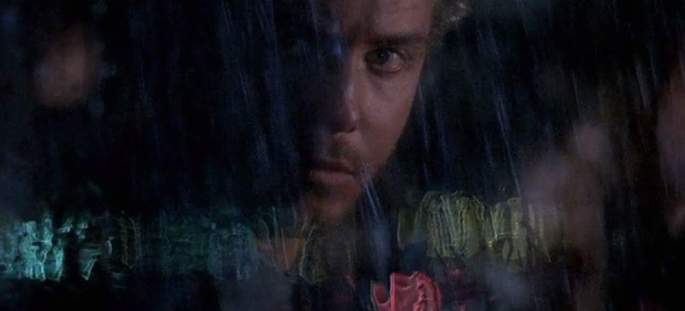
The beauty of the film always manages to catch me off guard more than anything, specifically during a sequence midway through the film when Graham, seated before a rain soaked window, professes his desire to catch the so-called “Tooth Fairy”, arguably one of the films most beautifully realized moments thanks to brilliant cinematographer Dante Spinotti, who also worked with Mann on The Last Of the Mohicans, Heat, The Insider, and Public Enemies. The combination of the psychological nature of the film and the undeniable beauty of Manhunter makes it a very difficult experience to shake. Like other serial killer thrillers such as Seven, Zodiac, American Psycho, and Frailty (to name a few), Manhunter tends to leave a stain on my mind for a little while that no soap known to man could ever wash away, and that’s a good thing in my book. I’m greatly looking forward to seeing this film restored in all its grim glory thanks to the folks at Shout Factory, whose slick new box art for the Collector’s Edition of Manhunter is the second image featured at the top of this review.

Let Me In – A Review by Josh Hains

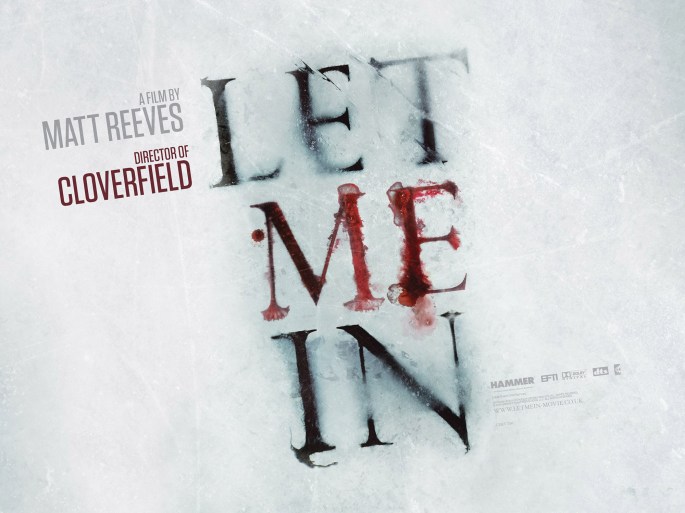
When you hear that a popular film is going to be remade, the general consensus is a large groan of dismay, especially if it’s a remake of a horror film, and even more so if it’s a foreign film to boot. Let The Right One In, the Swedish film from John Ajvide Lindqvist, was such a beloved, original voice in horror cinema in 2008, that horror audiences seemed completely dumbfounded by the notion that Cloverfield director Matt Reeves was going to helm the remake. To their surprise, what Reeves crafted was far from the dreadful slop they were expecting. Let Me In is the best American horror film in years.

Owen (Kofi Smit-McPhee) is a lonely, borderline depressed 12 year old boy, constantly neglected by his divorcing parents and relentlessly bullied by an older boy at school, a royal asshole. Owen befriends a girl the same age as him named Abby (Chloe Grace Moretz), who moves in into the apartment beside Owen with her father figure, Thomas. But Abby isn’t your average girl. She doesn’t have frosty breath like Owen, who skin is perhaps even paler than his, she walks in the snow barefoot because she doesn’t feel cold temperatures; I don’t think she feels warmth either. She doesn’t go to school, and only ever seems to come out a night. But, vampires tend to stay indoors anyways.

As Owen eventually learns, Abby is a vampire, and Thomas is her Familiar, a human who acts less like a father and more like a caretaker, dispatching unsuspecting victims left and right to feed the thirsty vampire. And then there’s the unnamed police detective (Elias Koteas) investigating what he believes to be a serial killer in the area. You would assume the same if you saw the gruesome ferocity of the murders. If only he knew his serial killer was a vampire.

Let Me In makes the right choice of showcasing the inherent loneliness and desperation of the life of a vampire. This isn’t Twilight, and it’s characters aren’t moody teenagers sharing lust for each other and experiencing a contrived, improbable romance. It also isn’t jam packed with elaborate costuming and sets, like the lavish Dracula epics. This is vampirism subverted, brought down to Earth, and made all too real through its delicate handling of the relationship between the two child leads, juxtaposed with the bleak grimness of their lonely existences.

You’ll notice I have been tip-toeing around certain plot details that others may include, and that I have completely avoided comparing the film to its European counterpart. I caught some of Let The Right One In on television once a few years ago, but I wasn’t very interested in allowing myself to indulge in such a bleak, disturbing horror film. Horror isn’t my favourite genre of film (nor is it my least favourite), and the kinds of horror films I most often like, while bleak and disturbing, tend to have a certain amount of kinetic energy about them. Let The Right One In didn’t do anything for me. Watching Let Me In for the first time last year, I was cautious and skeptical right off the bat, but I figured it could be the more accessible film, possessing that unique kinetic energy I enjoy in films like The Thing. It delivered the exact dosage I require, in spades.

Let Me In may take its time, may be patient enough to allow us to grow to care for not just Owen, but Abby, Thomas and even the police officer, but it also keeps your fingers glued to the seat, your knuckles as white as snow, your pulse jacked up by the suspense, your eyes hypnotized by the stunning, dark cinematography. It’s riveting, gorgeous, brutal stuff. I’m not saying the remake is superior to the original film. I just enjoyed it more.

Triple 9 – A Review by Josh Hains

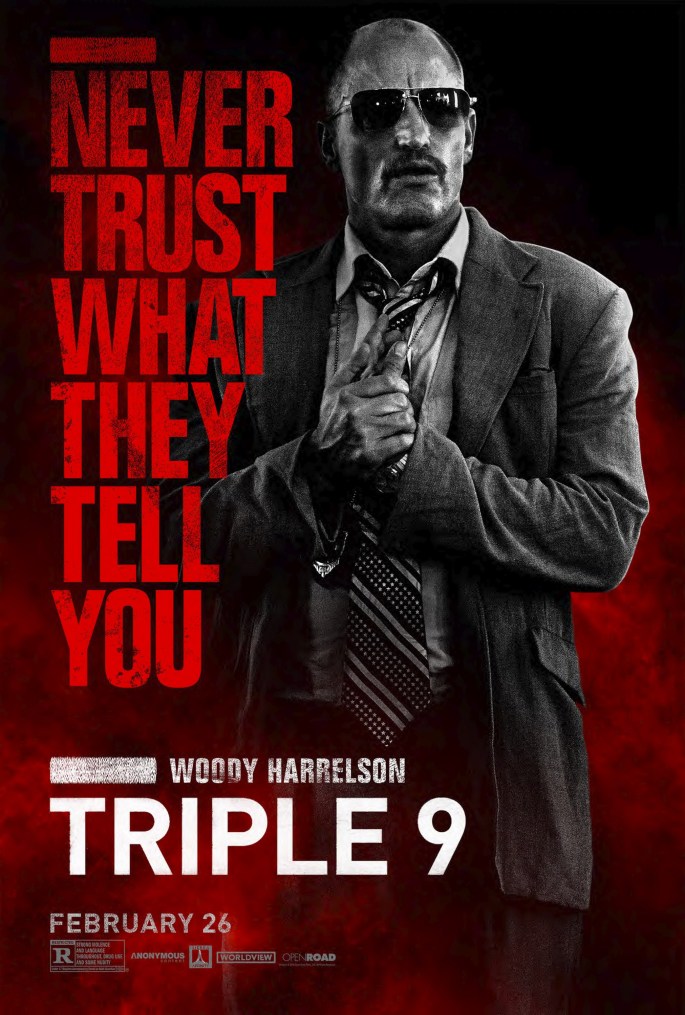
triple_nine_xxlg I think most of the criticism toward Triple 9 is misguided at best. I feel that most of the critics whose reviews I’ve read (and I’ve read dozens over the last week) weren’t expecting what Triple 9 delivers, they thought they were paying to see the next Heat or something, and upon being vastly disappointed, tore the film to shreds as they saw fit. I think a few critics jumped on the hateful bandwagon, and now moviegoers who were excited up until the reviews rolled out are unsure if they want to cough up their hard earned dough for the film or not. Some will have you believe the film is worth waiting for the Blu-Ray of. The joys of the internet age of film criticism and audience reception. This way of thinking is backwards. You have to see this film for yourself decide if it’s your cup of tea or not. Don’t even take my enthusiastically positive word for it. See it for yourself, and go from there.
When you see the trailers for Triple 9, it’s pretty easy to say it looks like a cross between Heat and Brooklyn’s Finest, or Street Kings or End Of Watch. It’s even easier to walk into the theatre expecting something akin to that. The surprise if Triple 9 is, that while there are minor similarities between the films I mentioned above, Triple 9 is its own unique film, a different monster entirely. I’ve never seen a crime film quite like it before and I doubt I will anytime soon given the lack of gritty crime films in theatres these days in preference of sanitized comic book and video game based movies.

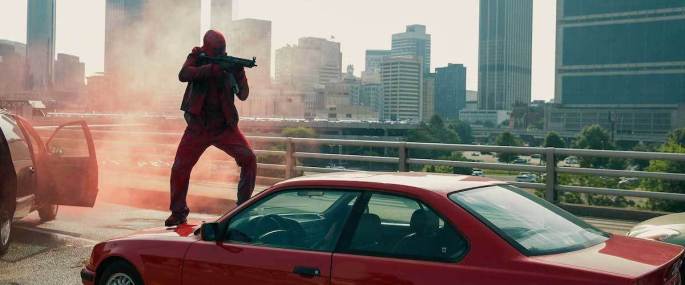
Triple 9 follows an ensemble of edgy characters strewn throughout Atlanta, Georgia, each one undergoing immense amounts of pressure, stress, and paranoia, and seemingly trying to keep their heads above the water. There’s Mike Atwood (Chiwetel Ejiofor), the hot headed leader of a 5-man group of thieves, and a former Navy Seal. His ex-wife Elena’s sister Irina,the wife of an imprisoned Russian mafia boss, is using his son as leverage over Mike so he’ll commit elaborate robberies. His team is comprised of Franco Rodriguez (Clifton Collins Jr.) and Marcus Belmont (Anthony Mackie); two corrupt Atlanta cops, and then there’s Russell Welch (Norman Reedus); a former Navy Seal and old war buddy to Mike, and Gabe Welch (Aaron Paul); Russell’s younger brother and a former Atlanta police officer who worked in the same precinct as Marcus and was a junkie until 6 months prior. The film opens with one such robbery, which goes horribly wrong when a hidden dye pack from the bank they just knocked off fills their escape vehicle with an impenetrable red mist, causing a multi vehicle collision on a packed highway. Then there’s Jeff Allen (Woody Harrelson), the Atlanta detective heading up the investigation into the robbery. He’s also the temperamental uncle of Chris Allen (Casey Affleck), a greenhorn cop with a wife and kid who conveniently becomes Marcus’ new partner. Irina wants the group of thieves to commit another heist, to continue to collect sensitive information that can set her husband free, but the guys need a new plan to pull of their next daring job. Franco and Marcus suggest killing a cop, which would incite a 999 or officer down call that sends every police offer to their fallen comrade’s position. Marcus nominates Chris as cop to kill…and that’s where I’ll leave you hanging. To say much more beyond this would ruin all hope for surprise.

Earlier today I would have told you I have two issues with the film, the first of which is the plot, which I would then explain is a little too reliant on convenience and is in some ways vaguely predictable and inevitable. I would then mention a sequence that occurs with around a half hour left in the film in which two characters enter an abandoned warehouse and only one of them has murder on their mind, we can assume what will occur next. I would point out that while this scene does play out exactly as we expect it to for a while, it takes us in a different direction after a couple minutes that is almost completely unexpected.

I’m not complaining about the plot now as I type away at this review because I’ve changed my mind since this morning. Triple 9 isn’t reliant on its plot so much as it is reliant on the unpredictable the actions of the characters, reactions that actually seem like the natural ones most of us would have. If you were a cop, and you were informed that your nephew’s life could be hanging by a thread, would you drive like a maniac to the scene of the crime, or take your sweet time? If you found out someone wants to kill you, would play it and wait for precisely the right moment to strike, or would you freak out and blow their head off right there? How you may react isn’t necessarily how someone else might, and that’s the key to the tension in Triple 9. You genuinely don’t know who is going to what and when, keeping you constantly trying to anticipate every character’s next move and in complete suspense. I swear my knuckles turned white during the last half hour of the film, the suspense was that gripping and overwhelming.

A review on rogerebert.com tries desperately to suggest that Michael’s sad predicament is a half assed attempt at inciting sympathy toward the character. This is false. I do not think I am meant to sympathize with Michael for one single second, rather I am meant to understand quite simply why he’s doing what he’s doing. His predicament is motivation for the character and an elaborate way of generating the beginnings of a gripping crime story, not a piss poor attempt at making him a three dimensional character.

On that note, do not walk into this film thinking you’ll like more than two of these characters. You won’t. The acting is so good here, so down to Earth, naturalistic, and nuanced. These aren’t showy Oscar bait performances, they’re subtle and realistic portrayals of plausible human beings, and not simply cardboard cut out archetypes. Take Harrelson for example, playing another oddball but with the edge he brought to Rampart, creating a fleshed out, dynamic, tangible human being. Which brings me to my second issue, which is the noticeably phony accents utilized by Kate Winslet and Gal Gadot that greatly affect their performances. These women don’t sound authentically Russian, in that Cate Blanchett in Indiana Jones And The Kingdom Of The Crystal Skull kind of way. I think if you changed Winslet’s character to someone of British ethnicity (and cast someone else from the UK in place of Gal Gadot, say Carey Mulligan), Winslet could have delivered a much icier, more vile performance. Sadly, due to the accent, she is so hindered she’s incapable of providing an enjoyable villainous performance. Thankfully, Gal Gadot has a fleeting presence in the film so one doesn’t have to endure yet another dreadful performance from her. One can only hope she has just as few minutes in Batman V. Superman.

John Hillcoat, whose previous films include The Proposition, The Road and Lawless, delivers yet another already sorely underrated motion picture, and directs the hell out of it. I recall a popular criticism of Lawless, that the film’s ending was too down and depressing for critics to grapple with, and that a happier ending would have made the film better for them. I’ve always found that to be a poor criticism. In today’s age of film criticism, over saturated and far too pretentiously picky, it doesn’t surprise me that so many critics would prefer a “Hollywood” ending for that film. I wonder how many of them realized that was the ending of the non-fiction book The Wettest County In The World, the source material for Lawless, based on facts and written by the grandson/grand nephew of the trio of brothers showcased in the film. Bear with me, there’s a point to this.

I don’t think too many of those same critics like the ending to Triple 9 either, which I won’t spoil. It’s partially the ending you expect, and partially an ending you don’t see coming. For this film it works and wonderfully. It suits the nature of the beast, the nature of this grimy, brutal crime saga. It’s not forced, inauthentic, or improbable. Watch Harrelson’s face at films end. He says everything his character is thinking with one action, and the look on his face and in his eyes. You not only understand him and what he’s thinking in that moment, you feel for him too. It’s damn near perfect.

triple_nine_ver13_xxlg

Deadpool – A Review by Josh Hains

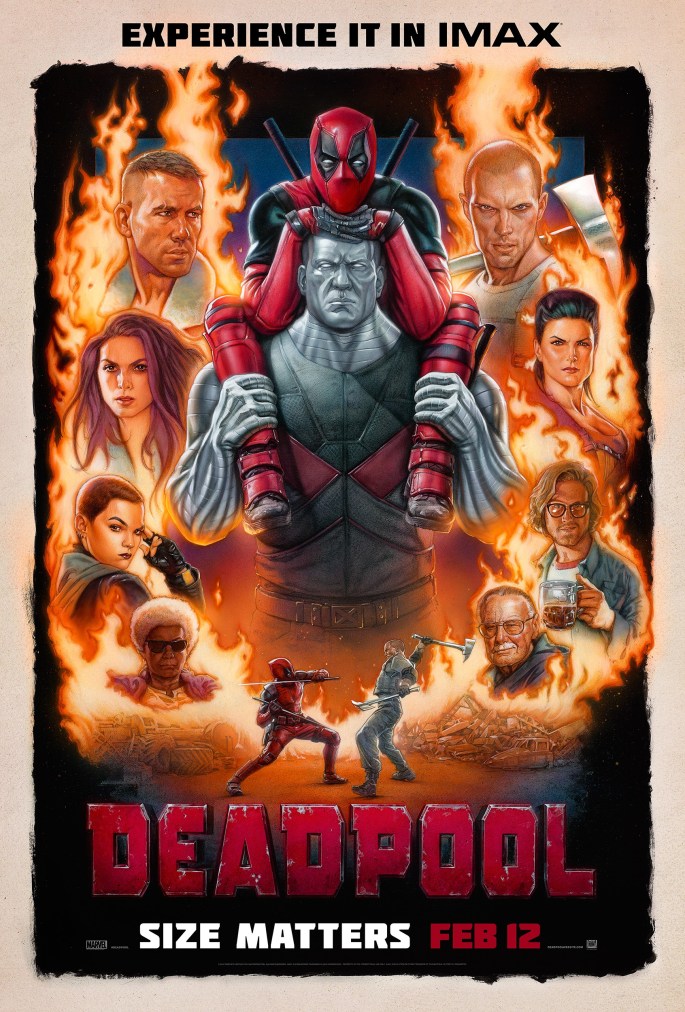
deadpool_ver6_xxlg Whoever said Deadpool was going to suck probably only heard about the movie within the last year and would rather watch X-Men Apocalypse…ew. They’ve probably never read a Deadpool comic book in their life, and had no idea who he is until the hugely popular marketing campaign kicked into full swing. They probably didn’t like that either and made that very clear on IMDb. And they probably have absolutely no appreciation for Ryan Reynolds. But of course, they can’t always be right. Deadpool is kickass!

Deadpool is light on its feet, hilarious, action packed, and accessible, but also rude, crude, violent, sexy, and not for everyone! Also, the main character isn’t green or animated, which means his chances of appearing in the next Avengers movie are slim to none, which is great because Hollywood tried sanitizing him once before and that was a bitch to get through. Deadpool speaks his mind loud and clear regardless of who is listening via voiceover or right into the camera breaking like 16 walls with a verbal diarrhea-like spontaneity that is much appreciated given how boring narration tends to be these days. It’s also 100% authentic to the character of Wade Wilson aka Deadpool aka The Merc With A Mouth, and his personality and mannerisms, the narrative style of his comics, his schizophrenia propelled fourth wall breaks, and the coarse, crude, profane and violent fun fans have come to expect from this parody of the Slade Wilson aka Deathstroke DC Comics character.

He’s as much of an anti-hero as Daredevil, but with a wicked sense of humour and comic timing that lands him the woman of his dreams, Vanessa, who sees our anti-hero Wade Wilson for the crudely mannered tough guy with a heart full of unicorns and Wham! for who he really is. But just when things get good and Wade gets laid constantly with his new lover, his life takes a giant shit on his shoulders and gives him cancer in his lungs, liver, brain, and prostate. All things he can live without. Some sketchy dude that looks like he should stay 500 yards away from schools offers Wade a cure and super human abilities, so Wade leaves Vanessa behind to become a super something. Unlike Daredevil however, after weeks of grueling experimentation, his eyesight is still intact along with his sense of humour and garrulous ramblings, his cancer completely gone, but his skin is all Freddy Krueger. Wade dubs himself Deadpool after a gambling racket his buddy Weasel runs, and with the assistance of Weasel, Blind Al (a crude old lady that let’s Wade crash at her place during his time of need), X-Men characters Colossus (a shiny CGI hero) and the moody Negasonic Teenage Warhead, Wade sets out to kill the guy who made his face look like an avocado had sex with an older, more disgusting avocado…the British bad guy Ajax and his sidekick Angel Dust, a less angry Rosie O’Donnell.

Along the way, bullets fly, blood spills and swords separate limbs and heads from bodies, all while Wade cracks jokes every other minute and breaks the fourth wall more times than he shoots people (count it if you don’t believe me), none of which is a bad thing! Deadpool is a load of furiously funny, blood soaked fun, right from the first milliseconds of the film until the end of the post credits sequence. It’s not the first R rated comic book movie, it surely won’t be the last, and it doesn’t have a huge budget or a Zack Snyder in the director’s chair. But it has a lot of heart, a great deal of humour, and some wicked bloody action, all of which have helped push the film into record breaking infamy. As a meta comic book film, Deadpool makes similarly themed comic book movies like Kickass look like the cheap wannabes they’ve always been, and does so with balls and attitude to spare.

Cue the music!


Jack’s Back – A Review by Josh Hains

Jack1

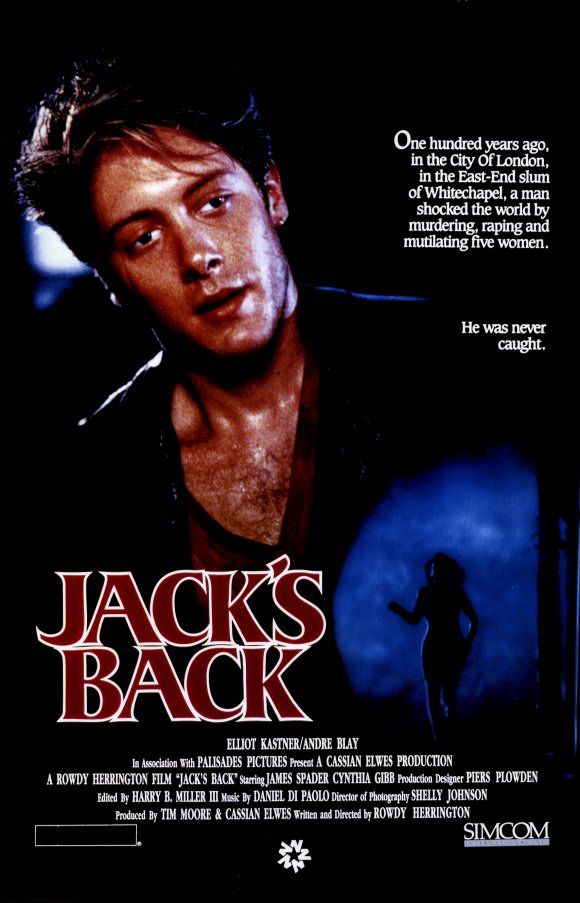
Jack’s Back has the displeasure of sounding like a derivative, gore infested horror slasher movie thanks to its poster and plot summary. What else could one expect from a movie about a serial killer on the loose in modern day Los Angeles, replicating the gruesome Jack The Ripper murders precisely 100 years later?

The surprise of Jack’s Back is that it’s far from the slasher we might expect it to be, and is more in line with a moody mystery thriller, perhaps something Hitchcock would have crafted. Here is a movie that isn’t concerned with the gory details of the aforementioned copycat murders, but rather atmosphere, suspense, and a couple clever twists you genuinely won’t see coming. I can’t discuss any more of the film’s plot without spoiling something, and of course I don’t want to do that, but I will say that James Spader plays twin brothers, one a medical student, the other a small time felon, and that one of them is a prime suspect for the murders.

Taking into consideration that Jack’s Back was director Rowdy Herrington’s first feature film, it is easy to understand why it’s a flawed piece of work, but that’s not to say that the movie is terrible, it’s just in need of improvement. It’s as contrived as it sounds, but it’s nice to see those contrivances work in a way that actually tricks you into thinking you’ve got it all figured out, given how straight forward the plot is, until one final twist makes you think “You sure fooled me”. It doesn’t pull  the rug out from underneath you, but it sure tries real hard.

I am glad that in today’s world James Spader is having some semblance of a career resurgence these last couple years. I’ve always felt it a shame that such a gifted actor was seemingly thrown to the curb after David Cronenberg’s controversial Crash (no, not the Oscar winning one), which seemed to repulse the average movie goer and film critic. Here in Jack’s Back, Spader was given the opportunity to play the lead for the first time, and not a pawn in a formulaic slasher flick, but a thoughtful pair of twins with some dimensionality to them. I really enjoyed the subtlety with which he treated the actions of the twins, a fine example being a moment when the medical student twin takes an injured old woman’s mind off the pain she’s feeling with just a few simple questions and a humorous punchline.

It’s a pleasure seeing Spader in dual roles, which at the time and still today are quite the rarity. This isn’t like recent films Enemy and The Double, where the leads actors play two different subconscious versions of the same entity, but a very rare occasion where both characters feel like completely different individuals altogether, who just happen to be identical twins. Jack’s Back might not be a great movie, and I’m sure it’s not everyone’s cup of tea, but for a first time director and a first time leading man at the time it’s quite the unique treat. Give it a look, it just might surprise you.