Apocalypse Now – An Appreciation by Josh Hains

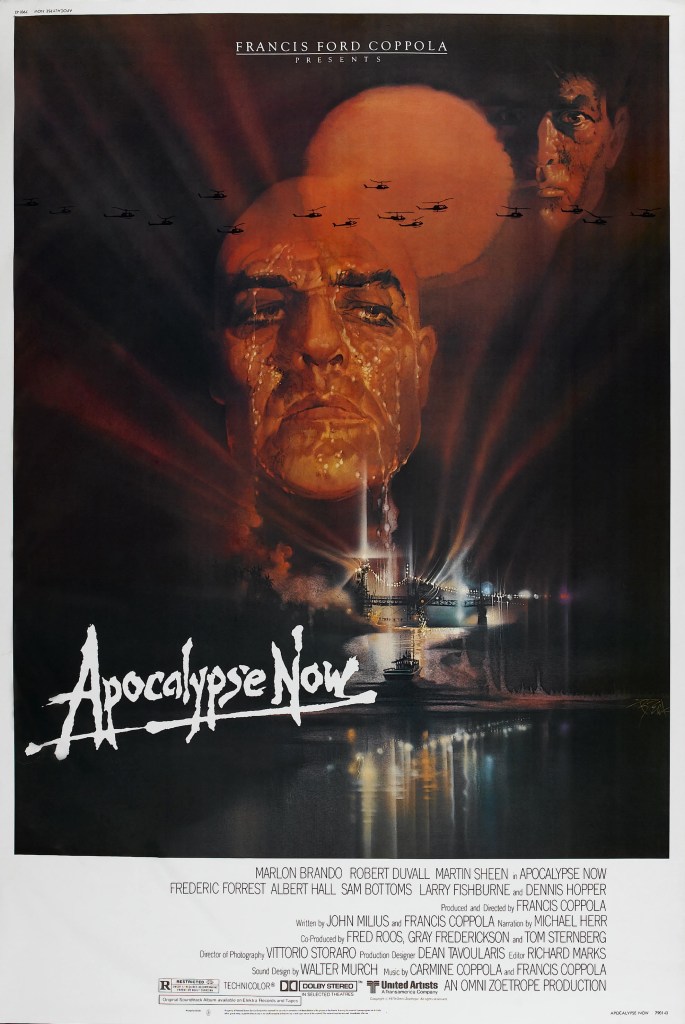
When I think about Apocalypse Now and the countless viewings I’ve undertaken over the years since I first watched it some ten or eleven years ago, two things always spring to the forefront of my mind like a bullet to the head: the horror, and the helicopter ride, and for good reason too.

I think the vision of Vietnam that director Francis Ford Coppola created is the epitome of hell, the stuff nightmares are born from. It’s as cold brutal, and unforgiving as anything I could ever fathom; a long bleak trip down the blackest tunnel into the fiery pits of man-made hell. Between the Doors, Wagner, and a Coppola score pounding against my eardrums like napalm strikes igniting the Vietnamese countryside, and the unforgettable, terrifying onslaught of violent imagery erupting across the screen, my mind often seems to shift into another dimension of itself, into a realm of utter despair and bleakness. The overwhelming power of Apocalypse Now comes from the way in which the film causes that shift in one’s mindset that takes you from a happy place, and throws you face first into the chaos of war. It’s a dehumanizing, soul killing experience, and yet also one of the most deeply fascinating I’ve ever encountered.

The horror I am referring to also encapsulates a disturbing monologue Kurtz gives to Willard late in the film, detailing the dismemberment of polio stricken children by the Viet Cong after Kurtz and his soldiers vaccinated them. “Then I realized they were stronger than we. They have the strength, the strength to do that. If I had 10 divisions of those men, then our troubles here would be over very quickly. You have to have men who are moral and at the same time who are able to utilize their primordial instincts to kill without feeling, without passion, without judgement.” His madness seems to spring from this soul changing event, the discovery that this war cannot be won by those weaker in their hearts than the people they’re trying to overcome. Only hearts of darkness will win Vietnam. large_apocalypse_now_blu-ray_7x

There’s also that line, “The horror. The horror.” It’s spoken with shallow breaths, whispered for only Willard to hear as it floats from the dying mouth of Kurtz and deep into our minds, residing prominently in our memories days after watching the film. It’s the first line I associate the film with every time I think about Apocalypse Now, without failure.

And then there’s the helicopter sequence, where Col. Kilgore’s choppers play Wagner’s Ride Of The Valkyries over the loudspeakers as they dive into enemy territory and wipe out everyone in the area, for the sole purpose of capturing a beach that offers great waves for the surfing enthusiast. I don’t know if such tactics were ever employed or not in Vietnam, and something tells me they likely weren’t, but in this film, in that moment, it’s nothing short of sheer brilliance. In a film that has one great sequence after another for its entirety, a rare feat in a sea of films that struggle for even just one great scene, the Ride Of The Valkyries sequence in its entirety is perhaps the most memorable scene in the entire film. Who could ever forget “I love the smell of napalm in the morning” anyways? large_apocalypse_now_blu-ray_3x

After a gut wrenching viewing of Apocalypse Now, I can’t help but think about the film, every last grueling second of it. It might be the most dehumanizing, horrific, grotesque, and stressful war film ever concocted to date, but it’s also the most memorable and unforgettable. There are plenty of war films that are nearly as depressive and brutal, more patriotic and perhaps indulgently so, and more triumphant and proud than Apocalypse Now, but flag waving manufactured heroism doesn’t always make a great war film. Apocalypse Now is the great American war film, that coveted “M” word, because we’re talking about it all these years later as enthusiastically as if it came out just yesterday, and that’s no easy feat. Persistence goes a long way.

Poster - Apocalypse Now_01


True Romance – A Review by Josh Hains

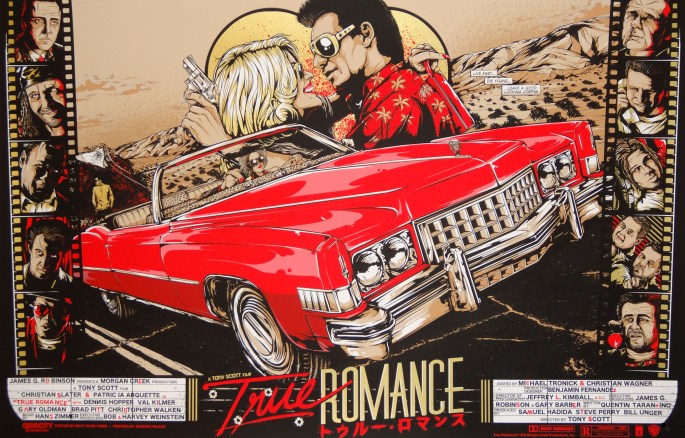
Roger Ebert hailed True Romance as a silly teenage boy’s fantasy come to life, fun and energetic, but absurd. I was a silly teenage boy the first time I saw the Director’s Cut of True Romance on DVD, and like some of my friends at the time, I loved it. I still feel like a silly teenager on the inside sometimes, and that part of me still loves watching this action packed piece of Hollywood entertainment. It might be silly, but that never bothered me before anyways.

True Romance requires a suspension of disbelief, to get your mind past the idea that in a single night, a young comic book store employee named Clarence with a love for Elvis and Sonny Chiba Kung-fu flicks, and the bombshell first time prostitute Alabama hired by Clarence’s boss to give Clarence a good time on his birthday, would ever fall so deeply, madly in love, that they marry the next morning after he kills her pimp, and then set out on a soon to be violent honeymoon with a bag full of cocaine that belongs to the mobsters hot on their tail. Although, this is a Quentin Tarantino screenplay, so most of this sounds like a slow drive to grandma’s house in Tarantino Land. 

Christian Slater and Patricia Arquette star as Clarence and Alabama, respectively, the seemingly ideal cinematic couple. Sure, they’re both a little bit cuckoo when you look at the direction the narrative takes, you must be a bit wacko to get married within hours of meeting, but the natural chemistry between the two actors generates a palpable sensation of honest love oozing from Clarence and Alabama. You really feel the passion between them when they kiss and flirt with each other.

The rest of the cast is rounded out by a director’s wet dream of character actors, including Val Kilmer, Gary Oldman, Samuel L. Jackson, Brad Pitt, James Gandolfini, Christopher Walken, Michael Rappaport, Tom Sizemore, Christopher Penn, Bronson Pinchot, Saul Rubinek, and Dennis Hopper as the least crazy, perhaps even 100% normal character in the entire film. They all appear in one facet or another over the course of this ensemble piece, each adding their own unique stamp to the late Tony Scott’s coolest pure action movie. It’s a real pleasure seeing such a remarkable cast at the top of their game.

As strong as the two leads are, they just aren’t as good as my two favourite performances in True Romance, from Gary Oldman, and James Gandolfini. Oldman is almost obnoxiously over the top and nearly unrecognizable as Drexl Spivey, Alabama’s eccentric dead-eyed, scarred, dreadlocked pimp. In such a brief amount of screen time, he creates one of cinema’s most memorable movie villains, a nasty, vile, unpredictable psychopath.

The same can be said for Gandolfini as Coccotti’s underboss Virgil, a shotgun toting psycho in his own right, and the ultimate nightmare for the naive Alabama. He doesn’t get to say much, but what comes out of his mouth carries immeasurable contempt and cruelty, later witnessed physically manifested in his violent abuse of the strong willed Alabama. I genuinely felt afraid for her throughout their graphic struggle, despite my assumption she would eventually overcome Virgil in brutal fashion anyways. Gandolfini was always just that damn good.

Much has been made about the most popular sequence in the film, largely referred to as “the Sicilian scene”, a long conversation between Walken’s Don Vincent Coccotti, whose drugs Clarence and Alabama currently have in their possession, and Hopper’s Clifford, a former cop and Clarence’s estranged father. The popularity of the scene derives in part from the verbal duel between Coccotti and Clifford, which leads to one of the funniest moments in any film Tarantino had his hands on, invoking a big ole belly laugh for those open to the crude and otherwise offensive humour of the scene. It’s my favourite dialogue driven scene in the film, always captivating me with Tarantino’s linguistic flair, and the sharp delivery of the now classic lines by Walken and Hopper. Every single time I watch True Romance and Hopper says “You’re part eggplant.” to which Walken retorts, “You’re a cantaloupe.”, I laugh out loud, and hard.

And then of course, there’s the action. Fast, furious, brutal, and unflinching, the slew of volatile outbursts of stylish, balletic violence are both dazzling and brutal in the same breath, a hypnotic flurry of blood and death. As a teenager, I was completely blown away by just how violent and intense the imagery was. Even today I sometimes find myself picking my jaw off the floor after the infamous bloody final shootout, which you have to see to believe. Tony Scott directed the hell out of those action pieces, and it’s a joy to see their influence running rampant in today’s films.

When you analyze True Romance, the harder and deeper you look, the more likely you might be to find cracks in the foundation; it’s not the flawless masterpiece some might hope for. But if you take True Romance for what it is, a piece of entertainment, and you choose to view it on a superficial level only, you probably won’t find any cracks at all. Not every film has to be perfect to be great entertainment.

“You’re so cool. You’re so cool.”

The Revenant – A Review by Josh Hains

Spoiler Alert…I guess.

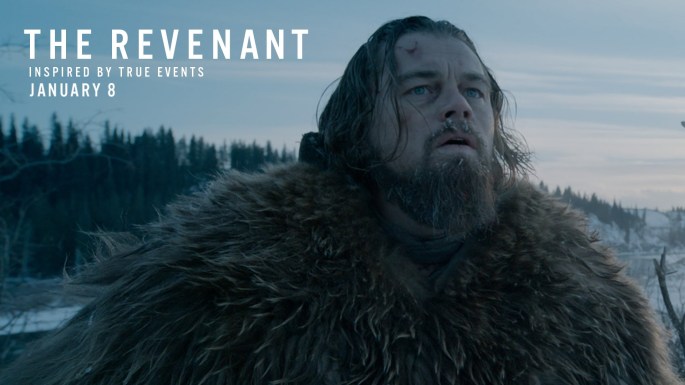
You can spoil a film, which I am about to mildly do, but you cannot spoil reality, hence my hesitancy to cite spoiler alert. Surely you can spoil the narrative construct of The Revenant as the film’s trailers most definitely came pretty damn close to doing, but you simply cannot spoil what has already happened in our reality; that ideology is asinine and ridiculous. Given that the purpose of my mild spoiling, should you wish to dub it as such, is for comparative purposes between the narrative of the film and the true events, I think it only fair to say just one more time, spoiler alert. You have been warned, but to be fair, I am not spoiling much you could not already guess. The premise of The Revenant is a man seeking revenge against the man who murdered his son and left him for dead after he was mauled by a grizzly bear. The trailers for the film, as well as the vast majority of the film’s marketing campaign, showcase this aspect of the film’s narrative, and if you have been following that campaign and have seen those trailers, you are probably well versed in that information. If you take the time to Google the true events, you will undoubtedly find some information that contradicts the film’s narrative. Hugh Glass did not have a son, ever. Nor did he kill the grizzly bear independently, but with the assistance of the two men who later left him for dead, John Fitzgerald and Jim Bridger, who fired multiple shots into the bear while Glass stabbed it repeatedly with his knife. And you will further find that while he was left for dead, and he did traverse from the forks of the Grand River to Fort Kiowa, some two hundred miles of crawling and walking, he did not end up exacting his revenge on Fitzgerald and Bridger. He let Bridger, who was in his teens, go free because of his age, and he had no choice but to allow the enlisted Fitzgerald to go free also, as killing anyone enlisted in the Amy at the time was illegal. He was given his stolen possessions back, including his distinguishable hunting rifle, and was later shot, scalped and mutilated by Arikara Indians a decade after the bear attack while working for the Army as a fur trapper and trader.

After watching The Revenant for the first time, and enduring what I can only call a completely overwhelming, deeply resonant, nearly depressive film as The Revenant most assuredly is, at films end I could not help but wonder if how I felt was how so many others before me must have felt after watching such films as Apocalypse Now, Aguirre Wrath of God, Once Upon A Time In America, Fitzcarraldo, The Great Silence, Exodus (1960), or Apocalypto, to name a few films that I find to be cinematic equivalents of The Revenant, for the first time in theatres. My mind wandered more from the time I left the theatre until a few hours later when my head came to rest upon my pillow, given that I have only ever been able to watch those other films in the comfort of my own home, never on a grand screen in a packed theatre, the sound of silence filling the room…I wonder even in this moment what it would have been like to witness such majestic pictures for the first time in such a manner. I reckon seeing The Revenant the way I did is surely the closest I will ever come to seeing something like Aguirre in theatres for awhile.

I wonder even further as I type away at this review, as to how strenuous and grueling the process of working on this film, in the dirt, mud, snow, and water, must have been for Leonardo DiCaprio, more than any other actor in the film. How it must have felt to dig down deep into the darkest trenches of one’s innermost soul and find every drop of pain, anger, frustration, and grief, and conjure those feelings to the surface but never put them into garrulous banter, just palpable expressing and body movement. I cannot fathom literally crawling through the dirt and snow, or eating raw bison liver, all in the name of art and the end result, which is nothing short of a masterpiece. There, I said it. Masterpiece. The Revenant is a masterpiece, that word I do not throw around often in fear of overuse and redundancy. That coveted word people use so often it has begun to slowly lose the impact that hides behinds the letters of the word. Masterpiece fits The Revenant the way your hand fits a glove. If I have anything of a negative nature to get out if my system, it would be that the hallucinatory dreams of Hugh Glass, while powerful, serene, and beautifully arranged, are completely unnecessary to the film, and in no way did they enhance my experience or my sympathy for Hugh Glass. But damn, they sure caught my eye. Aside from this misstep, a visual metaphor of some unexplained magnitude which one comes to expect from its director, Alejandro González Iñárritu, I took no other issues with the film. I understand the necessities of constructing a fictional son for Fitzgerald to murder and Glass to mourn and seek revenge in honour of, and allowing him to achieve his revenge as opposed to the non-violent real conclusion of Glass’ journey of revenge. Modern audiences are unlikely to understand the non-violent conclusion and instead crave bloodthirsty vengeance as Glass does in the film, and to appease that sensibility the filmmakers had to compromise truth for fiction. Because sometimes we do not need the truth, and do not mind being lied to, especially in the name of good cinema. Which is kind of weird. Do not try to think about that for too long, you will get a headache.

Tom Hardy as John Fitzgerald takes on the personification of not quite pure evil, but evil in the form of greed and cowardice. Given that not much is known about the man beyond the fact that he was a trapper and trader like Glass, that he helped Glass kill the bear along with Bridger, and he did rob Glass and leave him for dead, the logical manner in which to tackle the character is to give him a backstory we can understand and perhaps sympathize with, which the filmmakers delivered in spades. We learn about an attempted scalping by Indians of poor Fitzgerald’s head, how he felt the blood fill his nostrils, how he choked on the blood from his head, and if my memory is serving me correctly, how he survived the ordeal. I do not know that this aspect of the character and his respective history stands out to the average cinema goer in such an overwhelming film, but the thought of what that must have been like for the character, despite the likely fictitious nature of this aspect, is quite honestly, nothing but sheer horror in my own mind. In his interpretation of Fitzgerald, Hardy allows the audience to witness both sides of the man. We see his hasty and impatient way of wanting to kill off Glass or suspecting he will not survive the night, not wanting to stick around and help Glass but instead tearing off into the horizon after killing Glass’ son Hawk (a fine Forrest Goodluck in his first feature role). We see his greed, his insatiable desire for money at all cost, be it through theft or sticking around to help Glass for three hundred dollars Captain Henry (Domhnall Gleeson in the kind of role his father Brendan could ace, and he himself does strong work with) will pay him. We also bear witness to how in his greed and desperation for survival, his cowardice comes out, and he becomes afraid, unstable, violent, and uncaring. In his last moments you feel the fear in his actions, his struggle to survive in his last breaths against all odds against him, and in that Hardy creates a dimensionality, a true sense of humanity and realism incarnate that most villains these days lack on film.

Much has been made about the worn out internet joke of how Leonardo DiCaprio has been robbed repeatedly for years on end of Oscars for various performances, and how he may once again lose, leading to yet another year of hoping he will one day win the coveted award. I hope the joking will end in the upcoming Oscars, and that Leo will walk away with a most deserved Oscar. But I think that when the time comes, should he win, he wins not out of sympathy, or because the film is some kind of Oscar bait with its tale of survival and a gifted character actor committing so intensely to a physically demanding role, falling into that internet-ridiculed category of “they lost weight or whatever so they won”, but because Leo has truly earned the award. Sure he ate raw bison liver, and did all this physical stuff that most actors would have nightmares about, and that all helps create the persona of the character and gives life to what could easily be a one dimensional action flick archetype, but that is not why he should win. I think he should win because we walk away from The Revenant with the ability to show sympathy toward Hugh Glass and his journey into revenge. Every time he gets bitten and clawed by the grizzly, we jerk in horror, we feel his pain, and can imagine how truly terrifying it would be being mauled by a relentless predatory animal like said grizzly. When his son is killed in front of him, again we can fathom his pain, this time emotional, as we watch as he also does, as his son gets stabbed by Fitzgerald. When Glass crawls out of his grave, pulling himself along by his bare fingers, his entire body dragging along the black soil, we share more of his pain, and hope we may never have to crawl to survival. As his journey to safety and to revenge continues, as he is attacked by repulsive French soldiers and endures hundreds of miles of exhaustive, brutal weather and terrain, each drag of his body, every step on his broken right leg, every whip of chilled air to the exposed portions of his scarred, mutilated body, every drop of freezing river waters and freshly fallen snow as merciless as the last…we slowly come to the conclusion that if we had to endure what Glass has been through, we too, would feel that undying determination to surge forward in pursuit of our ultimate goal, revenge, and that Leo has managed to convey every ounce of this determination with nothing more than his facial expressions and subtle body movements. Watch his face during the infamous rape-less bear attack (seriously, people truly are strange) each time the bear tears into his backside or his chest, or bites his hands or claws his throat wide open, see him struggle beneath the might of the beast as it tries to crush his chest. See the terror on his face, and that pure near animalistic need to survive burning in his eyes, and try to convince me you did not emotionally invest in his survival, and completely buy his performance. Of course, he already deserved an Oscar for Martin Scorsese’s The Aviator, Leo’s finest screen performance to date.

The Revenant is for my money’s worth, in all likelihood the best film I have had the pleasure of seeing theatrically over the course of my life. I cannot think of another film I have seen in theatres that is as alive and and powerful as The Revenant. It is brought to life not just by the dynamic cast of stupendous character actors, but also by the breathtakingly gorgeous British Columbia and Argentina landscapes, beautifully photographed by the maestro Emmanuel Lubezki, and the sound Judgement and watchful eye of Alejandro Iñárritu. As great as some films from the 2015 season are, almost nothing seems to come close to being as immaculate as The Revenant, with the exception of The Hateful Eight, Quentin Tarantino’s irrefutable masterpiece.

It has only been a couple of day since I bore witness to the majestic achievement in cinema, and already I cannot stop thinking about nearly every second that passes by. It is as if the film itself has burrowed into my mind in eerie permanence. It is quite the dark trip into a kind of hell that used to await us not too long ago in mankind’s elaborate North American frontier history, where guns, tomahawks, knives and our bare hands were the foundations of our very survival, and our guide is the stubborn, relentless, undaunted Hugh Glass, taking our naive soft hands in his filthy torn hands, and single handedly dragging us into an elongated, contemplative, bloody battle of wits against the elements and men. A world where only the strong survive. A world of wolves thriving amongst dying sheep, not going gently into the night. 
A Tribute to Alan Rickman, and David Bowie by Josh Hains

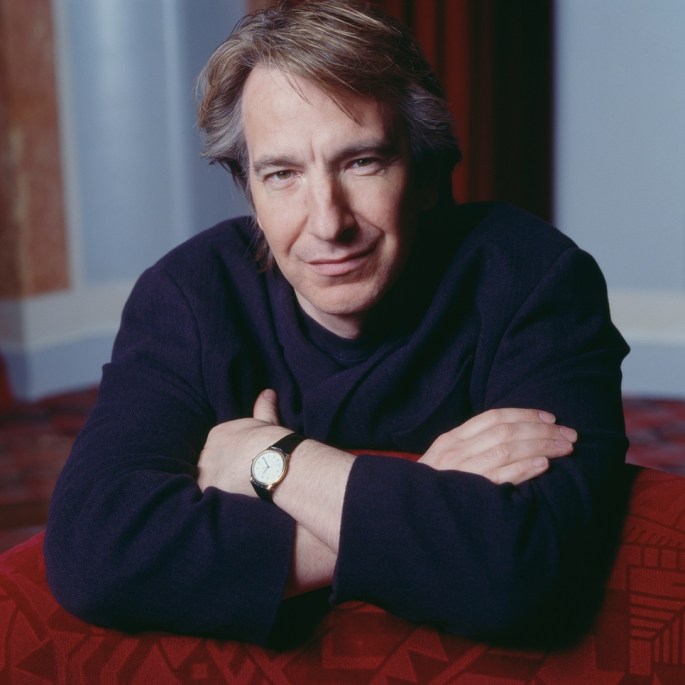
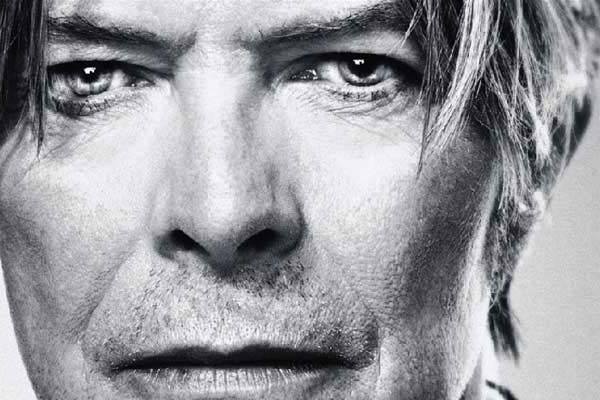
I have to say some words about the passing of beloved actor Alan Rickman, who passed away at the young age of 69 from a battle with cancer, the same way as musical icon David Bowie. I cannot begin to fathom the pain and grief their respective families are surely experiencing, and I can only wish them the deepest of sympathies from my heart to theirs at this most difficult time in their lives.

It is difficult to realize that two individuals who I cherished so much for so long, are no longer with us anymore, and the thought that I will never be able to hear their voices ring in my ears, or see them perform as splendidly as they both did for so long, is one that has left a void in my heart that cannot be filled. I grew up with Bowie’s unique sounds drifting from the speakers and dancing into my ears, every tune as weird, wonderful, and fascinating as the last. I was a little four year old boy cheering for Kevin Costner’s Robin Hood to defeat the villainous Sheriff of Nottingham, who Alan Rickman brought to life with such ferocity and grace, in Robin Hood: Prince Of Thieves. Throughout my life I continued to listen to Bowie’s tunes and watch him strut his stuff in films such as The Man Who Fell To Earth, and watch Rickman’s enthusiastic performances come to life onscreen, in everything from the badass Die Hard to the magnificent Harry Potter series, blindly assuming these two would be around for much, much longer.

12509804_962225607202846_687231817322484173_n

Something deep within me believes that these two brilliant men wouldn’t want me to feel sadness, pain, and grief, but would rather wish that myself and legions of fans around the world, instead take the time to remember the time we did have with them. To that notion, I say we shall. In the hours and days and years to come, lifelong fans of these tremendous artists will continue to gleefully listen to the soulful otherworldly music of David Bowie, and relentlessly watch the vast filmographies of both Bowie and Alan Rickman. Whether you know Bowie for Rebel Rebel, or Starman, or Ziggy Stardust, or some other tune or one of his varied film roles, or Rickman for The January Man, Die Hard, or that most beloved Professor Severus Snape, or for some other role, whether you have engaged in their work for twenty years or just a few months, take the time to remember what you love most about their respective careers, and them as individuals. Remember if Snape broke your heart. Remember if Hans Gruber gave you chills and made you laugh at his witty one liners and sarcastic demeanor. Remember if Rebel Rebel made you crank up the volume in your car and speed down the highway in pure bliss. Remember if Space Oddity, or Starman, or Heroes touched the deepest part of your soul. Remember if Bowie, with his flaming red hair and trendsetting outfits and makeup made you embrace your inner self and feel proud to be the unique individual you surely are. Remember the laughs. Remember the tears. Remember the smiles, the joy, the fun. Remember their work and how they made you feel. Remember your heroes, and never forget them.

“I do take my work seriously and the way to do that is not to take yourself too seriously .” – Alan Rickman

Sicario – A Review by Josh Hains

sicario_ver8_xxlg

“You are not a wolf, and this is the land of wolves.”

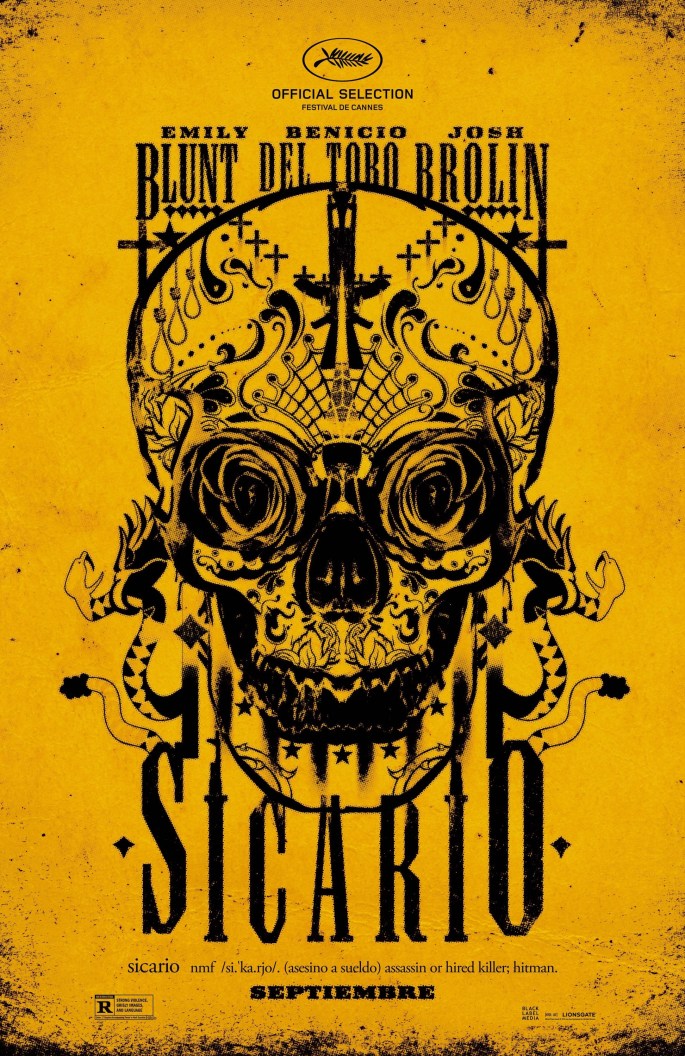
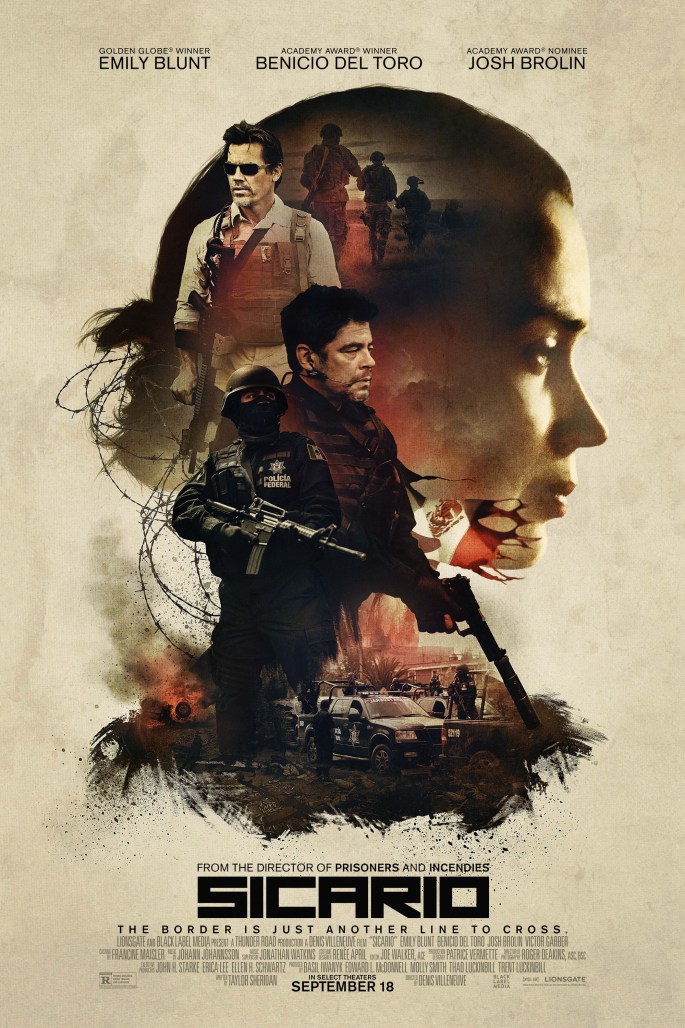
Sicario has been stuck in my mind since the opening sequence unfolded before my very eyes in theatres, in a manner so few films in my life ever have. Very few have ever been successful in leaving such a lasting stain on my mind. This film is like days-old dirt stuck under my fingernails, salt water swishing in my ears, the undying Sun burning in my eyes. It does not want to leave at all, it just wants to stay buried in these deep places I cannot reach. It is so dark, disquieting, and depressive in nature, and such a brutally violent, honest, and eerily realistic piece of cinema that quite honestly, made me want to shower after seeing it. I have not seen anything like it since The Counselor crept into theatres a couple years ago; Apocalypse Now springs to mind as another example. Sicario is ultimately a low-key, intimately orchestrated thriller that almost left me underwhelmed simply because it is not the big and bombastic flick one could assume it may be by the films trailers.

The score, repetitively pulsing throughout the film in the greatest way possible, chimes through the air with the ferocity of an explosion, then proceeds to crawl into your ear and make its way deep beneath the surface of your skin. As that music creeps toward your nerves, the suspense of any number of impeccable sequences, such as the infamous highway interaction, slowly turns your knuckles pearl white, puts the hairs on the back of your neck in standing position, and the gorgeous, stark cinematography lowers your jaw to the floor. A gunshot will crack against the wind, taking you by surprise as magnificently as the films twists, so deafeningly loud you almost experience a ringing sensation in the canals of your ear. The performances catch you off guard with their inherent subtleties and nuances, while the completely unexpected humour of a couple brief moments fills your lungs with welcomed laughter. The sheer brutality of the violence widens your eyes with fear, the popping of gunfire so realistic you just might think you are being shot at; murders so gruesome if you are of the weak stomached, your insides may churn at the sight of beheaded bodies, and heads exploding in bursts of crimson life force. But it is the journey by the characters into a near unparalleled descent into darkness from which there is no return, that will put a poisonous void inside the deepest caverns of your heart, and send cold shivers running down the length of your spinal column, disrupting the tranquility of your very soul. Sicario is a film that you’ll be unable to shake in any reasonable period of time.

The performances across the board are all great, from the itchy trigger fingered lowlife criminals to Emily Blunt’s naive agent Kate Macer, to Josh Brolin’s stern cowboy-ish possibly C.I.A. spook, though Benicio Del Toro’s quietly contemplative, brooding god of merciless death Alejandro is most likely to leave the strongest impression; he’s quite the wicked force of nature.

Any other year, Roger Deakins would deserve, and bear the potential of scoring an Oscar nod at the very least for his spellbinding cinematography that captures the smallest of dust particles to the true essence of night in such staggering detail one may shed tears in awe of the beauty, or simply find themselves speechless. While it likely is not as staggering as the work Emmanuel Lubezki has done with The Revenant (I have not had the pleasure of seeing that film just yet), Sicario still bolsters brilliantly concocted visuals from a true master of the craft.

In a crime film that follows the exploits of various law enforcement operatives systematically slaughtering cartel members left and right in an attempt to sever the head of the snake[so to speak] orchestrating cartel inflicted killings across America and Mexico, Sicario by films end feels like a hot-blooded rogue documentary with the ferocity of a screaming gunshot captured on camera by one of the agents, and not the silly exploitation movie it could have been in misguided hands. If one views it as such, you can clearly witness how blunt, honest, authentic, naturalistic, brutal, and precise this stellar film is. It surely is a stressful and powerfully overwhelming endurance test. It is assuredly an openly nihilistic (in the best way possible), unflinching examination of the thin grey line that separates wolves from sheep, and hunters from the hunted, with one hell of a bloodthirsty, tortured man in Alejandro dragging us blindly into a realm where darkness reaches out to darkness with battered hands and consumes its soul. And ours.

*This is a revised edition of a review I wrote on October 11th, 2015.


Inglourious Basterds – A Review by Josh Hains

“I think this just might be my masterpiece.” – Lt. Aldo Raine

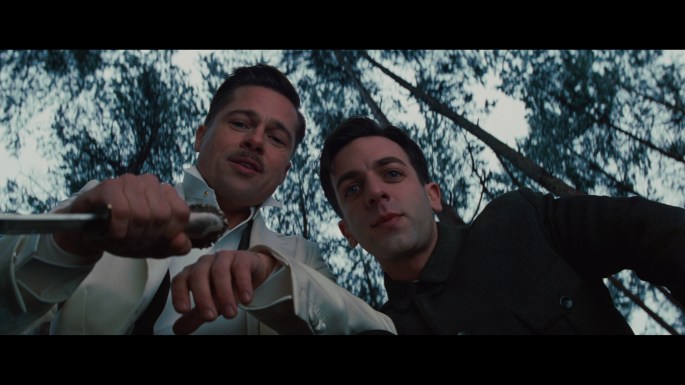
The quote above that leaps from the mouth of Lieutenant Aldo Raine, and both echoes an earlier scene in Inglourious Basterds, and closes out Quentin Tarantino’s sixth film, is not a gleefully pretentious boast as one could blindly assume, but in my eyes, a coy wink to the audience from a director who seemed to be aware at the time, that he had in fact concocted his masterpiece. To this day, Tarantino holds the film’s notorious opening sequence, where Christoph Waltz’s Nazi Colonel Hans Landa (in an Oscar winning turn) slowly and methodically removes vital information about the whereabouts of a Jewish family from the mouth of farmer Perrier LaPadite, in high regard as the best thing he has ever written. Whether he believes the film in its entirety is a masterpiece or not remains ambiguous to me. Whether you find it to be his masterpiece, or far from it, is another story. What I think of the film is coming right up.

I can recall with reasonable clarity the first time I saw Inglourious Basterds, on DVD in the comfort of my bedroom, and how I found myself both thrilled and bored at the same time. I had heard from friends and even a couple teachers at my high school that I was guaranteed to love Tarantino’s latest feature, and there I was at films end underwhelmed and sorely disappointed. At the time of the film’s release, I was quite the action movie junkie who seemingly lived and breathed violent cinema, and was expecting a simplistic, wickedly graphic WWII action adventure extravaganza, something so relentlessly bloodthirsty and violent it would make Rambo 4 and Shoot ‘Em Up look like Forrest Gump in comparison. What I did not expect, or want, was the deeply resonant, audacious blackly comical war picture I was served on a silver platter. You could say I was rather cinematically ignorant. Roger Ebert had it pegged right on the forehead when he said it would annoy some, and startle others. I was certainly startled by unexpected moments of frightening violence, and as mentioned, I was annoyed that I had not received that ultraviolent action movie I so desperately wanted. But by the same token, I was pleasantly surprised by Inglourious Basterds.

What took me by surprise were two vastly different aspects of the film: the craft, and the impact. Initially, I was taken back by how great the performances were, in particular and quite obviously, Pitt and Waltz’s, and just how much fun and wild and odd, and yet, deeply layered, three dimensional, and even kind of powerful those two performances and plenty of others, to this day still are. I was hypnotized by Tarantino’s musical selection, captivated by his editing and the offbeat and bold manner of storytelling he was shoving down my throat. But what really caught me off guard, was just how damn suspenseful the entire film was. I sat with my eyes glued to the screen while Landa interrogates LaPadite, quite literally chewing on my nails and almost giddy from the overwhelming tension and suspense I felt boiling over within myself. Or in the case of the sequence in the basement bar, where the identities of three Basterds hinge on the validity of one of their accents that sounds a wee bit off to a nosy and understandably suspicious Nazi Major, the threat of impending violence growing at the drop of every letter that falls from their respective tongues…I could have chewed my finger off, I was so consumed by suspense. Or even later in the film, in a moment toward films end to be more specific, when Shosanna is ever so close to watching her unseen reel of film displayed before Hitler himself and an unhealthy number of Nazis, when the ever persistent and fairly annoying Fredrick Zoller comes knocking at the door to the projection room…oh damn. I could have swallowed my arm whole like a shark.

But what has surprised me the most is the second item I mentioned, the impact the film has had on me in the years since my first viewing of it. Over time, and with expected subsequent viewings, I have come to adore it more and more with each individual viewing. Long gone is the lust for a purely cathartic action packed ride, the days of me wishing Tarantino had made the movie I wanted to see, and not the incredible piece of cinema I am praising today. The more I see Inglourious Basterds in all its angry, hilarious, gutsy, and riveting glory, the more I come to appreciate the cinematic gift Tarantino gave those receptive enough to see the film for what it is, and not what it could be.

Which brings me to one final point. On January 2nd, I sat down in a crowded theatre with quite a good seat in the middle if the room, and found myself completely engrossed in Quentin Tarantino’s eighth film, The Hateful Eight, for its entire 168 minute long duration. Yes, this was the widely seen digital theatrical cut. After seeing the film, I informed my friends that I felt it was the high point of Tarantino’s career, his masterpiece plain and simple, and likely my favourite film within his short repertoire. A week later, I find myself stumped. The Hateful Eight is like a well oiled machine with nary a hiccup along the way. It is so finely tuned, so boldly and magnificently performed, so passionately manufactured, and so angrily powerful and intensely resonant, I find myself unable to shake the memory of it from my mind for even a second. I called it his masterpiece after all. But prior to seeing The Hateful Eight, I called Inglourious Basterds his masterpiece. Surely he can have two masterpieces, but one will always stand a little taller than the other, so which one takes the high ground? I judged them by their endings. Now, for those of you who have not had the pleasure, or displeasure (depending on where you stand on the film once you’ve seen it), of seeing The Hateful Eight, you need not worry about spoilers, because I will not provide any.

The Hateful Eight, while complicated in the dialogue that leads to its inevitable conclusion, is to put it bluntly, simple entertainment, and almost could have been quite the superficial film. Much of the meat of the film is not bloody killing or hyper stylized visual gimmickry that seems to be the meat of a couple of his other films (at least three), but the very dialogue that propels the film forward, at least for me, with the velocity of a hot bullet. Additionally, The Hateful Eight is as angry, spiteful, nasty, brutal, profane, and humorous as Inglourious Basterds, and unexpectedly hopeful. It is a blast, a real treat, and a true gem of a film. At films end, I felt so deeply that the film is perfect, and in the way the ending is constructed and performed, I found myself swept up in its sublime power in a way only a small, and I do mean small, handful of films had ever done beforehand. I felt like I could breathe again, as if I had been holding my breath in as I sat in a disquieted and unnerved, suspense ridden state, completely caught up in the twisting and turning of this Western mystery. I felt pure relief, and yet I felt like I was still grappling with the angry, societally relevant morality tale spinning at the centre of the film, a sensation I have yet to shake.

Inglourious Basterds is not simply entertainment for the sake of entertainment or the mastering of craft…not that The Hateful Eight is either. It is an intricate, complicated piece of work. Here is a film that gives Jews hypothetical revenge against Nazism, with richly textured, yet goofy and nearly sadistic characters enacting swift justice with their guns, knives, and a baseball bat, creating chaos within France, and with every bullet riddled scalped Nazi, sending the coldest shivers all the way up the ranks of the Nazi war machine, echoing the horror of Nazi atrocities. In its final moments, one senses an air of achievement in much the same way the surviving characters surely do, having won the war and overcome pure evil, and yet we sit still, frozen, almost shell shocked, utterly disquieted. Because in those final moments, we are still dealing with the ramifications of their actions, cleansed of nothing, and left with a powerful, overwhelming sensation burning in our guts. Even as Aldo revels in his mastery of scarring Nazis with swastikas carved into their foreheads, and Tarantino winks at the audience with that clever last line that rings as truthfully as anything he has ever written, we cannot help but feel unsettled, disturbed, disquieted, shocked. I think we are supposed to.

But none of that answers the question of which film do I hold in higher regard as Tarantino’s clearer masterpiece. And on that note, here is my verdict: Inglorious Basterds is bound for the same iconic glory as Pulp Fiction, and fully deserves every ounce of it, but The Hateful Eight, flawless in its execution and utterly unforgettable in its sublime power, takes the high ground. A dramatic film has not stuck to my mind as hard as The Hateful Eight has in the last three years since I saw Killing Them Softly in its theatrical run. It is just that damn good.

But of course, I have a sneaking suspicion another film will replace The Hateful Eight in my mind as if I never saw it: the Golden Globe winning The Revenant.

We’ll see.

Mulholland Drive – A Review by Josh Hains

I do not hate Mulholland Drive, nor do I like Mulholland Drive.

David Lynch’s most celebrated film, the aforementioned Mulholland Drive, is also his most ambiguous piece of work to date. To call it confusing would be a disservice to his crafting of this meticulous, multifaceted surrealistic experience. It is not that Mulholland Drive is merely confusing from a lack of directorial control and self indulgence leading to unintended confusion and incoherence, but that the film intentionally lacks in many sequences, the connectivity necessary to compose a complete and full picture. This is not a film that ends with all loose threads tied up with a bow, but a film that purposely leaves loose endings, which generates room for interpretation of the films events, similar to the equally as confounding Birdman Or (The Unexpected virtue Of Ignorance) released in 2014. As I watched the film, captivated by most of its aspects but completely befuddled by the seemingly impenetrable plot, I began asking myself questions I would revisit in time. Who is the grungy, grotesque man who spookily appears from around a corner as if he sensed someone approaching? Is he just a random piece of a large intricate puzzle, or is he the physical embodiment pure evil, fear, or death, or perhaps all three? Who is the cowboy, and what is the reason behind Kesher’s interaction with him? Is everything just inside Diane’s mind at films end? Unlike Birdman however, upon finishing my first viewing of Mulholland Drive in 2014 (months prior to seeing Birdman), and in the case of subsequent viewings in the time since my initial viewing, I reacted both poorly and foolishly toward the film. Rather than approach the ambiguous nature of the film at its end with the same open-mindedness and childlike curiosity as I did with Birdman some months later, I greeted it with frustration and disdain for not closing in similar fashion to Blue Velvet or Wild At Heart, for not allowing me the relief of a “Hollywood ending” with all loose ends tied, and for leaving me absolutely confused and underwhelmed.

What I discovered in later viewings was not the truth of the film and its hidden meaning, but that the more I dissected and analyzed the material, the more time I spent engaged in the mystery of the film, the more frustrated and confused I would become. Justin Theroux, who portrays Adam Kesher, has expressed the belief that people such as myself, who take the time to dissect the film as thoroughly as we have done, will only end up further frustrating ourselves, due to the lack of what he called “connective tissue”. Once I recognized this aspect of the film this morning watching a brief clip of Theroux discussing the mysterious nature of Lynch’s films, in particular Mulholland Drive, after a revisit of Mulholland Drive last night, I saw the light at the end of a vast dark tunnel. I saw that the power of the film lies in its inability to be interpreted, or as Roger Ebert put it in his review of the film (which later made its it way into his “Great Movies” list) “It was a tribute to Lynch that the movie remained compulsively watchable while refusing to yield to interpretation.” I could not have said it better myself.

A question has remained in my mind for the rest of today, the question of what do I think of the film now that I have freed myself of compulsively searching the depths of the film for its meaning and some semblance of a clear resolution? Considering that in viewings past, my issues were not with any other aspect of the film; not the performances, not the cinematography and startling imagery, not the dread ridden bleak atmosphere, not the music, or the sex sequences and unexpected violence; beyond the purposely ambiguous and open-to-interpretation nature of the puzzling narrative, and seeing as how that issue has been cleared up rather nicely as of today, I think that the film is possibly David Lynch’s finest film. His masterpiece. The film upon which all his other works will forever be compared to. I could also say that the impenetrable nature of the film, the unwillingness to yield to interpretation and modern cinematic standards, places the film upon a pedestal above most other films that thrive in surrealistic realms, though unlikely above but quite possibly on par with Werner Herzog’s Aguirre, The Wrath Of God, or Alejandro Jodorowsky’s El Topo, both similarly mystifying, confounding, and surreal. Of course, these points are open to discussion and interpretation, and subsequent to change dependent on perspective.

All of this brings me back to my opening statements, and my final verdict on the film as a whole. I do not hate Lynch’s Mulholland Drive in any facet, nor do I like Mulholland Drive. I love it, and I want to see it again soon so I can once again become entangled in that mysterious dreamlike realm that seemingly inhabits one dark corner of Los Angeles. Or Diane’s demented imagination. Or both.


In The Heart of the Sea – A Review by Josh Hains

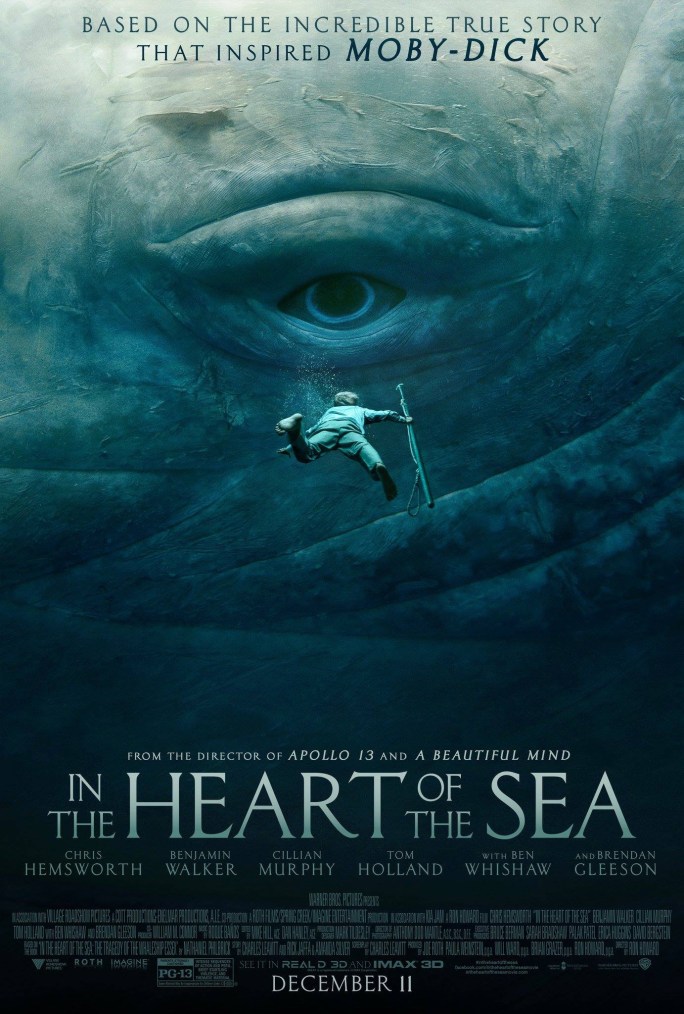
Ron Howard’s latest cinematic venture, In The Heart of the Sea, tells the true story of the prolific whaling ship The Essex, and the fateful whale attack that later inspired Herman Melville’s Moby Dick, and damn is it ever good. The film opens with Melville interviewing the last surviving crew member of the Essex, Thomas Nickerson, who at the time of the incident was only 14 years of age. The remainder of the film is a faithful, albeit sanitized, account of what really happened in the days both before and after this near mythological event, as seen through Nickerson’s green-horn eyes, though most of the events utilize Owen Chase as the film’s moral centerpiece. This makes sense, given that Chase is such a legendary figure in whaling history, and focusing specifically on Nickerson because he recounts the events would have been a foolish narrative choice, especially given that Chase and the boat’s one-time Captain, George Pollard, have always been the main focus of the human side of the accounts told.

In The Heart of the Sea is the first seafaring adventure I have seen committed to film in years that is not of the Pirates of the Caribbean canon, and is a welcomed addition to the barren genre. I think the popular criticism that the film fails to achieve epic qualities that it supposedly strives desperately toward is a miscalculated notion. The events depicted easily could have been exaggerated to mythological heights, which would have been a step forward in the wrong direction, given that the vast majority of the real events themselves were actually quite intimate and personal in comparison to the commonly exaggerated tale most associated with the event.

I really enjoyed the performances, in particular Chris Hemsworth, and Cillian Murphy as Chase and Joy, respectively, and the visual flourishes. Howard’s now typical use of amber, emerald, and blue hues within the visuals of his most recent works did not exactly meld with Rush, but here actually serves In The Heart of the Sea extraordinarily well, used to near perfection in the night sequences, adding a brooding aura to the nightly events. My only major issue lied within the over abundance of unnecessary CGI over practical effects that would have better sold the near epic quality of the notorious whale.

As a whole, the film works, and oh so very well, but in order for it to work properly, one must set aside bias and arrogance in pursuit of some pure masterpiece, and instead embrace something different for a change. Here is a film that embraces with effortlessness the intimate nature of the real event, cautiously avoiding the kind of overblown blockbuster qualities so many seemed to expect from this film. It is not an epic tale of bravery and courage by macho men in the face of a relentless monster, some epic sprawling adventure with a hero standing stoic and mighty at the end, but rather a cautionary story of remarkable survival filled with desperation, brutality, and an overwhelming bleak atmosphere. The arrogance of Mankind has been the assumption that nature is something controllable by our hand, and not the other way around. The Essex crew embodies our inherent arrogance, savagery, and ignorance while the whale itself takes on the other side; the uncontrollable, the untameable, the wild and free. In The Heart of the Sea marks a high point for seafaring adventure films, and is most definitely far better than some sour souls are making it out to be. Give it a chance, you just might be surprised.

My vote for most dynamic poster of the 2015 film season.


Lawrence of Arabia – A Review by Josh Hains

I have been blown away many a time by many a film, though as time passes by at breakneck speed, so few are able to blow me away time and time again in repeated viewings. Lawrence of Arabia is one of those few. While David Lean’s glorious masterpiece (a word I do not toss around often) is not my favourite film, it does sit high upon a pedestal of the greatest films I have ever seen. I can not think of another film of equal or greater length that has managed to sustain my interest as consistently as Lawrence of Arabia does in its nearly 4 hour runtime. Much of what keeps me entertained does not have to do with the plot, the score, or most of the supporting performances, but rather, that eccentric leading performance from the late Peter O’Toole, as T.E. Lawrence, and that absolutely gorgeous cinematography.

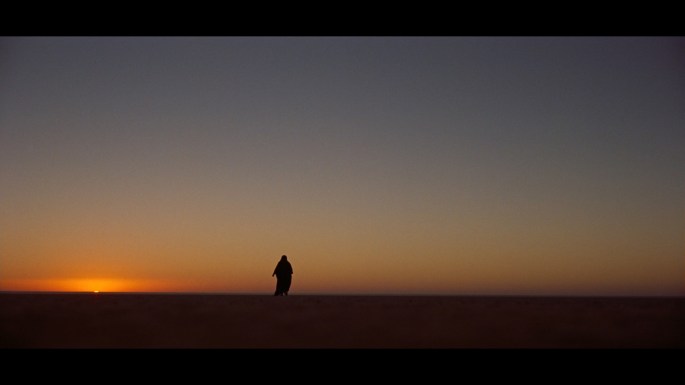
The first time I saw the film, I was completely hooked by the time Sherif Ali makes his grand entrance, initially appearing as nothing more than a speck on the screen, before slowly materializing into a full blooded, and violent figure. I can not think of too many other films that dedicated that much time and effort to introduce a character. I do not think I can name another film that took the time to showcase the rising of a bright orange sun that fills the sky with its warm glow as gracefully as Lawrence of Arabia did. Nor can I think of such a magnetic, yet eccentric and carefree performance as the one Peter O’Toole delivers. Whether he is uttering blunt thoughts or speaking through his eyes, his Lawrence chews up every scene with a delightful cheekiness, spontaneity, and flamboyance. You can hardly take your eyes off him for even a second as he completely dominates every scene he is featured in. At the end of the day when all the dust settles, when I find myself reflecting upon this magnificent work, I am always quietly moved by every single frame of this gorgeous film. I can not find a single visual flaw, a singular moment that sticks out as odd or misplaced or weird. Every frame blends together splendidly, coherently, and perfectly. Lawrence of Arabia, with such a wide visual scope and a story of truly epic proportions, is one of those rare films that makes you feel as small and insignificant as an ant. To see Lawrence in his ceremonial garments, a small silhouetted figure standing against an enormous sky, is to be reminded of how enormous our world really is, and just how beautiful this film truly is.

I honestly believe that the best kinds of films invite you into their worlds, captivate your heart, mind, and soul, and in doing so, help provide you with an escape from the hardships of your life, if only for a couple of hours. The greatest films one can ever watch not only do that, but are of such marvellous quality, one often finds themselves wishing they would never end and that you could continue the journey for hours more. Lawrence of Arabia is one of the finest examples of this ideal, a true cinematic gem. What a wonderful experience.