Brea Grant’s Lucky

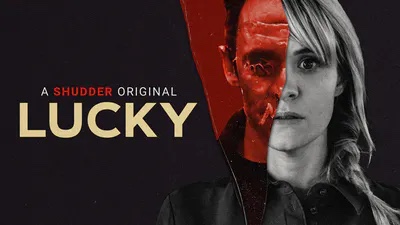
I struggled with Lucky, a new horror film billed as innovative and groundbreaking and yes it’s well made, yes it’s themes are incredibly important but you have to fashion a story that makes sense and draws you in around said themes or all you’re left with is abstraction without any proper narrative tissue to cling to. This is written by and stars Brea Grant, an actress whose work I loved in Rob Zombie’s Halloween II and some of the later seasons of NBC’s Heroes, where she played the Quicksilver proxy. Here she plays a suburban woman who is attacked one night in her own home by a masked man. She wounds the guy and he runs off, but the next night he shows up again. And the next night again. And again, and so on. When she tells her husband he more or less shrugs it off with a non-reaction. Her friends and the police seems to have the same lukewarm indifference so she’s stuck in this surreal twilight zone where she’s the only person who finds it concerning that the same intruder comes back night after night to torment her, no one in her life properly believes, listens or takes her seriously and she feels alienated and outmatched by both her attacker as well as the people and support systems in her life that are supposed to care. See where this is going? It’s a fabulous concept for a film and the fear, panic and paranoia is well executed on top of a terrific performance from Grant… however… the script does absolutely *nothing* to explain this concept from a story/script point of view beyond “she’s attacked every night by the same dude, no one really believes her and she’s basically on her own in fighting back.” Then, it starts happening on a mass scale all throughout the city like some kind of violent epidemic and everyone who is not the attacker or the victim seems to just carry on like nothing much of anything’s happening. The film makes absolutely zero effort to explain this beyond simply showing it happening, and as a result it completely tanks itself, and doesn’t work whatsoever as anything close to a coherent narrative. Now, this is a tricky one to review because of the subject matter itself so let me spell it out clearly: there is no doubt in my mind whatsoever that these themes are incredibly important, that violence/assault towards women is a very serious matter that needs to be addressed both in art or society, and so too the endemic indifference and non-believing nature of others in their lives who either turn a blind eye or don’t care. It’s so important. However: these filmmakers made their story *purely* from an abstract, allegorical point of view and didn’t mesh in a storytelling device or proper narrative to support it, and that to me felt lazy, incomplete and incoherent, and I disliked the film. Anyone out there hollering “you just didn’t get it because you’re a man and this film wasn’t made *for* you” into the echo chamber can stop right there. I succinctly and pristinely understood these themes, and understand how important they are, but that doesn’t change the fact that the film itself, as a piece of art, was not a successful endeavour and my saying so in a review doesn’t immediately imply that I’m discrediting anyone’s experiences or these social issues overall. I shouldn’t have to explain this so in depth but some people out there really seem to struggle with it, so there it is. Well made film from a technical standpoint, an absolute knockout of an original score by Jeremy Zuckerman, fantastic performance by Brea Grant and very important themes… but ultimately it falls flat on its face.

-Nate Hill

The VHS Files: Two Small Bodies

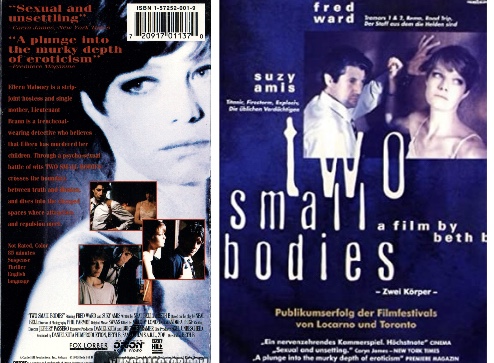
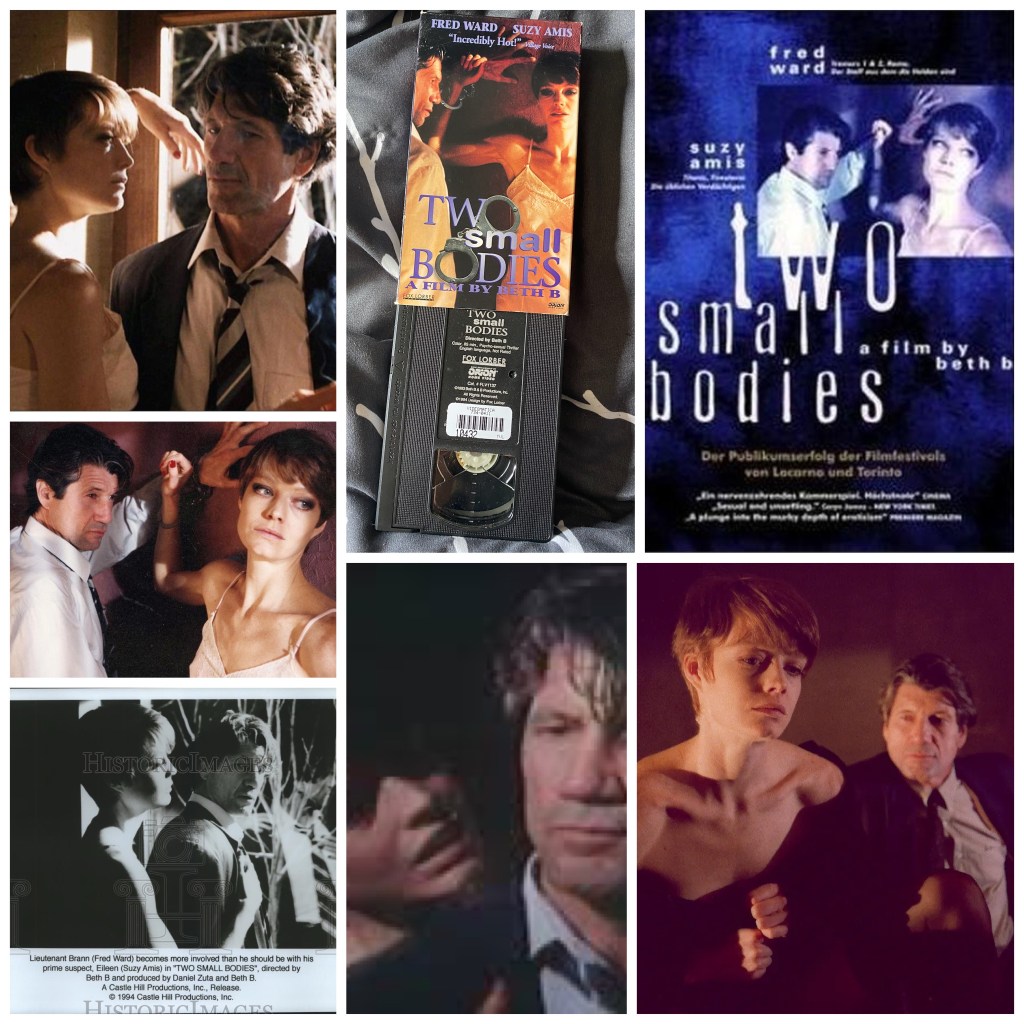
Today’s VHS File is an odd one called Two Small Bodies, essentially a grim two person drama that sees a police lieutenant (Fred Ward) relentlessly interrogate a single mother (Suzy Amis) who has reported her children as missing. They hang about her house as he goads, manipulates, probes and generally just drives a wedge into her life in an attempt to find out what happened to her kids, and he cultivates a growing suspicion that she’s the guilty party herself. This is based on a stage play, so we just have this one location, two actor story without anything else in the way of dynamics. Thankfully our two leads are both excellent, particularly Ward who is at his most… manic, Jim Carrey style acting I’ve ever seen him in a career full of mostly straight shooter authoritarian/cop roles. His cop (I began to wonder if he even was a real cop) here is a piece of work, and takes full advantage of the fact that Amis’s character is a stripper in his tirade of investigative fury towards her. The film is directed by cult filmmaker Beth B so the kinky underground vibe is there, but she struggles somehow in getting this story successfully across. You can only go so far with a constant back and forth barrage between two characters before you need narrative innovation and for your story to, you know… go somewhere! Unfortunately this doesn’t go anyplace concise beyond having the two leads engage in bizarre, borderline surreal roundtable dialogue and questionable behaviour and then just sort of leaves the ending open for us to figure out. I had a vague idea myself of who these two really were, what happened to the kids and what their situation was really about but the film (not sure how the play goes) does little to solidify any concreteness and let’s the final frames billow out in ambiguity like the perpetually windswept curtains in this woman’s nocturnal abode. That’s not to say it’s inherently a bad choice, ambiguity can be an especially *strong* choice if implemented correctly, but you just never know how each viewer will respond to that, and I was left a little lost. A fascinating exercise, if an incomplete one.

-Nate Hill

April Mullen’s Wander

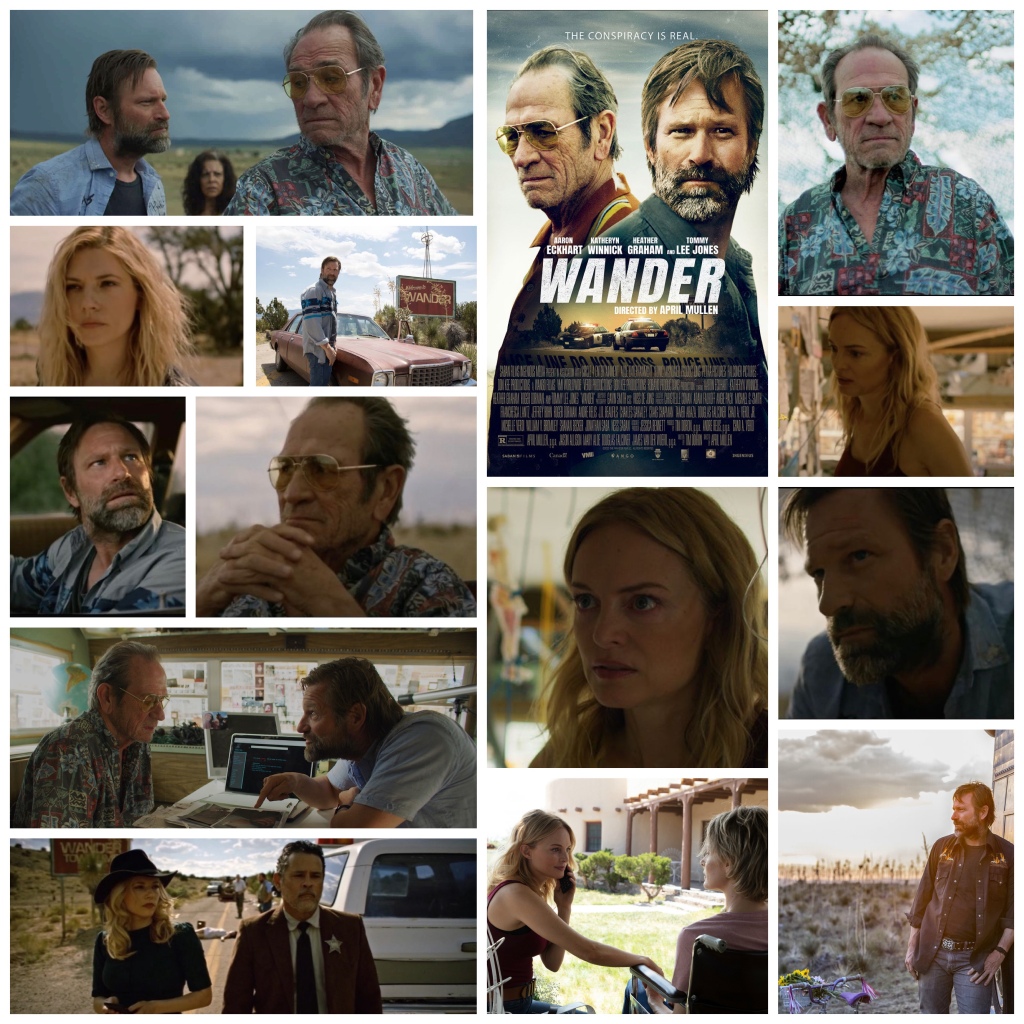
I wasn’t quite sure what to expect with April Mullen’s Wander and my hopes may have not been that high just based on reviews but I honestly loved this wild, scrappy, unconventional, ‘pulp arthouse’, sociopolitically conscious bauble of a film so much. Many won’t vibe with it and that’s okay because it’s supremely weird, visually stylish and kinetic in the fashion that filmmakers like Tony Scott and Oliver Stone traffic in and, quite frankly, all over the place in terms of tone, editing and plot to the point that many viewers will feel assaulted by commotion. I love it for all the reasons mentioned because my tastes always gravitate towards the wild, wooly, artsy and just plain strange. Aaron Eckart and Tommy Lee Jones give perhaps the two performances of their career that are most… ‘unlike their essence’, playing a couple of crusty, paranoid conspiracy theorists who run a tinfoil hat podcast from their dusty trailer. One night a distraught mother calls into their show claiming her daughter was kidnapped by shadowy government factions and corrupt law enforcement and enlists their help, so they pack up and venture out to Wander, NM, a literal one horse town with a nervous sheriff (Raymond Cruz) who knows more than he lets on and a mysterious cowgirl (Kathryn Winnick) who lurks about the place. Eckhart’s character has a lot to contend with beyond the task at hand, he’s ridden with PTSD from a former accident that killed his daughter and left his wife in brain damaged catatonia. Their investigation leads them to some pretty disturbing revelations that I won’t spoil here but there’s an interesting psychological juxtaposition between what’s really going on and what’s a facet of their already fractured collective mental states. Eckhart is wonderfully intense, barking and growling out his lines with the ferocity set on low burn and looking frantic as a wild animal, while Jones is the cunning old dog who is marginally more put together and tries to steady his pal but is still completely out of it himself. Heather Graham gives a wonderfully soulful supporting performance as a good friend of Eckhart’s who does her best to help him through what’s going on. What I really loved about this film is how many tones and styles tributary together for an often raucous but incredibly singular experience. The film opens with a preface paying respect to indigenous and all peoples of colour who have been displaced and mistreated along many borders and immediately begins with a jarring prologue as a Native woman flees unseen forces in a speeding car. Director April Mullens uses elaborate, tricky, swooping, unbelievably dynamic camera movements and chopper/drone shots to bring the story to life in an immersive and breathtaking way, and the musical talent of Canadian indigenous artist Jeremy Dutcher adds haunting atmospherics to the soundscape. This film is a lot of things, and it will no doubt be too much, or too ‘out there’ for many but it’s right up my dusty backcountry alley. Bizarre, confounding, melodic, emotional, frightening, it’s altogether like nothing I’ve seen and truly one for the books.

-Nate Hill

The VHS Files: John Irvin’s Freefall

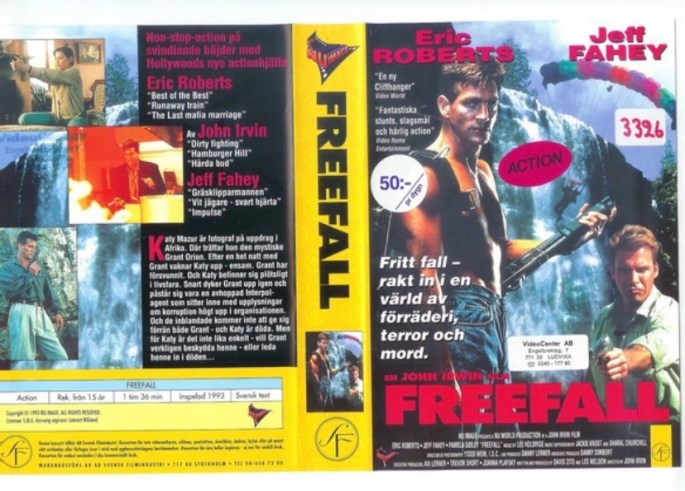
Today on the VHS Files is a super sexy Cliffhanger knockoff called Freefall starring an impossibly sweaty Eric Roberts, a super smarmy Jeff Fahey and a very foxy Pamela Gidley, who actually passed away last year and many of us fondly remember as Teresa Banks from Twin Peaks. This is actually a really solid action flick set in an exotic location and featuring these three B icons at the peak of their physical attractiveness. Pam plays wildlife photographer Katy, sent by her boss and fiancé Dex (Jeff) to get pictures of a rare bird of prey somewhere in deepest Africa. There she meets Eric’s Grant Orion, a daredevil adrenaline junkie who parachutes off waterfalls when he’s not sipping brandy on the hotel veranda, and she falls for him hard, hard enough for us to get to see them bang way up atop a waterfall with a gorgeous view. The plot goes bananas when it’s revealed that Grant is some sort of disgraced former Hollywood stuntman turned double agent for Interpol, all kinds of baddies are introduced including a freaky ass albino assassin and Dex himself who turns out it to not be the perfect fiancé she thought, and a globetrotting cat and mouse game gets underway. Roberts is terrific here, all lithe physicality and southern charm, Fahey himself tries an odd southern accent and comes across as a bit hammy but such is the arena here anyways, while Gidley fills out the action heroine role nicely. The film is directed by a dude named John Irvin who also did stuff like the Patrick Swayze western Next Of Kin, the rough crime pic City Of Industry, the cult Chris Walken curio Dogs Of War, the war film Hamburger Hill and the Schwarzenegger flick Raw Deal so he just knows his way around a good solid action sequence and how to handle tough guy actors. This is good fun with gorgeous locations, three knowingly arch lead performances and a relaxed vibe.

-Nate Hill

The VHS Files: Yesterday’s Target

Today’s VHS File is a dusty old SciFi time travel flick called Yesterday’s Target whose plot I just couldn’t get a handle on, despite it having some cool ideas, ambient atmospherics and neat set pieces. It stars one of the Baldwin brothers, and you pretty much know what you’re in for when they headline something. Daniel Baldwin is an unassuming factory worker who is recruited by a shadow organization because of his untapped psychic talents, targeted by a mysterious rogue military scientist played by Malcolm McDowell in one of his classic mega villain roles but he’s curiously restrained and relaxed here. Baldwin basically goes on a cross country road trip to find other psychics like him including a clairvoyant (Stacey Haiduk), a short order cook who is a firestarter (T.K. Carter from The Thing in this film’s liveliest performance) and others. They’re pursued by McDowell’s top man, a cowboy hat wearing Levar Burton in a bizarrely cartoonish performance that doesn’t work and brings the film somewhat down whenever he’s onscreen. There’s an absolute deluge of expository mumbo jumbo, arbitrary subplots and just garbled SciFi clutter here including some secret society that travels through time to prevent people from having shitty lives, a child prodigy, Vegas card sharking, McDowell’s random personal life with his wife and all sorts of interludes that muck about until I really wasn’t sure what this film was even about beyond a vague idea of ‘time travelling clairvoyants.’ Still, it’s very atmospheric and some of the performances are a lot of fun. It’s also quite muted and laidback and even when there’s gunplay or a pursuit it feels just… hushed and soothing somehow. There’s a deliberately anticlimactic ending as Baldwin and McDowell standoff only to surprise each other with revelations regarding identity, time loops and serendipitous phenomena that again, I wasn’t clear on, but allows Malcolm to inject some real poignancy into an otherwise standard villain role, if even for a brief moment when all is almost said and done. It’s worth a look but nothing special. I have no memory of where I even got the VHS tape but it’s another one of those screeners that nobody is supposed to sell yet somehow find their way to good homes. I see this is also streaming on something called Tubi though, if anyone is at all curious.

-Nate Hill

The VHS Files: Yesterday’s Target

Today’s VHS File is a dusty old SciFi time travel flick called Yesterday’s Target whose plot I just couldn’t get a handle on, despite it having some cool ideas, ambient atmospherics and neat set pieces. It stars one of the Baldwin brothers, and you pretty much know what you’re in for when they headline something. Daniel Baldwin is an unassuming factory worker who is recruited by a shadow organization because of his untapped psychic talents, targeted by a mysterious rogue military scientist played by Malcolm McDowell in one of his classic mega villain roles but he’s curiously restrained and relaxed here. Baldwin basically goes on a cross country road trip to find other psychics like him including a clairvoyant (Stacey Haiduk), a short order cook who is a firestarter (T.K. Carter from The Thing in this film’s liveliest performance) and others. They’re pursued by McDowell’s top man, a cowboy hat wearing Levar Burton in a bizarrely cartoonish performance that doesn’t work and brings the film somewhat down whenever he’s onscreen. There’s an absolute deluge of expository mumbo jumbo, arbitrary subplots and just garbled SciFi clutter here including some secret society that travels through time to prevent people from having shitty lives, a child prodigy, Vegas card sharking, McDowell’s random personal life with his wife and all sorts of interludes that muck about until I really wasn’t sure what this film was even about beyond a vague idea of ‘time travelling clairvoyants.’ Still, it’s very atmospheric and some of the performances are a lot of fun. It’s also quite muted and laidback and even when there’s gunplay or a pursuit it feels just… hushed and soothing somehow. There’s a deliberately anticlimactic ending as Baldwin and McDowell standoff only to surprise each other with revelations regarding identity, time loops and serendipitous phenomena that again, I wasn’t clear on, but allows Malcolm to inject some real poignancy into an otherwise standard villain role, if even for a brief moment when all is almost said and done. It’s worth a look but nothing special. I have no memory of where I even got the VHS tape but it’s another one of those screeners that nobody is supposed to sell yet somehow find their way to good homes. I see this is also streaming on something called Tubi though, if anyone is at all curious.

-Nate Hill

THE ROBERT ALTMAN FILES: BUFFALO BILL AND THE INDIANS, OR SITTING BULL’S HISTORY LESSON (1976)

At the conclusion of Nashville, the camera pans upward into the high heavens and the last image we see before staring off into the ether is the American flag. So it is appropriate that, at the beginning of Buffalo Bill and the Indians, or Sitting Bull’s History Lesson, the film that was released the following year, we see the raising of the American flag over the strains of reveille. Following some narration about the brave men and women who built our country and trudged through hardship after hardship, we witness the scene of an Indian attack on some settlers, driving the narrator’s point home in traditional western style. Once the carnage has concluded, the camera pulls back to reveal the attack has been a recreation and the settlers and natives are actors and this has all been done in the attempt to perfect a scenario for a Buffalo Bill’s Wild West Show. So where Nashville infused Altman’s vision of an America being infested with rot via politics and show business, Buffalo Bill and the Indians aims to almost invert that formula from the jump by giving a tall-tale American history lesson filtered completely through the artifice of show business which, ultimately and paradoxically, overflows with truths.

The year is 1886, and William F. “Buffalo Bill” Cody (Paul Newman) is a bigoted, ridiculously coiffed, narcissistic, and pinheaded blowhard who lives in a cloistered bubble of his own legend that is his Wild West Show where he is the figurehead, president, and CEO. But the new season needs a fresh angle as crowds are dwindling, causing chaos and cutbacks in Codyland. With the help of obsequious press agent Major John Burke (Kevin McCarthy) and ruthless producer Nate Salisbury (Joel Grey), Cody scores a coup when he wrangles Sitting Bull (Frank Kanquitts), whose victory over General George Custer at the battle of Little Big Horn made him a ready-made villain to audiences, into joining his show. Cody, a puffed up man of no small amount of self-importance, is frequently annoyed and enraged at Sitting Bull’s insistence on not rewriting history for the sake of entertainment nor allowing Bill to look like the star-spangled hero to which the latter is accustomed of appearing. Sitting Bull’s lethargic refusal to play the game Bill’s way, backed in full by Annie Oakley (Geraldine Chaplin), the show’s major draw, threatens the Wild West Show and, since he’s mostly a media construction, Bill’s existence.

To audiences of the day, this was maybe the most unwelcome bit of bicentennial cheer since Frank Zappa’s “Poofter’s Froth Wyoming Plans Ahead.” To fans of Paul Newman and westerns, this was an affront to the senses and their patriotic sensibilities. To those that loved Altman and were in the tank for him, it was unsubtle and too on-the-nose. And maybe both of those camps’ criticisms mattered a great deal in 1976 when the nation was struggling with itself as it turned 200 years old. The country’s dichotomous mindset couldn’t be summed up any better than the Academy nominating Taxi Driver, All the President’s Men, and Network for Best Picture only to then turn around and award the Oscar to Rocky, regardless of that film’s bottomless merits and endless appeal. It was clear that America was in the midst of a national case of the DT’s and was desperate to feel better.

Buffalo Bill and the Indians, unfortunately, was not made for people who wanted to feel better. It was made for people who thought all the ballyhoo circling the bicentennial was a racket, and a racist one at that. This kind of disdain made Robert Altman a frequent target of conservative critics who would continue to willfully label his flaming of American culture as a misanthropic attitude about America itself. Of course, this was wrong as Altman loved America and, in fact, embodied its best and greatest characteristics. What Altman hated was the rank hypocrisy and the half-truths that built so much of the American narrative, something that doesn’t seem like an unreasonable point of view. And, after all, what was the Wild West Show but a traveling pack of exaggerations that, nonetheless, blazed a trail in the collective mind of America and ensured that its revisionist tales took the place of actual history? If conservative critics are hell-bent on discussing the effect of television and movies on our citizens, why not extend that same argument to those mythological tales with a reach so far back into America’s past that our country’s mind has been hard-wired to recognize only its supposed benevolent greatness?

And perhaps Altman, whose Nashville was a critical hit but didn’t exactly achieve its goal of changing the way movies were made, earned himself no favors in Hollywood by making show business look like a nepotistic, valueless, and grotesque vessel frequently lost in it own sauce of incompetence and yes men. But by looking into the past and examining how so much of America’s historical foundation is built on myths and legends, he also sees the ability to shape the future. Buffalo Bill is a buffoon but his keen understanding of the power of “the show business” to twist history into something perverted, unfair, disgusting, and beneficial only to him is frightening. “Bill Cody can only trust his senses. And when his senses fail him, he might just see things as they really are,” muses Burt Lancaster’s Ned Buntline, one-time scribbler of penny dreadfuls but current deconstructionist of the myths he once helped create.

Naturally, something like Buffalo Bill and the Indians has aged extremely well and, viewing it in 2021, it’s a little jarring. For much of its running time, it feels like a funhouse mirror put up against our contemporary politics. Inspired by Arthur Kopit’s play Indians, screenwriters Altman and Allan Rudolph keep Buffalo Bill and the Indians confined within the boundaries of the camp of the Wild West Show and by keeping the film more or less stagebound, the Wild West Show and all of its backstage pandemonium begins to look like a lot like the White House of Donald Trump. When Bill meets Sitting Bull, it’s a mock celebration that’s meant to feel like an honorable meeting between two great heads of state but is instead a giant fantasy created to assuage the ego of Buffalo Bill who is such a moron, he has no idea what “incarcerated” means and confuses William Halsey (Will Sampson), Sitting Bull’s interpreter, for Sitting Bull himself. Liikewise, truth has no room within the parameters of the Wild West Show. Ned Buntline’s character is such an unwelcome creature in Bill’s land of fantasy that he attempts to have Buntline tossed from the premises the second Bill hears he’s around. Naturally, Bill delegates this duty to someone else and, likewise, Buntline won’t move until Bill disinvites him personally. This leads to one of the film’s most beautifully written and performed scenes in which Lancaster sighs “You haven’t changed, Bill.” “I’m not supposed to change,” Newman retorts. “That’s why people pay to see me.”

As a document in regards to Altman’s feelings toward the bicentennial, it’s fascinating. As a retroactive treatise on what would exactly happen if we lived in a political environment that operated like in the same fashion as backstage at The Muppet Show, it’s pretty brilliant even if Altman sometimes hard presses his acrid point to the point of smugness. “You know,” President Grover Cleveland coos in admiration as Buffalo Bill struts away from a reception, “it’s a man like that that made America what it is today.” Yeah… we get it. Additionally, Altman sometimes stretches himself for easy laughs and the running gag involving Buffalo Bill’s infatuation with opera singers proves to be more irritating and farcical than it is funny but it does at least set up one of the film’s most sublime moments in which the pack of artless cornballs in the Wild West Show are put to shame and moved to tears by the simple performance of by Nina Cavelini ‘Qui Sola Virgin Rosa’.

But, in the grand scheme of things, the film’s flaws seem minor in comparison to its triumphant execution and its fearless determination to take on both the seemingly unassailable lacquer that protects America’s Disneyfied image of itself and the vainglorious stupidity (and potential danger) of Hollywood. By admitting that America itself is a malleable tall tale if delivered by the right kind of polished huckster and that nobody, no matter how noble, is beneath selling out for the right price and practicality, Altman foretold of an America in ruin, susceptible to the charms of empty-headed, megawatt stars where relationships are transactional and nothing is sacred.

“Boy, I’ll tell you,” Harvey Keitel’s slack-jawed and dim-bulb nephew to Buffalo Bill says at some point in the film as he stares off into the distance, “there ain’t no business like the show business.”

Brother, you ain’t kidding.

(C) Copyright 2021, Patrick Crain
The VHS Files: Conundrum aka Frame By Frame

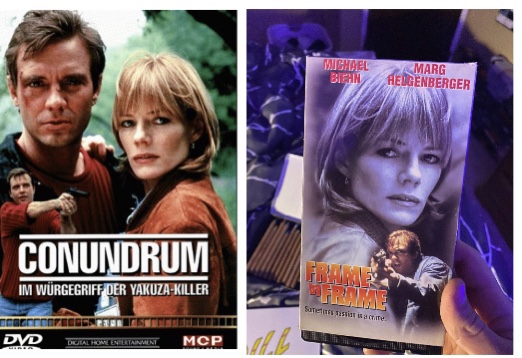
So here’s a fun idea (I hope)… I have hundreds of unwatched, obscure VHS tapes ive collected over the years and I’ve recently organized them, fired up the VCR and begun to explore the darkest corners of Z-Grade 70’s, 80’s and 90’s analog nirvana, so I’ll do a series of intermittent reviews based on these random, unheard of treasures with a snapshot of the tape itself, just for fun. First up is one called Frame By Frame, which I guess is officially called Conundrum on IMDb. It stars Michael Biehn and Marg Helgenberger as two inner city cops who begin to have a fiery affair amidst the aftermath of gangland killings stirred up by a Chinese crime syndicate. His family is murdered to set an example, this event brings them closer as she comforts him but before you know it other nasty secrets are unleashed and the classic obligatory ‘web of deceit, betrayal, twists and kinky obsession’ of the essential 80’s B movie potboiler is set into motion. Biehn and Helgenberger are perfect for each other, and on top of being two of the absolute sexiest cult icons of their day, they actually turn this run of the mill script into something fun thanks to their vivid characterizations. He’s as wild eyed and frantic as he was in Terminator and even gets one sly ‘big emotion’ scene that takes on new meaning once all the twists unfold, and she does this tough girl tomboy thing with her accent and mannerisms that’s fun too. The story kind of goes wildly all over the place and I didn’t quite follow every hairpin turn or believe in this brand of convolution but hey, it’s an ancient DTV flick and half the fun is watching these two stars rip snort their way through the hard boiled narrative anyways. I’m fairly sure I may be the only person to have ever seen this film because the tape I have is one of those promotional screeners that aren’t for resale (but they always are anyways), there are positively zero user reviews on IMDb or even critics reviews out there elsewhere on the interwebs and one can barely find traces of its existence at all beyond the tape I have. Good times though, especially if you love Biehn and Marg as much as this viewer.

-Nate Hill

Ramaa Mosley’s Tatterdemalion aka Lost Child

It’s always fascinating to me when a film is subtly billed as horror, unfolds thusly with the ever present promise of ambiguity and then takes the road less expected to provide a truly surprising and unexpected experience. Ramaa Mosley’s Tatterdemalion, given the far less inspired title of ‘Lost Child’ for its streaming release, is a powerful story of loss, trauma, reconciliation and finding your path, a deeply heartfelt drama that’s kind of.. not necessarily disguised as a horror, but is very down to earth despite its ‘folk horror’ stylistics and slightly spooky mythological underpinning. It tells of Iraq war veteran Fern (Leven Rambin) who returns to her hometown deep in the heart of the Missouri Ozarks to a broken family and a broken life. She tries to mend a relationship with her volatile brother (Taylor John Smith) and strikes up tentative romance with a kindly social worker who moonlights as the local bartender (Jim Parrack) and begins to get her life on track. One day deep in the heart of the woods she finds a young boy named Cecil (Landon Edwards) wandering lost, with no ID, family or recollection of where he came from. She takes him in and pretty soon odd things start to happen; she finds her energy sapped, she feels sick, she discovers strange iconography fashioned from sticks adorning her property and soon the locals with an ancestral connection to the ancient Ozark legends lost to time warn her of ‘Tatterdemalion’, a soul vanquishing demon personified as a lost child who preys upon unsuspecting folks who take them in. Is Cecil a dangerous entity, or simply one of the countless forgotten, abused and neglected children who are out there trying to find a home? I mean there’s many reviews calling this an ‘anti-horror’ film which in itself already spoils the answer to this question, but I’ll try not to say more other than to iterate how emotionally mature, down to earth and compassionate this narrative is, strikingly brought to life with warmth, depth and empathy by the assured hand of director Mosley, the first of her work I’ve had the pleasure of seeing. Leven Rambin is an actress who also brought the character of Athena Bezzerides to life brilliantly in season 2 of True Detective and she is stunning here, embodying the lost child elements in her own life as she struggles to come to terms with a tragic family history and figure out who Cecil is and care for him at the same time. Shot on location in atmospheric rural Missouri, scored to elemental and orchestral perfection by David Baron and Chris Maxwell, this is a phenomenal sleeper gem that’s streaming on Canadian Prime and I would highly recommend it.

-Nate Hill

THE MICHAEL MANN FILES: THE JERICHO MILE (1979)

Tracing his incremental steps that ultimately led to theatrical features, it makes sense that Michael Mann would create his first feature film for network television. Coming off two paying gigs that made 1978 a pivotal year for the filmmaker (namely his uncredited work on Ulu Grosbard’s Straight Time and his credited creation of the television series VEGA$ by way of the Mann-scripted pilot), he was a natural fit to write The Jericho Mile, a movie-of-the-week for ABC. Hired directly by actor Peter Strauss, Mann’s script impressed Strauss so much that he convinced the network to allow Mann to direct. After bouncing around Hollywood for a while and writing scripts for television (not to mention having the creation of a whole show on his resume), Mann was definitely due. And Strauss, insanely popular throughout the seventies due to his appearance in Rich Man, Poor Man, had the kind of stroke to make it happen.

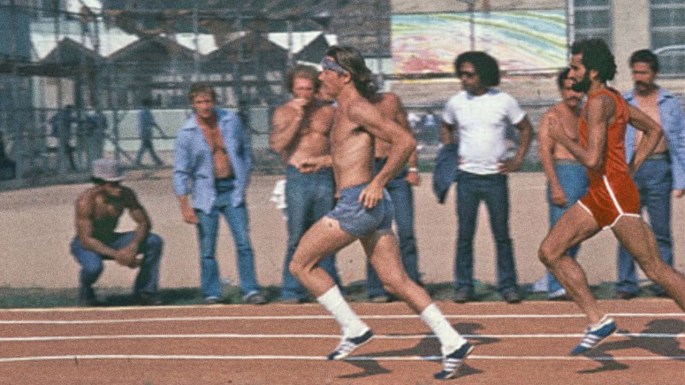
The Jericho Mile was prime material for Mann. A healthy blend of the prison film and the sports drama, the film follows lifer inmate Rain Murphy (Strauss) as he uses long distance running as a means of coping with the confines of prison and his inability to steer the direction of his life. As his prison counselor notices the incredible speed in which Murphy can clear a mile, a succession of events occur in which Murphy is given the opportunity to compete for a spot on the Olympic team while he also navigates the tricky and sometimes lethal political structure within the prison.

It is the latter where The Jericho Mile truly excels, at times feeling entirely authentic as the convicts with speaking roles mesh alongside the professional actors. Additionally, a great deal of value is generated by shooting within the walls of California’s Folsom Prison. The metal works, the kitchen, laundry room, the yard, and the squat, desolate cells go a great distance in selling the film’s credibility and reflecting a world that is cramped and oppressive. This last element is also helped immeasurably by its boxy 1.33:1 aspect ratio, standard for television broadcasts of the day, which now makes the film look especially claustrophobic and tight.

The film should also be commended for what it doesn’t do. While it can’t help but traffic in some of the hoariest tropes of the prison film (which may or may not be its fault since there are only a limited number of things that can occur in prison), it doesn’t stoop to underlining the explicit inhumanity that occurs in confinement. Instead of shocking viewers with lurid details (which was actually pretty much par for the course in the day), the film wisely keeps within the boundaries of taste and shows how prisoners are generally in an impossible double-bind with both the state and the prison population, the structure of the latter being as complicated, unfair, and unforgiving as the bureaucratic red tape and regulations that routinely crush the spirits of the incarcerated. Additionally, the film doesn’t introduce a doomed relationship into Murphy’s life and, instead, keeps his one encounter with the opposite gender to be that of a brief glance between himself and an executive assistant at the U.S. Olympic board, reminding him of his status as someone with zero future with her or with anyone else but himself and what’s in his head.

To this end, The Jericho Mile has a wise, knowing angle on the life of the career criminal and prisoner. Whether or not this is due to Mann’s familiarity with the Edward Bunker material that became the screenplay for Straight Time is uncertain, but it’s likely. The transcendent poeticism meshing with the gritty details feels very much like Bunker’s outward expression of the criminal life as a certain kind of art form but the level of stoic control in Murphy’s character is all Mann. Murphy is Max Dembo if Dembo was remanded back to the state pen and took up long distance running, speaking with a clear, direct cadence with very few consonants, most reminiscent of James Caan’s Frank in Thief. This is why The Jericho Mile also stands as an almost reference point for the vast majority of Mann’s other criminal protagonists that would come later. Certainly both Frank and Neil McCauley’s talk about prison and doing time harkens back to the life we see unfold in The Jericho Mile where the only time we leave the prison walls to get a sense of real freedom is when Murphy is allowed to run around the parameter of them while in training. The reasoning behind the reluctance for later Mann characters to want to go back into a hell on earth is made strikingly clear in this film and, once he’s out, Mann rarely ever takes his cameras, or his characters, back in.

Being a television movie, the film sometimes falls into traps that reveals its limited hand. Where it doesn’t feel as sanded down in terms of the language or the prison violence (though it is on both counts), Mann’s preoccupation with lacing his drama with broad, emotion-driven moments is met with the medium’s small scale causing passages that might play a little more successfully on larger-than-life movie theater screens. This is most evident with the hotted-up performance by Brian Dennehy as Dr. D, the leader of the neo-Nazi faction of the prison, and with Richard Lawson’s performance as the doomed inmate, Stiles. For both, the screen size seems an ill fit to their grander, almost stage-bound turns. Mann often lets his actors descend into a sort of archness (specifically Tom Cruise’s Vincent in Collateral and literally everyone in his theatrical adaptation of Miami Vice) where the characters play to both the dunderheads AND the back row, but those performances need to be accompanied by a bigness and a freedom that a made-for-television movie produced in 1979 is just not going to be able to allow.

Also less successful, though not fatally, is the film’s sports angle. Again, there can really be no suspense as to how any of this is going to work out so the actual moments of Murphy running, training, and racing are less interesting than the passages that explore the reasons for his running. Unfortunately, the hook of the film is in its plotted narrative so the main thrust of the movie is, in fact, that of a rote sports film. Mann’s attempt to turn Murphy into a hopeful symbol both by and for the inmates may anticipate his approach to the material he would later take with Ali but here it feels a little undercooked. Despite Strauss’s emotional reaction to it, the moment where the prisoners line up to give him food for his training feels like a lachrymose, reverse-Cool Hand Luke, hitting the chords it wants to but not hitting them like it should.

For the most part, The Jericho Mile is an absolute triumph and, in fact, made a pretty big splash with audiences and critics at the time. Peter Strauss is utterly fantastic and won an Emmy for his role while Mann and co-writer Patrick Nolan picked up Emmys for their script. But most importantly, it gave Michael Mann his first stab at assembling a feature while also allowing him to work in the milieu that would inform his characters and their collective worldview throughout the rest of his career.

(C) Copyright 2021, Patrick Crain