Review of QUEEN OF THE DESERT

Nicole Kidman, James Franco, Damian Lewis, Robert Pattinson, Jay Abdo. Directed by Werner Herzog. Rated PG-13. 112 minutes. 2017.

Werner Herzog’s Queen of the Desert ambles, utterly directionless, through the life of Gertrude Bell, who paved the way for cooperation between officials of Middle-Eastern governments and British colonialists by way of mapping out the regions of Arabia, Mesopotamia, Greater Syria, and Asia Minor. She was also a writer, a spy, and an archaeologist, living a full life for having had only 57 years of it before her death, two days before her 58th birthday, in July 1926. The film fails to provide any of this important context, which has been gleaned from encyclopedic accounts of her life that are more insightful than anything found onscreen.

Yes, this is one of those movies in which the written coda that leads into the credits tells us more about the movie’s subject (and, certainly, about the people she encountered) than the actual movie that proceeds it. What transpires amounts to a transparent doodle, a scribbled account of a few events that regard her life as having been lived between romances with two men and a flirtatious series of exchanges with a third. There is no sense of a life here, and the film is utterly impenetrable in its attempts to find some sort of central focus. Bell remains a cipher, and the figures of historical record whose paths she crosses are mere avatars within her vicinity.

Bell is played by Nicole Kidman in a performance that can be politely described as wooden, although one can detect that the actress is utterly lost in the weeds of Herzog’s screenplay, which provides a mixture of expository dialogue and whispered, ponderous narration. Joe Bini’s editing shifts between timelines with such abandon that it’s less a fluid progression than a random collage of moments without much in the way of context. We begin on her whirlwind romance with and marriage to Henry Cadogan (James Franco, sporting an awkward English accent on account of replacing the role’s original performer at the last minute), Viscount Chelsea and a British Army officer. His mysterious death, which has never been solved, would go on to haunt Bell for the rest of her life.

The film is too happy, though, to rush through the other pieces of Bell’s life to dwell on matters such as the death of the man she considered the love of her life. Soon, she has sworn off all other potential romances to wander the desert terrains of the Middle East, in which she aids in developing the borders between regions that are now known as the countries of Iraq and Jordan (An encounter with T.E. Lawrence, played by Robert Pattinson in a tired impression of Peter O’Toole, seems to be paying lip service to the real-life exchanges, making the scenes seem awkward and shoehorned-in). The development of this relationship was in collaboration with Winston Churchill (Christopher Fulford), but the collaboration is hardly the point, the film argues, when Bell has fostered another romance with Charles Doughty-Wylie (Damian Lewis), another Army officer.

The romances are apparently key for Herzog, whose film is restless but still sluggish, that features wide, panoramic vistas but is still strangely claustrophobic in its presentation of the imagery, and that purports to be the definitive account of Bell’s life yet does not take any time to observe the woman or to examine what drives her independent spirit. Her accomplishments are secondary to the romantic or political influence of the men surrounding her. That dishonesty is coupled, in Queen of the Desert, with a failure to provide anything of artistic merit or subjective worth. It becomes infuriating to witness.

Review of PERSONAL SHOPPER

Kristen Stewart, Lars Eidinger, Sigrid Bouaziz, Anders Danielsen Lie, Ty Olwin. Directed by Olivier Assayas. Rated R. 105 minutes. 2017.

We are accustomed to filmmakers dealing with ghosts in a certain way in the movies. Usually, it’s a spectral being whose existence within the plot is more important than the how or why of what brought it to the point of being a ghost. The human that may or may not have been is rarely a consideration, unless the film has more important matters on its mind than how to cater to a genre or its target audience. In the worst cases, usually speaking, the being is computer-generated in nature, swooping across or toward the camera while a high-pitched shriek or piteous moan plays on the soundtrack. In the best cases, the being is still technically at the mercy of a plot that requires it to be an object of fright. It takes a special kind of treatment to avoid the potential pitfall of a genre effort and approach the presence of a ghost as something that is elemental.

Personal Shopper is unique in that the ghosts central to our heroine’s story are not just tools of the plot. Writer/director Olivier Assayas is keenly aware of the delicate balancing act that he performs here. There are unnerving scenes of communication between the protagonist and someone/something on the other side of that invisible veil of death, but the dead here rarely communicate through theatrical means, such as the slamming of doors or the defusing of candles that are our only source of light. There is an extended sequence in which such things take place, but as the film progresses and shows us the other means of spectral communication, we realize that an old house with a creaky foundation might only be a vessel for that particular spirit.

The living visitor to said house is Maureen (Kristen Stewart), a clairvoyant whose twin brother died years ago in that very place, victim of the genetic malformation of the heart that led to a cardiac event. Maureen has the same malformation, and although the doctor assures her that, health-wise, she’s in the clear for now, it’s obviously a source of fear for her. In her day job, Maureen is the personal shopper for Kyra (Nora von Waldstatten), a diva whose modeling career has become so consuming of her time that her boyfriend Ingo (Lars Eidinger) is resentful and Maureen must choose and purchase clothing for the events she attends. Her boyfriend Gary (Ty Olwin) is on the other side of the world installing security features for a corporation and the process could take months. For both, the work is unfulfilling, and each simply wants to be with the other.

Maureen, though, has an important goal to see through: Her clairvoyance was a gift shared by her brother, and one of their promises to each other was for each to send the other a sign from the afterlife that he or she was at peace. Maureen feels she has waited in vain for this sign, until she starts receiving text messages from an unknown number. The conversations are innocuous, at first, though strangely philosophical: The person or presence on the other side of the phone interrogates her about her deepest nature, eventually causing her to question it. Assayas deftly frames all of this as a puzzle for the viewer to solve. Stewart’s performance, which utilizes the actress’s deadpan abilities while also traversing much emotional terrain, is an exemplary model of expressive acting in these sequences.

That deadpan quality becomes especially crucial as the narrative chips away at Maureen’s psyche and we are witness to a young woman losing her nerve. The riddle at the center of Personal Shopper is, as per usual with these efforts that are built around a puzzle, perhaps more important than the answer. Assayas certainly doesn’t stretch to lay it out clearly for us. Indeed, by the final set of sequences, the film has become more dependent upon our and the characters’ unconscious conclusions about how all of the film’s pieces (most of which, certainly, haven’t even been hinted at in this review) come together. It’s partly frustrating and partly mesmerizing to watch all of those pieces present themselves to us, particularly when events turn to tragedy and our perceptions of what is important are upended. The ultimate weight rests on its mesmeric qualities.

WOLFGANG PETERSEN’S DAS BOOT — A REVIEW BY NICK CLEMENT

2

In 1997, my father took me to see the full director’s cut of Wolfgang Petersen’s masterpiece Das Boot in 70mm. It was an absolutely unforgettable experience. Released in 1981 and shot for a hard-to-fathom $18.5 million, this exceedingly intense submarine thriller is likely the best film of its type, a relentless cat and mouse pursuit through murky WWII waters, with some of the most claustrophobic cinematography ever captured (the great Jost Vacano was the film’s herculean director of photography). I’ll never forget the final sequence to this film, once the U-boat has made its way back to port, and the Allied forces start dropping their bombs and gunning everyone down. After all that these guys had gone through out in the open water, once home, they encountered a different type of hell. Jürgen Prochnow, Herbert Grönemeyer, Hubertus Bengsch, and Klaus Wennemann anchored the supremely masculine cast of actors, all of whom felt totally authentic in nearly every situation posed by the emotionally draining narrative. The full director’s cut is currently available for purchase on Blu-ray.

1

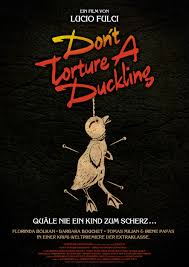
DON’T TORTURE A DUCKLING — A REVIEW BY GUEST CRITIC/FILMMAKER DAMIAN K. LAHEY

Don’t Torture A Duckling (1972) Dir. Lucio Fulci

DontTortureADucklingPoster

Young boys are being strangled in a small rural village in southern Italy. Historical context. ‘Don’t Torture A Duckling’ is considered a ‘giallo’ (named for the seedy yellow tinged paperbacks they were often inspired by) – a type of European thriller made popular following the international critical and commercial mega success of Dario Argento’s ‘The Bird With The Crystal Plumage’ in 1970. Waves of these giallo thrillers (some with artsy animal titles, some without) crashed upon Europe during this time. The women in these movies are unforgettable. The movies themselves? Kinda forgettable though there are certainly some gems to be found. Fulci, a director for hire at the time, jumped onto the band wagon first with ‘A Lizard In A Woman’s Skin’ which is a decent enough Argento rip-off though ‘Don’t Torture A Duckling’ is a film with its own voice and its own mission statement.

‘Don’t Torture A Duckling’ is a frightening and frustrating work and that’s how it should be. This is the story of the madness that creeps in when people never leave their enclave. People become slaves to the prejudices of their upbringing – holding on to outdated moral codes, superstitions and religious beliefs. They refuse to embrace cultural shifts or those they see as outsiders. And who suffers? The noble and innocent as this film so accurately portrays. Its messaging might be a bit too on the nose for some but this film plays more like a socio-political art house piece than a genre entry though it certainly has enough dollops of unnecessary gore and nudity to satiate the cine-pervs that scrounge around for that kind of stuff. But ultimately this film errs on the side of Bergman and Rossellini and this places it on a higher pedestal than many other works in this sub genre.

I personally believe this to be Fulci’s best and most accessible film. I don’t entirely agree with the revisionist evaluation of Fulci as being a director on par with other genre greats like Romero, Raimi, Carpenter and Argento. Certainly a talented and hard working dude. But did he have the vision or the artistry that the best of Romero, Argento, Carpenter, Cronenberg or Raimi have? I would say not. I think he falls more in the camp of D’Amato, Lenzi and Deodato. Lots of time chasing trends established by others. Not to say these directors don’t have flashes of brilliance or make some fun films. I totally dig their stuff and D’Amato’s ‘Beyond The Darkness’ is one of my favorite horror films. But there’s something missing from their work and Fulci’s. Too often it falls flat and comes off as needlessly crass.

Despite the above paragraph I do own a coffin tin collector’s box set of Fulci’s gore porn shocker ‘The Beyond’ complete with marquee cards and I would like to point out that the audio commentary by stars Catriona MacColl & David Warbeck is one of the best I have ever heard.

DontTortureADuckling


Ernest Dickinson’s Bones


Who would have thought that a horror flick starring Snoop Dogg would actually be a winner? Bones isn’t a milestone in the genre or anything, but it sure is better than the self promoting vanity piece that I expected going in. Usually when rappers or musicians headline their own films they turn out to be spectacular failures (50 Cent’s Get Rich or Die Trying and Dee Snider’s Strangeland come to mind), but this one comes off as a legitimate, entertaining horror effort. Snoop plays Jimmy Bones, a lucrative 70’s street hustler who is betrayed and slaughtered by his partners in crime, his own sweetheart Pearl (Pam Grier is never not cool) and one sleazebag of a cop (Michael T. Weiss, excellent). Decades later he returns, undead, in the form of a smooth talking supernatural street demon, out to exact bloody ghetto revenge on his old acquaintances and clean up his former inner city neighbourhood, which is actually just Vancouver in disguise, I mean what city in any movie ever isn’t just Vancouver? Loosely threaded with the story of a few kids who plan to turn his old gothic mansion into a silly hip hop nightclub, things rev into full gore gear when he shows up back in town to stir shit around and collect heads, and I mean that literally. Snoop is wicked fun, wisely dropping any rap gags or meta smirk, showing up in full jive talking boogeyman mode, meaning business and bringing along the dark, angry charisma to back it up. Director Ernest Dickinson helmed a few Tales From The Crypt outings and therefore knows his way around this very specific and distilled niche of horror. Shades of the 80’s are prescient with incredibly gooey, gag inducing effects that would make Freddy Krueger jealous, and one gets an almost Crow vibe from the story structure, via the paranormal revenge motif and baroque, Poe-esque fire and brimstone aesthetic. It’s silly for sure, but far far more grounded and committed than you’d expect this type of thing to be on paper. More of a head on its shoulders than Tales From The Hood anyway, and yes that’s a real thing. I must make additional mention of the prosthetic effects though; not since certain Elm Street outings, early Cronenberg or stuff like The Sentinel have I seen the level of deformed, hellish grossology onscreen than is present in some scenes here, they should be really proud of what they’ve done. 

 -Nate Hill

HOUSE OF FOOLS — A REVIEW BY GUEST CRITIC/FILMMAKER DAMIAN K. LAHEY

House Of Fools (2002) dir. Andrey Konchalovskiy


HouseOfFoolsPoster

This film has one of the more unique premises you’re likely to find. During the Chechen war, a mental hospital is abandoned by the doctors – leaving the patients to fend for themselves. ‘House Of Fools’ also does a very solid job of portraying mental illness. What makes mental illness so incredibly terrifying is that those that are inflicted with it do not believe they are. I have seen wonderful people I know succumb to this. People who were once so vibrant and alive. Watching them fall apart in such a humiliating way is a tragic thing. I would give all the money in the world if they could be healthy and happy again. Yuliya Vysotskaya shines as a tortured young woman who believes Bryan Adams is her fiancee and is away on tour. I thought it was really touching of Bryan Adams to make cameo appearances in this film in dream sequences. Not a lot of guys in his position would do that. It says a lot about his character and really added heart to the film. Not the biggest fan of his music, but…

With the arrival of the soldiers this film does not take the dark route that it could have though it is certainly tense and uncomfortable at times. This was a smart move by the director. As he has already established a set up rife with suspense he chooses to go with eccentric humor and sadness over vicious hysteria and exploitative elements which I believe was the right call to make. ‘House Of Fools’ depicts just a fragment of life during war time, reinforcing that it affects every facet of life. Nothing is safe from it. It creeps into everything. One of  my favorite scenes is when soldiers on opposing sides take a break from fighting to sell each other weed. At the end of the day this film is interested in asking the big question: who is crazier? The soldiers or the patients? But that’s too easy. What will stick with you are the sequences of the mental patients left on their own after the doctors have fled and their attempts at continuing with life as usual. It’s endearing and heart breaking.

HouseOfFools

So the movies I like are considered shitty…

The room was dark, or at least that’s  how it returns to me in my dreams. The lounge was in the center of the house, so the only light that entered was through a hallway door which often times was shrouded by a deep-green curtain. It was my father who pushed the curtain open this day, three summers and a thousand years ago. He was a giant to me then, but so were all the people in my world. A lumbering, hairy giant with sun-browned skin and hulking features; yet his smile was soothing, and as he entered the lounge carrying two boxes, that smile dominated his face. That smile was directed at me.
He placed both boxes down atop the television set and then disappeared behind it for several minutes. When he re-emerged he took the second box, the smaller of the two, and placed it into a slot, that opened at the push of a button, in the top of the larger box. Then he turned on the television set. The customary snow filled the screen momentarily and then came a flickering. My father fiddled with the big knobs on the front of the set and slowly there came an image, slowly there came sound, slowly there came magic. My life was changed forever.
VHS – come on, you remember. Think back to the films of your youth. Those glorious moments you could stop and rewind and watch over and over again. If you were one of those kids like me that watched 5 videos plus a night, when the rest of the house was in darkness and only creatures stirring were those comprised of cinematic genius and burger grease; those that had no life, except on the small screen in front of me that was a constant, was always waiting to drench my imagination with swords, laser blasters and maniac cops. I came to worship at this alter nightly and then there was the experience of wandering those video stores. Those gigantic basilicas of celluloid splendor; 15, 20,000, 30,000 titles wide. A bold new world I walked into bravely – never came out of really. There are times I feel that I am still wondering among those vast aisles. All those covers curious, strange and ultimately alluring; their siren song still sings to me, on nights when the stars are bright and the wind blows feint whispers and I am alone again . . . watching movies.
But something has changed; as King once wrote: ‘the world has moved on.’ The garden-variety flick experience today is bright and shining and biodegradable. Multi-billion-dollar behemoths or should I say, bottle rockets, that fly high, explode brilliantly and colorfully, and then vanish. Where have all the good films gone, as the Lizard King once put it: “where are the fruits we were promised, where’s the new wine – dying on the vine.” And die they do, in spectacular mutli-million dollars funerals like The Matrix Reloaded and Jupiter Ascending . . . but that’s another story.
I am here to talk about some of the movies I love, movies that they stayed with me, movies I rented so often the dude at the store eventually gave them to me cause well, and I quote:

VIDEO STORE DUDE
. . . No one can love these flicks
like you, you need them more than we do.

Thus I bring to your attention four films that have been featured on several crap film lists or in worst movies of all time articles. These are the movies I dig – and if you don’t, then you haven’t lived.
These four titles came out between 1979 and 1985. They all have bigger, more expensive A-list brothers, but that is not the point. These are prime examples of the glory days of VHS; and you never truly know it when you are living in a golden age. We did, we lived through it. (I’ll attempt to go spoiler free)

thai-poster-supersonic-man


Superhero flicks are a common staple in our lives and they are progressively getting worse. Guardians of the Galaxy excluded, liked that one. But in 1979 a hero that rose in Spain in the wake of Donner’s Superman captured my pre-adolescent attention. He was Supersonic Man;and the race the spawned him must have caught wind that this crazy fucker-of-a-scientist, played beautifully by Cameron Mitchel (star of some of my other favorites like Flight to Mars, Space Mutiny and Demon Cop) as Dr. Gulik, has plans to blow the earth to shit. So they send Supersonic down and give him a magic watch that helps him transform from his hilariously dubbed alter ego Paul. Paul meets Patricia, isn’t that beautiful. Her dad Prof. Morgan has been hoodwinked into working for Gulik and tries to get wise but then Gulik starts to use his daughter as a pawn to see that his evil plans are seen through to fruition. Of course Paul is no ordinary smart-casually dressed cat that is loitering around trying to make a nuisance of himself. He is an interstellar hero in disguise. It is full of funky-funny flying footage, unintentionally funny reactions to bad situations, and a recurring drunk character for comic relief with his little dog, Sugar. Comedy, that’s what they want. Laughter and a bit with a dog. Great beer and pizza movie.
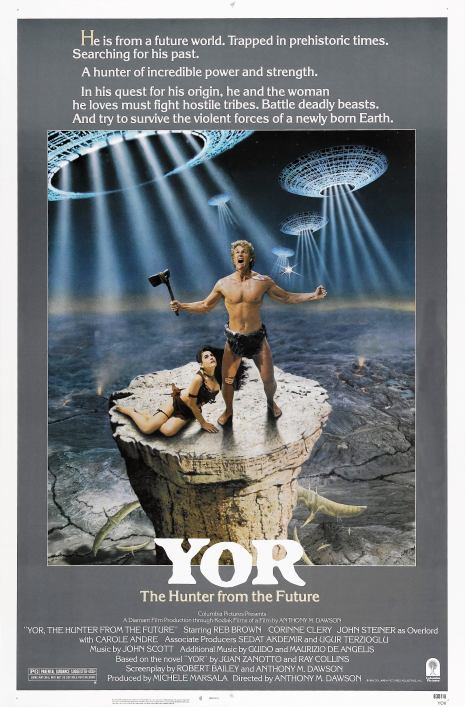
yor_poster


Now we jump into one of my favorite fantasy films. And what I ask you is better than a fantasy film? Well one with Reb Brown in it of course. Reb, in case you haven’t heard of him, was the first Captain America and went on to star in Space Mutiny (yes that is a glorious experience), Uncommon Valour and the film of the hour, Yor: The Hunter from the Future. This came out in ’83 and I am proud to report I still have my VHS copy. From its funky theme music to its cast of sexy-creepy-stupid characters, Yor (Brown) is running around in his best loin-cloth and happens upon a father and daughter being lovingly harassed by a triceratops. And it’s all downhill from there. Everywhere Yor goes he is like the angel of death, bringing with him the ravages of destruction and annihilation to just about every place he wonders into; from a seemingly prehistoric village, to the land of the sand people, to the peace-loving folk by the sea and finally to a futuristic fortress on a mythical island. Yor is searching for who he really is and all he has to go by is a gold medallion which every thinks is pretty cool. He fights and beats dinosaurs, really hairy cave dudes, big lizards, sand men, robots and finally the evil overlord (who killed his old man on the island fortress cause he started a coup d’état.) Turns out he saved his son (Yor), by sending him to Prehistoric Forest. Oh, I can here you drooling.
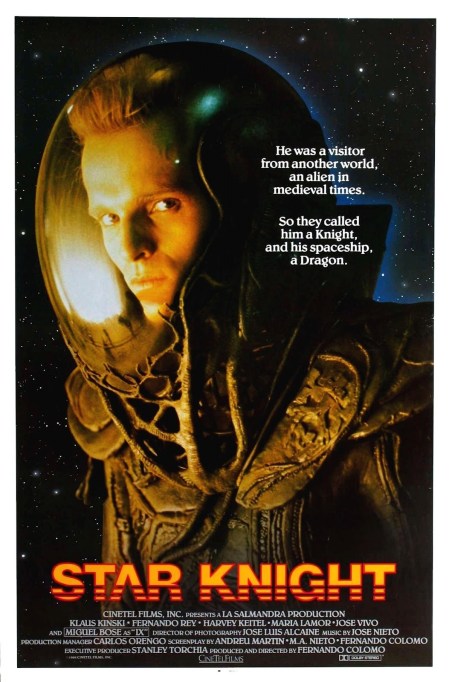
star knight poster
Time now for a fantasy mash up and one I am so relieved I was able to find and replace my dead video copy – yes this is available on DVD – it’s called Star Knight (or Knight of the Dragon.) Leonard Maltin gave this a bad review, to which I say, FUCK LEONARD MALTIN! This is cinematic cannabis. You’ve got Klaus Kinski (how can you not love that guy), Fernando Rey (you might have seen him in the French Connection as Frog #1 and 1492) and Harvey Keitel, yes I’ll say it again for the hearing impaired, Harvey (I’m a pretentious acting cock) Keitel, the only knight in shining armor with a Brooklyn accent. So the story goes: A beautiful princess is captured by what folks believe to be a dragon but it turns out it is a UFO and the due flying it, played by Miguel Bose (who was a very popular Spanish pop-star in his day) as IX. Trust me when I say he is the quiet type and literally communicates via symphonic chimes. Anyway Klever, or should I say Sir Klever (Keitel) who wants to get under the princesses robes sets out to slay the dragon/UFO. Everybody is dubbed but for Keitel and Rey, even Kinski (who speaks English, though it does add a few laughs) and this again adds to the film’s charm.
I saw a shitload of great flicks in ’85 but this is the one I remember. It is wonderful, from the intentionally and the unintentionally funny segments and that’s not including the comic relief in the form of the Green Knight ( and I’m not talking about Sean Connery from Sword of the Valiant.) Like I said (no spoilers) this is available on DVD, what are you waiting for?

H-0009_Humanoid_quad_movie_poster_l

Finally, and I never left the video shop without one, a purely science fiction entry. It just so happens that (God, I love her) my beautiful wife found a copy of it on DVD for me, the 1979 classic from Italy (yes STARCRASH is one of them) L’umanoide, or as you may have heard of it: The Humanoid. This has three James Bond performers in the cast, most notably two from The Spy Who Loved Me and Moonraker: personified by Barbara Bach (Mrs. Ringo Starr) and the late/great Richard Kiel. Big Rich was also in Moonraker as the assassin JAWS alongside another character from The Humanoid, Barbara Gibson played by Corinne Clery who was famously savaged by dogs for dropping company secrets on the pillow with Roger Moore. On a side note she was also Ka-Laa in Yor, small world aint it. The story focuses on an evil space Lady Agatha (Bach) who finds herself needing to stay young by draining the life out of other young ladies via a very painful looking needle-bed-thing (you’ll just have to watch it). She’s all buddy-buddy Lord Graal who wants to seize control of planet Metropolis from his brother. They stage a massacre from which Gibson (Clery) escapes, so they capture Kiel, turn him into a mindless automaton to bring her in so she can be subjected to the needle-bed-thing, supervised be the so-cruel-I-shouldn’t-have-a-licence-to-practice-medicine Dr. Kraspin. Gibson is aided by Nick, the telepathic Tom Tom, this little Asian kid who has laser-archer-dudes, dressed predominantly in white, watching his back.
Big Rich nearly completes the evil dude’s mission until Tom Tom helps undo their mental tempering and thus ‘The Humaniod’ is back on the side of good, helping defeat the nefarious Graal and joining his friends in a victory dance before Tom Tom has to go bush with the laser-archer-dudes back to his digs in galaxy far far away. Sniff-sniff. I’m sorry, it’s just so magnificent, I hope you get a chance to check it out. Come round to my house – we’ll watch it with Pepsi and chips.


So as the credits are rolling, I think back to that day in that dark lounge room and how a piece of me still lingers there, locked in silence and wonder. The air about me is eclipsed by electricity and magic, my mind leaves my body and I dance among the manufactured dreams of low-budget masters who didn’t need motion-capture and CGI to still my beating heart, ignite the flames of creativity deep within my being which sent me off on the quest, a quest that I am still on to this day, the quest to manifest my dreams. Kermit the Frog sang about it. His dream was about singing and dancing and making people happy, that kinda dream gets better the more people you share it with. My quest goes ever onward, but I have met some like-minded warriors along the way. We have come together recently to compose a trilogy that harkens back to the VHS days of yore. So if these films here mentioned and the millions of others like them are part and parcel of the spark which catches a fire and sends you off into ever-greater heights of dreaming, then you really ought to check them out. And these books to if you dig a celebration of B movies.


And above all, happy viewing. Be kind, rewind.

THE DUDE IN THE AUDIENCE

flat,550x550,075,f.u1


Scott Frank’s The Lookout


Scott Frank’s The Lookout is a film where every turn of plot, exchange of dialogue, set piece and stylistic choice just seems to mesh flawlessly, resulting in a package that’s nearly as perfect as you can get. Part psychological character study, part crime thriller, sewn together lovingly by threads of brilliantly written, intelligent interpersonal drama that seems lived in, the writer never uses the pen to pander nor patronize, but provides well drawn, realistic human beings who sound like actual people and not archetypes dwelling within the pages, never fully realized. Joseph Gordon Levitt plays Chris Pratt (not actual Chris Pratt lol) a young hotshot who becomes the victim of his own cocky, self destructive behaviour. After a horrific car accident that was entirely his fault, his girlfriend is left maimed and he a busted up shell of his former self, saddled with bushels of brain damage and the inability to cohesively live his day to day life the way he did before. It’s some sort of synapse frying neurological scarring that’s never fully explained, but the symptoms are clearly and fascinatingly outlined in a way that no other film has really tried before. He’s left somewhat adrift in life, naively attracted to his foxy psychiatrist (Carla Gugino), misunderstood by his parents (Bruce McGill & Alberta Watson), and cared for by his eccentric, blind and motor-mouthed roommate (Jeff Daniels, a standout as always). He happens to be from a small midwestern town though, and in movie land these burgs are almost always filled with schemes, heists, double crosses and feed store robberies. ‘Bro seduced’ by an equally suave and shady dude (Matthew Goode, whose work here lives up to that surname and then some), Chris is shanghaied into assisting in the hold up of the very bank he works at, and soon the kind of hell that would make the Coen brothers applaud breaks loose. Everything makes sense though, the jigsaw pieces of the narrative nestling flush against one another, not a beat feeling out of place or in danger of derailing the whole thing. That’s not the easiest thing to achieve, especially in a taught running time that clocks in under two hours and still manages to feel substantial. Levitt is terrific, a guy who used to be in control, used to be revered as the alpha who takes care of things, his condition worsened by the knowledge that people know full well how broken he is. The stakes are inherently high when someone that set back by life must navigate their way through the complex ins and outs of pulling off a bank heist. One hell of a film.  

-Nate Hill

AND THE SHIP SAILS ON — A REVIEW BY GUEST CRITIC/FILMMAKER DAMIAN K. LAHEY

AndTheShipSailsOnPoster

And The Ship Sails On (1983) dir. Federico Fellini

Such a wonderful concept. A cruise ship in 1914 sets sail with a number of eccentric folks to disperse the ashes of a famous opera singer. Fellini creates the ideal scenario for him to indulge himself though he cuts a nice pace here with just the right amount of class and abandonment to make for a remarkable viewing experience. Film uses the narrative device of a ‘reporter’ that speaks directly to the camera, gossiping about characters and making enthusiastic comments about the proceedings. This helps give the film an air of mirth and self deprecation it may not have otherwise had. There are other moments where the film comments on itself – references that draw attention to it being a set and the final shot exposing the camera technicians and the entire crew.

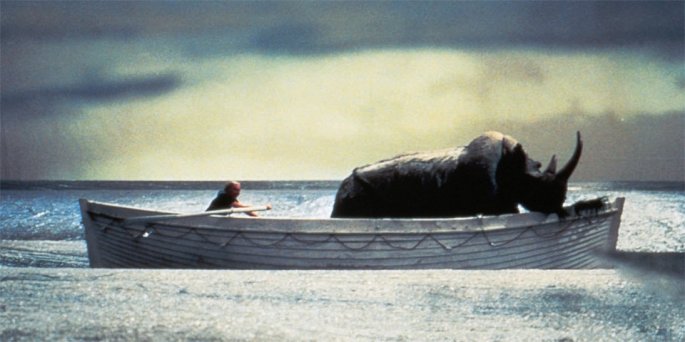
This film also provides a fictional account of the events that may have led to WWI. It paints a not so flattering picture of the European elite prior to the war – taking them to task for their extravagance and self absorption. Fellini makes murky comments about class division and there seems to be a bridge he might be trying to build between the entourage’s behavior towards the crew on the ship and their embracing of the Serbian refugees in the final act but it’s disconnected and not clear. Fellini plays it coy here and I believe he was wise to do so. Life is often a combination of intent, perception and the situational. Our morals and sense of duty can fluctuate from circumstance to circumstance. A scene in which the opera stars sing to the men working down below in the furnace is one of the greatest things I have ever seen in cinema. There is a love sick rhinoceros on board the ship in this film for no reason. I love that. Really. This film is a pure joy and an ode to the creative in every way.

This is one of my favorite films by Federico Fellini. It was financed by a millionaire in the United States who was a huge cinema lover. He lost money on the whole thing but said it was a one of a kind experience that he doesn’t regret. I’m not sure if this is true. Reportedly Fellini ran over budget on this guy and didn’t give a damn about it simply yelling “I must have it!!” over and over when he came up with some new lofty idea. I’m a big Fellini guy but I dig the later period films the best. I know I am in the minority here. ‘Amarcord’, ‘And The Ship Sails On’ and ‘Ginger & Fred’ are my top picks from him. I understand the significance of ‘8 1/2’, ‘La Strada’, ‘La Dolce Vita’, ‘I Vitelloni’ – and they have wonderful elements to them. Watched them all multiple times. Brilliant stuff, no doubt. But I always found them to drag bit. For those interested, ‘I, Fellini’, a collection of interviews with the director by Charlotte Chandler is a great read and provides delightful insight into the maestro’s creative process!

AndTheShipSailsOn

RIAN JOHNSON’S LOOPER — A REVIEW BY NICK CLEMENT

1.jpg

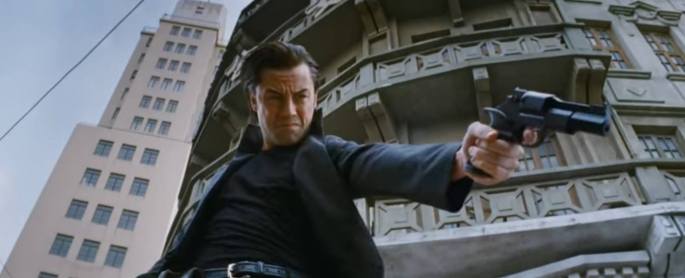
I’m still not 100% positive that I follow Looper and all of its time-travel hoopla and all of the rules the story establishes. But that doesn’t stop me from loving it up and down, and revisiting it whenever it pops up on the movie channels. I was a big fan of writer/director Rian Johnson’s debut film, Brick; his follow up, The Brothers Bloom, was a bit too precious but still demonstrated tons of style and cinematic quirk. But Looper is a heady and stylish mélange of science fiction and noir with some bloody shoot-outs, numerous narrative twists and turns, and really fun performances from an eclectic cast including Joseph Gordon-Levitt, Bruce Willis, Paul Dano, Jeff Daniels, Emily Blunt, Piper Perabo, Pierce Gagnon, Garret Dillahunt (love this guy!), Frank Brennan, and Noah Segan. I am still not entirely sure that Gordon-Levitt looks like Willis, but I can roll with it; when a movie is having this much fun and is consistently smart with its various elements than I can look past some inconsistencies.

2

Another big reason why this movie works as well as it does is that the characters are fully formed and everyone feels multidimensional, which is something that can’t be said for every movie of this ilk. And then when the explosive final act kicks into high-gear, the viewer has become emotionally invested in the story and characters so that by the end, you truly care about the outcome. The slick cinematography by Steve Yedlin features some superb individual shots, with lots of seamlessly integrated visual effects that make the film feel more expensive that it was. Looper was a big hit worldwide, pulling in $175 million, with a budget of roughly $30 million. The Chinese release version included additional scenes set in Shanghai that were removed for the American final cut.

3