Tony Scott’s Man On Fire is one of those films I can watch time and time again and never tire of, a magnificently melancholy tale of South of the border justice, criminal intrigue and a tequila shot of pulpy, blood soaked style that gets me every time. It’s loosely based on a 1987 film of the same name starring Scott Glenn, Jonathan Pryce, Danny Aiello and Joe Pecshi (there’s a random lineup, no?), but Scott intrepidly branches off into his own territory, and thank god for his vision. This was the first film in which he really explored his sketchy smokehouse of an aesthetic that he would later take to angelic heights with Domino. Colors blur and saturate, editing rockets by with the force of a bullet in a storm, subtitles appear arbitrarily and seemingly of their own volition. It’s a jarring tool set that he employs, and many abhor it. I’m as in love with it as he was though, and whether to throw us right into the protagonist’s psyche or simply because he felt the need to paint his pictures this way, the rest of the films in his remaining career carried the DNA, in varying doses. Fire is the key word for this film, in many of it’s forms. There’s a smoldering ember in Denzel Washington’s John Creasy that is fed by the winds of corruption as the film progresses, erupting into a blazing inferno of violence and fury. Creasy is a broken man, haunted by the questionable, never fully revealed actions of his military past. “Do you think God will ever forgive us for what we’ve done” he grimly asks his old war buddy Rayburn (a scene stealing Christopher Walken). “No” Rayburn ushers back curtly. It’s at this heavy nadir we join Creasy, lost in a sea of alcohol and guilt, an unmooored ship with a shattered hull looking for both anchorage and repair. Rayburn hooks him up with a bodyguard gig in Mexico City, keeping the young daughter of a rich businessman (Marc Anthony, terrific) safe from the very real threat of kidnapping. Dakota Fanning is compassionate, precocious and endearing as young Pita, who spies the wounded animal in Creasy right off the bat and tries to make friends. Creasy draws back in reluctance, but eventually warms up. I love the pace of this film to bits. It spends nearly half of its hefty running time simply getting to know these two characters, forging a bond between them before the inciting incident even looms on the horizon. And when the kidnapping occurs, as it must, the stakes are high as can be and our investment level in the situation is paramount. Setting up character is so key, and Scott nails it with scene after scene of quiet and careful interaction. Then he yanks the lid off the pot, as Pita is snatched in broad daylight, Creasy is injured and the kidnappers vanish into thin air. Pita’s mother (a soulful Radha Mitchell) works with the dodgy Mexican authorities and her husband’s lawyer Jordan (a sleazy Mickey Rourke). Creasy has other plans. Once healed, he embarks on a mission of fury and vengeance, knocking down doors, removing body parts, inflicting gratuitous bodily harm and using every technique in his training (believe me, there are some interesting ones) to track down those responsible and get Pita back. Washington does all this with a calm and cool exterior, letting the heat emanate from every calculated syllable and intense glare. The descent into Mexico City’s poverty stricken criminal underworld is a grisly affair, and all sorts of ugliness is exposed, shredded through the caffeinated prism of Scott’s lens. Two cops do what they can to help Creasy, idealistic Guerrero (Rachel Ticotin) and battle hardened Manzano (the always awesome Giancarlo Gianninni). It’s Creasy’s show though, and he blasts through it like a righteous hurricane of blood and bullets. Scott’s films have a knack for ending in over the top, Mexican standoff style shootouts, but the man subverts that here, going for something far more sorrowful and atmospheric, ending an intense tale on notes of sadness and resolute calm, gilded by the aching tones of songstress Lisa Gerrard and composer Harry Gregson Williams. Walken provides both comfort and catharsis, the only beacon of hope for Creasy other than Pita. Unlike John, Rayburn has moved on from the horrors of their past, but one still sees the trauma in his soul when he looks John in the eye and gets hit with what is reflected back. Tough stuff to get right, but hey, it’s Walken we’re looking at here, and he’s brilliant. Rourke has little more than an extended cameo, but his flavor is always appreciated, and he’s great too. I had no idea Anthony had the chops he exhibits here, but I loved his arc as well as his performance and he holds his own in a blistering scene with Washington. Washington is an elemental beast, shadowing what’s left of his humanity under a cloak of booze and brooding contemplation, until he’s coaxed out by the life saver Pita. Then he’s a lion, riding guns out into a ferocious swan song of a sunset that may just hold rays of redemption for him. This is Scott at his best, his unique brand of storytelling at its height, his creative juices a canister of lighter fluid set aflame with genius and innovation. A masterpiece.

Category: Film Review
ARI FOLMAN’S THE CONGRESS — A REVIEW BY NICK CLEMENT

What can one really say about Ari Folman’s bold, breathtakingly alive hybrid movie The Congress? It’s like nothing you’ve ever seen, I can promise that much. Half animated, half live-action, all totally blazed to the extreme, this is a colossal artistic statement about Hollywood, art, culture, society, and our unending preoccupation with make-believe and hero worship. It’s also one of the headiest films in recent memory, operating on multiple levels of reality and surreality; this is the cinematic equivalent to 100 hits of super-charged acid. The purposefully sprawling and messy structure plays to the film’s wild and operatic strengths. This isn’t a movie to be taken 100% literally, as it is, at heart, an existential crisis story that begs to be viewed multiple times for maximum appreciation. My Blu-ray has been abused over the last year or so. The phenomenal Robin Wright plays a heightened version of herself, a mid-40’s actress who is about to be abandoned by the major studios, an actress beaten down by the pressures of Hollywood and the demands of the star system. Via her impassioned agent (an super-sharp Harvey Keitel) and an extra-slimy studio chief (Danny Huston, twirling his moustache), she’s given the chance to have her mind, body, and soul digitally transferred into a computer so that her likeness can be used and re-used throughout the years, preserving her “Princess Buttercup” good-looks and charm, thus transforming her into the ultimate movie-star for years and years and years.

The movie makes a 20 year jump cut at the mid-point and leaps head-first into a hallucinatory outpouring of odd and crazily unique Anime-inspired images during the second and third acts, resulting in a film that feels like Who Framed Roger Rabbit? on PCP. It seems that the only way that one can enter the movie studio of the future (playfully referred to as Miramount) is to drink a potion which turns you into a digital avatar of yourself, and then, once inside this madcap universe, you’re able to drink yet another potion which can literally turn you into whatever you want. This film plays by its own set of wild and wacky rules and because of that, anything can happen, and I love films that operate in this fashion; I’m always drawn to filmmakers who are interested in challenging themselves and the audience. To say that I grasped all of this mind-bending work of art upon first glance would be to out-right lie; this is a dense, packed-to-the-gills experience, one that shouldn’t be immediately shrugged off as just another esoteric artistic experiment. Folman is the real deal, a man with a singular vision, and now, after Waltz with Bashir and The Congress, he’s a filmmaker that I will actively anticipate each new film with baited breath. Visual art like this needs to be celebrated instead of ignored, and my hope is that this film finds a long and happy life on Blu-ray and streaming.

MICHELANGELO ANTONIONI’S L’ECLISSE — A REVIEW BY NICK CLEMENT

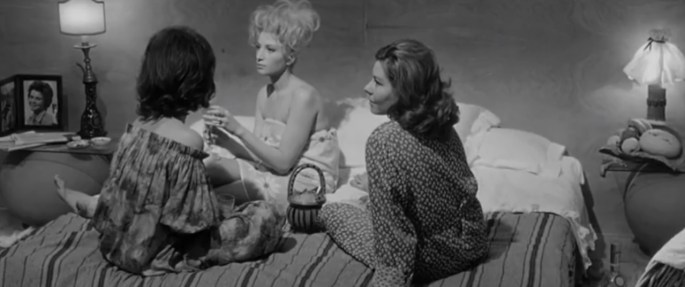
I could watch this stunning movie ever single day. Still as fascinating and as stylish as ever, the 1962 film L’Eclisse truly defies description. Monica Vitti was as alluring as it gets, and I am not sure if there has ever been a classier on-screen presence than Alain Delon. Michelangelo Antonioni made some all-time classics and this one has to be considered one of his best. The film feels like a poem, a glimpse into the life of a woman in flux, drifting from one encounter to the next, never fully sure of herself or the world around her. The final 10 minutes are beguiling in their strangeness and open-ended nature. The Criterion Collection, yet again, have delivered a ravishingly beautiful Blu-ray transfer; it looks like it was shot yesterday, with the sexy black and white images revealing untold depth and clarity. Gianni Di Venanzo’s illustrious cinematography is positively engrossing upon immediate sight, with every silky, dreamy image folding into the next, while always stressing open space and how people are placed within the frame. Everything about this movie screams pure cinema, and the trifecta of L’Eclisse, L’Avventura, and La Notte register as three of the most personal and fascinating films to explore similar themes and artistic motifs that I can think of. Blowup or The Passenger might be my overall favorite works from this extraordinary filmmaker, but there’s something so mysterious, so transfixing about L’Eclisse that I find myself returning to it on fairly regular basis. The film won the Special Jury Prize and was nominated for the Palm d’Or at the Cannes Film Festival.

Tony Scott’s Crimson Tide: A Review by Nate Hill
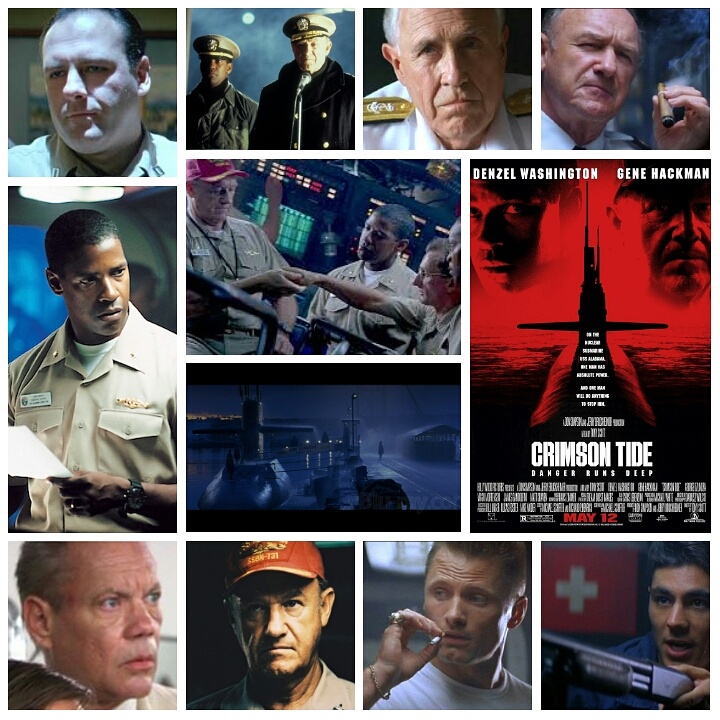
In terms of submarine movies, nothing will light your fire or get your pulse racing quite like Tony Scott’s Crimson Tide (well maybe Das Boot, but that’s another story). Scott just has this way with hyper kinetic tension and a knack for causing whirlwinds of propulsive energy in his work, and even when the material is more melancholy there is still a rousing climate to every frame. Pair his visual skill with Quentin Tarantino’s sterling (and uncredited) ear for dialogue and you’ve got one simmering package. Not too mention the actors and the blood stirring score from Hans Zimmer which is one of the composer’s best and richly orchestrated works. This is the second time Tarantino and Scott have done the writer director duo, albeit the lesser of the two films, it’s still a stunner. When lunatic Russian extremist Vladimir Radchenko (Daniel Von Bargen, RIP) goes off in a huff and threatens nuclear warfare, the Yanks get nervous and send in an ace in the hole submarine loaded with warheads of it’s own, cause, you know, ‘just in case.’ The vessel is captained by an intense and corrosive Gene Hackman, backed by a more reserved and introverted Denzel Washington. The two clash right off the bat and its obvious that fireworks of conflict will erupt between them once the shit hits the propeller. It soon does, in the form of a command order that is partly lost in translation. It could mean go ahead and fire the nukes on Radchenko. It also could not. Hackman, that spitfire, wants to engage and eradicate any chance of action on the extremist’s part. Washington insists on holding back, terrified by uncertainty. This troublesome personal disagreement eventually leads to flat out mutiny amongst the crew, in more ways than one. The crew has no concrete leader to direct their devotion to, and that’s a dangerous thing aboard a military vessel. Hackman and Washington are pure electricity as opposite sides of the same coin, facing off in a claustrophobic arena where one wrong move could end up in cataclysm. Along with internal disruption concerning the crew, there’s also the fact that they’re on a submarine miles below the surface to contend with, and it’s one whopper of a suspense cocktail. Viggo Mortensen is terrific in a conflicted supporting role, and watch for solid turns from Danny Nucci, George Dzunda, Matt Craven, Ryan Phillipe, Steve Zahn, Chris Ellis and a fiery James Gandolfini. Ooo and Jason Robards in an uncredited cameo, which he’s also done for Scott in Enemy Of The State. It’s pure movie bliss, but what can you expect from Scott other than the cream of the crop? The guy gave us pure gold for decades, bless his soul, and this is one of his best.
PETER HYAMS’ RUNNING SCARED — A REVIEW BY NICK CLEMENT

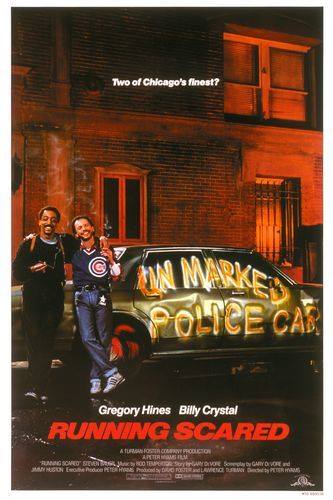
Riffing on material he had previously explored with 1974’s Busting, the 1986 buddy-cop comedy Running Scared found versatile filmmaker Peter Hyams back in familiar and comfortable genre territory, utilizing great physical location work, crisp action sequences, and the inherent charm and chemistry of his two fantastic leads, Gregory Hines and Billy Crystal, who truly made for an odd-couple pairing if there ever was one. Written with efficiency and genial humor by Jimmy Huston and Gary Devore, this film definitely enjoyed getting down and dirty, with Hines and Crystal as Chicago cops who cheat death on a daily basis, and decide that after a life on the streets chasing down bad guys, retiring down in Key West within the friendly confines of a new bar sounds like a great idea. But, in classic narrative tradition for this type of actioner, there’s one last big arrest that needs to be made, with the majority of the film centering on the action-adventure antics of the two officers as they run around the amazingly photogenic windy city, with Hyams, as per usual, serving as his own tremendous cinematographer. A great supporting cast was on hand, including Jimmy Smits, Steven Bauer, Joe Pantoliano, Dan Hedaya, Jon Gries, and it must be noted that the 80’s-accented soundtrack if pretty damn sweet. The final action set piece is outstanding. Released by MGM in June of 1986, Running Scared became a solid box office success, and would later become a staple item on HBO and cable.
STAR TREK: A Retrospective by Joel Copling
Rating in Stars: ***½ (out of ****)
Cast: Chris Pine, Zachary Quinto, Zoe Saldana, Karl Urban, Simon Pegg
Director: J.J. Abrams
MPAA Rating: PG-13 (for sci-fi action and violence, and brief sexual content)
Running Time: 2:07
Release Date: 05/08/09
It would, on face value, be easy to dismiss Star Trek as fan service by its very existence as another adaptation of Gene Roddenberry’s television series of the same name (which spawned four spin-off series, as well as a number of movies) and by a plot that seems to want to connect it to those movies (especially by including one of the old-guard cast as an older version of a character already present in the timeline). Fortunately, screenwriters Roberto Orci and Alex Kurtzman are respectful of the source material they are updating for a new audience, while injecting, if not new life, then a different kind of vivacity into the proceedings. This is a more-than-efficient spectacle, featuring some truly glorious set pieces and a welcome sense of humor. The fan-service aspects are only a minor distraction.
Following a prologue in which George Kirk (Chris Hemsworth) must sacrifice himself moments after the birth of his son when a massive Romulan ship emerges from a black hole in space and threatens the crew of the U.S.S. Kelvin, we are introduced to James Tiberius Kirk (Chris Pine), George’s son, and Spock (Zachary Quinto). The former is bitter as a grown man who never knew the father he resented for his sacrifice and a mother who remarried, but he’s influenced to join the Starfleet Academy by Captain Christopher Pike (Bruce Greenwood), who maintains that he sees greatness in the potential cadet. The latter is a logic-driven, half-human half-Vulcan whose place among his fellows is insulted when it is insinuated that his human mother (Winona Ryder) is a “disadvantage.” Through a combination of solid performances and writing, we get a sense of who these men are from minute one.
We are also introduced to the various elements that make up the U.S.S. Enterprise, the ship on which Pike currently resides as captain and Spock as first officer. There is Zoe Saldana as Nyota Uhura, the resourceful, multilingual lieutenant who had Kirk’s eye from the moment they met and is now dating the guarded Spock, John Cho and Anton Yelchin as Hikaru Sulu and Pavel Andreievich Chekhov, the two lieutenants in charge of maintaining the craft’s speed and orbit, and a very funny Simon Pegg as Montgomery Scott, the warp science expert hired on by way of strange, convoluted circumstances involving Kirk’s abandonment on a dangerous, arid planet where he runs into another version of Spock played by Leonard Nimoy.
That last part requires some context, and the context is occasionally labyrinthine. The villain is the captain of that Romulan ship, a vengeful individual named Nero (Eric Bana), who has traveled from almost two centuries in the future to exact his justice upon Starfleet for what he saw as the unjust genocide of his people and destruction of his world. That involves a MacGuffinesque red matter that can create a wormhole in space, and through the older Spock’s unintentionally tragic mistakes, Romulus was destroyed. When Vulcan is destroyed and the younger Spock’s mother dies, the plot kicks in: Nero must be defeated, but not in a way that carelessly causes more red matter to explode.
There is an efficiency to the plotting here in spite of its busy nature, with the screenwriters allowing us to become accustomed to the crew’s interactivity while ducking in and around stretches of action sequences that thrill on the basis of their seamless visual effects. Director J.J. Abrams, cinematographer Dan Mindel, and co-editors Mary Jo Markey and Maryann Brandon expertly devise and execute these sequences, such as a showdown between Kirk and an indigenous animal on the snowy planet, a dive in which Kirk, Sulu, and another officer must disable an enormous laser drill, and a climax that variously involves chases, shootouts, hand-to-hand combat, and a layering of desperate emotion just underneath the surface. Star Trek might be busy, but it’s as good as the original movies ever were. What a ride.
MICHAEL RITCHIE’S SMILE — A REVIEW BY NICK CLEMENT

Michael Ritchie’s 1975 quick-witted beauty pageant satire Smile is one of those casually deceptive films from that era, as it combined pitch black comedy and straight face observation over small-town American life and all of the intricacies that would surround an event like the one depicted in this timeless-feeling movie; it has aged extremely well, and clearly served as a blueprint for the more modern effort Drop Dead Gorgeous. Smile was part of that legendary run of films for Ritchie in the late 60’s and into the 70’s, which included Downhill Racer, Prime Cut, The Candidate, The Bad News Bears, and Semi-Tough, all classics in their own particular way. Starring Bruce Dern, Barbara Feldon, Michael Kidd, Geoffrey Lewis, Eric Shea, Nicholas Pryor, and future filmmaker Dennis Dugan, Smile also introduced some exceedingly beautiful and talented actresses, including Melanie Griffith, Annette O’Toole, Colleen Camp, and Caroline Williams, while also showcasing a variety of non-professional actresses who were cast because of their beauty queen experience. The comedy on display, which leaned on improv in some very funny spots, was all born out of situation, character, and real life, with Ritchie and screenwriter Jerry Belsen using their setting as a way of holding up a mirror to society and saying “Look how crazy we all are!” Conrad L. Hall’s naturalistic cinematography only sweetens the deal. Sadly, despite excellent critical notices, releasing studio United Artists didn’t have much faith in the film on a commercial level, and dumped into in the four theaters that it owned, so as a result, it became a cult classic before it could ever have the chance of being embraced by wider audiences. Almost 10 years after the release of the film, the material would be adapted for the stage, featuring songs by Marvin Hamlisch and Howard Ashman. Available on DVD.

Antoine Fuqua’s Training Day: A Review by Nate Hill
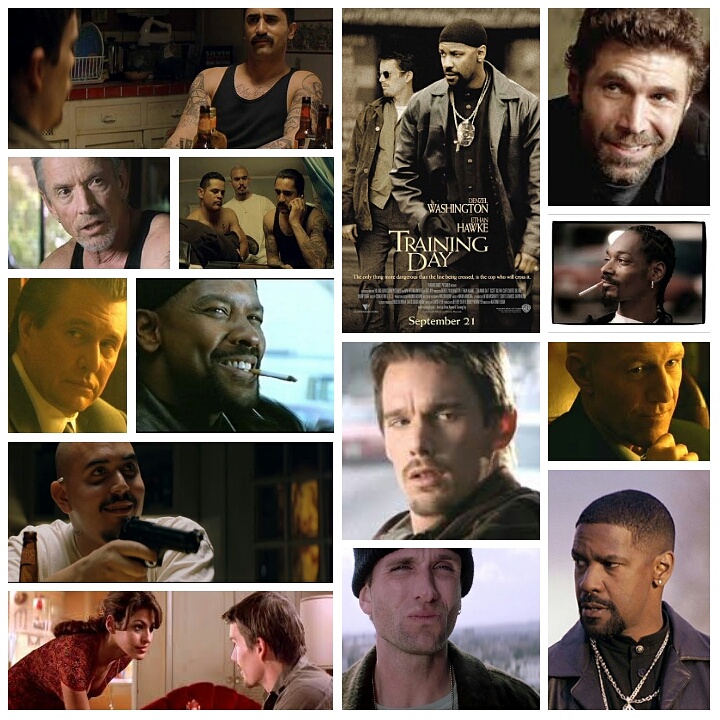
“To protect the sheep, you gotta catch the wolf, and it takes a wolf to catch a wolf.” This questionable sentiment is how rogue LAPD detective Alonzo Harris (Denzel Washington) justifies a heavy laundry list of dirty deeds, scary volatility, sociopathic backstabbing and a complete disregard for the badge that he wears on a chain like dog tags. And indeed, inner city Los Angeles can seem like a war zone, but its like he’s in fact more part of the problem than the dark angel of justice he sees in himself. Antoine Fuqua’s combustible crime drama Training Day rightly won Washington an Oscar for his unsettling runaway train of a performance, and he owns it down to the last maniacal mannerism and manipulative tactic. The film takes place over one smoggy L.A. day (hence the title) that feels like an eternity for its two leads, as well as all the colorful and often terrifying people they meet along the yellow brick road that’s paved with used needles and shell casings. Harris is tasked with showing rookie cop Jake Hoyt (Ethan Hawke) the ropes in his neighborhood, in the hopes that he’ll pass the test and achieve Narc status. Jake is prepared for a run of the mill crash course, but as soon as he’s treated to a verbal beatdown from Harris in the diner they meet at, he has a feeling it ain’t gonna be anywhere close to a normal day. This is just another day for Harris though, as he drags Hoyt by the scruff through drug busts, gang warfare, the worst neighborhood in town and pulls him deeper into his very dangerous world. Fuqua has a knack for getting the atmosphere of his settings just pitch perfect, and the feverish nightmare of the inner city comes alive, seemingly possessing the characters themselves until the atrocities just seem like a way of life. The trouble really starts when they run across Harris’s old drug lord buddy Roger (a wicked Scott Glenn in a role originally intended for Mickey Rourke), who proves a valuable asset later, though not in the way you might think. Harris introduces Jake to his equally crooked and scary team, including Peter Greene, Nick Chinlund and Dr. Dre who struggles in the acting department, especially in a room full of such heavy hitters. Jake is aghast at the horrors he sees and cannot believe the streets are like this. Harris devilishly assures him that this is the job, mutilating the symbol of his badge even more by justifying such behaviour as necessary. Tension reaches unbearable heights during a visit to a Latino gang household run by Cliff Curtis, Raymond Cruz and the eternally scary Noel Gugliemi. This is the heart of darkness fpr the film, a story beat from which there is seemingly no escape, until it becomes clear that Jake has somehow evolved a step up the food chain as far as LA goes, and is now ready to put down the dog who taught him, a dog who has long been rabid. People complain that the final act degenerates into a routine action sequence. Couldn’t disagree more. With a setup so primed with explosive conflict, it can’t end up anywhere else but an all out man to man scrap, which when followed by no flat out action sequences earlier in the film, hits hard. Their inevitable confrontation is a powerhouse, especially from Washington, who finally loses his composure and yowls like a trapped coyote, his actions caught up to him. In a role originally intended for Tom Sizemore (who would have rocked it in his own way) I’m glad Denzel got a crack at it, for he’s absolute dynamite. Watch for Harris Yulin, Raymond J. Barry and Tom Berenger as the three senior LAPD dick heads, Eva Mendes as Alonzo’s girlfriend, Macy Gray as a screeching banshee of a ghetto whore and Snoop Dogg as your friendly neighborhood wheelchair bound crack dealer. Fuqua keeps attention rooted on the dynamic between Washington and Hawke, who is excellent in as role that could have easily been swallowed up by Washington’s monster of of a performance. Hawke holds his own, and the film is really about how two very different guys view a difficult area of town, how it changes them both, and ultimately how their moral compasses end up on a collision course. One of the best crime framas out there, and quickly becoming timeless.
RICHARD BROOKS’ LOOKING FOR MR. GOODBAR — A REVIEW BY NICK CLEMENT

Wow. WOW. This is an intense film. I definitely wasn’t prepared for where this story would go. Richard Brooks’ bold and dark drama Looking for Mr. Goodbar had to have served as some sort of social wake-up call when it was first released in 1977. Embraced by critics and audiences, this cautionary tale of the singles scene offered up a period-appropriate glimpse at the changing sexual attitudes experienced by both sexes, but most strikingly, a free spirited female teacher who might not know exactly what she’s gotten herself into after a series of encounters with a variety of men. Featuring an absolutely blazing performance by Diane Keaton, in easily the most erotically charged work that I’ve seen from her as an actress, this rather nasty film sports a plethora of incredible supporting performances from Tom Berenger, Richard Gere, Howard Atherton, Richard Kiley, LeVar Burton, and Tuesday Weld. I had long heard of Looking for Mr. Goodbar and was super curious about it, so when it appeared on the TCM lineup this month, I totally flipped out.
I bet David Cronenberg loves this film, as it explores identity, the subversion of one’s true self, and how violence and sex are intrinsically linked. And because this film is not currently available on physical media or various streaming platforms and has become something of a talking piece among cinephiles, I am not going to discuss the plot any further for fear of any spoilers. What I will allow is that Keaton has nearly never been better, the cinematography by the great William A. Fraker conveyed casual menace in all of the best and most effective ways, and the startling opening title sequence, photographed in black and white by Kathy Fields was absolutely fantastic and immediately engrossing, bringing you into a sexy and shadowy world right from the start while the eclectic tunes of the era amped up the retro vibe. Uncompromising, startling, and more than a bit disturbing, Looking For Mr. Goodbar is certainly one of the more provocative films I’ve seen from any year in a long, long time.
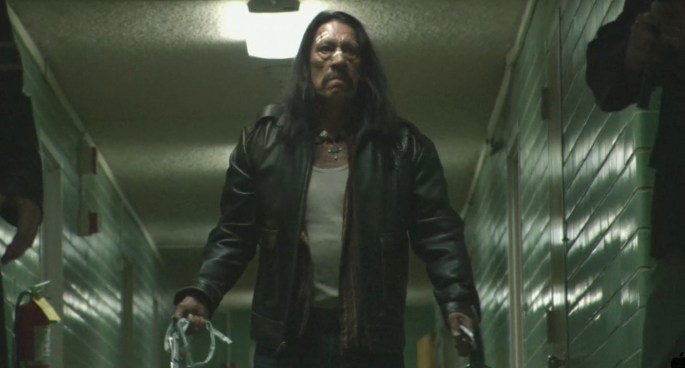
MACHETE – A REVIEW BY J.D. LAFRANCE

When he made his half of the Grindhouse double bill (2007), Robert Rodriguez also put together a trailer for a film he would like to see. And so, Machete (2010) was born – a Mexploitation action film about an ex-federale who is set-up, double-crossed and left for dead. However, the origins for this project go back even further to 1995 when Rodriguez made Desperado, the second film in his El Mariachi trilogy. It would be the first time (but certainly not the last) he worked with veteran character actor and professional badass Danny Trejo. He’s someone you’ve probably not heard of but have definitely seen. If you need a tough-looking tattooed henchman, he’s your man. While working on Desperado, Rodriguez envisioned Trejo starring in a series of action films as Machete but at that time the director did not have the clout to get someone to bankroll a Latino action film that didn’t feature someone with movie star looks like Antonio Banderas.
Rodriguez never forgot about his pet project and over the years cast Trejo in several of his films. Even though the Grindhouse films were a commercial failure, audiences loved the faux trailer for Machete. Rodriguez managed to convince a Hollywood studio to finance it with a modest budget and used his connections to assemble an impressive cast that included the likes of Robert De Niro, Jessica Alba, Steven Seagal, and “introducing” Don Johnson. However, what worked as a movie trailer be too much of a good thing as a feature film?
The prologue sets up everything we need to know about Machete (Trejo) – he’s a badass Mexican federale set-up by his corrupt superior and left for dead by local druglord Torrez (Seagal). It also sets just the right tone as we see Machete hacking and slashing his way through a house of bad guys with bloody abandon. Meanwhile, in the United States, a corrupt, ultra-conservative Texan senator named John McLaughlin (De Niro), campaigns on a platform of preventing illegal immigrants from crossing the border. He even employs a border vigilante group, led by the brutal Von Jackson (Johnson), to enforce his policies.
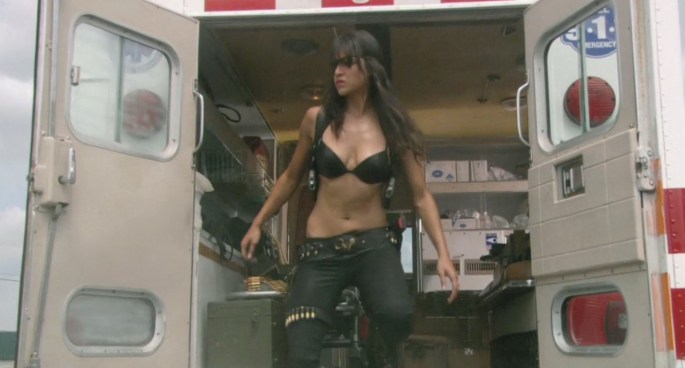
Sartana Rivera (Alba) is an upstanding Immigrations enforcement officer investigating the problem through legal channels and ends up crossing paths with Luz (Michelle Rodriguez), a no-nonsense taco stand operator who moonlights as a revolutionary operating an underground railroad of sorts for her Mexican brothers and sisters. Machete, now a day laborer (or, at least that’s his cover), is hired by Michael Booth (Jeff Fahey), a local businessman, to kill the Senator for $150,000. Machete is set up, shot and forced to go into hiding. With the help of Rivera and Luz, he plots revenge on the men that betrayed him.
It’s awesome to see Danny Trejo finally get to carry a film for once and play a character that doesn’t get killed off. He brings his customary intensity as the strong, silent man of action and in many respects the film is Rodriguez’s present to the actor as he has him take down tons of bad guys, look cool doing it, and hook up with many of the film’s lovely ladies, including Michelle Rodriguez, Jessica Alba and Lindsay Lohan! Robert De Niro is a lot of fun to watch playing a John McCain meets George W. Bush-esque xenophobic politician. It’s also great to see Steven Seagal as a powerful criminal and Machete’s arch-nemesis, not to mention appearing in a mainstream film that didn’t go straight-to-home video.
Michelle Rodriguez adds another tough chick role to her resume as she portrays the female Mexican equivalent of Che Guevara but with a dash of Snake Plissken. Another fun bit of casting is Lindsay Lohan playing the messed up celebutante child of Booth. She and Rodriguez have some fun riffing on her public persona and kudos to the director for not bowing to peer and public pressure about her party girl reputation and showing that regardless, she still has the acting chops. Rodriguez regulars Tom Savini and Cheech Marin show up in memorable bit parts as a deadly assassin and Machete’s ex-federale now-priest brother.
It’s no secret that Rodriguez is a filmmaker that wears his influences on his sleeve. For example, Desperado was an homage to the Hong Kong action films of John Woo and From Dusk Till Dawn (1996) and Planet Terror (2007) evoked the films of John Carpenter and George Romero. Growing up in the 1980s, Machete is Rodriguez’s love letter to the films produced by Cannon Films during that decade. They were responsible for cranking out an endless stream of generic action films starring the likes of Charles Bronson, Chuck Norris and Michael Dudikoff. In these films, the action stars were often a one-man army capable of wiping out the fighting force of a small country seemingly single-handedly. The same goes for Machete who is an unstoppable killing machine bent on revenge.
Machete is full of outrageous, over-the-top violence and inventively staged action sequences, like one scene where Machete bungee-jumps from one floor of a hospital to another with the aid of an evil henchman’s large intestine. In this respect, the film has the same gonzo, go-for-broke action that Rodriguez orchestrated in the underrated Once Upon a Time in Mexico (2003). Living up to his namesake, Machete finds all sorts of ways to kill the bad guys with a vast assortment of sharp weapons. Machete is a lot of fun and never outstays its welcome as Rodriguez knows how to keep things moving so that things never get boring.
Machete not only features all kinds of wild action sequences but also has something on its mind, commenting on the rampant immigration problems that continue to plague the states along the United States/Mexico border. Along the way, Rodriguez plays up and makes fun of Latino stereotypes (they are all day laborers and love tricked out cars) only to twist them into a rallying cry, a call for revolution that takes full bloom by the film’s exciting conclusion in a way that has to be seen to be believed. Best of all, Rodriguez has created yet another awesome Latino action hero. Forget Sylvester Stallone’s The Expendables (2010), Machete is the real deal and a no-holds-barred love letter to ‘80s action films. As great as it was to see many of the beloved action stars from the ‘80s and 1990s, I felt that Stallone’s film never went far enough. Rodriguez’s film doesn’t have that problem as it gleefully goes all the way with its cartoonish violence.