Bone Dry is fantastic little piece of sun soaked, revenge fuelled melodrama that serves as a glowing showcase for its two leads, Luke Goss and a ferocious Lance Henriksen. Lean, mean, gritty and reminiscent of 1970’s revenge outings, it’s a bloody delight of a flick. Luke Goss, an actor who can give Henriksen a run for his money in the intensity department, plays Eddie, a well dressed dude with a suspiciously murky past, winding his way through the desolation of the Mojave Desert. After breezing through a lonely cafe run by a girl (always nice to see Dee Wallace) who clearly has eyes for him, he sets out through a particularly lonely stretch of the terrain, and that’s where he finds himself in serious trouble. He’s soon stalked by a menacing, mysterious man named Jimmy (Henriksen), who is intent on tormenting, taunting and fucking him up at every turn. Jimmy is an ex war monster a man whose taken it upon himself to put Eddie through every ring of hell that the Mojave has to offer, all in service of some deeply buried reasons that emerge from the sand late in the third act, shedding scorching light on the two men’s character arc, and giving the film quite the emotional boost. When I say hell, I mean it. Eddie suffers through some unspeakably horrific scenarios, including a scene involving a cactus that will induce mass cringing among audience members. Director Brett A. Hart has a heightened, almost Walter Hill-esque style to his film, with the intensity metre ratcheted up past the maximum, and editing trimmed down to whip smart strokes that put you right in the middle of Eddie’s clammy desperation and Jimmy’s enigmatic fury. Henriksen spends the first half of the film with his face shrouded, adding to the mystery of his character. He’s a master of the craft who slowly lets the breadcrumb trail fall with every portentous mannerism and glowering posture until we finally see what Jimmy is really about. One his best performances. Goss doesn’t let the energy sag for a single second, something he has always been great at. There’s further work from the legendary Tommy ‘Tiny Lister’ Jr. as well, filling in another subplot stranded out there in the sand. This one is genre bliss, brutal and blistering until it cools off for a conclusion that cuts the viewer some respiratory slack after the breathlessness of its juggernaut setup. Terrific stuff.
Category: Film Review
Wildflowers: A Review by Nate Hill
Wildflowers is a film that examines the aftermath of 1960’s counterculture and the hippie movement. The free love sentiment produced many children who were raised unconventionally, and in some cases outright abandoned by their flower power parents. Cally (Clea Duvall) is one such girl, a wild tomboy who lives with her sometimes employed father (Thomas Arana), and spends her days cavorting around with adolescents in similar situations. It’s rare that Duvall gets a starring role, and she’s absolutely wonderful here, steering Cally along with longing, resentment and just a bit of touching ‘lost girl’ emotion. She’s an actress who needs to be cast in more stuff to showcase her talent, and not just thrown into lesbian roles because she identifies as such (grrr!). She steals the show and proves what a magnetic presence she is. Cally never knew her mother, and hope arises with the arrival of mysterious Sabine (Daryl Hannah) a woman old enough to be her mother and seemingly connected to her somehow. Sabine is a free spirit with a turbulent mindset, a result of the fragmented lives that people led back in that time period, often leading to wayward souls with no sedimentary existence to slide into after the show finishes and they realize they aren’t as young as they used to be. Cally’s story plays out beautifully, a girl just coming into her own and realizing who she is, via experimentation and intuition. She meets a drug dealer named Jacob, played by Eric Roberts. He’s the friendly drug dealer, a cinematic archetype often sought after by filmmakers. Roberts could play an evil dictator and still come off like Prince Charming, he’s just that likeable, and as such is perfect for the role, a kindly rapscallion with lessons and advice for Cally which don’t quite play out as one might think. In the end, it’s Duvall’s show, one of the only lead roles she has that is even out there to hunt down, such is the rarity of many films in her career. It’s filled with terrific scenery, a whimsical yet real world aura and performances of emotional truth. Worth tracking down for Clea’s fans (I’m proudly a die hard) and a delight for the casual viewer.
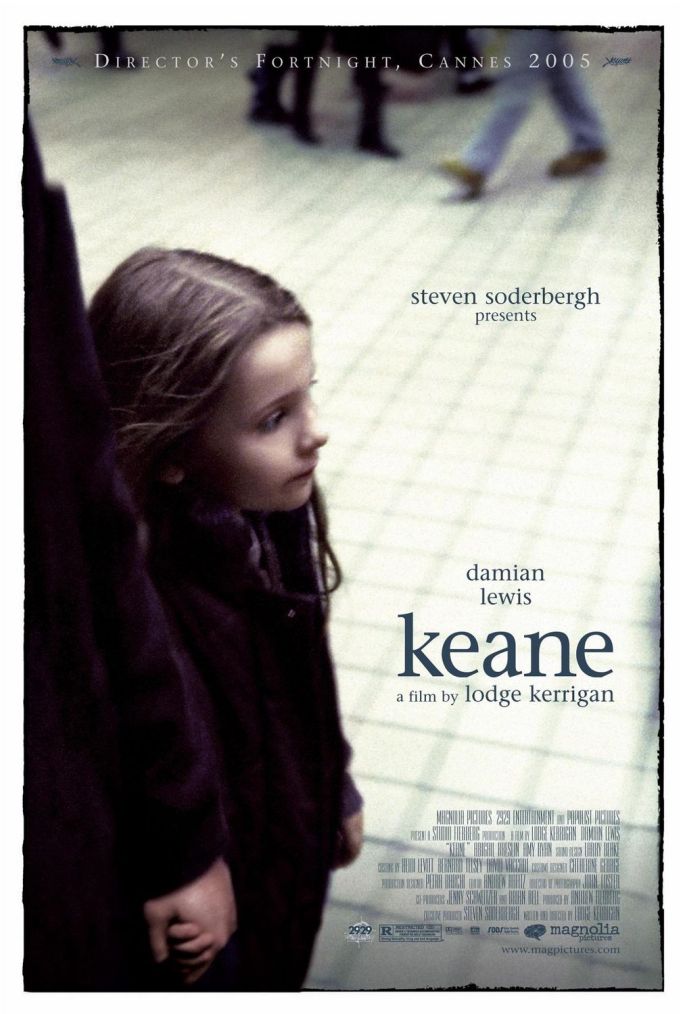
LODGE KERRIGAN’S KEANE — A REVIEW BY NICK CLEMENT

Unnerving doesn’t begin to describe Keane, a fascinating, immediately engrossing drama from 2004 that showcased an astounding performance from Damian Lewis as a schizophrenic man frantically searching for his lost daughter. Executive produced by Steven Soderbergh and written and directed by the erudite filmmaker Lodge Kerrigan (currently doing great work on the new Starz series The Girlfriend Experience, also produced by Soderbergh), the film is set in rather remote and unfamiliar NYC locations, and centers on a mentally fractured man who is attempting to piece together his life while trying to accep the fact that his daughter has been kidnapped. Complicating matters is a new and unique relationship that he forges with a seemingly despondent single mother (Amy Ryan) and her daughter (Abigail Breslin), which begins to push his emotional and psychological limits. This is a film of almost unbearable tension, with a central peformance by Lewis that amounts to nothing less than a tour de force. Kerrigan based the film on his own personal fear of having his daughter go missing, and in part on a movie he had filmed called In God’s Hands, with Maggie Gyllenhaal and Peter Sarsgaard, but which never got released due to technical difficulties with the film stock. Aesthetically, Keane is a remarkable achievement, with most shots lasting three to four minutes, and the entire picture being shot by cinematographer John Foster with hand held cameras that upped the immediacy factor. The lack of a muscial score also reinforced the seriousness of the entire piece. This is a shockingly low-profile item that is worth seeking out, but one that will challenge most viewers.
GUARDIANS OF THE GALAXY: A Retrospective by Joel Copling
Rating in Stars: *** (out of ****)
Cast: Chris Pratt, Zoe Saldana, Dave Bautista, the voices of Bradley Cooper, Vin Diesel
Director: James Gunn
MPAA Rating: PG-13 (for intense sequences of sci-fi violence and action, and for some language)
Running Time: 2:01
Release Date: 08/01/14
It might seem an odd place on which to start a positive review of, well, any movie, as well as it might run the risk of flying in the face of the usual logic, but Guardians of the Galaxy tries to be three things at once and only really works as one of them. Bear with me here, though, reader, because the one thing it does succeed at being is so significant that it dwarfs the other, less successful attempts. Because the screenplay by Nicole Perlman and director James Gunn approaches the origin story of yet another team of scrappy, fundamentally different superheroes as a comedy of five egos battling each other’s opposing philosophies.
It’s funny stuff in a smarmy and sarcastic way that might be its undoing if not for the fact that the actors in the roles of our heroes are so adept at playing the comedy mostly straight. The exception to that might be Chris Pratt as Peter Quill, aka Star-Lord, the de facto leader of the group that forms by accident and through reluctance on each member’s part. He was stolen from Earth mere minutes after his mother’s death and, even now, is stuck in the mode of the 1980s, listening to a Walkman radio as a way by which to remember her. Zoe Saldana is Gamora, a ruthless assassin and one of the two daughters of the guy who is positioned as the Big Bad of the Marvel Cinematic Universe, and Dave Bautista is Drax, an assassin himself who has no capacity to understand metaphor (Things don’t go over his head, he explains, because his reflexes are simply too good).
There are also Bradley Cooper voicing Rocket, a raccoon and former laboratory experiment whose personality defect is that he wants to cause destruction wherever he goes, and Vin Diesel as the voice of Groot, a sentient tree and Rocket’s hired bodyguard whose vocabulary is limited to five words (one of which is his name). The film smartly downplays these characters’ positive attributes to such a degree that they only occasionally eke through: Peter is brave but self-congratulatory in his courage, Gamora always has the hardened exterior of the girl who was taken from the family her father killed so that he could enslave her, Drax is determined to face the man who killed his own family to a degree that places everyone else at risk, Rocket will never understand why he was made to cause destruction but definitely wants to wreak that havoc, and Groot is, well, Groot.
The film’s attempts at something more earnest than it is feel as much like half-measures as its attempts to work as yet another stepping stone for the MCU, which pop up when the film must ultimately position them against a generic threat. He arrives in the form of Ronan the Accuser (an unrecognizable Lee Pace), who wants to control the universe with some sort of Infinity Stone that does something or other. It’s a MacGuffin, basically. He joins forces with Nebula (Karen Gillan), Gamora’s sister, while the heroes call upon a couple of officials (played by Glenn Close and John C. Reilly in throwaway appearances) from the planet that Ronan and Nebula hope to destroy. The conflict resolves itself in about as convoluted a way as a confusing MacGuffin can provide.
That, then, speaks indirectly to the film’s decision to also attempt to work as an action movie, and Gunn is mostly imprecise in doing so. The sequences of escapes and combat are competently staged and shot by Ben Davis but largely unspectacular (The finale is a whirl of random motion). Even so, there’s the dominating positive force of the primary cast of characters, each of whom is such a stand-out original that everything surrounding them is rendered null by their presence. Guardians of the Galaxy is a very funny movie in its best moments, and that is because of pure, unflappable conviction exactly where it counts.
CAPTAIN AMERICA: THE WINTER SOLDIER: A Retrospective by Joel Copling
Rating in Stars: *** (out of ****)
Cast: Chris Evans, Scarlett Johansson, Anthony Mackie, Sebastian Stan, Cobie Smulders
Directors: Anthony Russo and Joe Russo
MPAA Rating: PG-13 (for intense sequences of violence, gunplay and action throughout)
Running Time: 2:16
Release Date: 04/04/14
(Note: If you are one of the seven people who has not seen Captain America: The Winter Soldier yet, it is highly recommended you do so before reading this review. Of course, why are you reading it if you haven’t?)
If Captain America: The First Avenger did nothing to alleviate the problem of introductory superhero movies offering only a generic origin story and an equally generic conflict, its sequel does the opposite. We are already accustomed to Captain America, the hero whose costume adorned with stars and stripes is as unsubtle as his earnestness to protect American lives, and so, with Captain America: The Winter Soldier, screenwriters Christopher Markus and Stephen McFeely rather effectively apply a political undertone to the proceedings. Luckily, rather than going down the simplistic road of an obvious allegory, the politics here are entirely self-contained. They exist within the Marvel Cinematic Universe, in which this is the ninth film, and the stakes are higher as a result.
Here, the major villain comes from within the system to which Captain America (and, thus, Steve Rogers) belongs, and he’s not having it. HYDRA, the off-shoot club of the Nazi regime spearheaded by his old foe, has infiltrated S.H.I.E.L.D., the government agency that paired Steve (Chris Evans in a solid performance) with the other Avengers to defend the Earth. He discovers this at his old barracks, where he was trained with the late “Bucky” Barnes (Sebastian Stan) to defend the country, when forced to go on the run by that corrupt system. In that way, the villain is not the human person very blatantly telegraphed to be a corrupt individual but an idea.
It’s a pretty neat trick to sew doubt in the minds of the heroes here and the audience who have grown to have a sizable kernel of trust in that system. It’s a slow knife between the ribs, rather than some generic conflict against which Steve must work with Nick Fury (Samuel L. Jackson) and Natasha Romanoff (Scarlett Johansson), aka Black Widow, as well as a helping of allies (a returning Colbie Smulders as Maria Hill, Anthony Mackie as Sam Wilson, aka the Falcon, who has a nifty flight suit with wings, and Emily VanCamp as a S.H.I.E.L.D. agent undercover in Steve’s apartment complex). Someone close to them is killed, the establishment around them slowly crumbles, and it’s on the run they must go.
The film does succumb to two different familiar conceits with its presentation of a trio of villains. In ascending order of uniqueness and importance, there is Brock Rumlow (Frank Grillo, an intimidating presence), a seeming ally of Steve’s until a neat combat sequence in confined quarters. There is Alexander Pearce (Robert Redford), the aforementioned corrupt individual in power, who wants to continue HYDRA’s work at whatever cost (and his ultimate plan is even more radical). The third is a figure from Steve’s own past whose identity should not be revealed, but he shares the moniker of the film’s subtitle–and has a self-repairing metal arm, to boot.
The result of the familiarity is, admittedly, not of great impactfulness in the big picture. It appears in an extended action climax in which Steve and the Winter Soldier face off on a helicarrier (one of many in this case). Directors Anthony and Joe Russo stage the sequence as sleekly and efficiently as ever, but the most intriguing elements of their film are the ones that pit Captain America against the corroded ideology that helped to make him the hero he is. That is what ultimately gives Captain America: The Winter Soldier its surprising complexity and lifts it above its predecessor.
THE KILLERS – A REVIEW BY J.D. LAFRANCE

“The current cycle of crime films is a vicarious way to participate in the crime wave without committing a crime. That feeling is latent within each of us. Everybody wants to get even with somebody.” – Lee Marvin in a January 1969 interview with Playboy magazine
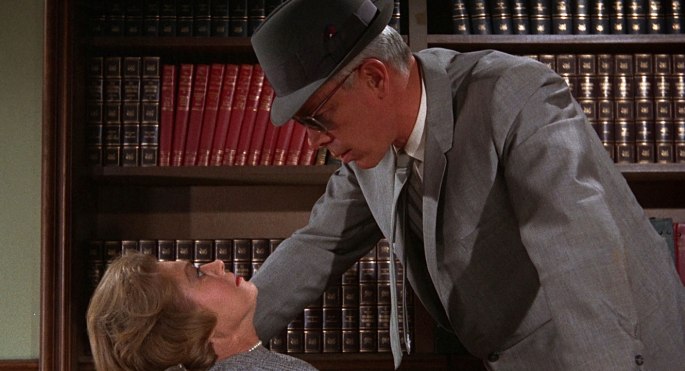
The first feature-length adaptation of Ernest Hemingway’s short story, “The Killers” was directed by Robert Siodmak in 1946 and featured a young Burt Lancaster and Ava Gardner as the two leads. It was a simple tale of a man who had hit rock bottom so badly that he allowed two hitmen to kill him. The doomed man was the focus of Siodmark’s film while, on the surface, it may seem that Don Siegel’s 1964 film version is all about doomed race car driver Johnny North. After all, he is given the bulk of The Killers’ screen time through flashbacks by the people that knew and loved him. However, Siegel drops in subtle visual clues throughout the film to suggest that the film is actually about the two professional killers with an emphasis on the elder more experienced one, Charlie, played by Lee Marvin. It is interesting to note that the first and last image of the film is of Charlie – the first tip off that this is his story and not North’s.
A great, menacing soundtrack by John Williams plays over the opening credits and immediately establishes the tough tone of Siegel’s film. Charlie and Lee (Clu Gulager) are ultra-cool, well-dressed hitmen that have been hired to kill ex-race car driver Johnny North (John Cassavetes) — now working as a teacher at a school for the blind. Even though he’s warned in advance, North does nothing and just lets the two men kill him. Afterwards, Charlie is bothered by the job. Something just does not feel right. And so, he and Lee decide to track down the people that knew North and find out why their victim didn’t run when he had the chance.
Along with Point Blank (1967), The Killers is one of the finest performances of Marvin’s career. He exudes a calm, malevolent nature through the simplest gesture or look and has a deep, weathered voice that conveys a lifetime of experience. For example, in the opening scene when Charlie and Lee question the receptionist at the school for the blind about North, the younger hitman fidgets with the furniture, taking some flowers out of a vase, sniffing them while pouring the water out onto the desk. The veteran killer concentrates on the frightened woman. Marvin uses that great voice of his to get the information he wants, uttering the immortal line, “I’m sorry lady, we don’t have the time.” This won’t be the last time he says that line. This scene is simultaneously funny and filled with tension in the way that the two men carry themselves. And yet we never lose sight of the fact that Charlie and Lee are there for only one reason: to kill North. Nothing is going to get in their way.
After they kill North, we see a more relaxed, casual side of Charlie. He and Lee are traveling on a train. The younger hitman still has his tie, vest and sunglasses on while the elder killer looks much more relaxed with the top button of his dress shirt undone, his shirt sleeves rolled up and his tie and sunglasses removed. However, something is bothering Charlie. Why didn’t North try to make a run for it? Charlie and Lee got paid a lot of money for a simple hit. They also find out that North was part of a million dollar heist – where’s the money? They don’t know who hired them but Charlie wants to find out. He wants that million dollars as he tells his partner, “But me, I’m getting old. My hair’s turning gray, my feet are sore and I’m tired of running.” It this slight admission that he’s getting older that humanizes Charlie for a brief moment and provides motivation for their quest. Half of a million dollars would certainly allow Charlie to retire in style.
Charlie and Lee decide to track down the other accomplices in the heist. In order to do so, they find North’s mechanic (played with blubbery bluster by Claude Akins). As Charlie puts the pressure on him, he says once again, “We don’t have the time.” There is now a bit of urgency in Charlie’s methods. As he said earlier, he’s tired of running and it is this urgency that motivates him to track down the money.
However, Charlie and Lee hit a dead end with the mechanic and go out for dinner. An interesting thing happens during this scene. At first, a mildly depressed Charlie is unable to eat his “fine steak,” but after he gets an encouraging call and a tip on the whereabouts of another one of North’s accomplices, his mood changes instantly and he happily begins cutting into his food. Charlie has become reinvigorated and tells Lee that it just isn’t the money that he’s after: “But I gotta find out what makes a man decide not to run. Why all of the sudden he’d rather die?” (Incidentally, this question is what also convinced Marvin to do the film) However, it is this curiosity that will ultimately be Charlie’s undoing.
Marvin delivers an economic performance which helps convey the all-business attitude of his character. He belonged to a dying breed of actor that you just don’t see anymore. Most actors today, if they’re lucky, take a whole film to convey the kind of toughness that Marvin has naturally. “Tough guys” of today – Russell Crowe, Jason Statham, Clive Owen, et al – don’t even come close to someone like Marvin. You can just tell from the way he looks and acts that he would kill you if you ever got in his way. And this kind of hard living attitude carried over into the actor’s real life as he alluded to in a 1969 interview with Playboy magazine and in Don Siegel’s memoir, A Siegel Film. The director recalls how Marvin showed up drunk the first two days of principal photography. The actor became such a disruptive influence on the set that Siegel had to intervene. Instead of dressing him down in front of everybody, he talked to Marvin in private. According to Siegel, Marvin never showed up to work drunk again.
When Charlie and Lee finally confront the film’s heavy, Jack Browning, played by Ronald Reagan in an inspired bit of casting. It was the first and only time that he played a bad guy in a movie. Browning would also be his last film role before he went into politics. It’s great to see a casually intense actor like Marvin square off against a limited one like Reagan. Charlie paces back and forth across the room with a gun in his hand while Browning sits there stiff as a board playing dumb while he’s accused of ordering the hit on North. Marvin does an excellent job working the room and questioning Reagan’s character. He clearly owns this scene.
Charlie shows just how brutal he can be when he questioning North’s girlfriend, Sheila (Angie Dickinson), and doesn’t like her answers. So, he and Lee hang her out of a window high above the street, scaring the answers out of her. Sheila pleads for her life at the end of the film putting all of the blame on Jack who says nothing, grimly accepting his fate at the hands of the uncompromising Charlie. Even after Charlie shoots and kills Jack, Sheila continues to pathetically plead for her life and Charlie utters that immortal line, “Lady, I don’t have the time,” before shooting and killing her. He kills her last because it is revenge for North’s death. Through flashbacks we learn that she not only double-crossed the doomed race car driver but she broke his heart too.
However, the damage to Charlie has been done. He has been mortally wounded by a sniper rifle at the hands of Jack earlier on. Charlie staggers out onto the front lawn of Jack’s house just as the police arrive. In a haze, he points his right hand like a gun and collapses dead, the precious money he spent the entire film pursuing fluttering all around him. Siegel then cuts to a long shot of Charlie’s dead body with the money lying in the heart of suburbia with its manicured green lawns and tract houses.
Siegel’s film takes place mostly during the day with a bright color scheme. This is due largely because the picture was originally intended to be a made-for-television movie (the first of its kind) but the harsh depiction of violence was too much for NBC and it was eventually released theatrically. The artificial T.V. look, with its extensive use of rear projection, gives The Killers an almost surreal kind of feel that works surprisingly well. Even though it is bright and colorful, the attitude of the film is pure, gritty film noir. Life is cheap and the film concludes on an uncompromisingly nihilistic note as Siegel ends things with a hell of a final image that underlines the very thing that resulted in everyone’s demise: money.
BARRY LEVINSON’S WAG THE DOG — A REVIEW BY NICK CLEMENT

I can vividly remember the opening night for Wag the Dog – it was back in 1997, I was in high school becoming a budding film lover, and I went with a group of friends to see this bitter black comedy about Hollywood and politics and I can remember being one of the few people who outright loved it upon first glance. It was very topical material at the time, and still is today, with razor-sharp satire always at the forefront, and a whiff of pompous know-it-all-humor that probably alienated many people. Energetically directed by Barry Levinson and co-written by Hilary Henkin and David Mamet, Wag the Dog centers on a presidential sex scandal, and the Washington DC-based spin doctor (Robert De Niro, wonderfully affable and light on his feet) who is called in for crisis management by the White House. His idea? He’ll start a fake war with Albania and spread various media rumors and lies in an effort to deflect the country’s attention from the real scandal at hand. De Niro enlists the help of an aging, full-of-himself Hollywood mega-producer, perfectly played with smarmy glee by a bronzed and absurdly coifed Dustin Hoffman, who brings along his various production contacts so that he can “produce a war” that nobody will ever realize is fake. And one that he can, rather frustratingly, never tell anyone he had a part in creating.
The comic mileage that’s derived from this ironically painful fact for Hoffman is a constant source of hilarity all throughout this happy-to-be-mean little movie. An amazing supporting cast rounds out the brittle edges of this scathing media takedown, with Anne Heche, a diseased Woody Harrelson, rapid-fire Dennis Leary, Willie Nelson, Andrea Martin, John Michael Higgins, David Koechner, William H. Macy, and Kirsten Dunst all showing up for memorable cameos and bit performances. But the black heart and acidic soul of this punchy little movie belongs to the amazing team of De Niro and Hoffman, who both seemed to be in love with the idea of occupying the same space as one another, generating tremendous chemistry, and letting the zippy screenplay do most of the heavy lifting. Mamet and Henkin’s script throws out a variety of nastily barbed zingers, and Levinson’s snappy direction is in perfect tandem with Robert Richardson’s agile, hot-white cinematography. Also, the idea that this movie was released exactly one month before the Monica Lewinsky scandal broke is just too wild to contemplate.
Disney’s Zootopia: A Review by Nate Hill
Disney’s Zootopia is the kind of animated film that passes with flying colors in just about every damn category it needs to, making it a thoroughly endearing classic that will stand the test of time and delight countless new fans as time goes on. It’s the best of its kind since last year’s Inside Out, and one that will be hard to top this time around. It’s got the most treasurable kind of story, one that has all the fun, flash and zip that the kids will take a shine to, some hilariously subversive and cheeky humour for the the adults to chuckle at, and some vital, important messages within its themes that adults will knowingly relate to, and the kids will subconsciously perceive. Never preachy nor pandering, all of its ingredients are mixed harmoniously. And let’s talk about that animation, good lord. Every year these films get more cutting edge and eye boggling, and this one busts the blueprints in its attempts to dazzle, with every kind of texture, glint and rendered gold on display. Animals of all shapes and sizes run, scamper, dart and dive throughout the film, to the point where I felt that only with multiple viewings could I appreciate every loving detail and subtle joke. Ginnifer Goodwin gives perky vocals to Judy Hops, a small town bunny who dreams of being a big city cop. Just leagues away from the tiny carrot farm she was raised on lies Zootopia, a sprawling metropolis where the denizens of the animal kingdom live in civilization, or rather, their brilliantly realized version of it. She is told time and time again that she’ll never become a cop, but pays no heed. And whadd’ya know, she becomes a cop. Left to rot on parking duty by stern bison Sergeant Bogo (growly Idris Elba) she fumes and longs for real action. Soon she meets wily fox and street hustler Nick Wilde (Jason Bateman in possibly the best vocal performance in years), and both are whisked away on an adventure through Zootopia to find some bad cats (and every other creature imaginable) who are up to no good. The city itself is a marvel in every sense of the word. Divided into detailed, vast and climatized zones including Tundra Town, Little Rodentia (laughed hardest at this sequence, purely inspired) and a subtropical tree house lined Rainforest area. The cast has buckets of fun, including JK Simmons as Mayor Lionheart, Bonnie Hunt and Don Lake as Judy’s endearing parents, Tommy Chong as a yak hippie, Peter Mansbridge as Peter ‘Moosebridge’, and more. Shakira shows up essentially as herself in animal form, with an original composition called ‘Try Everything’ which gives the film a lot of its charm and heart. Bateman just has to be commended for a performance so full of real conflict and shades of grey its hard to belive hes playing a fox in a Disney flick. Despite being in the most hyper real of all genres, hes walked right out of real life amd nails every note. There’s so many highlights I could write for pages, but I won’t spoil the fun, of which there’s no end. There’s also a very grounded head on the film’s shoulders, saying some important things about not giving up on your dreams (sounds clichéd, I know, but not the way the writing addresses it here), and never assuming one thing about a specific group of animals just because of the way a few of them behave. Subversive stuff for a kids movie, and I’d have it no other way, as the undercurrents of film forge minds and opinions for the young ones. Simply put, it’s destined to be a classic, and comes up a winner no matter how you look at it. Oh, and try not to bust a gut laughing at the sloth sequence, I dare you.
NOAH BAUMBACH’S MISTRESS AMERICA — A REVIEW BY NICK CLEMENT

After taking precise and damaging aim at family dynamics and interpersonal friendships in his early films (Kicking & Screaming, The Squid and The Whale, Margot at the Wedding), the astute and continually subversive filmmaker Noah Baumbach has recently switched gears a bit, with his acerbic sights set on wandering souls, millennial culture and societal expectations, with Greenberg, Frances Ha, While We’re Young, and most recently, Mistress America, forming some sort of thematically linked quartet. Co-written with co-star and wife Greta Gerwig, who knows how to play aimless, flighty and oblivious to an almost scary degree, the film charts the sideways struggle of a college freshmen named Tracy, played by the interesting actress Lola Kirke, who is seeking comfort and reassurance during an awkward, transitional period in her life. She’s a directionless student who has a hard time getting motivated, with her general apathy becoming challenged by her future stepsister Brooke (Gerwig), a free spirit and seeming jack-of-all-trades, a thirtysomething desperately wishing she was still a twentysomething, who jumps at any chance she can get to take an easy way out, clinging to anyone who might be able to help to continue keeping her afloat.
But at first, that’s not how Tracy views Brooke; she becomes emotionally smitten with her, looking up to her as a sort-of role model, until the picture becomes achingly clear: This is a person who hasn’t a clue how to live life. Baumbach loves to crush his targets with dry wit and harsh observation, and the way that he peels back the inherent phoniness of an entire generation of people with their constant “Me-Me” attitude speaks to his determination to portray cinematic millennial malaise in a way that few filmmakers have tried. Always critical of his characters and never interested in tying matters up with a neat bow, Baumbach and Gerwig’s script zeroes in on the situational aspects of the narrative (the screwball midsection is a highlight), and allows reflective character moments and dramatic beats to swim to the surface. This isn’t a flashy movie or attention getting from an aesthetic perspective, but rather, Baumbach wants his slim but potent film to rest confidently on its words and its message, which is often extremely funny in an all-too believable manner.
Neil Jordan’s Interview With The Vampire: A Review by Nate Hill
Neil Jordan’s film version of Interview With The Vampire is simultaneously one of the most sumptuous and tedious visions of the affliction to ever hit cinema. On the one hand, it’s an absolutely gorgeous, atmospheric and old worlde glance at two damned souls who carry out their macabre destiny with flair and vicious grace. I say tedious as some kind of bitter compliment, because no other film has quite captured the internal torture of eternity or the nocturnal gloom that must prevail over such an existence quite as well as this film has. It barely runs over two hours and we feel like we’ve been planted in front of the screen for years. Such is the dedication of director Jordan, a sneakily versatile gent who augments his stylistic and tonal approach to whatever material he is working with. The film is exciting and raises a pulse, but only on its terms, and for long periods of time we sit through languishing despair that no doubt adds to the mood, but exists to serve the psyches of our two leads, and dares the viewer to suffer alongside them. I have somewhat of a bone to pick with certain producers behind the scenes who no doubt had a forceful hand in the casting of Brad Pitt and Tom Cruise. You see, author Ann Rice had her heart set on a filmic version starring Rutger Hauer as Lestat, and Lance Henriksen as Louie. Now, Cruise and Pitt are at the utter opposite end of casting types in Hollywood, and while Jordan is never a guy to compromise or chase stars right off that bat, I am still sour when I think of the film we’ll never see, starring two actors infinitely more fascinating and vampiric that Brad and Tom. Nevertheless, I have som much appreciation for the film that I can’t take it too hard, and remain a steadfast fan. Pitt plays Louie, a depressed Louisiana plantation owner with nothing left, especially to lose. He meets roaming vampire Lestat (Cruise), who promptly turns him, and the two embark on a century spanning odyssey of nighttime escapades, thoroughly fraught with homoeroticism. It’s isn’t so much an organized narrative as it is a lengthy look at these two, trapped by their condition and making the bitter best of it. They meet others along the way, including Armand (a slinky Antonio Banderas), Santiago (Jordan regular Stephen Rhea, lively evil incarnate) and Claudia, a child who Louie turns. She’s played by Kirsten Dunst in the best performance of the film. A young girl with the vampire curse thrust upon her at such an age, who mentally matures into a steely, furious woman trapped in the body of a ten year old. Not many actresses could succeed at that, but she is a spitfire little shryke who dominates every scene. All this is being retold by Louie to a 1990’s journalist (Christian Slater) who morphs from bemused disbelief to cold terror, and eventual morbid fascination. It’s a slog to get through, but an ornately beautiful one with some really bloody effects and the always terrific stewardship of Neil Jordan, whose films are never short of mesmerizing, whichever genre they fall into. A dark, dingy horror with lacy elegance at its core.