“LET THE GIRL GO!”: Remembering King of the Kickboxers with Loren Avedon by Kent Hill


Error
This video doesn’t exist


The whole story of how I came to love King of the Kickboxers is something I am still working on. But what will say here dear reader is that I have of late been afforded greater insight into the making of the movie than I had ever hoped to obtain. For behind each of these movies are multitudes of individual artists and craftspeople that in many ways go to war to bring the images that we finally witness to the screen.

I first contacted participating members of the Seasonal Film family when compiling my anthology Conquest of the Planet of the Tapes. Now most folks aren’t unaware of the Seasonal catalogue, but it has its place in cinema history – the golden age of the martial arts/action movie. One of the main players involved was a gentleman named Keith W. Strandberg who served as writer and producer on the films which began with the movie that brought Jean-Claude Van Damme into public consciousness: No Retreat, No Surrender.

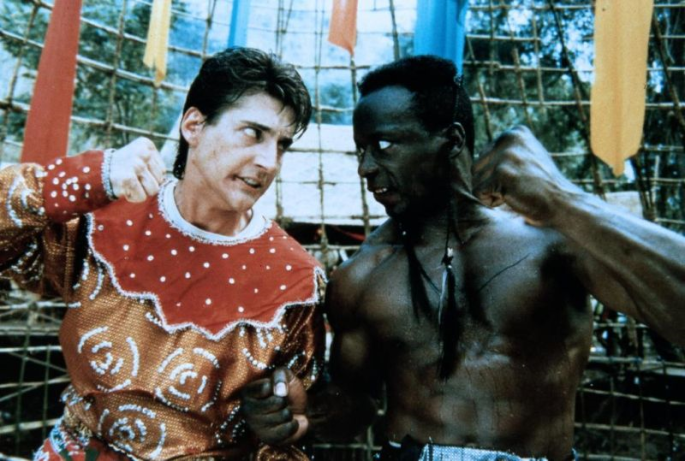
In time, two films would continue the NRNS series in the form of Raging Thunder and Blood Brothers. In acknowledging these I sought the participation of martial arts legend Keith Vitali (star of Blood Brothers & Superfights) and Loren Avedon. Loren has close to a three decade long career as a martial artist and is a 5th Dan black belt in Tae Kwon Do and 8th Dan black belt in Hap Ki Do. He received his big break when he was contacted by producer Roy Horan about a three picture deal with Seasonal. Aside from the NRNS series he would also star in the film King of the Kickboxers.

Now I must be careful here not to go ballistic and write the whole story, however, once upon a time I found myself on an 18 day bus trip through the wilds of Indonesia. It was clear from the first day we had been royally screwed by the company who was coordinating the adventure and so we spent a majority of the trip on the bus. There were three video tapes on that bus to help pass the time. One was Speed, the second was Michael Jackson’s Moonwalker, and the third was a film called King of the Kickboxers. It was fun, funny and had awesome fight sequences. Needless to say it quickly became the default movie on the bus and during the course of those 18 days I saw it many, many times.

So what is it about King of the Kicboxers that is, to me, so enduring? I suppose one could say that it was because of all the Hong Kong actioners and television (MONKEY every afternoon) I saw as a kid. KOTK, as with all the Seasonal productions, were among the first western audience films to employ the eastern style of filmmaking. Sure the reason for this is that they were co-productions and had American and international performers, but the way in which the productions were carried out and the methods employed during filming were right out pages of the eastern action movie play book. I guess the short answer is I just have a tremendous affection for straight to video movies like this. They came thick and fast once upon a time; lots of junk. Amongst all that product thought there were gems to be found. This was one such precious stone.

I recommend you take a look at KOTK before listening to the above interview, as I believe it will give you a better insight. But if you are already a fan of all films Seasonal and are like me, a devotee of KOTK, then press play above and listen along as the star of the show takes us behind the scenes of a movie that may have been forced upon me initially, but which now I watch over and over with both a warmth nostalgia and ever-increasing fondness.

I have interviewed Loren in greater length than what you will hear – but that is for other purposes. I thank him here publicly for his time and friendship and for assistance in the writing of a book whose time has come.

I CARE JACKSON!

PS: If you would like to listen me and Video Night Podcast honcho Michael Cook talk more about Seasonal Films then take a stroll down action lane:

http://l.facebook.com/l.php?u=http%3A%2F%2Ftraffic.libsyn.com%2Fretrorocketentertainment%2Fkent_hill_martial_arts.mp3&h=lAQEb7lVr&enc=AZP5xIKsNJA9393FuLN_0CRR63RNo24q4f3Ntja1kxHpk3O8jLkIIWJLJIHr5QR-BjFhgIAY24YMxMP1sdTRhpmzuy2NxAVH7–wN208pZ5630CyqkayHBSRN9pCenTU_6a5UCpvgMzEbJK5446ZKblHsSEpSwMZ8MCV8CGZ6BS26fpn8P3pwOeQx4c4t6155wklsv2-4qZ3Yiu27pJkqPWd&s=1


The Screenwriter of SEAL Team 6: An Interview with Chuck Pfarrer by Kent Hill

This slideshow requires JavaScript.


When I think of the film Navy SEALs nowadays, that line of Randal’s from Kevin Smith’s Clerks is usually the first thing that pops into my head(I hope Chuck will forgive me):

Randal Graves: They never rent quality flicks. They always pick the most intellectually devoid movies on the racks.

Low I.Q. Video Customer: OOOOH! NAVY SEALS!

If this is Mr. Smith’s point of view on the movie then so be it. After this thought fades away though, I find myself placing Navy SEALs up there with all those glorious military/action movies from the 90’s like Fire Birds, Flight of the Intruder, Under Siege, Hunt for the Red October, the Iron Eagle films, just to scratch the surface.

The film’s writer, Chuck Pfarrer was the perfect choice to pen such a movie – Chuck, you see, used to be a Navy SEAL. After graduating from military school plus two other colleges he went through Basic Underwater Demolition/SEAL training (BUD/S). Over the next eight years he racked up an impressive military career serving as a military advisor, training NATO forces, an executive officer of the SEAL Team assigned to the Multi-National Peacekeeping Force, before ending as Assault Element Commander at the United States Naval Special Warfare Development Group (DEVGRU), formerly known as SEAL Team 6.

Then Chuck went and did a crazy thing – he became a screenwriter.

With movies like Darkman, Barb Wire, Hard Target, The Jackal, Virus and Red Planet, plus uncredited writing on Arlington Road, Second Nature, Sudden Impact and The Green Hornet, as well as being author and creator of graphic novels for Dark Horse Comics, and writer/ producer on interactive full motion videos – all this on top of being a bestselling author – Chuck Pfarrer has traded one distinguished career for another.

Still the man remains humble and I was delighted to hear during one of our chats, that he refers to himself (as I do) as merely a scribbler. He has been busy promoting his new book Philip Nolan: The Man without a Country, but he has taken time out to have a chat about adventures in the movie business.


KH: Sir, it is a privilege for you to take time out of your busy schedule to chat with me?

CP: Thanks, Kent, for asking me.

KH: I am a big fan of both your fiction (Killing Che) as well as your non-fiction (Warrior Soul), but round these parts we talk about movies, so we shall focus on your screenwriting days if that’s okay?

CP: It’s absolutely true that screenwriting gets all the sizzle.

KH: So how did you get started in Hollywood?

CP: Oddly enough, I sold a couple of screenplays while I was in the navy. They didn’t go anywhere but they did get optioned and that encouraged me to try my hand after I got out of the Navy. When I left the SEAL Teams I was going to go to medical school to be a psychiatrist.  While I was waiting for acceptance into medical school, I sold a screenplay about Ernest Hemingway and I thought, probably naïvely that I should go to Hollywood and give screenwriting a try.  I got lucky and sold another screenplay based on my experience in the SEAL Teams. It became the movie Navy SEALs and based on that screenplay Sam Raimi hired me to write the film Darkman.

KH: Did the impact of Warrior Soul help when it came to shopping Navy Seals around town?

CP: Actually, I didn’t write Warrior Soul until I was pretty deep into my Hollywood career.   When I first sold the screenplay for Navy SEALs an editor at Knopf wanted me to write a book about the SEAL teams.  I refused because no SEAL had done that yet.   Richard Marcinko was the first SEAL to write about our community. Before that, no one in the Teams had written about being a SEAL. Navy SEALs are so famous now it’s hard to imagine that just about 10 or 15 years ago the community itself (and the government that hires us) considered the entire program too secret to write about.  With Warrior Soul I was only the third SEAL to write about SEAL Team Six, and I did so only after my commanding officer Bob Gormley wrote his book Combat Swimmer.  I didn’t want to be the first SEAL to write about SEAL Team Six.

KH: What was selling that first script like?

CP: The first screenplay I sold was actually about Ernest Hemingway’s life in Cuba. I sold that while I was still on active duty as a Navy SEAL. I co-wrote it with a great friend of mine, Richard T. Murphy, who was then in the MFA screenwriting program at NYU.  To our shock, our screenplay was nominated for Focus award and William Morris signed us both.  We suddenly found ourselves as working screenwriters.  It was especially strange for me because with that signing, I became the only Navy SEAL with a William Morris agent.

KH: You have created graphic novels, but your first clash with the comic book style world was working on Darkman?

CP: It was great working with Sam Raimi on Darkman. He’d recently finished The Evil Dead and had a really good idea about what he wanted to see in Darkman. Sam’s style is big and brash, and his films move by leaps and bounds. Sometimes it was a bit of a fight with Universal to make sure Sam got what he wanted.  In the end the battles were worth it.  We were all very happy with how the film came out and it was really a great honor to work with Sam, and a lot of fun.

KH: Let’s talk Hard Target, and your debut as an actor, you are Douglas Bender; killed in the film’s opening scenes?

CP: I was in New Orleans working with John Woo to make the movie, which was pretty unusual for a screenwriter but there were some small tweaks in the script that needed to be made as we went along. We were about three weeks from the wrap of the movie when John came to me and said, “I want you to play Douglas Binder”.  At that point in the draft we were shooting there really wasn’t much about the character Binder. As a victim, Binder had been basically a chalk mark on the sidewalk.   John and I went out to dinner and John told me about the 10-minute opening scene he had decided to do about the murder of Douglas Binder. It involved almost 10 days of shooting.  Binder winds up getting hunted all over the city of New Orleans, shot at, stabbed with arrows, run over by motorcycles, blown up and finally shot through with a cross-bow.   All very exciting — that is, until I wound up doing all of my own stunts. At the end of it I was black and blue. John Woo was also a director with a really clear vision and worked in a very collaborative way with the writer to get exactly what he wanted on the screen.   Working with John was a privilege.   He’s really an amazing and extremely creative guy.

KH: You now cross paths with another comic-book style piece in Barb Wire. Tell us of that experience?

CP: That was a nightmare. I had written a series of graphic novels for Dark Horse and they came to me and wanted me to do a rewrite on the script. I read it; it was bad, and I passed.   They came back and asked again.  I kept declining and the “negotiations” finally reached the point where the money they were offering was absolutely ridiculous and I said yes.   I had just finished the shooting script for The Jackal and I thought what the hell.  I thought I would be just another anonymous pencil trying to make the script into something.  The script was so bad I thought I could make it better, but I was wrong. It turned out that by the time I started working on the screenplay for Barb Wire, the previous writer had already submitted paperwork to take her name off the movie.  The fine print of my contract prohibited me from taking my name off the final product.  No matter what I came up with for the script, the notes from the studio never allowed me to make any real changes to improve it.   I thought the whole thing would go away, but the movie got made, it came out, and it was a train wreck.   And my name was on it.  It’s funny now.   The movie they made was so bad it even got a Razzie award.  It just goes to show that you should never do things you don’t believe in, and you should always read the fine print of your contracts.

KH: Bruce Willis is The Jackal. How did this gig come across your desk and did you have the opportunity to meet Bruce?

CP: I was at Universal and finishing up a three-year deal. The studio came to me and told me they had just bought the rights to The Day of the Jackal and asked me if I wanted to write a remake. I said no. However, the studio gets what it wants.  Eventually, they twisted my arm and I said yes.   During the time I was writing it they were vacillating a bit about calling it a remake.  I submitted the script and they were actually very happy with it.  We went right into preproduction.   I thought that they were no longer going to call it a remake, but simply just set it up as a brand-new movie.  Wonderful, I thought.  There won’t be any blowback from fans of the original film.  When they cast Bruce Willis and Richard Gere I was even happier because I realized they were going to make a serious movie out of it.  On most of my movies, I wind up training the actors how to use firearms, how to shoot and move, etc.  Diane Venora, who played the Russian investigator, worked for about a week with me on the LA SWAT Team range in LA.  I didn’t work very much with Bruce—his schedule was full right up until shooting.  I saw him on the set, of course, and talked to him as we worked.  But to me the biggest thrill on The Jackal was getting to work with Sidney Poitier– probably the only time in my career that I was ever star struck.   He was a joy to work with, a craftsman, a professional and a gentleman of the old school. Just to add it too—he did his own stunts!

KH: Virus I thought was a great movie and Donald Sutherland was delicious in his role. The film is based on the graphic novel of your creation?

CP: I pitched Virus to Universal at the beginning of my three-picture deal and they passed on it.   So I went ahead and wrote the series of graphic novels using the idea for Dark Horse.   They wound up selling 400,000 copies.   I went back to the studio armed with the four graphic novels, and the studio saw the potential, and told me to write it. Virus was made on the cusp of the age of digital filmmaking.   It was a story about bringing to life machines infected with a digital “Virus”, machines that could replicate themselves and use human tissues. It called for some really complicated effects.   The studio spent millions building the machines used in the movie.  The digital image technology just wasn’t there yet.  And there were some huge hurdles for the filmmakers to get over.  To be honest, I didn’t care very much for the movie.  I was rewritten and I didn’t think that the real human drama of the “events” came through.  

KH: Writing comics and also video games; was it a case of something you always wanted to do, or is it an opportunity seized upon?

CP: I was approached by Tusmani Media just after we made Virus to make interactive movies. They had a new technology that allowed them to vary story paths in video and they asked if I’d be willing to write them a script.   We did Flash Traffic and then Silent Steel.  Again, this was on the cusp of the digital age—we did some heavy-lifting.  It was really interesting for me to write scripts with multiple outcomes.   They weren’t shooter games—they were interactive thrillers.   We were doing things then that no one had ever done.   Now with GTA and products like it, “interactive” stories happen every day.  It was really great to help take that from theory to reality. There are still things yet to be done with the technology. 

KH: You got Val Kilmer to the surface of the Red Planet which was shot in my neck of the woods, Australia?

CP: It sure was. We were originally going to shoot it in Namibia.  I was going to direct it, but the studio went in another direction, and I was thrown a bone as Executive Producer.    The original script was called “Alone”, and like “The Martian”, it was about one guy, alone on the surface of Mars.  It was the studio that added three other guys.  I guess the original screenplay was the way to go. Fifteen years later someone shot something very like the original script and it was extremely successful.   One of the big frustrations about being a screenwriter is that your work passes through other “creators”.  When they improve the work, it’s great; when they drive it off a cliff, the easiest thing to do is blame the original writer!

KH: Like Bill Goldman, do you have any interesting tales that have not surfaced from the Screen Trade?

CP: Bill Goldman said it all. Almost everything he said in the book happens everyday to screenwriters in Hollywood.   Sometimes working in the process is great; sometimes it is a complete stick in the eye.   Part of it is the way the Guilds are set up.  If a director is hired for a film, that’s it—he is the director.  When a writer comes up with an original screenplay and the studio buys it, the studio is free to hire a dozen other writers to “improve” the screenplay. It is interesting what is happening now in TV. Writer/creators have the power to maintain their original idea—and that has been an epic move to correct the abuses that happen in feature film. When the studios hire a writer-creator to run a show, the vision gets to the screen.     That has changed series TV but feature films are going to stay as frustrating as ever.

KH: I found you have done uncredited script work or punch-ups as it is sometimes referred on scripts like Arlington Road, Sudden Impact, Green Hornet. How does this work come to you and is it tiresome to do such work and yet remain uncredited?

CP: It’s just part of the job. Sometimes it’s a lot like being a session player on an album.  You are hired as a technician a lot of times to come in and “punch up” the dialogue or get the plot sorted out.   The problem with changing anything in a screenplay is that it soon becomes very, very complex.  A small change in act one reverberates though the entire movie.   The crediting process through the writer’s guild is also complex.    For the most part, I think it is pretty fair.  I know the process is as honest as it can be.   In most cases, when I do a rewrite, I don’t ask for credit.   Arlington Road and Green Hornet are examples of work I did without credit. With Second Nature I didn’t even know they were shooting the script–and a lot of what I did went into it. 

KH: You’ve not had a film out since Red Planet; are you still developing scripts and what is the status of your latest film Crash Site?

CP: I have a few things in development– the effort goes on. As far as Crash Site is concerned, it is no longer being developed by ALCON. It is in turn around, in the hands of another producer. But I am working mostly now as a novelist.   I have a historical novel, Philip Nolan: The Man without a Country, that just came out from the Naval Institute Press, and I am working right now on a thriller.   It has been amazing to me how differently writers are treated in publishing and in screenwriting.  In publishing, the writer is the creator, and in screenwriting the writer is an expendable commodity.    The important thing—always—is to create believable characters and put them into interesting plots.   That’s the joy of the process for me.  That, and entertaining the people who see my movies or read my books. 


Again I offer my thanks to Chuck, for not only his generosity, but for taking the time out of busy schedule for this interview. He is a gentleman and a scholar, as well as being a truly unique and interesting character whose life and career are to be marvelled at.

All the films he has written are widely available on DVD and Blu-Ray. Below I have placed links to his books so that you may see for yourselves that he not simply a screenwriter or a novelist – but a great writer in general…

https://www.amazon.com/Philip-Nolan-Man-Without-Country-ebook/dp/B01CN2L7VI/ref=sr_1_1_twi_kin_2?s=books&ie=UTF8&qid=1480462242&sr=1-1&keywords=chuck+pfarrer

https://www.amazon.com/Warrior-Soul-Memoir-Navy-SEAL-ebook/dp/B000FC0XZK/ref=sr_1_3_twi_kin_2?s=books&ie=UTF8&qid=1480462242&sr=1-3&keywords=chuck+pfarrer

https://www.amazon.com/SEAL-Target-Geronimo-Inside-Mission-ebook/dp/B006BDDU4S/ref=sr_1_4_twi_kin_2?s=books&ie=UTF8&qid=1480462242&sr=1-4&keywords=chuck+pfarrer

https://www.amazon.com/Virus-Graphic-Novel-Chuck-Pfarrer/dp/1569713170/ref=sr_1_6?s=books&ie=UTF8&qid=1480462242&sr=1-6&keywords=chuck+pfarrer
Frogtowns and Fiascos: An interview with Randall Frakes by Kent Hill

This slideshow requires JavaScript.

Hell comes to Frogtown was like nothing I had seen up to that point. It was near midnight when my cousin Rick and I were watching it. He insisted we had to wait till all the grown-ups in the house were asleep.

This was a common occurrence of the times. Although I remember the day we were watching Robocop and my mum came past the room right as the guy robbing the convenience store was firing at the tech-resurrected Murphy screaming: FUCK ME! FUCK ME! FUCK ME! My mother said she was concerned about the language, but Rick always had a way of smoothing it over: “We’re not listening to the swear words Aunty Jen, we’re just digging the robot.”

Though the night we were checking out the adventures of Sam Hell, Rick insisted it had to be a stealth mission. “It’s got sexual references and boobs in it, as well as a mutant frog with three dicks” he said. I admit I failed to see understand his fear. After all there were boobs aplenty and these mysterious sexual references in most of the sword and sorcery videos I’d watched already. (Though I confess I had yet to witness and mutant frog with three dicks, I didn’t see it as something taboo, after all we’re talking about something completely implausible.)

“What did your Mum have to say about that?” asked Rick.

“I just followed your lead,” I said, “and told her I was only interested in the cool creatures and the sword fighting.”

He smiled and slapped me on the back.

Thus the movie began, and what a movie – truly unique and splendid.

For the uninitiated, Hell comes to Frogtown is a story set in a post-apocalyptic future where mutant frogs are considered a general nuisance and men are infertile. Enter Sam Hell; (Rowdy Roddy Piper pre They Live and Immortal Combat) he is conscripted by the powers that be to make love to complete strangers in a hostile, mutant environment. That on top of hooking up with the sexy Sandahl Bergman (All That Jazz) and Cec Verrell (Runaway plus a lot of TV) to go on a mission to the fabled Frogtown to rescue a bunch of kidnapped chicks from the nefarious Commander Toty and his three snakes. When Sam isn’t having his wedding tackle fried by Spangle (Bergman) and tellin’ the froggies to eat lead, he has to contend with Count Sodom/Captain Devlin (that’s right kids its Conan’s Dad), William Smith.

But the hero saves the day, gets the girls, stomps the frogs and goes off to impregnate the masses; a soldier’s work is never done. It is a romp with everything on offer: comedy, action, nudity, the dance of the three snakes and much more.

When I was putting together Conquest of the Planet of the Tapes I reached out to Frogtown scribe Randall Frakes, a thirty year veteran of the film business. He was cool and quickly agreed to write a piece for the book (which you may sample below.) Randall has had many adventures in the screen trade; from making an earlier short with future Oscar winner James Cameron (his friend and frequent collaborator), to working in the effects department on Corman movies, to his collaborations with the late, great Zen-Filmmaker Donald G. Jackson and most recently playing a part in the fiasco which was Empires of the Deep. He remains constant as well as persistent and was very kind to take the time to have a word with me for PTS:

KH: Was working in the movie business always your dream and what film did you see which got you hooked?

RF: Yes, from about the age of seven, after I saw Robert Aldrich’s 1956 adult war movie “Attack!” starring Jack Palance and Eddie Albert. It is brutal, honest and intense.

KH: Can you tell us how you got into the business, or broke in?

RF: James Cameron and I made a short film that was one scene from the first script we wrote together, called XENOGENESIS.

KH: Like a lot of aspiring filmmakers of the period you went to the Corman School of movie-making?

RF: I did, only in the sense of working in Corman’s special effects department as a cameraman, doing shots for BATTLE BEYOND THE STARS, ESCAPE FROM NEW YORK, and GALAXY OF TERROR. I tried to get a project going with him, but Roger has little sense of humour or satirical irony where his movies are concerned and I was at a stage where I really could not take the movie business all that seriously, so nothing ever came of it.

KH: You are good friends and have collaborated in one form or another with Jim Cameron during the course of his career?

RF: Yes, he calls me “his hip pocket guy,” and “Hollywood’s best kept secret.” I have been an official and unofficial story consultant on most of his projects, including the AVATAR sequel.  I also co-wrote the screen story for “TRUE LIES.”

KH: You were very gracious in writing a piece for my book about the glorious thing that is Hell Comes to Frogtown. You worked a number of times with Donald G. Jackson?

RF: Oh yes, on “ROLLER BLADE”, its sequel and ghost writing a few other titles. He loved avante garde films with little or no plots.  He called it Zen Filmmaking, and he was good at it.  But I am more traditional, influenced not so much by underground comics or the beat generation, but more so by Howard Hawks, Alfred Hitchcock and Delmer Daves.  We did not jell well on most of the projects, because we were always instinctively fighting each other’s styles, but we synchronized fairly well with Frogtown.

KH: You have spoken about what happened on Frogtown probably more than you care to, but, are there any revelations that have not surfaced that you can share?

RF: None, really. I am amazed I could remember the things I do.  That was a long time ago, in a galaxy far, far away!

(You can read Randall’s contribution to Conquest of the Planet of the Tapes: Straight to Video 3 here: https://podcastingthemsoftly.com/2016/08/14/excerpt-from-conquest-of-the-planet-of-the-tapes-straight-to-video-iii-when-hell-came-to-frogtown-by-randall-frakes/)

KH: You have worked steadily through the 90’s and into the new millennium with credits like Blowback, Devil’s Prey, Instinct to Kill, Groupie. How has it been working as a screenwriter over the years and how if at all has the landscape changed as far as selling scripts?

RF: The spec market has totally tanked. It is all assignment writing.  And to make a living at that, you need to form alliances with a mafia of producers, a group who regularly make movies based on novels, plays or songs or old TV shows (pre-branded, in other words) and who like your work and are always handing you off to another producer friend after finishing the last assignment.  Today it is really rough for an original and vital new voice to get traction in this town.  Not impossible, but VERY difficult.

KH: I read a great article recently about Empires of the Deep. I love grand tales of hubris. Can you share your side or your experience on the production?

RF: The short version is I gambled and lost. I could not convince the Chinese producer that he was wrong and I was right.  He used very little of what I wrote, and what he did use, he realized it poorly.  And I believe it was not a translation or cultural clash problem.  The guy was just a dolt.

(If you would like to read more about Empires of the Deep, this is a good in-depth piece: https://magazine.atavist.com/sunk)

KH: Do you have any great tales from set on any of the films you have worked on?

RF: Generally, I write ‘em and then move on as fast as I can to the next one. No one really wants a writer around on the set, and it’s mostly boring and frustrating to be there unless you are directing, so I have little contact with the actual picture-making process.  I tell stories.  That excites me.  Watching my characters and dialogue butchered by well-meaning but superficial changes is not so much fun.

KH: I have been trying to get a toe in the Hollywood pond for years. As a veteran of the business, what advice would you give to those still climbing the mountain?

RF: Make a short or a feature on your own dime, that is startlingly different and yet somehow familiar. Something with a strong “hook,” like clever lyrics to a hit song.  Then post it somewhere online and hope it gets noticed and wins some awards.  Then get an agent and write the best damn screenplay ever written and attach yourself as director.  Hey, it worked for Cameron, but that was a long time ago, when people who still cared about quality story-telling were producing movies. Not like now, where many of the people making movies are from the point-and-shoot video game generation, and know little about real people, real situations and real human psychology.

KH: Do you have any projects of your own that have gone unmade which you have long wished to see come to the screen?

RF: Only about fifty. Kidding, more like five.  One way or the other, I will get them made.  The key word to surviving in this town is PERSISTENCE.  You have to have a ton of it.

KH: I remember back a ways we were chatting and you mentioned you were in talks with some folks who wanted to remake Hell comes to Frogtown with Dwayne Johnson – can you comment on the status of the project. That Rock, he wants to remake everything?

RF: He doesn’t, it’s his agents who want him in branded projects that they believe have a chance to be successful. The remake is stymied for the moment due to lack of clarity about the legal remake rights . . . who has them and are they willing to make the sequel? That is being investigated as we speak.

KH: Well thank you sir. From this great admirer of your work and for contributing to my book I proffer you my humble thanks?

RF: My pleasure.


That was Randall Frakes everybody. If you haven’t heard the name you may have at least seen the films he has written; the novelizations and or listened to his great commentary with Donald G. Jackson on the Frogtown DVD.

If you haven’t . . . now’s the time.

Thunder Levin: An Interview by Kent Hill


Error
This video doesn’t exist


It was because of a whacky-clips-from-the-internet-show called The Soup that I first became aware of  the glorious thing that is Sharknado.

Near the end of the show there played a short clip of Ian Ziering of all people, cutting himself free from the guts of a shark with a chainsaw. I was, I must say, smitten from the beginning. Then I saw that this instant phenomenon was showing for one night only at a local cinema. I was there with bells on – what a hot ticket.

It was dizzying, ditzy and deliciously good. I saw it again, soon after, on the Universal Channel which had a great programming night called Mockbuster Mondays, where it played along with its director’s, Anthony C. Ferrante, Two-Headed Shark Attack.

Sharksploitation was in full swing, and of course, based on the strength of the overwhelming popularity of the first, hot on its heels would come The Second One. They are up to 4 now, with a 5th on the way. I had contacted Anthony during post-production on Sharknado 3 about writing the foreword for my anthology The Sequel: Straight 2 Video, which he graciously agreed to do. The book came out at the same time as Oh Hell No! – and coincidently, I too was well into my own third instalment Conquest of the Planet of the Tapes.

I reached out at that time to Sharknado scribe Thunder Levin to be a part of the filmmaker commentary which ran throughout the span of the Conquest. He, unfortunately, was busy at work on a script. In the weeks that followed there soon came an announcement on my news feed of Sharknado 4. “So that’s the script he was busy with,” I thought, smiling at the prospect.

At long last, and in the wake of The 4th Awakens, I was finally able to sit and have a chat with this multi-talented gentleman, who did the hard yards in Hollywood for quite a number of years before he became part of the creative team that would bring to the world the perfect storm – seeing sharks and tornadoes come together in the coolest possible way.

So, ladies and gentlemen, I give you Thunder Levin. Enough said…

PTS Presents Director’s Chair with Terry McMahon

mcmahon-powercast

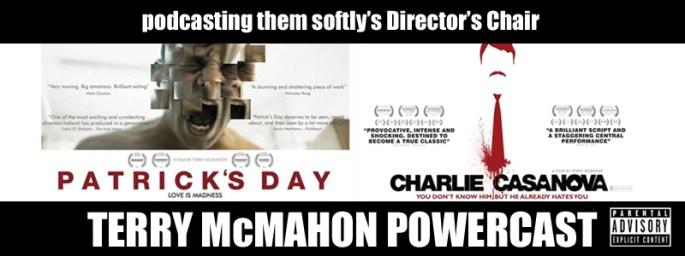
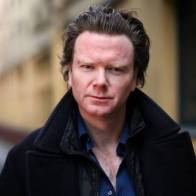
terry-mcmahonPodcasting Them Softly is beyond excited to present a conversation with filmmaker, actor, and teacher Terry McMahon! Terry‘s two feature films, Charlie Casanova and Patrick’s Day, are some of the best pieces of cinema to come out of Ireland in recent years, with Patrick’s Day making a big splash over the last two years as both a brilliant piece of cinema and enduring conversation piece. Terry‘s a filmmaker who is interested in society, people, and how we all relate and communicate with one another, and his keen eye and sharp voice can be seen and heard in everything he does. An actor, producer, writer, and director, Terry is a true talent, which was solidified when Patrick’s Day, which premiered at the 2014 South By Southwest Film Festival, was nominated for 9 Irish Film and Television Awards, and winning three, for Best Screenplay, Best Sound, and Best Actor for Moe Dunford. Terry also made an appearance in Christopher Nolan’s Batman Begins, and serves as an acting coach for Dublin-based performers. We hope you enjoy this informative, passionate, and humorous chat with one of the biggest personalities that we’ve had the pleasure of speaking with thus far!
PTS Presents Writer’s Workshop with Eric Heisserer

arrival-powercast

unnamed-1Podcasting Them Softly is beyond thrilled to present a chat with screenwriter Eric Heisserer, whose new science fiction film, Arrival, hits theaters this weekend! Riding a wave of stellar reviews and showcasing the directorial talents of Denis Villeneuve (Prisoners, Sicario, the upcoming Blade Runner 2049), Arrival has all the makings of an instant genre classic, and we were honored to be invited to take part in the official media junket for the first time. We’d like to extend an extra special thanks to the publicity departments of Sony Pictures and Paramount Pictures, Lauren Woods at PMKBNC, and Eric himself for making this happen! Hope you enjoy this fast but informative discussion about one of our most anticipated films of the year!
BMX Bandits & The Headman’s Daughter: An Interview with Brian Trenchard-Smith by Kent Hill

Error
This video doesn’t exist


I have a pair of cousins with whom, during my formative years, I watched a selection of movies that, without the restriction of the parental guidance that was recommended, I might not have seen till much later in my cinematic education. Thus it was during one of our all night video marathons, I happened to see a little movie titled Turkey Shoot.

I found it frenetic, funny – a great beer and pizza movie – or soda and potato chips I should say, in case my mother reads this. The director, whose name I would enthusiastically relay to my friends, after watching the flick again a number of times, was Brian Trenchard-Smith. A name not easily forgotten – so much so that when I next strode those long crimson carpeted aisles at my beloved video store, I looked for his name, for more of his work, soon discovering a treasure trove of great films: The Man from Hong Kong, Deathcheaters, Stunt Rock, Dead End Drive-In, Frog Dreaming, and Day of the Panther just to name a handful. I am not ashamed to admit I love the Leprechaun movies and Brain also helmed a pair of those.

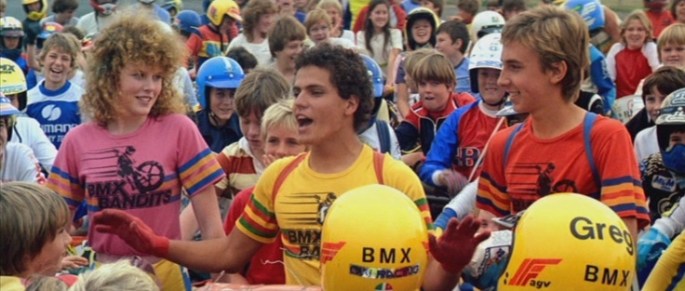
Back in the middle of all these discoveries I came across his film called BMX Bandits. It like so many films during that period of my life became something I would revisit constantly over the years to come. It is the film that brought Nicole Kidman to public consciousness as well as, I believe, is a movie that was at the forefront, as far as having guys robbing banks in novelty masks. It is also the film that boasts one of my favourite lines of dialogue: “I’m not going into that cemetery dressed as a pig.” It has the brilliant photography of a future Oscar winner, a rip-roaring chase sequence, a delightful moustache-twisting villain, comedy aplenty as well as being playfully sinister at times.

Being a fan of all of Brian’s movies it was tough, before asking him for a sit-down, to decide which film to focus on. I admit I had fantasies about taking an hour to indulge in production tales from Leprechaun 4 but I, in the end, opted for my sentimental favourite.

We began our discussion with Brian’s new book, The Headman’s Daughter which, once I finally get a shot to kick back and read it, I’ve a feeling that his unique, sometimes crazy, often thrilling cinematic voice will come to life on the printed page.

So find a comfortable chair and listen along as we talk about a brilliant filmmaker’s literary birth on top of the movie that Quentin Tarantino weathered a storm of discontentment over, after he confessed before an audience that he liked it better than The Goonies.

Ladies and Gentlemen, I give you the one and only, Brian Trenchard-Smith . . . .

Richard Stanley: An Interview by Kent Hill

Error
This video doesn’t exist

I first contacted Richard in 2015 with regard to the Straight to Video trilogy of anthologies I was putting together. He responded promptly and was very enthusiastic, saying he would work something up. Then he disappeared. I thought I had lucked out, when out of the blue he contacted me again; he had indeed been working on a piece and that he had not forgotten me. When what he had written arrived it was more than I dared hope for. Richard had crafted a heartfelt reminiscence of his youth, his early VHS adventures and then his first steps along the path which would eventually see he become the incredible journeyman filmmaker that has refused to let the creative fire within him subside.

So can lightning strike twice? Poised by my recent successes in securing audiences with filmmakers I ardently admire for interviews on this site, I thought I’d reach out once again, to that man who delivered more than I’d asked for. Greedy? Sure. Yet I am as fascinated by Richard Stanley as I am with his cinema. In David Gregory’s thrilling documentary, Lost Soul: The Doomed Journey of Richard Stanley’s Island of Dr. Moreau, I was, as I often am, intrigued with the journey storytellers take on the way to finally realising their ultimate pinnacle.

I was determined however, not to walk the road much travelled with Richard. I would keep it all as informal as possible, and along the way I found myself at times simply sitting back, letting this natural raconteur do his thing. We went back to the Island, because I admit I wanted to know a little more; we touched on Richard’s collaboration with the late Michael Herr; talked about the current state of cinema; being trapped in the transit lounge on 12 Monkeys. There was Judge Dredd, Ron Perlman, H.P. Lovecraft, Jodorowsky, and even the promise of a future autobiography which I will happily put down the cash for right now.

Again Richard Stanley offered up more than I could have hoped for, and I come away from the experience with even greater respect for this extraordinary gentleman and a hope – hope that there might come a day when the uncompromised vision of this richly unique artist can at long last see the light of day – finding it’s way to a cinema near us all.

To Richard my profound thanks. To the rest of you . . . enjoy.

(Disclaimer: – Our connection was hampered by a storm raging outside Richard’s house so I ask for your forgiveness. I had to edit around some spots where the audio and visual dropped out momentarily. Aside for some sound sync issues, the awesomeness of this conversation I believed has been preserved.)


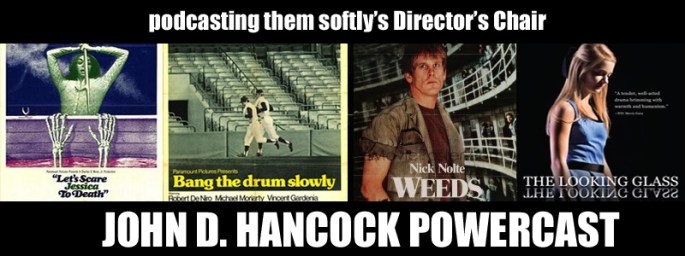
PTS Presents DIRECTOR’S CHAIR with John D. Hancock

HANCOCK POWERCAST.jpg

John Hancock.jpgPodcasting Them Softly is thrilled to present a discussion with filmmaker John D. Hancock! John is the director of the 70’s horror classic Let’s Scare Jessica to Death, the highly acclaimed baseball drama Bang the Drum Slowly with Robert De Niro and Michael Moriarity, Baby Blue Marine with Jan-Michael Vincent, the cult classic California Dreaming, family holiday favorite Prancer, and the prison drama Weeds with Nick Nolte. His most recent film was The Looking Glass (currently streaming on Netflix), which was a collaboration between John and his wife, Dorothy Tristan, who in addition to delivering a superb lead performance, wrote the film’s sensitively observed screenplay. His impressive TV credits include Cover Up, Lady Blue, Hill Street Blues, and The Twilight Zone, as well as multiple made for TV movies. He’s also a veteran of the stage, having directed works from Shakespearre to Saul Bellow, as well as versions of ‘night, Mother and Noises Off. He served as the Artistic Director of the San Francisco Actor’s Workshop in 1965, and later became Artistic Director of the Pittsburgh Playhouse and the New Repertory Theater in New York City, while also collaborating with famed playwright Tennessee Williams. It was a total honor to speak with him about his fabulous career – we hope you enjoy!
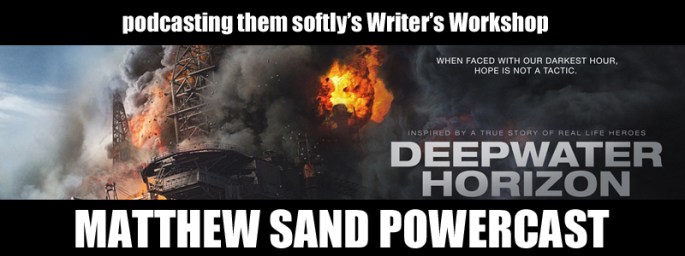
PTS Presents Writer’s Workshop with MATTHEW SAND

sand-powercast

mattsand_mingasson_025Matthew Sand is the co-writer of “Deepwater Horizon.” On April 20, 2010, one of the world’s largest man-made disasters occurred on the Deepwater Horizon oil rig in the Gulf of Mexico. Directed by Peter Berg (“Lone Survivor”), this story honors the brave men and women whose heroism would save many on board, and changed everyone’s lives forever. The film stars Mark Wahlberg, Kurt Russell, John Malkovich, Gina Rodriguez, Dylan O’Brien and Kate Hudson. Lionsgate is set to release the Summit/Participant production on September 30, 2016. For Sand, the story is not about the tragedy, but a simple act of heroism.

Sand was drawn to the story of “Deepwater Horizon” after reading a New York Times piece about a floor-hand on the rig, Mike Williams, and many others. Williams, a father-figure to the crew, risked his life to save others. When Sand began working on the project in 2010, there was no list of the eleven people who died (and no president at their funerals). To honor those men, one of the first things he did was find their names and set them down.

After moving to Los Angeles from his native Brooklyn where he worked in fine art, Sand quickly began writing and has written over 40 screenplays and teleplays for all of the major studios including “The Summoner,” “Beowulf” and “10,000 BC.” This lead him to meeting sibling American film directors Lana and Lilly Wachowski, who hired him for his first credited screenplay job, “Ninja Assassin.”

“Ninja Assassin,” directed by James McTeigue (“V for Vendetta”) was released in 2009.  The story follows a young ninja who turns his back on the orphanage that raised him, leading to a confrontation with a fellow ninja from the clan.  Sand resides in Los Angeles with his wife where he enjoys rock climbing and museums.

Currently, he is working on a mini-series for the BBC about the 3rd Crusade, “Little Brother” based on the novel by Cory Doctorow for Paramount, and an untitled feature film script for Netflix.