Nobody

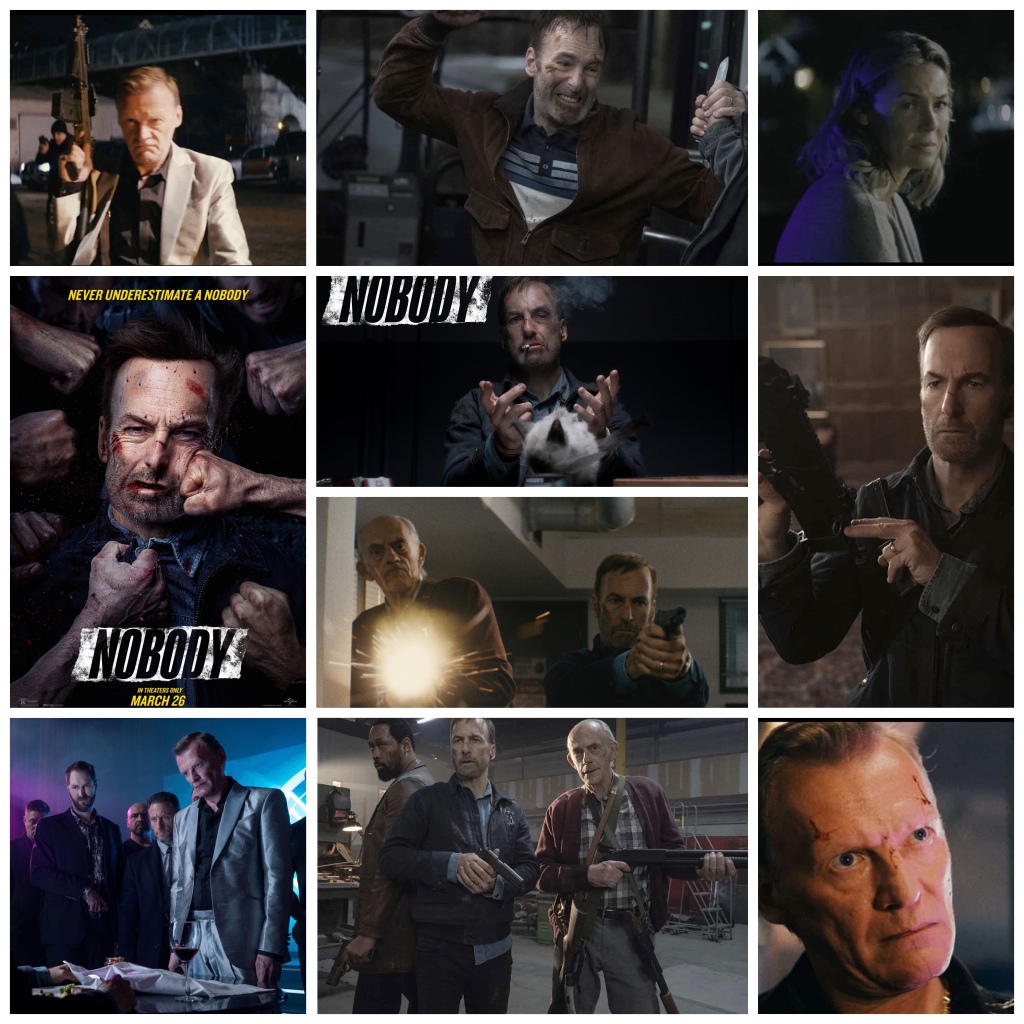
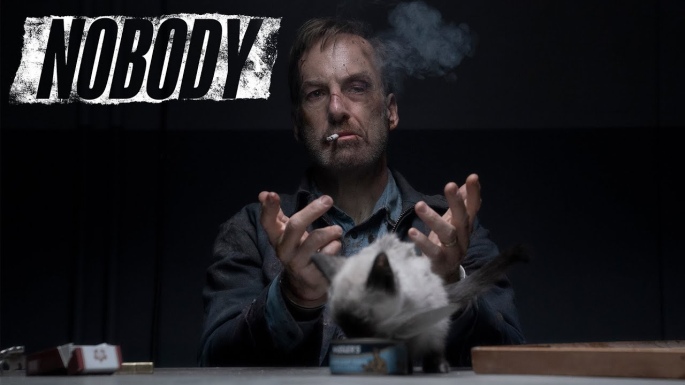
Nobody is a nice riff on the one man army revenge shtick and is not only in the tradition of John Wick, it’s also written by one half of the same creative forces behind it so it sorta has that feel, albeit of a more… suburban dad variety. Bob Odenkirk is a left field choice for the ‘invincible ex-spook’ archetype and while I had my doubts that his physicality could pull off some of the stuff I saw here, he no doubt has the grit and charisma in spades to inhabit this intense role. He’s Hutch, an unassuming family man whose wife (nice to see Connie Nielsen) and kids don’t seem to think much of him, especially after he appears to be totally ineffective at defending them from violent home invaders one night. It turns out this random blue collar family man is an ex government assassination guru and pretty soon that one encounter with burglars leads to an ongoing, cataclysmic feud with the Russian mob, spearheaded by a sociopathic (or soviet-pathic?) piece of work named Julian, played by Aleksey Serebryakov in an impressively rambunctious portrait of pure unfiltered evil, like a Slav kingpin version of the joker or something. The action here is wonderfully choreographed, relentlessly brutal and crisply filmed, especially a bone smashing close quarters fight on a public transit bus that kicks off the central conflict. The great Christopher Lloyd has a nice bit as Hutch’s dad, a veteran living in a rest home who proves he isn’t quite out for the count yet and gets some great kills in alongside his son, and we also get RZA as a former colleague who steps in for some action too. Unfortunately the film chose to include the always awesome Michael Ironside but inexplicably decided to cast him in a wholly inconsequential sideline role that has nothing to do with the plot overall and could have been played by any Joe Nobody, an ill advised casting choice that would have caused me to remove a star from the rating if I were doing that star thing. Don’t hire Michael Ironside unless it’s a memorable, badass, worthy role, it’s just common sense. Anywho, it’s a solid flick, great villain, superb action and while I may not be onboard with the hype as much as some I’ve seen, I still had a good time. I will give it extra credit for one of the most gruesome, satisfying, laugh out loud villain deaths I’ve seen in action cinema.

-Nate Hill

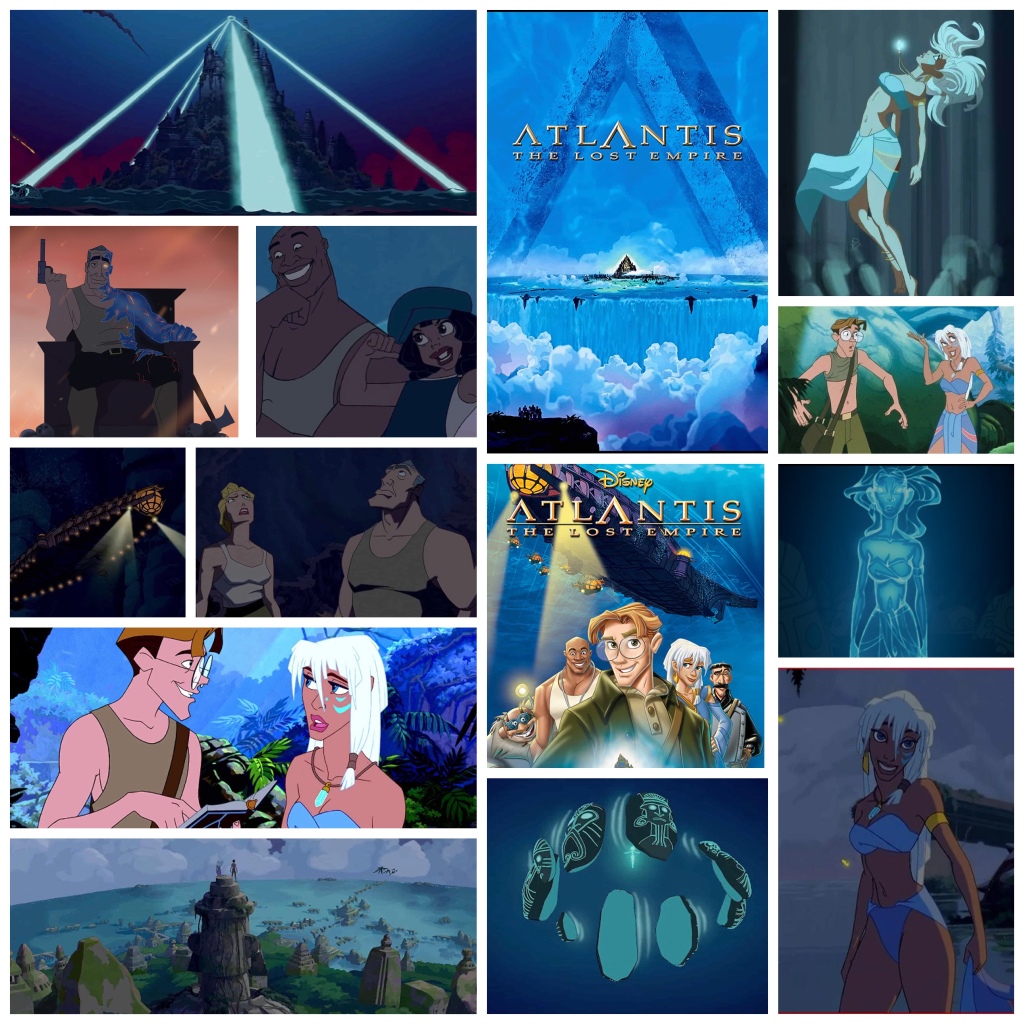
It’s interesting to me how the best Disney films, or at least the ones that I connect with most anyways, don’t get talked about too much. Atlantis: The Lost Empire is always one I was kind of dimly aware of, I had the McDonald’s toys as a kid even though I never saw the film and always thought of it as just another rote Princess storyline from the studio. How wrong I was. This is an absolutely sensational SciFi adventure fantasy on all levels, boundlessly imaginative, strikingly mature as far as Disney goes and the kind of intricately designed experience you can get lost in. In the early 1900’s young scholar Milo Thatch (Michael J. Fox in a lovely, exuberant turn) dreams of finding the lost city of Atlantis as his peers and superiors at the Smithsonian mock his efforts. When an eccentric and very rich tycoon (the late John Mahoney) agrees to fund an elaborate deep sea exploration with Milo spearheading the research aspect, it’s off to the races as a beautifully designed mega-craft descends into the Atlantic Ocean with our hero and a whole team of ragtag experts, grunts and grease monkeys onboard. The film is very realistic and fair with its characters and we get an entire fleet of fascinating individuals including an African American former civil war surgeon (Phil Morris) with indigenous roots, a cantankerous cook (Jim Varney), a Mediterranean explosives guru, a vivacious French geologist and the crew’s mercurial captain Rourke, given the commanding, affable yet vaguely menacing voice of James Garner who does a terrific job of the villainous arc. There is a Princess here but she isn’t doe eyed, sing-songy or cloying for romance every second. Her name is Kida (voiced wonderfully by Cree Summer), she’s the daughter of the Atlantean King (Leonard Nimoy, of all people) and she’s assured, strong willed and cares deeply for the plight of her race, who have fallen on hard times. There are eventual romantic sparks between her and Milo but they feel organic, earned and born out of a genuine, character development based relationship as the two get to know each other and she shows him around her striking world. The visual design and animation here is something else, even before we see Atlantis there’s a steampunk vibe to their equipment and vessel, and when we see the otherworldly biodiversity, detailed architectural splendour and tattoos/costume design it’s an atmosphere like no other. Not to mention the ballistic gong show of a climax, born out of capitalist fuelled betrayal, the very fate of Atlantis and every living thing in it at stake. This isn’t your average Disney flick and while there are the usual beats like comic relief and romance etc, it all feels far more down to earth than I’m used to from this kind of output. I’m reminded of another Disney one that has a similarly grounded, spectacularly imagined world, the wonderful Treasure Planet. I think the studio has never been as good or as inspired as their work with that one and now Atlantis too, it has to be up there as my favourite.

-Nate Hill

THE ROBERT ALTMAN FILES: FOOL FOR LOVE (1986)

I find myself experiencing deja vu as I sit to write this because I feel like I’ve visited this viewpoint before with an old review of John Cassavetes’s Love Streams. No, I’m not talking about the similarities between that film and Robert Altman’s Fool For Love (especially their big reveals halfway through their respective stories). Instead, I’m talking specifically about having talked about the Cannon Group, Inc., a fledgling studio that was purchased on the cheap by Menahem Golan and Yoram Globus in 1979, thriving during the mid-eighties by cranking out utter garbage like Over the Top and any one of the ball-busting Missing In Action pictures.

But Cannon was also a studio that was hungry for prestige pictures and marquee directors and would give those vaunted filmmakers quite a bit of latitude to bring their projects to fruition. The aforementioned Cassavetes picture couldn’t have come at a more opportune time for him, Andrei Konchalovsky managed to get both Runaway Train and Shy People produced under the Cannon flag, and Robert Altman found a safe haven with the studio after MGM stuck O.C. and Stiggs on a shelf upon that film’s completion and where it would sit for two straight years before finding its way into a release pipeline.

Instead of going hog wild with Cannon’s purse strings, Altman settled on adapting Sam Shepard’s Fool for Love, yet another filmed play for Altman which, O.C. and Stiggs aside, had been his cinematic bread and butter in the 80’s. After a decade of mostly wide-canvas ensemble pieces with busy soundtracks and a thousand other details with which to keep up, Altman found an almost peaceful place of reflection and freedom with those films that relied on one location and only a small handful of players.

With its limited cast and setting, Fool for Love was perfect material for Altman in 1986. Not so much because this kind of material had become his metier over the past few years but also specifically because it’s a piece that takes place in the outer reaches of the soul where past hurts and unrequited feelings can vacation and have too many drinks, creating a kind of combustible inner turmoil. For all of the ups and downs and the demons that Altman seemed to wrestle with throughout his career, Fool for Love comes off downright therapeutic to him.

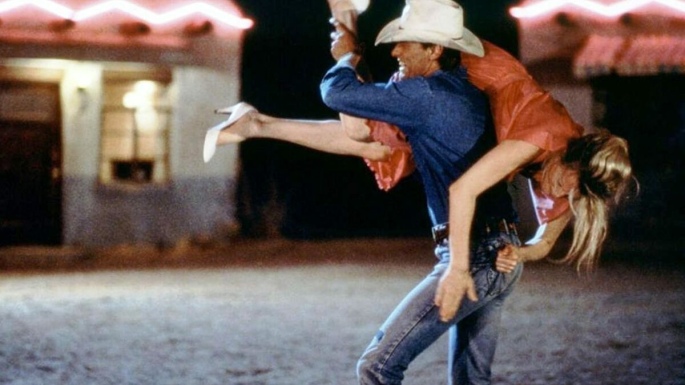
Fool for Love takes its time before revealing itself. Instead of hitting the ground running with expository dialogue between the players, it favors a dreamy mood where the dusk settles on the El Royale Motel, a horseshoe bungalow monument of desolation set on the edge of nowhere that looks like it’s mere weeks from becoming overrun with a post-apocalyptic motorcycle gang to be used as a hideout. The film doesn’t want to show its hand too early so it luxuriates in a great deal of visual flourishes and sparse small-talk while its seemingly rote and simple story of a broken love-affair plays out in front of us, Sandy Rogers’s songs mixing into the soundtrack to counterbalance the visuals as if Altman is crafting a gorgeous, long-form C&W music video.

The film’s deliberate pace is a hallmark of Sam Shepard’s work. As Shepard’s cowboys are men folded into the wrong time, they always seem like they’ve been snatched out of their time and dropped into the present day, kind of like a bewildered Peckinpah anti-hero who has to take his time to get his bearings. Drifting into the El Royale in his pickup and loaded horse trailer comes Eddie (Shepard), sometime cowboy and sometime stuntman, is in search of May (Kim Basinger), a sad, broken desert flower of lost love for whom the motel serves as both a place of employment and a refugee camp. At first, she deliberately avoids him even when Altman telegraphs that these two people are connected and avoidance is all but impossible. But he soon sees her from a distance and charges back to the motel to either rescue her, reconcile his feelings, or be resolved to reality lest the world explode around him. In the end, he achieves a degree of all three.

As this is not really a two-hander, there are a couple of other characters that inhabit the world of Fool for Love. In a bit of casting that can’t help but feel like an inspiration from the Wim Wenders-directed/Shepard-penned Paris, Texas, Harry Dean Stanton portrays a rambling man at the end of his life; a drifting, rudderless soul lording over both a literal and metaphoric trash heap in his twilight years whose life work was pissing away stability in favor of instant gratification. Randy Quaid pops up in the film’s final third as the civilized “man” who, in Shepard’s world, is worth examination in contrast to the self-governing “guy” and their verbal tug-of-war explores the subject of masculinity and its contextual, shifting definition.

Of all of Altman’s 80’s efforts, Fool for Love is among one of his bravest. It uses Shepard’s familiar and warm cowboy iconography to tell a tale that feels downright European. This clash of styles is what was at the soul of Sam Shepard’s work and persona. For he was a cowboy who nonetheless mingled with rock stars, was awarded more Obies than anyone else, and won a Pulitzer Prize for his florid and haunting words that articulated the split within the soul that can put folks into emotional spaces that are neither here nor there. Here, he shows why he was so good at interpreting his own material as he almost personifies the characters he creates. Then still wrestling with all of the cover-girl baggage that kept her from being taken seriously, Kim Basinger’s May is dishtowel dirty and quarter beer gorgeous and looks like someone you’d pick up in the back of Gilley’s. Though she rounds off her g’s while leaning into her twang a little too hard, Basinger is utterly terrific and gives one of the best performances of her career as the heartsick victim of cruel circumstances.

And, not for nothing, but Fool for Love is one of Altman’s most visually gorgeous films. While the majority of it takes place at night, the opening moment’s desert sundown is both ethereally beautiful and hauntingly portentous. The inner horseshoe of the motel is bathed in soft neon amid a cold blue outer rim creating a true geography; the motel of the mind and the junkyard of the soul courtesy of cinematographer Pierre Mingot’s careful framing and clever lighting. This is a piece populated by damaged people amid a dazzling and poetic detritus heap on the edge of the galaxy, almost like a science fiction film populated with truck stop queens and urban cowboys.

As humans, we all reside in a similar, congenial off-road memory motel. And, like the location in the film, it’s one that looks perfectly functional from the front and, honestly, perhaps it is. But behind it generally sits a heap of baggage and junk we all haul around from the past, some of it half-remembered and some of it fanciful myth-making. Understanding this, Altman’s work is full of characters who will add new wounds to established scar tissue if they think the self-deception will be less painful than the truth they would have to admit, creating more and more material for the junk pile. But, word to the wise, absolutely NEVER think that heap is too cleverly hidden from view nor something that won’t explode if exposed to the the right confluence of elements. If Fool for Love understands anything outside how to doom a film’s commercial prospects by being saddled with a one-sheet that makes the film look like Tender Mercies II: Tender Mercies Gets Laid, it’s most definitely that.

(C) Copyright 2021, Patrick Crain
Rituals

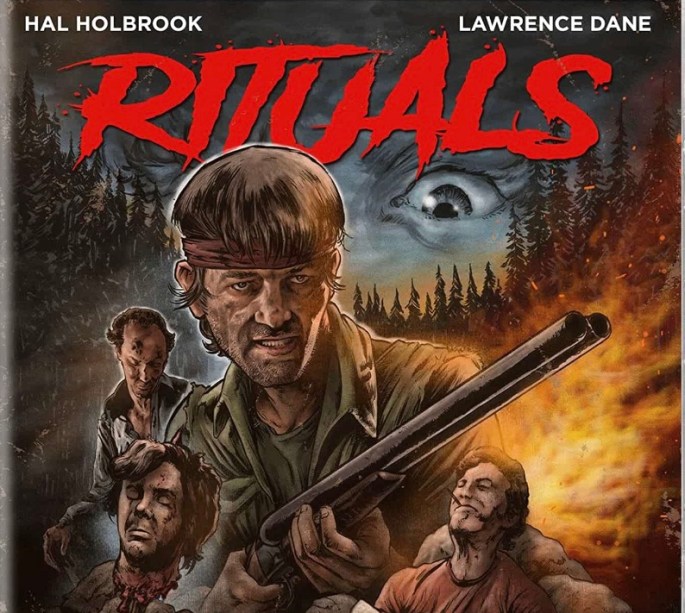
I’ve had some gnarly camping trips into the Canadian wilderness myself, but none so brutal, backbreaking and harrowing as the Ontario expedition that five bickering middle aged doctors embark on in Rituals, a punishingly intense, staggeringly effective thriller that despite a low budget, is about as high impact as possible. The cast is headed up by the late great Hal Holbrook and Lawrence Dane, two pack leaders in a team of five career medical professionals who are so far from the white coats and fluorescent lit hallways they usually no doubt inhabit, on a ruthless trek through the harshest terrain made all the more strenuous by the fact that they are being tracked, hunted and terrorized by an unseen individual who knows the region, and the psychological complexity of predator vs prey, far better than these fellows. This obviously has a Deliverance vibe on paper but not only is it a far stronger film than that (Boorman’s piece is a tad over-celebrated in my book), it isn’t just that tired old ‘big city blowhards tormented by inbred backwood yahoos’, there’s an actual believable reason why this person has targeted them, revealed bit by bit as their heinous ordeal unfolds. What also makes this so effective is the writing and performances; every character is fully fleshed out and feels like a real human being instead of a token archetype of your classic group dynamic, thanks to a script that has both compassion and condemnation for its characters in the same complex stroke. These are genuine human beings and the actors, Holbrook and Dane in particular, play them uncannily well in perhaps the performances of their careers. Not to mention the lush, lake speckled Northern Ontario scenery that abruptly turns stark, threatening and very Mordor-esque later on in the third act to mirror the increasingly hopeless plight of the men wandering through this desolate and unforgiving realm. This is an exceptional film, with a few damaged reels (VHS lines and cigarette burns lovingly dot the celluloid landscape) and Shudder has done a great job restoring what it could into Blu Ray quality while retaining a frayed, Grindhouse visual aesthetic at the same time. Highly, highly recommended.

-Nate Hill

The Little Girl Who Lives Down The Lane

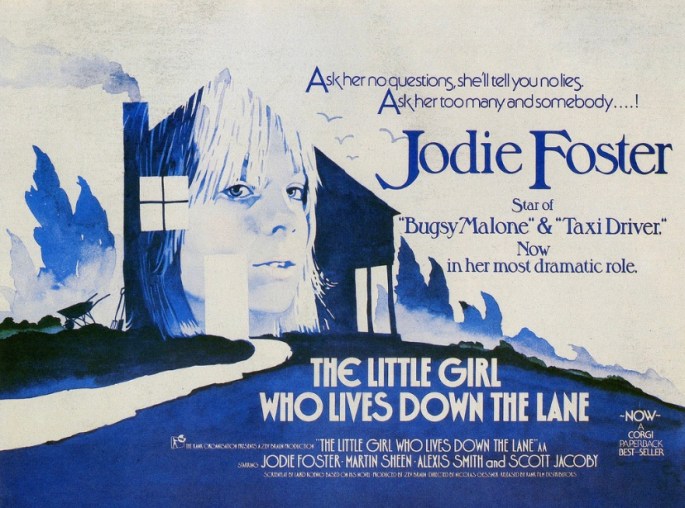
Jodie Foster had an interesting and edgy first leg of her career, with The Little Girl Who Lives Down The Lane being one of threw weirdest thrillers I’ve ever seen and certainly the strangest project shes been attached to that I’ve come across. Foster, age 13 or so here, plays Rynn, a girl living alone in a drafty house in a desolate Maine village that manages to be frightening and picturesque in the same stroke. The film doesn’t tell you right away why she’s alone but instead shows us a regular onslaught of visitors to her house who range from benign to eccentric to downright dangerous. Her landlady (Alexis Smith) is an overbearing bitch, the local police officer (Mort Shuman) is kind and compassionate and a teenage magician (Scott Jacoby) is someone she finds companionship and even romance with. The real trouble is in Martin Sheens violent, creepy sex offender who has a habit of showing up while she’s alone and getting real rapey on her. So who is this girl, and who thought up such a bizarre, unwieldy concept for a film? Well, as illogical, clunky and tasteless as I can’t be, I still found it pretty compelling, for Foster’s ethereal performance, for the sheer lunacy of its central premise, and I appreciated it in a sort of ‘dream logic meets modern fairytale’ way, which I’m not sure if the filmmakers were going for instead of a straightforward horror/thriller approach (it doesn’t work at all from that angle) but let’s just pretend that was their intention. Either way it’s a curio worth checking out simply for the audacity of the thing, and for Foster completists making their way through the cobwebs of her early career genre stuff. Also fun fact for David Lynch fans, the man directly references this film in his Twin Peaks: The Return and it’ll be fun for any avid Peaks fan to figure out why as they clamber through this narrative.

-Nate Hill

THE RUSS MEYER FILES: FANNY HILL (1964)

It is by mere coincidence that, in another series of career overviews of filmmakers who have meant a great deal to me over the years, I recently watched and wrote about L.A. Takedown, Michael Mann’s 1989 made-for-television movie that was his first attempt to bring his screenplay for Heat to general audiences. In that piece, I opined how much of a bummer it was for Mann to have to compromise his beautifully written script into such a trifle of a film. It’s a fine thing on its own but once you see Heat, you see what he really wanted to do with the material and L.A. Takedown can’t help but look flaccid in comparison.

And so we come, quite fortuitously, to the point in Russ Meyer’s career that we should be discussing Fanny Hill, the Albert Zugsmith-produced adaptation of John Cleland’s erotic novel from 1748. While it’s much less a personal loss of content and vision than what Mann faced, the disparity between the Meyer film, the first attempt at bringing Fanny Hill to the screen, and the novel is so stark that it’s almost embarrassing that a rough-hewed man’s man like Meyer would create such a puffy piece of cute nonsense out of a book that would make even the most degenerate of high seas pirates blush. Little wonder that an artistically frustrated Meyer took to the streets and freeballed Europe in the Raw directly after production wrapped which allowed him some personal freedom that had all been constricted on Fanny Hill’s production, not unlike one of the 18th century corsets worn by the lasses in that film.

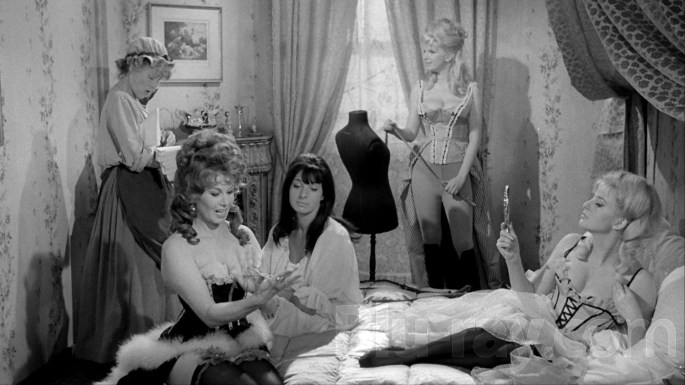
Dispensing with the book’s fuller and more rounded view of the titular character’s sexual maturation through experience, Meyer’s Fanny Hill is delivered as the slightest of farcical comedies with just enough peripheral décolletage and naughty double entendres to make it feel like adult fare. In it, our fresh-faced and virginal heroine (Leticia Roman) finds herself penniless on the streets of London and wanders into the clutches of Mrs. Maude Brown (Miriam Hopkins), a randy old madame of questionable moral character who runs a brothel in the city. Though her naïveté causes her to never quite understand where she’s working or what she’s doing, she nonetheless stumbles into love with a sailor in Her Majesty’s Navy (future hack director and Fassbinder protege, Ulli Lommel) whose sexual cluelessness matches hers and this union threatens to upend Mrs. Brown’s profitable find in Fanny.

This is all very cute and mildly saucy but it all feels more beholden to Zugsmith than it does to Meyer’s inner muse, which would no doubt lead to some more hot-blooded romping instead of perpetuating the elaborate cinematic cock tease presented here. There are a couple of Meyer gags like the fish in the cleavage bit, and during the more animated moments, the film has a slapstick style of frenetic editing that somewhat resembles Meyer but only if he were getting over the flu or some other ailment. For even when its trying, it feels a little slack compared to his other works. And unlike other outré movies in Meyer’s filmography like Blacksnake and The Seven Minutes, Fanny Hill doesn’t have a whole lot to say beyond the obvious and the usual themes found in his work get utterly muted in favor of the one joke Fanny Hill has at its disposal that it never tires of retelling during the duration of its unjustifiable 104 minute running time.

But where it goes really wrong is that, while Lommel’s Charles is a typical wet mop of a Meyer hero, the character of Fanny Hill is neither confident nor does she employ any agency whatsoever. Her madcap exploits in which she has no clue of the copious humping materializing around her grows tiresome and literally nobody that would have been familiar with the novel or with Meyer’s penchant for crafting bawdy cinema could have been pleased with the end result at the time.

Still, this film has undeniable charm thanks in large part due to Miriam Hopkins’s performance. As the wickedly amoral and conniving Mrs. Brown, Hopkins elevates the whole affair from anemic to astounding each and every time she’s occupying the screen. Sometimes the antics have the same kind of breezy fun found in a Benny Hill episode and count me as an admirer of the illustrated, woodcut-inspired wipes and the cheap-john sets that look like they were stolen from a soap opera. And Meyer DOES seem to ignite some kind of visual tension in putting Leticia Roman in the position of being the film’s innocent center that is always on the verge of being overwhelmed by the leering buxom women that are festooning the four corners of the frame.

Also causing a bit of actual frustration is simply how amazing the Blu ray from Vinegar Syndrome looks. Paired with Albert Zugsmith’s stupid The Phantom Gunslinger, Fanny Hill’s announcement was a pleasant surprise as it had become increasingly difficult to track down over the years. The release from Vinegar Syndrome reveals itself to be, like Fanny herself, an unwitting tease as we can witness just what incredible work they do which brings about a sadness in knowing that they will never be able to do with the rest of his non-studio catalogue as they have with Fanny Hill. It’s a weird film to use as a flex but thus is the paradox of the Russ Meyer filmography in the world of physical media.

In the end, Fanny Hill is a crisp, cheaply financed romp that illustrates how well Meyer could shoot in black and white and was simultaneously an unpleasant experience that would inform Meyer’s feelings about producers not named Russ Meyer for a good long while. While it’s far from Meyer’s best, it is still uniquely appealing. For when compared to the raw downers and the moralistic doom to come in the Gothic films, Fanny Hill is as light as a feather as the most airy of the nudie cuties; a truly transitional film that displays the sharp, high contrast photography that would reign supreme in his next set of pictures. Though Tinto Brass’s excellent 1991 film, Paprika, is arguably the most full-blooded and feminist-positive adaptation of Fanny Hill, Russ Meyer’s stab at the material is as charming as it is inconsequential.

(C) Copyright 2021, Patrick Crain
Steven Adam Renkovich’s The Awakening Of Lilith

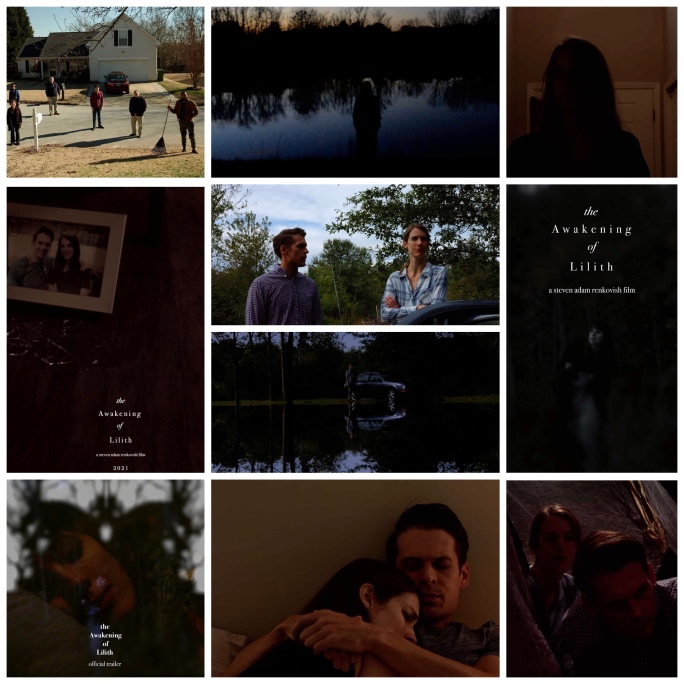
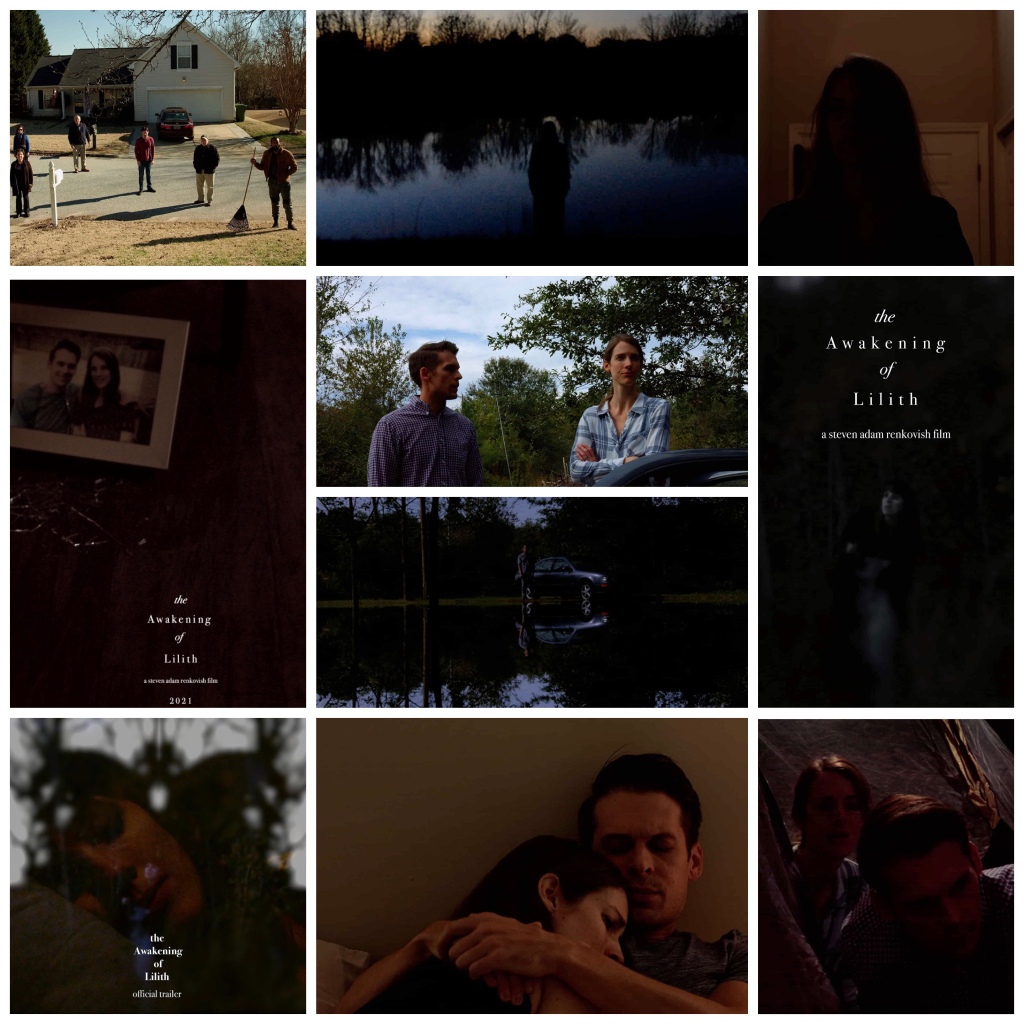
Grief. Mental illness. Turbulent family dynamics. A battle to maintain one’s identity amidst a myriad of struggles both internal and external. These are deep, difficult themes to work through in film and it’s so often that we see them not done proper justice, not explored in a fashion that feels fair, realistic or respectful and overall misses the mark. Steven Adam Renkovich’s The Awakening Of Lilith is a film of strength, assuredness and striking meditative intuition that approaches these themes from a refreshingly, staggeringly mature and relatable standpoint, between his his strong, hypnotic direction and an otherworldly, deeply instinctive lead performance from Brittany Renée as Lilith, a woman lost in the darkest corners of her own mind following a shrouded tragedy that we learn more of bit by bit. I always think of depression, anxiety and any mental illness as a relationship between space and time: these affliction are spaces we wander into, for an indeterminate amount of time, and while you are in them it quite literally feels like you will never, ever make it out; it’s like tunnel vision in fog. Lilith and her fiancée Noah (Justin Livingston) both suffer from variations on this and we see in flashbacks the strain it puts on their relationship as they try to work through their issues, individually and as a couple until… well, until we get back to present day Lilith, living with the fact that Noah, for reasons made agonizingly clear, is not around anymore. Lilith is not only navigating life without him but everyone else in her life who is not properly there for her including a coldhearted mother (Mary Miles Kokotek) and some friends who don’t quite have the proper empathy to support her. Renkovich’s script approaches the subject of mental illness with a precision, understanding, blunt realism and compassion that is all too rare in cinema overall, and the medium is immediately stronger with his feature debut voice in it. He uses eerie, haunting sound design and blurred, Rorschach-test like imagery to disorient and draw us into Lilith’s tempestuous and confusing internal landscape with terrific support from Seth Anderson’s often terrifying, frequently beautiful and always atmospheric score. Renée is a revelation as Lilith, possessive of the kind of old world poise, timeless anachronistic aura, clearly annunciated, carefully thought out expression and ethereal essence that is so rare in human beings and is always a truly special quality for an actor to have. She imbues Lilith with the kind of resolute, lonely sadness of someone who is used to living in their head and fiercely facing their demons in implosive silence. Livingston as Noah plays it a bit more clipped but underneath the curt vernacular we see someone who is sensitive but has never been allowed to outwardly own it, who guards a hurt so deep it’s clear he’s only ever allowed Lilith in to share it, a dynamic that both strengthens their relationship and puts it to ultimate test. My favourite scene is the two of them in a camping tent, together beyond the world; Lilith gives him a gift that has immense personal meaning to her and their bond is so deep the silence in the air around them can hear it, it’s a wonderful moment that’s made all the more affecting and heartbreaking when you look at their arc overall, accented in finality by a gorgeous ending credit song sung by Renée herself that leads you out of the narrative perfectly. There is a lot to unpack here for a film that clocks in just under 90 minutes, and I’ve only just brushed the surface of this textured, complex, beautifully crafted piece. Wondrous film.

-Nate Hill

Steven Adam Renkovich’s The Awakening Of Lilith

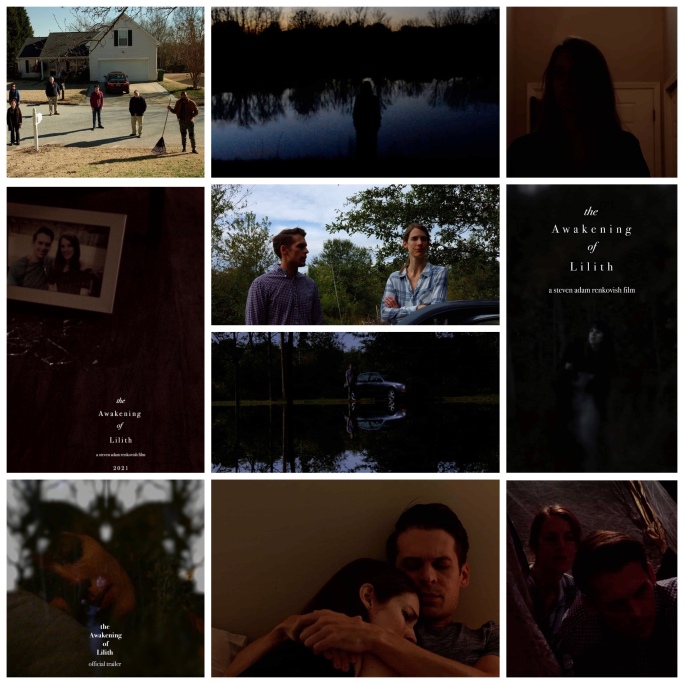
Grief. Mental illness. Turbulent family dynamics. A battle to maintain one’s identity amidst a myriad of struggles both internal and external. These are deep, difficult themes to work through in film and it’s so often that we see them not done proper justice, not explored in a fashion that feels fair, realistic or respectful and overall misses the mark. Steven Adam Renkovich’s The Awakening Of Lilith is a film of strength, assuredness and striking meditative intuition that approaches these themes from a refreshingly, staggeringly mature and relatable standpoint, between his his strong, hypnotic direction and an otherworldly, deeply instinctive lead performance from Brittany Renée as Lilith, a woman lost in the darkest corners of her own mind following a shrouded tragedy that we learn more of bit by bit. I always think of depression, anxiety and any mental illness as a relationship between space and time: these affliction are spaces we wander into, for an indeterminate amount of time, and while you are in them it quite literally feels like you will never, ever make it out; it’s like tunnel vision in fog. Lilith and her fiancée Noah (Justin Livingston) both suffer from variations on this and we see in flashbacks the strain it puts on their relationship as they try to work through their issues, individually and as a couple until… well, until we get back to present day Lilith, living with the fact that Noah, for reasons made agonizingly clear, is not around anymore. Lilith is not only navigating life without him but everyone else in her life who is not properly there for her including a coldhearted mother (Mary Miles Kokotek) and some friends who don’t quite have the proper empathy to support her. Renkovich’s script approaches the subject of mental illness with a precision, understanding, blunt realism and compassion that is all too rare in cinema overall, and the medium is immediately stronger with his feature debut voice in it. He uses eerie, haunting sound design and blurred, Rorschach-test like imagery to disorient and draw us into Lilith’s tempestuous and confusing internal landscape with terrific support from Seth Anderson’s often terrifying, frequently beautiful and always atmospheric score. Renée is a revelation as Lilith, possessive of the kind of old world poise, timeless anachronistic aura, clearly annunciated, carefully thought out expression and ethereal essence that is so rare in human beings and is always a truly special quality for an actor to have. She imbues Lilith with the kind of resolute, lonely sadness of someone who is used to living in their head and fiercely facing their demons in implosive silence. Livingston as Noah plays it a bit more clipped but underneath the curt vernacular we see someone who is sensitive but has never been allowed to outwardly own it, who guards a hurt so deep it’s clear he’s only ever allowed Lilith in to share it, a dynamic that both strengthens their relationship and puts it to ultimate test. My favourite scene is the two of them in a camping tent, together beyond the world; Lilith gives him a gift that has immense personal meaning to her and their bond is so deep the silence in the air around them can hear it, it’s a wonderful moment that’s made all the more affecting and heartbreaking when you look at their arc overall, accented in finality by a gorgeous ending credit song sung by Renée herself that leads you out of the narrative perfectly. There is a lot to unpack here for a film that clocks in just under 90 minutes, and I’ve only just brushed the surface of this textured, complex, beautifully crafted piece. Wondrous film.

-Nate Hill

THE MICHAEL MANN FILES: L.A. TAKEDOWN (1989)

In 1979, Michael Mann completed a 180 page screenplay that chronicled the exploits of a driven police detective and his criminal opposite. The screenplay was inspired by Mann’s conversations with Chicago detective and writer Chuck Adamson who, indeed, had matched wits with a high-line professional thief named Neil McCauley and, in the end, ended up killing him in a standoff. While Mann was able to break this screenplay apart over the years and place bits and moments of it into his various theatrical and television enterprises, his first chance to get as close as he could to doing the whole enchilada presented itself in the form of a television series Mann wanted to develop that centered around the robbery homicide department of the L.A.P.D. The 180 page script was cut in half, the tempo quickened to stroke level, and the two-hour pilot, eventually renamed L.A. Takedown, was produced.

In 2021, there are two ways to look at L.A. Takedown. The first would be to watch it in a retrospective manner where it will do nothing but look like a weak sauce, junior high stage performance of Heat, Mann’s now-classic theatrical retelling of the same material from 1995. While L.A. Takedown moves at the zippy pace of a television movie and I’m honestly astonished just how much of Heat Michael Mann was able to boil down into a 96 minute running time, absolutely nothing about it can touch Heat in terms of story, character, or mood which flattens this down into something just a little more heated than a stone cold table-read.

Another way to look at it is a logical step in the evolution of Michael Mann, one of the few filmmakers whose television work is as important as his feature work. In 1989, L.A. Takedown was Mann’s shot at getting his baby to the screen and as intact as humanly possible. We weren’t going to see reworked moments like Mike Torello coming home to his wife with another man in the early episodes of Crime Story; Manhunter’s Hannibal Lecktor and Will Graham looking at each other from across an expanse to evoke a certain kind of mirroring of the soul; or, as in Thief, Frank bitching to Leo about the transponders in the bumper and the wheel well. With L.A. Takedown, we were going to see all of Michael Mann’s heart and soul in the context in which it was originally envisioned.

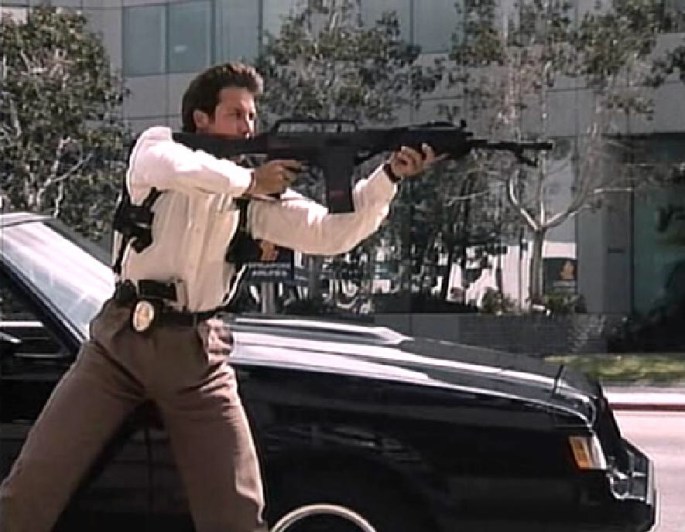
For the uninitiated, L.A. Takedown is a story about whip-smart and laser-focused LAPD detective Vincent Hanna (Scott Plank) who runs a crew of cops out of the robbery homicide department. On the other side of the moral coin is Patrick McLaren (Alex McArthur), cool-as-ice professional thief who, like Hanna, surrounds himself with a team of trusted professionals to pull of complex and high risk robberies. When the hold-up of an armored car leads to a multiple homicide, Hanna’s ears perk up and he is on the case while his marriage begins to slowly disintegrate under the pressure of his vocation.

Shot in nineteen days, L.A. Takedown has all the hallmarks of something that was created on the fly and thrown together as quickly as possible. And, while watching it, one can’t help but feel that this must have been a little more than heartbreaking for Michael Mann. Rewriting and resetting so many of Heat’s moody, noirish night pieces in the bright white California sun is as visually upsetting as if someone remade every Val Lewton movie and set them on Miami Beach at high noon. And even without the benefit of seeing the upgrade that would come in 1995, the leads in L.A. Takedown can’t help but feel like Heat if it were performed by the Max Fischer Players. Scott Plank and Alex McArthur are fine-ish but, setting aside the level of craft inherent in them versus DeNiro and Pacino, I’m not so convinced there’s enough there there in Plank’s performance to carry the television series that didn’t materialize from this. Where Pacino is a haggard and heavy-lidded live wire, Plank comes off like a grumpy and harried dad who’s mostly put out because he has to drive his fifteen year old to the mall.

And what L.A. Takedown excises robs it of its overall power. One of the main joys of Heat is realizing that is a love story about two men who don’t realize their in the best relationship of their lives with each other. In L.A. Takedown, there is no cross flattery between Hanna and McLaren. The mutual respect is there as evidenced by the third-string version of Heat’s classic diner scene. But the deep, solitary longing of two guys who cannot live normal lives is muted as it chooses to contrast McLaren and Hanna’s respective relationships with their significant others which, due to the nature of this being a pitch for a television series, had to have a happier ending of reconciliation which betrays a core commandment in the Mann universe and is the very thing that caused Manhunter to just miss masterpiece status.

But L.A. Takedown is not without its merits. I feel that, taken in the spirit of its original intent, it’s an important piece of the Mann puzzle and, on a technical level, Mann’s utilization of ethereal, synth-driven soundtracks is effective. His obsession with procedural detail is always fascinating and welcome and, regardless on whether or not the delivery is flat, let it be known that Michael Kenneth Mann can write a line of dialogue or two.

While this was meant to be a series that explored Hanna’s department, this was not yet a show that the networks wanted and Mann found himself again at a crossroads. While he would continue to work on a couple of more projects for television in the capacity of writer and executive producer (Drug Wars: The Camarena Story and Drug Wars II: The Cocaine Cartel), Mann was feeling the squeeze of television once more. Having blown his ultimate load on what amounted to a disappointing and failed television pilot, Michael Mann began to look toward America’s past to explore those themes that were close to his heart that might help regain some theatrical traction.

(C) Copyright 2021, Patrick Crain
B Movie Glory: Crossworlds

Direct to video horror/SciFi stuff starring Rutger Hauer is basically my bread and butter so I was very excited to see Crossworlds drop on Amazon prime after trying to score a DVD for years, to no avail. An inter dimensional travel flick with Hauer as a sort of Gandalf/Jedi/salt of the earth time machine mechanic hybrid sounds like a dream come true but unfortunately this one just never seems to be able to get it up past lukewarm, and I fear that budget is mostly the reason. It’s clear that this thing didn’t have all that many bucks thrown at it to play with and in a SciFi with this snazzy of a concept you just need to have impressive effects and better world building. Hauer’s sarcastic sage warrior is on a quest with a younger protege (Andrea Roth) to recruit a human college kid (Josh Charles) from our world and use his birthright talisman to thwart an evil organization from using it to combine all the parallel dimensions of the universe into one big ‘dimension gumbo’, thus eradicating the natural borders of the cosmos and promoting utter chaos. That sounds way cooler in writing than it does in the actual film too and unfortunately most of it is just running, chasing, clunky fight scenes and undercooked exposition without any real substance or flow. Charles as the lead is about as vanilla and lacking in charisma as they come, which hurts the film, while Hauer is wonderful as ever playing up the curmudgeonly aspects of his character and rocking a duster trench-coat like the badass he is. Roth I’ve always been fond of and she’s great too but the role is underwritten and she seems bored for most of it, while a very young and very drunk Jack Black steals a scene or three as a loud mouthed college bro. The film finds some torque when Stuart Wilson shows up as the scheming villain; Stuart is an actor who is pretty much incapable of boring or subpar work (much like Hauer) and he makes this guy someone you love to hate and turns every flatly written line into a mischievous flourish. But he nor Hauer can ultimately save this from the muddled doldrums it consistently wanders into and it’s frustrating because there’s a crackerjack premise somewhere in there that was just given half assed treatment both in the screenwriting phase and in production/execution and it shows. Perhaps one day someone with more money and a clearer vision will give this another shot.

-Nate Hill