David Cronenberg’s Videodrome

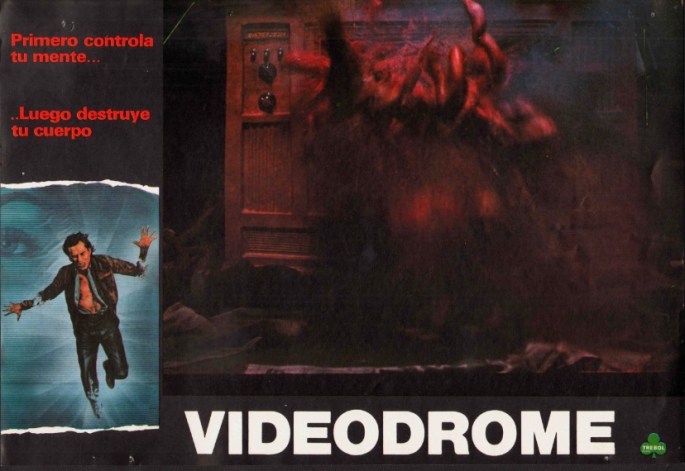
David Cronenberg’s Videodrome is a film I had slept on since I was a teenager and saw it it ominously leering off the shelf of Blockbuster with stark, gooey VHS cover art that promised a nearly sentient looking narrative and atmospheric horror experience that perhaps I wasn’t ready for, because I always passed it by. I’m kind of glad I waited until now to see it because I was fully able to appreciate what a rich, textured, detailed and seemingly impenetrable but inexplicably profound piece of art it is, not to mention just a gorgeously gonzo exercise in some of the absolute fucking BEST practical effects I’ve ever seen in cinema. James Woods is Max Renn, a freewheeling television producer whose time slot is dedicated to violence and scum because, as he cavalierly rationalizes it, that’s what people want to see. One day he discovers a mysterious scrambled signal broadcasting a show just about violence, murder and torture, a show that seems to be a bit too close to the real thing. His search for the origin and producer of this bizarre output takes him on a horrifying cosmic journey of mind-melding, body mutilating chaos as the signal begins to change both his external anatomy and internal mindscape. He hooks up with fellow TV host Nicki Brand (the great Debbie Harry) whose own dark impulses for boundary pushing S&M only further add to his unsettling environment. The plot is a dense, surreal and difficult spiral of reality shattering techno-horror, spectacularly splattery special effects and an editing process that aims to disorient while also keeping the viewer mesmerically rapt to the screen to see how it all plays out. There’s an undercurrent of warning regarding the psychological implications of technology and pornography that feels eerily ahead of its time, a commentary on the hypnotic and dangerous application of VR (WAY ahead of its time) and all sorts of elements woven together for a totally immersive, beautifully retro-futuristic experience. It also just knows how to have a blast at the simple level of being a visually effective horror film and believe me when I tell you that these FX are for the ages and might never be topped; from torso invading genitalia chasms to glistening prosthetic weaponry crudely fashioned onto human limbs to a TV set that lives, breathes and gives birth to roiling deformities behind the screen that serves to remind us of the worrying self awareness and startling agency we project onto and bestow unto technology. One of the finest horror films I’ve ever seen.

-Nate Hill

THE JACK HILL FILES: SPIDER BABY (1967)

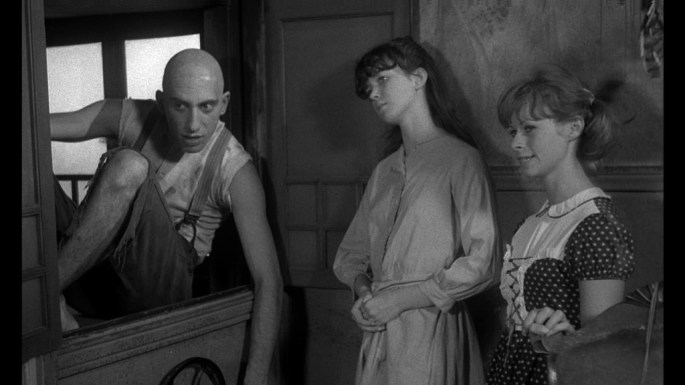
While the reputation for Tobe Hooper’s The Texas Chain Saw Massacre damn near drowns in its tangential relation to real-life serial killer Ed Gein, there is rarely a peep of recognition for Spider Baby, Jack Hill’s incredible film from 1967 which feels like more of a direct influence on the film than the legend of the backwoods monster from Wisconsin. Where only trace elements of Gein’s crimes were appropriated for The Texas Chain Saw Massacre, the juxtaposition of families both civilized and uncivilized duking it out in an isolated, dilapidated split-level where people quite literally eat other people is complete Spider Baby turf.

Stepping off on the right foot with a framing device in which Quinn Redeker’s Dudley-Do-Right square, Peter, breaks the fourth wall that feels like Criswell by way of Douglas Neidermeyer, Spider Baby spins a yarn regarding the creepy Merrey family, a rag-tag clan of inbreds who dwell in a large, dingy house behind a giant, iron gate that has long been overrun with dead vegetation. Suffering from a condition that takes its namesake from the family, each member is in a constant state of mental regression as they advance in age, eventually causing them to devolve into a pre-human state that leads to cannibalism. When a group of greedy relations descend upon the house to stake their claim to their inheritance, absolutely delightful chaos ensues.

I’m not quite sure if there was ever a horror film remotely like Jack Hill’s Spider Baby before it was made in 1964 (due to the producer’s bankruptcy, it didn’t see the light of day until 1967). It’s sick, perverse, truly creepy, and something of a cut above the drive-in and B-picture fare of its day. Aided by a truly sinister script by Hill and glorious black and white cinematography courtesy of genius-level pro Alfred Taylor, Spider Baby threads a careful needle between art and sleaze while never looking less than a million bucks. Also remarkable about Spider Baby is just how perfectly it balances horror and comedy. A lot of films work overtime to be horror comedies but they usually end up being unfunny and belabored half-assed neither-nors. In fact, so littered is the graveyard with subpar examples to the contrary, I can probably count the number of truly successful horror comedies on both hands with Spider Baby occupying the first thumb or digit (depending on your style of counting with your hand).

One of the things that further distinguishes Spider Baby is its sympathetic and humanistic central performance courtesy of Lon Chaney, Jr. As family chauffeur and protector, Bruno, Chaney brings the highest level of professionalism and emotional complexity to a role that most actors wouldn’t think necessary. A key moment near the end of the film becomes unexpectedly moving as Hill’s camera trains on Chaney’s face, observing Chaney as he heartbreakingly realizes what he must do to truly save the family from themselves, proving that Chaney was one of the most under appreciated of the Universal Monster players. There is also a sweet natured approach to the wild characters in the family and their ghastly actions as they are treated like Charles Addams figures come to life, albeit with a bit more teeth. But by casting the civilized people as the true monsters of the piece, Hill hits on a gold mine of subtext that continues to pay dividends today.

Aside from Chaney, Hill gets a lot from his troupe of actors, some of whom were part of his regular gang that popped up in various Roger Corman productions such as Hill’s Blood Bath and Francis Ford Coppola’s Dementia 13 (which has enough footage directed by Hill to ALMOST count as a co-effort). Beverly Washburn, Jill Banner, and Sid Haig all have an utter gas as the doomed progeny and the aforementioned Redeker pitches his role as the sweet-natured dunderheaded hero perfectly. Also, big ups go to Carol Ohmart in what could have been a thankless turn as the stereotypical cold-hearted and impossibly greedy bitch. Ohmart ratchets everything up to eleven with her tongue in her cheek, finally spinning off into delirious greatness in the film’s final moments as her materialistic deceitfulness gives way to an amorously debauched and animalistic passion for a slobbering man-child Sid Haig. I mean… it’s really something to behold.

While it contains definite nods to Psycho (the bird taxidermy, the Edward Hopper-like house in the middle of nowhere, the preservation of the ghoulish remains of family members) Spider Baby takes a giant step forward in terms of tone, content, and style and ultimately stakes a serious claim as one of the most significant horror films of the sixties. There’s just nothing else quite like it.

(C) Copyright 2021, Patrick Crain

THE DAVID ROBERT MITCHELL FILES: THE MYTH OF THE AMERICAN SLEEPOVER (2010)

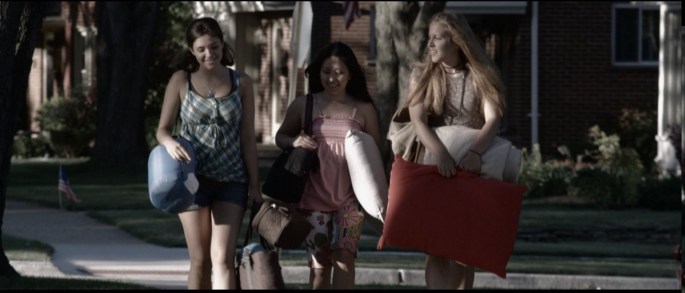
There’s a weird moment in some adolescent boys’ lives in which they don’t know whether they’d rather watch Cinemax or teepee a house. It’s a period that lasts about six months but it feels like a whole other lifetime to live through. For in life, there exists both a very specific twilight between being a child and being an adolescent, and then another between and adolescent and adult. David Robert Mitchell’s debut film, The Myth of the American Sleepover, realizes both simultaneously. Set in a suburban world where adults are heard but almost never seen, the film moves through a 24 hour period in the lives of several teens as they navigate a night of discovery, adventure, and wonder. Like American Graffiti, it has an elusive blonde who is the unobtainable end to a noble, nocturnal quest by a lovelorn romantic boy. Like Dazed and Confused, it celebrates the fluidity of cliques and the elasticity of youth. But instead of setting the tale in the expanse of a town where having a set of wheels is required to play along, The Myth of the American Sleepover shrinks it all down to the less-than-perfect suburban neighborhoods with aluminum filigree and poorly patched streets where everything in one’s world is within walking distance. It’s a film that looks divorced from actual time as it both completely modern but without any amenities to cement it in any one specific era. Of course, this is the point as The Myth of the American Sleepover aims to show just how very little changes no matter how many generations of young people one will see cycle through that same period.

Admittedly, perhaps my coming out of the other side of a spirit crushing, seventeen-year, white collar day job hasn’t caused me to regain the passionate grip on life that teenagers naturally have, but it has put things in a certain kind of perspective to understand that memory is precious, experience is beauty, and, in the words of Michael Mann, time is luck. Even when I can see the age of 50 on the horizon, absolutely nothing about this film feels foreign though it’s definitely pitched to an audience that is about a third of my age. And, in fact, there was a time in which I did not have faith in what the director was doing, thinking he brought little to the subgenre of coming-of-age films and overly inflating the importance of the rituals that kind of film celebrates. Now I see that he brought something very specific to the genre; a timeless and almost spiritual testament to the two most pivotal times in one’s life that, unfortunately, aren’t spaced too far apart from each other. No, it’s not saying anything new. But it’s also not wrapping its nostalgia in something larger than it needs to be. As life goes on, we’re saddled with many woes both self-inflicted or accidental. Indulging in entertainment to draw a heavy allegory is likely not most people’s idea of a good time at the movies. In part, I agree. So here’s one that captures the best part of your youth, now likely sundowning in the better part of your memory. And as the weeks on the downslope become quicker-paced in my own life, this film has incrementally revealed itself as a truly beautiful and life-affirming thing.

The Myth of the American Sleepover covers the spectrum of incoming freshman to the high school graduate floundering in his first year of college, but they’re used in a much more pointed way than in other coming-of-age films of its kind. This is a movie where the value is broken down into millions of pennies instead of banking on big money moments that are quote-ready and riotous. For this is a movie that remembers how fast you could put out a cigarette when you heard your parents roll up. It remembers how much an object as insignificant as a lighter could possess endless possibilities of meaning. It identifies the exact moment where you could sneak a quick kiss on the cheek and then giggle down the street about it with your friend. It recalls the pain of a breakup that would make you do a silly thing like take literally a “call me sometime” message in your senior yearbook after a couple of beers and go on a nocturnal quest for romantic companionship. It remembers how magical the smell of a crush’s shampoo could be. It remembers what it is to be of an age when a whole other epic sleepover was but two streets over. It remembers what it was to fuck with an Ouija board and think you were really getting away from something. It knows what a hazy, overcast “morning after” feels like and, better yet, dares to dream about the break in the clouds and the tomorrows to come. And, above everything else, it knows the crush of exhaustion that occurs after such a monumental and life-shifting evening. This is a rare film that wants to celebrate in all of the joy of youth even if it wants to gloss over those moments where memory might reveal a low time that you would certainly avoid or do over if given the chance to repeat it.

Maybe this feels like a G-rated Kids but that’s quite ok with me. Where sex is generally the ultimate goal of any post-pubescent creature, that doesn’t mean that every encounter and house party is like Fellini Satyricon with a Bugsy Malone cast. Near the beginning, there is a sweet and knowing juxtaposition between a freshman’s story of what happened with a girl and her story with what really happened between the two of them that puts the filmmaker squarely in the corner of both camps insofar as understanding how boys and girls function within their respective social cliques. But it flips convention a bit by not only showing the boy as having done much less than what he claims, it simultaneously shows that girls are likely quicker at sexually maturing than are boys. This is revealed again in a moment between the same freshman and his friend’s older sister who beckons him away from his buddies who are situated in the living room and into the bathroom. It’s a scene charged with some light sexual tension that she quickly gets defused by her as she senses just how out of his depth he is and, regardless of his pursuit, he wouldn’t know what to do with her if he caught her. “Can I kiss you?” he asks her after she’s pretty much thrown herself at him without explicitly articulating it and he’s missed every signal pitched in his direction. It’s a Mrs. Robinson moment he’s not ready for which again shows this as a universe not governed by adults but by kids who have to feel their way around life.

Sometimes, the dialogue given to the kids is a little pointed. Either my memory is faulty or there were high school juniors who would have rather waxed poetically about the good old days of playing a board game when they were carefree and younger instead of trying to make out with the girl who was obviously interested in them and sitting mere inches away. I mean, I just don’t recall that being how it went down in Del City, Oklahoma, but I do recognize it as a kind of creative license that, in pressing a point already made by the sheer mood of the film, it hits a rare false note. From a performance standpoint, the kids are something of a mixed bag but, on the other hand, I also think that is what lends to the film’s authenticity and the natural ease and sometimes awkwardness of the young cast never falls into distracting mediocrity.

More than just remembering, The Myth of the American Sleepover is a film that actually understands its characters, what happens to them, and how it affects them. It understands how you can end up in a car with strangers even though it’s a roll of the dice as to whether or not it’s a good idea to do so. It understands how the second banana can come along and, instead of being a third wheel or a stick in the mud, can find their own adventurous path. It understands how a letter revealing that the girl with whom you’re in love on only wants to be friends can create the mythical “Girlfriend in Canada” situation. It understands sneaking into the basement with an illicit crush even knowing it’s going to start static in the other room with his girlfriend. It understands the awkwardness of not knowing how you feel about your readiness to go to first base. It may even understand, in an opaque way, how confusing this might be for those not yet sure or comfortable with their sexuality. It understands a closed universe of benign fuck ups where forgiveness is much easier obtained than in one’s later years. It understands the fine line between creepy and sincere. It’s a film that understands, in the words of the tune from Streets of Fire, that tonight is what it means to be young and, doubling down on that, also poignantly and purposefully misunderstands that one will never run out of tonights. The Myth of the American Sleepover is, in a nutshell, Jim Steinman by way of Whit Stillman and an absolute treasure to behold.

(C) Copyright 2021, Patrick Crain

Anthony Scott Burns’s Come True

Sometimes a film just effortlessly and uncannily combines several elements that just resonates with me and lands as an all time favourite on the first time watch. In the case of Anthony Scott Burns’s Come True it’s the gorgeous mix of SciFi/horror, analog/VHS inspired aesthetic, dream and REM sleep centred storytelling, surreal artistic visuals and the synth dripping, supersonic original score by Electric Youth that just makes this film something so special I don’t even have the words. The story concerns a runaway teenager (Julia Sarah Stone) who sleeps on playground slides (theres a metaphor in there somewhere), lives a restless nomad life and suffers from paralyzing nightmares. She agrees to participate in a sleep study for cash by a shady group that has patented technology that maps and visualizes people’s dreams onto video screens, but this only seems to exacerbate her nightmares and literally give them the power to cross over into waking life. That’s just the diving board from which we plunge into a roiling subconscious abyss of daring, unapologetically strange narrative and atmospheric substance and it soon becomes clear that director Burns, although meticulously in control of his craft and vision, wishes to let this story run completely wild and go off the edge of the map, which is a great fit considering this is a film about dreams. Some folks will undoubtably dismiss this as confusing and inaccessible but for me it pierced a frequency in my psyche that few films are able to tune into and is just the perfect soul food for my warped perception and taste in film that always hungers for the different, the weird, the boundary pushing. Actress Stone has an ethereal, pixie-like aura to her that lends itself nicely to the overall vibe. We are treated to numerous extended dream sequences which are all shot through this sort of of perpetual POV forward propulsion movement, a technique that tricks us into thinking we are ourselves moving directly into both our TV screens and the dreams themselves, then we are presented in horrific inevitable fashion with the powerful antagonistic forces on display in dreamland and it feels just about as terrifyingly tactile and immersive as being in our own dream worlds, a genius filmmaking choice really, not to mention all of the dazzlingly surreal, stark monochrome imagery and artistic flourishes along the way. Electric Youth kind of got screwed in their first original score which was for a film called ‘Breathing’ that for whatever reason was never finished or released, but their wonderful work on it can still be heard on Spotify. Here they get another shot and go absolutely synthwave ballistic for an original composition that is so beautiful your ears will bleed neon and you’ll hear it in your own dreams. It brings the story to life in ways that transcend traditional narrative at times and lures you into its world until you are transfixed right up until the ballsy twist ending that will have some people rolling their eyes and some people’s minds blown, I thought it capped the story perfectly. I don’t often use the M word but to me, and my sensibilities of what I look for in film, this is a flat out masterpiece.

-Nate Hill

THE RUSS MEYER FILES: EUROPE IN THE RAW (1963)

Not quite nude enough to satisfy nudie-cutie enthusiasts and just a shade too blue to work as a light documentary on the finer tourist spots in Europe, I’m not entirely sure how one could successfully classify Russ Meyer’s 1963 oddity, Europe in the Raw. Conventional wisdom states that it is one of Meyer’s most trifling efforts; a complete bore from which some of the nude bits were put to better use three years later in Meyer’s somewhat similar Mondo Topless. But, in the year of our Lord 2021, I’m not so sure this assessment is entirely correct given the almost incalculable value viewers will get from seeing beautifully shot Europe as it was in 1963 and also due to the fact that, Darlene Gray aside, Mondo Topless is a pretty tiresome affair itself. So, yes, on one hand, Europe in the Raw is pretty dull. On the other hand, it’s at least pretty. And after the forced, mixed bag that were the nudie cuties that came before it, there is a pleasantly unshackled and relaxed exhalation that can be felt coming from Meyer which is refreshing even if it is inconsequential.

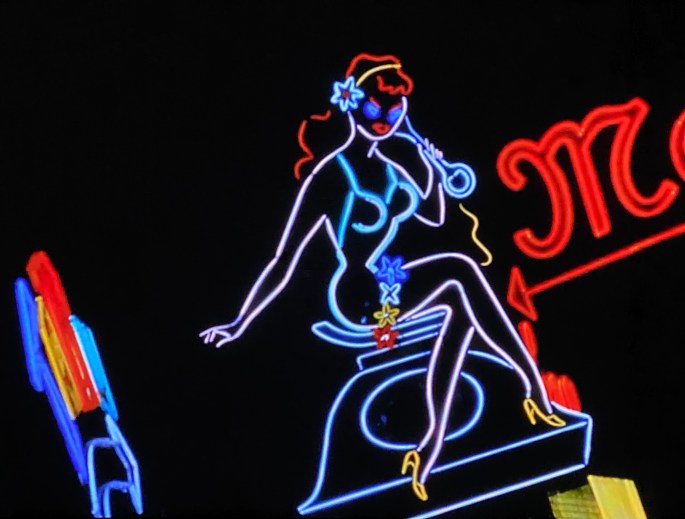
So, I guess we could just classify Europe in the Raw as a travelogue with boobs, and, to the latter point, only sometimes. As a travelogue, Europe in the Raw shows just what a gifted filmmaker Meyer was and, ironically, it is this aspect is the film’s greatest achievement as the copious amount of footage of vintage neon signage and staggeringly captured European architecture makes the nudity almost a secondary concern. Through his forcefully delivered corny dialogue and angles so Dutch that they’re almost an x-axis, Meyer bounds through Europe and shutterbugging everything he can, making the film feel like a vacation slide deck where a few errant images of a more adult nature “accidentally” got slipped into the carousel to liven up the party.

But, let’s face it, as he would find out later with (better) pictures such as The Seven Minutes and Blacksnake, things that don’t have even the most tangential relationship with enormous tits are not exactly what people who came to a Russ Meyer picture paid to see. Europe in the Raw begins with a breathless promise to bring you some of the most verboten and libidinous footage ever captured on film through a hidden camera, the discreetness of which is about on par with trying to conceal the presence of a full-sized chainsaw simply by holding it behind your back (as is actually attempted in Pieces, Juan Piquer Simón’s anti-masterpiece from 1982). It’s a hokey device and only some of the footage shot with the camera was used due to Meyer’s difficulty with operating it (“A pain in the ass” is how he described it), but the various low-slung POV tracking shots through the streets lined with authentic sex workers and a slow walk through a lace curtain that leads into a prostitute’s room both have definite pulses.

And while the latter bit is most definitely staged, it feels more genuine and alive than the majority of the routines that occur on actual stages. Save and except the routine by German dancer Avundabida, the vast majority of the elements that would make this a Russ Meyer film are listless, drab, and lacking the kind of energy that creates the wonderful two-way street with Meyer’s work. Where the carefully snipped, wild undulations of Uschi Digart could cause the entire celluloid of Cherry, Harry, and Raquel! to almost combust, the only chemistry between subject and camera in Europe in the Raw seems to be when Meyer is shooting structures and not strippers.

Again, if you honestly dig the photographic work of Meyer and appreciate him as a master craftsman, there is much to love here, most especially as time begins to take their toll on these locations. Likewise, a high-angled scene with a prostitute in Copenhagen has a candy-colored giallo spirit to it, illustrating how innately gorgeous and eye-popping some of Meyer’s lighting and color schemes could be. Even more so than the opening moments of Wild Gals of the Naked West, Europe in the Raw is all the evidence one would need to prove that Meyer’s work was worth the expense that was sadly never sunk into the preservation or restoration of his work.

While its reputation as a worthless endeavor kind of precedes it, Europe in the Raw is neither fish nor fowl. It’s not a sad effort that stirs any adverse feelings in me nor is it something that I have to force myself through, but it’s certainly not the title I would pull off the shelf when introducing a living room full of people to the work of Russ Meyer.

What I would do, however, is throw it on as if it were a slide show, casually yelling out “Whoops! How’d that naked lady get in there?!?!?!?” to that same living room full of people while simultaneously pounding my third gin and tonic and yukking it up with our guests.

What can I say? Shit gets wild over here.

(C) Copyright 2021, Patrick Crain

THE ROBERT ALTMAN FILES: O.C. AND STIGGS (1985)

After Ronald Regan scored a dominating win and a second term in office, there had to be some kind of numbness that was felt by those who knew Reagan was an intellectual lightweight but yet somehow, almost despite himself, remained vastly popular. What, they thought, can’t people see, or, more scarily, do they even care? It was probably the latter for Reagan hustled in a kind of hyper-capitalism that ran on credit and deregulation which forced everything to continue to be “bigger and better.” And while this excited those consumers who could afford to see the middle class take a squeeze, it also caused more and more people to fall through the cracks and stumble into the margins where they no longer became part of society but part of a conversation that had some kind of re-beautification scheme baked into it so those people could be further marginalized and forgotten.

Somehow and someway, Robert Altman decided to put all of this and other sundry sentiments of anti-Reaganism into a big screen adaptation of the summer adventures of a couple of teenage characters who had graced the pages of National Lampoon throughout the early eighties. The result was 1985’s O.C. and Stiggs, a film that sat on the shelves until 1987 and one that is generally considered Altman’s worst effort by people who, I suppose, have never heard of or seen Beyond Therapy or A Perfect Couple. While it’s never going to be confused with top-shelf Robert Altman, O.C. and Stiggs remains a delightfully sly film with more on its mind than most of its teen-sex brethren. And, honestly, who gives a flying fuck if Altman forgot to add the sex when he’s having such a gas using his ONE major studio film of the 80’s to gleefully torch the foundation of what every decent American should despise? Altman deserved a medal, not jeers and castigation, for this move.

The plot of O.C. and Stiggs is pretty episodic and random; it’s basically a recounting of the crazy summer that our two characters had as their senior year lurks on the horizon. For O.C. (Daniel Jenkins), it’s a bittersweet memory as he will soon be moving to Arkansas for his final year of high school as the grandfather he has been living with has had his retirement insurance cancelled and is going to have to stay in a nursing home. For Stiggs (Neill Barry), it was just another summer where he can torture the wealthy Schwab family and upend societal convention if only for the attention that he is not getting in his own dysfunctional and overcrowded home.

As much as Popeye was to some extent just McCabe & Mrs. Miller reconfigured for kids, O.C. and Stiggs is basically “I Was a Teenage Hawkeye and Trapper John” where all of the pranks, jokes, and misdeeds have been rerouted from military authority and are now at the expense of the Schwabs, a clan of nouveau riche straights whose patriarch (Paul Dooley) is the insurance king in a community where the words loud, bigoted, tacky, gaudy would be appropriate descriptors. Altman’s rendering of Scottsdale, Arizona, makes it look like the new American frontier; a community of inhabitants in a place not meant to be inhabited, replete with artificial wave pools and other stupid attractions. It’s a baking, sweltering enclave that is an absolute hell, 100% Barry Goldwater territory; the exact type of place where Hal Phillip Walker (Thomas Hal Phillips), Nashville’s third-party presidential candidate, is making a bid for the U.S. Senate ten years after the events of that film.

So it’s a teen sex comedy where the sex is substituted with a giant rod up the ass of the shallow crassness, racial cruelty, and the individualistic, selfish pursuits that had run amok in the back nine of the Reagan Era. And wherever Reaganism failed, O.C. and Stiggs exploits. The homeless, Vietnam vets, decorum, capitalism, and silly charities all get a full inspection as the characters of O.C. and Stiggs are the perpetual progressive irritants in a dead suburbia becoming even more zombiefied. Wherever society decides to stagnate to the detriment of some, the two are there to make sure everyone’s boats are lifted.

So does this really sound like a teen sex comedy at all? The film’s connection to National Lampoon is crucial given M*A*S*H’s contribution to what Roger Ebert used to call the “slob comedy” which was made famous with 1978’s National Lampoon’s Animal House. So this is Altman closing a chapter by bringing it full circle with a certain poignancy and sadness. Unlike other similar films of the day, both O.C. and Stiggs have deep grievances that have some emotional truth. O.C. is hurt by the Schwab Insurance Company which has cancelled his grandfather’s retirement insurance and Stiggs is damaged by a philandering father and a sense of being completely unseen in a busy cacophony of a family (very reminiscent of The Boy’s situation in That Cold Day in the Park). These are kids whose adventures are more stimulated by what their elders have wreaked than it is about chasing girls. “What you boys need is some pussy,” says Melvin Van Peebles’s Wino Bob, in a jive on Peebles’s Sweet Sweetback persona. He knows what it’s like to want to put your foot in the Man’s ass and here are two white kids who have some shared enemies and who want to do just that. But there is a wistfulness to Bob’s sentiment as it’s just too bad that change is left to the young who are the only ones with the energy to do anything when they should be asked little more than to go out and enjoy their lives.

With some nice references to Apocalypse Now, The Pink Panther, The Last Picture Show, and The Treasure of the Sierra Madre,Altman hasn’t been this referential since Brewster McCloud, itself referenced in O.C. and Stiggs via the jokey vanity plates and a very pointed scene dealing with a lot of bird shit. Additionally the inclusion of King Sunny Adae and his African Beats sets the film apart as one of the commercial aims of films like this was to pack the film with as many hot new artists as possible if only to create a separate revenue stream for the concurrently released soundtrack album. Here, the music of King Sunny Adae acts as pure joy and a great equalizer, one of the few things that seems to bring joy to everyone who hears it. And special mention has to be given to both Jane Curtain, who nails her role as the perpetually soused matriarch of the Schwab family (every member of which being too oblivious to notice is also a nice touch), and the radiant Cynthia Nixon, object of O.C.’s desire.

Of course, not everything in the film works like gangbusters. Sometimes the film has a difficult time mixing Altman’s style with the kind of two handed teen comedy that the movie sort-of kind-of wants to be. Sometimes it’s at ill at ease with itself and there are moments where Altman makes big miscalculations as to what the audience will find amusing by throwing unnecessary and goofy sound effects onto the soundtrack. Additionally, the film also shows the tell tale signs of over-editing; like the shapeless story was given the slightest bit of a plot only in the editing room leaving even more of this film on the editing room floor.

But considering the states of both Altman’s career and the subgenre he was inverting with O.C. & Stiggs, there is far more to celebrate here than to dismiss and the film’s continued life as a punchline thanks to people who should know better is borderline irresponsible. For all of the things Altman called out as a threat to our society in Nashville have brought in a return on their investment ten years later thus beginning the slow, poisonous crawl to our sorry state today. This is no better realized than in the character of Pat Coletti (the always incredible Martin Mull), a lazy and affable millionaire whose geographical proximity to the Schwabs makes him their almost polar opposite. Rich, insulated, and bored, Coletti’s brand of capitalism is an open, creative, and almost lax approach to making money which proves to be more inclusive and has a more balanced entrepreneurial spirit. So if O.C. And Stiggs is the final word in the slob comedy and not at all a teen sex comedy, Coletti and all of the adult characters represent the bitter end of the first half of their lives. While they’re all victims of Reaganism, they’re all choosing their own specific misery as they sink into inert middle-age, a place where most people no longer know how to grow but only know how to expand. And the choices they make speak volumes about their characters.

While Paul Dooley’s racist, conspiracy theory, doomsday prepper character looks like a first step toward MAGA right in the red, white, and blue middle of Reagan’s America, a retrospective view of O.C. and Stiggs shows how shockingly on the nose Altman was about all of it and how, perhaps, some of the criticism was from people who just didn’t want to believe it. I suppose if you had your head in the sand, this film would look incredibly silly. But, gosh, all of those American flags and “Don’t Tread on Me” signs papering cookie-cutter stucco homes that magically popped up in the middle of the Arizona desert to get away from… something? I’d say that, despite the inherent silliness in a so-called teen sex comedy being “Exhibit A” to prove a larger point, MAGA was less a phenomenon that sprung forth in 2016 and that it was there all along.

“This is real!” O.C. screams at Dennis Hopper during the film’s climax as the former is handed a grenade to be used to get out of Schwab’s doomsday room.

“Everything gets to be sooner or later,” Hopper replies.

(C) Copyright 2021, Patrick Crain

Steven Soderbergh’s No Sudden Move

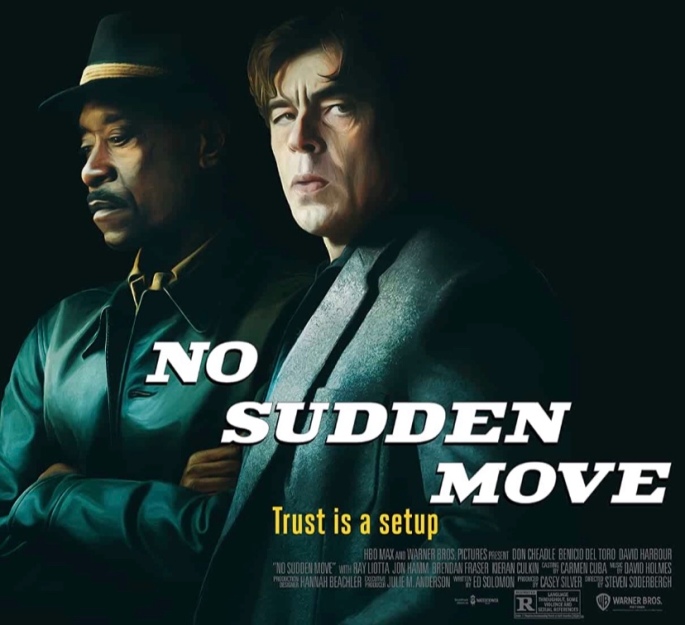
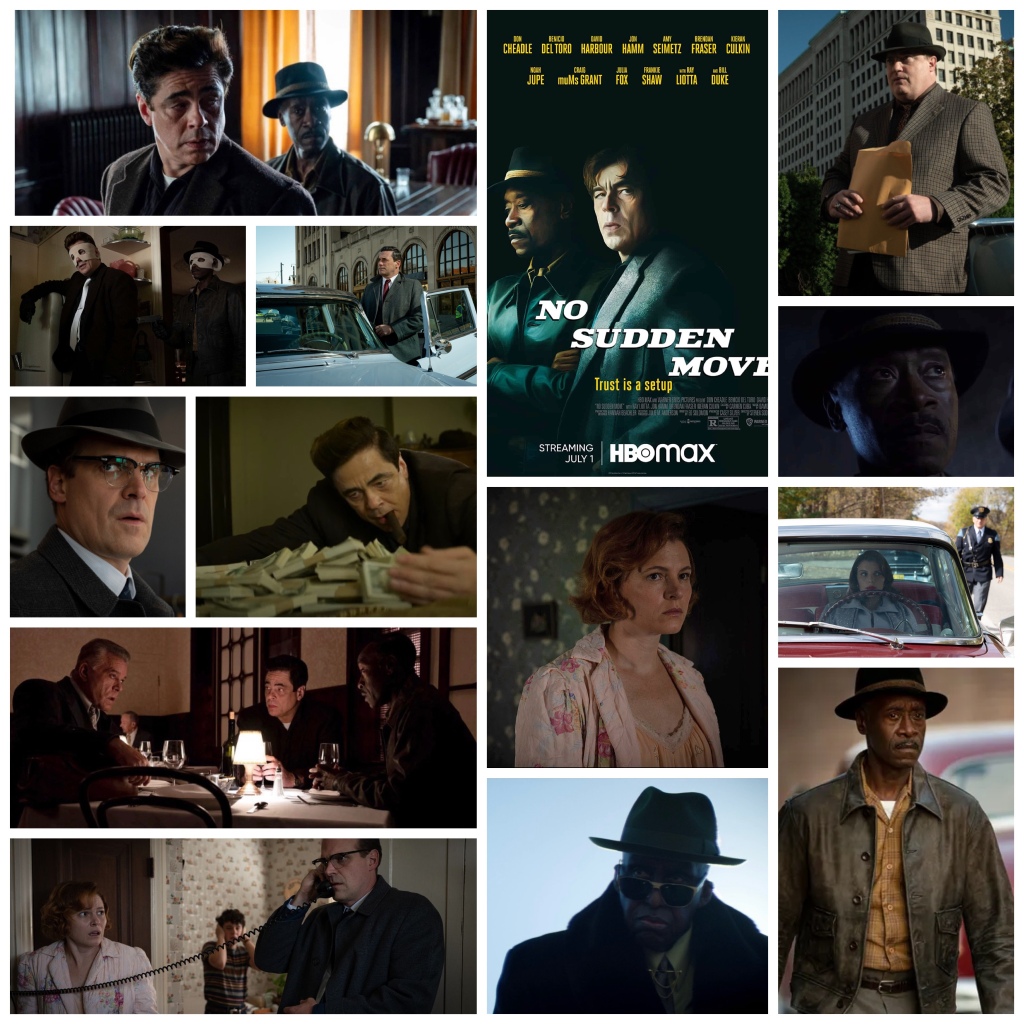
Steven Soderbergh’s No Sudden Move contradicts its own title by showing up out of nowhere all of a sudden, with an ensemble cast for the ages, a snazzy 50’s production design vibe and one of those deliriously convoluted marble maze narratives where things make just as much sense as they don’t. The film is honestly a lot more low key, subdued and laconic than you might expect from all of these moving parts, let’s more Out Of Sight than Ocean’s 11, more burnished, modest caper games than ritzy, tongue in cheek sizzle. Don Cheadle plays an aimless Detroit ex-con who is hired by a shady mob figure (Brendan Fraser) to babysit the family of a twitchy executive (David Harbour) while he retrieves something of great McGuffin-esque importance from a safe at his work. Alongside him are two less level headed operatives played by a greasy Benicio Del Toro and Rory Culkin, who collectively escalate the proceedings into a dangerous powder keg of betrayals, backstabbing and hopeless incompetence. Others orbit their situation including Ray Liotta as an appropriately volatile mobster, Julia Fox as his philandering wife, Jon Hamm as a keen federal agent, Amy Seimetz as Harbour’s stressed out wife, Bill Duke as an all powerful underworld kingpin and a sly cameo from an A lister (that I won’t spoil) as a cheerfully corrupt automobile industry magnate. The cast are all exceptional with everyone really keeping it on a low, laconic burn save for perhaps Liotta who has to get fired up at least once in every movie per his contract and Harbour who is cast pricelessly against type as a spineless fuck up. The narrative is a shifting puzzle box that requires adderall level attentiveness to fully absorb which I wasn’t giving it and as such was a bit fuzzy on some of the particulars but it was nonetheless lots of fun to watch these quaint, colourful characters mosey around old Detroit and have some good old fashioned noir fun.

-Nate Hill

Viggo Mortensen’s Falling

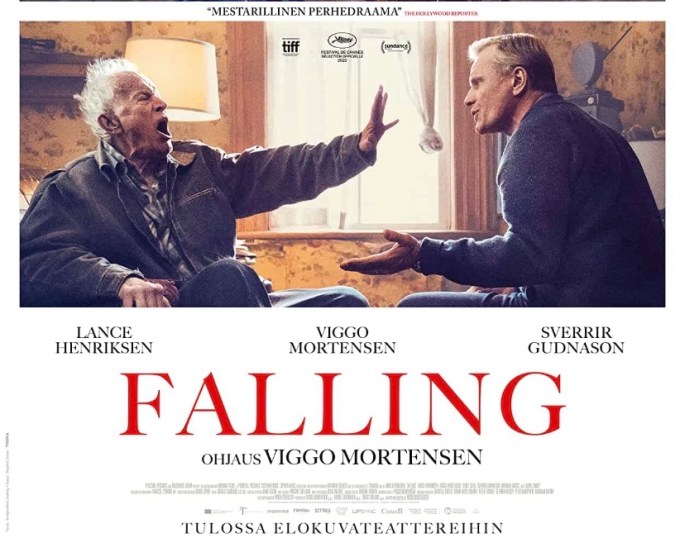
I love to see it when a cherished and talented actor makes their debut as a director, especially if they absolutely nail it, and Viggo Mortensen’s Falling is an astonishingly terrific first time effort behind the camera, in front of it and collaborating with one of cinema’s most prolific and underrated character actors, the mighty Lance Henriksen. Mortensen paints a deeply personal and seemingly autobiographical portrait of a stormy father son relationship here, a dynamic put to the absolute test in its twilight years as dementia throws a curveball. Henriksen is Willis Petersen, a conservative, sexist, crass, bigoted, bitter, flint-edged old goat whose emotional problems and inability to properly communicate made life extra tough on his wife and two kids growing up on a farm in chilly upstate New York. He is now a snowy haired senior citizen who can barely remember what day it is, and journeys with his grown up son John (Mortensen; patient, restrained, meticulously pensive until the breaking point) to live with him, his husband (Terry Chen) and their young daughter (Gabby Velis) in sunniest California. Willis is utterly and completely out of his element in this setting, while John, his family and the rest of the city do their best to ignore, endear and diplomatically deflect his brittle onslaught of angry, bigoted, rude and altogether inappropriate behaviour. Willis is a tough cookie to love or care for, especially in this golden age of hyper-tolerance, but Henriksen, in an absolute career best tour de force, makes him not just another angry old man but a human being who is so scared of dying, losing his memories of life and slipping away from the life affirming groove of his routine that he’s lashing out at basically everyone around him. Except for his young granddaughter, his relationship with her is perhaps the only genuinely warm-hearted and easygoing interaction he allows himself to inhabit. Mortensen masterfully edits together their present day life in Cali with picturesque, auburn laced and earthen flashbacks to Upstate NY where we see a young Willis (Sverrir Gudnason) raise John and his sister, struggle to be there for them without letting his flaws run amok and navigate through two marriages, one to the children’s sensitive mother (Hannah Gross) and later to another (Bracken Burns). Laura Linney gives a reliably focused and mesmerizing turn as Willis’s grown up daughter, who does everything she can not to get emotionally compromised by her father’s issues, and there’s a sly cameo from Viggo’s longtime pal David Cronenberg as a stoic butt doctor whose scene with Willis highlights some of the films coarse black humour, often at the expense of his son’s homosexuality as John himself looks on in almost unfathomable patience. It’s easy to condemn and dismiss a difficult character like Willis, but Mortensen’s complex direction and Henriksen’s volcanic yet finely shaded nuance refuse the viewer in drawing such hasty, narrow conclusions. Mortensen’s surreal editing, fluidly washed transitions, the wonder of the natural world and the magic of music to remind us that human beings are never just one thing and that a seemingly lost, scared and downright mean old man is still capable of compassion, patience and a modicum of self reflection, even in the eleventh hour. This is an astonishing film and a staggering debut for any filmmaker of any background with a central performance by Lance that anoints his entire epic career with that one last minute entry to crown it all, he and the film overall are truly magnificent.

-Nate Hill

THE MICHAEL MANN FILES: CRIME STORY (1986-1988)

In 1986, Michael Mann was having a hell of a year. The second season of Miami Vice had proven to be immensely popular, he stewarded Band of the Hand into the theaters as an executive producer, did the same for Manhunter as writer and director, and, finally, brought Crime Story to the airwaves, making him for one brief moment of time, the king of television.

Had Crime Story been half as successful as Miami Vice, there is little doubt that Michael Mann’s name and the show itself would have eclipsed Miami Vice in terms of the conversation as to what it contributed to pop culture. Where Miami Vice‘s influence was immediate and changed the entire look of America for a hot minute, Crime Story would have undoubtedly been on multiple critics’ lists regarding the greatest network television shows of all time for its sophisticated storytelling, stellar period soundtrack, and its impeccably gorgeous production design. Alas, what can only be deduced as network interference spoiled the soup and caused Crime Story to remain only as the foundation of a brilliant show that went horribly wrong, the seeds of which nonetheless scattered far and wide and brought forth amazing fruit.

Inspired by Rainer Werner Fassbinder’s astonishing Berlin Alexanderplatz, itself a multi-part German television series shown theatrically in New York City in 1980, Crime Story was to be a less episodic television series than Miami Vice and, instead, one that told, in serialized format, one continuous narrative of the obsessive cat-and-mouse game between Chicago Detective Mike Torello (Dennis Farina) and arch-criminal Ray Luca (Anthony Denison) that would span five seasons and cover the years 1963 through 1980. What Mann ended up with was more like Eight Hours Don’t Make a Day, the Fassbinder series that was initially scheduled to run in eight episodes but was canceled after only five, ending the series on, for Fassbinder, an uncharacteristically happy note JUST before it got to take its planned darker turn. Crime Story’s aborted ending after just two seasons doesn’t do that, exactly; but, if you cock your head and squint just right, the end of the show does makes a certain amount of sense and create a small amount of satisfaction if looked through the prism of the universe of Michael Mann.

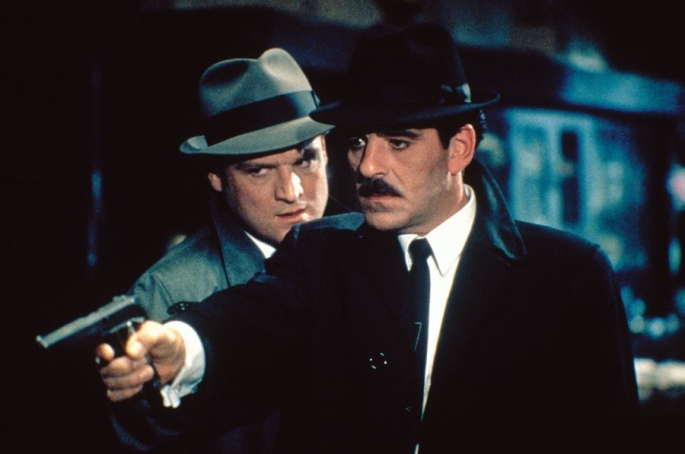
But before we get to the ending, we have to talk about the beginning and, man, what a glorious inception Crime Story had. Jumping off with an explosive, two-hour feature pilot, directed by Abel Ferrara, Crime Story chronicles the rise of Ray Luca, small-time Chicago criminal. Moving up through the ranks with the help of boss Phil Bartoli (Jon Polito), numbers runner Max Goldman (Andrew Dice Clay), cat burglar Frank Holman (Ted Levine), dim witted henchman Pauli Taglia (John Santucci), and crime lord Manny Weisbord (Joseph Wiseman), Luca is chased from one end of Chicago to Las Vegas and, ultimately, the end of the earth by Lieutenant Michael Torello and his gang of coppers; Nate Grossman (Steve Ryan), Danny Krychek (Bill Smitrovich), Walter Clemons (Paul Butler), and young blood Joey Indelli (Bill Campbell). Working both sides of the fence at different points in the show is Stephen Lang’s David Abrams, mob boss son on a crusade against injustice and crime.

Crime Story was created by Chuck Adamson and Gustave Reininger and, indeed, is based off of true crime events that were massaged and fictionalized. A soft bridge between the cinematic, operatic opulence of The Godfather and the gritty, granular details of Goodfellas and Casino, Crime Story’s biggest progeny is likely The Sopranos which had the benefit of coming after Scorsese’s at-bat and was able to launch off the familiar popularity of Goodfellas in the same way that Happy Days was able to cloak itself in American Graffiti clothes. But, in 1986, Crime Story was well ahead of the curve by attempting what Mann described as a 20 hour movie that snaked its way through the annals American history via the exploits of its two leads.

So, yes, that is, indeed, the outline of the plot of Casino you’re seeing (except with Andrew Dice Clay in the Robert De Niro part) deep into season one yet nine years before the Scorsese film hit the theaters. In fact, you’re likely to see a plot element or casting decision or three that will likely remind you of things you’ve seen before and, yes, you’re probably right in deducing that they’re familiar. For Crime Story was the Velvet Underground of television shows; nobody watched it but those that did created their own piece of organized crime entertainment that became wildly popular. This is likely due that the raw material assembled for Crime Story, interviews Reininger conducted with actual mob figures, made up so much of the material that was used in the mob genre in the wake of Goodfellas and Wise Guy, the 1986 Nicholas Pileggi book from which Goodfellas was adapted.

Unfortunately, after the show made a ballsy and epic shift from Chicago to Las Vegas halfway through its first season, something seemed to go terribly wrong in the second season. The show’s pace seemed to quicken and format seemed to become more conventional. What was a single-threaded chase for Ray Luca became stagnated in the Las Vegas desert while the antagonist and his exploits were pushed to the background and rinky-dink, Mickey Mouse investigations found their way onto Torello’s desk. This mimicked the way Miami Vice did business but Crime Story could ill-afford to monkey with its special formula and when chasing Ray Luca becomes secondary for a saggy spell, the show becomes far less compelling and at its worst, it feels like a routine cop show in a fun period getup. Perhaps this was a way to help bring new viewers on board at random which would be next to impossible as the show was envisioned. Hell, in the 44 episodes that make up Crime Story, there are at least three clip shows designed to square-up the audience that HAD been paying attention. And, given the way networks and television shows work, I can’t say that I entirely blame NBC. But it was a devil’s gambit; a bid for an audience that didn’t show up which ended up costing the show its greater reputation.

The other issue with making Crime Story less of a two-hander about Torello v. Luca and more one about Torello and His Flying Sack of Maniacs is that the latter approach is rote and most definitely NOT Michael Mann territory. For whatever lofty heights the first season reached, Crime Story winds up being the lesser between itself and Miami Vice mostly because either one of two things have to occur in Mann’s work; either you have the cop chasing the criminal who is just the mirror image of himself -or- the cop and the criminal are almost so intertwined that they’re basically the same person. This may seem like a distinction without much of a difference but this is also how Miami Vice could stay true to itself in almost every episode and not get out of the scope of Mann’s overall thesis. Without Ray Luca’s constant yang to Torello’s Yin, Crime Story becomes inert and uninspired although I will admit that “Blast From the Past,” the second season episode in which Torello hunts for the kidnappers of his ex-wife’s current husband, remains one of my favorite episodes of the entire show due to its uncommon emotional depth.

There does seem to be a point in which all of the historical tchotchke that riddles the central story of Crime Story eventually became too heavy for Mann and the networks which is why the last three episodes of the second season seem to jettison their historical skin and literally look like a three part Miami Vice arc in which Crockett and Tubbs find themselves in a high level of jeopardy in an unfriendly and unstable South American country. But say whatever you will about those episodes in which the show begins to (almost jarringly) expand into territory Mann would later touch with his stewardship of 1990’s Drug Wars: The Camarena Story, itself a prototype for Steven Soderbergh’s Traffic, it regains the core vision of the series where obsessed men strip themselves down to their most base and animalistic to hunt and destroy each other which, honestly, is what really drives Michael Mann’s best work. In fact, if you took away all of the period detail in Crime Story, you’d basically have the soul of his next feature, the 1989 made-for-television film, L.A. Takedown, which would find more important life six years later when Mann remade it as Heat. This is also why Crime Story’s second season’s cliffhanger ending, seen as tragically disappointing because of the show’s cancellation, is one that could also be easily seen as the most logical ending of all of Mann’s works. For if Torello’s season one threat to Luca of “I’m going to take you down right” is to be taken literally, there is really no other way for things to end outside them killing each other. So its probably best for everyone involved that they all perish when that plane hits the water lest Dennis Farina survive end up like poor Al Pacino or James Caan at the endings of Heat and Thief, respectively; a broken soul left to wander the earth alone, pouring over his miserable past with nothing especially to look forward to.

It’s something of a disappointment that Crime Story never became what it was inspired to be. Dennis Farina gives a tremendous, physical performance which looks like he hurt a few stuntmen and day players and it is a complete joy to watch him throw people through candy glass and slam their heads a little too forcefully into the props even when the show goes off the rails. Anthony Denison should have been a bigger star away from television and got done completely dirty when the second season ate his character away into being just a tiny bit more than supporting cast member. Andrew Dice Clay is surprisingly at ease and amazing which makes me wish that the show would have helped him pursue bigger and better acting roles which was a better vocation for him than what he became. And, man, Joseph Wiseman really gets to sink his teeth into a role that apparently contractually allowed him to eat every shred of scenery he wanted to when he was on screen. In the annals of Wiseman’s villainy, I’m generally more gripped and terrified when he’s lecturing someone in Crime Story than when he’s talking world domination with James Bond as the titular character in Dr. No.

And it’s probably not for nothing that contributing to the show’s inability to rise above a mere cult curiosity is the way it’s been treated since its broadcast. Due to Universal’s balking at picking up the show due to its tremendous price tag when they were already paying over $1 million per episode of Miami Vice, Crime Story was taken in by the television department over at New World Pictures, one-time Roger Corman outfit that had decided to go straight in the mid-80’s. To say that Universal was a better custodian of its intellectual property than New World is a vast underselling of the situation because Miami Vice has done nothing but lived on in syndicated reruns with little or no problem in terms of physical media or otherwise in allowing the consumers to watch the full, unedited show with as brilliant a picture as humanly possible. Not so with Crime Story. First released onto VHS in the subpar SLP mode (always a then-sign of trash quality), the show never fared any better when it made the jump to DVD. Now collected into one nine-disc DVD set by Image Entertainment, Crime Story is a disgraceful presentation of compressed, dark, and muddy images with sloppy and obvious soundalike cues sprinkled about where musical clearances were not obtained. To add insult to injury, the second season is presented without preservation to the original broadcast order necessitating one to consult IMDB to ensure they’re on the right track. This is a show that simply screams to be restored and if it were given better treatment, the show’s obvious shortcomings in the second season wouldn’t land as particularly hard as they do. For no matter how stupid Miami Vice got in its fourth season, Mill Creek made Crockett and Tubbs pursuing a tank of bull semen look absolutely and achingly beautiful. And if you think you’re going to get around these things by watching whatever app reflects as having this as a streaming option, you won’t as they’re using the same transfers.

Crime Story remains one hell of a show, regardless of its ignoble end. One could watch nothing more than the first season and think that Michael Mann had delivered one of the greatest things in all of network television. Alas, the second season came with a price tag that brought it down to earth. As the 1980’s were coming to a close Mann was finding the world of television to be just as frustrating as what he had experienced with The Keep and Manhunter. But he still had a couple of other small-screen projects standing between him and his big-screen reboot and they’d be ones in which he’d further shape his thematic ideas of good guys and bad guys living amid cultural, urban, and emotional wastelands.

(C) Copyright 2021, Patrick Crain
THE RUSS MEYER FILES: HEAVENLY BODIES (1963)

As Russ Meyer stumbled to the finish line of the nudie cutie craze, it was apparent that he was a filmmaker of commanding energy and imagination that had run through the proverbial store and exhausted it of its contents. 1963’s Heavenly Bodies, his last true nudie cutie, is indicative of both conceits. For Heavenly Bodies is quite literally a segmented movie in the spirit of Erotica that gives full-throated articulation, in numerous anecdotal ways, how the photography of beautiful women is the cornerstone to most commerce through advertising. Throughout each segment in the film, Meyer covers his models in every conceivable pose and situation in an attempt to justify the film’s reason for being. Unfortunately, the film is nothing more than a sixty-odd minute treatise on the not-controversial discovery that, if you already weren’t aware, sex sells.

Heavenly Bodies may not, in fact, even be a real nudie cutie. It’s sort of a combination between a nudie cutie and a pseudo-documentary on photography. This film is little more than Meyer shooting various cameramen shooting models in various states of undress; like a distilled Brian De Palma sexploitation picture in which the movie audience watches people within the movie watching. I might go so far as to say that this might be of equal interest for fans of Meyer’s parade of buxom women or those who have a raw enthusiasm for photography.

And just because the film is trite and silly and exhausted of anything that would make it work as entertainment, there is no denying Meyer’s skill for framing and composition. Some of the earliest images in the film wherein the camera is foregrounded aside Meyer’s models stunningly resemble the split-diopter shots that famously pepper the films of the aforementioned Brian De Palma. Additionally, the segment featuring Nancy Andre has a wild, unbridled energy that would later propel Mudhoney and Vixen showing once again that these nudie cuties were just wood shedding opportunities for Meyer. Just as the upshot view through the bed springs first made its storied appearance in Wild Gals of the Naked West, the utilization of the model in the spinning Danish chair looks suspiciously like a key moment in Cherry, Harry & Raquel.

Perhaps one of the film’s most interesting and revealing moments comes in the second segment as Russ Meyer leads his fellow buddies in the Army’s 166th Signal Photo Company out in the woods to photograph Althea Currier and Monica Strand. Less cheeky than some of the narration in this and the other films before it, Meyer almost deftly uses a photo field trip and all of its trappings to show a metaphoric group sex orgy in which almost every single line of narration could be taken as wry double-entendre. And it is only in this portion of the film that Meyer’s talent and wit collide to make something interesting. “Was your class reunion anything like this?” the narrator asks as Meyer’s buddies all snap away at the ladies as he stands behind them and directs them all. This is Meyer in a metaphoric nutshell. He was a tough, no-nonsense man who took his work very seriously but he was famously big-hearted and generous to friends and loved-ones. Meyer loved to work but he also liked to show people a good time and to be the ringmaster of such journeys. Here, the idea is made flesh and Meyer is showing his Army buddies, the closest friends he ever had, just how awesome his life is surrounded by tits and ass, encouraging them to indulge themselves.

But, honestly, that’s about all that can be said about Heavenly Bodies, the merciful end to Russ Meyer’s nudie cutie period. It’s a dull, mostly rote affair that, at 55 minutes, feels a little incomplete. But the fault in the film is more or less due to the depletion of the tank. For even after blazing the trail and exploring its outer limits, Meyer could still find ways to make the dullest of the sexploitation subgenres achieve a certain artistry in their visual execution.

That said, I sure am glad he only made a finite amount of them.

(C) Copyright 2021, Patrick Crain