Dredd: A Review By Nate Hill


After the floundering absurdity that was 1995’s Judge Dredd left a nasty taste in the collective mouths of fans, all wen quiet on the cinematic front of Dredd for nearly two decades (I call it the Batman & Robin effect). The clouds parted though, and we finally got one streamlined masterpiece of a flick with 2013’s Dredd. Not only is it achingly faithful to the comics right down to Dredd never removing his helmet, but it stands as one of the ballsiest and well made action pictures in recent years. It’s never overstuffed or busy, takes the violence seriously, has genuine suspense, a bone deep and super tough performance from a grizzled Karl Urban, a sexy, no nonsense villain and the best original score of 2013 by a country mile. Not too mention it’s atmospherics, which are helped by said score of course, to create a sonic mood board of post apocalyptic ruin and urban rot. Dredd is part of an elite department called the Judges, who roam the smoky desolation of Mega City One and act as judge, jury and executioner wherever they see fit. Dredd is a trigger happy juggernaut with no use for scum or criminals and has not a qualm with taking them out like the trash they are, often in brutal, bloody and uncompromising ways. On day he’s partnered up with judge in training Cassandra (Olivia Thirlby, perfect), a rookie with blossoming telepathic abilities. A routine call leads them to a gargantuan Mega Block tower called Peach Trees, a sting irony once we see the rampant squalor inside. This tower happens to be controlled by the fiercest criminal overlord in town, Ma Ma, played by a purring, lethal and altogether terrifying Lena Headey. Her tactics go beyond barbaric and she’s sitting on the manufacturing of a drug called Slo Mo, which makes the users feel like time is passing at one percent it’s normal rate (a gold mine for setting up a scene visually). Ma Ma locks down the tower as the two judges arrive, and decrees that she wants them dead. Now it’s a visceral fight for survival against her armies of thugs and miscreants, and a slow ascent towards her penthouse lair, for Dredd to finish her off. The whole film takes place in Peach Trees, so it’s a self contained, one location affair, and a goddamn knockout of a movie. There are R rated films that dabble in violence a bit and barely earn their stripes, and then there are R rated films that leap at the chance to show people dying six ways to Sunday. Dredd absolutely decimates Ma Ma’s armies in high style and often in super slow motion as they face him while they’re high. The slo mo never feels tacky, but has a tactile richness and fluidity that makes the inflicted carnage so satisfying as it unfolds. The score by Paul Leonard Morgan is an uproarious rallying call that drives forward constantly, charging out of the gate in the opening minute as Dredd pursues a van down the highway on his thundering motorbike, and pummelling each scene with heart stopping force until it mellows out for an eerie passage called ‘Ma Ma’s Requiem’ which is my favourite piece in the film and can be listened to on repeat. Pure genius. Thirlby is the voice of reason and the eyes of the audience, experiencing for the first time how ugly this crime fighting business is, and holding her own wickedly. There’s a dark sense of danger to the whole thing, a frank and outright lawlessness to the villains, as it’s just another day on the job for them. No overacting, no histrionics. Just mellowed out murder and meanness all round. This is the Dredd film that we’ve been waiting for, and have long deserved after that other mess. Low box office returns means we may never see a sequel (wtf is wrong with people, like, who didn’t go see this??), but we’ll always have this little blitzkrieg of a flick to re watch time and again. I know I will.

THE COLOR OF MONEY – A REVIEW BY J.D. LAFRANCE

color-of-money

The 1970s saw the rise of the Movie Brats, a collection of filmmakers that had grown up watching and studying films. They made challenging films that reflected the times in which they were made and were revered by cineastes as much as some of the actors appearing in them. Directors like William Friedkin, Francis Ford Coppola, Hal Ashby and Martin Scorsese made intensely personal films that blended a European sensibility with American genre films. However, the one-two punch of Jaws (1975) and Star Wars (1977) and the failure of expensive passion projects like New York, New York (1977) and Heaven’s Gate (1980) ended these directors’ influence and saw the rise of producers like Joel Silver, Don Simpson and Jerry Bruckheimer, and movie star-driven blockbusters in the 1980s and beyond. It got harder and harder for the Movie Brats to get their personal projects made. Most of them went the independent route, making films for smaller companies like Orion and doing the occasional paycheck gig with a Hollywood studio.

For years, Scorsese had been trying to fund a personal project of his own – an adaptation of The Last Temptation of Christ. It was a tough sell and he ended up making After Hours (1985) and The Color of Money (1986) as a way of keeping busy while he tried to get Last Temptation made. At the time of The Color of Money much was made of it being Scorsese’s first movie star-driven film and some critics and fans of the director felt that he was selling out. It would not only be promoted as a film starring Paul Newman and Tom Cruise (and not as a Scorsese film), but was a sequel (something that the director was never fond of doing) of sorts. Newman had been interested in reprising his famous role of “Fast” Eddie Felson from The Hustler (1961) for some time but he had never met the right person for the job – that is, until he met Scorsese.

The Color of Money begins twenty-five years after the events depicted in The Hustler and we find that Eddie (Newman) is enjoying a comfortable existence as a savvy liquor salesman with his bar owner girlfriend Janelle (Helen Shaver) and occasionally fronting a pool hustler. His current investment, a cocaine addict named Julian (played with just the right amount of sleazy arrogance by John Turturro), is getting roundly beaten by a young turk named Vincent (Tom Cruise) who catches Eddie’s attention with his “sledgehammer break.” He becomes fascinated watching Vincent play and his cocky behavior between shots, like how he works the table. Eddie also watches the dynamic between Vincent and his girlfriend Carmen (Mary Elizabeth Mastrantonio). What really catches his attention is not just Vincent’s raw talent but also his passion for the game. He’s even willing to play Julian after he’s won all of the guy’s money because he just wants his “best game.”

There’s a nice bit where Eddie tests Carmen’s skill as Vincent’s manager, exposing her lack of experience and schooling her on the basics of pool hustling in a beautifully written monologue by Richard Price that Newman nails with the ease of a seasoned pro. We get another healthy dose of Price’s authentic streetwise dialogue in the next scene where Eddie takes Vincent and Carmen out for dinner and continues to school his potential protégés: “If you got an area of excellence, you’re good at something, you’re the best at something, anything, then rich can be arranged. I mean rich can come fairly easy.” The scene is also nicely acted as Tom Cruise plays the cocky upstart with just the right amount of arrogant naiveté without being a typical goofball. As Eddie puts it, “You are a natural character. You’re an incredible flake,” but tells him that he can use that to hustle other players. The ex-pool player lays it all out for the young man: “Pool excellence is not about excellent pool. It’s about becoming something … You gotta be a student of human moves.” And in a nice bit he proves it by making a bet with them that he’ll leave with a woman at the bar. Of course, he knows her but it certainly proves his point. This is a wonderful scene that begins to flesh out Vincent and establish how much he and Carmen have to learn and how much Eddie has since The Hustler.

The young man is a real piece of work – brash, directionless but with raw talent. It is clear that Eddie sees much of his younger self in Vincent and decides to take the young man under his wing and teach him “pool excellence” by taking him and Carmen on the road. It’s an opportunity to make some money while also getting back Eddie’s passion for playing pool. The Color of Money proceeds to show the three of them on the road for six weeks, getting ready for an upcoming nine-ball tournament in Atlantic City. Of course, there are the predictable bumps in the road as Vincent’s impulsive knack for showing off costs them money and Eddie feels like the young man’s not listening to him. It’s a formula we’ve seen used in countless films but Scorsese does everything he can visually to keep things interesting, especially in the dynamic way he depicts the numerous games of pool, the use of music (for example, one game is scored to “Werewolves of London” by Warren Zevon) and the actors that play some of the opponents along the way, like a young Forest Whitaker as a skilled player that manages to hustle and beat Eddie at pool.

However, it is the camerawork by veteran cinematographer Michael Ballhaus that impresses the most. He and Scorsese depict each game differently, employing a variety of techniques, like quick snap zooms in and out, and floating the camera gracefully over the pool table or gliding around it. He even has the camera right on the pool table following the balls around. The camera movement and editing rhythm of each game is dictated by the mood and intensity of each match, like the grandiose techniques employed when Vincent shows off during a game of pool. As he revels in his own showboating moves, the camera spins around him as if intoxicated by his bravado. However, much like the chaotic pool hall brawl in Mean Streets (1973), the camera movement goes nowhere symbolizing the futility of Vincent’s actions. Sure, he beat the top guy at that pool hall but in doing so scared off an older player that had much more money.

While The Color of Money was made fairly early on in Tom Cruise’s career, his relative inexperience actually suits his character. His youthful energy mirrors Vincent’s. It is his job to come across as an arrogant flake of a human being, which he does quite well (too well for some who were unimpressed with his performance). Cruise has always been an actor that performs better surrounded by more talented and experienced people and with the likes of Paul Newman acting opposite him and Scorsese directing, it forces the young actor to raise his game. One imagines he learned a lot on the job much like Vincent does in the film. Scorsese knew exactly what he was doing when he cast Cruise and got a solid performance out of him. In the late ‘80s, Mary Elizabeth Mastrantonio acted in a series of high profile roles like The Abyss (1989), The January Man (1989) and this film. She’s given the thankless job of the girlfriend role but manages to make the most of it. One gets the feeling that Carmen is a fast learner and smarter than Vincent. She is much like Eddie in understanding the business side of pool hustling.

Color-of-Money-Tom-Cruise

Naturally, Newman owns the film, slipping effortlessly back into Eddie’s skin after more than 20 years and it’s like he never left. The scenes between him and Cruise are excellent as the headstrong Vincent bounces off of the world-weary Eddie. Over the course of the film something happens to the elder pool player. As he tells Vincent at one point, “I’m hungry again and you bled that back into me.” We see that youthful spark fire up in Eddie again after so many years dormant and Newman does a fantastic job conveying that. While many felt that his Academy Award for the performance he gives in The Color of Money was really a consolation prize for a career of brilliant performances, this does a disservice to just how good he is in this film and how enjoyable it is to watch him get to work with someone like Cruise and Scorsese, watching how their contrasting philosophies towards acting and filmmaking co-exist in this film. There is an energy and vitality that Cruise brings and Newman feeds off of it and Scorsese captures it like lightning in a bottle.

When Paul Newman read Walter Tevis’ sequel to The Hustler it made him wonder what “Fast” Eddie Felson would be doing now and wanted to revisit the character. He had seen Raging Bull (1980) and was so impressed by it that he wrote a letter to Scorsese complimenting him on such a fine piece of work. The director was just coming off of After Hours and was attached to several projects, including Dick Tracy, with Warren Beatty, a fantasy film entitled Winter’s Tale, Gershwin, with a screenplay written by Paul Schrader, and Wise Guy, a book about the New York mafia written by Nicholas Pileggi. However, they all took a backseat when Newman invited him to direct a sequel to The Hustler. The actor had been working on it for a year with a writer. Scorsese was interested but didn’t like the script Newman showed him because it was “a literal sequel. It was based on at least some familiarity with the original.” Scorsese felt like he couldn’t be involved with the project if he didn’t have some input on the original idea of the script.

Scorsese wanted to go in a different direction and brought in a new screenwriter, novelist Richard Price who had written The Wanderers and also a script for the director based on the film Night and the City (1950). Scorsese liked the script because it had “very good street sense and wonderful dialogue.” For The Color of Money, Price and Scorsese’s concept was basically what became the film, exploring the director’s preoccupation with redemption but with what Newman saw as “recapturing excellence, having been absent from it, and then witnessing it in somebody else.” Newman liked it and Price and Scorsese came up with an outline and began rewriting the script. Price studied pool players and wrote 80 pages of a script. They took it to Newman and got his input. By the end of nine months, Price and Scorsese decided to make the film with Newman.

For Scorsese this was the first time he had ever worked with a star of Newman’s magnitude. “I would go in and I’d see a thousand different movies in his face, images I had seen on that big screen when I was twelve years old. It makes an impression.” As a result, Scorsese and Price made the mistake of writing for themselves when they should have tailored the script to suit Newman and his image, or as Scorsese later said, “we were making a star vehicle movie.” The actor wanted to explore aging and the fear of losing his “pool excellence.” He also wanted the character of Minnesota Fats, played so memorably by Jackie Gleason in The Hustler, to return but Price couldn’t get the character to fit into the script. He and Scorsese even presented a version of the script with Fats in it to Gleason but he “felt it was an afterthought,” said Scorsese.

It was Newman that suggested Cruise for the role of Vincent to Scorsese. The young actor had met Newman before when auditioning to play his son in Harry & Son (1984). Scorsese cast Cruise before Top Gun (1986) had come out but he was a rising movie star thanks to Risky Business (1983). He had seen the young actor in All the Right Moves (1983) and liked him. The project was initially at 20th Century Fox but they didn’t like Price’s script and didn’t want to make it even with Cruise and Newman attached. Eventually, it went to Touchstone Pictures.

Newman was not fond of improvising on the set and suggested two weeks of rehearsals before filming. Scorsese wasn’t crazy about this and found them “aggravating. You are afraid that you are going to say ridiculous things, and the actors feel that way too.” However, he agreed to it and brought in Price so that he could make changes to the script. Fortunately, everyone felt secure in character and with each other. Price and Scorsese didn’t have the film’s ending resolved and felt that they had written themselves into a corner. The studio wanted them to shoot the film in Toronto but Scorsese felt that it was too clean and chose Chicago instead. Both Cruise and Newman did all their own pool playing with the former being taught how to do specific shots that he played in the film with the exception of one, which would have taken two additional days to learn and Scorsese didn’t want to spend the time. Cruise had dedicated himself to learning how to play pool: “All I had in my apartment was a bed and a pool table.” He worked with his trainer and the film’s pool consultant Mike Sigel for months before shooting started.

Some Scorsese fans marginalize The Color of Money as one of his paycheck films – the first he did for the money – and while it may not have the personal feel of a film like Taxi Driver (1976), it still has its merits, a strong picture that fits well into the man’s body of work. I would argue that it is one of his strongest films stylistically with some truly beautiful, often breathtaking camerawork capturing all the nuances of playing pool: the energy and vitality of the game is there without sacrificing any of the story or the characters. This film also shows how a director like Scorsese can take a hired gun project and make it his own. It looks, sounds and, most importantly, feels like one of his films and not a commercial studio picture. Others must have agreed as the film not only became Scorsese’s most financially successful film at the time but a critical hit as well.

ColorOfMoney_Rolex2

The director proved to the studios that he could deliver the goods at the box office while to himself he was still able to invest the film with some of his own personal touches. Ultimately, The Color of Money is about Eddie’s redemption and rekindling the spark he had in The Hustler before the screws were put to him. As with many sports movies, the story builds towards the climactic big game or, in the case of this film, the big tournament but Price’s script offers a slight twist in that Eddie’s victory is a hollow one and the real one is at the very end when his love for playing pool has finally come back completely. He is reinvigorated and excited about where his life and game will go from here and this is summed up beautiful in the film’s last line – “I’m back.”

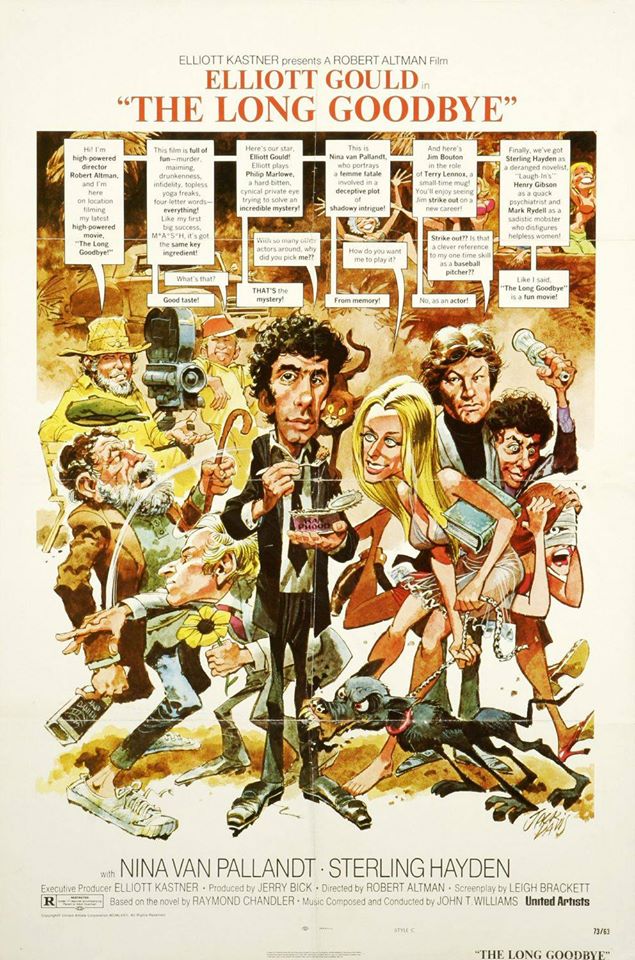
ROBERT ALTMAN’S THE LONG GOODBYE — A REVIEW BY NICK CLEMENT

1

There are very few Robert Altman movies that I’ve seen and not enjoyed. The man was beyond prolific, and I’m still not 100% caught up with his genre-hopping filmography, but he made so many great, unique, and all-together interesting motion pictures that it’s no wonder he’s been the inspiration for so many of our best current filmmakers. The Long Goodbye is one of my absolute favorites from Altman, an overstuffed shaggy-dog detective story that is more interested in people and their eccentricities rather than concrete plot points. Written by legendary screenwriter Leigh Brackett, this film served as an updated companion piece to Brackett’s decades earlier The Big Sleep, with both taking life as original novels by Raymond Chandler; talk about loving the art of being convoluted! The tone that Altman achieved in The Long Goodbye is exactly why I respond so favorably to its many distinct charms; the film is a cool customer, and feels like it could only have come from that glorious decade of 70’s cinema.

Elliot Gould did some of his best and funniest work as laconic detective Philip Marlowe, with the entire supporting cast delivering very tasty and memorable performances; Nina van Pallandt, Sterling Hayden, ex-MLB pitcher Jim Bouton, Henry Gibson, David Arkin, and filmmaker Mark Rydell were all fantastic. Altman’s trademark use of overlapping dialogue was in full swing in The Long Goodbye, and in tandem with the super-wide 2.35:1 cinematography by the legendary cameraman Vilmos Zsigmond, the film has an effortlessly cool, hazy-stoned, and oh-so-raggedly-beautiful aesthetic which is very well complimented by the Kino Blu-ray release. The final scene is all sorts of amazing, wrapping everything up but still retaining that loosey-goosey vibe, while the film sports a jazzy John Williams musical score. Apparently, Brian G. Hutton, Howard Hawks and Peter Bogdanovich were potential directors before Bogdanovich passed on the project, and recommended Altman. “I even lost my cat” POWER.

CRAIG JOHNSON’S THE SKELETON TWINS — A REVIEW BY NICK CLEMENT

1

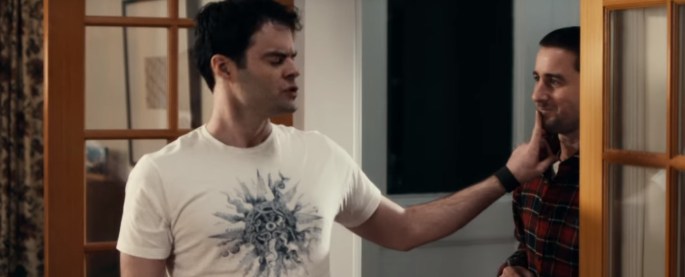
Bill Hader and Kristen Wiig are both absolutely fantastic in the poignant and hilarious black comedy The Skeleton Twins. Any movie that’s able to wring laughs out of the topic of suicide knows a thing or two about sly, subtle, dangerous humor; this is a film that goes to some tough places and asks for serious commitments from its two leads, who are more than up to the dramatic challenge. This is a wonderful brother-sister movie, filled with terrific scene after terrific scene, and even if there’s one narrative misstep that keeps it from being extra-tidy, there’s so much to enjoy and recommend about the storytelling. Hader and Wiig are estranged siblings, who crash back into each other’s orbits after both experience some scary life lessons. They are both broken souls, drifting through their respective problems, and the hope is that they might be able to bond once more in effort for some type of healing. Craig Johnson’s tonally perfect direction and character focused script (co-written with Mark Heyman) nails the sadness and the humor that’s necessary for a story like this.

2

Luke Wilson is a supporting actor MVP, stealing every single scene he appears in. But the movie belongs to Hader and Wiig, who both hit new heights as performers, with Hader in particular surprising in a big way. Never going over the top yet always bristling with emotion and outward feeling, his performance is perfectly in tune with the exceptionally dead-pan comedy style that Wiig excels at. Everyone knows that Hader can be a clown; here he’s able to get serious at a moment’s notice and I loved everything about him in this movie. Wiig continues her stellar big-screen run and adds another comical sad-sack to her repertoire, but this time, mixed in some serious grace notes as a dramatic actress. And in their numerous scenes together, Hader and Wiig radiate true sibling chemistry that’s a joy to watch. Painful one moment and then laugh out loud funny the next, The Skeleton Twins is one of those great little films that will surprise anyone who gives it a chance.

3

Tony Scott’s Man On Fire: A Review by Nate Hill 

Tony Scott’s Man On Fire is one of those films I can watch time and time again and never tire of, a magnificently melancholy tale of South of the border justice, criminal intrigue and a tequila shot of pulpy, blood soaked style that gets me every time. It’s loosely based on a 1987 film of the same name starring Scott Glenn, Jonathan Pryce, Danny Aiello and Joe Pecshi (there’s a random lineup, no?), but Scott intrepidly branches off into his own territory, and thank god for his vision. This was the first film in which he really explored his sketchy smokehouse of an aesthetic that he would later take to angelic heights with Domino. Colors blur and saturate, editing rockets by with the force of a bullet in a storm, subtitles appear arbitrarily and seemingly of their own volition. It’s a jarring tool set that he employs, and many abhor it. I’m as in love with it as he was though, and whether to throw us right into the protagonist’s psyche or simply because he felt the need to paint his pictures this way, the rest of the films in his remaining career carried the DNA, in varying doses. Fire is the key word for this film, in many of it’s forms. There’s a smoldering ember in Denzel Washington’s John Creasy that is fed by the winds of corruption as the film progresses, erupting into a blazing inferno of violence and fury. Creasy is a broken man, haunted by the questionable, never fully revealed actions of his military past. “Do you think God will ever forgive us for what we’ve done” he grimly asks his old war buddy Rayburn (a scene stealing Christopher Walken). “No” Rayburn ushers back curtly. It’s at this heavy nadir we join Creasy, lost in a sea of alcohol and guilt, an unmooored ship with a shattered hull looking for both anchorage and repair. Rayburn hooks him up with a bodyguard gig in Mexico City, keeping the young daughter of a rich businessman (Marc Anthony, terrific) safe from the very real threat of kidnapping. Dakota Fanning is compassionate, precocious and endearing as young Pita, who spies the wounded animal in Creasy right off the bat and tries to make friends. Creasy draws back in reluctance, but eventually warms up. I love the pace of this film to bits. It spends nearly half of its hefty running time simply getting to know these two characters, forging a bond between them before the inciting incident even looms on the horizon. And when the kidnapping occurs, as it must, the stakes are high as can be and our investment level in the situation is paramount. Setting up character is so key, and Scott nails it with scene after scene of quiet and careful interaction. Then he yanks the lid off the pot, as Pita is snatched in broad daylight, Creasy is injured and the kidnappers vanish into thin air. Pita’s mother (a soulful Radha Mitchell) works with the dodgy Mexican authorities and her husband’s lawyer Jordan (a sleazy Mickey Rourke). Creasy has other plans. Once healed, he embarks on a mission of fury and vengeance, knocking down doors, removing body parts, inflicting gratuitous bodily harm and using every technique in his training (believe me, there are some interesting ones) to track down those responsible and get Pita back. Washington does all this with a calm and cool exterior, letting the heat emanate from every calculated syllable and intense glare. The descent into Mexico City’s poverty stricken criminal underworld is a grisly affair, and all sorts of ugliness is exposed, shredded through the caffeinated prism of Scott’s lens. Two cops do what they can to help Creasy, idealistic Guerrero (Rachel Ticotin) and battle hardened Manzano (the always awesome Giancarlo Gianninni). It’s Creasy’s show though, and he blasts through it like a righteous hurricane of blood and bullets. Scott’s films have a knack for ending in over the top, Mexican standoff style shootouts, but the man subverts that here, going for something far more sorrowful and atmospheric, ending an intense tale on notes of sadness and resolute calm, gilded by the aching tones of songstress Lisa Gerrard and composer Harry Gregson Williams. Walken provides both comfort and catharsis, the only beacon of hope for Creasy other than Pita. Unlike John, Rayburn has moved on from the horrors of their past, but one still sees the trauma in his soul when he looks John in the eye and gets hit with what is reflected back. Tough stuff to get right, but hey, it’s Walken we’re looking at here, and he’s brilliant. Rourke has little more than an extended cameo, but his flavor is always appreciated, and he’s great too. I had no idea Anthony had the chops he exhibits here, but I loved his arc as well as his performance and he holds his own in a blistering scene with Washington. Washington is an elemental beast, shadowing what’s left of his humanity under a cloak of booze and brooding contemplation, until he’s coaxed out by the life saver Pita. Then he’s a lion, riding guns out into a ferocious swan song of a sunset that may just hold rays of redemption for him. This is Scott at his best, his unique brand of storytelling at its height, his creative juices a canister of lighter fluid set aflame with genius and innovation. A masterpiece.

ARI FOLMAN’S THE CONGRESS — A REVIEW BY NICK CLEMENT

1

What can one really say about Ari Folman’s bold, breathtakingly alive hybrid movie The Congress? It’s like nothing you’ve ever seen, I can promise that much. Half animated, half live-action, all totally blazed to the extreme, this is a colossal artistic statement about Hollywood, art, culture, society, and our unending preoccupation with make-believe and hero worship. It’s also one of the headiest films in recent memory, operating on multiple levels of reality and surreality; this is the cinematic equivalent to 100 hits of super-charged acid. The purposefully sprawling and messy structure plays to the film’s wild and operatic strengths. This isn’t a movie to be taken 100% literally, as it is, at heart, an existential crisis story that begs to be viewed multiple times for maximum appreciation. My Blu-ray has been abused over the last year or so. The phenomenal Robin Wright plays a heightened version of herself, a mid-40’s actress who is about to be abandoned by the major studios, an actress beaten down by the pressures of Hollywood and the demands of the star system. Via her impassioned agent (an super-sharp Harvey Keitel) and an extra-slimy studio chief (Danny Huston, twirling his moustache), she’s given the chance to have her mind, body, and soul digitally transferred into a computer so that her likeness can be used and re-used throughout the years, preserving her “Princess Buttercup” good-looks and charm, thus transforming her into the ultimate movie-star for years and years and years.

2

The movie makes a 20 year jump cut at the mid-point and leaps head-first into a hallucinatory outpouring of odd and crazily unique Anime-inspired images during the second and third acts, resulting in a film that feels like Who Framed Roger Rabbit? on PCP. It seems that the only way that one can enter the movie studio of the future (playfully referred to as Miramount) is to drink a potion which turns you into a digital avatar of yourself, and then, once inside this madcap universe, you’re able to drink yet another potion which can literally turn you into whatever you want. This film plays by its own set of wild and wacky rules and because of that, anything can happen, and I love films that operate in this fashion; I’m always drawn to filmmakers who are interested in challenging themselves and the audience. To say that I grasped all of this mind-bending work of art upon first glance would be to out-right lie; this is a dense, packed-to-the-gills experience, one that shouldn’t be immediately shrugged off as just another esoteric artistic experiment. Folman is the real deal, a man with a singular vision, and now, after Waltz with Bashir and The Congress, he’s a filmmaker that I will actively anticipate each new film with baited breath. Visual art like this needs to be celebrated instead of ignored, and my hope is that this film finds a long and happy life on Blu-ray and streaming.

3

MICHELANGELO ANTONIONI’S L’ECLISSE — A REVIEW BY NICK CLEMENT

2

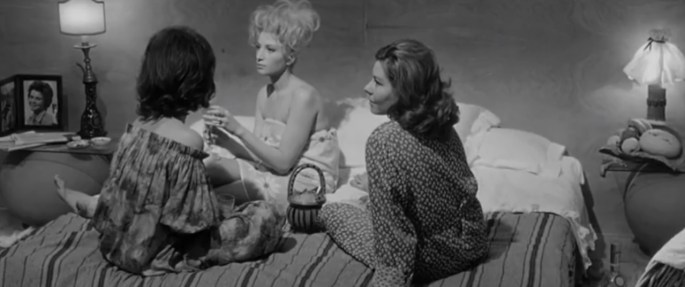
I could watch this stunning movie ever single day. Still as fascinating and as stylish as ever, the 1962 film L’Eclisse truly defies description. Monica Vitti was as alluring as it gets, and I am not sure if there has ever been a classier on-screen presence than Alain Delon. Michelangelo Antonioni made some all-time classics and this one has to be considered one of his best. The film feels like a poem, a glimpse into the life of a woman in flux, drifting from one encounter to the next, never fully sure of herself or the world around her. The final 10 minutes are beguiling in their strangeness and open-ended nature. The Criterion Collection, yet again, have delivered a ravishingly beautiful Blu-ray transfer; it looks like it was shot yesterday, with the sexy black and white images revealing untold depth and clarity. Gianni Di Venanzo’s illustrious cinematography is positively engrossing upon immediate sight, with every silky, dreamy image folding into the next, while always stressing open space and how people are placed within the frame. Everything about this movie screams pure cinema, and the trifecta of L’Eclisse, L’Avventura, and La Notte register as three of the most personal and fascinating films to explore similar themes and artistic motifs that I can think of. Blowup or The Passenger might be my overall favorite works from this extraordinary filmmaker, but there’s something so mysterious, so transfixing about L’Eclisse that I find myself returning to it on fairly regular basis. The film won the Special Jury Prize and was nominated for the Palm d’Or at the Cannes Film Festival.

3


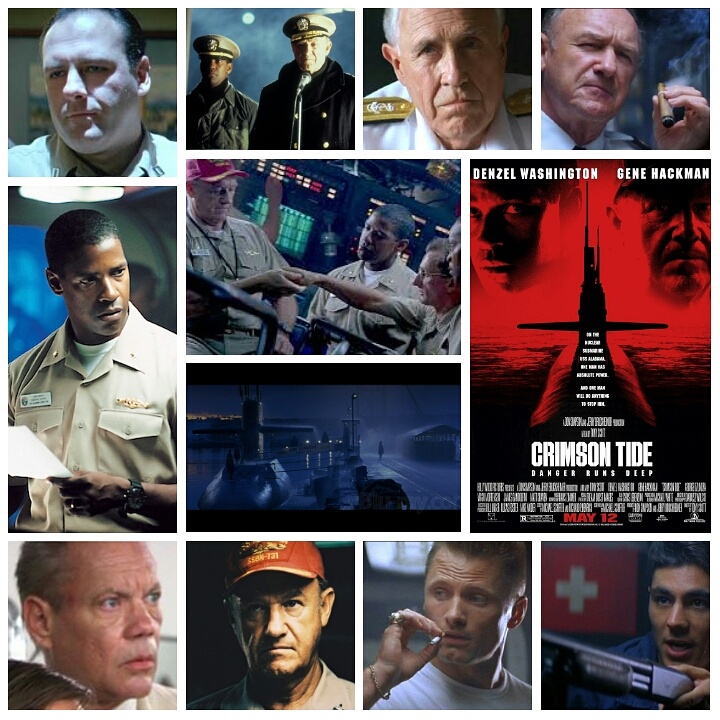
Tony Scott’s Crimson Tide: A Review by Nate Hill 

In terms of submarine movies, nothing will light your fire or get your pulse racing quite like Tony Scott’s Crimson Tide (well maybe Das Boot, but that’s another story). Scott just has this way with hyper kinetic tension and a knack for causing whirlwinds of propulsive energy in his work, and even when the material is more melancholy there is still a rousing climate to every frame. Pair his visual skill with Quentin Tarantino’s sterling (and uncredited) ear for dialogue and you’ve got one simmering package. Not too mention the actors and the blood stirring score from Hans Zimmer which is one of the composer’s best and richly orchestrated works. This is the second time Tarantino and Scott have done the writer director duo, albeit the lesser of the two films, it’s still a stunner. When lunatic Russian extremist Vladimir Radchenko (Daniel Von Bargen, RIP) goes off in a huff and threatens nuclear warfare, the Yanks get nervous and send in an ace in the hole submarine loaded with warheads of it’s own, cause, you know, ‘just in case.’ The vessel is captained by an intense and corrosive Gene Hackman, backed by a more reserved and introverted Denzel Washington. The two clash right off the bat and its obvious that fireworks of conflict will erupt between them once the shit hits the propeller. It soon does, in the form of a command order that is partly lost in translation. It could mean go ahead and fire the nukes on Radchenko. It also could not. Hackman, that spitfire, wants to engage and eradicate any chance of action on the extremist’s part. Washington insists on holding back, terrified by uncertainty. This troublesome personal disagreement eventually leads to flat out mutiny amongst the crew, in more ways than one. The crew has no concrete leader to direct their devotion to, and that’s a dangerous thing aboard a military vessel. Hackman and Washington are pure electricity as opposite sides of the same coin, facing off in a claustrophobic arena where one wrong move could end up in cataclysm. Along with internal disruption concerning the crew, there’s also the fact that they’re on a submarine miles below the surface to contend with, and it’s one whopper of a suspense cocktail. Viggo Mortensen is terrific in a conflicted supporting role, and watch for solid turns from Danny Nucci, George Dzunda, Matt Craven, Ryan Phillipe, Steve Zahn, Chris Ellis and a fiery James Gandolfini. Ooo and Jason Robards in an uncredited cameo, which he’s also done for Scott in Enemy Of The State. It’s pure movie bliss, but what can you expect from Scott other than the cream of the crop? The guy gave us pure gold for decades, bless his soul, and this is one of his best.

PETER HYAMS’ RUNNING SCARED — A REVIEW BY NICK CLEMENT

1

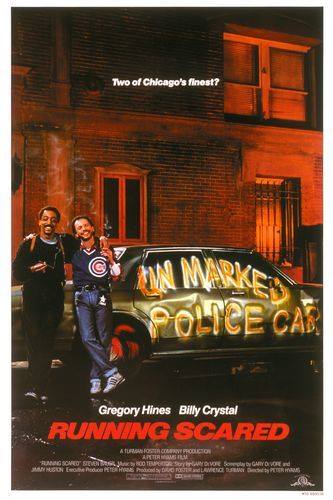
Riffing on material he had previously explored with 1974’s Busting, the 1986 buddy-cop comedy Running Scared found versatile filmmaker Peter Hyams back in familiar and comfortable genre territory, utilizing great physical location work, crisp action sequences, and the inherent charm and chemistry of his two fantastic leads, Gregory Hines and Billy Crystal, who truly made for an odd-couple pairing if there ever was one. Written with efficiency and genial humor by Jimmy Huston and Gary Devore, this film definitely enjoyed getting down and dirty, with Hines and Crystal as Chicago cops who cheat death on a daily basis, and decide that after a life on the streets chasing down bad guys, retiring down in Key West within the friendly confines of a new bar sounds like a great idea. But, in classic narrative tradition for this type of actioner, there’s one last big arrest that needs to be made, with the majority of the film centering on the action-adventure antics of the two officers as they run around the amazingly photogenic windy city, with Hyams, as per usual, serving as his own tremendous cinematographer. A great supporting cast was on hand, including Jimmy Smits, Steven Bauer, Joe Pantoliano, Dan Hedaya, Jon Gries, and it must be noted that the 80’s-accented soundtrack if pretty damn sweet. The final action set piece is outstanding. Released by MGM in June of 1986, Running Scared became a solid box office success, and would later become a staple item on HBO and cable.

STAR TREK: A Retrospective by Joel Copling

Rating in Stars: ***½ (out of ****)
Cast: Chris Pine, Zachary Quinto, Zoe Saldana, Karl Urban, Simon Pegg
Director: J.J. Abrams
MPAA Rating: PG-13 (for sci-fi action and violence, and brief sexual content)
Running Time: 2:07
Release Date: 05/08/09

It would, on face value, be easy to dismiss Star Trek as fan service by its very existence as another adaptation of Gene Roddenberry’s television series of the same name (which spawned four spin-off series, as well as a number of movies) and by a plot that seems to want to connect it to those movies (especially by including one of the old-guard cast as an older version of a character already present in the timeline). Fortunately, screenwriters Roberto Orci and Alex Kurtzman are respectful of the source material they are updating for a new audience, while injecting, if not new life, then a different kind of vivacity into the proceedings. This is a more-than-efficient spectacle, featuring some truly glorious set pieces and a welcome sense of humor. The fan-service aspects are only a minor distraction.

Following a prologue in which George Kirk (Chris Hemsworth) must sacrifice himself moments after the birth of his son when a massive Romulan ship emerges from a black hole in space and threatens the crew of the U.S.S. Kelvin, we are introduced to James Tiberius Kirk (Chris Pine), George’s son, and Spock (Zachary Quinto). The former is bitter as a grown man who never knew the father he resented for his sacrifice and a mother who remarried, but he’s influenced to join the Starfleet Academy by Captain Christopher Pike (Bruce Greenwood), who maintains that he sees greatness in the potential cadet. The latter is a logic-driven, half-human half-Vulcan whose place among his fellows is insulted when it is insinuated that his human mother (Winona Ryder) is a “disadvantage.” Through a combination of solid performances and writing, we get a sense of who these men are from minute one.

We are also introduced to the various elements that make up the U.S.S. Enterprise, the ship on which Pike currently resides as captain and Spock as first officer. There is Zoe Saldana as Nyota Uhura, the resourceful, multilingual lieutenant who had Kirk’s eye from the moment they met and is now dating the guarded Spock, John Cho and Anton Yelchin as Hikaru Sulu and Pavel Andreievich Chekhov, the two lieutenants in charge of maintaining the craft’s speed and orbit, and a very funny Simon Pegg as Montgomery Scott, the warp science expert hired on by way of strange, convoluted circumstances involving Kirk’s abandonment on a dangerous, arid planet where he runs into another version of Spock played by Leonard Nimoy.

That last part requires some context, and the context is occasionally labyrinthine. The villain is the captain of that Romulan ship, a vengeful individual named Nero (Eric Bana), who has traveled from almost two centuries in the future to exact his justice upon Starfleet for what he saw as the unjust genocide of his people and destruction of his world. That involves a MacGuffinesque red matter that can create a wormhole in space, and through the older Spock’s unintentionally tragic mistakes, Romulus was destroyed. When Vulcan is destroyed and the younger Spock’s mother dies, the plot kicks in: Nero must be defeated, but not in a way that carelessly causes more red matter to explode.

There is an efficiency to the plotting here in spite of its busy nature, with the screenwriters allowing us to become accustomed to the crew’s interactivity while ducking in and around stretches of action sequences that thrill on the basis of their seamless visual effects. Director J.J. Abrams, cinematographer Dan Mindel, and co-editors Mary Jo Markey and Maryann Brandon expertly devise and execute these sequences, such as a showdown between Kirk and an indigenous animal on the snowy planet, a dive in which Kirk, Sulu, and another officer must disable an enormous laser drill, and a climax that variously involves chases, shootouts, hand-to-hand combat, and a layering of desperate emotion just underneath the surface. Star Trek might be busy, but it’s as good as the original movies ever were. What a ride.