JOYCE CHOPRA’S SMOOTH TALK — A REVIEW BY NICK CLEMENT

3

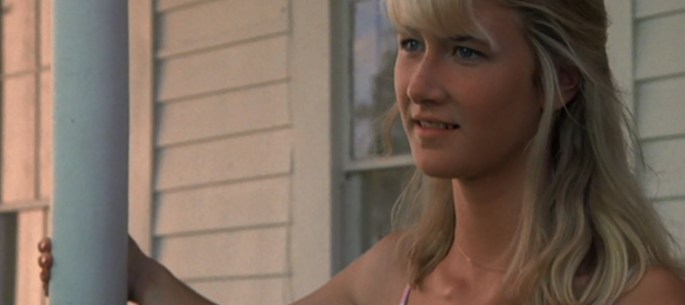
Smooth Talk is one of the greatest adolescent coming of age stories I’ve seen. It’s mystifying how this film doesn’t have a higher profile. Released for one week in theaters in 1985 after winning the Grand Jury Prize at Sundance and loosely based on the short story Where Are You Going, Where Have You Been? by Joyce Carol Oates, the film stars a then-18 year old Laura Dern, playing a 15 year old girl on the forefront of her own blossoming sexuality, unaware of the power that she holds over men, and too naïve to understand the dangerous consequences of her seemingly innocent actions. Dern, one of our greatest actresses for the last 30 years, is marvelous in the film, giving a performance that becomes all the richer when put into her own personal context as a human being. Here, at 18, she was asked to think like a 15 year old, which was only three years separated from her while she was shooting, thus presenting an intimate opportunity to potentially relive aspects of her own youth via cinematic artifice. Tom Cole’s screenplay adaptation skillfully depicts a family unit becoming untethered due to the stresses of growing up, and how shifting attitudes between mother and daughter can create friction and abrasive moments of personal interaction. Never cheap or cloying or overly sentimental, the film looks at its characters with intelligence and confidence, and never settles for the easy way out in any instance.

2

Her mother, played by Mary Kay Place in an extremely heartfelt performance that mixed equal parts exasperation and love, doesn’t know what to do with her daughter, instead focusing more effort on her first born child, while her husband, the casually aloof Levon Helm in a sadly hilarious performance, is so out to lunch as to never potentially understand the mindset of a teenaged girl, let alone his own daughter’s complicated development. Directed with sensitivity and grace by Joyce Chopra, who would go on to helm the epic disaster The Lemon Sisters in 1990, the film’s narrative moves into some seriously disturbing territory during the final act, when extra-sleazy Treat Williams shows up in an astonishing performance of seductive menace, portraying a man at least 10 years older than Dern, and who is looking for nothing remotely good at all. The final moments are devastating in their emotional and psychological implications, and Chopra’s decision to remain visually ambiguous during one key sequence was a bold and brave move, asking the audience to do the heavy lifting rather than being overt or explicit with her storytelling. James Glennon’s lyrical and poetic and summery cinematography perfectly meshed with Dennis Wasco’s evocative production design, while the score by Russ Kunkel and Bill Payne, featuring a few tracks from James Taylor’s including the subtly devious selection of “Handy Man” during a key cathartic moment, present a chilling sonic alternative to the more customary or expected melodic notes you’d expect from this sort of film. Olive Films has released Smooth Talk on Blu-ray, but sadly, there seems to be no special features. Netflix carries the DVD via their disc-at-home service. There’s a DVD also available for purchase at various online retailers. No streaming option on Amazon or Netflix is currently offered.

9


Sea Of Love: A Review by Nate Hill

image

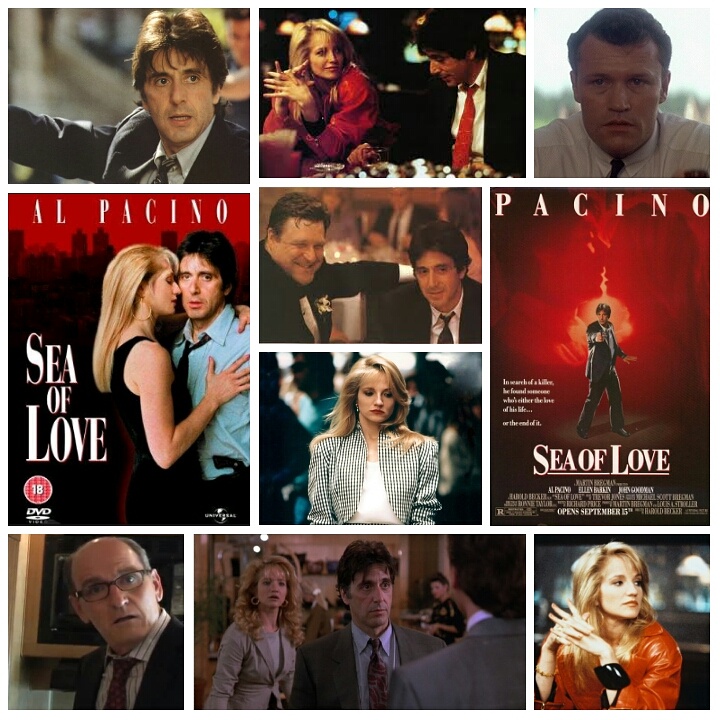
Sea Of Love is one of my favourite romantic thrillers of the 80’s. It’s perfectly structured, riveting the whole way through, and just as steamy as you’d imagine a pairing between Al Pacino and Ellen Barkin to be. It’s so well made that we don’t even notice pieces of the puzzle falling into place until the image they make is staring us right in the face and we sheepishly snap out of the sensual trance the film has laid upon us. It’s never too grisly, never sappy, but strikes every note in time with the rhythm of both its script and the acting style of the two leads. Pacino is Frank Keller, a police detective pursuing a killer who is choosing their victims based on personal ads placed in the newspaper. This provides a readily made paper trail for him to follow and hopefully find his man, but in the process he must stage a bunch of blind dates that are essentially theatrical stake outs, in attempt to lure his prey into the open. Pacino is always keen and sharp when playing detective roles, but only in this one does the romantic side of his life play just as important of a part as the thrill of the hunt and the crime dynamics, which makes the role unique in his career. Things get complicated when he gets involved in a torrid and unpredictable affair with Helen, a mysterious girl who replies to one of the adds and quickly becomes a prime suspect. Aided by another detective (John Goodman is fantastic as always) from a few precincts over, he tries to race against both time and the spiderweb of danger which is unseen yet slowly winches tighter on everyone involved, as the killer circles them all. Watch fpr suppoetin turns from Michael Rooker, William Hickeyn, Paul Calderon, Richard Jenkins, Larry Joshua, John Spencer and a cery young Samuel L. Jackson who is simply credited as ‘black guy”, which cracked me up. It’s got rocket fuel for pacing and I mean that as a compliment; It’s pure cinema from both a genre standpoint and in general. Fairly forgotten these days, but one of the very best to come out of its era.

Fallen Angels: Dead End For Delia- A Review by Nate Hill

image

Fallen Angels was a super cool L.A. film noir television series that ran in the 90’s, only never to be heard from again, curiously. It attracted an incredible lineup of directors including Tom Hanks, Alfonso Cuaron, Steven Soderberg, Peter Bogdanovitch, Jonathan Kaplan, John Dahl, Keith Gprdon, Tom Cruise and more, with an even more unbelievable troupe of prolific actors. For whatever sad reason though, it was never really released or marketed well, and has never seen the light of day. Dead End For Delia is the first, and one of the best of the bunch, directed by Phil Joanou, with the lead roles taken by Gary Oldman and Gabrielle Anwar. I’ve always wanted to see the two of them do something together, and funnily enough they share almost no screen time, but having the two occupy space in any project is electric enough. Oldman plays Pat Keilly, a police sergeant who is summoned to the scene of a crime, only to find out that the murder victim is his wife Delia (Anwar). As he is led along a trail of clues as to who her killer might be, he discovers things about her and realizes that he may have never really known his wife, or the person she really was. Oldman does something interesting here; for most of the film his trademark intensity sits at a low boil, lulling us into a false sense of calm and seeming to be one of his more restrained exercises. Then, all of a sudden in the last act he downright explodes and goes on a tirade of fuming emotion that is quite something to see. Makes me wonder if he planned this with his performance, or if he surprised himself with the unexpected outburst. The whole series is solidly star studded, and in addition to Oldman and Anwar we get to see Meg Tilly, Wayne Knight, Paul Guilfoyle, Vondie Curtis Hall and the great Dan Hedaya who works overtime playing at least ten different characters all throughout the show. It’s filmed through a lacy lens, the windows on set always open, the gauzy curtains set unearthly adrift to let in that clammy, humid L.A. breeze that promises secrets you wish you never knew as soon as it brushes against you. Perhaps one day this forgotten show will get a lovely dvd box set. Until then you have to scavenge for fragments over in the scrap yard of youtube. Good luck.

THEY LIVE – A REVIEW BY J.D. LAFRANCE

“I’m disgusted by what we’ve become in America. I truly believe there is brain death in this country.” — John Carpenter

they_live_23

Filmmaker John Carpenter has always considered himself as an outsider in Hollywood. Like Sam Fuller before him, Carpenter makes genre films that are usually regarded by critics as simple thrill rides. However, underneath the surface lurks a strong, often savage social commentary on what Carpenter believes to be the problems that plague the United States. This approach is readily apparent in They Live (1988), an angry film born out of his disgust with the greed and materialism of the Ronald Regan era during the 1980s. What’s interesting is how its scathing critique of homelessness, rampant unemployment and corporate greed has become relevant yet again. Sadly, these problems never really went away, they’ve just become more prevalent because of the current global economic reality.

Nada (Roddy Piper) is a drifter, an amiable blue collar guy looking for steady work in Los Angeles. He arrives in town like the lone gunman in a western, completely with an accompanying soundtrack that even features a lonely harmonica like something out of an Ennio Morricone spaghetti western score (perhaps a nod to Once Upon a Time in the West). Carpenter shows all kinds of homeless people populating the city. Nada is told that there are simply no jobs available by a clearly indifferent government social worker. He wanders by a blind African American preacher (Raymond St. Jacques) who rants about being oppressed, the corruption of the American spirit and tells everyone that it’s time to wake up just before two police officers arrive to deal with him. Nada passes by a store with televisions in the window that present all sorts of cliché images of Americana: Mount Rushmore, the bald eagle, an American Indian dancing, a cowboy riding a wild horse, and a group of guys playing sports together. These are images of propaganda designed to keep us sedated and complacent.

Nada eventually finds a job and befriends a fellow worker named Frank (Keith David), a man who is clearly tired of Capitalism as he says bitterly tells him, “The golden rule: he who has the gold, makes the rules. They close one more factory we should take a sledgehammer to one of their fuckin’ fancy foreign cars.” Nada tells him to be patient but Frank has clearly run out of that particular commodity. He proceeds to lay it all out in a nicely written speech that sums up the American dream in a nutshell: “The whole deal is like some kind of crazy game. They put you at the starting line and the name of the game is ‘make it through life.’ Only everyone’s out for themselves and lookin’ to do you in at the same time. Okay, man, here we are. Now you do what you can, but remember, I’m gonna do my best to blow your ass away.” These sentiments eerily anticipate the anti-materialistic message of Fight Club (1999) by several years. Nada is more optimistic. He believes in playing by the rules as he tells Frank, “I deliver a hard day’s work for my money, I just want the chance. It’ll come. I believe in America. I follow the rules.” But this faith in the system begins to change when the squatter’s camp the men are staying at is suddenly bulldozed by the police one night. At first, there seems to be no reason for this unprovoked attack but over the course of the film Carpenter does an excellent job of gradually revealing what is really going on.

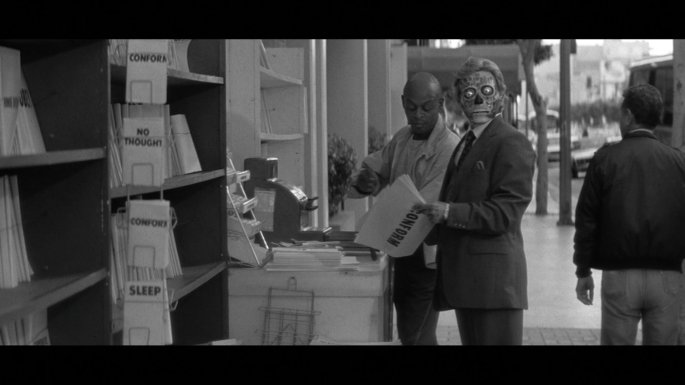
One day, while rummaging through some garbage, Nada comes across a pair of sunglasses that allow him to see things as they really are: the world is seen in black and white. The color facade disappears and billboards reveal their true messages: “OBEY,” “MARRY AND REPRODUCE,” and “SLEEP,” money is merely pieces of paper with the words, “THIS IS YOUR GOD,” written on them. Most shockingly is that with the glasses on, certain people turn out to be aliens in disguise. The glasses are a clever play on the notion of subliminal advertising and capitalism as the root of all evil. Once Nada wakes up, Carpenter has fun with the character, like when he enters a bank armed to the teeth, spots some aliens and says the memorable line, “I have come here to chew bubblegum and kick some ass. And I’m all out of bubblegum.” Or, when Nada confirms the truth of the alien’s existence to Frank when he tells him simply, “Life’s a bitch and she’s back in heat.” From this point, They Live’s pace rarely slackens as Nada and Frank form an uneasy alliance in an attempt to stop this secret alien invasion as if Marshall McLuhan suddenly took over scriptwriting duties and decided to rewrite Invasion of the Body Snatchers (1956) with a dash of Noam Chomsky for good measure.

The idea for They Live came from two sources: a futuristic story, involving an alien invasion, called “Nada” from a comic entitled Alien Encounters. This story was actually inspired from a short story called “Eight O’Clock in the Morning” by Ray Nelson that was originally published in The Magazine of Fantasy and Science Fiction in the 1960s. Carpenter describes it as “a D.O.A. type of story. A fellow is put in a trance by a stage hypnotist. When he awakens, he realizes that the entire human race has been hypnotized. Amongst us are alien creatures that are controlling our lives. He has only until eight o’clock in the morning to solve the problem.” Carpenter acquired the film rights to both the comic book and the short story and wrote the screenplay using Nelson’s story as a basis for the film’s structure.

The more political elements came from Carpenter’s growing distaste with the ever-increasing commercialization of popular culture and politics at the time. As he once remarked in an interview, “I began watching T.V. again. I quickly realized that everything we see is designed to sell us something…It’s all about wanting us to buy something. The only thing they want to do is take our money.” To this end, Carpenter thought of sunglasses as being the tool to seeing the truth, which “is seen in black and white. It’s as if the aliens have colorized us. That means, of course, that Ted Turner is really a monster from outer space.” In regards to the alien threat depicted in the film, the director said, “They want to own all our businesses. A Universal executive asked me, ‘Where’s the threat in that? We all sell out every day.’ I ended up using that line in the film.”

Since the screenplay was the product of so many sources: a short story, a comic book, and input from cast and crew, Carpenter decided to use the pseudonym, “Frank Armitage,” which was a subtle allusion to one of the filmmaker’s favorite writers, H.P. Lovecraft. Frank Armitage is in fact a character in Lovecraft’s “The Dunwich Horror.” Carpenter has always felt a close kinship with Lovecraft’s worldview and his influence can be felt in other films — most notably, The Thing (1982) and In The Mouth of Madness (1995). According to Carpenter, “Lovecraft wrote about the hidden world, the world underneath. His stories were about gods who are repressed, who were once on Earth and are now coming back. The world underneath has a great deal to do with They Live.”

After a budget of around three million dollars was established, Carpenter began casting his film. For the crucial role of Nada, the filmmaker surprisingly cast wrestler “Rowdy” Roddy Piper whom he had met at Wrestlemania III. For Carpenter it was an easy choice: “Unlike most Hollywood actors, Roddy has life written all over him.” Carpenter’s gamble pays off as Piper does a fine job playing an everyman-type hero who, at first plays by the rules, but once he realizes that it’s all a sham, decides to fight back. Piper’s performance is not going to win any acting awards but he does a solid job and brings the physical presence necessary for the role while also conveying a blue collar vibe.

Carpenter was impressed with Keith David’s performance in The Thing and needed someone “who wouldn’t be a traditional sidekick, but could hold his own.” To this end, Carpenter wrote the role of Frank specifically for the underrated actor. David does a great job as the perfect foil for Piper. The two men have this intense relationship that oscillates between outright distrust and grudging respect. This rather volatile alliance reaches critical mass in a wild, fist fight between the two men over a pair of the special sunglasses that lasts for several minutes. The brawl starts off seriously but eventually transforms into an absurd free-for-all. Carpenter remembers that the fight took three weeks to rehearse. “It was an incredibly brutal and funny fight, along the lines of the slugfest between John Wayne and Victor McLaglen in The Quiet Man.”

One of the reasons why They Live works so well is the film’s pacing. It starts off like the original Invasion of the Body Snatchers with the threat of alien invasion being implicit at first. Everything seems normal enough but after a half hour into the film, the threat suddenly becomes shockingly explicit when Nada puts on the sunglasses. From there, the film’s pacing speeds up and They Live begins to incorporate action film sequences into its science fiction premise. And yet, throughout the film, there is always thought-provoking commentary. This is represented by the pirate television broadcasts which, initially, seem like some lone conspiracy nut but eventually his ravings are revealed to be right on the money. His presence is the first sign that something is amiss. The television is presented as an electronic sedative in They Live. It’s a drug to the masses. When the T.V. pirate appears, the mind-numbing routine is broken and people get headaches as a result.
large_they_live_blu-ray_8Carpenter sees the commercial failure of his film as a result of “people who go to the movies in vast numbers these days [who] don’t want to be enlightened.” It’s a shame because They Live is far from being an overtly preachy film. On the contrary, it is always exciting and entertaining first, and a scathingly social satire second. However, the director sees the real tragedy to be the lack of humanity in society. “The real threat is that we lose our humanity. We don’t care anymore about the homeless. We don’t care about anything, as long as we make money.” If They Live is about anything, it’s a strong indictment against the capitalist greed that was so fashionable in the 1980s. It’s sentiment that still exists. This makes Carpenter’s film just as relevant today as it was back in 1988.
TARSEM’S THE FALL — A REVIEW BY NICK CLEMENT

1

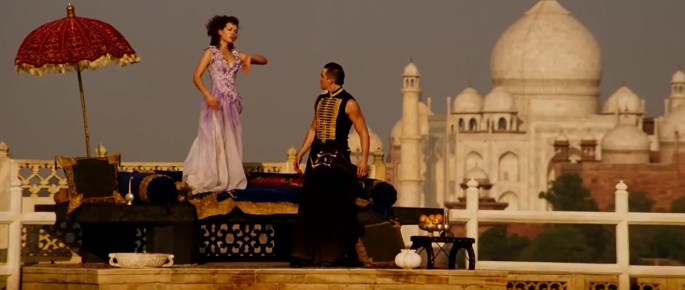
THE FALL is not going to be everyone’s cup of tea. But for me, this is the brew I need. I drank the whole pot and loved every single sip, as this is truly a one of a kind  effort. Directed by Tarsem (THE CELL) from a script he co-wrote with Dan Gilroy (NIGHTCRAWLER) and Nico Soultanakis, THE FALL is one of the most personal and private films that I’ve ever encountered, a constant feast for the eyes, ears, and brain. Terrence Malick and Werner Herzog would blush if they saw it. It’s also an uncompromising, wholly masterful vision that was easily my favorite film in 2008, and over the years, I’ve repeatedly returned to it in an effort to unlock all of its secrets and filmic virtues. There is imagery in THE FALL that I will never forget, and for me, that’s what I look for in movies – a visual style that’s going to take me somewhere new and fantastic in a way that I’ve not experienced. This is a haunting movie, a work that mixes surrealist fantasy with a simple yet dark story, and THE FALL has captivated me in a way that few other releases have over the last decade. From the utterly engrossing opening in luscious, smoky, black and white, all the way to the emotionally draining and satisfying ending, THE FALL sweeps you out of your seat with lush, exotic, and unforgettable visions while spinning a touching yet complicated narrative that adds up to something completely spectacular and original.

3

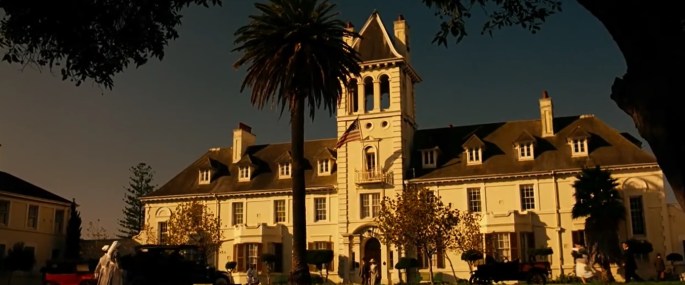
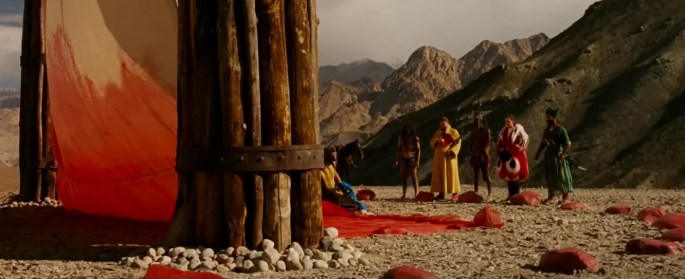
Shot over the course of four years in over 20 countries and fully financed by Tarsem out of his own pocket, THE FALL is the story of two lost souls who connect while convalescing in a Los Angeles hospital, sometime in the early 1920’s. Roy Walker (a tortured and excellent Lee Pace) is a Hollywood stuntman who has become paralyzed from the waist down after falling off his horse during the filming of a Western. Confined to his bed in the hospital, he is a man suffering not only from his terrible injury, but from a broken heart; it seems that his actress-girlfriend has run off with the film’s leading man. Along comes the impossibly precocious Alexandria (Catinca Untaru), a Romanian immigrant no older than 10 years old, who is nursing a broken arm at the hospital. Their paths cross and an instant bond is created. Roy begins to tell Alexandria a fantastical story about five adventurers (an Indian, an Italian explosives expert, a masked bandit, an African slave, and Charles Darwin) who are all caught in a battle with the evil Governor Odious. Alexandria patiently listens to Roy tell his story, and the audience gets to see how she envisions what she’s being told. Because of her wild imagination, the language barrier between her and Roy, and her childlike view of the world, Roy’s story shape-shifts in Alexandria’s head to the point of cerebral exhaustion. In a nod to THE WIZARD OF OZ, Alexandria imagines the five adventurers as versions of the people who surround her in the hospital (a doctor, a nurse, Roy himself, etc.). What she doesn’t realize is that Roy is really conning her; he starts stopping the story at integral moments (much to her cute annoyance) so that she can fetch him morphine pills from the hospital’s dispensary, in an attempt to slowly commit suicide. That’s as much of a plot synopsis that I will offer.

7

What I will report is that THE FALL is one of the most gorgeously mounted productions I can think of. Tarsem, a world-renowned commercials and music-video director who somehow has yet to truly explode on a massive stage, was operating on another level while making this film, working on an all-together different playing field with this film. His utter dominance of the visual language is so distinct and so intricately detailed that I’ve found it difficult to think of anyone else who comes close to this level of artistry. There are shades of BARAKA and PAN’S LABRYINTH and the aforementioned WIZARD OF OZ that can be felt throughout THE FALL, but in the end, Tarsem has created something completely original. This is a boldly imaginative movie that smartly pays homage to other works that have come before it, and yet sets out to chart its own specific course in the annals of cinematic fantasy. And still, for some reason, with as much talent as Tarsem clearly has, other than THE CELL, which benefitted from a terrific screenplay from Mark Protosevich, he’s yet to fully find his footing as an established filmmaker. Immortals was a great looking CGI/green screen movie that felt like 300’s cousin, and while I haven’t seen Mirror, Mirror, it felt like a decidedly minor effort based on the trailers. Self/Less came and went.

2

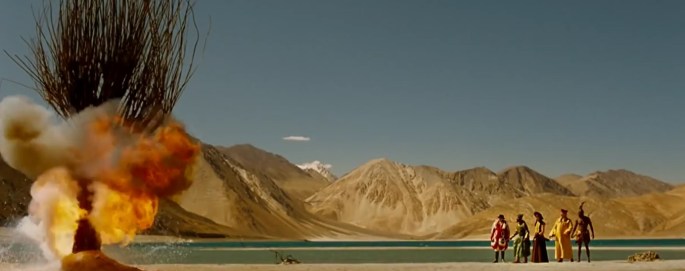
And to think, a project such as this one, could have easily been a complete failure. Without a strong story or well developed characters, the film would have become two hours of startlingly beautiful imagery in search of a meaningful narrative or dramatic purpose. The friendship that develops between Roy and Alexandria makes the fantasy sequences all the more involving because the closer they get in spirit, the more intense the fantastical elements become. Pace brings you into Roy’s situation and you feel his pain at times. His performance is always interesting and quite layered once you factor in the various levels that the story is pivoting on. Untaru is a revelation in her big screen debut, and even if she never makes another feature film again (she’s appeared in a few short films), she’ll always have this special piece of filmic history. Her line readings, at times alternating between supremely confident and slightly awkward, produce a nervous quality to the film that melds perfectly with the avant-garde nature of the visual scheme. Alexandria, whether due to her naiveté or youth, doesn’t understand everything that’s going on around her, which allows Tarsem and his writers the freedom to run wild with her interpretation of the story. Certain moments, including a swimming elephant, a chanting and dancing tribe of natives, a city painted in blue, a man resting on a bed of arrows like a bed of nails, and a creature separating itself from a flaming tree, were beyond words in their level of visual sophistication. Working with the brilliant cinematographer Colin Watkinson, THE FALL has one of the most unique and robust visual palettes that I’ve ever come across. The breathtaking opening sequence, showcasing Roy’s tragic accident in creamy black-and-white and super-slow-motion sets the tone right away; THE FALL is akin to a living, breathing painting.

5

THE FALL will be a polarizing film for most audiences, and to be honest, as with any great piece of moving image art, more than one viewing is likely required, because on first exposure, it’s incredibly easy to get lost in the visuals as the film is constantly overwhelming. It’s experimental, it’s artsy, it’s innocently pretentious in a great way, and above all, it’s totally exhilarating. To watch a filmmaker shoot for the moon the way Tarsem did here seems almost lunatic in the level of overall ambition. This is not the sort of film that could ever get made through the traditional studio system and it’s not the sort of film that, sadly, will win over sold-out crowds and every critic who checks it out (it’s a 50/50 split at Rottentomatoes, with some truly moronic comments made by some sneering “critics”). However, I truly feel that this is a work of art, and a beyond personal accomplishment that’s worth seeking out if you care at all about the power of filmmaking and storytelling. It’s a visual tour de force that has few equals and one of the rare instances where a filmmaker literally put their own money where their mouth was, conjuring up results that are nothing short of cinematically intoxicating.

9

The Caveman’s Valentine: A Review By Nate Hill


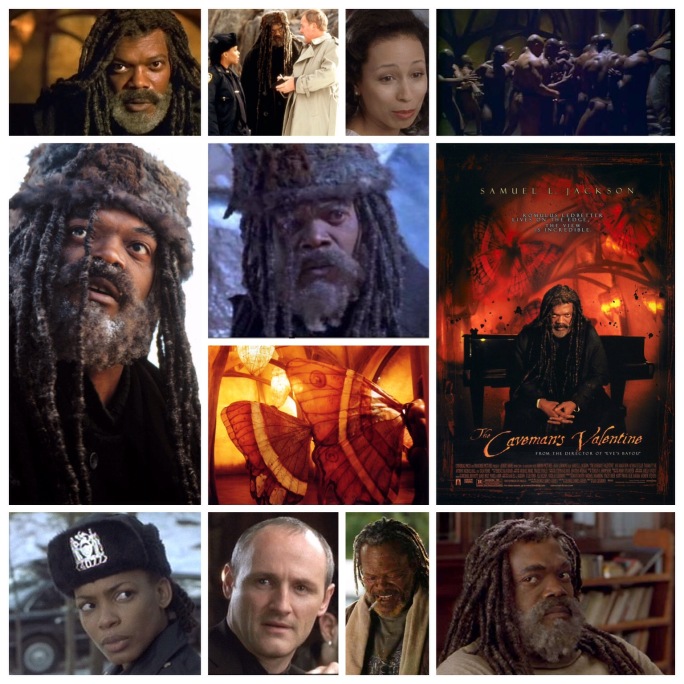
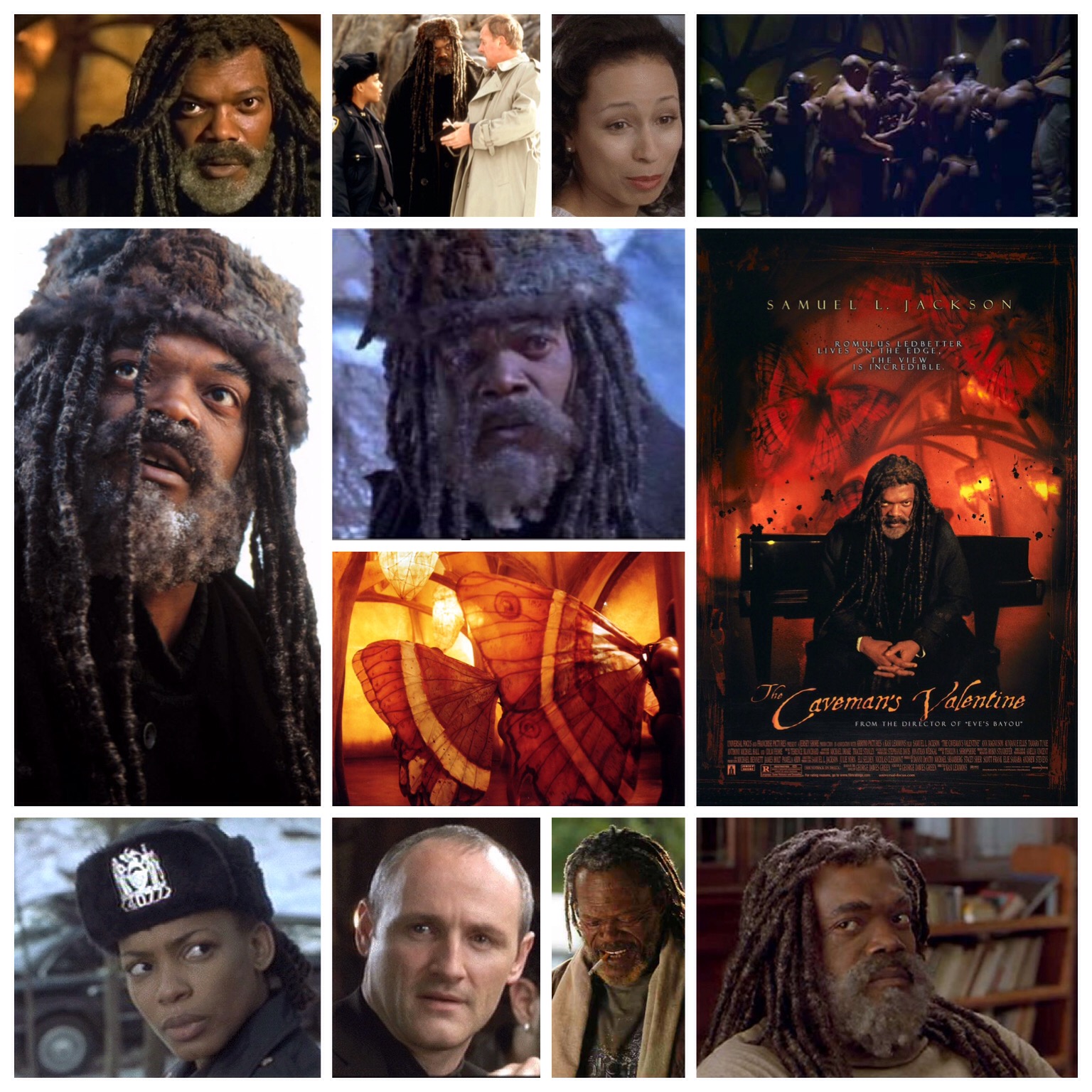
 The Caveman’s Valentine has always fascinated me. As someone who has a mental illness, I’ve always tried my best to seek out films that portray such conditions in a respectable, inquisitive and enlightening tone. While this one cushions it’s earnestness with a slightly lurid and generic murder mystery, much of its desire to explore its character’s inner mindset shine through superbly and with much more authenticity than other films that try the same. Unless you suffer through, or have some intimate experience with someone like this protagonist, it’s tough to artistically represent their state. This one manages very well, and Samuel L. Jackson gives one of the most memorable, affecting and curiously overlooked performances of his career so far. Jackson is an actor who almost always gets cast in assured, authoritative roles. Here he portrays exactly the opposite of that as Romulus, a severely schizophrenic man who lives in a cave in Central Park, New York City. Romulus was once a brilliant pianist and a student at Juilliard, before his illness cut his career and personal life painfully short. He spends his days in confusion, raving in delusion about an all powerful man named Stuyvesant who secretly manipulates everyone in the city. When a young man is found murdered near his cave door, he feels an internal compulsion to find out what happened to him. As you might imagine, a man with his affliction might not make the most reliable detective, but Romulus tries his best and in between bouts of paranoia he makes his way towards weirdo avant grade photographer David Leppenraub (always excellent Colm Feore) who may have had something to do with the homicide. He also has a daughter (Aunjanue Ellis) who is a policewoman and somewhat resents him through her ignorance, and a wife (Tamara Tunie) who no doubt left, but still speaks to him in segments of his visions. Because his perceptions can’t be trusted, even by himself, it makes it a touch and go plot-line that’s heavily accented by frequent visual detours into his own consciousness, where humanoid Moth Sarefs hauntingly play unearthly instruments. Director Kasi Lemmons is not only a woman, but an actress herself, both traits which I believe lead to a certain intuitive advantage in filmmaking. I absolutely love how she moulds the narrative to patiently linger with Romulus’s perception of events and never make them sensationalistic or rushed. Even though Romulus walks through a dangerous, real world story of murder and corruption, the film always sticks with his childlike, abstract and very intangible internal view of the world, a choice which most films either don’t possess the courage or aren’t allowed to do. Jackson is subtle, complex dynamite in what is for me the best work of his career, playing completely against type and most definitely the opposite of his usual instincts to give us something truly special, to any viewer who wishes to exhibit the same patience and understanding that the filmmakers have strived for in making this unique piece. 

Summer Love, aka Dead Man’s Bounty: A Review by Nate Hill

image

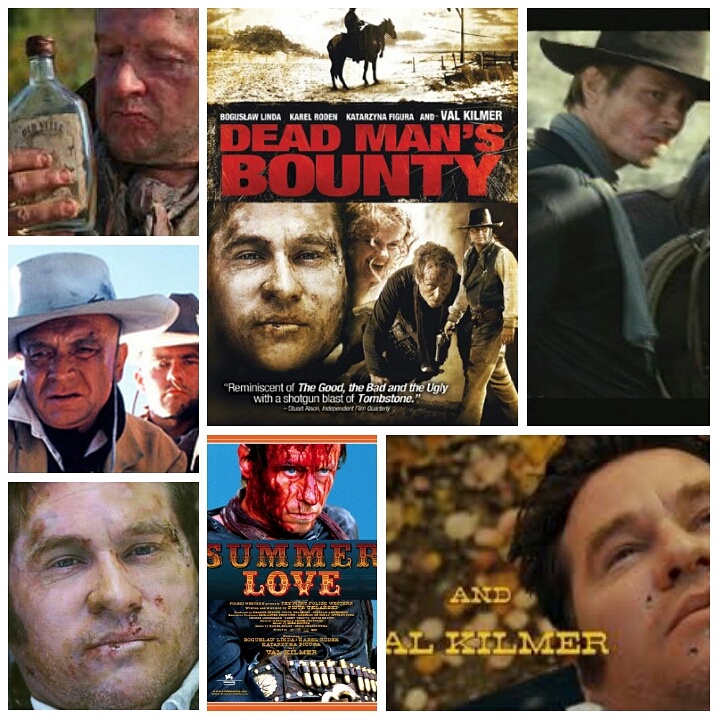
Ever wish there was a movie where Val Kilmer plays a dead corpse? Like…the whole movie? Well you’re in luck, because in Summer Love he does just that. It’s funny because there aren’t even any flashbacks, any death scene or any instances where he’s alive. He’s just a dead body for the whole. friggin. movie. Now you might think what an lazy, pay cheque collecting half ass move, but let me assure you that shit isn’t easy. I’ve played a corpse in films for maybe minutes at a time after I’ve bee killed, and that was bad enough. Thinking about having to lie still and do that for an entire film gives me hives. So kudos to Val who sticks through it like a champ, spending every frame all rigor mortis-ed up and dead as disco. The film was released in North America unde the dvd title ‘Dead Man’s Bounty’ a decidedly more genre title than Summer Love, which is all part of an effort to label it as a violent action western. It’s It’s a western, alright and it’s plenty violent. But action? No sir. It’s slower than the service I get at McDonald’s and very, very European. Most of the actors besides Kilmer are Polish, kind of like Eastwood waltzing around with a bunch of Italians in a spaghetti western. I guess the term for this one would be perogy western. The lead actor is actually Czech, the ever awesome Karel Roden, playing a perpetually wounded and apparantly mute gunslinger who arrives in a dinghole of a town with Kilmer’s body, looking to collect his bounty. The town is a sour, miserable, derelict place, populated by bad tempered, booze gulping men, and one much abused whore (Katarzyna Figura). The sheriff (Boguslaw Linda) is a stumbling, incapable drunkard whose first thought is to rob anyone who passes through his town. Roden silently navigates this cesspool outpost, keeping Kilmer near and his guns at the ready. Not much actually happens in the film, mostly everyone just sits around drinking and mumbling incoherently to themselves in tones that no doubt sound poetic to their heavily inebriated minds. The whore gets slapped around a whole lot which will no doubt put some viewers off, if they aren’t already asleep. The ‘Summer Love’ title comes from the chorus of a song which is played in an opening sequence that proves to be one of the few sparks of life in this fairly dead affair. Kilmer’s trademark peppiness is nowhere to be found because… well… he’s a dead guy, and the rest of the cast are basically drunk western zombies who have all lost their scripts. Morbidly fascinating, never enjoyable, startlingly bad.

Tony Scott’s Beat The Devil: A Review by Nate Hill


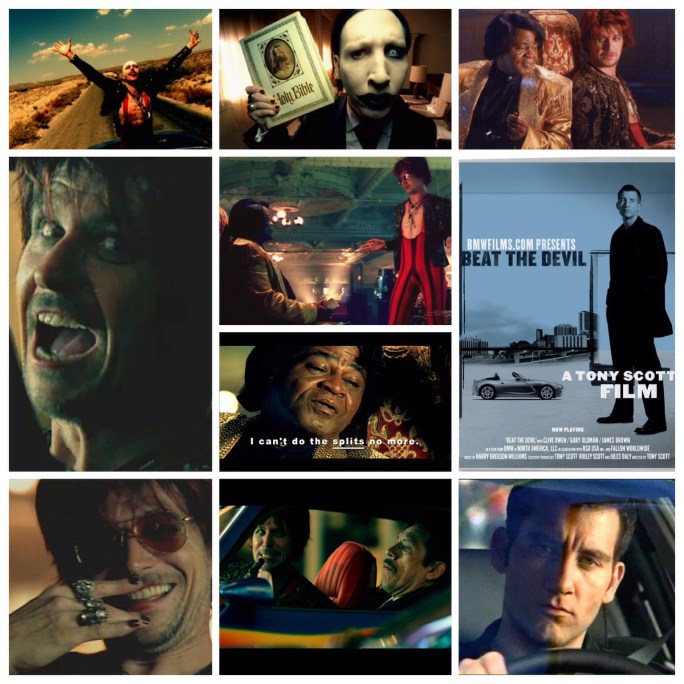
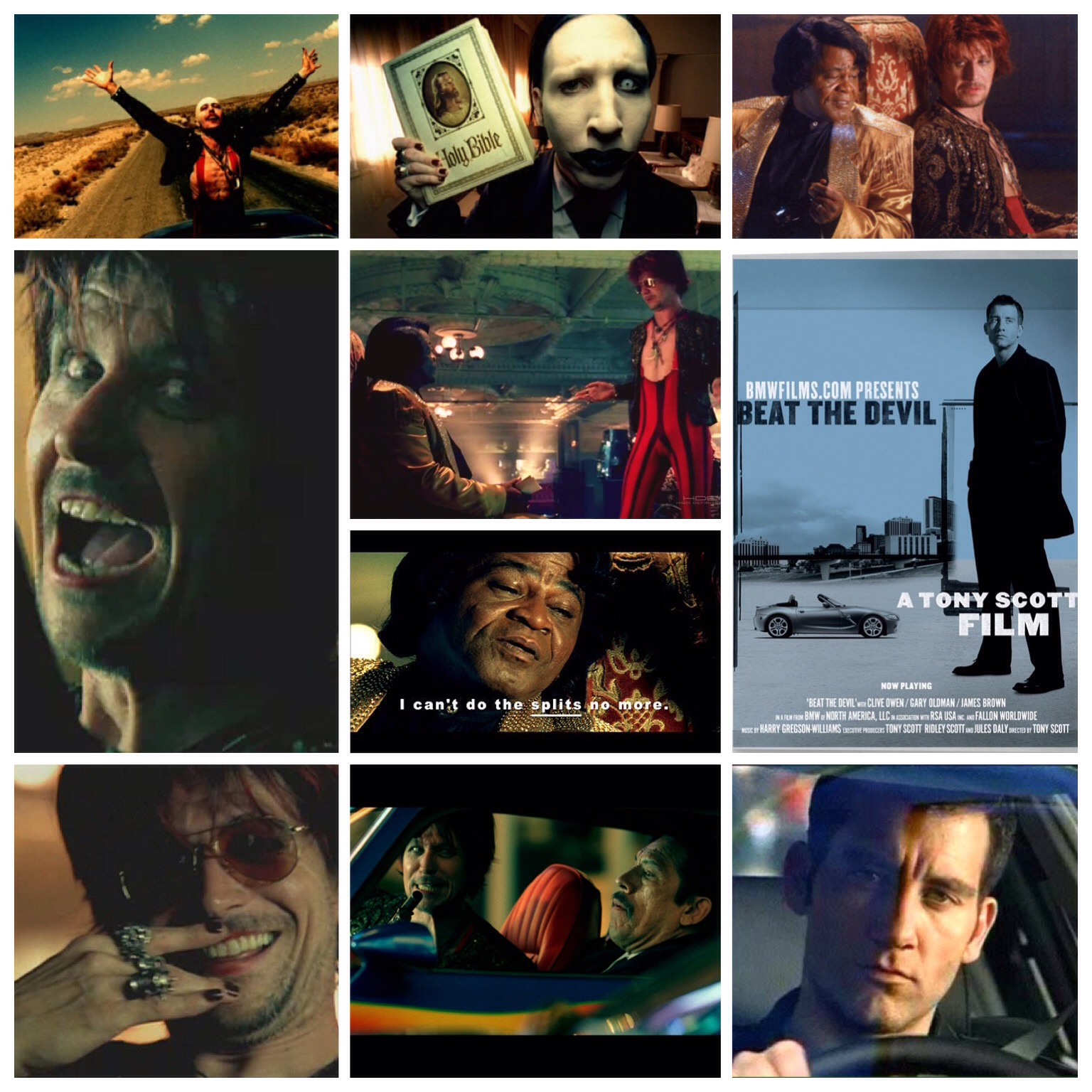
Tony Scott’s Beat The Devil is one part of a multi episode series of promotional short films called The Hire, themed around, and sponsored by BMW. An unbelievable amount of acting heft and prolific directors were brought in to make these, including Scott, Joe Carnahan, Alejandro Gonzales Inarritu, Guy Ritchie, Ang Lee and more. They’re all wonderful and different in their own way, but Scott’s is my favourite of the bunch hands down. From the eclectic cast, all having a blast, to the sheer kinetic momentum and adrenaline soaked velocity of the stylistic direction, it’s pure moviemaking. Tony Scott’s very distinct and polarizing visual aesthetic rears its beautiful head here for a literal crash course which would go on to emerge from the chrysalis and fully spread its wings in the director’s two best films, Man On Fire and Domino. This one is a delicious little treat and obvious precursor to those. The story is fable in nature, starring James Brown as himself (!), pining about his old age. He hires the 007 sequel Driver (Clive Owen, stars in every one of these films, drives a BMW all the time and ties them all together), who takes him to Las Vegas to see The Devil (Gary Oldman, who else), who he sold his soul to decades earlier for fame and fortune. Brown wants to renegotiate the terms of contract, or simply put. Wants to live as a youth longer. Oldman is a sight to see, adorned in crimson lipstick and all manner of kitschy wardrobe numbers, a flamboyant debutant who acts like a Dr. Seuss character in drag. He makes a deranged proposal: the two of them will race the Vegas strip at dawn, Owen against Devil’s driver Bob (a deadpan perfect Danny Trejo). If Brown wins, he gets an extension on life and youth. The race is pure Tony Scott, a commotion fuelled superstorm of breakneck editing, colours flying off the saturation charts proudly and auditory assault as only the guy can craft. It’s the most fun out of the Hire series, careening along on its own delirious and joyful reckless abandon. Watch for a priceless cameo from Marilyn Manson as well.

THE TRANSFORMERS: THE MOVIE – A REVIEW BY J.D. LAFRANCE

Tftm1986e

Before Michael Bay decided to piss all over our nostalgic memories of The Transformers cartoon with his live-action monstrosities, there was a feature-length animated film that for all of its clunky animation and cheesy, dated soundtrack is better than the entirety of Bay’s series of movies. For those of us who grew up watching the cartoon every day after school in the early 1980s, the movie came as quite a shock. Most of us, at that early, impressionable age, were unprepared for the much darker tone and the increased level of violence, including some of the show’s most popular and beloved characters getting quickly killed off in the first few opening scenes. The Transformers: The Movie (1986) was a commercial and critical failure but went on to develop a strong cult following among fans.

It is 20 years into the future (making it, at the time, 2005!) and the war between the Autobots (a race of good transformable robots) and the Decepticons (their evil counterparts) continues to rage. The Decepticons have taken control of the transformers’ home world of Cybertron. The Autobots are planning to retake the planet but need to get more energy from Earth in order to do so. Unfortunately, the Decepticons learn of these plans and their leader Megatron (voiced by Frank Welker) intercepts the ship headed for Earth with the intention of launching a sneak attack on the Autobot’s base. Unbeknownst to the Autobots and the Decepticons, a planet-sized transformer named Unicron (Orson Welles) is devouring entire planets to feed its insatiable desire for energy. Only the Matrix of Leadership, housed in Optimus Prime (Peter Cullen), leader of the Autobots, can stop him.

The dark tone of the movie is set right from the prologue, which features Unicron mercilessly destroying an entire planet of transformers. No one is spared. We even see one escape pod almost make it before getting sucked into Unicron’s massive, gaping maw. For kids used to the relatively tame television series this sequence came as quite a surprise. This was nothing compared to what came next as soon afterwards the Decepticons ambush a ship carrying several Autobots that are quickly and casually killed off! It was one thing to see anonymous characters with nothing invested in them be destroyed but it was something else entirely to see characters we had grown to like on the series dispatched so suddenly and coldly. These deaths do raise the stakes considerably as if the filmmakers were making a statement that all bets are off with this movie – any character, no matter how beloved, is fair game.

Clearly the powers that be (i.e. the toy company) meant to clear the decks for a new generation a.k.a. a new line of toys for kids to buy but I think they underestimated just how profound an effect all these deaths would have on their audience. This culminated with the death of Optimus Prime – the most popular transformer. Not since Darth Vader cut down Obi-Wan Kenobi in Star Wars (1977) had the death of a heroic character been so traumatic for its fanbase. At least Prime got to go out in style with an epic one-on-one slugfest with his nemesis Megatron. For kids at the time, it was an emotional moment because we cared about Prime. His death scene, in particular, had gravitas and meant something to the fans of the show. This is something that the Bay movies never were able to replicate with their multi-million dollar budgets.

Another memorable aspect of the movie is the scope and scale. Where the T.V. show’s action was largely confined to Earth, the movie opens things up by introducing other worlds and races (even if they are all transformers). And so we are presented with the Planet of Junk, one of the more fascinating additions to The Transformers universe. It is inhabited by the Junkions and their leader Wreck-Gar who speaks in T.V. clichés mainly derived from advertisements. In an inspired bit of casting, he is voiced by Monty Python alumni Eric Idle. Their world is a metallic compost heap masquerading as a planet and rather fittingly their theme song is performed by none other than Weird Al Yankovic. This race of robots provides a much-needed moment of levity in what up to that point had been a very dark film.

The battles are also bigger and more intense as Unicron transforms into an enormous robot that attacks Cybertron but this almost pales in comparison to the intensity of the epic battle between Optimus Prime and Megatron that left many fans shocked by its outcome. No one was prepared for what went down and the film never quite recovers from this moment. Speaking of gravitas, who better to play a transformer the size of a planet than Orson Welles, the brilliant filmmaker who made Citizen Kane (1941)? His digitally augmented voice has the dramatic weight befitting the scale and power of Unicron. The filmmakers needed a formidable actor to play a formidable character and they found their ideal candidate in Welles. This gig would be his last and he died five days after completing his work from a heart attack.

One of the things that dates The Transformers movie the most is its soundtrack of awesomely bad generic ‘80s hair metal, complete with the show’s cool theme song redone by Lion. Most memorably is Stan Bush’s “The Touch,” which went on to be hilariously immortalized in Paul Thomas Anderson’s Boogie Nights (1997). The one song that acts as a crazy counterpoint to this bloated arena rock is Weird Al Yankovic’s theme for the Junkions, “Dare to Be Stupid.” His goofy, non-sensical lyrics (anticipating Beck by a few years and actually goofing on Devo) are perfect for this absurdist, almost Dada-esque race of transformers.

After the first two seasons of the television show, toy company Hasbro wanted to eliminate many of the characters and introduce a new line. Season three would feature several new characters and the feature film would make that transition. Toy lines are discontinued for new ones and so the dilemma facing the screenwriters of the movie was how to make this transition seamlessly. According to story consultant Flint Dille, “So, we had this one scene where the Autobots basically had to run through a gauntlet of Decepticons. Which basically wiped out the entire ’84 product line in one massive charge of the light brigade. So whoever wasn’t discontinued, stumbled to the end.” The scene didn’t quite play out that way but over the first third of the film, several of seasons one and two characters were killed off. Not surprisingly, it was Hasbro that dictated the story of the film, “using characters that could best be merchandised for the movie. Only with that consideration could I have the freedom to change the storyline,” said director Nelson Shin in an interview.

The Transformers: The Movie
’s pacing is fast and furious with never a dull moment – perfect for kids with short attention spans and actually works in its favor as any narrative fat is trimmed, packing a lot of action into its running time (again something the live-action films failed to realize with their bloated lengths). While I don’t know if the movie exactly lives up to its poster’s tag line, “Beyond good. Beyond evil. Beyond your wildest imagination.” It was a pretty mind-blowing experience for this impressionable youth back in the day. So, I come at this movie now with nostalgic baggage in tow, unable to really look at it objectively. I can only imagine what kids of today think of it now. Sadly, they probably don’t even know/care of its existence having been bombarded by the Michael Bay movies, which is too bad because they lack the imagination, the ambition (which are largely earthbound while the animated film takes place mostly in outer space) and the substance that makes The Transformers: The Movie by far superior. Plus, I’d take the likes of Stan Bush and Lion over the bland nu metal stylings of Linkin Park any day.

MELANIE LAURENT’S BREATHE — A REVIEW BY NICK CLEMENT

3

I don’t want to oversell Melanie Laurent’s brilliant psychological thriller Breathe (Respire). It’s 85 minutes of cinematic perfection. There isn’t one bad scene or false moment. It’s a slow-burn first two acts which give way to some shattering developments by the finale. I wasn’t prepared for this film, how emotionally hard-hitting it would be, or for how stylish on a cinematic level it would get. This is a gorgeous film that was shot with a painter’s eye; cinematographer Arnaud Potier is now firmly on my radar. Released in France in 2014 and based on the novel by Anne-Sophie Brasme, Laurent and Julien Lambroschini handled the scripting adaptation, and while I can’t claim to be familiar with the source material, what they’ve put on screen is piercing, troubling, sexy, and fascinating on numerous levels. Starring Joséphine Japy and Lou de Laâge as two high school seniors who unexpectedly fall into each other’s orbits, the film operates as a smart and savvy mix of Blue is the Warmest Color and Fatal Attraction, and because of how delicate the entire piece is, I’m reluctant to reveal much more about the plot. What I will allow is that Laurent’s film is thematically rich, poking at the social norms and constructs of the modern high school setting, the many layers of friendship, obsession, and emerging sexuality, while toying with preconceived genre expectations in all the best ways. The two lead performances are tremendous, totally different from one another, and dependent on each other’s abilities in ways that two-handers like this really need to pounce on. Supporting performances are all top notch, there’s a Malick-esque vibe to some of Potier’s striking visuals along with some expertly judged stedicam work and slow-motion techniques, and the final scene is one that you’ll never, ever forget. Had I seen this film during the year of its initial release, it probably makes my top 15. Breathe is available as a DVD rental via Netflix and as a streaming option on Amazon.

2