SIN CITY – A REVIEW BY J.D. LAFRANCE

sin-city

Until recently, most adaptations of independent comic books were far more successful (and by successful I mean faithful to their source material) than long-running mainstream ones from the two largest comic book companies, Marvel and DC. One only has to look at examples, such as Ghost World (2001), American Splendor (2003) and Hellboy (2004) against the failures of Catwoman (2004), Elektra (2004) and Constantine (2005). So, why are the first three films more satisfying triumphs and the last three empty exercises in style? The answer is simple. In the case of the first three movies, the filmmakers wisely allowed the comic book creators direct involvement in the filmmaking process, whether it was working on the screenplay (as with Ghost World and Hellboy) or actually appearing in the movie (American Splendor).

In the past, the comic book creator was, at best, a peripheral presence in the filmmaking process, or not even included at all. With bigger, longer running series, like Spider-Man or Superman, it is much harder to include the creator because there is not just one but many who have worked on the comic book over the years. Where does the filmmaker even start in these cases? To be fair, with Iron Man (2008) began a great run of adaptations of Marvel Comics being successfully translated to the big screen but before it the examples were few and far between.

It only makes sense that if one is going to adapt a comic book into a film that it be faithful in look and tone to its source material. Otherwise, why adapt it in the first place? Of course, there is always the danger of being too faithful to the look of the comic and not being faithful to its content (characterization, story, dialogue, etc.) like Warren Beatty’s take on Dick Tracy (1990) — all style and no substance. It goes without saying that the next logical step would be to include its creator, if possible, in the process so as to achieve the authenticity and integrity of the source material. Filmmaker Robert Rodriguez took this notion to the next level with Sin City (2005) by having its creator Frank Miller co-direct the movie with him. In fact, Rodriguez is so respectful of Miller’s work that he not only has the artist’s name listed first in the directorial credit but also displays his name prominently above the film’s title.

Sin City
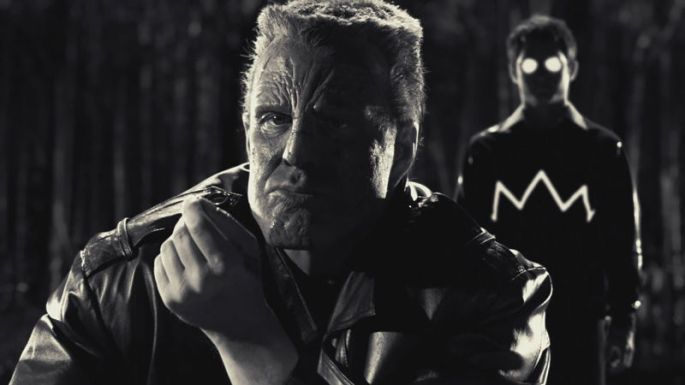
began as a series of graphic novels created by Miller. They are loving homages to the gritty pulp novels Dashiell Hammett, Raymond Chandler and Mickey Spillane and classic film noirs from the 1940s and 1950s. Miller’s world — the dangerous, crime-infested Basin City — is populated by tough, down-on-their-luck losers who risk it all to save impossibly voluptuous women from corrupt cops and venal men in positions of power through extremely violently means in the hopes of ultimately redeeming themselves. The movie ambitiously consists of three Sin City stories: That Yellow Bastard, The Hard Goodbye, and The Big Fat Kill with the short story, “The Customer is Always Right” acting as a prologue.

In the first story, Hartigan (Bruce Willis), a burnt-out cop with a bum-ticker and on the eve of retirement, is betrayed by his partner (Michael Madsen) after maiming a vicious serial killer (Nick Stahl) of young girls who also happens to be the son of the very power Senator Roark (Powers Boothe). The next tale features a monstrous lug named Marv (Mickey Rourke) who wakes up in bed with a dead prostitute named Goldie (Jaime King) and decides to get revenge on those responsible for killing the only thing that mattered in his miserable life. The final segment focuses on Dwight’s (Clive Owen) attempt to keep the peace in Old City when the prostitutes who run the area unknowingly kill a high profile (and also a sleaze bag) cop named Jack Rafferty (Benicio del Toro) and in the process risk destroying the precarious truce between the cops and the hookers that currently exists.

The three main protagonists are all well cast. Bruce Willis is just the right age to play Hartigan. With the age lines and the graying stubble on his face, he looks the part of a grizzled, world-weary cop with nothing left to lose. Willis has played this role often but never to such an extreme as in this film. Quite simply, Mickey Rourke was born to play Marv. With his own now legendary real life troubles and self-destructive behavior well documented, the veteran actor slips effortlessly into his role as the not-too-bright but with a big heart hero. British thespian Clive Owen is a pleasant surprise as Dwight and is more than capable of convincingly delivering the comic’s tough guy dialogue. As he proved with the underrated I’ll Sleep When I’m Dead (2003), Owen is able to project an intense, fearsome presence.

The larger-than-life villains are also perfectly cast. Nick Stahl exudes deranged sleaze as Roark, Jr. and cranks it up an even scarier notch or two once he undergoes his “transformation” as the Yellow Bastard of his story. Perhaps one of the biggest revelations is the casting of Elijah Wood as the mute cannibal Kevin. Nothing he has done previously will prepare you for the absolutely unsettling creepiness of his character. Finally, Benicio del Toro delivers just the right amount reptilian charm as Jackie-Boy. Not even death stops him from tormenting Dwight and it is obvious that Del Toro is having a blast with this grotesque character.

Miller’s pulp-noir dialogue may seem archaic and silly but it is actually simultaneously paying homage and poking fun at the terse, purple prose of classic noirs and crime novels of the ‘40s and ‘50s. Rourke, Willis and Owen fair the best with this stylized dialogue as they manage to sell it with absolute conviction. It helps that both Rourke and Willis have voices perfectly suited for this kind of material: weathered and worn like they have smoked millions of cigarettes and downed gallons of alcohol over the years.

Of the women in the cast, Jessica Alba is the only real miscast actress. Not only does she not look like her character, Nancy Callahan (who was much more curvy, full-bodied and naked most of the time in the comic) but she does not go all the way with the role and her line readings feel forced and unnatural. Fortunately, Rosario Dawson more than makes up for Alba as Gail, an S&M-clad, heavily-armed prostitute who helps Dwight dispose of Rafferty’s body. She looks the part and inhabits her role with the kind of conviction that Alba lacks.

Finally, somebody has realized that the panels of a comic book are perfect storyboards for a movie adaptation. With Miller’s guidance, Robert Rodriguez has uncannily recreated, in some cases, panel-for-panel, Sin City onto film. He has not only preserved the stylized black and white world with the occasional splash of color from Miller’s comic, but also the gritty, dime-novel love stories that beat at its heart. Fans of the comic will be happy to know that virtually all of the film’s dialogue (including the hard-boiled voiceovers) has been lifted verbatim from the stories and the sometimes gruesome ultraviolence has survived the MPAA intact.

If you think about it, Rodriguez’s career has led him up to this point. With the stylized, over-the-top action of Desperado (1995), the pulp-horror pastiche of From Dusk Till Dawn (1996) and the mock-epic Once Upon a Time in Mexico (2003), he has been making comic book-esque movies throughout his career. It was only a matter of time before he adapted an existing one. Cutting his teeth on these action movies has allowed him to perfectly capture the kinetic action of Miller’s comic. Seeing hapless thugs fly through the air at the hands of El Mariachi’s deadly weapons in Desperado foreshadows the cops being propelled through the air when Marv makes his escape in Sin City.

What Sky Captain and the World of Tomorrow (2004) did for the pulp serials of the 1930s and ‘40s, Sin City does for film noir. There is no question that Sin City resides at the opposite end of the spectrum from Sky Captain. While both feature retro-obsessed CGI-generated worlds, the former looks grungy and lived-in and the latter is pristine and perfect-looking. Sin City is absolutely drenched in the genre’s iconography: hired killers, femme fatales that populate dirty, dangerous city streets on rainy nights. It is the pulp-noir offspring of James Ellroy and Sam Fuller with a splash EC Comics gore. Ultimately, Sin City is a silly and cool ride and one has to admire a studio for having the balls to release a major motion picture done predominantly in black and white with the kind of eccentric characters, crazed violence and specifically-stylized world that screams instant-cult film.
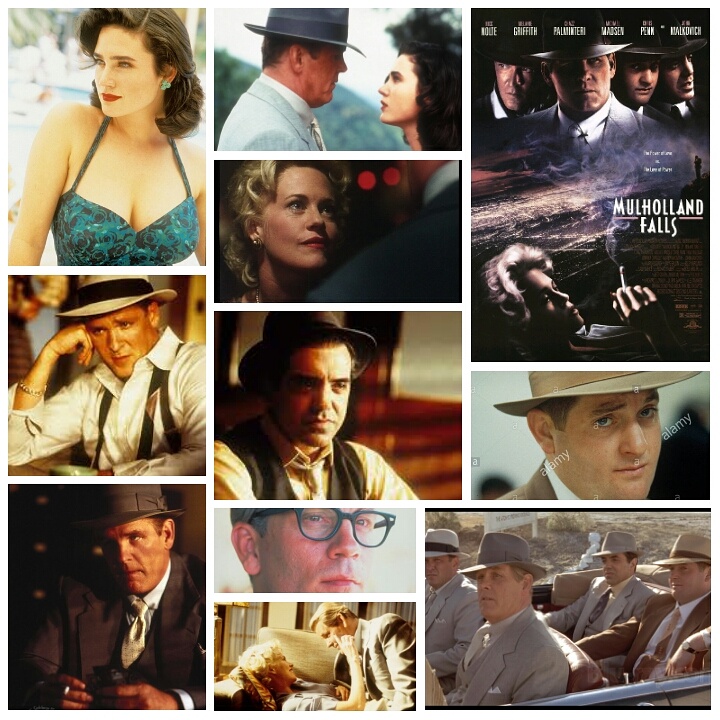
Lee Tamahori’s Mulholland Falls: A Review by Nate Hill

image

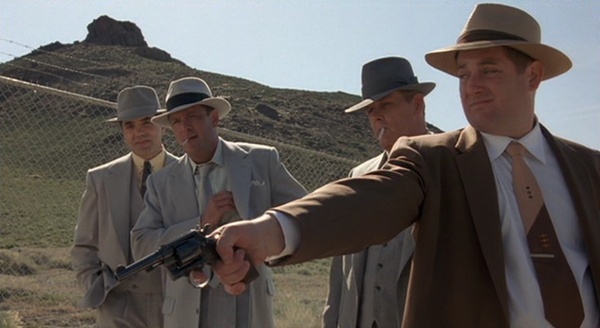
Lee Tamahori’s Mulholland Falls gets a bad rap in some circles for being boring and uneventful despite its charismatic cast and opulent setting that’s ripe for peppy action sequences. I think they are confusing boring with the concept of a paced and very slow burn, yet one with all the texture and richness of an action film, one that admirably decides to take the route of the old school noir, with loving care put into story and character, two elements which the action and violence live simply to serve, and not to take the driver’s seat against. Or it’s simply not some people’s cup of tea, which is totally okay too. Personally though, I love a good L.A. cop yarn that has a story to go with the toughness. This one bears striking similarity to 2013’s Gangster Squad, which also had Nick Nolte playing a 1940’s Los Angeles cop in charge of a squad that operates outside of the law. That film is pure cheese, all razzle dazzle and no plot. Mulholland Falls falls somewhere between Gangster Squad and L.A. Confidential; not quite up to delving into the serpentine intrigue of the latter, yet infinitely more interested in telling a worthwhile story than the former. And tell it does, in high flying style that only a crime film set in that time period can do. Nick Nolte plays Hoover, a whiskey voiced, take no prisoners LAPD badass who heads up an elite anti corruption task force that operates far outside the red tape and pretty much do what they want to stomp out corruption. His squad consists of Michael Madsen, Chris Penn and a scene stealing Chazz Palminteri as the oddball of the bunch, with serious impulse control issues. A straight up dream cast of tough guys, and although I’ll admit that Penn and Madsen are a tad underused, their presence alone boosts the film’s credentials into an epic pantheon. The film revs up with a kicker of an opening sequence in which the squad severely roughs up a troublesome mobster (an uncredited William L. Petersen). “This isn’t America, it’s Los Angeles” Nolte growls to him, stating the tone of perverse lawlessness which permeated the city back then. Soon he’s drawn into a tawdry scandal involving the murder of a young prostitute (Jennifer Connelly) who he previously had encounters with. The search leads him far and wide, crossing paths a sleazy photographer (Andrew Mcarthy), a dying air force tycoon (John Malkovich manages to ham it up even at his most laid back) and his stern lieutenant (Treat Williams). Nolte also has a poor jilted wife played nicely by Melanie Griffith in limited but effective screen time. The plot is hard boiled to the bone, with Nolte in one his most gruff mid career roles and loving every stressed out, rage fuelled second of it. The conclusion is his show, with a whacked out Palminteri in tow for a spectacular sequence set aboard a doomed military aircraft. The cast gets deeper, believe it or not, with Daniel Baldwin, Ed Lauter, Kyle Chandler, Titus Welliver, Louise Fletcher, Rob Lowe and Bruce Dern contributing gamely. This one’s got style on it’s side and then some, replicating a sense of time and place with the torque ramped up to near Sin City levels. Admittedly not perfect, but a pure and simple blast of a flick, in my opinion.

MULHOLLAND FALLS – A REVIEW BY J.D. LAFRANCE

600px-Mulfal-ctroop4

They say timing is everything and this certainly applies to the release and reception of movies. Case in point: Mulholland Falls (1996). Released a year before the very similar L.A. Confidential (1997), it was also a retro-neo-noir set in 1950s Los Angeles and featured a murder mystery leading to a vast conspiracy. However, Falls was promptly blasted by the critics and quickly disappeared from theaters while Confidential became the toast of critics and received awards from all over the world. So, what went wrong? Falls featured an impressive cast of solid character actors (it had more name actors than Confidential) and a critically acclaimed director with Once Were Warriors’ Lee Tamahori as opposed to Confidential’s Curtis Hanson who had only done adequate B-movies like The Hand That Rocks the Cradle (1992) and The River Wild (1994). Now that a few years have passed, Mulholland Falls has aged surprisingly well.

Set in 1953, the first image is one of a mushroom cloud from an atomic bomb explosion. It is one of the enduring images from that era and one that hangs like a shadow over the characters and events in the film. Max Hoover (Nick Nolte) leads a group of four cops known as The Hat Squad who do things their own way, like bullying out-of-town gangsters and dropping them off one of the deserted stretches of Mulholland Drive (aka “Mulholland Falls”) as a deterrent for setting up shop in L.A. One day, Max and his crew – Coolidge (Chazz Palminteri), Eddie (Michael Madsen) and Relyea (Chris Penn) – go out to a construction site to investigate the murder of a beautiful woman (Jennifer Connelly) who has been literally pressed into the ground. There is a shock of recognition on Max’s world-weary face. His connection to the dead girl and his subsequent investigation into her murder leads to a dangerous conspiracy involving the United States government and a mysterious General Timms (John Malkovich), head of the Atomic Energy Commission.

After the success of Once Were Warriors, Tamahori was offered many projects before finally choosing Mulholland Falls. Michael Mann was originally attached to the film but left at some point. One of the first things that is so striking about this film is the gorgeous attention to detail with vintage cars, suits and music from the period. This is enhanced by the gorgeous cinematography of the legendary Haskell Wexler who evokes classic film noir in every frame of Mulholland Falls. Tamahori assembled an impressive crew including the likes of production designer Richard Sylbert, who worked on Chinatown (1974) and The Manchurian Candidate (1962), and Wexler, who won an Academy Award for Who’s Afraid of Virginia Woolf? (1966) and worked One Flew Over the Cuckoo’s Nest (1975) and In the Heat of the Night (1967) amongst others.

Tamahori says that people within the industry were surprised that he hired veterans like Sylbert and Wexler and realized that Hollywood was being run by young executives: “It’s a kind of youth-oriented thing, and—blast, blam, blam, blam, make the action for the under-25-year-old crowd. Do this, do that, you’ve got to be on top, you have to be fast. They see age as being old and boring.” Mulholland Falls consciously eschews this approach for a slower paced, more thoughtful vibe that harkens back to films made before music videos and their kinetic editing changed the way films were made in Hollywood.

With his gravelly voice and weathered good looks, Nick Nolte is well cast as the conflicted tough guy, Max Hoover. If there is one significant problem with the film it is the lack of screen time given to the excellent members his crew. They are given little time to develop their characters with only Chazz Palminteri edging out the others. Palminteri plays Nolte’s best friend and second-in-command. He’s the most sensitive of the bunch (although, that’s not saying much) because he’s seeing a female psychiatrist and this makes him the voice of reason, often curbing Max’s more self-destructive impulses. Tamahori met Burt Reynolds and Tom Arnold for the role of Coolidge but felt that Reynolds was a little old for the role.

Little time is devoted to developing the chemistry between them. The filmmakers should have used The Untouchables (1987) as inspiration – although, the crucial difference is that in Brian De Palma’s film we see how Eliot Ness and his crew come together while in Mulholland Falls, Max and his group have been together for some time. Pete Dexter’s screenplay doesn’t do a good enough job making us believe that they are a tight-knit crew. That being said, the chemistry between Nolte and Palminteri begins to kick in towards the end of the film but it is too little, too late.

The casting of actresses Jennifer Connelly and Melanie Griffith is right on the money as they both have the voluptuous body type common to that era, especially Connelly who has curves in all the right places and that were also used to great effect in The Rocketeer (1991). Sadly, Connelly and Griffith aren’t given too much screen time but this does give Connelly’s character something of an ethereal, mysterious quality that is quite haunting and works well in the film.

John Malkovich essays yet another one of his cultured bad guy roles as General Timms. The first meeting between him and Nolte is good as we watch two different acting styles bounce off each other. Timms tries to dazzle Hoover with philosophical double speak while the cop plays dumb but subtly applies pressure on the scientist. What is so interesting about this scene is what is not being said. Watching this film again, I was struck by the eclectic cast featuring the likes of Treat Williams, Andrew McCarthy, Bruce Dern, Daniel Baldwin, William Petersen, and Rob Lowe.

There is somber tone that hangs over Mulholland Falls and the ending is refreshingly downbeat (unlike the very classic Hollywood ending of L.A. Confidential) evoking Chinatown of which it was most often compared to. Like any good noir protagonist, Max’s shattered life stays shattered. The murder has been solved but at a terrible cost to his own life. While Falls is a flawed film and certainly not as strong as Confidential, it is not an awful effort by any means and actually has a lot of merits. It is definitely worth another look if you haven’t seen it since it debuted or if you’ve never seen it before.

JEAN-MARC VALLEE’S DEMOLITION — A REVIEW BY NICK CLEMENT

demo

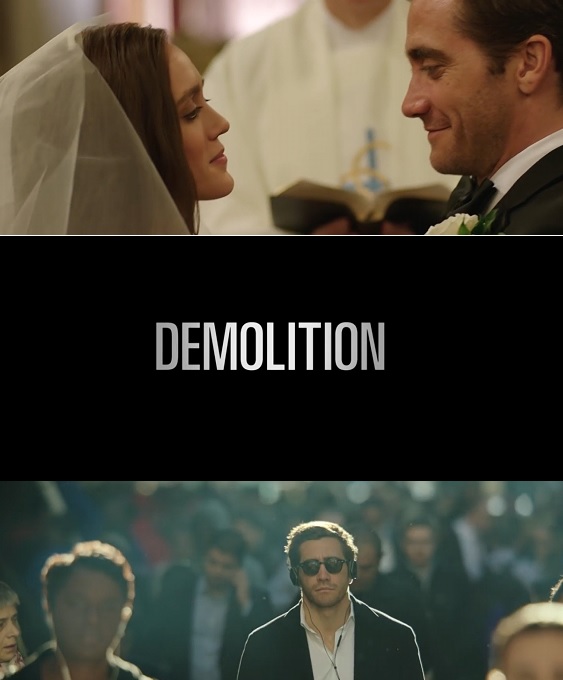
Demolition is “one of those movies.” I really admired this film, enjoyed it thoroughly, but only about as much as the filmmakers intended. This isn’t a happy or easy piece of work, which is probably why the critical response has been mixed, but I was struck by the honesty at play here, and how the screenplay presented an inherently flawed and rather unlikable lead character as the story’s entry-point, and how the film really centers on people in emotional flux, and how simple friendship can be the key ingredient to potential and hopeful catharsis. The more I think about the film, the more I really like it, but that’s not too surprising, because the director, Jean-Marc Vallee, has only made strong motion pictures (The Young Victoria, Dallas Buyer’s Club, and Wild) that are concerned with deep and complicated lead characters, and which allow for his actors to really cut loose and get invested in their roles. And in Demolition, the absolutely on-fire Jake Gyllenhaal delivers another robust, completely engaged and committed performance, this time as a young widower who has to actually learn to love his wife before he can begin to grieve. Bryan Sipe’s theatrical and movie-movie screenplay reminds in many instances of 21 Grams, and while not as overwhelming or pulverizing as Alejandro Gonzalez Inarritu’s picture, Demolition hits hard and often, with a tendency to show more than tell, which I really appreciated.

Vallee is a very visual filmmaker, given to quick-fire editing patterns in all of his work (the editing in Demolition reminds of the showier passages in Wild, which I loved), and here, by employing a very sleek visual aesthetic, he and his technicians were able to fully emphasize the money and the empty success that all of the characters have attained. Smoothly shot by Vallee’s regular cinematographer Yves Bélanger and crisply edited by Jay M. Glen who never allows a scene to go on too long, the film has a lightning-quick pace which is interesting considering the heavy dramatics that comprise the story. Chris Cooper is outstanding in his scenes with Gyllenhaal, and Naomi Watts is reliably effective as a woman who gets caught in Gyllenhaal’s orbit, and enters into a non-sexual, mutually beneficial relationship that helps the two of them get over some serious bumps in their lives. And in the film’s most surprising subplot, Gyllenhaal develops an interesting friendship with Watts’ son, played with sharp sass by Judah Lewis, which yields some unique laughs and moments of introspectiveness that were very surprising; all of this stuff could have served as the basis for an entirely different film. Demolition also contains one of the best and most subtle references to a likely college rapist in training, with the gross reminder that wealth and status can get you anything in this day and age. This is a purposefully frayed film with no easy answers, and because of that, I can certainly see how it won’t work for some. But for me, this is the sort of movie I’m always interested in experiencing.

Metro: A Review by Nate Hill

image

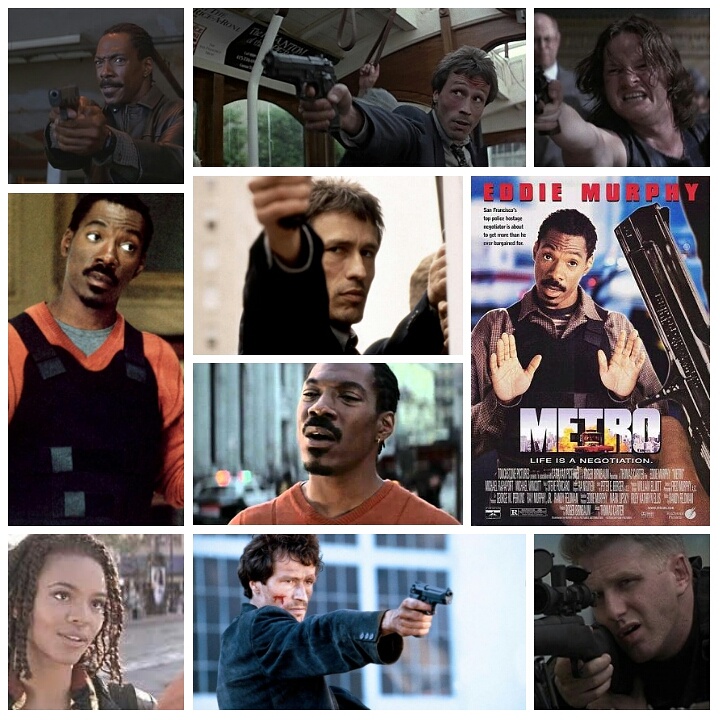
The 80’s and 90’s saw the momentous rise of beloved funnyman Eddie Murphy within the action comedy genre, particularly the wise cracking cop niche. 48 Hrs kicked it off, the Beverly Hills Cop trilogy added to the snowball effect, and so it went. His manic charisma led to many a starring role, including the somewhat forgotten actioner Metro, one thats notable because it shows the actor in just as many serious situations as comedic ones. There’s a tether on his sense of humour here, which in other films has been set to roam and end up where it may, often halting entire scenes for his non stop antics to play out. Here he gets a few moments like that, but even more to get seriously angry and tough, most likely helped by the fact that he’s up against one of the most truly heinous villains he’s ever had to face. Here he’s Scott Roper, a fast talking, resourceful San Francisco hostage negotiator who flexes both brain and brawn in a tense opening confrontation with a loose-screw criminal (Donal Logue). We see right off the bat what an efficient dude he is, a nice precursor for the trying times ahead. He’s inhabits a world chock full of every necessary genre element: a cranky police captain (Denis Arndt), a sexy girlfriend (stunning British gal Carmen Ejogo), a fresh out of the academy rookie partner (Michael Rapaport, not given much to do) a recently deceased former partner (Art Evans) to avenge, slain by the obligatory arch criminal, in this case psychotic jewel thief Michael Korda (Michael Wincott). Wincott makes Korda a truly detestable guy. Vile, slithery and absent of any shred of remorse, killing his way through the city with Roper hot on his tail. And there you have it, every necessary element in place for a solid cop flick, and one that’s gotten very little attention over the years. There’s neat action set pieces including a showstopper set aboard a speeding trolley car, endearing bits of comedy now and then from Murphy and some savage violence that proclaims the film’s hard R rating proudly. Murphy and Wincott have a sizzling verbal dual, separated by prison glass that launches the scene into the stratosphere of intense profanity, with F bombs spewed off in rapid fire, tempers and talents of both actors in overdrive. Lukewarm reviews can be found all over for this one. Yeah its no 48 Hrs, but it earns it’s stripes and to me is one of Murphy’s very best, helped along quite a bit by Wincott’s snarling, evil presence. Great fun.

B Movie Glory with Nate: Bone Dry

  
Bone Dry is fantastic little piece of sun soaked, revenge fuelled melodrama that serves as a glowing showcase for its two leads, Luke Goss and a ferocious Lance Henriksen. Lean, mean, gritty and reminiscent of 1970’s revenge outings, it’s a bloody delight of a flick. Luke Goss, an actor who can give Henriksen a run for his money in the intensity department, plays Eddie, a well dressed dude with a suspiciously murky past, winding his way through the desolation of the Mojave Desert. After breezing through a lonely cafe run by a girl (always nice to see Dee Wallace) who clearly has eyes for him, he sets out through a particularly lonely stretch of the terrain, and that’s where he finds himself in serious trouble. He’s soon stalked by a menacing, mysterious man named Jimmy (Henriksen), who is intent on tormenting, taunting and fucking him up at every turn. Jimmy is an ex war monster a man whose taken it upon himself to put Eddie through every ring of hell that the Mojave has to offer, all in service of some deeply buried reasons that emerge from the sand late in the third act, shedding scorching light on the two men’s character arc, and giving the film quite the emotional boost. When I say hell, I mean it. Eddie suffers through some unspeakably horrific scenarios, including a scene involving a cactus that will induce mass cringing among audience members. Director Brett A. Hart has a heightened, almost Walter Hill-esque style to his film, with the intensity metre ratcheted up past the maximum, and editing trimmed down to whip smart strokes that put you right in the middle of Eddie’s clammy desperation and Jimmy’s enigmatic fury. Henriksen spends the first half of the film with his face shrouded, adding to the mystery of his character. He’s a master of the craft who slowly lets the breadcrumb trail fall with every portentous mannerism and glowering posture until we finally see what Jimmy is really about. One his best performances. Goss doesn’t let the energy sag for a single second, something he has always been great at. There’s further work from the legendary Tommy ‘Tiny Lister’ Jr. as well, filling in another subplot stranded out there in the sand. This one is genre bliss, brutal and blistering until it cools off for a conclusion that cuts the viewer some respiratory slack after the breathlessness of its juggernaut setup. Terrific stuff. 

Wildflowers: A Review by Nate Hill


Wildflowers is a film that examines the aftermath of 1960’s counterculture and the hippie movement. The free love sentiment produced many children who were raised unconventionally, and in some cases outright abandoned by their flower power parents. Cally (Clea Duvall) is one such girl, a wild tomboy who lives with her sometimes employed father (Thomas Arana), and spends her days cavorting around with adolescents in similar situations. It’s rare that Duvall gets a starring role, and she’s absolutely wonderful here, steering Cally along with longing, resentment and just a bit of touching ‘lost girl’ emotion. She’s an actress who needs to be cast in more stuff to showcase her talent, and not just thrown into lesbian roles because she identifies as such (grrr!). She steals the show and proves what a magnetic presence she is. Cally never knew her mother, and hope arises with the arrival of mysterious Sabine (Daryl Hannah) a woman old enough to be her mother and seemingly connected to her somehow. Sabine is a free spirit with a turbulent mindset, a result of the fragmented lives that people led back in that time period, often leading to wayward souls with no sedimentary existence to slide into after the show finishes and they realize they aren’t as young as they used to be. Cally’s story plays out beautifully, a girl just coming into her own and realizing who she is, via experimentation and intuition. She meets a drug dealer named Jacob, played by Eric Roberts. He’s the friendly drug dealer, a cinematic archetype often sought after by filmmakers. Roberts could play an evil dictator and still come off like Prince Charming, he’s just that likeable, and as such is perfect for the role, a kindly rapscallion with lessons and advice for Cally which don’t quite play out as one might think. In the end, it’s Duvall’s show, one of the only lead roles she has that is even out there to hunt down, such is the rarity of many films in her career. It’s filled with terrific scenery, a whimsical yet real world aura and performances of emotional truth. Worth tracking down for Clea’s fans (I’m proudly a die hard) and a delight for the casual viewer. 

LODGE KERRIGAN’S KEANE — A REVIEW BY NICK CLEMENT

keane_xlg

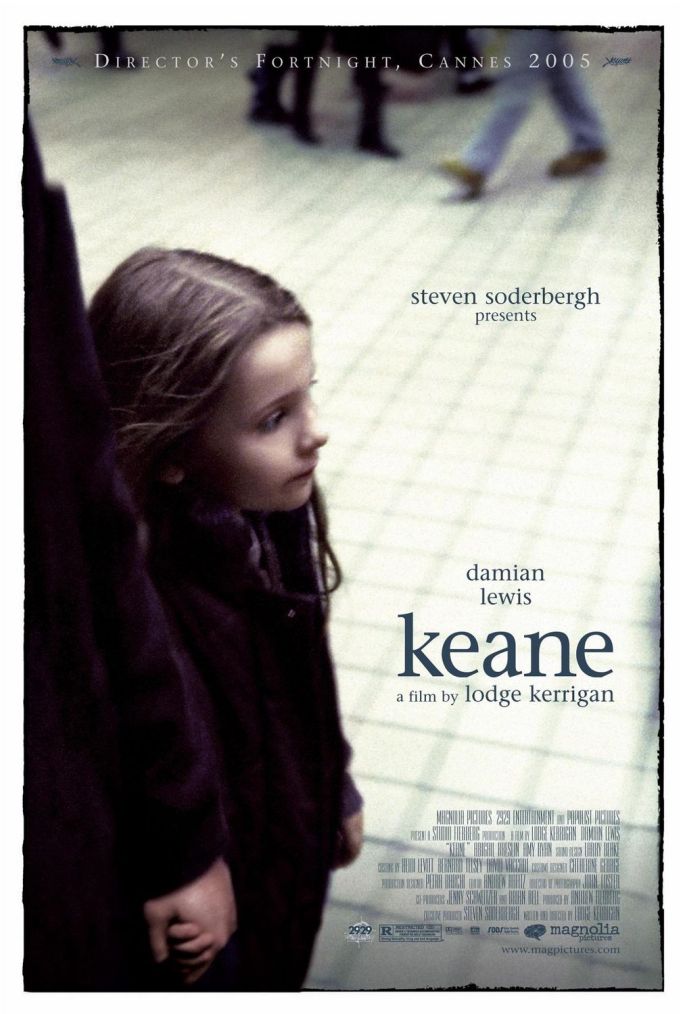
Unnerving doesn’t begin to describe Keane, a fascinating, immediately engrossing drama from 2004 that showcased an astounding performance from Damian Lewis as a schizophrenic man frantically searching for his lost daughter. Executive produced by Steven Soderbergh and written and directed by the erudite filmmaker Lodge Kerrigan (currently doing great work on the new Starz series The Girlfriend Experience, also produced by Soderbergh), the film is set in rather remote and unfamiliar NYC locations, and centers on a mentally fractured man who is attempting to piece together his life while trying to accep the fact that his daughter has been kidnapped. Complicating matters is a new and unique relationship that he forges with a seemingly despondent single mother (Amy Ryan) and her daughter (Abigail Breslin), which begins to push his emotional and psychological limits. This is a film of almost unbearable tension, with a central peformance by Lewis that amounts to nothing less than a tour de force. Kerrigan based the film on his own personal fear of having his daughter go missing, and in part on a movie he had filmed called In God’s Hands, with Maggie Gyllenhaal and Peter Sarsgaard, but which never got released due to technical difficulties with the film stock. Aesthetically, Keane is a remarkable achievement, with most shots lasting three to four minutes, and the entire picture being shot by cinematographer John Foster with hand held cameras that upped the immediacy factor. The lack of a muscial score also reinforced the seriousness of the entire piece. This is a shockingly low-profile item that is worth seeking out, but one that will challenge most viewers.

GUARDIANS OF THE GALAXY: A Retrospective by Joel Copling

Rating in Stars: *** (out of ****)
Cast: Chris Pratt, Zoe Saldana, Dave Bautista, the voices of Bradley Cooper, Vin Diesel
Director: James Gunn
MPAA Rating: PG-13 (for intense sequences of sci-fi violence and action, and for some language)
Running Time: 2:01
Release Date: 08/01/14

It might seem an odd place on which to start a positive review of, well, any movie, as well as it might run the risk of flying in the face of the usual logic, but Guardians of the Galaxy tries to be three things at once and only really works as one of them. Bear with me here, though, reader, because the one thing it does succeed at being is so significant that it dwarfs the other, less successful attempts. Because the screenplay by Nicole Perlman and director James Gunn approaches the origin story of yet another team of scrappy, fundamentally different superheroes as a comedy of five egos battling each other’s opposing philosophies.

It’s funny stuff in a smarmy and sarcastic way that might be its undoing if not for the fact that the actors in the roles of our heroes are so adept at playing the comedy mostly straight. The exception to that might be Chris Pratt as Peter Quill, aka Star-Lord, the de facto leader of the group that forms by accident and through reluctance on each member’s part. He was stolen from Earth mere minutes after his mother’s death and, even now, is stuck in the mode of the 1980s, listening to a Walkman radio as a way by which to remember her. Zoe Saldana is Gamora, a ruthless assassin and one of the two daughters of the guy who is positioned as the Big Bad of the Marvel Cinematic Universe, and Dave Bautista is Drax, an assassin himself who has no capacity to understand metaphor (Things don’t go over his head, he explains, because his reflexes are simply too good).

There are also Bradley Cooper voicing Rocket, a raccoon and former laboratory experiment whose personality defect is that he wants to cause destruction wherever he goes, and Vin Diesel as the voice of Groot, a sentient tree and Rocket’s hired bodyguard whose vocabulary is limited to five words (one of which is his name). The film smartly downplays these characters’ positive attributes to such a degree that they only occasionally eke through: Peter is brave but self-congratulatory in his courage, Gamora always has the hardened exterior of the girl who was taken from the family her father killed so that he could enslave her, Drax is determined to face the man who killed his own family to a degree that places everyone else at risk, Rocket will never understand why he was made to cause destruction but definitely wants to wreak that havoc, and Groot is, well, Groot.

The film’s attempts at something more earnest than it is feel as much like half-measures as its attempts to work as yet another stepping stone for the MCU, which pop up when the film must ultimately position them against a generic threat. He arrives in the form of Ronan the Accuser (an unrecognizable Lee Pace), who wants to control the universe with some sort of Infinity Stone that does something or other. It’s a MacGuffin, basically. He joins forces with Nebula (Karen Gillan), Gamora’s sister, while the heroes call upon a couple of officials (played by Glenn Close and John C. Reilly in throwaway appearances) from the planet that Ronan and Nebula hope to destroy. The conflict resolves itself in about as convoluted a way as a confusing MacGuffin can provide.

That, then, speaks indirectly to the film’s decision to also attempt to work as an action movie, and Gunn is mostly imprecise in doing so. The sequences of escapes and combat are competently staged and shot by Ben Davis but largely unspectacular (The finale is a whirl of random motion). Even so, there’s the dominating positive force of the primary cast of characters, each of whom is such a stand-out original that everything surrounding them is rendered null by their presence. Guardians of the Galaxy is a very funny movie in its best moments, and that is because of pure, unflappable conviction exactly where it counts.

CAPTAIN AMERICA: THE WINTER SOLDIER: A Retrospective by Joel Copling

Rating in Stars: *** (out of ****)
Cast: Chris Evans, Scarlett Johansson, Anthony Mackie, Sebastian Stan, Cobie Smulders
Directors: Anthony Russo and Joe Russo
MPAA Rating: PG-13 (for intense sequences of violence, gunplay and action throughout)
Running Time: 2:16
Release Date: 04/04/14

(Note: If you are one of the seven people who has not seen Captain America: The Winter Soldier yet, it is highly recommended you do so before reading this review. Of course, why are you reading it if you haven’t?)

If Captain America: The First Avenger did nothing to alleviate the problem of introductory superhero movies offering only a generic origin story and an equally generic conflict, its sequel does the opposite. We are already accustomed to Captain America, the hero whose costume adorned with stars and stripes is as unsubtle as his earnestness to protect American lives, and so, with Captain America: The Winter Soldier, screenwriters Christopher Markus and Stephen McFeely rather effectively apply a political undertone to the proceedings. Luckily, rather than going down the simplistic road of an obvious allegory, the politics here are entirely self-contained. They exist within the Marvel Cinematic Universe, in which this is the ninth film, and the stakes are higher as a result.

Here, the major villain comes from within the system to which Captain America (and, thus, Steve Rogers) belongs, and he’s not having it. HYDRA, the off-shoot club of the Nazi regime spearheaded by his old foe, has infiltrated S.H.I.E.L.D., the government agency that paired Steve (Chris Evans in a solid performance) with the other Avengers to defend the Earth. He discovers this at his old barracks, where he was trained with the late “Bucky” Barnes (Sebastian Stan) to defend the country, when forced to go on the run by that corrupt system. In that way, the villain is not the human person very blatantly telegraphed to be a corrupt individual but an idea.

It’s a pretty neat trick to sew doubt in the minds of the heroes here and the audience who have grown to have a sizable kernel of trust in that system. It’s a slow knife between the ribs, rather than some generic conflict against which Steve must work with Nick Fury (Samuel L. Jackson) and Natasha Romanoff (Scarlett Johansson), aka Black Widow, as well as a helping of allies (a returning Colbie Smulders as Maria Hill, Anthony Mackie as Sam Wilson, aka the Falcon, who has a nifty flight suit with wings, and Emily VanCamp as a S.H.I.E.L.D. agent undercover in Steve’s apartment complex). Someone close to them is killed, the establishment around them slowly crumbles, and it’s on the run they must go.

The film does succumb to two different familiar conceits with its presentation of a trio of villains. In ascending order of uniqueness and importance, there is Brock Rumlow (Frank Grillo, an intimidating presence), a seeming ally of Steve’s until a neat combat sequence in confined quarters. There is Alexander Pearce (Robert Redford), the aforementioned corrupt individual in power, who wants to continue HYDRA’s work at whatever cost (and his ultimate plan is even more radical). The third is a figure from Steve’s own past whose identity should not be revealed, but he shares the moniker of the film’s subtitle–and has a self-repairing metal arm, to boot.

The result of the familiarity is, admittedly, not of great impactfulness in the big picture. It appears in an extended action climax in which Steve and the Winter Soldier face off on a helicarrier (one of many in this case). Directors Anthony and Joe Russo stage the sequence as sleekly and efficiently as ever, but the most intriguing elements of their film are the ones that pit Captain America against the corroded ideology that helped to make him the hero he is. That is what ultimately gives Captain America: The Winter Soldier its surprising complexity and lifts it above its predecessor.