If I were a filmmaker, I would kill for the ad campaign American International afforded to Blood Bath. One could stare for hours at its gorgeously macabre one-sheet which overflows with all kinds of promise for the brave audience member who would dare pay a ticket to witness the horrors ahead. Maidens being lowered into a pit of boiling blood while others are chained to a wall amid a mass of skeletons and cobwebs all behind a wrought-iron portcullis? Who’s not up for that ride?
Naturally, it being an American International production, only some of the ad campaign for Blood Bath was going to be true. There’s certainly a pit into which maidens caught up in suspended net traps could be lowered but, unfortunately, they’d literally get a wax bath as there is no blood in sight. Nor, now that you mention it, are there any other maidens shackled to the walls. And you can totally forget the skeletons. Not sure what’s going with them in that one-sheet.
In fact, fuck the skeletons. One could hardly be faulted for not being sure what’s going on with anything in Blood Bath at all. For instead of it being the next feature in Jack Hill’s career after his remarkable debut, Mondo Keyhole, Blood Bath was a salvage job given to Hill and Stephanie Rothman, another budding young talent in Corman’s universe. A true Frankenstein’s monster of a film, Blood Bath, stands out less as a crucial piece of either Hill or Rothman’s resumes and more as its own summer college course on Roger Corman and how he could take a convoluted, middling art-heist thriller named Operation: Titian and turn it into three other movies, two of them vampire films.
I shall not spend the day going through the howzits and whyzits of the Roger Corman School of Preserve and Recycle that would chronicle the history of Operation: Titian and how it wound its way into first becoming Portrait of Terror, then Blood Bath, and, finally, Track of the Vampire. That story will never be better laid out than in author Tim Lucas’s fascinating and painstakingly detailed, feature-length video essay, The Problem With Titian, included in Arrow’s deluxe Blu ray release of Blood Bath. Just understand that Roger Corman was a man who was going to realize the maximize value of an investment, no matter what he had to do to realize that value and without the slightest regards to how ugly the vehicle that delivered the value looked. For, if he did, we would not be talking about Blood Bath at all and, instead, how Operation: Titian is a fine thriller that’s overly complicated and disjointed but not without some nice lighting and gorgeous Dubrovnik locales. The end.
But we’re here to talk about Blood Bath, the third attempt to make something out of Operation: Titian and, up until then, the most radical of the repurposing of the original footage. For out of Blood Bath’s paltry running time of 62 minutes, no more than 8% of it originates from Operation: Titian. Instead, it keeps a few moments of exterior architecture shots and reuses a few shots of Titian’s prowling, cape-adorned figure for its own needs, but all sprinkled throughout a fairly new narrative curiously of extensive reshoots by Hill and, later, Rothman.
Blood Bath chiefly rethinks William Campbell’s madman from Operation: Titian and Portrait of Terror. Where he was but an imposter to the Sordi name in those two films, he is part of the actual Sordi lineage in Blood Bath. In Titian and Portrait, Sordi was the patriarch to a cursed clan and commissioned the artist Titian to paint a portrait of his doomed wife. In Blood Bath, Sordi is transformed into an artist of historical note; just as popular as Titian but whose name was destroyed with his work when he was burned at the stake as a heretic. And according to Lucas’s video essay, Hill’s original film had Campbell succumbing to an obsessive madness which caused him to kill the models that would pose for him. Obsessed and possessed by the spirit of Melitza, Sordi’s black magic-riddled lover from the past, Campbell’s mania would eventually spin out of control by the end of the film as the spirits of his victims would emerge from their wax cocoons and overtake him in a moment that would predate Hill’s Spider-Baby by a couple of years and William Lustig’s Maniac by many more.
Some of this footage still exists in Blood Bath. But what also exists is a bizarre, left-field graft in which the Sordi lineage was ALSO cursed with vampirism, thus allowing William Campbell’s mad-artist to also dissolve into a prowling, cape-adorned (see above) vampire (who, it should also be noted, looks nothing like William Campbell). New characters are added to the mix as the vampire story, wholly a concoction of Rothman’s, created a new branch in the narrative that needed some exposition. And it goes without saying that Stephanie Rothman’s contributions to the film, no matter how well-intentioned or commercially necessary, sink the film. And this is even more the case with Track of the Vampire, the longer television cut of Blood Bath. Adding even more incongruous pickup scenes to the already wobbly story and placing Patrick Magee’s character, who appears rather puzzlingly only in corpse form in Blood Bath, back into the mix (through the magic of poor ADR and editing, he is transformed from the lethal art thief in Titian to a cuckolded husband in Track), Track of the Vampire is the sad, final end to the long journey of Operation: Titian.
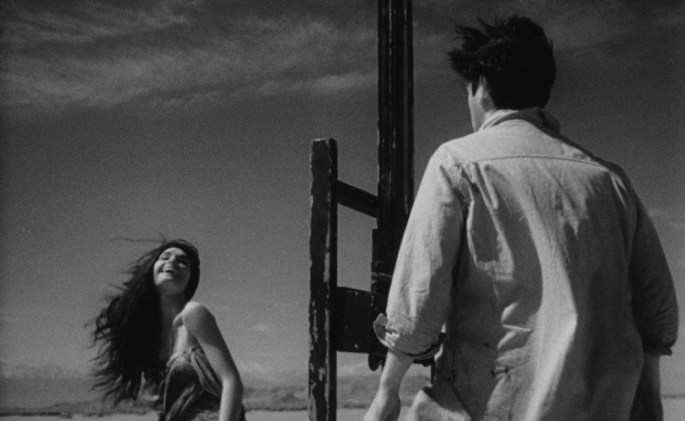
Audiences looking for anything resembling a traditional Jack Hill film will likely find little to mine in Blood Bath. As mentioned before, the film’s ending has a surprisingly creepy vibe that is in line with Spider-Baby and the appearances by Sid Haig and Karl Schanzer all give it a lighter touch and familiar feel than what was served up in Operation: Titian or Portrait of Terror. Additionally, Hill’s dreamy, impressionistic desert flashbacks give the film the same kind of artistic edge found in the grime of Mondo Keyhole. But, unlike that film, there is a lack of interesting or strong female characters here. There is a hint of sexual progressiveness in Lori Saunders’s ballet dancer, Dorean, who wants to sleep with Campbell’s Sordi in the worst way, but he is impotent, a factor in his mania. This harkens back to the characters in Mondo Keyhole but without any kind of satisfying payoff in terms of the Dorean character. In Mondo Keyhole, the female protagonist broke free of her untenable and unhealthy relationship with an abuser and simultaneously found herself in a wild, celebratory orgy of free love. Here, Dorean gets rescued by Karl Schanzer’s character as if she were just a cliched damsel in distress.
In the end, Blood Bath was an assignment for the two fledgling filmmakers more than it was a movie. Both Hill and Rothman would go on to craft bigger and better things; Rothman moving on to make The Student Nurses, one of the better “Nurse Movies” for Roger Corman, and The Velvet Vampire, a fun AIP attempt at making a Jess Franco film. Hill would reassemble some of the cast for Blood Bath and move almost immediately to Spider-Baby which would become the granddaddy of all “backwoods family” horror films and further cement his legacy as a master of genre cinema with a little more on his mind than most.
(C) Copyright 2021, Patrick Crain





 Podcasting Them Softly