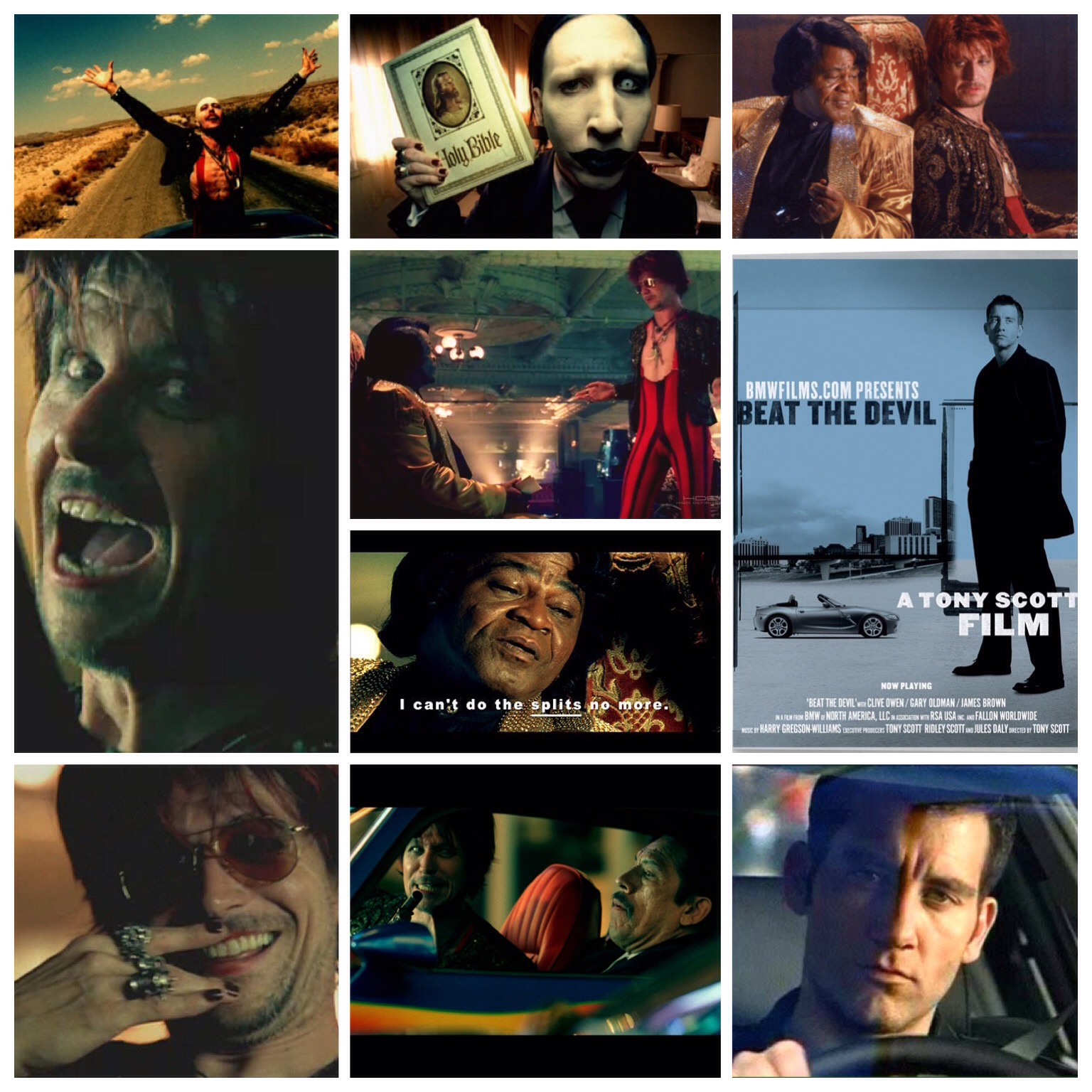
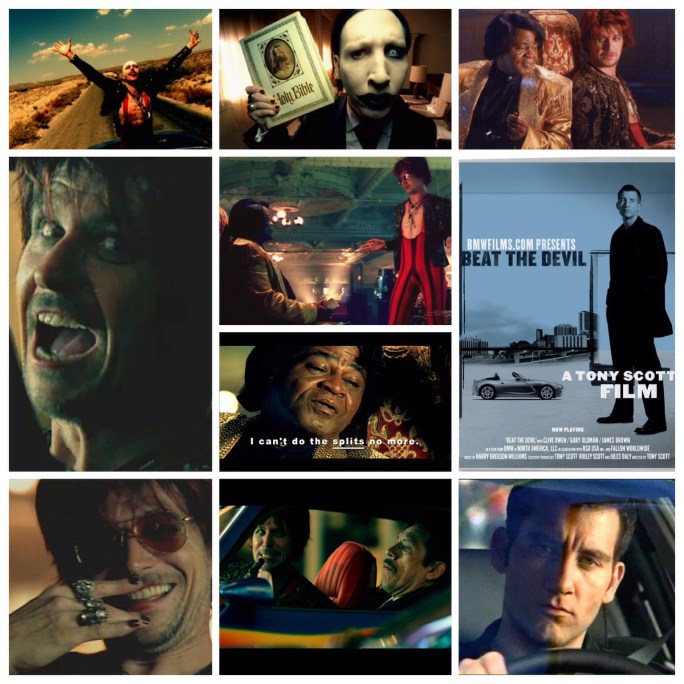
Tony Scott’s Beat The Devil is one part of a multi episode series of promotional short films called The Hire, themed around, and sponsored by BMW. An unbelievable amount of acting heft and prolific directors were brought in to make these, including Scott, Joe Carnahan, Alejandro Gonzales Inarritu, Guy Ritchie, Ang Lee and more. They’re all wonderful and different in their own way, but Scott’s is my favourite of the bunch hands down. From the eclectic cast, all having a blast, to the sheer kinetic momentum and adrenaline soaked velocity of the stylistic direction, it’s pure moviemaking. Tony Scott’s very distinct and polarizing visual aesthetic rears its beautiful head here for a literal crash course which would go on to emerge from the chrysalis and fully spread its wings in the director’s two best films, Man On Fire and Domino. This one is a delicious little treat and obvious precursor to those. The story is fable in nature, starring James Brown as himself (!), pining about his old age. He hires the 007 sequel Driver (Clive Owen, stars in every one of these films, drives a BMW all the time and ties them all together), who takes him to Las Vegas to see The Devil (Gary Oldman, who else), who he sold his soul to decades earlier for fame and fortune. Brown wants to renegotiate the terms of contract, or simply put. Wants to live as a youth longer. Oldman is a sight to see, adorned in crimson lipstick and all manner of kitschy wardrobe numbers, a flamboyant debutant who acts like a Dr. Seuss character in drag. He makes a deranged proposal: the two of them will race the Vegas strip at dawn, Owen against Devil’s driver Bob (a deadpan perfect Danny Trejo). If Brown wins, he gets an extension on life and youth. The race is pure Tony Scott, a commotion fuelled superstorm of breakneck editing, colours flying off the saturation charts proudly and auditory assault as only the guy can craft. It’s the most fun out of the Hire series, careening along on its own delirious and joyful reckless abandon. Watch for a priceless cameo from Marilyn Manson as well.
Tag: Clive Owen
SIN CITY – A REVIEW BY J.D. LAFRANCE

Until recently, most adaptations of independent comic books were far more successful (and by successful I mean faithful to their source material) than long-running mainstream ones from the two largest comic book companies, Marvel and DC. One only has to look at examples, such as Ghost World (2001), American Splendor (2003) and Hellboy (2004) against the failures of Catwoman (2004), Elektra (2004) and Constantine (2005). So, why are the first three films more satisfying triumphs and the last three empty exercises in style? The answer is simple. In the case of the first three movies, the filmmakers wisely allowed the comic book creators direct involvement in the filmmaking process, whether it was working on the screenplay (as with Ghost World and Hellboy) or actually appearing in the movie (American Splendor).
In the past, the comic book creator was, at best, a peripheral presence in the filmmaking process, or not even included at all. With bigger, longer running series, like Spider-Man or Superman, it is much harder to include the creator because there is not just one but many who have worked on the comic book over the years. Where does the filmmaker even start in these cases? To be fair, with Iron Man (2008) began a great run of adaptations of Marvel Comics being successfully translated to the big screen but before it the examples were few and far between.
It only makes sense that if one is going to adapt a comic book into a film that it be faithful in look and tone to its source material. Otherwise, why adapt it in the first place? Of course, there is always the danger of being too faithful to the look of the comic and not being faithful to its content (characterization, story, dialogue, etc.) like Warren Beatty’s take on Dick Tracy (1990) — all style and no substance. It goes without saying that the next logical step would be to include its creator, if possible, in the process so as to achieve the authenticity and integrity of the source material. Filmmaker Robert Rodriguez took this notion to the next level with Sin City (2005) by having its creator Frank Miller co-direct the movie with him. In fact, Rodriguez is so respectful of Miller’s work that he not only has the artist’s name listed first in the directorial credit but also displays his name prominently above the film’s title.
Sin City began as a series of graphic novels created by Miller. They are loving homages to the gritty pulp novels Dashiell Hammett, Raymond Chandler and Mickey Spillane and classic film noirs from the 1940s and 1950s. Miller’s world — the dangerous, crime-infested Basin City — is populated by tough, down-on-their-luck losers who risk it all to save impossibly voluptuous women from corrupt cops and venal men in positions of power through extremely violently means in the hopes of ultimately redeeming themselves. The movie ambitiously consists of three Sin City stories: That Yellow Bastard, The Hard Goodbye, and The Big Fat Kill with the short story, “The Customer is Always Right” acting as a prologue.
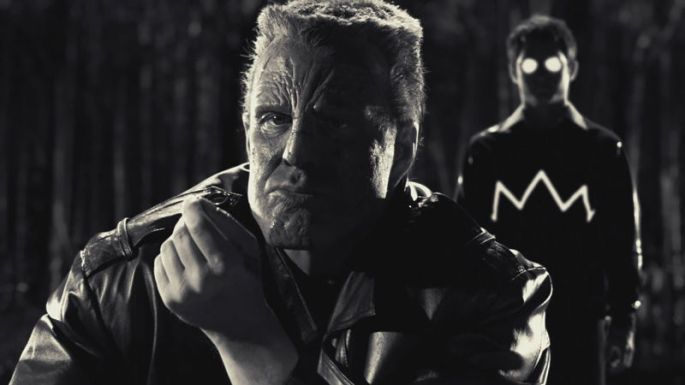
In the first story, Hartigan (Bruce Willis), a burnt-out cop with a bum-ticker and on the eve of retirement, is betrayed by his partner (Michael Madsen) after maiming a vicious serial killer (Nick Stahl) of young girls who also happens to be the son of the very power Senator Roark (Powers Boothe). The next tale features a monstrous lug named Marv (Mickey Rourke) who wakes up in bed with a dead prostitute named Goldie (Jaime King) and decides to get revenge on those responsible for killing the only thing that mattered in his miserable life. The final segment focuses on Dwight’s (Clive Owen) attempt to keep the peace in Old City when the prostitutes who run the area unknowingly kill a high profile (and also a sleaze bag) cop named Jack Rafferty (Benicio del Toro) and in the process risk destroying the precarious truce between the cops and the hookers that currently exists.
The three main protagonists are all well cast. Bruce Willis is just the right age to play Hartigan. With the age lines and the graying stubble on his face, he looks the part of a grizzled, world-weary cop with nothing left to lose. Willis has played this role often but never to such an extreme as in this film. Quite simply, Mickey Rourke was born to play Marv. With his own now legendary real life troubles and self-destructive behavior well documented, the veteran actor slips effortlessly into his role as the not-too-bright but with a big heart hero. British thespian Clive Owen is a pleasant surprise as Dwight and is more than capable of convincingly delivering the comic’s tough guy dialogue. As he proved with the underrated I’ll Sleep When I’m Dead (2003), Owen is able to project an intense, fearsome presence.
The larger-than-life villains are also perfectly cast. Nick Stahl exudes deranged sleaze as Roark, Jr. and cranks it up an even scarier notch or two once he undergoes his “transformation” as the Yellow Bastard of his story. Perhaps one of the biggest revelations is the casting of Elijah Wood as the mute cannibal Kevin. Nothing he has done previously will prepare you for the absolutely unsettling creepiness of his character. Finally, Benicio del Toro delivers just the right amount reptilian charm as Jackie-Boy. Not even death stops him from tormenting Dwight and it is obvious that Del Toro is having a blast with this grotesque character.
Miller’s pulp-noir dialogue may seem archaic and silly but it is actually simultaneously paying homage and poking fun at the terse, purple prose of classic noirs and crime novels of the ‘40s and ‘50s. Rourke, Willis and Owen fair the best with this stylized dialogue as they manage to sell it with absolute conviction. It helps that both Rourke and Willis have voices perfectly suited for this kind of material: weathered and worn like they have smoked millions of cigarettes and downed gallons of alcohol over the years.
Of the women in the cast, Jessica Alba is the only real miscast actress. Not only does she not look like her character, Nancy Callahan (who was much more curvy, full-bodied and naked most of the time in the comic) but she does not go all the way with the role and her line readings feel forced and unnatural. Fortunately, Rosario Dawson more than makes up for Alba as Gail, an S&M-clad, heavily-armed prostitute who helps Dwight dispose of Rafferty’s body. She looks the part and inhabits her role with the kind of conviction that Alba lacks.
Finally, somebody has realized that the panels of a comic book are perfect storyboards for a movie adaptation. With Miller’s guidance, Robert Rodriguez has uncannily recreated, in some cases, panel-for-panel, Sin City onto film. He has not only preserved the stylized black and white world with the occasional splash of color from Miller’s comic, but also the gritty, dime-novel love stories that beat at its heart. Fans of the comic will be happy to know that virtually all of the film’s dialogue (including the hard-boiled voiceovers) has been lifted verbatim from the stories and the sometimes gruesome ultraviolence has survived the MPAA intact.
If you think about it, Rodriguez’s career has led him up to this point. With the stylized, over-the-top action of Desperado (1995), the pulp-horror pastiche of From Dusk Till Dawn (1996) and the mock-epic Once Upon a Time in Mexico (2003), he has been making comic book-esque movies throughout his career. It was only a matter of time before he adapted an existing one. Cutting his teeth on these action movies has allowed him to perfectly capture the kinetic action of Miller’s comic. Seeing hapless thugs fly through the air at the hands of El Mariachi’s deadly weapons in Desperado foreshadows the cops being propelled through the air when Marv makes his escape in Sin City.
What Sky Captain and the World of Tomorrow (2004) did for the pulp serials of the 1930s and ‘40s, Sin City does for film noir. There is no question that Sin City resides at the opposite end of the spectrum from Sky Captain. While both feature retro-obsessed CGI-generated worlds, the former looks grungy and lived-in and the latter is pristine and perfect-looking. Sin City is absolutely drenched in the genre’s iconography: hired killers, femme fatales that populate dirty, dangerous city streets on rainy nights. It is the pulp-noir offspring of James Ellroy and Sam Fuller with a splash EC Comics gore. Ultimately, Sin City is a silly and cool ride and one has to admire a studio for having the balls to release a major motion picture done predominantly in black and white with the kind of eccentric characters, crazed violence and specifically-stylized world that screams instant-cult film.
PTS PRESENTS: 15 QUESTIONS WITH COSTUME DESIGNER ELLEN MIROJNICK

Award winning costume designer Ellen Mirojnick has been a part of some of the biggest, most exciting films and TV programs over the last 30 years. With work stretching various genres and styles, she’s collaborated with some of the industry’s true heavyweights, including Steven Soderbergh, Ridley Scott, Adrian Lyne, Paul Verhoeven, John Woo, Richard Attenborough, Renny Harlin, Mark Rydell, Angelina Jolie, and the late Tony Scott, to name only a bunch. An Emmy and Costume Designer Guild Award winner for her spectacular work on the HBO film Behind the Candelabra, Ellen continually applies her love and passion for the arts to each project she takes on, with results that are always eye-catching and wholly appropriate to the material. Podcasting Them Softly is proud to present an interview with Ellen, as she discusses her inspirations, some of the key films on her resume, her dynamic work on The Knick, and what she has in store for the future. We hope you enjoy!

- How did you get your start with costume design and what are some memories from your first job?
I was designing junior sportswear in NY. My husband was working on a film in New Orleans called French Quarter. The film didn’t have a costume designer. I was visiting, they offered me the job, and I was hooked! I did everything from designing the costumes through full wardrobe on set, including sewing. And I can’t sew! So I had holes in my fingers and had to continually wipe blood off the clothes!
- Who were some of your inspirations when you were starting out, and growing up, what were some of your favorite films, or the films that spoke to you the most?

Well of course Edith Head. But my favorite film was Auntie Mame, so I couldn’t get enough of Orry-Kelly’s work. I’ve always loved movies! As a kid and while growing up, I went all the time to the cinema. The only films I didn’t see were scary ones. I loved all of Audrey Hepburn’s films, Auntie Mame as I said, and Some Like It Hot was a favorite. I really responded to film noir, the French New Wave, and I just really loved sitting in the movie theater dreaming in the dark.
- What was your first “big break” in the industry?

I had a few big breaks. I was given a film to design and was immediately a Costume Designer. I would say my career as we know it began with Fatal Attraction.
- You have worked with some absolutely legendary filmmakers – Ridley Scott, Adrian Lyne (multiple times), Oliver Stone (multiple times), John Woo, Kathryn Bigelow, Steven Soderbergh (multiple times), Paul Verhoeven, and Tony Scott, just to name a few. Has there been one filmmaker, on this list or not, who you feel you’ve been especially “in tune” with?

I was in tune with all of the above when we worked together, all were momentous experiences! But the legendary filmmaker who I love working with and would say I’ve been “in tune with” the most is Steven Soderbergh. I call him The Grand Master.
- Which currently working filmmakers would you love to collaborate with?
I would love to collaborate with Steve McQueen, or somebody brand new, who is passionate about telling stories. Christopher Nolan, I love how he is fascinated by alternate or parallel universes. Marty Scorsese would be the ultimate New York State of Mind, and I’d still love to work again with everyone I’ve previously collaborated with.
- After working with Soderbergh on the fantastic Behind the Candelabra which won you an Emmy, he brought you on to his revolutionary new TV show The Knick. What’s it been like working on that show?
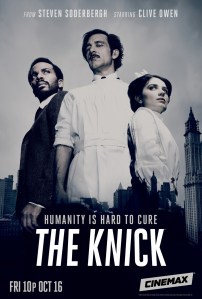
There aren’t enough words to describe working with Steven. I feel blessed to be a member of this amazing team. We were all tremendously excited to do something as adventurous as The Knick. 10 hours of storytelling, the complexity of the characters, a true time in history with the early 1900’s, and yet strangely, it still feels very much like today. It was absolutely ELECTRIC putting the pieces together. We built a hospital and a city through a lens we hadn’t seen before. It doesn’t get much better, needless to say, when watching great actors exploring the unknown! Steven has an idea and we get to explore it. He is very trusting with his crew, and he allows us great freedom interpreting the material. He doesn’t micro manage! The goal, as it’s been said by others, is that the actors come onto the set and you know everything works when he picks up the camera and begins to shoot, it’s time for action! The show has been a magnificent challenge, and my joy comes from meeting the various challenges every day, and working with my team, especially with Production Designer extraordinaire Howard Cummings.
- The Knick feels like cinema turned into TV. How has this show differed from other TV programs you’ve worked on?
The Knick doesn’t compare with anything. When you are involved with a project that breaks the rules, the rebel in me, as with all the members of the team, rises far and beyond anyone’s wildest dreams! I have only done the occasional TV pilot, all of which have sold and went on to become successful series. And one other TV film, Cinderella, which was lots of fun. But the Knick is great storytelling, chapter by chapter, with great actors loving their characters and their challenges. We shoot it like you shoot a film and I don’t know anyone else that can shoot 560 pages in 73 days! Steven can and does!
- This fall sees the release of Angelina Jolie’s By the Sea, which looks emotionally draining and very much a throwback to 70’s filmmaking. What was it like working with her and Brad Pitt on this seemingly quite personal looking film?

Working with Angelina and Brad was great! I didn’t know what to expect but they were great collaborators. It’s a difficult film that was very demanding and an intense assignment, but rewarding none the less.
- John Woo’s Face/Off is one of the greatest American action pictures ever made, and the stylish costumes, especially the suits, were a big component of that film’s overall sense of visual flair. What can you remember about working on that bullet fest?
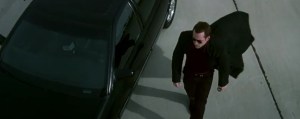
I was thrilled to work with John Woo. I was a great fan of all his Hong Kong films. I loved that I always liked his bad guy! Face/Off was originally going to take place in the near future. I came along and suggested that at the core of the film lived the same man, both sides of him, good and bad, just like the work John does best. They changed the film’s time frame to present day and the characters just spoke to me. John had an idea that when Nic Cage walked across the tarmac, his coat would fly open as in Lawrence of Arabia. We were able to achieve it with the aid of wind machines! Everyone thought it was a spectacular leather coat and it went on to inspire many future iconic film characters. It wasn’t leather, but rather, it was a polyester priest robe!
- Strange Days is one of the most ambitious science fiction films ever made, and everything about the look and feel of that film is tremendous, especially the distinct wardrobe worn by every scuzzy character. What can you remember about working with Kathryn Bigelow on this masterpiece of cinema?
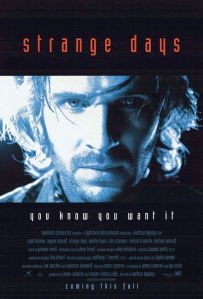
Working with Kathryn was quite fulfilling. The film took place at the turn of the decade, the year 2000. It was 1994 if I remember correctly when we were shooting, and 2000 wasn’t that far into the future. I helped to create a world that was a hyper mix, with various ethnicities, different time periods, rock ‘n roll, etc. It was divine ecology with nothing being wasted; the rich were rich, the poor were desperate. I remember wanting it to be decadent and sexy. I think it was ahead of its time for sure…
- One of the most underrated films on your resume is Lee Tamahori’s Mulholland Falls, aka, “The Hat Movie.” That film has an extraordinary sense of style, and the costume work was nothing short of brilliant. What was it like doing a full blown period noir and getting a chance to work with that incredible male ensemble, all of whom looked beyond snazzy in their outfits?
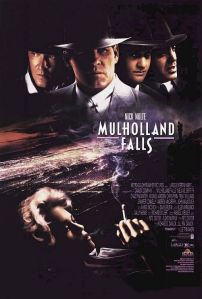
I’m so happy you feel that way about this film as I loved working on it! I love designing for men, it’s pretty clear. I had trouble being thought of as one to design period films, so when I was asked to do this film I felt like I had finally gotten a chance. It was my first period film since Chaplin, and I went into it full on. Nick Nolte, Chazz Palminteri, Michael Madsen, the late Chris Penn, John Malkovich, Melanie Griffith, Jennifer Connelly, and all the supporting players, including Rob Lowe – what a fabulous cast to work with! I loved working on the colors of the suits, and we found original fabrics for all the guys, and all the hats were handmade for the picture. I had a great time, but the story no one knows is that the real life detectives all wore white suits and cruised the strip in a white convertible! The producers thought the studio would be expecting “Men in White”, but after meeting with Frank Mancuso, the head of the studio at that time, he told us we had made the right choice.
- Nancy Meyers is a filmmaker who has a very specific style of storytelling and set decoration. What was it like working with her on What Women Want, which is one of the more thoughtful entries on her resume of entertaining comedies?
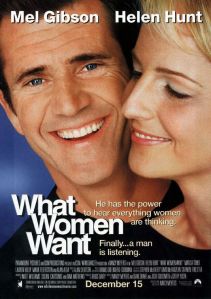
Nancy and I have very similar tastes in most areas, which made for a really good collaboration. It’s always a pleasurable working experience when your taste aligns with that of the filmmaker.
- Is there a genre you’d like to work in that you previously haven’t?
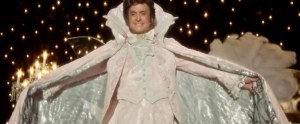
I’d love to do a musical or a fantasy, maybe a nitty-gritty thriller or something definitely not pretty. Actually, anything with a great story and an inspired storyteller – that’s what I’m looking for in new projects.
- Who are some of the other current costume designers who inspire you to continuously do great work?

There are so many great designers working today and I don’t want to leave anyone out!
- If you’re able to divulge any information, what projects do you have coming out in the near future, and what are you currently working on?

I’m currently in Cambodia, about to shoot Angelina Jolie’s next directorial project. It’s adapted from the book by Loung Ung called “First They Killed My Father: A Daughter Remembers.”

(This interview was conducted via email in November 2015, and was edited by Nick Clement.)
ALFONSO CUARON’S CHILDREN OF MEN — A REVIEW BY NICK CLEMENT
Prophetic. Speculative. Provocative. Chilling. Alfonso Cuarón’s Children of Men is one of the best films of my lifetime, a totally immersive experience where ideas and action coexist in an effort to tell a deeply human and thoroughly harrowing story of mankind’s last hope for survival. Clive Owen was fantastic in the leading role of a lifetime, while the supporting cast including a stony Michael Caine, a mysterious Julianne Moore, the shifty Chiwetel Ejiofor, the slimy Danny Huston, and the scene-stealing Peter Mullan all get a chance to shine. The blunt, forceful, incredibly streamlined screenplay (by four credited writers) is all forward narrative momentum, while Cuarón and cinematographer of the century Emmanuel Lubezki plunge the viewer into the middle of any number of violent spectacles, including large scale military battled, close-quarters combat, and vehicular mayhem, all shot with a constantly roving camera that’s prone to some very, very long and elaborate sequences without any noticeable edits. The film is a technical knock-out, a marvel on a story level, and it’s a total embarrassment that one of the most ambitious and challenging action pictures ever made wasn’t given any Academy recognition. Cuarón would later get his trophy for his spectacular thrill-ride direction on Gravity, and while that film is certainly accomplished in ways that very few other movies have ever been, Children of Men is an absolute all-timer, and a reminder that big, bold ideas can still intermingle with overwhelmingly visceral action.