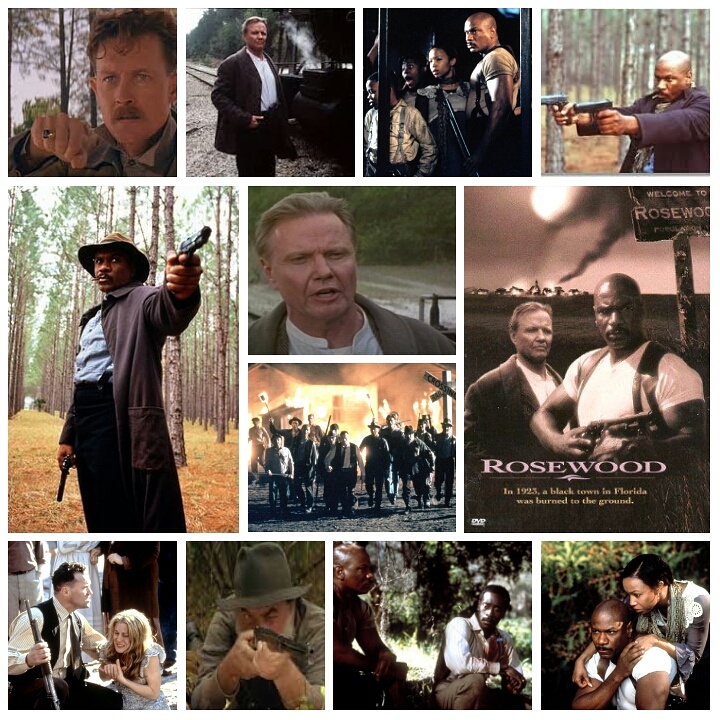
John Singleton’s Rosewood is a partly fictionalized, greatly dramatized retelling of one of the largest lynchings and subsequent conflicts in American history. The time is 1923, the place is Rosewood, a small southern town populated largely by African communities. When borderline insane local housewife Fanny (Catherine Kellner) is caught in the midst of a violent sexual fling, a young black man accidentally stumbles upon the scene. Being the crazy bitch she is, she melodramatically pins it on him, inciting the wrath of the town. The real culprit was of course a white dude, played briefly by Robert Patrick before fleeing the county for good. Because of this selfish misdirection, every white man and his mother now wants the boy hung, and it escalates with the speed of a prairie fire until a full scale race war rages through Rosewood. A lone mercenary called Mann (Ving Rhames) happens to be around and lends his quickdraw talents to the townsfolk who are being hunted. The sheriff (Michael Rooker) is somewhat of a pushover, and unable to quell the mob anyway, especially when it’s led by a rabid Bruce McGill, who is scary and then some. The only white boy who has anything but ropes or torches to offer these poor folks is a kindly store owner played by Jon Voight, who shelters a group of them on his property, much to the mob’s anger. Voight’s character is odd; when we meet him he is in heated coitus with one of his shopkeeps, a young African girl. It’s later revealed that she’s afraid of him. Despite this dark piece of his arc, Singleton treats him as a hero, begging the question, were there scenes cut that elaborated on his relationship with her? Such imbalances in tone can be found in the story as well: much of the film is treated with a combination of severe melodrama and true crime drama, speckled here and there with jarring little bits of pulp that feel like they’re from a Django type flick. Wouldn’t have been the narrative mix I would have used, but perhaps Singleton’s hand slipped and too much of an aspect fell in which he only ever meant as a subtle garnish. Nevertheless, it’s very solidly made, wherever it sits on the genre map, with all the actors, particularly the African townsfolk, shining nicely. It’s disturbing as well, with the black body count reaching sickening heights and the racist fever at a vicious spike in temperature. It’s a scary scenario when the hunters greatly outnumber the hunted, and mass deaths are imminent, especially when such anger is involved. Sympathy is earned in spades from the viewer, as well as the urge to look away at least a few different times. I haven’t done my research on the real story so I couldn’t tell you where it falls on the authenticity charts, but I suspect a great deal of it has been exaggerated for effect and impact. In that, it succeeds, if faltering in tone a few times to puzzle the viewer, before getting back on track.

Tag: don cheadle
Ocean’s Thirteen: A Review by Nate Hill
As silly, gaudy and drawn out the Ocean’s franchise had gotten by its third outing, I still somewhat enjoyed Ocean’s Thirteen, an overblown attempt to keep the magic alive that most of the time trips over its own bells and whistles. That being said, the gang is all there, and that alone is good for some laughs. This time around, Eliott Gould’s cranky charmer Reuben has been ousted from his Vegas property by Willie Bank (Al Pacino) a ruthless and ludicrously rich casino tycoon with big plans for the future. Reuben is left in a dazed depression, and the gang all drifts back together to try and rob the hell out of Pacino, using methods and cons so over the top they almost seem like a parody of the former films. Pacino is a bit more clownish than Andy Garcia’s grim Terry Benedict was in the first film, which adds to the cavalier absence of any sense of real danger. In fact, Benedict is now chummy with the gang himself, which is a cute turn of events but kind of seems to silly. Ellen Barkin adds a lot of class as Pacino’s head honcho, fitting into the Ocean world nicely. The gang I’d all back and more eccentric than ever, with Matt Damon scoring comedic points in one of the funniest prosthetic jobs I’ve ever seen. Newcomers to the show include Julian Sands, Oprah Winfrey and a reliably hapless David Paymer. It’s not that this one takes the formula too far, it’s just that we’ve been there, done that, got the t-shirt and there was really not much need for it. I won’t say no though, because the blue print of what made the first so fun is still there, it’s just been jazzed up and adorned with a few too many gilded sequins and fancy jib jab. Still enjoyable.
Swordfish: A Review by Nate Hill
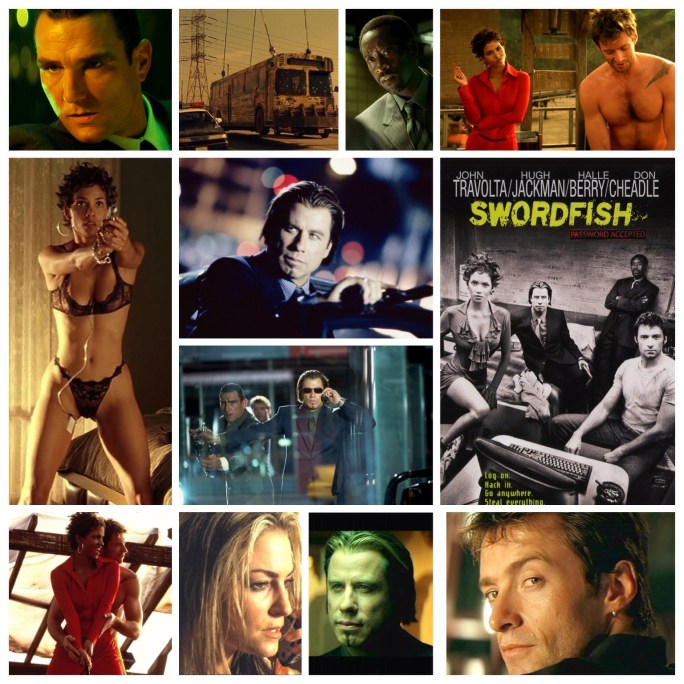
Swordfish tries so hard to be cool, and save for a few moments of smirking silliness, it is pretty goddamned cool. The early 2000’s still carried lingering, reminiscent elements of the 90’s, the super cyber hacker archetype included. The cyber hacker is played by two types of people: basement dwelling, Mountain Dew drinking chatter boxes and virile, sexy supermodels. The latter is employed here, personified by Hugh Jackman as Stanley, a sly devil who can hack into almost anything effortlessly, but has been caught and never allowed to touch a computer again. Enter Gabriel (John Travolta), a silver tongued arch villain out to steal all the money and priceless artifacts he can hope to ever own. Although Travolta isn’t as truly off the rails as in some of his villain roles, the amiable charm he puts forth here is but a ruse to cloud the monster beneath. He’s a very bad man, putting Stanley’s loved ones in jeopardy and forcing him to work computer wizardry for ill gotten riches. Gabriel has a girlfriend named Ginger (Halle Berry, never sexier) who walks a moral tightrope between the two alpha males, torn between roguish indifference and and her conscience. Stanley is also hounded by an FBI Agent (Don Cheadle), with whom he has a tumultuous past. The film resists goin completely by the motions, lulling you just to the border of entropy and then throwing something surprising from a direction you didn’t look in. My favourite scene of the film shows Travolta giving a monologue on bank robbery etiquette, complete with a reference to Sydney Lumet’s Dog Day Afternoon, confirming the fact that this flick has a strong script to go with its pyrotechnics. He flexes his sonic directorial muscles in an especially extraordinary action sequence involving a bus and a helicopter that will seriously make your finger hover over the replay button. Vinnie Jones is an ambassador of cool, in a lively turn as Gabriel’s head thug. Sam Shepherd has fun as a corrupt Senator. There’s also fine work from Zachary Grenier, Tim Dekay, William Mapother, Rudolph Martin and Drea De Matteo. Director Dominic Sena comes from music video land, having also helmed the priceless Nic Cage Bruckheimer-fest Gone in 60 Seconds, as well as the fallout brilliant psycho road thriller Kalifornia. Here he doses the flash and sizzle of 60 seconds with the hard hitting violence of Kalifornia, presented in a story guaranteed to raise a pulse. It’s also got pretty much the coolest poster of 2001. I dare you to find a cooler one, go ahead. Oh, and Travolta’s manscaping here deserves its own spinoff film.