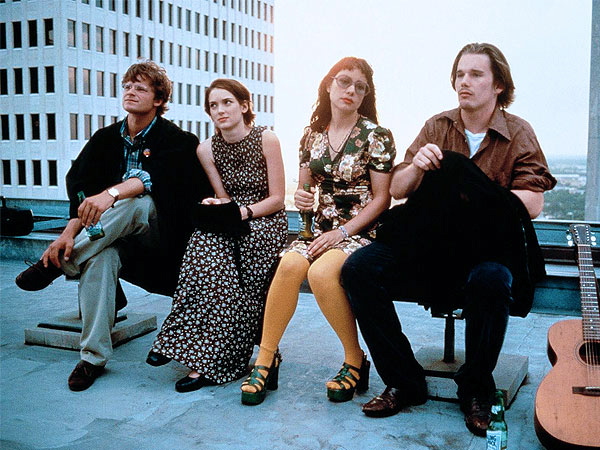
The early to mid-1990s was a period of time when popular culture was dominated by Generation X, from films like Richard Linklater’s Slacker (1990) to Douglas Copeland’s book, Generation X to the massive popularity of Seattle music spearheaded by Nirvana. During this decade three films were made that provided a fascinating spectrum of how this generation was depicted. On one end, there was Linklater’s low-budget independent film. On the opposite end there was the glossy, studio picture Reality Bites (1993). Somewhere in between was Singles (1992), which shared the big studio backing of Reality Bites but with the authenticity of Slacker.
I can remember when I first saw Reality Bites, I hated it. I had recently seen and was blown away by Slacker, which felt so authentic. In comparison, Reality Bites tried in vain to capture the essence of Gen-X, but came across more like an episode of Friends. Slacker presented everyday settings with realistic, albeit eccentric people, warts and all, while Reality Bites introduced perfect looking people with perfect problems. Now that some time has passed and the whole Gen-X thing has died down, I see Reality Bites in a different light now. When I think of the film, I think of the videos for “Stay” by Lisa Loeb and “Spin the Bottle” by Juliana Hatfield – the two big singles to come off the soundtrack album. Back in the day, it seemed like those two songs were everywhere. The film is still lightweight material but it has a more nostalgic vibe now as a dated piece of mainstream ‘90s culture. It’s a pretty decent snapshot of that time and reminds me a lot of what I liked about the decade.
Reality Bites also features one of my favorite performances of Winona Ryder’s entire career. She had just come off making several period piece films and was clearly looking to do something contemporary, something that spoke to her generation. She used her star power to pluck an unknown screenwriter out of obscurity and, with the help of Ethan Hawke, got the film made where it would normally have languished in development hell for years. However, Reality Bites was seen as and marketed as a Gen-X film and its supposed target audience wasn’t interested in seeing their lives and interests writ large in a mainstream commercial film. It underperformed at the box office but has since gone on to develop a sizable following. I don’t want to say cult following because it isn’t that kind of film but it does have its fans.
Reality Bites is about four college graduates dealing with life after school as they try to figure out what they want to do with the rest of their lives. Vickie (Janeane Garofalo) works as store manager at a local Gap. Sammy (Steve Zahn) is trying to figure out a way to tell his conservative mother that he’s gay. Troy (Ethan Hawke) is a struggling musician. Lelaina (Ryder) aspires to be a filmmaker and chronicles the ups and downs of her three friends for a documentary about her generation.
Lelaina, like her friends, is a child of divorce and her parents (Swoosie Kurtz and Joe Don Baker) want her to get a regular 9-to-5 job so that she can become a productive member of society. To pay the bills, she works as an assistant/gofer for a morning television talk show called Good Morning Grant! where she caters to the whims of its obnoxious host (played with two-faced gusto by John Mahoney). She’s roommates with Vickie and their friendship is summed up rather nicely in a scene where we see them singing along to Squeeze’s “Tempted” in Lelaina’s car. Who hasn’t done that with their friend(s) at some point in their lives? I don’t mean necessarily to that song but to music in general.
One day, she literally runs into Michael Grates (Ben Stiller), an executive at MTV wannabe, In Your Face TV, when they get into a minor car accident. She finds herself attracted to his inability to articulate a sentence much less a thought and he’s drawn to her nervous, awkward energy. It’s baffling what they see in each other but they’re both young and attractive and start dating. However, when Troy is fired from his day job, Vickie invites him to stay at their place (“Welcome to the maxi-pad.”) until he can find work, much to Lelaina’s chagrin (“That’s the American Dream of the ‘90s. That could take years!”). Me think she doth protest too much (“He will turn this place into a den of slack!”). See, Lelaina has a thing for Troy and he for her but they’re too busy getting on each other’s nerves in a meet-cute kinda way to do anything about it.
Lelaina’s first date with Michael has to be one of the most inarticulate ones ever put on film as they stammer their way through dinner. They each come up with some real gems to woo each other, like he tells her about how Frampton Comes Alive! changed his life while she explains why the Big Gulp is the most profound invention in her lifetime (?!). Maybe these two are really made for each other. As superficial as Lelaina comes across a lot of the time, Winona Ryder, with her adorable presence, keeps me interested and engaged. Away from Michael’s I.Q.-sucking black hole presence, Lelaina seems smarter.
When he’s not spending time pretending he can’t stand Lelaina, Troy writes awful, subpar Beck lyrics and quotes from Cool Hand Luke (1967). While he waits for her to realize that he loves her, he has sex with a succession of not-too bright groupies (one of them is a blink and you’ll miss her, Renee Zwelleger). Vickie also has a revolving door of sexual partners – so much so, that she gets an AIDS test and anxiously awaits the results – her character’s big dilemma that is resolved fairly quickly and a little too neatly.
Ben Stiller, in what was not only his first major acting gig, but also his directorial debut, does a good job of portraying a guy who means well but is so clueless when it comes to things that really matter. He isn’t afraid to come off as an idiot while also hinting that underneath it all Michael does appear to have the best intentions, he just goes about articulating them in all the wrong ways. Troy, on the other hand, is mean-spirited and channels his jealously in vindictive ways, like when he pretends to tell Lelaina that he loves her. The hurt that registers on her face, especially in her eyes, says it all, reminding one of how good a silent actress Ryder could have been if she had acted in another bygone era.
Ryder shows a capacity for comedy in a montage where Lelaina applies for a series of film and T.V.-related jobs featuring brief but amusing cameos by Andy Dick, Keith David, Anne Meara, and David Spade. Watching Ryder try to define irony under pressure always gives me a chuckle as does her interaction with Spade’s condescending burger jockey (“Ms. Pierce, there’s a reason I’ve been here six months.”). She was one of my earliest cinematic crushes and I know I shouldn’t like this film but dammit, she’s in vintage adorable Manic Pixie Dream Girl mode – smart and gorgeous with a vulnerable quality that I find irresistible. Sorry Natalie Portman, Zooey Deschanel and you other Pixie Dream Girls, Ryder is the original – accept no substitutes!
Coming from the world of stand-up comedy, Janeane Garofalo gets some of the film’s funniest lines (“I think I was conceived on an acid trip.”) and delivers them effortlessly like she was born to play Vickie. She also interacts well with Ryder and an even more interesting film would’ve been one where Vickie’s friendship with Lelaina was the focus. Obviously, others thought she had something special and for a brief while, Garofalo flirted with a mainstream film career with The Truth About Cats and Dogs (1996) and The MatchMaker (1997). Out of the four friends the one that suffers most in terms of screen time is Sammy. It often feels like his storyline was reduced so that more time could be devoted to the Michael-Lelaina-Troy love triangle. It’s a shame because Steve Zahn is such a gifted comedic actor with excellent timing and he’s given little to do in Reality Bites.
If I sound a little too harsh on Reality Bites, I don’t mean to be. The film does nail what it’s like to sit around with your friends, get high and comment ironically on old 1970s sitcoms. There is a fun bit where our four friends go out to get junk food and dance spontaneously to “My Sharona” by the Knack. It’s nice to see the normally reserved Ryder cut loose and act goofy. The film’s best scenes are the ones where all four friends are interacting with each other, bantering back and forth in a way that feels authentic and has a relaxed air that only comes from people who have known each other for some time.
In 1991, the producer of The Big Chill (1983), Michael Shamberg wanted to make a like-minded film for people in their twenties. He read Helen Childress’ Blue Bayou, a writing sample from the 23-year-old University of Southern California film school graduate. He liked it and wanted her sample to be the basis for his project. She met with him and told him about her life and friends and their struggle to find work during the recession that had hit the United States at the time. She had used her friends, their personalities and some of their experiences as the basis for her script. Shamberg, along with co-producer Stacy Sher, saw the pilot for The Ben Stiller Show and approached him to direct not act. At the time, Sher and Childress were developing the screenplay and had Lelaina and Troy figured out but couldn’t quite come up a credible character to complete the love triangle.
In February 1992, Shamberg sent Ben Stiller a copy of Childress’ script while he was editing the pilot for a show on Fox. He soon signed on to direct and worked with Childress for nine to ten months, developing her script. He suggested that he could play the third person in the love triangle. Over time, the Michael Grates character changed from a 35-year-old advertising man attempting to market Japanese candy bars in America to a twentysomething executive at a music video T.V. station. Childress and Stiller also changed the structure of the film, with the focus changing to the relationship between Lelaina and Troy while the stories about Vickie and Sammy, which were originally more fleshed out, were scaled back.
Childress and Stiller had a script that could be filmed by December 1992 and began shopping it around to various Hollywood studios all of whom turned it down because it tried to capture the Generation X market much like Singles had attempted to and failed. They finally got TriStar interested and began developing it there. The studio soon put it in turnaround. Childress, Sher and Stiller managed to convince the Film Commission of Texas to fund a location scouting trip to Houston despite no studio backing, no budget and no cast. As they arrived in the city, they got a call and learned that Winona Ryder had read Childress’ script. She wanted to do it and Universal Pictures agreed to finance the film. Coincidentally, Childress had Ryder in mind when she wrote the character of Lelaina.
The previous three films Ryder had made were period pieces and she needed a break. She wanted to do “something about people my age and in my generation growing up in today’s society.” She read Childress’ script while making The House of Spirits (1993) and it made her laugh: “It was very familiar to me – the way they talk, the attitude they have towards each other, the places they go. These were things I could relate to.” It was exactly the change of pace she wanted. At the time, Ethan Hawke’s career was in a rut after the buzz from Dead Poets Society (1989) had subsided. Up to that point, he had been known mostly for playing clean-cut characters and so the role of Troy would be something of a departure for him. Ryder was a fan of Hawke’s work and stipulated in her contract that he would co-star opposite her.
Stiller met Steve Zahn through Hawke as they were doing a play together at the time and was impressed by how funny he was. Zahn borrowed some money from his agent and went to Los Angeles to test for the film. He responded strongly to portraying a gay character coming out of the closet. Janeane Garofalo knew Stiller through their work together on his show and the producers felt that her style of comedy was perfect for the role of Vickie. According Garofalo, it came down to her, Parker Posey, Anne Heche and Gwyneth Paltrow. The studio loved and wanted Paltrow but Ryder liked Garofalo and had developed an instant connection with her.
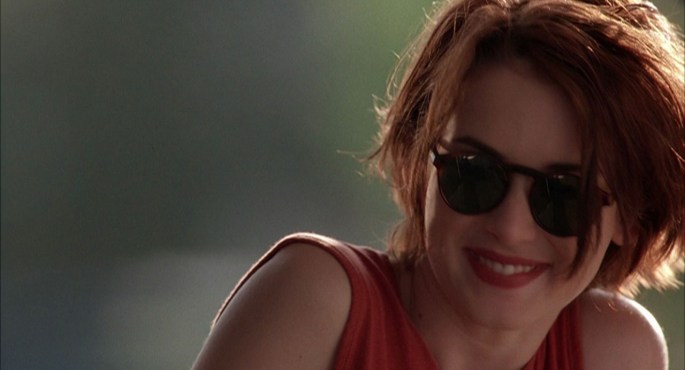 Ultimately, Reality Bites plays it too safe and veers dangerously close to being a feature-length sitcom by wrapping things up too conveniently. The characters often come across as superficial which tends to undercut the sincerity of the film’s message. Singles and the hilarious short-lived MTV sitcom, Austin Stories, were much more successful in documenting the trials and tribulations of Gen-X. And yet I’m oddly fascinated with Reality Bites, mostly because of Garofalo and Ryder. They play characters that deserve to be in a better film. I always thought that at the end of the film, Lelaina should’ve dumped both guys and stayed single. I mean, look at her options: Michael is a clueless T.V. executive that listens to generic gangsta rap and Troy is a pretentious wannabe musician that screws around with her emotions. Hell, she should’ve hooked up with Vickie, who is funny in wonderfully sarcastic way and digs ‘70s popular culture in a sincerely ironic way. Despite all of its flaws, I still enjoy watching Reality Bites when I just want to turn off my brain and let a film wash over me – junk food for the mind. Films like that have their place, too.
 Few people saw Before Sunrise when it was released in 1995 but those who did really loved it. In its own subtle and unassuming way, Richard Linklater’s film flew in the face of most romantic films at the time. It refused to be dated by obvious, trendy popular culture references and music. It featured an honest dialogue between two twentysomethings who meet by chance on a train and decide to get off together in Vienna. Before Sunrise would also mark an interesting change of pace for Linklater. With Slacker (1990) and Dazed and Confused (1993), he had worked with rather sizable ensemble casts, but with this film it was essentially two characters and the occasional people they encounter.
 Podcasting Them Softly