When I saw the marketing and trailer hype for Robert Zemeckis’s Flight, I was strongly under the impression that when I got around to seeing it I’d get a conspiracy style thriller. Some aviation intrigue, maybe a little government corruption, valiantly unveiled by Denzel Washington’s hotshot pilot protagonist. How very wrong I was. To my credit, it wasn’t my fault, but that of the severely misleading marketing. But then, how do you market a film like this? Hell, it’s a wonder it even made it past the pitching stage! The airplane related fiasco one sees in the previews is but a tiny segment that acts as at catalyst for one of the most searing and honest portraits of addiction I’ve ever seen. Washington is Whip Whittaker, senior pilot, ladies man, assured professional and severe drug and alcohol user. Whip snorts and guzzles day and night, including during the job. He’s functional and hides it well, but thats just another facet of his problem. When an onboard malfunction causes crisis on one of his flights, he takes a giant leap of faith, spectacularly landing the airplane upside down and essentially saving every passenger’s life. End of story? Not really. From there the film throws a curveball, as we dig deeper into Whip’s life, habits and history. An inquiry is launched into his mental state during the event, led by a stern and silky voiced Melissa Leo. His superiors do everything to defend him, but it becomes clear that he has been coming apart at the seams for sometime now, and the incident was one of the final rips. It’s a journey into one man’s refusal to admit his problems, and the often extreme ways in which life holds up a mirror in front of us and demands acceptance. Kelly Reilly is superb as a damaged girl he meets who tries to take his hand and lead down the way to fixing what is broken, but he’s pretty damn far off the path. John Goodman is his charismatic self as Whip’s groovy drug dealer, and Bruce Greenwood reliably steals scenes as an airline official determind to defend Whip to the bitter end. Washington is heartbreaking, especially in the scenes of alcohol abuse, which are tough to watch. He’s never had a character arc quite like this, and it’s one of the most special, vital gifts of acting he has ever given us. The look, feel and tone of the film is anything but gritty or depressing. It has a glossy, aesthetic sheen to it that barely hints at the commotion and strife which befalls it’s lead character. Perhaps this was Zemeckis’s intention: dazzle us out of the gate with crisp frames and bright cinematography and then blindside us with the darker elements, showing us in the process that such issues can befall any one of us in society, no matter how outwardly successful, confident or in control we seem. The film is as complex as it’s protagonist and begs the audience to empathize with him on his journey, despite the glaring shortcomings we observe. It’s one of the most human stories I’ve ever seen; two hours spent with a realistic person who is assured, broken, confused, scared, stubborn, strong willed, weak and deeply wounded all at the same time. Washington paints the picture for us momentously, and it’s the best work he’s ever done. You don’t get too many films like this released by the studio system, and this one is some kind of miracle.
Tag: film review
THE LORD OF THE RINGS: THE FELLOWSHIP OF THE RING – A REVIEW BY J.D. LAFRANCE

It was the film many thought would never happen and that languished in development hell for years, bouncing from studio to studio until New Line Cinema took a very big gamble with filmmaker Peter Jackson who, at that point in his career, was known for making slapsticky low budget horror films (Braindead) and had one art house hit (Heavenly Creatures). He wasn’t someone you would necessarily entrust millions upon millions of dollars on making a trilogy of fantasy films – not the most commercially successful genre (Willow, anyone?). Jackson was also tackling The Lord of the Rings, the much-beloved series of books by J.R.R. Tolkien – get it wrong and you’re going to have legions of very unhappy fans.
However, Jackson was a fan too and he had a vision, which, with the help of his co-screenwriters Fran Walsh and Philippa Boyens, and an army of collaborators, brought The Lord of the Rings vividly to life. The first film, The Fellowship of the Ring (2001), was a massive critical and commercial success and would be followed by two even more successful sequels, The Two Towers (2002) and The Return of the King (2003). Everyone has their favorite film of the trilogy and for me it’s the first one because it has an intimate feel rendered on an epic scale, if that makes any sense. In other words, The Fellowship of the Ring is about a small group of characters, the Fellowship, and the journey they undertake.
Jackson establishes this intimacy early on with Bilbo Baggins’ (Ian Holm) birthday celebration. The Special Extended Edition version takes its time introducing the hobbits and their world. Jackson uses warm, inviting colors and folksy music to convey that the hobbits are a friendly, down-to-earth people who live in a tight-knit community where everyone knows each other. Most importantly, we are introduced to Frodo (Elijah Wood), the hero of this epic tale. For it is he who Bilbo entrusts with the last remaining Ring that he must to take Mordor to destroy so that it doesn’t fall into the hands of the evil Sauron.
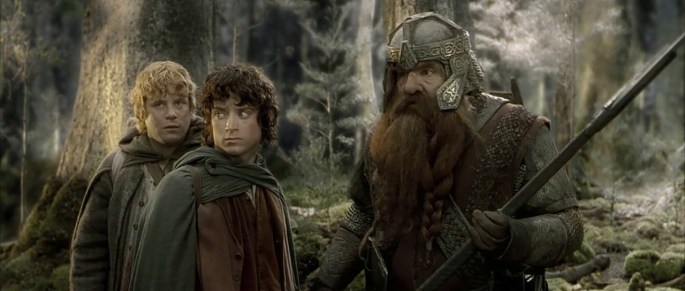
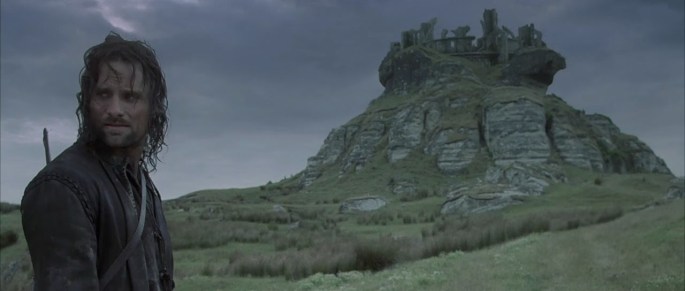
The Shire sequences also establish the dangerously seductive lure of the Ring, the origins of the quest and the creation of the Fellowship as led by the mighty wizard Gandalf the Grey (Ian McKellen). Aside from Frodo, fellow hobbits Sam (Sean Astin), Merry (Dominic Monaghan) and Pippin (Billy Boyd) join him on his journey. The group starts simply enough and over the course of the film others join their ranks, including Aragorn (Viggo Mortensen), a human ranger, Legolas (Orlando Bloom), an elvan archer, Gimli (John Rhys-Davies), a grumpy dwarf, and Boromir (Sean Bean), a human fighter. At heart of the Fellowship (and really all three films) is the friendship between Frodo and Sam. It is Sam who looks out for Frodo and sticks with him for the entire quest.
There are all kinds of parallels, story structure-wise, between The Fellowship of the Ring and Star Wars: A New Hope (1977). The Tolkien books were an obvious influence on George Lucas’ films. The main characters from both films are plucked from obscurity, a remote rural environment to go on a dangerous quest and are mentored by an elderly wizard type. Hell, Han Solo and Aragorn are characters cut from the same cloth and are both given cool introductions to establish their respective badass credentials.
Jackson manages to get some career-best performances out of many cast members. Elijah Wood, Sean Astin and Orlando Bloom, in particular, have never done anything better since (or before for that matter, except maybe for Wood and his chilling turn in Sin City) and this film launched a series of very eclectic leading man roles for the always watchable Viggo Mortensen (it doesn’t get more diverse than disparate roles in Hidalgo and Eastern Promises). Both Ian McKellen and Christopher Lee give the film some serious class and loads of genre credibility. It is Wood and Astin that anchor this film and give it its heart. The relationship between their two characters epitomizes most noble aspects of friendship and of the Fellowship. This only deepens in subsequent installments.
Once our heroes begin their journey, Jackson establishes a riveting urgency as they are pursued by the nightmarish ringwraiths and a vicious army of orcs. And yet this only strengthens the camaraderie among the hobbits and the rest of the Fellowship despite its dysfunction in the form of Boromir. However, when it matters and when faced with dangerous opponents, they work as a team as evident in the exciting and visceral battle against a monster in Balin’s Tomb and the even grittier battle against the orcs at the film’s climax.
Contrary to popular belief, Peter Jackson did not have a lifelong ambition to adapt Tolkien’s books into films. Producer Saul Zaentz owned the film rights for years and gave them to Jackson when he and Fran Walsh met with him and expressed their passion for the project. Zaentz sold the rights to Miramax who wanted to make only one film with Jackson. Disney was the financial backer but they didn’t believe in the project, refusing to give Miramax the money to make it. Harvey Weinstein, head of Miramax, gave Jackson three weeks to find someone else to make the film and in 1998, New Line agreed to make it into three films. Jackson originally proposed two films but it was New Line’s idea to make three.
In order to cut down on costs, Jackson decided to film all three films back-to-back over a grueling 274-day shooting schedule on location in remote areas of New Zealand in more than 100 locations with 20 major speaking roles and 20,000 extras. At the height or production, the film crew swelled to 1,300 people with seven units shooting multiple elements simultaneously. Jackson and company were at the mercy of New Zealand’s notoriously mercurial weather – unseasonal snowstorms and overnight flooding but in the end, the filmmakers accomplished what they set out to do and the proof is in the impressive final results.
The Fellowship of the Ring is one of those rare films that lives up to its mountains of hype. Jackson tells an engaging story and crams as much of the source material as possible into the film. Sure, certain characters and subplots have been cut-out but that is the nature of a feature film adaptation. Maybe, someday, someone can turn it into a mini-series so that everything can be included. Until then, we have Jackson’s magnificent films to enjoy.
The Art Of The Steal: A Review by Nate Hill
Heist flicks are sneaky affairs, but that doesn’t mean that awesome ones like The Art Of The Steal should just tiptoe past everyone’s radar with no hubbub. When subpar stuff like Now You See Me is breaking waves and this one collects dust before a year since it’s release, you know somethin ain’t right. It’s actually probably just budgeting and marketing, to chalk it up simply. Despite the cast (what a lineup) this one barely made a blip on the sonar when it came out a couple years ago. It’s great fun, with a crusty lead performance from Kurt Russell as Crunch Calhoun, an ageing motorcycle daredevil who used to moonlight as an art thief. He is lured out of ‘retirement’ by his sleazy brother Nicky (Matt Dillon crosses off another notch on the old scumbag belt with this role) with the proposition of one last score, involving his old crew and the theft of a historical artifact owned by a hilarious Terence Stamp. Other members of their crew include a crafty Jay Baruchel and Kenneth Welsh as salty ladies man Uncle Paddy. Twists and turns lace the plot, as they should in these types of films, but it’s the bawdy sense of humour that won me over. More than anything else this is a comedy, situational in nature and willing to give each weirdo of the bunch their own demented moment to shine. It’s Russel’s show though, a burnt out Evel Knievel type of dude who gets a face full of nonsense from his brother, edging him to the end of his rope. Russell owns it, egged on by the raucous chorus of characters accompanying him, and the nasty arc from Dillon that is the only piece which subverts the mostly lighthearted tone. Fun, little seen stuff that deserves a wider audience.
Devil In a Blue Dress: A Review by Nate Hill
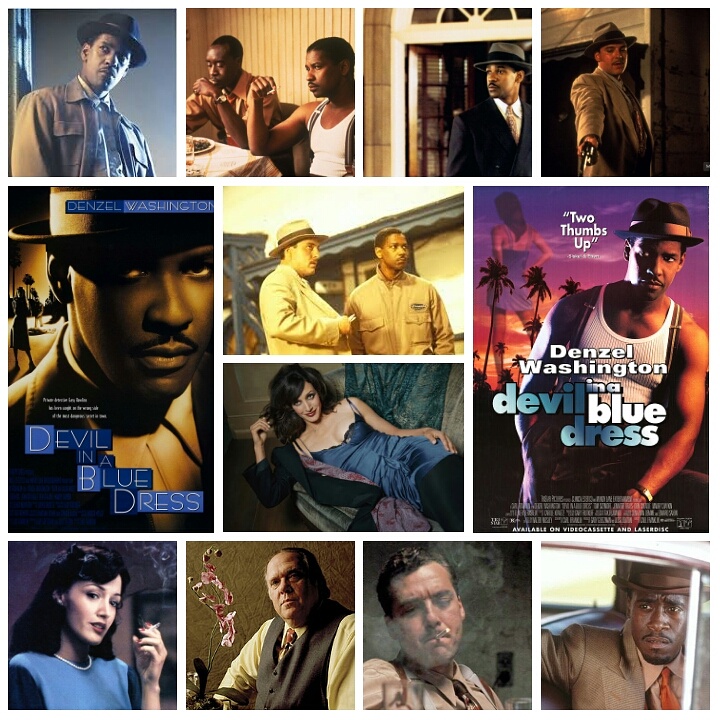
Devil In A Blue Dress takes the classic Raymond Chandler mystery form and uproots it just a smidge, setting it in the African American community of 1948 Los Angeles, with terrific results. Noir takes on a double meaning (naughty pun) as WWII vet turned private eye Ezekial “Easy” Rawlins (Denzel Washington) finds himself mired in the quick sands of corruption, coersion and murder most foul after taking on a job that’s led him straight to the dirtiest little secret in town. After he accepts a missing persons inquiry from mysterious DeWitt Allbright (Tom Sizemore, first shady and then downright scary when we see what he’s really about), he finds himself searching for a girl named Daphne (Jennifer Beals) a runaway with ties to a very powerful politician (Maury Chaykin makes your skin creep and crawl) with some seriously disturbing extra curricular activities. Rawlins recognizes danger when he sees it and tries to back out, but by then he knows too much and it’s way late in the game. Now he must navigate the scene like the pro he to escape not only with answers, but perhaps his life. Washington gives him the underdog treatment, a worn out gumshoe who still has some grit left, enough for one last ride in any case. There’s an L.A. Confidential type feel to the plot in the sense that it ducks some conventions in order to service true surprise from its audience. Sizemore is a charming viper as the kind of dude you never want to trust (isn’t he just the best at playing that?) and Beals subverts the damsel in distress archetype by injecting her performance with a jolt of poison. In terms of L.A. noir this baby is fairly overlooked, but holds its own to this day. Watch for Don Cheadle as well.
Safe House: A Review by Nate Hill
Safe House is cut from the same cloth as many a spy movie, but this horse doesn’t have quite as much piss and vinegar as other ones in the stable, notably the Bourne trilogy. It’s more of a slow burn, peppered with a few purposeful action sequences and quite a lot of time spent with Denzel Washington’s world weary spook Tobin Frost, a veteran operative who has gone severely rogue after escaping the grasp of a nasty CIA interrogator (Robert Patrick). He’s soon in the hands of rookie agent Matt Weston (Ryan Reynolds) who has been left to guard an agency safe house in Europe, now overrun with shadowy special ops dudes out to snuff Frost. The two of them are forced on the run together, and attempt to smoke out those behind the chaos, who turn out to be a little closer to home than they thought (don’t they always, in these types of movies?). Weston is young, naive and idealistic, Frost is bitter, jaded and ready to burn the agency down around him for what his career has made him do. They’re a formulaic pair made believable by the two actors, both putting in admirable work. Brendan Gleeson is great as Westons’s dodgy handler, Vera Farmiga shows moral conflict in those perfect blue eyes as another paper pusher in Langley, and Sam Shepherd smarms it up as the CIA top dog. It was nice to see Ruben Blades as well, who doesn’t work nearly enough, and watch for a sly cameo from Liam Cunningham as an ex MI6 agent. It’s not the greatest or the most memorable film, but it does the trick well enough, has a satisfying R rated edge to its violence and benefits from Washington being nice and rough around the edges. There’s a downbeat quality to it to, as Weston watches the futility inherent in the life of a spy unfold in Frost’s actions, which are leading nowhere but a self inflicted dead for a cause that’s bigger than both of them, but ultimately leaves them in the dust. Solid, if just above average stuff.
Slow West: A Review by Nate Hill
Slow West clocks in briskly under 90 minutes, which is usually unheard of for a western. You can stamp out any thoughts of it being rushed or too slight of a flick though, because it’s exactly what it needs to be every step of the way. It’s a beautifully scored, tightly plotted and boldly characterized (the key ingredient in the genre, if you ask me) mix that saunters along like a mule of the plains, before kicking up the dust for a bloody, atmospheric finale that leaves you stunned and breathing hard. Westerns are often ambitious, lofty affairs and can get quite moody and too densely packed for their own good. Not this baby. It breezes by like a summer wind, with just enough violence, character development and aching catharsis to billow out its chipper narrative during the brief stay we are treated to. Kodi Smit McPhee plays a young Scottish lad who is a tad out of his depths in the American west, searching for a girl (Caren Pistorius) who had to flee the country with her father (The Hound himself, Rory McCann). McPhee is naive to the dangers of this new territory, and nearly finds himself at the receiving end of a bullet before being saved by a roaming outlaw (Michael Fassbender) who takes him under his wing with much gruff and huff along the way. Reluctance is doled out along with sympathy on Fassbender’s part as he shields the boy from a dangerous bounty hunter and former employer of his, played by a wonderfully greasy Ben Mendelsohn, perpetually shrouded in acrid cigar smoke and snuggled up in one epic and fabulous fur pelt. These three wayward misfits gravitate towards the obligatory final shoot out, which takes place in the girl’s hideaway house on the picturesque pretty plains. Impressive is an understatement for this sequence: yellow grass sways, a hailstorm of bullets punctuate the horizon and the mournful tones of Jed Kurzel’s lonely score, grim fates are earned in a gorgeous set piece that resembles something like Wes Anderson making an Oater. Everything before and winds up to this sequence, and the payoff is superb. If I’ve made it sound dark or off putting, think again. It’s all crafted with the utmost light and poetic buoyancy, a lilting sadness to the violence that hits home but never batters you. The performances echo this as well, Fassbender a world weary, affable and altogether dangerous man, Mendelsohn slithering about with a dry silver tongue and an itchy trigger finger, and a fish out of water McPhee stuck in between. The visual palette is quite something to see, accented by the music perfectly. I’m beyond anxious to see what first time director John Maclean comes up with for us for his next ride, for he’s knocked it out of the ranch with this one. Ho for the West.
Virtuosity: A Review by Nate Hill
Nothing says the 90’s like Virtuosity, a big hunk of circuit board sleaze and cheese that is so of it’s time that it’s hard to watch it these days without believing it to be some kind of spoof. Re-reading that sentence it sounds like I was making some kind of underhanded compliment, which I suppose is a better outcome for a film to arrive at than some. It could have gotten stale or dated in a bad way. Well it’s definitely not stale (it is dated though), in fact it’s one of the liveliest flicks from back then, thanks mostly to a ballistic characterization from Russell Crowe. Crowe is Sid.6, a virtual reality program molded from the personalities of several different serial killers and designed to basically wreak havoc. This is exactly what happens when he escapes, or rather is let out by one of the maniacs at the research centre (Stephen Spinella). Sid is now flesh, blood and roughly 200 pounds of extremely skilled, remorseless killing material, running wild in the unsuspecting streets. The head of the Institute (William Forsythe) has the brilliant idea to recruit ex-cop whack job Parker Barnes (Denzel Washington) to hunt Sid down and destroy him. Barnes has a bleak history with artificial intelligence, one that has left him with a cybernetic replacement arm and a huge chip on his shoulder. This is one mean, mean spirited film, as we are subjected to a manic Crowe as tortures, murders and maims innocent civilians with a grinning cavalier cadence the Joker would applaud. He’s off his nut here, something which clumsy bruiser Crowe rarely gets to do, so it’s a rare and extreme outing for him. Washington is perpetually angry, ill adjusted and violent here, and the lengths he goes to destroy Sid are almost as bad as his quarry’s homicidal antics. The cast is stacked with genre favourites, so watch for Costas Mandylor, Kevin J. O’Connor, Louise Fletcher, Kelly Lynch, Traci Lords and a weaselly William Fichtner. The special effects… well what can I say, this was the 90’s and they look like a computer game that’s been drenched in battery acid, then souped up with caffeine. There’s brief homages to video games in fact, and the opener where Crowe is still inside the program is fairly creative. I don’t know if the creators of the film were trying to say something about the dangers of virtual reality, but whatever it was, it’s sort of lost in a hurricane of unpleasent shenanigans that are admittedly entertaining. One thing that’s evident is that anyone who makes a computer program with the persona of one, let alone a handful of murderers is just begging for an incident. I suppose that’s the point here though, the catalyst for the whole deal. Crowe and Washington are great though, both down and dirtier than their characters in the next royal rumble they’d share, Ridley Scott’s American Gangster. Fun stuff, if you have a strong gag reflex and don’t take yourself too seriously.
Donnie Darko: A Review by Nate Hill
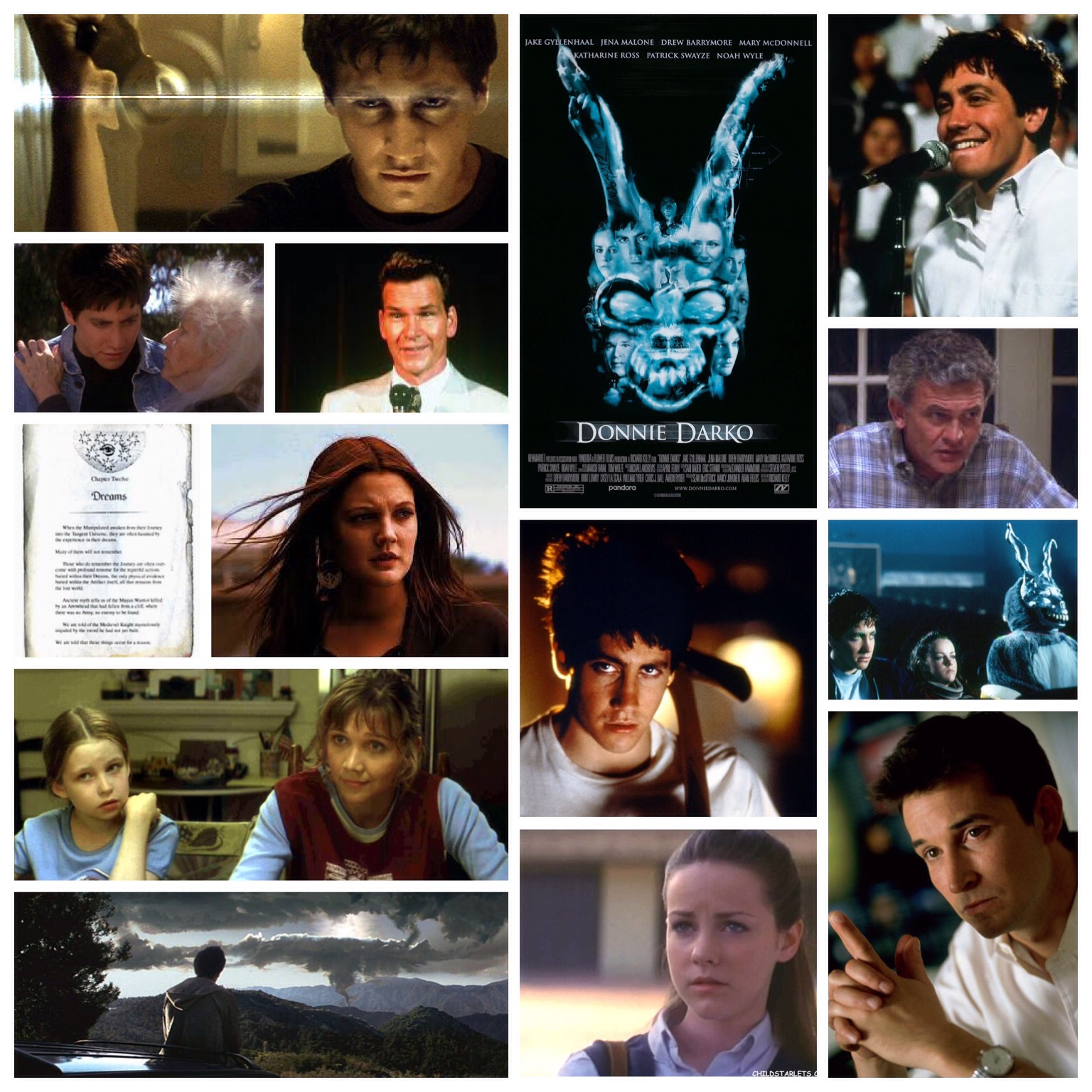
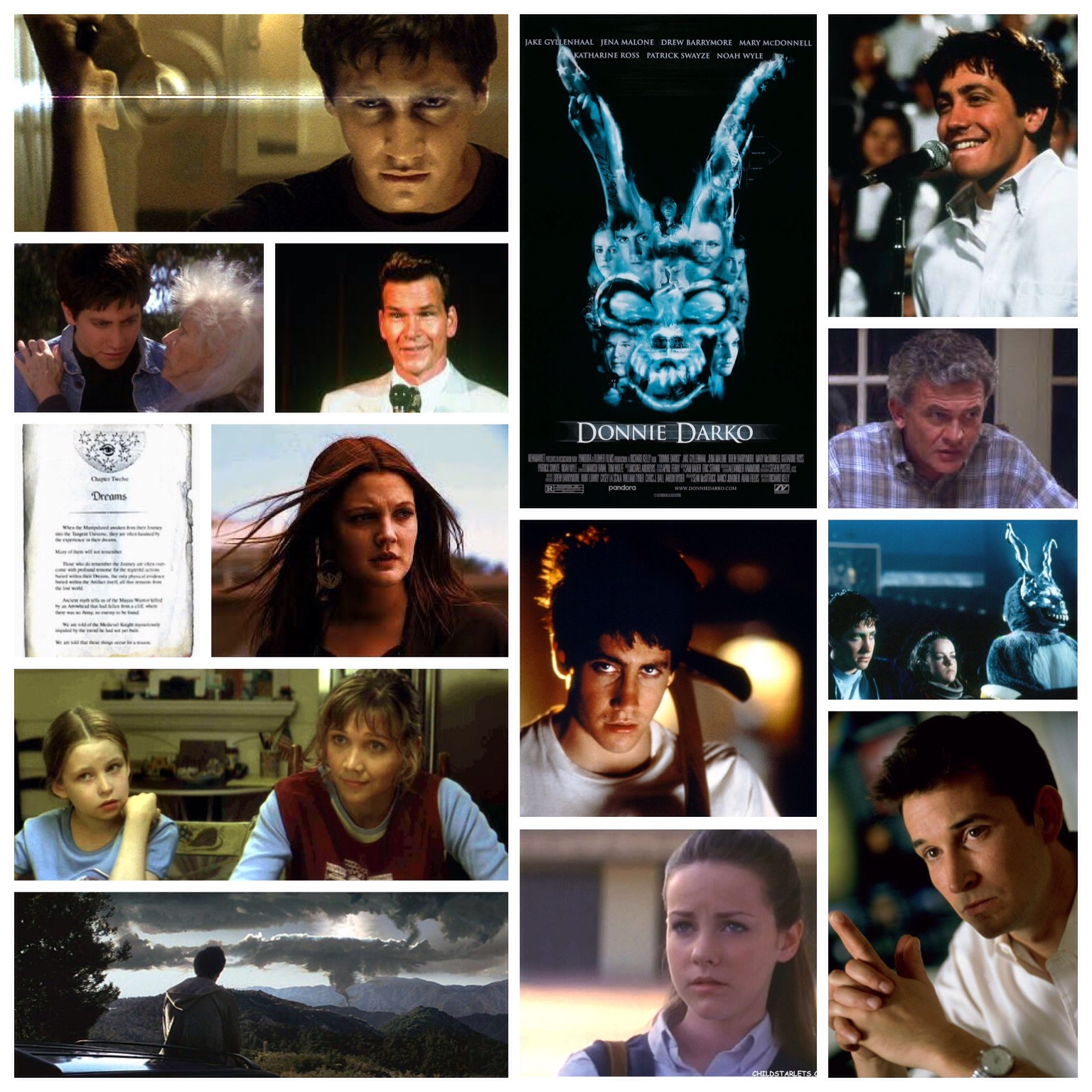
The director’s cut of Richard Kelly’s Donnie Darko is one of the most profound experiences I’ve ever had watching a film. It transports you to its many layered dimension with unforced ease and tells it’s story in chapters that feel both fluid and episodic in the same stroke. It has such unattainable truths to say with its story, events that feel simultaneously impossible to grasp yet seem to make sense intangibly, like the logic one finds within a dream. These qualities are probably what lead to such polarized, controversial reactions from the masses, and eventual yearning to dissect the hidden meaning which at the time of its release, didn’t yet have the blessing of the extended cut and it’s many changes. A whole lot of people hate this movie, and just as many are in love with it as I am. I think the hate is just frustration that has boiled over and caused those without the capacity for abstract thought to jump ship on the beautiful nightmare this one soaks you in. Movies that explore the mind, the unexplainable, and the unknowable are my bread and butter, with this one taking one of the premier spots in my heart. Kelly has spun dark magic here, which he has never been able to fully recreate elsewhere (The Box is haunting, if ultimately a dud, but his cacophonic mess Southland Tales really failed to resonate with me in the slightest). Jake Gyllenhaal shines in one of his earliest roles as Donnie, a severely disturbed young man suffering through adolescence in the 1980’s, which is bad enough on its own. He’s also got some dark metaphysical forces on his back. Or does he? Donnie has visions of an eerie humanoid rabbit named Frank (James Duval) who gives him self destructive commands and makes prophetic statements about the end of the world. His home life should be idyllic, if it weren’t for the black sheep he represents in their midst, displaying behaviour outside their comprehension. Holmes Osborne subtly walks away with every scene he’s in as his father, a blueprint of everyone’s dream dad right down to a sense of humour that shows he hasn’t himself lost his innocence. Mary McDonnell alternates between stern and sympathetic as his mother, and he has two sisters: smart ass Maggie Gyllenhaal (art imitating life!) and precocious young Daveigh Chase (also Lilo and Samara from The Ring, funnily enough). The film also shows us what a showstopper high school must have been in the 80’s, with a script so funny it stings, and attention paid to each character until we realize that none are under written, and each on feels like a fully rounded human being, despite showing signs of cliche. Drew Barrymore stirs things up as an unconventional English teacher, Beth Grant is the classic old school prude who is touting the teachings of a slick local motivational speaker (Patrick Swayze). The plot is a vague string of pearls held together by tone and atmosphere, as well as Donnie’s fractured psyche. Is he insane? Are there actually otherworldly forces at work? Probably both. It’s partly left up to the viewer to discern, but does have a concrete ending which suggests… well, a lot of things, most of which are too complex to go into here. Any understanding of the physics on display here starts with a willingness to surrender your emotions and subconscious to the auditory, visual blanket of disorientation that’s thrown over you. Just like for Donnie, sometimes our answers lies just outside what is taught and perceived, in a realm that has jumped the track and exists independently of reality and in a period of time wrapped in itself, like a snake eating it’s own tail. Sound like epic implications? They are, but for the fact that they’re rooted in several characters who live in a small and isolated community, contrasting macro with micro in ways that would give David Lynch goosebumps. None of this malarkey would feel complete without a little romanticism, especially when the protagonist is in high school. Jena Malone is his star crossed lover in an arc that finds them spending little time together, yet forming a bond that that feels transcendant. Soundtrack too must be noted, from an effective opener set to INXS’s Never Tear Us Apart to the single most affecting use of Gary Jules’s Mad World I’ve ever heard. It’s important that you see the director’s cut though, wherein you can find the most complete and well paced version of the story. There’s nothing quite like Donnie Darko, to the point where even I feel like my lengthy review is stuff and nonsense, and you just have to watch the thing and see to truly experience it.
Donnie Darko: A Review by Nate Hill
The director’s cut of Richard Kelly’s Donnie Darko is one of the most profound experiences I’ve ever had watching a film. It transports you to its many layered dimension with unforced ease and tells it’s story in chapters that feel both fluid and episodic in the same stroke. It has such unattainable truths to say with its story, events that feel simultaneously impossible to grasp yet seem to make sense intangibly, like the logic one finds within a dream. These qualities are probably what lead to such polarized, controversial reactions from the masses, and eventual yearning to dissect the hidden meaning which at the time of its release, didn’t yet have the blessing of the extended cut and it’s many changes. A whole lot of people hate this movie, and just as many are in love with it as I am. I think the hate is just frustration that has boiled over and caused those without the capacity for abstract thought to jump ship on the beautiful nightmare this one soaks you in. Movies that explore the mind, the unexplainable, and the unknowable are my bread and butter, with this one taking one of the premier spots in my heart. Kelly has spun dark magic here, which he has never been able to fully recreate elsewhere (The Box is haunting, if ultimately a dud, but his cacophonic mess Southland Tales really failed to resonate with me in the slightest). Jake Gyllenhaal shines in one of his earliest roles as Donnie, a severely disturbed young man suffering through adolescence in the 1980’s, which is bad enough on its own. He’s also got some dark metaphysical forces on his back. Or does he? Donnie has visions of an eerie humanoid rabbit named Frank (James Duval) who gives him self destructive commands and makes prophetic statements about the end of the world. His home life should be idyllic, if it weren’t for the black sheep he represents in their midst, displaying behaviour outside their comprehension. Holmes Osborne subtly walks away with every scene he’s in as his father, a blueprint of everyone’s dream dad right down to a sense of humour that shows he hasn’t himself lost his innocence. Mary McDonnell alternates between stern and sympathetic as his mother, and he has two sisters: smart ass Maggie Gyllenhaal (art imitating life!) and precocious young Daveigh Chase (also Lilo and Samara from The Ring, funnily enough). The film also shows us what a showstopper high school must have been in the 80’s, with a script so funny it stings, and attention paid to each character until we realize that none are under written, and each on feels like a fully rounded human being, despite showing signs of cliche. Drew Barrymore stirs things up as an unconventional English teacher, Beth Grant is the classic old school prude who is touting the teachings of a slick local motivational speaker (Patrick Swayze). The plot is a vague string of pearls held together by tone and atmosphere, as well as Donnie’s fractured psyche. Is he insane? Are there actually otherworldly forces at work? Probably both. It’s partly left up to the viewer to discern, but does have a concrete ending which suggests… well, a lot of things, most of which are too complex to go into here. Any understanding of the physics on display here starts with a willingness to surrender your emotions and subconscious to the auditory, visual blanket of disorientation that’s thrown over you. Just like for Donnie, sometimes our answers lies just outside what is taught and perceived, in a realm that has jumped the track and exists independently of reality and in a period of time wrapped in itself, like a snake eating it’s own tail. Sound like epic implications? They are, but for the fact that they’re rooted in several characters who live in a small and isolated community, contrasting macro with micro in ways that would give David Lynch goosebumps. None of this malarkey would feel complete without a little romanticism, especially when the protagonist is in high school. Jena Malone is his star crossed lover in an arc that finds them spending little time together, yet forming a bond that that feels transcendant. Soundtrack too must be noted, from an effective opener set to INXS’s Never Tear Us Apart to the single most affecting use of Gary Jules’s Mad World I’ve ever heard. It’s important that you see the director’s cut though, wherein you can find the most complete and well paced version of the story. There’s nothing quite like Donnie Darko, to the point where even I feel like my lengthy review is stuff and nonsense, and you just have to watch the thing and see to truly experience it.
ADVENTURELAND – A REVIEW BY J.D. LAFRANCE

Summer jobs are usually the bane of a young person’s existence. They are what you slog through so that you can afford to go to school. They are the drudgery you endure while daydreaming of going to the beach, hanging out with your friends or going to see your favorite band – in other words, pretty much anything else but work. Summer jobs are a necessary evil and no one understands that better than filmmaker Greg Mottola who has masterfully encapsulated these feelings in Adventureland (2009), his follow-up to the popular hit Superbad (2007).
The film opens to the strains of “Bastards of Young” by The Replacements and right away you know you’re in good hands. The year is 1987 and James Brennan (Jesse Eisenberg) has just graduated from college. He is planning to go to Europe for the summer with his buddies; however, his folks can no longer afford to help him pay for it or for grad school at Columbia University in the fall where he hopes to study journalism. James makes some calls, does some legwork and realizes that, with his academic background and a resume with a severe lack of work experience, he’s not qualified for manual labor.
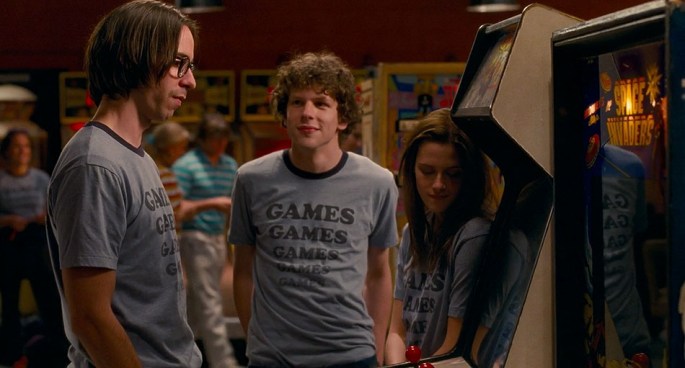
Faced with no other options, James decides to apply at Adventureland, a local amusement park. Much to his surprise, he’s hired right on the spot and put in charge of various games booths. He’s shown how everything works by Joel (Martin Starr), a terminally bored co-worker who’s clearly done this song and dance routine way too many times, telling James at one point, “So, your life must be utter shit or you wouldn’t be here.” While working at the theme park James meets Em (Kristen Stewart), an attractive co-worker with excellent taste in music, and whom he develops a crush on. He also befriends Connell (Ryan Reynolds), the park’s maintenance man, and who is in a local band in his spare time, claiming to have once jammed with Lou Reed. James spends the summer hanging out with Em and his fellow co-workers and learns that if he wants to be a good writer he needs to have some life experiences under his belt.
Adventureland accurately portrays the thankless slog of a minimum wage job (“We are doing the work of pathetic lazy morons,” Joel deadpans) with repetitive tasks, annoying customers, and crap pay. The only thing that makes it remotely bearable is the people James works with – after all, misery loves company. Mottola includes all sorts of nice touches, like the cheesy Foreigner cover band that plays at the local bar, or the mixed tape of music that James makes for Em, which gives the film a more personal feel. This is helped considerably by a great soundtrack that features the likes of Big Star, Crowded House, Husker Du, and The Jesus and Mary Chain – bands responsible for some of the best alternative music of the 1980s. Like the way music was used in Richard Linklater’s Dazed and Confused (1993), the music in Adventureland transports you back to another time and immerses you in it.
Jesse Eisenberg and Kristen Stewart have excellent chemistry together and do a good job of playing two young people that want different things out of a relationship. She has her own issues and they keep James always slightly at arm’s length. One hopes that despite the success of the Twilight films, Stewart will continue to make small, more personal films like Adventureland. Eisenberg nails the awkwardness of someone who’s had very few life experiences, especially in the romance and relationship department.
Mottola does a good job of portraying the brief flings that happen over the course of a summer. They are intense while they last even though they rarely do. He also accurately depicts how messy they can be, especially when you’re at that awkward age – your twenties – and are still trying to figure things out. Adventureland has an authenticity in how it feels to be in your twenties and to fall in love for the first time, stumbling through things, learning as you go. Whereas Mottola was basically a hired gun on Superbad, Adventureland comes from a very personal place and has much more heart while still being very funny and entertaining.