Paul Verhoeven’s Robocop: A Review by Nate Hill 

  
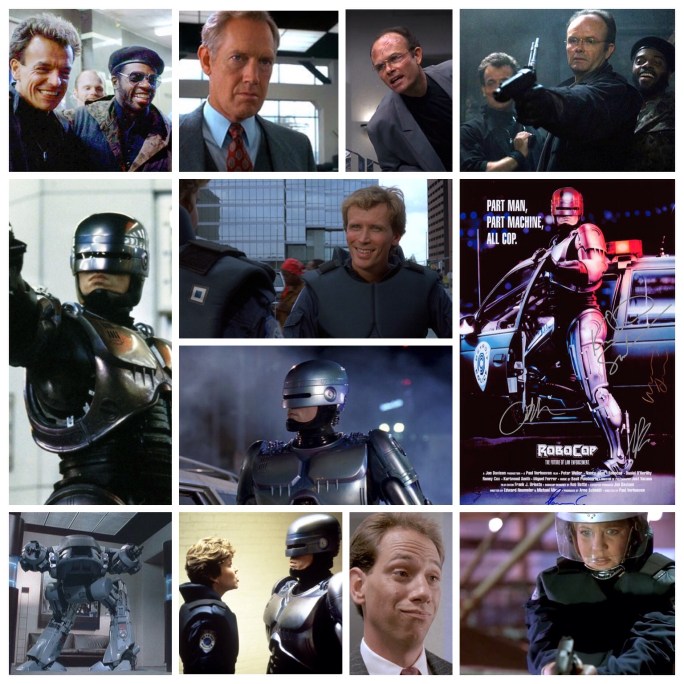
“Bitches, leave!!” I direct that sentiment towards anyone out there who thinks the remake of Robocop can hold a candle to Paul Verhoeven’s brilliant, incredibly graphic and bitingly satirical 1987 classic. Everything that was special and amazing about the original was absolutely pissed on with the remake, and it kills me that I run into people my age these days who aren’t even aware that the remake IS a remake, and think it’s the original Robocop. Ugh. Get out. No, this is the real, steel deal, accented by Verhoeven’s blunt approach to characterization and overly ultraviolent, near Cronenberg-esque flair for carnage. Peter Weller only gets to act as regular joe police officer Alex Murphy for a brief and chaotic prologue, but makes the most of it with his deadpan delivery and piercing gaze. Murphy is assigned to a precinct in the heart of Old Detroit, a district so corrupt, rotten and infested with crime it literally resembles a war zone, and cops wear heavy riot gear on their beat. Paired Nancy Allen, he beelines it for a suspicious truck leaving the scene of a heist. Only one problem: this particular truck happens to belong to evil arch criminal Clarence Boddicker (Kurtwood Smith) and his merry band of psychopaths, who are armed to the teeth with heavy artillery. Cornered in a warehouse, Murphy is brutally, and I mean fucking brutally dispatched by Boddicker and his gang, shredded by a hail of gunfire that turns him into raw hamburger meat. What’s left of him is quickly swooped up by corporate, and used in a high tech, absolutely silly program run by coked up suited opportunist Bob Morton (Miguel Ferrer). His idea has gotten in the way of nefarious plans put in motion by the top dog of the company, a maniac named Dick Jones played by Ronny Cox in a frighteningly funny turn that makes you terrified in between fits of giggles. Once Murphy has been through Morton’s wringer, Robocop emerges, an epic, unstoppable android enforcer who lays waste to criminal scum all over town, until traces of Murphy’s consciousness bubble up past the circuit boards and he gets his own agenda. Jones is determind to take him down, along with Morton, undermining The Old Man (Daniel O’Herlihy), the acting CEO. For a film called Robocop that came out in 1987 you’d think were in for a cut and dry action cheese fest. Not with Verhoeven at the helm. The Dutch madman is never one to play it safe (a refreshing trait among European directors) and pulls out all the stops here for a bloody good time that pauses ever so slightly to nudge you with its cynical side that just loves to bash social convention into oblivion. The effects are so 80’s you’ll swoon, especially when Jones’s own robo creation shows up in clanking, drunken stop motion that you can practically reach out and touch. Smith is a homicidal wonder as Boddicker, the smarmy fury and unrestrained behaviour hijacking every scene he’s in. Leland Palmer himself, Ray Wise plays Leon Nash, his equally dastardly second in command, and a host of gnarly character actors back them up, all of which have curiously guest starred on Fox’s 24 at various points in time, including Weller too. The level of fucks given with this film goes into the negative region of the thermometer, and to this day few studio films have been able to boast such disregard for discretion or lay claim to a sheer love of bombastic villains, a blatant lack of subtlety and a willingness to take things to cinematic infinity, beyond and back again just so they can throw a few more bullets into the mix. Accept no substitutes.
Indie Gems with Nate: A Broken Life 

A Broken Life stars Tom Sizemore as a hopelessly depressed dude who has the notion of killing himself, after he spends a whole day going around to visit the various people in his life, tie off loose ends, make amends and right some wrongs. It’s a concept that could get silly, theatrical and self indulgent, but it’s handled swimmingly enough here, mostly thanks to Sizemore’s honest work that doesn’t really mug for emotional payoff or squeeze pathos where there’s nothing to mine. This is probably because he’s usually the hoped up maniac who is putting other people in the morgue, and like I always say, casting actors against type brings out the best intuitive nature. He’s also the lead, which means he gets to bring more than just a supporting dose of his power here, assisting the film greatly. He’s joined by his assistant  (Corey Sevier), who records the whole thing on a video camera, adding to the already indie flavor. His adventures include a visit to his old boss (Saul Rubinek) who mistreated him years earlier. Sizemore and Rubinek have faced off before in Tony Scott’s True Romance, in kinetic fashion. Here they’re just as electric, but reign it in a bit as the material requires, crafting one of the film’s most effective scenes. Other ventures include a reunion with his estranged ex wife (Cynthia Dale), and frequent run ins with a sagely homeless man (Ving Rhames) who spouts a lot of benevolent wisdom that seems to be profound and nonsensical all at once. These type of films either work or they don’t, plain and simple. They’re either giant mopey ego balloons or terrific little eleventh hour character studies that come from a place of honesty. This one has a few off key notes of the former, but fpr the most part glides smoothly along the tracks of the latter category, thanks to Sizemore’s committed performance.  

Adrian Lyne’s Jacob’s Ladder: A Review by Nate Hill 


Few supernatural horror films tap into the abstract realm of the unconscious quite as effectively as Adrian Lyne’s Jacob’s Ladder. There’s a select group out there who have done it as well (Tarsem Singh with The Cell, Hellraiser and Silent Hill come to mind), but there’s just such an abundance of generic, or ‘vanilla’ horror out there. It’s not that that kind of stuff isn’t great, I just like to see something strive for a little more, stylistically speaking, go for something truly elemental and out of the box in its attempts to elicit fright. This one engraves nightmares of an inexplicable variety into your perception, images and sounds made all the more disturbing by the fact that we never really know what is going on with our protagonist, a Viet Nam vet named Jacob (Tim Robbins), a decent dude with a sketchy past who spends his days as a postal worker in NYC. Jacob is plagued by waking nightmares, visions of demons, confusing allusions to his past and a son (a pre Home Alone Macauley Culkin) who may have died, or never existed at all, all combined with a general sense of dread that almost seems to crawl out of the screen and choke the viewer. Jacob is dating a co worker (RIP Elizabeth Pena), who isn’t equipped to deal with whatever is going on with him, and his only friend seems to be his doting chiropractor Louis, played by an excellent Danny Aiello in a performance that is a ray of kindness and light in an otherwise ice cold atmospheric palette. Jacob begins to suspect that he and his platoon may have been victims of illegal weapons gas testing, and are now suffering the psychological fallout, or perhaps that his plight goes much deeper than that. It’s a disorienting state of mind for him, and in turn puts the viewer in a similar daze of eeriness and uncertainty, with not a concrete clue or answer in sight until the film reaches its devastating final moments. Ving Rhames, Pruitt Taylor Vince, Eriq La Salle and Matt Craven are just as haunted as his fellow Nam buddies, Jason Alexander has an energetic bit as a lawyer, and watch for Kyle Gass, Orson Bean and Lewis Black in early smaller roles. This film has put a hazy emotional and visual filter over my perception for years, and each time I give it another visit I get goosebumps from the horrors within, especially on a crisp recent blu Ray. There’s one sequence in particular which I won’t spoil with details, except to say it should be front and centre on the demo reel for the entire horror genre in cinema, a harrowing journey into a hellishly creative interzone of undefinable fear that still serves as the blueprint for some of my bad dreams to this day. A fright flick classic.

B Movie Glory with Nate: The River Murders 

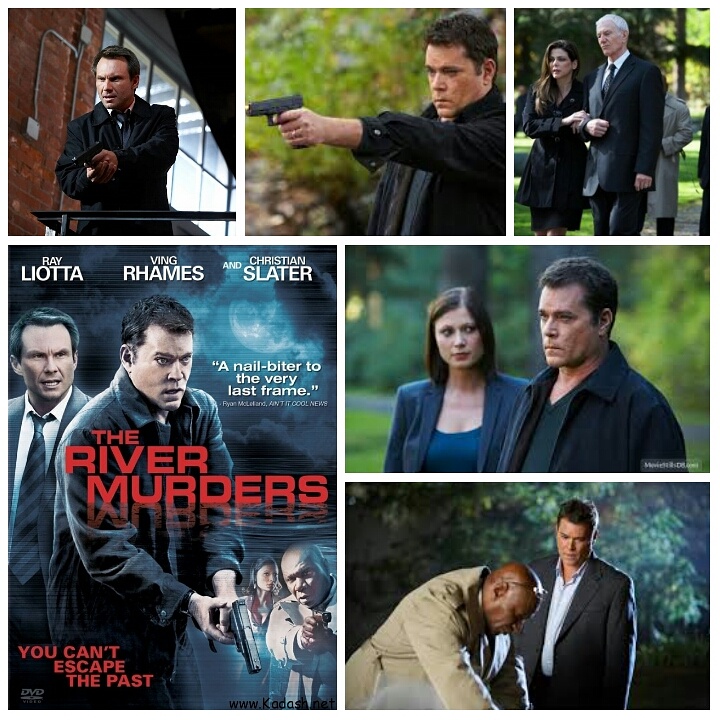
The River Murders is a fairly entertaining thriller vehicle for Ray Liotta that tries hard to be in the same grisly territory as stuff like Sev7n, and winds up looking pretty silly in its efforts. It takes place on a rural community in the Midwest, where a serial killer is leaving bodies for authorities to find. Detective Jack Verdon (Liotta) does some digging and finds that that himself and the killer may have met before in the past, making it personal. This causes unrest for both the department and Verdon’s mental state, prompting the arrival of an overzealous Federal agent (Christian Slater, annoying as hell here), and the concern of his captain (Ving Rhames). It’s fun watching Liotta spin out of control, and the film climaxes with reasonable intensity, but showcases nothing unique or noteworthy. Raymond J. Barry has a nice bit as Liotta’s father too. 

The Tournament: A Review by Nate Hill 

The Tournament is just about as awesome as action movies can get, and just about as bloody too. I love films involving assassins, contests, games, violence and such. The Running Man was clearly a huge influence on this one, right down to the inclusion of a larger than life game show host, here played by Liam Cunningham. Liam plays a shadowy nut job named Powers, and every four years he arranges an elaborate and incredibly destructive Olympic games for contract killers and psychos alike. Every time he hosts it in a new city, using hidden cameras and explaining away the damage with disasters and attacks. If this sounds so very 80’s, it is. We’re in throwback city here, with a touch of modern tone not unlike Joe Carnahan’s Smokin Aces. The reigning champion is Joshua Harlow (Ving Rhames), a brutal warrior who has been coaxed back into the game with revenge on his mind. Each assassin is fitted with a tracking device so they can track each other, an idea which goes haywire when a civilian accidentally gets stuck with one and ends up in the cross hairs. The civilian in question is a drunken priest (lol) played by Robert Carlyle, who has no idea what’s going on and suddenly has a dwindling life expectancy. He catches a break when a lethal but sympathetic female competitor (beauty queen Kelly Hu is an angel of physicality) takes pity and decides to help him out. They’ve got quite an armada to cut through though, including a rowdy cockney whacko (Craig Conway) a parkour master (Sebastian Foucan), an ex Spetsnaz freak (Scott Adkins) with a habit of blowing shit up left right and center, and lastly a Texan pretty boy lunatic played cheerfully by Ian Somerhalder. He’s so evil they just had to include a bit where he shoots a stray dog in the face without batting a perfect eyelash (animal lovers, you’ve been forewarned). All this mayhem is taken in by Powers and his sickening audience of wealthy kingpins, who sit in a great big boardroom and bet on the outcome of the carnage. Cunningham is a blast of devilish charm as Powers, an amoral villain of dark showmanship and sociopathic class. Between exploding heads, grenades ripping through the streets of London, frenetic hand to hand combat, colorful personalities, over the top depictions of bad human behavior and a general sense of hedonistic, slash and burn glee, this is one for the books. 

L.A. Confidential: A Review by Nate Hill 

  
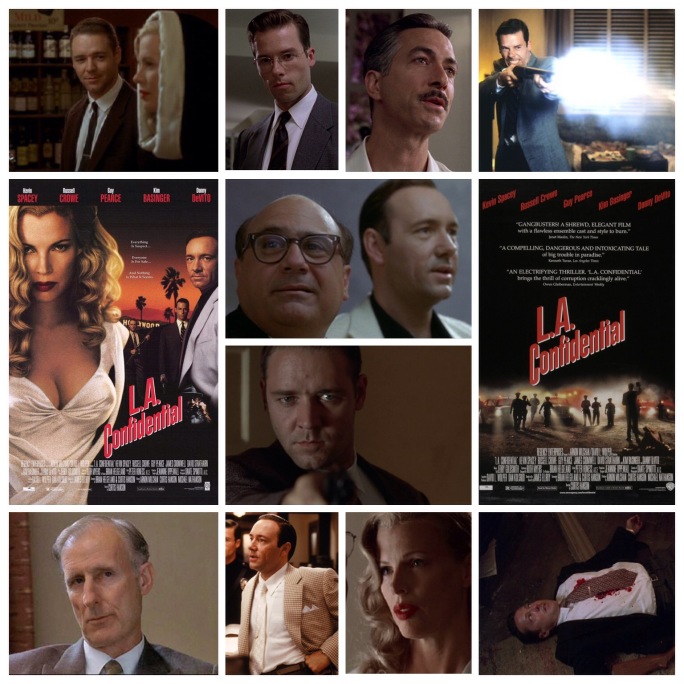
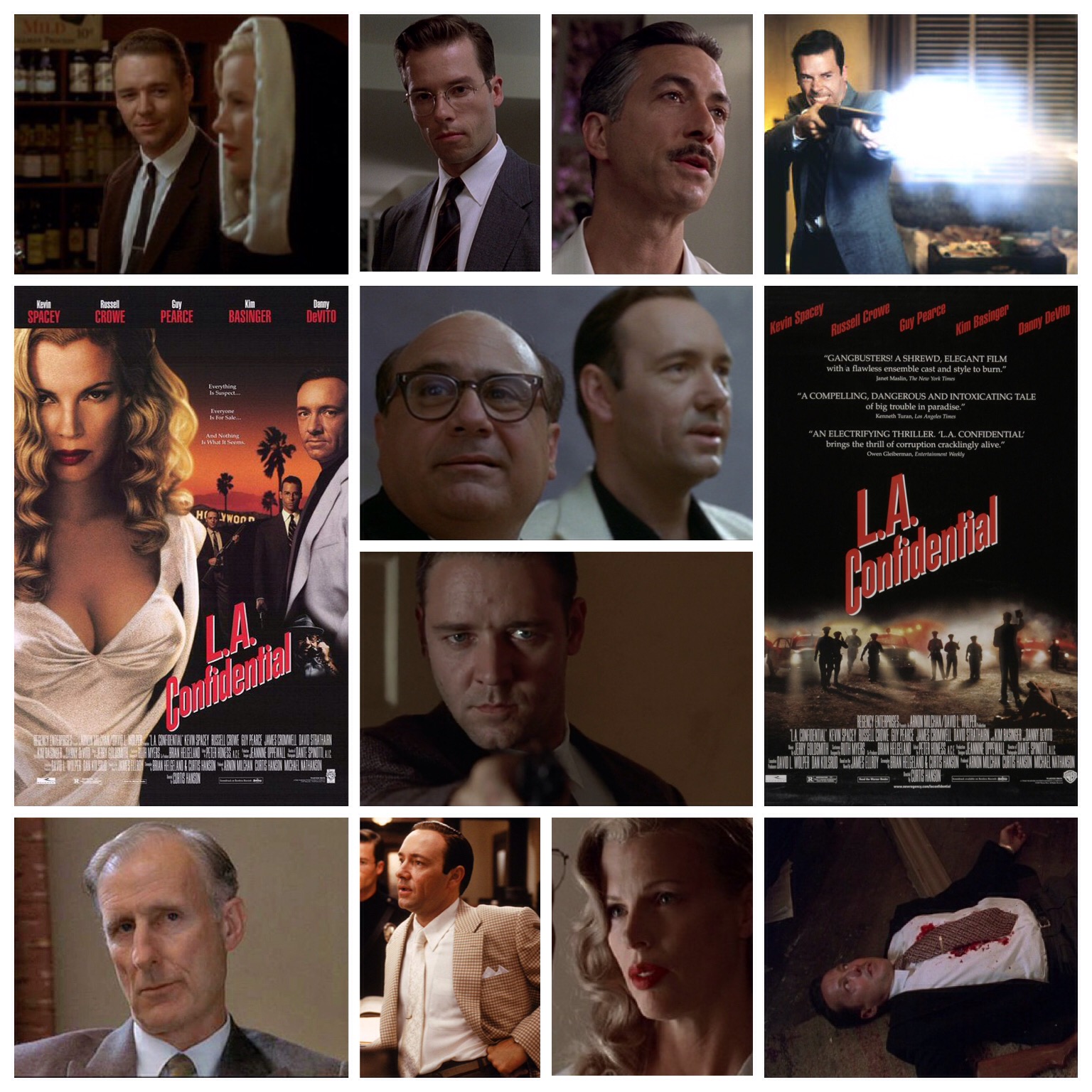
The finest Los Angeles film noir to ever come out of Hollywood, Curtis Hanson’s L.A. Confidential is a serpentine wonder, a two and a half hour parade of hard boiled detectives, sultry dames and shady dealings, all wrapped up in a multiple murder story that kicks everyone’s arc into gear, taking you places you didn’t think you’d see some of these people go. ‘Triple homicide at the nite owl’, barks the headline of a gossip rag run by a sleazy Danny Devito, and indeed the crime scene has everyone buzzing, from the shirt tuckers in the highest ranks of the LAPD, to the burly brass knuckle wearers on the brutish task force. Something is amiss with the case, and Sgt. Edmund Exley (Guy Pearce) is a dogged straight arrow with a nose for corruption. He isn’t quite the formidable force needed to barge down certain doors or break certain bones though, and that’s where Det. Bud White (Russell Crowe) comes into play. The two are initially at each other’s throats following a cleanse of many of the department’s corrupt officers, spurred by Exley himself. It soon becomes clear that they have no choice but to work together, in order to smoke out the evil source of the crime, which may be closer to home than anyone thought. Crowe and Pearce were not the stars they are now back then, but came up from the farm league in sensational style, barging onto the Hollywood scene in shotgun toting, shit kicking style. Kim Basinger won an Oscar for her poised, complex turn as a call girl who works for a pimp named Pierce Patchett (a glib David Strathairn), an eccentric who pays surgeons to deck his girls out to look like movie starlets. My favourite performance in the film comes from a diabolical James Cromwell as Captain Dudley, a dangerous rogue who you don’t want to cross for fear of his unpredictability. Kevin Spacey is all style and self loathing as Jack Vincennes, a media mogul of a cop who advises on TV shows and hogs the press limelight like a boorish politician. The supporting cast is all across the board, including work from Simon Baker, Graham Beckel, Tomas Arana, Ron Rifkin, Brenda Bakke, Jack Conley and an amusing cameo from Paul Guilfoyle as Mickey Cohen. Adapting a novel by the great undisputed king of LA noir, James Ellroy, Hanson weaves a deadly web of sensation, intrigue and steamy goings on that never follows a readily discernable pattern of narrative, and constantly has tricks up it’s sleeves. Remember Rollo Tomassi.

B Movie Glory with Nate: Sin


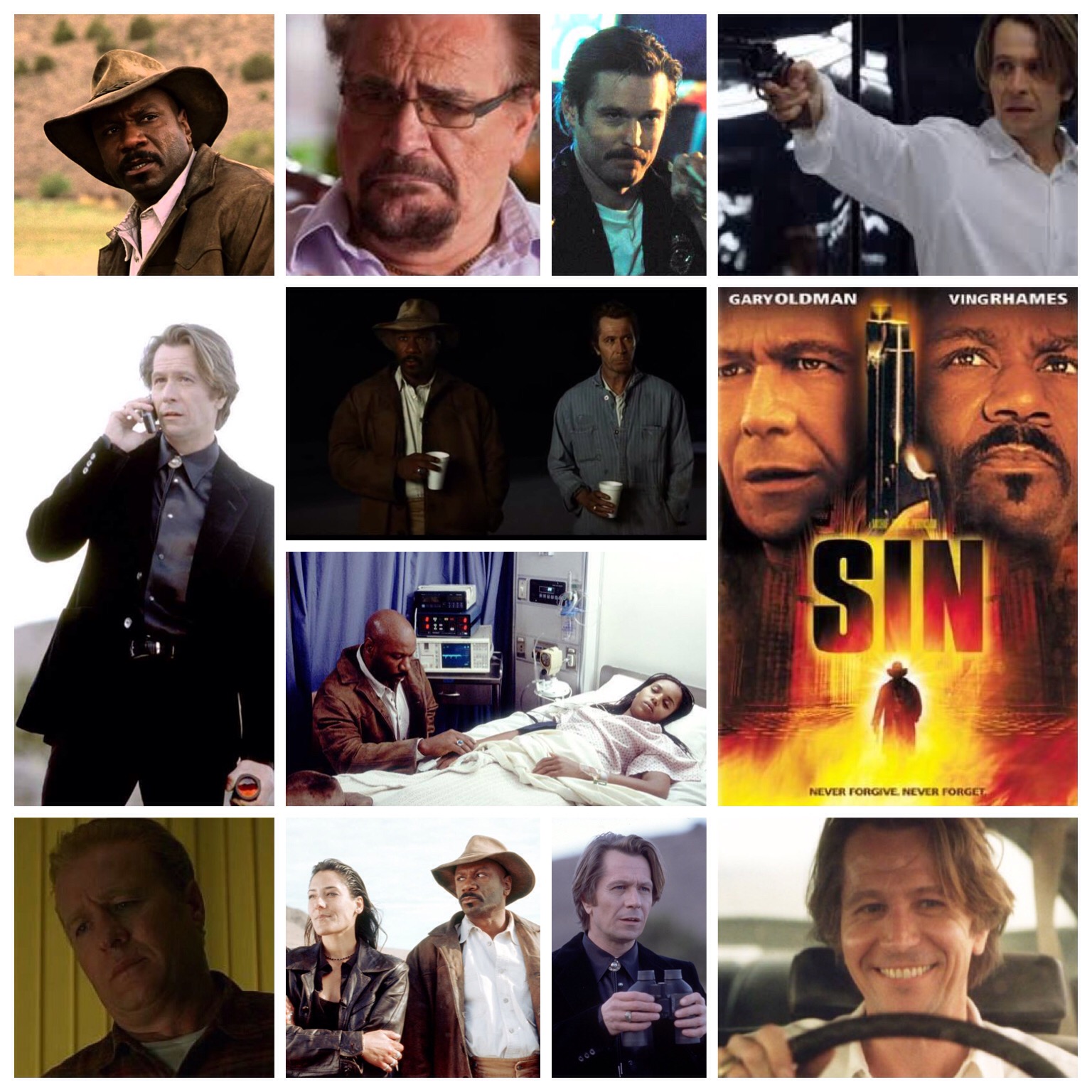
Sin is known as the B movie that Gary Oldman did, and he himself has bad mouthed it on occasion. Back then though, this was the only kind of movie like that he had to explain away. These days he has quite a few more of this type in his filmography, so he can’t really talk. It really isn’t the best movie, and functions as well as its limited budget and mediocre script will allow, but I must say there are a few moments, ones with stars Oldman and Rhames, that are just killer, and one in fact that borders on greatness. Rhames plays Eddie Burns, an ex cop or military man who lives estranged in the country, until the organized gang rape of his sister (Kerry Washington) coaxes him back into Reno Nevada. This heinous crime (a scene which borders on exploitation, to be honest) is orchestrated by Charlie Strom (Oldman), a nasty pornographer and drug kingpin who has a decades old bone to pick with Eddie. The film has some lonely atmospherics to it, the eventual confrontation between the two playing out in a poetic, if contrived fashion. For all the two bit moments in the script (and there are a lot), there’s one showstopper of a scene between Rhames and Oldman, that is reminiscent of Michael Mann’s Heat, and is quietly but surely affecting in its sadness. Brian Cox blusters through as Eddie’s former police boss, Bill Sage hangs out for a bit as a detective, and the one, the only Gregg Henry appears as a sleazy informant who feeds Rhames Intel. He also gets the best line of the film, exclaiming “I haven’t even had my morning fattie” after being rudely awakened Rhames. Watch for Alicia Coppola, Daniel Dae Kim and Arie Verveen as well. There’s some genuine ambition in the script, delving into the complex moral conundrum that exists between protagonist and antagonist, and how the two archetypes aren’t always so clear cut. Conscience and lack thereof is explored as well, with surprising results. I won’t lie and say it isn’t just a trashy b movie, but I won’t pretend there wasn’t some moments and aspects which I greatly enjoyed. It’s somewhere right in the middle. 

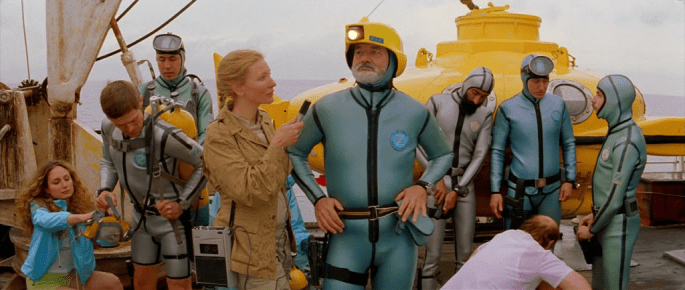
THE LIFE AQUATIC WITH STEVE ZISSOU – A REVIEW BY J.D. LAFRANCE

the-life-aquatic-with-steve-zissou-1024x435

There’s always a certain amount of trepidation when a filmmaker like Wes Anderson, known for making intimate and personal films, starts making movies on a more ambitious scale – bigger budgets and movie stars in an attempt to appeal to a larger audience – that he will lose all of the qualities that made his movies so interesting in the first place. Easily his most accomplished film, The Life Aquatic with Steve Zissou (2004) merged his stylized dialogue and quirky characters with elaborate sets and action set pieces in an exotic locale.

After his best friend is eaten by a Jaguar shark, famed oceanographer Steve Zissou (Bill Murray) vows revenge. The problem is that the fish is endangered and he’s having trouble raising money for the expedition. He also meets Ned Plimpton (Owen Wilson) who may be his son by a woman he met 30 years ago. So, he convinces the young man to join his expedition in an attempt to make up for three decades of neglect.

Ever since Bottle Rocket (1996), Anderson’s movies feature a water motif in some form or another, whether it is Anthony and Inez’s first kiss in a swimming pool in Bottle Rocket or Max Fischer’s desire to build an aquarium in Rushmore (1998). With Life Aquatic, Anderson finally realizes his fascination with water head on by crafting an homage to Jacques Cousteau.

Life Aquatic also continues Anderson’s thematic pre-occupation with flawed father figures and their sons. There is the burnt out Mr. Blume and Max in Rushmore and Royal and his children in The Royal Tenenbaums (2001). In Life Aquatic, Steve tries to reconnect with Ned in the hopes that they will bond while hunting for the Jaguar shark. Like Blume and Royal, the world seems to have forgotten about Steve. He’s washed up and hit rock bottom now that his best friend has been killed.

The film also continues Anderson’s structuring of his movies into segments. In Rushmore, the story was broken down into months serving as acts in a play, with Tenenbaums, it was chapters as in a book and now with Life Aquatic it is days as Steve’s mission is being filmed for a new documentary. This structure reinforces the magical, almost-fairy tale feeling that Anderson creates in every one of his films by drawing attention to itself as a fanciful tale.

Bill Murray turns in another excellent, low-key performance as the melancholy Zissou. With his beard and gruff, macho attitude, Steve comes across as a Hemingway-esque figure with a dash of Cousteau. And yet, no matter how extravagant things get, Murray always keeps things grounded with his sparse performance. Over the course of his career, the comedian has been gradually refining his style of acting. He gained fame in broad comedies like Stripes (1981) and Ghostbusters (1984) but has fine-tuned his style to a less-is-more approach with movies like Rushmore and Lost in Translation (2003). His turn in Life Aquatic is just the right blend of comedy and pathos.

Most films don’t warrant much thought or discussion, but Anderson gets more and more interesting with each new effort. They are filled with so many fascinating little details crammed in each and every frame, repeated thematic motifs and minor characters who often wander in and out of the background of scenes. His movies are magical, existing in their own unique worlds and bursting with ideas that are almost too much to absorb in one sitting. As was the allure of David Lynch’s short-lived T.V. show, Twin Peaks, one of the appeals of Anderson’s films is that we want to be in these quirky worlds he creates and we want to know his characters. We want to lose ourselves in his universe and the beauty of DVD is that they allow us to revisit the worlds of his movies any time we want.

Anderson is not only more ambitious in terms of structure and scale but also with the visuals of Life Aquatic. Shot in Italy, he utilizes the striking landscape of the country for a sun-kissed warm color scheme of yellows and browns. There are also the striking images that linger long after the film ends: the glowing jellyfish on a beach at night and the stop-motion animated fish (by Nightmare Before Christmas’ Henry Selick) and portrays them so vividly and in an exciting way.

Anderson’s career had been building up to this film. With The Royal Tenenbaums, he was able to juggle a large cast of name stars while still maintaining his artistic integrity. With Life Aquatic, he continued to use stars but upped the ante in production values and scope. However, he did not lose the intimate feeling that all of his movies possess. No matter how ambitious or big the scale, his films have hand-crafted feel to them. One gets the feeling that Anderson cares about every detail and every aspect and it is this personal touch that makes his movies so unique.

Joe Carnahan’s Narc: A Review by Nate Hill

image

Joe Carnahan’s Narc is a proper old school ass kicking crime picture, and a blistering one that pulls no punches in the grit department either. Carnahan is clearly in love with the rugged action/genre pieces from the 60’s and 70’s that he grew up with, and every film he has made so far in his career has been reflective of that, starting with this excellent debut. He comes charging out of the gate as fast as his lead character breathlessly pursues a perp through a run down suburban neighborhood, a sequence of pure visceral brilliance that sets the tone and let’s us know he means business. Jason Patric plays Nick, an under cover narcotics officer with a decorated past and the scars to show for it, working the dankest streets of motor city Detroit. When a recently slain fellow officer’s case is reopened, he is picked to investigate, joined by the deceased cop’s former partner, Lt. Henry Oak (Ray Liotta). In this case, nothing is what it seems, agendas are hidden well, and violence constantly simmers just below the surface of every interaction and exchange of dialogue. This is especially the case with Liotta, who gives a staggering career best performance as a cop on the edge of sanity, justifying his heinous actions on the body of his slain friend. No one knows how to lose their cool like Ray, but here he is downright terrifying, a wild eyed monster and the epitome of the guy not to trust, lest you be driven down the same destructive path. Nick uncovers more secrets than he ever wished to know, and it all comes full circle in an angry, pulse rocketing confrontation that serves as one of the best blow ups in the genre, and goes to show you don’t need a huge epic gunfight to cap off your story with style and intensity. Carnahan wisely keeps the fireworks man to man, and intimate in nature, proving once again what intuition he has in the director’s chair. Chi Mcbride is always reliable, here playing the gruff police captain, and Busta Rhymes proves yet again that he’s one of the few rappers who can actually act, giving a pretty damn committed performance as a thug. Liotta owns this one in pure beast mode, but the team effort is what makes it so special, and a crime classic. Carnahan and Co. have done something timeless for crime films, and raised the bar on the intensity level one can attain when everything is in place, and firing on all cylinders. A powerhouse of a film, and a mini masterpiece. 

EASY RIDER – A REVIEW BY J.D. LAFRANCE

easyrider1

The critical and commercial success of Easy Rider (1969) scared the hell out of the Hollywood studios at the time of its release. Executives thought that they knew what the public wanted to see: safe comedies like Pillow Talk (1959) or the Frankie and Annette beach party movies. Along came this counter-culture movie that featured contemporary rock ‘n’ roll music, two hippie protagonists and a nihilistic ending. And audiences loved it. All bets were off on what audiences wanted to see and so the studios began hiring young producers and directors who in turn cast their friends and contemporaries in their films. As a result, Easy Rider ushered in the last great decade of American movies in the 1970s.

After selling their stash of cocaine, Billy (Dennis Hopper) and Wyatt (Peter Fonda) decide to ride their motorcycles from California to Florida (by way of the South) where they plan to live off the money. They travel the back roads of America and encounter all sorts of people: suspicious small-townsfolk, an oppressive sheriff and a rancher and his large family who invite them to a meal. The deeper they go into the South, the more resistance they meet because of how they look.

Easy Rider is a fantastic snapshot of the times. It signaled the end of the not-so idyllic 1960s, where having long hair could deny you a room in a motel because the manager didn’t like the way you looked. The hippie commune that Billy and Wyatt briefly stop at is not all peace and love. Some of them are suspicious of the duo. There is conflict among the members and it becomes obvious that they suffer from many of the same problems that plague the outside world.

Time running out is a constant theme throughout Easy Rider. When Billy and Wyatt start their journey, Wyatt throws away his watch. Later on, he finds a discarded pocket watch just before they leave the commune. Also, as they are leaving, the hitchhiker they pick up warns Wyatt that time is running out. It eerily foreshadows the film’s disturbing finale and gives a feeling of impending doom that hangs over the entire film.

Peter Fonda plays Wyatt as the quiet, more introspective character, while Dennis Hooper’s Billy is a talkative, let-it-all-hang-out type. Wyatt is more trusting of people and Billy is more paranoid and guarded — he is constantly thinking of the money they have stashed in their bikes and is very protective of it. They make a good team with their strengths and weaknesses complimenting each other. However, their dynamic is given a jolt once Jack Nicholson appears as George Hanson, an ACLU lawyer who gets Billy and Wyatt out of jail. Nicholson showcases his trademark easy-going charm in all of the scenes he’s in. His stoned rap (during one of the camp fire scenes) about UFOs and “the Venusians” is funny and oddly poignant. Later on, he talks about how the country has been divided and says, “It’s real hard to be free when you’re bought and sold in the marketplace.” His speech anticipates the greed-obsessed ‘80s. People forget that Easy Rider really put Nicholson on the map and led to an impressive string of film roles in the ‘70s.

Laszlo Kovacs’ beautiful cinematography really does a stunning job of showcasing the expansive landscape of the U.S.: the imposing mountains in California, the vast canyons of Arizona at sunset with pink and red hues in the sky and the deep green foliage as Billy and Wyatt get closer to New Orleans. Kovacs would go on to shoot such great films as Five Easy Pieces (1970), Shampoo (1975) and Ghostbusters (1984).

easyrider2Easy Rider’s nihilistic ending would go on to inspire similar-minded road movies in the ‘70s, like Monte Hellman’s Two-Lane Blacktop (1971), Vanishing Point (1971), and Terrence Malick’s Badlands (1973). Easy Rider’s legacy is impressive. It paved the way for the Movie Brats (Coppola, Lucas, Scorsese, et al) in the ‘70s, which was the golden age of American filmmaking where the director was king.